
South Korea vs Czechia World Cup 2026 preview
Table of Contents Show
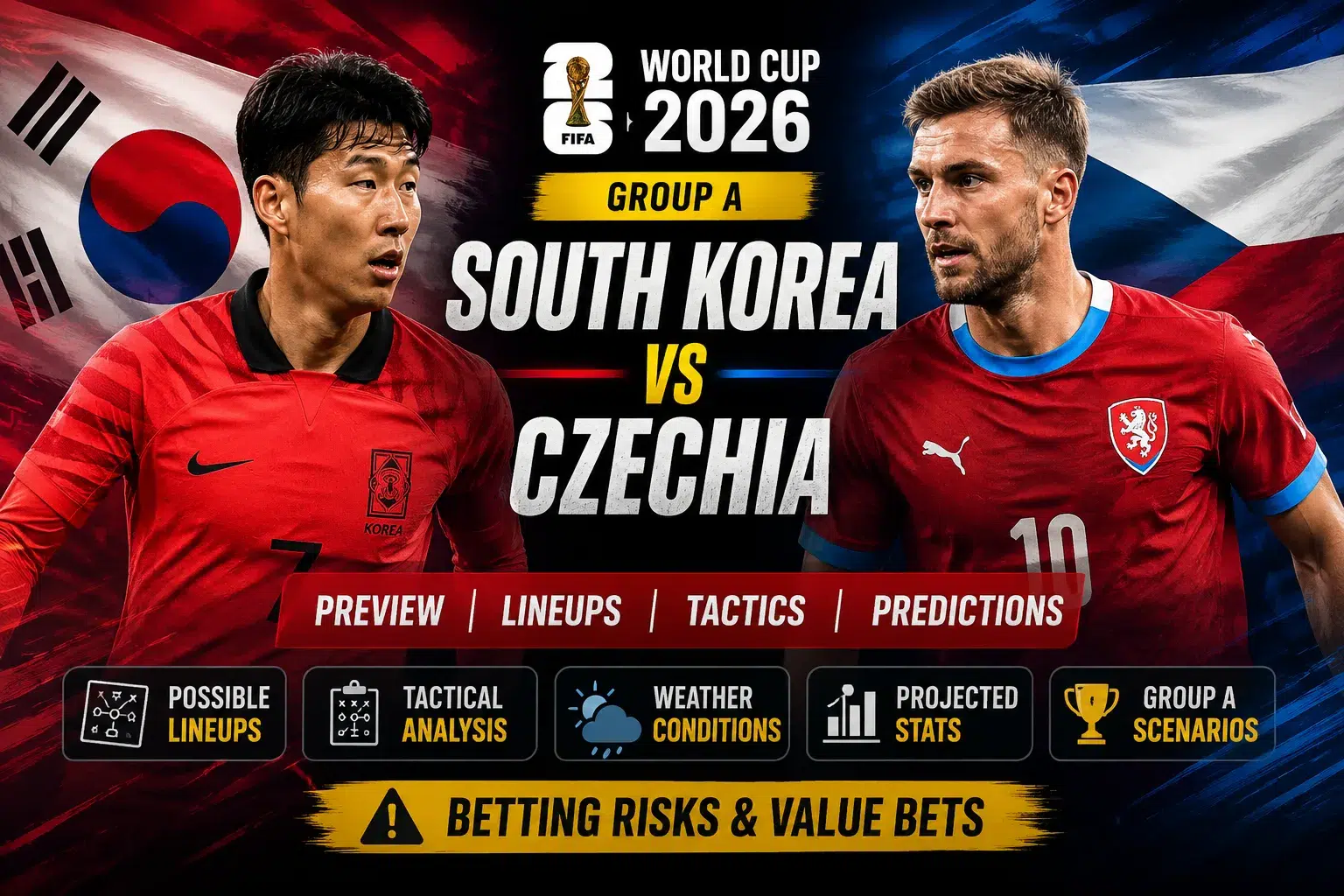
South Korea face Czechia in a FIFA World Cup 2026 Group A match at Estadio Guadalajara in Zapopan, Mexico, on Thursday, 11 June 2026. The listed kick-off time is 8pm local time in Guadalajara, 02:00 GMT on Friday, 11am in Seoul and 4am in Prague. This match matters because both teams start in a difficult Group A that also includes Mexico and South Africa. The expanded World Cup format gives the top two teams from each group a direct route to the Round of 32, while the eight best third-placed teams also advance, so the first match can shape qualification pressure immediately.
South Korea enter with the stronger FIFA ranking profile and a technical attacking core built around Son Heung-min, Lee Kang-in, Hwang Hee-chan and Kim Min-jae. Hong Myung-bo’s side should look for fast attacks, diagonal runs, wide overloads and midfield circulation through Hwang In-beom and Lee Jae-sung. Czechia enter with physical strength, set-piece quality, aerial power and attacking options such as Patrik Schick, Adam Hlozek, Pavel Sulc and Tomas Chory. Miroslav Koubek’s team should try to impose duels, win second balls and create danger through crosses and dead-ball situations.
The projected match profile points to a tight, physical and tactical contest. South Korea may create more transition speed and technical combinations. Czechia may create more set-piece stress and aerial pressure. This preview explains match facts, team news, predicted lineups, tactical patterns, weather context, projected statistics, card risk, group scenarios and responsible betting market signals. It does not provide guaranteed betting advice.
| Field | Data |
|---|---|
| Match | South Korea vs Czechia |
| Competition | FIFA World Cup 2026 |
| Stage | Group Stage |
| Group | Group A |
| Date | Thursday, 11 June 2026 |
| Kick-off Time | 20:00 Guadalajara / 02:00 GMT Friday / 11:00 Seoul Friday / 04:00 Prague Friday |
| Stadium | Estadio Guadalajara / Estadio Akron |
| City | Zapopan / Guadalajara metropolitan area |
| Host Country | Mexico |
| Expected Attendance | Exact expected attendance not available from verified public data; stadium capacity is reported around 46,000+ |
| Referee | Amin Mohamed Omar was reported in pre-match data; official FIFA confirmation should be checked before publication |
| VAR | Not available from verified public data |
| Weather Forecast | Warm Guadalajara conditions; projected range around 18–30°C, with evening temperature expected lower than daytime peak |
| Pitch Context | Modern stadium surface; exact match-day pitch speed not available from verified public data |
| Main Article Focus | Preview, predicted lineups, team news, tactical map, weather model, projected stats, betting risks, group scenarios |
South Korea vs Czechia is the second match of World Cup 2026’s opening day and a crucial Group A fixture. Mexico and South Africa attract much of the group narrative because Mexico are hosts, but this game can shape the group’s competitive balance. South Korea need a strong start because their technical quality and World Cup continuity create expectation. Czechia need a result because their return to the World Cup after a long absence gives them a chance to reset their tournament identity.
This is not a simple “technical team vs physical team” match, but that contrast gives the preview its core structure. South Korea can hurt Czechia with movement, speed and combination play. Czechia can hurt South Korea with height, set pieces, crosses, second balls and central duels. The match can become a control battle between South Korea’s ability to play around pressure and Czechia’s ability to turn every aerial contest into territory.
South Korea vs Czechia matters because South Korea need an opening win to protect their expected qualification route, while Czechia can change Group A immediately with a physical, set-piece-driven result that puts pressure on both South Korea and the host-nation storyline around Mexico.
A credible preview must separate confirmed facts from projections. This match has confirmed fixture information, venue information, group context and team-news reports. It also has several unknowns: final tactical shapes, exact official lineups at publication time, VAR appointment, late injury status and live market movement.
| Category | Status | South Korea vs Czechia Example | Article Use |
|---|---|---|---|
| Confirmed fact | Verified fixture data | South Korea vs Czechia, Group A, Estadio Guadalajara, 11 June 2026 | Hard match base |
| Tournament fact | Verified format context | Group A includes South Korea, Czechia, Mexico and South Africa | Group scenario analysis |
| Announced / reported info | Public pre-match reporting | Referee reported as Amin Mohamed Omar in pre-match data | Mark as reported, verify before publication |
| Team-news report | Verified media report | Bae Jun-ho doubtful; Cho Yu-min ruled out | Team-news section |
| Probable information | Tactical forecast | South Korea likely use speed and rotations; Czechia likely use physicality and set pieces | Tactical sections |
| Projected data | Model-based range | Possession, shots, xG, fouls and cards | Use ranges, not fixed numbers |
| Unknown data | Not verified | VAR, exact official attendance, official lineups if not published | Mark unavailable |
| Scenario-based analysis | Possible future pattern | Czechia may target long throws and aerial duels | Use “may”, “could”, “watch for” |
This distinction matters because football forecasts fail when a writer treats uncertainty as knowledge. A projected yellow-card range is not the same as a confirmed disciplinary event. A predicted lineup is not the same as an official lineup. A betting market signal is not the same as a guaranteed outcome. The article uses probability language because the match has variables that can change quickly.
Group A creates a specific tactical and psychological problem. Mexico, South Africa, South Korea and Czechia form a group where the host nation carries spotlight pressure, but the second fixture can decide which non-host team enters the qualification race with momentum.
| Team | Pre-Match Points | Goal Difference | Opening-Match Pressure | Main Need |
|---|---|---|---|---|
| South Korea | 0 | 0 | High | Win or avoid defeat to protect expected Round of 32 route |
| Czechia | 0 | 0 | High | Earn points after 20-year World Cup absence |
| Mexico | Depends on opener context | Depends on opener context | Very high as host | Use home advantage |
| South Africa | Depends on opener context | Depends on opener context | Medium-high | Build survival route |
South Korea’s pressure comes from continuity and player quality. They have a strong modern World Cup identity compared with many Asian teams, and they carry attacking names that global readers recognize. Son Heung-min, Lee Kang-in, Hwang Hee-chan and Kim Min-jae create expectation. The team must convert that expectation into tournament control.
Czechia’s pressure is different. They return to the World Cup after a long absence. That creates opportunity and urgency. They do not need to dominate possession to make this match work. They need to impose physical pressure, make South Korea uncomfortable, win aerial duels and turn set pieces into high-value moments.
The expanded tournament format changes group strategy. A team can qualify from third place if results across groups allow it. This makes every point useful. It also makes goal difference important. A draw can become valuable. A narrow defeat can remain survivable. A heavy defeat can damage the third-place route.
| Result | South Korea Impact | Czechia Impact | Group A Meaning |
|---|---|---|---|
| South Korea win | South Korea take early control and reduce pressure before Mexico/South Africa context | Czechia must recover quickly | South Korea become strong Round of 32 candidate |
| Draw | South Korea lose some favorite value but stay stable | Czechia gain a useful platform | Group remains open |
| Czechia win | South Korea face immediate pressure | Czechia become a serious qualification candidate | Group hierarchy shifts |
South Korea must deal with expectation. Czechia must deal with return pressure. These are not the same.
South Korea need rhythm. Their best attacking players benefit from fast combinations and clean ball speed. If Czechia slow the match with fouls, aerial contests and set pieces, South Korea may lose rhythm.
Czechia need belief. A strong opening 20 minutes can help them turn the match into a duel contest. If they allow South Korea to move freely early, they may spend too much time defending quick rotations.
South Korea and Czechia have a balanced head-to-head record in the available pre-match reporting: one win each and one draw from three meetings. Their last meeting before this tournament was a friendly in June 2016, which South Korea won 2-1 in Prague. That historical note adds context, but it should not drive the forecast. The current players, coaches, injuries and match conditions matter more.
Pre-match form creates an interesting contrast. South Korea entered with mixed recent form. Czechia entered with a stronger short-term results profile after successful playoff work and friendly wins. Form matters, but tournament openers can reset momentum.
The match takes place in Mexico, one of the three World Cup 2026 host countries. South Korea and Czechia meet on neutral ground, but the environment is not neutral in a physical sense. Guadalajara conditions, travel adaptation, local temperature, crowd profile and pitch rhythm can affect both teams.
| Host-Country Factor | Match Relevance |
|---|---|
| Host country | Mexico |
| Neutral fixture | Neither team has home-nation advantage |
| Travel load | Both teams travel long distances compared with local hosts |
| Crowd profile | Likely mixed local and traveling support |
| Climate | Warm Mexican conditions can influence tempo |
| Time-zone adaptation | Both teams need body-clock adjustment |
| Tournament context | Opening-day game increases global attention |
Estadio Guadalajara, commonly associated with Estadio Akron, sits in the Guadalajara metropolitan area, in Zapopan. The stadium gives the match a modern venue setting and a football-specific atmosphere. It does not carry the same altitude story as Mexico City, but it still gives European and Asian teams a different climate and time-zone setting.
| City Factor | Expected Tactical Impact |
|---|---|
| Warm weather | Can reduce repeated high pressing if teams manage energy poorly |
| Evening kick-off | Helps reduce peak heat stress compared with afternoon match |
| Travel adaptation | Can affect concentration and late-game sharpness |
| Neutral crowd | May reduce emotional advantage for either side |
| Stadium scale | Around 46,000-capacity setting can create strong noise without host pressure |
| Mexican pitch conditions | Can reward quick passing if the surface is fast |
| Local atmosphere | Can favor technical play if the pitch remains clean |
| Stadium Detail | Data |
|---|---|
| Stadium | Estadio Guadalajara / Estadio Akron |
| City | Zapopan / Guadalajara metropolitan area |
| Country | Mexico |
| Capacity | Around 46,000+ reported capacity |
| Surface | Exact match-day condition not available from verified public data |
| Roof | Partial stadium structure; exact roof effect on match conditions not verified |
| Tactical Impact | Neutral venue, warm evening, possible fast surface, crowd noise |
| Main Match Use | Group A fixture |
| Weather Factor | Tactical Meaning |
|---|---|
| Warm daytime range | Teams need hydration and pacing |
| Evening kick-off | Reduces peak heat but does not remove fatigue risk |
| Humidity unknown | Do not overstate recovery effect without verified data |
| Wind unknown | Long balls and crosses can be affected if wind rises |
| Rain not confirmed | Pitch should not be treated as heavy unless match-day update confirms it |
| No major altitude factor like Mexico City | Sprint recovery less altitude-sensitive than Azteca opener |
| Neutral weather uncertainty | Both teams must adjust after warm-up |
The most important weather factor is not extreme heat. It is the warm setting combined with opening-game intensity. South Korea may want to play fast. Czechia may want to make the match physical. If the match becomes end-to-end, energy management can matter after 60 minutes.
South Korea’s team-news picture includes one confirmed major absence and one important doubt. Defender Cho Yu-min was ruled out of the World Cup after a foot injury. Bae Jun-ho was doubtful before the opener because of an ankle issue. These details matter because South Korea need depth, speed and defensive balance against Czechia’s physical structure.
| Player | Status | Source Type | Tactical Impact |
|---|---|---|---|
| Cho Yu-min | Out of World Cup | Reuters / KFA reporting | Reduces defensive depth |
| Bae Jun-ho | Doubtful before opener | Reuters reporting | Reduces youthful attacking midfield option |
| Son Heung-min | Key player available in pre-match reporting | Public team context | Main attacking leader |
| Hwang Hee-chan | Key attacking option | Public team context | Transition runner and direct threat |
| Lee Kang-in | Key creative option | Public team context | Set pieces, half-space passing, creative rotations |
| Kim Min-jae | Defensive leader | Public team context | Centre-back control against Czech forwards |
South Korea’s main tactical concern is not only who starts. It is whether they can build enough physical protection around their technical players. Czechia can test duels. South Korea need central players who can receive, turn and survive contact.
Czechia’s team news includes attacking competition. Adam Hlozek had recently recovered from injury according to pre-match reporting. Pavel Sulc and Lukas Provod were also in the mix. Patrik Schick gives Czechia an elite striker profile. Tomas Chory gives Koubek a two-metre aerial option. Tomas Soucek and Vladimir Darida provide experience and midfield stability.
| Player | Status | Source Type | Tactical Impact |
|---|---|---|---|
| Patrik Schick | Key attacking option | Public pre-match reporting | Main striker profile and finishing threat |
| Adam Hlozek | Recently recovered from injury | Pre-match reporting | Attacking support option |
| Pavel Sulc | In attacking mix | Pre-match reporting | Creative support / forward connection |
| Lukas Provod | In selection mix | Pre-match reporting | Wide or central support |
| Tomas Chory | Available attacking option | Pre-match reporting | Aerial power and set-piece value |
| Tomas Soucek | Key midfielder | Pre-match reporting | Duels, set pieces, leadership |
| Vladimir Darida | Experienced midfielder | Pre-match reporting | Stability and control |
Czechia’s main selection question is the attacking support around Schick. Koubek must decide whether he wants more technical support, more physical pressure or a balance. That choice can change the match. A Chory-based plan increases aerial pressure. A Hlozek/Sulc/Provod-based plan can increase mobility and second-line threat.
| Player | Team | Issue | Probability to Start | Risk if Starts |
|---|---|---|---|---|
| Bae Jun-ho | South Korea | Ankle issue | Low/medium based on pre-match reporting | Limited explosiveness or minutes |
| Adam Hlozek | Czechia | Recent recovery | Medium | Match sharpness risk |
| Other players | Both | Not available from verified public data | Unknown | Do not invent |
No confirmed suspension issue was available from verified public data in the source set. This article does not invent disciplinary absences. Card risk is treated as a match forecast, not a confirmed suspension report.
Official lineups should always replace projected lineups once available. Before official lineups, the safest approach is to publish predicted shapes with confidence levels and alternative scenarios.
| Position | Player |
|---|---|
| GK | Kim Seung-gyu |
| RCB | Lee Han-beom |
| CB | Kim Min-jae |
| LCB | Kim Tae-hyeon |
| RWB / RB | Seol Young-woo |
| CM | Hwang In-beom |
| CM | Lee Jae-sung |
| LWB / LB | Lee Tae-seok |
| AM / RW | Lee Kang-in |
| FW | Son Heung-min |
| FW | Hwang Hee-chan |
| Position | Player |
|---|---|
| GK | Matej Kovar |
| RCB | Stepan Chaloupek |
| CB | Robin Hranac |
| LCB | Ladislav Krejci |
| RWB / RB | Vladimir Coufal |
| CM | Tomas Soucek |
| CM | Vladimir Darida |
| LWB / LB | David Jurasek |
| AM / FW | Adam Hlozek |
| AM / FW | Pavel Sulc |
| ST | Patrik Schick |
| Team | Base Formation | In Possession | Out of Possession | Confidence |
|---|---|---|---|---|
| South Korea | 3-4-3 / 3-4-2-1 | 3-2-5 or 3-4-3 rotations | 5-4-1 or 5-2-3 press | Medium |
| Czechia | 3-4-2-1 / 3-5-2 variant | 3-2-5 with wing-backs high | 5-4-1 / 5-3-2 compact block | Medium |
| Scenario | Trigger | Expected Change |
|---|---|---|
| South Korea add more creativity | Czechia sit deep | Lee Kang-in moves centrally more often |
| South Korea add more defensive control | Czechia dominate aerial balls | Extra midfielder or deeper wing-back behavior |
| Czechia add aerial dominance | South Korea struggle on set pieces | Tomas Chory becomes more important |
| Czechia add mobility | South Korea defend deeper | Hlozek, Sulc or Provod attack half-spaces |
| South Korea manage Bae absence | Bae unavailable | More responsibility on Lee Kang-in and Lee Jae-sung |
| Czechia protect late result | Leading after 70’ | Extra defender or defensive midfielder |
South Korea’s predicted shape should support fast transitions and wide rotations. Czechia’s predicted shape should support aerial pressure, wing-back crossing and central duels.
South Korea’s identity should combine speed, technical movement and flexible attacking rotations. They have enough attacking quality to move Czechia around. The key is whether they can handle Czechia’s physical pressure without losing rhythm.
| Phase | Expected Pattern |
|---|---|
| Build-up | Three-at-the-back circulation with midfield support |
| Attack | Fast combinations, wide overloads, diagonal runs from Son and Hwang |
| Defense | Compact back five when deep, selective pressing higher |
| Transitions | Quick release to Son, Hwang and Lee Kang-in |
| Set pieces | Lee Kang-in delivery, movement around Kim Min-jae and central runners |
| Weakness | Aerial pressure, defensive set pieces, physical second balls |
South Korea should try to build through calm circulation. Kim Min-jae can anchor the back line. Hwang In-beom and Lee Jae-sung can connect midfield. Lee Kang-in can drop into pockets and create passing angles. The wing-backs can stretch Czechia’s shape.
The build-up risk is Czechia’s pressure on second balls. If South Korea play into crowded central zones and lose duels, Czechia can turn the match into a transition and set-piece battle. South Korea need ball speed and support angles.
South Korea can attack in three main ways:
Son remains the key player because he changes defensive spacing. Czechia cannot leave him in open grass. If they drop too deep to protect against him, South Korea can control territory. If they push too high, he can attack space.
Lee Kang-in gives South Korea craft. He can slow the ball, speed it up, deliver set pieces and attack half-spaces. Hwang Hee-chan gives direct running and physical forward pressure.
South Korea need to defend Czechia’s size. They must protect the box against Schick, Soucek and possibly Chory. Kim Min-jae’s role is critical. He must win aerial duels, organize the line and stop Czechia from turning crosses into repeated second balls.
South Korea should avoid fouls in wide areas. Czechia can use wide free kicks as a major chance source. South Korea must also defend long throws, deep crosses and second-phase balls.
Czechia’s identity should combine physicality, set-piece quality, directness and midfield experience. They do not need to match South Korea’s speed. They need to make the match heavier, slower and more duel-based.
| Phase | Expected Pattern |
|---|---|
| Build-up | Three-centre-back structure with wing-back progression |
| Attack | Crosses, set pieces, second balls, direct passes into Schick |
| Defense | Compact back five, physical midfield duels |
| Transitions | Quick wide release and direct support for Schick |
| Set pieces | Soucek, Schick, Krejci, Chory-type aerial targets |
| Weakness | Defending speed behind wing-backs, quick South Korean rotations |
Czechia should use their defensive structure to create safe progression. The centre-backs can circulate and look for Coufal or Jurasek wide. Soucek and Darida can stabilize midfield. Schick can receive direct passes or pin centre-backs.
Czechia should avoid loose central passes. South Korea can counter quickly if Son or Hwang receive in space. A safe pass wide may be better than a risky pass through the middle.
Czechia can attack with width, height and box occupation. Their strongest route may be wing-back crossing and set-piece pressure. Schick provides finishing quality. Soucek attacks the box from midfield. Chory can add a taller target if selected or introduced.
Czechia should not rely only on crosses. They also need second-line shots, knockdowns and switches to the far side. South Korea can defend the first ball if the attack is too predictable.
Czechia must defend South Korea’s speed. The back line must control depth. Wing-backs must avoid getting trapped high when possession is lost. Midfielders must stop Lee Kang-in from receiving freely between lines.
Czechia’s defensive strength is size and structure. Their defensive risk is speed behind them. South Korea can create their best attacks if they turn Czechia’s wing-backs and attack the channels.
| Zone | South Korea Edge | Czechia Edge | Likely Control | Why It Matters |
|---|---|---|---|---|
| Left flank | Son’s diagonal runs and wing-back support | Coufal’s experience and physical defending | Balanced | Can create South Korea’s best transition chances |
| Right flank | Lee Kang-in rotations and combination play | Jurasek’s width and crossing | South Korea technical edge | Controls chance creation |
| Central midfield | Hwang In-beom and Lee Jae-sung mobility | Soucek and Darida physicality | Split | Decides tempo and second balls |
| Penalty box | Movement and cutbacks | Czech aerial power | Czechia physical edge | Decides set-piece and crossing value |
| Set pieces | Delivery quality | Czech height and targets | Czechia edge | Main Czech scoring route |
| Transitions | Son and Hwang speed | Czech rest defense and tactical fouls | South Korea edge | Main Korean scoring route |
| Defensive third | Kim Min-jae leadership | Schick/Soucek aerial pressure | Balanced | Box control decides risk |
Why it matters: Son can attack space, finish quickly and force Czechia to drop deeper than they want.
What to watch: Watch whether Son receives early diagonal passes behind the right wing-back. If he runs at retreating defenders, South Korea’s transition threat rises.
Risk trigger: If Czechia’s right side receives an early yellow card, South Korea may attack that zone more aggressively.
Why it matters: Schick gives Czechia a central finishing reference. Kim must win aerial duels and prevent clean lay-offs.
What to watch: Watch the first three direct balls into Schick. If he holds possession, Czechia can move up the pitch.
Risk trigger: If Kim or another centre-back fouls Schick near the box, Czechia gain set-piece value.
Why it matters: Lee Kang-in can create between the lines, but Soucek can make that zone physically uncomfortable.
What to watch: Watch whether Lee receives facing forward or with his back to goal. Forward-facing touches favor South Korea.
Risk trigger: If Czechia deny Lee’s left-footed passing lane, South Korea may rely too much on wide speed.
Why it matters: Czechia have size and aerial targets. South Korea must defend first contact and second balls.
What to watch: Watch marking around Soucek, Schick, Krejci and Chory-type targets.
Risk trigger: A cheap foul in a wide area can become Czechia’s best chance of the half.
Why it matters: Both teams may use back-three structures. Wing-backs must attack and recover.
What to watch: Watch which wing-back pair tires first. Late space can appear behind the side that attacks too often.
Risk trigger: If one team’s wing-back is caught high repeatedly, the opponent’s transition route becomes clear.
These figures are projected ranges. They are not confirmed facts and should not be treated as final match data.
| Projected Stat | South Korea | Czechia | Confidence | Reason |
|---|---|---|---|---|
| Possession | 50–56% | 44–50% | Medium | South Korea may circulate more, but Czechia can disrupt rhythm |
| Shots | 10–14 | 9–13 | Medium | Both teams have clear attacking routes |
| Shots on Target | 3–6 | 3–5 | Medium | Match projects as balanced |
| xG Range | 1.10–1.70 | 0.90–1.50 | Low/Medium | Set pieces can shift Czechia xG quickly |
| Big Chances | 1–3 | 1–3 | Low/Medium | Both have high-value routes |
| Corners | 4–7 | 4–7 | Medium | Wing-back and crossing patterns on both sides |
| Fouls | 11–15 | 12–17 | Medium | Physical duels expected |
| Yellow Cards | 1–3 | 2–4 | Low/Medium | Czechia’s physical approach may increase risk |
| Red Card Risk | Low | Low/Medium | Low | Depends on referee and transition fouls |
| Offsides | 1–3 | 1–2 | Low | South Korea’s runs behind can trigger offsides |
| Saves | 2–4 | 3–5 | Medium | Both goalkeepers may face meaningful action |
| Crosses | 12–18 | 18–26 | Medium | Czechia may use more crossing |
| Tackles | 15–21 | 18–25 | Medium | Czechia may defend speed through duels |
| Interceptions | 9–14 | 10–16 | Medium | Both teams can block central lanes |
| Clearances | 15–22 | 16–24 | Medium | Set pieces and wide attacks increase clearances |
The projected numbers suggest a close match. South Korea may have a slight possession advantage. Czechia may produce more crossing volume and set-piece pressure. Both teams can create chances, but in different ways.
South Korea’s best statistical path is efficient shot quality from transitions and combinations. Czechia’s best statistical path is shot volume from crosses, headers, set pieces and second balls. If South Korea limit Czech set pieces, their probability improves. If Czechia slow South Korea’s attacks and create dead balls, their probability improves.
This table does not predict exact events. It identifies likely windows where risk can rise.
| Match Window | Tactical State | Physical State | Card Risk | Goal Risk | Betting Market Trigger |
|---|---|---|---|---|---|
| 1’–15’ | Teams test shape; Czechia may look for early aerial tone | Fresh legs | Low/Medium | Medium | First set piece, first Son run |
| 16’–30’ | Midfield duels define rhythm | Contact increases | Medium | Medium | Fouls, corners, crossing volume |
| 31’–45+’ | First-half adjustments appear | More second-ball contests | Medium/High | Medium | Late-half set pieces |
| 46’–60’ | Coaches react to first-half evidence | Reset intensity | Medium | Medium | Substitution preparation |
| 61’–75’ | Space can open behind wing-backs | Fatigue appears | High | Medium/High | Live totals, cards, counters |
| 76’–90+’ | Game state dominates | Cramps and time management possible | High | High | Late set pieces, red-card risk |
The first window can reveal whether Czechia want to make the match physical immediately. Early crosses, long throws and aerial duels can test South Korea’s back line. South Korea need calm circulation and early movement from Son and Hwang to stretch the Czech defensive shape.
Midfield control becomes clearer here. If Hwang In-beom and Lee Jae-sung move the ball cleanly, South Korea can speed up attacks. If Soucek and Darida dominate contact, Czechia can make the match heavier.
This window can produce late first-half set-piece danger. Czechia may increase crossing if they sense aerial advantage. South Korea may look for fast breaks before half-time.
Coaches adjust. South Korea may move Lee Kang-in into a more central creative pocket. Czechia may adjust wing-back height or introduce more direct support around Schick.
This is a high-variance window. Wing-backs tire. Midfield duels become slower. Transition space appears. Cards become more likely if defenders arrive late.
Game state decides behavior. If South Korea lead, Czechia can load the box. If Czechia lead, South Korea can push Son and Hwang higher. If level, both teams must decide whether a draw is useful or whether three points justify risk.
| Factor | Expected Impact | South Korea Effect | Czechia Effect |
|---|---|---|---|
| Warm Guadalajara conditions | Requires energy management | Fast transitions need pacing | Physical duels require recovery |
| Evening kick-off | Reduces peak heat stress | Helps tempo | Helps pressing and aerial duels |
| Humidity unknown | Recovery effect uncertain | Do not overstate | Do not overstate |
| Wind unknown | Crosses and long balls may be affected if wind rises | Affects diagonal passes | Affects crossing plan |
| Rain not confirmed | Pitch should not be assumed heavy | Passing model stable | Crossing model stable |
| Neutral venue | No direct home edge | Less pressure | Less pressure |
| Travel adaptation | Body clock can matter | Seoul time difference significant | Prague time difference significant |
The main weather variable is warm-condition energy management. South Korea’s speed can lose sharpness if they attack too quickly without rest defense. Czechia’s physical duels can lose power if they chase too often. Evening kick-off helps both teams compared with an afternoon start.
| Player | Team | Role | Impact Score /10 | Why |
|---|---|---|---|---|
| Son Heung-min | South Korea | Captain / forward | 9.0 | Main transition and finishing threat |
| Kim Min-jae | South Korea | Centre-back | 8.7 | Key defender against Schick and Czech aerial play |
| Lee Kang-in | South Korea | Creator | 8.5 | Set pieces and half-space chance creation |
| Hwang Hee-chan | South Korea | Direct forward | 8.2 | Can attack space and press defenders |
| Hwang In-beom | South Korea | Midfield controller | 8.0 | Connects possession and transitions |
| Lee Jae-sung | South Korea | Midfield connector | 7.8 | Helps counter-press and support attacks |
| Patrik Schick | Czechia | Striker | 8.8 | Main finishing and aerial reference |
| Tomas Soucek | Czechia | Midfield leader | 8.6 | Duels, set pieces and box arrivals |
| Adam Hlozek | Czechia | Support attacker | 8.0 | Can link with Schick and attack channels |
| Vladimir Darida | Czechia | Midfield stabilizer | 7.9 | Experience and tempo control |
| Vladimir Coufal | Czechia | Wing-back / full-back | 7.8 | Crossing, defensive duels and leadership |
| Tomas Chory | Czechia | Aerial substitute / striker option | 7.7 | Can change box dynamics if used |
Son Heung-min is the most important attacker because he changes Czechia’s defensive depth. Czechia cannot defend too high if Son has space behind them. That gives South Korea strategic value even before Son touches the ball.
Kim Min-jae is the most important defender because Czechia’s threat runs through aerial contests, Schick’s movement and set-piece pressure. Kim must control first contact and organize the box.
Tomas Soucek may be the most important midfielder in the match because he affects both boxes. He can win duels, attack set pieces, protect central zones and disrupt South Korea’s rhythm.
Tomas Chory can change the match if Czechia need aerial dominance. He gives Koubek a direct way to increase box pressure. For South Korea, Bae Jun-ho would be a possible energy option if fit, but his status was doubtful in pre-match reporting.
Pre-match data reported Egyptian referee Amin Mohamed Omar. This should be verified against official FIFA appointment information before final publication. VAR information was not available from verified public data in the current source set.
| Discipline Factor | Forecast |
|---|---|
| Referee style | Reported referee data suggests card management could matter, but official confirmation is required |
| Tactical foul risk | Medium/high |
| Dissent risk | Medium |
| VAR intervention risk | Medium |
| Penalty risk | Medium |
| Red-card risk | Low/medium |
| Team | Yellow Card Range | Red Card Risk | Main Risk Zone |
|---|---|---|---|
| South Korea | 1–3 | Low | Fouls after Czechia aerial wins and second balls |
| Czechia | 2–4 | Low/medium | Fouls on Son, Hwang and Lee Kang-in in transition |
Czechia may carry higher card risk because they may defend quicker players in space. South Korea may carry card risk if they foul around Schick or Soucek and allow Czechia set pieces.
The most important disciplinary zones are:
Set pieces may become one of the match’s strongest predictors. Czechia hold a clear physical route. South Korea hold delivery quality and movement, but Czechia’s size and aerial options can stress Korea’s defense.
| Set-Piece Area | South Korea | Czechia | Edge |
|---|---|---|---|
| Corners for | Lee Kang-in delivery, Kim Min-jae target | Soucek, Schick, Krejci, Chory-type targets | Czechia |
| Corners against | Must defend aerial size | Must defend Korean movement | Czechia attacking edge |
| Wide free kicks | Creative delivery | Strong aerial targets | Czechia |
| Direct free kicks | Lee Kang-in threat | Schick/Soucek indirect threat | Balanced |
| Penalties | Taker hierarchy not verified | Taker hierarchy not verified | Unknown |
| Long throws | Not verified as Korean weapon | Czechia can use physical box entries | Czechia possible edge |
| Second balls | Fast reactions around box | Strong duel profile | Balanced |
South Korea must avoid cheap fouls near the box. Czechia can turn dead balls into their best scoring route. If South Korea defend open play well but concede repeated free kicks, the match still tilts toward Czechia’s strengths.
Czechia must also defend Korean set pieces carefully. Lee Kang-in can deliver dangerous balls. Kim Min-jae can attack aerial zones. South Korea may not have the same overall height profile, but delivery quality can offset that.
| Area | South Korea | Czechia |
|---|---|---|
| Goalkeeper distribution | Must support build-up under Czech pressure | Must handle Korean pressing and diagonal runs |
| Shot-stopping pressure | Medium | Medium/high |
| Cross handling | High because Czechia may cross often | Medium |
| High-line risk | Risk against Schick hold-up and Hlozek runs | Risk against Son and Hwang speed |
| Penalty-box defending | Must defend aerial targets | Must defend cutbacks and fast combinations |
| Back-post weakness | Possible against Czech crosses | Possible against Korean switches |
| Communication | Needs clarity on set pieces | Needs depth control against speed |
South Korea’s defensive risk is aerial and physical. Czechia’s defensive risk is speed and spacing. This contrast makes the match tactically clear. South Korea must keep the ball moving. Czechia must keep the match in duels.
If Czechia cross frequently, South Korea’s goalkeeper and centre-backs face repeated pressure. If South Korea transition quickly, Czechia’s goalkeeper faces higher-quality shots even from fewer attacks.
Substitutions should be treated as scenarios, not certainties.
| Minute Window | South Korea Possible Change | Czechia Possible Change | Trigger |
|---|---|---|---|
| 45’–60’ | Add midfield control or wide energy | Add attacking support or adjust wing-back height | First-half imbalance |
| 60’–75’ | Add fresh runner or protect midfield | Add Chory-type aerial threat or fresh attacker | Fatigue or score pressure |
| 75’–90’ | Protect lead or chase with speed | Load box, add height, defend result | Game state |
South Korea may protect space behind their wing-backs and use Son/Hwang as counter outlets. They should not drop too deep because Czechia can load the box.
Czechia may defend lower and use set pieces to slow the game. South Korea would need to increase speed and create cutbacks rather than force crosses.
Both teams face a risk decision. A draw can be useful in a 48-team World Cup format. A win can transform the group. The bench choice will reveal each coach’s risk appetite.
This section explains market signals and risk. It does not provide guaranteed picks.
| Market | Current Signal | Main Risk |
|---|---|---|
| Match Winner | South Korea may be slight favorite by ranking and attacking profile | Czech physicality and set pieces can reduce favorite value |
| Double Chance | South Korea or draw may appear safer | Low price may not justify match volatility |
| Over/Under Goals | Moderate total profile | Set-piece goal or early goal can open game |
| Both Teams to Score | Plausible | Depends on South Korea transition quality and Czech set pieces |
| Corners | Balanced to Czechia-leaning if Czechia cross often | Game state changes volume |
| Cards | Medium risk | Referee confirmation and threshold matter |
| Player Shots | Son and Schick are obvious watchlist names | Service and minutes matter |
| Player Cards | Czech defenders vs Korean speed; Korean defenders vs Czech aerial duels | Referee style unknown |
| Trigger | Possible Market Effect |
|---|---|
| Bae Jun-ho ruled in or out | Affects South Korea bench creativity |
| Adam Hlozek confirmed fit | Strengthens Czech attacking depth |
| Tomas Chory selected | Increases aerial and set-piece expectation |
| Referee confirmation | Affects cards and penalty markets |
| Weather shift | Affects tempo and totals |
| Official lineups | Moves player shots, team totals and match winner |
| Early Group A result | Changes draw value perception |
| Trigger | Meaning | Risk |
|---|---|---|
| Czechia win repeated early headers | South Korea box pressure rises | Aerial edge may not equal goals |
| Son gets space behind wing-back | Korean transition threat rises | One run can overstate control |
| Early yellow to Czech defender | Korean speed advantage increases | Referee may later balance threshold |
| 0-0 after 60’ | Draw value rises | Late set piece can still break it |
| Czechia dominate corners | Set-piece pressure increases | Corner volume can still be low xG |
| South Korea create cutbacks | Higher-quality Korean chance creation | Finishing still uncertain |
Responsible betting note: This preview explains match data and market behavior. It does not provide guaranteed betting advice. World Cup betting involves risk. Readers should check local gambling laws, use licensed operators, set limits and avoid chasing losses.
| Factor | How It Can Break the Forecast |
|---|---|
| Late lineup change | Changes formations, roles and set-piece matchups |
| Early goal | Forces one team to abandon the base plan |
| Early yellow card | Changes wide duels and transition defending |
| Injury | Forces tactical reshuffle |
| VAR penalty | Creates non-pattern goal |
| Weather shift | Alters ball speed, fatigue and crossing quality |
| Red card | Makes pre-match stats less relevant |
| Goalkeeper error | Creates low-probability swing |
| Tactical surprise | Breaks projected matchup assumptions |
| Market overreaction | Creates false betting signal |
The prediction can fail if South Korea’s speed does not translate into chance quality. It can also fail if Czechia’s set-piece volume becomes more dangerous than projected. One corner, one foul or one aerial mismatch can change the match without changing the general tactical logic.
| Scenario | Probability Band | Match Story |
|---|---|---|
| South Korea narrow win | Medium | Korea use speed and technical combinations to create enough high-value chances |
| Draw | Medium | Czechia slow the rhythm, win duels and limit Korean transition space |
| Czechia upset | Low/medium | Czechia score from set piece or aerial pressure and defend the lead |
| High-scoring match | Low/medium | Early goal opens space and both teams attack transition lanes |
| Low-scoring match | Medium/high | Both teams respect group risk and chance quality stays limited |
The safest scenario frame is a close match. South Korea have the higher technical ceiling. Czechia have a physical route that can damage Korea’s structure. A narrow margin is more plausible than a blowout.
| Result | South Korea Impact | Czechia Impact |
|---|---|---|
| South Korea win | Korea take control of their qualification route | Czechia need response in match two |
| Draw | Korea stay stable but lose some favorite value | Czechia gain useful platform |
| Czechia win | Korea face pressure before the next match | Czechia become strong Round of 32 candidate |
A draw can be useful because the expanded format rewards point accumulation. A heavy defeat is more dangerous than a narrow defeat because third-place qualification can depend on goal difference.
| Data Point | Status | Preferred Source Type |
|---|---|---|
| Match date | Confirmed | FIFA / verified match preview |
| Stadium | Confirmed | FIFA / verified match preview |
| City | Confirmed | FIFA / verified match preview |
| Group | Confirmed | FIFA / tournament coverage |
| Coaches | Confirmed in verified reporting | Match previews / federation data |
| Referee | Reported, should be verified | Official appointment / live match centre |
| VAR | Not available from verified public data | FIFA match centre |
| Weather | Forecast / historical condition range | Weather data |
| Lineups | Predicted until official release | Team sheet / FIFA match centre |
| Injuries | Reported | Reuters / federation reports |
| Odds | Dynamic | Licensed market data |
| Projected stats | Model-based estimate | Editorial forecast |
| Minute-window scenarios | Scenario forecast only | Editorial model |
This preview is analytical and informational. It is not a guarantee of the final result. Football includes randomness and low-probability events. Final lineups, injuries, referee decisions, VAR, weather and early goals can change the match.
Projected statistics, scoreline scenarios and betting market notes are probability-based estimates. They are not certain outcomes. South Korea can control transitions and still fail to score. Czechia can create fewer open-play chances and still score from a set piece. A goalkeeper error, red card, deflection or penalty can break the pre-match model.
Readers should verify official lineups, injuries, weather conditions, referee information and market prices before making decisions. Readers should check local gambling laws and use licensed operators only. Readers should set spending and time limits, avoid chasing losses and treat betting as entertainment rather than income.
This article does not provide guaranteed betting advice, fixed-match information, insider tips, risk-free picks or certain outcomes.
South Korea vs Czechia is scheduled for Thursday, 11 June 2026, with kick-off listed at 20:00 in Guadalajara, 02:00 GMT on Friday, 11:00 in Seoul and 04:00 in Prague.
The match is being played at Estadio Guadalajara, also known as Estadio Akron, in Zapopan in the Guadalajara metropolitan area of Mexico.
South Korea are projected in a 3-4-3 or 3-4-2-1 structure with Kim Seung-gyu, Kim Min-jae, Hwang In-beom, Lee Kang-in, Son Heung-min and Hwang Hee-chan as key names. Czechia are projected in a 3-4-2-1 shape with Matej Kovar, Tomas Soucek, Vladimir Darida, Adam Hlozek, Pavel Sulc and Patrik Schick as key names. Official lineups should be verified before publication.
The main tactical matchup is South Korea’s speed, movement and technical combinations against Czechia’s physical duels, set-piece strength and aerial pressure. South Korea need transition quality. Czechia need to slow rhythm and win box battles.
The prediction can be wrong because late lineup changes, early goals, injuries, VAR penalties, red cards, referee decisions, weather changes, set-piece goals and goalkeeper errors can change the match. This preview uses probability logic, not certainty.
[expert_review params=»JTdCJTIyY29sb3IlMjIlM0ElMjJncmVlbi0yJTIyJTJDJTIyZXhwZXJ0X2F2YXRhciUyMiUzQSUyMiUyMiUyQyUyMmV4cGVydF9uYW1lJTIyJTNBJTIyJTIyJTJDJTIyZXhwZXJ0X2xpbmslMjIlM0ElMjIlMjIlMkMlMjJleHBlcnRfaWQlMjIlM0ElMjIxJTIyJTJDJTIyZXhwZXJ0X3R5cGUlMjIlM0ElMjJleHBlcnRfaWQlMjIlMkMlMjJleHBlcnRfYXZhdGFyX2FsdCUyMiUzQSUyMiUyMiUyQyUyMmV4cGVydF9zaG93JTIyJTNBMSUyQyUyMmV4cGVydF9kZXNjcmlwdGlvbiUyMiUzQSUyMlNwb3J0cyUyMEJldHRpbmclMjBBbmFseXN0JTIwJTI2JTIwRWRpdG9yaWFsJTIwQ29udHJpYnV0b3IlMjIlMkMlMjJleHBlcnRfc2hvd19idXR0b24lMjIlM0ExJTJDJTIyZXhwZXJ0X3Nob3dfYnV0dG9uX3R5cGUlMjIlM0ElMjJwb3B1cCUyMiUyQyUyMmV4cGVydF9xdWVzdGlvbl9idXR0b25fdGV4dCUyMiUzQSUyMkFzayUyMFF1ZXN0aW9uJTIyJTJDJTIycXVlc3Rpb25fZXh0ZXJuYWxfbGluayUyMiUzQSUyMiUyMiUyQyUyMnBvcHVwX3VzZV9waG9uZSUyMiUzQTAlMkMlMjJleHBlcnRfdGl0bGUlMjIlM0ElMjJBdXRob3IlMjIlMkMlMjJleHBlcnRfc2hvd190aXRsZSUyMiUzQTElMkMlMjJleHBlcnRfdGV4dCUyMiUzQSUyMkFsZXglMjBNb3JnYW4lMjBpcyUyMGElMjBzcG9ydHMlMjBiZXR0aW5nJTIwYW5hbHlzdCUyMGFuZCUyMGVkaXRvcmlhbCUyMGNvbnRyaWJ1dG9yJTIwd2hvJTIwd3JpdGVzJTIwZGV0YWlsZWQlMjBib29rbWFrZXIlMjByZXZpZXdzJTJDJTIwYmV0dGluZyUyMGd1aWRlcyUyQyUyMHBsYXRmb3JtJTIwY29tcGFyaXNvbnMlMkMlMjBhbmQlMjByZXNwb25zaWJsZSUyMGdhbWJsaW5nJTIwZXhwbGFpbmVycy4lMjBIaXMlMjB3b3JrJTIwZm9jdXNlcyUyMG9uJTIwcHJhY3RpY2FsJTIwaW5mb3JtYXRpb24lMjBmb3IlMjB1c2VycyUyMHdobyUyMHdhbnQlMjB0byUyMHVuZGVyc3RhbmQlMjBob3clMjBiZXR0aW5nJTIwc2l0ZXMlMjBvcGVyYXRlJTIwYmVmb3JlJTIwdGhleSUyMHJlZ2lzdGVyJTJDJTIwZGVwb3NpdCUyQyUyMG9yJTIwY2xhaW0lMjBhJTIwYm9udXMuJTIyJTJDJTIycWElMjIlM0ElNUIlNUQlMkMlMjJxYV9zaG93X3RpdGxlJTIyJTNBMSUyQyUyMnFhX3RpdGxlJTIyJTNBJTIyJUQwJTkyJUQwJUJFJUQwJUJGJUQxJTgwJUQwJUJFJUQxJTgxJTIwJUQxJThEJUQwJUJBJUQxJTgxJUQwJUJGJUQwJUI1JUQxJTgwJUQxJTgyJUQxJTgzJTIyJTJDJTIyc2NvcmUlMjIlM0ElNUIlNUQlMkMlMjJzY29yZV9zdW1tYXJ5X3RleHQlMjIlM0ElMjIlMjIlMkMlMjJzY29yZV9zdW1tYXJ5X2F2ZXJhZ2UlMjIlM0EwJTJDJTIyc2NvcmVfbWF4JTIyJTNBJTIyNSUyMiUyQyUyMnNjb3JlX3N5bWJvbCUyMiUzQSUyMiUyMiUyQyUyMnNjb3JlX3RpdGxlJTIyJTNBJTIyJTIyJTJDJTIyc2NvcmVfc2hvd190aXRsZSUyMiUzQTAlMkMlMjJwbHVzZXMlMjIlM0ElNUIlNUQlMkMlMjJtaW51c2VzJTIyJTNBJTVCJTVEJTJDJTIycGx1c2VzX21pbnVzZXNfc2hvd190aXRsZSUyMiUzQTElMkMlMjJwbHVzZXNfbWludXNlc190aXRsZSUyMiUzQSUyMiVEMCU5RiVEMCVCQiVEMSU4RSVEMSU4MSVEMSU4QiUyMCVEMCVCOCUyMCVEMCVCQyVEMCVCOCVEMCVCRCVEMSU4MyVEMSU4MSVEMSU4QiUyMiUyQyUyMnBsdXNlc190aXRsZSUyMiUzQSUyMiUyMiUyQyUyMm1pbnVzZXNfdGl0bGUlMjIlM0ElMjIlMjIlN0Q=»]