
Live Betting Guide: How In-Play Betting Works
Table of Contents Show
Views: 0
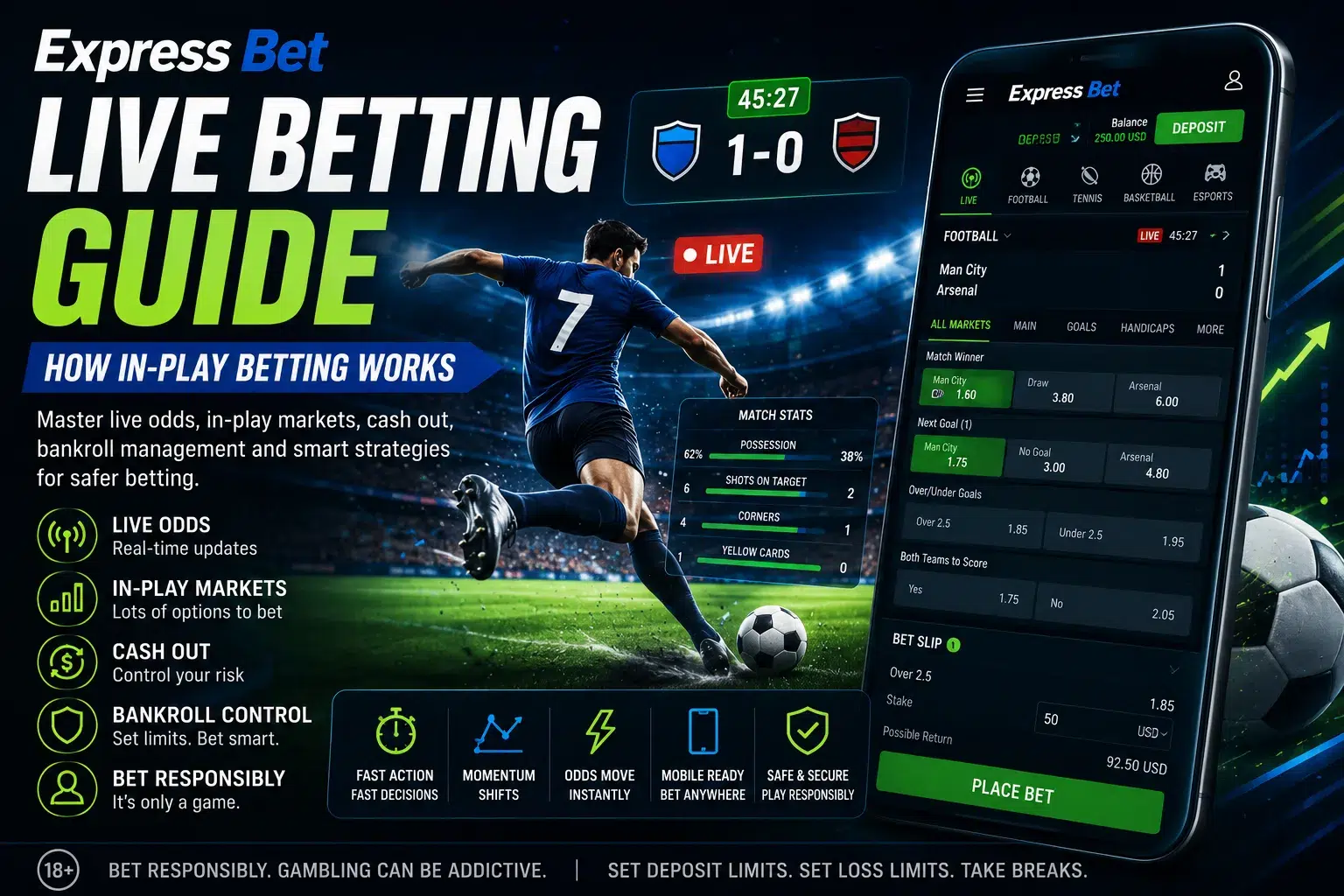
Live betting means placing wagers during a sports or esports event after it has already started. Users open the live betting section of an online sportsbook, select an active match, read the score, time, statistics, and game state, choose a live betting market, check the live odds, enter a stake, and confirm the live bet slip before the odds change or the market is suspended. Live odds change because of goals, wickets, red cards, injuries, timeouts, substitutions, momentum shifts, betting volume, and bookmaker risk management. Live betting is faster and riskier than pre-match betting because decisions happen under pressure, streams can be delayed, and odds can move before the user reacts. A safer live betting approach requires sport knowledge, reliable statistics, small stakes, bankroll management, stop-loss rules, cash out discipline, and responsible gambling tools. Live betting does not guarantee profit. It must stay entertainment, and users should never bet money needed for bills, food, rent, debt, loans, or family expenses.
 500% on first depositBETTINGPETTING
 200% on first depositAVIATOR2049
 500% on first depositEXPRESSBET
 Welcome 150% Casino Bonus + 100 Free Spins
 Welcome Bonus up to 127 000 INR + 150 FS
 100% on first deposit with up to $275
 250 Free spins in selected slots
Quick Summary
Live betting, also called in-play betting, allows users to bet while a match or event is already happening. Instead of placing a wager before kick-off, toss, first serve, tip-off, or map start, the user reacts to the current game state.
The main difference between live betting and pre-match betting is timing. Pre-match betting gives the user more time to research. Live betting gives the user more current information but less time to think. This makes live betting flexible, but it also makes it dangerous for users who react emotionally.
Live odds change during events because the bookmaker updates probability after every important moment. A red card in football, a wicket in cricket, a break of serve in tennis, a scoring run in basketball, or an economy swing in CS2 can move prices instantly.
Live betting requires controlled decisions. A user must understand the sport, read the match situation, use small stakes, and stop after a preset loss limit. Beginners should learn pre-match betting first and treat live betting with caution.
Key Takeaways
- Live betting means betting after an event starts.
- In-play odds move quickly because the game state changes.
- Live betting creates more pressure than pre-match betting.
- Stream delay can make users see old information.
- Market suspension is normal during dangerous moments.
- Cash out can reduce risk, but it can also reduce value.
- Beginners should use small stakes and simple markets.
- Live accumulators are high risk.
- No live betting strategy guarantees profit.
- Responsible betting rules are mandatory.
What Is Live Betting?
Live betting is betting during an active event. It is also called in-play betting, in-game betting, or online live betting. A user can open a live sportsbook, select an event that is currently running, and place a bet on markets that remain available during the event.
Live betting differs from pre-match betting because the odds react to real-time events. Before a football match starts, the bookmaker sets odds based on team strength, injuries, expected lineups, form, and market activity. After the match starts, the bookmaker updates the odds according to score, time, chances, cards, injuries, substitutions, and pressure.
Example:
A football match starts at 0–0. After 20 minutes, Team A dominates possession, creates several chances, and forces corners. The bookmaker shortens the odds on Team A to score next. A user places a live bet on Team A to score the next goal.
This bet still carries risk. Team B may score from a counterattack. Team A may lose momentum. A red card may change the match. A missed chance does not guarantee another chance. Live betting gives more information, but it does not remove uncertainty.
Live betting is popular because it feels active. Users can react to match flow. They can bet on the next goal, next wicket, next point, live totals, live handicap, set winner, map winner, or cash out markets. This speed creates excitement, but it also increases the chance of emotional betting.
How Live Betting Works Step by Step
Live betting follows a clear process. The user should treat each step as a risk checkpoint.
- Choose a safe online sportsbook.
- Log in to the account.
- Open the live betting section.
- Select a live sport or event.
- Check score, time, statistics, and game state.
- Choose a live market.
- Check current odds.
- Enter stake.
- Review the live bet slip.
- Confirm before odds change.
- Track the result.
- Use cash out only when it fits the plan.
Text flow:
Open Live Section → Select Event → Read Game State → Choose Market → Check Odds → Enter Stake → Confirm Bet → Track Result
A live bet should never start with the odds alone. The user must first understand the situation. A price may look attractive, but the game state may explain why the odds moved. For example, a team may have high odds because its key player is injured, the team has a red card, or the match has shifted tactically.
The user should also check whether the market is stable. Live odds can change before confirmation. Many bookmakers show an odds change notification. Some allow users to accept any odds change automatically. Beginners should avoid automatic acceptance because it can confirm a bet at a worse price than expected.
Live Betting vs Pre-Match Betting
Pre-match betting and live betting require different habits. A user should not use the same decision speed for both.
| Factor | Pre-Match Betting | Live Betting |
|---|---|---|
| Timing | Before the event starts | During the event |
| Research Time | More time available | Less time available |
| Odds Movement | Slower | Fast and frequent |
| Market Availability | Broad before start | Changes during event |
| Emotional Pressure | Lower | Higher |
| Stream Delay Risk | Not relevant | Important risk |
| Market Suspension | Rare | Common |
| Data Requirements | Pre-event research | Real-time game-state reading |
| Beginner Suitability | Better for beginners | Riskier for beginners |
| Risk Level | Medium | Medium to high |
Pre-match betting allows more planning. The user can check team news, injuries, statistics, weather, lineups, odds movement, and market rules without the pressure of a running clock.
Live betting gives the user updated information. The user can see whether a favorite is actually performing well, whether a cricket pitch is slow, whether a tennis player is injured, or whether a basketball team is pushing pace. This information can help, but it also pushes users into quick decisions.
Beginners should usually learn pre-match betting first. It builds market understanding, odds discipline, and bankroll control before adding live pressure.
Why Live Odds Change
Live odds change because the probability of each outcome changes during the event. A bookmaker adjusts prices to reflect the current situation and to manage financial exposure.
Main reasons for live odds movement include:
- score changes;
- time remaining;
- injuries;
- red cards;
- substitutions;
- wickets;
- timeouts;
- momentum shifts;
- possession and pressure;
- expected goals;
- match statistics;
- betting market volume;
- bookmaker risk management;
- data feed speed.
Examples:
Football Odds After a Red Card
If Team A receives a red card in the 25th minute, its odds to win usually rise. The team has fewer players and may defend deeper. The opponent’s odds may shorten. Totals, corners, and cards markets may also shift.
Read more on Football Betting Guide
Tennis Odds After a Break of Serve
If a player breaks serve in the first set, that player’s odds may shorten quickly. Tennis odds react strongly because service games often decide set control.
Read more on Tennis Betting Guide
Cricket Odds After a Wicket
If a team loses two quick wickets during a chase, the match winner odds can move sharply. The movement depends on wickets in hand, required run rate, pitch, and batting depth.
Read more on Cricket Betting Guide
Basketball Odds After a 10–0 Run
Basketball odds can swing after a scoring run. However, short runs can reverse quickly. A user should check whether the run comes from real tactical control or short-term shooting variance.
Read more on Basketball Betting Guide
Esports Odds After a Strong First Map
In esports, odds can change after a dominant map win. But users must check map vetoes and remaining maps. A team may be strong on one map and weak on another.
Read more on Esports Betting Guide
Understanding Game State in Live Betting
Game state means the full live context of an event. It includes more than the score.
Important game-state factors include:
- current score;
- time remaining;
- team or player momentum;
- tactical situation;
- injury status;
- possession or territory;
- fatigue;
- motivation;
- match importance;
- statistical pressure;
- weather;
- substitutions;
- player roles;
- pace of play;
- discipline risk.
A good live bettor does not react only to the score. A 0–0 football match can be slow and lifeless, or it can be full of chances. A basketball team can lead by 12 points but show foul trouble and poor bench depth. A cricket team can need 60 runs from 40 balls with wickets in hand, or the same target with tailenders batting.
The user must understand why the score looks the way it does. Scoreboard-only betting leads to weak decisions. Context matters more than raw numbers.
Best Sports for Live Betting
Some sports suit live betting better than others because they have frequent scoring, clear phases, or useful live statistics. Each sport still needs specific knowledge.
Football Live Betting
Football live betting includes next goal, match winner, double chance, totals, team goals, corners, cards, and cash out. It is popular because match flow is visible, and odds move after major events.
Useful factors:
- shot quality;
- pressure;
- corners;
- dangerous attacks;
- red cards;
- substitutions;
- defensive shape;
- match tempo;
- late-goal risk.
Football is also risky because one event can change everything. A team can dominate and concede from one counterattack. A red card can ruin a pre-match assumption. A late penalty can change totals and match winner markets.
Cricket Live Betting
Cricket live betting includes match winner, innings runs, over runs, wickets, top batter, team score, and chase markets. T20 cricket is especially active because every over can shift the game.
Useful factors:
- required run rate;
- wickets in hand;
- pitch behavior;
- powerplay;
- death overs;
- bowling matchups;
- dew;
- weather;
- toss impact;
- batting depth.
Cricket live betting needs caution because momentum can change quickly. One over can change the required rate. One wicket can change chase pressure.
Tennis Live Betting
Tennis live betting includes match winner, set winner, game winner, total games, handicap, tie-break markets, and point-based markets.
Useful factors:
- serve dominance;
- break points;
- first-serve percentage;
- unforced errors;
- player fitness;
- surface;
- medical timeouts;
- mental pressure.
Tennis odds can swing heavily during one set. A break of serve can move the market, but strong servers can recover. Users should avoid overreacting to one game.
Basketball Live Betting
Basketball live betting includes moneyline, spread, totals, quarter markets, player props, and team totals. Basketball has fast scoring, so odds move often.
Useful factors:
- pace;
- foul trouble;
- player rotations;
- timeouts;
- shooting variance;
- back-to-back fatigue;
- bench strength;
- blowout risk.
Short scoring runs can mislead users. A 10–0 run may show tactical control, or it may reflect temporary shooting luck.
Esports Live Betting
Esports live betting includes map winner, round winner, total maps, kills, objectives, and match winner markets. CS2, Dota 2, League of Legends, Valorant, and Mobile Legends can offer many live markets.
Useful factors:
- map vetoes;
- economy;
- draft advantage;
- objective control;
- role changes;
- patch updates;
- roster substitutions;
- team communication;
- live stream delay.
Esports users need game knowledge. A user who does not understand economy in CS2 or draft scaling in Dota 2 should avoid live markets.
MMA and Boxing Live Betting
Combat sports live betting includes fight winner, round betting, method of victory, and total rounds.
Useful factors:
- fighter fatigue;
- injury signs;
- damage taken;
- pace;
- grappling control;
- corner advice;
- judge scoring uncertainty.
Combat sports carry high risk because one strike, injury, or judging decision can change the result.
Common Live Betting Markets
Live sportsbooks offer different markets depending on sport and event size.
| Live Betting Market | Meaning | Risk Level | Best For |
| Live Match Winner | Bet on the final winner during the event | Medium | Users reading game state |
| Next Goal | Bet on which team scores next | High | Football users |
| Next Point | Bet on next point or game phase | High | Tennis and basketball users |
| Next Wicket | Bet on wicket-related cricket outcome | High | Cricket specialists |
| Next Round | Bet on next round winner | High | Esports or combat users |
| Live Totals | Bet on updated total goals, points, runs, or maps | Medium | Data-focused users |
| Live Handicap | Bet with an adjusted spread | Medium to high | Experienced users |
| Both Teams to Score | Bet whether both teams score | Medium | Football users |
| Team Totals | Bet on one team’s live total | Medium | Users with tactical insight |
| Corners | Bet on corner totals or next corner | Medium to high | Football specialists |
| Cards | Bet on yellow/red card markets | High | Users reading match aggression |
| Player Props | Bet on player performance | Medium to high | Users with player knowledge |
| Set Winner | Bet on current or next set | Medium | Tennis users |
| Map Winner | Bet on esports map result | Medium | Esports users |
| Race Winner | Bet during racing events | High | Racing specialists |
| Cash Out Markets | Close or adjust an active bet | Variable | Risk control users |
Beginners should start with simple markets. Complex player props, live handicaps, and live accumulators require more experience.
How to Place a Live Bet
A live bet should follow a clear process. The user must avoid rushed clicks.
Example:
Sport: Football
Match Time: 30th minute
Score: 0–0
Market: Over 1.5 Goals
Odds: 1.90
Stake: $5
Potential return: $9.50
Potential profit: $4.50
Before placing the bet, the user should check match pressure. A 0–0 score after 30 minutes does not automatically mean goals are coming. The user should check shots, shot quality, dangerous attacks, corners, defensive errors, substitutions, and tempo.
The user must also confirm before odds change. If the price changes from 1.90 to 1.70, the bet no longer has the same value. Automatic acceptance can confirm a weaker price.
The user should not increase stake after missed chances. Missed chances can create frustration. Frustration often leads to chasing. A live bet should stay within the planned stake size.
The user should track the bet after placement. The record should include match time, score, market, odds, stake, result, and reason for the bet.
What Is a Live Bet Slip?
A live bet slip is the confirmation panel for an in-play wager. It updates faster than a pre-match bet slip because odds and markets change during the event.
A live bet slip usually shows:
- selected event;
- current score;
- current time;
- selected live market;
- odds;
- stake;
- possible return;
- odds change notification;
- acceptance of changed odds;
- suspended market warning;
- cash out option;
- confirmation button.
Users must be careful with automatic odds acceptance settings. Some platforms let users accept any odds change, accept higher odds only, or require manual confirmation. Beginners should use manual confirmation when possible.
A small change in odds can affect long-term value. A user who wanted 2.10 should not automatically accept 1.85 without reviewing the decision again.
Market Suspension in Live Betting
Market suspension means the bookmaker temporarily pauses betting on a market. This usually happens during dangerous or uncertain moments.
Suspension can happen after:
- goals;
- penalties;
- VAR checks;
- red cards;
- injuries;
- wickets;
- timeouts;
- set points;
- match points;
- map-defining moments;
- major esports objectives;
- feed delays.
Examples:
In football, the market may suspend when a team attacks inside the penalty area or during VAR. In cricket, the market may suspend during a wicket review. In tennis, markets can suspend around break points or set points. In basketball, suspension may happen during a timeout or end-game possession. In esports, suspension can occur during a round-ending fight or objective battle.
The odds may return at a different price. Users should not panic during suspension. Suspension protects bookmakers from delayed data and prevents users from betting on outdated prices.
Live Stream Delay and Data Delay
Live stream delay is one of the biggest risks in live betting. The user’s stream may show action several seconds or even minutes later than the sportsbook’s data feed.
Bookmaker feeds are often faster than television streams, mobile streams, and unofficial streams. A user may think a market is slow to react, but the sportsbook may already know more recent data.
Risks include:
- odds already reflect unseen action;
- a goal or wicket may have happened before the user sees it;
- market suspension may reveal delayed information;
- mobile streams may lag;
- illegal streams may have large delays;
- live stats may update at different speeds.
Warning:
Users should not place live bets only because the stream shows an opportunity. The sportsbook may already know more recent data.
This is especially important for tennis points, cricket balls, basketball possessions, and esports rounds.
Cash Out in Live Betting
Cash out lets a user close a bet before the event ends. The bookmaker offers an amount based on the current state of the bet.
Types:
- full cash out: closes the entire bet;
- partial cash out: closes part of the bet and leaves part active.
Cash out values change during live events. A favorable goal can increase the offer. A red card, injury, or momentum shift can reduce it. The bookmaker controls the offer, and it may not reflect perfect value for the user.
| Cash Out Situation | Possible Use | Risk |
| Bet is winning but game state worsens | Lock partial profit | Cashing out too early |
| Key player gets injured | Reduce exposure | Offer may already be poor |
| Red card changes match | Prevent larger loss | Emotional decision |
| Accumulator has one leg left | Secure part of payout | Lower value than waiting |
| Odds move sharply against user | Limit damage | Panic cash out |
Cash out is not always good. It can reduce variance, but it can also reduce long-term value. Users should decide cash out rules before betting. Emotional cash out after every pressure moment creates poor discipline.
Live Betting Strategy Basics
A live betting strategy should start with risk control, not prediction confidence.
Basic principles:
- watch the event or use reliable live statistics;
- understand the sport;
- wait for clear game state;
- use small stakes;
- avoid betting every momentum shift;
- compare live odds if possible;
- avoid late panic bets;
- set a stop-loss;
- track every live bet.
Expert note:
Live betting strategy should start with risk control, not prediction confidence.
No live betting tips can guarantee profit. A user can read the match correctly and still lose because of one unexpected event. Strategy should reduce bad decisions, not pretend to remove uncertainty.
Live Betting Strategy for Football
Football live betting requires reading pressure, not only possession. A team can hold 65% possession and create nothing. Another team can sit deep and create better counterattacks.
Useful football signals:
- shot quality;
- touches in the box;
- dangerous attacks;
- corners;
- defensive errors;
- tactical dominance;
- pressing intensity;
- player fatigue;
- substitutions;
- red-card risk;
- late-goal patterns.
Examples:
Over Goals After Real Pressure
A user may consider over goals if both teams create high-quality chances, defenders look unstable, and the tempo remains high. The user should still use a small stake because missed chances can continue.
Under Goals After Slow Tempo
An under goals live bet may make sense when both teams play slowly, create few shots, and protect the result. The user must check time decay and substitutions.
Next Goal After Tactical Dominance
A next goal bet may look attractive when one team dominates territory and creates repeated chances. The risk is a counterattack or sudden tactical shift.
Card Markets After Aggressive Match Flow
Card markets may fit matches with repeated fouls, emotional players, derby tension, and strict refereeing. The user must know referee style and match context.
Users should not chase missed chances. A missed penalty or open goal can create anger. Anger creates poor stake decisions.
Live Betting Strategy for Cricket
Cricket live betting depends on format. T20, ODI, and Test cricket have different rhythm and variance.
Important cricket factors:
- required run rate;
- wickets in hand;
- pitch behavior;
- dew;
- powerplay;
- death overs;
- bowling matchup;
- batting depth;
- toss impact;
- weather;
- field restrictions.
T20 live betting needs smaller stakes because momentum changes quickly. A chase can look difficult, then one over changes the required rate. A strong batting team can lose two wickets and collapse. Dew can help chasing teams. Pitch slowdown can hurt later innings.
Live-over betting is volatile. One boundary, wide, no-ball, or wicket can decide a market. Beginners should be cautious with ball-by-ball and over-by-over bets.
Live Betting Strategy for Tennis
Tennis live betting is driven by serve, return pressure, fitness, and mental momentum. Odds can swing sharply during one set.
Useful tennis factors:
- first-serve percentage;
- second-serve weakness;
- break points;
- return pressure;
- unforced errors;
- medical timeouts;
- surface type;
- fatigue;
- body language;
- head-to-head style matchup.
A broken serve does not always prove a player is collapsing. Some players break back quickly. Users should avoid overreaction to one service game.
Retirement rules matter. Some bookmakers void bets if a player retires. Others settle after one set or after the match starts. Users must know the rule before live betting tennis.
Live Betting Strategy for Basketball
Basketball live betting moves quickly because teams score often. The user must separate real tactical shifts from short scoring runs.
Important basketball factors:
- pace;
- foul trouble;
- timeouts;
- player rotations;
- back-to-back fatigue;
- three-point variance;
- live totals;
- quarter markets;
- blowout risk;
- bench quality;
- injury news.
A 10–0 run can create a big odds move. It may show defensive pressure, or it may be a short stretch of hot shooting. Users should check shot quality, lineup changes, and timeout response.
Live totals can be tricky. Early fast pace can slow after rotations. A high-scoring first quarter does not guarantee a high-scoring match.
Live Betting Strategy for Esports
Esports live betting needs game-specific knowledge. A user must understand the mechanics behind the odds movement.
Important esports factors:
- map vetoes;
- economy in CS2;
- draft in Dota 2 and League of Legends;
- objective control;
- round momentum;
- patch changes;
- roster substitutions;
- team communication;
- side advantage;
- live stream delay;
- lower-tier match risk.
CS2 live markets depend heavily on economy, side, weapon buys, and round streaks. Dota 2 and League of Legends depend on draft scaling, objectives, map control, and teamfight execution. Valorant depends on economy, agent utility, and side strength.
Users should avoid esports live betting without game knowledge. Watching a scoreboard is not enough.
Live Betting Bankroll Management
Live betting needs stricter bankroll management than pre-match betting. Fast decisions increase the chance of mistakes.
Rules:
- use smaller stakes than pre-match betting;
- set a live betting budget before the event starts;
- use 0.5% to 1% unit size for beginners;
- create a separate live betting limit;
- stop after a preset number of losses;
- avoid redepositing during live events;
- avoid chasing with larger stakes.
| Bankroll Size | 0.5% Live Stake | 1% Live Stake | Beginner Advice |
| $50 | $0.25 | $0.50 | Use tiny stakes or avoid live betting |
| $100 | $0.50 | $1 | Limit live bets to 2–3 per session |
| $250 | $1.25 | $2.50 | Track every live bet |
| $500 | $2.50 | $5 | Avoid live accumulators |
| $1000 | $5 | $10 | Use strict stop-loss rules |
A beginner should not treat the full sportsbook balance as live betting money. A user can set one separate live limit for each event or session.
Stop-Loss Rules for Live Betting
A stop-loss rule tells the user when to stop after losses. It must be set before the event starts.
Common stop-loss rules:
- stop after losing 2–3 units in one session;
- stop after two emotional bets;
- stop after betting outside the plan;
- stop after stream delay confusion;
- stop after repeated odds changes;
- stop if frustration appears;
- stop after one accidental large stake.
Examples:
A user has a $100 bankroll and a $1 unit. The stop-loss is $3. After three losing 1-unit live bets, the user stops.
A user has a $500 bankroll and a $5 unit. The stop-loss is $15. After losing 3 units, the user stops and reviews the session later.
Stop-loss rules protect against chasing losses. A user who keeps betting to recover usually increases damage.
Common Live Betting Mistakes
Live betting mistakes often come from speed and emotion.
Common mistakes include:
- betting only because odds moved;
- chasing losses;
- betting every few minutes;
- ignoring stream delay;
- using large stakes;
- overreacting to one goal or wicket;
- trusting live stats without context;
- betting without knowing the market;
- accepting changed odds blindly;
- using cash out emotionally;
- betting while angry or drunk;
- placing live accumulators carelessly;
- switching to casino after live betting losses;
- following fake live signals;
- betting after market suspension without reassessment.
The most dangerous mistake is increasing stake after a loss. This can turn one bad read into a full bankroll problem.
Live Accumulator Bets
Live accumulators combine several in-play selections into one ticket. They are riskier than single live bets because each leg moves quickly and every selection must win.
Risks include:
- fast odds movement;
- market suspension;
- poor confirmation timing;
- increased emotional pressure;
- correlation between selections;
- low chance of all legs winning;
- difficulty tracking game states across matches.
| Live Accumulator Type | Risk Level | Beginner Advice |
| 2-leg live accumulator | High | Use tiny stake only |
| 3-leg live accumulator | Very high | Usually avoid |
| 5-leg live accumulator | Extreme | Not beginner-friendly |
| Multi-sport live accumulator | Extreme | Avoid |
| Live + pre-match mixed accumulator | High | Understand every leg |
Beginners should avoid live accumulators. A single live bet is easier to understand, track, and control.
Bet Builder in Live Betting
Live bet builder allows users to combine several markets from one event while the event is running. Availability depends on the bookmaker and sport.
Example:
Team A to win + over 2.5 goals + Player X to score
All conditions must win. If Team A wins 2–0 and Player X does not score, the bet loses. If Player X scores but the match ends 2–2, the bet loses.
Live bet builder risks include:
- higher odds;
- higher correlation risk;
- limited live availability;
- odds suspension;
- quick price movement;
- misunderstanding one leg;
- emotional selection adding.
Users must understand every leg. Adding more selections only to increase odds is poor risk management.
Live Betting and Bonuses
Some betting bonuses include live betting. Others exclude it. Users must read the bonus terms before placing in-play wagers with bonus funds.
Important bonus rules include:
- live betting eligibility;
- minimum odds;
- eligible markets;
- wagering requirements;
- free bet rules;
- cash out restrictions;
- bonus expiry;
- maximum stake limits;
- country restrictions;
- withdrawal rules.
Users should not place live bets only to complete wagering requirements. This creates rushed decisions. A bonus should support a betting plan, not control it.
Free bets on live markets can be useful when terms are clear, but they still carry risk. The user should check whether the free bet stake is returned or only the profit.
Mobile Live Betting
Mobile live betting allows users to place in-play bets through a betting app or mobile sportsbook website. It is convenient, but it increases the risk of accidental and emotional betting.
Important mobile features:
- clean betting app interface;
- quick odds updates;
- clear live bet slip;
- push notifications;
- cash out button;
- secure mobile payment flow;
- biometric login;
- connection stability;
- responsible gambling settings;
- manual odds acceptance.
Mobile risks:
- accidental taps;
- unstable internet connection;
- delayed odds updates;
- battery problems;
- app freezes;
- small-screen stake errors;
- betting while distracted.
APK warning:
Users should use only official betting apps or official sportsbook websites. Unofficial APK files can steal login details, payment data, and documents.
Live Betting Scams and Fake Prediction Tools
Live betting scams target users who want certainty during fast events. Scammers sell “signals,” “inside odds,” or “guaranteed live picks.”
Common scams include:
- fake live signals;
- Telegram VIP groups;
- “sure live odds” sellers;
- AI live prediction scams;
- fixed match claims;
- fake bots;
- fake insider information;
- crash game predictor scams;
- fake account managers;
- fake betting APK files.
No tool can guarantee live sports results. Real events contain uncertainty. Anyone who asks for account access, deposits, payment, or personal documents in exchange for guaranteed live wins is unsafe.
Users should never give sportsbook login details to another person. They should not install unknown betting tools. They should not pay for “fixed” live markets.
Responsible Gambling in Live Betting
Live betting can become fast and emotional. The short time between decision and result can encourage repeated bets. This makes responsible gambling rules essential.
Core rules:
- betting is entertainment, not income;
- never use rent, bills, food, debt, loan money, or family money;
- set deposit limits;
- set loss limits;
- set session time limits;
- take cooling-off breaks;
- stop after repeated losses;
- use self-exclusion if control weakens;
- seek help if gambling causes harm.
Warning signs include:
- betting every few minutes;
- hiding losses;
- borrowing money;
- chasing after a bad live bet;
- switching to casino after sports losses;
- feeling panic during live events;
- increasing stake to recover;
- being unable to stop after reaching limits.
Live betting speed can increase harmful behavior if the user cannot stop. In that case, the correct action is to stop betting, not to search for a better strategy.
Beginner Checklist Before Placing a Live Bet
Before placing a live bet, a user should confirm:
- I understand the sport.
- I understand the live market.
- I checked the score and time.
- I checked match statistics.
- I know my stake.
- I know my stop-loss.
- I am not chasing losses.
- I am not betting because of anger.
- I checked for stream delay.
- I reviewed the live bet slip.
- I did not accept changed odds blindly.
- I can afford to lose the stake.
If any point fails, the user should not place the bet.
Example of a Safer Live Betting Session
Example:
- Bankroll: $100
- Live unit: $1
- Event: Football match
- Maximum live bets: 3
- Stop-loss: $3
- Market: Over 1.5 goals
- Stake: $1
- No live accumulator
- No redeposit after loss
- Cash out only if match state changes sharply
This is safer than opening the live section and betting every market because the user has limits before emotion starts. The user knows the maximum loss, maximum number of bets, stake size, and cash out rule.
A controlled session does not guarantee profit. It only reduces uncontrolled damage.
Live Betting Glossary
- Live betting — betting during an active event.
- In-play betting — another name for live betting.
- Live odds — odds that update during an event.
- Market suspension — temporary pause in betting during important moments.
- Cash out — closing a bet before the event ends.
- Partial cash out — closing part of the bet while leaving part active.
- Live bet slip — the confirmation panel for a live bet.
- Stake — the amount placed on the bet.
- Payout — total return if the bet wins.
- Odds movement — change in odds during the event.
- Stream delay — delay between real event action and the user’s video feed.
- Data feed — information source used by sportsbooks to update odds.
- Game state — full current match situation.
- Momentum — current flow or pressure in the event.
- Stop-loss — preset point where the user stops after losses.
- Bankroll — money reserved only for betting.
- Live accumulator — multi-selection bet placed during live events.
- Bet builder — a combined bet with several markets from one event.
- Red card — football disciplinary event that can change odds sharply.
- Wicket — cricket dismissal event that can shift match odds.
- Map winner — esports market on who wins a specific map.
- Responsible gambling — controls that keep betting from causing harm.
Expert Verdict
Live betting is useful, flexible, and high-risk. It gives users more current information than pre-match betting, but it also creates more pressure. Fast decisions require stricter bankroll rules.
The strongest live bettors do not only watch the score. They understand game state. They read pressure, fatigue, tactics, player condition, and market movement. They also know when not to bet.
Stream delay creates hidden risk. The user’s video may be behind the bookmaker’s data feed. A visible opportunity may already be priced into live odds.
Live betting works better with simple markets, small stakes, and clear stop-loss rules. Cash out must be planned before the bet, not used emotionally after every momentum shift.
Beginners should start carefully. They should avoid live accumulators, avoid automatic odds acceptance, and use responsible gambling tools early.
FAQ
Live betting means placing a bet while a sports or esports event is already happening. It is also called in-play betting.
The user opens the live section, selects an active event, checks the score and game state, chooses a live market, enters a stake, and confirms the live bet slip.
Yes. Live betting and in-play betting usually mean the same thing.
Live betting legality depends on the user’s country, state, or region. Users must check local gambling laws before betting.
Yes. Live betting is risky because odds move quickly, decisions happen under pressure, and streams can be delayed.
Live odds change because of score changes, time remaining, injuries, red cards, wickets, timeouts, momentum shifts, and bookmaker risk management.
Market suspension means the bookmaker temporarily pauses betting during important or uncertain moments.
Live stream delay means the user’s video feed is behind real action or the bookmaker’s data feed.
Football, cricket, tennis, basketball, esports, MMA, and boxing all offer live betting. Each sport requires specific knowledge.
Common markets include live match winner, next goal, live totals, live handicap, player props, set winner, map winner, corners, cards, and cash out.
Log in, open the live section, select an event, choose a market, check the odds, enter a stake, review the bet slip, and confirm.
A live bet slip shows the selected event, current score, market, odds, stake, possible return, odds changes, and confirmation button.
Yes, if the bookmaker offers cash out on that bet. The value changes during the event.
No. Cash out can reduce risk, but it can also reduce value. Users should not use it only from panic.
Beginners should use small stakes, often 0.5% to 1% of bankroll per live bet.
Set a stop-loss before the event. Stop after reaching it. Do not redeposit or increase stakes after losses.
Live accumulators are high risk. Beginners should avoid them or use tiny stakes only.
Some bonuses allow live betting, and some exclude it. Users must read the bonus terms before betting.
Mobile live betting can be safe through official apps and websites. Unofficial APK files are unsafe.
No tool can guarantee live sports results. Users should avoid fake signals, bots, fixed-match claims, and guaranteed-win groups.
The biggest mistake is chasing losses with larger stakes after a bad live bet.
Beginners should usually learn pre-match betting first. Live betting is faster and more emotional.
Use small stakes, set a live betting budget, create a stop-loss, avoid redeposits, and track every live bet.
Stop after reaching the stop-loss, after emotional bets, after repeated mistakes, or when betting stops feeling controlled.
No. Live betting cannot guarantee profit. It carries risk, and users can lose money even with strong analysis.
Conclusion
Live betting is fast, flexible, and risky. It allows users to bet during sports and esports events, but it demands stronger discipline than pre-match betting. Users need sport knowledge, game-state awareness, reliable statistics, small stakes, stop-loss rules, bankroll control, and responsible gambling tools.
A good live bettor does not chase every odds movement. The user waits for a clear situation, checks the live bet slip, avoids automatic mistakes, and stops when limits are reached.
Live betting never guarantees profit. It should never be funded with money needed for rent, food, bills, debt, loans, or family expenses. If live betting becomes stressful, hidden, compulsive, or financially harmful, the user should stop and use responsible gambling support immediately.
[expert_review params=»JTdCJTIyY29sb3IlMjIlM0ElMjJncmVlbi0yJTIyJTJDJTIyZXhwZXJ0X2F2YXRhciUyMiUzQSUyMiUyMiUyQyUyMmV4cGVydF9uYW1lJTIyJTNBJTIyJTIyJTJDJTIyZXhwZXJ0X2xpbmslMjIlM0ElMjIlMjIlMkMlMjJleHBlcnRfaWQlMjIlM0ElMjIxJTIyJTJDJTIyZXhwZXJ0X3R5cGUlMjIlM0ElMjJleHBlcnRfaWQlMjIlMkMlMjJleHBlcnRfYXZhdGFyX2FsdCUyMiUzQSUyMiUyMiUyQyUyMmV4cGVydF9zaG93JTIyJTNBMSUyQyUyMmV4cGVydF9kZXNjcmlwdGlvbiUyMiUzQSUyMlNwb3J0cyUyMEJldHRpbmclMjBBbmFseXN0JTIwJTI2JTIwRWRpdG9yaWFsJTIwQ29udHJpYnV0b3IlMjIlMkMlMjJleHBlcnRfc2hvd19idXR0b24lMjIlM0ExJTJDJTIyZXhwZXJ0X3Nob3dfYnV0dG9uX3R5cGUlMjIlM0ElMjJwb3B1cCUyMiUyQyUyMmV4cGVydF9xdWVzdGlvbl9idXR0b25fdGV4dCUyMiUzQSUyMkFzayUyMFF1ZXN0aW9uJTIyJTJDJTIycXVlc3Rpb25fZXh0ZXJuYWxfbGluayUyMiUzQSUyMiUyMiUyQyUyMnBvcHVwX3VzZV9waG9uZSUyMiUzQTAlMkMlMjJleHBlcnRfdGl0bGUlMjIlM0ElMjJBdXRob3IlMjIlMkMlMjJleHBlcnRfc2hvd190aXRsZSUyMiUzQTElMkMlMjJleHBlcnRfdGV4dCUyMiUzQSUyMkFsZXglMjBNb3JnYW4lMjBpcyUyMGElMjBzcG9ydHMlMjBiZXR0aW5nJTIwYW5hbHlzdCUyMGFuZCUyMGVkaXRvcmlhbCUyMGNvbnRyaWJ1dG9yJTIwd2hvJTIwd3JpdGVzJTIwZGV0YWlsZWQlMjBib29rbWFrZXIlMjByZXZpZXdzJTJDJTIwYmV0dGluZyUyMGd1aWRlcyUyQyUyMHBsYXRmb3JtJTIwY29tcGFyaXNvbnMlMkMlMjBhbmQlMjByZXNwb25zaWJsZSUyMGdhbWJsaW5nJTIwZXhwbGFpbmVycy4lMjBIaXMlMjB3b3JrJTIwZm9jdXNlcyUyMG9uJTIwcHJhY3RpY2FsJTIwaW5mb3JtYXRpb24lMjBmb3IlMjB1c2VycyUyMHdobyUyMHdhbnQlMjB0byUyMHVuZGVyc3RhbmQlMjBob3clMjBiZXR0aW5nJTIwc2l0ZXMlMjBvcGVyYXRlJTIwYmVmb3JlJTIwdGhleSUyMHJlZ2lzdGVyJTJDJTIwZGVwb3NpdCUyQyUyMG9yJTIwY2xhaW0lMjBhJTIwYm9udXMuJTIyJTJDJTIycWElMjIlM0ElNUIlNUQlMkMlMjJxYV9zaG93X3RpdGxlJTIyJTNBMSUyQyUyMnFhX3RpdGxlJTIyJTNBJTIyJUQwJTkyJUQwJUJFJUQwJUJGJUQxJTgwJUQwJUJFJUQxJTgxJTIwJUQxJThEJUQwJUJBJUQxJTgxJUQwJUJGJUQwJUI1JUQxJTgwJUQxJTgyJUQxJTgzJTIyJTJDJTIyc2NvcmUlMjIlM0ElNUIlNUQlMkMlMjJzY29yZV9zdW1tYXJ5X3RleHQlMjIlM0ElMjIlMjIlMkMlMjJzY29yZV9zdW1tYXJ5X2F2ZXJhZ2UlMjIlM0EwJTJDJTIyc2NvcmVfbWF4JTIyJTNBJTIyNSUyMiUyQyUyMnNjb3JlX3N5bWJvbCUyMiUzQSUyMiUyMiUyQyUyMnNjb3JlX3RpdGxlJTIyJTNBJTIyJTIyJTJDJTIyc2NvcmVfc2hvd190aXRsZSUyMiUzQTAlMkMlMjJwbHVzZXMlMjIlM0ElNUIlNUQlMkMlMjJtaW51c2VzJTIyJTNBJTVCJTVEJTJDJTIycGx1c2VzX21pbnVzZXNfc2hvd190aXRsZSUyMiUzQTElMkMlMjJwbHVzZXNfbWludXNlc190aXRsZSUyMiUzQSUyMiVEMCU5RiVEMCVCQiVEMSU4RSVEMSU4MSVEMSU4QiUyMCVEMCVCOCUyMCVEMCVCQyVEMCVCOCVEMCVCRCVEMSU4MyVEMSU4MSVEMSU4QiUyMiUyQyUyMnBsdXNlc190aXRsZSUyMiUzQSUyMiUyMiUyQyUyMm1pbnVzZXNfdGl0bGUlMjIlM0ElMjIlMjIlN0Q=»]