
Cricket Betting Guide: How to Bet on Cricket Online
Table of Contents Show
This Cricket Betting Guide explains how cricket betting works, including match winner, toss, innings runs, player runs, wickets, top batter, top bowler, totals, live betting, DLS rules, pitch, weather, and format differences. It is for users who want to understand cricket markets before betting on Test, ODI, T20, international, or domestic cricket. The main benefit is clearer market knowledge and safer decision-making. The main limitation is that no guide can make cricket betting safe or profitable. Before betting, check local law, legal age, bookmaker license, playing XI, pitch, weather, odds, settlement rules, limits, and responsible gambling tools.
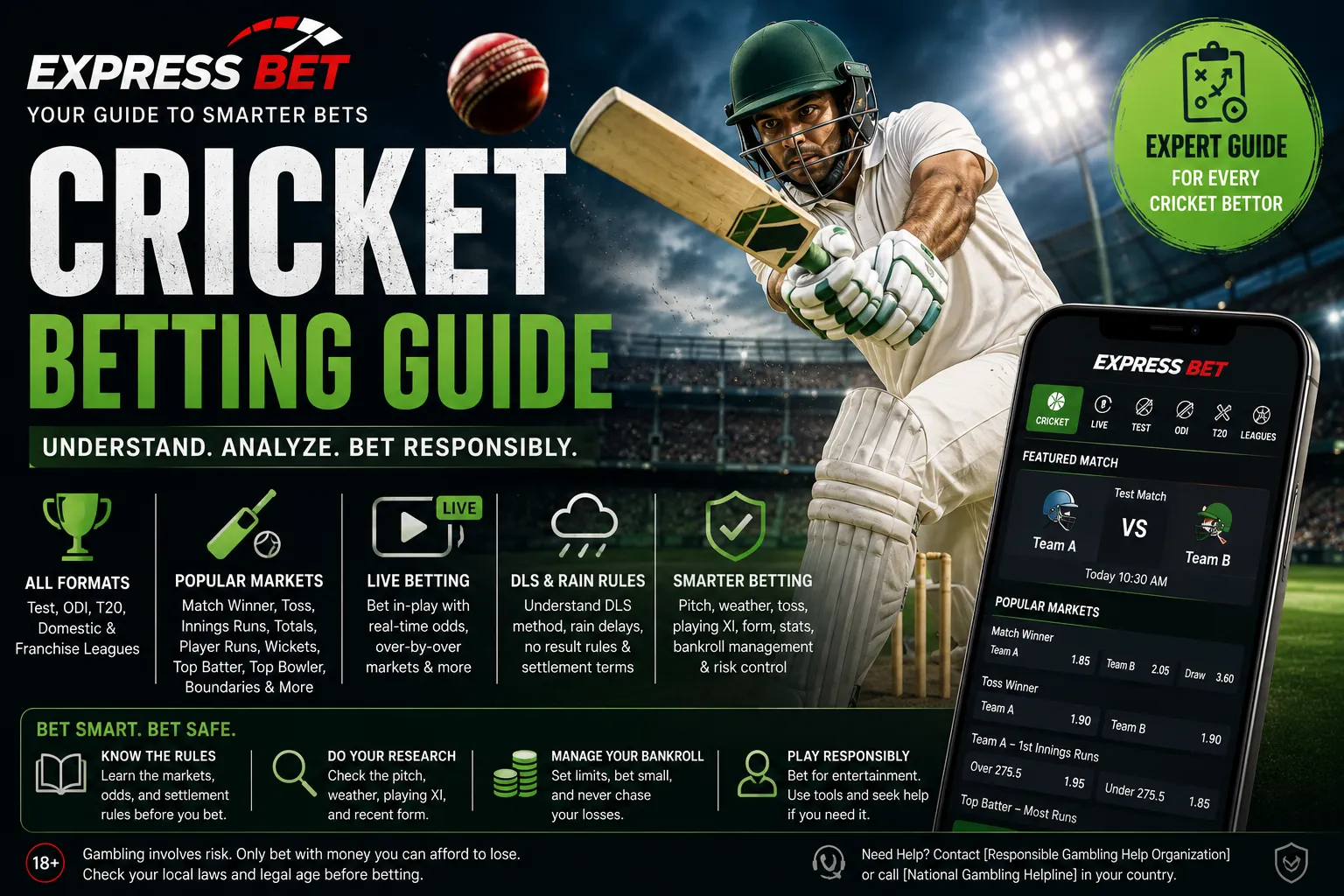
Cricket betting means placing a wager on cricket outcomes through a sportsbook or betting site. Users can bet on the match winner, toss winner, innings runs, team totals, player runs, player wickets, top batter, top bowler, boundaries, sixes, session markets, futures, accumulators, and live cricket markets.
Online cricket betting works through a bookmaker. The sportsbook lists cricket matches, formats, competitions, betting markets, odds, and settlement rules. The user selects a market, enters a stake, confirms the bet slip, and waits for the official result. If the selection wins under the market rules, the sportsbook pays the return. If it loses, the user loses the stake.
The most common cricket markets include match winner, innings runs, player runs, wickets, top batter, top bowler, total boundaries, total sixes, powerplay runs, session markets, and live betting. Toss betting is also common, but it should be treated with caution because the toss itself is a random event.
Cricket formats require different analysis. Test cricket has draw risk, pitch deterioration, weather risk, declarations, follow-on scenarios, and long-duration markets. ODI cricket has 50-over innings, powerplay structure, middle-over control, death overs, chase dynamics, and DLS/rain risk. T20 cricket moves faster and often creates sharper live betting swings, sixes markets, powerplay markets, and death-over volatility.
DLS/rain rules, pitch, weather, toss, and playing XI matter because cricket conditions can change a match quickly. A rain delay can reduce overs. A pitch can favor batters, seamers, or spinners. A confirmed playing XI can change player props and match winner markets. A toss decision can affect batting order and bowling conditions.
Bookmaker choice, payments, bonuses, and KYC matter because users need clear rules before depositing. A cricket sportsbook should show license information, withdrawal rules, payment options, DLS/rain settlement terms, bonus conditions, privacy policy, KYC requirements, and responsible gambling tools.
Cricket betting is entertainment, not income. Every cricket bet includes risk of loss. No strategy, prediction tool, Telegram signal, AI model, tipster, bonus, bookmaker ranking, or affiliate review can guarantee profit.
Cricket betting means placing a wager on a cricket match, player, innings, session, tournament, or live event. The bet can focus on the final match result, a team’s score, a batter’s runs, a bowler’s wickets, total sixes, top performers, or in-play situations.
Cricket betting can happen before a match starts. This is called pre-match cricket betting. Users may study format, pitch report, weather, playing XI, toss context, team form, player roles, and market rules before placing a bet.
Cricket betting can also happen during a match. This is called live cricket betting or in-play betting. Live odds can move after every over, wicket, boundary, dot ball, bowling change, field change, injury, rain delay, or DLS adjustment.
Common cricket betting formats include:
Cricket odds show potential payout and implied probability. The user enters a stake, checks the possible return, and confirms the bet slip.
Example:
A user selects Team A to win at decimal odds of 1.90. The user stakes $10. If Team A wins under the market rules, the user receives $19 total return. Profit is $9 because the original $10 stake is included in the return.
Formula:
Stake × Odds = Total Return
Profit = Total Return − Stake
Cricket betting depends on real cricket results, but that does not make it safe or predictable. A strong team can lose. A batter can be dismissed early. A bowler can go wicketless. Rain can reduce overs. A DLS adjustment can change a chase. A pitch can behave differently than expected.
Cricket betting is entertainment, not income. Users should never bet with money needed for rent, food, bills, debt, loans, family, education, medical needs, or emergency savings.
Online cricket betting follows a standard sportsbook process. The exact interface differs by bookmaker, but the basic flow is similar.
Flow diagram:
Check Law → Choose Sportsbook → Register → Verify → Deposit → Select Cricket → Select Format/League → Select Match → Choose Market → Check Rules → Check Context → Enter Stake → Place Bet → Track Result → Withdraw
Before placing a cricket bet, users should check:
Users should not deposit before reading withdrawal rules. Users should not accept bonuses before checking wagering requirements. Users should not place cricket player prop bets without checking role, batting order, bowling role, format, pitch, and weather context.
Cricket betting belongs inside sports betting, but it has specific features that make it different from many other sports.
| Factor | General Sports Betting | Cricket Betting |
|---|---|---|
| Match structure | Varies by sport | Built around overs, innings, wickets, and formats |
| Main formats | Sport-specific | Test, ODI, T20, domestic, franchise, international |
| Weather impact | Varies | Rain and DLS can strongly affect markets |
| Draw possibility | Varies | Important in Test cricket |
| Toss impact | Usually limited or absent | Can affect batting/bowling strategy |
| Playing surface | Varies | Pitch can favor batting, seam, spin, or slow scoring |
| Live betting | Can be fast or slow | Moves after wickets, boundaries, dot balls, and run-rate changes |
| Player markets | Varies | Batter runs, bowler wickets, top batter, top bowler |
| Short-sample markets | Varies | Powerplay, death overs, over-by-over, session betting |
| Settlement complexity | Varies | DLS, reduced overs, no result, abandoned matches |
Cricket has different match formats. Test cricket can last up to five days and includes draw risk. ODI cricket has 50-over innings. T20 cricket uses 20-over innings and often produces fast scoring, sixes markets, and live swings.
Innings structure matters. A team can bat first and set a target. The second team can chase with a required run rate. Wickets in hand, overs remaining, partnerships, and batting depth can change live odds quickly.
Toss influence can matter because a captain may choose to bat or bowl depending on pitch, weather, dew, and match format. But the toss winner itself remains random.
Pitch influence is central. A batting pitch can support higher totals. A spin-friendly pitch can help spinners. Seam movement can support pace bowlers. Pitch deterioration can matter in Test cricket.
Weather and DLS risk are specific cricket concerns. Rain can reduce overs, change target calculations, void some markets, or create no result scenarios depending on bookmaker rules.
Cricket betting and casino gambling both involve risk, but they work differently.
| Factor | Cricket Betting | Casino Gambling |
| Result source | Official cricket match outcomes | RNG or live dealer rules |
| Main variables | Teams, players, pitch, weather, overs, wickets | Game rules and random outcomes |
| Speed | Match-based, but live betting can be fast | Often very fast |
| Common markets | Match winner, innings runs, player runs, wickets, sixes | Slots, roulette, blackjack, baccarat, crash games |
| Research role | Cricket knowledge can inform decisions | Rules knowledge helps, but outcome remains uncertain |
| Weather impact | High in some matches | Usually none |
| Risk type | Overconfidence, DLS rules, toss, live swings, accumulators | Rapid repeated rounds and house edge |
| Control tools | Deposit, loss, stake, session limits | Deposit, loss, stake, session limits |
Cricket betting uses official match outcomes. Casino games use random number generators or live dealer rules. Cricket has sports variables such as pitch, weather, batting order, bowling role, match format, and DLS rules. Casino games can move faster because rounds may finish in seconds.
Both include risk of loss. Both require limits. Users should not use casino games to recover cricket betting losses. Switching to slots, roulette, crash games, or blackjack after a cricket loss is a warning sign.
Match winner — a market where the user picks the team that wins the match.
Toss winner — a market where the user picks which team wins the coin toss.
Innings runs — a market on how many runs a team scores in an innings.
Team total — a market on one team’s total runs.
Player runs — a market on how many runs a batter scores.
Player wickets — a market on how many wickets a bowler takes.
Top batter — a market on which player scores the most runs for a team or match.
Top bowler — a market on which bowler takes the most wickets for a team or match.
Total boundaries — a market on total fours and/or sixes, depending on bookmaker wording.
Total sixes — a market on the number of sixes in a match or innings.
Powerplay — the early overs of a limited-overs innings with fielding restrictions.
Death overs — the final overs of a limited-overs innings.
Run rate — average runs scored per over.
Required run rate — runs per over needed by the chasing team.
Wickets in hand — wickets remaining for the batting team.
Partnership — runs scored by two batters before a wicket falls.
Session betting — markets on specific periods, common in Test cricket.
Draw — a result possible in Test cricket when no team wins within the scheduled time.
DLS method — Duckworth-Lewis-Stern method used to adjust targets in rain-affected limited-overs matches.
Rain delay — interruption caused by weather.
Pitch report — information about the playing surface.
Playing XI — confirmed eleven players selected for a team.
Live betting — betting during an active match.
Cash out — optional early settlement feature where available.
Bet slip — confirmation panel showing selection, odds, stake, and possible return.
Stake — money placed on a bet.
Payout — total return if the bet wins.
Bankroll — money reserved only for betting.
KYC — Know Your Customer verification.
Responsible gambling — tools and behavior that reduce gambling harm.
Cricket odds show potential payout and implied probability. They do not guarantee a result.
Common odds formats include:
Decimal odds are simple because they show total return per unit staked.
Formula:
Stake × Odds = Total Return
Profit = Total Return − Stake
| Stake | Odds | Total Return | Profit |
| $5 | 1.50 | $7.50 | $2.50 |
| $10 | 1.90 | $19.00 | $9.00 |
| $20 | 2.20 | $44.00 | $24.00 |
| $50 | 3.00 | $150.00 | $100.00 |
Favorites usually have lower odds. Underdogs usually have higher odds. A low price does not remove risk. A high price does not automatically mean value.
Cricket odds can move because of pitch reports, weather changes, playing XI confirmation, toss result, batting order changes, injury news, public betting, sharp betting, or market risk. Live cricket odds can move after wickets, boundaries, dot balls, run-rate shifts, rain interruptions, and DLS adjustments.
For a deeper explanation of odds formats and implied probability, users should read the Odds Explained guide.
Cricket betting markets can be simple or complex. Beginners should start with markets they understand.
| Cricket Market | Meaning | Beginner Risk Level |
| Match winner | Pick the team that wins | Low to medium |
| Toss winner | Pick the team that wins the toss | High due to randomness |
| Innings runs | Bet on team runs in an innings | Medium |
| Team totals | Bet over/under one team’s total | Medium |
| Player runs | Bet on a batter’s runs | Medium to high |
| Player wickets | Bet on bowler wickets | Medium to high |
| Top batter | Pick highest run scorer | High |
| Top bowler | Pick highest wicket taker | High |
| Total boundaries | Bet on fours/sixes count | Medium to high |
| Total sixes | Bet on sixes count | Medium to high |
| Powerplay runs | Bet on early-over scoring | High |
| Session markets | Bet on specific match periods | High |
| Futures | Long-term tournament or series markets | Medium to high |
| Accumulators/parlays | Combine selections | High |
| Live betting | Bet during the match | High |
Match winner and simple innings markets are easier starting points than toss betting, top batter, session markets, and live markets.
Toss betting is simple to understand but risky because it is random. Player markets require knowledge of role, batting position, bowling role, pitch, format, and team news.
Cricket match winner betting means picking the team that wins the match under sportsbook rules.
Example:
Team A match winner at 1.80 with a $10 stake returns $18 if Team A wins under market rules.
Profit is $8 because the original stake is included in the return.
Match winner is often simpler for beginners than player props or session markets. The user only picks the winning team. But the market still carries risk.
Important match winner factors include:
Test cricket can include draw risk. A strong team may dominate parts of a Test match and still fail to win because of weather, time, pitch slowdown, defensive batting, or declarations.
Limited-overs cricket can include tied, no result, abandoned, or DLS-adjusted outcomes. Users must read market rules before betting.
Toss betting means betting on which team wins the coin toss.
The toss can influence match strategy. A captain may choose to bat first on a dry pitch, bowl first under cloudy conditions, or chase when dew may help batting later.
But betting on the toss winner itself is still a random outcome.
The toss does not depend on team strength, pitch analysis, batting depth, bowling quality, or form. It is a coin toss. That makes it risky for serious stake sizing.
Toss betting should be treated with caution. Oversized stakes on toss markets are poor risk control.
Warning:
The toss can influence strategy, but betting on the toss winner itself is still a random outcome.
A user who repeatedly increases stake on toss markets may be chasing quick outcomes, not making reasoned decisions.
Innings runs and team totals focus on how many runs a team scores.
Common examples include:
Example:
Team A over 165.5 runs wins if Team A scores 166 or more under market rules.
Factors that affect innings runs and team totals include:
First innings runs often depend on pitch, batting intent, and bowling quality. Second innings chase markets depend on target, required run rate, wickets in hand, dew, pressure, and DLS risk.
Powerplay runs can swing quickly because fielding restrictions encourage scoring but early wickets can slow the innings. Death overs can also be volatile because batters attack more and bowlers use yorkers, slower balls, or defensive fields.
Player runs markets focus on how many runs a batter scores.
Common player runs markets include:
| Player Runs Factor | Why It Matters |
| Batting position | Openers face more balls than lower-order batters |
| Role | Anchors and finishers score in different ways |
| Format | Test, ODI, and T20 batting roles differ |
| Pitch condition | Difficult pitches increase dismissal risk |
| Bowler matchup | Spin, pace, swing, and bounce can matter |
| Strike rate | Affects scoring speed |
| Chasing context | Target can change batting approach |
| Early dismissal risk | One ball can end the bet |
| Weather/DLS | Reduced overs can change opportunity |
| Playing XI | Player must be selected and may have a defined role |
Player runs markets can be volatile. A strong batter can be dismissed early. A middle-order batter may not face enough balls. A finisher may enter too late. A chase may end before some batters get a full opportunity.
Users should check batting order, format, pitch, bowling matchup, and playing XI before betting.
Bowler markets focus on wickets or bowling performance.
Common bowler markets include:
| Bowler Market Factor | Why It Matters |
| Bowling role | New-ball, middle-over, and death-over bowlers have different wicket chances |
| Overs expected | A bowler must bowl enough overs to create opportunity |
| Pitch condition | Seam, swing, spin, or bounce can affect wickets |
| Format | T20, ODI, and Test bowling roles differ |
| Matchup | Batter weakness against pace or spin can matter |
| Death overs | More wicket chances but also more runs conceded |
| Fielding support | Dropped catches can affect wicket markets |
| Team strategy | Captain may change bowling order |
| Weather | Cloud or dew can affect bowling conditions |
| Opposition style | Aggressive batters create both wickets and boundaries |
Opening bowlers may benefit from swing or seam movement. Spinners may benefit from dry or worn surfaces. Death-over bowlers can take wickets because batters attack, but they can also concede runs.
Player wickets markets require role clarity. A bowler who does not bowl a full quota may have limited opportunity.
Top batter and top bowler markets ask users to pick the best performer in a team or match.
Top batter markets can include:
Top bowler markets can include:
These markets are higher variance than match winner because they require a specific player to outperform teammates and opponents. A player can be in good form and still lose the market because another player scores faster or takes more wickets.
Role matters. Opening batters usually have more balls to score. Top-order batters have more opportunity than lower-order hitters. New-ball bowlers and death-over bowlers may have more wicket chances depending on format.
Users should use smaller stakes on top performer markets.
Boundaries markets focus on fours and sixes.
Common markets include:
Factors that affect boundaries and sixes include:
T20 matches usually create more boundary-focused markets than Test cricket. But no format removes risk. A match expected to produce sixes can slow down because of pitch, wickets, or bowling quality.
Boundaries markets can be volatile. A few shots can decide the bet. Users should avoid oversized stakes on volatile markets.
Powerplay, death overs, and session markets focus on short parts of a match.
Powerplay markets can include:
Death-over markets can include:
Test match session markets can include:
Short-sample markets are riskier than full-match markets. One wicket, one expensive over, one maiden over, one dropped catch, or one rain interruption can decide the market.
Powerplay markets can change quickly because fielding restrictions create scoring chances, but early wickets can slow scoring sharply.
Death-over markets can be explosive, but they depend on batters at the crease, wickets in hand, bowling quality, and match situation.
Session betting in Test cricket can depend on pitch condition, weather, batting intent, fatigue, and tactical decisions.
Cricket futures are long-term markets. They settle after a tournament, series, or long competition.
| Futures Market | Meaning | Main Risk |
| Tournament winner | Team wins the tournament | Long path, injuries, rotation, weather |
| Series winner | Team wins a bilateral series | Format and venue changes |
| Group winner | Team finishes top of group | Net run rate and schedule risk |
| Qualification market | Team reaches playoffs or knockouts | Multiple match dependency |
| Top tournament batter | Player scores most runs | Form, role, injury, rotation |
| Top tournament bowler | Player takes most wickets | Selection and conditions |
| Player of the tournament | Player wins award | Subjective and performance dependent |
| Outright winner | Broad winner market | Long settlement period |
Futures tie up bankroll for longer. A bet can look strong early and fail later because of injury, rotation, weather, schedule difficulty, or net run-rate scenarios.
Users should use smaller stakes on long-term markets.
Cricket accumulators and parlays combine multiple selections into one ticket. All legs usually must win.
A cricket accumulator may include:
The potential return is higher because risk is higher. An accumulator can lose even if most selections are correct.
Cricket-specific accumulator risks include:
Beginners should use caution. Large accumulators can hide poor risk control. One failed leg loses the ticket.
Cricket live betting means betting during a live match.
Live cricket odds can move quickly because cricket has constant match-state changes.
| Live Cricket Event | Possible Odds Impact |
| Wicket | Chasing side or batting side odds may shift sharply |
| Boundary | Run-rate and totals may move |
| Dot balls | Required run rate may rise |
| Expensive over | Totals and match winner can move |
| Maiden over | Batting pressure increases |
| Bowling change | Matchups may shift |
| Field change | Scoring areas may change |
| Rain delay | Markets may suspend |
| DLS adjustment | Target and odds can change sharply |
| Powerplay swing | Early momentum changes |
| Death-over hitting | Totals and match winner can flip |
| Stream delay | User may see old information |
| Market suspension | User may not place or adjust bet |
Live cricket betting is high risk. Users may react emotionally after one wicket, one six, one dropped catch, or one over.
Run rate and required run rate matter. Wickets in hand matter. A team chasing 60 from 36 balls with many wickets in hand is different from the same equation with few wickets left.
Users should use smaller stakes and strict limits for live cricket betting. They should not live bet to recover a previous loss.
For deeper in-play risk management, users should read the Live Betting Guide.
DLS and rain rules are central to cricket betting. Rain can interrupt matches, reduce overs, change targets, void markets, or produce no result depending on format and rules.
DLS means Duckworth-Lewis-Stern. It is used in limited-overs cricket to adjust targets after rain interruptions.
| Situation | Betting Risk | What To Check |
| Rain delay | Market suspension or reduced overs | Bookmaker rain rules |
| Reduced overs | Scoring markets change | Minimum overs requirement |
| DLS adjustment | Target changes | DLS settlement terms |
| No result | Match winner may void | Market-specific rules |
| Abandoned match | Many markets may void | Void policy |
| Partial innings | Some player markets may stand or void | Player prop rules |
| Delayed toss | Pre-match markets may move | Timing and market rules |
| Weather forecast | Increased uncertainty | Forecast and venue context |
Users must read bookmaker-specific rules. One sportsbook may void a market in a rain-affected match while another may settle it based on official result or minimum overs.
DLS can change the meaning of a chase. A team can become favorite or underdog quickly after a revised target.
Test cricket betting is different from ODI and T20 betting. A Test match can last up to five days and can end in a win, loss, draw, or sometimes tie.
Key Test cricket betting factors include:
The draw is important. Rain, slow scoring, strong defensive batting, or flat pitches can make a draw more likely.
Pitch deterioration matters. A pitch may help batters early and spinners later. Seam movement can also vary by cloud, moisture, and ball condition.
Declarations can affect totals and match winner markets. Follow-on decisions can change the match structure.
Session betting is common in Test cricket, but it is volatile because one session can change after a wicket cluster, new ball spell, or weather interruption.
ODI betting focuses on 50-over cricket.
Common ODI markets include:
ODI cricket has a balance between patience and aggression. Batting teams may build early, rotate strike in middle overs, and attack in death overs.
Chase dynamics matter. A required run rate can rise or fall quickly. Wickets in hand affect how aggressively the batting side can play.
DLS and rain risk matter in ODI cricket. Reduced overs can change the target and scoring approach.
Pitch and toss context also matter. Some teams prefer chasing. Some pitches slow down. Dew can affect bowling later.
T20 betting focuses on 20-over cricket. It usually moves faster than ODI and Test cricket.
Common T20 markets include:
T20 betting often involves faster scoring, powerplay pressure, death-over hitting, bowling matchups, toss impact, and dew factors.
Live betting swings can be sharp. One over can change match odds. One wicket can slow the chase. One finisher can change the required rate.
Franchise leagues are a major part of T20 cricket. IPL is one example of a T20 franchise league, but IPL-specific betting belongs on the dedicated IPL Betting Guide. This general cricket guide should not replace IPL event content.
International cricket betting includes bilateral series, ICC tournaments, Test matches, ODIs, T20Is, and national team competitions.
Key international cricket factors include:
ICC tournaments may include group-stage qualification scenarios and knockout pressure. Net run rate can matter in some formats. Neutral venues can reduce home advantage or change conditions.
Users should verify current squads, schedules, playing XI, pitch reports, weather, odds, and bookmaker rules before betting.
Domestic and franchise cricket includes local leagues, regional competitions, and T20 franchise leagues.
Examples include IPL, BBL, PSL, CPL, The Hundred, SA20, and WPL. These are broad examples only. IPL-specific fixtures, squads, match previews, event markets, and season angles belong on the dedicated IPL Betting Guide.
Domestic and franchise cricket factors include:
Franchise leagues can involve player availability changes because of international duty, injuries, workload, or overseas player restrictions. Users must verify current team news before betting.
Cricket betting analysis should focus on format, pitch, weather, team news, and market rules.
Confirmed playing XI affects match winner, player runs, wickets, top batter, top bowler, and team totals.
A batter not selected cannot score. A bowler not selected cannot take wickets. A player in the XI may still have a different role than expected.
Users should avoid player markets before checking team news where possible.
The toss can affect strategy. A captain may choose to bat first on a good surface, bowl first with cloud cover, or chase under dew.
The toss does not guarantee the result. A team can win the toss and lose the match. A team can make the right decision and still fail.
Pitch conditions can affect scoring and wickets.
A batting pitch may support higher team totals. A spin-friendly pitch may help spinners. A pitch with seam movement may help fast bowlers. Bounce can affect stroke play. Pitch deterioration can matter in Test cricket.
Pitch reports should be verified before betting.
Weather can change cricket betting more than in many sports. Rain can reduce overs, delay the match, create DLS targets, or produce no result.
Users should check weather forecasts and bookmaker rain rules before betting.
Batting order affects opportunity.
Openers usually face more balls. Anchors may build innings. Finishers may face fewer balls but score quickly. All-rounders may have dual roles. Lower-order hitters may only appear if wickets fall.
Player runs markets need batting role analysis.
Bowling roles affect wicket markets.
New-ball bowlers may use swing and seam. Middle-over spinners may control run rate. Death-over bowlers may take wickets because batters attack.
Users should check expected overs and role before betting on bowler markets.
Venue can affect scoring, sixes, and boundaries.
Small boundaries may support sixes. Large grounds can reduce boundary frequency and increase running between wickets. Some venues support spin. Others support pace or batting.
Venue tendencies should be considered, but they are not guarantees.
Test, ODI, and T20 require different thinking.
Test betting may include draw, declarations, sessions, and pitch deterioration. ODI betting includes innings structure, middle overs, and DLS risk. T20 betting includes powerplay, death overs, sixes, and fast live swings.
Users should not apply one format’s logic to another without adjustment.
A cricket betting site should offer clear rules, strong market coverage, safe payments, and responsible gambling tools.
| Sportsbook Feature | Why It Matters for Cricket Betting |
| License and regulation | Shows legal oversight where applicable |
| Cricket market depth | Supports match, innings, player, and live markets |
| Test, ODI, T20 coverage | Covers different formats |
| International cricket coverage | Adds national team markets |
| Domestic and franchise coverage | Adds league options |
| Player props | Important for runs, wickets, top batter, top bowler |
| Live betting quality | Supports in-play cricket markets |
| DLS/rain settlement clarity | Critical for cricket rules |
| Odds quality | Better prices improve possible returns |
| Mobile app | Useful for live markets and alerts |
| Deposit methods | Affects account funding |
| Withdrawal speed | Affects access to balance |
| KYC process | Can affect payouts |
| Customer support | Helps with settlement and payment issues |
| Bonus terms | Determines whether promotions are usable |
| Responsible gambling tools | Supports safer betting control |
| Privacy policy | Explains data handling |
| Security | Protects account and payment data |
Users should avoid sportsbooks with unclear DLS rules, unclear withdrawal terms, poor support, suspicious APK files, no responsible gambling tools, or guaranteed-win language.
Cricket betting bonuses can appear as welcome offers, free bets, reload bonuses, odds boosts, cricket promotions, tournament promotions, parlay boosts, cashback, or loyalty rewards.
| Bonus Type | How It Works | Main Risk |
| Welcome bonus | Extra funds after first deposit | Wagering requirements |
| Free bet | Promotional stake for a cricket bet | Stake may not be returned |
| Reload bonus | Bonus on later deposits | Encourages more deposits |
| Odds boost | Increased odds on selected cricket markets | Stake limits and restrictions |
| Cricket promotion | Offer tied to cricket matches | Market restrictions |
| Tournament promotion | Offer tied to a cricket tournament | Expiry and eligibility rules |
| Parlay boost | Higher payout on multi-leg bets | Higher failure risk |
| Cashback | Partial return on losses | Can normalize losses |
| Loyalty rewards | Points or ongoing rewards | Can increase activity |
Bonus terms may include:
A cricket bonus is not free money if it pushes users to deposit more or bet more than planned.
Users should skip a bonus if the terms are unclear or if the bonus conflicts with their betting limits.
Cricket betting strategy can reduce weak decisions. It cannot guarantee profit.
A practical approach includes:
Expert note:
Cricket betting strategy starts with risk control and market understanding, not confidence in one team.
A user can analyze well and still lose. A wicket can fall early. A rain delay can change the target. A strong batter can be dismissed first ball. A bowler can bowl well without taking wickets.
Strategy should not become overconfidence.
Beginners should keep cricket betting simple.
Useful beginner tips:
A beginner does not need to bet on every over, every match, or every live market. Fewer bets with clearer reasoning are safer than constant action.
Rain can change overs, targets, market settlement, and no-result outcomes. Users must check rules before betting.
A player market is weak if the user does not know whether the player is selected or what role the player has.
The toss can affect strategy, but it does not guarantee match result.
Toss winner is random. Large stakes on toss markets are poor risk control.
Pitch can affect runs, wickets, spin, seam movement, and totals.
Test, ODI, and T20 cricket require different analysis.
More bets do not mean better decisions.
One failed leg loses the full ticket.
A batter’s previous dismissal does not make the next player run bet safer.
Rain and abandonment can affect settlement.
Bonus rules can restrict withdrawals and push overbetting.
Trying to recover previous losses increases harm risk.
This is a warning sign and should be avoided.
No fixed-match claim, Telegram signal, predictor, AI bot, or tipster can guarantee cricket betting results.
Cricket betting risks should be understood before betting.
| Risk Type | Cricket Example | Safer Action |
| Financial risk | Losing more than planned on live markets | Set deposit and loss limits |
| Emotional risk | Chasing after a wicket or DLS loss | Use cooling-off |
| Live betting risk | Reacting to every over | Use smaller stakes or avoid live betting |
| Toss betting risk | Oversized stake on random toss | Treat toss markets with caution |
| Player prop risk | Batter dismissed early | Use small stakes |
| DLS/rain risk | Reduced overs change settlement | Read bookmaker rules |
| Accumulator risk | One rain-affected leg loses ticket | Avoid large accumulators |
| Bookmaker risk | Unclear DLS rules | Read terms before betting |
| Payment risk | Withdrawal blocked by KYC or bonus | Verify rules before deposit |
| Privacy risk | Uploading documents to unsafe site | Check privacy and security |
| Bonus risk | Betting more to clear wagering | Skip unclear bonuses |
| Underage gambling risk | Minor accessing sportsbook | Block access and verify age |
For a deeper risk breakdown, users should read the Betting Risks guide.
Responsible gambling means keeping cricket betting limited, controlled, and treated as entertainment.
Rules:
Users may contact [Responsible Gambling Help Organization], [National Gambling Helpline], [Self-Exclusion Register], or [Country-Specific Support Resource] where available.
Users should verify current responsible gambling resources, legal requirements, bookmaker licensing status, and support contacts in their own country or region before relying on them.
Cricket betting warning signs can appear before severe financial harm.
Signs include:
For a full checklist, users should read the Problem Gambling Signs guide.
Users should stop if cricket betting causes stress, secrecy, debt, conflict, panic, guilt, or loss of control.
Express Bet provides informational content only. Express Bet may publish cricket betting guides, sportsbook reviews, betting comparisons, affiliate links, and responsible gambling content.
Express Bet does not guarantee bookmaker safety, winnings, withdrawals, odds value, or user outcomes. Express Bet does not make cricket betting safe or profitable.
Users remain responsible for checking:
Users should stop betting if control weakens. Users should seek help if betting creates stress, secrecy, debt, conflict, panic, guilt, or loss of control.
Cricket betting means placing wagers on cricket matches, teams, innings, players, totals, boundaries, sixes, futures, or live outcomes through a sportsbook.
Users choose a cricket sportsbook, register, verify where required, deposit money, select cricket, choose a match, choose a market, enter a stake, confirm the bet slip, and wait for settlement.
Cricket betting legality depends on country, state, province, region, operator license, and legal betting age. Users must check local law before betting.
Cricket match winner betting means picking the team that wins the match under sportsbook rules.
Toss betting means wagering on which team wins the coin toss before the match.
Yes. Toss betting is risky because the toss winner is random. The toss can affect match strategy, but the toss result itself cannot be predicted reliably.
Innings runs markets are bets on how many runs a team scores in a specific innings.
Cricket team totals are over/under markets based on one team’s total runs.
Player runs bets are markets on how many runs a batter scores.
Player wickets bets are markets on how many wickets a bowler takes.
Top batter betting means picking the player who scores the most runs for a team, match, series, or tournament.
Top bowler betting means picking the bowler who takes the most wickets for a team, match, series, or tournament.
These markets focus on total fours, total sixes, player sixes, team boundaries, or match boundaries.
Cricket live betting means placing bets during an active match while odds move based on wickets, runs, overs, weather, and match state.
Yes. Live cricket betting is risky because odds move quickly after wickets, boundaries, dot balls, run-rate changes, rain delays, and DLS adjustments.
DLS means Duckworth-Lewis-Stern method. It adjusts targets in rain-affected limited-overs cricket.
Rain can delay play, reduce overs, trigger DLS, void some markets, or cause no result depending on match rules and bookmaker terms.
Some cricket bets may void after no result, but rules depend on bookmaker and market type. Users must check settlement terms.
Test cricket betting means wagering on five-day cricket markets, including match winner, draw, innings, session, player, and series markets.
ODI betting means wagering on 50-over cricket markets, including match winner, innings runs, top batter, top bowler, powerplay, and live markets.
T20 betting means wagering on 20-over cricket markets, including match winner, powerplay runs, total sixes, player runs, player wickets, and live markets.
IPL betting is specific to one T20 franchise league, with IPL teams, fixtures, venues, playoffs, season context, and IPL-specific markets. This Cricket Betting Guide is broader and covers cricket betting across formats and competitions.
International cricket betting means wagering on national team matches, bilateral series, ICC tournaments, Test matches, ODIs, and T20Is.
Cricket futures are long-term markets such as tournament winner, series winner, top tournament batter, top tournament bowler, or qualification markets.
Yes. Cricket accumulators are risky because one failed leg can lose the full ticket. Rain, DLS, toss, no result, and player rotation can add extra risk.
Cricket betting bonuses may include welcome offers, free bets, odds boosts, cricket promotions, cashback, or tournament offers. They usually include terms and restrictions.
Check license, legal availability, cricket market depth, DLS/rain rules, live betting quality, payments, withdrawals, KYC, support, bonuses, privacy, security, and responsible gambling tools.
Check local law, legal age, bookmaker license, market rules, DLS/rain terms, playing XI, pitch, weather, toss context, odds, payment rules, bonus terms, and limits.
No. Strategy can reduce weak decisions, but it cannot guarantee profit.
Beginners should use small stakes. A cautious approach often uses 0.5% to 1% of bankroll for normal bets and less for high-risk markets.
Cricket betting risks include financial loss, emotional betting, live betting swings, toss randomness, player prop volatility, DLS/rain risk, accumulator risk, bookmaker issues, payment delays, bonus restrictions, and underage gambling risk.
Responsible gambling means setting limits, avoiding essential money, not chasing losses, using cooling-off tools, and stopping if betting causes harm.
Stop if betting causes stress, secrecy, debt, conflict, panic, guilt, chasing losses, broken limits, or loss of control.
No. Minors must not use cricket betting sites. Users must meet the legal betting age in their location.
Express Bet is an informational website unless the owner states otherwise. Third-party sportsbooks handle accounts, odds, deposits, withdrawals, and wagers.
Cricket betting includes match winner, toss, innings runs, team totals, player runs, wickets, top batter, top bowler, boundaries, sixes, futures, accumulators, and live markets.
Users must understand DLS/rain rules, pitch, weather, toss, playing XI, format differences, settlement rules, deposits, withdrawals, bonuses, risks, and responsible gambling tools before betting.
Cricket betting is entertainment, not income. Every cricket bet includes risk of loss. No strategy, prediction tool, tipster, AI model, Telegram signal, bookmaker ranking, bonus, or affiliate review can guarantee profit.
Users must check local law and legal betting age. Users must verify sportsbook license, payment rules, bonus terms, KYC process, privacy policy, and withdrawal rules before depositing.
Users should set limits before betting. Deposit limits, loss limits, stake limits, session limits, cooling-off periods, and self-exclusion can reduce harm. They do not make cricket betting safe or profitable.
Users should stop if betting causes stress, secrecy, debt, conflict, panic, guilt, chasing losses, or loss of control.
Users should read the dedicated IPL Betting Guide for IPL-specific event betting instead of relying on this general cricket guide for IPL details.
[expert_review params=»JTdCJTIyY29sb3IlMjIlM0ElMjJncmVlbi0yJTIyJTJDJTIyZXhwZXJ0X2F2YXRhciUyMiUzQSUyMiUyMiUyQyUyMmV4cGVydF9uYW1lJTIyJTNBJTIyJTIyJTJDJTIyZXhwZXJ0X2xpbmslMjIlM0ElMjIlMjIlMkMlMjJleHBlcnRfaWQlMjIlM0ElMjIxJTIyJTJDJTIyZXhwZXJ0X3R5cGUlMjIlM0ElMjJleHBlcnRfaWQlMjIlMkMlMjJleHBlcnRfYXZhdGFyX2FsdCUyMiUzQSUyMiUyMiUyQyUyMmV4cGVydF9zaG93JTIyJTNBMSUyQyUyMmV4cGVydF9kZXNjcmlwdGlvbiUyMiUzQSUyMlNwb3J0cyUyMEJldHRpbmclMjBBbmFseXN0JTIwJTI2JTIwRWRpdG9yaWFsJTIwQ29udHJpYnV0b3IlMjIlMkMlMjJleHBlcnRfc2hvd19idXR0b24lMjIlM0ExJTJDJTIyZXhwZXJ0X3Nob3dfYnV0dG9uX3R5cGUlMjIlM0ElMjJwb3B1cCUyMiUyQyUyMmV4cGVydF9xdWVzdGlvbl9idXR0b25fdGV4dCUyMiUzQSUyMkFzayUyMFF1ZXN0aW9uJTIyJTJDJTIycXVlc3Rpb25fZXh0ZXJuYWxfbGluayUyMiUzQSUyMiUyMiUyQyUyMnBvcHVwX3VzZV9waG9uZSUyMiUzQTAlMkMlMjJleHBlcnRfdGl0bGUlMjIlM0ElMjJBdXRob3IlMjIlMkMlMjJleHBlcnRfc2hvd190aXRsZSUyMiUzQTElMkMlMjJleHBlcnRfdGV4dCUyMiUzQSUyMkFsZXglMjBNb3JnYW4lMjBpcyUyMGElMjBzcG9ydHMlMjBiZXR0aW5nJTIwYW5hbHlzdCUyMGFuZCUyMGVkaXRvcmlhbCUyMGNvbnRyaWJ1dG9yJTIwd2hvJTIwd3JpdGVzJTIwZGV0YWlsZWQlMjBib29rbWFrZXIlMjByZXZpZXdzJTJDJTIwYmV0dGluZyUyMGd1aWRlcyUyQyUyMHBsYXRmb3JtJTIwY29tcGFyaXNvbnMlMkMlMjBhbmQlMjByZXNwb25zaWJsZSUyMGdhbWJsaW5nJTIwZXhwbGFpbmVycy4lMjBIaXMlMjB3b3JrJTIwZm9jdXNlcyUyMG9uJTIwcHJhY3RpY2FsJTIwaW5mb3JtYXRpb24lMjBmb3IlMjB1c2VycyUyMHdobyUyMHdhbnQlMjB0byUyMHVuZGVyc3RhbmQlMjBob3clMjBiZXR0aW5nJTIwc2l0ZXMlMjBvcGVyYXRlJTIwYmVmb3JlJTIwdGhleSUyMHJlZ2lzdGVyJTJDJTIwZGVwb3NpdCUyQyUyMG9yJTIwY2xhaW0lMjBhJTIwYm9udXMuJTIyJTJDJTIycWElMjIlM0ElNUIlNUQlMkMlMjJxYV9zaG93X3RpdGxlJTIyJTNBMSUyQyUyMnFhX3RpdGxlJTIyJTNBJTIyJUQwJTkyJUQwJUJFJUQwJUJGJUQxJTgwJUQwJUJFJUQxJTgxJTIwJUQxJThEJUQwJUJBJUQxJTgxJUQwJUJGJUQwJUI1JUQxJTgwJUQxJTgyJUQxJTgzJTIyJTJDJTIyc2NvcmUlMjIlM0ElNUIlNUQlMkMlMjJzY29yZV9zdW1tYXJ5X3RleHQlMjIlM0ElMjIlMjIlMkMlMjJzY29yZV9zdW1tYXJ5X2F2ZXJhZ2UlMjIlM0EwJTJDJTIyc2NvcmVfbWF4JTIyJTNBJTIyNSUyMiUyQyUyMnNjb3JlX3N5bWJvbCUyMiUzQSUyMiUyMiUyQyUyMnNjb3JlX3RpdGxlJTIyJTNBJTIyJTIyJTJDJTIyc2NvcmVfc2hvd190aXRsZSUyMiUzQTAlMkMlMjJwbHVzZXMlMjIlM0ElNUIlNUQlMkMlMjJtaW51c2VzJTIyJTNBJTVCJTVEJTJDJTIycGx1c2VzX21pbnVzZXNfc2hvd190aXRsZSUyMiUzQTElMkMlMjJwbHVzZXNfbWludXNlc190aXRsZSUyMiUzQSUyMiVEMCU5RiVEMCVCQiVEMSU4RSVEMSU4MSVEMSU4QiUyMCVEMCVCOCUyMCVEMCVCQyVEMCVCOCVEMCVCRCVEMSU4MyVEMSU4MSVEMSU4QiUyMiUyQyUyMnBsdXNlc190aXRsZSUyMiUzQSUyMiUyMiUyQyUyMm1pbnVzZXNfdGl0bGUlMjIlM0ElMjIlMjIlN0Q=»]