
Problem Gambling Signs: How to Recognize Betting Harm Early
This Problem Gambling Signs guide explains the behavioral, financial, emotional, social, and digital warning signs that betting may be becoming harmful. It is for users who read sportsbook reviews, betting guides, or bookmaker comparisons and want to recognize risk before losses, secrecy, or debt escalate. The main benefit is earlier awareness and faster action. The main limitation is that this guide cannot diagnose addiction or replace professional help. Before betting or continuing to bet, check your limits, recent behavior, local law, legal age, support options, and self-exclusion tools.
Quick Summary
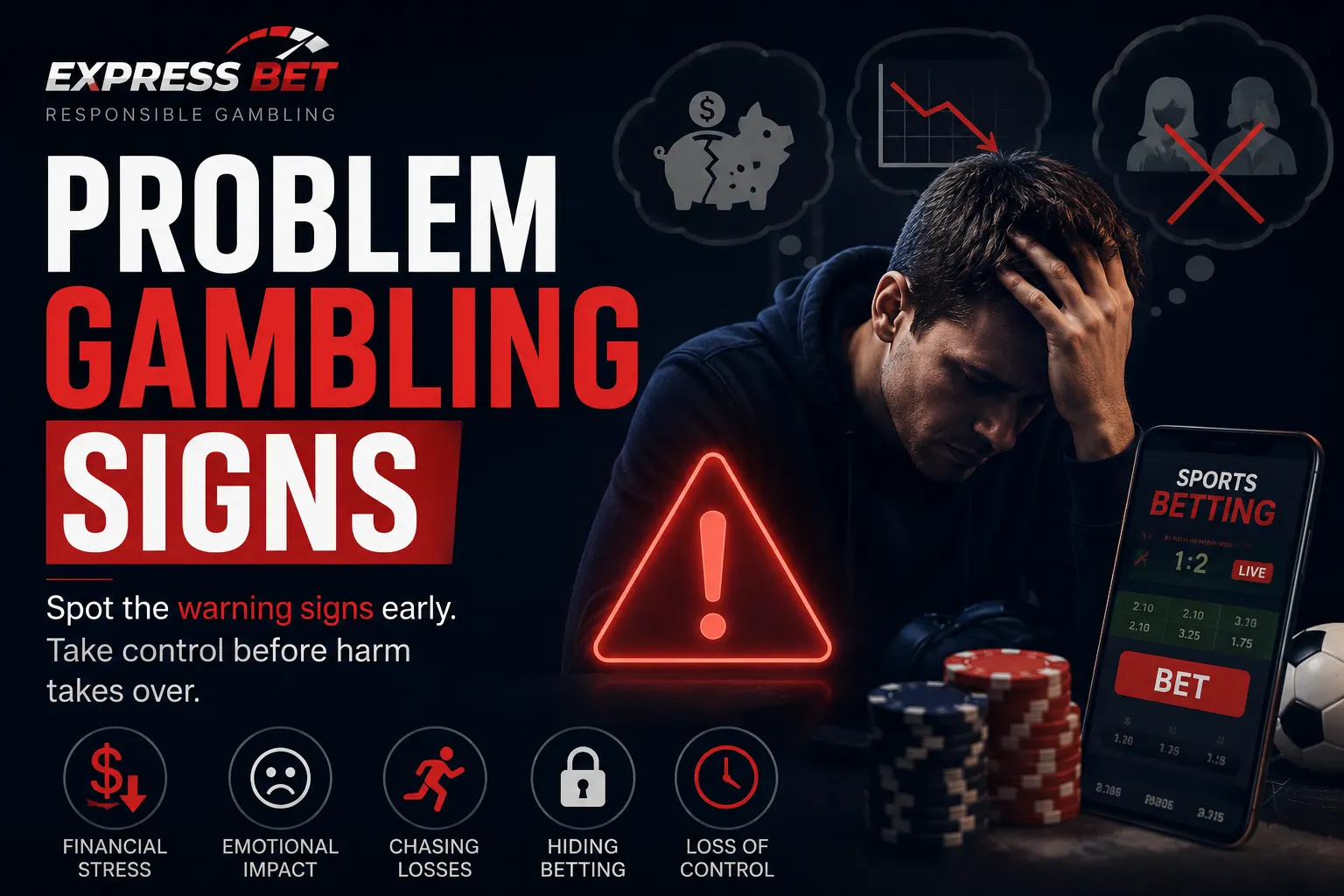
Problem gambling signs are warning signals that betting may no longer be controlled entertainment. These signs can appear through money use, emotions, behavior, secrecy, relationships, digital habits, account activity, and repeated betting patterns.
Warning signs should be taken seriously because gambling harm can grow before severe debt appears. A user does not need a formal diagnosis to stop betting, set limits, use a cooling-off period, self-exclude, or contact support.
Gambling harm can appear when users bet more than planned, chase losses, hide betting, borrow money, use bill money, raise deposit limits after losses, feel panic after losing, or think constantly about the next bet.
Chasing losses is a serious red flag. A previous loss does not make the next bet more likely to win. Betting again mainly to recover money can increase financial and emotional harm.
Live betting, casino games, crash games, and bonuses can worsen impulsive behavior. Live markets move fast. Casino games create rapid repeated decisions. Bonuses can push users to deposit more or bet more than planned.
Users should stop early if control weakens. Deposit limits, loss limits, session limits, cooling-off tools, and self-exclusion can help, but these tools only work when users do not bypass them.
This article is for educational and harm-awareness purposes only. It is not medical advice, mental health diagnosis, financial advice, or legal advice. A qualified professional or support organization can help assess the situation.
Key Takeaways
- Betting is entertainment, not income.
- Problem gambling signs can appear before serious debt.
- Chasing losses is one of the clearest warning signs.
- Hiding betting can suggest gambling harm is developing.
- Borrowing money to bet requires immediate action.
- Broken limits show that control may be weakening.
- Live betting and casino games can escalate harm quickly.
- Bonuses can push users into overbetting.
- Minors must not gamble.
- Users must check local gambling laws and legal betting age.
- Warning signs should be treated early, not ignored.
- Self-exclusion and support resources matter when limits fail.
What Are Problem Gambling Signs?
Problem gambling signs are changes in behavior, money use, emotions, time use, secrecy, and control that may suggest betting is becoming harmful.
These signs do not automatically mean a person has a diagnosed gambling disorder. They do mean the user should stop, review behavior, and take protective action.
Occasional betting usually has clear boundaries. The user decides a budget, places limited bets, accepts possible losses, and stops when the planned limit is reached.
Harmful betting patterns look different. The user may bet more than planned, hide losses, chase previous losses, borrow money, increase stakes, use multiple accounts, or feel unable to stop.
A single sign may matter. Repeated signs require stronger action. Users should not wait until debt becomes severe. Early action is easier than crisis response.
Problem gambling signs do not require a formal diagnosis to take action. A user can stop betting, set limits, self-exclude, contact support, or speak to someone trusted at the first warning signs.
Betting Is Entertainment, Not Income
Betting is entertainment, not income. Sports betting, esports betting, casino games, crash games, UFC betting, football betting, cricket betting, and live betting all include risk of loss.
Betting outcomes are uncertain. A strong team can lose. A favorite can fail. A fighter can lose by one strike or submission. A cricket market can change after one over. A casino game can create rapid losses.
Bookmaker margin exists. Odds are not neutral guarantees. They include a pricing edge for the bookmaker. This does not mean every bet loses, but it means betting should not be treated as work, savings, investment, or financial planning.
No strategy guarantees profit. No predictor, tipster, AI bot, signal group, bonus, bookmaker ranking, or affiliate review can remove risk.
Users must never bet essential money.
Never bet money needed for:
- rent;
- food;
- bills;
- debt;
- loans;
- family expenses;
- education;
- medical costs;
- emergency savings.
If losing the stake would create stress, conflict, debt, or missed payments, the user should not place the bet.
The Main Categories of Problem Gambling Signs
Problem gambling signs can appear in several areas of life. A user should look at the full pattern, not only one bet.
| Sign Category | What It Includes | Why It Matters |
|---|---|---|
| Financial signs | Repeated deposits, debt, bill money use, borrowing, unpaid expenses | Money harm can escalate quickly |
| Emotional signs | Panic, guilt, anger, shame, anxiety, desperation | Betting may be affecting mental state |
| Behavioral signs | Betting longer than planned, increasing stakes, ignoring limits | Control may be weakening |
| Social signs | Hiding betting, lying, conflict, isolation | Secrecy often signals developing harm |
| Digital/account signs | Multiple accounts, constant app checking, bypassing limits, fake APKs | Account behavior can show loss of control |
| Betting-pattern signs | Frequent live betting, casino after sports losses, large accumulators | Repeated patterns reveal risk better than one bet |
| Legal/age-related signs | Underage gambling, illegal access, fake identity, bypassing restrictions | Can create serious legal and account problems |
A user should treat these categories as a self-check. One sign deserves attention. Multiple signs require stronger protection.
Financial Warning Signs
Financial warning signs are often the easiest to notice. They can also be the most serious because betting can affect rent, food, bills, family expenses, and debt.
Financial warning signs include:
- betting more than planned;
- repeated deposits;
- raising deposit limits after losses;
- using bill money;
- using rent money;
- borrowing money;
- using credit or loans where available;
- overdraft use;
- selling belongings;
- hiding losses;
- asking others for money without explaining betting;
- unpaid bills;
- using savings;
- financial panic after losses.
| Financial Sign | What It May Mean | What To Do |
| Betting more than planned | The budget is not controlling behavior | Stop and review limits |
| Repeated deposits | The user may be chasing losses | Activate deposit limits |
| Raising limits after losses | Emotional recovery behavior may be active | Do not raise limits; take a break |
| Using bill money | Essential money is at risk | Stop immediately |
| Borrowing money | Financial harm may be developing | Seek support |
| Using credit or loans | Losses may be moving into debt | Stop and contact help resources |
| Selling belongings | Severe financial pressure may exist | Seek urgent support |
| Hiding losses | Secrecy and financial harm may overlap | Talk to someone trusted |
| Unpaid bills | Betting is affecting life obligations | Stop betting immediately |
| Financial panic | Losses exceeded emotional tolerance | Use cooling-off or self-exclusion |
If betting affects essential expenses, stop immediately and seek support.
A user should not wait until debt is large. Essential-money use is already a serious stop signal.
Chasing Losses
Chasing losses means placing another bet mainly to recover money lost on a previous bet. It is one of the clearest problem gambling signs.
A previous loss does not make the next bet more likely to win. A lost football bet does not make the next football bet stronger. A losing casino session does not mean a win is due. A failed UFC pick does not make the next method-of-victory bet safer.
Increasing stakes after losses is dangerous. It can turn a small loss into a larger loss. It can also turn one planned session into an uncontrolled sequence.
Chasing losses can appear as:
- betting again immediately after losing;
- raising stake size;
- opening live markets to recover quickly;
- switching to casino games after sports betting losses;
- using crash games to recover money;
- accepting poor odds because of pressure;
- using a bonus to continue after the budget is gone;
- opening another account to keep betting.
Practical rule:
If the next bet exists mainly to recover the previous loss, stop before placing it.
The safer action is to stop, take a cooling-off period, review the situation later, and use stronger limits if needed.
Emotional Warning Signs
Emotional warning signs show that betting may be affecting mood, stress, and self-control.
These signs include:
- stress before or after betting;
- anger after losses;
- panic after losing;
- guilt after betting;
- shame about betting;
- anxiety when unable to bet;
- irritability when interrupted;
- mood depending on betting results;
- using betting to escape sadness, boredom, loneliness, or stress;
- feeling desperate to win.
| Emotional Sign | What It Can Indicate | Safer Response |
| Stress before betting | Betting may no longer feel recreational | Pause before betting |
| Anger after losses | Emotional control may be weakening | Use cooling-off |
| Panic after losing | Losses exceeded comfort level | Stop immediately |
| Guilt after betting | Betting may conflict with limits or values | Review behavior honestly |
| Shame about betting | Secrecy may develop | Talk to someone trusted |
| Anxiety when unable to bet | Betting may be becoming intrusive | Take a break |
| Irritability when interrupted | Betting may be controlling attention | End the session |
| Mood depends on results | Emotional dependence may be forming | Reduce or stop betting |
| Betting to escape emotions | Betting is being used as coping | Seek non-betting support |
| Desperation to win | Chasing risk is high | Do not place another bet |
Betting should not be used to manage sadness, boredom, stress, loneliness, anger, or debt pressure.
Behavioral Warning Signs
Behavioral warning signs show how a user acts around betting. These signs often reveal loss of control before the user admits there is a problem.
Behavioral signs include:
- inability to stop;
- betting longer than planned;
- betting late at night;
- betting during work or study;
- checking odds constantly;
- placing bets without research;
- betting on unfamiliar sports;
- increasing stake size;
- ignoring limits;
- opening multiple accounts;
- using several apps at once;
- switching to faster products;
- betting while drunk or high.
| Behavioral Sign | Why It Matters | First Action |
| Inability to stop | Control may be weakened | Use time-out or self-exclusion |
| Betting longer than planned | Session limits may be failing | Set hard time limits |
| Betting late at night | Fatigue can increase poor decisions | Block late sessions |
| Betting during work or study | Betting is interfering with life | Stop and set access blocks |
| Checking odds constantly | Betting thoughts may be intrusive | Take a break from betting content |
| Betting without research | Impulse is replacing decision-making | Stop the session |
| Betting on unfamiliar sports | User may be chasing action | Do not bet |
| Increasing stakes | Risk is escalating | Return to fixed unit size |
| Ignoring limits | Safety tools are failing | Strengthen limits |
| Multiple accounts | User may bypass controls | Close accounts or self-exclude |
| Several apps at once | Activity is spreading | Reduce access |
| Switching to faster products | Risk may be escalating | Avoid casino and live markets |
| Betting while drunk or high | Judgment is impaired | Do not log in |
One repeated behavior can become a pattern. Patterns matter more than excuses.
Social and Relationship Warning Signs
Social warning signs appear when betting affects trust, communication, family life, work, study, or friendships.
Social warning signs include:
- hiding betting from partner, family, or friends;
- lying about time or money spent;
- avoiding conversations about money;
- conflict over betting;
- neglecting family responsibilities;
- missing work, study, or social plans;
- asking others for money;
- becoming defensive when questioned;
- isolating to bet privately.
Secrecy often indicates gambling harm is already developing. A user who feels the need to hide betting may already know that the behavior has crossed a boundary.
Relationship conflict can also be an early warning sign. If others are asking about betting, money, mood, or time spent on apps, the user should not dismiss the concern automatically.
A safer response is to stop betting, review account history, write down losses, and speak honestly with someone trusted.
Digital and Account Warning Signs
Digital behavior can show problem gambling signs. Betting now often happens through mobile apps, websites, mirror domains, Telegram groups, and affiliate-linked bookmaker pages.
Digital and account signs include:
- checking betting apps constantly;
- keeping multiple bookmaker accounts open;
- bypassing deposit limits;
- deleting betting history;
- using mirror sites;
- installing unofficial APKs;
- joining Telegram tipster groups;
- paying for “VIP signals”;
- using prediction bots;
- hiding betting notifications;
- using private browsing to hide betting;
- creating new accounts after self-exclusion.
| Digital Sign | Risk | What To Do |
| Constant app checking | Betting may dominate attention | Use app timers |
| Multiple accounts | Limits may be bypassed | Close accounts or self-exclude |
| Bypassing deposit limits | Control tools are failing | Stop and use stronger blocks |
| Deleting history | Secrecy is developing | Talk to someone trusted |
| Mirror sites | Unsafe access risk | Verify official channels |
| Unofficial APKs | Security and privacy risk | Delete and avoid |
| Telegram tipster groups | Scam and pressure risk | Leave groups |
| Paid “VIP signals” | False certainty risk | Stop using signals |
| Prediction bots | Fake guarantee risk | Do not trust them |
| Hidden notifications | Secrecy and avoidance | Disable accounts or self-exclude |
| Private browsing | Concealment behavior | Treat as warning sign |
| New accounts after self-exclusion | Serious loss-of-control risk | Seek support immediately |
Digital concealment is not a minor issue. It often shows the user is trying to continue betting while avoiding visibility.
Betting Pattern Warning Signs
Betting patterns are important because problem gambling signs often appear through repetition.
Pattern-based signs include:
- frequent live betting;
- repeated casino use after sports losses;
- large accumulators;
- exact score chasing;
- high-risk props;
- impulsive UFC exact round betting;
- cricket toss betting with oversized stakes;
- esports map chasing;
- betting on every match;
- betting because odds moved;
- betting because a bonus expires;
- betting on unfamiliar events.
A single high-risk bet may be a mistake. Repeated high-risk betting after losses suggests a deeper problem.
Betting because odds moved is also risky. Odds movement does not prove a result. Betting because a bonus expires can also create rushed decisions.
A healthy pattern has limits, planned stakes, clear reasons, and acceptance of losses. A harmful pattern has urgency, secrecy, repeated deposits, and emotional pressure.
Warning Signs in Sports Betting
Sports betting warning signs include betting on every match, backing teams emotionally, placing oversized accumulators, ignoring draw risk, misunderstanding settlement rules, and chasing late goals.
Football users may misunderstand 90-minute result vs qualification markets. A team can draw after 90 minutes and still qualify after extra time or penalties. Confusion here can create frustration and chasing.
Other sports betting signs include:
- betting because a favorite “must win”;
- adding weak selections to raise accumulator odds;
- betting during anger after a red card or VAR decision;
- chasing after a late goal changes the market;
- increasing stake because a team is popular.
Sports betting harm can develop slowly because events are spread across a schedule. Daily match volume can still create repeated betting behavior.
Warning Signs in Live Betting
Live betting can turn one planned bet into a long sequence of impulsive decisions.
Warning signs include:
- repeated in-play bets;
- betting after every goal, wicket, knockout, red card, or map swing;
- chasing after market movement;
- ignoring stream delay;
- reacting emotionally to odds changes;
- continuing after planned session time;
- placing bets during market panic;
- trying to recover money before the match ends.
Live betting feels urgent because odds change quickly. This urgency can weaken judgment.
A user who cannot watch a live market without betting should avoid live betting or use stricter limits.
Warning Signs in Casino and Crash Games
Casino games and crash games can move faster than sports betting. They can create rapid repeated decisions and fast losses.
Casino-related warning signs include:
- switching to casino after sports losses;
- rapid repeated spins or rounds;
- chasing multipliers in crash games;
- increasing stakes after near misses;
- ignoring session time;
- using casino games to “recover” betting losses;
- losing the budget quickly;
- continuing after the planned stop point.
Using casino games to recover sports betting losses is a major warning sign. Casino games should not be used as a recovery tool.
Crash games can be especially risky because they create pressure to cash out at the right moment. Repeated “almost” outcomes can push users into another round.
Warning Signs in Esports Betting
Esports betting warning signs can appear through map chasing, fake signals, and emotional live reactions.
Signs include:
- chasing after one map loss;
- trusting fake predictors;
- joining signal groups;
- betting on low-data matches;
- overreacting to roster rumors;
- betting during emotional live swings;
- ignoring patches and meta changes;
- increasing stakes after a team fight or economy swing;
- betting on unfamiliar teams because odds look attractive.
No esports predictor, Telegram signal group, leaked script claim, or AI bot can guarantee outcomes.
If a user is paying for “inside information” or “sure wins,” the user is exposed to both gambling harm and scam risk.
Warning Signs in UFC Betting
UFC betting has unique warning signs because fights can change instantly.
UFC-specific signs include:
- emotional fighter loyalty;
- oversized method-of-victory bets;
- exact round chasing;
- live betting after knockdowns or submission attempts;
- chasing after controversial decisions;
- betting more because a fighter “must win”;
- increasing stake after weigh-ins or faceoffs without real analysis;
- betting on every fight on the card.
A fighter can look dominant and still lose by submission or knockout. A close decision can produce frustration. That frustration should not lead to another impulsive bet.
Method-of-victory and exact round markets are high risk. Oversized stakes on these markets can indicate poor control.
Warning Signs Linked to Bonuses and Promotions
Bonuses can trigger harmful behavior when users deposit or bet more than planned.
Bonus warning signs include:
- depositing only because a bonus expires;
- accepting bonuses without reading terms;
- betting more to meet wagering requirements;
- opening multiple accounts for bonuses;
- increasing risk to meet minimum odds;
- playing casino games to clear wagering;
- treating free bets as harmless.
| Bonus Warning Sign | Why It Matters | Safer Action |
| Bonus expires soon | Creates rushed decisions | Skip the bonus |
| No terms read | User may misunderstand restrictions | Read or avoid |
| Wagering pressure | User may overbet | Set wagering limit |
| Multiple bonus accounts | Can signal chasing behavior | Stop and review |
| Higher odds required | User may choose risky markets | Do not force bets |
| Casino wagering | Fast-play risk rises | Avoid casino clearing |
| Free bet feels harmless | Can lead to follow-up deposits | Use small boundaries |
A bonus is not harmless if it causes the user to deposit more, bet more, or choose markets they do not understand.
Warning Signs Linked to Bookmaker Reviews and Affiliate Links
Express Bet may publish bookmaker reviews, betting guides, comparisons, affiliate links, event betting pages, esports betting pages, casino-related informational content, and responsible gambling content.
Reviews are informational. Rankings do not guarantee safety, winnings, withdrawals, or personal control. Affiliate links may generate commission.
Users should not register only because a review is positive. Users should not deposit because a ranking looks high. Users should verify license, legal eligibility, terms, payments, KYC, bonus rules, privacy policy, and responsible gambling tools.
No review, ranking, affiliate link, or bonus should be treated as a reason to gamble more than planned.
A user should use reviews as research, not as permission to bet.
When Warning Signs Become Urgent
Some warning signs require immediate action.
Urgent stop signals include:
- using rent, food, or bill money;
- borrowing money to bet;
- selling belongings;
- hiding debt;
- lying to family;
- trying to bypass self-exclusion;
- feeling unable to stop;
- feeling unsafe or overwhelmed;
- gambling causing severe conflict;
- gambling causing panic or desperation;
- opening new accounts after limits;
- betting while drunk or high;
- thinking about gambling constantly.
If you feel unsafe or overwhelmed, contact [Local Emergency Number] or [Country-Specific Support Resource].
Urgent signs should not be negotiated with. The correct action is to stop betting and seek support.
Self-Check: Problem Gambling Signs Checklist
Answer each item honestly:
- I bet more than planned.
- I chase losses.
- I hide betting.
- I borrow money to bet.
- I use essential money.
- I raise limits after losses.
- I bet late at night.
- I use casino games after sports losses.
- I feel guilty after betting.
- I cannot stop thinking about betting.
- I open multiple accounts.
- I ignore self-exclusion or limits.
Interpretation:
- 1–2 signs: stop and review behavior.
- 3–5 signs: use cooling-off tools and talk to someone.
- 6+ signs or any debt/essential-money sign: stop betting and seek support immediately.
This checklist does not diagnose addiction. It helps users identify risk and act early.
What To Do If You Notice Warning Signs
If warning signs appear, take action before harm escalates.
- Stop betting immediately.
- Do not redeposit.
- Do not increase stakes.
- Do not open casino games.
- Write down what happened.
- Set or lower deposit limits.
- Set or lower loss limits.
- Use a cooling-off period.
- Use self-exclusion if signs repeat.
- Talk to someone trusted.
- Contact gambling support if money, stress, or secrecy is involved.
A user should not wait for a “perfect time” to stop. The best time to stop is when the warning sign appears.
How Limits Help When Warning Signs Appear
Limits can reduce harm when warning signs appear, but only if users do not bypass them.
| Tool | When To Use It |
| Deposit limit | Repeated deposits or raising budget |
| Loss limit | Losing more than planned |
| Stake limit | Increasing stakes after losses |
| Wagering limit | Repeated small bets or overactivity |
| Session limit | Betting longer than planned |
| Cooling-off period | Emotional betting or chasing |
| Self-exclusion | Repeated broken limits or loss of control |
If a user keeps bypassing limits, self-exclusion and support resources may be necessary.
Limits are not proof of control if the user is constantly trying to work around them.
How to Talk to Someone About Gambling Harm
Secrecy increases harm. Talking to someone can reduce pressure and create accountability.
Users can speak with:
- family;
- friends;
- counselor;
- doctor;
- mental health professional;
- financial advisor;
- gambling support organization.
Users should be honest about money, time, and behavior. They do not need to explain every detail at first. A first message can be simple: “I think betting is becoming a problem, and I need help stopping.”
Users should not wait until debt becomes severe. Support can start with one message or one call.
Users may contact [Responsible Gambling Help Organization] or [National Gambling Helpline] where available.
Where to Get Help
Support resources vary by country and region. Users should verify current local resources.
Users may contact:
- [Responsible Gambling Help Organization]
- [National Gambling Helpline]
- [Self-Exclusion Register]
- [Regulator Website]
- [Country-Specific Support Resource]
- a doctor;
- a counselor;
- a mental health professional;
- a trusted family member or friend;
- financial counseling services.
If you feel unsafe or overwhelmed, contact [Local Emergency Number] or [Country-Specific Support Resource].
Users should verify current responsible gambling resources, legal requirements, bookmaker licensing status, and support contacts in their own country or region before relying on them.
Privacy and Problem Gambling Support
Users may share personal information when seeking support. They should understand how that information may be handled.
Express Bet should not request unnecessary sensitive data. Users should avoid sending financial documents, ID documents, betting account screenshots, or private health details unless necessary and secure.
Third-party bookmakers process responsible gambling data under their own privacy policies. This may include deposit limits, loss limits, self-exclusion records, KYC documents, payment data, and account activity.
Users should check privacy policies before submitting support forms or uploading documents.
Express Bet Problem Gambling Awareness Statement
Express Bet provides informational content only. Express Bet may publish bookmaker reviews, betting guides, comparisons, affiliate links, and responsible gambling content.
Express Bet does not guarantee bookmaker safety, winnings, withdrawals, odds value, user outcomes, or legal eligibility. Express Bet does not diagnose gambling addiction or gambling disorder.
Users remain responsible for checking:
- local gambling laws;
- legal betting age;
- operator terms;
- payment rules;
- withdrawal rules;
- privacy policies;
- KYC requirements;
- bonus rules;
- responsible gambling tools.
Users should stop betting if warning signs appear. Users should seek support if betting creates stress, secrecy, debt, conflict, guilt, panic, or loss of control.
FAQ
Problem gambling signs are warning signals that betting may be becoming harmful. They can involve money, mood, behavior, secrecy, relationships, account activity, or repeated betting patterns.
There is no single first sign for every user. Common early signs include betting more than planned, chasing losses, hiding betting, or feeling stressed after losses.
Yes. Chasing losses is a serious warning sign because the next bet is being used to recover the previous loss.
Yes. Hiding betting can suggest secrecy, shame, or loss of control. It should be taken seriously.
Yes. Borrowing money to bet can indicate financial harm. The user should stop betting and seek support.
Yes. Betting with bill money, rent money, food money, or debt money is an urgent stop signal.
Yes. Live betting can increase impulsive behavior because odds move quickly and users may react emotionally.
Casino games can move faster than sports betting. Rapid spins, rounds, or crash-game decisions can create fast losses.
A bonus is not automatically a warning sign. It becomes a warning sign when it pushes a user to deposit more, bet more, or ignore limits.
Betting apps can increase access and frequency. Constant app checking, hidden notifications, or multiple accounts can be warning signs.
No prediction tool, tipster, AI bot, signal group, or fixed-match claim can guarantee results. Many such products can increase risk or expose users to scams.
Stop betting immediately. Do not redeposit. Use a cooling-off period. Lower limits. Use self-exclusion if the breach repeats.
Use cooling-off after chasing losses, emotional betting, broken limits, hiding betting, or betting more than planned.
Use self-exclusion when limits fail repeatedly, control weakens, debt appears, or betting creates stress, secrecy, or conflict.
Start with a direct message to a trusted person or support service. State that betting may be becoming harmful and that you need help stopping.
No. Minors must not gamble online. Users must meet the legal betting age in their location.
Express Bet is an informational website unless the owner states otherwise. Third-party bookmakers handle betting accounts, odds, deposits, withdrawals, and wagers.
No. Express Bet does not diagnose gambling addiction or gambling disorder. This page is educational and cannot replace professional support.
Users may contact [Responsible Gambling Help Organization], [National Gambling Helpline], [Self-Exclusion Register], [Regulator Website], [Country-Specific Support Resource], a doctor, counselor, trusted person, or financial counseling service.
Yes. Warning signs can appear through stress, secrecy, chasing losses, broken limits, and constant betting thoughts before major debt appears.
Yes. Betting should stop if it creates stress, panic, guilt, secrecy, conflict, or loss of control.
Check your recent behavior, limits, budget, legal age, local law, bookmaker terms, responsible gambling tools, and whether betting is still controlled entertainment.
Conclusion
Problem gambling signs can appear through money, mood, behavior, secrecy, relationships, digital habits, and account activity. Users should act early.
Chasing losses, borrowed money, essential money, secrecy, broken limits, and inability to stop require immediate attention. These signs should not be ignored.
Betting is entertainment, not income. No strategy, tipster, prediction tool, bonus, bookmaker ranking, or affiliate review can remove risk.
Users should use deposit limits, loss limits, session limits, cooling-off tools, self-exclusion, and support resources. These tools reduce harm, but they do not make betting safe or profitable.
Users should seek help early if betting creates stress, debt, secrecy, conflict, guilt, panic, or loss of control. Early action is protection, not failure.
[expert_review params=»JTdCJTIyY29sb3IlMjIlM0ElMjJncmVlbi0yJTIyJTJDJTIyZXhwZXJ0X2F2YXRhciUyMiUzQSUyMiUyMiUyQyUyMmV4cGVydF9uYW1lJTIyJTNBJTIyJTIyJTJDJTIyZXhwZXJ0X2xpbmslMjIlM0ElMjIlMjIlMkMlMjJleHBlcnRfaWQlMjIlM0ElMjIxJTIyJTJDJTIyZXhwZXJ0X3R5cGUlMjIlM0ElMjJleHBlcnRfaWQlMjIlMkMlMjJleHBlcnRfYXZhdGFyX2FsdCUyMiUzQSUyMiUyMiUyQyUyMmV4cGVydF9zaG93JTIyJTNBMSUyQyUyMmV4cGVydF9kZXNjcmlwdGlvbiUyMiUzQSUyMlNwb3J0cyUyMEJldHRpbmclMjBBbmFseXN0JTIwJTI2JTIwRWRpdG9yaWFsJTIwQ29udHJpYnV0b3IlMjIlMkMlMjJleHBlcnRfc2hvd19idXR0b24lMjIlM0ExJTJDJTIyZXhwZXJ0X3Nob3dfYnV0dG9uX3R5cGUlMjIlM0ElMjJwb3B1cCUyMiUyQyUyMmV4cGVydF9xdWVzdGlvbl9idXR0b25fdGV4dCUyMiUzQSUyMkFzayUyMFF1ZXN0aW9uJTIyJTJDJTIycXVlc3Rpb25fZXh0ZXJuYWxfbGluayUyMiUzQSUyMiUyMiUyQyUyMnBvcHVwX3VzZV9waG9uZSUyMiUzQTAlMkMlMjJleHBlcnRfdGl0bGUlMjIlM0ElMjJBdXRob3IlMjIlMkMlMjJleHBlcnRfc2hvd190aXRsZSUyMiUzQTElMkMlMjJleHBlcnRfdGV4dCUyMiUzQSUyMkFsZXglMjBNb3JnYW4lMjBpcyUyMGElMjBzcG9ydHMlMjBiZXR0aW5nJTIwYW5hbHlzdCUyMGFuZCUyMGVkaXRvcmlhbCUyMGNvbnRyaWJ1dG9yJTIwd2hvJTIwd3JpdGVzJTIwZGV0YWlsZWQlMjBib29rbWFrZXIlMjByZXZpZXdzJTJDJTIwYmV0dGluZyUyMGd1aWRlcyUyQyUyMHBsYXRmb3JtJTIwY29tcGFyaXNvbnMlMkMlMjBhbmQlMjByZXNwb25zaWJsZSUyMGdhbWJsaW5nJTIwZXhwbGFpbmVycy4lMjBIaXMlMjB3b3JrJTIwZm9jdXNlcyUyMG9uJTIwcHJhY3RpY2FsJTIwaW5mb3JtYXRpb24lMjBmb3IlMjB1c2VycyUyMHdobyUyMHdhbnQlMjB0byUyMHVuZGVyc3RhbmQlMjBob3clMjBiZXR0aW5nJTIwc2l0ZXMlMjBvcGVyYXRlJTIwYmVmb3JlJTIwdGhleSUyMHJlZ2lzdGVyJTJDJTIwZGVwb3NpdCUyQyUyMG9yJTIwY2xhaW0lMjBhJTIwYm9udXMuJTIyJTJDJTIycWElMjIlM0ElNUIlNUQlMkMlMjJxYV9zaG93X3RpdGxlJTIyJTNBMSUyQyUyMnFhX3RpdGxlJTIyJTNBJTIyJUQwJTkyJUQwJUJFJUQwJUJGJUQxJTgwJUQwJUJFJUQxJTgxJTIwJUQxJThEJUQwJUJBJUQxJTgxJUQwJUJGJUQwJUI1JUQxJTgwJUQxJTgyJUQxJTgzJTIyJTJDJTIyc2NvcmUlMjIlM0ElNUIlNUQlMkMlMjJzY29yZV9zdW1tYXJ5X3RleHQlMjIlM0ElMjIlMjIlMkMlMjJzY29yZV9zdW1tYXJ5X2F2ZXJhZ2UlMjIlM0EwJTJDJTIyc2NvcmVfbWF4JTIyJTNBJTIyNSUyMiUyQyUyMnNjb3JlX3N5bWJvbCUyMiUzQSUyMiUyMiUyQyUyMnNjb3JlX3RpdGxlJTIyJTNBJTIyJTIyJTJDJTIyc2NvcmVfc2hvd190aXRsZSUyMiUzQTAlMkMlMjJwbHVzZXMlMjIlM0ElNUIlNUQlMkMlMjJtaW51c2VzJTIyJTNBJTVCJTVEJTJDJTIycGx1c2VzX21pbnVzZXNfc2hvd190aXRsZSUyMiUzQTElMkMlMjJwbHVzZXNfbWludXNlc190aXRsZSUyMiUzQSUyMiVEMCU5RiVEMCVCQiVEMSU4RSVEMSU4MSVEMSU4QiUyMCVEMCVCOCUyMCVEMCVCQyVEMCVCOCVEMCVCRCVEMSU4MyVEMSU4MSVEMSU4QiUyMiUyQyUyMnBsdXNlc190aXRsZSUyMiUzQSUyMiUyMiUyQyUyMm1pbnVzZXNfdGl0bGUlMjIlM0ElMjIlMjIlN0Q=»]