
How to Bet Online: Complete Beginner Guide
Table of Contents Show
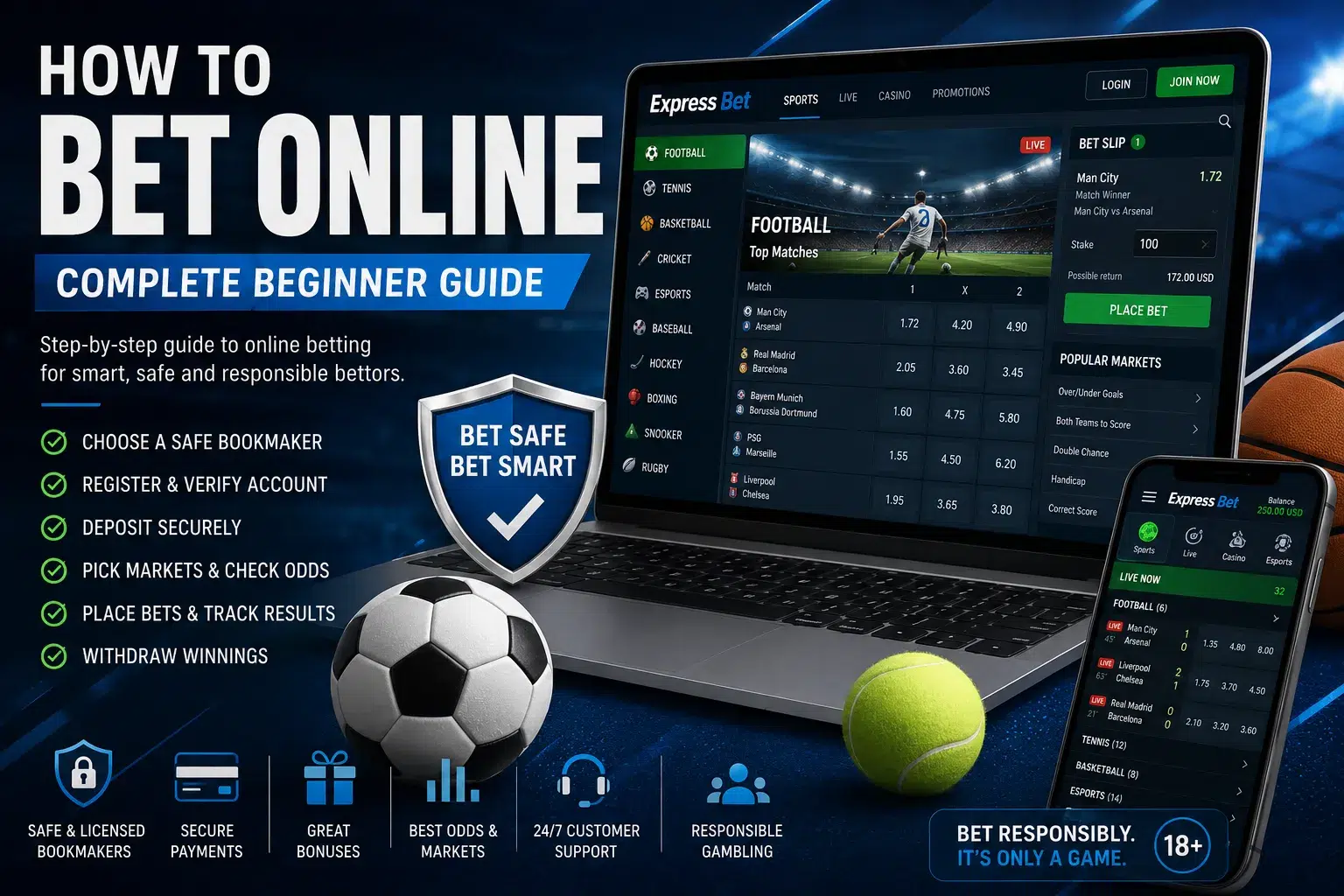
Online betting means placing wagers on sports, esports, and selected events through an online bookmaker or sportsbook account. A beginner can bet online by choosing a safe bookmaker, registering an account, completing KYC verification when required, depositing money, selecting a sport and betting market, checking the odds, entering a stake, confirming the betting slip, and waiting for the result. Safe online betting requires legal awareness, secure payments, clear withdrawal rules, realistic bankroll management, and responsible gambling controls. Betting odds, stake size, payout, bonus terms, and account verification matter because they affect risk, possible return, and withdrawal access. Online betting never guarantees profit. Users must only bet money they can afford to lose, avoid chasing losses, and use deposit limits, loss limits, cooling-off tools, or self-exclusion when betting stops feeling controlled.
 500% on first depositBETTINGPETTING
 200% on first depositAVIATOR2049
 500% on first depositEXPRESSBET
 Welcome 150% Casino Bonus + 100 Free Spins
 Welcome Bonus up to 127 000 INR + 150 FS
 100% on first deposit with up to $275
 250 Free spins in selected slots
Online betting allows users to place bets through digital betting sites, online sportsbooks, or betting apps. The user chooses an event, selects a market, accepts the odds, enters a stake, and confirms the bet. If the selection wins, the bookmaker pays the return based on the odds. If the selection loses, the stake is lost.
A beginner needs several things before placing a bet online: legal access in the user’s region, a safe bookmaker, a verified sportsbook account, a payment method, a small betting budget, and a clear understanding of the selected market.
Bookmaker selection matters because unsafe online betting sites may delay withdrawals, hide terms, offer weak support, or use misleading bonuses. Bankroll control matters because even good bets can lose. Betting must stay entertainment, not income.
Online betting is the process of placing wagers through a website or mobile app instead of a land-based betting shop. The bookmaker publishes betting odds on sports, esports, and sometimes non-sport events. The user chooses a market, selects an outcome, enters a stake, and confirms the wager.
Online betting differs from land-based betting because the full process happens digitally. The user can register, deposit, place bets, track results, and request withdrawals from a computer or mobile device. This convenience makes betting easier, but it also increases risk because users can bet quickly and repeatedly.
Bookmakers offer odds to show the possible payout and the implied probability of an outcome. Lower odds usually mean a more likely outcome and smaller return. Higher odds usually mean a less likely outcome and larger return.
Example:
A user chooses a football match. The user selects Team A to win at decimal odds of 2.00. The user stakes $10. If Team A wins, the total return is $20. The profit is $10 because the original $10 stake is included in the return.
Formula:
Stake × Odds = Total Return
Total Return − Stake = Profit
Online betting is also different from casino gaming. Sports betting depends on real sports or esports outcomes and bookmaker odds. Casino games usually use random number generators, live dealer rules, or fixed game mechanics. A sports betting strategy does not control casino results.
Online betting follows a clear process. The steps are simple, but each step carries risk if the user ignores rules, limits, or account safety.
Basic process:
Flow diagram:
Choose Bookmaker → Register → Verify Account → Deposit → Select Event → Choose Market → Enter Stake → Place Bet → Track Result → Withdraw
The user must understand that a bet becomes active after confirmation. Most confirmed bets cannot be cancelled unless the bookmaker offers cash out or special cancellation rules. Users should check the event, market, odds, stake, and possible return before confirming.
Online betting legality depends on the user’s country, state, or region. Some places allow licensed online sportsbooks. Some places allow limited betting markets. Some places ban online gambling. Some places restrict offshore bookmakers.
Users must check local law before opening a sportsbook account. This guide does not provide legal advice because gambling laws change by jurisdiction.
Important legal points include:
VPN use can create account problems. Some users try to access blocked betting sites with a VPN. This can violate bookmaker terms. It can also cause account closure, balance review, or withdrawal refusal. A user should not assume that technical access means legal or permitted access.
A safe betting process starts with legal access. If the user is not sure whether betting is allowed, the user should check local rules before depositing money.
A safe online bookmaker gives users clear information before registration. It explains license details, payment rules, bonus terms, withdrawal limits, KYC requirements, and responsible gambling tools.
A weak bookmaker often hides important details. It may advertise large bonuses, but it may delay withdrawals or add unclear restrictions later.
| Bookmaker Feature | Why It Matters | What to Check |
|---|---|---|
| License and Regulation | Shows legal oversight | Regulator name, license number, operating company |
| Company Information | Shows transparency | Legal entity, address, ownership details |
| Secure Website | Protects account data | HTTPS connection, official domain, no suspicious redirects |
| Terms and Conditions | Defines user rights | Withdrawal rules, bonus rules, account limits |
| Responsible Gambling Tools | Helps users control risk | Deposit limits, loss limits, self-exclusion |
| Reliable Withdrawals | Protects winnings | Processing time, limits, KYC rules |
| Fair Bonus Terms | Prevents locked funds | Wagering requirements, expiry dates, minimum odds |
| Sports Coverage | Improves market choice | Football, cricket, tennis, basketball, esports |
| Mobile Quality | Supports safe use | Official app, mobile website, stable bet slip |
| Customer Support | Solves account issues | Live chat, email, response speed |
| Complaint History | Shows user experience | Repeated withdrawal or support complaints |
| Payment Availability | Affects deposits and withdrawals | Cards, bank transfer, e-wallets, UPI, crypto |
A user should not judge a bookmaker only by bonus size. A smaller bonus with clear terms can be better than a large bonus with restrictive wagering rules.
Unsafe betting sites often show the same warning signs. Users should avoid platforms that hide core information or push aggressive deposits.
Red flags include:
A site that hides payment rules or withdrawal conditions is not suitable for beginners. The user should be able to read the withdrawal process before making the first deposit.
Registration creates a sportsbook account. The process differs by bookmaker, but most sites follow similar steps.
Typical registration process:
Users must enter real details. Fake names, incorrect birth dates, and mismatched payment details can cause withdrawal problems. Many bookmakers compare account details with KYC documents before paying withdrawals.
Account security tips:
A betting account contains money and personal documents. It should be protected like a financial account.
KYC means “Know Your Customer.” Bookmakers use KYC verification to confirm a user’s identity, age, address, and payment ownership. Verification helps prevent underage betting, fraud, duplicate accounts, money laundering, and payment abuse.
KYC may happen during registration, before the first deposit, before withdrawal, or after suspicious account activity. Some bookmakers allow users to deposit before KYC, but request documents before withdrawal. Users should check this policy before depositing.
Common KYC documents:
| KYC Document | Purpose | Common Requirement |
| Passport | Confirms identity and age | Clear photo, valid document |
| National ID | Confirms legal identity | Front and back image |
| Driver’s License | Confirms identity and age | Valid license photo |
| Proof of Address | Confirms residence | Utility bill, bank statement |
| Payment Proof | Confirms payment ownership | Card photo with hidden digits, wallet screenshot |
| Selfie Verification | Confirms document holder | Selfie with ID or live check |
Users should upload documents only through official bookmaker channels. They should not send documents to Telegram contacts, WhatsApp agents, or unofficial email addresses.
Fake accounts create serious withdrawal risk. If the name on the betting account does not match the payment method or ID document, the bookmaker may freeze withdrawals until the issue is resolved.
A deposit adds money to the sportsbook account. The user should check the minimum deposit, fees, currency, processing time, and bonus impact before paying.
Deposit process:
Common deposit methods:
| Deposit Method | Speed | Best For | Possible Issue |
| Bank Card | Fast | General users | Card rejection or bank block |
| Bank Transfer | Medium | Larger deposits | Slow processing |
| UPI | Fast | Indian users | Bank or app limits |
| Paytm | Fast | Mobile wallet users | Regional availability |
| PhonePe | Fast | Indian mobile payments | Transaction limits |
| Google Pay | Fast | Mobile payments | Bank-side restrictions |
| Skrill | Fast | International users | Fees |
| Neteller | Fast | Betting users | Fees or country limits |
| Jeton | Fast to Medium | Global wallet users | Limited availability |
| Crypto | Fast to Medium | Crypto users | Price volatility |
| Local Wallets | Fast | Country-specific users | Limited bookmaker support |
Users should not deposit more than their bankroll plan allows. A bonus offer should not decide the deposit size. The deposit must fit the betting budget.
A withdrawal sends available money from the sportsbook account to the user’s payment method. Withdrawals often require KYC verification.
Withdrawal process:
Important withdrawal factors:
| Withdrawal Factor | Why It Matters |
| Minimum Withdrawal | User cannot withdraw below this amount |
| Maximum Withdrawal | Large wins may need multiple withdrawals |
| Processing Time | Delays affect user planning |
| KYC Requirements | Unverified accounts may be blocked from withdrawal |
| Same-Method Rule | Some sites return money to the deposit method first |
| Bonus Wagering | Active bonuses can lock funds |
| Pending Period | Withdrawal may stay pending before approval |
| Payment Provider Delay | Bank or wallet may add extra processing time |
Users should read withdrawal rules before depositing. A bookmaker that makes deposits easy but hides withdrawal terms creates avoidable risk.
Betting odds show two things: possible payout and implied probability. The most common odds formats are decimal odds, fractional odds, and American odds.
Decimal odds are simple for international users. They show the total return per $1 staked.
Examples:
The profit is not the full return. The original stake is included.
Example:
A $10 stake at 2.00 returns $20. The profit is $10 because the user gets the $10 stake back inside the total return.
Higher odds usually mean higher risk. A selection at 5.00 pays more because it is less likely than a selection at 1.40. Low odds can still lose. A user should not stake too much only because odds look “safe.”
Bookmakers also include margin in odds. This margin gives the bookmaker an advantage over time. Odds comparison helps users avoid weak prices.
The basic payout formula is:
Stake × Odds = Total Return
The profit formula is:
Total Return − Stake = Profit
| Stake | Odds | Total Return | Profit |
| $5 | 1.50 | $7.50 | $2.50 |
| $10 | 2.00 | $20 | $10 |
| $20 | 2.50 | $50 | $30 |
| $50 | 3.00 | $150 | $100 |
A bet with higher odds can create a larger return, but the chance of losing is usually higher. Users should calculate payout before confirming the betting slip.
Online betting sites offer several bet types. Beginners should start with simple formats before using complex tickets.
A single bet has one selection on one event. Example: Team A to win a football match. This is the easiest format to understand and track.
An accumulator bet combines multiple selections in one bet slip. All selections must win. If one selection loses, the whole accumulator loses. Accumulators offer higher potential payout but higher risk.
A system bet combines selections in a more complex structure. Some selections can lose while part of the system still wins. System bets require stronger understanding and are not ideal for first-time users.
A live bet happens while the event is already in progress. Odds change quickly. Live betting is also called in-play betting.
An outright bet predicts a tournament, league, or season winner. Example: a team to win the Champions League or a player to win a tennis tournament.
A player prop bet focuses on player performance. Examples include player goals, assists, points, rebounds, runs, wickets, shots, cards, or kills in esports.
Bet builder allows users to combine several markets from one event. Example: Team A to win, over 2.5 goals, and one player to score. Bet builder creates attractive odds but increases risk.
| Bet Type | How It Works | Risk Level | Best For |
| Single Bet | One selection | Lower | Beginners |
| Accumulator | Multiple selections, all must win | High | Small-stake users |
| System Bet | Multiple combinations | Medium to High | Experienced users |
| Live Bet | Bet during event | High | Fast, disciplined users |
| Outright | Long-term winner | Medium to High | Season/tournament followers |
| Player Prop | Player performance | Medium | Users with player knowledge |
| Bet Builder | Several markets in one event | High | Advanced users |
A betting market is the specific outcome a user chooses. Different sports offer different markets.
| Market | Meaning | Example | Risk Level |
| Match Winner | Bet on who wins | Team A to win | Medium |
| Double Chance | Two outcomes covered | Team A or draw | Lower |
| Handicap | Virtual advantage/disadvantage | Team A -1.5 | Medium |
| Totals / Over-Under | Total goals, points, runs, sets | Over 2.5 goals | Medium |
| Both Teams to Score | Both teams must score | Yes/No | Medium |
| Correct Score | Exact final score | 2-1 | High |
| First Goal Scorer | First player to score | Player A | High |
| Player Points | Player performance total | Over 24.5 points | Medium |
| Total Runs | Cricket run total | Over 165.5 runs | Medium |
| Set Betting | Tennis set score | Player A 2-0 | Medium to High |
| Map Winner | Esports map result | Team A map 1 | Medium |
| Outrights | Tournament winner | Team A to win league | Medium to High |
Beginners should choose markets they understand. A user should not bet on corners, cards, player props, or map handicaps without knowing how the market is settled.
A first bet should be small, simple, and easy to track. The goal is to understand the process, not to win a large amount.
Step-by-step process:
Practical example:
Sport: Football
Market: Match Winner
Selection: Team A
Odds: 2.00
Stake: $10
Potential return: $20
Potential profit: $10
If Team A wins, the user receives $20 total. If Team A draws or loses, the $10 stake is lost.
A beginner should not place the first bet on a long accumulator, live market, unknown league, or emotional favorite team pick. A single bet teaches the process more clearly.
A betting slip is the confirmation panel that shows the selected bet before placement. It usually appears after the user clicks the odds.
A betting slip shows:
Users must check the slip before confirming. Common mistakes include selecting the wrong team, wrong market, wrong stake, or wrong odds. Odds can change before confirmation. Some bookmakers ask users to accept the new odds before placing the bet.
A confirmed bet usually cannot be reversed. Checking the slip is a basic safety habit.
Pre-match betting happens before the event starts. Live betting happens during the event.
| Factor | Pre-Match Betting | Live Betting |
| Timing | Before the event | During the event |
| Odds Movement | Slower | Fast |
| Research Time | More time | Less time |
| Emotional Risk | Lower | Higher |
| Market Suspension | Rare | Common |
| Stream Delay Risk | No | Yes |
| Beginner Suitability | Better | Riskier |
| Decision Speed | Controlled | Fast |
Beginners should start with pre-match betting because it allows more time for research. The user can check lineups, injuries, team form, odds movement, and market rules.
Live betting can be useful for experienced users, but it creates pressure. A goal, red card, wicket, injury, or sudden momentum change can push users into fast decisions. Streams may also be delayed. The bookmaker’s odds may already reflect action that the user has not seen yet.
Live betting needs strict limits. A user should never chase losses through in-play betting.
Mobile betting allows users to place bets through a phone or tablet. Most bookmakers provide either a mobile website, Android app, iOS app, or all three.
Important mobile features include:
A good online betting app should make the bet slip clear and prevent accidental stake errors. A poor app may freeze, delay odds updates, or make market navigation confusing.
APK safety warning:
Users should download betting apps only from official bookmaker websites or official app stores. Unofficial APK files can steal personal data, payment details, login information, and documents. Telegram APK links and random mirror links are high risk.
Betting sites use bonuses to attract users. A bonus can help when the terms are clear, but it can also lock money behind strict rules.
Common bonuses:
| Bonus Type | How It Works | Main Risk |
| Welcome Bonus | Extra funds after first deposit | High wagering requirements |
| Free Bet | Bet without using cash stake | Profit may exclude stake |
| Reload Bonus | Bonus on later deposits | Encourages extra deposits |
| Cashback | Returns part of losses | Conditions may limit use |
| Odds Boost | Increased odds on selected bets | Limited markets |
| Accumulator Bonus | Extra payout on multi-bets | High accumulator risk |
| Risk-Free Bet | Refund after losing bet | Refund may be bonus credit |
| Loyalty Reward | Ongoing rewards | May push overbetting |
| Casino Bonus | Bonus for casino games | Strict wagering rules |
Bonus terms to check:
A large bonus with strict terms may be worse than a smaller bonus with fair terms. Users should not deposit more than planned because of a promotion.
Bankroll management means controlling the money used for betting. It protects users from random staking, emotional decisions, and fast losses.
Basic rules:
| Bankroll Size | 1% Stake | 2% Stake | Beginner Advice |
| $50 | $0.50 | $1 | Use tiny stakes and learn |
| $100 | $1 | $2 | Good beginner structure |
| $250 | $2.50 | $5 | Track every bet |
| $500 | $5 | $10 | Avoid emotional stake jumps |
| $1000 | $10 | $20 | Use strict loss limits |
A beginner should not deposit $100 and stake $20 on one bet. That is 20% of the bankroll. A few losses can destroy the balance. Small stakes help users learn without severe damage.
Different bookmakers can offer different odds on the same event. Odds comparison can improve potential return.
| Bookmaker | Odds on Same Selection | Return on $10 Stake |
| Bookmaker A | 1.85 | $18.50 |
| Bookmaker B | 1.90 | $19.00 |
| Bookmaker C | 1.95 | $19.50 |
The difference looks small on one bet. Over many bets, small odds differences matter. A user who always accepts weaker odds reduces long-term value.
Odds comparison does not guarantee profit. It only helps users avoid poor prices.
Cash out lets users close a bet before the event ends. The bookmaker offers a settlement amount based on the current status of the bet.
Types:
Cash out can reduce risk when the event changes. It can also lock partial profit. However, the offered amount may be lower than the true value of waiting. The bookmaker controls the cash out price.
Users should not use cash out emotionally after every score change. It should be part of a plan, not a panic button.
Beginners often repeat the same mistakes.
Common mistakes include:
The most dangerous mistake is chasing. A user loses a bet, increases the next stake, and tries to recover immediately. This can destroy bankroll control.
Online betting attracts scammers because many users want certainty. Scammers sell fake confidence.
Common scams include:
No tool can guarantee sports results. Sports outcomes include uncertainty. Anyone who asks for account access, document photos, deposits, or payment for “sure wins” is dangerous.
Users should never share sportsbook login details. They should not install prediction APKs from unknown sources. They should not send money to tipsters who claim fixed results.
Different sports need different betting logic. A user should not use one simple method across all markets.
Football betting includes match winner, totals, both teams to score, handicaps, corners, cards, correct score, and player markets. Football can be low scoring, so one red card, penalty, or late goal can change the result.
Users should check lineups, injuries, team motivation, schedule congestion, and home advantage.
Cricket betting includes match winner, top batter, total runs, wickets, innings markets, and live-over betting. Toss, pitch, weather, batting order, and format matter. T20 cricket moves faster than Test cricket.
Users should avoid large stakes before toss-dependent markets.
Tennis betting includes match winner, set betting, game handicap, total games, and outright markets. Surface, fitness, travel, form, and mental pressure matter.
Users should check retirement rules because bookmakers settle retired matches differently.
Basketball betting includes moneyline, spread, totals, player points, rebounds, assists, quarters, and live markets. Basketball has fast scoring and sharp momentum swings.
Users should check injuries, rest days, player minutes, and team rotation.
Combat sports betting includes fight winner, method of victory, round betting, and total rounds. One punch, injury, cut, or judge decision can decide the outcome.
Users should use small stakes on exact round and method markets.
Esports betting includes CS2, Dota 2, League of Legends, Valorant, and other games. Markets include match winner, map winner, total maps, round handicaps, and tournament winners.
Users should check rosters, patches, map vetoes, and tournament motivation.
Esports betting follows the same core process as sports betting, but it needs game-specific knowledge.
Steps:
Esports live betting can be risky because odds move quickly after early rounds, draft decisions, economy shifts, objectives, or map control changes. A user who does not understand the game should avoid live esports markets.
Many sportsbooks also offer casino sections. These may include slots, live casino, roulette, blackjack, baccarat, crash games, and instant games.
Casino games differ from sports betting. Sports betting uses odds on real events. Casino games use random number generators, live dealer rules, or fixed mechanics.
Important warning:
Users should not use casino games to recover sports betting losses. Casino games can run faster than sports bets. A user can place many bets in minutes. This speed creates higher emotional risk.
Sports bankroll and casino bankroll should stay separate.
Responsible gambling is the most important part of online betting. Betting must stay entertainment. It must not become a way to earn income, pay bills, recover debt, or solve financial problems.
Rules:
Users should stop immediately if they lose control. Warning signs include borrowing money, hiding losses, lying about betting, chasing losses, panic after losing, and inability to stop after reaching limits.
Before placing the first online bet, the user should confirm:
If one answer is unclear, the user should pause before depositing.
Safe online betting is not about betting more. It is about betting with fewer uncontrolled decisions.
Example session:
This structure is safer than depositing $100 and staking $20 immediately. The user risks 1% of the bankroll on one bet instead of 20%. The stop-loss also prevents emotional chasing.
A safe first session teaches the platform, bet slip, odds, settlement, and withdrawal process. It does not chase a large win.
Online betting is simple to start but risky without control. A beginner can register, deposit, and place a bet in minutes. That convenience creates danger when users skip bookmaker research, ignore odds, overuse bonuses, or stake too much.
Bookmaker selection matters because users need safe payments, clear terms, reliable withdrawals, account protection, and responsible gambling tools. Odds understanding matters because payout and risk are linked. Bankroll management matters because losses are normal.
Bonuses need careful reading. A bonus can be useful only when the terms fit the user’s plan. Mobile safety also matters. Users should avoid unofficial APK files and fake betting apps.
Responsible gambling is mandatory. Online betting must stay entertainment. If betting affects money, health, family, work, or sleep, the user should stop.
Choose a licensed bookmaker, create an account, complete verification if required, deposit money, select a sport and market, enter a stake in the betting slip, and confirm the bet.
You need legal access, a safe bookmaker, a registered sportsbook account, a payment method, a betting budget, and basic knowledge of odds and markets.
It depends on the user’s country, state, or region. Users must check local gambling laws before registering or depositing money.
Check license information, company details, withdrawal rules, payment options, responsible gambling tools, customer support, bonus terms, and user complaints.
An online sportsbook is a digital platform where users can place bets on sports, esports, and selected events.
Odds show possible payout and implied probability. In decimal odds, stake multiplied by odds equals total return.
Use this formula: stake × odds = total return. Profit equals total return minus the original stake.
A betting slip is the confirmation panel that shows the selected event, market, odds, stake, possible payout, and confirmation button.
A single bet has one selection on one event. It is the simplest bet type for beginners.
An accumulator combines multiple selections. All selections must win for the bet to pay out.
Live betting means placing bets while the event is already happening. Odds change during the event.
Yes. Live betting is risky because decisions happen quickly, odds move fast, and users may react emotionally.
Log in, open the cashier, choose a payment method, enter the amount, confirm payment, and wait for the sportsbook balance to update.
Open the withdrawal section, choose a payment method, enter the amount, complete KYC if required, confirm the request, and wait for processing.
Bookmakers use KYC to verify identity, age, address, and payment ownership. It helps prevent fraud and underage gambling.
Yes. Many bookmakers offer Android apps, iOS apps, or mobile websites. Users should use only official apps and official websites.
Only official APK files from the bookmaker’s verified website should be considered. Random APK files from Telegram or unknown sites are unsafe.
Beginners should use simple bonuses with clear terms. A small free bet or low-wagering offer can be safer than a large bonus with strict rules.
No. Online betting never guarantees profit. Sports results are uncertain, and bookmakers include margin in odds.
Many beginners use 0.5% to 1% of their bankroll per bet. Small stakes reduce damage from losing streaks.
Bankroll management means controlling the money used for betting. It includes stake size, deposit limits, loss limits, and result tracking.
Set a stop-loss before betting. Stop when the limit is reached. Do not redeposit after emotional losses.
Most guaranteed-pick claims are unreliable. Users should avoid anyone who promises sure wins, fixed matches, or account access profits.
Cash out allows users to close a bet before the event ends. It can reduce risk, but the bookmaker controls the offer.
Stop when betting causes stress, debt, hidden losses, family conflict, work problems, sleep issues, or loss of control.
Online betting requires more than clicking odds and waiting for results. Users need bookmaker research, legal awareness, safe payments, KYC understanding, odds knowledge, bankroll management, and responsible gambling rules.
Beginners should start with simple markets, small stakes, and strict limits. They should read withdrawal rules before depositing, avoid unsafe apps, compare odds, track bets, and reject any claim of guaranteed profit.
Online betting never guarantees income. It should never be funded with essential money. A user who cannot control deposits, losses, time, or emotions should stop betting and use responsible gambling tools immediately.