
Odds Explained: Complete Betting Odds Guide
Table of Contents Show
Betting odds show the possible payout from a sports bet and the implied probability of a selected outcome. Users may see decimal odds, fractional odds, or American odds depending on the sportsbook, region, or betting app. Decimal odds calculate total return by multiplying stake by odds, while profit equals total return minus the original stake. Betting odds also include bookmaker margin, also called overround or vig, which gives the sportsbook an edge over time. Higher odds usually mean higher potential payout but lower implied probability and higher risk. Understanding odds helps users read markets, compare prices, calculate payouts, and avoid poor betting decisions, but it does not guarantee profit. Bankroll management, deposit limits, loss limits, and responsible gambling rules remain essential because every sports bet can lose.
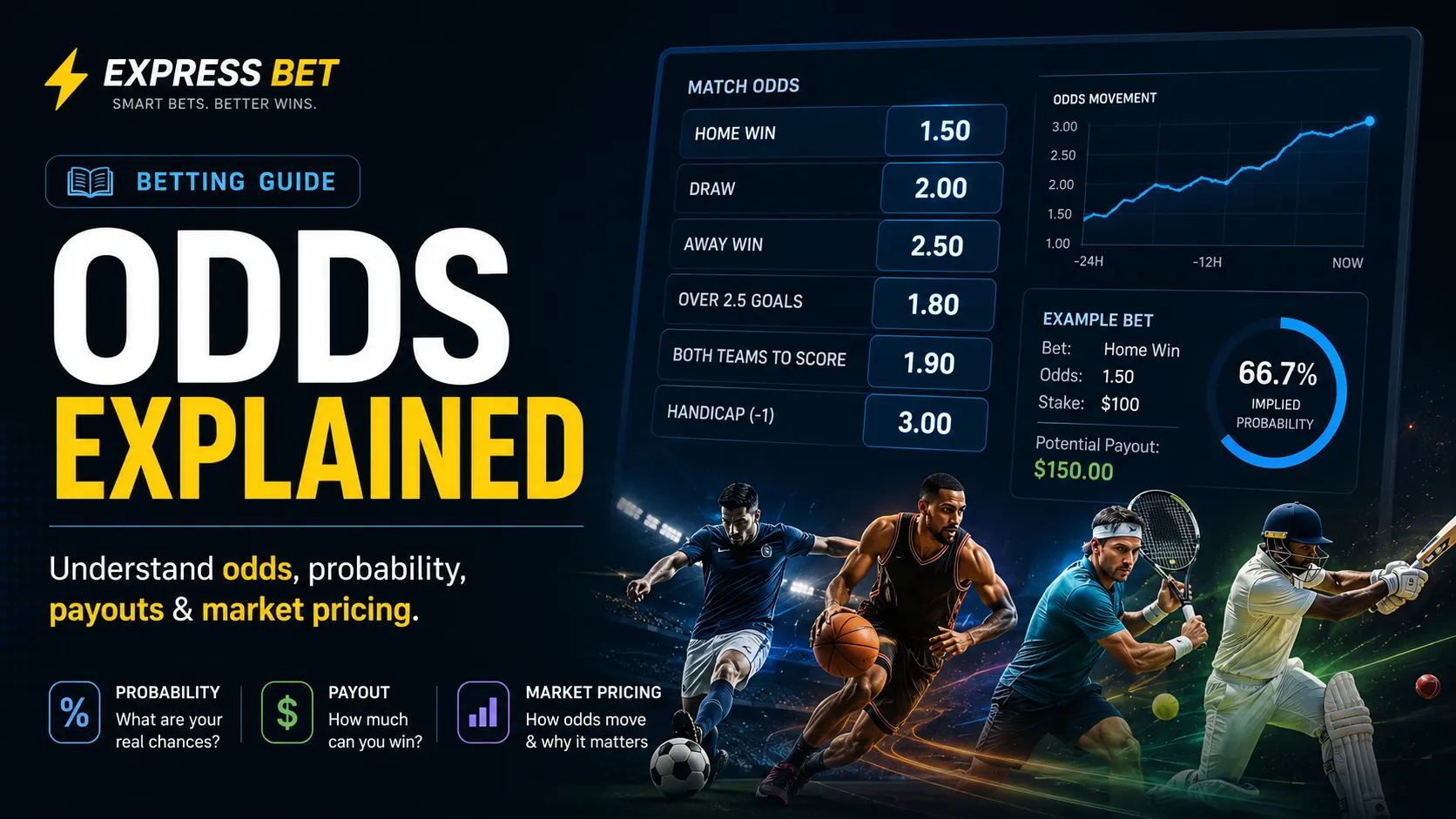
Betting odds are market prices. They show how much a user can receive if a selection wins and how likely the bookmaker believes the outcome is after adding margin. Odds connect three core betting elements: stake, payout, and probability.
Different regions use different odds formats. Decimal odds are common in Europe, Asia, Australia, and many international online sportsbooks. Fractional odds are common in the United Kingdom and horse racing. American odds are common in the United States and are also called moneyline odds.
Odds comparison matters because the same selection can have different prices at different bookmakers. A small odds difference can change the total return. Over many bets, poor prices can damage long-term betting results.
Betting must stay entertainment. Odds knowledge can improve decision quality, but it cannot make sports predictable. Users should use small stakes, track results, set limits, avoid chasing losses, and never bet money needed for bills, rent, food, debt, loans, or family expenses.
Betting odds are numbers that show the price of a selection in a betting market. A selection can be a team, player, outcome, score, total, handicap, or prop. The odds tell the user how much the bet can return if the selection wins.
Odds also reflect probability. A selection with low odds has a higher implied probability. A selection with high odds has a lower implied probability. This does not mean the bookmaker predicts the result with certainty. It means the bookmaker has priced the market based on probability, margin, risk exposure, and betting activity.
A betting market can show several selections. A football match winner market may show Team A, draw, and Team B. A tennis match winner market may show Player A and Player B. A totals market may show over and under.
Example:
A football match offers Team A at decimal odds of 2.00. A user stakes $10. If Team A wins, the total return is $20. The profit is $10.
The total return includes the original stake. The profit excludes the original stake.
Formula:
Stake × Odds = Total Return
Total Return − Stake = Profit
Odds are not guarantees. A favorite can lose. An underdog can win. A low price can fail. A high price can land. Odds show market price, not certainty.
Odds decide possible payout. If two bookmakers offer different odds for the same selection, the bookmaker with the higher odds gives a higher possible return for the same stake.
Odds also show implied probability. A selection at 2.00 has an implied probability of 50% before margin adjustment. A selection at 5.00 has an implied probability of 20%. This helps users understand the risk profile of a bet.
Odds help users compare bookmakers. A bettor who accepts poor prices loses value before the event starts. Odds comparison does not guarantee profit, but it helps users avoid unnecessary disadvantage.
Odds affect accumulator returns. In an accumulator, decimal odds multiply together. This can create a large headline price, but every selection must win. High combined odds can create false confidence.
Odds affect bankroll risk. A user who bets large amounts on low odds may believe the risk is small, but low odds can still lose. A user who chases high odds may suffer long losing streaks. Stake size should match risk.
Odds movement can show market changes. A price may shorten after team news, injury confirmation, public betting volume, or sharp betting activity. A price may drift after negative news or reduced confidence.
Expert note:
Understanding odds helps users measure risk, but it does not make sports outcomes predictable.
Sportsbooks use three main odds formats: decimal, fractional, and American.
Decimal odds are common in Europe, Asia, Australia, and many online sportsbooks. They are the easiest format for total return.
Formula:
Stake × Decimal Odds = Total Return
Example:
A user stakes $10 at odds of 2.50.
$10 × 2.50 = $25 total return
$25 − $10 = $15 profit
Decimal odds include the original stake. This is the main detail beginners must remember.
Fractional odds are common in the UK and horse racing. They show the profit compared with the stake.
Examples:
Fractional odds show profit first. The original stake returns separately if the bet wins.
American odds are common in the United States. They are also called moneyline odds.
Positive American odds show how much profit a $100 stake would win.
Example:
+200 means a $100 stake wins $200 profit.
Negative American odds show how much the user must stake to win $100 profit.
Example:
-150 means the user must stake $150 to win $100 profit.
American odds can feel less intuitive for beginners, but they are standard in many US sportsbooks.
| Odds Format | Example | Meaning | Common Region | Beginner Difficulty |
|---|---|---|---|---|
| Decimal Odds | 2.00 | Total return is 2× stake | Europe, Asia, Australia, online sportsbooks | Easy |
| Fractional Odds | 2/1 | Profit is 2× stake | UK, horse racing | Medium |
| American Odds | +200 | $100 stake wins $200 profit | United States | Medium |
| American Odds | -150 | Stake $150 to win $100 profit | United States | Harder |
Decimal odds show the total return for each unit staked. If the odds are 2.00, every $1 returns $2 total if the bet wins. If the odds are 1.50, every $1 returns $1.50 total. If the odds are 3.00, every $1 returns $3 total.
Decimal odds include the original stake. This is why profit is smaller than total return.
Examples:
| Stake | Decimal Odds | Total Return | Profit |
| $5 | 1.50 | $7.50 | $2.50 |
| $10 | 2.00 | $20.00 | $10.00 |
| $20 | 3.00 | $60.00 | $40.00 |
| $50 | 5.00 | $250.00 | $200.00 |
Different decimal odds imply different risk levels:
Low odds do not mean safe. A 1.25 selection can still lose. High odds do not mean better. A 5.00 selection pays more because it is less likely to happen.
Fractional odds show profit compared with stake. They do not show total return directly.
Example:
2/1 means the user wins 2 units of profit for every 1 unit staked.
If a user stakes $10 at 2/1:
Profit = $20
Total return = $30
This includes $20 profit plus the original $10 stake.
How to read common fractional odds:
Fractional to decimal conversion:
Fractional odds + 1 = Decimal odds
Examples:
| Fractional Odds | Stake | Profit | Total Return | Decimal Equivalent |
| 2/1 | $10 | $20 | $30 | 3.00 |
| 5/2 | $10 | $25 | $35 | 3.50 |
| 10/11 | $11 | $10 | $21 | 1.91 |
| 1/4 | $20 | $5 | $25 | 1.25 |
Fractional odds are useful once the user understands that the fraction shows profit, not total return.
American odds use positive and negative numbers.
Positive odds show profit on a $100 stake.
Examples:
Negative odds show how much the user must stake to win $100 profit.
Examples:
Positive odds usually show underdogs. Negative odds usually show favorites. This is not always about team quality alone. It reflects the market price for that selection.
| American Odds | Stake | Profit | Total Return | Decimal Equivalent |
| +200 | $10 | $20.00 | $30.00 | 3.00 |
| +150 | $10 | $15.00 | $25.00 | 2.50 |
| -110 | $11 | $10.00 | $21.00 | 1.91 |
| -150 | $15 | $10.00 | $25.00 | 1.67 |
| -250 | $25 | $10.00 | $35.00 | 1.40 |
American odds are less intuitive for many international users because positive and negative signs use different payout logic. Beginners can convert them to decimal odds for easier comparison.
Odds conversion helps users compare prices across sportsbooks. A user may see one bookmaker using decimal odds and another using American odds. Conversion puts them into the same format.
Useful formulas:
Decimal to implied probability:
1 ÷ Decimal Odds × 100
Fractional to decimal:
Fractional Odds + 1
Positive American to decimal:
American Odds ÷ 100 + 1
Negative American to decimal:
100 ÷ Absolute American Odds + 1
Examples:
| Decimal | Fractional | American | Implied Probability |
| 1.50 | 1/2 | -200 | 66.67% |
| 2.00 | 1/1 | +100 | 50.00% |
| 2.50 | 3/2 | +150 | 40.00% |
| 3.00 | 2/1 | +200 | 33.33% |
| 5.00 | 4/1 | +400 | 20.00% |
Conversion does not tell the user whether the bet is good. It only translates the price into another format. The user still needs market knowledge, bankroll control, and risk discipline.
Beginners often confuse total return and profit. This mistake can make a bet look more attractive than it is.
Total return includes the original stake. Profit excludes the original stake.
Examples:
| Stake | Odds | Total Return | Profit |
| $10 | 1.50 | $15 | $5 |
| $10 | 2.00 | $20 | $10 |
| $10 | 3.00 | $30 | $20 |
| $25 | 2.40 | $60 | $35 |
| $50 | 1.80 | $90 | $40 |
A bet slip may display “possible return.” This usually means total return. The user should subtract the stake to know the actual profit.
Decimal odds make payout calculation simple.
Formula:
Stake × Odds = Total Return
Profit formula:
Total Return − Stake = Profit
Stake: $10
Odds: 2.20
Total return: $10 × 2.20 = $22
Profit: $22 − $10 = $12
Selection 1: 1.80
Selection 2: 2.00
Selection 3: 1.50
Accumulator odds: 1.80 × 2.00 × 1.50 = 5.40
Stake: $10
Total return: $10 × 5.40 = $54
Profit: $54 − $10 = $44
All three selections must win.
A user places a live bet at odds of 1.90 with a $5 stake.
Total return: $5 × 1.90 = $9.50
Profit: $9.50 − $5 = $4.50
If odds change before confirmation, the calculation changes.
Free bets may follow different rules. Some bookmakers return only the profit and not the free bet stake.
Example:
Free bet: $10
Odds: 3.00
Normal cash bet total return would be $30.
Free bet return may be only $20 profit if the $10 free stake is not returned.
Users must read free bet rules before using bonus funds.
Implied probability converts odds into a percentage chance. It helps users understand what probability the odds suggest.
Formula for decimal odds:
1 ÷ Decimal Odds × 100 = Implied Probability
Examples:
| Decimal Odds | Implied Probability | Risk Profile |
| 1.25 | 80.00% | Strong favorite, low payout |
| 1.50 | 66.67% | Favorite, still risky |
| 2.00 | 50.00% | Even-price outcome |
| 3.00 | 33.33% | Lower-probability outcome |
| 5.00 | 20.00% | Long shot |
| 10.00 | 10.00% | Very high risk |
Implied probability is not the same as true probability. It includes bookmaker margin. It can also move because of betting demand, injury news, lineup changes, and market behavior.
A bettor may estimate true probability differently from the bookmaker. This is where value betting starts. The risk is that the bettor’s estimate may be wrong.
A favorite is the selection priced as more likely to win. An underdog is the selection priced as less likely to win.
Favorites usually have lower odds. Underdogs usually have higher odds.
Example:
| Selection | Odds | Role | Meaning |
| Team A | 1.60 | Favorite | Higher implied probability, lower payout |
| Draw | 3.80 | Neutral outcome | Lower implied probability |
| Team B | 5.50 | Underdog | Lower implied probability, higher payout |
Favorites can still lose. Underdogs can still win. A famous team is not always a good bet. A user should not bet only because the favorite has a well-known name or a large fan base.
Underdogs can offer higher payout, but they lose more often. A user who bets only high odds should expect longer losing streaks.
Bookmaker margin is the sportsbook’s built-in edge. It is also called overround or vig. It means the bookmaker sets odds so that the implied probabilities add up to more than 100%.
Simple example:
A fair coin toss has two outcomes:
Fair decimal odds would be:
A bookmaker may offer:
At 1.91, each side has an implied probability of about 52.36%.
52.36% + 52.36% = 104.72%
The extra 4.72% is the bookmaker margin.
Bookmaker margin differs by sport, market, event size, and bookmaker. Major markets often have lower margin. Smaller leagues, player props, novelty markets, and live markets can have higher margin.
Lower-margin markets can be better for users because less value is removed from the price. Odds comparison helps reduce the effect of margin because some bookmakers offer better prices than others.
Expert note:
Bookmaker margin is one reason users should not treat betting as guaranteed income.
Bookmakers set odds using data, models, trading decisions, and market behavior. Odds are prices, not promises.
Factors include:
Before an event, a bookmaker may price a match using historical data and current team news. After the market opens, odds may move because users bet into the market.
If respected bettors place large bets on one side, a sportsbook may adjust the odds. If public money floods a popular team, the sportsbook may also adjust price to manage risk.
During live betting, automated systems update odds based on game state and data feeds. A goal, red card, wicket, timeout, break of serve, or map swing can change prices instantly.
Odds movement means a price changes after the market opens. Movement can happen before the event or during live betting.
Reasons include:
Terms:
| Odds Movement Term | Meaning | Example |
| Odds Shortening | Odds decrease | Team A moves from 2.20 to 1.90 |
| Odds Drift | Odds increase | Team B moves from 2.00 to 2.40 |
| Line Movement | Betting line changes | Handicap moves from -1.5 to -2.0 |
| Steam Move | Fast market-wide movement | Many books move odds at once |
Odds shortening can mean stronger market confidence, but it does not guarantee the selection will win. Odds drift can signal negative news, but it does not automatically mean the selection is bad.
A user should ask why odds moved before betting after movement.
Pre-match odds are available before the event starts. Live odds update during the event.
| Factor | Pre-Match Odds | Live Odds |
| Timing | Before event | During event |
| Data Used | Historical data, news, market action | Current score, time, game state |
| Speed of Movement | Slower | Instant or very fast |
| Market Suspension | Rare | Common |
| Emotional Risk | Lower | Higher |
| Stream Delay | Not relevant | Important risk |
| Beginner Suitability | Better | Riskier |
| Risk Level | Medium | Medium to high |
Live odds require stricter bankroll control because users make decisions under pressure. A price can change before a user confirms the bet. Some sportsbooks suspend markets during dangerous moments, then reopen at a different price.
Pre-match odds allow more research time. Beginners should usually start with pre-match markets before using live odds.
The same selection can have different odds at different bookmakers. Odds comparison helps users find the better price.
Example:
| Bookmaker | Odds on Same Selection | Return on $10 Stake | Difference |
| Bookmaker A | 1.85 | $18.50 | Base |
| Bookmaker B | 1.90 | $19.00 | +$0.50 |
| Bookmaker C | 1.95 | $19.50 | +$1.00 |
| Bookmaker D | 2.00 | $20.00 | +$1.50 |
The difference looks small on one bet. Over hundreds of bets, taking better odds matters. Poor prices reduce possible return and increase the impact of bookmaker margin.
Odds comparison does not guarantee profit. It only helps users avoid accepting worse prices than available.
Value betting means the bookmaker’s odds appear higher than the bettor’s estimated true probability.
Example:
A bettor estimates a team has a 50% chance to win. Fair decimal odds would be 2.00. If a bookmaker offers 2.20, the bettor may see value.
This still does not guarantee a winning bet. A 50% chance means the selection can lose often. The value depends on whether the bettor’s probability estimate is accurate.
Poor estimates create false value. A user may think a team has a 60% chance because they support that team. That is not value. It is bias.
Value betting requires:
Bankroll management protects users from variance. A value bet can lose. Many value bets can lose in a row. Users need small stakes and realistic expectations.
Odds and risk are connected. Higher odds usually mean lower implied probability. Lower odds usually mean higher implied probability. Neither side is safe by default.
| Odds Range | Implied Risk | Suggested Betting Approach |
| 1.10–1.40 | Low payout, still possible loss | Do not use oversized stakes |
| 1.50–2.00 | Moderate range | Good for simple beginner examples |
| 2.00–3.00 | Higher risk | Use standard or reduced units |
| 3.00–5.00 | Long-shot range | Use smaller stakes |
| 5.00+ | Very high risk | Tiny stakes only, avoid chasing |
Low odds can still lose. A user who stakes too much on 1.20 odds risks a lot for a small profit. High odds can pay more, but they lose more often.
Stake size should reflect risk. A beginner should not increase stake only because a bet “looks safe.”
Accumulator odds multiply selections together. This creates a larger combined price, but every selection must win.
Example:
Selection 1 odds: 1.80
Selection 2 odds: 2.00
Selection 3 odds: 1.50
Accumulator odds:
1.80 × 2.00 × 1.50 = 5.40
Stake: $10
Return: $54
Profit: $44
This looks attractive. The risk is that one losing leg loses the entire bet. If two selections win and one loses, the accumulator loses.
Accumulators can create false confidence because each individual selection may look reasonable. Combined probability falls quickly as legs increase.
Beginners should avoid long accumulators or use very small stakes.
Bet builder combines several markets from one event. A football bet builder may include:
Team A to win + over 2.5 goals + Player X to score
The odds increase because every condition must happen. If Team A wins 2–0, the bet loses because over 2.5 goals fails. If over 2.5 goals lands but Player X does not score, the bet loses. If Player X scores and the match ends 2–2, the bet loses because Team A did not win.
Bet builder pricing also considers correlation. Some events are connected. For example, Team A winning and Team A scoring multiple goals may be related. The bookmaker adjusts the price for that relationship.
Users must understand every leg. Adding selections only to increase odds is poor risk control.
Cash out value changes with live odds. If the odds move in the user’s favor, the cash out offer may increase. If the odds move against the user, the offer may fall.
| Situation | Odds Movement | Cash Out Effect |
| User’s team scores first | Odds shorten in user’s favor | Cash out usually increases |
| User’s team receives red card | Odds drift against user | Cash out usually drops |
| Match time runs out favorably | Odds improve for current result | Cash out may increase |
| Opponent creates heavy pressure | Odds move against user | Cash out may decrease |
| Market becomes unstable | Odds suspend or shift | Cash out may disappear |
Cash out is controlled by bookmaker pricing. It can reduce risk, but it can also reduce value. Emotional cash out after every pressure moment can damage long-term results.
Users should decide cash out rules before betting. Cash out should fit a plan, not panic.
Bonuses often include odds-related rules. A user must read these rules before placing bets with bonus funds.
Common odds-related bonus terms include:
Example:
A bonus may require bets at minimum odds of 1.80. A user who places bets at 1.40 may not complete wagering requirements.
Another bonus may require an accumulator with at least three selections and minimum odds per leg. This can push users into higher-risk bets.
Users should not place bad bets only to meet bonus odds requirements. A bonus should not control the betting plan.
Odds awareness helps bankroll management. High odds should usually receive smaller stakes because long losing streaks are common. Low odds should not justify oversized stakes because low odds can still lose.
Basic bankroll rules:
| Bankroll Size | 1% Stake | Safe Beginner Use |
| $50 | $0.50 | Learn odds and markets with tiny stakes |
| $100 | $1 | Use single bets and track results |
| $250 | $2.50 | Compare odds before betting |
| $500 | $5 | Set loss limits and avoid overconfidence |
| $1000 | $10 | Track ROI by odds range |
A user should record odds for every bet. This helps identify whether losses come from long shots, live odds, accumulators, or poor market selection.
Bankroll management matters more than confidence. A confident bet can still lose.
Beginners often make predictable odds mistakes.
Common mistakes include:
A $10 bet at 2.00 returns $20 total, but the profit is $10. The stake is included in the return.
A 1.20 favorite can still lose. Large stakes on low odds create poor risk-reward balance.
High odds look attractive but lose more often. Users should not chase large payout screenshots.
A user who takes 1.80 when 1.95 is available loses value.
The bookmaker builds edge into the price. Users should not treat odds as fair probability.
Positive and negative American odds use different payout logic. Beginners should convert to decimal if needed.
Accumulator odds multiply, but probability drops as selections increase.
Odds may move because of injury, lineup news, or sharp market action. The user should understand the reason.
Shortening does not guarantee success. It only shows price movement.
No odds format can create guaranteed profit.
Odds scams target users who want certainty. Scammers use technical language to make weak claims sound professional.
Common scams include:
No odds format, prediction tool, tipster, or bot can guarantee sports results. Users should never give account access, payment details, ID documents, or money to anyone promising certain profit.
Fixed match sellers are especially dangerous. Most are scams. They often ask for upfront payment and disappear after the match loses.
A user should reject any claim that removes risk from betting. Real betting always carries risk.
Odds can make risk look smaller than it is. A low price may look safe. A high price may look tempting. Both can create harmful behavior if the user loses control.
Responsible gambling rules:
Understanding odds does not protect users if they cannot control betting behavior. A user who understands implied probability can still chase losses. A user who understands bookmaker margin can still overbet.
Warning signs include:
In these cases, stopping is more important than learning another odds formula.
Before accepting odds, a beginner should confirm:
If any answer is unclear, the user should not confirm the bet.
Example:
Step-by-step explanation:
The selection is Team A. The market is match winner. The odds are 2.50 in decimal format.
The payout calculation is:
$10 × 2.50 = $25 total return
The profit calculation is:
$25 − $10 = $15 profit
The implied probability is:
1 ÷ 2.50 × 100 = 40%
This does not mean Team A has exactly a 40% true chance. It means the odds imply 40% before deeper adjustment. Bookmaker margin and market behavior affect the price.
If Team A wins, the user receives $25 total. If Team A draws or loses, the user loses the $10 stake.
The user should compare odds, check team news, confirm the stake, and ensure the bet fits the bankroll plan.
Odds are prices, not predictions. They show potential payout and implied probability, but they do not guarantee results. Users must understand how odds formats work before placing bets.
Decimal odds are the easiest for beginners because they show total return directly. Fractional odds show profit compared with stake. American odds use positive and negative pricing. Users can convert formats to compare prices across sportsbooks.
Bookmaker margin matters because the sportsbook builds edge into odds. Odds comparison improves decision quality because better prices give better possible return for the same stake.
High odds carry higher risk. Low odds are not safe by default. Accumulators and bet builders can create attractive combined odds, but they lose when one condition fails.
Bankroll management matters more than confidence. A user should use small stakes, set deposit limits, set loss limits, track results, and avoid chasing losses.
Responsible gambling is mandatory. Betting odds knowledge is useful only when the user can control behavior.
Betting odds are numbers that show the possible payout and implied probability of a betting selection.
Odds connect stake, payout, and probability. In decimal odds, stake multiplied by odds equals total return.
Decimal odds show total return for each unit staked. A $10 bet at 2.00 returns $20 total if it wins.
Fractional odds show profit compared with stake. Odds of 2/1 mean the user wins $2 profit for every $1 staked.
American odds use positive and negative numbers. +200 means a $100 stake wins $200 profit. -150 means the user must stake $150 to win $100 profit.
Decimal odds are usually easiest because they use a simple formula: stake multiplied by odds equals total return.
For decimal odds, multiply stake by odds. Then subtract the stake to find profit.
Total return includes the original stake. Profit excludes the original stake.
Implied probability is the chance suggested by the odds. For decimal odds, divide 1 by the odds and multiply by 100.
Use this formula for decimal odds: 1 ÷ decimal odds × 100.
Bookmaker margin is the sportsbook’s built-in edge. It makes the total implied probability higher than 100%.
Overround is the total implied probability of all outcomes in a market. The amount above 100% represents bookmaker margin.
Bookmakers change odds because of injuries, lineups, weather, betting volume, sharp money, score changes, and risk management.
Odds shortening means the price decreases. For example, 2.20 moving to 1.90 is shortening.
Odds drift means the price increases. For example, 2.00 moving to 2.50 is drifting.
No. Low odds can still lose. Users should not place oversized stakes only because odds look safe.
High odds offer higher possible payout, but they usually have lower probability and higher risk.
Accumulator odds multiply all selections together. Every selection must win for the accumulator to pay.
Live odds update during the event based on score, time, injuries, red cards, wickets, momentum, and bookmaker data feeds.
Cash out value changes when odds move. If odds move in the user’s favor, the cash out offer may increase. If odds move against the user, it may drop.
Some bonuses require bets at minimum odds, such as 1.80 or higher. Bets below that price may not count toward wagering.
Value betting means the offered odds appear higher than the bettor’s estimated true probability. It still does not guarantee a win.
No. Understanding odds improves risk awareness and payout calculation, but it cannot guarantee profit.
Beginners should start with decimal odds, small stakes, simple markets, odds comparison, and result tracking.
Stop when betting causes stress, debt, hidden losses, chasing behavior, family conflict, sleep problems, or loss of control.
Betting odds show possible payout and implied probability, but they do not guarantee results. Users must understand decimal odds, fractional odds, American odds, total return, profit, payout formulas, bookmaker margin, odds movement, accumulator odds, cash out effects, and bonus odds rules before betting.
Odds knowledge helps users read markets and compare sportsbooks. It also helps users avoid poor prices and misunderstandings. It does not remove uncertainty. Sports outcomes remain unpredictable.
A safer betting approach requires bankroll management, small stakes, odds comparison, deposit limits, loss limits, and responsible gambling tools. Users should avoid chasing losses, reject guaranteed-pick scams, and treat betting as entertainment only.
[expert_review params=»JTdCJTIyY29sb3IlMjIlM0ElMjJncmVlbi0yJTIyJTJDJTIyZXhwZXJ0X2F2YXRhciUyMiUzQSUyMiUyMiUyQyUyMmV4cGVydF9uYW1lJTIyJTNBJTIyJTIyJTJDJTIyZXhwZXJ0X2xpbmslMjIlM0ElMjIlMjIlMkMlMjJleHBlcnRfaWQlMjIlM0ElMjIxJTIyJTJDJTIyZXhwZXJ0X3R5cGUlMjIlM0ElMjJleHBlcnRfaWQlMjIlMkMlMjJleHBlcnRfYXZhdGFyX2FsdCUyMiUzQSUyMiUyMiUyQyUyMmV4cGVydF9zaG93JTIyJTNBMSUyQyUyMmV4cGVydF9kZXNjcmlwdGlvbiUyMiUzQSUyMlNwb3J0cyUyMEJldHRpbmclMjBBbmFseXN0JTIwJTI2JTIwRWRpdG9yaWFsJTIwQ29udHJpYnV0b3IlMjIlMkMlMjJleHBlcnRfc2hvd19idXR0b24lMjIlM0ExJTJDJTIyZXhwZXJ0X3Nob3dfYnV0dG9uX3R5cGUlMjIlM0ElMjJwb3B1cCUyMiUyQyUyMmV4cGVydF9xdWVzdGlvbl9idXR0b25fdGV4dCUyMiUzQSUyMkFzayUyMFF1ZXN0aW9uJTIyJTJDJTIycXVlc3Rpb25fZXh0ZXJuYWxfbGluayUyMiUzQSUyMiUyMiUyQyUyMnBvcHVwX3VzZV9waG9uZSUyMiUzQTAlMkMlMjJleHBlcnRfdGl0bGUlMjIlM0ElMjJBdXRob3IlMjIlMkMlMjJleHBlcnRfc2hvd190aXRsZSUyMiUzQTElMkMlMjJleHBlcnRfdGV4dCUyMiUzQSUyMkFsZXglMjBNb3JnYW4lMjBpcyUyMGElMjBzcG9ydHMlMjBiZXR0aW5nJTIwYW5hbHlzdCUyMGFuZCUyMGVkaXRvcmlhbCUyMGNvbnRyaWJ1dG9yJTIwd2hvJTIwd3JpdGVzJTIwZGV0YWlsZWQlMjBib29rbWFrZXIlMjByZXZpZXdzJTJDJTIwYmV0dGluZyUyMGd1aWRlcyUyQyUyMHBsYXRmb3JtJTIwY29tcGFyaXNvbnMlMkMlMjBhbmQlMjByZXNwb25zaWJsZSUyMGdhbWJsaW5nJTIwZXhwbGFpbmVycy4lMjBIaXMlMjB3b3JrJTIwZm9jdXNlcyUyMG9uJTIwcHJhY3RpY2FsJTIwaW5mb3JtYXRpb24lMjBmb3IlMjB1c2VycyUyMHdobyUyMHdhbnQlMjB0byUyMHVuZGVyc3RhbmQlMjBob3clMjBiZXR0aW5nJTIwc2l0ZXMlMjBvcGVyYXRlJTIwYmVmb3JlJTIwdGhleSUyMHJlZ2lzdGVyJTJDJTIwZGVwb3NpdCUyQyUyMG9yJTIwY2xhaW0lMjBhJTIwYm9udXMuJTIyJTJDJTIycWElMjIlM0ElNUIlNUQlMkMlMjJxYV9zaG93X3RpdGxlJTIyJTNBMSUyQyUyMnFhX3RpdGxlJTIyJTNBJTIyJUQwJTkyJUQwJUJFJUQwJUJGJUQxJTgwJUQwJUJFJUQxJTgxJTIwJUQxJThEJUQwJUJBJUQxJTgxJUQwJUJGJUQwJUI1JUQxJTgwJUQxJTgyJUQxJTgzJTIyJTJDJTIyc2NvcmUlMjIlM0ElNUIlNUQlMkMlMjJzY29yZV9zdW1tYXJ5X3RleHQlMjIlM0ElMjIlMjIlMkMlMjJzY29yZV9zdW1tYXJ5X2F2ZXJhZ2UlMjIlM0EwJTJDJTIyc2NvcmVfbWF4JTIyJTNBJTIyNSUyMiUyQyUyMnNjb3JlX3N5bWJvbCUyMiUzQSUyMiUyMiUyQyUyMnNjb3JlX3RpdGxlJTIyJTNBJTIyJTIyJTJDJTIyc2NvcmVfc2hvd190aXRsZSUyMiUzQTAlMkMlMjJwbHVzZXMlMjIlM0ElNUIlNUQlMkMlMjJtaW51c2VzJTIyJTNBJTVCJTVEJTJDJTIycGx1c2VzX21pbnVzZXNfc2hvd190aXRsZSUyMiUzQTElMkMlMjJwbHVzZXNfbWludXNlc190aXRsZSUyMiUzQSUyMiVEMCU5RiVEMCVCQiVEMSU4RSVEMSU4MSVEMSU4QiUyMCVEMCVCOCUyMCVEMCVCQyVEMCVCOCVEMCVCRCVEMSU4MyVEMSU4MSVEMSU4QiUyMiUyQyUyMnBsdXNlc190aXRsZSUyMiUzQSUyMiUyMiUyQyUyMm1pbnVzZXNfdGl0bGUlMjIlM0ElMjIlMjIlN0Q=»]