
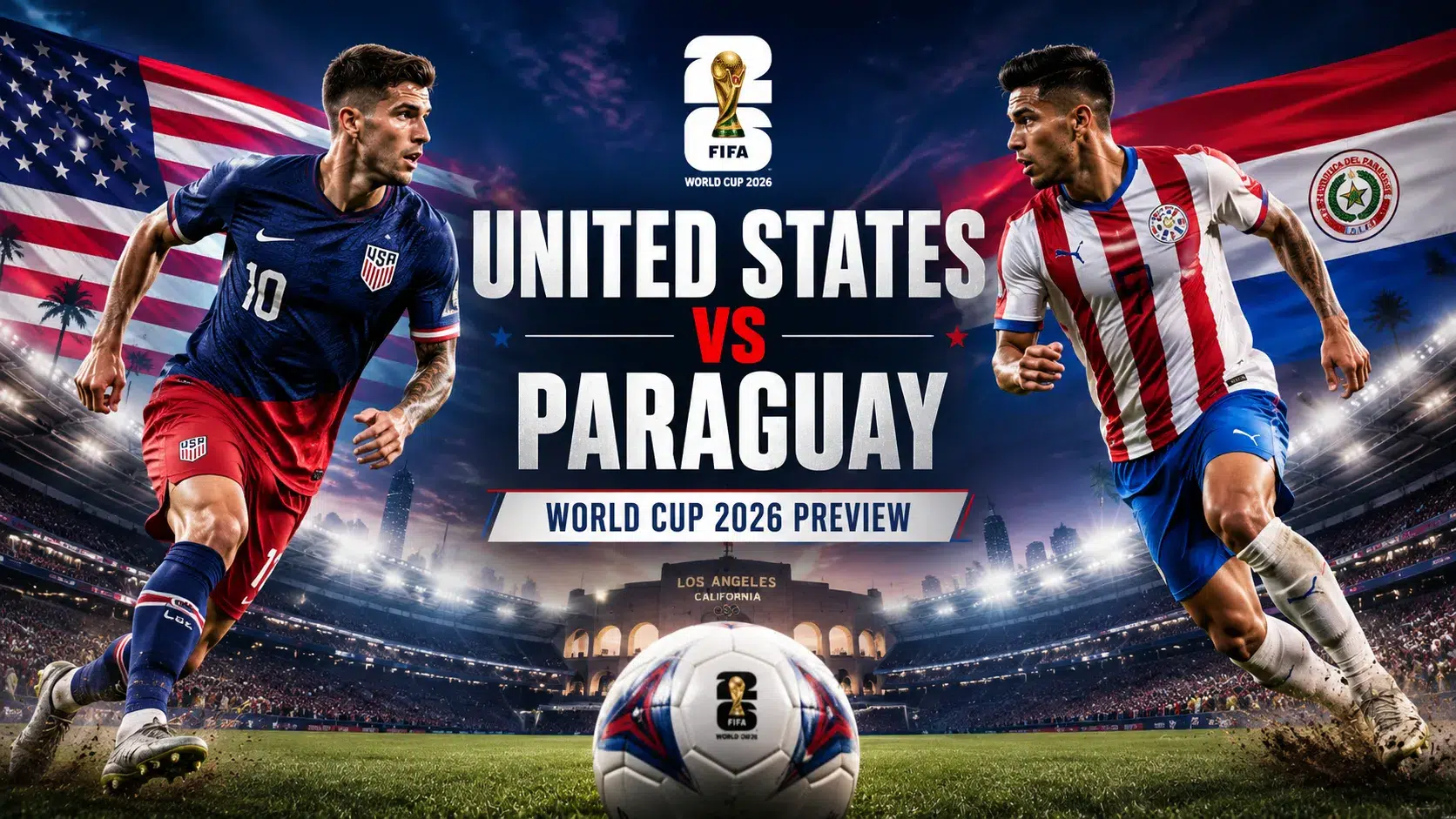
United States vs Paraguay World Cup 2026 preview
Table of Contents Show
The United States face Paraguay in a FIFA World Cup 2026 Group D match at Los Angeles Stadium in Inglewood, California. The match is scheduled for Friday, June 12, 2026, with a 6 p.m. PT local kickoff, which corresponds to 01:00 UTC on June 13. This fixture is the United States’ opening match of the tournament and the first World Cup 2026 match played on U.S. soil, which makes it a pressure-heavy event for Mauricio Pochettino’s team.
The United States enter with home advantage, crowd pressure, attacking depth and a front line built around Christian Pulisic and Folarin Balogun. Matt Freese starts in goal, while Chris Richards returns to the defensive line and Tim Ream leads the back line. Paraguay enter as a compact, physical South American opponent under Gustavo Alfaro, with Julio Enciso making a notable start despite recent injury concern. Paraguay also start Miguel Almiron, Antonio Sanabria, Gustavo Gomez and Andres Cubas, which gives them experience, transition threat and defensive bite.
The projected match profile points to U.S. possession pressure, Paraguay defensive resistance, medium-to-high transition intensity, and strong sensitivity to the first goal. The main tactical matchup is the United States’ speed and positional attack against Paraguay’s compact defensive block, midfield duels and counterattacking outlet through Enciso and Almiron. This preview explains lineups, tactics, weather, projected stats, Group D scenarios and responsible betting risks. It does not provide guaranteed betting advice.
| Field | Data |
|---|---|
| Match | United States vs Paraguay |
| Competition | FIFA World Cup 2026 |
| Stage | Group Stage |
| Group | Group D |
| Date | Friday, June 12, 2026 |
| Kick-off Time | 6 p.m. PT / 01:00 UTC on June 13 |
| Stadium | Los Angeles Stadium |
| City | Inglewood / Los Angeles area |
| Host Country | United States |
| Attendance | 70,492 reported after match publication |
| Referee | Not available from verified public data in the current source set |
| VAR | Not available from verified public data in the current source set |
| Weather Forecast / Match Weather | Cloudy, around 70°F / 21°C |
| Pitch Context | Tournament venue surface; exact pre-match pitch speed not available from verified public data |
| Main Article Focus | Pre-match probability dossier, lineups, tactics, projected stats, weather, betting risk, Group D scenarios |
United States vs Paraguay is not just another group-stage fixture. It is the host nation’s first test in a tournament played across North America. The U.S. are not only trying to win three points. They are trying to validate a project, manage home pressure, and show that Mauricio Pochettino’s attacking ideas can work in a World Cup environment.
Paraguay bring a different pressure profile. They do not carry host expectation. They return to the World Cup stage with a hard-nosed South American identity, a coach who values structure, and enough attacking talent to punish mistakes. Julio Enciso’s inclusion gives Paraguay more technical spark, while Miguel Almiron gives them speed and transition threat. Gustavo Gomez and Junior Alonso give them central defensive experience.
The match should be viewed through three main lenses:
United States vs Paraguay matters because the U.S. need a home-opening win to control Group D and calm tournament pressure, while Paraguay can disrupt the host narrative with compact defending, physical midfield resistance and transition threat.
A professional World Cup preview must separate confirmed data from projected data. This matters because the match can change after official lineups, late injuries, referee decisions, VAR reviews, weather updates and the first goal.
| Category | Status | United States vs Paraguay Example | Article Use |
|---|---|---|---|
| Confirmed fact | Verified before publication | United States vs Paraguay, Group D, Los Angeles Stadium | Hard match base |
| Match timing | Verified source data | 6 p.m. PT / 01:00 UTC | Match snapshot |
| Announced information | Available before kick-off | Starting lineups reported by Reuters | Used as lineup fact |
| Team-news report | Verified reporting | Freese selected over Turner; Enciso starts despite recent injury | Team-news section |
| Probable information | Tactical forecast | U.S. likely press and attack with width; Paraguay likely defend compactly | Tactical analysis |
| Projected data | Model-based estimate | Possession range, shots, xG, corners, cards | Ranges only |
| Unknown data | Not verified in source set | Referee, VAR, exact pre-match pitch speed | Marked unavailable |
| Scenario-based analysis | Possible future pattern | Paraguay may target space behind U.S. full-backs | Written as “may”, “could”, “watch for” |
This distinction protects the reader from false certainty. A projected possession range is not a final match statistic. A likely tactical pattern is not a guaranteed event. A betting market signal is not a safe outcome. Football contains randomness. A deflection, early booking, goalkeeper mistake, injury or set piece can change the match in seconds.
This article therefore uses probability language. It treats future actions as scenarios, not facts.
Group D contains the United States, Paraguay, Australia and Turkey. The structure gives the group a strong tactical mix. The United States carry home pressure. Paraguay bring South American physicality and defensive discipline. Australia bring tournament hardness. Turkey bring technical attacking talent and volatility.
| Team | Pre-Match Points | Goal Difference | Opening-Match Pressure | Main Need |
|---|---|---|---|---|
| United States | 0 | 0 | Very high | Win the home opener and control the group |
| Paraguay | 0 | 0 | Medium-high | Avoid defeat or steal a result |
| Australia | 0 | 0 | Medium | Watch opener and prepare for own first match |
| Turkey | 0 | 0 | Medium/high | Enter group with technical ambition |
The expanded World Cup format changes group strategy. The top two teams in each group advance directly, while the best third-placed teams can also progress. That makes one point useful, but it also makes goal difference important. A draw can be a platform. A narrow defeat can remain recoverable. A heavy defeat can damage the third-place route.
The United States need this opener for several reasons.
First, the match is played on home soil. The home crowd gives energy, but it also creates expectation. The U.S. must manage emotion. They need aggression without chaos.
Second, Mauricio Pochettino’s team needs a clean competitive statement. A strong opening performance can validate the tactical direction: high pressing, aggressive full-backs, midfield runs and fast attacking combinations.
Third, the U.S. must avoid group-table stress. A home draw would not end the campaign, but it would increase pressure before matches against Australia and Turkey. A loss would create immediate scrutiny.
Fourth, the lineup includes several important narrative points. Matt Freese starts in goal over Matt Turner. Chris Richards returns to the defense after an ankle issue. Christian Pulisic and Folarin Balogun lead the attack. These decisions create tactical and psychological focus.
Paraguay can approach the match with less public burden. They are not hosts. They can use the stadium environment against the United States if they keep the game level. The longer the match remains 0-0 or close, the more pressure shifts toward the home team.
Paraguay’s goals are practical:
| Result | United States Impact | Paraguay Impact | Group D Meaning |
|---|---|---|---|
| United States win | U.S. take early control and reduce pressure | Paraguay must recover in match two | Host narrative strengthens |
| Draw | U.S. face questions despite earning a point | Paraguay gain a valuable platform | Group becomes more open |
| Paraguay win | U.S. enter crisis mode early | Paraguay become serious qualification contenders | Group hierarchy shifts sharply |
The United States face pressure from the crowd, the tournament stage, and the home-host narrative. Paraguay face pressure from the occasion and the need to show they can compete after returning to the World Cup stage. These pressures differ.
The U.S. pressure is active. They are expected to do something. Paraguay’s pressure is reactive. They are expected to survive, resist and punish.
That contrast can shape the game. The United States may attack more. Paraguay may wait for mistakes. The first 20 minutes will show whether the U.S. can turn pressure into structure or whether Paraguay can turn the crowd into tension.
| Factor | Match Relevance |
|---|---|
| Host country | United States |
| Home-nation edge | U.S. receive crowd support and venue familiarity |
| Tournament role | First U.S.-based match of World Cup 2026 |
| Travel context | Paraguay manage international travel and adaptation |
| Crowd profile | Strong U.S. support expected |
| Media pressure | High around host-nation opener |
| Security/event layer | Major tournament event in Los Angeles area |
The United States have a strong emotional edge. The crowd can help them press. It can amplify attacking moments. It can force Paraguay into rushed clearances. It can also create impatience if the first goal does not arrive.
Paraguay must treat the environment as part of the game. Calm restarts, compact body language, and controlled fouls matter. Paraguay should not let the stadium dictate tempo.
| City Factor | Expected Tactical Impact |
|---|---|
| Weather | Mild, cloudy, around 70°F / 21°C |
| Altitude | No major altitude issue |
| Humidity | Not central based on available match weather |
| Wind | Not available from verified public data |
| Venue size | Large-event atmosphere |
| Crowd noise | Communication stress for Paraguay |
| Surface | Exact pre-match pitch speed not available from verified public data |
Los Angeles conditions are favorable for a high-tempo match. The weather is not extreme. The U.S. can press and attack without a major heat limitation. Paraguay can also maintain compactness without severe climate stress.
The key environmental issue is not temperature. It is occasion. The stadium and home pressure may affect tempo more than weather.
| Stadium Detail | Data |
|---|---|
| Stadium | Los Angeles Stadium |
| City | Inglewood / Los Angeles area |
| Country | United States |
| Attendance | 70,492 reported after match publication |
| Kick-off | 6 p.m. PT |
| Weather | Cloudy, around 70°F |
| Surface | Tournament surface; exact pitch speed not available from verified public data |
| Tactical Impact | High crowd energy, large venue pressure, favorable weather |
| Weather / Environment Factor | Tactical Meaning |
|---|---|
| Cloudy conditions | Reduces sun and heat stress |
| Around 70°F / 21°C | Supports normal pressing and running loads |
| No altitude issue | Normal recovery model |
| Large crowd | Raises emotional tempo and communication pressure |
| Unknown wind | Do not overstate long-ball or crossing impact |
| Exact surface speed unavailable | Avoid claiming pitch behavior as fact |
The weather gives no obvious excuse for slow tempo. The U.S. can press in bursts. Paraguay can defend with intensity. Fatigue should come more from game state, running load and emotional pressure than climate.
The United States’ key team-news point is goalkeeper selection. Mauricio Pochettino selected Matt Freese over Matt Turner. Chris Richards starts after working back from an ankle issue. Christian Pulisic and Folarin Balogun lead the attack. Tim Ream captains the defense.
| Player | Status | Tactical Impact |
|---|---|---|
| Matt Freese | Announced starter | Goalkeeper debut pressure, distribution and shot-stopping focus |
| Matt Turner | Not starting | Experienced goalkeeper begins on bench |
| Chris Richards | Announced starter | Defensive recovery and central-duel value |
| Tim Ream | Announced starter / captain | Defensive leadership and buildup calm |
| Sergiño Dest | Announced starter | Right-side attacking width and ball progression |
| Antonee Robinson | Announced starter | Left-side width, recovery and crossing |
| Tyler Adams | Announced starter | Midfield screening and counter-pressing |
| Weston McKennie | Announced starter | Box runs, duels and vertical midfield power |
| Malik Tillman | Announced starter | Advanced midfield creativity and pressing |
| Christian Pulisic | Announced starter | Main chance creator and dribbling threat |
| Folarin Balogun | Announced starter | Main striker and penalty-box reference |
The U.S. lineup points toward dynamic attacking football. Pulisic and Balogun give direct threat. McKennie gives box arrival. Dest and Robinson give full-back width. Adams gives the rest-defense base. Ream gives organization.
Freese’s start changes the goalkeeper narrative. Paraguay can test him early with shots, crosses and pressure. The U.S. can protect him by controlling the ball and stopping transitions before they reach the box.
Paraguay’s key team-news point is Julio Enciso’s start despite a recent injury concern. Gustavo Alfaro also starts Orlando Gill in goal. Paraguay’s lineup includes experienced central defenders and midfielders who can make the match physical.
| Player | Status | Tactical Impact |
|---|---|---|
| Orlando Gill | Announced starter | Goalkeeper under likely U.S. pressure |
| Gustavo Gomez | Announced starter | Defensive leader and set-piece target |
| Junior Alonso | Announced starter | Centre-back experience |
| Omar Alderete | Announced starter | Defensive physicality |
| Juan Jose Caceres | Announced starter | Wide defensive role |
| Andres Cubas | Announced starter | Ball-winning midfield role |
| Diego Gomez | Announced starter | Midfield power and transition support |
| Damian Bobadilla | Announced starter | Central work rate and defensive support |
| Miguel Almiron | Announced starter | Transition speed and wide threat |
| Antonio Sanabria | Announced starter | Centre-forward and box presence |
| Julio Enciso | Announced starter | Creative spark and counterattacking danger |
Paraguay have enough quality to make the match uncomfortable. Enciso and Almiron can punish open spaces. Sanabria gives a central forward target. Cubas can break rhythm. Gomez and Alonso can organize the defense.
| Player | Team | Issue | Match Impact |
|---|---|---|---|
| Chris Richards | United States | Recently returned from ankle issue | Defensive fitness and rhythm watchlist |
| Julio Enciso | Paraguay | Recent injury concern before start | Creativity boost but physical monitoring needed |
| Other United States players | United States | Not available from verified public data | Do not invent |
| Other Paraguay players | Paraguay | Not available from verified public data | Do not invent |
No confirmed suspension issue was available in the verified source set. This article treats card risk as a forecast, not confirmed disciplinary data.
Because lineups were reported before kick-off, this section uses announced lineups rather than speculative predicted XIs.
| Position / Line | Player | Likely Role |
|---|---|---|
| GK | Matt Freese | Goalkeeper, distribution starter, pressure-management figure |
| DEF | Sergiño Dest | Right-back / attacking full-back |
| DEF | Chris Richards | Centre-back / recovery defender |
| DEF | Tim Ream | Centre-back / captain, buildup organizer |
| DEF | Antonee Robinson | Left-back / attacking width and recovery |
| DEF / Hybrid | Alex Freeman | Defensive width / structural role |
| MID | Tyler Adams | Defensive midfielder / counter-press anchor |
| MID | Weston McKennie | Box-to-box midfielder, aerial runner |
| MID | Malik Tillman | Advanced midfielder, connector |
| ATT | Christian Pulisic | Left-sided creator / inside forward |
| ATT | Folarin Balogun | Centre-forward, finishing reference |
| Position / Line | Player | Likely Role |
|---|---|---|
| GK | Orlando Gill | Goalkeeper |
| DEF | Omar Alderete | Defender / aerial presence |
| DEF | Juan Jose Caceres | Wide defender |
| DEF | Junior Alonso | Centre-back |
| DEF | Gustavo Gomez | Centre-back / defensive leader |
| MID | Diego Gomez | Midfield runner / transition support |
| MID | Miguel Almiron | Wide / attacking midfielder, transition runner |
| MID | Andres Cubas | Ball-winner / defensive midfielder |
| MID | Damian Bobadilla | Central midfielder |
| ATT | Antonio Sanabria | Centre-forward |
| ATT | Julio Enciso | Creative forward / attacking outlet |
| Team | Base Formation | In Possession | Out of Possession | Confidence |
|---|---|---|---|---|
| United States | 4-3-3 / 3-2-5 variant | 2-3-5 or 3-2-5 with full-backs high | 4-4-2 / 4-1-4-1 press | Medium |
| Paraguay | 4-4-2 / 4-2-3-1 / compact hybrid | Direct exits, occasional 2-3-5 buildup | 4-4-2 or 4-5-1 compact block | Medium |
| Scenario | Trigger | Expected Change |
|---|---|---|
| U.S. need more control | Paraguay win midfield duels | Adams stays deeper, McKennie less advanced |
| U.S. need more width | Paraguay defend narrow | Dest and Robinson push higher |
| U.S. chase goal | Level after 60’ | Gio Reyna or another creative attacker may become relevant |
| Paraguay chase goal | Losing after 60’ | More direct support for Sanabria or extra forward |
| Paraguay protect result | Leading or drawing late | Deeper block and more midfield protection |
| Paraguay target Freese | Early goalkeeper uncertainty | More shots, crosses and pressure into box |
The U.S. lineup gives more attacking fluidity. Paraguay’s lineup gives more physical resistance and transition options.
| Phase | Expected Pattern |
|---|---|
| Build-up | Ream, Richards and Freese start possession; Adams protects midfield |
| Attack | Pulisic dribbles, Balogun runs central channels, full-backs provide width |
| Defense | Aggressive pressing in bursts, Adams as rest-defense anchor |
| Transitions | Fast release through Pulisic, McKennie, Dest and Balogun |
| Set pieces | McKennie, Richards and Ream as aerial targets |
| Weakness | Space behind full-backs, Freese pressure, emotional home tempo |
The United States should build through calm first passes and fast second actions. Freese can support the first line. Ream gives composure. Richards gives recovery range. Adams should remain available as the stabilizer.
The U.S. should avoid unnecessary risk near their own box. Paraguay can press in moments and use Enciso or Almiron to attack mistakes. If the U.S. move the ball cleanly into midfield, they can attack Paraguay’s block before it settles.
Dest and Robinson matter because they can stretch Paraguay horizontally. If both full-backs push high at the same time, Adams and the centre-backs must protect counter lanes.
The U.S. attack should use several routes:
The best U.S. attacks should not rely only on crosses. They should create cutbacks, through balls, central overloads and quick switches. Paraguay’s centre-backs can defend predictable aerial balls. They will struggle more if U.S. runners attack multiple lanes.
The U.S. defensive task begins after losing the ball. Paraguay’s best route is likely transition. Enciso and Almiron can use space. Sanabria can occupy centre-backs. If the U.S. overcommit, Paraguay can attack quickly.
Adams must protect central zones. Ream and Richards must avoid stepping out without cover. Dest and Robinson must recover after forward runs.
The U.S. should avoid fouls near the box. Paraguay can turn set pieces into chance value.
| Phase | Expected Pattern |
|---|---|
| Build-up | Mixed direct and short buildup, depending on U.S. press |
| Attack | Transitions through Enciso and Almiron, Sanabria as central reference |
| Defense | Compact block, physical midfield duels, centre-back leadership |
| Transitions | Quick release into wide and central channels |
| Set pieces | Gomez, Alonso, Alderete and Sanabria as aerial targets |
| Weakness | Defending U.S. speed, full-back isolation, limited scoring rhythm |
Paraguay should not force short buildup if the U.S. press aggressively. They can play direct into Sanabria, use Almiron in space, or look for Enciso between lines. The key is second-ball support. A long pass is useful only if midfielders are close enough to win the next action.
Cubas and Diego Gomez must give Paraguay balance. If they only defend, Paraguay may lose territory. If they step too high, U.S. midfielders can attack the space behind them.
Paraguay’s attack may be selective. They can create danger through:
Paraguay do not need many attacks to be dangerous. They need high-value attacks. Their best chances may appear after U.S. turnovers or from dead balls.
Paraguay should defend with compactness. The central defenders must track Balogun. The midfield must block passing lanes into Pulisic and Tillman. Wide defenders need help against Dest, Robinson and Pulisic.
The risk is being dragged too deep. If Paraguay spend too long inside their own box, U.S. pressure can become corners, rebounds and second balls.
| Zone | United States Edge | Paraguay Edge | Likely Control | Why It Matters |
|---|---|---|---|---|
| U.S. left flank | Pulisic and Robinson combinations | Caceres / defensive support | U.S. technical edge | Creates cutbacks and dribbles |
| U.S. right flank | Dest progression | Alderete / Alonso cover | U.S. mobility edge | Can stretch Paraguay’s block |
| Central midfield | Adams, McKennie, Tillman | Cubas, Diego Gomez, Bobadilla | Balanced | Decides tempo and second balls |
| Penalty box | Balogun movement, McKennie runs | Gomez, Alonso, Alderete aerial defense | Balanced | Decides shot quality |
| Set pieces | McKennie, Richards, Ream | Paraguay aerial defenders and Sanabria | Balanced | Can decide tight match |
| Transitions | U.S. counter-press and speed | Enciso and Almiron outlet | Paraguay threat | Best underdog route |
| Defensive third | U.S. must protect space | Paraguay likely defend more phases | Paraguay under pressure | Concentration test |
Pulisic is the main U.S. chance creator. He can dribble, combine, draw fouls and create shots. Paraguay must prevent him from receiving with space to turn.
What to watch: Whether Pulisic receives near the touchline only or inside the half-space. Half-space touches are more dangerous.
Risk trigger: An early booking for Paraguay’s right-sided defender can make Pulisic’s route more dangerous.
Balogun gives the U.S. a central striker profile. Gomez and Alonso give Paraguay experience and physicality. This duel decides whether U.S. possession becomes clear chances.
What to watch: Balogun’s first run after Pulisic or Dest receives. If he times runs between defenders, Paraguay must defend facing their own goal.
Risk trigger: If Paraguay hold Balogun away from central zones, U.S. may need more midfield runners.
Adams must protect the transition lane. Enciso can receive quickly and carry Paraguay forward. This is one of the match’s most important tactical duels.
What to watch: The first pass after Paraguay recover possession. If Enciso receives facing forward, U.S. rest defense is under stress.
Risk trigger: Adams arriving late can create tactical foul risk.
Freese starts in goal over Turner. Paraguay may test him early. This does not require high shot volume. A goalkeeper can be tested by crosses, set pieces and pressure.
What to watch: Freese’s first distribution and first aerial action.
Risk trigger: A nervous early touch can make Paraguay target him more often.
McKennie can arrive late into the box and create aerial mismatches. Paraguay must track him when U.S. attacks reach wide zones.
What to watch: McKennie’s timing into the penalty area. Late arrivals can be harder to mark than static forwards.
Risk trigger: If Paraguay midfielders lose McKennie, U.S. cutbacks and crosses become more dangerous.
These numbers are projected ranges, not confirmed facts.
| Projected Stat | United States | Paraguay | Confidence | Reason |
|---|---|---|---|---|
| Possession | 55–62% | 38–45% | Medium | U.S. should control more ball at home |
| Shots | 12–17 | 7–11 | Medium | U.S. likely create more attacking volume |
| Shots on Target | 4–7 | 2–4 | Medium | Paraguay can limit central chance quality |
| xG Range | 1.30–2.00 | 0.70–1.30 | Low/Medium | First goal and set pieces can distort profile |
| Big Chances | 1–3 | 0–2 | Low/Medium | U.S. volume edge, Paraguay transition route |
| Corners | 5–8 | 2–5 | Medium | U.S. wide pressure may create blocks |
| Fouls | 10–14 | 13–18 | Medium | Paraguay may defend speed with contact |
| Yellow Cards | 1–3 | 2–4 | Low/Medium | Referee unknown |
| Red Card Risk | Low | Low/Medium | Low | Transition fouls and pressure can raise risk |
| Offsides | 1–3 | 1–2 | Low | Balogun and Almiron runs can trigger lines |
| Saves | 2–4 | 3–6 | Medium | Gill may face more shots |
| Crosses | 16–24 | 10–16 | Medium | U.S. likely use width |
| Tackles | 14–20 | 18–25 | Medium | Paraguay likely defend more duels |
| Interceptions | 8–13 | 10–16 | Medium | Paraguay’s block can cut passing lanes |
| Clearances | 12–20 | 22–32 | Medium | Paraguay may defend deeper for periods |
The United States should lead possession, territory and shot volume. Paraguay should try to keep the U.S. away from high-value central chances. The key variable is not whether the U.S. have more of the ball. They probably will. The key variable is whether they create shots from inside the box, cutbacks, and central passing combinations.
Paraguay’s statistical route is narrower. They need transition quality, set pieces and efficient finishing. Their xG may stay lower than the U.S. range, but one high-value counter can change the match.
This table does not predict exact events. It describes likely windows and risk changes.
| Match Window | Tactical State | Physical State | Card Risk | Goal Risk | Betting Market Trigger |
|---|---|---|---|---|---|
| 1’–15’ | U.S. likely start fast; Paraguay test Freese and defensive spacing | Fresh legs, high emotion | Low/Medium | Medium | Early U.S. pressure, first Paraguay counter |
| 16’–30’ | Paraguay block becomes clearer; U.S. look for flank overloads | Contact increases | Medium | Medium | Wide duels, corners, first clear chance |
| 31’–45+’ | U.S. may increase pressure if no goal; Paraguay may slow tempo | First fatigue signs | Medium/High | Medium | Late first-half set pieces |
| 46’–60’ | Coaches adjust after first-half evidence | Reset intensity | Medium | Medium | Substitution preparation |
| 61’–75’ | Space can open behind full-backs | Fatigue grows | High | Medium/High | Live totals, cards, transition signs |
| 76’–90+’ | Game state dominates | Time management and cramps possible | High | High | Late goal pressure, set pieces |
The U.S. may attack early because the crowd and occasion encourage energy. The first objective should be control, not chaos. Paraguay need to survive the initial wave and show that they can counter.
The match pattern becomes clearer. If Pulisic and Dest receive freely, Paraguay have a defensive problem. If Cubas and Gomez win midfield duels, Paraguay can slow the U.S.
If the game remains level, U.S. pressure can become emotional. Paraguay may use set pieces and slower possessions to reduce tempo.
Coaches adjust. Pochettino may alter full-back height or central spacing. Alfaro may decide whether Paraguay need more forward support.
This is the key risk window. Fatigue, cards and substitutions begin to matter. If the U.S. have moved Paraguay side to side for an hour, spaces can appear. If Paraguay have kept the score level, the pressure shifts toward the hosts.
Game state controls everything. A U.S. lead means control and transition prevention. A draw means pressure and risk. A Paraguay lead means deep defending and counterattacks.
| Factor | Expected Impact | United States Effect | Paraguay Effect |
|---|---|---|---|
| Cloudy conditions | Reduces heat stress | Supports pressing | Supports compact defending |
| Around 70°F / 21°C | Normal running load | Helps high tempo | Helps physical duels |
| No altitude issue | Normal sprint recovery | Supports full-back runs | Supports counterattacks |
| Wind not verified | Do not overstate crossing effects | Unknown | Unknown |
| Pitch speed not verified | Must avoid claims | Affects passing if fast | Affects clearances if slick |
| Large crowd | Emotional tempo increase | Advantage and pressure | Communication challenge |
The most important environmental factor is not climate. It is stadium pressure. The weather supports a normal match. The crowd may create the real volatility.
| Player | Team | Role | Impact Score /10 | Why |
|---|---|---|---|---|
| Christian Pulisic | United States | Creator / inside forward | 9.0 | Main dribbler and chance creator |
| Folarin Balogun | United States | Striker | 8.7 | Central finishing reference |
| Tyler Adams | United States | Defensive midfielder | 8.5 | Protects counters and controls rest defense |
| Weston McKennie | United States | Box-to-box midfielder | 8.4 | Duels, box runs and aerial threat |
| Sergiño Dest | United States | Attacking full-back | 8.1 | Right-side progression and width |
| Matt Freese | United States | Goalkeeper | 7.9 | Must manage pressure in tournament debut |
| Tim Ream | United States | Centre-back / captain | 7.9 | Defensive leadership and buildup calm |
| Julio Enciso | Paraguay | Creative forward | 8.6 | Main technical threat and transition spark |
| Miguel Almiron | Paraguay | Wide / transition runner | 8.4 | Speed outlet against advanced U.S. full-backs |
| Gustavo Gomez | Paraguay | Centre-back / leader | 8.3 | Organizes defense and set-piece threat |
| Andres Cubas | Paraguay | Ball-winner | 8.0 | Disrupts U.S. midfield rhythm |
| Antonio Sanabria | Paraguay | Centre-forward | 7.9 | Central reference and box presence |
| Orlando Gill | Paraguay | Goalkeeper | 7.8 | Likely faces more shot volume |
Christian Pulisic is the most important attacker because he can break the match through dribbling, passing and penalty-box entries. Paraguay must prevent him from receiving in the half-space.
Gustavo Gomez is Paraguay’s most important defender because he must organize the block, handle Balogun and defend set pieces.
Tyler Adams is the most important midfielder because the U.S. need protection behind attacking full-backs. If Adams controls transitions, Paraguay’s best route weakens.
Gio Reyna is a logical U.S. creative game-changer if Pochettino needs more central imagination. Paraguay’s bench options are not fully detailed in the verified source set, so this article does not invent specific bench roles beyond available lineup context.
The referee and VAR were not available from verified public data in the current source set. Therefore, the discipline preview uses tactical logic rather than confirmed referee-profile data.
| Discipline Factor | Forecast |
|---|---|
| Referee style | Not available from verified public data |
| Tactical foul risk | Medium/high |
| Dissent risk | Medium because of host pressure |
| VAR intervention risk | Medium |
| Penalty risk | Medium |
| Red-card risk | Low/medium |
| Team | Yellow Card Range | Red Card Risk | Main Risk Zone |
|---|---|---|---|
| United States | 1–3 | Low | Counter-fouls after full-back advances |
| Paraguay | 2–4 | Low/medium | Wide duels against Pulisic, Dest and Robinson |
Paraguay may carry the higher card range because they are likely to defend more speed-based attacks. The U.S. carry card risk when they lose possession with full-backs high.
The risk rises if:
Set pieces can decide this match because Paraguay have defensive size and the U.S. have strong aerial midfield runners.
| Set-Piece Area | United States | Paraguay | Edge |
|---|---|---|---|
| Corners for | McKennie, Richards, Ream, Balogun | Gomez, Alonso, Alderete, Sanabria | Balanced |
| Corners against | Must defend Paraguay’s centre-backs | Must track U.S. late runners | Balanced |
| Wide free kicks | Pulisic / delivery options | Paraguay aerial targets | Paraguay slight edge |
| Direct free kicks | Not verified as fixed taker hierarchy | Not verified as fixed taker hierarchy | Unknown |
| Penalties | Taker hierarchy not verified | Taker hierarchy not verified | Unknown |
| Long throws | Not available from verified public data | Not available from verified public data | Unknown |
| Second balls | Adams/McKennie important | Cubas/Gomez important | Balanced |
The U.S. should avoid fouls near wide crossing zones. Paraguay can use set pieces to reduce the U.S. speed advantage. The U.S. can also create set-piece pressure through McKennie and Richards, but they must defend counters after corners.
| Area | United States | Paraguay |
|---|---|---|
| Goalkeeper distribution | Freese starts over Turner and must play calmly | Gill may go long under U.S. pressure |
| Shot-stopping pressure | Medium | Medium/high |
| Cross handling | Medium | Medium/high |
| High-line risk | Space behind Dest and Robinson | Space behind full-backs against U.S. speed |
| Penalty-box defending | Must track Sanabria and Gomez | Must track Balogun and McKennie |
| Back-post weakness | Possible if full-back loses far-side runner | Possible against U.S. switches |
| Communication | Home crowd helps but also creates noise | Crowd noise can disrupt Paraguay |
Freese’s main risk is pressure in a high-profile start. He may not face many shots, but early actions matter. Paraguay should test him if the chance appears.
Gill’s main risk is workload. He may face more shots and crosses. His rebound control and command of the box can keep Paraguay alive.
Substitution forecasts are scenarios, not certainties.
| Minute Window | United States Possible Change | Paraguay Possible Change | Trigger |
|---|---|---|---|
| 45’–60’ | Add creative control or adjust full-back height | Add midfield support or fresh wide runner | First-half imbalance |
| 60’–75’ | Add Reyna-type creativity or fresh forward | Add attacking outlet or defensive midfielder | Score pressure |
| 75’–90’ | Protect lead or chase winner | Defend result or load counterattack | Game state |
The U.S. should protect central transitions. They can still attack, but they should not leave Enciso and Almiron open spaces.
Paraguay may defend deeper and slow tempo. The U.S. need to avoid rushed crossing and create central combinations.
The U.S. may feel pressure to win at home. Paraguay may treat a draw as useful. This tension can shape substitutions.
This section explains market behavior. It does not provide guaranteed picks.
| Market | Current Signal | Main Risk |
|---|---|---|
| Match Winner | United States likely favored by home advantage | Host pressure and Paraguay compactness |
| Double Chance | U.S. or draw may look safer | Low price may not match volatility |
| Over/Under Goals | Moderate total profile | Early goal can open the match |
| Both Teams to Score | Plausible | Paraguay shot volume may be limited |
| Corners | U.S. corner volume may rise | Early goal can reduce pressure |
| Cards | Medium risk | Referee unknown |
| Player Shots | Balogun and Pulisic watchlist | Service and role matter |
| Player Cards | Paraguay defenders vs U.S. speed | Referee threshold unknown |
| Trigger | Possible Market Effect |
|---|---|
| Freese starting over Turner | Changes goalkeeper-risk perception |
| Enciso confirmed starter | Increases Paraguay attacking credibility |
| Richards fitness confirmation | Improves U.S. defensive confidence |
| Referee announcement | Moves cards and penalty markets |
| Weather shift | Affects totals and pace |
| Public money on U.S. | Can compress host price |
| Official lineups | Moves player shots and team-total markets |
| Trigger | Meaning | Risk |
|---|---|---|
| U.S. create early corners | Territorial pressure | Does not guarantee chance quality |
| Paraguay counter cleanly twice | U.S. rest defense vulnerable | Low sample risk |
| Freese looks nervous early | Paraguay confidence can rise | One action can mislead |
| Pulisic isolates defender | U.S. chance quality rises | Needs box support |
| 0-0 after 60’ | Pressure shifts toward U.S. | Paraguay fatigue may still rise |
| Paraguay full-back booked | U.S. flank attack improves | Referee may adjust threshold |
Responsible betting note: This preview explains match data and market behavior. It does not provide guaranteed betting advice. World Cup betting involves risk. Readers should check local gambling laws, use licensed operators, set limits and avoid chasing losses.
| Factor | How It Can Break the Forecast |
|---|---|
| Late lineup change | Changes roles, formations and set-piece matchups |
| Early goal | Forces one team to abandon base plan |
| Early yellow card | Changes wide duels and transition defending |
| Injury | Forces tactical reshuffle |
| VAR penalty | Creates non-pattern goal |
| Weather shift | Alters ball speed, fatigue and crossing quality |
| Red card | Makes pre-match stats less relevant |
| Goalkeeper error | Creates low-probability swing |
| Tactical surprise | Breaks projected matchup assumptions |
| Market overreaction | Creates false betting signal |
The prediction can fail if Paraguay score first and force the U.S. into emotional attacking. It can also fail if the U.S. score early and open the match. One set piece, goalkeeper error or card can change the entire game state.
| Scenario | Probability Band | Match Story |
|---|---|---|
| United States narrow win | Medium/high | U.S. control territory and create enough quality through Pulisic and Balogun |
| Draw | Medium | Paraguay defend compactly and limit central chances |
| Paraguay upset | Low/medium | Paraguay score first through transition or set piece and defend deep |
| High-scoring match | Low/medium | Early goal opens space and both teams attack transition lanes |
| Low-scoring match | Medium | U.S. control ball but Paraguay block chance quality |
The safest scenario frame is a U.S.-favored match with meaningful Paraguay resistance. The U.S. have the stronger base case. Paraguay have a credible spoiler route.
| Result | United States Impact | Paraguay Impact |
|---|---|---|
| United States win | U.S. gain control and reduce host pressure | Paraguay need response in match two |
| Draw | U.S. lose some margin but stay stable | Paraguay gain useful platform |
| Paraguay win | U.S. enter immediate pressure cycle | Paraguay become serious Round of 32 candidate |
Goal difference matters in the expanded format. A draw can help Paraguay. A narrow defeat can be survivable. A heavy defeat can damage third-place ranking.
| Data Point | Status | Preferred Source Type |
|---|---|---|
| Match date | Confirmed | FIFA / U.S. Soccer / Reuters |
| Stadium | Confirmed | FIFA / U.S. Soccer |
| City | Confirmed | FIFA / U.S. Soccer |
| Group | Confirmed | FIFA / match reporting |
| Coaches | Confirmed in verified reporting | Reuters / federation context |
| Referee | Not available from verified public data | FIFA match centre |
| VAR | Not available from verified public data | FIFA match centre |
| Weather | Confirmed in match reporting / forecast context | Official or match report |
| Lineups | Announced before kick-off | Reuters |
| Injuries | Reported for specific players | Reuters |
| Odds | Dynamic | Licensed market data |
| Projected stats | Model-based estimate | Editorial forecast |
| Minute-window scenarios | Scenario forecast only | Editorial model |
This article uses confirmed facts where available and marks unavailable information clearly. It does not invent referee data, VAR data, unverified injuries or exact betting odds.
This preview is analytical and informational. It is not a guarantee of the final result. Football includes randomness and low-probability events. Final lineups, injuries, referee decisions, VAR, weather and early goals can change the match.
Projected statistics, scoreline scenarios and betting market notes are probability-based estimates. They are not certain outcomes. The United States can control possession and still fail to win. Paraguay can create fewer open-play chances and still score from a set piece, transition or individual mistake. A goalkeeper error, red card, deflection or penalty can break the pre-match model.
Readers should verify official lineups, injuries, referee information, weather conditions and market prices before making decisions. Readers should check local gambling laws and use licensed operators only. Readers should set spending and time limits, avoid chasing losses and treat betting as entertainment rather than income.
This article does not provide guaranteed betting advice, fixed-match information, insider tips, risk-free picks or certain outcomes.
United States vs Paraguay is scheduled for Friday, June 12, 2026, with kick-off at 6 p.m. PT in Los Angeles, which corresponds to 01:00 UTC on June 13.
The match is being played at Los Angeles Stadium in Inglewood, California, in the United States.
The article uses announced pre-match lineups. The United States start Matt Freese, Sergiño Dest, Chris Richards, Antonee Robinson, Tim Ream, Alex Freeman, Tyler Adams, Weston McKennie, Malik Tillman, Christian Pulisic and Folarin Balogun. Paraguay start Orlando Gill, Omar Alderete, Juan Jose Caceres, Junior Alonso, Gustavo Gomez, Diego Gomez, Miguel Almiron, Andres Cubas, Damian Bobadilla, Antonio Sanabria and Julio Enciso.
The main tactical matchup is the United States’ speed, pressing and attacking width against Paraguay’s compact defensive block, midfield duels and transition threat through Julio Enciso and Miguel Almiron.
The prediction can be wrong because late lineup changes, early goals, injuries, VAR penalties, red cards, referee decisions, weather shifts, set-piece goals and goalkeeper errors can change the match. This preview uses probability logic, not certainty.
[expert_review params=»JTdCJTIyY29sb3IlMjIlM0ElMjJncmVlbi0yJTIyJTJDJTIyZXhwZXJ0X2F2YXRhciUyMiUzQSUyMiUyMiUyQyUyMmV4cGVydF9uYW1lJTIyJTNBJTIyJTIyJTJDJTIyZXhwZXJ0X2xpbmslMjIlM0ElMjIlMjIlMkMlMjJleHBlcnRfaWQlMjIlM0ElMjIxJTIyJTJDJTIyZXhwZXJ0X3R5cGUlMjIlM0ElMjJleHBlcnRfaWQlMjIlMkMlMjJleHBlcnRfYXZhdGFyX2FsdCUyMiUzQSUyMiUyMiUyQyUyMmV4cGVydF9zaG93JTIyJTNBMSUyQyUyMmV4cGVydF9kZXNjcmlwdGlvbiUyMiUzQSUyMlNwb3J0cyUyMEJldHRpbmclMjBBbmFseXN0JTIwJTI2JTIwRWRpdG9yaWFsJTIwQ29udHJpYnV0b3IlMjIlMkMlMjJleHBlcnRfc2hvd19idXR0b24lMjIlM0ExJTJDJTIyZXhwZXJ0X3Nob3dfYnV0dG9uX3R5cGUlMjIlM0ElMjJwb3B1cCUyMiUyQyUyMmV4cGVydF9xdWVzdGlvbl9idXR0b25fdGV4dCUyMiUzQSUyMkFzayUyMFF1ZXN0aW9uJTIyJTJDJTIycXVlc3Rpb25fZXh0ZXJuYWxfbGluayUyMiUzQSUyMiUyMiUyQyUyMnBvcHVwX3VzZV9waG9uZSUyMiUzQTAlMkMlMjJleHBlcnRfdGl0bGUlMjIlM0ElMjJBdXRob3IlMjIlMkMlMjJleHBlcnRfc2hvd190aXRsZSUyMiUzQTElMkMlMjJleHBlcnRfdGV4dCUyMiUzQSUyMkFsZXglMjBNb3JnYW4lMjBpcyUyMGElMjBzcG9ydHMlMjBiZXR0aW5nJTIwYW5hbHlzdCUyMGFuZCUyMGVkaXRvcmlhbCUyMGNvbnRyaWJ1dG9yJTIwd2hvJTIwd3JpdGVzJTIwZGV0YWlsZWQlMjBib29rbWFrZXIlMjByZXZpZXdzJTJDJTIwYmV0dGluZyUyMGd1aWRlcyUyQyUyMHBsYXRmb3JtJTIwY29tcGFyaXNvbnMlMkMlMjBhbmQlMjByZXNwb25zaWJsZSUyMGdhbWJsaW5nJTIwZXhwbGFpbmVycy4lMjBIaXMlMjB3b3JrJTIwZm9jdXNlcyUyMG9uJTIwcHJhY3RpY2FsJTIwaW5mb3JtYXRpb24lMjBmb3IlMjB1c2VycyUyMHdobyUyMHdhbnQlMjB0byUyMHVuZGVyc3RhbmQlMjBob3clMjBiZXR0aW5nJTIwc2l0ZXMlMjBvcGVyYXRlJTIwYmVmb3JlJTIwdGhleSUyMHJlZ2lzdGVyJTJDJTIwZGVwb3NpdCUyQyUyMG9yJTIwY2xhaW0lMjBhJTIwYm9udXMuJTIyJTJDJTIycWElMjIlM0ElNUIlNUQlMkMlMjJxYV9zaG93X3RpdGxlJTIyJTNBMSUyQyUyMnFhX3RpdGxlJTIyJTNBJTIyJUQwJTkyJUQwJUJFJUQwJUJGJUQxJTgwJUQwJUJFJUQxJTgxJTIwJUQxJThEJUQwJUJBJUQxJTgxJUQwJUJGJUQwJUI1JUQxJTgwJUQxJTgyJUQxJTgzJTIyJTJDJTIyc2NvcmUlMjIlM0ElNUIlNUQlMkMlMjJzY29yZV9zdW1tYXJ5X3RleHQlMjIlM0ElMjIlMjIlMkMlMjJzY29yZV9zdW1tYXJ5X2F2ZXJhZ2UlMjIlM0EwJTJDJTIyc2NvcmVfbWF4JTIyJTNBJTIyNSUyMiUyQyUyMnNjb3JlX3N5bWJvbCUyMiUzQSUyMiUyMiUyQyUyMnNjb3JlX3RpdGxlJTIyJTNBJTIyJTIyJTJDJTIyc2NvcmVfc2hvd190aXRsZSUyMiUzQTAlMkMlMjJwbHVzZXMlMjIlM0ElNUIlNUQlMkMlMjJtaW51c2VzJTIyJTNBJTVCJTVEJTJDJTIycGx1c2VzX21pbnVzZXNfc2hvd190aXRsZSUyMiUzQTElMkMlMjJwbHVzZXNfbWludXNlc190aXRsZSUyMiUzQSUyMiVEMCU5RiVEMCVCQiVEMSU4RSVEMSU4MSVEMSU4QiUyMCVEMCVCOCUyMCVEMCVCQyVEMCVCOCVEMCVCRCVEMSU4MyVEMSU4MSVEMSU4QiUyMiUyQyUyMnBsdXNlc190aXRsZSUyMiUzQSUyMiUyMiUyQyUyMm1pbnVzZXNfdGl0bGUlMjIlM0ElMjIlMjIlN0Q=»]