
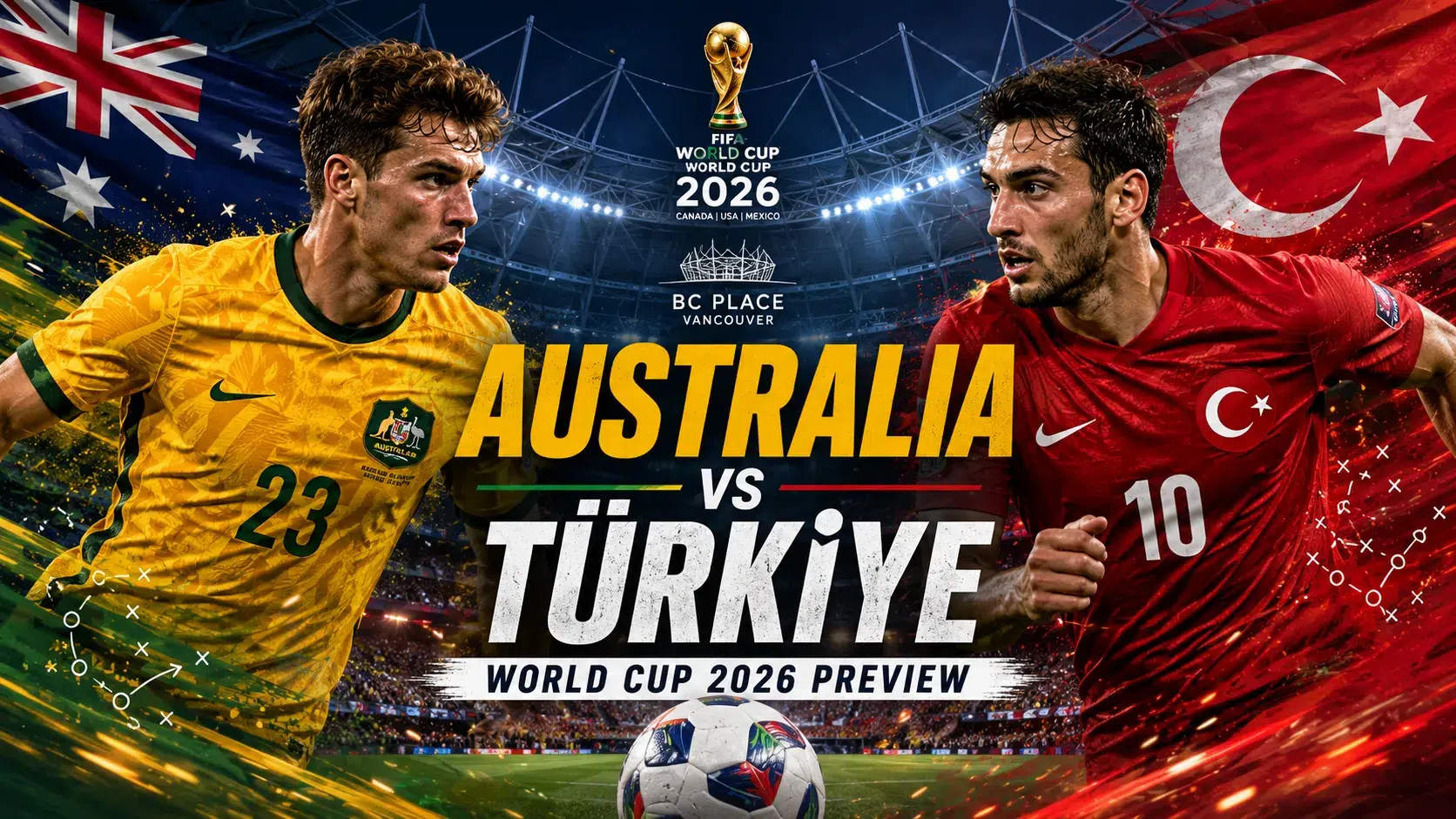
Australia vs Türkiye World Cup 2026 Preview
Table of Contents Show
Australia face Türkiye in a FIFA World Cup 2026 Group D match at BC Place in Vancouver, Canada. The match is scheduled for Saturday, 13 June 2026, with kick-off at 9:00 p.m. local time in Vancouver, which corresponds to 04:00 GMT on Sunday, 14 June and 2:00 p.m. AEST in Australia. This fixture matters because both teams begin in a difficult Group D that also includes the United States and Paraguay. The United States already made a strong early statement in the group, so Australia and Türkiye both need an immediate platform.
Australia enter as disciplined underdogs under Tony Popovic. The Socceroos have become World Cup regulars, but they still face questions around attacking ceiling, midfield control and finishing quality. Mohamed Toure is available after a minor training concern, and Australia will likely rely on compact defending, set pieces, wide work, physical duels and fast forward support.
Türkiye enter as favourites because they carry more individual technical talent, especially through Arda Güler, Kenan Yıldız, Hakan Çalhanoğlu and other attacking midfield options. Vincenzo Montella’s main task is emotional control. Türkiye are back at the World Cup for the first time in 24 years, and expectation can become a burden.
The projected match profile points to Türkiye possession and creative control against Australia’s compact block, aerial work and transition discipline. This preview explains match facts, projected lineups, tactical patterns, weather, projected stats, Group D scenarios and responsible betting risks. It does not provide guaranteed betting advice.
| Field | Data |
|---|---|
| Match | Australia vs Türkiye |
| Competition | FIFA World Cup 2026 |
| Stage | Group Stage / First Stage |
| Group | Group D |
| Date | Saturday, 13 June 2026 local time / Sunday, 14 June 2026 GMT and AEST |
| Kick-off Time | 9:00 p.m. Vancouver local / 04:00 GMT / 2:00 p.m. AEST Sunday |
| Stadium | BC Place |
| City | Vancouver |
| Host Country | Canada |
| Expected Attendance | Not available from verified public data in the current source set |
| Referee | Not available from verified public data in the current source set |
| VAR | Not available from verified public data in the current source set |
| Weather Forecast | Partly cloudy around kick-off, approximately 69°F / 21°C |
| Pitch Context | Tournament venue surface; exact match-day pitch speed not available from verified public data |
| Main Article Focus | Pre-match probability dossier, projected lineups, tactics, weather, projected stats, betting risks, Group D scenarios |
Australia vs Türkiye is one of the most tactically interesting early Group D fixtures. It is not a simple favourite-versus-underdog match. Türkiye have the higher technical ceiling and more glamorous attacking names. Australia have the tournament habits, physical edge, structure and underdog mentality that can make a favourite uncomfortable.
The match is also emotionally loaded. Türkiye are returning to the World Cup after a 24-year absence. Their last appearance came in 2002, when they finished third. This generation does not carry responsibility for that absence, but it does carry the expectation of ending it well. Australia, meanwhile, are no longer outsiders to the tournament. They have qualified for six straight World Cups and reached the last 16 in 2022. They know how to survive group-stage pressure.
Group D makes the opener more important. The United States, Paraguay, Australia and Türkiye form a group where every first match changes the pressure map. A win here can build a direct Round of 32 route. A draw can still be useful. A heavy defeat can damage third-place qualification scenarios.
Australia vs Türkiye matters because Türkiye need to turn superior individual talent into early Group D control, while Australia can disrupt the group hierarchy with disciplined defending, set-piece pressure and transition play.
A professional preview must separate confirmed facts from projections. This is especially important because official starting lineups were not available from the verified public source set used for this article at the time of writing. The lineups below are projected, not confirmed.
| Category | Status | Australia vs Türkiye Example | Article Use |
|---|---|---|---|
| Confirmed fact | Verified before publication | Australia vs Türkiye, BC Place, Vancouver, Group D | Hard match base |
| Match timing | Verified fixture data | 9:00 p.m. local / 04:00 GMT / 2:00 p.m. AEST | Match snapshot |
| Tournament context | Verified fixture context | Group D includes Australia, Türkiye, United States and Paraguay | Group scenario analysis |
| Team-news report | Verified media reporting | Popovic said Australia squad availability was strong and Mohamed Toure had no major issue | Team-news section |
| Türkiye context | Verified media reporting | Montella wants Türkiye to manage emotion after 24-year World Cup absence | Psychological and tactical framing |
| Probable information | Tactical forecast | Türkiye likely control more ball; Australia likely defend compactly and counter | Tactical sections |
| Projected data | Model-based estimate | Possession, shots, xG, corners, cards | Ranges only |
| Unknown data | Not verified in current source set | Referee, VAR, exact attendance, official starting XIs | Marked unavailable |
| Scenario-based analysis | Possible future pattern | Australia may target set pieces and second balls | Written as “may”, “could”, “likely”, “watch for” |
This distinction protects reader trust. A projected XI is not an official team sheet. A projected xG range is not a final match statistic. A betting market signal is not a safe outcome. A tactical forecast can fail after one early goal, one set-piece goal, one injury or one red card.
This article uses careful language. It says “projected,” “possible,” “likely,” “risk increases,” and “watch for.” It does not claim that a goal, card, injury, substitution or VAR decision will happen at a specific minute.
Group D includes the United States, Paraguay, Australia and Türkiye. The group contains a host nation, a South American team with defensive toughness, an Asian confederation regular, and a technically gifted European side returning after a long World Cup absence.
| Team | Current Group Situation | Opening-Match Pressure | Main Need |
|---|---|---|---|
| United States | Already made an early group statement before this fixture | High but reduced after opener | Protect advantage in later matches |
| Paraguay | Under pressure after opening result context | High | Recover quickly |
| Australia | Starting their campaign | Medium-high | Avoid defeat or steal early platform |
| Türkiye | Starting their campaign | High | Convert favourite status into points |
The expanded World Cup format changes how teams read a first match. The top two teams from each group qualify directly for the Round of 32, while the best third-placed teams can also advance. This means one point can be useful, but goal difference matters. A draw can be a platform. A narrow defeat can remain survivable. A heavy defeat can make the third-place route harder.
Australia enter the tournament with a familiar identity. They are used to being underestimated. They have made themselves difficult to beat in World Cup settings. Their 2022 last-16 finish gave them recent tournament credibility, even if they still lack the attacking star power that top-tier nations often possess.
This opener gives Australia a chance to shift the group’s power structure. Türkiye may be the more talented side, but Australia can win the match’s physical and emotional layers. They can make Türkiye play under pressure, defend set pieces, handle second balls and show maturity after a long World Cup absence.
Australia’s practical objectives are clear:
Türkiye’s stakes are emotional and technical. They are back at the World Cup for the first time since 2002. That creates pride, but also pressure. Vincenzo Montella has already stressed emotional control. His players must enjoy the occasion without becoming trapped by it.
Türkiye’s best version can be exciting. Arda Güler gives creativity and final-third imagination. Kenan Yıldız gives young attacking quality. Hakan Çalhanoğlu gives midfield passing, set pieces and tempo. Türkiye can control possession, combine through midfield, attack the half-spaces and create shots from technical overloads.
Their risk is overplaying. If Türkiye chase beautiful football without defensive balance, Australia can hurt them through set pieces, direct attacks and transitional moments.
Türkiye’s practical objectives:
| Result | Australia Impact | Türkiye Impact | Group D Meaning |
|---|---|---|---|
| Australia win | Massive qualification platform and underdog statement | Türkiye face immediate pressure after long-awaited return | Group D hierarchy shifts |
| Draw | Australia gain a useful point and preserve goal difference | Türkiye lose some favourite margin but stay stable | Third-place route remains important |
| Türkiye win | Australia need a response against USA/Paraguay | Türkiye validate favourite status and gain control | Türkiye become strong Round of 32 candidate |
Australia play with underdog clarity. That can be powerful. They do not need to impress neutrals with possession. They need to make the match hard, win duels and take their moments.
Türkiye play with expectation. They have the talent label. They have the 24-year return story. They have a passionate national fan base. Their emotional test is whether they can play free football without rushing the moment.
The first 20 minutes can shape the match. If Türkiye settle quickly, they can control. If Australia frustrate them, the emotional balance can shift.
| Factor | Match Relevance |
|---|---|
| Host country | Canada |
| Venue city | Vancouver |
| Neutral match | Neither Australia nor Türkiye is a host nation |
| Travel load | Both teams manage long-haul adaptation |
| Crowd profile | Likely mixed international support |
| Climate | Mild Pacific evening conditions |
| Stadium context | Indoor/covered-stadium environment can stabilize match conditions |
Canada provides a neutral host setting, but Vancouver is not a neutral travel environment. Australia face long travel from their home region. Türkiye also manage transcontinental travel and time-zone adaptation. Both teams must handle body-clock shifts and training rhythm.
The stadium environment should be more controlled than an open hot-weather venue. BC Place has a roof structure, which can reduce weather uncertainty. The main environmental issue is not extreme heat. It is match timing, travel adaptation and emotional energy.
| City Factor | Expected Tactical Impact |
|---|---|
| Evening kick-off | Reduces heat load and supports normal tempo |
| Temperature around 69°F / 21°C | Comfortable for pressing and duels |
| Partly cloudy conditions | Stable visual conditions |
| No major altitude factor | Normal sprint recovery model |
| Travel adjustment | Can affect sharpness more than climate |
| Large stadium environment | Crowd noise and emotional rhythm matter |
| Roof / stadium structure | Weather impact may be lower than open-air venues |
Vancouver weather should allow both teams to play close to their tactical identity. Australia can press in bursts and compete physically. Türkiye can circulate the ball without major heat-related tempo reduction. Fatigue will come more from game state, pressing choices and travel adaptation than from climate.
| Stadium Detail | Data |
|---|---|
| Stadium | BC Place |
| City | Vancouver |
| Country | Canada |
| Match Role | Group D opener for Australia and Türkiye |
| Kick-off | 9:00 p.m. local time |
| Weather Near Kick-off | Partly cloudy, around 69°F / 21°C outside conditions |
| Roof / Venue Context | Stadium structure can reduce direct weather effect |
| Pitch Speed | Not available from verified public data |
| Tactical Impact | Controlled conditions, strong atmosphere, normal running load |
| Weather / Environment Factor | Tactical Meaning |
|---|---|
| Mild evening temperature | Pressing and repeated duels are physically manageable |
| No altitude issue | Normal recovery model |
| Partly cloudy weather | Minimal visual disruption |
| Stadium roof context | Lower direct weather volatility |
| Travel adaptation | Focus and late sharpness may matter |
| Pitch speed unknown | Avoid claiming exact passing or bounce behavior |
The most important environmental factor is not weather. It is travel and emotional pressure. The match should not be forecast as slow because of climate. If it slows, it will likely slow because Australia make it physical or Türkiye become patient in possession.
Australia’s team-news position is relatively positive in verified public reporting. Mohamed Toure missed training with a minor issue, but Tony Popovic said there were no fitness problems in the squad and that everyone was available. Australia still face structural questions: striker profile, midfield control, and how much technical risk they can take against Türkiye.
| Player / Role | Status | Tactical Impact |
|---|---|---|
| Mohamed Toure | Reported fit after minor training concern | Forward speed, pressing and channel threat |
| Mathew Ryan | Projected senior goalkeeper option | Experience, organization and shot-stopping |
| Harry Souttar | Projected centre-back option if selected | Aerial defense and set-piece target |
| Kye Rowles | Projected defensive option | Left-sided defensive balance |
| Jackson Irvine | Projected midfield leader | Duels, work rate and box arrivals |
| Aiden O’Neill | Midfield option | Pressing, ball-winning and structure |
| Craig Goodwin | Wide / set-piece option | Delivery and crossing threat |
| Riley McGree | Reported injury loss in wider pre-match context | Reduces attacking midfield creativity if unavailable |
Australia’s main team-news question is not whether they have talent. It is where Popovic places that talent. If Australia choose extra physicality, they can make the match harder for Türkiye. If they choose more speed, they can attack transitions. If they choose more passing control, they can avoid defending too deep but may lose some direct threat.
Türkiye’s main story is not an injury crisis in the verified source set. It is emotional control and talent management. Montella must shape a team that can handle the weight of returning after 24 years and still play with freedom.
| Player / Role | Status | Tactical Impact |
|---|---|---|
| Arda Güler | Key player in pre-match reporting | Creative hub, final pass, shooting threat |
| Kenan Yıldız | Key young attacking player in pre-match reporting | Half-space movement and dribbling threat |
| Hakan Çalhanoğlu | Projected midfield leader | Tempo, passing, set pieces and leadership |
| Vincenzo Montella | Coach | Must control emotional weight and attacking balance |
| Türkiye squad | Emotionally significant World Cup return | Must avoid overplaying the occasion |
| Defensive unit | Projected available unless official update says otherwise | Must handle Australia set pieces and direct play |
Türkiye’s challenge is balance. They have enough attacking talent to control the ball. They must also keep rest defense behind those attacks. Australia can punish a loose structure.
| Player | Team | Issue | Match Impact |
|---|---|---|---|
| Mohamed Toure | Australia | Minor training absence, reported as no fitness issue | Monitor workload and starting role |
| Riley McGree | Australia | Reported injury loss in wider pre-match context | Reduces creative midfield option if unavailable |
| Kenan Yıldız | Türkiye | Some reports mentioned fitness watch, but verified source set does not confirm match absence | Treat as watchlist only, not absence |
| Other Türkiye players | Türkiye | Not available from verified public data | Do not invent |
| Other Australia players | Australia | Not available from verified public data | Do not invent |
No confirmed suspension issue was available in the verified source set. Card risk is analyzed as match forecast, not confirmed disciplinary data.
Official starting lineups were not available from verified public data in the current source set. The following lineups are projected XIs based on squad context, team style and public pre-match reporting. They should be replaced by official lineups when team sheets become available.
| Position / Line | Player | Likely Role |
|---|---|---|
| GK | Mathew Ryan | Goalkeeper, captaincy-level experience, defensive organization |
| RB | Nathaniel Atkinson / Jason Geria | Defensive width and duels |
| CB | Harry Souttar | Aerial defender and set-piece target |
| CB | Kye Rowles | Left-sided centre-back and build-up support |
| LB | Aziz Behich / Jordan Bos | Defensive width or more progressive full-back option |
| CM | Jackson Irvine | Midfield leader, duels, box arrivals |
| CM | Aiden O’Neill | Ball-winning and midfield structure |
| CM / AM | Connor Metcalfe | Link player and pressing support |
| RW | Craig Goodwin / wide runner | Delivery and set-piece value |
| ST | Mohamed Toure | Forward speed and channel running |
| LW | Martin Boyle / wide forward option | Transition outlet and pressing threat |
| Position / Line | Player | Likely Role |
|---|---|---|
| GK | Uğurcan Çakır / Mert Günok | Goalkeeper, distribution and shot-stopping |
| RB | Zeki Çelik / Mert Müldür | Defensive width and right-side support |
| CB | Merih Demiral | Physical centre-back and aerial defender |
| CB | Abdülkerim Bardakcı / Samet Akaydin | Left-sided centre-back option |
| LB | Ferdi Kadıoğlu | Progressive full-back, ball-carrying and width |
| CM | Hakan Çalhanoğlu | Deep playmaker, set pieces, tempo leader |
| CM | Orkun Kökçü | Ball progression and passing rhythm |
| CM / AM | İsmail Yüksek / Salih Özcan | Midfield balance and pressing support |
| RW / AM | Arda Güler | Creative hub, left-footed final-third threat |
| LW / AM | Kenan Yıldız | Dribbling, half-space movement and attacking support |
| ST | Barış Alper Yılmaz / centre-forward option | Pressing, running and penalty-box presence |
| Team | Base Formation | In Possession | Out of Possession | Confidence |
|---|---|---|---|---|
| Australia | 4-2-3-1 / 4-3-3 | 2-3-5 in longer attacks, direct 4-2-4 in transitions | 4-5-1 / compact 4-4-2 | Medium |
| Türkiye | 4-2-3-1 / 4-3-3 | 2-3-5 with full-backs and creators high | 4-4-2 / 4-1-4-1 press | Medium |
| Scenario | Trigger | Expected Change |
|---|---|---|
| Australia choose more physicality | Türkiye’s midfield quality dominates | Extra duel player in midfield |
| Australia choose more speed | Türkiye push full-backs high | More direct runners around Toure |
| Australia need goal late | Trailing after 60’ | Extra striker or more direct wide delivery |
| Australia protect draw | Level after 70’ | Deeper midfield and more compact block |
| Türkiye choose more control | Australia sit deep | Extra passer beside Çalhanoğlu |
| Türkiye choose more verticality | Australia defend high | Yıldız/Güler used closer to striker |
| Türkiye protect lead | Leading after 70’ | More midfield control, less full-back risk |
The central tactical uncertainty is Australia’s striker and wide selection. The central Türkiye uncertainty is the balance between creativity and rest defense.
| Phase | Expected Pattern |
|---|---|
| Build-up | Mixed, with direct options under pressure |
| Attack | Wide delivery, set pieces, second balls, Toure channel runs |
| Defense | Compact mid-block, strong aerial and duel work |
| Transitions | Fast release into wide runners and forward channels |
| Set pieces | Major weapon through Souttar, Irvine and delivery players |
| Weakness | Limited midfield control against elite technicians, space behind full-backs |
Australia should not try to out-pass Türkiye for long periods. They can build when pressure is light, but they should not invite central turnovers. Türkiye have enough technical talent to punish loose passes in midfield.
The safest build-up model is mixed. Australia can play short to draw Türkiye forward, then use direct passes into Toure or wide runners. They need support for the second ball. A long pass is only useful if Irvine, O’Neill or wide players are close enough to compete for the next action.
Mathew Ryan, if selected, gives experience and calm. The centre-backs must decide when to play and when to clear. Against Türkiye, avoiding bad turnovers can be more important than looking elegant.
Australia’s best attacking route may come from wide areas and second phases. Türkiye may control more possession, but Australia can create danger if they win territory and force set pieces.
Australia’s attack should focus on:
Australia should not become passive. A pure low block can invite Türkiye to create repeated half-space entries. Australia need moments where they step out, pressure the ball and force Türkiye backward.
Australia’s defensive plan must start with compactness. Arda Güler and Hakan Çalhanoğlu cannot receive freely. Kenan Yıldız cannot be allowed to drive inside without a second defender near him.
Australia should defend in a mid-block for long phases. The defensive line should not drop too early because that gives Türkiye space around the box. The midfield must protect the central lane. Wide players must help full-backs when Türkiye create overloads.
| Weakness | How Türkiye Can Target It |
|---|---|
| Technical midfield gap | Use Çalhanoğlu and Güler between lines |
| Limited striker service | Force Toure away from goal |
| Full-back isolation | Use Yıldız and Güler in wide/half-space duels |
| Deep defending | Create cutbacks and edge-of-box shots |
| Set-piece dependence | Avoid fouls and corners |
| Emotional underdog chase | Score first and force Australia to open |
| Phase | Expected Pattern |
|---|---|
| Build-up | Controlled possession through Çalhanoğlu and centre-backs |
| Attack | Half-space combinations, Güler creativity, Yıldız dribbling, full-back support |
| Defense | Press after loss, compact midfield screen |
| Transitions | Quick release to young attackers if Australia overcommit |
| Set pieces | Çalhanoğlu delivery and centre-back targets |
| Weakness | Emotional pressure, transition defense, defending Australian aerial balls |
Türkiye should build through midfield quality. Çalhanoğlu can dictate tempo. Kökçü can progress play. Güler can receive higher and create final-third decisions. Full-backs can stretch the field.
The risk is central overconfidence. Australia can wait for loose passes and attack quickly. Türkiye must avoid slow possession in crowded areas. They should switch play and force Australia’s block to move.
Türkiye can hurt Australia through:
The best Türkiye attack will not be slow possession only. It will create speed inside possession: fast switches, third-man runs, quick combinations, and late arrivals into the box.
Türkiye’s defensive challenge is Australia’s directness. They must defend set pieces and second balls. Centre-backs must track Toure’s movement. Midfielders must win rebounds. Full-backs must not leave too much space behind them.
Türkiye should avoid unnecessary fouls near their box. Australia can turn dead balls into their best chance source.
| Weakness | How Australia Can Target It |
|---|---|
| Emotional return pressure | Keep match level and frustrate |
| Full-backs high | Counter into channels |
| Set-piece defending | Attack Souttar and Irvine zones |
| Young attacking risk | Force turnovers and transitions |
| Overplaying through midfield | Press traps near halfway |
| Defensive fouls | Win free kicks and corners |
| Zone | Australia Edge | Türkiye Edge | Likely Control | Why It Matters |
|---|---|---|---|---|
| Australia left / Türkiye right | Direct wide running and crosses | Türkiye technical full-back support | Balanced | Controls counter outlet |
| Australia right / Türkiye left | Wide delivery and duels | Yıldız / Kadıoğlu progression | Türkiye edge | Main Türkiye creative lane |
| Central midfield | Irvine/O’Neill duels | Çalhanoğlu, Kökçü, Güler technical control | Türkiye edge | Decides tempo |
| Penalty box | Souttar/Irvine set-piece power | Türkiye mobile attackers | Split | Decides chance quality |
| Set pieces | Australia aerial edge | Türkiye delivery quality | Australia slight edge in aerial target, Türkiye in delivery | High-value route for both |
| Transitions | Australia direct running | Türkiye counter-press quality | Balanced | Best underdog route |
| Defensive third | Australia compactness | Türkiye territorial pressure | Türkiye territory edge | Tests patience and shot quality |
This duel can decide the match’s rhythm. Irvine gives Australia work rate, duels and leadership. Çalhanoğlu gives Türkiye passing range, tempo and set-piece delivery.
What to watch: Whether Çalhanoğlu receives with time to face forward. If he does, Türkiye can control the rhythm.
Risk trigger: If Australia foul him in dangerous zones, Türkiye’s set-piece value rises.
Toure gives Australia speed and movement. Türkiye’s centre-backs must defend behind them and avoid being dragged into uncomfortable channels.
What to watch: The first long pass behind Türkiye’s full-backs or centre-backs. If Toure reaches those passes, Australia’s threat becomes real.
Risk trigger: A centre-back yellow card can change Türkiye’s defensive aggression.
Güler can make the match feel different with one pass or one shot. Australia must deny him central pockets.
What to watch: Whether Güler receives between Australia’s midfield and defensive lines.
Risk trigger: If Güler turns freely twice in the first half, Australia may need to adjust their midfield shape.
Yıldız can attack inside channels and isolate defenders. Australia need cover, not only one-vs-one defending.
What to watch: Whether Yıldız is forced wide or allowed to dribble inside.
Risk trigger: An Australian full-back booking can make this duel dangerous.
Australia can use dead balls as equalizers. Türkiye must handle aerial targets without panicking.
What to watch: First two Australia corners or wide free kicks.
Risk trigger: If Türkiye lose first contact, Australia’s set-piece confidence rises.
These numbers are projected ranges, not confirmed match data.
| Projected Stat | Australia | Türkiye | Confidence | Reason |
|---|---|---|---|---|
| Possession | 38–45% | 55–62% | Medium | Türkiye likely control more ball |
| Shots | 7–11 | 12–17 | Medium | Türkiye technical edge should create more volume |
| Shots on Target | 2–4 | 4–7 | Medium | Australia can limit central quality if compact |
| xG Range | 0.70–1.30 | 1.30–2.00 | Low/Medium | First goal and set pieces can shift profile |
| Big Chances | 0–2 | 1–3 | Low/Medium | Türkiye open-play edge; Australia set-piece route |
| Corners | 3–6 | 5–8 | Medium | Türkiye pressure may create more corners |
| Fouls | 12–17 | 10–15 | Medium | Australia may defend more duels |
| Yellow Cards | 2–4 | 1–3 | Low/Medium | Referee unknown |
| Red Card Risk | Low/Medium | Low | Low | Repeated defensive duels can raise Australia risk |
| Offsides | 1–3 | 1–2 | Low | Toure and Türkiye forwards can trigger lines |
| Saves | 3–6 | 2–4 | Medium | Australia goalkeeper may face more shots |
| Crosses | 12–18 | 16–24 | Medium | Both teams can use width |
| Tackles | 18–25 | 14–20 | Medium | Australia likely defend more phases |
| Interceptions | 10–16 | 8–13 | Medium | Australia block can intercept central passes |
| Clearances | 22–32 | 12–20 | Medium | Australia may defend deeper for periods |
Türkiye should lead possession, territorial pressure and shot volume. Australia’s best statistical route is not control. It is efficiency. They need set pieces, second balls and transitional chances.
If Türkiye create cutbacks and central entries, their xG can move toward the upper range. If Australia force them into long shots and slow crosses, the match becomes closer. If Australia win several corners or free kicks, their xG can rise without much possession.
This table does not predict exact events. It identifies likely windows where tactical risk may shift.
| Match Window | Tactical State | Physical State | Card Risk | Goal Risk | Betting Market Trigger |
|---|---|---|---|---|---|
| 1’–15’ | Türkiye likely test possession rhythm; Australia test compactness | Fresh legs, high emotion | Low/Medium | Medium | First Güler touch, first Australia direct attack |
| 16’–30’ | Türkiye’s midfield control becomes clearer | Contact increases | Medium | Medium | Yıldız isolation, Australia fouls |
| 31’–45+’ | If level, Türkiye may increase pressure | First fatigue signs | Medium/High | Medium | Late first-half corners and set pieces |
| 46’–60’ | Coaches adjust after first-half evidence | Reset intensity | Medium | Medium | Australia block height, Türkiye tempo |
| 61’–75’ | Space may appear behind full-backs and midfield lines | Fatigue rises | High | Medium/High | Live totals, cards, attacking subs |
| 76’–90+’ | Game state dominates | Time management and cramps possible | High | High | Late set pieces, emotional pressure |
Türkiye should try to settle emotionally. They must avoid rushing the first pass and forcing combinations. Australia should stay compact and send an early signal through one direct attack or one set piece.
The midfield pattern becomes clearer. If Çalhanoğlu and Güler receive freely, Türkiye gain control. If Australia stop central access and win second balls, the match becomes more physical.
If the score is level, Türkiye’s pressure may increase. Australia can use this to counter if Türkiye overcommit. Set pieces can become important late in the half.
Half-time adjustments matter. Türkiye may change the position of Güler or Yıldız. Australia may decide whether to stay compact or press higher in short bursts.
This is the highest tactical variance window. Substitutions, fatigue and cards start to matter. Australia can use fresh runners. Türkiye can use technical depth.
Game state rules the final phase. If Türkiye lead, they must avoid emotional defending. If Australia lead or draw, they must keep an outlet. If Türkiye chase, Australia’s transition route becomes stronger.
| Factor | Expected Impact | Australia Effect | Türkiye Effect |
|---|---|---|---|
| Mild evening around 69°F / 21°C | Supports normal tempo | Pressing in bursts possible | Possession rhythm stable |
| Partly cloudy | No major visual issue | Stable direct passes | Stable combination play |
| No altitude issue | Normal sprint recovery | Helps counterattacks | Helps pressing after loss |
| Roof / stadium context | Reduces direct weather volatility | Less wind/rain disruption | Helps technical play |
| Wind not verified | Do not overstate crossing impact | Unknown | Unknown |
| Pitch speed not verified | Avoid exact surface claims | Affects direct balls if fast | Affects combinations if fast |
| Travel adaptation | Body-clock and sharpness issue | Relevant | Relevant |
The most important environmental factor is travel and emotional rhythm, not weather. Vancouver conditions should allow a normal match. Türkiye can play technically. Australia can compete physically. The match will slow only if Australia succeed in disrupting rhythm or if Türkiye choose patient possession.
| Player | Team | Role | Impact Score /10 | Why |
|---|---|---|---|---|
| Mohamed Toure | Australia | Forward runner | 8.3 | Gives Australia speed and channel threat |
| Jackson Irvine | Australia | Midfield leader | 8.2 | Duels, leadership and box arrivals |
| Harry Souttar | Australia | Centre-back / set-piece target | 8.1 | Aerial defense and attacking dead balls |
| Mathew Ryan | Australia | Goalkeeper | 7.9 | Experience and defensive organization |
| Aiden O’Neill | Australia | Midfielder | 7.8 | Helps disrupt Türkiye’s creators |
| Craig Goodwin | Australia | Wide delivery / set-piece option | 7.7 | Provides crossing and dead-ball value |
| Arda Güler | Türkiye | Creator | 9.0 | Main final-third imagination and left-footed threat |
| Hakan Çalhanoğlu | Türkiye | Midfield controller | 8.8 | Tempo, passing and set-piece delivery |
| Kenan Yıldız | Türkiye | Attacking midfielder / winger | 8.5 | Dribbling, half-space movement and unpredictability |
| Orkun Kökçü | Türkiye | Midfield passer | 8.1 | Progression and control |
| Ferdi Kadıoğlu | Türkiye | Full-back / carrier | 8.0 | Wide progression and inverted support |
| Merih Demiral | Türkiye | Centre-back | 7.9 | Physical defense and aerial set-piece role |
Arda Güler is the most important attacking player because he can change chance quality with one action. Australia must deny him central time.
Harry Souttar is Australia’s key defender because he can control aerial duels and attack set pieces. Türkiye’s key defensive figure may be the centre-back who handles Toure’s runs.
Hakan Çalhanoğlu is the most important midfielder because Türkiye’s rhythm flows through him. Jackson Irvine is Australia’s most important midfield counterweight because he can disrupt, compete and arrive in the box.
Australia’s bench can change the match through fresh runners and striker support. Türkiye’s bench can change the match through technical attackers and midfield control. Specific bench roles should be updated once official team sheets are available.
The referee and VAR were not available from verified public data in the current source set. Therefore, this discipline preview uses tactical logic rather than referee-profile claims.
| Discipline Factor | Forecast |
|---|---|
| Referee style | Not available from verified public data |
| Tactical foul risk | Medium/high |
| Dissent risk | Medium due to emotional occasion |
| VAR intervention risk | Medium |
| Penalty risk | Medium |
| Red-card risk | Low/medium |
| Team | Yellow Card Range | Red Card Risk | Main Risk Zone |
|---|---|---|---|
| Australia | 2–4 | Low/Medium | Midfield and wide zones against Güler, Yıldız and Kadıoğlu |
| Türkiye | 1–3 | Low | Transition fouls after Australia direct attacks |
Australia may carry the higher yellow-card range because they are likely to defend more technical dribblers. Türkiye’s card risk comes from stopping counters and defending set pieces.
The risk rises if:
Set pieces can decide this match because Australia have aerial strength and Türkiye have elite delivery quality.
| Set-Piece Area | Australia | Türkiye | Edge |
|---|---|---|---|
| Corners for | Souttar, Irvine and centre-back targets | Demiral and centre-back targets | Australia aerial edge |
| Corners against | Must defend Çalhanoğlu delivery | Must defend Australian height | Balanced |
| Wide free kicks | Goodwin-type delivery and aerial targets | Çalhanoğlu delivery and technical variation | Balanced |
| Direct free kicks | Not verified as fixed taker hierarchy | Çalhanoğlu / Güler threat | Türkiye edge |
| Penalties | Taker hierarchy not verified | Taker hierarchy not verified | Unknown |
| Long throws | Not available from verified public data | Not available from verified public data | Unknown |
| Second balls | Irvine/O’Neill important | Türkiye midfield reactions important | Balanced |
Australia’s set-piece route is one of their best equalizers. Türkiye must avoid cheap fouls and corners. If Australia generate repeated dead balls, the match can shift away from open-play technical superiority.
Türkiye’s set-piece route is different. Çalhanoğlu and Güler can create value through delivery and direct shots. Australia must avoid fouls in central and wide dangerous zones.
| Area | Australia | Türkiye |
|---|---|---|
| Goalkeeper distribution | Ryan likely goes mixed short/direct | Türkiye goalkeeper supports controlled build-up |
| Shot-stopping pressure | Medium/high | Medium |
| Cross handling | Medium | High against Australia set pieces |
| High-line risk | Australia may sit deeper | Türkiye risk space behind full-backs |
| Penalty-box defending | Must track Güler/Yıldız runs and striker | Must track Toure and aerial targets |
| Back-post weakness | Risk against switches | Risk against Australia crosses |
| Communication | Must organize compact block | Must manage direct balls and second balls |
Australia’s goalkeeper may face more total pressure. Türkiye’s goalkeeper may face fewer but more aerially chaotic moments from set pieces.
The defensive risk map is clear: Australia must defend creativity. Türkiye must defend physicality.
Substitution forecasts are scenarios, not certainties.
| Minute Window | Australia Possible Change | Türkiye Possible Change | Trigger |
|---|---|---|---|
| 45’–60’ | Add fresh runner or midfield protection | Add control or more attacking width | First-half imbalance |
| 60’–75’ | Add striker support or defensive legs | Add technical attacker or deeper controller | Score pressure |
| 75’–90’ | Protect draw/lead or chase set pieces | Protect lead or chase winner through creators | Game state |
Australia should not drop too deep too early. They need an outlet. They must defend set pieces and stop Türkiye’s creators from receiving centrally.
Türkiye should control the ball and avoid risky central turnovers. Australia will use set pieces and direct attacks.
Australia may view a draw as useful. Türkiye may feel stronger pressure to win. That emotional split can define substitutions.
This section explains market behavior. It does not provide guaranteed picks.
| Market | Current Signal | Main Risk |
|---|---|---|
| Match Winner | Türkiye likely favored by talent and public perception | Australia structure and set-piece threat |
| Double Chance | Türkiye or draw may appear safer | Low price may not justify volatility |
| Over/Under Goals | Moderate total profile | Early goal can open match |
| Both Teams to Score | Plausible | Australia shot volume may be limited |
| Corners | Türkiye corner volume may rise | Australia set-piece threat creates counter-angle |
| Cards | Medium risk | Referee unknown |
| Player Shots | Güler/Yıldız/Toure watchlist | Role and service matter |
| Player Cards | Australia midfielders/full-backs vs Türkiye creators | Referee threshold unknown |
| Trigger | Possible Market Effect |
|---|---|
| Official Australia striker choice | Moves player shots and team total perception |
| Toure confirmed starting | Increases Australia transition threat |
| Kenan Yıldız status update | Affects Türkiye attacking ceiling |
| Referee announcement | Moves cards and penalty markets |
| Weather/stadium update | Likely minor unless pitch/roof issue appears |
| Public money on Türkiye | Can compress favourite price |
| Australia set-piece lineup | Can affect corners and anytime scorer markets |
| Trigger | Meaning | Risk |
|---|---|---|
| Türkiye control early possession | Expected pattern | Possession alone may not mean chance quality |
| Australia create early set pieces | Underdog threat rises | Set-piece volume can be temporary |
| Güler receives freely | Türkiye chance quality rises | Australia may adjust |
| Australia win second balls | Türkiye rhythm disrupted | Needs final-third support |
| 0-0 after 60’ | Pressure shifts toward Türkiye | Australia fatigue may still rise |
| Australia full-back booked | Yıldız/Güler side becomes more dangerous | Referee threshold can shift |
Responsible betting note: This preview explains match data and market behavior. It does not provide guaranteed betting advice. World Cup betting involves risk. Readers should check local gambling laws, use licensed operators, set limits and avoid chasing losses.
| Factor | How It Can Break the Forecast |
|---|---|
| Late lineup change | Changes roles, formations and set-piece matchups |
| Early goal | Forces one team to abandon base plan |
| Early yellow card | Changes wide duels and transition defending |
| Injury | Forces tactical reshuffle |
| VAR penalty | Creates non-pattern goal |
| Weather or roof-status shift | Alters ball speed, sound, and rhythm |
| Red card | Makes pre-match stats less relevant |
| Goalkeeper error | Creates low-probability swing |
| Tactical surprise | Breaks projected matchup assumptions |
| Market overreaction | Creates false betting signal |
The forecast can fail if Australia score first and force Türkiye into emotional attacking. It can also fail if Türkiye score early and open space behind Australia’s block. One set piece, one goalkeeper mistake, one card or one Güler action can change the entire match model.
| Scenario | Probability Band | Match Story |
|---|---|---|
| Australia narrow win | Low/medium | Australia score from set piece or transition and defend with discipline |
| Draw | Medium | Australia keep compactness and Türkiye struggle to convert possession into clear chances |
| Türkiye narrow win | Medium/high | Türkiye control territory and create enough chance quality through Güler/Yıldız/Çalhanoğlu |
| High-scoring match | Low/medium | Early goal opens space and both teams attack transition lanes |
| Low-scoring match | Medium/high | Australia slow the rhythm and Türkiye face a compact block |
The safest scenario frame is a Türkiye-favoured match with meaningful Australia resistance. Türkiye hold the stronger talent profile. Australia hold a credible spoiler route through structure, set pieces and duels.
| Result | Australia Impact | Türkiye Impact |
|---|---|---|
| Australia win | Major platform and strong third-place/top-two boost | Türkiye face immediate pressure after long-awaited return |
| Draw | Australia gain useful point and protect goal difference | Türkiye lose favourite-margin points but stay alive |
| Türkiye win | Australia need response against USA/Paraguay | Türkiye gain control and validate favourite status |
Goal difference matters in the expanded format. A draw can be useful. A narrow defeat can still be survivable. A heavy defeat can damage third-place ranking.
| Data Point | Status | Preferred Source Type |
|---|---|---|
| Match date | Confirmed | FIFA / Football Australia |
| Stadium | Confirmed | FIFA / Football Australia |
| City | Confirmed | FIFA / Football Australia |
| Group | Confirmed | FIFA / Reuters |
| Coaches | Confirmed in verified reporting | Reuters |
| Referee | Not available from verified public data | FIFA match centre |
| VAR | Not available from verified public data | FIFA match centre |
| Weather | Forecast | Weather source |
| Lineups | Projected until official team sheets | FIFA match centre / official team sheets |
| Injuries | Reported for specific players | Reuters / verified media |
| Odds | Dynamic | Licensed market data |
| Projected stats | Model-based estimate | Editorial forecast |
| Minute-window scenarios | Scenario forecast only | Editorial model |
This article uses confirmed facts where available and marks unavailable information clearly. It does not invent referee data, VAR data, exact attendance, official starting lineups or unverified injury absences.
This preview is analytical and informational. It is not a guarantee of the final result. Football includes randomness and low-probability events. Final lineups, injuries, referee decisions, VAR, weather and early goals can change the match.
Projected statistics, scoreline scenarios and betting market notes are probability-based estimates. They are not certain outcomes. Türkiye can control possession and still fail to win. Australia can create fewer open-play chances and still score from a set piece, transition or individual mistake. A goalkeeper error, red card, deflection or penalty can break the pre-match model.
Readers should verify official lineups, injuries, referee information, weather conditions and market prices before making decisions. Readers should check local gambling laws and use licensed operators only. Readers should set spending and time limits, avoid chasing losses and treat betting as entertainment rather than income.
This article does not provide guaranteed betting advice, fixed-match information, insider tips, risk-free picks or certain outcomes.
Australia vs Türkiye is scheduled for Saturday, 13 June 2026, with kick-off at 9:00 p.m. local time in Vancouver. That corresponds to 04:00 GMT and 2:00 p.m. AEST on Sunday, 14 June.
Australia vs Türkiye is being played at BC Place in Vancouver, Canada.
Official starting lineups were not available from verified public data in the current source set. Australia are projected to use Mathew Ryan, Harry Souttar, Kye Rowles, Jackson Irvine, Aiden O’Neill, Mohamed Toure and wide delivery options as key figures. Türkiye are projected to use Arda Güler, Hakan Çalhanoğlu, Kenan Yıldız, Orkun Kökçü, Ferdi Kadıoğlu and a mobile centre-forward profile as key figures.
The main tactical matchup is Türkiye’s technical midfield and half-space creativity against Australia’s compact block, aerial set-piece power and transition threat through direct forward runners.
The prediction can be wrong because late lineup changes, early goals, injuries, VAR penalties, red cards, referee decisions, weather or roof-status changes, set-piece goals and goalkeeper errors can change the match. This preview uses probability logic, not certainty.
[expert_review params=»JTdCJTIyY29sb3IlMjIlM0ElMjJncmVlbi0yJTIyJTJDJTIyZXhwZXJ0X2F2YXRhciUyMiUzQSUyMiUyMiUyQyUyMmV4cGVydF9uYW1lJTIyJTNBJTIyJTIyJTJDJTIyZXhwZXJ0X2xpbmslMjIlM0ElMjIlMjIlMkMlMjJleHBlcnRfaWQlMjIlM0ElMjIxJTIyJTJDJTIyZXhwZXJ0X3R5cGUlMjIlM0ElMjJleHBlcnRfaWQlMjIlMkMlMjJleHBlcnRfYXZhdGFyX2FsdCUyMiUzQSUyMiUyMiUyQyUyMmV4cGVydF9zaG93JTIyJTNBMSUyQyUyMmV4cGVydF9kZXNjcmlwdGlvbiUyMiUzQSUyMlNwb3J0cyUyMEJldHRpbmclMjBBbmFseXN0JTIwJTI2JTIwRWRpdG9yaWFsJTIwQ29udHJpYnV0b3IlMjIlMkMlMjJleHBlcnRfc2hvd19idXR0b24lMjIlM0ExJTJDJTIyZXhwZXJ0X3Nob3dfYnV0dG9uX3R5cGUlMjIlM0ElMjJwb3B1cCUyMiUyQyUyMmV4cGVydF9xdWVzdGlvbl9idXR0b25fdGV4dCUyMiUzQSUyMkFzayUyMFF1ZXN0aW9uJTIyJTJDJTIycXVlc3Rpb25fZXh0ZXJuYWxfbGluayUyMiUzQSUyMiUyMiUyQyUyMnBvcHVwX3VzZV9waG9uZSUyMiUzQTAlMkMlMjJleHBlcnRfdGl0bGUlMjIlM0ElMjJBdXRob3IlMjIlMkMlMjJleHBlcnRfc2hvd190aXRsZSUyMiUzQTElMkMlMjJleHBlcnRfdGV4dCUyMiUzQSUyMkFsZXglMjBNb3JnYW4lMjBpcyUyMGElMjBzcG9ydHMlMjBiZXR0aW5nJTIwYW5hbHlzdCUyMGFuZCUyMGVkaXRvcmlhbCUyMGNvbnRyaWJ1dG9yJTIwd2hvJTIwd3JpdGVzJTIwZGV0YWlsZWQlMjBib29rbWFrZXIlMjByZXZpZXdzJTJDJTIwYmV0dGluZyUyMGd1aWRlcyUyQyUyMHBsYXRmb3JtJTIwY29tcGFyaXNvbnMlMkMlMjBhbmQlMjByZXNwb25zaWJsZSUyMGdhbWJsaW5nJTIwZXhwbGFpbmVycy4lMjBIaXMlMjB3b3JrJTIwZm9jdXNlcyUyMG9uJTIwcHJhY3RpY2FsJTIwaW5mb3JtYXRpb24lMjBmb3IlMjB1c2VycyUyMHdobyUyMHdhbnQlMjB0byUyMHVuZGVyc3RhbmQlMjBob3clMjBiZXR0aW5nJTIwc2l0ZXMlMjBvcGVyYXRlJTIwYmVmb3JlJTIwdGhleSUyMHJlZ2lzdGVyJTJDJTIwZGVwb3NpdCUyQyUyMG9yJTIwY2xhaW0lMjBhJTIwYm9udXMuJTIyJTJDJTIycWElMjIlM0ElNUIlNUQlMkMlMjJxYV9zaG93X3RpdGxlJTIyJTNBMSUyQyUyMnFhX3RpdGxlJTIyJTNBJTIyJUQwJTkyJUQwJUJFJUQwJUJGJUQxJTgwJUQwJUJFJUQxJTgxJTIwJUQxJThEJUQwJUJBJUQxJTgxJUQwJUJGJUQwJUI1JUQxJTgwJUQxJTgyJUQxJTgzJTIyJTJDJTIyc2NvcmUlMjIlM0ElNUIlNUQlMkMlMjJzY29yZV9zdW1tYXJ5X3RleHQlMjIlM0ElMjIlMjIlMkMlMjJzY29yZV9zdW1tYXJ5X2F2ZXJhZ2UlMjIlM0EwJTJDJTIyc2NvcmVfbWF4JTIyJTNBJTIyNSUyMiUyQyUyMnNjb3JlX3N5bWJvbCUyMiUzQSUyMiUyMiUyQyUyMnNjb3JlX3RpdGxlJTIyJTNBJTIyJTIyJTJDJTIyc2NvcmVfc2hvd190aXRsZSUyMiUzQTAlMkMlMjJwbHVzZXMlMjIlM0ElNUIlNUQlMkMlMjJtaW51c2VzJTIyJTNBJTVCJTVEJTJDJTIycGx1c2VzX21pbnVzZXNfc2hvd190aXRsZSUyMiUzQTElMkMlMjJwbHVzZXNfbWludXNlc190aXRsZSUyMiUzQSUyMiVEMCU5RiVEMCVCQiVEMSU4RSVEMSU4MSVEMSU4QiUyMCVEMCVCOCUyMCVEMCVCQyVEMCVCOCVEMCVCRCVEMSU4MyVEMSU4MSVEMSU4QiUyMiUyQyUyMnBsdXNlc190aXRsZSUyMiUzQSUyMiUyMiUyQyUyMm1pbnVzZXNfdGl0bGUlMjIlM0ElMjIlMjIlN0Q=»]