
Prematch vs Live Betting: Key Differences, Risks, and Better Timing Choices
Table of Contents Show
This Prematch vs Live Betting guide compares betting before an event starts with betting during an active match or game. It is for users who want to understand which betting method gives more time for research, which creates faster decisions, and which risks matter most. The main benefit is clearer timing, odds, and risk awareness before placing bets. The main limitation is that neither method can make betting safe or profitable. Before betting, check local law, legal age, bookmaker rules, odds, settlement terms, limits, and responsible gambling tools.
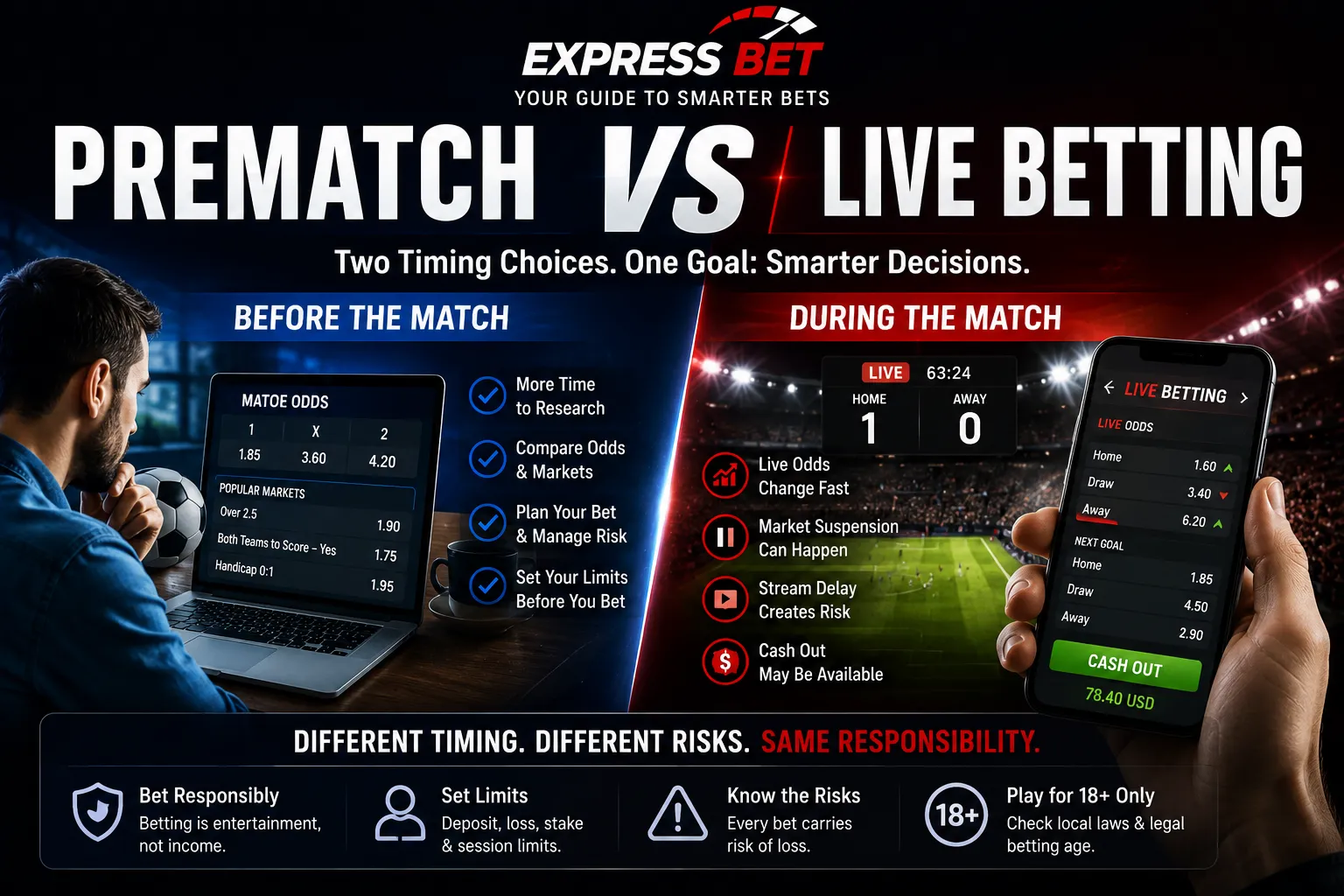
Pre-match betting means placing a bet before a sports event starts. The user studies the event, checks odds, reviews team news, compares markets, enters a stake, confirms the bet slip, and waits for the event to settle.
Live betting means placing a bet during an active event. It is also called in-play betting. The user sees the current score, time, match state, odds movement, and available live markets before choosing whether to bet.
The main difference is timing. Pre-match betting is usually slower and gives more time for research. Live betting is faster and depends on current match state. Live betting can create more emotional pressure because decisions happen during active play.
Pre-match odds may move before the event starts because of team news, injuries, lineups, weather, market money, or bookmaker risk. Live odds move during the event because of goals, points, wickets, injuries, substitutions, knockdowns, map swings, possession changes, and time remaining.
Pre-match betting has fewer real-time issues. Live betting adds risks such as stream delay, scoreboard delay, market suspension, changed odds, bet acceptance delay, rejected bets, and cash out limits.
Beginners usually need simpler markets and stricter limits. Pre-match betting is often easier for beginners because there is more time to understand odds and settlement rules. Live betting requires faster decisions, smaller stakes, and stronger discipline.
Both methods include risk of loss. Neither pre-match betting nor live betting guarantees profit. Betting is entertainment, not income.
Pre-match betting means betting before an event starts. The user places the bet before kickoff, tipoff, first ball, first serve, first round, map start, or another official event start time.
Pre-match betting is common across football, basketball, cricket, tennis, UFC, esports, and other sports. A user may bet on match winner, moneyline, spread, handicap, totals, player props, team props, futures, outright markets, or accumulators before the event begins.
Pre-match odds are available before the event. They may open early and then move as new information appears. Team news, injuries, lineups, weather, pitch condition, player availability, and market demand can all affect pre-match odds.
The main advantage is time. Users can compare odds, read market rules, check event context, decide stake size, and avoid rushed choices.
Example:
A user places a pre-match bet on Team A to win before kickoff at decimal odds of 1.90. The bet is confirmed before the match starts. If Team A wins under the market rules, the bet wins. If Team A does not win under those rules, the bet loses.
Pre-match betting still includes risk. More research time does not guarantee better results. A favorite can lose. A player can be injured after the bet is placed. A lineup can change. A market assumption can be wrong.
Live betting means betting during an active event. It is also called in-play betting. The user places the bet after the event has already started.
Live betting uses in-play odds. These odds update as the event changes. A goal, point, wicket, red card, timeout, knockdown, break of serve, map swing, or injury can move live odds quickly.
A live bet slip may not confirm instantly. The bookmaker may apply a bet acceptance delay. Odds may change before confirmation. The bet may be rejected. A market may suspend before the user can place the bet.
Live betting may feel more informed because the user can watch the event. That does not make it safer. The bookmaker may have faster data. The stream may be delayed. Odds may already reflect the visible match state.
Example:
A user watches a basketball game and places a live bet on Over 215.5 total points during the second quarter. The odds may change before confirmation because the score and pace keep moving.
Live betting can create repeated small bets. A user may react to every goal, wicket, point, possession, round, or map swing. This can increase risk quickly.
| Factor | Pre-Match Betting | Live Betting |
|---|---|---|
| Timing | Before event starts | During active event |
| Research time | More time available | Less time available |
| Odds movement | Slower, based on news and market activity | Faster, based on live match state |
| Decision speed | Slower | Faster |
| Emotional pressure | Usually lower | Usually higher |
| Market suspension | Less common | Common |
| Stream delay | Usually not relevant | Important risk |
| Cash out relevance | May become relevant after event starts | Often more visible but not guaranteed |
| Bet acceptance delay | Less noticeable | Common |
| Market variety | Broader pre-event markets | Dynamic in-play markets |
| Beginner suitability | Usually easier | Usually harder |
| Main risk | Wrong assumptions or late news | Fast emotional decisions |
Pre-match betting is usually slower and research-based. Live betting is faster and match-state-based.
Pre-match betting allows users to prepare. Live betting asks users to make decisions while the event changes. This creates different risk profiles.
A pre-match user may lose because the original analysis was wrong. A live betting user may lose because the decision was rushed, odds changed, or the market moved before confirmation.
Neither method is safe by default. Both require limits.
Pre-match odds are prices offered before an event starts. They show potential return and implied probability, but they do not guarantee a result.
Common pre-match odds movements can happen because of:
Decimal odds show total return per unit staked.
Formula:
Stake × Odds = Total Return
Profit = Total Return − Stake
Example:
A $10 stake at decimal odds of 1.90 gives a total return of $19 if the bet wins. Profit is $9 because the $10 stake is included in the return.
Pre-match odds are not guarantees. A low price does not mean safety. A high price does not automatically mean value.
For a deeper explanation of odds formats and implied probability, users should read the Odds Explained guide.
Live odds update during the event. They react to the current match state.
Live odds can move because of:
| Live Event | Possible Odds Impact |
| Football goal | Match winner and totals move quickly |
| Red card | Team strength and goal markets change |
| Basketball scoring run | Live spread and totals shift |
| Cricket wicket | Match winner and innings runs move |
| Tennis break of serve | Match winner odds change sharply |
| UFC knockdown | Fight winner odds move instantly |
| Esports team fight | Map winner and handicap markets shift |
| Injury | Player props and team markets change |
| Time running out | Current leader odds may shorten |
| Market suspension | Betting may pause temporarily |
Live odds may change before confirmation. The bookmaker may reject live bets if the market changes too quickly. Bookmaker margin still exists.
For deeper live odds, stream delay, and market suspension details, users should read the Live Sports Betting guide.
Pre-match betting gives users more time to study the event before placing a bet.
Users can review:
More time can reduce weak decisions. It allows users to avoid rushed betting, compare bookmakers, check settlement rules, and decide stake size before emotions rise.
Research does not remove risk. A user can study carefully and still lose. Sports outcomes remain uncertain. Betting remains entertainment, not income.
A good pre-match process is not about certainty. It is about reducing avoidable mistakes.
Live betting moves quickly because the event moves quickly. Odds update during active play. Markets can suspend. The bet slip can show changed odds. The user may feel pressure to confirm before the price moves again.
Live betting can create repeated decisions:
This can lead to overactivity. Many small bets can become a large total risk.
Expert note:
Live betting rewards patience more than reaction speed. A rushed live bet is usually a risk signal.
Fast decisions are not automatically better decisions. A user reacting emotionally is often behind the market.
Pre-match and live betting can offer different markets.
| Market Type | Usually Pre-Match | Usually Live | Risk Note |
| Match winner | Yes | Yes | Live price changes quickly |
| Moneyline | Yes | Yes | Current score affects price |
| Spread | Yes | Yes | Live spread can shift often |
| Handicap | Yes | Yes | Settlement rules matter |
| Totals | Yes | Yes | Live totals react to pace |
| Player props | Yes | Sometimes | Injury and minutes risk |
| Team props | Yes | Sometimes | Live context matters |
| Futures | Yes | Rarely | Long settlement period |
| Outright markets | Yes | Rarely | Season/tournament risk |
| Accumulators | Yes | Sometimes | One failed leg loses ticket |
| Next goal | Rarely | Yes | High volatility |
| Next point | Rarely | Yes | Very fast |
| Next wicket | Rarely | Yes | High volatility |
| Live corners | No or limited | Yes | Volatile |
| Live cards | No or limited | Yes | Volatile |
| Live map winner | No or limited | Yes | Esports volatility |
| Cash out | After bet is placed | Often visible live | Not guaranteed |
Pre-match betting usually has broader preparation time. Live betting has dynamic markets, but those markets can be volatile.
Users should not choose live markets only because they look active or exciting.
Settlement rules decide whether a bet wins, loses, voids, or returns the stake.
Pre-match markets settle based on market wording. Live markets also settle based on market wording, but live markets may have more specific time windows.
Users must check rules for:
A football 90-minute market usually includes stoppage time but excludes extra time and penalties unless stated otherwise.
A basketball full-game market may include overtime depending on bookmaker rules.
A cricket match may be affected by rain, reduced overs, DLS, no result, or abandoned play.
A tennis retirement can void or settle differently depending on sportsbook terms.
A live market can be limited to the next point, next game, next wicket, next goal, current quarter, current round, current map, or remaining match.
Market wording matters. Users should not bet before understanding it.
Market suspension is more common in live betting. It means the bookmaker temporarily pauses a market.
| Situation | Pre-Match Effect | Live Effect |
| Team lineup released | Odds may move | Not relevant if event has not started |
| Event about to start | Market may close | Live markets may open |
| Football goal | Not relevant before match | Market may suspend |
| VAR check | Not relevant before match | Market may suspend |
| Cricket wicket | Not relevant before match | Market may suspend |
| Basketball timeout | Not usually relevant pre-match | Live odds may reset |
| Tennis disputed point | Not relevant pre-match | Market may suspend |
| UFC knockdown | Not relevant pre-match | Market may move sharply |
| Esports technical pause | May delay start | Live market may suspend |
Users may not be able to bet or cash out during suspension. A market can reopen at a different price.
Live bets may also face bet acceptance delay. The bookmaker may show changed odds. The user may need to confirm the new price. The bet may be rejected.
Pre-match markets can also close before event start or after lineups. But live suspension is more frequent and more disruptive.
Stream delay is mainly a live betting issue.
A user may watch a video stream, TV broadcast, or scoreboard that is behind the bookmaker’s data feed. The sportsbook may already know what happened before the user sees it.
This creates a false sense of timing. A user may think they are acting quickly, but the market may already have adjusted.
Example:
A user watching a delayed tennis stream may try to bet before seeing a break point outcome, but the sportsbook may already have updated or suspended the market.
Stream delay can affect:
Users should assume the bookmaker’s data feed is faster than their stream.
Cash out is a bookmaker feature that may allow users to settle a bet before the final result.
Cash out may apply to both pre-match and live bets after the event starts. A pre-match bet can become eligible for cash out during the event. A live bet can also show cash out if the bookmaker supports it.
Live cash out values can change quickly. Cash out may disappear during market suspension. Partial cash out may be available on some platforms.
Cash out is not guaranteed. It does not remove betting risk. It is controlled by the bookmaker and may be unavailable when users want it most.
Warning:
Cash out is a bookmaker feature, not a guaranteed safety tool.
Users should not place risky bets assuming cash out will always protect them.
Pre-match and live betting create different emotional risks.
| Emotional Trigger | More Common In | Safer Response |
| Overconfidence before event | Pre-match | Reduce stake and check assumptions |
| Team loyalty | Pre-match | Avoid emotional picks |
| Betting too many fixtures | Pre-match | Limit match volume |
| Large accumulators | Pre-match | Avoid long tickets |
| Reacting after goals | Live | Pause before betting |
| Reacting after wickets | Live | Avoid instant chase bets |
| Betting after red cards | Live | Wait for market reset |
| Panic betting | Live | Stop session |
| Repeated small bets | Live | Use wagering limits |
| Chasing losses | Both | Use cooling-off |
| Betting while angry | Live | Stop immediately |
Pre-match emotional risk often comes from confidence before the event. Live emotional risk often comes from reacting during the event.
Both can lead to poor decisions. Users should stop if betting causes stress, panic, guilt, secrecy, conflict, debt, or loss of control.
Bankroll management means controlling betting money and stake size. It does not guarantee profit. It only reduces avoidable damage.
Users should use:
| Limit Type | Pre-Match Use | Live Betting Use |
| Deposit limit | Controls funding before betting | Prevents live redeposits |
| Loss limit | Stops losing periods | Stops live chasing |
| Stake limit | Controls bet size | Should usually be lower |
| Session limit | Controls time spent researching and betting | Essential for live sessions |
| Wagering limit | Controls total betting volume | Helps stop repeated small bets |
| Cooling-off period | Useful after losses | Useful after emotional live betting |
| Self-exclusion | Needed when control fails | Needed when live chasing repeats |
Live betting stakes should usually be smaller than pre-match stakes because live markets move faster.
Users should not redeposit during live sessions. Users should not use live betting to recover pre-match losses. Users should not use casino games to recover sports betting losses.
Pre-match betting is usually easier for beginners because it gives more time to research and less real-time pressure.
Beginners can read market rules, compare odds, check team news, and think before confirming the bet. This does not make pre-match betting safe, but it can reduce rushed decisions.
Live betting can be harder because odds move quickly and emotions can rise. Users may react to goals, wickets, points, timeouts, or map swings without enough thought.
Beginners should usually learn:
Beginners should avoid:
Practical recommendation:
Beginners should usually learn pre-match markets first, understand odds and settlement rules, then approach live betting only with smaller stakes and strict limits.
Neither method guarantees profit.
Pre-match football betting may include:
Live football betting may include:
A football match can change instantly after a goal, red card, penalty, VAR decision, injury, or substitution.
One goal or red card can change several live football markets instantly.
Users must check 90-minute settlement. Extra time and penalties usually do not count unless the market says otherwise.
Pre-match basketball betting may include:
Live basketball betting may include:
Basketball live odds can change after every possession. A scoring run, foul trouble, timeout, injury, substitution, or three-point swing can move markets quickly.
Pre-match basketball gives more time to check injury reports, rest, travel, pace, and rotations. Live basketball requires faster decisions.
Pre-match cricket betting may include:
Live cricket betting may include:
A wicket, six, rain delay, or DLS adjustment can shift live cricket markets quickly.
Pre-match cricket gives users time to check pitch, weather, toss context, and playing XI. Live cricket requires awareness of run rate, wickets in hand, overs remaining, and possible DLS changes.
Pre-match tennis betting may include:
Live tennis betting may include:
Tennis live odds can move point by point. A break of serve, medical timeout, tiebreak, or retirement can change markets sharply.
Users must check tennis retirement rules. Bookmakers may settle retirement differently.
Pre-match UFC and combat sports betting may include:
Live UFC betting may include:
A live combat sports bet can lose instantly after one strike, knockdown, submission, cut, or injury.
Pre-match UFC gives time to study styles and rules. Live UFC creates sudden-finish risk.
Users should use extreme caution with live combat sports markets.
Pre-match esports betting may include:
Live esports betting may include:
Esports live markets can change after one round, bomb plant, objective fight, economy reset, technical pause, or team fight.
Users should avoid fake signal groups, “sure win” bots, live predictor scams, and Telegram tips. No live scanner or esports bot can guarantee results.
| Pre-Match Betting Pros | Pre-Match Betting Cons |
| More time for research | Late lineup changes can affect bets |
| Easier odds comparison | Injuries can appear after placement |
| Calmer decision-making | Odds may move against user |
| Better for beginners | Market assumptions may be wrong |
| Easier stake planning | Accumulators can increase risk |
| More time to read rules | Users may bet too early |
| More time to set limits | Bonus pressure can affect decisions |
Pre-match betting is more structured. It gives users time to think. But it still includes uncertainty.
A calm process can still produce a losing bet.
| Live Betting Pros | Live Betting Cons |
| Users can observe match state | Faster decisions |
| Updated odds reflect current conditions | Stream delay |
| More markets during active play | Market suspension |
| Cash out may be available | Changed odds |
| Users can avoid some pre-match uncertainty | Emotional betting |
| Current pace or momentum is visible | Repeated small bets |
| Some markets only appear live | Cash out not guaranteed |
| Live context can inform decisions | Higher chasing risk |
Live betting can give more current information, but that information may already be priced into the odds.
The main danger is speed. Fast markets can create fast losses.
Common pre-match betting mistakes include:
A player may not start. A team may rotate. A formation may change.
Injuries can affect match winner, totals, props, and team performance.
Users may misunderstand 90-minute football, basketball overtime, tennis retirement, cricket DLS, or esports map rules.
Early odds may move after new information appears.
Favorites still lose. Low odds do not remove risk.
One failed leg loses the full ticket.
Bonus rules can restrict withdrawals and push overbetting.
Payout includes stake. Profit is payout minus stake.
A new pre-match bet should not exist mainly to recover an old loss.
Users must never bet with money needed for rent, food, bills, debt, loans, family, education, medical needs, or emergency savings.
Common live betting mistakes include:
The user may be watching old action while the bookmaker already has faster data.
Users must check the final odds before confirmation.
Goals, wickets, red cards, knockdowns, and map swings can create rushed decisions.
Reacting to every event creates overactivity.
Live betting should not be used to recover pre-match losses.
Cash out can disappear during suspension.
Live markets may settle over a specific time period.
Impaired judgment increases risk.
No signal group, prediction tool, bot, scanner, or tipster guarantees results.
This is a warning sign and should be avoided.
| Risk Type | Pre-Match Betting | Live Betting | Safer Action |
| Financial risk | Large pre-event stakes | Many small live bets | Set deposit and loss limits |
| Emotional risk | Overconfidence | Panic betting | Use cooling-off |
| Speed risk | Lower | High | Slow down or avoid live betting |
| Information risk | Late team news | Fast-changing match state | Verify context |
| Stream delay risk | Low | High | Assume bookmaker data is faster |
| Market suspension risk | Low | High | Do not rely on constant access |
| Cash out risk | May appear after start | Changes quickly | Treat as optional |
| Bonus risk | Bonus pressure | Live promotion urgency | Read terms or skip |
| Accumulator risk | Common | Possible | Avoid large tickets |
| Player prop risk | Lineup and role uncertainty | Injury and substitution risk | Use small stakes |
| Underage gambling risk | Present | Present | Minors must not gamble |
Both methods require risk controls. Live betting generally needs stricter session limits and smaller stakes.
Responsible gambling applies to both pre-match and live betting.
Core rules:
Users may contact [Responsible Gambling Help Organization], [National Gambling Helpline], [Self-Exclusion Register], or [Country-Specific Support Resource] where available.
Users should verify current responsible gambling resources, legal requirements, bookmaker licensing status, betting rules, and support contacts in their own country or region before relying on them.
Problem gambling signs can appear with either method.
Warning signs include:
For a full checklist, users should read the Problem Gambling Signs guide.
Users should stop if betting causes stress, secrecy, debt, conflict, panic, guilt, chasing losses, or loss of control.
A sportsbook should be checked before any deposit.
| Sportsbook Feature | Why It Matters |
| License and regulation | Shows legal oversight where applicable |
| Legal availability | Confirms whether users may register |
| Pre-match market depth | Gives more event and market options |
| Live market depth | Supports in-play betting |
| Odds quality | Better prices improve possible return |
| Odds stability | Reduces confusing movement |
| Market suspension clarity | Important for live users |
| Cash out rules | Explains limits and availability |
| Bet acceptance transparency | Shows changed odds and delays |
| Mobile app speed | Useful for live betting |
| Payments | Affects deposits |
| Withdrawals | Affects access to balance |
| KYC | Can affect payouts |
| Support | Helps with settlement issues |
| Bonus terms | Determines promotion usability |
| Responsible gambling tools | Supports safer control |
| Privacy policy | Explains data handling |
| Security | Protects account and payment data |
Users should avoid sportsbooks with unclear ownership, missing license details, vague withdrawal rules, weak responsible gambling tools, suspicious APK files, or guaranteed-win language.
Express Bet provides informational content only. Express Bet may publish sports betting guides, sportsbook reviews, betting comparisons, affiliate links, event betting pages, and responsible gambling content.
Express Bet does not guarantee bookmaker safety, winnings, withdrawals, odds value, live odds accuracy, cash out availability, or user outcomes. Express Bet does not make pre-match betting or live betting safe or profitable.
Users remain responsible for checking:
Users should stop betting if control weakens. Users should seek help if betting creates stress, secrecy, debt, conflict, panic, guilt, or loss of control.
Pre-match betting means placing a bet before a sports event starts.
Live betting means placing a bet during an active sports event.
In-play betting is another name for live betting.
The main difference is timing. Pre-match betting happens before the event. Live betting happens during the event.
Pre-match betting is usually easier for beginners because it gives more time for research. It is not safe or profitable by default.
Live betting can be riskier because decisions happen faster, odds move quickly, and emotional pressure can be higher.
Beginners should usually learn pre-match markets first before using live betting with smaller stakes and strict limits.
Pre-match odds are betting prices available before an event starts.
Live odds are betting prices that update during an active event.
Live odds change because of score changes, time remaining, injuries, possession, wickets, points, map swings, and bookmaker risk controls.
Yes. Pre-match odds can move because of team news, injuries, lineups, weather, market money, or bookmaker risk.
Market suspension means the bookmaker temporarily pauses a market.
Stream delay means the video shown to the user is behind the real event.
Bet acceptance delay is a short wait before a live bet is confirmed.
Changed odds are new odds shown before the bet confirms.
Cash out is an optional bookmaker feature that may allow early settlement.
No. Cash out is not guaranteed and may disappear during market suspension
Common pre-match markets include match winner, moneyline, spread, handicap, totals, player props, team props, futures, and accumulators.
Common live markets include live match winner, live totals, live handicap, next goal, next point, next wicket, live player props, and live team totals.
No. Using live betting to recover losses is chasing behavior and increases harm risk.
No betting method is safe. Both pre-match and live betting include risk of loss.
No. Neither method can guarantee profit.
Beginners should use small stakes and set deposit, loss, stake, and session limits before betting.
Live stakes should usually be smaller than pre-match stakes because live markets move faster.
Pre-match football allows lineup and market checks. Live football reacts quickly to goals, red cards, penalties, VAR, and substitutions.
Pre-match basketball uses injury, rotation, spread, and totals analysis. Live basketball odds can change after every possession.
Pre-match cricket uses pitch, weather, playing XI, and format analysis. Live cricket reacts to wickets, boundaries, run rate, DLS, and rain.
Pre-match tennis uses surface, form, and matchup context. Live tennis odds move point by point.
Pre-match UFC uses fight style and market analysis. Live UFC can change instantly after one strike or submission.
Pre-match esports uses roster, patch, and map context. Live esports reacts to economy swings, team fights, objectives, and map changes.
Check local law, legal age, bookmaker rules, odds, lineups, injuries, settlement rules, bonus terms, and limits.
Check local law, legal age, live rules, stream delay, market suspension, changed odds, cash out rules, score, time, and limits.
Check license, legal availability, pre-match and live markets, odds quality, payments, withdrawals, KYC, support, bonus terms, privacy, security, and responsible gambling tools.
Main risks include financial loss, emotional betting, speed pressure, stream delay, market suspension, changed odds, accumulators, bonuses, and chasing losses.
Responsible gambling means using limits, avoiding essential money, not chasing losses, taking breaks, and stopping if betting causes harm.
Stop if betting causes stress, secrecy, debt, conflict, panic, guilt, chasing losses, broken limits, or loss of control.
No. Minors must not use sports betting sites. Users must meet the legal betting age in their location.
Express Bet is an informational website unless the owner states otherwise. Third-party sportsbooks handle accounts, odds, deposits, withdrawals, and wagers.
Pre-match betting happens before the event and usually allows more research time. Users can check odds, lineups, injuries, weather, market rules, and stake size before the event begins.
Live betting happens during the event and creates faster decisions. Live markets move with the match state and can change after goals, points, wickets, injuries, red cards, knockdowns, or map swings.
Live betting has added risks such as stream delay, market suspension, changed odds, bet acceptance delay, rejected bets, and cash out limits.
Pre-match betting still has risks such as late news, wrong assumptions, poor odds, injuries after bet placement, and accumulator losses.
Neither method guarantees profit. Betting is entertainment, not income. Every bet includes risk of loss.
Users must check local law and legal betting age. Users must verify sportsbook license, payment rules, bonus terms, KYC process, privacy policy, withdrawal rules, and settlement rules.
Users should set limits before betting. Deposit limits, loss limits, stake limits, wagering limits, session limits, cooling-off periods, and self-exclusion can reduce harm. They do not make betting safe or profitable.
Users should stop if betting causes stress, secrecy, debt, conflict, panic, guilt, chasing losses, or loss of control.
[expert_review params=»JTdCJTIyY29sb3IlMjIlM0ElMjJncmVlbi0yJTIyJTJDJTIyZXhwZXJ0X2F2YXRhciUyMiUzQSUyMiUyMiUyQyUyMmV4cGVydF9uYW1lJTIyJTNBJTIyJTIyJTJDJTIyZXhwZXJ0X2xpbmslMjIlM0ElMjIlMjIlMkMlMjJleHBlcnRfaWQlMjIlM0ElMjIxJTIyJTJDJTIyZXhwZXJ0X3R5cGUlMjIlM0ElMjJleHBlcnRfaWQlMjIlMkMlMjJleHBlcnRfYXZhdGFyX2FsdCUyMiUzQSUyMiUyMiUyQyUyMmV4cGVydF9zaG93JTIyJTNBMSUyQyUyMmV4cGVydF9kZXNjcmlwdGlvbiUyMiUzQSUyMlNwb3J0cyUyMEJldHRpbmclMjBBbmFseXN0JTIwJTI2JTIwRWRpdG9yaWFsJTIwQ29udHJpYnV0b3IlMjIlMkMlMjJleHBlcnRfc2hvd19idXR0b24lMjIlM0ExJTJDJTIyZXhwZXJ0X3Nob3dfYnV0dG9uX3R5cGUlMjIlM0ElMjJwb3B1cCUyMiUyQyUyMmV4cGVydF9xdWVzdGlvbl9idXR0b25fdGV4dCUyMiUzQSUyMkFzayUyMFF1ZXN0aW9uJTIyJTJDJTIycXVlc3Rpb25fZXh0ZXJuYWxfbGluayUyMiUzQSUyMiUyMiUyQyUyMnBvcHVwX3VzZV9waG9uZSUyMiUzQTAlMkMlMjJleHBlcnRfdGl0bGUlMjIlM0ElMjJBdXRob3IlMjIlMkMlMjJleHBlcnRfc2hvd190aXRsZSUyMiUzQTElMkMlMjJleHBlcnRfdGV4dCUyMiUzQSUyMkFsZXglMjBNb3JnYW4lMjBpcyUyMGElMjBzcG9ydHMlMjBiZXR0aW5nJTIwYW5hbHlzdCUyMGFuZCUyMGVkaXRvcmlhbCUyMGNvbnRyaWJ1dG9yJTIwd2hvJTIwd3JpdGVzJTIwZGV0YWlsZWQlMjBib29rbWFrZXIlMjByZXZpZXdzJTJDJTIwYmV0dGluZyUyMGd1aWRlcyUyQyUyMHBsYXRmb3JtJTIwY29tcGFyaXNvbnMlMkMlMjBhbmQlMjByZXNwb25zaWJsZSUyMGdhbWJsaW5nJTIwZXhwbGFpbmVycy4lMjBIaXMlMjB3b3JrJTIwZm9jdXNlcyUyMG9uJTIwcHJhY3RpY2FsJTIwaW5mb3JtYXRpb24lMjBmb3IlMjB1c2VycyUyMHdobyUyMHdhbnQlMjB0byUyMHVuZGVyc3RhbmQlMjBob3clMjBiZXR0aW5nJTIwc2l0ZXMlMjBvcGVyYXRlJTIwYmVmb3JlJTIwdGhleSUyMHJlZ2lzdGVyJTJDJTIwZGVwb3NpdCUyQyUyMG9yJTIwY2xhaW0lMjBhJTIwYm9udXMuJTIyJTJDJTIycWElMjIlM0ElNUIlNUQlMkMlMjJxYV9zaG93X3RpdGxlJTIyJTNBMSUyQyUyMnFhX3RpdGxlJTIyJTNBJTIyJUQwJTkyJUQwJUJFJUQwJUJGJUQxJTgwJUQwJUJFJUQxJTgxJTIwJUQxJThEJUQwJUJBJUQxJTgxJUQwJUJGJUQwJUI1JUQxJTgwJUQxJTgyJUQxJTgzJTIyJTJDJTIyc2NvcmUlMjIlM0ElNUIlNUQlMkMlMjJzY29yZV9zdW1tYXJ5X3RleHQlMjIlM0ElMjIlMjIlMkMlMjJzY29yZV9zdW1tYXJ5X2F2ZXJhZ2UlMjIlM0EwJTJDJTIyc2NvcmVfbWF4JTIyJTNBJTIyNSUyMiUyQyUyMnNjb3JlX3N5bWJvbCUyMiUzQSUyMiUyMiUyQyUyMnNjb3JlX3RpdGxlJTIyJTNBJTIyJTIyJTJDJTIyc2NvcmVfc2hvd190aXRsZSUyMiUzQTAlMkMlMjJwbHVzZXMlMjIlM0ElNUIlNUQlMkMlMjJtaW51c2VzJTIyJTNBJTVCJTVEJTJDJTIycGx1c2VzX21pbnVzZXNfc2hvd190aXRsZSUyMiUzQTElMkMlMjJwbHVzZXNfbWludXNlc190aXRsZSUyMiUzQSUyMiVEMCU5RiVEMCVCQiVEMSU4RSVEMSU4MSVEMSU4QiUyMCVEMCVCOCUyMCVEMCVCQyVEMCVCOCVEMCVCRCVEMSU4MyVEMSU4MSVEMSU4QiUyMiUyQyUyMnBsdXNlc190aXRsZSUyMiUzQSUyMiUyMiUyQyUyMm1pbnVzZXNfdGl0bGUlMjIlM0ElMjIlMjIlN0Q=»]