
FIFA World Cup 2030
Table of Contents Show
Views 0
FIFA World Cup 2030
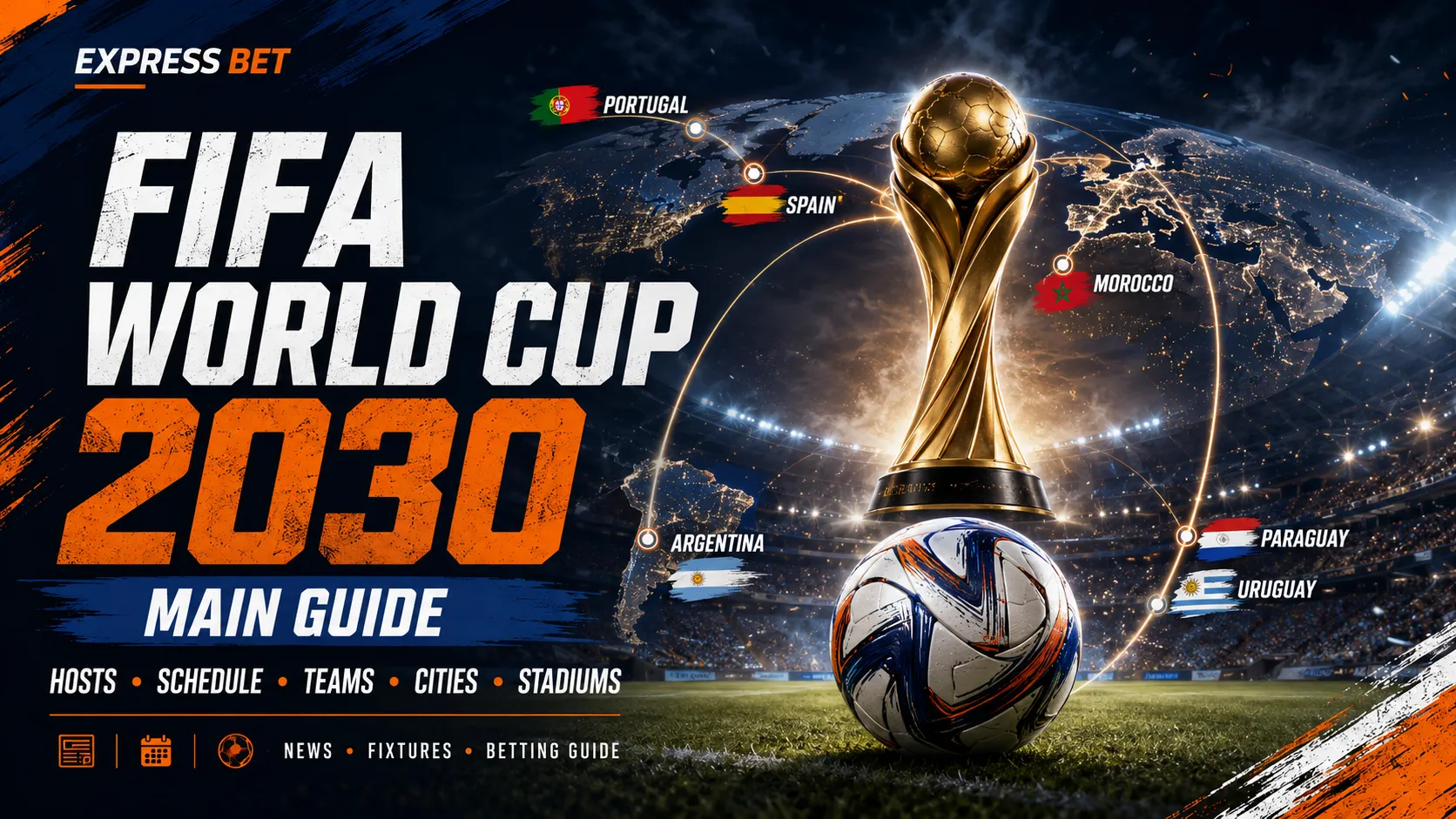
The FIFA World Cup 2030 will be one of the most unusual tournaments in football history. It will mark 100 years since the first FIFA World Cup was played in Uruguay in 1930. The main tournament hosts are Morocco, Portugal and Spain. Three centenary celebration matches are also planned in Argentina, Paraguay and Uruguay, with one match in each country. This page is the central Express Bet hub for FIFA World Cup 2030 information, including schedule updates, teams, cities, stadiums, fixtures, match previews, betting context, odds movement, travel notes and future tournament news.
FIFA World Cup 2030 Overview
The FIFA World Cup 2030 is the 2030 edition of the men’s FIFA World Cup. It is a global national-team football tournament and will carry extra historical weight because it celebrates the centenary of the competition.
The first FIFA World Cup was held in 1930. Uruguay hosted it and won it. That historical link explains why the 2030 tournament includes a South American centenary element, even though the main hosting structure belongs to Morocco, Portugal and Spain.
This tournament is different from a standard single-country World Cup. It connects Europe, Africa and South America. That creates a unique football story, but it also creates practical questions. Fans will need clear information about where matches are played, how the schedule works, which teams qualify, where the final will be held, and how travel between host regions affects teams and supporters.
For bettors, the FIFA World Cup 2030 will need careful analysis. The tournament will involve different climates, long travel routes, different crowd conditions and a wide range of playing styles. Early betting markets may appear before full details are confirmed, but serious analysis should wait for official schedules, group draws, squads and venue allocations.
FIFA World Cup 2030 quick facts:
- Tournament: FIFA World Cup 2030
- Main hosts: Morocco, Portugal and Spain
- Centenary match hosts: Argentina, Paraguay and Uruguay
- Theme: 100-year anniversary of the FIFA World Cup
- Format: To be confirmed by FIFA if changes occur
- Teams: To be confirmed through qualification
- Schedule: To be confirmed
- Stadiums: To be confirmed or finalized by FIFA
- Betting focus: Pre-match analysis, odds context, team form, risk management
| Topic | Current status | What users should check next |
|---|---|---|
| Host countries | Morocco, Portugal and Spain are the main hosts | [Internal link: FIFA World Cup 2030 Host Countries] |
| Centenary matches | Argentina, Paraguay and Uruguay will host one match each | [Internal link: FIFA World Cup 2030 Schedule] |
| Schedule | Full official schedule to be confirmed | [Internal link: FIFA World Cup 2030 Schedule] |
| Teams | Final qualified teams to be confirmed through qualification | [Internal link: FIFA World Cup 2030 Teams] |
| Qualification | Confederation qualification will define the final field | [Internal link: FIFA World Cup 2030 Qualification] |
| Stadiums | Final venue list to be confirmed or finalized by FIFA | [Internal link: FIFA World Cup 2030 Stadiums] |
| Cities | Host city details require official confirmation | [Internal link: FIFA World Cup 2030 Cities] |
| Groups | Group draw not yet confirmed | [Internal link: FIFA World Cup 2030 Groups] |
| Betting guide | Broad betting education can begin before the draw | [Internal link: FIFA World Cup 2030 Betting Guide] |
| Match previews | To be published once fixtures are known | [Internal link: FIFA World Cup 2030 Match Previews] |
| Results | To be updated during the tournament | [Internal link: FIFA World Cup 2030 Match Results] |
Why FIFA World Cup 2030 Is Different
The FIFA World Cup 2030 is different because it is not only a football tournament. It is also a centenary event. FIFA is using the 2030 edition to connect the modern World Cup with its origin story.
The main competition structure belongs to Morocco, Portugal and Spain. That gives the tournament a strong Mediterranean identity. Spain brings one of the richest football infrastructures in Europe. Portugal brings a deep football culture, major club stadiums and a national-team tradition that has become stronger in the modern era. Morocco brings North African football culture, intense stadium atmospheres and the wider symbolic importance of African hosting involvement.
The South American centenary matches add another layer. Argentina, Paraguay and Uruguay are not ordinary supporting locations. Uruguay hosted the first World Cup in 1930. Argentina has one of the strongest football identities in the world. Paraguay gives the centenary concept a broader CONMEBOL footprint. Together, these matches connect the first century of the World Cup with the next one.
This format also creates logistical complexity. Teams involved in South American centenary matches may face different travel patterns than teams starting directly in Europe or Africa. Fans may need to understand multiple host regions, time zones, ticketing systems, travel rules and venue conditions. Broad tournament coverage must therefore be structured carefully.
That is why this Express Bet page works as a hub. It gives the main picture first. Deeper information belongs on separate pages. The FIFA World Cup 2030 schedule page should handle match dates. The teams page should handle qualification and squads. The cities and stadiums pages should handle venue detail. Match previews should handle tactical and betting analysis once exact fixtures exist.
FIFA World Cup 2030 Host Countries
The FIFA World Cup 2030 host structure includes three main host countries and three centenary match countries. The main hosts are Morocco, Portugal and Spain. The centenary match hosts are Argentina, Paraguay and Uruguay.
This structure matters because host context can affect football analysis. A team playing in Spain may face different conditions from a team playing in Morocco. A centenary match in South America may carry unusual travel and emotional context. A bettor should not treat every match as if it happens in the same environment.
Morocco
Morocco is one of the three main hosts of the FIFA World Cup 2030. Its role is important for African football and for the global profile of North African football culture.
Moroccan football has grown in visibility in recent years. The national team has become known for tactical discipline, intense defensive organization and strong emotional support from fans. Moroccan club football also carries strong local identity, especially in major stadium environments where crowd pressure can be significant.
For the FIFA World Cup 2030, Morocco’s role should be analyzed in several ways. First, it gives African fans a major connection to the tournament. Second, it adds different climate and travel considerations. Third, it may create venue conditions that differ from European stadium environments in Spain and Portugal.
No page should invent final Moroccan stadium allocations before official confirmation. The correct approach is to track FIFA updates, host committee announcements and verified venue plans. The future stadiums page should explain each confirmed Moroccan venue once the list is final.
Portugal
Portugal is another main host of the FIFA World Cup 2030. It brings a strong football culture, modern stadiums and a national-team identity built around technical players, tactical structure and consistent tournament relevance.
Portuguese football is shaped by major clubs, strong academies and a long record of producing elite players. The country has hosted major football events before, and its stadium infrastructure is familiar to European football audiences.
For fans, Portugal may become one of the most attractive host destinations because of compact geography, established travel routes and football cities with strong club traditions. For bettors, Portuguese venues may matter because they can influence travel efficiency, crowd balance and playing conditions.
The dedicated host countries page should cover Portugal in more detail. The stadiums page should handle confirmed venues. The schedule page should explain whether Portugal hosts group-stage matches, knockout matches or other key fixtures once FIFA confirms the full match calendar.
Spain
Spain is one of the central hosts of the FIFA World Cup 2030. Its football infrastructure is among the strongest in the world. Spanish cities have major stadiums, large fan bases and deep experience with elite football.
Spain’s football identity is linked to technical play, positional control, intense club rivalries and a long tournament history. Its domestic league has helped shape modern football tactics. That makes Spain an important part of the tournament narrative.
Spain may also become central to debates about the FIFA World Cup 2030 final, but the final venue must not be treated as confirmed until FIFA officially confirms it. Many articles make early claims about venues before official confirmation. This hub should avoid that mistake.
Spain’s role should be covered in layers. The host countries page should explain its tournament role. The cities page should cover confirmed host cities. The stadiums page should cover confirmed venues. Match previews should later analyze how specific Spanish stadiums affect match conditions.
Argentina
Argentina is a centenary match host for the FIFA World Cup 2030. It is not one of the three main hosts unless FIFA changes the structure. Its role is symbolic and historical.
Argentina’s football culture is one of the strongest in the world. The country has produced major players, powerful national teams and some of the most intense football atmospheres anywhere. A centenary match in Argentina gives the tournament an emotional South American opening chapter.
For analysis, Argentina’s role should be described precisely. The country is part of the centenary celebration structure. It should not be presented as a full co-host on the same level as Morocco, Portugal and Spain.
Paraguay
Paraguay is also a centenary match host. Its inclusion gives the South American celebration a wider regional identity.
Paraguayan football has a reputation for defensive toughness, competitiveness and strong national identity. Its role in the FIFA World Cup 2030 is expected to be limited to the centenary match structure unless FIFA announces changes.
For readers, the key point is simple. Paraguay is involved in the celebration of the World Cup’s 100-year history. It should be included in any accurate overview of the tournament, but not misrepresented as a main host.
Uruguay
Uruguay is central to the historical meaning of the FIFA World Cup 2030. The first FIFA World Cup was held in Uruguay in 1930. Uruguay won that tournament. That makes its centenary role more than symbolic.
A centenary match in Uruguay connects the 2030 tournament with the competition’s origin. Montevideo and the 1930 legacy will be major storytelling elements in the build-up. Still, the number of matches should not be exaggerated. The current structure is one centenary celebration match in Uruguay.
For a deeper breakdown of every host nation, stadium plan and football context, visit [Internal link: FIFA World Cup 2030 Host Countries].
FIFA World Cup 2030 Schedule
The full FIFA World Cup 2030 schedule is not yet complete for practical editorial use until FIFA confirms the final match calendar, kick-off times, venues and fixture order. Some broad planning may exist before the final draw, but a proper schedule page must rely on confirmed information.
The dedicated FIFA World Cup 2030 schedule page should eventually include the opening match, the three centenary matches, group-stage fixtures, knockout dates, rest days, venue assignments, local kick-off times and time-zone conversions.
A useful schedule page must separate confirmed facts from expected structure. It should not invent fixtures before teams qualify. It should not publish made-up kick-off times. It should not claim a final stadium unless FIFA confirms it.
The schedule will matter for fans because it shapes travel plans, ticket decisions and viewing habits. It will matter for teams because rest periods, travel distance and venue changes can affect performance. It will matter for bettors because schedule pressure often influences rotation, tactical risk and in-play market behavior.
Important schedule factors for analysis include:
- Rest advantage between matches
- Travel distance between venues
- Climate change between host regions
- Local kick-off time
- Squad rotation risk
- Recovery windows
- Knockout path difficulty
- Venue familiarity
- Opening-match emotion
- Centenary match disruption
For bettors, the schedule should never be treated as background detail. A team with one extra rest day may press harder. A team forced into long-distance travel may manage tempo. A favorite facing a short turnaround may rotate. These factors do not guarantee outcomes, but they can change match probabilities.
The detailed fixture calendar belongs here: [Internal link: FIFA World Cup 2030 Schedule].
FIFA World Cup 2030 Teams
The final list of FIFA World Cup 2030 teams will be confirmed through qualification and automatic qualification rules. Until qualification is complete, no article should publish a fake final team list.
The teams page should become one of the most important sections of the Express Bet FIFA World Cup 2030 content hub. It should track qualified teams, qualification routes, squad strength, coaching changes, tactical identity and tournament history.
A strong team profile should not only list players. It should explain how the team plays. Does it defend deep? Does it press high? Does it rely on transitions? Does it dominate possession? Does it struggle against compact blocks? Does it have enough squad depth for a long tournament?
These questions matter for football fans, but they also matter for betting analysis. A team’s public reputation often moves odds before deeper analysis catches up. Famous teams can become overpriced. Less famous teams can be underrated if their qualification numbers, tactical structure and defensive record are strong.
A future FIFA World Cup 2030 teams page should include:
- Qualified teams
- Host teams
- Qualification route
- FIFA ranking context
- Squad depth
- Tactical profile
- Key players
- Coaching style
- Recent tournament record
- Betting relevance
- Injury watch
- Warm-up match form
The team hub belongs here: [Internal link: FIFA World Cup 2030 Teams].
FIFA World Cup 2030 Qualification
FIFA World Cup 2030 qualification will define the final tournament field. It will also create the first serious evidence for team analysis.
Qualification is not only a path to the tournament. It is also a data source. It shows which teams can manage pressure, travel, away matches, hostile crowds and different tactical matchups.
The major confederations involved in the qualification process are:
- UEFA
- CAF
- CONMEBOL
- CONCACAF
- AFC
- OFC
The exact qualification format and slot allocation should be checked against official FIFA and confederation information. This page should not invent qualification tables or final standings. The dedicated qualification page should be updated as each confederation progresses.
For bettors, qualification matters because it reveals patterns. Some teams dominate weak opposition but struggle against organized sides. Some teams collect points without creating many chances. Some teams concede few goals because of structure, not luck. Others look strong on paper but depend too heavily on one or two players.
The qualification page should track:
- Team form
- Competitive strength of opponents
- Away performance
- Squad consistency
- Coaching changes
- Injuries
- Tactical evolution
- Goal difference
- Defensive record
- Chance creation
- Set-piece strength
- Match tempo
Qualification data will become more useful as the tournament approaches. Early narratives are often too simple. Detailed qualification analysis gives readers a better base for future match previews.
Follow qualification updates here: [Internal link: FIFA World Cup 2030 Qualification].
FIFA World Cup 2030 Groups
The FIFA World Cup 2030 groups will become one of the key pre-tournament topics once the draw is complete. Until then, no group list should be treated as official.
The group draw shapes the tournament. It affects team strategy, betting markets, travel patterns and qualification scenarios. A strong team in a difficult group may face shorter odds but higher risk. A balanced group may produce tighter matches, lower goal totals and more draw potential.
A future FIFA World Cup 2030 groups page should include:
- Official group draw
- Team-by-team group analysis
- Group difficulty rating
- Likely tactical matchups
- Travel impact
- Betting market overview
- Qualification scenarios
- Head-to-head context
- Stadium assignments
- Rest-day comparison
The group page should not duplicate full team profiles. It should focus on matchups. For example, a possession-heavy team against a transition team creates a different betting picture from two cautious teams that both prefer low-risk structure.
Group betting can be attractive, but it carries risk. A single red card, injury or rotation decision can change the group table. Bettors should avoid treating group futures as safe bets.
The group hub belongs here: [Internal link: FIFA World Cup 2030 Groups].
FIFA World Cup 2030 Cities
Host cities matter because football is not played in neutral theory. It is played in specific places. City conditions can affect teams, supporters and betting analysis.
The FIFA World Cup 2030 cities page should focus on confirmed host cities once the final list is official. If candidate or expected cities are discussed before final confirmation, they must be labeled clearly as proposed, expected or not yet confirmed.
City-level factors include:
- Stadium location
- Climate
- Altitude if relevant
- Travel connections
- Local football culture
- Fan zones
- Accommodation pressure
- Matchday atmosphere
- Time zones
- Recovery logistics
- Distance from training bases
- Airport access
For supporters, city guides help with travel planning. For teams, cities affect recovery and match preparation. For bettors, city context can become useful when it changes match conditions.
A hot afternoon match may reduce pressing intensity. A long transfer between cities may affect recovery. A venue with strong crowd pressure may affect underdogs differently from favorites. None of these factors should be overstated, but they should not be ignored.
The full city guide belongs here: [Internal link: FIFA World Cup 2030 Cities].
FIFA World Cup 2030 Stadiums
Stadiums are more than backdrops. They shape the match environment. The FIFA World Cup 2030 stadiums page should explain confirmed venues, capacity, location, stadium design, football history and match allocation once FIFA finalizes details.
Until then, this main hub should avoid unconfirmed stadium claims. It should explain why stadiums matter and direct readers to the dedicated venue page.
Key stadium factors include:
- Pitch quality
- Capacity
- Crowd pressure
- Roof or open-air design
- Climate control if relevant
- Grass type
- Travel distance from team bases
- Historical home advantage
- Atmosphere
- Camera and viewing experience
- Match allocation
- Local transport access
For football analysis, stadium details can matter. Some venues create intense noise. Some have wide open designs. Some produce slower pitch conditions. Some are easier for away fans to reach. Some may create unusual climate demands.
For betting analysis, stadium context should be used carefully. It is one input, not a prediction engine. A stadium can support a tactical argument, but it cannot replace team news, matchups, form and price analysis.
The full venue guide belongs here: [Internal link: FIFA World Cup 2030 Stadiums].
FIFA World Cup 2030 Fixtures
The FIFA World Cup 2030 fixtures will become available once qualification, draw and schedule details are complete.
There is a difference between schedule and fixtures. The schedule is the tournament calendar. It explains dates, rounds and match slots. Fixtures are exact matches between teams. A fixture tells users which teams play, where they play, when they play and what stage the match belongs to.
The fixture page should later include:
- Team vs team matches
- Venue
- Date
- Kick-off time
- Group or knockout round
- Pre-match notes
- Odds context
- Live update links
- Result links after the match
- Match preview links
- Group table impact
- Knockout path impact
A fixture page should be clean and practical. Users do not want vague essays when they search fixtures. They want exact matches, times and links to deeper analysis. The main hub should only summarize this and point users to the dedicated schedule and fixture pages.
Follow the fixture calendar here: [Internal link: FIFA World Cup 2030 Schedule].
FIFA World Cup 2030 Match Previews
Express Bet match previews should become a major part of the FIFA World Cup 2030 content system once the fixtures are known.
A useful match preview is not a prediction dressed as certainty. It is a structured analysis of team news, tactical matchups, venue context, form and betting market risk. It should help users understand the match, not push them toward reckless betting.
Each match preview should include:
- Team news
- Expected lineups
- Tactical setup
- Recent form
- Injuries and suspensions
- Head-to-head record
- Key players
- Venue context
- Weather
- Rest days
- Betting odds movement
- Market risks
- Responsible betting note
The best previews should explain why a market may be attractive or dangerous. For example, a low total may look logical if both teams defend deep, but early-match red-card risk, set-piece weakness or goalkeeper issues can change the picture.
Match previews should never promise guaranteed outcomes. Football has high variance. A deflection, penalty, VAR decision or injury can break even strong analysis.
Future previews belong here: [Internal link: FIFA World Cup 2030 Match Previews].
FIFA World Cup 2030 Match Results
The FIFA World Cup 2030 match results section will become useful during and after the tournament. Result pages should do more than repeat the final score.
A strong result article should explain what happened and why it mattered. It should cover tactical changes, key moments, substitutions, cards, match statistics and tournament impact.
Each result page should include:
- Final score
- Scorers
- Match timeline
- Cards
- Substitutions
- Tactical changes
- xG if available
- Possession
- Shots
- Goalkeeper saves
- Betting market reaction
- Group table impact
- Knockout bracket impact
- What the result means next
For bettors, results pages can also explain market movement. Did a favorite win but perform poorly? Did an underdog lose despite strong xG? Did a team rely on set pieces rather than open-play dominance? These details matter for future previews.
Results should be written neutrally. They should not exaggerate one match into a full tournament conclusion. World Cup narratives change quickly.
Follow results here: [Internal link: FIFA World Cup 2030 Match Results].
FIFA World Cup 2030 Betting Guide
The FIFA World Cup 2030 betting guide should help users understand markets, odds and risk. It should not encourage reckless gambling. It should not promise profit. It should not present betting as income.
World Cup betting is popular because the tournament attracts casual fans and experienced bettors at the same time. That creates opportunity, but also danger. Public money can move markets. Famous teams can become overpriced. Emotional betting becomes common.
Major World Cup 2030 betting markets may include:
- Match winner
- Draw
- Double chance
- Over/under goals
- Both teams to score
- Asian handicap
- Correct score
- First goalscorer
- Cards
- Corners
- Outright winner
- Group winner
- Top goalscorer
- Team to qualify
- Live betting markets
Some markets are easier to understand than others. Match winner is simple, but prices may be poor on heavy favorites. Over/under goals can be useful when tactical patterns are clear, but one early goal changes match state. Correct score is high risk. First goalscorer is high variance. Accumulators increase risk quickly because every leg must win.
Outright betting can change over time. A team may look strong before the draw, then face a difficult path. Another team may have shorter odds after an easy group draw. Injuries, squad announcements, coaching changes and warm-up matches can all move prices.
The correct approach is to analyze price, not only team strength. A strong team is not automatically a good bet. A weak team is not automatically a bad bet. Value depends on probability compared with market price.
Read the full betting guide here: [Internal link: FIFA World Cup 2030 Betting Guide].
For broader football betting education, use [Internal link: Football Betting Guide].
For risk control, read [Internal link: Responsible Gambling].
How World Cup 2030 Odds May Change
World Cup 2030 odds will not stay fixed. They will move as information changes. Odds are market prices. They are not guarantees and not official predictions.
Several factors can influence World Cup 2030 odds:
| Factor | Why it matters | Betting impact | Risk level |
|---|---|---|---|
| Qualification performance | Shows competitive form before the tournament | Can shorten or lengthen outright odds | Medium |
| Group draw | Defines early path difficulty | Can affect group and outright markets | High |
| Injuries | Removes key players or weakens depth | Can move match and outright prices | High |
| Squad announcements | Confirms player availability | Can shift team strength ratings | Medium |
| Tactical form | Shows how a team actually plays | Affects totals, handicaps and match markets | Medium |
| Travel routes | May affect recovery and preparation | Important for short-turnaround matches | Medium |
| Climate and venue | Can change tempo and fatigue | Useful for totals and live betting | Medium |
| Public betting pressure | Popular teams attract casual money | Can create overpriced favorites | High |
| Bookmaker margin | Reduces long-term bettor value | Important in all markets | High |
| News cycles | Rumors can move prices quickly | Can create unstable markets | Medium |
| Knockout bracket path | Determines likely opponents | Strong effect on outrights | High |
A bettor should understand that odds include bookmaker margin. A price can look attractive but still be poor value. The market is not only about picking winners. It is about comparing implied probability with realistic probability.
Early odds require extra caution. Before qualification, the draw and squad announcements, many markets rely on assumptions. Some assumptions will be wrong.
Key Betting Risks for FIFA World Cup 2030
World Cup betting carries specific risks because the tournament attracts high emotion. Many users bet on national loyalty, famous names or social media narratives. That is not analysis.
Key betting risks include:
- Emotional betting
- National bias
- Overrating famous teams
- Underrating smaller teams
- Betting too early
- Betting based on social media noise
- Ignoring rotation
- Ignoring travel fatigue
- Chasing losses
- Using accumulators without risk control
- Misreading odds movement
- Treating predictions as certainty
- Betting without checking lineups
- Overreacting to one match
- Ignoring bookmaker margin
The biggest mistake is treating the World Cup as predictable because the teams are familiar. International football has limited preparation time. Coaches may change systems. Players arrive from different club seasons. Some teams have strong names but weak balance. Others have less star power but better structure.
Betting should be treated as risk-based entertainment, not income. Users must follow local laws and age restrictions. Users should set limits and never bet money they cannot afford to lose.
For risk guidance, read [Internal link: Responsible Gambling].
FIFA World Cup 2030 News and Updates
The FIFA World Cup 2030 news section should track official updates and important developments. It should not recycle rumors without context.
Future updates may include:
- Confirmed schedule
- Final stadium list
- Host city confirmation
- Qualification results
- Group draw
- Squad announcements
- Injuries
- Referee appointments
- Weather notes
- Ticket information
- Broadcast information
- Match previews
- Match results
A useful news page must separate official confirmation from reports. Many World Cup stories appear years before the tournament. Some are accurate. Some are speculation. Some are political pressure or local media positioning.
Express Bet should use a clear editorial standard. If FIFA confirms it, say confirmed. If a host committee proposes it, say proposed. If media report it, say reported. If the detail is uncertain, say not yet confirmed.
Follow updates here: [Internal link: FIFA World Cup 2030 News].
FIFA World Cup 2030 TV and Streaming
The FIFA World Cup 2030 TV and streaming picture will depend on broadcast rights in each country. Rights differ by region, language and platform. Users should not assume one global streaming option will cover every country.
A future TV and streaming guide should cover:
- Official broadcasters
- Free-to-air options where legal
- Paid streaming services
- Mobile viewing
- Legal viewing rules
- VPN risks and legality
- Match time zones
- Highlights availability
- Radio coverage where relevant
- Regional broadcast differences
Express Bet should not promote illegal streams. It should guide users toward legal viewing routes. If a country has free-to-air coverage, that should be explained clearly. If coverage requires a paid subscription, the article should say so.
The streaming guide belongs here: [Internal link: FIFA World Cup 2030 TV and Streaming Guide].
FIFA World Cup 2030 Travel and Fan Context
The FIFA World Cup 2030 will create major travel interest because of its multi-country structure. Fans may need to think about different regions, transport systems and matchday rules.
This hub should not become a full travel guide. It should summarize the main factors and link to deeper city and stadium pages.
Travel topics to track include:
- Multi-country tournament logistics
- Passport and visa checks
- Long-distance travel
- Regional transport
- Accommodation demand
- Matchday planning
- Fan zones
- Safety
- Weather and clothing
- Ticket timing
- Airport connections
- Local transport
- Stadium access
- Mobile internet
- Payment methods
Fans should always check official tournament sources, government travel advice and airline rules before booking. World Cup travel is expensive and changes quickly. Early assumptions can become costly mistakes.
The fan travel angle also matters for atmosphere. Some matches may attract heavy local support. Others may depend more on traveling fans. That can affect the feel of a match, especially in knockout rounds.
How Express Bet Will Cover FIFA World Cup 2030
Express Bet will cover the FIFA World Cup 2030 as an independent sports betting and football analysis website.
Express Bet is not FIFA. It is not an official World Cup website. It is not a bookmaker. It does not accept bets, deposits, withdrawals or user accounts. It does not handle ticket sales, broadcast access or betting disputes.
The editorial approach should be based on:
- Factual updates
- Match previews
- Result analysis
- Odds education
- Betting risk notes
- Tactical analysis
- Team guides
- City and stadium context
- No guaranteed predictions
- No fake insider claims
- No unofficial streams
- No scam betting systems
The goal is to help readers understand the tournament and betting context. The site should explain information clearly, avoid false certainty and update pages when official details change.
Suggested FIFA World Cup 2030 Content Hub Structure
A strong World Cup content hub needs clear hierarchy. The main page should stay broad. Subpages should handle depth.
| Subpage | Purpose | Best internal anchor | Update frequency |
|---|---|---|---|
| FIFA World Cup 2030 Schedule | Tournament calendar, dates, rounds and kick-off times | FIFA World Cup 2030 schedule | High after confirmation |
| FIFA World Cup 2030 Fixtures | Exact team-vs-team matches after draw | FIFA World Cup 2030 fixtures | High during tournament |
| FIFA World Cup 2030 Teams | Qualified teams and team profiles | FIFA World Cup 2030 teams | Medium to high |
| FIFA World Cup 2030 Qualification | Qualification routes and standings | FIFA World Cup 2030 qualification | High during qualifiers |
| FIFA World Cup 2030 Groups | Draw analysis and group scenarios | FIFA World Cup 2030 groups | High after draw |
| FIFA World Cup 2030 Standings | Group tables during tournament | FIFA World Cup 2030 standings | Very high during tournament |
| FIFA World Cup 2030 Knockout Bracket | Knockout path and bracket updates | FIFA World Cup 2030 knockout bracket | Very high during knockout stage |
| FIFA World Cup 2030 Host Countries | Country-level hosting overview | FIFA World Cup 2030 host countries | Medium |
| FIFA World Cup 2030 Cities | Host city guides and logistics | FIFA World Cup 2030 cities | Medium |
| FIFA World Cup 2030 Stadiums | Venue profiles and stadium analysis | FIFA World Cup 2030 stadiums | Medium |
| FIFA World Cup 2030 Betting Guide | Betting markets and risk education | FIFA World Cup 2030 betting guide | Medium |
| FIFA World Cup 2030 Odds | Odds movement and market context | World Cup 2030 odds | High near tournament |
| FIFA World Cup 2030 Match Previews | Tactical and betting previews | World Cup 2030 match previews | Very high during tournament |
| FIFA World Cup 2030 Match Results | Final scores and analysis | FIFA World Cup 2030 match results | Very high during tournament |
| FIFA World Cup 2030 TV and Streaming Guide | Legal viewing options by region | FIFA World Cup 2030 TV and streaming | Medium to high |
Core tournament pages
1. FIFA World Cup 2030 Schedule
This page should cover the full tournament calendar once FIFA confirms it. It should include opening matches, group-stage dates, knockout rounds, rest days, local kick-off times and time-zone conversions.
It should not be overloaded with team analysis. Its main job is usability. Users searching for dates should get clean, updated schedule information.
2. FIFA World Cup 2030 Fixtures
This page should list exact matches after qualification and the draw. It should show team names, venues, dates, kick-off times, group or knockout stage and links to previews.
Fixtures should be easy to scan. Each match can later link to a dedicated preview and result page.
3. FIFA World Cup 2030 Teams
This page should track all qualified teams. It should explain each team’s qualification route, tactical identity, coach, squad depth and tournament history.
The teams page should be updated after squads are announced. It should avoid early final-squad claims before official lists exist.
4. FIFA World Cup 2030 Qualification
This page should explain the road to the tournament. It should track confederation qualification, standings, important matches and teams close to qualification.
It should focus on evidence. Qualification performance gives early signals for future World Cup analysis.
5. FIFA World Cup 2030 Groups
This page should become active after the draw. It should explain each group, key matches, group difficulty and possible qualification scenarios.
It should link to team pages, fixture pages and match previews. It should not duplicate every team profile.
6. FIFA World Cup 2030 Standings
This page should update during the tournament. It should show points, goal difference, goals scored, goals conceded and qualification status.
Standings pages must be accurate and fast. They are useful after every group-stage match.
7. FIFA World Cup 2030 Knockout Bracket
This page should track the knockout path. It should show the Round of 32, Round of 16, quarter-finals, semi-finals, third-place match and final.
It should explain how each result changes the bracket. It should link to previews and results.
Host and venue pages
1. FIFA World Cup 2030 Host Countries
This page should explain Morocco, Portugal, Spain, Argentina, Paraguay and Uruguay. It should separate main hosts from centenary match hosts.
It should cover football culture, tournament role, geography and expected fan context.
2. FIFA World Cup 2030 Cities
This page should cover confirmed host cities once official. It should explain city logistics, climate, transport and fan experience.
It should help fans and analysts understand the environment around each match.
3. FIFA World Cup 2030 Stadiums
This page should profile confirmed stadiums. It should include capacity, location, design, atmosphere, pitch context and match allocation when available.
Stadium pages should avoid unverified venue claims.
4. FIFA World Cup 2030 Travel Guide
This page should cover travel planning, documents, transport, accommodation, safety and matchday movement.
It should always tell users to check official sources before booking.
5. FIFA World Cup 2030 Fan Guide
This page should focus on practical fan experience. It should cover tickets, fan zones, local rules, stadium access, weather and viewing culture.
It should not replace official ticketing information.
Betting and analysis pages
1. FIFA World Cup 2030 Betting Guide
This page should explain betting markets, odds, bankroll control and responsible gambling. It should avoid promises and hype.
It should be useful before and during the tournament.
2. FIFA World Cup 2030 Odds
This page should explain World Cup 2030 odds movement. It should cover outright markets, group markets and match markets.
It should make clear that odds are market prices, not guarantees.
3. FIFA World Cup 2030 Predictions
This page should provide analytical predictions only after enough information exists. It should avoid fake certainty.
Predictions should include reasoning, risk and alternative scenarios.
4. FIFA World Cup 2030 Outright Winner Odds
This page should focus on tournament winner markets. It should track favorites, dark horses and price movement.
It should explain how draw path affects outright value.
5. FIFA World Cup 2030 Group Betting Guide
This page should analyze group winner, qualification and points markets after the draw.
It should explain why group markets can change quickly after the first matchday.
6. FIFA World Cup 2030 Live Betting Guide
This page should explain in-play betting risks. It should cover match state, substitutions, cards, fatigue and tempo.
It should warn users against impulsive live betting.
7. FIFA World Cup 2030 Betting Risks
This page should focus on responsible gambling. It should cover emotional betting, national bias, chasing losses and overuse of accumulators.
It should link to broader responsible gambling resources.
Editorial content
1. FIFA World Cup 2030 News
This page should track official tournament updates. It should separate confirmed facts from rumors and reports.
It should be updated when FIFA, host committees or confederations publish important information.
2. FIFA World Cup 2030 Match Previews
This page should collect all match previews. Each preview should cover tactics, team news, odds context and risk.
It should become one of the main daily content areas during the tournament.
3. FIFA World Cup 2030 Match Results
This page should collect result articles. Each result should explain scoreline, tactics, key moments and tournament impact.
It should update quickly during the tournament.
4. FIFA World Cup 2030 Team News
This page should track squad updates, injuries, suspensions and coaching decisions.
It should help readers follow changes before match previews.
5. FIFA World Cup 2030 Injury Updates
This page should focus on injuries and player availability. It should cite official team statements where possible.
It should avoid rumor-based claims.
6. FIFA World Cup 2030 Tactical Analysis
This page should publish deeper football analysis. It can cover pressing systems, build-up structures, defensive blocks and matchup trends.
It should support match previews without duplicating them.
Conclusion
The FIFA World Cup 2030 will be a historic tournament because it combines the modern global scale of the World Cup with the 100-year anniversary of the competition. Morocco, Portugal and Spain will form the main hosting base, while Argentina, Paraguay and Uruguay will connect the tournament to its South American origin through centenary celebration matches.
For fans, the tournament will require clear information about schedule, teams, cities, stadiums, fixtures, tickets, travel and viewing options. For bettors, it will require careful analysis of team form, qualification data, draw paths, venue conditions, injuries, odds movement and risk.
This Express Bet page should be used as the central FIFA World Cup 2030 hub. It gives the main overview and points readers toward deeper pages as official details become available. Bookmark this page for future updates on the FIFA World Cup 2030 schedule, teams, qualification, host countries, cities, stadiums, match previews, match results, betting guide and tournament news.
FAQ
The FIFA World Cup 2030 is the 2030 edition of the men’s FIFA World Cup. It will also mark the 100-year anniversary of the first FIFA World Cup, which was held in Uruguay in 1930.
The main hosts are Morocco, Portugal and Spain. Argentina, Paraguay and Uruguay will host one centenary celebration match each.
They are involved because the 2030 tournament marks the centenary of the FIFA World Cup. Uruguay hosted the first World Cup in 1930, and the South American matches are part of the centenary celebration.
Yes, the tournament structure includes matches in six countries. The main tournament hosts are Morocco, Portugal and Spain, while Argentina, Paraguay and Uruguay are centenary match hosts.
The exact confirmed start date should be checked against official FIFA announcements. This page will not invent dates before the final schedule is officially confirmed.
The full public match schedule, including every fixture, venue and kick-off time, should be treated as to be confirmed until FIFA publishes the final details.
The final qualified teams will be confirmed through qualification and automatic qualification rules. Do not rely on unofficial lists before qualification is complete.
The tournament is expected to follow the modern expanded World Cup model unless FIFA announces a change. The final format should always be checked against official FIFA rules.
The FIFA World Cup 2030 final venue should be treated as not yet confirmed unless FIFA officially announces it. Any early claim should be checked carefully.
The final list of host cities should be confirmed by FIFA and tournament organizers. Candidate or expected cities should not be treated as final until official confirmation.
The final FIFA World Cup 2030 stadiums list should be checked against official tournament information. This hub links to a dedicated stadiums page for confirmed venue updates.
Fixtures will be listed on the dedicated Express Bet fixture and schedule pages once teams, groups, dates and venues are confirmed. Use [Internal link: FIFA World Cup 2030 Schedule].
Betting availability depends on your location, local laws and licensed operators. Express Bet does not accept bets and does not operate as a bookmaker.
Common markets may include match winner, draw, over/under goals, both teams to score, Asian handicap, group winner, outright winner, top goalscorer and live betting markets.
No. Predictions are not guaranteed. Football includes injuries, red cards, tactical changes, penalties, VAR decisions and other high-variance events.
Broadcast rights differ by country. The legal viewing options will depend on official broadcasters and streaming partners in each region.
Express Bet will cover the tournament with factual updates, match previews, results, tactical analysis, odds education, betting risk notes, team guides, city guides and stadium context.
Both phrases refer to the same tournament. FIFA World Cup 2030 is better for public-facing SEO titles and page names. 2030 FIFA World Cup is a more official-style variation often used in formal writing.
[expert_review params=»JTdCJTIyY29sb3IlMjIlM0ElMjJncmVlbi0yJTIyJTJDJTIyZXhwZXJ0X2F2YXRhciUyMiUzQSUyMiUyMiUyQyUyMmV4cGVydF9uYW1lJTIyJTNBJTIyJTIyJTJDJTIyZXhwZXJ0X2xpbmslMjIlM0ElMjIlMjIlMkMlMjJleHBlcnRfaWQlMjIlM0ElMjIxJTIyJTJDJTIyZXhwZXJ0X3R5cGUlMjIlM0ElMjJleHBlcnRfaWQlMjIlMkMlMjJleHBlcnRfYXZhdGFyX2FsdCUyMiUzQSUyMiUyMiUyQyUyMmV4cGVydF9zaG93JTIyJTNBMSUyQyUyMmV4cGVydF9kZXNjcmlwdGlvbiUyMiUzQSUyMlNwb3J0cyUyMEJldHRpbmclMjBBbmFseXN0JTIwJTI2JTIwRWRpdG9yaWFsJTIwQ29udHJpYnV0b3IlMjIlMkMlMjJleHBlcnRfc2hvd19idXR0b24lMjIlM0ExJTJDJTIyZXhwZXJ0X3Nob3dfYnV0dG9uX3R5cGUlMjIlM0ElMjJwb3B1cCUyMiUyQyUyMmV4cGVydF9xdWVzdGlvbl9idXR0b25fdGV4dCUyMiUzQSUyMkFzayUyMFF1ZXN0aW9uJTIyJTJDJTIycXVlc3Rpb25fZXh0ZXJuYWxfbGluayUyMiUzQSUyMiUyMiUyQyUyMnBvcHVwX3VzZV9waG9uZSUyMiUzQTAlMkMlMjJleHBlcnRfdGl0bGUlMjIlM0ElMjJBdXRob3IlMjIlMkMlMjJleHBlcnRfc2hvd190aXRsZSUyMiUzQTElMkMlMjJleHBlcnRfdGV4dCUyMiUzQSUyMkFsZXglMjBNb3JnYW4lMjBpcyUyMGElMjBzcG9ydHMlMjBiZXR0aW5nJTIwYW5hbHlzdCUyMGFuZCUyMGVkaXRvcmlhbCUyMGNvbnRyaWJ1dG9yJTIwd2hvJTIwd3JpdGVzJTIwZGV0YWlsZWQlMjBib29rbWFrZXIlMjByZXZpZXdzJTJDJTIwYmV0dGluZyUyMGd1aWRlcyUyQyUyMHBsYXRmb3JtJTIwY29tcGFyaXNvbnMlMkMlMjBhbmQlMjByZXNwb25zaWJsZSUyMGdhbWJsaW5nJTIwZXhwbGFpbmVycy4lMjBIaXMlMjB3b3JrJTIwZm9jdXNlcyUyMG9uJTIwcHJhY3RpY2FsJTIwaW5mb3JtYXRpb24lMjBmb3IlMjB1c2VycyUyMHdobyUyMHdhbnQlMjB0byUyMHVuZGVyc3RhbmQlMjBob3clMjBiZXR0aW5nJTIwc2l0ZXMlMjBvcGVyYXRlJTIwYmVmb3JlJTIwdGhleSUyMHJlZ2lzdGVyJTJDJTIwZGVwb3NpdCUyQyUyMG9yJTIwY2xhaW0lMjBhJTIwYm9udXMuJTIyJTJDJTIycWElMjIlM0ElNUIlNUQlMkMlMjJxYV9zaG93X3RpdGxlJTIyJTNBMSUyQyUyMnFhX3RpdGxlJTIyJTNBJTIyJUQwJTkyJUQwJUJFJUQwJUJGJUQxJTgwJUQwJUJFJUQxJTgxJTIwJUQxJThEJUQwJUJBJUQxJTgxJUQwJUJGJUQwJUI1JUQxJTgwJUQxJTgyJUQxJTgzJTIyJTJDJTIyc2NvcmUlMjIlM0ElNUIlNUQlMkMlMjJzY29yZV9zdW1tYXJ5X3RleHQlMjIlM0ElMjIlMjIlMkMlMjJzY29yZV9zdW1tYXJ5X2F2ZXJhZ2UlMjIlM0EwJTJDJTIyc2NvcmVfbWF4JTIyJTNBJTIyNSUyMiUyQyUyMnNjb3JlX3N5bWJvbCUyMiUzQSUyMiUyMiUyQyUyMnNjb3JlX3RpdGxlJTIyJTNBJTIyJTIyJTJDJTIyc2NvcmVfc2hvd190aXRsZSUyMiUzQTAlMkMlMjJwbHVzZXMlMjIlM0ElNUIlNUQlMkMlMjJtaW51c2VzJTIyJTNBJTVCJTVEJTJDJTIycGx1c2VzX21pbnVzZXNfc2hvd190aXRsZSUyMiUzQTElMkMlMjJwbHVzZXNfbWludXNlc190aXRsZSUyMiUzQSUyMiVEMCU5RiVEMCVCQiVEMSU4RSVEMSU4MSVEMSU4QiUyMCVEMCVCOCUyMCVEMCVCQyVEMCVCOCVEMCVCRCVEMSU4MyVEMSU4MSVEMSU4QiUyMiUyQyUyMnBsdXNlc190aXRsZSUyMiUzQSUyMiUyMiUyQyUyMm1pbnVzZXNfdGl0bGUlMjIlM0ElMjIlMjIlN0Q=»]