
Saudi Arabia vs Uruguay World Cup 2026 Preview
Table of Contents Show
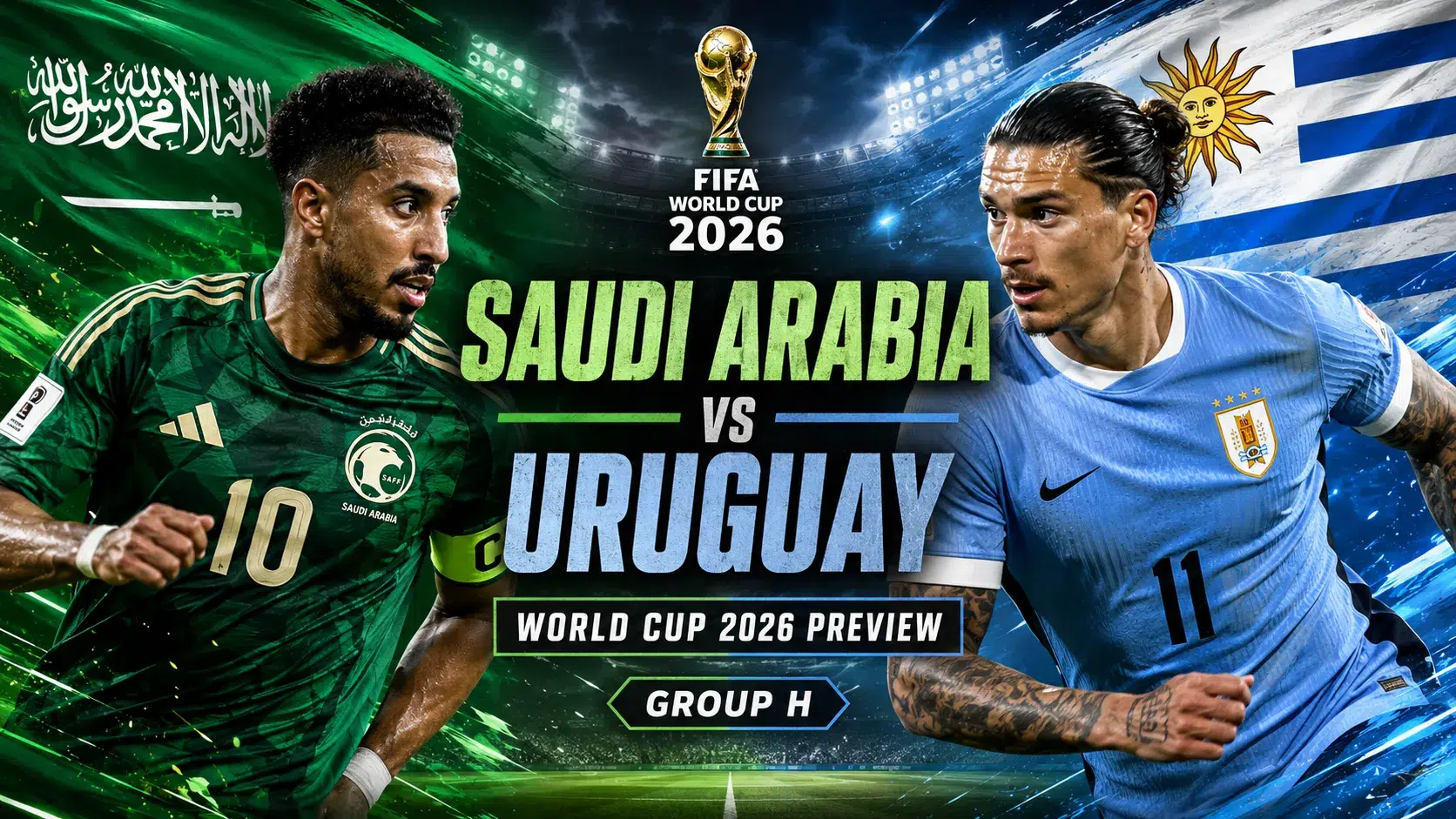
Saudi Arabia face Uruguay in a FIFA World Cup 2026 Group H match at Miami Stadium in Miami Gardens, Florida, United States, on Monday, 15 June 2026. Kick-off is scheduled for 6:00 p.m. local Eastern time, which corresponds to 22:00 UTC. This is the opening Group H match for both teams, with Spain and Cape Verde also in the section.
Saudi Arabia enter under Georgios Donis after a late coaching change that followed the dismissal of Hervé Renard. The squad is led by Salem Al Dawsari, Saud Abdulhamid, Mohamed Kanno and goalkeeper Mohamed Al Owais. Uruguay enter under Marcelo Bielsa with a younger, high-intensity team built around Federico Valverde, Darwin Núñez, Manuel Ugarte and a fast pressing model. Ronald Araújo is a doubt because of a muscle issue, so Uruguay’s defensive structure needs monitoring before official team sheets.
The projected match type is Uruguay possession pressure, high pressing and transition speed against Saudi Arabia’s compact block, wide counters and Salem Al Dawsari-led attacking threat. The key matchup is Saudi Arabia’s midfield screen against Uruguay’s Valverde-Ugarte-Bentancur engine. Group H pressure is high because Spain are strong favourites and Cape Verde can affect the third-place route. Betting markets should be treated as risk signals only. This preview does not provide guaranteed betting advice.
| Field | Data |
|---|---|
| Match | Saudi Arabia vs Uruguay |
| Competition | FIFA World Cup 2026 |
| Stage | Group Stage / First Stage |
| Group | Group H |
| Date | Monday, 15 June 2026 |
| Kick-off Time | 6:00 p.m. ET / 22:00 UTC |
| Stadium | Miami Stadium |
| City | Miami Gardens, Florida |
| Host Country | United States |
| Expected Attendance | Not available from verified public data |
| Referee | Not available from verified public data |
| VAR | Not available from verified public data |
| Weather Forecast | Around 88°F / 31°C at kick-off, partly cloudy, thunderstorm risk later in the evening |
| Pitch Context | Tournament venue surface; exact match-day pitch speed not available from verified public data |
| Main Article Focus | Pre-match probability dossier, predicted lineups, team news, tactics, heat and storm risk, projected stats, cards, Group H scenarios and betting risk |
Saudi Arabia vs Uruguay is a contrast match. Uruguay bring South American intensity, elite midfield power and Bielsa’s pressing model. Saudi Arabia bring recent World Cup upset history, domestic-league cohesion, Salem Al Dawsari’s star value and a need to prove that a late coaching change has not destabilised the team.
The match should not be described only as favourite versus underdog. Uruguay are the stronger team on paper, but Saudi Arabia have shown before that they can punish a high line and force elite opponents into uncomfortable game states. The main question is whether Saudi Arabia can survive Uruguay’s early pressure and then turn recoveries into meaningful attacks.
Saudi Arabia vs Uruguay matters because Uruguay need a controlled opening win to challenge Spain for Group H control, while Saudi Arabia need a disciplined result to keep their qualification path alive before facing Spain and Cape Verde.
| Category | Status | Saudi Arabia vs Uruguay Example | Article Use |
|---|---|---|---|
| Confirmed fact | Verified before publication | Saudi Arabia vs Uruguay, Group H, Miami Stadium | Hard match base |
| Match timing | Verified fixture and broadcast context | Monday, 15 June 2026, 6:00 p.m. ET / 22:00 UTC | Match snapshot |
| Tournament context | Verified schedule context | Group H includes Spain, Cape Verde, Saudi Arabia and Uruguay | Group scenario analysis |
| Team-news report | Verified media reporting | Saudi Arabia enter under Georgios Donis after a late coaching change | Team-news ledger |
| Team-news report | Verified media reporting | Ronald Araújo is a doubt for Uruguay due to a muscle issue | Injury watchlist |
| Confirmed squad information | Verified media reporting | Saudi Arabia’s 26-man squad includes Salem Al Dawsari, Saud Abdulhamid, Mohamed Kanno and Mohamed Al Owais | Player sections |
| Probable information | Tactical forecast | Uruguay likely press high; Saudi Arabia likely defend compactly and counter | Tactical sections |
| Projected data | Model-based estimate | Possession, shots, xG, corners, fouls, cards | Ranges only |
| Unknown data | Not verified in current source set | Referee, VAR, exact attendance, official starting XIs | Marked unavailable |
| Scenario-based analysis | Possible future pattern | Saudi Arabia may target space behind Uruguay’s full-backs | Written as forecast, not fact |
This distinction matters because this fixture invites false certainty. Uruguay are likely favourites, but a favourite label is not a match result. Saudi Arabia’s 2022 win over Argentina remains a clear reminder that a high-line favourite can lose control if the underdog defends compactly, attacks the right spaces and finishes efficiently.
A predicted lineup is not an official team sheet. A projected xG range is not a final statistic. A betting signal is not a guaranteed outcome. A tactical preview can fail after one early goal, one injury, one red card, one goalkeeper mistake, one weather interruption or one VAR decision.
This dossier uses probability language. It does not claim that any goal, card, substitution, injury or VAR review will happen at a specific minute.
Group H contains Spain, Cape Verde, Saudi Arabia and Uruguay. Spain enter as the strongest historical and squad-profile team. Uruguay enter as a serious contender for first or second place. Saudi Arabia enter with upset potential and a need to make one of the group favourites uncomfortable. Cape Verde enter as a debutant but cannot be dismissed in the expanded format.
| Team | Pre-Match Points | Goal Difference | Opening Pressure | Main Need |
|---|---|---|---|---|
| Spain | 0 | 0 | Very high | Confirm favourite status and avoid early noise |
| Cape Verde | 0 | 0 | High | Compete, protect goal difference and seek a historic platform |
| Saudi Arabia | 0 | 0 | High | Avoid defeat or keep goal difference manageable |
| Uruguay | 0 | 0 | Very high | Win opener and validate contender status |
The expanded 48-team format changes the group-stage calculation. The top two teams qualify directly for the Round of 32. Some third-placed teams can also qualify. That means Saudi Arabia do not need to beat both Uruguay and Spain to stay alive. They need points, goal-difference control and a clean path toward the Cape Verde match.
Uruguay need three points because Spain are likely to set a high standard in the group. A draw would not end Uruguay’s campaign, but it would reduce their margin. A defeat would turn the Spain match into a pressure fixture and give Saudi Arabia a major platform.
Saudi Arabia enter with unstable preparation. The late coaching change creates tactical uncertainty. Georgios Donis knows Saudi football from club work, but he does not carry major international tournament experience. That matters because World Cup openers punish unclear structure.
Saudi Arabia also carry the memory of 2022. Their win against Argentina created a global reference point. That memory can inspire the squad, but it can also distort expectations. The Saudi goal should not be to repeat the Argentina match emotionally. It should be to build a disciplined plan that fits this opponent.
Saudi Arabia’s practical objectives are clear:
Uruguay enter with ambition. Bielsa has rebuilt the squad around younger leaders and a more aggressive style. Federico Valverde gives elite midfield power. Darwin Núñez gives depth, pressing and penalty-box threat. Manuel Ugarte gives ball-winning bite. Ronald Araújo, if available, gives defensive power, but his doubt matters.
Uruguay’s challenge is control. Bielsa teams can overwhelm opponents with intensity, but they can also leave space. Against Saudi Arabia, that is the tactical risk. Saudi Arabia do not need 50 percent possession to hurt Uruguay. They need one clean forward pass behind an advanced full-back or one set piece.
Uruguay’s practical objectives:
Goal difference matters in Group H. Spain’s presence means Saudi Arabia and Uruguay must think beyond one result. Uruguay may chase a second or third goal if they lead, but overcommitting can open counters. Saudi Arabia may accept a narrow defeat differently from a heavy defeat if the match turns against them. That is not defeatist. It is tournament logic.
For Saudi Arabia, a draw would be excellent. A narrow loss would be recoverable. A heavy defeat would create pressure before Spain and Cape Verde. For Uruguay, a win is expected. A narrow win is useful. A dominant win would improve goal-difference pressure on Spain.
Saudi Arabia carry uncertainty pressure. Uruguay carry favourite pressure. Saudi Arabia must not panic if Uruguay control the ball. Uruguay must not rush if Saudi Arabia defend deep.
The first 20 minutes can define the mood. If Uruguay generate early chances, Saudi Arabia may be forced deeper. If Saudi Arabia survive the first pressing wave, the match can become more tense for Uruguay. If Saudi Arabia score first, Uruguay’s rest defence and emotional control become the central questions.
| Result | Saudi Arabia Impact | Uruguay Impact | Group H Meaning |
|---|---|---|---|
| Saudi Arabia win | Historic platform and major third-place/top-two boost | Uruguay face immediate pressure before Spain/Cape Verde | Group H becomes unstable |
| Draw | Saudi Arabia gain a valuable point and protect morale | Uruguay lose expected-margin points | Spain gain indirect leverage |
| Uruguay win | Saudi Arabia need recovery and goal-difference control | Uruguay validate contender status | Expected hierarchy mostly holds |
| Factor | Match Relevance |
|---|---|
| Host country | United States |
| Venue region | Miami Gardens, Florida |
| Neutral match | Neither team is host nation |
| Travel context | Saudi Arabia and Uruguay both manage long-haul travel |
| Climate | Hot and humid South Florida conditions |
| Crowd profile | Likely mixed international crowd with strong neutral interest |
| Event scale | Large NFL stadium adapted for World Cup football |
| Tournament timing | Early group-stage match with high uncertainty |
The United States setting gives both teams a neutral venue, but Miami is not neutral in physical terms. South Florida’s heat and humidity can affect both teams. Uruguay’s high-intensity model requires repeated sprinting. Saudi Arabia’s defensive plan may require repeated lateral shifting. Both activities become more expensive in warm conditions.
The crowd may be mixed. Uruguay can draw strong South American support. Saudi Arabia can draw travelling support and neutral attention because of their 2022 upset history. If the match stays close, the crowd may lean toward the underdog story.
| City Factor | Expected Tactical Impact |
|---|---|
| Evening kick-off | Reduces the worst afternoon heat but does not remove humidity |
| Temperature around 88°F / 31°C | Pressing and sprint recovery become important |
| Thunderstorm risk after kick-off window | Match conditions should be monitored |
| No altitude issue | Fatigue is heat/humidity-led, not altitude-led |
| Coastal climate | Humidity can slow recovery |
| Travel load | Both teams face travel and adaptation demands |
| Local football culture | Strong Latin American interest can increase crowd energy |
Miami Gardens is not an altitude match. It is a heat, humidity and storm-watch match. The ball may move normally if conditions stay dry, but rain or lightning risk can affect tempo, grip and interruptions. Those conditions must be checked close to kick-off.
| Stadium Detail | Data |
|---|---|
| Stadium | Miami Stadium |
| Known Venue Context | Hard Rock Stadium / Miami Gardens event context |
| City | Miami Gardens |
| State | Florida |
| Country | United States |
| Kick-off | 6:00 p.m. ET / 22:00 UTC |
| Expected Attendance | Not available from verified public data |
| Referee | Not available from verified public data |
| VAR | Not available from verified public data |
| Roof Status | Stadium has canopy coverage over many seating areas; match-specific climate control and roof status not available from verified public data |
| Pitch Speed | Not available from verified public data |
| Tactical Impact | Heat, humidity, storm risk, hydration and transition management |
| Weather / Environment Factor | Tactical Meaning |
|---|---|
| Around 88°F / 31°C at kick-off | Constant high pressing becomes costly |
| Humidity risk | Recovery between sprints can slow |
| Thunderstorm risk later | Coaches should prepare for possible surface or delay changes |
| No altitude | Sprint recovery is climate-led, not oxygen-led |
| Pitch condition unknown | Avoid fixed claims about bounce or speed |
| Possible rain | Could affect goalkeeper handling and long balls if it arrives |
| Heat load | Substitution timing and hydration become important |
| Evening cooling | Tempo may become easier if conditions cool and storms stay away |
The most important weather factor is humidity combined with heat. Uruguay’s pressing model must be selective enough to last. Saudi Arabia’s low-to-mid block must avoid unnecessary chasing. The team that controls wasted running may finish stronger.
| Team | Player / Role | Status | Tactical Impact |
|---|---|---|---|
| Saudi Arabia | Georgios Donis | Head coach appointed shortly before World Cup | Creates tactical adaptation question |
| Saudi Arabia | Salem Al Dawsari | Confirmed in squad | Main attacking talisman and transition threat |
| Saudi Arabia | Saud Abdulhamid | Confirmed in squad; only foreign-based player in Reuters report | Key full-back / wide defensive and attacking option |
| Saudi Arabia | Mohamed Al Owais | Confirmed in squad | Experienced goalkeeper and likely pressure-management figure |
| Saudi Arabia | Mohamed Kanno | Confirmed in squad | Midfield experience, physical duels and box support |
| Saudi Arabia | Hassan Tambakti | Confirmed in squad | Centre-back experience and aerial defence |
| Uruguay | Marcelo Bielsa | Head coach | High-pressing structure and aggressive transition model |
| Uruguay | Federico Valverde | Key Uruguay leader in reporting | Midfield engine, shooting, pressing and tempo |
| Uruguay | Darwin Núñez | Key Uruguay attacker in reporting | Depth runs, pressing and penalty-box threat |
| Uruguay | Ronald Araújo | Doubt due to muscle issue | Defensive structure and centre-back selection risk |
| Player | Team | Status | Tactical Impact |
|---|---|---|---|
| Ronald Araújo | Uruguay | Doubt due to muscle issue | If absent, Uruguay lose recovery speed, aerial power and defensive authority |
| Not available from verified public data | Saudi Arabia | Not available | Do not invent |
| Player | Team | Status | Tactical Impact |
|---|---|---|---|
| Not available from verified public data | Saudi Arabia | Not available | Do not invent |
| Not available from verified public data | Uruguay | Not available | Do not invent |
| Player / Group | Team | Issue | Match Impact |
|---|---|---|---|
| Ronald Araújo | Uruguay | Muscle issue | Centre-back pairing and high-line coverage should be monitored |
| Saudi Arabia defensive unit | Saudi Arabia | No verified match-day absence in current source set | Final team sheet needed |
| Saudi Arabia goalkeeper group | Saudi Arabia | Mohamed Al Owais has World Cup experience | Pressure management can matter |
| Both squads | Both | Heat and humidity load | Substitution timing and cramp risk may matter |
No confirmed suspension issue was available from verified public data in the current source set. Card risk below is a match forecast, not confirmed disciplinary data.
Araújo’s doubt is the most important player-availability issue. If he cannot start, Uruguay may still field a strong defence, but the high-line safety margin decreases. Bielsa’s pressing model depends on defenders who can defend large spaces behind the midfield. Saudi Arabia may try to test that area early.
Saudi Arabia’s key issue is not a known injury. It is cohesion under a new coach. Donis must quickly define the defensive line, midfield screen and outlet structure. A squad built mainly from the domestic league can have existing familiarity, but late managerial change can still alter pressing triggers and role clarity.
Official starting lineups were not available from verified public data in the current source set. The following XIs are projected from squad context, pre-match reporting and tactical logic. They should be replaced with official team sheets before publication.
| Position / Line | Player | Likely Role |
|---|---|---|
| GK | Mohamed Al Owais | Experienced goalkeeper, shot-stopper, defensive organiser |
| RB | Saud Abdulhamid | Progressive full-back, recovery defender, transition outlet |
| CB | Hassan Tambakti | Centre-back, aerial defence, leadership |
| CB | Ali Lajami / Abdulelah Al Amri | Centre-back, physical duels and box protection |
| LB | Moteb Al Harbi / Hassan Kadesh | Defensive full-back, wide cover |
| DM | Abdullah Al Khaibari | Midfield screen, ball-winning and central protection |
| CM | Mohamed Kanno | Physical midfielder, second balls and box support |
| CM | Musab Al Juwayr | Progression, set-piece support and midfield link |
| RW | Ayman Yahya / Khalid Al Ghannam | Wide outlet, pressing support and counter runner |
| ST | Feras Al Brikan / Saleh Al Shehri | Central forward, hold-up play and box presence |
| LW | Salem Al Dawsari | Main creator, left-sided attacker and transition threat |
| Position / Line | Player | Likely Role |
|---|---|---|
| GK | Sergio Rochet / goalkeeper option | Shot-stopper, buildup starter and sweeper support |
| RB | Nahitan Nández / right-back option | Aggressive full-back, pressing and wide duels |
| CB | José María Giménez / Sebastián Cáceres | Centre-back, aerial defence and high-line cover |
| CB | Ronald Araújo / Mathías Olivera / alternate CB | Defensive power if fit; alternative if Araújo cannot start |
| LB | Mathías Viña / left-back option | Width, recovery and overlap support |
| DM | Manuel Ugarte | Ball-winning midfielder and counter-press anchor |
| CM | Federico Valverde | Midfield leader, runner, shooter and pressing engine |
| CM | Rodrigo Bentancur / Giorgian de Arrascaeta profile | Progression, timing and final-third link |
| RW | Facundo Pellistri | Wide runner, pressing and direct speed |
| ST | Darwin Núñez | Central striker, depth runs and finishing threat |
| LW | Maximiliano Araújo | Wide attacker, transition runner and pressing support |
| Team | Base Formation | In Possession | Out of Possession | Confidence |
|---|---|---|---|---|
| Saudi Arabia | 4-3-3 / 4-2-3-1 | Direct 2-3-5 in rare sustained attacks; more often quick release to Al Dawsari | 4-5-1 / compact 4-1-4-1 | Medium |
| Uruguay | 4-3-3 / 4-2-3-1 | 2-3-5 with aggressive full-backs and midfield rotations | 4-3-3 high press or 4-4-2 pressing trigger shape | Medium |
| Scenario | Trigger | Expected Change |
|---|---|---|
| Saudi Arabia choose maximum protection | Uruguay start with high pressure | Extra defensive midfielder or deeper winger |
| Saudi Arabia chase transition speed | Uruguay full-backs push high | Al Dawsari and Yahya stay higher |
| Saudi Arabia need a goal late | Trailing after 60’ | Saleh Al Shehri or Abdullah Al Hamdan profile adds box presence |
| Saudi Arabia protect draw | Level after 70’ | Deeper midfield block and slower restarts |
| Uruguay lose Araújo | Muscle issue prevents start | Cáceres, Olivera or another centre-back profile adjusts back line |
| Uruguay need more creativity | Saudi block stays deep | De Arrascaeta-type profile or extra creator becomes relevant |
| Uruguay protect lead | Leading after 70’ | Less full-back risk and more midfield control |
| Uruguay chase goal | Level late | More direct service to Núñez and more aggressive wide pressure |
The main Saudi selection question is the balance between midfield protection and enough support for Al Dawsari. The main Uruguay question is Araújo’s status. If Araújo is out, Bielsa may still press high, but the rest defence must become cleaner.
| Phase | Expected Pattern |
|---|---|
| Build-up | Cautious short buildup mixed with direct passes under pressure |
| Attack | Salem Al Dawsari transitions, wide counters, striker hold-up play |
| Defense | Compact mid-to-low block, central protection, full-back discipline |
| Transitions | Quick first pass into Al Dawsari or wide runner |
| Set Pieces | Kanno, Tambakti and striker targets; Al Dawsari delivery |
| Weakness | Late coaching change, defensive spacing against high press, transition exposure after turnovers |
Saudi Arabia should build with caution. Uruguay will likely press aggressively. Slow central passes can become dangerous. Donis needs his team to use a practical build-up model.
Short passes can work when Uruguay’s first line sits off. Direct passes are safer when Bielsa’s press closes the goalkeeper and centre-backs. The key is not pass length. The key is second-ball support. If Saudi Arabia hit long passes toward Feras Al Brikan or Saleh Al Shehri without nearby midfielders, Uruguay will recover quickly and attack again.
Mohamed Al Owais must manage risk. He should avoid central passes into covered midfielders. He can use full-backs when pressure is loose, but Uruguay may trap wide areas. A diagonal release toward Al Dawsari can become valuable if Uruguay’s right side advances.
Saudi Arabia should not press Uruguay high for long periods. Uruguay are comfortable in chaos and can create space if a press becomes disconnected. A mid-block with selective pressing is safer.
Useful Saudi pressing triggers:
Saudi Arabia should avoid chasing Uruguay’s centre-backs across the pitch. Miami heat and Uruguay’s passing speed can punish wasted running.
Saudi Arabia’s main attacking side is likely the left, through Salem Al Dawsari. He remains the most dangerous individual attacker. He can carry, cut inside, draw fouls and create shots. Uruguay will prepare for him, so Saudi Arabia need support.
The left-sided pattern should include:
Saudi Arabia should not isolate Al Dawsari completely. If he receives alone against two or three defenders, attacks will die quickly.
Musab Al Juwayr can become important if selected. He can connect midfield and attack. Mohamed Kanno can also play forward passes after duels. Al Dawsari is the key final-third passer. The first pass after recovery is Saudi Arabia’s most important pass.
Saudi Arabia’s transition threat is their main route. They are unlikely to dominate possession. They can still create danger if Uruguay overcommit. The pattern is simple but hard to execute:
Saudi Arabia can use set pieces as pressure relief and scoring chances. Kanno, Tambakti and the striker profile can attack crosses. Al Dawsari can deliver. Uruguay are strong aerially, but Araújo’s doubt could alter the set-piece balance.
Saudi Arabia should value corners, wide free kicks and long restarts. They may not get many. Each one matters.
The main weakness is spacing after Uruguay’s first press. If Saudi Arabia lose the ball in their own half, Uruguay can create immediate pressure. The second weakness is defending wide overloads. Uruguay can attack with full-backs, wingers and midfield runners.
Saudi Arabia must also avoid early cards. A full-back booked against Pellistri or Maximiliano Araújo can become a target.
Al Owais should distribute pragmatically. Short passing can help control tempo, but only if the midfield angles are clean. Long passes toward the striker can relieve pressure. Throws to full-backs can invite traps if Uruguay’s winger closes quickly.
Saud Abdulhamid can be a major outlet, but he must choose moments. If he attacks too often, Uruguay can exploit the space behind him. The opposite full-back should usually hold a safer position. Saudi Arabia cannot afford both full-backs high against Bielsa transitions.
Feras Al Brikan or Saleh Al Shehri must give Saudi Arabia more than box presence. The striker must hold the ball, win fouls, press intelligently and connect with Al Dawsari. A strong Saudi striker performance may include limited shots but valuable territory.
| Phase | Expected Pattern |
|---|---|
| Build-up | Centre-back circulation, Ugarte base, Valverde progression, full-back width |
| Attack | High tempo, wide speed, Núñez depth runs, midfield shots and cutbacks |
| Defense | High press, counter-press and aggressive duels |
| Transitions | Fast vertical attacks after recoveries |
| Set Pieces | Valverde delivery/shooting, centre-back aerial targets, Núñez movement |
| Weakness | Space behind full-backs, Araújo doubt, heat cost of constant pressing |
Uruguay should build with speed and directness. Bielsa teams often use structure to create chaos for the opponent. Uruguay can circulate through centre-backs, use Ugarte as the base and release Valverde into forward positions. They can also play early into Núñez or the wingers.
Saudi Arabia may defend compactly. Uruguay must avoid slow sterile possession. They should move the block side to side, then attack with sharp vertical passes. Valverde’s ability to carry and shoot can force Saudi midfielders out of position.
Uruguay will likely press high in phases. The question is duration. Miami heat makes constant pressing expensive. Bielsa may still demand intensity, but game management matters.
Uruguay’s pressing triggers:
The press must include rest defence. If both full-backs push high and Ugarte is dragged away, Saudi Arabia can counter.
Uruguay can attack both sides. Pellistri can stretch one flank. Maximiliano Araújo can attack the other. Valverde can overload either half-space. The most dangerous central action may come when Núñez pins centre-backs and Valverde attacks the second line.
Uruguay should create:
Federico Valverde is Uruguay’s key all-phase player. He can progress, press, shoot and lead tempo. Ugarte is the key defensive passer because he wins the ball and restarts attacks. Bentancur or a similar profile can connect the second phase. If Valverde receives freely, Saudi Arabia’s block will suffer.
Uruguay’s transition threat is strong. If they win the ball high, they can attack before Saudi Arabia’s block resets. Núñez is dangerous in open space. Pellistri and Araújo can run behind full-backs. Valverde can carry through midfield.
The risk is reverse transition. Uruguay’s own attacking aggression can leave spaces if Saudi Arabia break the first counter-press.
Uruguay have a strong set-piece history and enough aerial profiles to threaten. Giménez, Araújo if fit, Núñez and centre-back alternatives can attack deliveries. Valverde can strike from distance after clearances. Saudi Arabia must defend first contact and edge-of-box rebounds.
The main weakness is space behind the press. Saudi Arabia can target the channel behind Uruguay’s full-backs. If Araújo is absent, Uruguay may have less recovery speed. Bielsa’s system can still work, but spacing must be exact.
Uruguay’s goalkeeper should support quick restarts and avoid slow passes into traps. Saudi Arabia may not press high constantly, so Uruguay can start attacks calmly. If Saudi Arabia step up, diagonal passes to the wide areas can bypass pressure.
Uruguay’s full-backs should attack selectively. They can create width, but both should not vacate their zones without Ugarte and centre-backs positioned correctly. Saudi Arabia’s best route is behind advanced full-backs.
Darwin Núñez must stretch Saudi Arabia’s defence. He should attack behind, press aggressively and occupy centre-backs. He can also create space for Valverde and wingers. If he only receives with his back to goal, Saudi Arabia can control him. If he receives running toward goal, Uruguay’s attack becomes dangerous.
| Zone | Saudi Arabia Edge | Uruguay Edge | Likely Control | Why It Matters |
|---|---|---|---|---|
| Saudi left / Uruguay right | Salem Al Dawsari transition threat | Uruguay press and right-side duels | Balanced with Uruguay territory edge | Saudi Arabia’s main outlet |
| Saudi right / Uruguay left | Abdulhamid recovery and forward runs | Maximiliano Araújo speed and overlap support | Uruguay slight edge | Can expose Saudi full-back depth |
| Central midfield | Kanno physicality and Al Khaibari screening | Valverde, Ugarte and Bentancur-type control | Uruguay edge | Decides tempo and second balls |
| Penalty box | Saudi aerial targets on rare set pieces | Núñez movement and Uruguay runners | Uruguay edge | Decides chance quality |
| Set pieces | Al Dawsari delivery, Tambakti/Kanno targets | Uruguay aerial power and Valverde rebounds | Uruguay slight edge | Can break a compact match |
| Transitions | Al Dawsari and Abdulhamid outlets | Uruguay counter-press and high recoveries | Split | Main Saudi route and main Uruguay weapon |
| Defensive third | Saudi compactness | Uruguay territorial pressure | Uruguay pressure edge | Tests Saudi concentration |
Al Dawsari is Saudi Arabia’s main attacking threat. Uruguay must prevent him from receiving in space after turnovers.
Why it matters: Saudi Arabia may create few attacks. Al Dawsari can turn one transition into a serious chance.
What to watch: Whether Al Dawsari receives facing goal or trapped near the touchline.
Risk trigger: If Uruguay’s right-back or right centre-back receives an early yellow card, Saudi Arabia may target that side more directly.
Valverde can dominate the match if Saudi Arabia allow him to carry forward. He can pass, press, shoot and arrive late.
Why it matters: Uruguay’s attacking rhythm flows through Valverde’s vertical actions.
What to watch: Valverde’s first forward carry after Ugarte wins the ball.
Risk trigger: If Al Khaibari or Kanno is booked early, Saudi Arabia’s midfield aggression drops.
Núñez gives Uruguay depth and penalty-box power. Tambakti must defend movement, not only physical contact.
Why it matters: If Núñez stretches the line, Uruguay’s midfield runners gain space.
What to watch: Whether Núñez receives behind the line or only with back to goal.
Risk trigger: If Saudi Arabia’s centre-backs drop too deep, Uruguay can attack the edge of the box with Valverde and Bentancur-type runners.
Ugarte is central to Uruguay’s counter-press. Saudi Arabia need to bypass him quickly after recovery.
Why it matters: If Ugarte wins every second ball, Saudi Arabia cannot escape pressure.
What to watch: The first pass after Saudi Arabia win the ball.
Risk trigger: If Ugarte gets pulled toward Al Dawsari’s side, central space can open for Kanno or Al Juwayr.
Uruguay can use set pieces to punish Saudi Arabia if open-play attacks stall. Saudi Arabia must defend first contact and rebounds.
Why it matters: Set pieces can break a disciplined low block.
What to watch: Marking on Núñez, Giménez and any Araújo replacement.
Risk trigger: Repeated Uruguay corners before half-time can increase defensive pressure and card risk.
| Projected Stat | Saudi Arabia | Uruguay | Confidence | Reason |
|---|---|---|---|---|
| Possession | 35–42% | 58–65% | Medium/high | Uruguay likely control territory and ball |
| Shots | 5–9 | 13–19 | Medium | Uruguay pressing and attacking depth should create volume |
| Shots on Target | 1–3 | 4–7 | Medium | Saudi Arabia may limit central shot quality if compact |
| xG Range | 0.40–0.90 | 1.50–2.40 | Low/Medium | First goal and transition quality can shift profile |
| Big Chances | 0–1 | 1–4 | Low/Medium | Uruguay have stronger box access |
| Corners | 2–4 | 5–9 | Medium | Uruguay wide pressure likely creates blocks |
| Fouls | 12–17 | 10–15 | Medium | Saudi Arabia likely defend more duels |
| Yellow Cards | 2–4 | 1–3 | Low/Medium | Referee not confirmed |
| Red Card Risk | Low/Medium | Low | Low | Defensive fatigue can raise Saudi risk |
| Offsides | 1–2 | 1–3 | Low | Núñez depth runs and Saudi counters can trigger lines |
| Saves | 3–6 | 1–3 | Medium | Al Owais may face heavier workload |
| Crosses | 8–14 | 18–28 | Medium | Uruguay likely use width and pressure |
| Tackles | 18–26 | 13–19 | Medium | Saudi Arabia likely defend longer spells |
| Interceptions | 10–16 | 8–13 | Medium | Saudi block can cut passing lanes |
| Clearances | 24–38 | 10–18 | Medium | Saudi Arabia may defend deep for long periods |
Uruguay should lead possession, shots, corners and territory. That does not automatically mean an easy match. Saudi Arabia can make Uruguay’s possession lower-value if they protect the centre and force wide crosses from poor angles.
The most important numbers are shot quality and transition prevention. Uruguay can produce 18 shots and still struggle if most are blocked. Saudi Arabia can produce six shots and still be dangerous if one is a clean Al Dawsari transition or set piece.
The xG model favours Uruguay. The forecast remains uncertain because first-goal timing, Araújo’s status, heat, humidity and counter-press efficiency can change the match.
| Match Window | Tactical State | Physical State | Card Risk | Goal Risk | Betting Market Trigger |
|---|---|---|---|---|---|
| 1’–15’ | Uruguay likely press high; Saudi Arabia test compactness and first outlets | Fresh legs, heat still relevant | Low/Medium | Medium | First Uruguay press, first Al Dawsari transition |
| 16’–30’ | Uruguay may increase territory and corner pressure | Saudi defensive shifting grows | Medium | Medium/High | Valverde carries, Núñez runs, Saudi full-back duels |
| 31’–45+’ | If level, Saudi confidence can rise; Uruguay may force faster attacks | Humidity and repeated pressing begin to matter | Medium/High | Medium | Late first-half set pieces |
| 46’–60’ | Coaches adjust from first-half evidence | Reset intensity after half-time | Medium | Medium | Uruguay creative change, Saudi block height |
| 61’–75’ | Space may open as fatigue and substitutions arrive | Cramp and timing risk increase | High | Medium/High | Live totals, cards, Uruguay pressure |
| 76’–90+’ | Game state dominates | Late fatigue, time management, storm monitoring | High | High | Late corners, counters, penalty appeals |
Uruguay should try to establish immediate pressure. Saudi Arabia must avoid dangerous turnovers in their own half. The first clean Saudi escape can affect Uruguay’s full-back risk.
Uruguay’s midfield should begin to control territory. Saudi Arabia must stop Valverde from carrying freely. If Uruguay create repeated corners, set pieces can become a main route.
If the match remains level, Saudi Arabia can gain confidence. Uruguay must avoid frustration and low-value shooting. Saudi Arabia must avoid late-half fouls around the box.
Half-time adjustments matter. Donis may alter outlet positions. Bielsa may adjust pressing angles or full-back height. The next phase can show whether Saudi Arabia can survive beyond low-block defending.
This is a major physical window. Heat and humidity can affect Uruguay’s press and Saudi Arabia’s defensive shifting. Substitutions can change the forward outlet and card risk.
Game state rules the final phase. If Uruguay lead, they may seek goal difference but must control counters. If Saudi Arabia lead or draw, they may defend deeper and use restarts to manage tempo. If storms affect conditions, goalkeeper handling and long-ball control can change.
| Factor | Expected Impact | Saudi Arabia Effect | Uruguay Effect |
|---|---|---|---|
| Heat around 88°F / 31°C | Sprint and pressing cost rises | Defensive shifting can tire | High pressing becomes more expensive |
| Humidity risk | Recovery between efforts can slow | Compactness must reduce wasted running | Counter-press timing becomes harder late |
| Thunderstorm risk later | Surface and match rhythm should be monitored | Direct passes and clearances can change if wet | Pressing and goalkeeper handling can change |
| No altitude | Oxygen profile is normal | Fatigue is climate-led | Fatigue is climate-led |
| Roof status not verified | Climate-control assumptions should be avoided | Prepare for outdoor heat load | Prepare for outdoor heat load |
| Pitch condition unknown | Exact speed unavailable | Avoid fixed direct-ball assumptions | Avoid fixed possession-speed assumptions |
| Evening cooling | Conditions may improve late if storms stay away | Late counters may become more viable | Pressing may recover after substitutions |
The most important weather factor is heat plus humidity. Uruguay’s tactical identity depends on repeated pressing and high recoveries. Saudi Arabia’s likely plan depends on compact defending and quick transitions. Both require energy. If Uruguay press too constantly, Saudi Arabia can find late spaces. If Saudi Arabia defend too passively, fatigue can create mistakes around the box.
| Player | Team | Role | Match Impact Score /10 | Reason |
|---|---|---|---|---|
| Salem Al Dawsari | Saudi Arabia | Creator / left forward | 8.8 | Main Saudi transition and individual-threat player |
| Saud Abdulhamid | Saudi Arabia | Full-back / wide outlet | 8.2 | Recovery speed, forward release and defensive workload |
| Mohamed Al Owais | Saudi Arabia | Goalkeeper | 8.1 | Likely faces shot and cross pressure |
| Mohamed Kanno | Saudi Arabia | Midfielder | 7.9 | Duels, box support and second-ball resistance |
| Hassan Tambakti | Saudi Arabia | Centre-back | 7.9 | Key defender against Núñez and aerial pressure |
| Musab Al Juwayr | Saudi Arabia | Midfield link | 7.7 | Can connect recoveries to counters |
| Feras Al Brikan | Saudi Arabia | Striker | 7.6 | Hold-up play and box reference |
| Federico Valverde | Uruguay | Midfield leader | 9.2 | Pressing, running, shooting and tempo control |
| Darwin Núñez | Uruguay | Striker | 8.8 | Depth runs, pressing and finishing threat |
| Manuel Ugarte | Uruguay | Defensive midfielder | 8.6 | Counter-press and second-ball control |
| Ronald Araújo | Uruguay | Centre-back | 8.5 | High-line protection if fit; major watchlist |
| Rodrigo Bentancur | Uruguay | Midfielder | 8.1 | Progression and timing between phases |
| Facundo Pellistri | Uruguay | Wide attacker | 7.9 | Width, pressing and direct running |
| Maximiliano Araújo | Uruguay | Wide attacker | 7.9 | Speed, pressing and far-side threat |
Salem Al Dawsari is Saudi Arabia’s most important attacker because he can create danger from limited possession. Darwin Núñez is Uruguay’s most important forward because he converts Uruguay’s pressing and passing into depth, shots and box pressure.
Hassan Tambakti is Saudi Arabia’s most important defensive figure because he must manage Núñez, aerial duels and box organisation. Ronald Araújo would be Uruguay’s most important defender if fit, but his muscle issue makes the centre-back selection a major watchlist.
Federico Valverde is the most important midfielder in the match. He can control the tempo, press, carry forward and shoot. Saudi Arabia’s midfield screen must deny him forward-facing momentum.
Saudi Arabia can change the match through Saleh Al Shehri, Abdullah Al Hamdan or a fresh wide runner if they need a goal. Uruguay can change the match through an additional creator, wide runner or forward support if Saudi Arabia survive the first hour. Specific bench roles should be updated once official team sheets are available.
Saudi Arabia’s full-backs and defensive midfielders carry card risk because they may face repeated Uruguay pressure. Uruguay’s card risk is lower but appears if they must stop Al Dawsari in transition.
Ronald Araújo is the clear injury-management watchlist player because of the reported muscle issue. Heat and humidity can also affect high-intensity players on both teams.
The referee and VAR were not available from verified public data in the current source set. Therefore, this discipline preview uses tactical logic rather than referee-profile claims.
| Discipline Factor | Forecast |
|---|---|
| Referee Style | Not available from verified public data |
| Tactical Foul Risk | Medium/high |
| Dissent Risk | Medium |
| VAR Intervention Risk | Medium |
| Penalty Risk | Medium |
| Red-Card Risk | Low/medium |
| Team | Yellow-Card Range | Red-Card Risk | Main Risk Zone |
|---|---|---|---|
| Saudi Arabia | 2–4 | Low/Medium | Full-back zones and midfield screen against Uruguay pressure |
| Uruguay | 1–3 | Low | Tactical fouls after Saudi transitions |
Saudi Arabia may carry the higher yellow-card range because they are projected to defend more actions. Uruguay’s card risk comes from reverse transitions. If Al Dawsari escapes into space, Uruguay may need tactical fouls.
The risk rises if:
| Set-Piece Area | Saudi Arabia | Uruguay | Edge |
|---|---|---|---|
| Corners For | Tambakti, Kanno, striker targets, Al Dawsari delivery | Giménez, Núñez, Araújo if fit, centre-back targets | Uruguay |
| Corners Against | Must defend Uruguay aerial size and rebounds | Must track Saudi runners and Al Dawsari delivery | Uruguay slight edge |
| Wide Free Kicks | Al Dawsari / Al Juwayr delivery | Valverde / wide delivery options | Balanced to Uruguay |
| Direct Free Kicks | Taker hierarchy not verified | Taker hierarchy not verified | Unknown |
| Penalties | Taker hierarchy not verified | Taker hierarchy not verified | Unknown |
| Long Throws | Not available from verified public data | Not available from verified public data | Unknown |
| Aerial Duels | Useful but limited volume expected | Stronger aerial profile | Uruguay edge |
Uruguay have the set-piece edge because of their centre-back and striker profiles. Saudi Arabia can still create danger if Al Dawsari wins wide free kicks. The key defensive matchup is Saudi Arabia’s centre-backs against Núñez and Uruguay’s aerial runners.
Saudi Arabia must defend second balls. A clearance to the edge of the box can become a Valverde shot. Uruguay must avoid fouling Al Dawsari in crossing zones because set pieces are one of Saudi Arabia’s clearest routes to chance creation.
| Area | Saudi Arabia | Uruguay |
|---|---|---|
| Goalkeeper Distribution | Al Owais likely mixes direct passes and short release | Uruguay goalkeeper supports buildup and quick restarts |
| Shot-Stopping Pressure | Medium/high | Low/medium |
| Cross Handling | High because Uruguay may use wide pressure | Medium because Saudi cross volume may be lower |
| High-Line Risk | Saudi Arabia likely defend lower | Uruguay risk space behind full-backs and press |
| Penalty-Box Defending | Must track Núñez, Valverde runners and set-piece targets | Must track Saudi striker and Al Dawsari cuts |
| Back-Post Weakness | Possible against Uruguay switches | Possible if full-backs overcommit |
| Defensive Communication | High workload under pressure | Important if Araújo absent or limited |
Mohamed Al Owais may face more pressure because Uruguay are projected to create more shots, crosses and corners. Uruguay’s goalkeeper may face fewer shots, but Saudi chances can arrive after high-value transitions. Concentration matters for both.
| Minute Window | Saudi Arabia Possible Change | Uruguay Possible Change | Trigger |
|---|---|---|---|
| 45’–60’ | Add fresh midfielder, change outlet side or add striker support | Adjust pressing line, add creative midfielder or wide runner | First-half imbalance |
| 60’–75’ | Fresh wide runner, deeper midfielder or second striker if chasing | Fresh forward, winger or control midfielder | Heat, cards, score pressure |
| 75’–90’ | Protect draw/lead or chase with direct balls | Protect lead, chase goal difference or force late pressure | Game state |
Saudi Arabia should not drop into passive box defence too early. They need an outlet through Al Dawsari or a striker. If they defend without release, Uruguay can create repeated corners and shots.
Uruguay should control rest defence. Goal difference may matter, but reckless attacking can create Saudi counters. Bielsa’s side must decide whether to maintain high pressure or manage tempo in heat.
A draw may be more useful to Saudi Arabia than Uruguay. Uruguay may increase attacking risk. Saudi Arabia may add defensive legs and protect central space. That emotional split can drive late substitutions and live market movement.
| Market | Current Signal | Main Risk |
|---|---|---|
| Match Winner | Uruguay likely favoured by squad profile and market perception | Saudi upset potential, heat and first-goal volatility |
| Double Chance | Uruguay or draw likely shorter | Low price may not reflect Saudi transition threat |
| Over/Under Goals | Moderate total profile | Early goal can open match; Saudi block can suppress tempo |
| BTTS | Possible but not automatic | Saudi shot volume may be low |
| Corners | Uruguay corner volume likely higher | Early Uruguay goal can reduce pressure volume |
| Cards | Medium risk | Referee unknown |
| Player Shots | Núñez, Valverde, Al Dawsari watchlist | Official lineup and role matter |
| Player Cards | Saudi full-backs/midfielders, Uruguay transition stoppers | Referee threshold unknown |
| Trigger | Possible Market Effect |
|---|---|
| Official Uruguay XI | Moves player shots, team total and clean-sheet markets |
| Ronald Araújo status | Affects Uruguay defensive confidence and Saudi scoring markets |
| Saudi Arabia shape | Affects Uruguay goal expectation |
| Al Dawsari role | Affects Saudi shot and assist markets |
| Referee announcement | Moves cards and penalty markets |
| Weather update | Affects totals, tempo and late goal markets |
| Thunderstorm risk update | Affects live-market assumptions around pitch and rhythm |
| Public money on Uruguay | Can compress favourite price |
| Trigger | Meaning | Risk |
|---|---|---|
| Uruguay create early central shots | Chance quality is strong | Early saves can still keep match close |
| Saudi Arabia escape press twice | Uruguay rest defence may be vulnerable | Small sample can mislead |
| Valverde receives freely | Uruguay midfield control rises | Saudi Arabia may adjust block |
| Al Dawsari isolates full-back | Saudi chance quality rises | Needs support inside box |
| 0-0 after 60’ | Pressure shifts toward Uruguay | Saudi fatigue may still rise |
| Heat slows Uruguay press | Saudi counters may improve | Uruguay substitutes can restore intensity |
This preview explains match data and market behavior. It does not provide guaranteed betting advice. World Cup betting involves risk. Readers should check local gambling laws, use licensed operators, set limits and avoid chasing losses.
| Factor | How It Can Break the Forecast |
|---|---|
| Late Lineup Change | Changes Uruguay’s high-line protection or Saudi Arabia’s outlet structure |
| Early Goal | Forces one team to abandon its base plan |
| Early Yellow Card | Changes full-back duels and midfield aggression |
| Injury | Forces tactical reshuffle and changes physical balance |
| VAR Penalty | Creates a non-pattern goal and alters game state |
| Weather Shift | Heat, rain or storms can change tempo, grip and goalkeeper handling |
| Red Card | Makes possession and xG projections less relevant |
| Goalkeeper Error | Creates a low-probability swing |
| Tactical Surprise | Saudi Arabia may press higher or Uruguay may manage tempo more conservatively |
| Market Overreaction | Early pressure or one counter can distort live betting signals |
The forecast can fail if Saudi Arabia score first and force Uruguay into emotional attacking. It can also fail if Uruguay score early and Saudi Arabia must leave their compact block. Heat, humidity, Araújo’s status, set pieces, goalkeeper performance and card timing can all break the pre-match model.
| Scenario | Probability Band | Match Story |
|---|---|---|
| Saudi Arabia Narrow Win | Low/medium | Saudi Arabia score through transition or set piece and defend with discipline |
| Draw | Medium | Saudi Arabia survive pressure and Uruguay struggle to convert territory into clear chances |
| Uruguay Win | Medium/high | Uruguay press, create more shots and convert through Núñez, Valverde or set pieces |
| High-Scoring Match | Low/medium | Early goal opens the game and both teams attack transition lanes |
| Low-Scoring Match | Medium/high | Saudi Arabia defend compactly and heat reduces pressing rhythm |
The safest scenario frame is Uruguay-favoured but not Uruguay-certain. Uruguay have the stronger midfield, pressing model and attacking depth. Saudi Arabia have upset logic, Al Dawsari’s transition threat and tournament experience from previous high-pressure matches.
| Result | Saudi Arabia Impact | Uruguay Impact |
|---|---|---|
| Saudi Arabia Win | Saudi Arabia gain a major top-two or third-place platform | Uruguay face pressure before Cape Verde and Spain |
| Draw | Saudi Arabia gain a valuable point and protect goal difference | Uruguay lose expected-margin points |
| Uruguay Win | Saudi Arabia need recovery before Spain/Cape Verde | Uruguay gain early Group H control and pressure Spain |
A win gives Uruguay the expected platform. A draw gives Saudi Arabia a useful route toward third-place or top-two contention. A Saudi win would transform the group. A defeat does not eliminate either team because third-place qualification exists, but goal difference and next-match pressure become central.
| Data Point | Status | Preferred Source Type |
|---|---|---|
| Match Date | Confirmed | FIFA match centre / fixture listings |
| Stadium | Confirmed | FIFA match centre |
| City | Confirmed | FIFA / venue context |
| Group | Confirmed | FIFA match centre |
| Coaches | Confirmed | Reuters pre-match reporting |
| Saudi Squad | Confirmed through Reuters squad report | Reuters / official federation context |
| Uruguay Team News | Confirmed through Reuters pre-match report | Reuters |
| Referee | Not available from verified public data | FIFA match centre if announced |
| VAR | Not available from verified public data | FIFA match centre if announced |
| Weather | Forecast | Weather service |
| Lineups | Projected until official team sheets | FIFA match centre / official team sheets |
| Injuries | Partly confirmed through verified reporting | Reuters / federation updates |
| Suspensions | No confirmed active suspension in current source set | FIFA disciplinary data |
| Odds | Dynamic market signal only | Licensed odds providers / aggregators |
| Projected Stats | Model-based estimate | Editorial forecast |
| Minute-Window Scenarios | Scenario forecast only | Editorial model |
This article uses confirmed facts where available and marks unavailable information clearly. It does not invent referee data, VAR data, exact attendance, official starting lineups or unverified injuries.
This preview is analytical and informational. It is not a guarantee of the final result. Football includes randomness and low-probability events. Final lineups, injuries, referee decisions, VAR, weather and early goals can change the match.
Projected statistics, scoreline scenarios and betting market notes are probability-based estimates. They are not certain outcomes. Uruguay can dominate possession and still fail to win. Saudi Arabia can create fewer open-play chances and still score from a transition, set piece or individual action. A goalkeeper error, red card, deflection, penalty, injury or weather shift can break the pre-match model.
Betting markets move before and during the match. Readers should verify official lineups, injuries, referee information, weather conditions and market prices before making decisions. Readers should check local gambling laws and use licensed operators only. Readers should set spending and time limits, avoid chasing losses and treat betting as entertainment rather than income.
This article does not provide guaranteed betting advice, fixed-match information, insider tips, risk-free picks or certain outcomes.
Saudi Arabia vs Uruguay is scheduled for Monday, 15 June 2026, with kick-off at 6:00 p.m. local Eastern time in Miami Gardens and 22:00 UTC.
Saudi Arabia vs Uruguay is being played at Miami Stadium in Miami Gardens, Florida, United States.
Official starting lineups were not available from verified public data in the current source set. Saudi Arabia are projected to use Mohamed Al Owais, Saud Abdulhamid, Hassan Tambakti, Mohamed Kanno, Musab Al Juwayr, Salem Al Dawsari and Feras Al Brikan or Saleh Al Shehri as key figures. Uruguay are projected to use Federico Valverde, Manuel Ugarte, Darwin Núñez, Facundo Pellistri, Maximiliano Araújo and a centre-back group affected by Ronald Araújo’s injury watchlist.
The main tactical matchup is Uruguay’s high-intensity midfield press through Federico Valverde and Manuel Ugarte against Saudi Arabia’s compact midfield screen and Salem Al Dawsari-led transition attack.
The prediction can be wrong because late lineup changes, early goals, injuries, VAR penalties, red cards, referee decisions, weather shifts, set-piece goals and goalkeeper errors can change the match. This preview uses probability logic, not certainty.
[expert_review params=»JTdCJTIyY29sb3IlMjIlM0ElMjJncmVlbi0yJTIyJTJDJTIyZXhwZXJ0X2F2YXRhciUyMiUzQSUyMiUyMiUyQyUyMmV4cGVydF9uYW1lJTIyJTNBJTIyJTIyJTJDJTIyZXhwZXJ0X2xpbmslMjIlM0ElMjIlMjIlMkMlMjJleHBlcnRfaWQlMjIlM0ElMjIxJTIyJTJDJTIyZXhwZXJ0X3R5cGUlMjIlM0ElMjJleHBlcnRfaWQlMjIlMkMlMjJleHBlcnRfYXZhdGFyX2FsdCUyMiUzQSUyMiUyMiUyQyUyMmV4cGVydF9zaG93JTIyJTNBMSUyQyUyMmV4cGVydF9kZXNjcmlwdGlvbiUyMiUzQSUyMlNwb3J0cyUyMEJldHRpbmclMjBBbmFseXN0JTIwJTI2JTIwRWRpdG9yaWFsJTIwQ29udHJpYnV0b3IlMjIlMkMlMjJleHBlcnRfc2hvd19idXR0b24lMjIlM0ExJTJDJTIyZXhwZXJ0X3Nob3dfYnV0dG9uX3R5cGUlMjIlM0ElMjJwb3B1cCUyMiUyQyUyMmV4cGVydF9xdWVzdGlvbl9idXR0b25fdGV4dCUyMiUzQSUyMkFzayUyMFF1ZXN0aW9uJTIyJTJDJTIycXVlc3Rpb25fZXh0ZXJuYWxfbGluayUyMiUzQSUyMiUyMiUyQyUyMnBvcHVwX3VzZV9waG9uZSUyMiUzQTAlMkMlMjJleHBlcnRfdGl0bGUlMjIlM0ElMjJBdXRob3IlMjIlMkMlMjJleHBlcnRfc2hvd190aXRsZSUyMiUzQTElMkMlMjJleHBlcnRfdGV4dCUyMiUzQSUyMkFsZXglMjBNb3JnYW4lMjBpcyUyMGElMjBzcG9ydHMlMjBiZXR0aW5nJTIwYW5hbHlzdCUyMGFuZCUyMGVkaXRvcmlhbCUyMGNvbnRyaWJ1dG9yJTIwd2hvJTIwd3JpdGVzJTIwZGV0YWlsZWQlMjBib29rbWFrZXIlMjByZXZpZXdzJTJDJTIwYmV0dGluZyUyMGd1aWRlcyUyQyUyMHBsYXRmb3JtJTIwY29tcGFyaXNvbnMlMkMlMjBhbmQlMjByZXNwb25zaWJsZSUyMGdhbWJsaW5nJTIwZXhwbGFpbmVycy4lMjBIaXMlMjB3b3JrJTIwZm9jdXNlcyUyMG9uJTIwcHJhY3RpY2FsJTIwaW5mb3JtYXRpb24lMjBmb3IlMjB1c2VycyUyMHdobyUyMHdhbnQlMjB0byUyMHVuZGVyc3RhbmQlMjBob3clMjBiZXR0aW5nJTIwc2l0ZXMlMjBvcGVyYXRlJTIwYmVmb3JlJTIwdGhleSUyMHJlZ2lzdGVyJTJDJTIwZGVwb3NpdCUyQyUyMG9yJTIwY2xhaW0lMjBhJTIwYm9udXMuJTIyJTJDJTIycWElMjIlM0ElNUIlNUQlMkMlMjJxYV9zaG93X3RpdGxlJTIyJTNBMSUyQyUyMnFhX3RpdGxlJTIyJTNBJTIyJUQwJTkyJUQwJUJFJUQwJUJGJUQxJTgwJUQwJUJFJUQxJTgxJTIwJUQxJThEJUQwJUJBJUQxJTgxJUQwJUJGJUQwJUI1JUQxJTgwJUQxJTgyJUQxJTgzJTIyJTJDJTIyc2NvcmUlMjIlM0ElNUIlNUQlMkMlMjJzY29yZV9zdW1tYXJ5X3RleHQlMjIlM0ElMjIlMjIlMkMlMjJzY29yZV9zdW1tYXJ5X2F2ZXJhZ2UlMjIlM0EwJTJDJTIyc2NvcmVfbWF4JTIyJTNBJTIyNSUyMiUyQyUyMnNjb3JlX3N5bWJvbCUyMiUzQSUyMiUyMiUyQyUyMnNjb3JlX3RpdGxlJTIyJTNBJTIyJTIyJTJDJTIyc2NvcmVfc2hvd190aXRsZSUyMiUzQTAlMkMlMjJwbHVzZXMlMjIlM0ElNUIlNUQlMkMlMjJtaW51c2VzJTIyJTNBJTVCJTVEJTJDJTIycGx1c2VzX21pbnVzZXNfc2hvd190aXRsZSUyMiUzQTElMkMlMjJwbHVzZXNfbWludXNlc190aXRsZSUyMiUzQSUyMiVEMCU5RiVEMCVCQiVEMSU4RSVEMSU4MSVEMSU4QiUyMCVEMCVCOCUyMCVEMCVCQyVEMCVCOCVEMCVCRCVEMSU4MyVEMSU4MSVEMSU4QiUyMiUyQyUyMnBsdXNlc190aXRsZSUyMiUzQSUyMiUyMiUyQyUyMm1pbnVzZXNfdGl0bGUlMjIlM0ElMjIlMjIlN0Q=»]