
Types of Bets: Complete Sports Betting Guide
Table of Contents Show
Types of bets define how a sports betting wager is structured, how many selections it includes, how the bet is settled, and how risk and payout work. Users need to understand different types of bets before betting because a single bet, accumulator bet, parlay bet, system bet, live bet, handicap bet, over-under bet, player prop bet, bet builder, outright bet, each-way bet, and cash out bet all behave differently on a bet slip. Simple bet types usually carry lower complexity and are easier for beginners to track, while complex bet types such as accumulators, bet builders, live bets, correct score bets, and system bets can increase risk quickly. Betting odds, stake size, payout, total return, profit, and bankroll management matter because every wager can lose. No bet type guarantees profit. Responsible gambling is required because betting must stay entertainment, not income.
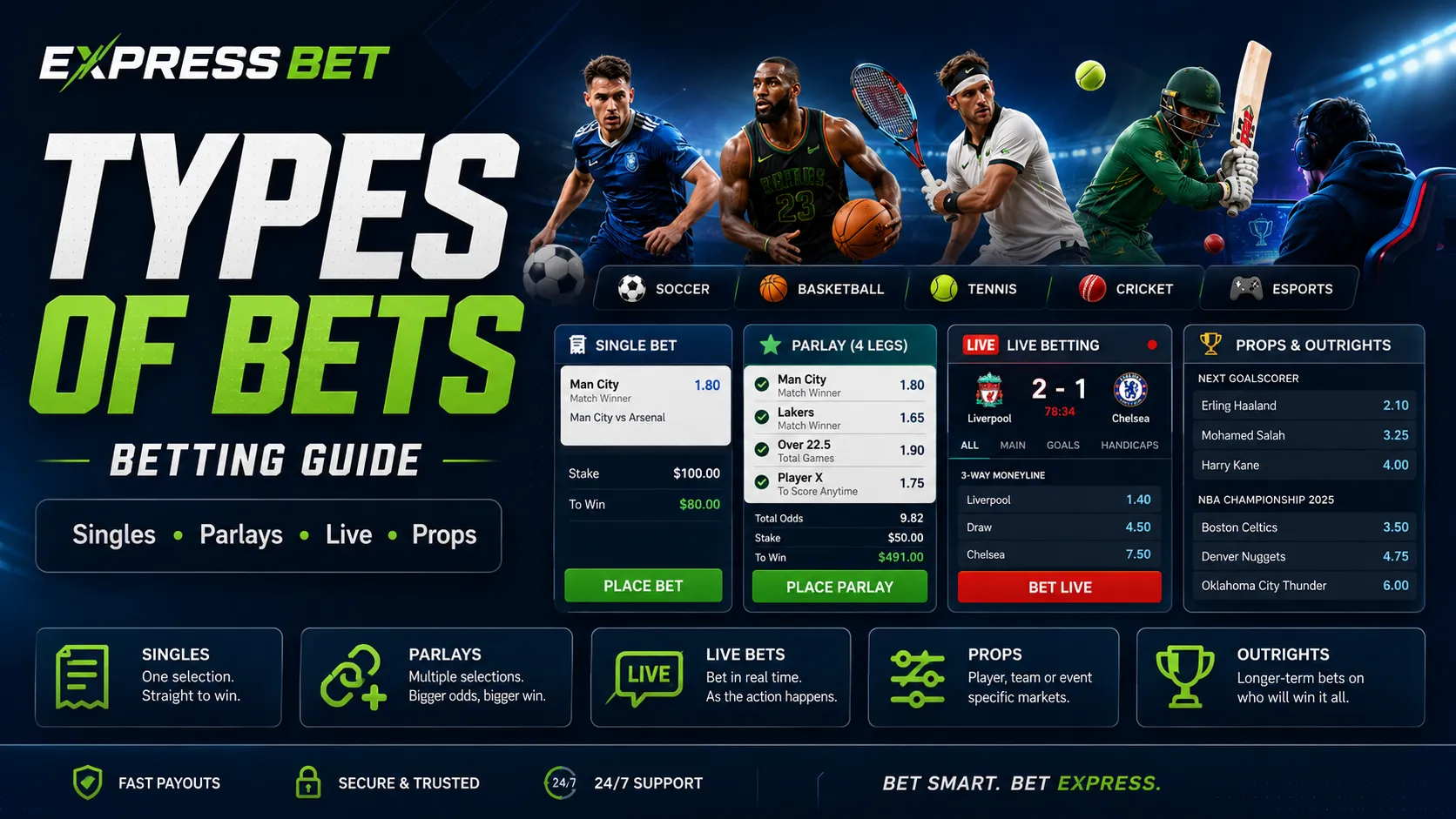
Betting types describe the structure of a wager. A bookmaker may offer many betting markets, but the user still needs to choose how to place the wager. The same selection can be used as a single bet, added to an accumulator, included in a system bet, or combined with other markets in a bet builder.
Bookmakers offer different bet types because users have different goals. Some users want simple match winner bets. Some users want higher odds through accumulator bets. Some users want draw protection through draw no bet. Some users want player-specific options through prop betting. Some users want real-time action through live betting.
Beginners should usually start with simple bet types. A single bet, match winner bet, double chance bet, draw no bet, or basic totals bet is easier to understand and track. Complex bet types carry higher risk because they include more conditions, more settlement rules, or faster decision pressure.
Accumulator bets and bet builders can look attractive because they create higher odds. They also fail when one required selection loses. Live betting requires faster decisions, stronger emotional control, and stricter bankroll management.
A bet type is the structure of a wager. It explains how the user places the selection, how many selections are included, and how the bookmaker settles the result.
A betting market is different. A market describes what the user predicts. A bet type describes how that prediction is placed.
Example:
A user can bet on Team A to win as a single bet. The user can add Team A to an accumulator. The user can combine Team A to win with over 2.5 goals and Player X to score in a bet builder. The selection may look similar, but the bet type changes the risk and payout.
Bet types appear on bookmaker websites and betting apps through the bet slip. A single bet slip shows one selection. An accumulator bet slip shows several selections and combined odds. A system bet slip shows several combinations. A bet builder slip shows several conditions from one event.
The user must understand settlement rules before confirming any wager. Settlement rules decide whether the bet wins, loses, pushes, voids, or returns part of the stake. This matters especially with handicaps, Asian totals, each-way bets, system bets, and player props.
Beginners often confuse bet type and betting market. This confusion creates mistakes on the bet slip.
A bet type means the structure of the wager. A betting market means the event condition or outcome that the user predicts.
| Term | Meaning | Example |
|---|---|---|
| Bet Type | Structure of the wager | Single bet, accumulator, system bet, live bet |
| Betting Market | What the user predicts | Match winner, totals, handicap, player props |
| Selection | The chosen outcome inside a market | Team A to win, over 2.5 goals |
| Bet Slip | Confirmation area for the wager | Stake, odds, possible return, bet type |
| Settlement Rule | How the bookmaker grades the result | Win, lose, void, push, half-win, half-loss |
Example:
“Over 2.5 goals” is a betting market. Placing it alone is a single bet. Combining it with two more selections is an accumulator. Combining it with Team A to win and Player X to score from the same match is a bet builder.
This distinction matters because risk changes with the structure. A market can be reasonable as a single bet but risky inside a large accumulator.
Every bet type uses stake, odds, payout, and profit.
The stake is the amount the user places on a bet. The odds show the price of the selection and the possible payout. The total return includes the original stake. Profit excludes the original stake.
Decimal odds formula:
Stake × Odds = Total Return
Profit formula:
Total Return − Stake = Profit
| Stake | Odds | Total Return | Profit |
| $5 | 1.50 | $7.50 | $2.50 |
| $10 | 2.00 | $20.00 | $10.00 |
| $20 | 2.50 | $50.00 | $30.00 |
| $50 | 3.00 | $150.00 | $100.00 |
Payout differs between bet types. A single bet uses one price. An accumulator multiplies odds. A system bet may include several combinations. An each-way bet splits the stake between win and place parts. A free bet may not return the bonus stake.
Users should check the bet slip before confirming. The slip should show selection, market, odds, stake, total return, and bet type. If the user does not understand one field, the bet should not be placed.
A single bet has one selection on one event. It is the simplest sports betting bet type.
Example:
Sport: Football
Market: Match Winner
Selection: Team A
Odds: 2.00
Stake: $10
Potential return: $20
Potential profit: $10
If Team A wins, the bet wins. If Team A does not win, the stake is lost. In a three-way football market, a draw also makes Team A to win lose.
Single bets suit beginners because they are easy to understand and track. The user knows exactly which selection caused the win or loss.
Examples by sport:
| Single Bet Feature | Explanation |
| Number of selections | One |
| Complexity | Low |
| Odds calculation | One price |
| Settlement | Based on one outcome |
| Beginner suitability | High |
| Tracking difficulty | Low |
| Main risk | The selection loses |
Single bets do not guarantee profit. They only reduce structural complexity. The user still needs market knowledge, odds comparison, and bankroll control.
An accumulator bet combines multiple selections in one bet slip. All selections must win. If one selection loses, the full accumulator loses.
Accumulator bets are also called parlay bets in the United States.
Accumulator odds multiply. This creates higher potential payout but also higher risk.
Example:
Selection 1 odds: 1.80
Selection 2 odds: 2.00
Selection 3 odds: 1.50
Accumulator odds:
1.80 × 2.00 × 1.50 = 5.40
Stake: $10
Potential return: $54
Potential profit: $44
This looks attractive, but all three selections must win. If two win and one loses, the bet loses.
| Number of Selections | Risk Level | Beginner Advice |
| 2-leg accumulator | Moderate | Use small stake only |
| 3-leg accumulator | High | Keep stake reduced |
| 5-leg accumulator | Very high | Avoid as main strategy |
| 8-leg accumulator | Extreme | Entertainment stake only |
| 10+ leg accumulator | Very extreme | Beginners should avoid |
Accumulators are popular because they create high odds from small stakes. This can create false confidence. A user may think each selection is likely, but combined probability falls with each added leg.
Beginners should use small stakes or avoid accumulators until they understand implied probability and bankroll management.
Single bets and accumulator bets behave very differently.
| Factor | Single Bet | Accumulator Bet |
| Number of selections | One | Two or more |
| Risk | Lower structure risk | Higher structure risk |
| Payout | Based on one odds price | Combined odds multiply |
| Beginner suitability | Strong | Limited |
| Bankroll impact | Easier to control | Can drain bankroll quickly |
| Tracking difficulty | Simple | Harder |
| Emotional risk | Lower | Higher due to near misses |
| Settlement | One result decides | One failed leg loses all |
Beginners should usually start with single bets. They are easier to understand, easier to record, and easier to analyze. Accumulators create emotional near misses. A user may feel “close” when one leg fails, but the result is still a loss.
A system bet uses multiple selections arranged into several smaller combinations. Unlike a normal accumulator, not every selection must win for some return to be possible. However, system bets are more complex and may cost more because several combinations are included.
Common system bet examples:
A 2 from 3 system uses three selections and creates three two-selection combinations. If two selections win, one combination may pay. If all three win, several combinations may pay.
| System Bet | How It Works | Risk Level | Best For |
| 2 from 3 | Three selections, all two-selection combinations | Medium | Users learning systems |
| 3 from 4 | Four selections, all three-selection combinations | Medium to high | Experienced users |
| Trixie | Three selections, four bets: three doubles and one treble | Medium | Racing and football users |
| Yankee | Four selections, 11 bets: doubles, trebles, fourfold | High | Experienced bettors |
| Lucky 15 | Four selections, 15 bets including singles | High | Racing users |
System bets can reduce all-or-nothing risk, but they can also increase total stake. The user must know how many combinations are active and what the total stake is.
Beginners should be careful. A system bet can look safer than an accumulator, but the cost and settlement rules may be harder to understand.
A moneyline or match winner bet means the user bets on the winner of an event.
The structure changes by sport. Some sports use two-way markets. Some sports use three-way markets.
Examples:
| Sport | Market Type | Possible Outcomes |
| Tennis | Two-way | Player A or Player B |
| Basketball | Two-way | Team A or Team B |
| Football | Three-way | Home, draw, away |
| Cricket | Usually two-way, depending on format | Team A or Team B |
| Esports | Usually two-way | Team A or Team B |
| MMA / Boxing | Usually two-way, with draw markets sometimes separate | Fighter A or Fighter B |
The draw matters. In football, Team A to win loses if the match ends in a draw. In basketball, overtime may count depending on the market. Users must check settlement rules before placing the bet.
Match winner bets are easy to understand, but they still carry risk. A favorite can lose. A famous team can underperform.
Double chance betting is common in football. It covers two of the three main outcomes.
Options:
| Double Chance Option | Meaning | Risk Level |
| Home Win or Draw | Bet wins if home team wins or match draws | Lower than match winner |
| Away Win or Draw | Bet wins if away team wins or match draws | Lower than match winner |
| Home Win or Away Win | Bet wins if either team wins, loses if draw | Medium |
Double chance has lower odds than a match winner bet because it covers more outcomes. It can suit cautious users who want broader coverage.
It is not risk-free. If a user chooses home win or draw, the bet loses if the away team wins. Users should still check team news, motivation, tactics, and odds value.
A handicap bet adds or subtracts a virtual advantage before settlement. Bookmakers use handicaps to balance mismatched teams or create more even betting markets.
A positive handicap gives a team a virtual start. A negative handicap requires a team to win by a larger margin.
Example:
Team A -1.5 means Team A must win by 2 or more goals.
Team B +1.5 means Team B can win, draw, or lose by 1 goal.
Handicap bets are common in football, basketball, tennis, cricket, esports, and American football. They can be harder for beginners because settlement depends on the final score after the handicap is applied.
European handicap is usually a three-way market. It can include home, draw, and away outcomes after the handicap.
Example:
Team A -1 European handicap means Team A must win by 2 or more for the Team A handicap selection to win. If Team A wins by exactly 1, the handicap result may be a draw option.
Asian handicap removes or reduces the draw possibility. It can include whole, half, and quarter lines.
Common types:
Settlement rules matter. A user should not place Asian handicap bets without understanding push, half-win, and half-loss results.
| Handicap Type | Example | Meaning | Risk Level |
| Negative Handicap | Team A -1.5 | Team A must win by 2+ | Medium to high |
| Positive Handicap | Team B +1.5 | Team B can lose by 1 and still cover | Medium |
| European Handicap | Team A -1 | Three-way settlement after handicap | Medium to high |
| Asian Whole Handicap | Team A -1.0 | Win by 2+, push if win by 1 | Medium |
| Asian Half Handicap | Team A -0.5 | Must win, no push | Medium |
| Asian Quarter Handicap | Team A -0.25 | Split stake across two lines | Higher complexity |
Spread betting in sports betting is common in US sports. It is similar to handicap betting.
The favorite must win by more than the spread. The underdog can lose by less than the spread and still cover.
Example:
Team A -6.5 means Team A must win by 7 or more points. If Team A wins by 6, the bet loses.
Team B +6.5 means Team B can win outright or lose by 6 or fewer points. If Team B loses by 7 or more, the bet loses.
Spread betting is common in basketball, American football, and hockey. Users must understand whether overtime counts. Most standard US spreads include overtime, but rules can vary by bookmaker and market.
Spread bets require careful analysis of team strength, pace, injuries, home advantage, and matchup style.
A totals bet means the user bets on whether the total number of goals, points, runs, sets, maps, or rounds will be over or under a bookmaker line.
Examples:
| Sport | Totals Market Example | What Must Happen |
| Football | Over 2.5 goals | Match needs 3 or more goals |
| Basketball | Over 220.5 points | Teams need 221+ total points |
| Cricket | Over 165.5 runs | Team needs 166+ runs |
| Tennis | Over 22.5 games | Match needs 23+ games |
| Esports | Over 2.5 maps | Match needs 3 maps |
| MMA | Over 2.5 rounds | Fight must pass the stated point |
Totals can be useful when the winner is hard to predict. A user may not know which football team will win but may expect a high-scoring match.
Risk factors include injuries, weather, tactics, pace, red cards, player rotation, pitch condition, and game script.
Totals are beginner-friendly only when the user understands the sport and line.
A team totals bet focuses on one team’s scoring output instead of the full event total.
Examples:
Team totals can be useful when one side has a strong attacking or scoring profile. They can also be useful when the user does not trust the opponent to contribute to a full-event over.
Risks include injuries, tactics, weather, rotation, slow tempo, early lead, defensive game script, and player availability. A team that scores well on average can still underperform in one match.
Both Teams to Score, or BTTS, is common in football. The market asks whether both teams will score at least one goal.
| BTTS Option | Meaning | Example Result |
| BTTS Yes | Both teams must score | 1–1, 2–1, 3–2 |
| BTTS No | At least one team does not score | 0–0, 1–0, 2–0 |
BTTS depends on match style. Users should check attacking form, defensive weakness, injuries, tactical approach, motivation, home/away patterns, and lineup news.
BTTS Yes can lose even in an open match if one team misses chances. BTTS No can lose from one penalty, defensive mistake, or late goal.
A correct score bet requires the user to predict the exact final score. It is common in football and other low-scoring sports.
Example:
Correct score 2–1 wins only if the match ends exactly 2–1.
If the match ends 2–0, 1–1, 3–1, or any other score, the bet loses.
Correct score bets usually have high odds because the probability is low. One late goal can destroy the bet. Beginners should use tiny stakes or avoid this market.
Correct score betting is high risk. It should not be used as a recovery method after losses.
Scorer markets focus on which player scores.
Common scorer markets:
| Scorer Market | Meaning | Risk Level |
| First Goal Scorer | Player must score the first goal | High |
| Anytime Goal Scorer | Player must score at any time | Medium to high |
| Last Goal Scorer | Player must score the final goal | High |
| Player to Score 2+ | Player must score two or more | Very high |
Scorer markets require lineup knowledge. A player may start on the bench, play fewer minutes, miss penalties, change role, or leave injured. Penalty taker role matters. Set-piece role matters. Team style matters.
Odds can change sharply after confirmed lineups. Users should not bet on scorer markets before knowing whether the player starts unless they understand bookmaker void rules.
A player prop bet focuses on an individual player’s performance. Prop betting appears across many sports.
Examples:
| Sport | Player Prop Example | Key Risk |
| Football | Player shots, assists, cards | Minutes and tactical role |
| Basketball | Points, rebounds, assists | Foul trouble and rotation |
| Cricket | Runs, wickets, boundaries | Batting order and pitch |
| Tennis | Aces, double faults, games won | Surface and fitness |
| Esports | Kills, assists, objectives | Map role and game script |
Player props need player research. A user must check recent form, minutes, role, opponent, matchup, injury status, and market line.
Prop betting can be useful, but it can also become risky because lines often include strong bookmaker margin. Users should track results by player prop type.
An outright bet, also called a futures bet in the United States, predicts a long-term result.
Examples:
Outright bets can stay open for weeks or months. This means the bankroll is tied up. Odds can move during the season because of injuries, transfers, form, schedule, or standings.
Some bookmakers offer cash out on outright bets. The value changes as the event progresses.
Outrights can be useful for small stakes, but users should avoid tying too much bankroll into long-term bets. A season can change quickly.
A live bet, also called an in-play bet, is placed after the event starts. Live betting markets update during the event.
Examples:
| Live Bet Feature | Risk |
| Fast odds movement | User may confirm worse odds |
| Market suspension | Betting may pause during key moments |
| Stream delay | User may see old information |
| Emotional pressure | User may chase losses |
| Cash out availability | User may cash out emotionally |
| Live bet slip updates | Mistakes can happen quickly |
Live betting is riskier than pre-match betting because users make decisions under pressure. Beginners should use small stakes and strict stop-loss rules.
Cash out allows the user to close a bet before the event ends. It can apply to single bets, accumulators, live bets, and outright bets when the bookmaker supports it.
Types:
Cash out value changes with odds movement. If the bet becomes more likely to win, the cash out offer may increase. If the bet becomes less likely to win, the offer may decrease.
| Cash Out Situation | Possible Use | Risk |
| Bet is winning but game state worsens | Lock partial profit | Cashing out too early |
| One accumulator leg remains | Reduce all-or-nothing risk | Lower value than waiting |
| Player injury changes outlook | Limit exposure | Offer may already be poor |
| Red card changes match | Control damage | Emotional decision |
| Market becomes unstable | Protect stake | Cash out may disappear |
Cash out can reduce risk, but it can also reduce value. Users should decide cash out rules before betting. Emotional cash out after every momentum shift is poor discipline.
A bet builder combines several markets from one event. All conditions must win.
Example:
Team A to win + over 2.5 goals + Player X to score
If Team A wins 2–0, the bet loses because over 2.5 goals fails. If the match has over 2.5 goals but Player X does not score, the bet loses. If Player X scores but Team A does not win, the bet loses.
Bet builder markets are common in football and basketball. They can create higher odds but also higher risk. Correlated bets affect pricing. A bookmaker may reduce odds when conditions are related.
Users must understand every leg. Adding more legs only to make odds larger is a common mistake.
Same game parlay is a US-style term. It is similar to bet builder. It combines several selections from one game into one wager.
Example:
Team A moneyline + Player Y over 20.5 points + total points over 215.5
Same game parlays are popular in US sports betting. They create higher payout potential, but all selections must win. Correlation pricing matters because some outcomes are connected.
Same game parlays are high risk. Users should use small stakes and avoid building tickets only for large odds.
Each-way betting is common in horse racing, golf, and some outright markets. An each-way bet has two parts: one bet to win and one bet to place.
Example:
$10 each-way means:
The place part pays if the selection finishes within the bookmaker’s place terms. Place terms vary by sport, event, field size, and bookmaker.
Each-way betting can reduce all-or-nothing risk, but it does not remove risk. It also doubles the stake. Beginners often misunderstand this and think a $10 each-way bet costs $10. It usually costs $20.
Users must check place rules before betting.
Draw no bet is common in football. The user chooses one team. If the selected team wins, the bet wins. If the match ends in a draw, the stake is returned. If the selected team loses, the bet loses.
| Result | Draw No Bet Outcome |
| Selected team wins | Bet wins |
| Match draws | Stake returned |
| Selected team loses | Bet loses |
Draw no bet offers lower odds than match winner because it gives draw protection. It can suit users who like one team but want protection against a draw.
It is not risk-free. The selected team can still lose.
Asian totals are similar to over-under bets but can include push, half-win, or half-loss results.
Examples:
Over 2.0 goals:
Over 2.5 goals:
Over 2.25 goals:
Over 2.75 goals:
Asian totals require settlement knowledge. Beginners should start with simple over-under lines before using quarter totals.
Special and novelty bets cover markets outside regular sports structure. These may include awards, entertainment events, TV competitions, political events where legally available, and special bookmaker markets.
These bets often have:
Users should treat novelty bets as high-risk entertainment. They should not use large stakes or depend on them for serious analysis.
Political betting may be restricted or illegal in some regions. Users must check local law and bookmaker terms.
Esports betting includes several bet types and markets. Popular games include CS2, Dota 2, League of Legends, Valorant, and Mobile Legends.
Common esports bet types and markets:
Esports betting requires knowledge of patches, rosters, map vetoes, drafts, team form, and tournament motivation. A team can change performance after an update or roster move.
Lower-tier esports events can have weaker data and higher uncertainty. Beginners should use smaller stakes and avoid live esports betting without game knowledge.
Some sportsbooks include casino sections. Casino bets are different from sports bets.
Sports bets depend on real events and bookmaker odds. Casino bets depend on random number generators, live dealer rules, or fixed game mechanics.
Casino examples:
Casino games need a separate bankroll. Users should not use casino games to recover sports betting losses. Casino games can move faster than sports bets and can drain money quickly.
Sports analysis does not apply to RNG games. A user who understands football odds cannot predict a slot result.
| Bet Type | Complexity | Risk Level | Beginner Suitability | Suggested Stake Approach |
| Single Bet | Low | Medium | High | Normal small unit |
| Double Chance | Low | Lower to medium | High | Normal small unit |
| Draw No Bet | Low | Lower to medium | High | Normal small unit |
| Totals | Medium | Medium | Good if market understood | Normal or reduced unit |
| Handicap | Medium to high | Medium to high | Limited | Reduced unit |
| Player Props | Medium | Medium to high | Limited | Reduced unit |
| Accumulator | Medium | High | Low | Small stake |
| System Bet | High | Medium to high | Low | Know total stake first |
| Correct Score | Low structure, high prediction difficulty | Very high | Low | Tiny stake or avoid |
| Live Bet | Medium | High | Low | Smaller unit and stop-loss |
| Bet Builder | High | High | Low | Small stake |
| Same Game Parlay | High | High | Low | Small stake |
| Outright | Medium | Medium to high | Medium | Small long-term stake |
| Each-Way | Medium | Medium | Medium | Check total stake |
| Novelty Bet | Medium | High | Low | Tiny entertainment stake |
Risk depends on the market, odds, user knowledge, and stake size. A simple bet can still be risky if the user stakes too much. A complex bet can become dangerous if the user does not understand settlement rules.
Beginners should start with bet types that are easy to understand, settle, and track.
Better beginner options:
Beginners should be careful with:
Beginner checklist:
A beginner should build discipline before using complex structures.
Bankroll management means controlling the money used for betting. Different bet types need different stake sizes.
Simple bets can use a normal small unit. High-risk bets need smaller stakes. Accumulators should use reduced stakes. Live betting needs separate session limits. Casino bets need a separate bankroll.
A beginner unit size often ranges from 0.5% to 1% of bankroll per normal bet.
| Bankroll Size | 1% Unit | High-Risk Bet Suggested Stake |
| $50 | $0.50 | $0.10–$0.25 |
| $100 | $1.00 | $0.25–$0.50 |
| $250 | $2.50 | $0.50–$1.25 |
| $500 | $5.00 | $1.00–$2.50 |
| $1000 | $10.00 | $2.50–$5.00 |
High-risk bets include correct score, long accumulators, live accumulators, same game parlays, novelty bets, and high-odds player props.
Users should set deposit limits and loss limits. They should stop after reaching a preset loss limit. Chasing losses with more complex bet types is one of the fastest ways to damage a bankroll.
Users often make the same mistakes when choosing bet types.
A user may think over 2.5 goals is a bet type. It is a market. The bet type depends on how the user places it.
Beginners often move into accumulators, bet builders, or systems before understanding single bets.
Accumulators create high odds but lose when one leg fails. Near misses are still losses.
Asian handicap and European handicap have different settlement rules. Users must read the rules first.
Double chance covers two outcomes, not all outcomes. It can still lose.
Adding legs only for a bigger payout usually increases risk without improving decision quality.
Player props and scorer markets depend on minutes, role, injury status, and starting lineup.
Live betting can push users into fast and angry decisions.
A $10 each-way bet usually costs $20 total.
Casino games can increase damage quickly. They should not be used for recovery.
Some bonuses exclude certain bet types or require minimum odds.
Wrong stake, wrong market, wrong odds, and wrong bet type can all appear before confirmation.
Scammers often claim that one bet type can guarantee profit. This is false.
Common scams include:
No bet type guarantees profit. A single bet can lose. An accumulator can lose. A system bet can lose. A correct score tip can be fake. A live signal can be delayed or invented.
Users should never give account access, money, ID documents, or payment details to anyone promising sure wins. Any promise of risk-free profit should be treated as a red flag.
Complex bet types can hide risk. A bet builder may look like one bet, but it includes several conditions. A system bet may look safer, but it can cost more. A live bet may feel informed, but it can be emotional. A casino bet may look like quick recovery, but it can increase losses.
Responsible gambling rules:
Understanding bet types does not protect users if they cannot control betting behavior. A user can understand every market and still lose control through emotional staking.
Warning signs include:
In these cases, stopping is more important than learning another bet type.
Before choosing a bet type, the user should confirm:
If one answer is unclear, the user should not place the bet.
Example match:
Team A vs Team B
The user considers three ways to bet.
Selection: Team A to win
Odds: 2.00
Stake: $10
Total return:
$10 × 2.00 = $20
Profit:
$20 − $10 = $10
Risk:
Team A must win. A draw or Team B win makes the bet lose in a three-way match winner market.
Selection: Team A or draw
Odds: 1.40
Stake: $10
Total return:
$10 × 1.40 = $14
Profit:
$14 − $10 = $4
Risk:
The bet wins if Team A wins or the match draws. The bet loses if Team B wins. The payout is lower because two outcomes are covered.
Selections:
Team A to win + over 2.5 goals + Player X to score
Odds: 5.00
Stake: $10
Total return:
$10 × 5.00 = $50
Profit:
$50 − $10 = $40
Risk:
All conditions must win. If Team A wins 2–0, the bet loses because over 2.5 goals fails. If Team A wins 3–0 but Player X does not score, the bet loses. The higher odds come with higher risk.
This comparison shows why bet type matters. The same match can create very different risk profiles.
Simple bet types are easier to control. Single bets, match winner bets, double chance, draw no bet, and basic totals give users clearer settlement and easier tracking.
Complex bet types increase risk. Accumulators, bet builders, same game parlays, correct score bets, and live bets can create higher potential payouts, but they also increase the chance of losing. Higher odds often mean lower probability.
Live bets need strict discipline because odds move quickly and users can react emotionally. Handicap, Asian total, each-way, and system bets require settlement knowledge. Users must understand the rules before confirming the bet slip.
Bankroll management matters more than confidence. A confident bet can lose. Users should use small stakes, set loss limits, set deposit limits, avoid chasing losses, and reject guaranteed-profit claims.
Responsible gambling is mandatory. No bet type protects a user who cannot control stake size or stop betting.
The main types include single bets, accumulator bets, parlay bets, system bets, match winner bets, double chance, handicap bets, totals, player props, live bets, bet builders, same game parlays, outright bets, each-way bets, and cash out betting.
A single bet is usually the easiest bet type for beginners because it has one selection and simple settlement.
A single bet is one selection on one event. The bet wins if the selection wins and loses if the selection fails.
An accumulator bet combines multiple selections. Every selection must win for the bet to pay.
A parlay bet is the US term for an accumulator bet. It combines multiple selections into one wager.
A system bet arranges multiple selections into combinations. Some returns may be possible even if not every selection wins, but the total stake can be higher.
A match winner bet means betting on which team or player wins an event.
Double chance covers two of three football outcomes, such as home win or draw.
A handicap bet adds or subtracts a virtual advantage before settlement. It balances the market between stronger and weaker teams.
Asian handicap is a handicap format that can remove or reduce draw risk. It can include push, half-win, or half-loss outcomes.
A totals bet means betting on whether total goals, points, runs, maps, sets, or rounds go over or under a bookmaker line.
Over-under betting is another name for totals betting. The user chooses whether the final total will be above or below the line.
A player prop bet focuses on individual player performance, such as points, rebounds, shots, runs, wickets, assists, or kills.
An outright bet predicts a long-term result, such as a league winner, tournament winner, or top scorer.
A live bet is placed after the event has started. Odds move during the event based on the game state.
Cash out lets users close a bet before final settlement if the bookmaker offers this feature.
A bet builder combines several markets from one event. All conditions must win.
A same game parlay combines several selections from one game. It is similar to a bet builder.
An each-way bet has two parts: one bet to win and one bet to place. The total stake is usually doubled.
Draw no bet returns the stake if the match ends in a draw. It wins if the selected team wins and loses if the selected team loses.
High-risk bet types include long accumulators, correct score, live accumulators, bet builders, same game parlays, novelty bets, and high-odds player props.
Beginners should be careful with accumulators, system bets, live bets, correct score, bet builders, same game parlays, and complex handicap markets.
Single bets use one odds price. Accumulators multiply odds. System bets use combinations. Bet builders combine several prices from one event.
Use normal small units for simple bets and reduced stakes for high-risk bet types. Set deposit limits, loss limits, and stop-loss rules.
No. No bet type guarantees profit. Every bet can lose, and users should treat betting as entertainment only.
Types of bets define how a wager is structured and how risk works. A single bet is simple. An accumulator multiplies risk across several selections. A system bet uses combinations. A live bet adds time pressure. A bet builder combines several conditions from one event. Handicap, totals, player props, each-way bets, and draw no bet all have different settlement rules.
Beginners should start with simple bet types, understand betting odds, read settlement rules, use small stakes, and track every result. Complex bet types should use reduced stakes because higher odds often mean lower probability and higher risk.
No bet type guarantees profit. Users should avoid chasing losses, reject fake guaranteed picks, and treat betting as entertainment only. Responsible bankroll management is essential before any bet is placed.
[expert_review params=»JTdCJTIyY29sb3IlMjIlM0ElMjJncmVlbi0yJTIyJTJDJTIyZXhwZXJ0X2F2YXRhciUyMiUzQSUyMiUyMiUyQyUyMmV4cGVydF9uYW1lJTIyJTNBJTIyJTIyJTJDJTIyZXhwZXJ0X2xpbmslMjIlM0ElMjIlMjIlMkMlMjJleHBlcnRfaWQlMjIlM0ElMjIxJTIyJTJDJTIyZXhwZXJ0X3R5cGUlMjIlM0ElMjJleHBlcnRfaWQlMjIlMkMlMjJleHBlcnRfYXZhdGFyX2FsdCUyMiUzQSUyMiUyMiUyQyUyMmV4cGVydF9zaG93JTIyJTNBMSUyQyUyMmV4cGVydF9kZXNjcmlwdGlvbiUyMiUzQSUyMlNwb3J0cyUyMEJldHRpbmclMjBBbmFseXN0JTIwJTI2JTIwRWRpdG9yaWFsJTIwQ29udHJpYnV0b3IlMjIlMkMlMjJleHBlcnRfc2hvd19idXR0b24lMjIlM0ExJTJDJTIyZXhwZXJ0X3Nob3dfYnV0dG9uX3R5cGUlMjIlM0ElMjJwb3B1cCUyMiUyQyUyMmV4cGVydF9xdWVzdGlvbl9idXR0b25fdGV4dCUyMiUzQSUyMkFzayUyMFF1ZXN0aW9uJTIyJTJDJTIycXVlc3Rpb25fZXh0ZXJuYWxfbGluayUyMiUzQSUyMiUyMiUyQyUyMnBvcHVwX3VzZV9waG9uZSUyMiUzQTAlMkMlMjJleHBlcnRfdGl0bGUlMjIlM0ElMjJBdXRob3IlMjIlMkMlMjJleHBlcnRfc2hvd190aXRsZSUyMiUzQTElMkMlMjJleHBlcnRfdGV4dCUyMiUzQSUyMkFsZXglMjBNb3JnYW4lMjBpcyUyMGElMjBzcG9ydHMlMjBiZXR0aW5nJTIwYW5hbHlzdCUyMGFuZCUyMGVkaXRvcmlhbCUyMGNvbnRyaWJ1dG9yJTIwd2hvJTIwd3JpdGVzJTIwZGV0YWlsZWQlMjBib29rbWFrZXIlMjByZXZpZXdzJTJDJTIwYmV0dGluZyUyMGd1aWRlcyUyQyUyMHBsYXRmb3JtJTIwY29tcGFyaXNvbnMlMkMlMjBhbmQlMjByZXNwb25zaWJsZSUyMGdhbWJsaW5nJTIwZXhwbGFpbmVycy4lMjBIaXMlMjB3b3JrJTIwZm9jdXNlcyUyMG9uJTIwcHJhY3RpY2FsJTIwaW5mb3JtYXRpb24lMjBmb3IlMjB1c2VycyUyMHdobyUyMHdhbnQlMjB0byUyMHVuZGVyc3RhbmQlMjBob3clMjBiZXR0aW5nJTIwc2l0ZXMlMjBvcGVyYXRlJTIwYmVmb3JlJTIwdGhleSUyMHJlZ2lzdGVyJTJDJTIwZGVwb3NpdCUyQyUyMG9yJTIwY2xhaW0lMjBhJTIwYm9udXMuJTIyJTJDJTIycWElMjIlM0ElNUIlNUQlMkMlMjJxYV9zaG93X3RpdGxlJTIyJTNBMSUyQyUyMnFhX3RpdGxlJTIyJTNBJTIyJUQwJTkyJUQwJUJFJUQwJUJGJUQxJTgwJUQwJUJFJUQxJTgxJTIwJUQxJThEJUQwJUJBJUQxJTgxJUQwJUJGJUQwJUI1JUQxJTgwJUQxJTgyJUQxJTgzJTIyJTJDJTIyc2NvcmUlMjIlM0ElNUIlNUQlMkMlMjJzY29yZV9zdW1tYXJ5X3RleHQlMjIlM0ElMjIlMjIlMkMlMjJzY29yZV9zdW1tYXJ5X2F2ZXJhZ2UlMjIlM0EwJTJDJTIyc2NvcmVfbWF4JTIyJTNBJTIyNSUyMiUyQyUyMnNjb3JlX3N5bWJvbCUyMiUzQSUyMiUyMiUyQyUyMnNjb3JlX3RpdGxlJTIyJTNBJTIyJTIyJTJDJTIyc2NvcmVfc2hvd190aXRsZSUyMiUzQTAlMkMlMjJwbHVzZXMlMjIlM0ElNUIlNUQlMkMlMjJtaW51c2VzJTIyJTNBJTVCJTVEJTJDJTIycGx1c2VzX21pbnVzZXNfc2hvd190aXRsZSUyMiUzQTElMkMlMjJwbHVzZXNfbWludXNlc190aXRsZSUyMiUzQSUyMiVEMCU5RiVEMCVCQiVEMSU4RSVEMSU4MSVEMSU4QiUyMCVEMCVCOCUyMCVEMCVCQyVEMCVCOCVEMCVCRCVEMSU4MyVEMSU4MSVEMSU4QiUyMiUyQyUyMnBsdXNlc190aXRsZSUyMiUzQSUyMiUyMiUyQyUyMm1pbnVzZXNfdGl0bGUlMjIlM0ElMjIlMjIlN0Q=»]