
FIFA World Cup 2026 Cities: Full Guide to Host Cities, Stadiums, Match Locations and Betting Context
Table of Contents Show
Views 0
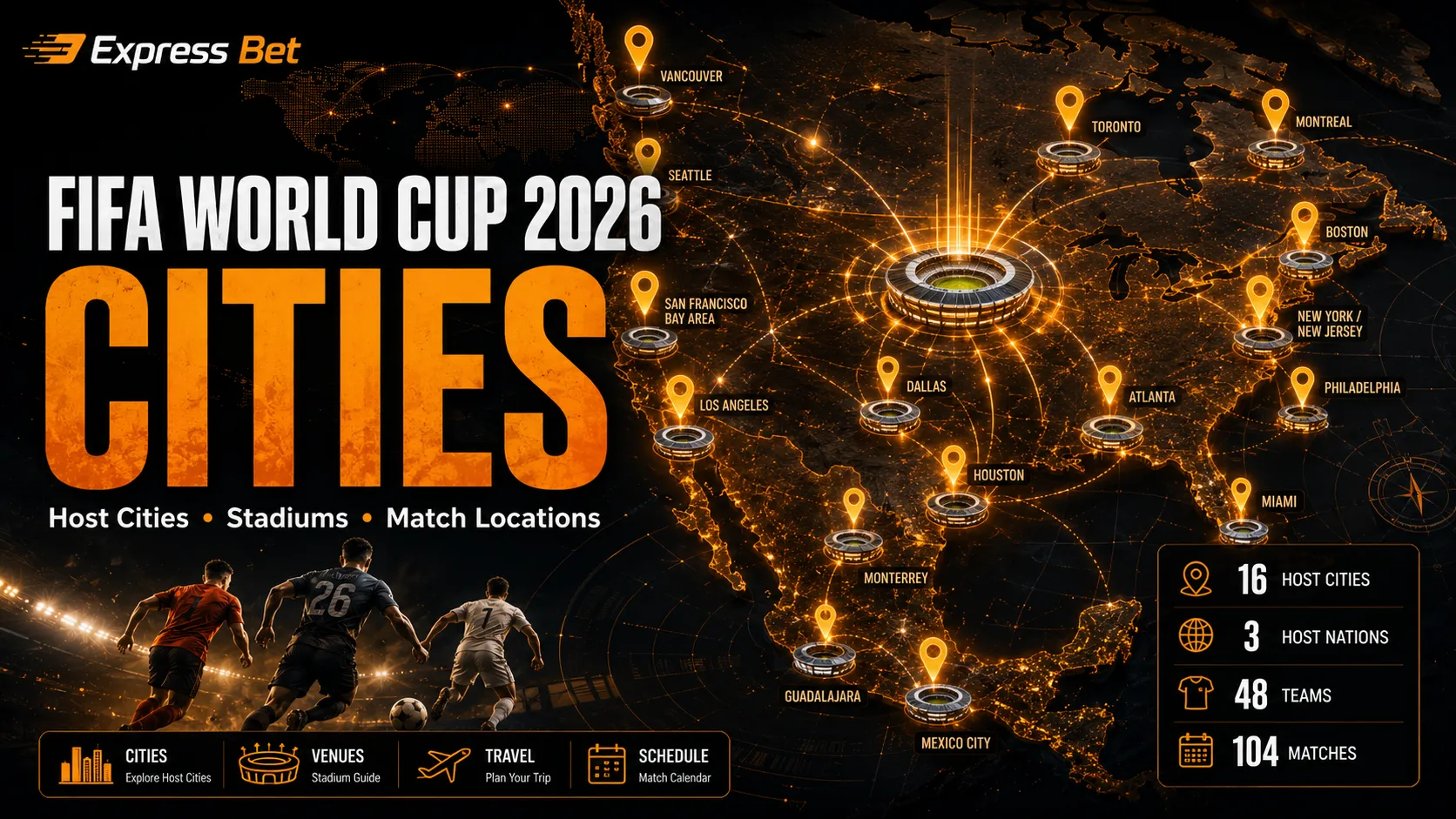
The FIFA World Cup 2026 cities are spread across Canada, Mexico and the United States, with 16 host cities staging matches during the expanded 48-team tournament. This guide explains every host city, tournament venue, country grouping, travel context, fan angle and betting context. Fans can use it to understand where matches are played and how the tournament map works. Bettors can use city information to assess travel, climate, rest, venue type and local conditions before checking odds, lineups or predictions. City data matters, but it should never be used alone.
FIFA World Cup 2026 Cities Overview
The FIFA World Cup 2026 is hosted by three countries: Canada, Mexico and the United States.
The tournament uses 16 host cities. Canada has two. Mexico has three. The United States has eleven. This makes the 2026 edition different from most previous World Cups. The tournament is not concentrated in one country or one small region. It is spread across a very large map.
That matters for fans. A supporter following one team may need to track match dates, travel distances, time zones and stadium locations. A match in Vancouver is not the same travel experience as a match in Mexico City, Miami or Boston.
It also matters for betting analysis. Host city context can affect preparation. Teams may have to move between countries. They may face different weather. They may play in open-air venues, covered venues or stadiums with controlled conditions. They may move from altitude to sea level. They may face strong local crowd pressure.
None of these factors guarantees a match result. A better team can still win in difficult conditions. A weaker team can still lose even with a favorable travel path. But city context helps explain the environment around a match.
The FIFA World Cup 2026 includes 48 teams and 104 matches. The expanded format increases travel, rest-day differences and fixture complexity. The host city structure is part of that complexity.
For Express Bet readers, this page works as a city guide and a betting-context guide. It does not replace the schedule page, the stadiums page, match previews or daily predictions. It connects those pages by explaining where the tournament happens.
Full List of FIFA World Cup 2026 Host Cities
| Host City | Country | Tournament Venue | Region | Key Tournament Role | Betting Context |
|---|---|---|---|---|---|
| Toronto | Canada | Toronto Stadium | Eastern Canada | Canadian host city | Travel, time zone and local conditions matter |
| Vancouver | Canada | Vancouver Stadium | Western Canada | Canadian host city | West Coast travel and recovery can matter |
| Guadalajara | Mexico | Guadalajara Stadium | Western Mexico | Mexican host city | Climate, crowd and travel context matter |
| Mexico City | Mexico | Mexico City Stadium | Central Mexico | Opening match city | Altitude, atmosphere and pressure matter |
| Monterrey | Mexico | Monterrey Stadium | Northern Mexico | Mexican host city | Heat, travel and northern location matter |
| Atlanta | United States | Atlanta Stadium | Southeast USA | U.S. host city | Stadium conditions and travel context matter |
| Boston | United States | Boston Stadium | Northeast USA | U.S. host city | East Coast travel and weather matter |
| Dallas | United States | Dallas Stadium | South-Central USA | Major U.S. host city | Heat, indoor context and travel matter |
| Houston | United States | Houston Stadium | South USA | U.S. host city | Heat and humidity can affect tempo |
| Kansas City | United States | Kansas City Stadium | Central USA | U.S. host city | Central location affects travel paths |
| Los Angeles | United States | Los Angeles Stadium | West Coast USA | U.S. host city | West Coast travel and media attention matter |
| Miami | United States | Miami Stadium | Southeast USA | Third-place match city | Heat, humidity and motivation matter |
| New York New Jersey | United States | New York New Jersey Stadium | Northeast USA | Final city | Public market pressure and media attention matter |
| Philadelphia | United States | Philadelphia Stadium | Northeast USA | U.S. host city | East Coast cluster and travel context matter |
| San Francisco Bay Area | United States | San Francisco Bay Area Stadium | West Coast USA | U.S. host city | West Coast travel and climate matter |
| Seattle | United States | Seattle Stadium | Pacific Northwest USA | U.S. host city | Travel distance and atmosphere matter |
The city list shows the scale of the tournament. The World Cup 2026 map stretches from Vancouver to Mexico City, from Seattle to Miami, and from Los Angeles to Boston.
This structure creates a tournament with regional clusters. Some teams may stay mostly within one part of the map. Others may move between distant cities. Fans and bettors should check each fixture in the schedule rather than assume all teams face equal travel conditions.
FIFA World Cup 2026 Host Countries
Canada World Cup 2026 Cities
Canada has two FIFA World Cup 2026 host cities: Toronto and Vancouver.
This gives Canada one eastern host city and one western host city. That matters because the distance between Toronto and Vancouver is large. A team moving between these areas would face a major travel leg and a time zone change.
Canada’s role also matters for fans. Toronto and Vancouver are large cities with strong international communities. They can attract mixed crowds and neutral supporters. Matchday atmosphere may depend on the teams involved.
For bettors, Canada-based matches should be checked for travel path, rest days, local weather and squad rotation. A match in Toronto may sit within an East Coast travel sequence. A match in Vancouver may connect with West Coast fixtures in Seattle, San Francisco Bay Area or Los Angeles.
Mexico World Cup 2026 Cities
Mexico has three FIFA World Cup 2026 host cities: Guadalajara, Mexico City and Monterrey.
Mexico City is especially important because it hosts the opening match. Mexico also brings strong football culture and a different match environment from many U.S. and Canadian venues.
The Mexican cities are not identical. Mexico City has altitude and pressure. Guadalajara has its own football culture and regional identity. Monterrey brings northern Mexico conditions and travel context.
For bettors, Mexico-based matches require careful reading. Crowd intensity, heat, altitude and travel can all form part of the match profile. They should not be treated as automatic betting edges. They should be combined with team quality, lineups and tactical analysis.
United States World Cup 2026 Cities
The United States has eleven FIFA World Cup 2026 host cities: Atlanta, Boston, Dallas, Houston, Kansas City, Los Angeles, Miami, New York New Jersey, Philadelphia, San Francisco Bay Area and Seattle.
The U.S. map is wide. It includes the West Coast, East Coast, South, Southeast and Central regions. That creates very different travel and climate conditions.
Some venues may offer controlled stadium environments. Others may place more emphasis on outdoor heat, humidity or local weather. Teams may need to adjust quickly between cities.
For bettors, the U.S. host city structure matters because a team’s schedule can be demanding. A move from Seattle to Dallas is different from a move from Philadelphia to New York New Jersey. A team with longer rest may handle travel better. A team with short rest may rotate or reduce intensity.
Canada FIFA World Cup 2026 Cities
Toronto
Toronto is one of Canada’s two FIFA World Cup 2026 host cities. The tournament venue is Toronto Stadium.
Toronto is located in eastern Canada. It is a major international city with strong football communities and large immigrant populations. That can create diverse matchday crowds. Depending on the teams involved, the atmosphere may feel neutral, mixed or strongly tilted toward one side.
From a travel perspective, Toronto fits more naturally with the East Coast cluster. It is closer to cities such as Boston, New York New Jersey and Philadelphia than to Vancouver, Seattle or Los Angeles. That can matter when teams have short recovery windows.
The time zone is also relevant. Toronto sits in the Eastern Time zone. Teams moving from western venues may need to adjust. This is not usually decisive by itself, but it can affect preparation if the rest period is short.
The climate in Toronto during the tournament period can be mild to warm. Matchday weather should still be checked close to kick-off. Bettors should not rely on general city climate alone.
For betting analysis, Toronto matters most in three areas.
First, travel path. Check where each team played its previous match.
Second, rest days. A team with more time between fixtures may handle movement better.
Third, lineup risk. If a team has already qualified or faces a crowded schedule, the coach may rotate.
Toronto should be treated as a practical schedule point, not a prediction shortcut.
Vancouver
Vancouver is Canada’s western host city. The tournament venue is Vancouver Stadium.
Vancouver sits on the West Coast. That makes it part of a regional cluster with Seattle, San Francisco Bay Area and Los Angeles. A team playing in Vancouver may face shorter travel if its next match is also on the West Coast. It may face a much longer transition if the next match is in the East, South or Mexico.
The city has a different climate profile from many southern venues. Vancouver is generally milder than Houston, Miami, Monterrey or Mexico City during the summer period. Still, matchday conditions should always be checked before making assumptions.
Vancouver can matter for teams traveling across North America. A long trip into or out of the city can affect training rhythm. This may be more important if the schedule allows limited rest.
For fans, Vancouver offers a distinct Canadian World Cup setting. Travel planning, accommodation, local transport and stadium access should be checked through official sources.
For bettors, Vancouver creates useful context for rest, travel and time zone analysis. It does not create a standalone betting angle. A strong tactical matchup remains more important than the city itself.
Mexico FIFA World Cup 2026 Cities
Mexico City
Mexico City is one of the most important FIFA World Cup 2026 cities. The tournament venue is Mexico City Stadium. It hosts the opening match of the tournament.
That role gives the city special attention. Opening matches attract global media, large betting volume and strong emotional narratives. The host nation factor may influence public betting, especially when Mexico plays.
Mexico City also has altitude. This is one of the most important venue-context points in the tournament. Teams that are not used to altitude may need to manage energy, pressing and recovery. This does not mean the altitude decides the match. It means analysts should include it in the match profile.
Crowd atmosphere can also matter. Mexico has a deep football culture. A match involving Mexico in Mexico City can create intense pressure. But crowd support alone does not make a bet valuable. Prices may already reflect it.
For betting analysis, Mexico City requires attention to:
Rest days
Altitude adaptation
Team pressing style
Substitution patterns
Weather
Crowd pressure
Public betting volume
Confirmed lineups
A high-tempo team may adjust its intensity. A team with strong depth may handle conditions better. A team with limited bench options may struggle late if the match is physically demanding.
Guadalajara
Guadalajara is one of Mexico’s three FIFA World Cup 2026 host cities. The tournament venue is Guadalajara Stadium.
The city has a strong football identity. That makes it a meaningful host location for fans. Matchday crowds may bring energy even when the host nation is not playing.
Guadalajara is located in western Mexico. Travel context depends on the wider schedule. A team moving between Guadalajara and another Mexican city may face a different recovery profile from a team moving between Guadalajara and Canada or the U.S. East Coast.
Climate should be checked by matchday. General expectations are not enough. Heat, humidity, kick-off time and stadium conditions can all shape match tempo.
From a betting perspective, Guadalajara matters as part of the Mexican venue group. It can influence travel planning, preparation and crowd environment. It should be considered alongside the fixture date and previous match location.
Good betting analysis should ask:
Did either team travel far before this match?
Does either team have short rest?
Is the match part of a final group-stage scenario?
Are the lineups confirmed?
Does the market overprice a popular team?
Guadalajara helps frame those questions.
Monterrey
Monterrey is a FIFA World Cup 2026 host city in northern Mexico. The tournament venue is Monterrey Stadium.
Its location makes it different from Mexico City and Guadalajara. Monterrey sits closer to the U.S. border and can connect with southern and central U.S. travel patterns.
Weather can be relevant. Summer conditions in Monterrey may create physical demands. Match time and stadium conditions should be checked before making any betting judgment.
For fans, Monterrey offers another Mexican football environment. It has strong local football culture and should create active matchday settings.
For bettors, Monterrey should be reviewed through travel and climate context. A team arriving after a difficult fixture may manage intensity. Another team with better rest may press more aggressively. These are not guarantees. They are variables.
Markets that may be sensitive to Monterrey conditions include totals, corners, cards and player props. If heat affects pace, over/under goals may need closer review. If a team tires late, live betting markets may change quickly.
United States FIFA World Cup 2026 Cities
Atlanta
Atlanta is one of the United States host cities. The tournament venue is Atlanta Stadium.
Atlanta gives the tournament a major southeast U.S. location. Stadium conditions can matter because some venues reduce weather impact through roof or controlled-environment features. Exact matchday setup should still be checked.
Atlanta is also a major travel hub. This may help movement for fans and teams. But travel still depends on the previous and next fixture. A team arriving from the West Coast or Mexico may face more adjustment than a team already playing in the eastern or central U.S.
For fans, Atlanta can be a strong matchday city. Accommodation, traffic and stadium access should be planned early.
For bettors, Atlanta’s value is contextual. Do not assume a match is easier or harder because it is in Atlanta. Check the schedule sequence. Check whether the team has enough rest. Check whether lineups suggest rotation. Then compare the match conditions with the odds.
Boston
Boston is a United States host city in the Northeast. The tournament venue is Boston Stadium.
Boston sits in the East Coast region. It can connect with Toronto, New York New Jersey and Philadelphia in travel analysis. Teams playing multiple matches in this region may avoid major time zone changes. Teams arriving from the West Coast may face more adjustment.
The climate can vary, but it is generally less extreme than hotter southern venues. Weather should still be checked close to kick-off. Rain, wind or temperature can affect match tempo and passing conditions.
For fans, Boston offers a major sports-market setting. Crowd composition may depend heavily on the teams involved.
For bettors, Boston matters mainly through region and travel. If a team plays in Boston after a long cross-country move, preparation can be affected. If a team stays within the East Coast cluster, travel strain may be lower.
Markets to monitor include match winner, totals and player props. Weather and lineup information are especially important near kick-off.
Dallas
Dallas is one of the major United States host cities. The tournament venue is Dallas Stadium.
Dallas is located in the south-central U.S. It can act as a bridge between western, central and southern tournament routes. Its location matters for travel planning.
The stadium context can be important. Dallas Stadium is known as a large modern venue. Matchday conditions may be less exposed than in some open-air stadiums, depending on setup. Still, bettors should check official match details and conditions.
Dallas can attract major matches and heavy betting interest. Public attention can influence prices, especially if a popular national team plays there.
For betting, Dallas is relevant for:
Travel sequences
Rest days
Indoor or controlled conditions
Public market volume
Knockout-stage pressure if applicable
A controlled venue can reduce weather uncertainty, but it does not remove tactical uncertainty. Team quality, injuries and lineups remain central.
Houston
Houston is a United States host city in the southern part of the country. The tournament venue is Houston Stadium.
Heat and humidity can be relevant in Houston. This does not mean every match will be slow or low scoring. It means match tempo should be checked against conditions, kick-off time and team style.
Teams that press high may need to manage energy. Teams with stronger benches may handle late-game fatigue better. Substitution patterns can matter.
For fans, Houston requires practical planning around weather, transport and stadium access. Matchday timing can affect comfort.
For bettors, Houston can be relevant for over/under goals, corners and live betting. If the match becomes physically demanding, the second half may look different from the first. That can affect live odds and late-goal markets.
Still, city context is only one input. Confirmed lineups and tactical setup remain more important.
Kansas City
Kansas City is a United States host city with a central location. The tournament venue is Kansas City Stadium.
Its geography can be useful in the tournament map. A central city may reduce travel for some teams and increase it for others, depending on the route.
Kansas City also has a strong sports culture. Matchday atmosphere can be active, especially for high-profile fixtures or matches involving teams with traveling support.
For betting analysis, Kansas City should be viewed as part of the central U.S. cluster. It may matter when teams move from either coast or from Mexico.
Main betting variables include:
Previous match city
Next match city
Rest period
Kick-off time
Squad depth
Group-stage pressure
Kansas City does not create a direct betting angle. It helps explain the physical and travel context around a fixture.
Los Angeles
Los Angeles is one of the key West Coast host cities. The tournament venue is Los Angeles Stadium.
The city has a large media profile and a diverse football audience. Matches in Los Angeles may attract strong global attention, especially if major teams are involved.
Travel distance is the key betting factor. A team moving from Los Angeles to an East Coast venue may face a long trip and a time zone change. A team staying within the West Coast cluster may have a smoother path.
Los Angeles can also create public betting attention. Popular teams and star players may receive more action in high-profile markets. That can affect odds.
For bettors, Los Angeles requires a clear separation between media attention and actual value. A big-name match in a major city does not automatically create a good bet.
Useful checks include:
Is the team traveling across time zones?
Is the match early or late in the group stage?
Is the team likely to rotate?
Are star players expected to start?
Has the market overreacted to public interest?
Miami
Miami is a United States host city. The tournament venue is Miami Stadium. It is also scheduled to host the third-place match.
Miami brings clear weather context. Heat and humidity can matter. These conditions may affect tempo, pressing, late-game fatigue and substitution decisions.
The third-place match is a special case. It is not a normal knockout match. The teams are the losing semi-finalists. Motivation can be difficult to read. Some teams treat the match seriously. Others rotate or give minutes to different players.
That makes confirmed lineups essential.
For fans, Miami is a major travel destination. Accommodation, transport, heat, crowd size and ticket verification should be planned carefully.
For bettors, Miami can be relevant in live betting and totals markets. If conditions are physically demanding, the second half may show fatigue. But do not bet only on weather. Tactical style and motivation are still decisive.
New York New Jersey
New York New Jersey is one of the most important FIFA World Cup 2026 cities. The tournament venue is New York New Jersey Stadium. It hosts the final on 19 July 2026.
This gives the city the highest-profile match of the tournament. The final attracts global attention, heavy betting activity and strong media narratives.
For fans, New York New Jersey will be a major tournament destination. Travel, accommodation, local transport and stadium access should be planned early.
For bettors, the final city matters because public betting volume can distort prices. Popular teams and famous players may attract money regardless of value. Markets can become emotional.
Key betting checks for matches in New York New Jersey include:
Public market pressure
Lineup certainty
Tactical matchup
Previous knockout workload
Extra-time risk
Cards and set-piece pressure
Player fatigue
Media narratives
The city itself does not decide the match. But the final setting creates pressure. That pressure can affect teams, fans and markets.
Philadelphia
Philadelphia is a United States host city on the East Coast. The tournament venue is Philadelphia Stadium.
It fits into the eastern cluster with Boston, New York New Jersey and Toronto. Teams staying within this region may avoid extreme travel. Teams arriving from the West Coast, Mexico or the southern U.S. may face a different preparation path.
Philadelphia has a strong sports culture. Crowd intensity can be high, depending on the match.
For betting, Philadelphia matters through travel, weather and regional scheduling. If a team has a stable route through eastern venues, it may prepare more consistently. If it arrives after a long travel leg, rest and recovery become more important.
Markets to watch include match winner, Asian handicap and cards. Pressure and crowd atmosphere may influence game intensity, but they do not guarantee outcomes.
San Francisco Bay Area
San Francisco Bay Area is a West Coast host city. The tournament venue is San Francisco Bay Area Stadium.
The city connects naturally with other western venues such as Seattle, Vancouver and Los Angeles. A team playing within that cluster may have a more manageable travel path.
Climate can be different from hotter southern cities. Matchday weather should still be checked. Conditions can influence tempo, passing and player comfort.
For fans, San Francisco Bay Area can be a major travel stop. Planning should include transport, accommodation and stadium access.
For bettors, the city matters most in relation to travel distance and time zone. A team moving from San Francisco Bay Area to the East Coast may face more adjustment than a team staying in the West.
This can affect preparation, especially in a tight schedule. But team depth and coaching decisions still matter more than location alone.
Seattle
Seattle is a Pacific Northwest host city. The tournament venue is Seattle Stadium.
Seattle has a strong football atmosphere and a distinct regional profile. It is close to Vancouver compared with most other host cities, which may create a useful regional cluster.
The city’s location matters for travel. Moving from Seattle to eastern or southern venues can create a long travel leg. Moving between Seattle and Vancouver is much shorter.
Weather can be different from many other host cities. Matchday conditions should be checked, but Seattle generally brings a different environment from Houston, Miami, Monterrey or Mexico City.
For betting, Seattle matters through travel, rest and possible crowd atmosphere. If a team has to cross the continent after playing there, the next fixture may require closer analysis.
FIFA World Cup 2026 Cities by Region
The FIFA World Cup 2026 cities can be grouped by region. This helps fans understand travel routes and helps bettors read schedule pressure.
West Coast Cities
West Coast and Pacific-side cities include:
Vancouver
Seattle
San Francisco Bay Area
Los Angeles
This cluster can reduce travel pressure for teams playing several matches in the west. It can also create long travel legs if a team moves to the East Coast, Mexico or the southern U.S.
For bettors, West Coast scheduling is relevant to rest and time zones. A team moving east after a late match may have less effective preparation time.
Central and Southern Cities
Central and southern cities include:
Dallas
Houston
Kansas City
Monterrey
Mexico City
Guadalajara
This is the broadest regional group. It includes central U.S. locations, southern U.S. venues and Mexican host cities.
This cluster can involve heat, altitude, humidity and travel variation. Mexico City is especially relevant because of altitude and the opening match. Houston and Miami-like southern conditions can be relevant for heat and humidity, though Miami sits in the eastern/southeastern group.
For bettors, this region requires careful climate and recovery checks.
East Coast Cities
East Coast and eastern-side cities include:
Toronto
Boston
New York New Jersey
Philadelphia
Atlanta
Miami
This group includes Canada, the northeast U.S., the southeast U.S. and the final venue.
Travel within the northeast may be more manageable than cross-country travel. Atlanta and Miami add southern conditions and different climate profiles.
For bettors, the East Coast cluster matters because many high-profile matches may attract strong public betting volume. New York New Jersey is especially important because it hosts the final.
FIFA World Cup 2026 Cities and Stadium Conditions
Stadium conditions can affect match analysis. They should not be exaggerated.
A match is still decided by players, tactics, execution and game state. But the venue can shape the environment.
Open-air venues can expose teams to weather. Covered or climate-controlled venues can reduce some weather effects. Heat and humidity can affect pressing. Altitude can affect energy use. Pitch conditions can affect passing speed and ball control.
Local crowd impact can also matter. Host-nation matches often attract emotional betting activity. Public money may move prices. That does not mean the crowd guarantees performance.
Final-stage pressure is another factor. A semi-final or final in a major city can create a different environment from an early group match. Players are used to pressure, but the market may still react strongly to narratives.
The correct approach is measured.
Use stadium and city context as one layer. Then check:
Team quality
Tactical style
Recent form
Injuries
Suspensions
Lineups
Rest days
Travel sequence
Odds movement
Market rules
No venue guarantees a result.
How Host Cities Affect World Cup Betting Analysis
Host cities affect betting analysis by shaping the match environment.
Travel distance is the first factor. A team moving across North America may face less training time and more recovery pressure. This can matter in a tournament with short rest periods.
Rest days are the second factor. Travel is more damaging when rest is limited. A long trip with six days of recovery is different from a long trip with three days of recovery.
Time zones are the third factor. A team moving from the West Coast to the East Coast, or from Canada to Mexico, may need adjustment.
Weather is the fourth factor. Heat, humidity, rain or cooler conditions can influence tempo. A fast pressing team may not press with the same intensity in difficult conditions.
Altitude is the fifth factor. Mexico City is the clearest example. Teams must manage physical output.
Stadium type is the sixth factor. A covered or controlled venue can reduce weather uncertainty. An open venue can increase it.
Crowd environment is the seventh factor. Some teams may enjoy strong support. Others may face pressure. But crowd influence should not be treated as a standalone betting reason.
Group-stage motivation is the eighth factor. City context matters more when combined with qualification scenarios. A team needing a win in difficult conditions may play differently from a team that only needs a draw.
Knockout fatigue is the ninth factor. Teams that played extra time may enter the next city with more physical strain.
Good betting analysis combines all these points. Bad betting analysis isolates one factor and overstates it.
Betting Markets Where City Context Can Matter
Match Winner
Travel, venue and crowd can influence match-winner analysis, but they do not decide it.
A host nation or popular team may attract money. That can shorten the price. The shorter price may not always be good value.
Before betting match winner, check whether the odds reflect real team strength or public demand.
Over/Under Goals
Heat, humidity, altitude and fatigue can influence tempo.
If conditions reduce pressing, a match may become slower. If both teams need points, the match may become more open despite difficult conditions.
Totals should be judged with tactics, motivation and lineups.
Both Teams To Score
Both Teams To Score depends on attacking intent and defensive risk.
City context may matter if conditions affect tempo. It may also matter if crowd pressure pushes a team to attack. But the key question remains tactical. Can both teams create enough chances?
Asian Handicap
Asian handicap markets are sensitive to expected winning margin.
A favorite with short rest may still win but not by a large margin. A weaker team with a favorable travel path may keep the score closer.
City context can help adjust margin expectations.
Player Props
Player props require lineup certainty.
City and schedule context can affect minutes. A player may be rested. A winger may press less in heat. A midfielder may commit more fouls if the team is tired.
Do not bet player props before checking confirmed lineups.
Cards and Corners
Cards and corners can be affected by pressure, fatigue and match tempo.
A tense final group match can create more fouls. A team chasing a goal can generate more corners. A hot or humid match may reduce pressing but increase late defensive errors.
Referee style also matters.
Live Betting
City context can appear during the match.
A team may fade late in heat. A team may struggle with altitude. A team may slow the game after taking the lead. These patterns are visible in live betting, but markets move quickly.
Live betting should be controlled. Avoid rushed decisions.
FIFA World Cup 2026 Cities and Match Schedule
The cities page connects directly with the FIFA World Cup 2026 schedule.
A city tells you where a match is played. The schedule tells you when it is played. Betting analysis needs both.
A match in Mexico City after long travel is different from a match in Mexico City after a stable preparation window. A match in Seattle before a cross-country move may affect the next fixture. A match in Miami late in the tournament may carry heat, fatigue and motivation questions.
Users should check which matches are played in each city and how those fixtures fit into each team’s route.
Schedule page:
https://expressbet.vip/events/world-cup-2026/fifa-world-cup-2026-schedule/
City context becomes more important when rest days are limited. It also becomes more important in final group matches and knockout rounds. These stages bring pressure, rotation decisions and fatigue.
FIFA World Cup 2026 Cities for Fans
Fans should treat the host city list as a planning tool.
Check match dates before booking travel. Check the exact stadium. Check local transport. Check accommodation early. Check official ticket rules. Do not buy from unreliable sources.
Each city has different travel conditions. A trip to Toronto is different from a trip to Mexico City. A match in Vancouver creates different planning needs from a match in Miami or Dallas.
Weather preparation also matters. Fans should check local forecasts close to matchday. Heat, rain or long stadium access times can affect comfort.
Local laws and entry rules should be checked through official sources. Visa requirements, travel documents and local regulations can change. This page does not provide legal or immigration advice.
Matchday crowds can be large. Arrive early. Use official transport guidance where available. Keep tickets accessible. Follow stadium rules. Check what items are allowed before leaving for the venue.
Safety also matters. Use official channels for match information. Plan transport after the match. Avoid unverified ticket sellers and unofficial claims.
FIFA World Cup 2026 Cities for Bettors
Bettors should use city information carefully.
Do not bet only because a team plays near home. Home-region support can matter, but markets often price it in.
Do not bet only because a team has traveled far. Professional teams prepare for travel. Some squads handle it better than others.
Do not bet only because of weather. Weather can affect tempo, but tactics and lineups may matter more.
A better approach is to combine city data with match data.
Check:
Confirmed lineups
Injuries
Suspensions
Rest days
Previous match city
Next match city
Travel distance
Weather
Venue type
Odds movement
Bookmaker rules
Team motivation
Treat betting as entertainment, not income. Use licensed operators where sports betting is legal. Set limits before placing bets.
Related FIFA World Cup 2026 Guides
World Cup 2026 main event hub:
https://expressbet.vip/events/world-cup-2026/
World Cup 2026 schedule:
https://expressbet.vip/events/world-cup-2026/fifa-world-cup-2026-schedule/
World Cup 2026 groups:
/events/world-cup-2026/groups/
World Cup 2026 teams:
/events/world-cup-2026/teams/
World Cup 2026 stadiums:
https://expressbet.vip/events/world-cup-2026/stadiums/
World Cup 2026 betting guide:
/sports-betting/football-betting-guide/world-cup-2026-betting-guide/
World Cup 2026 odds:
/sports-betting/football-betting-guide/world-cup-2026-odds/
World Cup 2026 predictions:
/sports-betting/football-betting-guide/world-cup-2026-predictions/
These pages help connect city context with teams, groups, fixtures, stadiums, odds and predictions.
Responsible Betting Notice
Betting involves risk. City information does not guarantee match outcomes.
Venue, weather, crowd and travel data can help explain the match environment. They should not be used alone. A team with a difficult travel route can still win. A team with crowd support can still lose. A match in hot conditions can still produce goals.
Odds change quickly. Lineups can change the market. Injuries and suspensions can change match balance. Always check current team news, confirmed starting elevens and bookmaker rules before betting.
Never chase losses. Set limits. Do not treat betting as income. Do not bet with money needed for essential expenses. Only bet where sports betting is legal. Use licensed operators where applicable.
If betting stops being controlled or recreational, stop and seek help from a responsible gambling organization in your jurisdiction.
Final Thoughts on FIFA World Cup 2026 Cities
The FIFA World Cup 2026 cities form one of the most important parts of the tournament structure. There are 16 host cities across Canada, Mexico and the United States. This creates a wide tournament map with different climates, travel routes, time zones and stadium environments.
Fans can use the city guide to understand where matches are played and how the tournament moves across North America.
Bettors can use city context to improve analysis. Travel, climate, venue type, crowd pressure and rest days can all matter. But they are not enough on their own. City information should be combined with the schedule, lineups, injuries, team form, odds movement and tactical context.
Use this page as the city hub for World Cup 2026. Then continue to the schedule, stadiums, groups, teams and betting guide pages for deeper tournament coverage.
FAQ
There are 16 FIFA World Cup 2026 host cities.
The tournament is hosted by Canada, Mexico and the United States.
Canada’s host cities are Toronto and Vancouver.
Mexico’s host cities are Guadalajara, Mexico City and Monterrey.
The United States host cities are Atlanta, Boston, Dallas, Houston, Kansas City, Los Angeles, Miami, New York New Jersey, Philadelphia, San Francisco Bay Area and Seattle.
Mexico City hosts the opening match of the FIFA World Cup 2026.
New York New Jersey hosts the FIFA World Cup 2026 final at New York New Jersey Stadium.
Cities matter because they affect travel, climate, time zones, stadium conditions and crowd context. These factors can influence preparation, but they do not guarantee results.
Yes. Weather can affect tempo, pressing, fatigue and substitutions. It should be checked with lineups, tactics and match motivation.
Yes. Long travel and short rest can affect preparation. But team depth, coaching and recovery planning also matter.
No. A city is the host location. A stadium is the tournament venue inside or near that city.
Use the World Cup 2026 schedule page to check match dates, venues and city assignments.
No. Host city data is only one part of analysis. Check lineups, injuries, form, odds movement and bookmaker rules.
Yes. Express Bet publishes World Cup 2026 match previews, predictions and betting guides as independent analysis.
Fans should check match dates, official ticket information, stadium access, accommodation, local transport, weather and official travel guidance.
[expert_review params=»JTdCJTIyY29sb3IlMjIlM0ElMjJncmVlbi0yJTIyJTJDJTIyZXhwZXJ0X2F2YXRhciUyMiUzQSUyMiUyMiUyQyUyMmV4cGVydF9uYW1lJTIyJTNBJTIyJTIyJTJDJTIyZXhwZXJ0X2xpbmslMjIlM0ElMjIlMjIlMkMlMjJleHBlcnRfaWQlMjIlM0ElMjIxJTIyJTJDJTIyZXhwZXJ0X3R5cGUlMjIlM0ElMjJleHBlcnRfaWQlMjIlMkMlMjJleHBlcnRfYXZhdGFyX2FsdCUyMiUzQSUyMiUyMiUyQyUyMmV4cGVydF9zaG93JTIyJTNBMSUyQyUyMmV4cGVydF9kZXNjcmlwdGlvbiUyMiUzQSUyMlNwb3J0cyUyMEJldHRpbmclMjBBbmFseXN0JTIwJTI2JTIwRWRpdG9yaWFsJTIwQ29udHJpYnV0b3IlMjIlMkMlMjJleHBlcnRfc2hvd19idXR0b24lMjIlM0ExJTJDJTIyZXhwZXJ0X3Nob3dfYnV0dG9uX3R5cGUlMjIlM0ElMjJwb3B1cCUyMiUyQyUyMmV4cGVydF9xdWVzdGlvbl9idXR0b25fdGV4dCUyMiUzQSUyMkFzayUyMFF1ZXN0aW9uJTIyJTJDJTIycXVlc3Rpb25fZXh0ZXJuYWxfbGluayUyMiUzQSUyMiUyMiUyQyUyMnBvcHVwX3VzZV9waG9uZSUyMiUzQTAlMkMlMjJleHBlcnRfdGl0bGUlMjIlM0ElMjJBdXRob3IlMjIlMkMlMjJleHBlcnRfc2hvd190aXRsZSUyMiUzQTElMkMlMjJleHBlcnRfdGV4dCUyMiUzQSUyMkFsZXglMjBNb3JnYW4lMjBpcyUyMGElMjBzcG9ydHMlMjBiZXR0aW5nJTIwYW5hbHlzdCUyMGFuZCUyMGVkaXRvcmlhbCUyMGNvbnRyaWJ1dG9yJTIwd2hvJTIwd3JpdGVzJTIwZGV0YWlsZWQlMjBib29rbWFrZXIlMjByZXZpZXdzJTJDJTIwYmV0dGluZyUyMGd1aWRlcyUyQyUyMHBsYXRmb3JtJTIwY29tcGFyaXNvbnMlMkMlMjBhbmQlMjByZXNwb25zaWJsZSUyMGdhbWJsaW5nJTIwZXhwbGFpbmVycy4lMjBIaXMlMjB3b3JrJTIwZm9jdXNlcyUyMG9uJTIwcHJhY3RpY2FsJTIwaW5mb3JtYXRpb24lMjBmb3IlMjB1c2VycyUyMHdobyUyMHdhbnQlMjB0byUyMHVuZGVyc3RhbmQlMjBob3clMjBiZXR0aW5nJTIwc2l0ZXMlMjBvcGVyYXRlJTIwYmVmb3JlJTIwdGhleSUyMHJlZ2lzdGVyJTJDJTIwZGVwb3NpdCUyQyUyMG9yJTIwY2xhaW0lMjBhJTIwYm9udXMuJTIyJTJDJTIycWElMjIlM0ElNUIlNUQlMkMlMjJxYV9zaG93X3RpdGxlJTIyJTNBMSUyQyUyMnFhX3RpdGxlJTIyJTNBJTIyJUQwJTkyJUQwJUJFJUQwJUJGJUQxJTgwJUQwJUJFJUQxJTgxJTIwJUQxJThEJUQwJUJBJUQxJTgxJUQwJUJGJUQwJUI1JUQxJTgwJUQxJTgyJUQxJTgzJTIyJTJDJTIyc2NvcmUlMjIlM0ElNUIlNUQlMkMlMjJzY29yZV9zdW1tYXJ5X3RleHQlMjIlM0ElMjIlMjIlMkMlMjJzY29yZV9zdW1tYXJ5X2F2ZXJhZ2UlMjIlM0EwJTJDJTIyc2NvcmVfbWF4JTIyJTNBJTIyNSUyMiUyQyUyMnNjb3JlX3N5bWJvbCUyMiUzQSUyMiUyMiUyQyUyMnNjb3JlX3RpdGxlJTIyJTNBJTIyJTIyJTJDJTIyc2NvcmVfc2hvd190aXRsZSUyMiUzQTAlMkMlMjJwbHVzZXMlMjIlM0ElNUIlNUQlMkMlMjJtaW51c2VzJTIyJTNBJTVCJTVEJTJDJTIycGx1c2VzX21pbnVzZXNfc2hvd190aXRsZSUyMiUzQTElMkMlMjJwbHVzZXNfbWludXNlc190aXRsZSUyMiUzQSUyMiVEMCU5RiVEMCVCQiVEMSU4RSVEMSU4MSVEMSU4QiUyMCVEMCVCOCUyMCVEMCVCQyVEMCVCOCVEMCVCRCVEMSU4MyVEMSU4MSVEMSU4QiUyMiUyQyUyMnBsdXNlc190aXRsZSUyMiUzQSUyMiUyMiUyQyUyMm1pbnVzZXNfdGl0bGUlMjIlM0ElMjIlMjIlN0Q=»]