
Canada vs Bosnia-Herzegovina World Cup 2026 preview
Table of Contents Show
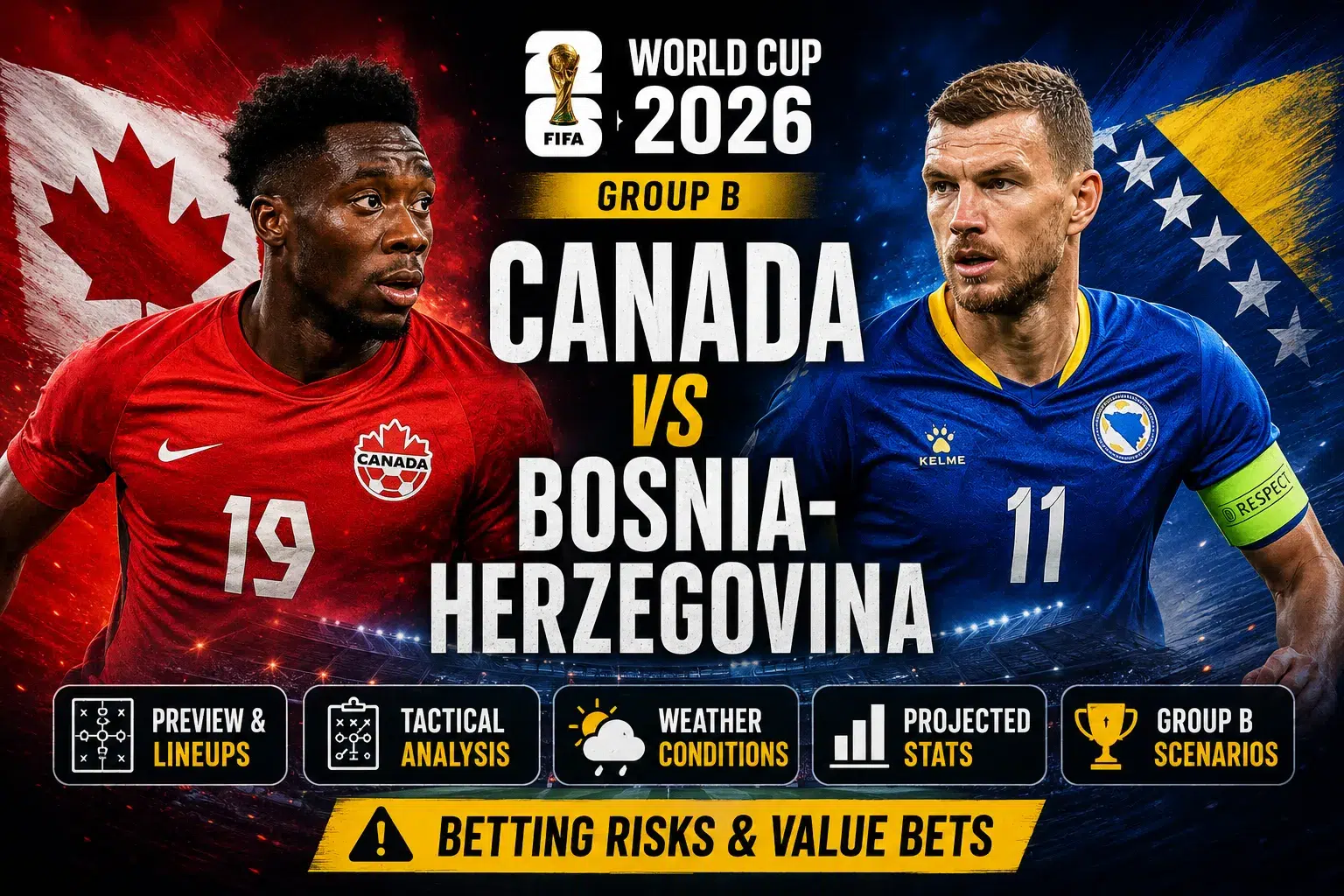
Canada face Bosnia-Herzegovina in a FIFA World Cup 2026 Group B match at Toronto Stadium in Toronto, Canada, on Friday, 12 June 2026. Kick-off is scheduled for 3 p.m. local time. This is Canada’s first men’s World Cup match on home soil, so the fixture carries national, sporting and psychological weight beyond the normal value of a group-stage opener. Group B includes Canada, Bosnia-Herzegovina, Qatar and Switzerland, which means every point matters immediately in a format where the top two teams in each group and the best third-placed teams can advance to the Round of 32.
Canada enter with home advantage, crowd energy and a fast attacking core led by Jonathan David, Tani Oluwaseyi and Tajon Buchanan. Jesse Marsch’s team must manage injuries to key players, including Alphonso Davies and Marcelo Flores, and must avoid letting the occasion become bigger than the football. Bosnia-Herzegovina enter with tournament experience through Edin Dzeko and Sead Kolasinac, but Dzeko starts on the bench in the announced lineup. Sergej Barbarez’s side should rely on defensive structure, midfield physicality, set pieces and selective attacks through Ermedin Demirovic, Esmir Bajraktarevic and Jovo Lukic.
The projected match profile points to Canada possession pressure, Bosnia defensive resistance, medium card risk, and strong sensitivity to the first goal. This preview explains official match facts, team news, announced lineups, tactical patterns, weather context, projected statistics, betting market risks and forecast uncertainty. It does not provide guaranteed betting advice.
| Field | Data |
|---|---|
| Match | Canada vs Bosnia-Herzegovina |
| Competition | FIFA World Cup 2026 |
| Stage | Group Stage |
| Group | Group B |
| Date | Friday, 12 June 2026 |
| Kick-off Time | 3 p.m. Toronto local time |
| Stadium | Toronto Stadium |
| City | Toronto |
| Host Country | Canada |
| Expected Attendance | Not available from verified public data in the source set |
| Referee | Not available from verified public data in the source set |
| VAR | Not available from verified public data in the source set |
| Weather Forecast | Mainly pleasant afternoon conditions, approximately 25°C; broader daily range around 13.6–27.0°C |
| Pitch Context | Tournament venue surface; exact match-day pitch speed not available from verified public data |
| Main Article Focus | Pre-match probability dossier, lineups, tactics, weather, projected stats, betting risks, Group B scenarios |
Canada vs Bosnia-Herzegovina is a landmark fixture for Canadian football. It is not only a World Cup group-stage match. It is the first men’s World Cup match played by Canada on Canadian soil. That creates a rare combination: home advantage, national expectation, emotional pressure and tactical uncertainty.
Canada arrive with speed, youth, pressing energy and attacking talent. They also arrive with injuries that change the balance of the team. Alphonso Davies is unavailable for the opener. Marcelo Flores is ruled out of the tournament. Moise Bombito’s physical status is a concern. These absences matter because Canada’s best version depends on speed, defensive recovery and vertical attacks.
Bosnia-Herzegovina arrive with a different profile. They are not hosts. They do not carry the same public pressure. They can treat the match as a chance to frustrate Canada and turn the emotional weight against the home team. Their lineup places Edin Dzeko on the bench, which changes the pre-match expectation. It suggests that Bosnia may begin with a more mobile structure before using Dzeko’s experience later if the game state demands it.
The match should be read through three lenses: Canada’s home pressure, Bosnia’s defensive maturity, and the effect of the first goal.
Canada vs Bosnia-Herzegovina matters because Canada need a home-opening result to build their first real World Cup momentum, while Bosnia can damage the host narrative with a structured defensive performance, making Canada’s attacking speed against Bosnia’s compact block the key pre-match battleground.
A serious preview must separate confirmed facts from projections. This matters more for a World Cup opener because team news, official lineups, referee appointments, weather, crowd pressure and early match state can change the final shape of the match.
| Category | Status | Canada vs Bosnia-Herzegovina Example | Article Use |
|---|---|---|---|
| Confirmed fact | Verified before publication | Canada vs Bosnia-Herzegovina, Group B, Toronto Stadium, Friday match | Hard match base |
| Tournament fact | Verified by tournament context | Group B includes Canada, Bosnia-Herzegovina, Qatar and Switzerland | Group scenario analysis |
| Announced information | Available before kick-off | Starting lineups were reported before the match | Used as lineup fact |
| Team-news report | Verified media reporting | Davies and Flores unavailable; Bombito concern | Availability analysis |
| Probable information | Tactical forecast | Canada likely press and attack vertically; Bosnia likely defend compactly | Tactical sections |
| Projected data | Model-based estimate | Possession range, shot range, xG range, card range | Ranges only |
| Unknown data | Not verified in source set | Referee, VAR, exact attendance | Marked unavailable |
| Scenario-based analysis | Possible future pattern | Bosnia may use Dzeko later if chasing or seeking aerial presence | Written as forecast, not fact |
This distinction protects reader trust. A predicted shot range is not a final stat. A betting market signal is not a guaranteed result. A player’s role can change when the first goal arrives. A tactical plan can collapse after one early booking. A weather forecast can shift by kick-off.
The article uses careful language. It says “projected,” “likely,” “possible,” “watch for” and “risk increases.” It does not say that a specific goal, card, injury or VAR decision will happen. That is the correct editorial method for a pre-match dossier.
Group B has four different profiles. Canada are co-hosts and carry emotional pressure. Bosnia-Herzegovina bring veteran experience and a hard qualification story. Qatar bring tournament experience from hosting 2022. Switzerland bring consistency and European tournament structure.
| Team | Pre-Match Points | Goal Difference | Opening-Match Pressure | Main Need |
|---|---|---|---|---|
| Canada | 0 | 0 | Very high | Start with points at home |
| Bosnia-Herzegovina | 0 | 0 | Medium-high | Avoid defeat or steal a win |
| Qatar | 0 | 0 | Medium | Stay alive in a balanced group |
| Switzerland | 0 | 0 | Medium/high | Control the group through consistency |
The 2026 World Cup format changes how teams read the first match. A draw is not useless. A narrow defeat is not fatal. But goal difference can matter if third-place ranking decides qualification. That makes emotional control important. Canada cannot chase the opener as if it is a final. Bosnia cannot accept a heavy defeat while chasing a late equalizer.
Canada need this match for identity. Their previous men’s World Cup history has been painful. They have searched for a first World Cup point and a first true tournament foothold. Playing on home soil gives the team a rare chance to turn national attention into football progress.
But home pressure has danger. A crowd can push a team forward too early. Players can rush final balls. Full-backs can overcommit. Midfielders can foul after turnovers. Attackers can force shots from poor positions.
Canada need to turn emotion into structure.
Their main objectives:
Bosnia-Herzegovina can treat this match as a pressure-transfer opportunity. Canada carry the stadium and national expectation. Bosnia can use that against them. The longer the match remains level, the more the pressure can shift from the underdog to the host.
Bosnia’s path does not require 60% possession. It requires defensive compactness, controlled exits, set pieces and selective attacks. If Bosnia frustrate Canada for 30–45 minutes, the crowd dynamic can change. Canada may become less patient. Bosnia can then find set-piece or transition moments.
The decision to start Edin Dzeko on the bench changes the opening plan. Bosnia may begin with more mobility and use Dzeko later as a game-state weapon. That can work if Bosnia stay close. It becomes less useful if Canada build a strong early lead.
| Result | Canada Impact | Bosnia-Herzegovina Impact | Group B Meaning |
|---|---|---|---|
| Canada win | Canada get historic momentum and reduce pressure before match two | Bosnia must recover quickly | Host narrative strengthens |
| Draw | Canada gain a first platform but may feel frustration at home | Bosnia earn a valuable away-style group point | Group remains open |
| Bosnia-Herzegovina win | Canada face immediate national scrutiny | Bosnia become serious Round of 32 contenders | Group hierarchy shifts early |
Canada have two kinds of pressure: opportunity and expectation. The opportunity is huge because a home World Cup match can shift the sport’s place in national culture. The expectation is dangerous because the crowd may treat Bosnia as a match Canada should win.
Bosnia have different pressure. They return with a squad that mixes veterans and younger players. They can compete with less emotional burden. Their main psychological challenge is the stadium. If they handle the first 20 minutes, they can grow into the match.
| Factor | Match Relevance |
|---|---|
| Host country | Canada |
| Home-nation edge | Canada receive crowd and familiarity advantage |
| Historical importance | First men’s World Cup match for Canada on home soil |
| Travel context | Bosnia must manage travel and time-zone adjustment |
| Local pressure | Canada carry national expectation |
| Crowd profile | Likely heavily pro-Canada |
| Cultural event layer | Opening ceremony and national attention can increase emotional load |
Canada have the clearest emotional advantage. The crowd can create pressure on Bosnia’s defensive line. It can also raise the tempo of Canada’s press. But crowd emotion must be controlled. If Canada attack too quickly or foul after turnovers, the advantage can become chaos.
Bosnia must manage the stadium by slowing the game at the correct moments. That does not mean time-wasting. It means calm restarts, simple passes, organized clearances and controlled body language.
| City Factor | Expected Tactical Impact |
|---|---|
| Afternoon kickoff | Warm but manageable conditions |
| Temperature around 25°C | Requires hydration and pacing but not extreme heat management |
| Thunderstorm risk earlier in day | Could affect surface if rain occurred before match |
| Urban stadium setting | Strong event atmosphere and travel complexity |
| No major altitude factor | Sprint recovery not altitude-sensitive |
| Home crowd | Can affect communication and emotional rhythm |
| Local familiarity | Canada understand the environment better |
Toronto does not create the same altitude issue as Mexico City. The physical model is different. The issue is not thin air. The issue is match tempo, weather changes earlier in the day, afternoon warmth and emotional load.
If the surface is dry and fast, Canada’s vertical attacks can benefit. If earlier rain leaves the surface slick, passing speed can increase but footing can become more complicated. Exact pitch condition must be confirmed near kick-off.
| Stadium Detail | Data |
|---|---|
| Stadium | Toronto Stadium |
| City | Toronto |
| Country | Canada |
| Venue Area | Exhibition Place area |
| Match Role | Canada’s home World Cup opener |
| Expected Atmosphere | Strongly pro-Canada |
| Surface | Exact match-day pitch speed not available from verified public data |
| Roof | Not treated as a closed-roof match in this preview |
| Tactical Impact | Crowd noise, home pressure, possible fast surface, warm afternoon |
| Weather / Environment Factor | Tactical Meaning |
|---|---|
| Afternoon around 25°C | Pressing must be timed and hydrated |
| Earlier thunderstorm risk | Pitch could be slick if rain affected surface |
| No altitude concern | Teams can maintain normal sprint model |
| Home crowd | Canada may start fast; Bosnia must communicate clearly |
| Warm conditions | Late-game fatigue can appear after repeated transitions |
| Possible changing surface | Goalkeepers and defenders must handle ball speed |
The most important weather factor is not extreme heat. It is the combination of warm afternoon conditions and possible surface change after earlier weather risk. Canada want speed. Bosnia want control. Any surface that increases ball speed can help Canada’s vertical game but also increase turnover risk.
Canada’s team news contains major absences and role changes. Alphonso Davies is unavailable for the opener. Marcelo Flores is ruled out after injury. Moise Bombito’s recovery had become a concern before the match. Maxime Crepeau starts in goal. Stephen Eustaquio captains the side. Jonathan David and Tani Oluwaseyi lead the attack.
| Player | Status | Tactical Impact |
|---|---|---|
| Alphonso Davies | Out for opener | Removes elite left-side speed, recovery and ball progression |
| Marcelo Flores | Ruled out of tournament | Reduces attacking midfield depth |
| Moise Bombito | Recovery concern before opener | Reduces defensive speed and depth if unavailable |
| Maxime Crepeau | Announced starter | Provides experienced goalkeeping presence |
| Stephen Eustaquio | Captain | Midfield control and leadership |
| Jonathan David | Announced starter | Main striker and scoring reference |
| Tani Oluwaseyi | Announced starter | Vertical forward and pressing energy |
| Tajon Buchanan | Announced starter | Wide speed and direct attacking threat |
| Ismael Kone | Announced starter | Ball carrying and midfield power |
| Liam Millar | Announced starter | Wide balance and pressing support |
Davies’ absence matters most because he changes two phases at once. He gives elite ball progression and defensive recovery. Without him, Canada must create width and recovery through collective structure rather than one superstar profile.
Flores’ absence reduces creative depth. Bombito’s concern affects defensive recovery. Canada still have enough attacking quality to threaten Bosnia, but the injuries reduce margin for error.
Bosnia’s headline decision is Edin Dzeko starting on the bench. That is not a small detail. Dzeko is Bosnia’s all-time leading scorer and one of the major veterans in the squad. Starting without him suggests that Bosnia may begin with more mobility, then use Dzeko later if they need aerial presence, penalty-box control or experience.
| Player | Status | Tactical Impact |
|---|---|---|
| Edin Dzeko | Substitute in announced lineup | Late aerial and experience weapon |
| Sead Kolasinac | Announced starter | Defensive leadership and physical presence |
| Nikola Vasilj | Announced starter | Goalkeeper under likely Canada pressure |
| Ermedin Demirovic | Announced starter | Forward link and attacking pressure |
| Jovo Lukic | Announced starter | Penalty-box and forward role |
| Esmir Bajraktarevic | Announced starter | Creative / wide attacking outlet |
| Amar Dedic | Announced starter | Full-back / wide defensive role |
| Benjamin Tahirovic | Announced starter | Midfield structure and ball progression |
| Nikola Katic | Announced starter | Centre-back and aerial defender |
| Tarik Muharemovic | Announced starter | Defensive role |
Bosnia’s plan likely starts with structure. They have enough defensive and midfield presence to frustrate Canada. The Dzeko bench role creates a game-state card. If Bosnia need a goal, he can enter and change the box profile. If Bosnia lead, his use may depend on whether Barbarez wants hold-up play or defensive work from the front.
| Player | Team | Issue | Match Impact |
|---|---|---|---|
| Alphonso Davies | Canada | Hamstring injury | Out for opener; removes elite left-side weapon |
| Marcelo Flores | Canada | Knee injury | Tournament absence; reduces creative depth |
| Moise Bombito | Canada | Recovery concern | Defensive speed/depth concern |
| Other Canada players | Canada | Not available from verified public data | Do not invent |
| Bosnia players | Bosnia-Herzegovina | Not available from verified public data | Do not invent |
No verified suspension issue was available from the source set. Card risk is analyzed as match forecast, not as confirmed suspension data.
Because lineups were reported before the match, this section uses announced lineups rather than speculative predicted XIs.
| Position / Line | Player | Likely Role |
|---|---|---|
| GK | Maxime Crepeau | Goalkeeper, distribution starter, experienced organizer |
| DEF | Alistair Johnston | Right-back / right-sided defender |
| DEF | Luc De Fougerolles | Centre-back / defensive support |
| DEF | Derek Cornelius | Centre-back |
| DEF | Richie Laryea | Left-back / wing-back style runner |
| MID | Stephen Eustaquio | Captain, midfield controller |
| MID | Ismael Kone | Ball carrier and duel midfielder |
| MID | Liam Millar | Wide midfielder / pressing support |
| ATT | Tajon Buchanan | Wide attacker, transition runner |
| ATT | Jonathan David | Central striker / finishing reference |
| ATT | Tani Oluwaseyi | Forward runner / pressing attacker |
| Position / Line | Player | Likely Role |
|---|---|---|
| GK | Nikola Vasilj | Goalkeeper |
| DEF | Tarik Muharemovic | Defender |
| DEF | Sead Kolasinac | Defensive leader |
| DEF | Amar Dedic | Full-back / wide defender |
| DEF | Nikola Katic | Centre-back / aerial defender |
| MID | Benjamin Tahirovic | Midfielder |
| MID | Ivan Basic | Midfielder |
| MID / ATT | Amar Memic | Wide / support role |
| ATT | Ermedin Demirovic | Forward / link attacker |
| ATT | Esmir Bajraktarevic | Creative / wide attacker |
| ATT | Jovo Lukic | Forward / penalty-box role |
| Team | Base Formation | In Possession | Out of Possession | Confidence |
|---|---|---|---|---|
| Canada | 4-3-3 / 4-2-3-1 variant | 2-3-5 or 3-2-5 depending on full-back height | 4-4-2 or 4-1-4-1 press | Medium |
| Bosnia-Herzegovina | 4-3-3 / 4-2-3-1 / compact hybrid | 2-3-5 in controlled build-up, more direct under pressure | 4-5-1 or 4-4-2 compact block | Medium |
| Scenario | Trigger | Expected Change |
|---|---|---|
| Canada need more control | Bosnia win midfield second balls | Extra midfield stabilizer or deeper Eustaquio role |
| Canada need more width | Bosnia defend narrow | More aggressive Laryea or Buchanan positioning |
| Canada chase goal | Level or trailing after 60’ | Cyle Larin or another attacking option may become important |
| Bosnia need aerial presence | Trailing or chasing late | Edin Dzeko can enter as box target |
| Bosnia protect result | Leading after 70’ | Extra defensive midfielder or deeper block |
| Bosnia need counter speed | Canada push full-backs high | Use Bajraktarevic/Demirovic outlets |
The central tactical note is clear: Canada start with mobility and speed; Bosnia hold Dzeko as a late experience and aerial option.
| Phase | Expected Pattern |
|---|---|
| Build-up | Crepeau plus centre-backs, Eustaquio as connector |
| Attack | Direct runs, wide speed, David central movement, Buchanan 1v1 threat |
| Defense | Aggressive press in bursts, rest defense behind full-backs |
| Transitions | Fast release to Buchanan, David and Oluwaseyi |
| Set pieces | David, Cornelius and central runners as targets |
| Weakness | Space behind full-backs, Davies absence, emotional home pressure |
Canada should build with Eustaquio as the key rhythm player. Crepeau can start attacks through centre-backs or wider defenders. Cornelius and De Fougerolles must make clean early decisions because Bosnia can press selectively and then retreat.
Canada should not overplay near their box. Bosnia do not need many high turnovers to create danger. Canada’s build-up must be clean, but not slow. The team’s best attacking qualities come after the first line is broken.
Ismael Kone can carry the ball through midfield. That matters because Bosnia may try to lock central passing lanes. A strong carry can break the block and force Bosnia to foul or retreat.
Canada’s attack should use three direct routes:
Without Davies, Canada lose a major left-side progression weapon. That places more responsibility on Laryea, Millar, Kone and Buchanan to create width and speed.
Canada should avoid predictable crossing. Bosnia have size and experience. If Canada send early crosses from poor positions, Bosnia can defend first contact. Canada need cutbacks, quick combinations and runs behind defenders.
Canada’s defensive challenge is transition control. The team may push forward because of home pressure. That can create space behind full-backs. Bosnia can attack through Demirovic, Bajraktarevic or later Dzeko.
Canada must stop the first forward pass after losing the ball. Eustaquio and Kone need strong counter-pressing positions. Centre-backs must avoid stepping out too aggressively if there is no cover.
Canada should avoid cheap fouls in wide zones. Bosnia can use set pieces to reduce Canada’s open-play advantage.
| Phase | Expected Pattern |
|---|---|
| Build-up | Mixed, with Vasilj and defenders using direct exits under pressure |
| Attack | Set pieces, direct passes, second balls, selective counters |
| Defense | Compact block, physical duels, protection of central lanes |
| Transitions | Fast outlet through Demirovic, Bajraktarevic or Lukic |
| Set pieces | Kolasinac, Katic and potential Dzeko threat if introduced |
| Weakness | Defending Canadian speed, wide isolation, late fatigue |
Bosnia should not force short passing if Canada press aggressively. They can build short when Canada sit off, but direct exits may be safer under pressure. Vasilj can look for longer distribution. Midfielders must position for second balls.
Tahirovic and Basic need to provide enough control to avoid constant defending. If Bosnia only clear the ball, Canada can recycle attacks. If Bosnia connect two or three passes after recovery, they can slow the match and reduce Canada’s pressure.
Bosnia’s attack should be selective. They may create fewer open-play sequences, but they can create important moments from:
The decision to bench Dzeko means Bosnia may start with more mobility. The risk is reduced box presence. If they cannot hold the ball up, Canada can keep attacking waves alive.
Bosnia need compact defending. The central zones must stay protected. Canada’s speed can be dangerous if defenders step out alone. The full-backs must receive support against Buchanan, Millar and overlapping runs.
Bosnia’s best defensive plan is not pure low block. A pure low block may invite too much Canada pressure. The better plan is a compact mid-block with selective pressing triggers.
| Zone | Canada Edge | Bosnia-Herzegovina Edge | Likely Control | Why It Matters |
|---|---|---|---|---|
| Canada right flank | Buchanan speed and Johnston support | Kolasinac / defensive cover | Canada speed edge | Creates 1v1 and crossing chances |
| Canada left flank | Laryea running, Millar support | Dedic/Memic side coverage | Balanced | Davies absence makes this side important |
| Central midfield | Eustaquio and Kone mobility | Tahirovic and Basic physicality | Split | Decides tempo and second balls |
| Penalty box | David movement, Oluwaseyi pressure | Katic, Kolasinac, Vasilj, possible Dzeko later | Balanced | Decides chance quality |
| Set pieces | Canada delivery and runners | Bosnia height and experience | Bosnia slight edge | Main Bosnia scoring route |
| Transitions | Canada speed | Bosnia direct outlets | Canada in attack, Bosnia in counter-threat | Can decide first goal |
| Defensive third | Canada must manage space | Bosnia likely defend more | Bosnia under pressure | Concentration test |
David is Canada’s main scoring reference. He does not need constant touches, but he needs useful touches. Bosnia must prevent him from receiving between centre-backs and midfield. If David receives facing goal, Canada’s attack becomes more dangerous.
What to watch: David’s first-touch location. If he receives inside the box or in the half-space, Canada are creating quality. If he receives far from goal with his back turned, Bosnia are controlling him.
Risk trigger: A Bosnia centre-back yellow card can make defending David harder.
Buchanan can attack defenders with speed. Canada may use him to create the first defensive imbalance. Bosnia need help from midfield and full-back support.
What to watch: Whether Buchanan receives isolated 1v1. If he does, Canada’s crossing and cutback potential rises.
Risk trigger: If Bosnia’s wide defender gets booked early, Canada can target that flank.
Eustaquio can control Canada’s rhythm. Tahirovic can disrupt Bosnia’s midfield pressure and connect forward. This duel can decide whether Canada dominate possession or Bosnia slow the match.
What to watch: Which player controls the second pass after a turnover.
Risk trigger: If Eustaquio is pressed out of rhythm, Canada may become too direct.
Crepeau’s command matters because Bosnia can create set-piece stress. Canada may not face many open-play shots, but goalkeeper decisions on corners and free kicks can matter.
What to watch: Crepeau’s starting position, communication and handling under traffic.
Risk trigger: A foul near the box gives Bosnia a high-value chance without needing open-play control.
Dzeko starts on the bench, but his role can still shape the match. If Bosnia trail or need a target, he can enter and change the box dynamic.
What to watch: Whether Bosnia stay close enough to make Dzeko a meaningful late weapon.
Risk trigger: If Canada defend deep late, Dzeko’s aerial and hold-up value rises.
These are projected ranges, not confirmed match data.
| Projected Stat | Canada | Bosnia-Herzegovina | Confidence | Reason |
|---|---|---|---|---|
| Possession | 53–60% | 40–47% | Medium | Canada should control more ball at home |
| Shots | 11–16 | 7–11 | Medium | Canada likely produce more attacking volume |
| Shots on Target | 4–6 | 2–4 | Medium | Bosnia can limit central chances |
| xG Range | 1.20–1.90 | 0.70–1.30 | Low/Medium | First goal and set pieces can change profile |
| Big Chances | 1–3 | 0–2 | Low/Medium | Canada volume edge, Bosnia set-piece route |
| Corners | 5–8 | 3–5 | Medium | Canada wide pressure may create blocks |
| Fouls | 10–14 | 12–17 | Medium | Bosnia may defend speed with contact |
| Yellow Cards | 1–3 | 2–4 | Low/Medium | Referee unknown |
| Red Card Risk | Low | Low/Medium | Low | Transition fouls and late pressure create risk |
| Offsides | 1–3 | 1–2 | Low | Canada’s runs behind can trigger offsides |
| Saves | 2–4 | 3–6 | Medium | Vasilj may face more shot volume |
| Crosses | 16–24 | 12–18 | Medium | Canada likely use width, Bosnia use set pieces |
| Tackles | 15–21 | 18–25 | Medium | Bosnia likely defend more duels |
| Interceptions | 8–13 | 10–16 | Medium | Bosnia block can intercept central passes |
| Clearances | 14–22 | 22–32 | Medium | Bosnia may defend deeper for periods |
Canada should lead possession, shot volume and territorial pressure. Bosnia should try to keep Canada’s chance quality lower than their possession suggests. The key number is not possession. The key number is central xG.
Canada’s best statistical route is a mix of cutbacks, box entries and fast transitions. Bosnia’s best statistical route is set-piece xG and selective counters.
If Canada only create crosses from deep positions, Bosnia can survive. If Canada create cutbacks and central shots for David, the match tilts strongly toward the host.
This table does not predict exact events. It outlines likely match windows and risk changes.
| Match Window | Tactical State | Physical State | Card Risk | Goal Risk | Betting Market Trigger |
|---|---|---|---|---|---|
| 1’–15’ | Canada likely start fast; Bosnia test composure | Fresh legs, high emotion | Low/Medium | Medium | Early Canada pressure, first Bosnia set piece |
| 16’–30’ | Bosnia block shape becomes clearer | Contact increases | Medium | Medium | Wide duels, Canadian corners |
| 31’–45+’ | Canada may push if no goal; Bosnia can slow rhythm | First fatigue signs | Medium/High | Medium | Late first-half pressure |
| 46’–60’ | Coaches adjust from first-half evidence | Reset intensity | Medium | Medium | Substitution preparation |
| 61’–75’ | Space can open; Dzeko/Larin-type bench roles matter | Fatigue grows | High | Medium/High | Live totals, cards, attacking subs |
| 76’–90+’ | Game state dominates | Cramps and time management possible | High | High | Late goal pressure, set pieces |
Canada may start with adrenaline. The crowd will push them forward. The danger is rushing. The first 15 minutes should establish territorial control, not chaos.
Bosnia must survive the opening energy. They need clean clearances, calm restarts and visible forward outlets.
The match pattern becomes clearer. If Canada repeatedly isolate Buchanan or David, Bosnia have a problem. If Bosnia slow Canada and win set pieces, the match becomes more balanced.
If the score remains level, pressure can shift toward Canada. Bosnia can use this window to slow the game, defend set pieces and look for one counter.
Coaching adjustments matter. Canada may change wide spacing or add more central presence. Bosnia may decide whether to keep Dzeko on the bench or prepare a different attacking profile.
This is a high-value substitution window. Canada may add finishing power. Bosnia may add experience or aerial presence. Cards and fatigue can rise.
Game state rules everything. Canada leading means control and discipline. Canada level means pressure and risk. Bosnia leading means box defense and time management. Bosnia trailing means set pieces and Dzeko-type aerial routes.
| Factor | Expected Impact | Canada Effect | Bosnia-Herzegovina Effect |
|---|---|---|---|
| Warm afternoon | Requires pacing and hydration | Pressing must be timed | Defensive shifting can tire |
| Around 25°C | Manageable but relevant | Supports high tempo if managed | Requires controlled blocks |
| Earlier thunderstorm risk | Possible surface effect | Faster ball can help attacks | Slick surface can affect clearances |
| No altitude concern | Normal sprint recovery model | Helps pressing plan | Helps defensive recovery |
| Home crowd | Emotional tempo increase | Advantage and pressure | Communication challenge |
| Pitch speed unknown | Final check needed | Affects passing and cutbacks | Affects defensive control |
The most important weather factor is surface condition after earlier weather risk. If the pitch is slick, Canada’s fast attacks and cutbacks can become more dangerous, but turnovers can also increase. If the surface is dry and stable, Canada can still play fast, while Bosnia can defend with more predictable footing.
| Player | Team | Role | Impact Score /10 | Why |
|---|---|---|---|---|
| Jonathan David | Canada | Striker | 8.8 | Main scoring reference and central threat |
| Tajon Buchanan | Canada | Wide attacker | 8.4 | Can create 1v1s and transition danger |
| Stephen Eustaquio | Canada | Captain / midfielder | 8.3 | Controls rhythm and rest defense |
| Ismael Kone | Canada | Midfield carrier | 8.0 | Breaks pressure with carries |
| Maxime Crepeau | Canada | Goalkeeper | 7.9 | Must command box and manage set pieces |
| Tani Oluwaseyi | Canada | Forward runner | 7.8 | Adds depth and pressing energy |
| Richie Laryea | Canada | Wide defender / runner | 7.7 | Important without Davies |
| Edin Dzeko | Bosnia-Herzegovina | Bench striker / veteran | 8.5 | Can change late box profile if introduced |
| Sead Kolasinac | Bosnia-Herzegovina | Defensive leader | 8.3 | Physical presence and experience |
| Ermedin Demirovic | Bosnia-Herzegovina | Forward link | 8.1 | Key open-play outlet |
| Esmir Bajraktarevic | Bosnia-Herzegovina | Creative outlet | 7.9 | Can attack space and carry counters |
| Benjamin Tahirovic | Bosnia-Herzegovina | Midfielder | 7.8 | Helps Bosnia escape pressure |
| Nikola Vasilj | Bosnia-Herzegovina | Goalkeeper | 7.8 | Likely faces Canadian pressure |
Jonathan David is the most important attacker because Canada need a penalty-box reference. He must receive useful service, not just chase hopeful crosses.
Sead Kolasinac is Bosnia’s most important defensive figure because he provides experience and physical authority against Canada’s speed and home pressure.
Stephen Eustaquio is the most important midfielder because Canada need rhythm and emotional control. His passing tempo can prevent Canada from rushing.
Edin Dzeko can change Bosnia’s late attacking profile. If Bosnia need a goal or need to hold the ball higher, his experience and aerial presence can matter.
The referee and VAR were not available from verified public data in the source set used for this article. Therefore, the discipline section uses tactical logic rather than referee-history claims.
| Discipline Factor | Forecast |
|---|---|
| Referee style | Not available from verified public data |
| Tactical foul risk | Medium/high |
| Dissent risk | Medium due to home crowd pressure |
| VAR intervention risk | Medium |
| Penalty risk | Medium |
| Red-card risk | Low/medium |
| Team | Yellow Card Range | Red Card Risk | Main Risk Zone |
|---|---|---|---|
| Canada | 1–3 | Low | Counter-fouls after turnovers |
| Bosnia-Herzegovina | 2–4 | Low/medium | Wide duels against Buchanan and David support runs |
Bosnia may carry higher yellow-card risk because they will likely defend more speed-based attacks. Canada’s risk appears after turnovers. If Canada overcommit, they may need tactical fouls to stop counters.
The match’s card risk rises if:
Set pieces can decide this match. Canada may create more open-play pressure. Bosnia may create high-value dead-ball moments. The difference matters.
| Set-Piece Area | Canada | Bosnia-Herzegovina | Edge |
|---|---|---|---|
| Corners for | David, Cornelius, central runners | Kolasinac, Katic, Dzeko if introduced | Balanced |
| Corners against | Must defend height and physicality | Must defend Canada movement | Bosnia slight aerial edge |
| Wide free kicks | Canada delivery and runners | Bosnia aerial targets | Bosnia edge |
| Direct free kicks | Not available from verified public data | Not available from verified public data | Unknown |
| Penalties | Taker hierarchy not verified | Taker hierarchy not verified | Unknown |
| Long throws | Not available from verified public data | Not available from verified public data | Unknown |
| Second balls | Kone and Eustaquio important | Bosnia physical midfield important | Balanced |
Canada must avoid fouls near the box. Bosnia can use set pieces to reduce Canada’s speed advantage. Canada can use corners as pressure tools, but they must defend the counter after clearances.
If Dzeko enters, Bosnia’s set-piece threat increases. Canada should adjust marking before the first delivery, not after a chance.
| Area | Canada | Bosnia-Herzegovina |
|---|---|---|
| Goalkeeper distribution | Crepeau supports controlled build-up | Vasilj may face pressure and go long |
| Shot-stopping pressure | Medium | Medium/high |
| Cross handling | High because Bosnia may use set pieces | Medium/high because Canada may use wide attacks |
| High-line risk | Space behind full-backs | Space behind full-backs against Canada speed |
| Penalty-box defending | Must defend Dzeko/Demirovic/Katic routes | Must track David and runners |
| Back-post weakness | Possible if wide defender loses runner | Possible against Canada switches |
| Communication | Home crowd helps Canada but creates noise | Crowd noise can disrupt Bosnia |
Crepeau’s main risk is set-piece command. He may not face constant open-play shots, but Bosnia can create dangerous dead-ball moments.
Vasilj’s main risk is volume. Canada may create more shots and crosses. He must handle pressure without giving rebounds.
Canada’s defensive risk is transition space. Bosnia’s defensive risk is speed and repeated pressure.
Substitutions are scenario-based and should not be treated as exact predictions.
| Minute Window | Canada Possible Change | Bosnia Possible Change | Trigger |
|---|---|---|---|
| 45’–60’ | Add control or adjust wide attack | Add midfield support | First-half imbalance |
| 60’–75’ | Add finishing presence, fresh runner or Cyle Larin-type profile | Add Dzeko or extra aerial option | Score pressure |
| 75’–90’ | Protect lead or chase winner | Defend result or load box | Game state |
Canada should protect central transitions and avoid needless fouls. They can keep speed high enough to stop Bosnia from pushing everyone forward.
Bosnia may defend deeper and use Dzeko or another outlet to hold the ball. Canada must avoid emotional crossing and keep creating quality.
Both teams face a risk decision. Canada may feel pressure to win at home. Bosnia may consider a draw useful. Substitution choices will show each coach’s appetite for risk.
This section explains market behavior. It does not provide guaranteed picks.
| Market | Current Signal | Main Risk |
|---|---|---|
| Match Winner | Canada may be favored by home advantage | Injuries reduce certainty |
| Double Chance | Canada or draw may look safer | Low price may not match volatility |
| Over/Under Goals | Moderate total profile | First goal can change match shape |
| Both Teams to Score | Plausible | Bosnia open-play volume may be limited |
| Corners | Canada corner volume may rise | Early goal can change volume |
| Cards | Medium risk | Referee unknown |
| Player Shots | David likely watchlist name | Service quality matters |
| Player Cards | Bosnia defenders vs Canada speed | Referee threshold unknown |
| Trigger | Possible Market Effect |
|---|---|
| Davies absence already priced in | Limits Canada’s upside expectation |
| Bombito status update | Affects Canada defensive risk |
| Dzeko bench confirmation | Changes Bosnia scoring and aerial profile |
| Weather shift | Affects total goals and crossing markets |
| Referee announcement | Affects cards and penalty markets |
| Canada-heavy public money | Can compress home favorite price |
| Official lineups | Moves player shots, corners and match winner markets |
| Trigger | Meaning | Risk |
|---|---|---|
| Canada dominate early corners | Territorial pressure | Does not guarantee chance quality |
| Bosnia win repeated set pieces | Underdog threat rises | Set pieces can be low volume |
| David isolated | Canada attack lacks support | One chance can still change game |
| Dzeko enters | Bosnia box profile changes | Role depends on game state |
| 0-0 after 60’ | Pressure shifts toward Canada | Bosnia fatigue can still rise |
| Early yellow to Bosnia defender | Canada speed route improves | Referee threshold can change |
Responsible betting note: This preview explains match data and market behavior. It does not provide guaranteed betting advice. World Cup betting involves risk. Readers should check local gambling laws, use licensed operators, set limits and avoid chasing losses.
| Factor | How It Can Break the Forecast |
|---|---|
| Late lineup change | Changes formations, roles and set-piece matchups |
| Early goal | Forces one team to abandon the base plan |
| Early yellow card | Changes wide duels and transition defending |
| Injury | Forces tactical reshuffle |
| VAR penalty | Creates non-pattern goal |
| Weather shift | Alters ball speed, fatigue and crossing quality |
| Red card | Makes pre-match stats less relevant |
| Goalkeeper error | Creates low-probability swing |
| Tactical surprise | Breaks projected matchup assumptions |
| Market overreaction | Creates false betting signal |
The prediction can fail if Canada’s home pressure turns into rushed attacking. It can also fail if Bosnia’s set-piece threat becomes more efficient than projected. One foul, one corner, one Dzeko involvement or one goalkeeper error can change the match.
| Scenario | Probability Band | Match Story |
|---|---|---|
| Canada narrow win | Medium/high | Canada use home pressure and speed to create enough chances |
| Draw | Medium | Bosnia defend compactly and slow Canada’s rhythm |
| Bosnia-Herzegovina upset | Low/medium | Bosnia score first through set piece or transition and defend well |
| High-scoring match | Low/medium | Early goal opens space and forces both teams to attack |
| Low-scoring match | Medium/high | Canada control ball but chance quality stays limited |
The safest scenario frame is a tight Canada-favored match. Canada have home advantage and attacking speed. Bosnia have enough structure and experience to make the game uncomfortable.
| Result | Canada Impact | Bosnia-Herzegovina Impact |
|---|---|---|
| Canada win | Canada gain historic momentum and Group B control | Bosnia need response in match two |
| Draw | Canada earn a platform but face home frustration | Bosnia gain a useful point |
| Bosnia-Herzegovina win | Canada enter immediate pressure cycle | Bosnia become serious qualification contenders |
A draw can still be useful in the 48-team format. A heavy defeat is more damaging than a narrow defeat because third-place qualification can depend on goal difference.
| Data Point | Status | Preferred Source Type |
|---|---|---|
| Match date | Confirmed | FIFA / verified match reporting |
| Stadium | Confirmed | FIFA / verified match reporting |
| City | Confirmed | FIFA / local reporting |
| Group | Confirmed | FIFA / tournament coverage |
| Coaches | Confirmed in verified reporting | Match previews / federation data |
| Referee | Not available from verified public data | FIFA match centre |
| VAR | Not available from verified public data | FIFA match centre |
| Weather | Forecast / historical match-day data | Weather source |
| Lineups | Announced before kick-off | Reuters / official team sheets |
| Injuries | Reported | Reuters / federation reports |
| Odds | Dynamic | Licensed market data |
| Projected stats | Model-based estimate | Editorial forecast |
| Minute-window scenarios | Scenario forecast only | Editorial model |
This article uses confirmed facts where available and marks unavailable information clearly. It does not invent referee data, VAR data, attendance, injuries or betting odds.
This preview is analytical and informational. It is not a guarantee of the final result. Football includes randomness and low-probability events. Final lineups, injuries, referee decisions, VAR, weather and early goals can change the match.
Projected statistics, scoreline scenarios and betting market notes are probability-based estimates. They are not certain outcomes. Canada can control possession and still fail to win. Bosnia-Herzegovina can create fewer open-play chances and still score from a set piece, transition or individual mistake. A goalkeeper error, red card, deflection or penalty can break the pre-match model.
Readers should verify official lineups, injuries, referee information, weather conditions and market prices before making decisions. Readers should check local gambling laws and use licensed operators only. Readers should set spending and time limits, avoid chasing losses and treat betting as entertainment rather than income.
This article does not provide guaranteed betting advice, fixed-match information, insider tips, risk-free picks or certain outcomes.
Canada vs Bosnia-Herzegovina is scheduled for Friday, 12 June 2026, with kick-off at 3 p.m. local time in Toronto.
The match is being played at Toronto Stadium in Toronto, Canada. It is Canada’s first men’s World Cup match played on home soil.
The article uses announced pre-match lineups. Canada start Maxime Crepeau, Alistair Johnston, Luc De Fougerolles, Derek Cornelius, Richie Laryea, Stephen Eustaquio, Ismael Kone, Liam Millar, Tajon Buchanan, Jonathan David and Tani Oluwaseyi. Bosnia-Herzegovina start Nikola Vasilj, Tarik Muharemovic, Sead Kolasinac, Benjamin Tahirovic, Amar Dedic, Ermedin Demirovic, Ivan Basic, Amar Memic, Nikola Katic, Esmir Bajraktarevic and Jovo Lukic.
The main tactical matchup is Canada’s speed, home pressure and attacking width against Bosnia-Herzegovina’s compact defending, set-piece threat and late Dzeko option. Canada need chance quality. Bosnia need pressure resistance.
The prediction can be wrong because late lineup changes, early goals, injuries, VAR penalties, red cards, referee decisions, weather shifts, set-piece goals and goalkeeper errors can change the match. This preview uses probability logic, not certainty.
[expert_review params=»JTdCJTIyY29sb3IlMjIlM0ElMjJncmVlbi0yJTIyJTJDJTIyZXhwZXJ0X2F2YXRhciUyMiUzQSUyMiUyMiUyQyUyMmV4cGVydF9uYW1lJTIyJTNBJTIyJTIyJTJDJTIyZXhwZXJ0X2xpbmslMjIlM0ElMjIlMjIlMkMlMjJleHBlcnRfaWQlMjIlM0ElMjIxJTIyJTJDJTIyZXhwZXJ0X3R5cGUlMjIlM0ElMjJleHBlcnRfaWQlMjIlMkMlMjJleHBlcnRfYXZhdGFyX2FsdCUyMiUzQSUyMiUyMiUyQyUyMmV4cGVydF9zaG93JTIyJTNBMSUyQyUyMmV4cGVydF9kZXNjcmlwdGlvbiUyMiUzQSUyMlNwb3J0cyUyMEJldHRpbmclMjBBbmFseXN0JTIwJTI2JTIwRWRpdG9yaWFsJTIwQ29udHJpYnV0b3IlMjIlMkMlMjJleHBlcnRfc2hvd19idXR0b24lMjIlM0ExJTJDJTIyZXhwZXJ0X3Nob3dfYnV0dG9uX3R5cGUlMjIlM0ElMjJwb3B1cCUyMiUyQyUyMmV4cGVydF9xdWVzdGlvbl9idXR0b25fdGV4dCUyMiUzQSUyMkFzayUyMFF1ZXN0aW9uJTIyJTJDJTIycXVlc3Rpb25fZXh0ZXJuYWxfbGluayUyMiUzQSUyMiUyMiUyQyUyMnBvcHVwX3VzZV9waG9uZSUyMiUzQTAlMkMlMjJleHBlcnRfdGl0bGUlMjIlM0ElMjJBdXRob3IlMjIlMkMlMjJleHBlcnRfc2hvd190aXRsZSUyMiUzQTElMkMlMjJleHBlcnRfdGV4dCUyMiUzQSUyMkFsZXglMjBNb3JnYW4lMjBpcyUyMGElMjBzcG9ydHMlMjBiZXR0aW5nJTIwYW5hbHlzdCUyMGFuZCUyMGVkaXRvcmlhbCUyMGNvbnRyaWJ1dG9yJTIwd2hvJTIwd3JpdGVzJTIwZGV0YWlsZWQlMjBib29rbWFrZXIlMjByZXZpZXdzJTJDJTIwYmV0dGluZyUyMGd1aWRlcyUyQyUyMHBsYXRmb3JtJTIwY29tcGFyaXNvbnMlMkMlMjBhbmQlMjByZXNwb25zaWJsZSUyMGdhbWJsaW5nJTIwZXhwbGFpbmVycy4lMjBIaXMlMjB3b3JrJTIwZm9jdXNlcyUyMG9uJTIwcHJhY3RpY2FsJTIwaW5mb3JtYXRpb24lMjBmb3IlMjB1c2VycyUyMHdobyUyMHdhbnQlMjB0byUyMHVuZGVyc3RhbmQlMjBob3clMjBiZXR0aW5nJTIwc2l0ZXMlMjBvcGVyYXRlJTIwYmVmb3JlJTIwdGhleSUyMHJlZ2lzdGVyJTJDJTIwZGVwb3NpdCUyQyUyMG9yJTIwY2xhaW0lMjBhJTIwYm9udXMuJTIyJTJDJTIycWElMjIlM0ElNUIlNUQlMkMlMjJxYV9zaG93X3RpdGxlJTIyJTNBMSUyQyUyMnFhX3RpdGxlJTIyJTNBJTIyJUQwJTkyJUQwJUJFJUQwJUJGJUQxJTgwJUQwJUJFJUQxJTgxJTIwJUQxJThEJUQwJUJBJUQxJTgxJUQwJUJGJUQwJUI1JUQxJTgwJUQxJTgyJUQxJTgzJTIyJTJDJTIyc2NvcmUlMjIlM0ElNUIlNUQlMkMlMjJzY29yZV9zdW1tYXJ5X3RleHQlMjIlM0ElMjIlMjIlMkMlMjJzY29yZV9zdW1tYXJ5X2F2ZXJhZ2UlMjIlM0EwJTJDJTIyc2NvcmVfbWF4JTIyJTNBJTIyNSUyMiUyQyUyMnNjb3JlX3N5bWJvbCUyMiUzQSUyMiUyMiUyQyUyMnNjb3JlX3RpdGxlJTIyJTNBJTIyJTIyJTJDJTIyc2NvcmVfc2hvd190aXRsZSUyMiUzQTAlMkMlMjJwbHVzZXMlMjIlM0ElNUIlNUQlMkMlMjJtaW51c2VzJTIyJTNBJTVCJTVEJTJDJTIycGx1c2VzX21pbnVzZXNfc2hvd190aXRsZSUyMiUzQTElMkMlMjJwbHVzZXNfbWludXNlc190aXRsZSUyMiUzQSUyMiVEMCU5RiVEMCVCQiVEMSU4RSVEMSU4MSVEMSU4QiUyMCVEMCVCOCUyMCVEMCVCQyVEMCVCOCVEMCVCRCVEMSU4MyVEMSU4MSVEMSU4QiUyMiUyQyUyMnBsdXNlc190aXRsZSUyMiUzQSUyMiUyMiUyQyUyMm1pbnVzZXNfdGl0bGUlMjIlM0ElMjIlMjIlN0Q=»]