
Switzerland vs Bosnia and Herzegovina World Cup 2026 Preview
Table of Contents Show
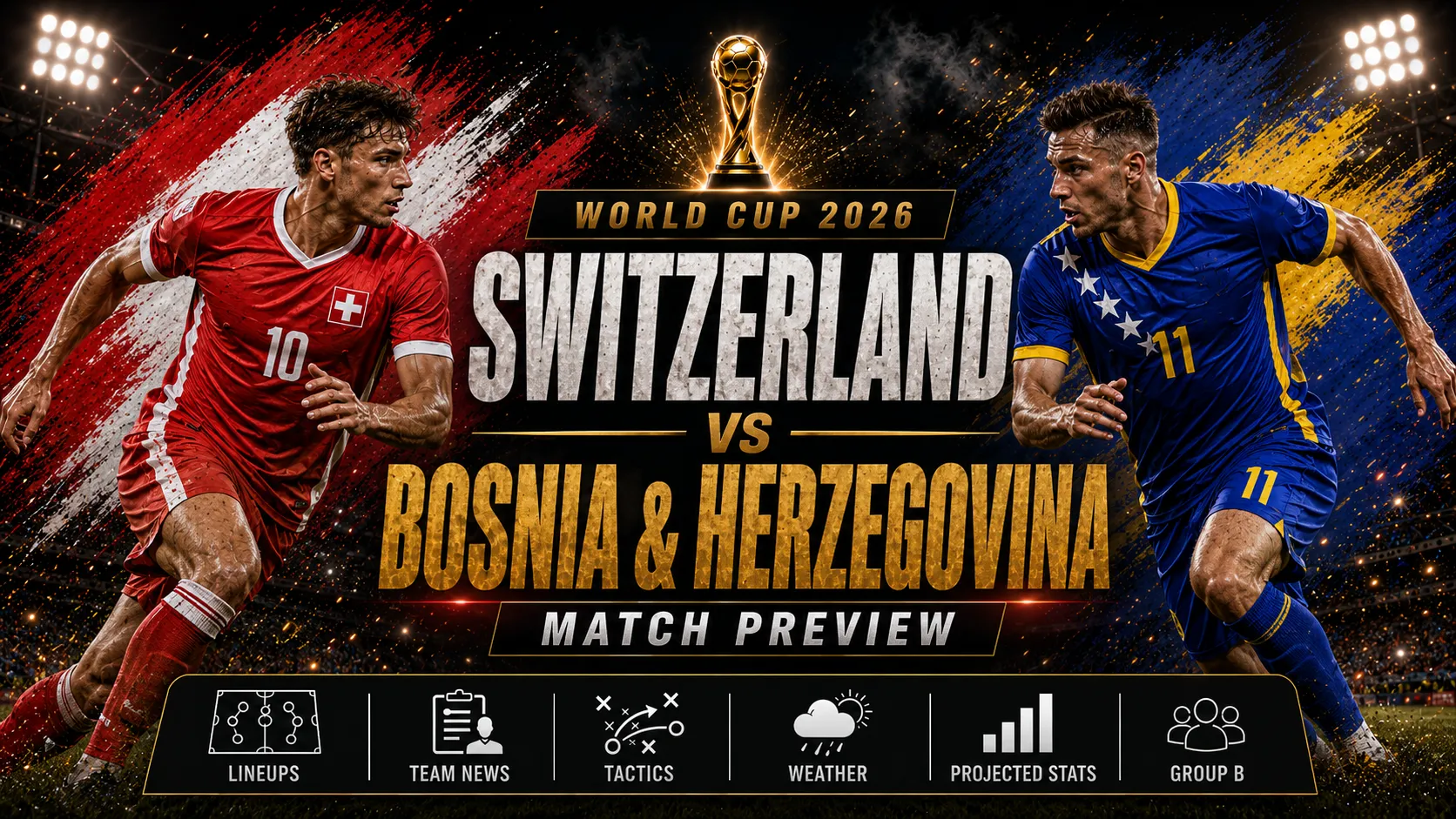
Switzerland face Bosnia and Herzegovina in a FIFA World Cup 2026 Group B match at Los Angeles Stadium in Los Angeles, United States, on Thursday, 18 June 2026. Kick-off is scheduled for 12:00 p.m. local Pacific time and 19:00 UTC. This is the second group-stage match for both teams. Group B also includes Canada and Qatar.
Both teams enter after opening 1-1 draws. Switzerland drew with Qatar after Breel Embolo scored from the penalty spot and a late Swiss own goal changed the result. Bosnia and Herzegovina drew with Canada after Jovo Lukić gave them a first-half lead before Canada equalised. Switzerland are coached by Murat Yakin and rely on Gregor Kobel, Manuel Akanji, Granit Xhaka, Remo Freuler, Breel Embolo, Dan Ndoye and Ruben Vargas. Bosnia and Herzegovina are coached by Sergej Barbarez and lean on Nikola Vasilj, Sead Kolašinac, Amar Dedić, Benjamin Tahirović, Ermedin Demirović, Jovo Lukić and possible veteran impact from Edin Džeko.
The likely tactical shape is Switzerland controlling more possession through Xhaka and Freuler while Bosnia defend compactly and attack through Demirović, Bajraktarević, Lukić, Džeko or wide transitions. The key matchup is Switzerland’s wide and central chance creation against Bosnia’s disciplined defensive block. Betting markets should be read as risk signals only, not guarantees.
| Field | Data |
|---|---|
| Match | Switzerland vs Bosnia and Herzegovina |
| Competition | FIFA World Cup 2026 |
| Stage | Group Stage / First Stage |
| Group | Group B |
| Match Number | Match 26 |
| Date | Thursday, 18 June 2026 |
| Kick-off Time | 12:00 p.m. Pacific Time / 19:00 UTC / 21:00 Bern / 21:00 Sarajevo |
| Stadium | Los Angeles Stadium |
| Venue Context | SoFi Stadium / Inglewood context outside FIFA naming |
| City | Los Angeles / Inglewood venue context |
| Host Country | United States |
| Expected Attendance | Not available from verified public data |
| Referee | Not available from verified public data |
| VAR | Not available from verified public data |
| Weather Forecast | Around 70°F / 21°C at local noon, cloudy; exact match-hour humidity, wind and pitch speed not available from verified public data |
| Pitch Context | Tournament football surface; exact pitch speed not available from verified public data |
| Main Article Focus | Pre-match probability dossier, Group B scenarios, predicted lineups, tactical analysis, weather, player roles, projected stats, cards, set pieces and responsible betting risk |
Switzerland vs Bosnia and Herzegovina is a pressure match in a balanced Group B. Every team in the group has one point after one match. Switzerland remain the group favourite by squad depth and recent World Cup consistency, but their draw with Qatar exposed finishing and game-management issues. Bosnia gained a useful point against co-hosts Canada but also showed that they must create more after scoring first.
Switzerland vs Bosnia and Herzegovina matters because a win can move either team toward Group B control, while another draw keeps the group open and increases final-round pressure.
| Category | Status | Switzerland vs Bosnia and Herzegovina Example | Article Use |
|---|---|---|---|
| Confirmed fact | Verified before publication | Switzerland vs Bosnia and Herzegovina, Group B, Los Angeles Stadium, 18 June 2026 | Hard match base |
| Confirmed timing | Verified fixture context | 12:00 Los Angeles / 19:00 UTC / 21:00 Bern / 21:00 Sarajevo | Match snapshot |
| Confirmed group context | Verified reporting | Canada, Qatar, Switzerland and Bosnia all have one point after opening 1-1 draws | Group table and qualification pressure |
| Confirmed Switzerland result | Verified reporting | Switzerland drew 1-1 with Qatar after Embolo’s penalty and a late own goal | Team context |
| Confirmed Bosnia result | Verified reporting | Bosnia drew 1-1 with Canada after Jovo Lukić scored first | Team context |
| Confirmed squad context | Verified public squad reporting | Switzerland include Kobel, Akanji, Xhaka, Freuler, Embolo, Ndoye, Vargas and Okafor | Player and lineup sections |
| Confirmed squad context | Verified public lineup and squad reporting | Bosnia include Vasilj, Dedić, Kolašinac, Tahirović, Demirović, Bajraktarević, Lukić and Džeko | Player and lineup sections |
| Probable information | Tactical forecast | Switzerland likely control more ball; Bosnia likely defend compactly and counter | Tactical sections |
| Projected data | Model-based estimate | Possession, shots, xG, corners, cards, fouls and substitution windows | Forecast tables |
| Unknown data | Not verified in current source set | Expected attendance, official referee, official VAR, exact humidity, exact wind, pitch speed | Marked unavailable |
| Scenario-based analysis | Possible future pattern | Bosnia may use Džeko later; Switzerland may increase wide pressure if central lanes close | Written as forecast, not fact |
This distinction matters because this match has already produced misleading surface narratives. Switzerland had enough control against Qatar to expect more than one point. Bosnia led Canada but still had to absorb pressure. Those facts help the model. They do not decide the next match.
A predicted lineup is not an official team sheet. A projected xG range is not a final statistic. A betting market price is not a result. A tactical forecast can fail after one early goal, one injury, one red card, one goalkeeper error, one VAR penalty or one weather-driven surface change.
This preview uses probability language. It does not claim that any goal, card, injury, substitution or VAR decision will happen at a specific minute.
Group B is unusually level before this match. Canada, Qatar, Switzerland and Bosnia all have one point. Each team has scored once and conceded once. That makes Match 26 a possible pivot point for the whole section.
| Team | Played | Won | Drawn | Lost | Goals For | Goals Against | Goal Difference | Points |
|---|---|---|---|---|---|---|---|---|
| Canada | 1 | 0 | 1 | 0 | 1 | 1 | 0 | 1 |
| Qatar | 1 | 0 | 1 | 0 | 1 | 1 | 0 | 1 |
| Switzerland | 1 | 0 | 1 | 0 | 1 | 1 | 0 | 1 |
| Bosnia and Herzegovina | 1 | 0 | 1 | 0 | 1 | 1 | 0 | 1 |
The expanded 48-team format changes the logic. The top two teams qualify directly for the Round of 32. The best eight third-placed teams also advance. That means a draw does not destroy either team, but a win matters heavily because it creates a clear route before the final round.
Switzerland face Canada in their final group match. Bosnia face Qatar. That schedule gives Bosnia a clear incentive to attack this match intelligently. A win against Switzerland would give Bosnia four points before facing Qatar. A draw still keeps them alive. A defeat would put pressure on the final match and goal difference.
Switzerland need to turn control into points. Their group-stage record has been strong across recent World Cups. But this group will not wait for reputation. Another draw may leave Switzerland needing a result against Canada, with the co-hosts still highly motivated.
Switzerland entered the tournament as the most established World Cup team in Group B. They have experience, a stable tactical core and a midfield leader in Xhaka. They also have defensive reliability through Akanji, Elvedi, Rodriguez and Kobel.
The Qatar match created two problems. First, Switzerland did not convert enough territory into margin. Second, they conceded late when game management should have protected the result. Those issues matter because Bosnia can be physically resilient and emotionally stubborn.
Switzerland’s practical objectives:
Bosnia gained a valuable point against Canada. They did so in a hostile host-country environment. That matters. It showed resilience. It also showed the limits of protecting a lead without enough attacking release.
Barbarez has built a younger, more aggressive Bosnia around Demirović, Bajraktarević, Tahirović, Dedić and other newer profiles. Džeko remains the iconic reference, but Bosnia did not start him against Canada. That decision created a younger front line and preserved a late-game option. The same question returns here: start Džeko for penalty-box gravity, or use him later against tired Swiss defenders.
Bosnia’s practical objectives:
Every Group B team has neutral goal difference. That makes late-game decisions unusually important. A narrow win can move a team into control. A heavy defeat can damage the third-place comparison. A second draw leaves both teams on two points, which may still be useful but may require a final-round win.
If Switzerland lead by one goal, they may chase a second but must protect against Bosnia counters. If Bosnia lead by one, they may defend deeper and use Džeko or another forward as the release valve. If the match is level late, both coaches must decide whether one point is enough.
Switzerland carry favourite pressure. Bosnia carry opportunity pressure. Switzerland will be judged harshly if they fail to beat both Qatar and Bosnia. Bosnia can build confidence if they remain level deep into the match.
If Switzerland score first, Bosnia must avoid becoming too direct too early. If Bosnia score first, Switzerland must avoid rushed crossing and low-quality distance shots. If the match stays level after 60 minutes, pressure may shift toward Switzerland.
| Result | Switzerland Impact | Bosnia and Herzegovina Impact | Group B Meaning |
|---|---|---|---|
| Switzerland win | Switzerland move to 4 points and regain group-control status before Canada | Bosnia stay on 1 point and need a final-round result against Qatar | Expected hierarchy strengthens |
| Draw | Switzerland reach 2 points but face pressure before Canada | Bosnia reach 2 points and stay alive before Qatar | Group remains wide open |
| Bosnia win | Switzerland face major pressure before Canada | Bosnia move to 4 points and gain a strong qualification platform | Group hierarchy shifts sharply |
| Factor | Match Relevance |
|---|---|
| Host country | United States |
| Venue region | Southern California |
| Neutral match | Neither team is host nation |
| Travel context | Switzerland played in Santa Clara; Bosnia played in Toronto |
| Climate profile | Mild coastal-influenced weather compared with inland heat venues |
| Altitude | No altitude issue |
| Crowd profile | Mixed neutral, Swiss, Bosnian and local support expected |
| Stadium context | Large modern NFL venue adapted for World Cup football |
| Tournament pressure | Second group match with direct qualification impact |
Los Angeles gives both teams a high-profile but physically manageable setting. The noon kick-off matters, but the projected temperature is not extreme. The travel load may matter more for Bosnia because they move from Toronto to the West Coast after an emotionally intense opener against Canada. Switzerland move within California after playing in Santa Clara.
| City Factor | Expected Tactical Impact |
|---|---|
| Noon local kick-off | Early body-clock and hydration planning matter |
| Around 70°F / 21°C at noon | Pressing in phases remains realistic |
| Cloudy forecast around kick-off | Direct sun should not dominate if forecast holds |
| No altitude | Normal oxygen recovery profile |
| Large venue environment | Communication matters on defensive line and set pieces |
| West Coast travel | Bosnia’s travel adaptation is a watchlist item |
| Strong diaspora potential | Bosnia may have energetic support in a neutral venue |
Los Angeles should not force a major tactical rewrite. Switzerland can press in selected waves. Bosnia can defend compactly without major heat penalty. The key physical question is travel rhythm and recovery, not extreme weather.
| Stadium Detail | Data |
|---|---|
| FIFA Stadium Name | Los Angeles Stadium |
| Common Venue Context | SoFi Stadium / Inglewood |
| City | Los Angeles / Inglewood venue context |
| State | California |
| Host Country | United States |
| Kick-off | 12:00 p.m. PT / 19:00 UTC |
| Expected Attendance | Not available from verified public data |
| Referee | Not available from verified public data |
| VAR | Not available from verified public data |
| Roof Status | Stadium has covered / roofed design context; match-specific playing-environment details not available from verified public data |
| Pitch Speed | Not available from verified public data |
| Tactical Impact | Surface speed, crowd acoustics and wide-pitch spacing should be checked early |
| Weather / Environment Factor | Tactical Meaning |
|---|---|
| Around 70°F / 21°C | High-intensity phases remain viable |
| Cloudy at noon | Direct heat load should be reduced if forecast holds |
| Exact humidity unavailable | Avoid precise cramp claims |
| Exact wind unavailable | Long switches and crosses should be judged live |
| No altitude | Pressing cost is normal rather than altitude-driven |
| Roof / covered venue context | Wind and surface may be less volatile, but official match condition should be checked |
| Pitch speed unavailable | First 10 minutes should reveal ball skid and bounce |
| Noon schedule | Substitution timing can still matter after travel and opener fatigue |
The most important environmental factor is not heat. It is the combination of noon timing, travel recovery and surface calibration. Switzerland can keep tempo if Xhaka controls rhythm. Bosnia can stay compact if the midfield distances remain short.
| Team | Player / Role | Status | Tactical Impact |
|---|---|---|---|
| Switzerland | Murat Yakin | Head coach | Experienced tournament coach with pragmatic flexibility |
| Switzerland | Granit Xhaka | Available squad midfielder | Main tempo controller and long-range passer |
| Switzerland | Gregor Kobel | Available squad goalkeeper | Shot-stopping and distribution base |
| Switzerland | Manuel Akanji | Available squad defender | Defensive leader and buildup player |
| Switzerland | Nico Elvedi | Available squad defender | Centre-back option and aerial defender |
| Switzerland | Ricardo Rodriguez | Available squad defender | Left-sided experience and set-piece delivery |
| Switzerland | Remo Freuler | Available squad midfielder | Balance, pressing and second balls |
| Switzerland | Denis Zakaria | Available squad midfielder | Defensive coverage and physical duels |
| Switzerland | Breel Embolo | Available squad forward; scored penalty against Qatar | Main striker and contact forward |
| Switzerland | Dan Ndoye | Available squad attacker | Right-side direct runner and pressing outlet |
| Switzerland | Ruben Vargas | Available squad attacker | Left-side or inside attacker |
| Bosnia and Herzegovina | Sergej Barbarez | Head coach | Compact, energetic and emotionally intense team structure |
| Bosnia and Herzegovina | Nikola Vasilj | Started against Canada | Goalkeeper and box organiser |
| Bosnia and Herzegovina | Sead Kolašinac | Started against Canada | Defensive leader and physical left-sided presence |
| Bosnia and Herzegovina | Amar Dedić | Started against Canada | Right-back / wing-back progression and duels |
| Bosnia and Herzegovina | Benjamin Tahirović | Started against Canada | Midfield screen and passing link |
| Bosnia and Herzegovina | Ermedin Demirović | Started against Canada | Forward runner, pressing and transition threat |
| Bosnia and Herzegovina | Jovo Lukić | Scored against Canada | Central striker option and box reference |
| Bosnia and Herzegovina | Edin Džeko | Named substitute against Canada | Veteran striker and possible late aerial/hold-up option |
| Player | Team | Status | Tactical Impact |
|---|---|---|---|
| Edin Džeko | Bosnia and Herzegovina | Recovered enough to be on the bench against Canada; start and workload remain tactical watchlist | If he starts, Bosnia gain box presence but may lose pressing range |
| Not available from verified public data | Switzerland | Not available | Do not invent individual doubts |
| Not available from verified public data | Bosnia and Herzegovina | Not available | Do not invent additional doubts |
| Player | Team | Status | Tactical Impact |
|---|---|---|---|
| Not available from verified public data | Switzerland | Not available | No confirmed match-specific absence used in this preview |
| Not available from verified public data | Bosnia and Herzegovina | Not available | No confirmed match-specific absence used in this preview |
| Player / Group | Team | Issue | Match Impact |
|---|---|---|---|
| Switzerland attacking efficiency | Switzerland | No confirmed injury issue, but finishing pressure after Qatar draw | Embolo, Ndoye, Vargas and Okafor roles should be checked |
| Switzerland game management | Switzerland | Late concession against Qatar | Substitution timing and defensive shape late in match become watchlist items |
| Bosnia forward role | Bosnia and Herzegovina | Džeko did not start the opener | Barbarez must decide whether to start him or preserve him |
| Bosnia chance creation | Bosnia and Herzegovina | Limited attack after scoring against Canada | Bajraktarević, Demirović and midfield support carry larger responsibility |
| Both squads | Both | Second match after travel and short turnaround | Substitution windows and physical load matter |
| Team | Confirmed Suspension | Notes |
|---|---|---|
| Switzerland | Not available from verified public data | No confirmed suspension in current source set |
| Bosnia and Herzegovina | Not available from verified public data | No confirmed suspension in current source set |
Switzerland’s tactical plan is stable because no confirmed match-specific absence changes the core. Yakin can choose between a back three and back four, but the central principles remain similar: Xhaka controls tempo, Freuler balances, Embolo occupies defenders, and the wide attackers stretch the pitch.
Bosnia’s main uncertainty is Džeko. Starting him can improve hold-up play, aerial threat and penalty-box control. It can also reduce pressing intensity if Switzerland move the ball quickly. Keeping him as a substitute can preserve a late tactical change, especially if the game becomes direct after 60 minutes.
Official starting lineups were not available from verified public data in the current source set. The following XIs are projections built from squad context, opening-match lineups and tactical logic. They should be replaced with official team sheets before publication.
| Position / Line | Player | Likely Role |
|---|---|---|
| GK | Gregor Kobel | Goalkeeper, shot-stopping, buildup support and high-ball command |
| RB / RCB | Silvan Widmer / Nico Elvedi | Defensive width or back-three balance |
| CB | Manuel Akanji | Defensive leader, buildup progression and recovery defending |
| CB / LB | Ricardo Rodriguez / Nico Elvedi | Left-sided organisation, set pieces and box defence |
| LB / LWB | Miro Muheim / Ricardo Rodriguez | Left-side service and defensive width |
| DM / CM | Granit Xhaka | Tempo controller, long switches and midfield leadership |
| CM | Remo Freuler | Pressing balance, second balls and defensive support |
| CM / DM | Denis Zakaria / Michel Aebischer | Physical cover, ball-winning and right-side balance |
| RW | Dan Ndoye | Direct runner, pressing winger and wide outlet |
| ST | Breel Embolo | Central striker, hold-up play, box threat and penalty reference |
| LW | Ruben Vargas / Noah Okafor | Wide/inside attacker, counter threat and final-third support |
| Position / Line | Player | Likely Role |
|---|---|---|
| GK | Nikola Vasilj | Goalkeeper, shot-stopping, cross handling and long distribution |
| RB | Amar Dedić | Right-back / wing-back, forward support and recovery defending |
| CB | Nikola Katić | Centre-back, aerial defending and box protection |
| CB | Tarik Muharemović | Centre-back, marking and buildup support |
| LB | Sead Kolašinac | Left-back / left centre-back, physical defending and leadership |
| DM | Benjamin Tahirović | Midfield screen, passing link and second-ball work |
| CM | Ivan Bašić / Dženis Burnić | Ball circulation, pressing and set-piece support |
| CM / RM | Amar Memić / Armin Gigović | Running, wide support and transition link |
| RW | Esmir Bajraktarević | Right-side or inside carrier, pressing and final-third threat |
| ST | Ermedin Demirović | Forward runner, channel attacks and pressure leader |
| ST / CF | Jovo Lukić / Edin Džeko | Lukić as mobile starter; Džeko as veteran target or late option |
| Team | Base Formation | In Possession | Out of Possession | Confidence |
|---|---|---|---|---|
| Switzerland | 3-4-2-1 / 4-3-3 | 2-3-5 or 3-2-5 with Xhaka central and wide attackers high | 5-2-3, 4-4-2 or compact 4-1-4-1 depending on lineup | Medium |
| Bosnia and Herzegovina | 4-4-2 / 4-2-3-1 / 5-3-2 | Direct 2-3-5 in limited attacks; early forward release to Demirović/Lukić/Džeko | Compact 4-4-2 or 5-4-1 mid-to-low block | Medium |
| Scenario | Trigger | Expected Change |
|---|---|---|
| Switzerland want more control | Bosnia defend deep and narrow | Aebischer or Zakaria supports Xhaka and Freuler |
| Switzerland want more speed | Bosnia full-backs advance | Okafor starts or enters earlier on the left |
| Switzerland want more box presence | Bosnia protect central zones | Itten or Amdouni becomes striker or second-forward option |
| Switzerland protect lead | Leading after 70’ | Extra midfielder and deeper wing-back behaviour |
| Bosnia start Džeko | Barbarez wants hold-up and aerial route from kick-off | Demirović may play off him or wide |
| Bosnia preserve Džeko | Barbarez wants pressing and speed early | Lukić and Demirović start again |
| Bosnia chase goal | Trailing after 60’ | Džeko, Tabaković or Baždar profile adds box presence |
| Bosnia protect draw | Level after 70’ | Extra midfielder or defender, slower restarts and deeper block |
| Phase | Expected Pattern |
|---|---|
| Build-up | Kobel, Akanji, Rodriguez/Elvedi and Xhaka form controlled first phase |
| Attack | Xhaka switches, Ndoye/Vargas width, Embolo contact play and late midfield arrivals |
| Defense | Compact central screen with Freuler/Zakaria protecting transitions |
| Transitions | Early release to Ndoye, Okafor, Vargas or Embolo after recoveries |
| Set Pieces | Rodriguez/Xhaka/Rieder delivery, Akanji, Elvedi, Embolo and Itten targets |
| Weakness | Late-game concentration, occasional exposure behind advanced wide players and finishing efficiency |
Switzerland should build through control. Kobel can support short circulation. Akanji can step forward and break lines. Xhaka should receive early and face forward. Freuler can connect the next pass. Zakaria or Aebischer can protect rest defence.
Bosnia will likely allow some Swiss possession. That makes ball speed important. Slow passing helps Bosnia slide across the field. Switzerland need switches, quick wide isolations and third-man runs around Embolo.
The best Swiss build-up route may be:
Switzerland can press Bosnia in phases. They should not press without cover because Demirović and Bajraktarević can attack space. The best Swiss press should use clear triggers.
Useful Switzerland pressing triggers:
Switzerland’s counter-press after losing the ball may matter more than the high press. Bosnia’s best open-play route begins with the first forward pass. Switzerland must stop that pass early.
Switzerland can attack through both wings. Ndoye gives direct threat on the right. Vargas or Okafor gives left-side movement. Xhaka’s switches can move Bosnia’s block and create one-vs-one moments.
The right side may become a strong route if Ndoye receives against Kolašinac or a shifted Bosnian left side. The left side may become stronger if Okafor enters against tired defenders.
Switzerland should not over-cross from poor angles. Bosnia have centre-backs who can defend aerial balls. Low crosses, cutbacks and edge-of-box shots may be more productive.
Xhaka is Switzerland’s key passer. His role is not only to complete passes. He must decide when to speed the game and when to slow it. If he receives without pressure, Switzerland can dominate territory. If Bosnia close him early, Akanji and Freuler must share progression.
Fabian Rieder can become important if selected or introduced. He gives delivery and creative passing from advanced midfield zones.
Switzerland can counter through Ndoye, Vargas, Okafor and Embolo. The transition threat depends on the first pass after recovery. Bosnia may push Dedić high at times. Switzerland can attack that space if the recovery pass is clean.
Switzerland should avoid chaotic transitions if they lead. They lost two points against Qatar through late game-management failure. Control matters as much as chance volume.
Switzerland have a solid set-piece profile. Xhaka, Rodriguez and Rieder can deliver. Akanji, Elvedi, Embolo, Itten and Zakaria can attack the box. Bosnia have size and defensive commitment, so Switzerland need movement and second-ball plans.
Corners may matter if Bosnia defend deep. Switzerland should target far-post screens and edge-of-box rebounds rather than only direct central balls.
Switzerland’s main weakness is space behind wide players if the wing-backs or full-backs advance too high. Bosnia can use Demirović and Bajraktarević to attack those lanes. The second weakness is late concentration. The Qatar draw will keep this issue central.
Kobel can build short and play longer if Bosnia press. His distribution can help Switzerland bypass pressure. He must also stay alert because Bosnia may create fewer but more direct chances.
Switzerland’s wide defenders should attack asymmetrically. If both sides push high, Bosnia’s counter route improves. One wide player can advance while the far-side defender stays connected to the centre-backs.
Embolo is the central attacking reference. He must hold the ball, pin centre-backs, attack crosses and create space for Ndoye and Vargas. If Bosnia defend deep, his ability to receive under contact can define Switzerland’s chance quality.
| Phase | Expected Pattern |
|---|---|
| Build-up | Cautious short play mixed with direct passes into Demirović, Lukić or Džeko |
| Attack | Channel runs, right-side progression through Dedić/Bajraktarević and central forward support |
| Defense | Compact 4-4-2, 4-5-1 or back-five block depending on Džeko decision |
| Transitions | First forward pass into Demirović, Bajraktarević, Lukić or Džeko |
| Set Pieces | Bašić/Bajraktarević/Kolašinac delivery, Katić, Kolašinac, Džeko and Lukić targets |
| Weakness | Limited chance volume after taking lead, pressure on young midfield and risk of defending too deep |
Bosnia should build pragmatically. Switzerland can press and counter-press with structure. Bosnia should not invite unnecessary pressure around their own box. Vasilj can go direct when the short lane is closed.
The first build-up route can use Tahirović or Bašić to connect midfield. The second route can go direct into Demirović or Lukić. If Džeko starts, he becomes the obvious target. If he stays on the bench, Bosnia can keep more pressing mobility early.
Bosnia need support around the first receiver. Against Canada, they scored first but struggled to create consistent attacking relief afterward. That pattern cannot repeat without risk.
Bosnia should press selectively. Switzerland can play through a disconnected press. Barbarez may ask the forwards to press Akanji or Rodriguez when the ball travels backward, but the midfield must stay connected.
Useful Bosnia pressing triggers:
Bosnia should not chase Xhaka across the pitch. They should screen his passing lanes and force Switzerland toward lower-value wide areas.
Bosnia’s right side may be the main attacking side. Dedić can advance. Bajraktarević can carry inside. Demirović can run into the channel. This can test Switzerland’s left-side structure.
The left side carries physical stability through Kolašinac. He may not give the same repeated attacking speed, but he can support set pieces, duels and defensive organisation.
Tahirović can become the key midfield passer. Bašić can deliver set pieces and first forward balls. Bajraktarević can create through carries. If Džeko plays, the key pass may simply be an early ball into his chest or head with runners around him.
Bosnia’s transition threat is practical. Demirović can run channels. Bajraktarević can carry. Lukić can attack the box. Džeko can hold the ball and bring others into play. The first forward pass after winning possession matters more than possession share.
The ideal Bosnia transition:
Bosnia can threaten set pieces. Katić, Kolašinac, Lukić, Demirović, Džeko and Tabaković give aerial presence. Canada conceded from a Bosnian routine in the opener. Switzerland must respect this route.
Bosnia should value wide free kicks and corners. Set pieces can slow Switzerland’s rhythm and give Bosnia a path to high-value chances.
Bosnia’s main weakness is sustained pressure. If they defend too deep, Switzerland can create repeated corners and rebounds. The second weakness is chance volume. Bosnia must avoid long periods where every clearance returns immediately.
The third weakness is fatigue if the defensive block has to shift laterally for 90 minutes. Switzerland can move the ball side to side and use substitutes to attack tired full-backs.
Vasilj should use mixed distribution. Short passes can help Bosnia breathe. Direct balls can relieve pressure. If Džeko plays, long distribution gains value. If he does not start, Bosnia need more movement around Demirović and Lukić.
Dedić can be a major outlet, but his forward runs create recovery risk. Kolašinac must defend with discipline against Swiss wide players. Bosnia’s full-backs should not both advance unless the midfield screen is secure.
Demirović is a modern pressure forward. Lukić gives penalty-box movement. Džeko gives hold-up play, aerial gravity and experience. Barbarez’s forward choice may define whether Bosnia start with mobility or late-game target power.
| Zone | Switzerland Edge | Bosnia Edge | Likely Control | Why It Matters |
|---|---|---|---|---|
| Switzerland left / Bosnia right | Vargas/Okafor movement and Xhaka switches | Dedić and Bajraktarević transition route | Balanced | Could decide Bosnia’s best counter lane |
| Switzerland right / Bosnia left | Ndoye direct running and wide service | Kolašinac physical defence | Switzerland slight edge | Main Swiss isolation route |
| Central midfield | Xhaka, Freuler, Zakaria/Aebischer control | Tahirović and Bašić compactness | Switzerland edge | Decides possession and pressure |
| Penalty box | Embolo, Akanji, Elvedi, Itten targets | Katić, Muharemović, Kolašinac, Džeko size | Balanced | Both teams have aerial threat |
| Set pieces | Swiss delivery and multiple targets | Bosnia’s opener goal pattern and tall forwards | Balanced | Dead balls can break a tight game |
| Transitions | Ndoye, Okafor, Vargas speed | Demirović, Bajraktarević, Dedić directness | Balanced | Main route for Bosnia to unsettle Switzerland |
| Defensive third | Swiss structure and Kobel | Bosnian compact block and Vasilj | Switzerland slight edge | Switzerland may face fewer defensive phases |
Xhaka controls Switzerland’s rhythm. Tahirović must reduce his forward-facing time.
Why it matters: Switzerland’s possession becomes dangerous when Xhaka can switch play and find wide attackers early.
What to watch: Whether Bosnia close Xhaka before his first touch or allow him to dictate tempo.
Risk trigger: If Tahirović is dragged too high, spaces can open behind him for Embolo and Swiss runners.
Embolo gives Switzerland contact play and central threat. Bosnia’s centre-backs must defend him without overcommitting.
Why it matters: If Embolo pins the centre-backs, Switzerland’s wide players can attack cutback lanes.
What to watch: His first touch under pressure and his movement across the near post.
Risk trigger: If one Bosnia centre-back receives an early yellow card, Switzerland can target him through body contact.
Ndoye can stretch the right side. Kolašinac provides power and defensive experience.
Why it matters: This duel can determine whether Switzerland create regular wide entries.
What to watch: Whether Ndoye receives facing goal or receives with Kolašinac already close.
Risk trigger: If Kolašinac needs repeated help, Bosnia’s midfield may open central gaps.
Demirović is Bosnia’s main active forward. Akanji is Switzerland’s best defensive organiser.
Why it matters: Bosnia need Demirović to create forward territory and stop Switzerland from recycling every attack.
What to watch: Channel runs behind Akanji and Elvedi, especially after Swiss turnovers.
Risk trigger: If Akanji steps into midfield and loses the duel, Bosnia can attack exposed space.
Džeko may start or enter later. His role can change Bosnia’s attacking reference.
Why it matters: Switzerland lost two points late against Qatar. Džeko can stress late defending through hold-up play and aerial timing.
What to watch: Whether he appears after 60 minutes and whether Bosnia support him with runners.
Risk trigger: If Switzerland defend too deep late, Džeko’s value increases.
| Projected Stat | Switzerland | Bosnia and Herzegovina | Confidence | Reason |
|---|---|---|---|---|
| Possession | 55–63% | 37–45% | Medium/high | Switzerland should control more ball through Xhaka and Freuler |
| Shots | 12–20 | 6–11 | Medium | Switzerland had high shot volume in opener; Bosnia may defend deeper |
| Shots on Target | 4–7 | 2–4 | Medium | Bosnia can suppress central quality but face pressure |
| xG Range | 1.30–2.20 | 0.60–1.20 | Low/Medium | First goal and Džeko usage can shift match shape |
| Big Chances | 1–3 | 0–2 | Low/Medium | Switzerland have stronger open-play creation but Bosnia set pieces matter |
| Corners | 5–9 | 2–5 | Medium | Swiss territory and wide attacks likely create blocks |
| Fouls | 9–14 | 11–17 | Medium | Bosnia likely defend more midfield and wide duels |
| Yellow Cards | 1–3 | 2–4 | Low/Medium | Referee unknown; tactical fouls may matter |
| Red-Card Risk | Low | Low/Medium | Low | Bosnia defensive workload raises watchlist, not certainty |
| Offsides | 1–3 | 1–3 | Low | Embolo, Demirović and Lukić can attack depth |
| Saves | 2–4 | 3–7 | Medium | Vasilj likely faces more shots |
| Crosses | 16–26 | 8–15 | Medium | Switzerland should attack wide more often |
| Tackles | 13–20 | 18–27 | Medium | Bosnia likely defend longer spells |
| Interceptions | 8–13 | 11–18 | Medium | Bosnia’s block can cut central passes |
| Clearances | 12–20 | 24–38 | Medium | Bosnia may defend deep for extended phases |
Switzerland should lead possession, shots, corners and territorial pressure. Bosnia can still make the match tight if they defend central lanes and keep set pieces dangerous. The key statistic is not possession. It is chance quality. Switzerland need cutbacks, central shots and Embolo touches in the box. Bosnia need clean counters, set pieces and enough second-ball support to prevent repeated Swiss waves.
| Match Window | Tactical State | Physical State | Card Risk | Goal Risk | Betting Market Trigger |
|---|---|---|---|---|---|
| 1’–15’ | Switzerland likely establish possession; Bosnia test compactness and first counter | Noon conditions manageable; early tempo likely stable | Low/Medium | Medium | First Xhaka switch, first Demirović run |
| 16’–30’ | Switzerland may increase wide pressure through Ndoye and Vargas | Bosnia’s block begins lateral shifting | Medium | Medium | Swiss corners, Bosnia fouls near wide zones |
| 31’–45+’ | If level, Bosnia confidence may rise; Switzerland may push tempo | Contact load rises before half-time | Medium/high | Medium | Late first-half set pieces |
| 46’–60’ | Coaches adjust block height and forward support | Reset intensity after halftime | Medium | Medium/high | Džeko usage, Okafor/Rieder Swiss change |
| 61’–75’ | Substitutions can open space | Fatigue from lateral defending increases | High | Medium/high | Fresh wide attackers, Bosnia target forward |
| 76’–90+’ | Game state dominates | Concentration and match management matter | High | High | Late corners, Džeko aerials, Swiss game management |
Switzerland should test Bosnia’s midfield screen early. Bosnia need clean first clearances and at least one forward action to stop Switzerland from settling fully.
Swiss wide pressure may increase. Bosnia must protect full-backs and avoid fouls in crossing zones. Xhaka’s switch direction can reveal the preferred attack side.
If Bosnia keep the match level, their confidence can rise. Switzerland must avoid impatience. Set pieces can become important before halftime.
The first adjustment phase may define the match. Yakin can add speed or creativity. Barbarez can decide whether Džeko becomes central to the attack.
Substitutes can change tempo. Switzerland can introduce Okafor, Rieder, Amdouni or Itten. Bosnia can add Džeko, Tabaković, Baždar or extra midfield legs.
Late game management is central after Switzerland’s Qatar draw. If Switzerland lead, they must close the match cleanly. If Bosnia are level or leading, set pieces and long balls may become more direct.
| Factor | Expected Impact | Switzerland Effect | Bosnia and Herzegovina Effect |
|---|---|---|---|
| Around 70°F / 21°C | Supports normal match tempo | Pressing in phases remains viable | Compact defending remains viable |
| Cloudy noon forecast | Reduces direct-sun load | Helps sustained possession rhythm | Helps defensive shifting |
| Humidity unavailable | Avoid exact fatigue claims | Standard hydration plan | Standard hydration plan |
| Wind unavailable | Crosses and switches should be judged live | Xhaka switches need calibration | Vasilj long balls need calibration |
| No altitude | Normal sprint recovery | Counter-pressing easier than in altitude venues | Transition runs remain viable |
| Roof / covered stadium context | May reduce wind exposure, but official match condition unavailable | Passing and crossing may be stable | Goalkeeper distribution may be stable |
| Pitch speed unknown | First 10 minutes reveal ball movement | Swiss short combinations need calibration | Bosnia clearances and counters need calibration |
| Travel load | Bosnia have longer travel from Toronto | Switzerland may settle faster | Bosnia recovery is a watchlist item |
The most important factor is travel and match rhythm rather than raw weather. The forecast supports football. The team that handles the second-match turnaround better may hold more energy after 60 minutes.
| Player | Team | Role | Match Impact Score /10 | Reason |
|---|---|---|---|---|
| Granit Xhaka | Switzerland | Midfield controller | 9.0 | Main tempo setter and switch passer |
| Breel Embolo | Switzerland | Striker | 8.7 | Central reference and scorer in opener |
| Manuel Akanji | Switzerland | Centre-back | 8.5 | Defensive leader and buildup player |
| Gregor Kobel | Switzerland | Goalkeeper | 8.2 | Shot-stopping and concentration against counters |
| Dan Ndoye | Switzerland | Winger | 8.1 | Direct wide threat and pressing outlet |
| Remo Freuler | Switzerland | Midfielder | 8.0 | Balance, counter-pressing and second balls |
| Ruben Vargas | Switzerland | Forward / winger | 7.9 | Left-side movement and final-third support |
| Denis Zakaria | Switzerland | Midfielder | 7.9 | Physical coverage and transition protection |
| Ermedin Demirović | Bosnia and Herzegovina | Forward | 8.6 | Main active runner and transition threat |
| Nikola Vasilj | Bosnia and Herzegovina | Goalkeeper | 8.3 | Likely shot-stopping workload |
| Sead Kolašinac | Bosnia and Herzegovina | Defender | 8.2 | Defensive leadership and physical duels |
| Amar Dedić | Bosnia and Herzegovina | Full-back / wing-back | 8.1 | Right-side progression and recovery |
| Benjamin Tahirović | Bosnia and Herzegovina | Midfielder | 8.0 | Screen against Xhaka and central passing outlet |
| Esmir Bajraktarević | Bosnia and Herzegovina | Attacker | 7.9 | Carrying and transition support |
| Jovo Lukić | Bosnia and Herzegovina | Forward | 7.9 | Scored against Canada and offers box movement |
| Edin Džeko | Bosnia and Herzegovina | Striker | 7.8 | Veteran hold-up and aerial option if used |
Embolo is Switzerland’s most important attacker because he converts possession into penalty-box presence. Demirović is Bosnia’s most important attacker because he gives them running, pressing and transition threat.
Akanji is Switzerland’s key defender because he controls buildup and transition recovery. Kolašinac is Bosnia’s key defensive personality because he brings physicality, leadership and left-side organisation.
Xhaka is the match’s most important midfielder. Tahirović is Bosnia’s most important central disruptor because he must reduce Xhaka’s influence.
Switzerland can change the match through Okafor, Rieder, Amdouni, Itten, Jashari or Sow. Bosnia can change the match through Džeko, Tabaković, Baždar, Gigović, Burnić or Alajbegović.
Bosnia’s centre-backs and full-backs carry card risk against Embolo, Ndoye and Vargas. Switzerland’s defensive midfielders and centre-backs carry card risk if Demirović or Bajraktarević break the first pressure.
Džeko remains a workload watchlist because he did not start against Canada. No confirmed Swiss injury-management case was available from verified public data.
The referee and VAR were not available from verified public data in the current source set. Therefore, this discipline preview uses tactical logic rather than referee-profile claims.
| Discipline Factor | Forecast |
|---|---|
| Referee Style | Not available from verified public data |
| Tactical Foul Risk | Medium/high |
| Dissent Risk | Medium |
| VAR Intervention Risk | Medium |
| Penalty Risk | Medium |
| Red-Card Risk | Low/medium |
| Team | Yellow-Card Range | Red-Card Risk | Main Risk Zone |
|---|---|---|---|
| Switzerland | 1–3 | Low | Tactical fouls after Bosnia counters |
| Bosnia and Herzegovina | 2–4 | Low/Medium | Full-back zones and centre-back duels |
Bosnia may carry the higher yellow-card range because they are projected to defend longer spells. Switzerland’s card risk appears when Bosnia escape through Demirović, Bajraktarević or Dedić.
| Set-Piece Area | Switzerland | Bosnia and Herzegovina | Edge |
|---|---|---|---|
| Corners For | Akanji, Elvedi, Embolo, Itten, Zakaria targets | Katić, Kolašinac and Vasilj command | Balanced to Switzerland |
| Corners Against | Must defend Džeko, Katić, Lukić, Kolašinac | Must defend Embolo, Akanji, Elvedi | Balanced |
| Wide Free Kicks | Xhaka, Rodriguez, Rieder delivery | Bašić, Bajraktarević, Kolašinac delivery | Balanced |
| Direct Free Kicks | Taker hierarchy not verified | Taker hierarchy not verified | Unknown |
| Penalties | Embolo scored from the spot in opener, but official hierarchy should be checked | Taker hierarchy should be confirmed from official XI | Unknown |
| Long Throws | Not available from verified public data | Not available from verified public data | Unknown |
| Aerial Duels | Strong through Embolo, Akanji, Elvedi | Strong through Džeko, Katić, Kolašinac, Lukić | Balanced |
The set-piece edge is close. Switzerland have more territorial pressure and likely corner volume. Bosnia have enough height and a proven opening-match set-piece route. The defensive matchup that can decide the match is Embolo and Akanji against Katić, Muharemović and Kolašinac.
| Area | Switzerland | Bosnia and Herzegovina |
|---|---|---|
| Goalkeeper Distribution | Kobel can support buildup and long switches | Vasilj likely mixes direct balls and short restarts |
| Shot-Stopping Pressure | Low/medium | Medium/high |
| Cross Handling | Medium against Bosnia set pieces | High against Swiss wide pressure |
| High-Line Risk | Space behind advanced wide players | Bosnia likely defend lower |
| Penalty-Box Defending | Must track Demirović, Lukić, Džeko and set-piece runners | Must track Embolo, Ndoye, Vargas and aerial targets |
| Back-Post Weakness | Possible if Switzerland over-shift toward Dedić side | Possible against Swiss switches and far-post runs |
| Defensive Communication | Late-game concentration important after Qatar draw | Constant organisation under Swiss possession |
Vasilj may face more pressure because Switzerland are projected to create more shots and corners. Kobel may face fewer actions, but Bosnia’s chances can be high-value if they come from transition or set pieces.
| Minute Window | Switzerland Possible Change | Bosnia Possible Change | Trigger |
|---|---|---|---|
| 45’–60’ | Add Rieder for delivery, Okafor for speed, Amdouni for inside movement | Add Džeko for hold-up, Gigović/Burnić for midfield legs | First-half blockage or low chance quality |
| 60’–75’ | Add Itten for box presence, Sow/Jashari for control | Add Tabaković/Baždar for central threat, Alajbegović for creativity | Score pressure and fatigue |
| 75’–90’ | Protect lead with extra midfielder or chase with second striker | Protect draw/lead or chase through direct balls to Džeko | Game state |
Switzerland should manage possession better than they did against Qatar. They should avoid retreating too early and should keep one forward outlet active.
Bosnia may defend deeper and use Džeko or Demirović as the outlet. Switzerland must avoid panic crossing and maintain passing rhythm through Xhaka.
Switzerland may feel more pressure to win. Bosnia may still consider a draw useful before Qatar, but four points would be a major prize. Substitutions will show each coach’s appetite for risk.
| Market | Current Signal | Main Risk |
|---|---|---|
| Match Winner | Switzerland priced as favourite in available market snapshots | Bosnia’s resilience, set pieces and underdog transition route |
| Double Chance | Switzerland or draw likely shorter | Low price may not reflect Group B volatility |
| Over/Under Goals | Public line shown around 2.5 goals in available market snapshots | Both teams drew 1-1 in openers; first goal can change tempo |
| BTTS | Plausible but not automatic | Bosnia chance volume may depend on transition quality |
| Corners | Switzerland corner volume likely higher | Early Switzerland goal can reduce pressure volume |
| Cards | Medium signal | Referee unknown and tactical duels matter |
| Player Shots | Embolo, Xhaka, Ndoye, Demirović, Džeko/Lukić watchlist | Official lineups and roles matter |
| Player Cards | Bosnia defenders, Swiss transition stoppers | Referee threshold unknown |
| Trigger | Possible Market Effect |
|---|---|
| Switzerland shape confirmation | Back three may affect possession and wing-back markets |
| Džeko starting status | Moves Bosnia shots, aerial props and BTTS expectations |
| Okafor or Rieder starting | Changes Switzerland speed or delivery profile |
| Bosnia back-four vs back-five | Affects Switzerland corners and team total |
| Referee announcement | Moves cards and penalty markets |
| Weather / roof / pitch update | Can affect totals, corners and goalkeeper handling |
| Public money on Switzerland | Can compress favourite price |
| Official team sheets | Can move player-shot and scorer markets |
| Trigger | Meaning | Risk |
|---|---|---|
| Xhaka receives freely | Switzerland control and chance quality rise | Bosnia may adjust the screen |
| Bosnia find Demirović early | Counter route is active | One break can overstate match balance |
| Switzerland create repeated corners | Territorial pressure rises | Corners do not guarantee goals |
| Džeko enters before 60’ | Bosnia may shift toward direct and aerial play | Workload may still be managed |
| Bosnia full-back booked | Swiss wide attack gains value | Referee threshold may change later |
| 0-0 after 60’ | Pressure shifts toward Switzerland | Bosnia set pieces remain dangerous |
This preview explains match data and market behavior. It does not provide guaranteed betting advice. World Cup betting involves risk. Readers should check local gambling laws, use licensed operators, set limits and avoid chasing losses.
| Factor | How It Can Break the Forecast |
|---|---|
| Late Lineup Change | Džeko, Okafor, Rieder or defensive-shape decisions can change the match model |
| Early Goal | Forces one team to abandon its base plan |
| Early Yellow Card | Changes full-back and centre-back aggression |
| Injury | Alters pressing, forward role or defensive structure |
| VAR Penalty | Creates a non-pattern goal and changes game state |
| Weather Shift | Surface, roof or wind conditions can affect passing and crosses |
| Red Card | Makes possession and xG projections less useful |
| Goalkeeper Error | Can swing a low-margin match |
| Tactical Surprise | Bosnia may press higher or Switzerland may play more conservatively |
| Market Overreaction | Early possession or one counter can distort live prices |
The forecast can fail if Bosnia score first and turn the match into a compact survival test. It can also fail if Switzerland score early and create transition space against an open Bosnia. Late-game management, Džeko’s role, Xhaka’s influence and set pieces can all break the model.
| Scenario | Probability Band | Match Story |
|---|---|---|
| Switzerland Narrow Win | Medium/high | Switzerland control territory, create more shots and convert through Embolo, wide pressure or set piece |
| Draw | Medium | Bosnia defend compactly, Switzerland lack finishing efficiency and the group remains level |
| Bosnia Upset | Low/medium | Bosnia score through set piece or transition and defend with discipline |
| High-Scoring Match | Low/medium | Early goal opens the game and both teams chase group advantage |
| Low-Scoring Match | Medium/high | Bosnia keep compact distances and Switzerland struggle to turn possession into clear chances |
The safest scenario frame is Switzerland-favoured but not Switzerland-certain. Switzerland have stronger group-stage pedigree and deeper control tools. Bosnia have resilience, set-piece threat and a clear underdog path.
| Result | Switzerland Impact | Bosnia and Herzegovina Impact |
|---|---|---|
| Switzerland Win | Switzerland reach 4 points and can approach Canada with qualification control | Bosnia stay on 1 point and need a strong final match against Qatar |
| Draw | Switzerland reach 2 points and still need a result against Canada | Bosnia reach 2 points and stay alive before Qatar |
| Bosnia Win | Switzerland remain on 1 point and face high pressure before Canada | Bosnia reach 4 points and gain a strong knockout-route platform |
A win is valuable because four points can be enough for the Round of 32 path in many group scenarios. A draw keeps both sides alive but leaves too much unresolved. A defeat does not automatically eliminate either team, but it increases dependence on final-round results and goal difference.
| Data Point | Status | Source Type |
|---|---|---|
| Match Date | Confirmed | FIFA match centre / FIFA preview |
| Stadium | Confirmed | FIFA match centre / FIFA preview |
| City | Confirmed | FIFA match centre / FIFA preview |
| Group | Confirmed | FIFA / Reuters Group B context |
| Group Standings | Confirmed before match | Reuters preview and match data context |
| Switzerland Squad | Confirmed | Reuters squad page / FIFA squad article context |
| Bosnia Squad | Confirmed | Reuters lineup and FIFA squad article context |
| Switzerland Coach | Confirmed | Reuters squad page |
| Bosnia Coach | Confirmed | Reuters and FIFA squad context |
| Opening Results | Confirmed | Reuters match preview and match reports |
| Referee | Pending | FIFA match centre if announced |
| VAR | Pending | FIFA match centre if announced |
| Weather | Forecast | Weather service |
| Lineups | Projected | Editorial forecast until official team sheets |
| Injuries | Partly unavailable | Public team-news reporting only |
| Odds | Market-signal only | Licensed bookmaker / odds aggregator displays |
| Projected Stats | Model-based | Editorial forecast using opener data and tactical logic |
| Minute-Window Scenarios | Scenario-based | Editorial model |
This article uses confirmed facts where available and marks unavailable information clearly. It does not invent official starting XIs, expected attendance, referee assignment, VAR assignment, exact pitch speed, exact humidity, exact wind or unverified suspensions.
This preview is analytical and informational. It is not a guarantee of the final result. Football includes randomness and low-probability events. Final lineups, injuries, referee decisions, VAR, weather and early goals can change the match.
Projected statistics, scoreline scenarios and betting market notes are probability-based estimates. They are not certain outcomes. Switzerland can dominate possession and still fail to win. Bosnia and Herzegovina can create fewer open-play chances and still score from a counter, set piece or individual action. A goalkeeper error, red card, deflection, penalty, injury or weather shift can break the pre-match model.
Betting markets move before and during the match. Readers should verify official lineups, injuries, referee information, weather conditions, roof status, pitch condition and market prices before making decisions. Readers should check local gambling laws and use licensed operators only. Readers should set spending and time limits. Readers should not chase losses. Betting should be treated as entertainment, not income.
This article does not provide guaranteed betting advice, fixed-match information, insider tips, prediction tools, risk-free picks or certain outcomes.
Switzerland vs Bosnia and Herzegovina is scheduled for Thursday, 18 June 2026, with kick-off at 12:00 p.m. local Pacific time in Los Angeles and 19:00 UTC.
Switzerland vs Bosnia and Herzegovina is being played at Los Angeles Stadium in Los Angeles, United States, with SoFi Stadium / Inglewood as the common venue context outside FIFA naming.
Official starting lineups were not available from verified public data in the current source set. Switzerland are projected to use Gregor Kobel, Manuel Akanji, Nico Elvedi or Ricardo Rodriguez, Granit Xhaka, Remo Freuler, Denis Zakaria or Michel Aebischer, Dan Ndoye, Breel Embolo and Ruben Vargas or Noah Okafor as key figures. Bosnia and Herzegovina are projected to use Nikola Vasilj, Amar Dedić, Nikola Katić, Tarik Muharemović, Sead Kolašinac, Benjamin Tahirović, Ivan Bašić, Esmir Bajraktarević, Ermedin Demirović and Jovo Lukić or Edin Džeko as key figures.
The main tactical matchup is Switzerland’s Xhaka-led possession, wide attacks and Embolo penalty-box role against Bosnia’s compact defensive block, Demirović-led transitions and possible Džeko aerial impact.
The prediction can be wrong because late lineup changes, early goals, injuries, VAR penalties, red cards, referee decisions, weather or roof-status changes, set-piece goals and goalkeeper errors can change the match. This preview uses probability logic, not certainty.
[expert_review params=»JTdCJTIyY29sb3IlMjIlM0ElMjJncmVlbi0yJTIyJTJDJTIyZXhwZXJ0X2F2YXRhciUyMiUzQSUyMiUyMiUyQyUyMmV4cGVydF9uYW1lJTIyJTNBJTIyJTIyJTJDJTIyZXhwZXJ0X2xpbmslMjIlM0ElMjIlMjIlMkMlMjJleHBlcnRfaWQlMjIlM0ElMjIxJTIyJTJDJTIyZXhwZXJ0X3R5cGUlMjIlM0ElMjJleHBlcnRfaWQlMjIlMkMlMjJleHBlcnRfYXZhdGFyX2FsdCUyMiUzQSUyMiUyMiUyQyUyMmV4cGVydF9zaG93JTIyJTNBMSUyQyUyMmV4cGVydF9kZXNjcmlwdGlvbiUyMiUzQSUyMlNwb3J0cyUyMEJldHRpbmclMjBBbmFseXN0JTIwJTI2JTIwRWRpdG9yaWFsJTIwQ29udHJpYnV0b3IlMjIlMkMlMjJleHBlcnRfc2hvd19idXR0b24lMjIlM0ExJTJDJTIyZXhwZXJ0X3Nob3dfYnV0dG9uX3R5cGUlMjIlM0ElMjJwb3B1cCUyMiUyQyUyMmV4cGVydF9xdWVzdGlvbl9idXR0b25fdGV4dCUyMiUzQSUyMkFzayUyMFF1ZXN0aW9uJTIyJTJDJTIycXVlc3Rpb25fZXh0ZXJuYWxfbGluayUyMiUzQSUyMiUyMiUyQyUyMnBvcHVwX3VzZV9waG9uZSUyMiUzQTAlMkMlMjJleHBlcnRfdGl0bGUlMjIlM0ElMjJBdXRob3IlMjIlMkMlMjJleHBlcnRfc2hvd190aXRsZSUyMiUzQTElMkMlMjJleHBlcnRfdGV4dCUyMiUzQSUyMkFsZXglMjBNb3JnYW4lMjBpcyUyMGElMjBzcG9ydHMlMjBiZXR0aW5nJTIwYW5hbHlzdCUyMGFuZCUyMGVkaXRvcmlhbCUyMGNvbnRyaWJ1dG9yJTIwd2hvJTIwd3JpdGVzJTIwZGV0YWlsZWQlMjBib29rbWFrZXIlMjByZXZpZXdzJTJDJTIwYmV0dGluZyUyMGd1aWRlcyUyQyUyMHBsYXRmb3JtJTIwY29tcGFyaXNvbnMlMkMlMjBhbmQlMjByZXNwb25zaWJsZSUyMGdhbWJsaW5nJTIwZXhwbGFpbmVycy4lMjBIaXMlMjB3b3JrJTIwZm9jdXNlcyUyMG9uJTIwcHJhY3RpY2FsJTIwaW5mb3JtYXRpb24lMjBmb3IlMjB1c2VycyUyMHdobyUyMHdhbnQlMjB0byUyMHVuZGVyc3RhbmQlMjBob3clMjBiZXR0aW5nJTIwc2l0ZXMlMjBvcGVyYXRlJTIwYmVmb3JlJTIwdGhleSUyMHJlZ2lzdGVyJTJDJTIwZGVwb3NpdCUyQyUyMG9yJTIwY2xhaW0lMjBhJTIwYm9udXMuJTIyJTJDJTIycWElMjIlM0ElNUIlNUQlMkMlMjJxYV9zaG93X3RpdGxlJTIyJTNBMSUyQyUyMnFhX3RpdGxlJTIyJTNBJTIyJUQwJTkyJUQwJUJFJUQwJUJGJUQxJTgwJUQwJUJFJUQxJTgxJTIwJUQxJThEJUQwJUJBJUQxJTgxJUQwJUJGJUQwJUI1JUQxJTgwJUQxJTgyJUQxJTgzJTIyJTJDJTIyc2NvcmUlMjIlM0ElNUIlNUQlMkMlMjJzY29yZV9zdW1tYXJ5X3RleHQlMjIlM0ElMjIlMjIlMkMlMjJzY29yZV9zdW1tYXJ5X2F2ZXJhZ2UlMjIlM0EwJTJDJTIyc2NvcmVfbWF4JTIyJTNBJTIyNSUyMiUyQyUyMnNjb3JlX3N5bWJvbCUyMiUzQSUyMiUyMiUyQyUyMnNjb3JlX3RpdGxlJTIyJTNBJTIyJTIyJTJDJTIyc2NvcmVfc2hvd190aXRsZSUyMiUzQTAlMkMlMjJwbHVzZXMlMjIlM0ElNUIlNUQlMkMlMjJtaW51c2VzJTIyJTNBJTVCJTVEJTJDJTIycGx1c2VzX21pbnVzZXNfc2hvd190aXRsZSUyMiUzQTElMkMlMjJwbHVzZXNfbWludXNlc190aXRsZSUyMiUzQSUyMiVEMCU5RiVEMCVCQiVEMSU4RSVEMSU4MSVEMSU4QiUyMCVEMCVCOCUyMCVEMCVCQyVEMCVCOCVEMCVCRCVEMSU4MyVEMSU4MSVEMSU4QiUyMiUyQyUyMnBsdXNlc190aXRsZSUyMiUzQSUyMiUyMiUyQyUyMm1pbnVzZXNfdGl0bGUlMjIlM0ElMjIlMjIlN0Q=»]