
Brazil vs Morocco World Cup 2026 Preview
Table of Contents Show
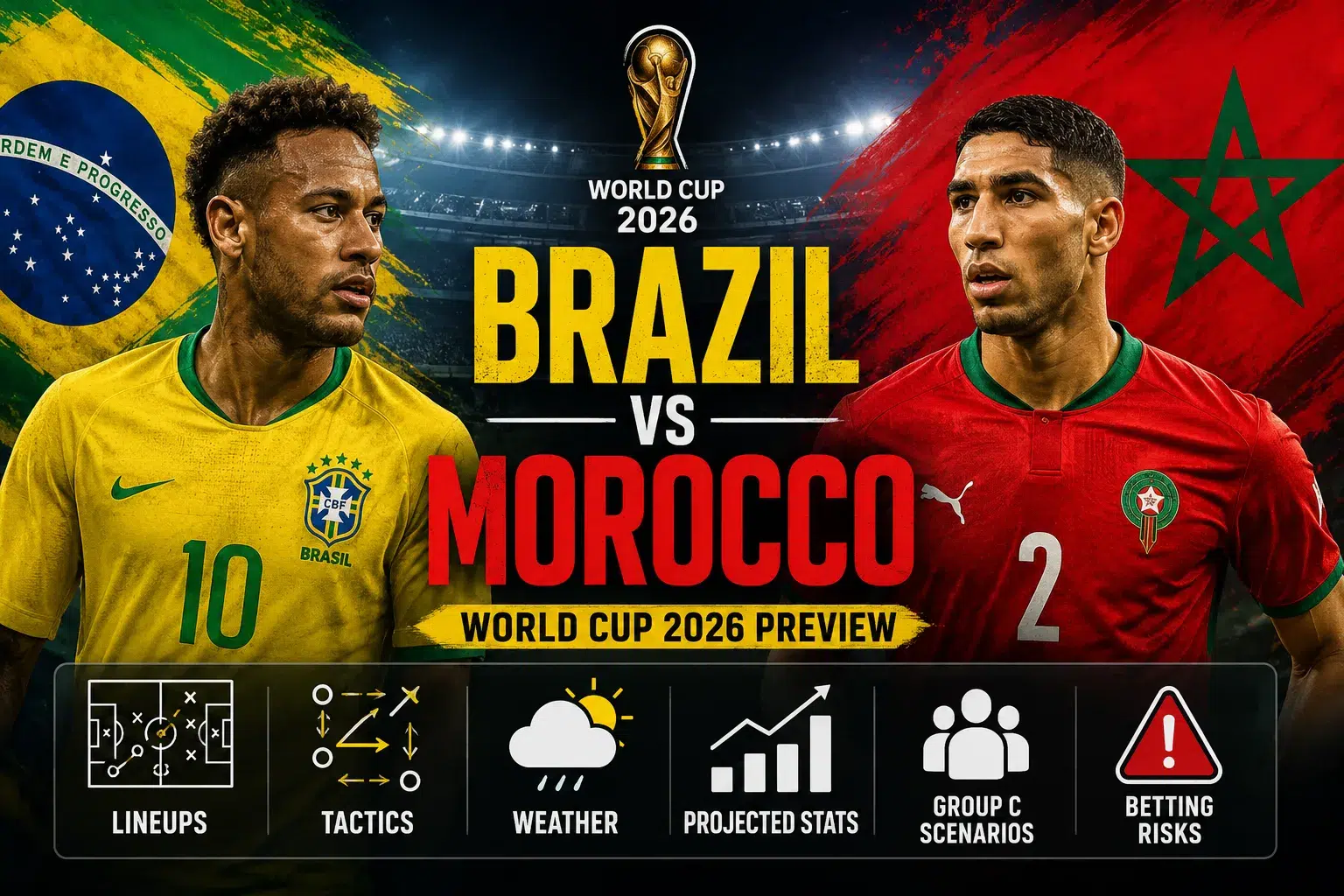
Brazil face Morocco in a FIFA World Cup 2026 Group C match at New York/New Jersey Stadium in East Rutherford, New Jersey, on Saturday, 13 June 2026. Kick-off is scheduled for 6:00 p.m. ET, which corresponds to 22:00 GMT. The match belongs to Group C, where Brazil and Morocco share the section with Haiti and Scotland. This is one of the strongest early group-stage fixtures because Brazil are five-time world champions chasing a sixth title, while Morocco arrive as the 2022 World Cup semi-finalists and recent African champions.
Brazil enter under Carlo Ancelotti with world-class attacking quality through Vinicius Junior, Raphinha, Bruno Guimarães and other elite players, but the squad has been hit by injury disruption. Neymar is unavailable for the Morocco opener, while Rodrygo, Estêvão, Éder Militão and Wesley are also reported absent. Morocco enter under Mohamed Ouahbi with confidence, structure, Achraf Hakimi’s leadership, Yassine Bounou’s goalkeeping, Brahim Díaz’s creativity and the memory of beating Spain and Portugal in Qatar.
The likely tactical shape points to Brazil possession and wide attacking pressure against Morocco’s compact block, fast full-back transitions and set-piece discipline. The key matchup is Vinicius Junior against Achraf Hakimi’s defensive and transition side. This preview explains match facts, team news, predicted lineups, tactical patterns, weather, projected statistics, Group C scenarios and responsible betting risks. It does not provide guaranteed betting advice.
| Field | Data |
|---|---|
| Match | Brazil vs Morocco |
| Competition | FIFA World Cup 2026 |
| Stage | Group Stage / First Stage |
| Group | Group C |
| Date | Saturday, 13 June 2026 |
| Kick-off Time | 6:00 p.m. ET / 22:00 GMT |
| Stadium | New York/New Jersey Stadium |
| City | East Rutherford / New York-New Jersey area |
| Host Country | United States |
| Expected Attendance | Not available from verified public data in the current source set |
| Referee | Not available from verified public data in the current source set |
| VAR | Not available from verified public data in the current source set |
| Weather Forecast | Mostly clear around kick-off, approximately 88°F / 31°C |
| Pitch Context | Tournament venue surface; exact match-day pitch speed not available from verified public data |
| Main Article Focus | Pre-match probability dossier, projected lineups, tactics, weather, projected stats, betting risks, Group C scenarios |
Brazil vs Morocco is not a normal group-stage opener. It is a heavyweight test inside a group that also includes Haiti and Scotland. Brazil carry the expectation of a football superpower. Morocco carry the authority of a team that already proved it can beat elite opponents in a World Cup setting.
Brazil’s story is complicated by injuries. Carlo Ancelotti begins a major tournament with Brazil while missing several players who could have shaped the starting XI or the attacking rotation. That does not remove Brazil’s talent edge, but it reduces flexibility and increases the burden on Vinicius Junior, Raphinha, Bruno Guimarães, Casemiro and the remaining attacking structure.
Morocco’s story is no longer a pure underdog story. Their 2022 World Cup run changed how opponents read them. They can defend deeply. They can transition. They can handle pressure. They can also carry the ball through elite players and attack with full-backs. Their challenge is different now. They are not surprising the world. They are defending a higher standard.
The match should be read through four lenses:
Brazil vs Morocco matters because Brazil need an opening win to validate their sixth-title campaign, while Morocco can confirm their elite-tournament status by taking points from a five-time world champion in a difficult Group C.
A professional World Cup preview must separate confirmed facts from projections. This matters strongly for Brazil vs Morocco because the match includes injury uncertainty, probable tactical adjustments, dynamic betting markets and no verified official starting lineups in the current source set.
| Category | Status | Brazil vs Morocco Example | Article Use |
|---|---|---|---|
| Confirmed fact | Verified before publication | Brazil vs Morocco, Group C, New York/New Jersey Stadium | Hard match base |
| Match timing | Verified fixture data | 13 June 2026, 22:00 GMT / 6:00 p.m. ET | Match snapshot |
| Tournament context | Verified fixture context | Group C includes Brazil, Morocco, Haiti and Scotland | Group scenario analysis |
| Team-news report | Verified media reporting | Neymar ruled out; Rodrygo, Estêvão, Éder Militão and Wesley unavailable | |
| Morocco team-news report | Verified media reporting | Nayef Aguerd and Abde Ezzalzouli absent after injuries | Team-news section |
| Probable information | Tactical forecast | Brazil likely control possession; Morocco likely defend compactly and transition | Tactical sections |
| Projected data | Model-based estimate | Possession, shots, xG, cards, corners | Ranges only |
| Unknown data | Not verified in current source set | Referee, VAR, exact attendance, official starting XIs | Marked unavailable |
| Scenario-based analysis | Possible future pattern | Morocco may target space behind Brazil full-backs | Written as “may”, “could”, “likely”, “watch for” |
This distinction protects reader trust. A predicted XI is not an official lineup. A projected xG range is not a final match statistic. A betting market signal is not a guaranteed outcome. A tactical forecast can change after one early goal, one injury, one red card or one VAR decision.
This article uses probability language. It treats future match events as scenarios, not facts. It does not claim that any goal, card, injury, substitution or referee decision will happen at a specific minute.
Group C contains Brazil, Morocco, Haiti and Scotland. Brazil are the biggest global name in the group. Morocco are the recent World Cup semi-finalists and one of the strongest African sides. Scotland and Haiti both return to the World Cup after long absences. That makes the Brazil vs Morocco opener the highest-profile Group C match on paper.
| Team | Pre-Match Points | Goal Difference | Opening-Match Pressure | Main Need |
|---|---|---|---|---|
| Brazil | 0 | 0 | Very high | Win opener and control group early |
| Morocco | 0 | 0 | High | Prove 2022 was not a one-tournament spike |
| Haiti | 0 | 0 | High | Compete and protect goal difference |
| Scotland | 0 | 0 | High | Build qualification platform |
The expanded World Cup format changes group strategy. The top two teams in each group advance directly to the Round of 32. The best third-placed teams can also advance. That makes a draw useful, but it also makes goal difference important. A narrow defeat can be recoverable. A heavy defeat can damage a third-place route.
Brazil and Morocco both know this match can shape the group. Brazil can take early control with a win. Morocco can make the group unstable with a draw or victory. Both teams must balance ambition with risk.
Brazil’s stakes are always high. Five World Cup titles create permanent expectation. The sixth-title narrative has followed Brazil since 2002. Every new generation enters the tournament under the same question: can Brazil return to the top?
This opener adds a special layer. Carlo Ancelotti gives Brazil a coach with elite European authority, but he starts the tournament with a disrupted squad. Neymar’s absence changes the emotional and creative profile. Rodrygo and Estêvão’s absence reduces attacking depth. Éder Militão’s absence removes defensive quality and recovery speed. Wesley’s absence limits a potential full-back option.
Brazil still have Vinicius Junior, Raphinha, Bruno Guimarães, Casemiro, Lucas Paquetá, Marquinhos, Gabriel Magalhães and Alisson-type elite profiles in the broader squad picture. They have enough talent to win. The problem is not talent. The problem is structure and adaptation.
Brazil’s practical objectives:
Morocco’s stakes are different. Their 2022 run changed their status. They no longer enter elite matches as unknown underdogs. Opponents now respect their defensive organization, goalkeeper quality, full-back strength and transition game.
Mohamed Ouahbi’s task is to keep that authority while adapting to injury absences. Nayef Aguerd’s absence affects centre-back balance. Abde Ezzalzouli’s absence reduces wing depth and one-vs-one threat. Morocco still have Achraf Hakimi, Yassine Bounou, Noussair Mazraoui, Brahim Díaz, Azzedine Ounahi, Sofyan Amrabat-type midfield steel if selected, and other strong technical profiles.
Morocco can treat this match as a statement. A draw against Brazil would be valuable. A win would change the group and reinforce Morocco’s status as a serious knockout-stage candidate.
Morocco’s practical objectives:
| Result | Brazil Impact | Morocco Impact | Group C Meaning |
|---|---|---|---|
| Brazil win | Brazil take early control and reduce pressure before Haiti/Scotland context | Morocco must recover in match two | Brazil become clear group leader |
| Draw | Brazil lose expected-margin points but stay stable | Morocco gain a strong platform | Group C becomes more balanced |
| Morocco win | Brazil face immediate scrutiny and pressure | Morocco become serious group-control candidate | Group hierarchy shifts sharply |
Brazil have the pressure of expectation. They are not allowed to “just start slowly” in the eyes of many supporters. A cautious opening 30 minutes can be interpreted as weakness. That is dangerous because Morocco are built to exploit impatient opponents.
Morocco have the pressure of validation. Their 2022 run created belief, but it also created expectation. They must show that their identity survives a new tournament, a new coach situation and injury changes.
The emotional winner may be the team that manages the first 20 minutes better.
| Factor | Match Relevance |
|---|---|
| Host country | United States |
| Venue region | New York/New Jersey area |
| Neutral match | Neither team is host nation |
| Fan profile | Strong Brazilian support expected; Moroccan diaspora support possible |
| Travel context | Both teams manage North American travel and climate adaptation |
| Event scale | Major stadium and global broadcast audience |
| Climate | Warm evening conditions in New Jersey |
This is officially a neutral match. It may not feel neutral. Brazil attract large global support, and the New York/New Jersey area has enough international football culture to create a loud environment. Morocco can also expect strong diaspora support.
Crowd emotion can matter. Brazil may feel crowd-driven expectation. Morocco may benefit if the stadium grows tense after a long 0-0 spell. The environment can shift from carnival to pressure quickly.
| City Factor | Expected Tactical Impact |
|---|---|
| Evening kick-off | Reduces peak daytime heat but remains warm |
| Temperature around 88°F / 31°C near kick-off | Hydration and pacing matter |
| Mostly clear conditions | Stable visibility and ball flight |
| No major altitude issue | Normal sprint recovery model |
| Large stadium environment | Communication and emotional control matter |
| Travel adjustment | More relevant for rhythm than altitude |
| Urban event context | High crowd intensity and media pressure |
The weather is warm enough to affect the match. An 88°F / 31°C evening does not make football impossible, but it changes pressing cost. Repeated high pressing can become expensive. Recovery after long transitions can slow. Substitution timing can matter.
Brazil may want to control the ball and move Morocco side to side. Morocco may want to defend compactly and counter selectively. Warm conditions make both tasks more demanding. Brazil must avoid slow, sterile possession. Morocco must avoid spending too long chasing.
| Stadium Detail | Data |
|---|---|
| Stadium | New York/New Jersey Stadium |
| Location | East Rutherford / New York-New Jersey area |
| Country | United States |
| Match Role | Brazil and Morocco Group C opener |
| Kick-off | 6:00 p.m. ET / 22:00 GMT |
| Weather Near Kick-off | Mostly clear, around 88°F / 31°C |
| Roof | Not treated as a closed-roof match in this preview |
| Pitch Speed | Not available from verified public data |
| Tactical Impact | Warm conditions, large crowd, pressure-heavy environment |
| Weather / Environment Factor | Tactical Meaning |
|---|---|
| Warm evening temperature | Pressing must be controlled rather than constant |
| Mostly clear conditions | Stable visibility and delivery |
| No altitude issue | Normal oxygen and recovery model |
| Large stadium | Communication and emotional rhythm matter |
| Pitch speed unknown | Avoid exact claims about bounce or surface |
| Hydration demand | Substitution timing and tempo management matter |
| Possible late fatigue | Transition defense can weaken after repeated sprints |
The most important weather factor is heat load. The match is not extreme, but it is warm enough to influence pressing, hydration, cramps and late defensive tracking. Brazil should use possession to manage energy. Morocco should defend in compact zones rather than chase every pass.
Brazil’s team-news section is one of the most important parts of this preview. Carlo Ancelotti enters the opener with major absences. Neymar is ruled out for the Morocco match as he continues to recover from a calf issue. Rodrygo, Estêvão, Éder Militão and Wesley are also reported unavailable. That is a major reduction in attacking flexibility, defensive recovery and right-side options.
| Player / Role | Status | Tactical Impact |
|---|---|---|
| Neymar | Ruled out for Morocco opener | Removes senior creative star and emotional reference |
| Rodrygo | Reported unavailable | Reduces attacking rotation and half-space quality |
| Estêvão | Reported unavailable | Removes young wide attacking option |
| Éder Militão | Reported unavailable | Reduces defensive speed, aerial depth and centre-back/full-back flexibility |
| Wesley | Reported unavailable | Limits full-back or wide defensive rotation |
| Vinicius Junior | Available in pre-match reporting | Main ball-carrier and left-side attacking weapon |
| Raphinha | Available in pre-match reporting | Right/left attacking threat, pressing and delivery |
| Bruno Guimarães | Projected key midfielder | Progression, duels and tempo control |
| Casemiro | Projected midfield anchor | Screening, defensive structure and set-piece presence |
| Alisson | Projected senior goalkeeper | Shot-stopping and calm distribution |
Neymar’s absence changes Brazil’s creative structure. It can make the team less dependent on one player, but it also removes a player who can slow tempo, draw fouls and decide tight matches with individual technique. Rodrygo’s absence matters because he can connect Madrid-style movements with Vinicius. Estêvão’s absence removes an unpredictable wide profile. Militão’s absence matters against Morocco transitions because recovery speed and defensive versatility are valuable.
Brazil still have elite quality. The issue is balance. Ancelotti must create a structure where Vinicius and Raphinha can attack without leaving transition lanes exposed.
Morocco also enter with injury problems. Nayef Aguerd and Abde Ezzalzouli are reported out after injuries suffered in Morocco’s final friendly against Norway. Achraf Hakimi is reported back after a thigh issue and leads a team that wants to show it no longer belongs in the underdog category.
| Player / Role | Status | Tactical Impact |
|---|---|---|
| Nayef Aguerd | Reported unavailable | Reduces left-sided centre-back quality and defensive balance |
| Abde Ezzalzouli | Reported unavailable | Reduces wing depth and direct wide threat |
| Achraf Hakimi | Recovered in pre-match reporting | Main right-side leader, transition weapon and defensive matchup |
| Yassine Bounou | Projected key goalkeeper | Shot-stopping, box command and calm under pressure |
| Brahim Díaz | Projected key attacker | Creative link, dribbling and central/wide threat |
| Azzedine Ounahi | Projected midfield player | Carrying, pressure resistance and progression |
| Noussair Mazraoui | Projected full-back option | Defensive flexibility and buildup |
| Sofyan Amrabat | Projected midfield screen if selected | Ball-winning and central protection |
Aguerd’s absence matters because Brazil can attack the space and aerial matchups around Morocco’s centre-backs. Ezzalzouli’s absence matters because he gives direct wide threat and bench impact. Morocco still have structure and talent, but their rotation is thinner.
| Player | Team | Issue / Status | Match Impact |
|---|---|---|---|
| Neymar | Brazil | Ruled out for opener | Removes senior creative option |
| Rodrygo | Brazil | Reported unavailable | Reduces attacking depth |
| Estêvão | Brazil | Reported unavailable | Reduces wing rotation |
| Éder Militão | Brazil | Reported unavailable | Reduces defensive speed and flexibility |
| Wesley | Brazil | Reported unavailable | Reduces full-back rotation |
| Nayef Aguerd | Morocco | Reported unavailable | Reduces defensive balance |
| Abde Ezzalzouli | Morocco | Reported unavailable | Reduces wing depth |
| Achraf Hakimi | Morocco | Recovered from thigh issue in pre-match reporting | Key player but physical workload should be monitored |
No confirmed suspension issue was available in the verified source set. Card risk is analyzed as a match forecast, not confirmed disciplinary data.
Official starting lineups were not available from verified public data in the current source set. The following lineups are projected XIs based on public pre-match reporting, squad context and tactical logic. They should be replaced by official team sheets before publication if available.
| Position / Line | Player | Likely Role |
|---|---|---|
| GK | Alisson | Goalkeeper, distribution and shot-stopping |
| RB | Danilo | Defensive balance, leadership and right-side coverage |
| CB | Marquinhos | Centre-back organizer and buildup player |
| CB | Gabriel Magalhães | Left-sided centre-back, aerial power |
| LB | Alex Sandro / left-back option | Defensive full-back, balance behind Vinicius |
| DM | Casemiro | Midfield screen, duels and set-piece presence |
| CM | Bruno Guimarães | Progression, tempo and counter-pressing |
| CM / AM | Lucas Paquetá | Final-third link, ball retention and box support |
| RW | Raphinha | Wide threat, pressing and delivery |
| ST | Matheus Cunha / striker option | Link striker, pressing and central occupation |
| LW | Vinicius Junior | Main left-side attacker and transition weapon |
| Position / Line | Player | Likely Role |
|---|---|---|
| GK | Yassine Bounou | Goalkeeper, shot-stopper, box command |
| RB | Achraf Hakimi | Right-back, transition leader, overlap threat |
| CB | Chadi Riad / centre-back option | Centre-back replacing Aguerd-side balance |
| CB | Issa Diop / centre-back option | Aerial and physical defender |
| LB | Noussair Mazraoui | Left-back / inverted support, defensive flexibility |
| CM | Sofyan Amrabat / holding option | Defensive screen and ball-winning |
| CM | Azzedine Ounahi | Carrying, progression and midfield release |
| CM | Neil El Aynaoui / Ayyoub Bouaddi option | Midfield energy and passing support |
| RW | Brahim Díaz | Creative attacker, inside movement |
| ST | Youssef En-Nesyri / central striker option | Penalty-box target and aerial presence |
| LW | Ismael Saibari / Bilal El Khannouss option | Half-space link and support runner |
| Team | Base Formation | In Possession | Out of Possession | Confidence |
|---|---|---|---|---|
| Brazil | 4-3-3 / 4-2-3-1 | 2-3-5 or 3-2-5 with full-back balance | 4-4-2 press or 4-1-4-1 block | Medium |
| Morocco | 4-3-3 / 4-1-4-1 | 2-3-5 in controlled phases, direct transition after recoveries | 4-5-1 / compact 4-1-4-1 | Medium |
| Scenario | Trigger | Expected Change |
|---|---|---|
| Brazil add more control | Morocco counter through Hakimi/Brahim | Casemiro stays deeper, full-backs more conservative |
| Brazil chase more speed | Morocco defend deep | Wide attackers stay high, striker attacks central gaps |
| Brazil need late goal | Level after 60’ | Extra attacker or more aggressive full-back profile |
| Brazil protect lead | Leading after 70’ | More midfield control and less full-back risk |
| Morocco add more protection | Vinicius isolates Hakimi side repeatedly | Extra midfielder shifts toward that flank |
| Morocco chase goal | Trailing after 60’ | More direct forward support and earlier crosses |
| Morocco protect draw | Level after 70’ | Bounou tempo management, deeper midfield block |
The lineup uncertainty is important. Brazil’s injuries reduce rotation. Morocco’s Aguerd and Ezzalzouli absences reduce defensive and attacking depth. Both coaches may choose more balance than normal because the opener is high-risk.
| Phase | Expected Pattern |
|---|---|
| Build-up | Centre-back circulation, Bruno Guimarães progression, Casemiro screen |
| Attack | Vinicius isolation, Raphinha width, Paquetá combinations, striker link play |
| Defense | Controlled press, rest defense behind full-backs |
| Transitions | Quick release to Vinicius and Raphinha after recoveries |
| Set pieces | Gabriel, Marquinhos, Casemiro and striker targets |
| Weakness | Injury-reduced depth, transition space behind full-backs, pressure of expectation |
Brazil should build with control rather than rush. Ancelotti’s teams usually value structure, timing and positional spacing. Brazil can use centre-backs to attract pressure, then progress through Bruno Guimarães or Paquetá. Casemiro can protect the first line and stop counters before they develop.
The full-back balance is crucial. If both Brazilian full-backs push high, Morocco can attack the empty zones through Hakimi, Brahim Díaz or Ounahi. Brazil need one full-back to support attacks while the opposite side maintains rest defense.
Vinicius should not receive only from long isolated passes. Brazil need to create conditions for him: diagonal switches, one-vs-one spacing, underlapping support and quick central connections after he draws defenders.
Brazil’s attack should use width, tempo variation and individual superiority. Vinicius is the obvious left-side weapon. Raphinha can attack from the right or provide inverted actions depending on shape. Paquetá can link midfield and attack. Bruno can progress through pressure.
Brazil should avoid two mistakes:
The best Brazil attacks can come from:
Brazil’s defensive challenge is not long defensive spells. It is transition control. Morocco may not dominate possession, but they can create dangerous moments from recoveries. Hakimi can run into space. Brahim can receive between lines. Ounahi can carry out of pressure.
Brazil must stop Morocco’s first forward pass after turnovers. Casemiro and Bruno are central to that. If Brazil lose the ball with Vinicius and the full-back high, they need immediate pressure or spacing behind the ball.
| Weakness | How Morocco Can Target It |
|---|---|
| Injury-reduced attacking depth | Force Brazil into long, frustrating possessions |
| Space behind full-backs | Use Hakimi and Brahim in transition |
| Neymar/Rodrygo absence | Force Brazil to solve creativity through fewer players |
| Militão absence | Test recovery speed and aerial balance |
| Pressure of expectation | Keep match level and slow tempo |
| Heat management | Make Brazil press repeatedly without clean recoveries |
| Phase | Expected Pattern |
|---|---|
| Build-up | Mixed build-up with Bounou, full-back outlets and midfield carriers |
| Attack | Right-side transitions through Hakimi, Brahim link play, striker aerial threat |
| Defense | Compact 4-5-1 / 4-1-4-1, central protection |
| Transitions | Fast release into wide and half-space runners |
| Set pieces | Bounou security, Hakimi delivery, aerial targets |
| Weakness | Aguerd absence, Brazil’s wide dribbling, defending repeated switches |
Morocco should not force risky short passes if Brazil press high. Bounou can play short or go longer. Ounahi can carry through pressure. Amrabat-type midfield protection can help the first pass. Hakimi can act as a wide outlet if Brazil overload the opposite side.
Morocco’s build-up goal is not to out-possess Brazil. It is to escape pressure and create enough threat that Brazil cannot attack without caution.
Morocco’s best attacking route may come from the right side. Hakimi can overlap, underlap or carry into space. Brahim Díaz can move inside and connect. Ounahi can support through midfield carries.
The striker role matters. A forward such as En-Nesyri gives aerial threat and box presence. Against Brazil, that can help Morocco turn limited possession into penalty-box stress.
Morocco can attack through:
Morocco’s defensive identity should begin with compactness. They must stop Brazil from attacking central areas too easily. They should force Brazil wide, then defend crosses with numbers. They must also protect the far post because Brazil can switch play quickly.
The Vinicius side requires a plan. Morocco cannot rely on one defender alone. Hakimi is elite, but Vinicius can still create danger if he receives with space. Morocco need midfield support, centre-back cover and timing.
| Weakness | How Brazil Can Target It |
|---|---|
| Aguerd absence | Attack centre-back spacing and aerial matchups |
| Ezzalzouli absence | Reduce Morocco’s left-wing direct threat |
| Defending Vinicius repeatedly | Create overloads and force help rotations |
| Deep block fatigue | Move ball side to side in warm conditions |
| Bounou workload | Create rebounds and second balls |
| Full-back overcommitment | Counter behind Hakimi if he pushes too high |
| Zone | Brazil Edge | Morocco Edge | Likely Control | Why It Matters |
|---|---|---|---|---|
| Brazil left / Morocco right | Vinicius dribbling and acceleration | Hakimi recovery speed and transition threat | Balanced elite duel | Match’s headline zone |
| Brazil right / Morocco left | Raphinha delivery and pressing | Mazraoui flexibility | Brazil slight edge | Can punish Morocco focus on Vinicius |
| Central midfield | Bruno, Casemiro, Paquetá quality | Ounahi carrying, Amrabat-type ball-winning | Brazil slight edge in possession | Decides tempo and counter control |
| Penalty box | Brazil movement and set-piece targets | Bounou, Morocco centre-backs, striker outlet | Balanced | Decides chance conversion |
| Set pieces | Gabriel/Marquinhos/Casemiro targets | Hakimi delivery, En-Nesyri-type aerial threat | Balanced | Can decide a tight match |
| Transitions | Brazil speed after recoveries | Morocco Hakimi/Brahim outlet | Morocco threat if Brazil overcommit | Main underdog route |
| Defensive third | Brazil likely defend less often | Morocco likely defend more phases | Morocco under pressure | Concentration and fatigue test |
This is the match’s clearest elite duel. Vinicius is Brazil’s main destabilizer. Hakimi is Morocco’s most important wide defender and transition runner. The duel is not only about one-vs-one defending. It is about space, support and transition balance.
Why it matters: If Vinicius beats the first defender repeatedly, Morocco’s block must tilt. That opens central and opposite-side spaces. If Hakimi controls the duel and attacks forward, Brazil’s left side becomes a defensive concern.
What to watch: Whether Vinicius receives in isolation or with Morocco’s midfield already shifted toward him.
Risk trigger: If Hakimi or a nearby Moroccan midfielder receives an early yellow card, Brazil may attack that side more aggressively.
Bruno can decide whether Brazil’s possession has progression or only circulation. Morocco must prevent him from turning forward easily.
Why it matters: Brazil need clean service into the attacking line. If Bruno breaks pressure, Brazil can attack before Morocco set the block.
What to watch: Bruno’s first forward pass after Brazil recover the ball.
Risk trigger: If Morocco’s midfield screen loses spacing, Brazil can create central entries.
Bounou may face pressure even if Morocco defend well. His command of the box and rebound control can keep Morocco in the game.
Why it matters: Brazil may create shot volume. Bounou must prevent rebounds and handle crosses under pressure.
What to watch: Whether Brazil force saves from central areas or only from wide/low-xG positions.
Risk trigger: One early save can lift Morocco; one rebound can give Brazil a second-chance goal opportunity.
Brazil’s greatest tactical risk is not being dominated. It is being countered. Morocco can attack the space behind full-backs quickly.
Why it matters: If Brazil control rest defense, Morocco’s route narrows. If Brazil overcommit, Morocco can create high-value chances from fewer attacks.
What to watch: Casemiro’s position after Brazil lose the ball.
Risk trigger: A Brazil full-back high with no midfield cover creates Morocco’s cleanest transition route.
Brazil’s centre-backs must defend set pieces, crosses and direct balls. Morocco can create value from limited possession if they win aerial moments.
Why it matters: A set-piece goal can break the possession model.
What to watch: Marking on the first Morocco corner or wide free kick.
Risk trigger: A foul near the box gives Morocco a chance without open-play control.
These numbers are projected ranges, not confirmed match data.
| Projected Stat | Brazil | Morocco | Confidence | Reason |
|---|---|---|---|---|
| Possession | 55–62% | 38–45% | Medium | Brazil likely control more ball |
| Shots | 12–17 | 7–11 | Medium | Brazil attacking volume edge |
| Shots on Target | 4–7 | 2–4 | Medium | Morocco can limit central quality |
| xG Range | 1.30–2.00 | 0.70–1.30 | Low/Medium | Morocco transitions and set pieces can shift profile |
| Big Chances | 1–3 | 0–2 | Low/Medium | Brazil have volume, Morocco have high-value counter route |
| Corners | 5–8 | 3–5 | Medium | Brazil wide pressure likely creates blocks |
| Fouls | 10–14 | 12–17 | Medium | Morocco may defend more duels |
| Yellow Cards | 1–3 | 2–4 | Low/Medium | Referee unknown |
| Red Card Risk | Low | Low/Medium | Low | Repeated wide duels can raise Morocco risk |
| Offsides | 1–3 | 1–2 | Low | Vinicius and Moroccan counters can trigger lines |
| Saves | 2–4 | 3–6 | Medium | Bounou may face more pressure |
| Crosses | 16–24 | 10–16 | Medium | Brazil likely use width and switches |
| Tackles | 14–20 | 18–25 | Medium | Morocco likely defend more phases |
| Interceptions | 8–13 | 10–16 | Medium | Morocco block can cut passing lanes |
| Clearances | 12–20 | 22–32 | Medium | Morocco may defend deeper for periods |
Brazil should lead possession, shots and corners. That does not guarantee a comfortable match. Morocco can defend long phases and create danger from fewer attacks. The key statistic is chance quality, not possession.
If Brazil create cutbacks, central entries and clean Vinicius/Raphinha isolations, their xG can rise toward the upper range. If Morocco force Brazil into long shots and predictable crosses, Brazil’s possession can become lower-value.
Morocco’s xG depends on transition efficiency and set pieces. One clean Hakimi-Brahim transition or one set-piece header can make Morocco dangerous even with limited ball control.
This table does not predict exact events. It identifies likely windows where tactical risk may shift.
| Match Window | Tactical State | Physical State | Card Risk | Goal Risk | Betting Market Trigger |
|---|---|---|---|---|---|
| 1’–15’ | Brazil likely test Morocco’s block; Morocco search for early transition signal | Fresh legs, high emotion | Low/Medium | Medium | First Vinicius duel, first Hakimi outlet |
| 16’–30’ | Brazil possession rhythm becomes clearer | Heat load starts to matter | Medium | Medium | Brazil corners, Morocco counters |
| 31’–45+’ | If level, Brazil may increase pressure; Morocco can slow tempo | More contact and set-piece duels | Medium/High | Medium | Late first-half set pieces |
| 46’–60’ | Coaches adjust from first-half evidence | Reset intensity | Medium | Medium | Brazil attacking changes, Morocco block height |
| 61’–75’ | Space can open as heat and chasing runs accumulate | Fatigue rises | High | Medium/High | Live totals, cards, winger duels |
| 76’–90+’ | Game state dominates | Cramps and time management possible | High | High | Late corners, transition risk, penalty appeals |
Brazil should begin with controlled possession. The goal should be to test Morocco’s shape, not to force quick shots. Morocco need one early counter or one clean buildup escape to show Brazil the match has risk.
The match’s pattern becomes clearer. If Brazil isolate Vinicius and Raphinha repeatedly, Morocco must adjust. If Morocco release Hakimi or Brahim into space, Brazil must reduce full-back risk.
If the score remains level, Brazil pressure can rise. Morocco can use this window to slow tempo, defend set pieces and reach half-time with belief. Late first-half fouls and corners can matter.
Half-time adjustments matter. Brazil may change the spacing around Vinicius or move Paquetá closer to the front line. Morocco may shift extra help toward Brazil’s left or push Hakimi forward selectively.
This is the high-variance window. Warm conditions, substitutions, fatigue and cards begin to matter. Brazil may increase attacking pressure. Morocco may find larger transition spaces if Brazil chase.
Game state rules the final phase. If Brazil lead, they should control transitions. If Morocco lead or draw, they may defend deeper and rely on Bounou and compactness. If Brazil chase, Morocco’s counter route becomes stronger.
| Factor | Expected Impact | Brazil Effect | Morocco Effect |
|---|---|---|---|
| Warm evening around 88°F / 31°C | Pressing cost and hydration demand rise | Brazil must manage tempo | Morocco must avoid excessive chasing |
| Mostly clear conditions | Stable visibility and ball flight | Supports switches and wide attacks | Supports long outlets and set pieces |
| No altitude issue | Normal oxygen/recovery model | Helps technical rhythm | Helps transition bursts |
| Wind not verified | Do not overstate crossing impact | Unknown | Unknown |
| Pitch speed not verified | Avoid exact surface claims | Affects passing if fast | Affects clearances if slick |
| Large stadium | Emotional pressure and communication stress | Brazil expectation rises | Morocco can use tension if level |
The most important weather factor is warm temperature. It can affect repeated pressing, defensive shifting, hydration and late fatigue. Brazil should use possession to control energy. Morocco should defend compactly and choose pressing moments carefully.
| Player | Team | Role | Impact Score /10 | Why |
|---|---|---|---|---|
| Vinicius Junior | Brazil | Left winger / main ball-carrier | 9.2 | Primary Brazil destabilizer and elite one-vs-one threat |
| Raphinha | Brazil | Wide forward | 8.7 | Pressing, delivery, shooting and opposite-side threat |
| Bruno Guimarães | Brazil | Midfield progressor | 8.6 | Connects possession to chance creation |
| Casemiro | Brazil | Defensive midfielder | 8.3 | Rest-defense anchor and set-piece presence |
| Marquinhos | Brazil | Centre-back leader | 8.1 | Defensive organization and buildup calm |
| Gabriel Magalhães | Brazil | Centre-back / aerial defender | 8.0 | Set-piece target and Morocco aerial defense |
| Alisson | Brazil | Goalkeeper | 8.0 | May face fewer but high-value transition moments |
| Achraf Hakimi | Morocco | Right-back / transition leader | 9.0 | Defensive duel with Vinicius and attacking outlet |
| Yassine Bounou | Morocco | Goalkeeper | 8.8 | Shot-stopping and box command under Brazil pressure |
| Brahim Díaz | Morocco | Creative attacker | 8.5 | Main technical link in transition and final third |
| Azzedine Ounahi | Morocco | Midfield carrier | 8.2 | Pressure release and progression |
| Sofyan Amrabat | Morocco | Midfield screen | 8.1 | Ball-winning and central protection if selected |
| Noussair Mazraoui | Morocco | Full-back | 7.9 | Defensive flexibility and buildup support |
Vinicius Junior is Brazil’s most important attacker because he changes defensive shape. Morocco must assign support to his side, and that can open other zones. For Morocco, Brahim Díaz is the most important attacker because he can turn limited possession into high-quality transitions.
Achraf Hakimi is Morocco’s most important defensive and attacking player because he faces Vinicius while also offering a transition route. For Brazil, Marquinhos and Gabriel must control set pieces and prevent Morocco from turning limited chances into goals.
Bruno Guimarães is Brazil’s most important midfielder because he can break pressure and connect to the front line. Morocco’s most important midfield role belongs to the player who screens central passes and releases Ounahi or Brahim after recoveries.
Brazil’s injury list reduces the bench’s attacking glamour, but any fresh wide runner or striker profile can matter after 60 minutes. Morocco’s bench can change the match through added forward speed, extra midfield protection or a second striker if chasing. Specific bench names should be updated once official team sheets are available.
The referee and VAR were not available from verified public data in the current source set. Therefore, this discipline preview uses tactical logic rather than referee-profile claims.
| Discipline Factor | Forecast |
|---|---|
| Referee style | Not available from verified public data |
| Tactical foul risk | Medium/high |
| Dissent risk | Medium because of elite-match pressure |
| VAR intervention risk | Medium |
| Penalty risk | Medium |
| Red-card risk | Low/medium |
| Team | Yellow Card Range | Red Card Risk | Main Risk Zone |
|---|---|---|---|
| Brazil | 1–3 | Low | Counter-fouls after Morocco transitions |
| Morocco | 2–4 | Low/Medium | Wide duels against Vinicius and Raphinha |
Morocco may carry the higher yellow-card range because they are likely to defend more one-vs-one actions against elite dribblers. Brazil’s risk comes after turnovers. If Morocco break into space, Brazil may need tactical fouls.
The card risk rises if:
Set pieces can decide a match with this level of defensive quality. Brazil have aerial targets. Morocco have delivery, Bounou’s defensive command and potential aerial threat.
| Set-Piece Area | Brazil | Morocco | Edge |
|---|---|---|---|
| Corners for | Gabriel, Marquinhos, Casemiro and striker targets | Bounou command, centre-back protection | Brazil slight aerial edge |
| Corners against | Must defend Moroccan aerial runners | Must defend Brazil size and rebounds | Balanced |
| Wide free kicks | Raphinha/Paquetá delivery options | Hakimi/Brahim delivery options | Balanced |
| Direct free kicks | Not verified as fixed taker hierarchy | Hakimi/Brahim possible threat | Unknown / Morocco slight technical threat |
| Penalties | Taker hierarchy not verified | Taker hierarchy not verified | Unknown |
| Long throws | Not available from verified public data | Not available from verified public data | Unknown |
| Second balls | Casemiro/Bruno important | Ounahi/Amrabat important | Balanced |
Brazil can use set pieces to attack Morocco’s Aguerd-less defensive structure. Morocco can use set pieces to reduce Brazil’s possession edge. Both teams must defend second balls. A clearance without pressure can become another attack.
| Area | Brazil | Morocco |
|---|---|---|
| Goalkeeper distribution | Alisson supports buildup and pressure release | Bounou can go short or long under pressure |
| Shot-stopping pressure | Medium | Medium/high |
| Cross handling | Medium | High because Brazil may attack wide |
| High-line risk | Brazil risk space behind full-backs | Morocco risk depth if full-backs step high |
| Penalty-box defending | Must defend set pieces and En-Nesyri-type aerial threat | Must track Vinicius, Raphinha and Brazil runners |
| Back-post weakness | Possible if full-backs overcommit | Possible against Brazil switches |
| Communication | Must manage counters | Must manage sustained pressure |
Bounou may face more total pressure because Brazil should generate more possession and shots. Alisson may face fewer actions, but those actions can be dangerous because Morocco transitions can produce high-value chances.
Brazil’s defensive risk is transition. Morocco’s defensive risk is sustained pressure and individual duels against elite wide attackers.
Substitution forecasts are scenarios, not certainties.
| Minute Window | Brazil Possible Change | Morocco Possible Change | Trigger |
|---|---|---|---|
| 45’–60’ | Add control, adjust full-back height, change striker support | Add midfield protection or fresh wide runner | First-half imbalance |
| 60’–75’ | Add attacking runner or more central link player | Add forward speed or deeper screen | Score pressure |
| 75’–90’ | Protect lead or chase winner | Protect draw/lead or counter with fresh legs | Game state |
Brazil should control possession and protect transition lanes. They should not turn a lead into a stretched match. Casemiro and Bruno must stay connected.
Morocco may defend deeper and use Bounou’s command, Hakimi’s outlets and midfield discipline. Brazil must avoid rushed crosses and low-value shots.
Brazil may feel stronger pressure to win. Morocco may see a draw as valuable. That emotional difference can shape substitutions and live betting markets.
This section explains market behavior. It does not provide guaranteed picks.
| Market | Current Signal | Main Risk |
|---|---|---|
| Match Winner | Brazil likely favored by squad profile and reputation | Injury disruption and Morocco defensive quality |
| Double Chance | Brazil or draw may appear safer | Low price may not match Morocco threat |
| Over/Under Goals | Moderate total profile | Early goal can open match; compact defending can suppress it |
| Both Teams to Score | Plausible | Morocco shot volume may be limited |
| Corners | Brazil corner volume may rise | Early Brazil goal can reduce pressure |
| Cards | Medium risk | Referee unknown |
| Player Shots | Vinicius, Raphinha, Brazil striker, Brahim watchlist | Role and service matter |
| Player Cards | Morocco wide defenders and Brazil transition stoppers | Referee threshold unknown |
| Trigger | Possible Market Effect |
|---|---|
| Official Brazil XI | Moves player shots, team total and match-winner confidence |
| Confirmation of Neymar/Rodrygo absences | Reduces Brazil attacking depth perception |
| Morocco defensive lineup after Aguerd absence | Moves Brazil scoring expectation |
| Hakimi fitness confirmation | Strengthens Morocco transition and defensive profile |
| Referee announcement | Moves cards and penalty markets |
| Weather update | Can affect tempo and live totals |
| Public money on Brazil | Can compress favourite price |
| Trigger | Meaning | Risk |
|---|---|---|
| Brazil create early corners | Territorial pressure | Does not guarantee high-quality chances |
| Morocco release Hakimi twice | Brazil rest defense vulnerable | Low sample can mislead |
| Vinicius beats first defender repeatedly | Brazil chance quality rises | Morocco may adjust |
| Bounou makes early saves | Morocco confidence rises | Saves can mask pressure |
| 0-0 after 60’ | Pressure shifts toward Brazil | Morocco fatigue may still rise |
| Morocco defender booked | Brazil wide attack improves | Referee threshold may change |
Responsible betting note: This preview explains match data and market behavior. It does not provide guaranteed betting advice. World Cup betting involves risk. Readers should check local gambling laws, use licensed operators, set limits and avoid chasing losses.
| Factor | How It Can Break the Forecast |
|---|---|
| Late lineup change | Changes roles, formations and set-piece matchups |
| Early goal | Forces one team to abandon base plan |
| Early yellow card | Changes wide duels and transition defending |
| Injury | Forces tactical reshuffle |
| VAR penalty | Creates non-pattern goal |
| Weather shift | Alters fatigue, ball speed and pressing cost |
| Red card | Makes pre-match stats less relevant |
| Goalkeeper error | Creates low-probability swing |
| Tactical surprise | Breaks projected matchup assumptions |
| Market overreaction | Creates false betting signal |
The forecast can fail if Morocco score first and force Brazil into emotional attacking. It can also fail if Brazil score early and make Morocco leave their compact block. One Vinicius action, one Hakimi transition, one Bounou save, one penalty or one set piece can change the entire match model.
| Scenario | Probability Band | Match Story |
|---|---|---|
| Brazil narrow win | Medium/high | Brazil control territory and create enough quality through Vinicius, Raphinha and midfield pressure |
| Draw | Medium | Morocco defend compactly, Bounou performs well and Brazil lack clean central chances |
| Morocco upset | Low/medium | Morocco score first through transition or set piece and defend with discipline |
| High-scoring match | Low/medium | Early goal opens space and both teams attack transition lanes |
| Low-scoring match | Medium/high | Morocco slow rhythm and Brazil’s injury-hit attack struggles for clear chances |
The safest scenario frame is Brazil-favoured but not Brazil-certain. Brazil have the stronger talent base and possession expectation. Morocco have enough tactical discipline, goalkeeper quality and transition threat to make the match dangerous.
| Result | Brazil Impact | Morocco Impact |
|---|---|---|
| Brazil win | Brazil gain control of Group C and reduce pressure before Haiti/Scotland | Morocco need response in match two |
| Draw | Brazil lose favourite-margin points but stay stable | Morocco gain a strong platform |
| Morocco win | Brazil enter immediate scrutiny despite tournament depth | Morocco become serious group-control candidate |
Goal difference matters in the expanded format. A draw can be valuable. A narrow defeat can remain survivable. A heavy defeat can damage third-place ranking.
| Data Point | Status | Preferred Source Type |
|---|---|---|
| Match date | Confirmed | FIFA match centre |
| Stadium | Confirmed | FIFA match centre |
| City | Confirmed | FIFA / venue context |
| Group | Confirmed | FIFA / Reuters fixture context |
| Coaches | Confirmed in verified reporting | Reuters / federation context |
| Referee | Not available from verified public data | FIFA match centre |
| VAR | Not available from verified public data | FIFA match centre |
| Weather | Forecast | Weather source |
| Lineups | Projected until official team sheets | FIFA match centre / official team sheets |
| Injuries | Reported for specific players | Reuters / verified media |
| Odds | Dynamic | Licensed market data |
| Projected stats | Model-based estimate | Editorial forecast |
| Minute-window scenarios | Scenario forecast only | Editorial model |
This article uses confirmed facts where available and marks unavailable information clearly. It does not invent referee data, VAR data, exact attendance, official starting lineups or unverified injury absences.
This preview is analytical and informational. It is not a guarantee of the final result. Football includes randomness and low-probability events. Final lineups, injuries, referee decisions, VAR, weather and early goals can change the match.
Projected statistics, scoreline scenarios and betting market notes are probability-based estimates. They are not certain outcomes. Brazil can control possession and still fail to win. Morocco can create fewer open-play chances and still score from a set piece, transition or individual mistake. A goalkeeper error, red card, deflection or penalty can break the pre-match model.
Betting markets move before and during the match. Readers should verify official lineups, injuries, referee information, weather conditions and market prices before making decisions. Readers should check local gambling laws and use licensed operators only. Readers should set spending and time limits, avoid chasing losses and treat betting as entertainment rather than income.
This article does not provide guaranteed betting advice, fixed-match information, insider tips, risk-free picks or certain outcomes.
Brazil vs Morocco is scheduled for Saturday, 13 June 2026, with kick-off at 6:00 p.m. ET in the New York/New Jersey area and 22:00 GMT.
Brazil vs Morocco is being played at New York/New Jersey Stadium in East Rutherford, New Jersey, United States.
Official starting lineups were not available from verified public data in the current source set. Brazil are projected to use Alisson, Danilo, Marquinhos, Gabriel Magalhães, Casemiro, Bruno Guimarães, Lucas Paquetá, Raphinha, Matheus Cunha and Vinicius Junior as key figures. Morocco are projected to use Yassine Bounou, Achraf Hakimi, Noussair Mazraoui, Brahim Díaz, Azzedine Ounahi and a central striker profile as key figures.
The main tactical matchup is Brazil’s wide attacking quality, especially Vinicius Junior and Raphinha, against Morocco’s compact defensive block, Achraf Hakimi’s transition threat and Yassine Bounou’s goalkeeping control.
The prediction can be wrong because late lineup changes, early goals, injuries, VAR penalties, red cards, referee decisions, weather shifts, set-piece goals and goalkeeper errors can change the match. This preview uses probability logic, not certainty.
[expert_review params=»JTdCJTIyY29sb3IlMjIlM0ElMjJncmVlbi0yJTIyJTJDJTIyZXhwZXJ0X2F2YXRhciUyMiUzQSUyMiUyMiUyQyUyMmV4cGVydF9uYW1lJTIyJTNBJTIyJTIyJTJDJTIyZXhwZXJ0X2xpbmslMjIlM0ElMjIlMjIlMkMlMjJleHBlcnRfaWQlMjIlM0ElMjIxJTIyJTJDJTIyZXhwZXJ0X3R5cGUlMjIlM0ElMjJleHBlcnRfaWQlMjIlMkMlMjJleHBlcnRfYXZhdGFyX2FsdCUyMiUzQSUyMiUyMiUyQyUyMmV4cGVydF9zaG93JTIyJTNBMSUyQyUyMmV4cGVydF9kZXNjcmlwdGlvbiUyMiUzQSUyMlNwb3J0cyUyMEJldHRpbmclMjBBbmFseXN0JTIwJTI2JTIwRWRpdG9yaWFsJTIwQ29udHJpYnV0b3IlMjIlMkMlMjJleHBlcnRfc2hvd19idXR0b24lMjIlM0ExJTJDJTIyZXhwZXJ0X3Nob3dfYnV0dG9uX3R5cGUlMjIlM0ElMjJwb3B1cCUyMiUyQyUyMmV4cGVydF9xdWVzdGlvbl9idXR0b25fdGV4dCUyMiUzQSUyMkFzayUyMFF1ZXN0aW9uJTIyJTJDJTIycXVlc3Rpb25fZXh0ZXJuYWxfbGluayUyMiUzQSUyMiUyMiUyQyUyMnBvcHVwX3VzZV9waG9uZSUyMiUzQTAlMkMlMjJleHBlcnRfdGl0bGUlMjIlM0ElMjJBdXRob3IlMjIlMkMlMjJleHBlcnRfc2hvd190aXRsZSUyMiUzQTElMkMlMjJleHBlcnRfdGV4dCUyMiUzQSUyMkFsZXglMjBNb3JnYW4lMjBpcyUyMGElMjBzcG9ydHMlMjBiZXR0aW5nJTIwYW5hbHlzdCUyMGFuZCUyMGVkaXRvcmlhbCUyMGNvbnRyaWJ1dG9yJTIwd2hvJTIwd3JpdGVzJTIwZGV0YWlsZWQlMjBib29rbWFrZXIlMjByZXZpZXdzJTJDJTIwYmV0dGluZyUyMGd1aWRlcyUyQyUyMHBsYXRmb3JtJTIwY29tcGFyaXNvbnMlMkMlMjBhbmQlMjByZXNwb25zaWJsZSUyMGdhbWJsaW5nJTIwZXhwbGFpbmVycy4lMjBIaXMlMjB3b3JrJTIwZm9jdXNlcyUyMG9uJTIwcHJhY3RpY2FsJTIwaW5mb3JtYXRpb24lMjBmb3IlMjB1c2VycyUyMHdobyUyMHdhbnQlMjB0byUyMHVuZGVyc3RhbmQlMjBob3clMjBiZXR0aW5nJTIwc2l0ZXMlMjBvcGVyYXRlJTIwYmVmb3JlJTIwdGhleSUyMHJlZ2lzdGVyJTJDJTIwZGVwb3NpdCUyQyUyMG9yJTIwY2xhaW0lMjBhJTIwYm9udXMuJTIyJTJDJTIycWElMjIlM0ElNUIlNUQlMkMlMjJxYV9zaG93X3RpdGxlJTIyJTNBMSUyQyUyMnFhX3RpdGxlJTIyJTNBJTIyJUQwJTkyJUQwJUJFJUQwJUJGJUQxJTgwJUQwJUJFJUQxJTgxJTIwJUQxJThEJUQwJUJBJUQxJTgxJUQwJUJGJUQwJUI1JUQxJTgwJUQxJTgyJUQxJTgzJTIyJTJDJTIyc2NvcmUlMjIlM0ElNUIlNUQlMkMlMjJzY29yZV9zdW1tYXJ5X3RleHQlMjIlM0ElMjIlMjIlMkMlMjJzY29yZV9zdW1tYXJ5X2F2ZXJhZ2UlMjIlM0EwJTJDJTIyc2NvcmVfbWF4JTIyJTNBJTIyNSUyMiUyQyUyMnNjb3JlX3N5bWJvbCUyMiUzQSUyMiUyMiUyQyUyMnNjb3JlX3RpdGxlJTIyJTNBJTIyJTIyJTJDJTIyc2NvcmVfc2hvd190aXRsZSUyMiUzQTAlMkMlMjJwbHVzZXMlMjIlM0ElNUIlNUQlMkMlMjJtaW51c2VzJTIyJTNBJTVCJTVEJTJDJTIycGx1c2VzX21pbnVzZXNfc2hvd190aXRsZSUyMiUzQTElMkMlMjJwbHVzZXNfbWludXNlc190aXRsZSUyMiUzQSUyMiVEMCU5RiVEMCVCQiVEMSU4RSVEMSU4MSVEMSU4QiUyMCVEMCVCOCUyMCVEMCVCQyVEMCVCOCVEMCVCRCVEMSU4MyVEMSU4MSVEMSU4QiUyMiUyQyUyMnBsdXNlc190aXRsZSUyMiUzQSUyMiUyMiUyQyUyMm1pbnVzZXNfdGl0bGUlMjIlM0ElMjIlMjIlN0Q=»]