
Germany vs Curaçao World Cup 2026 Preview
Table of Contents Show
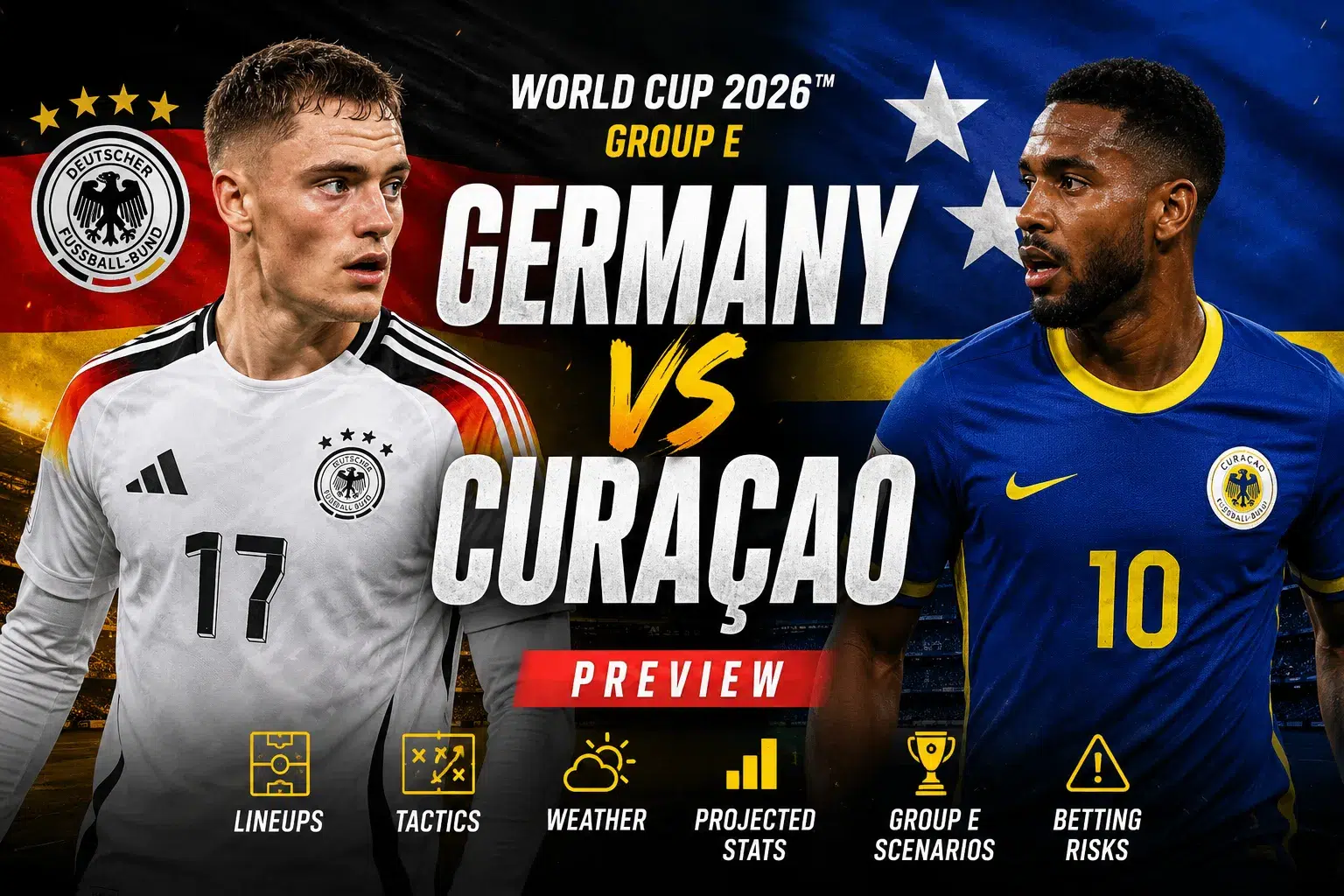
Germany face Curaçao in a FIFA World Cup 2026 Group E match at Houston Stadium in Houston, Texas, United States, on Sunday, 14 June 2026. Kick-off is scheduled for 12:00 p.m. local time in Houston, 1:00 p.m. ET and 17:00 UTC. This match opens Germany’s Group E campaign against the smallest nation ever to qualify for the men’s World Cup and one of the tournament’s most unusual debut stories.
Germany enter under Julian Nagelsmann with a heavy favourite profile, a strong attacking core and pressure to repair the damage of recent early World Cup exits. Deniz Undav is an important forward storyline after a major Bundesliga season, while Florian Wirtz, Jamal Musiala, Joshua Kimmich and Germany’s senior defensive leaders should shape the tactical model. Curaçao enter under Dick Advocaat with Leandro Bacuna as a key leader, Eloy Room as an experienced goalkeeper and a squad built around Dutch-based and diaspora talent. Their likely plan is compact defending, selective pressing, direct counters and careful set-piece management.
The projected match type is Germany possession dominance against Curaçao defensive survival and transition resistance. The key matchup is Germany’s central creators against Curaçao’s midfield screen and low block. Betting markets should be treated as risk signals only. This preview does not provide guaranteed betting advice.
| Field | Data |
|---|---|
| Match | Germany vs Curaçao |
| Competition | FIFA World Cup 2026 |
| Stage | Group Stage / First Stage |
| Group | Group E |
| Date | Sunday, 14 June 2026 |
| Kick-off Time | 12:00 p.m. Houston local / 1:00 p.m. ET / 17:00 UTC |
| Stadium | Houston Stadium |
| City | Houston, Texas |
| Host Country | United States |
| Expected Attendance | Not available from verified public data |
| Referee | Not available from verified public data |
| VAR | Not available from verified public data |
| Weather Forecast | Hot early-afternoon conditions around 92°F / 33–34°C; later thunderstorm risk in the wider forecast window |
| Pitch Context | Tournament venue surface; exact match-day pitch speed not available from verified public data |
| Main Article Focus | Pre-match probability dossier, team news, predicted lineups, tactical analysis, weather risk, projected stats, discipline forecast, Group E scenarios and betting risk |
Germany vs Curaçao is a classic World Cup contrast match. Germany carry the weight of a four-time world champion. Curaçao carry the force of a debut story that reaches far beyond a normal group-stage fixture. The game is not balanced in reputation, squad depth or market expectation. It can still become tactically important because Germany have suffered from opening-match pressure before, and Curaçao will not need much possession to make the match emotionally uncomfortable.
Germany should dominate the ball. Curaçao should defend in compact lines, protect central space and use transitions through experienced midfielders and forward runners. The weather adds a physical layer. Houston’s early-afternoon heat can affect pressing rhythm, hydration, cramp risk and substitution timing.
Germany vs Curaçao matters because Germany need a controlled opening win to reset their World Cup credibility, while Curaçao can turn their debut into a historic statement by staying compact, disciplined and competitive against one of football’s traditional powers.
| Category | Status | Germany vs Curaçao Example | Article Use |
|---|---|---|---|
| Confirmed fact | Verified before publication | Germany vs Curaçao, Group E, Houston Stadium | Hard match base |
| Match timing | Verified fixture data | 14 June 2026, 12:00 p.m. Houston local / 17:00 UTC | Match snapshot |
| Tournament context | Verified schedule data | Group E includes Germany, Curaçao, Côte d’Ivoire and Ecuador | Group scenario analysis |
| Team-news report | Verified media reporting | Deniz Undav is a major Germany forward storyline; Curaçao named an unchanged 26-man squad | Team-news section |
| Probable information | Tactical forecast | Germany likely control possession; Curaçao likely defend compactly and counter | Tactical sections |
| Projected data | Model-based estimate | Possession, shots, xG, corners, fouls, cards | Ranges only |
| Unknown data | Not verified in current source set | Referee, VAR, exact attendance, official starting XIs | Marked unavailable |
| Scenario-based analysis | Possible future pattern | Curaçao may target space behind Germany’s advanced full-backs | Written as forecast, not fact |
This distinction matters because Germany vs Curaçao invites lazy certainty. Germany are the obvious favourite, but football does not obey reputation alone. A predicted lineup is not an official lineup. A projected xG range is not a final statistic. A betting market signal is not a guarantee. A low block can survive longer than expected. A favourite can concede first. A goalkeeper can change a match. A red card can destroy the pre-match model.
This preview uses probability language. It separates confirmed fixture data from projected tactical patterns. It does not claim that a goal, card, substitution, injury or VAR decision will happen at a specific minute.
Group E includes Germany, Curaçao, Côte d’Ivoire and Ecuador. Germany enter as the strongest historical side and likely group favourite. Côte d’Ivoire and Ecuador form a serious direct battle for qualification positions. Curaçao enter as debutants, but the expanded format gives even underdogs a reason to protect goal difference and compete for third-place possibilities.
| Team | Pre-Match Points | Goal Difference | Opening Pressure | Main Need |
|---|---|---|---|---|
| Germany | 0 | 0 | Very high | Win cleanly and avoid another poor tournament start |
| Curaçao | 0 | 0 | High | Compete, protect goal difference and seek a historic point |
| Côte d’Ivoire | 0 | 0 | High | Win or avoid defeat against Ecuador |
| Ecuador | 0 | 0 | High | Use defensive strength to build a qualification platform |
The expanded World Cup format changes the group-stage calculation. The top two teams from each group qualify directly for the Round of 32. Some third-placed teams also qualify. This makes every point useful and every goal difference swing important.
Germany cannot treat this match only as a formality. A narrow win still gives three points, but a flat performance can increase pressure before harder fixtures. A draw would create immediate crisis narratives. A defeat would become one of the major stories of the tournament.
Curaçao cannot treat this match only as a free hit. The team may need goal difference later. A disciplined narrow defeat can preserve a path. A draw would become historic. A win would be one of the greatest World Cup shocks.
Germany’s World Cup standards are severe. The team won the tournament in 1954, 1974, 1990 and 2014. That history creates pressure. Recent World Cup group-stage failures made the pressure sharper. Germany need a first match that shows control, maturity and tactical clarity.
Julian Nagelsmann’s task is not only to select stars. He must make Germany efficient. The team need occupation of central spaces, counter-pressing security, proper full-back balance and cleaner finishing than in some past tournaments.
Germany’s practical objectives are clear:
Curaçao’s stakes are historic. This is a World Cup debut for a small island nation with a population far below the scale of traditional tournament powers. The team reached this point through organisation, diaspora recruitment, federation growth and a clear collective identity under Dick Advocaat.
Curaçao’s main objective is credibility. They need to show that they can compete in structure, not only appear on the schedule. Against Germany, that means discipline before ambition.
Curaçao’s practical objectives:
| Result | Germany Impact | Curaçao Impact | Group E Meaning |
|---|---|---|---|
| Germany win | Germany take early control and reduce pressure before Côte d’Ivoire/Ecuador fixtures | Curaçao must protect goal difference and recover | Expected group hierarchy holds |
| Draw | Germany enter immediate scrutiny | Curaçao earn a historic point and major morale boost | Group E becomes unstable |
| Curaçao win | Germany face crisis and global criticism | Curaçao produce a historic upset | Group E hierarchy breaks immediately |
Germany carry expectation pressure. They are expected to win, and the match can become uncomfortable if they do not score early. Curaçao carry debut pressure. They must manage nerves, crowd scale and the speed of elite tournament football.
The emotional balance can change quickly. If Germany score early, Curaçao may need to protect goal difference. If Curaçao survive the opening phase, Germany may become impatient. If Curaçao score first, the match becomes a psychological test for Germany rather than a simple possession exercise.
| Factor | Match Relevance |
|---|---|
| Host country | United States |
| Venue region | Houston, Texas |
| Neutral match | Neither team is a host nation |
| Travel context | Germany and Curaçao both manage tournament travel, climate and time-zone adaptation |
| Climate | Hot early-afternoon conditions |
| Crowd profile | Likely mixed, with neutral fans, German support and Curaçao’s debut interest |
| Event scale | Major tournament stage, large venue, global broadcast audience |
The United States provides a neutral setting, but Houston’s climate is a major factor. Germany are more accustomed to European summer conditions than to Texas heat. Curaçao players may have more Caribbean climate familiarity, but club backgrounds vary widely. Climate familiarity is not a guarantee of physical advantage because match intensity, travel, humidity and stadium conditions matter.
The crowd profile may favour Germany in size and visibility, but Curaçao’s debut story can attract neutral support. If the match stays close, neutral energy may shift toward the underdog.
| City Factor | Expected Tactical Impact |
|---|---|
| Early-afternoon kick-off | Heat load begins immediately |
| Temperature near 92°F / 33–34°C | Pressing intensity must be managed |
| Humidity risk | Recovery can slow and cramp risk can rise |
| Later thunderstorm risk | Could affect pre/post-match conditions if weather shifts |
| No altitude issue | Normal oxygen profile |
| Open-air event context | Surface heat and hydration matter |
| Travel adjustment | Germany face larger time-zone and climate change than Curaçao |
Houston is not an altitude match. It is a heat and hydration match. Germany’s main physical issue is not oxygen. It is repeated sprint cost. Curaçao’s main physical issue is defensive shifting. A compact block can tire if it spends long periods sliding side to side.
| Stadium Detail | Data |
|---|---|
| Stadium | Houston Stadium |
| City | Houston |
| State | Texas |
| Country | United States |
| Kick-off | 12:00 p.m. local / 17:00 UTC |
| Expected Attendance | Not available from verified public data |
| Referee | Not available from verified public data |
| VAR | Not available from verified public data |
| Roof Status | Not available from verified public data for match conditions |
| Pitch Speed | Not available from verified public data |
| Tactical Impact | Heat, hydration, tempo control and pressing management |
| Weather / Environment Factor | Tactical Meaning |
|---|---|
| Around 92°F / 33–34°C at early afternoon | Constant high pressing becomes expensive |
| Possible humidity | Recovery slows and fatigue can rise after repeated sprints |
| Later storm risk | Weather should be monitored; do not treat storm as a confirmed match event |
| No altitude issue | Normal oxygen profile |
| Roof status not verified | Do not assume fully climate-controlled conditions |
| Pitch speed unknown | Avoid exact claims about bounce or roll |
| Heat load | Substitution timing, hydration breaks and tempo management may matter |
The most important weather factor is heat. Germany may use the ball to control energy. Curaçao may use compactness to conserve energy, but a deep block can also become physically costly if Germany move the ball quickly. Both teams must manage sprints carefully.
Germany’s pre-match story includes the forward profile around Deniz Undav, the tactical authority of Julian Nagelsmann and the broader pressure to fix recent World Cup failures. Undav’s path is notable because he enters the World Cup after a major Bundesliga scoring season. Germany also have elite creative options and experienced leaders.
| Player / Role | Status | Tactical Impact |
|---|---|---|
| Julian Nagelsmann | Germany head coach | Sets pressing structure, attacking rotations and midfield balance |
| Deniz Undav | Major forward storyline, World Cup debut expected | Penalty-box finishing, pressing and central movement |
| Florian Wirtz | Projected key creator | Between-lines passing, final-third decision-making |
| Jamal Musiala | Projected key attacker if fit/selected | Dribbling, half-space disruption and chance creation |
| Joshua Kimmich | Projected midfield/right-side leader | Tempo, passing range, pressing control |
| Manuel Neuer | Senior goalkeeper profile in public reporting | Experience, distribution and line management |
| Antonio Rüdiger | Projected defensive leader | Physical defending, recovery and duel control |
| Jonathan Tah / Nico Schlotterbeck | Projected defensive options | Centre-back coverage and buildup |
| David Raum / Maximilian Mittelstädt | Projected left-sided options | Width, crossing and pressing support |
No official starting XI was available from verified public data in the current source set. This article uses projected lineups, not confirmed lineups.
Curaçao’s team-news base is built around squad stability. Dick Advocaat named an unchanged 26-man squad from March friendlies. The team is led by Leandro Bacuna and includes players based across multiple countries, with many connected to Dutch football structures.
| Player / Role | Status | Tactical Impact |
|---|---|---|
| Dick Advocaat | Curaçao head coach | Experience, structure and defensive pragmatism |
| Leandro Bacuna | Key captain/leader figure | Midfield leadership, set pieces and physical duels |
| Juninho Bacuna | Key midfield option | Ball carrying, duel work and transition support |
| Eloy Room | Experienced goalkeeper | Shot-stopping, box command and emotional stability |
| Gervane Kastaneer | Forward / wide attacking option | Direct running and counter threat |
| Rangelo Janga | Veteran striker profile | Hold-up play, box presence and experience |
| Riechedly Bazoer | Defensive/midfield option if selected | Structure, ball progression and duel coverage |
| Cuco Martina | Defensive veteran profile | Leadership and wide/centre-back flexibility |
Curaçao’s main strength is continuity. Their main risk is the speed and scale of a World Cup opener against Germany. Defensive clarity is more important than ambitious rotation.
| Player | Team | Status | Tactical Impact |
|---|---|---|---|
| Not available from verified public data | Germany | Not available | Do not invent |
| Not available from verified public data | Curaçao | Not available | Do not invent |
| Player | Team | Status | Tactical Impact |
|---|---|---|---|
| Not available from verified public data | Germany | Not available | Do not invent |
| Not available from verified public data | Curaçao | Not available | Do not invent |
| Player / Group | Team | Issue | Match Impact |
|---|---|---|---|
| Germany creative unit | Germany | No verified individual match-day absence in current source set | Final team sheet needed |
| Curaçao squad | Curaçao | No verified individual match-day absence in current source set | Final team sheet needed |
| Both squads | Both | Heat load | Substitution timing and cramp risk may matter |
No confirmed suspension issue was available from verified public data in the current source set. Card risk below is a match forecast, not confirmed disciplinary data.
Official starting lineups were not available from verified public data in the current source set. The following XIs are projected from team identity, public reporting, squad context and tactical logic. They should be replaced with official team sheets before publication.
| Position / Line | Player | Likely Role |
|---|---|---|
| GK | Manuel Neuer | Goalkeeper, sweeper role, distribution starter |
| RB | Joshua Kimmich / right-back option | Inverted full-back or midfield-control role |
| CB | Antonio Rüdiger | Defensive leader, duel defender, recovery runner |
| CB | Jonathan Tah / Nico Schlotterbeck | Centre-back, buildup and aerial control |
| LB | David Raum / Maximilian Mittelstädt | Width, crossing and recovery |
| DM | Robert Andrich / holding midfielder option | Ball-winning and rest-defense cover |
| CM | Leon Goretzka / central runner option | Physicality, box arrivals and pressing |
| AM | Florian Wirtz | Creative hub, final pass, between-lines movement |
| RW | Leroy Sané / wide attacker option | Width, dribbling and speed |
| ST | Deniz Undav | Central striker, pressing and finishing |
| LW | Jamal Musiala / left-sided creator | Dribbling, half-space entry and chance creation |
| Position / Line | Player | Likely Role |
|---|---|---|
| GK | Eloy Room | Goalkeeper, shot-stopper, defensive organiser |
| RB | Cuco Martina / right-back option | Veteran defender, wide duel management |
| CB | Riechedly Bazoer / centre-back option | Defensive structure and ball progression |
| CB | Jurien Gaari / centre-back option | Aerial defending and central cover |
| LB | Sherel Floranus / left-back option | Wide defence and transition support |
| DM | Leandro Bacuna | Captain profile, midfield screen, set pieces |
| CM | Juninho Bacuna | Ball carrier, pressure release and duel player |
| CM | Vurnon Anita / midfield option | Positioning, experience and short passing |
| RW | Gervane Kastaneer | Counter runner and wide outlet |
| ST | Rangelo Janga | Hold-up striker, box target and veteran presence |
| LW | Brandley Kuwas / wide option | Direct attacking outlet and delivery |
| Team | Base Formation | In Possession | Out of Possession | Confidence |
|---|---|---|---|---|
| Germany | 4-2-3-1 / 4-3-3 | 2-3-5 or 3-2-5 with one full-back inverted | 4-4-2 press or 4-1-4-1 counter-press | Medium |
| Curaçao | 4-5-1 / 4-2-3-1 | Direct 2-3-5 only in rare sustained attacks | 5-4-1 or compact 4-5-1 depending on wing depth | Medium |
| Scenario | Trigger | Expected Change |
|---|---|---|
| Germany choose maximum control | Curaçao defend deep | Kimmich used centrally or inverted to overload midfield |
| Germany choose maximum width | Curaçao protect central spaces | Raum/Mittelstädt and Sané-type winger stretch the block |
| Germany need penalty-box power | Curaçao survive early pressure | Undav stays central with more crosses and second runners |
| Germany protect lead | Leading after 60’ | Lower full-back risk and more midfield control |
| Curaçao choose deeper protection | Germany dominate early | Wide players drop closer to full-backs |
| Curaçao chase goal | Trailing after 60’ | Janga/Kastaneer support increases, more direct balls |
| Curaçao protect draw | Level after 70’ | Even deeper block, slower restarts and more defensive substitutions |
The biggest lineup uncertainty is Germany’s exact balance between control and creativity. Nagelsmann must decide how much attacking aggression he wants in a hot match against a deep block. Curaçao’s biggest uncertainty is whether Advocaat chooses a pure compact block or leaves more speed high for counters.
| Phase | Expected Pattern |
|---|---|
| Build-up | Centre-back circulation, Kimmich/Wirtz progression, one full-back balance |
| Attack | Central overloads, half-space dribbling, wide switches, Undav box occupation |
| Defense | High counter-press with rest-defense structure |
| Transitions | Immediate pressure after losing the ball, fast release to wide players |
| Set Pieces | Rüdiger, Tah/Schlotterbeck, Undav, Goretzka-type aerial targets |
| Weakness | Overcommitment, heat cost, pressure if early goal does not come |
Germany should build with patience and tempo variation. Curaçao will likely protect central spaces and invite Germany to circulate the ball. The key is not possession volume. Germany should create useful possession. That means moving the block, changing speed and creating central entries after wide switches.
Germany can use a 2-3-5 or 3-2-5 shape in possession. One full-back can advance while the other remains safer. Kimmich’s role matters. If he plays as an inverted full-back, Germany can overload midfield. If he plays as a midfielder, Germany can control rhythm more directly. If he starts at right-back and stays wide, Germany can stretch Curaçao more.
The centre-backs must not become lazy in circulation. Curaçao may wait for one bad pass or one heavy touch to launch a counter. Rüdiger and the second centre-back should play forward when possible, but not force passes into crowded midfield zones.
Germany should press after turnovers. That is the most efficient pressing model in heat. Constant long pressing can waste energy. A counter-press after losing the ball can stop Curaçao before they find Bacuna, Kastaneer or Janga.
The best pressing triggers:
Germany should avoid pressing with only front players while midfield stays detached. That creates space behind the press.
Germany can attack both sides, but the most dangerous areas should be half-spaces rather than pure touchline crosses. Wirtz and Musiala-type profiles can receive between lines and force Curaçao defenders to step out. Sané or another winger can stretch the line. The striker must occupy centre-backs.
Germany should not overuse one flank. A deep block survives better when attacks are predictable. Switches of play can move Curaçao’s block and create delayed spaces.
Florian Wirtz is the main final-third connector if selected. Kimmich can control deeper phases. Germany need both profiles: one player to decide tempo and one player to break lines. Curaçao’s defensive plan should try to block Wirtz’s forward-facing receptions.
Germany’s transition threat comes from immediate counter-pressing and fast wide release. If Germany recover the ball high, they can attack before Curaçao reset. But if Germany lose the ball with both full-backs high, Curaçao can counter into open channels.
Germany have a strong set-piece profile. Rüdiger, Tah, Schlotterbeck, Goretzka-type runners and Undav can attack aerial zones. Against a deep block, corners and wide free kicks can matter. Germany should attack first and second balls. Curaçao will likely defend with numbers, so rebounds at the edge of the box can be decisive.
Germany’s biggest defensive weakness is rest-defense failure. Curaçao may not create many attacks, but a single counter can be dangerous if Germany lose spacing. Germany must keep at least two centre-backs and one midfield screen ready after attacks.
Neuer’s distribution can help Germany compress the match. He can stand high, recycle possession and stop long balls early. That can reduce Curaçao’s counters. The risk is space behind the line if Germany lose timing. Communication with centre-backs must be clean.
Germany should not push both full-backs high for long periods in Houston heat. One side can attack while the other side holds. If Germany need a goal late, the risk profile can change. Before then, balance matters.
Undav’s role is central. He must give Germany penalty-box movement, pressing and finishing. He should not only wait for crosses. He should move across centre-backs, attack rebounds and combine with Wirtz or Musiala. Against a deep block, small movements matter.
| Phase | Expected Pattern |
|---|---|
| Build-up | Direct exits, goalkeeper-to-striker passes, Bacuna-led pressure release |
| Attack | Counters through wide runners, Janga hold-up play, Bacuna set pieces |
| Defense | Compact block, deep midfield line, narrow central protection |
| Transitions | First pass into Bacuna, Kastaneer, Kuwas or Janga |
| Set Pieces | Bacuna delivery, Janga aerial presence, centre-back targets |
| Weakness | Sustained pressure, heat fatigue, defending central creators |
Curaçao should not try to outbuild Germany for long spells. The safer model is selective. They can play short when Germany sit off, but they should go direct under pressure. The goal is to avoid dangerous turnovers.
Eloy Room may need to distribute long more often than usual. Long balls toward Janga or wide outlets can give Curaçao territory. The problem is second-ball support. If Janga wins a duel but no midfielder is close, Germany recover and attack again.
Leandro Bacuna is important. He can receive under pressure, guide the team and deliver set pieces. Curaçao need him close to the first forward pass after recovery.
Curaçao are unlikely to press high for long phases. A low or mid-block is more realistic. They can press selectively when Germany play sideways or when a full-back receives near the touchline. The team must protect central zones above all.
The pressing priority is not to win the ball high every time. It is to force Germany away from the middle and into lower-value wide areas.
Curaçao’s main attacking side may depend on which winger starts. Kastaneer can give direct running. Kuwas can provide delivery and experience. The strongest route may be quick wide counters after Germany full-backs advance.
Curaçao should use the channels behind Germany’s full-backs. A direct pass into space can create pressure even if it does not become a shot. Territory can matter against a favourite.
Leandro Bacuna is the key passer and leader. Juninho Bacuna can also carry and connect. Curaçao need both to survive pressure. If Germany isolate them, Curaçao’s forward line may become disconnected.
Curaçao’s transition threat is their main open-play route. They need the first pass after recovery to be clean. If the first pass is poor, Germany will counter-press. If the first pass reaches a runner, Germany may need tactical fouls.
The ideal transition pattern:
Curaçao may not have many corners or free kicks. Each one matters. Bacuna’s delivery can be important. Janga and centre-backs can attack aerial zones. Set pieces can also help Curaçao rest, reset and move the team up the pitch.
Curaçao’s main weakness is sustained pressure. Germany can move the block side to side. Heat makes defensive shifting harder. If Curaçao defend too deep, rebounds and second balls can build. The second weakness is central creator control. Wirtz and Musiala can punish small gaps.
Eloy Room may face heavy shot volume. His distribution must avoid central mistakes. Short passing can be risky if Germany press. Direct passes can be useful if Janga has support.
Curaçao full-backs should be conservative. They may rarely attack simultaneously. Their priority is to stop German wide and half-space overloads. If one full-back is booked early, Germany will likely attack that side.
Janga’s role is difficult but important. He may have few touches. He must hold the ball, win fouls, contest aerial passes and help the block breathe. A striker in an underdog side can perform well without many shots.
| Zone | Germany Edge | Curaçao Edge | Likely Control | Why It Matters |
|---|---|---|---|---|
| Germany left / Curaçao right | Musiala/Raum-type overloads and dribbling | Veteran defensive positioning if Martina side selected | Germany edge | Can create half-space entries |
| Germany right / Curaçao left | Sané/Kimmich-type progression and switches | Counter space if Germany full-back advances | Germany edge with transition risk | Controls width and counter risk |
| Central midfield | Wirtz, Kimmich, Goretzka/Andrich control | Bacuna experience and duel resistance | Germany strong edge | Decides rhythm and chance quality |
| Penalty box | Undav movement, Germany aerial targets | Room and compact centre-backs | Germany edge | Decides whether possession becomes goals |
| Set pieces | Germany height and delivery | Bacuna delivery, Janga aerial presence | Germany edge | Can break the low block |
| Transitions | Germany counter-press | Curaçao direct outlets | Curaçao’s best route | Main underdog path |
| Defensive third | Germany likely defend less often | Curaçao defend long phases | Germany territory edge | Tests Curaçao concentration |
Wirtz can turn Germany’s possession into chance creation. Curaçao must stop him from receiving between midfield and defence.
Why it matters: Germany can have possession without danger if Wirtz is disconnected. If he receives facing goal, Curaçao’s block can break.
What to watch: Wirtz’s first touch location. Forward-facing touches near the box are dangerous.
Risk trigger: If Curaçao’s defensive midfielder receives an early yellow card, Wirtz may find more freedom.
Undav gives Germany a direct scoring reference. Curaçao centre-backs must track movement, not only mark space.
Why it matters: Germany need a penalty-box finisher against a deep block.
What to watch: Undav’s runs across the near post and between defenders.
Risk trigger: If Curaçao centre-backs defend too deep, Germany can create rebounds and second balls.
Kimmich can control Germany’s rhythm. Bacuna can lead Curaçao’s resistance and transition release.
Why it matters: This duel connects both teams’ structure. Kimmich wants control. Bacuna wants disruption and release.
What to watch: Who wins the first pass after Curaçao clear the ball.
Risk trigger: If Bacuna cannot receive under pressure, Curaçao may become trapped.
Germany’s biggest risk is not normal defensive pressure. It is the sudden counter after overcommitment.
Why it matters: Curaçao may create few chances, so each transition can be high-value.
What to watch: Germany’s full-back height after lost possession.
Risk trigger: If both Germany full-backs are high and the midfield screen is late, Curaçao’s counter route opens.
Room may face the heaviest workload on the pitch. He must handle shots, crosses and rebounds.
Why it matters: A goalkeeper can keep an underdog alive long enough to shift pressure.
What to watch: Room’s rebound control and command on corners.
Risk trigger: If Germany force early saves from central zones, Curaçao’s defensive pressure rises.
| Projected Stat | Germany | Curaçao | Confidence | Reason |
|---|---|---|---|---|
| Possession | 65–72% | 28–35% | Medium/high | Germany should control the ball heavily |
| Shots | 17–24 | 3–7 | Medium | Germany volume edge is strong |
| Shots on Target | 6–10 | 1–3 | Medium | Curaçao may limit central quality but face volume |
| xG Range | 2.00–3.20 | 0.20–0.80 | Low/Medium | Germany edge is clear; first goal can shift match |
| Big Chances | 3–6 | 0–1 | Low/Medium | Germany likely create most high-value chances |
| Corners | 7–11 | 1–3 | Medium | Germany wide pressure likely produces blocks |
| Fouls | 8–13 | 12–18 | Medium | Curaçao likely defend more duels |
| Yellow Cards | 1–2 | 2–4 | Low/Medium | Referee not confirmed |
| Red Card Risk | Low | Low/Medium | Low | Repeated defensive duels can raise underdog risk |
| Offsides | 1–3 | 1–2 | Low | Germany runs and Curaçao counters can trigger lines |
| Saves | 1–3 | 5–9 | Medium | Room likely faces high workload |
| Crosses | 22–34 | 5–10 | Medium | Germany likely use width heavily |
| Tackles | 10–16 | 20–30 | Medium | Curaçao likely defend long phases |
| Interceptions | 7–12 | 13–20 | Medium | Curaçao block can intercept central passes |
| Clearances | 8–15 | 28–42 | Medium | Curaçao may defend deep for long periods |
Germany should dominate possession, shots, corners and territory. The main uncertainty is efficiency. If Germany create central shots, the match can move toward the upper xG range. If Curaçao force Germany into blocked crosses and long shots, the match can stay tighter for longer.
Curaçao’s projected attacking numbers are low. Their route is not volume. It is one transition, one set piece or one German mistake. That means Germany’s rest defense is critical. A favourite can control 70% of the ball and still concede if the structure after loss is poor.
| Match Window | Tactical State | Physical State | Card Risk | Goal Risk | Betting Market Trigger |
|---|---|---|---|---|---|
| 1’–15’ | Germany likely establish possession; Curaçao defend compactly | Fresh legs, heat already relevant | Low/Medium | Medium/high | First Germany central entry, first Curaçao clearance |
| 16’–30’ | Germany may increase wide pressure and corners | Curaçao defensive shifting grows | Medium | Medium/high | Corner volume, Undav touches |
| 31’–45+’ | If level, Germany pressure may become emotional | Heat and repeated defending matter | Medium/High | Medium | Late first-half set pieces |
| 46’–60’ | Coaches adjust after first-half evidence | Reset intensity, hydration important | Medium | Medium/high | Germany substitutions if blocked |
| 61’–75’ | Space may open as Curaçao tire | Cramp and fatigue risk increase | High | High | Live totals, cards, Germany attacking changes |
| 76’–90+’ | Game state dominates | Late fatigue and time management | High | Medium/high | Goal difference chase, late corners |
Germany should use the opening phase to establish tempo. Curaçao should protect central areas and avoid conceding early. The first important sign is whether Germany create central touches or only circulate around the block.
Germany’s wide pressure may grow. Curaçao’s full-backs will need support. If Germany create repeated corners, the set-piece pressure can become a major match theme.
If Curaçao keep the match level, pressure can shift slightly toward Germany. The crowd and favourite status can produce impatience. Germany must stay methodical.
Half-time adjustments matter. Germany may alter attacking spacing or introduce a more direct profile. Curaçao may need fresh defensive legs if the first half required heavy shifting.
This is a high-risk physical window. Houston heat and repeated defending can weaken Curaçao’s block. Germany’s substitutes can raise tempo. Card risk can increase when tired defenders arrive late.
Game state dominates. If Germany lead, goal difference may become relevant. If the match remains close, Curaçao may protect the result. If Curaçao trail narrowly, they must decide whether to chase or protect goal difference.
| Factor | Expected Impact | Germany Effect | Curaçao Effect |
|---|---|---|---|
| Heat around 92°F / 33–34°C | Pressing and sprint cost rise | Germany should avoid wasteful pressing | Curaçao defensive shifting can tire |
| Humidity risk | Recovery can slow | Ball circulation can conserve energy | Cramps and late fatigue risk rise |
| Later thunderstorm risk | Monitor, but do not treat as confirmed match event | Could affect rhythm if weather shifts | Could affect clearance and handling if rain arrives |
| No altitude issue | Normal oxygen profile | Supports possession tempo | Supports counters if energy remains |
| Roof status not verified | Climate control cannot be assumed | Prepare for heat load | Prepare for heat load |
| Pitch condition unknown | Exact speed unavailable | Avoid fixed passing assumptions | Avoid fixed direct-ball assumptions |
| Early-afternoon kick-off | Heat is present from first minute | Manage tempo early | Avoid early overexertion |
The most important weather factor is heat. Germany can reduce heat cost through possession. Curaçao must reduce defensive running by staying compact and not chasing every pass. The match may be decided partly by how well Curaçao survive repeated side-to-side movement after 60 minutes.
| Player | Team | Role | Match Impact Score /10 | Reason |
|---|---|---|---|---|
| Florian Wirtz | Germany | Creator | 9.1 | Main line-breaker and final-third connector |
| Deniz Undav | Germany | Striker | 8.7 | Penalty-box finisher and forward storyline |
| Jamal Musiala | Germany | Dribbler / half-space attacker | 8.6 | Can break compact blocks through carries |
| Joshua Kimmich | Germany | Midfield/full-back controller | 8.6 | Tempo, structure and rest-defense control |
| Antonio Rüdiger | Germany | Centre-back | 8.2 | Defensive leadership and transition security |
| Manuel Neuer | Germany | Goalkeeper | 8.0 | Distribution and high-line management |
| Leandro Bacuna | Curaçao | Midfield leader | 8.4 | Captain profile, pressure release and set pieces |
| Eloy Room | Curaçao | Goalkeeper | 8.3 | Likely faces heavy shot volume |
| Juninho Bacuna | Curaçao | Midfielder | 7.9 | Carrying and duel support |
| Gervane Kastaneer | Curaçao | Forward / wide runner | 7.8 | Counterattacking route |
| Rangelo Janga | Curaçao | Striker | 7.7 | Hold-up play and box presence |
| Cuco Martina | Curaçao | Defender | 7.6 | Experience and defensive organization |
Deniz Undav is Germany’s most important finishing figure if selected. Wirtz and Musiala can create, but Undav must convert pressure into goals. For Curaçao, Kastaneer or Janga can become important because they may receive the few forward actions that define the underdog’s attacking output.
Antonio Rüdiger is Germany’s most important defender because he must manage the few Curaçao counters with concentration. Eloy Room may be Curaçao’s most important defensive figure because the goalkeeper workload is likely high.
Kimmich is Germany’s rhythm player if used centrally or as an inverted full-back. Leandro Bacuna is Curaçao’s midfield leader and the player most likely to help the team survive pressure.
Germany’s bench can change the match through added speed, width or creative passing. Curaçao’s bench can change the match through fresh defensive legs or a direct runner. Specific bench roles should be updated once official team sheets are available.
Curaçao full-backs and defensive midfielders carry the highest card risk because Germany may force repeated one-vs-one defending. Germany’s card risk comes mainly from stopping counters after losing the ball.
No verified individual injury-management case was available in the current source set. Heat and first-match load can still affect substitution timing and cramp risk.
The referee and VAR were not available from verified public data in the current source set. Therefore, this discipline preview uses tactical logic rather than referee-profile claims.
| Discipline Factor | Forecast |
|---|---|
| Referee Style | Not available from verified public data |
| Tactical Foul Risk | Medium |
| Dissent Risk | Medium |
| VAR Intervention Risk | Medium |
| Penalty Risk | Medium |
| Red-Card Risk | Low/medium |
| Team | Yellow-Card Range | Red-Card Risk | Main Risk Zone |
|---|---|---|---|
| Germany | 1–2 | Low | Tactical fouls after Curaçao counters |
| Curaçao | 2–4 | Low/Medium | Full-back zones and central defensive screen |
Curaçao carry the higher yellow-card range because they are likely to defend more actions. Germany’s attackers can force late tackles, shirt pulls and recovery fouls. Germany’s own card risk appears if Curaçao break into space and Germany must stop the counter.
| Set-Piece Area | Germany | Curaçao | Edge |
|---|---|---|---|
| Corners For | Rüdiger, Tah/Schlotterbeck, Undav, Goretzka-type runners | Room command, packed defensive box | Germany |
| Corners Against | Must defend Janga and centre-back targets | Must defend Germany height and rebounds | Germany edge |
| Wide Free Kicks | Kimmich/Wirtz/Raum delivery options | Bacuna delivery | Germany |
| Direct Free Kicks | Wirtz/Kimmich/Sané-type options if selected | Bacuna possible threat | Germany |
| Penalties | Taker hierarchy not verified | Taker hierarchy not verified | Unknown |
| Long Throws | Not available from verified public data | Not available from verified public data | Unknown |
| Aerial Duels | Strong centre-backs and forward targets | Janga and centre-backs | Germany edge |
Germany have the clear set-piece edge because of likely delivery quality and aerial targets. Curaçao can still create danger if Bacuna wins wide free-kick territory. Curaçao must defend first contact, rebounds and blockers around the goalkeeper.
| Area | Germany | Curaçao |
|---|---|---|
| Goalkeeper Distribution | Neuer can support high buildup and recycle possession | Room may mix short passes with direct clearances |
| Shot-Stopping Pressure | Low/medium | High |
| Cross Handling | Low/medium | High |
| High-Line Risk | Germany risk space behind if overcommitted | Curaçao likely defend low rather than high |
| Penalty-Box Defending | Must defend rare counters and set pieces | Must track Undav, late runners and aerial targets |
| Back-Post Weakness | Possible if full-back switches off | Possible against German switches |
| Defensive Communication | Concentration after long possession | Constant organization under pressure |
Eloy Room may face far more pressure. He may need to manage shots, crosses, corners and rebounds. Neuer may face fewer actions, but one counter can still create danger. A goalkeeper in the favourite team must stay alert after long quiet phases.
| Minute Window | Germany Possible Change | Curaçao Possible Change | Trigger |
|---|---|---|---|
| 45’–60’ | Add width, more striker support or fresh creator | Add defensive legs or change wide outlet | First-half blockage or early fatigue |
| 60’–75’ | Increase attacking tempo, add runner, manage heat load | Fresh full-back/winger, deeper midfielder | Heat, cards, score pressure |
| 75’–90’ | Protect lead, chase goal difference or add control | Protect result or protect goal difference | Game state |
Germany should control the ball and avoid careless counters. Goal difference can matter, but reckless attacking can create avoidable transition risk.
Curaçao would likely defend deeper and use every restart to breathe. Germany would need central patience and better shot selection. Panic crossing would help Curaçao.
Germany would face major pressure. Curaçao may decide that a draw is historic and group-useful. Germany’s substitutions would likely become more aggressive. Curaçao’s substitutions would likely focus on legs, structure and time management.
| Market | Current Signal | Main Risk |
|---|---|---|
| Match Winner | Germany likely heavy favourite | Heavy favourite prices can ignore heat, lineup and low-block variance |
| Double Chance | Germany or draw likely extremely short | Low value and limited upside |
| Over/Under Goals | Germany team total likely central market | First goal timing controls total profile |
| BTTS | Lower signal because Curaçao shot volume may be limited | One counter or set piece can break it |
| Corners | Germany corner volume likely high | Early goals can reduce sustained corner pressure |
| Cards | Medium signal | Referee unknown |
| Player Shots | Undav, Wirtz, Musiala, Sané-type players watchlist | Official lineup and role matter |
| Player Cards | Curaçao full-backs/midfielders watchlist | Referee threshold unknown |
| Trigger | Possible Market Effect |
|---|---|
| Official Germany attacking XI | Moves player shots and team-total markets |
| Undav starting confirmation | Moves striker shots and scoring markets |
| Musiala fitness/role confirmation | Moves creativity and assist markets |
| Curaçao defensive shape | Affects Germany goal expectation |
| Referee announcement | Moves cards and penalty markets |
| Weather update | Can affect total goals and pace |
| Public money on Germany | Can compress favourite prices further |
| Trigger | Meaning | Risk |
|---|---|---|
| Germany create early central shots | Chance quality is strong | Early saves can still keep match close |
| Curaçao survive first 30 minutes | Pressure may shift toward Germany | Germany fatigue may also affect tempo |
| Germany only create deep crosses | Low-block success signal | Set pieces can still break it |
| Curaçao full-back booked | Germany wide route improves | Referee threshold may change |
| Heat slows pressing | Lower tempo possible | Late substitutions can reopen match |
| Curaçao counter cleanly once | Underdog threat is real | One counter can overstate control |
This preview explains match data and market behavior. It does not provide guaranteed betting advice. World Cup betting involves risk. Readers should check local gambling laws, use licensed operators, set limits and avoid chasing losses.
| Factor | How It Can Break the Forecast |
|---|---|
| Late Lineup Change | Changes Germany’s attacking structure or Curaçao’s defensive depth |
| Early Goal | Forces Curaçao to open or Germany to manage rather than attack |
| Early Yellow Card | Changes wide defending and tactical foul behaviour |
| Injury | Forces tactical reshuffle and changes physical balance |
| VAR Penalty | Creates a non-pattern goal and alters game state |
| Weather Shift | Heat, humidity or storms can affect tempo and ball handling |
| Red Card | Makes possession and xG projections less relevant |
| Goalkeeper Error | Gives either team a low-probability swing |
| Tactical Surprise | Curaçao may press higher or Germany may rotate roles unexpectedly |
| Market Overreaction | Heavy favourite narratives can distort risk reading |
The forecast can fail if Curaçao score first and force Germany into emotional attacking. It can also fail if Germany score early and reduce tempo, which may affect totals and corner markets. Heat, set pieces, goalkeeper performance and card timing can all break the pre-match model.
| Scenario | Probability Band | Match Story |
|---|---|---|
| Germany Narrow Win | Medium | Germany dominate but Curaçao defend deep and Room keeps the score close |
| Draw | Low/medium | Curaçao survive pressure, Germany waste chances and heat slows tempo |
| Curaçao Upset | Low | Curaçao score first from counter or set piece and defend with discipline |
| High-Scoring Match | Medium/high | Germany score early, Curaçao open slightly and shot volume turns into goals |
| Low-Scoring Match | Medium | Germany control ball but lack sharpness against compact block |
The safest scenario frame is Germany-favoured with high possession and high shot volume. The uncertainty lies in goal timing and efficiency. A first-half German goal can open the match. A long 0-0 can create pressure and reduce attacking clarity.
| Result | Germany Impact | Curaçao Impact |
|---|---|---|
| Germany Win | Germany take early Group E control and protect expected top-two path | Curaçao need recovery and goal-difference management |
| Draw | Germany face immediate scrutiny and lose expected-margin points | Curaçao earn a historic point and a real third-place platform |
| Curaçao Win | Germany enter crisis before harder group tests | Curaçao produce a historic upset and transform Group E |
A Germany win would match expectations and place pressure on Côte d’Ivoire and Ecuador. A draw would make the group more volatile. A Curaçao win would change the tournament’s early narrative. Goal difference matters because third-place qualification can depend on margins across groups.
| Data Point | Status | Preferred Source Type |
|---|---|---|
| Match Date | Confirmed | FIFA schedule / broadcaster fixture listing |
| Stadium | Confirmed | FIFA schedule / broadcaster fixture listing |
| City | Confirmed | FIFA / venue context |
| Group | Confirmed | FIFA schedule |
| Coaches | Confirmed in verified media and public team context | |
| Squad | Confirmed in Reuters squad reporting for Curaçao; Germany squad context from verified media | |
| Referee | Not available from verified public data | FIFA match centre if announced |
| VAR | Not available from verified public data | FIFA match centre if announced |
| Weather | Forecast | Weather source |
| Lineups | Projected until official team sheets | FIFA match centre / official team sheets |
| Injuries | Not fully available from verified public data | Federation / verified media |
| Suspensions | No confirmed active suspension in current source set | FIFA disciplinary data / verified reporting |
| Odds | Dynamic market signal only | Licensed odds providers / aggregators |
| Projected Stats | Model-based estimate | Editorial forecast |
| Minute-Window Scenarios | Scenario forecast only | Editorial model |
This article uses confirmed facts where available and marks unavailable information clearly. It does not invent referee data, VAR data, exact attendance, official starting lineups or unverified injuries.
This preview is analytical and informational. It is not a guarantee of the final result. Football includes randomness and low-probability events. Final lineups, injuries, referee decisions, VAR, weather and early goals can change the match.
Projected statistics, scoreline scenarios and betting market notes are probability-based estimates. They are not certain outcomes. Germany can dominate possession and still struggle to score. Curaçao can create few open-play chances and still score from a counter, set piece or mistake. A goalkeeper error, red card, deflection, penalty, injury or weather shift can break the pre-match model.
Betting markets move before and during the match. Readers should verify official lineups, injuries, referee information, weather conditions and market prices before making decisions. Readers should check local gambling laws and use licensed operators only. Readers should set spending and time limits, avoid chasing losses and treat betting as entertainment rather than income.
This article does not provide guaranteed betting advice, fixed-match information, insider tips, risk-free picks or certain outcomes.
Germany vs Curaçao is scheduled for Sunday, 14 June 2026, with kick-off at 12:00 p.m. local time in Houston, 1:00 p.m. ET and 17:00 UTC.
Germany vs Curaçao is being played at Houston Stadium in Houston, Texas, United States.
Official starting lineups were not available from verified public data in the current source set. Germany are projected to use Manuel Neuer, Antonio Rüdiger, Joshua Kimmich, Florian Wirtz, Jamal Musiala and Deniz Undav as key figures. Curaçao are projected to use Eloy Room, Leandro Bacuna, Juninho Bacuna, Gervane Kastaneer and Rangelo Janga as key figures.
The main tactical matchup is Germany’s central creativity and possession pressure against Curaçao’s compact defensive block, Bacuna-led midfield resistance and direct counterattacking outlet.
The prediction can be wrong because late lineup changes, early goals, injuries, VAR penalties, red cards, referee decisions, weather shifts, set-piece goals and goalkeeper errors can change the match. This preview uses probability logic, not certainty.
[expert_review params=»JTdCJTIyY29sb3IlMjIlM0ElMjJncmVlbi0yJTIyJTJDJTIyZXhwZXJ0X2F2YXRhciUyMiUzQSUyMiUyMiUyQyUyMmV4cGVydF9uYW1lJTIyJTNBJTIyJTIyJTJDJTIyZXhwZXJ0X2xpbmslMjIlM0ElMjIlMjIlMkMlMjJleHBlcnRfaWQlMjIlM0ElMjIxJTIyJTJDJTIyZXhwZXJ0X3R5cGUlMjIlM0ElMjJleHBlcnRfaWQlMjIlMkMlMjJleHBlcnRfYXZhdGFyX2FsdCUyMiUzQSUyMiUyMiUyQyUyMmV4cGVydF9zaG93JTIyJTNBMSUyQyUyMmV4cGVydF9kZXNjcmlwdGlvbiUyMiUzQSUyMlNwb3J0cyUyMEJldHRpbmclMjBBbmFseXN0JTIwJTI2JTIwRWRpdG9yaWFsJTIwQ29udHJpYnV0b3IlMjIlMkMlMjJleHBlcnRfc2hvd19idXR0b24lMjIlM0ExJTJDJTIyZXhwZXJ0X3Nob3dfYnV0dG9uX3R5cGUlMjIlM0ElMjJwb3B1cCUyMiUyQyUyMmV4cGVydF9xdWVzdGlvbl9idXR0b25fdGV4dCUyMiUzQSUyMkFzayUyMFF1ZXN0aW9uJTIyJTJDJTIycXVlc3Rpb25fZXh0ZXJuYWxfbGluayUyMiUzQSUyMiUyMiUyQyUyMnBvcHVwX3VzZV9waG9uZSUyMiUzQTAlMkMlMjJleHBlcnRfdGl0bGUlMjIlM0ElMjJBdXRob3IlMjIlMkMlMjJleHBlcnRfc2hvd190aXRsZSUyMiUzQTElMkMlMjJleHBlcnRfdGV4dCUyMiUzQSUyMkFsZXglMjBNb3JnYW4lMjBpcyUyMGElMjBzcG9ydHMlMjBiZXR0aW5nJTIwYW5hbHlzdCUyMGFuZCUyMGVkaXRvcmlhbCUyMGNvbnRyaWJ1dG9yJTIwd2hvJTIwd3JpdGVzJTIwZGV0YWlsZWQlMjBib29rbWFrZXIlMjByZXZpZXdzJTJDJTIwYmV0dGluZyUyMGd1aWRlcyUyQyUyMHBsYXRmb3JtJTIwY29tcGFyaXNvbnMlMkMlMjBhbmQlMjByZXNwb25zaWJsZSUyMGdhbWJsaW5nJTIwZXhwbGFpbmVycy4lMjBIaXMlMjB3b3JrJTIwZm9jdXNlcyUyMG9uJTIwcHJhY3RpY2FsJTIwaW5mb3JtYXRpb24lMjBmb3IlMjB1c2VycyUyMHdobyUyMHdhbnQlMjB0byUyMHVuZGVyc3RhbmQlMjBob3clMjBiZXR0aW5nJTIwc2l0ZXMlMjBvcGVyYXRlJTIwYmVmb3JlJTIwdGhleSUyMHJlZ2lzdGVyJTJDJTIwZGVwb3NpdCUyQyUyMG9yJTIwY2xhaW0lMjBhJTIwYm9udXMuJTIyJTJDJTIycWElMjIlM0ElNUIlNUQlMkMlMjJxYV9zaG93X3RpdGxlJTIyJTNBMSUyQyUyMnFhX3RpdGxlJTIyJTNBJTIyJUQwJTkyJUQwJUJFJUQwJUJGJUQxJTgwJUQwJUJFJUQxJTgxJTIwJUQxJThEJUQwJUJBJUQxJTgxJUQwJUJGJUQwJUI1JUQxJTgwJUQxJTgyJUQxJTgzJTIyJTJDJTIyc2NvcmUlMjIlM0ElNUIlNUQlMkMlMjJzY29yZV9zdW1tYXJ5X3RleHQlMjIlM0ElMjIlMjIlMkMlMjJzY29yZV9zdW1tYXJ5X2F2ZXJhZ2UlMjIlM0EwJTJDJTIyc2NvcmVfbWF4JTIyJTNBJTIyNSUyMiUyQyUyMnNjb3JlX3N5bWJvbCUyMiUzQSUyMiUyMiUyQyUyMnNjb3JlX3RpdGxlJTIyJTNBJTIyJTIyJTJDJTIyc2NvcmVfc2hvd190aXRsZSUyMiUzQTAlMkMlMjJwbHVzZXMlMjIlM0ElNUIlNUQlMkMlMjJtaW51c2VzJTIyJTNBJTVCJTVEJTJDJTIycGx1c2VzX21pbnVzZXNfc2hvd190aXRsZSUyMiUzQTElMkMlMjJwbHVzZXNfbWludXNlc190aXRsZSUyMiUzQSUyMiVEMCU5RiVEMCVCQiVEMSU4RSVEMSU4MSVEMSU4QiUyMCVEMCVCOCUyMCVEMCVCQyVEMCVCOCVEMCVCRCVEMSU4MyVEMSU4MSVEMSU4QiUyMiUyQyUyMnBsdXNlc190aXRsZSUyMiUzQSUyMiUyMiUyQyUyMm1pbnVzZXNfdGl0bGUlMjIlM0ElMjIlMjIlN0Q=»]