
Ghana vs Panama World Cup 2026 Preview
Table of Contents Show
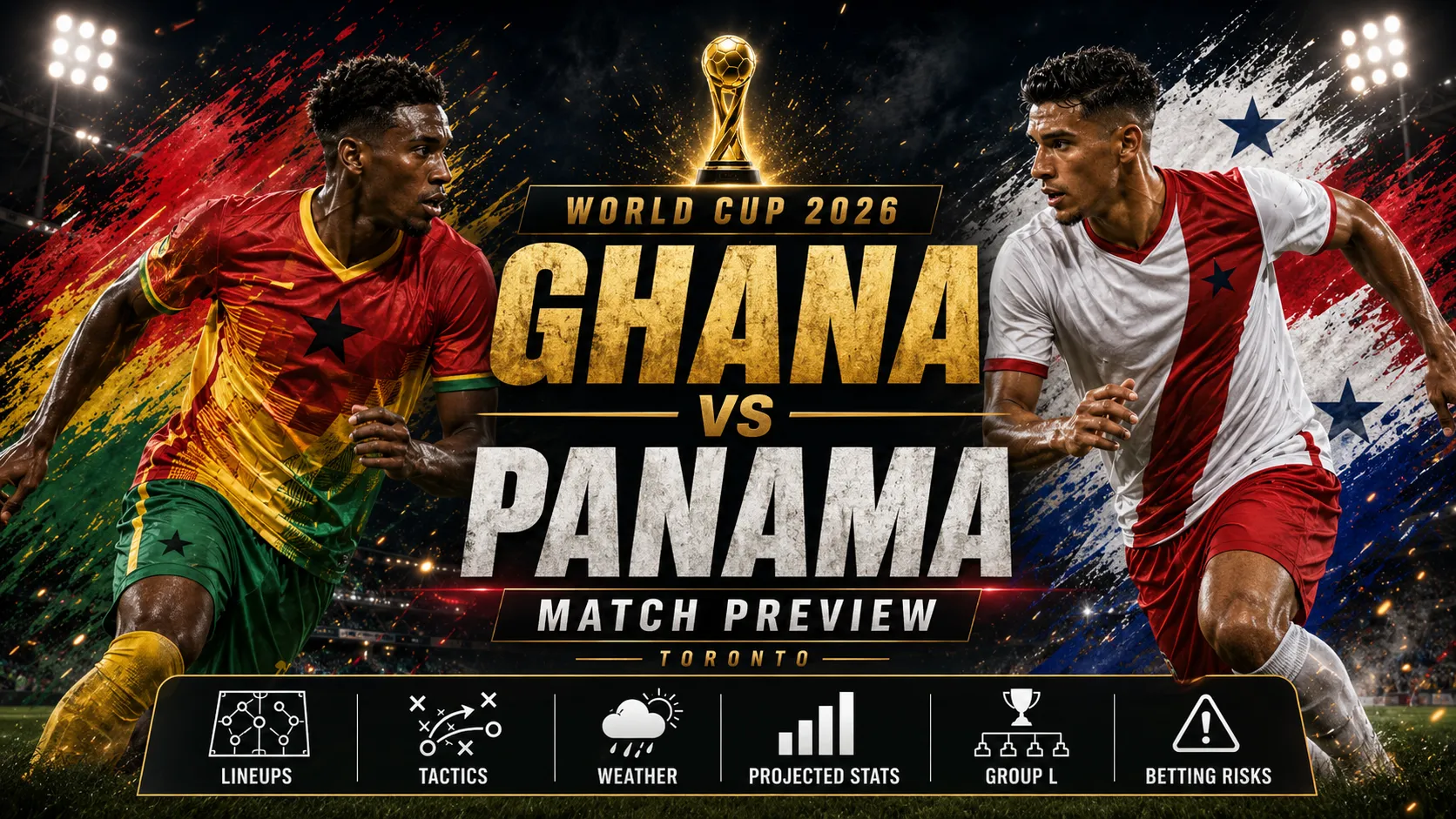
Ghana face Panama in a FIFA World Cup 2026 Group L match at Toronto Stadium / BMO Field context in Toronto, Canada, on Wednesday, 17 June 2026. Kick-off is scheduled for 7:00 p.m. local Eastern Time and 23:00 UTC. This is the opening group-stage match for both teams in a section that also includes England and Croatia.
Ghana enter under Carlos Queiroz with a disrupted squad picture. Mohammed Kudus is unavailable through injury, and Thomas Partey is unavailable for the Panama match after his Canadian visa application was refused. Ghana’s likely attacking structure therefore leans heavily on Antoine Semenyo, Inaki Williams, Jordan Ayew, Ernest Nuamah, Abdul Fatawu and Kamaldeen Sulemana. Panama enter under Thomas Christiansen with a more stable core led by Anibal Godoy, Adalberto Carrasquilla, Ismael Diaz, Jose Fajardo, Amir Murillo and Fidel Escobar.
The likely tactical shape is Ghana using athletic forwards, direct transitions and compact midfield protection against Panama’s disciplined 4-2-3-1 / 4-3-3 structure, Carrasquilla-led progression and Diaz-led final-third movement. The key matchup is Ghana’s weakened midfield screen against Panama’s Godoy-Carrasquilla central platform. The projected match type is narrow, physical, transition-heavy and high-pressure. Betting markets should be treated as signals only, not guarantees.
| Field | Data |
|---|---|
| Match | Ghana vs Panama |
| Competition | FIFA World Cup 2026 |
| Stage | Group Stage / First Stage |
| Group | Group L |
| Date | Wednesday, 17 June 2026 |
| Kick-off Time | 7:00 p.m. Eastern Time / 23:00 UTC |
| Stadium | Toronto Stadium / BMO Field context |
| City | Toronto, Ontario |
| Host Country | Canada |
| Expected Attendance | Not available from verified public data |
| Referee | Not available from verified public data |
| VAR | Not available from verified public data |
| Weather Forecast | Around 69°F / 20°C at local kick-off with showers risk; rain risk later in the evening |
| Pitch Context | Tournament venue surface; exact match-day pitch speed not available from verified public data |
| Main Article Focus | Pre-match probability dossier, predicted lineups, squad disruption, tactical analysis, Toronto weather, projected stats, disciplinary risk, Group L scenarios and responsible betting context |
Ghana vs Panama is one of the most important lower-profile openers of the group stage. England and Croatia are the heavyweight names in Group L, so both Ghana and Panama need a result before the group becomes harder. Ghana have more World Cup history and more individual attacking names. Panama have greater recent structural continuity, a clearer coach cycle and a strong belief that their second World Cup should not repeat their 2018 experience.
This match should not be framed as a simple favourite-underdog game. Ghana’s squad disruption changes the balance. Panama’s improvement under Christiansen changes the expectation. The opener may become a tight tactical contest where midfield control, transitions, set pieces and rain-affected execution matter more than reputation.
Ghana vs Panama matters because both teams need points immediately before facing England and Croatia, making this opener the clearest route to a realistic qualification platform.
| Category | Status | Ghana vs Panama Example | Article Use |
|---|---|---|---|
| Confirmed fact | Verified before publication | Ghana vs Panama, Group L, Toronto / BMO Field context | Hard match base |
| Match timing | Verified fixture / broadcast context | Wednesday, 17 June 2026, 7:00 p.m. ET / 23:00 UTC | Match snapshot |
| Tournament context | Verified schedule context | Group L includes England, Croatia, Ghana and Panama | Group scenario analysis |
| Announced information | Verified media reporting | Thomas Partey is unavailable for the Panama game after a visa refusal | Team news and midfield forecast |
| Announced information | Verified media reporting | Mohammed Kudus is out of Ghana’s World Cup squad through injury | Team news and attacking structure |
| Squad context | Verified squad reporting | Ghana squad includes Semenyo, Inaki Williams, Jordan Ayew, Nuamah, Fatawu, Sulemana, Elisha Owusu and Kwasi Sibo | Player and lineup sections |
| Squad context | Verified squad reporting | Panama squad includes Godoy, Carrasquilla, Diaz, Fajardo, Murillo, Escobar, Davis and Mosquera | Player and lineup sections |
| Probable information | Tactical forecast | Ghana likely use direct athletic attacks; Panama likely use compact structure and central progression | Tactical identity sections |
| Projected data | Model-based estimate | Possession, shots, xG, fouls, cards, substitutions and set-piece pressure | Ranges only |
| Unknown data | Not verified in current source set | Referee, VAR, exact attendance, official starting XIs, exact pitch speed, exact wind | Marked unavailable |
| Scenario-based analysis | Possible future pattern | Panama may target Ghana’s midfield without Partey; Ghana may target Panama’s full-back channels | Written as forecast, not fact |
This distinction matters. A confirmed absence is not the same as a predicted tactical consequence. Ghana’s Partey issue is confirmed for the match. Ghana’s replacement structure is a projection until the official team sheet appears. Panama’s squad list is confirmed. Panama’s pressing height is a forecast until Christiansen’s starting XI and first match actions reveal the plan.
A serious preview should not claim certainty before a future match. The official lineup can change the whole picture. Rain can affect ball speed and goalkeeper handling. A first-half card can change pressing intensity. A goalkeeper mistake can distort expected goals. A tactical forecast can be correct in structure and still miss the final score.
Group L contains England, Croatia, Ghana and Panama. England carry the strongest squad profile. Croatia carry tournament pedigree and midfield intelligence. Ghana and Panama sit in the part of the group where every point can change the knockout route.
| Team | GP | W | D | L | GD | Points | Opening Pressure |
|---|---|---|---|---|---|---|---|
| England | 0 | 0 | 0 | 0 | 0 | 0 | Very high |
| Croatia | 0 | 0 | 0 | 0 | 0 | 0 | Very high |
| Ghana | 0 | 0 | 0 | 0 | 0 | 0 | High |
| Panama | 0 | 0 | 0 | 0 | 0 | 0 | High |
The expanded 48-team format changes the group-stage calculation. The top two teams qualify directly for the Round of 32. The best eight third-placed teams also qualify. That means Ghana and Panama do not need to win the group to keep the campaign alive. They need points, goal-difference control and one strong performance against a direct rival.
This opener is the most accessible match for both sides on paper. England and Croatia can dominate possession and control long spells. Ghana and Panama therefore need to treat this match as a qualification hinge. A win creates a platform. A draw keeps both teams alive but transfers pressure into harder fixtures. A defeat creates immediate stress.
Ghana enter the tournament with history and uncertainty. They have been a World Cup quarter-finalist before, but they have also endured recent tournament disappointment. They failed to qualify for the last Africa Cup of Nations, and their World Cup preparation includes a late coaching change. Queiroz brings experience, but he has had limited time to build a stable identity.
Ghana’s problem is not a lack of athletes. It is structure. Kudus is out. Partey cannot play in Canada. Mohammed Salisu is not in the squad because of injury. Alexander Djiku was replaced by Derrick Luckassen after injury. These absences affect central control, defensive depth and creative balance.
Ghana’s practical objectives:
Panama enter with stronger structure than they had in 2018. That tournament gave Panama their first World Cup experience, but it ended with three defeats, 11 goals conceded and no points. The 2026 version has more experience, more competitive maturity and a coach who has stayed long enough to build habits.
Christiansen’s Panama are not a novelty team. They have competed well in CONCACAF, reached major regional finals and gained tournament experience against higher-profile opponents. They also carry one clear national goal: earn a first World Cup win.
Panama’s practical objectives:
Goal difference matters immediately. England and Croatia can create pressure later. A heavy defeat against either favourite could hurt a third-place route. Ghana and Panama therefore need not only points but also margin control.
If Ghana win, they can approach England with less panic. If Panama win, they create a historic platform and can treat Croatia differently. If the match is drawn, both sides still need a result against one of the group favourites or strong goal-difference management.
Ghana carry pressure from disrupted preparation. Panama carry pressure from history. Ghana’s players must show that the absence of Kudus and Partey does not break the plan. Panama must show that improvement under Christiansen can translate to World Cup points.
If Ghana score first, Panama must avoid repeating the emotional collapse patterns of inexperienced World Cup sides. If Panama score first, Ghana must avoid forcing direct attacks too early. If the match stays level after 60 minutes, the pressure may become heavier for Ghana because their individual attacking reputation is stronger.
| Result | Ghana Impact | Panama Impact | Group L Meaning |
|---|---|---|---|
| Ghana win | Ghana gain the needed platform before England and Croatia | Panama lose their clearest points route and must respond | Ghana become a realistic third-place or second-place challenger |
| Draw | Ghana remain alive but lose expected-margin points | Panama gain useful survival value but still need more | Group L remains open but pressure rises |
| Panama win | Ghana face immediate crisis before harder fixtures | Panama claim a historic World Cup result and transform their group path | Group L hierarchy becomes unstable |
| Factor | Match Relevance |
|---|---|
| Host country | Canada |
| Venue region | Toronto, Ontario |
| Neutral match | Neither team is host nation |
| Travel context | Ghana based in Boston before the match; Panama based in Ontario before the tournament |
| Immigration context | Ghana miss Partey because he cannot enter Canada for this match |
| Climate | Mild but rainy match-hour risk |
| Crowd profile | Likely mixed Canadian, Ghanaian diaspora, Panamanian and neutral support |
| Event scale | Compact football stadium adapted for World Cup use |
| Tournament pressure | Group opener with direct qualification value |
Canada matters directly because of the Partey situation. Ghana’s midfield issue is not only tactical; it is tied to host-country immigration rules. Panama do not carry the same match-specific disruption. That gives Panama a preparation advantage.
Toronto’s crowd can also matter. Ghana may have strong diaspora support. Panama may draw travelling support and neutral backing because of their first-win storyline. A tight match can shift stadium energy quickly.
| City Factor | Expected Tactical Impact |
|---|---|
| 7:00 p.m. local kick-off | Evening temperature should be moderate |
| Forecast around 69°F / 20°C at kick-off | Physical load is manageable |
| Showers risk at kick-off | Passing speed, first touch and goalkeeper handling can change |
| Rain risk later | Late clearances, slips and set-piece handling become watchlist items |
| No altitude issue | Normal oxygen recovery profile |
| Urban stadium setting | Crowd proximity and communication matter |
| Time-zone context | Panama and Ghana must manage travel rhythm, but match time is practical |
Toronto is not a heat problem. It is a wet-weather execution problem. A damp pitch can help fast passes but punish poor first touches. It can make long balls skid. It can make crossing and goalkeeper handling more uncertain. It can also increase late tackling risk if players mistime challenges on the surface.
| Stadium Detail | Data |
|---|---|
| Stadium | Toronto Stadium / BMO Field context |
| City | Toronto |
| Province | Ontario |
| Country | Canada |
| Kick-off | 7:00 p.m. local / 23:00 UTC |
| Expected Attendance | Not available from verified public data |
| Referee | Not available from verified public data |
| VAR | Not available from verified public data |
| Roof Status | Not treated as a closed-roof venue in this preview |
| Pitch Speed | Not available from verified public data |
| Tactical Impact | Rain risk, compact stadium atmosphere, moderate temperature, wet-ball handling watchlist |
| Weather / Environment Factor | Tactical Meaning |
|---|---|
| Around 69°F / 20°C | Pressing in phases remains physically realistic |
| Showers at kick-off risk | Passing, turning and goalkeeper handling need early calibration |
| Later rain risk | Late set pieces, clearances and slips can become important |
| Exact humidity unavailable | Avoid precise cramp claims |
| Exact wind unavailable | Long diagonals and crosses should be assessed live |
| No altitude | Normal sprint recovery model |
| Pitch speed unavailable | Ball speed must be judged in the first 10 minutes |
| Open-stadium context | Wet surface and wind remain live variables |
The most important weather factor is rain risk. It can flatten the difference between a technically cleaner team and a more direct team. It can also increase the value of corners, long throws, second balls and goalkeeper concentration.
| Team | Player / Role | Status | Tactical Impact |
|---|---|---|---|
| Ghana | Carlos Queiroz | Head coach | Late-cycle appointment; experience but limited preparation time |
| Ghana | Mohammed Kudus | Out of World Cup squad through injury | Ghana lose a central creator and high-value attacker |
| Ghana | Thomas Partey | Unavailable for Panama match after Canadian visa refusal | Ghana lose central midfield control and experience |
| Ghana | Mohammed Salisu | Not in squad after serious injury context | Ghana lose defensive depth and left-footed centre-back quality |
| Ghana | Alexander Djiku | Injured before squad finalisation; replaced by Derrick Luckassen | Ghana lose an experienced defender |
| Ghana | Antoine Semenyo | Confirmed squad attacker | Main attacking reference and direct threat |
| Ghana | Inaki Williams | Confirmed squad forward | Runs behind, central or wide role |
| Ghana | Jordan Ayew | Confirmed squad forward | Senior attacking control, fouls won, wide/central link |
| Ghana | Elisha Owusu | Confirmed squad midfielder | Likely midfield responsibility without Partey |
| Ghana | Kwasi Sibo | Confirmed squad midfielder | Possible central role in screening and progression |
| Panama | Thomas Christiansen | Head coach | Long-cycle coach with stable tactical platform |
| Panama | Anibal Godoy | Confirmed squad midfielder / captain profile | Leadership, defensive screen and tempo control |
| Panama | Adalberto Carrasquilla | Confirmed squad midfielder | Main progression and chance-creation midfielder |
| Panama | Ismael Diaz | Confirmed squad forward | Main scoring reference and 2025 Gold Cup top scorer context |
| Panama | Amir Murillo | Confirmed squad defender | Right-back / wide duel and progression |
| Panama | Fidel Escobar | Confirmed squad centre-back | Defensive leadership and aerial duels |
| Panama | Jose Fajardo | Confirmed squad forward | Central forward depth and box presence |
| Panama | Orlando Mosquera | Confirmed squad goalkeeper | Goalkeeper option and shot-stopping profile |
| Player | Team | Status | Tactical Impact |
|---|---|---|---|
| Adalberto Carrasquilla | Panama | Included despite injury context from Liga MX final reporting | Starting role and minutes should be checked against official XI |
| Not available from verified public data | Ghana | Not available | Do not invent additional doubtful players |
| Not available from verified public data | Panama | Not available | Do not invent additional doubtful players |
| Player | Team | Status | Tactical Impact |
|---|---|---|---|
| Mohammed Kudus | Ghana | Out of World Cup squad through injury | Removes elite ball-carrying and final-third creativity |
| Thomas Partey | Ghana | Unavailable for Panama match after visa refusal | Removes midfield security and ball-winning |
| Mohammed Salisu | Ghana | Not in squad after injury context | Reduces centre-back depth |
| Alexander Djiku | Ghana | Replaced after injury | Reduces defensive experience |
| Kadir Barria | Panama | Not selected in final squad | No direct match-day role; reduces midfield option depth |
| Not available from verified public data | Panama | Not available | Do not invent match-day absences |
| Player / Group | Team | Issue | Match Impact |
|---|---|---|---|
| Ghana midfield | Ghana | Partey unavailable for Canada match | Elisha Owusu, Kwasi Sibo and Caleb Yirenkyi may carry more responsibility |
| Ghana attack | Ghana | Kudus absent | Semenyo, Inaki Williams, Jordan Ayew, Fatawu, Nuamah and Sulemana must replace chance creation collectively |
| Ghana defence | Ghana | Salisu and Djiku not in squad | Centre-back selection and aerial protection become watchlist items |
| Carrasquilla | Panama | Included after injury context | Panama’s central rhythm depends on his role and sharpness |
| Panama veteran core | Panama | Older midfield leadership group | Godoy workload and late-game legs should be monitored |
| Both goalkeepers | Both | Rain risk | Handling, catching and clearances become more important |
No confirmed suspension was available from verified public data in the current source set. Card risk below is a tactical forecast, not confirmed disciplinary information.
Ghana’s two major losses shape the whole match. Kudus would normally help Ghana beat pressure, carry through the middle and create shots from broken situations. Partey would normally help Ghana control second balls, protect the centre-backs and switch play under pressure. Without both, Ghana may become more direct and more dependent on athletic forwards.
Panama’s key concern is not a confirmed absence. It is Carrasquilla’s condition and the role he can play. If he starts and moves well, Panama can play through midfield. If his workload is managed, Christiansen may need Godoy, Cristian Martinez or Carlos Harvey to carry more structural responsibility.
Official starting lineups were not available from verified public data in the current source set. The following XIs are projections built from squad context, team news and tactical logic. They should be replaced with official team sheets before publication.
| Position / Line | Player | Likely Role |
|---|---|---|
| GK | Lawrence Ati-Zigi / Benjamin Asare | Shot-stopping, box command, wet-ball distribution |
| RCB | Jerome Opoku | Centre-back, aerial defence, right-side buildup |
| CB | Jonas Adjetey | Central defender, box protection |
| LCB | Abdul Mumin / Derrick Luckassen | Left-side centre-back, recovery and clearances |
| RWB | Alidu Seidu / Caleb Yirenkyi | Wide defence, pressing support and transition outlet |
| CM | Elisha Owusu | Midfield screen, ball-winning and passing security |
| CM | Kwasi Sibo | Second balls, duels and simple progression |
| LWB | Gideon Mensah / Baba Abdul Rahman | Wide defence and crossing support |
| RF | Antoine Semenyo | Main direct runner, shot threat and pressing forward |
| CF | Inaki Williams / Brandon Thomas-Asante | Depth runner and central reference |
| LF | Jordan Ayew / Ernest Nuamah | Senior link player or direct wide threat |
| Position / Line | Player | Likely Role |
|---|---|---|
| GK | Orlando Mosquera / Luis Mejia | Shot-stopping, wet-ball handling and distribution |
| RB | Amir Murillo | Progressive right-back, duels against Ghana’s left side |
| CB | Fidel Escobar | Defensive leader, aerial control and buildup |
| CB | Jose Cordoba / Edgardo Farina | Centre-back, recovery and physical duels |
| LB | Eric Davis / Roderick Miller | Left-back, set-piece delivery or conservative width |
| DM | Anibal Godoy | Captain profile, midfield screen and tempo control |
| CM | Adalberto Carrasquilla | Main progressive passer and central creator |
| CM | Cristian Martinez / Carlos Harvey | Running support, second balls and defensive coverage |
| RW | Yoel Barcenas / Jose Luis Rodriguez | Wide outlet and transition runner |
| ST | Ismael Diaz / Jose Fajardo | Main forward, pressing and box movement |
| LW | Cesar Yanis / Alberto Quintero | Wide running, crossing and counter support |
| Team | Base Formation | In Possession | Out of Possession | Confidence |
|---|---|---|---|---|
| Ghana | 3-4-2-1 / 4-2-3-1 | Direct 3-2-5 or 2-3-5 depending on full-back height | Compact 5-4-1 or 4-4-2 block | Medium |
| Panama | 4-2-3-1 / 4-3-3 | 2-3-5 with Murillo/Davis supporting width and Carrasquilla central | 4-5-1 or 4-4-2 mid-block | Medium/high |
| Scenario | Trigger | Expected Change |
|---|---|---|
| Ghana choose maximum protection | Partey unavailable and Panama central strength respected | Back three with Owusu/Sibo central screen |
| Ghana choose more attacking speed | Panama full-backs push high | Nuamah, Fatawu or Sulemana starts high |
| Ghana need more central hold-up | Wet surface increases direct play | Brandon Thomas-Asante or Inaki Williams becomes central reference |
| Ghana protect lead | Leading after 70’ | Deeper wing-backs and extra midfielder |
| Panama protect Carrasquilla workload | Fitness or minutes concern | Martinez/Harvey support Godoy; Carrasquilla may play managed minutes |
| Panama chase goal | Trailing after 60’ | Fajardo or Waterman adds central box presence |
| Panama protect draw | Level after 70’ | Deeper midfield line, slower restarts and full-back caution |
| Panama target Ghana’s right/left channel | Ghana wing-back advances too high | Diaz and Barcenas/Rodriguez attack early diagonals |
| Phase | Expected Pattern |
|---|---|
| Build-up | Mixed direct build-up, cautious central passing, early release into Semenyo or Williams |
| Attack | Athletic transitions, wide carries, Jordan Ayew link play, Semenyo shot threat |
| Defense | Compact mid-block, wing-back tracking, centre-back protection |
| Transitions | Quick first pass into Semenyo, Williams, Nuamah, Fatawu or Sulemana |
| Set Pieces | Jordan Ayew delivery, Semenyo/Williams/centre-back targets |
| Weakness | Midfield control without Partey, chance creation without Kudus, defensive depth injuries |
Ghana should build with restraint. Without Partey and Kudus, Ghana lose two players who can receive under pressure and progress the ball through difficult spaces. Queiroz may therefore choose a more pragmatic plan.
The first build-up route can be direct into Semenyo or Inaki Williams. The second route can be through Elisha Owusu and Kwasi Sibo. The third route can use wing-backs or full-backs to move the ball wide before Panama’s central screen closes.
Ghana should avoid slow central passing near their own box. Panama press with structure. Carrasquilla and Godoy can punish loose midfield passes. A wet surface can make central errors more dangerous. The goalkeeper should choose direct distribution when the short pass is not clear.
Ghana can press in moments, but they should not chase Panama blindly. Panama have enough midfield quality to play through a disconnected press. Ghana’s best defensive structure may be a compact mid-block that protects the centre and forces Panama wide.
Useful Ghana pressing triggers:
Ghana should not let the front line press without midfield connection. If Semenyo and Williams jump too early and Owusu/Sibo stay deep, Panama can find Carrasquilla between lines.
Ghana’s main attacking side may be whichever side Semenyo occupies. He gives Ghana direct running, physical pressure and shot threat. If he starts right, Ghana can attack Panama’s left-back. If he starts central-left, he can combine with Jordan Ayew or Mensah.
Jordan Ayew can slow attacks and win fouls. That is important in rain. Ghana may need set pieces and territory, not only open-play combinations. Williams can run behind Panama’s centre-backs if the first pass is early.
Ghana should target:
Ghana’s key passer may not be a classic playmaker in this match. Owusu and Sibo need to move the ball safely. Jordan Ayew may become the most important final-third passer. If Nuamah, Fatawu or Sulemana starts, Ghana can add more carrying but less control.
The absence of Kudus means Ghana need collective passing. One player will not replace his ball-carrying and chance creation.
Transition is Ghana’s clearest route. Ghana have enough speed to hurt Panama if the first pass is accurate. Semenyo, Williams, Nuamah, Fatawu and Sulemana all give Ghana forward momentum. Panama’s full-backs may advance, especially Murillo. Ghana can attack that space.
The ideal Ghana transition:
Ghana should treat set pieces as a serious scoring route. Jordan Ayew can deliver. Semenyo, Williams and centre-backs can attack the box. Panama are experienced and physically strong, but wet conditions can create rebounds and handling pressure.
Ghana should also use attacking free kicks to slow Panama’s rhythm. If Panama control midfield, fouls won by Ayew or Semenyo can shift territory.
Ghana’s main defensive weakness is central balance without Partey. Owusu and Sibo must screen Carrasquilla and Godoy. If Panama receive between lines, Ghana’s centre-backs may be pulled out.
The second weakness is depth at centre-back after injuries. Ghana must avoid leaving defenders isolated against Diaz, Fajardo or wide runners.
Ghana’s goalkeeper should avoid unnecessary central risk. Rain can make short passes difficult. Direct distribution toward Williams, Semenyo or Ayew may be safer when Panama press. Long kicks need second-ball support.
Ghana’s wide players must choose moments carefully. If Ghana use a back three, wing-backs can advance, but one should hold if Panama keep Diaz or Barcenas high. If Ghana use a back four, both full-backs should not push at the same time.
The central striker must occupy Panama’s centre-backs. Williams gives depth. Thomas-Asante gives physical work and box presence. Semenyo can also act as central runner. The striker must press, hold the ball and create space for late runners.
| Phase | Expected Pattern |
|---|---|
| Build-up | Structured passing through Godoy and Carrasquilla, mixed with direct wide releases |
| Attack | Carrasquilla progression, Diaz movement, Murillo overlaps, wide runners |
| Defense | Compact mid-block, experienced back line, Godoy screen |
| Transitions | First pass into Diaz, Barcenas, Rodriguez, Yanis or Fajardo |
| Set Pieces | Davis/Godoy/Carrasquilla delivery, Escobar/Cordoba/Fajardo aerial targets |
| Weakness | Potential Carrasquilla workload issue, vulnerability to Ghana’s athletic counters |
Panama should build with more confidence than in 2018. Christiansen has developed a side that can compete with stronger teams through discipline and timing. Godoy gives leadership and protection. Carrasquilla gives progression. Murillo gives right-side athleticism. Diaz gives final-third movement.
Panama do not need to dominate possession for 90 minutes. They need to use the ball well enough to test Ghana’s disrupted midfield. If Carrasquilla receives forward-facing touches, Panama can create controlled attacks. If Ghana force him sideways or if his condition limits him, Panama may need more direct play.
Panama can press in structured waves. Ghana’s build-up may be vulnerable because of midfield absences. Christiansen may ask Diaz and the wingers to force Ghana toward the touchline.
Useful Panama pressing triggers:
Panama should not overpress Semenyo’s side without cover. Ghana can attack the channel if Panama’s full-back and winger are too high.
Panama’s main attacking side may be the right if Murillo starts aggressively. Murillo can overlap and create crossing angles. Carrasquilla can drift toward that side to combine. If Ghana’s left side advances, Panama can attack behind it.
The left side may depend on Davis and the selected winger. Davis can deliver set pieces and crosses. Barcenas or Yanis can provide direct runs.
Panama should target:
Carrasquilla is Panama’s key passer and progression player. Godoy is the stabiliser. Davis can be important from dead balls and left-side delivery. Christiansen needs Carrasquilla close to the ball but not trapped under Ghana’s pressure.
If Carrasquilla cannot start or cannot play full intensity, Panama’s chance quality may drop. They can still compete physically, but they lose their clearest central creative route.
Panama’s transition threat is less explosive than Ghana’s on paper, but it can be more organised. Diaz, Fajardo, Barcenas, Rodriguez and Yanis can all attack space. Panama’s transitions may become dangerous if Ghana lose the ball with wing-backs high.
The first pass matters. Panama should not clear aimlessly. They should look for Diaz’s feet, Carrasquilla’s first forward pass or the wide channel behind Ghana’s full-back.
Panama have a useful set-piece profile. Escobar, Cordoba, Fajardo, Waterman and Godoy can attack aerial balls. Davis, Carrasquilla or Barcenas can deliver. Rain can increase the value of set pieces because the ball may skid and rebounds may appear.
Panama should value wide free kicks. Ghana’s defensive absences and wet handling conditions make every dead ball important.
Panama’s main weakness is defending Ghana’s athletic transitions. If Panama lose the ball with both full-backs advanced, Semenyo and Williams can attack directly. Panama must keep rest defence connected.
The second weakness is possible midfield fatigue. Godoy’s leadership matters, but Ghana can create running duels late. Panama need fresh legs after 60 minutes.
Panama’s goalkeeper should mix short and direct distribution. Short passing can draw Ghana forward. Direct kicks toward Diaz or Fajardo can bypass pressure. In wet weather, the goalkeeper must avoid risky passes across the box.
Murillo gives Panama a major wide outlet, but he must balance attack and recovery. Davis can deliver from the left, but he may need to stay deeper if Ghana’s right side carries speed. Christiansen should avoid both full-backs advancing at maximum height without Godoy cover.
Diaz is Panama’s main scoring reference. Fajardo offers central support and physical presence. Waterman gives another forward option. The striker must stretch Ghana, press centre-backs and attack rebounds.
| Zone | Ghana Edge | Panama Edge | Likely Control | Why It Matters |
|---|---|---|---|---|
| Ghana left / Panama right | Ghana can use Ayew/Mensah combinations | Murillo and Carrasquilla can overload | Balanced to Panama | Panama may attack Ghana’s left-side defensive channel |
| Ghana right / Panama left | Semenyo/Fatawu/Nuamah speed | Davis experience and set-piece delivery | Ghana transition edge | Ghana’s strongest open-field route |
| Central midfield | Owusu/Sibo work rate | Godoy/Carrasquilla experience and progression | Panama slight edge | Partey’s absence changes this zone |
| Penalty box | Semenyo/Williams physical threat | Escobar/Cordoba/Farina aerial defence | Balanced | Decides low-margin chances |
| Set pieces | Ayew delivery, Ghana athletic targets | Davis/Carrasquilla delivery, Panama centre-backs | Balanced | Rain can raise dead-ball value |
| Transitions | Ghana pace and direct runners | Panama structure and first-pass quality | Ghana edge in speed, Panama edge in order | Main swing zone |
| Defensive third | Ghana back line under midfield stress | Panama experienced back line | Panama slight edge | Ghana’s absences create more uncertainty |
Semenyo is Ghana’s clearest attacking reference. He can run channels, shoot early and carry through contact.
Why it matters: Ghana may not control midfield. Semenyo can turn limited possession into dangerous attacks.
What to watch: Whether Semenyo receives facing goal or is forced into back-to-goal touches near the line.
Risk trigger: If Panama’s left-back receives an early yellow card, Ghana may attack that side repeatedly.
Carrasquilla can control Panama’s progression if Ghana do not close him quickly.
Why it matters: Ghana are missing Partey. Panama will likely test the central lane.
What to watch: Carrasquilla’s first forward-facing receptions between Ghana’s midfield and attack.
Risk trigger: If Owusu or Sibo is booked early, Ghana’s central aggression may drop.
Godoy can control the match if he wins loose balls after Ghana’s direct passes.
Why it matters: Ghana may go direct more often because of midfield absences.
What to watch: Who collects the ball after Williams, Semenyo or Ayew contest first contact.
Risk trigger: If Ghana win second balls consistently, Panama’s defensive block will face repeated pressure.
Diaz gives Panama movement and finishing. Ghana’s centre-backs must track him without losing shape.
Why it matters: Panama may create limited high-value chances. Diaz can turn one channel run into a decisive moment.
What to watch: His runs between Ghana’s left centre-back and wing-back.
Risk trigger: If Ghana’s centre-back line becomes stretched, Diaz can attack blind-side spaces.
Jordan Ayew can win fouls, slow the match and create set-piece territory.
Why it matters: In a wet match, free kicks and set pieces can become high-value chances.
What to watch: Whether Panama defenders step into contact or force Ayew backward.
Risk trigger: Repeated fouls near the box can shift Ghana’s attacking route from open play to dead balls.
| Projected Stat | Ghana | Panama | Confidence | Reason |
|---|---|---|---|---|
| Possession | 46–52% | 48–54% | Medium | Panama may control more central rhythm; Ghana may play more directly |
| Shots | 8–13 | 9–14 | Medium | Both teams project as moderate-volume sides in a tight opener |
| Shots on Target | 2–5 | 3–5 | Medium | Wet conditions and defensive blocks may limit clean shots |
| xG Range | 0.80–1.50 | 0.90–1.60 | Low/Medium | Chance quality depends on transitions and set pieces |
| Big Chances | 0–2 | 0–2 | Low/Medium | Match may hinge on few high-value moments |
| Corners | 3–6 | 3–7 | Medium | Rain and wide attacks can create blocks |
| Fouls | 12–18 | 12–17 | Medium | Physical midfield and transition fouls likely |
| Yellow Cards | 2–4 | 2–4 | Low/Medium | Referee unknown; duels should be frequent |
| Red-Card Risk | Low/Medium | Low/Medium | Low | Tactical fouls and wet tackles raise watchlist slightly |
| Offsides | 1–3 | 1–3 | Low | Williams, Semenyo, Diaz and Fajardo can attack depth |
| Saves | 2–4 | 2–5 | Medium | Both goalkeepers may face moderate pressure |
| Crosses | 12–20 | 14–22 | Medium | Panama full-backs and Ghana wide runners can create wide service |
| Tackles | 17–25 | 16–24 | Medium | Both teams likely contest midfield heavily |
| Interceptions | 10–16 | 10–17 | Medium | Compact blocks should cut central passes |
| Clearances | 18–30 | 18–28 | Medium | Set pieces and rain can increase defensive clearances |
This does not profile as a one-way match. Ghana may have more explosive forwards. Panama may have more settled midfield structure. Ghana’s absence list makes their possession projection less secure. Panama’s central platform makes their control more credible.
The key numbers are not raw possession or total shots. The key numbers are shots from central zones, set-piece xG, recoveries after long balls and transition entries. A team can lose possession and still create the best chances if it wins the right turnovers.
Rain can also distort the statistical profile. Skidding crosses, second balls and goalkeeper spills can create chances that do not follow normal buildup patterns.
| Match Window | Tactical State | Physical State | Card Risk | Goal Risk | Betting Market Trigger |
|---|---|---|---|---|---|
| 1’–15’ | Both teams likely test pressure and surface speed; Ghana may go direct early | Fresh legs; rain calibration important | Low/Medium | Medium | First Carrasquilla touch, first Semenyo transition |
| 16’–30’ | Panama may test Ghana’s midfield; Ghana may target wide speed | Contact rises in midfield | Medium | Medium | Godoy second balls, Ghana wide counters |
| 31’–45+’ | If level, set pieces may become more important | Wet surface can increase concentration risk | Medium/High | Medium | Late first-half free kicks and corners |
| 46’–60’ | Coaches adjust midfield distances and forward support | Reset intensity after half-time | Medium | Medium | Carrasquilla workload, Ghana striker role |
| 61’–75’ | Space may open with substitutions | Fatigue and wet-tackle timing matter | High | Medium/High | Fresh Ghana speed, Panama forward changes |
| 76’–90+’ | Game state dominates | Time management and pressure increase | High | Medium/High | Late counters, set pieces, penalty appeals |
The first phase should show each coach’s risk tolerance. Ghana may avoid long short-build-up sequences. Panama may try to move the ball through Carrasquilla and Godoy. Both teams must judge the surface early.
Panama may begin testing Ghana’s midfield structure. Ghana may seek earlier forward passes to Semenyo and Williams. The match can become stretched if either team overcommits.
Set pieces can become more important before half-time. Rain risk makes goalkeeper handling and defensive clearances more fragile. Card risk can rise if players slide into late challenges.
The first adjustment window matters. Queiroz may alter Ghana’s attacking support. Christiansen may adjust Carrasquilla’s position or workload. The match may tilt toward the team that controls second balls after halftime.
Substitutions can change the speed of the match. Ghana can add Nuamah, Fatawu, Sulemana or another runner. Panama can add Fajardo, Waterman or fresh wide legs. Fatigue and wet surface can raise foul risk.
Game state dominates. If either team leads, the temptation to protect the margin will be strong because Group L is difficult. If the match is level, both coaches must decide whether a draw is acceptable or whether the opener must be won.
| Factor | Expected Impact | Ghana Effect | Panama Effect |
|---|---|---|---|
| Mild temperature around 69°F / 20°C | Physical tempo can stay high | Ghana can use repeated transition sprints | Panama can maintain mid-block pressing |
| Showers risk | Ball may skid and first touch becomes harder | Direct passes can become dangerous if overhit | Short passing through midfield needs caution |
| Later rain risk | Late set pieces and clearances become riskier | Goalkeeper and centre-backs must stay clean | Mosquera/Mejia and centre-backs face handling pressure |
| Exact humidity unavailable | Avoid precise fatigue claims | Standard hydration plan | Standard hydration plan |
| Exact wind unavailable | Crosses and diagonals need live adjustment | Ayew deliveries need calibration | Davis/Carrasquilla deliveries need calibration |
| No altitude | Normal oxygen recovery | Supports Ghana’s athletic game | Supports Panama’s pressing windows |
| Pitch speed unavailable | Early match observation matters | Long balls may skid beyond runners | Short passes may accelerate |
| Open-stadium context | Weather remains a live variable | Defensive slips possible | Goalkeeper handling watchlist |
The most important weather factor is rain. It can increase set-piece value, decrease confidence in short build-up and raise the importance of second balls. It may also reduce the tactical gap between the more direct team and the more structured team.
| Player | Team | Role | Match Impact Score /10 | Reason |
|---|---|---|---|---|
| Antoine Semenyo | Ghana | Forward / direct runner | 8.8 | Main attacking reference without Kudus |
| Jordan Ayew | Ghana | Forward / link player | 8.2 | Senior control, fouls won and set-piece creation |
| Inaki Williams | Ghana | Striker / runner | 8.1 | Depth threat and central transition outlet |
| Elisha Owusu | Ghana | Midfielder | 7.9 | Key screen without Partey |
| Kwasi Sibo | Ghana | Midfielder | 7.8 | Second balls and central duels |
| Ernest Nuamah | Ghana | Winger | 7.8 | Direct carrying and late-game speed |
| Abdul Fatawu | Ghana | Winger | 7.7 | Wide threat and transition support |
| Lawrence Ati-Zigi / Benjamin Asare | Ghana | Goalkeeper | 7.8 | Wet-ball handling and box command |
| Adalberto Carrasquilla | Panama | Midfielder / creator | 8.7 | Main progression source and central passer |
| Anibal Godoy | Panama | Midfielder / leader | 8.4 | Screen, leadership and second-ball control |
| Ismael Diaz | Panama | Forward | 8.4 | Main scoring reference and movement player |
| Amir Murillo | Panama | Right-back | 8.0 | Wide progression and defensive duels |
| Fidel Escobar | Panama | Centre-back | 7.9 | Defensive leadership and aerial control |
| Eric Davis | Panama | Left-back | 7.8 | Set-piece delivery and defensive experience |
| Orlando Mosquera / Luis Mejia | Panama | Goalkeeper | 7.8 | Rain handling and shot-stopping workload |
Semenyo is Ghana’s most important attacker because he gives Ghana the direct power they need without Kudus. Diaz is Panama’s most important attacker because he turns Panama’s structure into penalty-box threat.
Ghana’s most important defensive role is the central midfield screen. Panama’s most important defender is likely Escobar because he must organise against Semenyo, Williams and Ayew.
Carrasquilla is the most important midfielder in the match if he starts and plays close to full capacity. Ghana’s most important midfielder is Owusu because he must replace part of Partey’s defensive control.
Ghana can change the match through Nuamah, Fatawu, Sulemana, Thomas-Asante or Bonsu Baah depending on the starting XI. Panama can change the match through Fajardo, Waterman, Quintero, Yanis or Rodriguez.
Ghana’s central midfielders carry card risk if Carrasquilla receives freely. Panama’s full-backs carry card risk if Semenyo, Fatawu, Nuamah or Sulemana attacks them repeatedly.
Carrasquilla’s workload should be monitored because he was included despite injury context. Ghana’s risk is more absence-based than doubt-based: Partey and Kudus are not available for this match.
The referee and VAR were not available from verified public data in the current source set. Therefore, this discipline preview uses tactical logic rather than referee-profile claims.
| Discipline Factor | Forecast |
|---|---|
| Referee Style | Not available from verified public data |
| Tactical Foul Risk | Medium/high |
| Dissent Risk | Medium |
| VAR Intervention Risk | Medium |
| Penalty Risk | Medium |
| Red-Card Risk | Low/medium |
| Team | Yellow-Card Range | Red-Card Risk | Main Risk Zone |
|---|---|---|---|
| Ghana | 2–4 | Low/Medium | Central midfield and full-back zones |
| Panama | 2–4 | Low/Medium | Full-back zones and tactical fouls after Ghana transitions |
Card risk is balanced. Ghana may foul when Carrasquilla and Diaz move through central zones. Panama may foul when Semenyo or Williams breaks into space. Wet surface can increase mistimed tackles, but the referee threshold remains unknown.
| Set-Piece Area | Ghana | Panama | Edge |
|---|---|---|---|
| Corners For | Ayew delivery, centre-back targets, Semenyo/Williams pressure | Escobar/Cordoba/Farina defensive strength | Balanced |
| Corners Against | Must defend Panama centre-backs and Fajardo/Waterman if used | Must defend Ghana athletic targets | Balanced |
| Wide Free Kicks | Ayew, Nuamah or other delivery profiles | Davis, Carrasquilla, Barcenas delivery profiles | Slight Panama delivery edge |
| Direct Free Kicks | Taker hierarchy not verified | Taker hierarchy not verified | Unknown |
| Penalties | Taker hierarchy should be confirmed on official team sheet | Taker hierarchy should be confirmed on official team sheet | Unknown |
| Long Throws | Not available from verified public data | Not available from verified public data | Unknown |
| Aerial Duels | Strong athletic targets | Experienced centre-back group | Balanced |
Set pieces can decide this match. Rain increases the value of delivery and rebounds. Panama may have a slight delivery edge through Davis and Carrasquilla, while Ghana may have strong attacking athletes if they can win first contact.
The decisive defensive matchup may be Ghana’s marking of Panama’s centre-backs and Panama’s handling of Semenyo/Williams on second balls.
| Area | Ghana | Panama |
|---|---|---|
| Goalkeeper Distribution | Likely mixed direct and short distribution | Mixed distribution through centre-backs or direct to forwards |
| Shot-Stopping Pressure | Medium | Medium |
| Cross Handling | High because rain and set pieces matter | High because rain and Ghana athletic pressure matter |
| High-Line Risk | Space behind wing-backs/full-backs if Ghana push high | Space behind full-backs if Murillo/Davis advance |
| Penalty-Box Defending | Must track Diaz, Fajardo, Escobar and second balls | Must track Semenyo, Williams, Ayew and centre-backs |
| Back-Post Weakness | Possible if Ghana over-shift toward Carrasquilla | Possible if Panama over-shift toward Semenyo |
| Defensive Communication | Important because Ghana lack full midfield stability | Important because Ghana transitions can arrive fast |
Neither goalkeeper should expect a quiet match. The shot volume may be moderate, but the pressure moments can be awkward. Rain can make crosses, low shots and rebounds more dangerous. The goalkeeper who handles routine balls cleanly may have a large hidden impact.
| Minute Window | Ghana Possible Change | Panama Possible Change | Trigger |
|---|---|---|---|
| 45’–60’ | Add speed through Nuamah/Fatawu/Sulemana or more central presence through Thomas-Asante | Adjust Carrasquilla workload, add fresh winger or forward | First-half control problem or fitness concern |
| 60’–75’ | Fresh wide runner, extra striker, or deeper midfielder to protect draw/lead | Fajardo/Waterman central presence or Quintero/Yanis width | Fatigue, cards, score pressure |
| 75’–90’ | Protect lead with extra defender/midfielder or chase with direct forwards | Protect draw/lead or chase through direct service | Game state |
Ghana should protect central space first. They cannot retreat completely because Panama can create set-piece pressure. Ghana need an outlet through Semenyo, Williams or Ayew.
Panama should control tempo through Godoy and Carrasquilla if available. They must not drop too deep too early. Ghana’s athletic forwards can create chaos if Panama defend only the box.
A draw may feel more acceptable to Panama than Ghana, but both teams need points. Queiroz may add speed. Christiansen may add a forward or protect midfield depending on Ghana’s momentum.
| Market | Current Signal | Main Risk |
|---|---|---|
| Match Winner | Ghana listed as a narrow market favourite in available sportsbook snapshot | Ghana’s midfield absences reduce certainty |
| Double Chance | Ghana/draw likely shorter; Panama/draw may carry underdog value signal | Market can overreact to team names |
| Over/Under Goals | Under 2.5 carries a lower-price signal in available market snapshot | Wet surface and set pieces can create random goals |
| BTTS | Plausible but not automatic | Both sides may create moderate rather than high shot volume |
| Corners | Balanced-to-Panama/Ghana pressure dependent | Early goal can change corner volume |
| Cards | Medium signal | Referee unknown and rain affects tackle timing |
| Player Shots | Semenyo, Williams, Diaz, Fajardo, Carrasquilla watchlist | Official lineups and roles matter |
| Player Cards | Ghana midfielders, Panama full-backs, Panama tactical stoppers | Referee threshold unknown |
| Trigger | Possible Market Effect |
|---|---|
| Official Ghana XI | Changes Ghana attack, midfield and clean-sheet confidence |
| Ghana back-three confirmation | Can lower total-goals expectation and raise draw probability |
| Carrasquilla starting confirmation | Improves Panama progression and chance-creation profile |
| Panama striker choice | Changes Panama shot and BTTS market |
| Rain/wind update | Can affect totals, goalkeeper props, corners and cards |
| Referee announcement | Can move cards and penalty markets |
| Public betting on Ghana | Can compress Ghana price even if squad disruption remains |
| Trigger | Meaning | Risk |
|---|---|---|
| Carrasquilla receives freely | Panama control and chance quality rise | Ghana may adjust the midfield screen |
| Semenyo breaks early | Ghana transition route is live | One break can overstate Ghana control |
| Repeated wet-surface slips | Game volatility increases | Slips are random and hard to price |
| Ghana midfield booked early | Panama central route improves | Referee may manage threshold differently later |
| Panama full-back booked | Ghana wide route improves | Ghana still need support inside the box |
| 0-0 after 60’ | Pressure increases on Ghana and draw becomes more valuable | Late substitutions can change tempo quickly |
This preview explains match data and market behavior. It does not provide guaranteed betting advice. World Cup betting involves risk. Readers should check local gambling laws, use licensed operators, set limits and avoid chasing losses.
| Factor | How It Can Break the Forecast |
|---|---|
| Late Lineup Change | Ghana may choose a shape that changes the midfield risk; Panama may manage Carrasquilla differently |
| Early Goal | Forces one team to abandon the base plan and opens transition lanes |
| Early Yellow Card | Changes full-back and midfield aggression |
| Injury | Alters balance, especially in Ghana midfield or Panama central creation |
| VAR Penalty | Creates a non-pattern goal and changes match state |
| Weather Shift | Heavy rain can change passing, crosses, goalkeeper handling and tackle timing |
| Red Card | Makes possession and xG projections less useful |
| Goalkeeper Error | Wet ball can create low-probability but decisive moments |
| Tactical Surprise | Panama may press higher or Ghana may play more conservatively than expected |
| Market Overreaction | Early possession or one transition can distort live betting signals |
The forecast can fail if Ghana score early and force Panama out of their stable structure. It can also fail if Panama score first and Ghana become too direct. The largest uncertainty lies in Ghana’s midfield without Partey, Panama’s Carrasquilla workload, rain conditions, and first-goal timing.
| Scenario | Probability Band | Match Story |
|---|---|---|
| Ghana Narrow Win | Medium | Ghana use Semenyo/Williams transitions and set pieces to overcome midfield disruption |
| Draw | Medium/high | Both teams protect structure, chance quality stays limited and rain raises caution |
| Panama Upset | Medium | Panama control key midfield phases and punish Ghana’s central absences |
| High-Scoring Match | Low/medium | Early goal opens the game and wet-surface errors increase chance volume |
| Low-Scoring Match | Medium/high | Compact blocks, high stakes and under-2.5 market logic align |
The safest scenario frame is tight and low-margin. Ghana have stronger attacking athleticism. Panama have stronger continuity and central structure. The match can tilt toward either side through one set piece, one transition or one wet-ball mistake.
| Result | Ghana Impact | Panama Impact |
|---|---|---|
| Ghana Win | Ghana move to 3 points and create a platform before England and Croatia | Panama must chase recovery against Croatia and England |
| Draw | Ghana stay alive but lose the clearest win route | Panama earn a useful point and keep third-place route open |
| Panama Win | Ghana face major pressure before England | Panama gain historic momentum and a real qualification platform |
A Ghana win gives Queiroz immediate credibility and reduces pressure. A draw keeps both teams alive but increases dependence on matches against stronger opponents. A Panama win would be historic and could make Group L unstable.
Goal difference remains important because the third-place route can depend on margins across groups. Neither team can treat a narrow defeat the same as a heavy defeat.
| Data Point | Status | Source Type |
|---|---|---|
| Match Date | Confirmed | FIFA / ESPN / broadcaster fixture context |
| Stadium | Confirmed | ESPN match page; FIFA venue naming context |
| City | Confirmed | ESPN match page |
| Group | Confirmed | ESPN standings and Reuters preview |
| Ghana Squad | Confirmed | Reuters squad page / Reuters squad report |
| Panama Squad | Confirmed | Reuters squad page / Reuters squad report / FIFA squad article context |
| Ghana Coach | Confirmed | Reuters team page and preview |
| Panama Coach | Confirmed | Reuters squad and team page |
| Partey Availability | Confirmed | Reuters / FIFA statement reporting |
| Kudus Availability | Confirmed | Reuters injury reporting |
| Referee | Pending | FIFA match centre if announced |
| VAR | Pending | FIFA match centre if announced |
| Weather | Forecast | Weather service |
| Lineups | Projected | Editorial forecast until official team sheets |
| Odds | Market-signal only | ESPN sportsbook snapshot / licensed market display |
| Projected Stats | Model-based | Editorial forecast |
| Minute-Window Scenarios | Scenario-based | Editorial model |
This article uses confirmed facts where available and marks unavailable information clearly. It does not invent official starting XIs, referee assignment, VAR assignment, attendance, pitch speed, wind, humidity or unverified suspensions.
This preview is analytical and informational. It is not a guarantee of the final result. Football includes randomness and low-probability events. Final lineups, injuries, referee decisions, VAR, weather and early goals can change the match.
Projected statistics, scoreline scenarios and betting market notes are probability-based estimates. They are not certain outcomes. Ghana can create the better transitions and still fail to win. Panama can control midfield periods and still lose to one direct attack or set piece. A goalkeeper error, red card, deflection, penalty, injury or weather shift can break the pre-match model.
Betting markets move before and during the match. Readers should verify official lineups, injuries, referee information, weather conditions and market prices before making decisions. Readers should check local gambling laws and use licensed operators only. Readers should set spending and time limits. Readers should not chase losses. Betting should be treated as entertainment, not income.
This article does not provide guaranteed betting advice, fixed-match information, insider tips, prediction tools, risk-free picks or certain outcomes.
Ghana vs Panama is scheduled for Wednesday, 17 June 2026, with kick-off at 7:00 p.m. Eastern Time in Toronto and 23:00 UTC.
Ghana vs Panama is being played at Toronto Stadium / BMO Field context in Toronto, Ontario, Canada.
Official starting lineups were not available from verified public data in the current source set. Ghana are projected to use Lawrence Ati-Zigi or Benjamin Asare in goal, with Jerome Opoku, Jonas Adjetey, Abdul Mumin or Derrick Luckassen in defence, Elisha Owusu and Kwasi Sibo in midfield, and Antoine Semenyo, Inaki Williams and Jordan Ayew as key attacking figures. Panama are projected to use Orlando Mosquera or Luis Mejia in goal, Amir Murillo, Fidel Escobar, Jose Cordoba or Edgardo Farina in defence, Anibal Godoy and Adalberto Carrasquilla in midfield, and Ismael Diaz or Jose Fajardo in attack.
The main tactical matchup is Ghana’s disrupted midfield without Thomas Partey against Panama’s Godoy-Carrasquilla central structure. Ghana’s best counterweight is the speed and power of Semenyo, Williams and their wide runners.
The prediction can be wrong because late lineup changes, early goals, injuries, VAR penalties, red cards, referee decisions, weather shifts, set-piece goals and goalkeeper errors can change the match. This preview uses probability logic, not certainty.
[expert_review params=»JTdCJTIyY29sb3IlMjIlM0ElMjJncmVlbi0yJTIyJTJDJTIyZXhwZXJ0X2F2YXRhciUyMiUzQSUyMiUyMiUyQyUyMmV4cGVydF9uYW1lJTIyJTNBJTIyJTIyJTJDJTIyZXhwZXJ0X2xpbmslMjIlM0ElMjIlMjIlMkMlMjJleHBlcnRfaWQlMjIlM0ElMjIxJTIyJTJDJTIyZXhwZXJ0X3R5cGUlMjIlM0ElMjJleHBlcnRfaWQlMjIlMkMlMjJleHBlcnRfYXZhdGFyX2FsdCUyMiUzQSUyMiUyMiUyQyUyMmV4cGVydF9zaG93JTIyJTNBMSUyQyUyMmV4cGVydF9kZXNjcmlwdGlvbiUyMiUzQSUyMlNwb3J0cyUyMEJldHRpbmclMjBBbmFseXN0JTIwJTI2JTIwRWRpdG9yaWFsJTIwQ29udHJpYnV0b3IlMjIlMkMlMjJleHBlcnRfc2hvd19idXR0b24lMjIlM0ExJTJDJTIyZXhwZXJ0X3Nob3dfYnV0dG9uX3R5cGUlMjIlM0ElMjJwb3B1cCUyMiUyQyUyMmV4cGVydF9xdWVzdGlvbl9idXR0b25fdGV4dCUyMiUzQSUyMkFzayUyMFF1ZXN0aW9uJTIyJTJDJTIycXVlc3Rpb25fZXh0ZXJuYWxfbGluayUyMiUzQSUyMiUyMiUyQyUyMnBvcHVwX3VzZV9waG9uZSUyMiUzQTAlMkMlMjJleHBlcnRfdGl0bGUlMjIlM0ElMjJBdXRob3IlMjIlMkMlMjJleHBlcnRfc2hvd190aXRsZSUyMiUzQTElMkMlMjJleHBlcnRfdGV4dCUyMiUzQSUyMkFsZXglMjBNb3JnYW4lMjBpcyUyMGElMjBzcG9ydHMlMjBiZXR0aW5nJTIwYW5hbHlzdCUyMGFuZCUyMGVkaXRvcmlhbCUyMGNvbnRyaWJ1dG9yJTIwd2hvJTIwd3JpdGVzJTIwZGV0YWlsZWQlMjBib29rbWFrZXIlMjByZXZpZXdzJTJDJTIwYmV0dGluZyUyMGd1aWRlcyUyQyUyMHBsYXRmb3JtJTIwY29tcGFyaXNvbnMlMkMlMjBhbmQlMjByZXNwb25zaWJsZSUyMGdhbWJsaW5nJTIwZXhwbGFpbmVycy4lMjBIaXMlMjB3b3JrJTIwZm9jdXNlcyUyMG9uJTIwcHJhY3RpY2FsJTIwaW5mb3JtYXRpb24lMjBmb3IlMjB1c2VycyUyMHdobyUyMHdhbnQlMjB0byUyMHVuZGVyc3RhbmQlMjBob3clMjBiZXR0aW5nJTIwc2l0ZXMlMjBvcGVyYXRlJTIwYmVmb3JlJTIwdGhleSUyMHJlZ2lzdGVyJTJDJTIwZGVwb3NpdCUyQyUyMG9yJTIwY2xhaW0lMjBhJTIwYm9udXMuJTIyJTJDJTIycWElMjIlM0ElNUIlNUQlMkMlMjJxYV9zaG93X3RpdGxlJTIyJTNBMSUyQyUyMnFhX3RpdGxlJTIyJTNBJTIyJUQwJTkyJUQwJUJFJUQwJUJGJUQxJTgwJUQwJUJFJUQxJTgxJTIwJUQxJThEJUQwJUJBJUQxJTgxJUQwJUJGJUQwJUI1JUQxJTgwJUQxJTgyJUQxJTgzJTIyJTJDJTIyc2NvcmUlMjIlM0ElNUIlNUQlMkMlMjJzY29yZV9zdW1tYXJ5X3RleHQlMjIlM0ElMjIlMjIlMkMlMjJzY29yZV9zdW1tYXJ5X2F2ZXJhZ2UlMjIlM0EwJTJDJTIyc2NvcmVfbWF4JTIyJTNBJTIyNSUyMiUyQyUyMnNjb3JlX3N5bWJvbCUyMiUzQSUyMiUyMiUyQyUyMnNjb3JlX3RpdGxlJTIyJTNBJTIyJTIyJTJDJTIyc2NvcmVfc2hvd190aXRsZSUyMiUzQTAlMkMlMjJwbHVzZXMlMjIlM0ElNUIlNUQlMkMlMjJtaW51c2VzJTIyJTNBJTVCJTVEJTJDJTIycGx1c2VzX21pbnVzZXNfc2hvd190aXRsZSUyMiUzQTElMkMlMjJwbHVzZXNfbWludXNlc190aXRsZSUyMiUzQSUyMiVEMCU5RiVEMCVCQiVEMSU4RSVEMSU4MSVEMSU4QiUyMCVEMCVCOCUyMCVEMCVCQyVEMCVCOCVEMCVCRCVEMSU4MyVEMSU4MSVEMSU4QiUyMiUyQyUyMnBsdXNlc190aXRsZSUyMiUzQSUyMiUyMiUyQyUyMm1pbnVzZXNfdGl0bGUlMjIlM0ElMjIlMjIlN0Q=»]