
Netherlands vs Japan World Cup 2026 Preview
Table of Contents Show
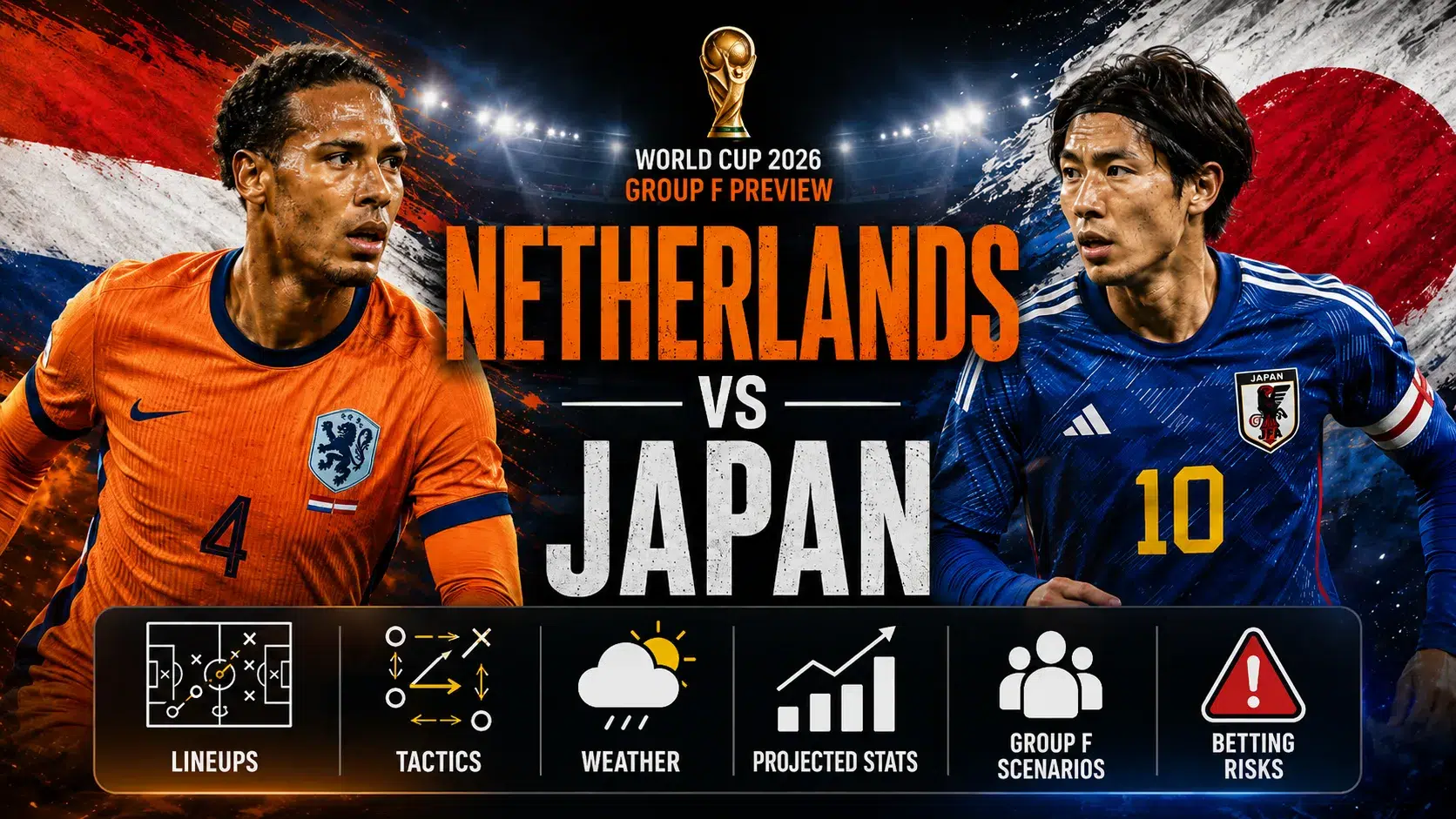
Netherlands face Japan in a FIFA World Cup 2026 Group F match at Dallas Stadium in Dallas / Arlington, Texas, United States, on Sunday, 14 June 2026. Kick-off is scheduled for 3:00 p.m. local Central time, 20:00 UTC, 22:00 in the Netherlands and 05:00 on Monday in Japan. This is the opening Group F match for both teams, with Sweden and Tunisia also in the group.
The Netherlands enter under Ronald Koeman with heavy internal pressure, a strong squad and an ambition to finally win the World Cup after losing three previous finals. Memphis Depay is fit and available, Bart Verbruggen is fit, and Jan Paul van Hecke is expected to start beside Virgil van Dijk after Jurrien Timber was ruled out. Japan enter under Hajime Moriyasu without Wataru Endo, whose foot injury and international retirement force a midfield rethink. Ko Itakura takes the captaincy, while Takefusa Kubo, Daichi Kamada, Ao Tanaka and Ayase Ueda shape Japan’s likely tactical core.
The projected match type is a high-level tactical contest between Dutch possession, central creativity and aerial power against Japan’s compact pressing, technical midfield, transition speed and collective structure. The key matchup is Frenkie de Jong and the Dutch creators against Japan’s rebuilt midfield screen. Betting markets should be treated as risk signals only, not guarantees.
| Field | Data |
|---|---|
| Match | Netherlands vs Japan |
| Competition | FIFA World Cup 2026 |
| Stage | Group Stage / First Stage |
| Group | Group F |
| Date | Sunday, 14 June 2026 |
| Kick-off Time | 3:00 p.m. CDT / 20:00 UTC / 22:00 Netherlands time / 05:00 Japan time on Monday |
| Stadium | Dallas Stadium |
| City | Dallas / Arlington, Texas |
| Host Country | United States |
| Expected Attendance | Not available from verified public data |
| Referee | Not available from verified public data |
| VAR | Not available from verified public data |
| Weather Forecast | Hot Texas conditions; exact match-hour official weather not available from verified public data; performance-impairing heat risk is relevant |
| Pitch Context | Tournament venue surface; exact match-day pitch speed not available from verified public data |
| Main Article Focus | Pre-match probability dossier, predicted lineups, team news, tactics, weather, projected stats, cards, Group F scenarios and betting risk |
Netherlands vs Japan is one of the strongest technical matches of the early group stage. The Netherlands bring elite centre-back quality, midfield control, high-level creators and attacking depth. Japan bring one of the most tactically mature squads in Asia, strong European-club experience, pressing coordination and a realistic belief that the team can go beyond its historical World Cup ceiling.
This is not a simple favourite-versus-underdog match. The Netherlands have the stronger reputation and deeper high-end squad. Japan have enough organisation, speed and technical quality to make the opener uncomfortable. The match can be decided by midfield balance, transition control, heat management and finishing efficiency.
Netherlands vs Japan matters because the winner can take early control of Group F, while the loser faces immediate pressure before later fixtures against Sweden and Tunisia.
| Category | Status | Netherlands vs Japan Example | Article Use |
|---|---|---|---|
| Confirmed fact | Verified before publication | Netherlands vs Japan, Group F, Dallas Stadium | Hard match base |
| Match timing | Verified fixture context | Sunday, 14 June 2026; 20:00 UTC / 3:00 p.m. Dallas local time | Match snapshot |
| Tournament context | Verified schedule context | Group F includes Netherlands, Japan, Sweden and Tunisia | Group scenario analysis |
| Team-news report | Verified media reporting | Memphis Depay and Bart Verbruggen are fit; Wataru Endo is out and retired internationally | |
| Defensive availability | Verified media reporting | Jan Paul van Hecke is expected to start after Jurrien Timber was ruled out | Lineup forecast |
| Probable information | Tactical forecast | Netherlands likely control more possession; Japan likely press and counter in structured phases | Tactical sections |
| Projected data | Model-based estimate | Possession, shots, xG, corners, cards, fouls | Ranges only |
| Unknown data | Not verified in current source set | Referee, VAR, exact attendance, official starting XIs | Marked unavailable |
| Scenario-based analysis | Possible future pattern | Japan may target space behind Dutch full-backs; Netherlands may overload Japan’s midfield | Written as forecast, not fact |
This distinction matters because pre-match writing loses value when it treats projection as fact. A predicted XI is not an official team sheet. A projected xG range is not a final statistic. A betting market signal is not a guaranteed result. A tactical model can break after one early goal, one injury, one red card, one goalkeeper error or one VAR review.
This dossier uses probability language. It does not claim that any goal, card, substitution, injury or VAR decision will happen at a specific minute.
Group F contains Netherlands, Japan, Sweden and Tunisia. It is one of the more balanced groups outside the obvious title-favourite sections. The Netherlands carry the largest historical reputation. Japan carry the strongest Asian profile and a clear ambition to reach a new level. Sweden bring top-level forward power. Tunisia bring defensive discipline and qualifying resilience.
| Team | Pre-Match Points | Goal Difference | Opening Pressure | Main Need |
|---|---|---|---|---|
| Netherlands | 0 | 0 | Very high | Start like a contender and avoid an opening wobble |
| Japan | 0 | 0 | High | Prove they can compete with elite European opposition |
| Sweden | 0 | 0 | High | Prepare for a direct qualification race |
| Tunisia | 0 | 0 | High | Stay compact and protect a realistic third-place path |
The expanded 48-team format changes the group-stage calculation. The top two teams qualify directly for the Round of 32. Some third-placed teams also advance. That means a draw can be useful, but goal difference becomes important from match one.
For the Netherlands, a win would confirm their favourite status in the group. A draw would not destroy their campaign, but it would increase pressure against Sweden and Tunisia. A defeat would reopen questions about whether the Dutch can handle tournament expectation.
For Japan, a win would be one of the biggest early group-stage statements. A draw would be a strong platform. A defeat would be recoverable, but Japan would need points from Sweden and Tunisia.
The Netherlands have reached three World Cup finals and lost all three. That history shapes every tournament. Koeman’s squad are not only trying to win Group F. They are trying to show that this generation can handle pressure better than several talented Dutch teams that fell short.
The Dutch stakes are tactical as well as emotional. They must show that possession can become chance quality. They must protect transitions. They must manage Memphis Depay’s fitness and role. They must use Frenkie de Jong’s control without becoming too slow. They must make Japan defend in areas that reduce Japan’s counterattacking rhythm.
The Netherlands need:
Japan have been a consistent World Cup team, but the next target is clear: win a knockout match and go deeper than the last 16. This opener is a serious test of that ambition. Japan do not need to dominate the Netherlands to prove progress. They need to control moments, defend intelligently and make the Dutch uncomfortable.
Endo’s absence changes Japan’s midfield. He provided leadership, ball-winning and structure. Ko Itakura’s captaincy gives the team a defensive leader, but Japan must replace Endo’s midfield timing. Ao Tanaka, Kaishu Sano, Daichi Kamada and other midfield options must handle a demanding Dutch possession structure.
Japan need:
| Result | Netherlands Impact | Japan Impact | Group F Meaning |
|---|---|---|---|
| Netherlands win | Dutch take early control and reduce pressure before Sweden/Tunisia | Japan need recovery and points in next matches | Expected hierarchy holds |
| Draw | Dutch lose expected-margin points | Japan gain a credible platform | Group F becomes more open |
| Japan win | Dutch face immediate scrutiny | Japan become strong top-two candidate | Group F hierarchy shifts sharply |
| Factor | Match Relevance |
|---|---|
| Host country | United States |
| Venue region | North Texas |
| Neutral match | Neither team is host nation |
| Travel context | Both teams manage long-haul travel and time-zone change |
| Climate | Hot summer conditions with heat-risk concern |
| Crowd profile | Likely mixed international crowd with Dutch, Japanese and neutral support |
| Tournament setting | Large NFL-style venue adapted for World Cup football |
The United States setting gives both teams a neutral stage. Travel adjustment affects both. The Netherlands face a long transatlantic trip and a major climate change from northern Europe to Texas. Japan face a longer east-west travel load and a difficult body-clock shift.
The main environmental issue is heat. The match is scheduled in the afternoon. Texas summer conditions can reduce repeated pressing quality, increase hydration demand and raise fatigue risk.
| City Factor | Expected Tactical Impact |
|---|---|
| Afternoon kick-off | Heat load begins immediately |
| Hot weather risk | Pressing must be timed |
| Possible storm risk earlier in the day | Surface and roof decisions should be checked before kick-off |
| No altitude issue | Oxygen profile remains normal |
| Large stadium | Crowd noise and communication matter |
| Travel/time-zone load | Japan face a major body-clock adjustment; Netherlands face heat adaptation |
| Heat-performance concern | Sprint recovery and substitution timing become important |
Dallas is not an altitude match. It is a heat-management match. The tactical issue is not oxygen. It is repeated sprint cost and recovery between pressing actions.
| Stadium Detail | Data |
|---|---|
| Stadium | Dallas Stadium |
| City | Dallas / Arlington |
| Country | United States |
| Kick-off | 3:00 p.m. local / 20:00 UTC |
| Expected Attendance | Not available from verified public data |
| Referee | Not available from verified public data |
| VAR | Not available from verified public data |
| Roof Status | Not available from verified public data for match conditions |
| Pitch Speed | Not available from verified public data |
| Tactical Impact | Heat, body-clock management, possible roof/weather effects, large-stadium atmosphere |
| Weather / Environment Factor | Tactical Meaning |
|---|---|
| Heat above normal comfort range | Pressing must be selective |
| Possible storm risk earlier in day | Match-day surface and roof status should be checked |
| Humidity not verified at exact match hour | Do not overstate exact cramp risk, but monitor hydration |
| No altitude | Sprint recovery is heat-driven, not altitude-driven |
| Roof status not confirmed | Do not assume full climate control |
| Pitch speed unknown | Avoid claims about bounce or ball speed |
| Afternoon sun/heat | Substitution windows after 60 minutes may become important |
The most important weather factor is heat. Both sides use pressing in different ways. The Netherlands can press after loss and keep the ball to reduce heat cost. Japan can press in coordinated waves and counter quickly. Both teams need to avoid wasted sprints.
| Team | Player / Role | Status | Tactical Impact |
|---|---|---|---|
| Netherlands | Memphis Depay | Fit and available | Gives the Dutch a senior striker and central creative-forward reference |
| Netherlands | Bart Verbruggen | Fit | Stabilizes goalkeeper selection and distribution |
| Netherlands | Jan Paul van Hecke | Expected to start | Gives Koeman a centre-back partner for Virgil van Dijk |
| Netherlands | Jurrien Timber | Ruled out of tournament by injury | Reduces defensive versatility |
| Japan | Wataru Endo | Out after foot injury and international retirement | Forces midfield restructure and removes senior captaincy |
| Japan | Ko Itakura | New captain | Gives Japan defensive leadership |
| Japan | Shuto Machino | Called up after Endo exit | Adds forward depth rather than direct midfield replacement |
| Japan | Kaoru Mitoma | Reported unavailable through injury in Dutch defensive reporting | Removes a high-level wide dribbler if confirmed in final squad context |
| Player | Team | Status | Tactical Impact |
|---|---|---|---|
| Not available from verified public data | Netherlands | Not available | Do not invent |
| Not available from verified public data | Japan | Not available | Do not invent |
| Player | Team | Status | Tactical Impact |
|---|---|---|---|
| Jurrien Timber | Netherlands | Ruled out | Reduces defensive flexibility and right-sided centre-back depth |
| Wataru Endo | Japan | Out / retired internationally after foot-injury issue | Removes midfield leadership, ball-winning and defensive timing |
| Kaoru Mitoma | Japan | Reported unavailable through injury in Dutch pre-match reporting | Reduces Japan’s elite left-wing carrying threat |
| Player / Group | Team | Issue | Match Impact |
|---|---|---|---|
| Memphis Depay | Netherlands | Recently had limited football but reported fit | Workload and sharpness should be monitored |
| Bart Verbruggen | Netherlands | Previously recovering from a knock but reported fit | Goalkeeper workload risk appears low if fully fit |
| Japan midfield | Japan | Endo absence | Structural adaptation required |
| Both teams | Both | Heat load | Substitution timing and cramp risk may matter |
No confirmed suspension issue was available from verified public data in the current source set. Card risk below is a match forecast, not confirmed disciplinary data.
Official starting lineups were not available from verified public data in the current source set. The following XIs are projected from team context, pre-match reporting and tactical logic. They should be replaced with official team sheets before publication.
| Position / Line | Player | Likely Role |
|---|---|---|
| GK | Bart Verbruggen | Goalkeeper, buildup starter, shot-stopper |
| RB | Denzel Dumfries / right-back option | Width, aerial threat, transition running |
| CB | Jan Paul van Hecke | Centre-back, ball security, defensive duels |
| CB | Virgil van Dijk | Captain, defensive leader, aerial control |
| LB | Nathan Aké / left-back option | Defensive balance, left-side cover |
| DM | Frenkie de Jong | Deep controller, press resistance, tempo |
| CM | Tijjani Reijnders | Progression, box support, passing rhythm |
| CM / AM | Xavi Simons | Between-lines creator and pressing trigger |
| RW | Donyell Malen / Jeremie Frimpong profile | Speed, width and running behind |
| ST | Memphis Depay | Central forward, link play and finishing |
| LW | Cody Gakpo | Left-sided attacker, inside movement and shooting |
| Position / Line | Player | Likely Role |
|---|---|---|
| GK | Zion Suzuki / goalkeeper option | Shot-stopper, distribution under pressure |
| RB | Yukinari Sugawara / right-back option | Wide defence, crosses and ball progression |
| CB | Ko Itakura | Captain, centre-back leader, buildup |
| CB | Takehiro Tomiyasu / centre-back option if available | Defensive control and aerial security |
| LB | Hiroki Ito / left-sided defensive option | Balance and recovery |
| DM | Ao Tanaka | Midfield control and ball-winning |
| CM | Kaishu Sano / midfield option | Endo replacement profile, duel and coverage |
| CM / AM | Daichi Kamada | Link player, between-lines support |
| RW | Takefusa Kubo | Main creative attacker, left-footed threat |
| ST | Ayase Ueda / Shuto Machino option | Central striker, pressing and box movement |
| LW | Daizen Maeda / wide runner option | Speed, pressing and channel threat |
| Team | Base Formation | In Possession | Out of Possession | Confidence |
|---|---|---|---|---|
| Netherlands | 4-3-3 / 4-2-3-1 | 2-3-5 with De Jong as controller | 4-4-2 press or 4-1-4-1 mid-block | Medium |
| Japan | 4-2-3-1 / 4-3-3 | 2-3-5 in attacks, quick wide releases | 4-4-2 / 4-5-1 compact press | Medium |
| Scenario | Trigger | Expected Change |
|---|---|---|
| Netherlands seek more speed | Japan defend high or leave channels | Frimpong/Malen profile becomes more valuable |
| Netherlands seek more control | Japan press central zones | Extra midfielder or deeper Simons role |
| Netherlands protect lead | Leading after 70’ | More compact midfield and lower full-back risk |
| Japan seek more midfield security | Dutch dominate De Jong zones | Sano/Tanaka/Kamada triangle becomes deeper |
| Japan chase goal | Trailing after 60’ | Machino or another striker profile adds box presence |
| Japan protect draw | Level after 70’ | Deeper line, extra defensive midfielder, slower restarts |
| Phase | Expected Pattern |
|---|---|
| Build-up | Verbruggen, Van Dijk, Van Hecke and De Jong create a calm first phase |
| Attack | Central rotations, Gakpo inside runs, Memphis link play, right-side speed |
| Defense | Counter-press after loss, Van Dijk controls depth |
| Transitions | Quick release to wide runners after midfield recoveries |
| Set Pieces | Van Dijk, Dumfries, Van Hecke and Memphis as targets |
| Weakness | Space behind attacking full-backs and heat cost of repeated pressing |
The Netherlands should build through controlled possession. Verbruggen can support the first phase. Van Dijk can direct the back line. Van Hecke can offer ball security. De Jong is the key player because he can receive under pressure and turn possession into progression.
Japan will try to block central lanes. The Netherlands must move the ball quickly enough to prevent Japan from setting traps. Slow possession can help Japan. Fast, controlled switches can hurt Japan.
The Dutch should press in bursts rather than chase for 90 minutes. Heat makes reckless pressing expensive. The best pressing moments will come after loss, especially when Japan try to play the first forward pass.
A high press can work if the front line, midfield and full-backs move together. A disconnected press can create space for Kubo, Kamada and Japan’s wide runners.
The Netherlands can attack through both flanks. Gakpo’s left-side inside movement can create shots and combinations. The right side can use Dumfries, Frimpong or Malen-type speed. The central lane remains crucial because Memphis and Simons can connect attacks.
The best Dutch pattern may be: De Jong breaks pressure, Simons receives between lines, Gakpo or Memphis attacks the box, and the opposite winger attacks the far post.
Frenkie de Jong is the key passer. His ability to receive under pressure can break Japan’s first defensive line. If Japan block him, the Netherlands may need Van Dijk diagonals or Simons dropping deeper.
The Netherlands have transition quality, but they must balance it with rest defence. If Japan lose the ball while pushing full-backs forward, the Dutch can attack quickly. If the Dutch lose the ball with both full-backs advanced, Japan can counter.
The Netherlands have a strong set-piece profile. Van Dijk, Van Hecke, Dumfries and Memphis can attack aerial deliveries. Against Japan, set pieces may become important if open-play spaces are limited.
The main defensive weakness is space behind full-backs. Japan can attack quickly through Kubo, Maeda, Ueda or Kamada. The Netherlands must keep one midfielder close enough to stop the first pass.
Verbruggen’s distribution can help the Netherlands control tempo. He must avoid central risk if Japan press aggressively. Direct passes to wide players can be useful if Japan compress the middle.
Dutch full-backs should not attack recklessly in Dallas heat. One side can advance while the other holds. Dumfries can add aerial threat, but his forward runs can open space behind him.
Memphis must link play and threaten the box. He does not need to run constantly if his fitness is managed. He needs clean touches between Japan’s lines and intelligent movement against Itakura.
| Phase | Expected Pattern |
|---|---|
| Build-up | Short passing when possible, direct escape when Dutch press triggers |
| Attack | Kubo creativity, Kamada link play, striker movement, wide running |
| Defense | Compact block, coordinated pressing traps, Itakura leadership |
| Transitions | Fast release after recoveries, especially into wide channels |
| Set Pieces | Itakura, Ueda/Machino and centre-back targets |
| Weakness | Endo absence, defending Dutch aerial size, central duels |
Japan should build with caution. Endo’s absence removes an important organiser. Ao Tanaka, Sano and Kamada must share the task. Japan should not force central passes when De Jong and the Dutch midfield press forward.
Japan can use short combinations to attract pressure, then play wide. Kubo can receive between lines. Kamada can connect midfield and attack. The striker must provide depth.
Japan’s pressing must be selective. The team can press very well when coordinated. The risk is heat and Dutch press resistance. De Jong can turn pressure into progression if Japan press without compact distances.
The best triggers:
Japan’s right side with Kubo can become the key creative route. The left side can use Maeda or another runner to attack behind the Dutch right-back. Without Mitoma, Japan lose one elite dribbling lane, so they may need more collective wide rotations.
Kubo is Japan’s main final-third passer. Kamada can support through central combinations. Tanaka and Sano must provide the base. If Kubo is isolated, Japan’s attack can become too direct.
Japan can create danger after Dutch turnovers. The first pass must be clean. If Japan need three passes to escape, the Dutch counter-press may recover the ball. If Kubo or Maeda receives early, Japan can attack open spaces.
Japan can threaten set pieces, but the Netherlands have greater aerial size. Japan should focus on movement, screens and second balls rather than simple high deliveries. Itakura can be a target.
Japan’s main weakness is the midfield restructure after Endo. The team can still defend well, but timing and leadership in central zones matter. The second weakness is aerial defending against Van Dijk, Dumfries and Dutch centre-backs.
Japan’s goalkeeper must stay calm under Dutch pressure. Short passing can invite danger if the midfield spacing is poor. Direct passes to wide runners can relieve pressure.
Japan’s full-backs should advance selectively. If both push high, the Netherlands can counter through Gakpo, Malen or Memphis. Japan need at least one full-back connected to the centre-backs.
Ueda or Machino must press, hold the ball and attack the box. The striker may receive few clean chances. A strong performance can include winning fouls, stretching Van Dijk and supporting Kubo.
| Zone | Netherlands Edge | Japan Edge | Likely Control | Why It Matters |
|---|---|---|---|---|
| Dutch left / Japan right | Gakpo inside movement | Kubo counter-threat if Japan win it | Balanced | Can decide attacking rhythm |
| Dutch right / Japan left | Dumfries/Frimpong speed | Maeda-type counters | Netherlands physical edge | Creates transition risk both ways |
| Central midfield | De Jong, Reijnders, Simons | Tanaka, Sano, Kamada structure | Netherlands slight edge | Decides possession and first pass after turnovers |
| Penalty box | Van Dijk/Dumfries/Memphis aerial value | Itakura leadership and compact marking | Netherlands edge | Set pieces and crosses matter |
| Set pieces | Dutch size and delivery | Japanese movement and second balls | Netherlands edge | Can break a tight match |
| Transitions | Dutch counter-press | Japanese speed and Kubo release | Balanced | Japan’s best route |
| Defensive third | Dutch elite centre-backs | Japan compact collective block | Split | Determines shot quality |
De Jong can control the match if he receives cleanly. Japan must block his forward-facing touches.
Why it matters: Dutch possession becomes dangerous when De Jong breaks the first line.
What to watch: De Jong’s first forward pass after receiving from Van Dijk or Verbruggen.
Risk trigger: If Japan’s midfield screen gets stretched, De Jong can carry into the final third.
Memphis gives the Netherlands link play and goal threat. Itakura gives Japan leadership and defensive timing.
Why it matters: If Memphis connects attacks, Japan’s block can be pulled apart.
What to watch: Whether Memphis receives between midfield and defence or only outside the box.
Risk trigger: If Itakura is forced into repeated recovery fouls, Japan’s defensive risk rises.
Kubo can turn limited Japan possession into attacking threat. The Netherlands must deny him space to cut inside.
Why it matters: Kubo may be Japan’s cleanest route to chance creation.
What to watch: Whether Kubo receives facing goal after turnovers.
Risk trigger: If the Dutch left-back is booked early, Kubo’s one-vs-one value rises.
The Netherlands have clear centre-back strength. Japan’s striker must create movement and occupy both centre-backs.
Why it matters: If Japan cannot hold the ball, the Dutch can keep pressure high.
What to watch: First-contact duels after Japan clear or counter.
Risk trigger: If Japan’s striker wins early fouls, the Dutch high line may become more cautious.
The Netherlands have aerial power. Japan must manage first contact and rebounds.
Why it matters: A set-piece goal can break Japan’s compact plan.
What to watch: Marking on Van Dijk, Dumfries and Van Hecke.
Risk trigger: Repeated Dutch corners before half-time can increase pressure and card risk.
| Projected Stat | Netherlands | Japan | Confidence | Reason |
|---|---|---|---|---|
| Possession | 55–62% | 38–45% | Medium | Netherlands likely control more ball |
| Shots | 12–17 | 8–12 | Medium | Dutch volume edge, Japan counter threat |
| Shots on Target | 4–7 | 2–5 | Medium | Japan can limit central chance quality |
| xG Range | 1.30–2.10 | 0.70–1.40 | Low/Medium | Heat, first goal and transitions can shift profile |
| Big Chances | 1–3 | 0–2 | Low/Medium | Netherlands have more box access |
| Corners | 5–8 | 3–5 | Medium | Dutch width and set pieces likely produce volume |
| Fouls | 10–14 | 11–16 | Medium | Japan may defend more phases |
| Yellow Cards | 1–3 | 2–4 | Low/Medium | Referee not confirmed |
| Red Card Risk | Low | Low/Medium | Low | Transition fouls and heat fatigue can raise risk |
| Offsides | 1–3 | 1–2 | Low | Dutch and Japanese forward runs |
| Saves | 2–4 | 3–6 | Medium | Japan goalkeeper may face higher volume |
| Crosses | 16–24 | 10–16 | Medium | Netherlands likely use wider pressure |
| Tackles | 14–20 | 18–25 | Medium | Japan likely defend more duels |
| Interceptions | 8–13 | 11–17 | Medium | Japan block can cut central passes |
| Clearances | 12–20 | 20–30 | Medium | Japan may defend deeper for stretches |
The Netherlands should lead possession and shot volume. Japan can still make the match close if they keep Dutch shots away from central zones. The key number is not possession. It is shot quality.
If the Netherlands create cutbacks and central touches for Memphis, Gakpo and Simons, their xG can rise. If Japan force them into long shots and predictable crosses, the match becomes closer. Japan’s xG depends on transitions and Kubo’s final-third decisions.
| Match Window | Tactical State | Physical State | Card Risk | Goal Risk | Betting Market Trigger |
|---|---|---|---|---|---|
| 1’–15’ | Netherlands likely establish possession; Japan test compactness | Fresh legs, heat already relevant | Low/Medium | Medium | First De Jong progression, first Kubo counter |
| 16’–30’ | Dutch central rhythm becomes clearer | Pressing cost starts to show | Medium | Medium | Japan pressing traps, Dutch corners |
| 31’–45+’ | If level, Japan may grow into counters | Heat and defensive shifting matter | Medium/High | Medium | Late first-half set pieces |
| 46’–60’ | Coaches adjust midfield spacing | Reset intensity after half-time | Medium | Medium | Dutch right-side changes, Japan striker support |
| 61’–75’ | Space may open as heat accumulates | Fatigue and cramp risk rise | High | Medium/High | Live totals, cards, substitutions |
| 76’–90+’ | Game state dominates | Late fatigue and time management | High | High | Late corners, counters, penalty appeals |
| Factor | Expected Impact | Netherlands Effect | Japan Effect |
|---|---|---|---|
| Heat risk | Repeated pressing cost rises | Must use possession to control energy | Must press in waves, not chase constantly |
| Possible storm risk earlier | Surface/roof status should be checked | Could affect ball speed if surface changes | Could affect direct counters |
| Humidity not verified exactly | Do not overstate, but monitor hydration | May affect high counter-pressing | May affect compact shifting |
| No altitude | Normal oxygen profile | Supports technical rhythm | Supports sprint counters |
| Roof status not verified | Climate control cannot be assumed | Heat planning needed | Heat planning needed |
| Pitch speed unknown | Avoid exact surface claims | Ball circulation may vary | First touch in counters may matter |
The most important weather factor is heat. Both sides must manage intensity. The Netherlands can use possession to reduce sprint load. Japan must avoid pressing every Dutch pass. Fresh legs after 60 minutes may become decisive.
| Player | Team | Role | Match Impact Score /10 | Reason |
|---|---|---|---|---|
| Frenkie de Jong | Netherlands | Midfield controller | 9.0 | Main Dutch tempo and progression player |
| Memphis Depay | Netherlands | Striker / link forward | 8.7 | Senior attacking reference and goal threat |
| Virgil van Dijk | Netherlands | Centre-back / captain | 8.7 | Defensive control and set-piece threat |
| Cody Gakpo | Netherlands | Left attacker | 8.4 | Inside runs, shooting and link play |
| Xavi Simons | Netherlands | Creator | 8.3 | Between-lines passing and pressing |
| Bart Verbruggen | Netherlands | Goalkeeper | 7.9 | Distribution and shot-stopping |
| Takefusa Kubo | Japan | Creator / winger | 8.8 | Japan’s main final-third imagination |
| Ko Itakura | Japan | Centre-back / captain | 8.5 | Defensive leadership after Endo exit |
| Daichi Kamada | Japan | Midfield link | 8.2 | Connects midfield and attack |
| Ao Tanaka | Japan | Midfielder | 8.0 | Key Endo-replacement structure |
| Ayase Ueda | Japan | Striker | 7.9 | Box movement and pressing |
| Daizen Maeda | Japan | Wide/forward runner | 7.8 | Speed and defensive work rate |
Memphis Depay is the Netherlands’ most important attacking reference if selected. Kubo is Japan’s most important creator because he can turn limited possession into high-value moments.
Van Dijk is the most important Dutch defender. Itakura is the most important Japanese defender because he must organise the back line and replace some of Endo’s leadership influence.
De Jong is the most important midfielder in the match. Japan’s midfield must limit his forward-facing touches.
The Netherlands can change the match through Frimpong, Malen or another speed profile. Japan can change the match through Machino or another forward option if they need box presence late.
Japan’s defensive midfielders and full-backs carry card risk against Dutch rotations. Dutch full-backs carry risk if Kubo or Maeda break into transition.
Memphis Depay’s workload should be monitored because he was recently short of match rhythm despite being fit. Heat load can affect both teams’ substitutions.
The referee and VAR were not available from verified public data in the current source set. Therefore, this discipline preview uses tactical logic rather than referee-profile claims.
| Discipline Factor | Forecast |
|---|---|
| Referee Style | Not available from verified public data |
| Tactical Foul Risk | Medium/high |
| Dissent Risk | Medium |
| VAR Intervention Risk | Medium |
| Penalty Risk | Medium |
| Red-Card Risk | Low/medium |
| Team | Yellow-Card Range | Red-Card Risk | Main Risk Zone |
|---|---|---|---|
| Netherlands | 1–3 | Low | Tactical fouls after Japan counters |
| Japan | 2–4 | Low/Medium | Midfield screen and full-back zones against Dutch rotations |
Japan may carry the higher card range because they are likely to defend more phases. The Netherlands’ card risk appears if they lose possession with full-backs high and must stop Kubo or Maeda in transition.
| Set-Piece Area | Netherlands | Japan | Edge |
|---|---|---|---|
| Corners For | Van Dijk, Van Hecke, Dumfries, Memphis | Itakura, Ueda, centre-back targets | Netherlands |
| Corners Against | Strong aerial defence | Must defend Dutch height | Netherlands edge |
| Wide Free Kicks | Gakpo/Simons/Depay delivery options | Kubo/Kamada delivery options | Balanced to Netherlands |
| Direct Free Kicks | Depay/Gakpo/Simons possible profiles | Kubo/Kamada possible profiles | Balanced |
| Penalties | Taker hierarchy not verified | Taker hierarchy not verified | Unknown |
| Long Throws | Not available from verified public data | Not available from verified public data | Unknown |
| Aerial Duels | Strong | Technical movement, less size | Netherlands edge |
The Netherlands have the set-piece edge because of Van Dijk, Van Hecke and Dumfries. Japan must defend first contact and second balls. Japan can still threaten through movement and Kubo delivery.
| Area | Netherlands | Japan |
|---|---|---|
| Goalkeeper Distribution | Verbruggen supports short buildup | Japan goalkeeper may mix short/direct |
| Shot-Stopping Pressure | Medium | Medium/high |
| Cross Handling | Medium | High against Dutch aerial targets |
| High-Line Risk | Space behind full-backs | Space behind full-backs if Japan chase |
| Penalty-Box Defending | Must track Ueda/Maeda counters | Must track Memphis, Gakpo, Van Dijk |
| Back-Post Weakness | Possible against Japan switches | Possible against Dutch diagonal crosses |
| Defensive Communication | Van Dijk-led | Itakura-led after Endo exit |
Japan’s goalkeeper may face more pressure because the Netherlands are projected to create more shots and corners. Verbruggen may face fewer actions, but Japan’s transitions can still produce high-value moments.
| Minute Window | Netherlands Possible Change | Japan Possible Change | Trigger |
|---|---|---|---|
| 45’–60’ | Add speed or adjust right side | Add midfield stability or forward support | First-half imbalance |
| 60’–75’ | Fresh winger, striker support, heat management | Fresh runner, striker or extra midfielder | Heat, cards, score pressure |
| 75’–90’ | Protect lead or chase winner | Protect draw or chase through direct play | Game state |
The Netherlands should control possession and avoid open transitions. They should not expose both full-backs chasing a second goal.
Japan may defend deeper and use Kubo/Maeda counters. The Netherlands must avoid panic crossing.
A draw may be more acceptable to Japan than the Netherlands. Koeman may increase attacking risk. Moriyasu may protect structure while keeping one counter outlet high.
| Market | Current Signal | Main Risk |
|---|---|---|
| Match Winner | Netherlands likely favoured | Japan’s tactical quality and heat risk reduce certainty |
| Double Chance | Netherlands or draw likely shorter | Low price may not reflect Japan upside |
| Over/Under Goals | Moderate total profile | Heat and compactness can suppress tempo |
| BTTS | Plausible but not automatic | Japan shot volume may depend on counters |
| Corners | Netherlands corner volume may rise | Early goal can change corner profile |
| Cards | Medium risk | Referee unknown |
| Player Shots | Memphis, Gakpo, Kubo, Ueda watchlist | Official lineup and role matter |
| Player Cards | Japan midfielders/full-backs, Dutch transition stoppers | Referee threshold unknown |
| Trigger | Possible Market Effect |
|---|---|
| Official Dutch XI | Moves player shots and team-total markets |
| Memphis starting confirmation | Moves scorer and shot markets |
| Japan midfield selection after Endo absence | Affects Dutch possession expectation |
| Kubo role | Affects Japan shot and assist markets |
| Referee announcement | Moves cards and penalty markets |
| Weather/roof update | Affects total goals and tempo |
| Public money on Netherlands | Can compress favourite price |
| Trigger | Meaning | Risk |
|---|---|---|
| De Jong receives freely | Dutch control rises | Japan may adjust block |
| Japan counter cleanly twice | Dutch rest defence vulnerable | Low sample can mislead |
| Dutch corners rise early | Territorial pressure | Does not guarantee central xG |
| Kubo isolates full-back | Japan chance quality rises | Needs box support |
| 0-0 after 60’ | Pressure shifts toward Netherlands | Japan fatigue may still rise |
| Heat slows pressing | Lower tempo possible | Late substitutions can reopen match |
This preview explains match data and market behavior. It does not provide guaranteed betting advice. World Cup betting involves risk. Readers should check local gambling laws, use licensed operators, set limits and avoid chasing losses.
| Factor | How It Can Break the Forecast |
|---|---|
| Late Lineup Change | Changes midfield balance and attacking roles |
| Early Goal | Forces one team to abandon base plan |
| Early Yellow Card | Changes wide duels and pressing aggression |
| Injury | Forces tactical reshuffle and changes physical balance |
| VAR Penalty | Creates a non-pattern goal and alters game state |
| Weather Shift | Heat, storms or roof status can affect tempo |
| Red Card | Makes possession and xG projections less relevant |
| Goalkeeper Error | Creates a low-probability swing |
| Tactical Surprise | Japan may press higher or Netherlands may use a different shape |
| Market Overreaction | Early possession or one counter can distort live prices |
The forecast can fail if Japan score first and force the Netherlands into emotional attacking. It can also fail if the Netherlands score early and reduce tempo. Heat, set pieces, goalkeeper performance and card timing can all break the pre-match model.
| Scenario | Probability Band | Match Story |
|---|---|---|
| Netherlands Narrow Win | Medium/high | Dutch possession and set-piece edge produce enough chance quality |
| Draw | Medium | Japan stay compact and use counters to keep the match balanced |
| Japan Upset | Low/medium | Japan score first through transition or Kubo-created chance and defend well |
| High-Scoring Match | Low/medium | Early goal opens space and both teams attack transition lanes |
| Low-Scoring Match | Medium/high | Heat and compact defending suppress tempo and chance quality |
The safest scenario frame is Netherlands-favoured but not Netherlands-certain. Japan have enough tactical maturity to make the match close.
| Result | Netherlands Impact | Japan Impact |
|---|---|---|
| Netherlands Win | Netherlands take early control of Group F | Japan need response against Sweden and Tunisia |
| Draw | Netherlands lose expected-margin points | Japan gain a strong platform |
| Japan Win | Netherlands face immediate pressure | Japan become a strong top-two candidate |
A win gives either team a strong top-two path. A draw keeps both alive but increases later pressure. A defeat is not fatal because third-place qualification exists, but goal difference and next-match pressure become important.
| Data Point | Status | Preferred Source Type |
|---|---|---|
| Match Date | Confirmed | FIFA fixture listing / Reuters preview |
| Stadium | Confirmed | FIFA fixture listing / Reuters venue context |
| City | Confirmed | FIFA / Reuters venue context |
| Group | Confirmed | FIFA / Reuters |
| Coaches | Confirmed | Reuters pre-match reporting |
| Squad | Partly confirmed through pre-match reporting | |
| Referee | Not available from verified public data | FIFA match centre if announced |
| VAR | Not available from verified public data | FIFA match centre if announced |
| Weather | Forecast / heat-risk signal | Weather data and climate-risk source |
| Lineups | Projected until official team sheets | FIFA match centre / official team sheets |
| Injuries | Reported for specific players | Reuters / verified media |
| Suspensions | No confirmed active suspension in current source set | FIFA disciplinary data |
| Odds | Dynamic market signal only | Licensed odds providers / aggregators |
| Projected Stats | Model-based estimate | Editorial forecast |
| Minute-Window Scenarios | Scenario forecast only | Editorial model |
This article uses confirmed facts where available and marks unavailable information clearly. It does not invent referee data, VAR data, exact attendance, official starting lineups or unverified injuries.
This preview is analytical and informational. It is not a guarantee of the final result. Football includes randomness and low-probability events. Final lineups, injuries, referee decisions, VAR, weather and early goals can change the match.
Projected statistics, scoreline scenarios and betting market notes are probability-based estimates. They are not certain outcomes. The Netherlands can dominate possession and still fail to win. Japan can create fewer open-play chances and still score from a transition, set piece or individual action. A goalkeeper error, red card, deflection, penalty, injury or weather shift can break the pre-match model.
Betting markets move before and during the match. Readers should verify official lineups, injuries, referee information, weather conditions and market prices before making decisions. Readers should check local gambling laws and use licensed operators only. Readers should set spending and time limits, avoid chasing losses and treat betting as entertainment rather than income.
This article does not provide guaranteed betting advice, fixed-match information, insider tips, risk-free picks or certain outcomes.
Netherlands vs Japan is scheduled for Sunday, 14 June 2026, with kick-off at 3:00 p.m. local Central time in Dallas / Arlington and 20:00 UTC.
Netherlands vs Japan is being played at Dallas Stadium in Dallas / Arlington, Texas, United States.
Official starting lineups were not available from verified public data in the current source set. The Netherlands are projected to use Bart Verbruggen, Virgil van Dijk, Jan Paul van Hecke, Frenkie de Jong, Xavi Simons, Cody Gakpo and Memphis Depay as key figures. Japan are projected to use Ko Itakura, Ao Tanaka, Daichi Kamada, Takefusa Kubo, Ayase Ueda or Shuto Machino, and a wide runner such as Daizen Maeda.
The main tactical matchup is Dutch possession and central creativity through Frenkie de Jong, Memphis Depay and Xavi Simons against Japan’s compact midfield screen, coordinated pressing and transition threat through Takefusa Kubo.
The prediction can be wrong because late lineup changes, early goals, injuries, VAR penalties, red cards, referee decisions, weather shifts, set-piece goals and goalkeeper errors can change the match. This preview uses probability logic, not certainty.
[expert_review params=»JTdCJTIyY29sb3IlMjIlM0ElMjJncmVlbi0yJTIyJTJDJTIyZXhwZXJ0X2F2YXRhciUyMiUzQSUyMiUyMiUyQyUyMmV4cGVydF9uYW1lJTIyJTNBJTIyJTIyJTJDJTIyZXhwZXJ0X2xpbmslMjIlM0ElMjIlMjIlMkMlMjJleHBlcnRfaWQlMjIlM0ElMjIxJTIyJTJDJTIyZXhwZXJ0X3R5cGUlMjIlM0ElMjJleHBlcnRfaWQlMjIlMkMlMjJleHBlcnRfYXZhdGFyX2FsdCUyMiUzQSUyMiUyMiUyQyUyMmV4cGVydF9zaG93JTIyJTNBMSUyQyUyMmV4cGVydF9kZXNjcmlwdGlvbiUyMiUzQSUyMlNwb3J0cyUyMEJldHRpbmclMjBBbmFseXN0JTIwJTI2JTIwRWRpdG9yaWFsJTIwQ29udHJpYnV0b3IlMjIlMkMlMjJleHBlcnRfc2hvd19idXR0b24lMjIlM0ExJTJDJTIyZXhwZXJ0X3Nob3dfYnV0dG9uX3R5cGUlMjIlM0ElMjJwb3B1cCUyMiUyQyUyMmV4cGVydF9xdWVzdGlvbl9idXR0b25fdGV4dCUyMiUzQSUyMkFzayUyMFF1ZXN0aW9uJTIyJTJDJTIycXVlc3Rpb25fZXh0ZXJuYWxfbGluayUyMiUzQSUyMiUyMiUyQyUyMnBvcHVwX3VzZV9waG9uZSUyMiUzQTAlMkMlMjJleHBlcnRfdGl0bGUlMjIlM0ElMjJBdXRob3IlMjIlMkMlMjJleHBlcnRfc2hvd190aXRsZSUyMiUzQTElMkMlMjJleHBlcnRfdGV4dCUyMiUzQSUyMkFsZXglMjBNb3JnYW4lMjBpcyUyMGElMjBzcG9ydHMlMjBiZXR0aW5nJTIwYW5hbHlzdCUyMGFuZCUyMGVkaXRvcmlhbCUyMGNvbnRyaWJ1dG9yJTIwd2hvJTIwd3JpdGVzJTIwZGV0YWlsZWQlMjBib29rbWFrZXIlMjByZXZpZXdzJTJDJTIwYmV0dGluZyUyMGd1aWRlcyUyQyUyMHBsYXRmb3JtJTIwY29tcGFyaXNvbnMlMkMlMjBhbmQlMjByZXNwb25zaWJsZSUyMGdhbWJsaW5nJTIwZXhwbGFpbmVycy4lMjBIaXMlMjB3b3JrJTIwZm9jdXNlcyUyMG9uJTIwcHJhY3RpY2FsJTIwaW5mb3JtYXRpb24lMjBmb3IlMjB1c2VycyUyMHdobyUyMHdhbnQlMjB0byUyMHVuZGVyc3RhbmQlMjBob3clMjBiZXR0aW5nJTIwc2l0ZXMlMjBvcGVyYXRlJTIwYmVmb3JlJTIwdGhleSUyMHJlZ2lzdGVyJTJDJTIwZGVwb3NpdCUyQyUyMG9yJTIwY2xhaW0lMjBhJTIwYm9udXMuJTIyJTJDJTIycWElMjIlM0ElNUIlNUQlMkMlMjJxYV9zaG93X3RpdGxlJTIyJTNBMSUyQyUyMnFhX3RpdGxlJTIyJTNBJTIyJUQwJTkyJUQwJUJFJUQwJUJGJUQxJTgwJUQwJUJFJUQxJTgxJTIwJUQxJThEJUQwJUJBJUQxJTgxJUQwJUJGJUQwJUI1JUQxJTgwJUQxJTgyJUQxJTgzJTIyJTJDJTIyc2NvcmUlMjIlM0ElNUIlNUQlMkMlMjJzY29yZV9zdW1tYXJ5X3RleHQlMjIlM0ElMjIlMjIlMkMlMjJzY29yZV9zdW1tYXJ5X2F2ZXJhZ2UlMjIlM0EwJTJDJTIyc2NvcmVfbWF4JTIyJTNBJTIyNSUyMiUyQyUyMnNjb3JlX3N5bWJvbCUyMiUzQSUyMiUyMiUyQyUyMnNjb3JlX3RpdGxlJTIyJTNBJTIyJTIyJTJDJTIyc2NvcmVfc2hvd190aXRsZSUyMiUzQTAlMkMlMjJwbHVzZXMlMjIlM0ElNUIlNUQlMkMlMjJtaW51c2VzJTIyJTNBJTVCJTVEJTJDJTIycGx1c2VzX21pbnVzZXNfc2hvd190aXRsZSUyMiUzQTElMkMlMjJwbHVzZXNfbWludXNlc190aXRsZSUyMiUzQSUyMiVEMCU5RiVEMCVCQiVEMSU4RSVEMSU4MSVEMSU4QiUyMCVEMCVCOCUyMCVEMCVCQyVEMCVCOCVEMCVCRCVEMSU4MyVEMSU4MSVEMSU4QiUyMiUyQyUyMnBsdXNlc190aXRsZSUyMiUzQSUyMiUyMiUyQyUyMm1pbnVzZXNfdGl0bGUlMjIlM0ElMjIlMjIlN0Q=»]