
Belgium vs Egypt World Cup 2026 Preview
Table of Contents Show
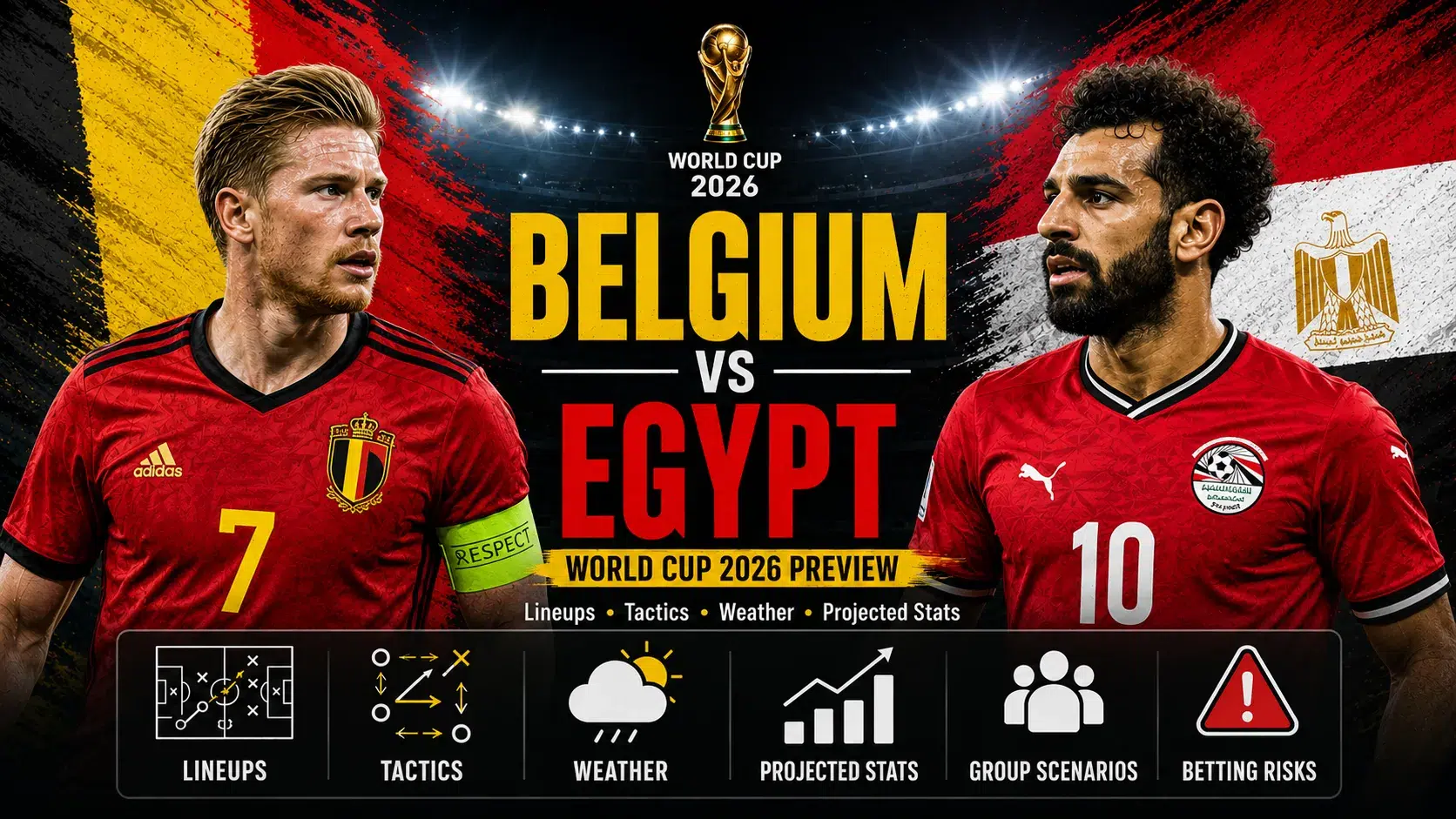
Belgium face Egypt in a FIFA World Cup 2026 Group G match at Seattle Stadium in Seattle, Washington, United States, on Monday, 15 June 2026. Kick-off is scheduled for 12:00 local Pacific time, 19:00 UTC, 21:00 in Brussels and 22:00 in Cairo. This is the opening Group G match for both teams in a section that also includes IR Iran and New Zealand.
Belgium enter under Rudi Garcia with a squad that mixes senior leaders and newer attacking profiles. Kevin De Bruyne, Romelu Lukaku and Thibaut Courtois remain central figures, while Jérémy Doku, Amadou Onana, Charles De Ketelaere and Nicolas Raskin represent the transition layer. Egypt enter under Hossam Hassan with Mohamed Salah as the attacking reference, Omar Marmoush as the key vertical partner, and Mohamed El Shenawy as the senior goalkeeper figure. Salah returned in Egypt’s final warm-up phase and is expected to be central to the plan.
The likely tactical shape is Belgium controlling possession through De Bruyne, Onana and Tielemans-type midfield structures while Egypt defend compactly and attack through Salah, Marmoush and transition runners. The key matchup is Belgium’s left/right wide pressure against Egypt’s full-back protection, and De Bruyne’s central passing against Egypt’s midfield screen. The projected match type is Belgium territorial control against Egypt’s counterattack and low-block resistance. Betting markets should be treated as risk signals only, not guarantees.
| Field | Data |
|---|---|
| Match | Belgium vs Egypt |
| Competition | FIFA World Cup 2026 |
| Stage | Group Stage / First Stage |
| Group | Group G |
| Date | Monday, 15 June 2026 |
| Kick-off Time | 12:00 Seattle / 19:00 UTC / 21:00 Brussels / 22:00 Cairo |
| Stadium | Seattle Stadium |
| City | Seattle, Washington |
| Host Country | United States |
| Expected Attendance | Not available from verified public data |
| Referee | Not available from verified public data |
| VAR | Not available from verified public data |
| Weather Forecast | Mostly clear around 79°F / 26°C at local noon; exact wind, humidity and pitch condition not available from verified public data |
| Pitch Context | Tournament venue surface; exact match-day pitch speed not available from verified public data |
| Main Article Focus | Pre-match probability dossier, predicted lineups, team news, tactical analysis, Seattle context, weather model, projected stats, cards, Group G scenarios and betting risk |
Belgium vs Egypt is a high-value opener because both teams can realistically shape Group G from the first match. Belgium carry the favourite profile. Egypt carry the most dangerous individual counterattacking weapon in the group through Salah, plus a direct attacking partner in Marmoush. Belgium need control and efficiency. Egypt need structure, patience and ruthless transition decisions.
This match is not only a technical contrast. It is a pressure contrast. Belgium must show that the post-golden-generation transition still has tournament substance. Egypt must show that they can turn African pedigree into a first World Cup win and a credible knockout route.
Belgium vs Egypt matters because Belgium need an opening win to confirm Group G control, while Egypt need points or a disciplined narrow-margin performance before facing New Zealand and IR Iran.
| Category | Status | Belgium vs Egypt Example | Article Use |
|---|---|---|---|
| Confirmed fact | Verified before publication | Belgium vs Egypt, Group G, Seattle Stadium | Hard match base |
| Match timing | Verified fixture data | 15 June 2026, 12:00 Seattle / 19:00 UTC | Match snapshot |
| Tournament context | Verified schedule context | Group G includes Belgium, Egypt, IR Iran and New Zealand | Group scenario analysis |
| Team-news report | Verified media reporting | Belgium are expected to dominate possession; Egypt are expected to defend deep and counter through Salah and Marmoush | Tactical sections |
| Squad context | Verified public squad reporting | Belgium squad includes De Bruyne, Lukaku, Courtois, Doku, Onana and De Ketelaere | Player and lineup sections |
| Egypt squad context | Verified public preliminary/final-squad reporting | Egypt squad context includes Salah, Marmoush, El Shenawy, Zizo, Trezeguet and other senior figures | Player and tactical sections |
| Probable information | Tactical forecast | Belgium likely use possession and wide pressure; Egypt likely use compact defending and counters | Tactical identity sections |
| Projected data | Model-based estimate | Possession, shots, xG, corners, cards and fouls | Ranges only |
| Unknown data | Not verified in current source set | Referee, VAR, exact attendance, official starting XIs, exact wind, humidity and pitch speed | Marked unavailable |
| Scenario-based analysis | Possible future pattern | Egypt may target space behind Belgian full-backs if Belgium overcommit | Written as forecast, not fact |
This distinction matters. A preview loses value when it treats projection as fact. A predicted lineup is not an official team sheet. A projected xG range is not a final statistic. A market signal is not a guaranteed result. A tactical plan can break after one early goal, one yellow card, one injury, one goalkeeper error, one VAR penalty or one weather shift.
This dossier uses probability language. It does not claim that a goal, card, substitution, injury or VAR review will happen at a specific minute.
Group G contains Belgium, Egypt, IR Iran and New Zealand. Belgium enter as the most obvious favourite. Egypt enter as a strong second-place candidate with Salah and Marmoush giving the attack elite counter potential. Iran bring World Cup experience and a Taremi-led attack. New Zealand bring Chris Wood, aerial strength and direct-play threat.
| Team | Pre-Match Points | Goal Difference | Opening Pressure | Main Need |
|---|---|---|---|---|
| Belgium | 0 | 0 | Very high | Win opener and confirm favourite status |
| Egypt | 0 | 0 | High | Avoid defeat or create a direct top-two platform |
| IR Iran | 0 | 0 | High | Win or avoid defeat against New Zealand |
| New Zealand | 0 | 0 | High | Protect goal difference and chase historic points |
The expanded 48-team format changes the group-stage equation. The top two teams qualify directly for the Round of 32. Some third-placed teams also qualify. That makes a draw useful, but goal difference still matters from match one.
Belgium need three points because they are expected to lead the group. A draw would not end their campaign, but it would increase pressure before Iran and New Zealand. A defeat would create immediate scrutiny and make the group unstable.
Egypt need a result because their later fixtures against New Zealand and Iran may become qualification deciders. A draw against Belgium would be valuable. A narrow defeat would remain recoverable. A heavy defeat would damage the third-place route and create psychological pressure.
Belgium’s tournament identity is still tied to the golden generation. The 2018 third-place finish remains the country’s best World Cup result. The 2022 group-stage exit damaged the perception of the team. Rudi Garcia now has to manage transition without wasting the remaining value of the senior core.
Belgium still have elite players. De Bruyne can control tempo and final passes. Courtois can decide games through shot-stopping. Lukaku can pin centre-backs if fit and selected. Doku can break compact blocks through dribbling. Onana can win midfield duels. De Ketelaere can connect midfield and attack.
Belgium’s practical objectives:
Egypt are one of Africa’s historic powers, but their World Cup record remains thin. They are still chasing a first World Cup victory. This match gives them a chance to change that record immediately, but the challenge is difficult. Belgium can dominate possession and force Egypt into long defensive spells.
Hossam Hassan’s team must avoid two traps. The first is passive defending. Egypt cannot defend inside their own box for 90 minutes without an outlet. The second is emotional counterattacking. Salah and Marmoush must choose moments carefully. A rushed counter can become another Belgian possession wave.
Egypt’s practical objectives:
Goal difference matters in Group G. Belgium may need it to control first place. Egypt may need it for top-two or third-place ranking. Iran and New Zealand will likely target points from each other, so margins can shape the final table.
If Belgium lead narrowly, they may still push for a second goal. But overcommitting can open Salah and Marmoush counters. If Egypt trail by one, they must decide whether to chase a draw or protect the margin. A narrow loss can be recoverable. A heavy loss can change the group.
Belgium carry expectation pressure. They are supposed to win. Egypt carry historic-pressure weight because they are still chasing a first World Cup victory. If Belgium score early, the match can open. If Egypt survive the first hour, pressure may shift toward Belgium. If Egypt score first, Belgium must show patience and control rather than panic.
| Result | Belgium Impact | Egypt Impact | Group G Meaning |
|---|---|---|---|
| Belgium win | Belgium take expected early control and protect top-two path | Egypt must recover against New Zealand and Iran | Expected hierarchy holds |
| Draw | Belgium lose expected-margin points | Egypt gain a strong qualification platform | Group G becomes more balanced |
| Egypt win | Belgium face immediate scrutiny | Egypt claim historic World Cup momentum | Group G hierarchy shifts sharply |
| Factor | Match Relevance |
|---|---|
| Host country | United States |
| Venue region | Pacific Northwest |
| Neutral match | Neither team is host nation |
| Travel context | Belgium and Egypt both manage long-haul travel and time-zone adaptation |
| Climate | Mild-to-warm Seattle conditions |
| Crowd profile | Likely mixed international support with neutral local attendance |
| Tournament pressure | First Group G match for both teams |
| Stadium context | Large American football venue adapted for World Cup use |
The United States setting gives both teams a neutral venue. Seattle’s climate is less physically extreme than Houston, Miami or Monterrey. That means the match should depend more on tactical rhythm than heat survival.
Travel still matters. Belgium prepared in the Seattle area, which can reduce adaptation issues. Egypt played a final warm-up in the United States, which gives them some local rhythm. The noon kick-off creates a daytime match, but the forecast does not suggest severe heat.
| City Factor | Expected Tactical Impact |
|---|---|
| Noon kick-off | Temperature rises into a warm but manageable zone |
| Forecast around 79°F / 26°C | Pressing in bursts is realistic |
| Mostly clear forecast | Low rain disruption if forecast holds |
| No altitude issue | Normal oxygen profile |
| Large stadium atmosphere | Communication and crowd noise matter |
| Pacific time-zone setting | Cairo and Brussels body clocks require adaptation |
| Neutral crowd | Momentum can swing toward the underdog if Egypt frustrate Belgium |
Seattle does not create a severe physical problem. The main city factor is rhythm. A noon kick-off can affect body clocks and pre-match routines. Belgium’s possession model should benefit from controlled conditions. Egypt’s counterattacking plan should also have enough physical environment support.
| Stadium Detail | Data |
|---|---|
| Stadium | Seattle Stadium |
| Known Venue Context | Lumen Field event context |
| City | Seattle |
| State | Washington |
| Country | United States |
| Kick-off | 12:00 local / 19:00 UTC |
| Expected Attendance | Not available from verified public data |
| Referee | Not available from verified public data |
| VAR | Not available from verified public data |
| Roof Status | Stadium is not treated as a closed-roof venue in this preview |
| Pitch Speed | Not available from verified public data |
| Tactical Impact | Mild-to-warm conditions, crowd noise, normal pressing capacity, possible surface adjustment |
| Weather / Environment Factor | Tactical Meaning |
|---|---|
| Around 79°F / 26°C at noon | Pressing in waves remains feasible |
| Mostly clear | Low handling risk if forecast holds |
| Humidity not verified in source set | Avoid exact hydration claims |
| Wind not available from verified public data | Avoid claims about long-ball drift |
| No altitude | Normal sprint recovery model |
| Pitch condition unknown | Avoid fixed claims about bounce or speed |
| Daylight match | Visibility should be stable; sun exposure should still be monitored |
| Mild-to-warm environment | Substitutions may be tactical more than heat-driven |
The most important weather factor is the noon temperature. It is warm enough to make constant pressing inefficient, but not hot enough to define the match by itself. Belgium can press after loss. Egypt can defend compactly and counter without expecting severe climate fatigue.
| Team | Player / Role | Status | Tactical Impact |
|---|---|---|---|
| Belgium | Rudi Garcia | Head coach | Oversees Belgium’s post-golden-generation transition |
| Belgium | Kevin De Bruyne | Senior midfield leader | Main passing, tempo and chance-creation figure |
| Belgium | Romelu Lukaku | Included in squad after injury-hit season | Central striker and box reference if selected |
| Belgium | Thibaut Courtois | Senior goalkeeper | Shot-stopping, command and tournament experience |
| Belgium | Jérémy Doku | Key winger | One-vs-one dribbling and low-block disruption |
| Belgium | Amadou Onana | Key midfielder | Duel power, rest defence and aerial presence |
| Belgium | Charles De Ketelaere | Attacking option | Link play, pressing and box support |
| Belgium | Axel Witsel | Veteran squad figure, mainly bench-role context | Late-game structure and experience |
| Egypt | Hossam Hassan | Head coach | Former Egypt striker, now responsible for tournament structure |
| Egypt | Mohamed Salah | Captain / attacking leader | Main transition threat and final-third decision-maker |
| Egypt | Omar Marmoush | Forward | Vertical runner, pressing and scoring support |
| Egypt | Mohamed El Shenawy | Senior goalkeeper figure | Organisation and shot-stopping |
| Egypt | Mahmoud Trezeguet | Wide/inside attacking option | Experience, pressing and box arrivals |
| Egypt | Ahmed Sayed Zizo | Attacking midfield / wide option | Delivery, set pieces and final-third passing |
| Egypt | Hamdy Fathy | Defensive/midfield option | Structure, ball-winning and centre-back cover |
| Egypt | Mohamed Abdelmonem | Centre-back profile | Box defending and aerial control |
| Player | Team | Status | Tactical Impact |
|---|---|---|---|
| Romelu Lukaku | Belgium | Selected after injury-hit season; starting load not guaranteed in this preview | If limited, Belgium may use De Ketelaere, Trossard or Stassin as central/false-nine options |
| Not available from verified public data | Egypt | Not available | Do not invent |
| Player | Team | Status | Tactical Impact |
|---|---|---|---|
| Lois Openda | Belgium | Reported omitted from Belgium squad context | Removes one speed-forward alternative |
| Nathan De Cat | Belgium | Reported not selected | No direct senior tactical effect unless Belgium need an extra midfield prospect |
| Mostafa Mohamed | Egypt | Reported omission from preliminary squad context | Removes a familiar centre-forward option from earlier Egypt cycles |
| Not available from verified public data | Egypt | Not available | Do not invent extra absences |
| Player / Group | Team | Issue | Match Impact |
|---|---|---|---|
| Romelu Lukaku | Belgium | Injury-hit season and limited recent national-team rhythm in public reporting | Starting role, sprint load and minutes should be monitored |
| Kevin De Bruyne | Belgium | Senior workload profile | Belgium may manage intensity through tempo rather than constant pressing |
| Mohamed Salah | Egypt | Returned after rehabilitation and played in final warm-up phase | Egypt’s attacking ceiling depends on his sharpness |
| Egypt defensive block | Egypt | No verified individual crisis in current source set | Official team sheet needed |
| Both squads | Both | Noon match and warm conditions | Hydration and substitution timing still matter |
No confirmed suspension issue was available from verified public data in the current source set. Card risk below is a match forecast, not confirmed disciplinary data.
Lukaku’s condition matters because Belgium’s attack changes with him. If he starts, Belgium can pin Egypt’s centre-backs and attack crosses. If he does not start or cannot play high minutes, Belgium may use more fluid movement through De Ketelaere, Trossard, Doku or other forward profiles.
Salah’s readiness matters because Egypt’s plan depends on him. Egypt can defend deep, but they need a credible release threat. Salah forces Belgium to keep rest defence behind attacks. Marmoush gives Egypt a second runner and can stop Belgium from defending only one side.
Official starting lineups were not available from verified public data in the current source set. The following XIs are projected from squad context, pre-match reporting and tactical logic. They should be replaced with official team sheets before publication.
| Position / Line | Player | Likely Role |
|---|---|---|
| GK | Thibaut Courtois | Goalkeeper, shot-stopper, aerial command and distribution |
| RB | Timothy Castagne / Thomas Meunier profile | Wide defence, overlap support and recovery against counters |
| CB | Zeno Debast | Ball-playing centre-back, buildup and box defence |
| CB | Arthur Theate / Koni De Winter profile | Left-sided centre-back, aerial defence and cover |
| LB | Maxime De Cuyper / Joaquin Seys profile | Left-side width, crossing and recovery |
| DM | Amadou Onana | Midfield screen, duel winner and rest-defence anchor |
| CM | Youri Tielemans / Nicolas Raskin | Passing link, pressing support and second balls |
| AM | Kevin De Bruyne | Main creator, tempo controller and final-third passer |
| RW | Jérémy Doku / Dodi Lukebakio | One-vs-one winger, width and direct dribbling |
| ST | Romelu Lukaku / Charles De Ketelaere | Central striker or link forward depending on fitness |
| LW | Leandro Trossard / Alexis Saelemaekers | Inside forward, combination support and pressing |
| Position / Line | Player | Likely Role |
|---|---|---|
| GK | Mohamed El Shenawy | Goalkeeper, defensive organiser and shot-stopper |
| RB | Mohamed Hany | Wide defender against Belgium’s left-side attacks |
| CB | Mohamed Abdelmonem | Centre-back, aerial control and box defence |
| CB | Ramy Rabia / Yasser Ibrahim | Centre-back, physical defending and clearances |
| LB | Ahmed Fattouh / Karim Hafez | Full-back, wide defence and transition support |
| DM | Hamdy Fathy | Defensive screen and centre-back protection |
| CM | Marwan Attia / Nabil Emad Dunga | Central cover, second-ball work and passing outlet |
| CM / AM | Ahmed Sayed Zizo | Set pieces, final-third link and wide/inside support |
| RW | Mohamed Salah | Captain, main transition attacker and shot creator |
| ST | Omar Marmoush | Forward runner, pressing and central/wide movement |
| LW | Mahmoud Trezeguet / Ibrahim Adel | Wide support, counter runner and defensive work rate |
| Team | Base Formation | In Possession | Out of Possession | Confidence |
|---|---|---|---|---|
| Belgium | 4-2-3-1 / 4-3-3 | 2-3-5 with De Bruyne between lines and one full-back advanced | 4-4-2 pressing trigger shape or 4-1-4-1 mid-block | Medium |
| Egypt | 4-3-3 / 4-5-1 / 4-2-3-1 | Direct 2-3-5 only in rare sustained attacks; early release to Salah/Marmoush | Compact 4-5-1 or 4-4-2 low-to-mid block | Medium |
| Scenario | Trigger | Expected Change |
|---|---|---|
| Belgium protect Lukaku minutes | Fitness or workload caution | De Ketelaere, Trossard or Stassin profile starts centrally |
| Belgium seek more control | Egypt defend deep and narrow | Tielemans/Raskin stays closer to De Bruyne and Onana |
| Belgium seek more speed | Egypt leave wide counter space | Doku and Lukebakio-style profiles become more important |
| Belgium protect lead | Leading after 70’ | Witsel or extra midfielder adds structure |
| Egypt choose maximum protection | Belgium start Doku and De Bruyne high | Extra midfielder covers full-backs |
| Egypt chase goal | Trailing after 60’ | Trezeguet, Ibrahim Adel or another runner supports Salah/Marmoush |
| Egypt protect draw | Level after 70’ | Deeper block, slower restarts and fresh defensive legs |
| Egypt press higher | Belgium build slowly | Salah and Marmoush trigger pressure on centre-backs |
The main Belgian selection issue is the striker role. The main Egyptian selection issue is the balance between full-back protection and enough support for Salah. If Egypt defend with too many players too deep, Salah may become isolated. If they leave too many players high, Belgium can play through midfield.
| Phase | Expected Pattern |
|---|---|
| Build-up | Courtois and centre-backs circulate through Onana, Tielemans/Raskin and De Bruyne |
| Attack | Wide isolation, De Bruyne final passes, Doku dribbles, Lukaku or De Ketelaere box/link role |
| Defense | Counter-press after loss, Onana screening transitions |
| Transitions | Immediate pressure after turnovers and fast release to Doku or Trossard |
| Set Pieces | Lukaku, Onana, Theate, Debast and De Bruyne delivery |
| Weakness | Space behind full-backs, Salah/Marmoush counters, Lukaku workload uncertainty |
Belgium should build with control. Courtois can support the first phase. The centre-backs can circulate and draw Egypt’s first line forward. Onana can anchor midfield. Tielemans or Raskin can connect the second phase. De Bruyne should receive in zones where he can face forward and hit early passes.
Egypt will likely protect central areas. Belgium should avoid slow possession that allows Egypt to slide across the pitch. The correct buildup rhythm is controlled but not sleepy. Belgium need switches, third-man runs and sharper entries into the half-spaces.
Belgium’s best build-up pattern may look like this:
Belgium can press after losing the ball. They should not chase Egypt constantly in warm noon conditions, but the environment allows high-intensity waves. The counter-press is more important than a pure high press.
Useful Belgium pressing triggers:
Belgium must avoid a disconnected press. If De Bruyne and the front line press but Onana is too far away, Egypt can find Salah early. Rest defence matters more than possession percentage.
Belgium’s main attacking side depends on Doku’s position. If Doku starts right or left, that flank becomes the main one-vs-one route. Egypt will likely double-team him. Belgium should use that pressure to create central space for De Bruyne and the striker.
The opposite side can be a finishing side. Trossard, Saelemaekers or another wide profile can arrive inside after switches. Belgium should avoid predictable crossing from deep. They need cutbacks and central shots.
De Bruyne is Belgium’s key passer. He can break Egypt’s block with one early ball. Tielemans can also switch play. Onana’s passing is more structural. The key is De Bruyne’s first forward-facing touch. If he receives under no pressure, Egypt’s block will be stretched.
Belgium can transition quickly after high recoveries. Doku and Trossard can carry. Lukaku can run central channels if fit. De Ketelaere can combine. But Belgium must manage reverse transition. Egypt’s best route is the first pass into Salah or Marmoush after a Belgian turnover.
Belgium have a set-piece edge if Lukaku, Onana, Debast, Theate or De Winter are on the pitch. De Bruyne gives elite delivery. Egypt must defend first contact and rebounds. Belgium can use short-corner variations if Egypt overload the six-yard box.
Belgium’s main defensive weakness is space behind advanced full-backs. Salah can punish that. Marmoush can run diagonally behind centre-backs. If Belgium attack with both full-backs high, Onana must remain central and ready to stop transitions.
The second weakness is emotional impatience. If Egypt defend deep and the match stays level, Belgium may force shots. That helps Egypt.
Courtois can start short attacks, hit longer passes and control box pressure. Egypt may not press him constantly. He must stay alert for sudden counters. A goalkeeper in a possession-dominant team often faces fewer shots but higher concentration demands.
Belgian full-backs should not attack at the same time without midfield cover. One can support wide overloads. The other should stay connected to the centre-backs. Egypt will look for the channel behind the full-back nearest Salah.
Lukaku’s role depends on fitness and sharpness. If he starts, he must pin centre-backs, attack crosses and create space for De Bruyne. If Belgium use De Ketelaere or Trossard centrally, the attack becomes more fluid but less physically direct. The striker role will define Belgium’s box presence.
| Phase | Expected Pattern |
|---|---|
| Build-up | Cautious short play mixed with direct release to Salah or Marmoush |
| Attack | Salah transition threat, Marmoush vertical runs, Zizo/Trezeguet support |
| Defense | Compact low-to-mid block, wide double-teams, central congestion |
| Transitions | First pass into Salah, Marmoush or Trezeguet after recovery |
| Set Pieces | Salah/Zizo delivery, Abdelmonem, Rabia, Hamdy Fathy aerial targets |
| Weakness | Long defensive spells, full-back isolation, limited possession if counters fail |
Egypt should build practically. Belgium’s press can create turnovers if Egypt overplay. El Shenawy can go long when needed. Short build-up should happen only when Belgium’s press is not set.
Hamdy Fathy and Marwan Attia-type midfielders must offer safe passing angles. Zizo can connect attacks if he receives between the lines. Salah and Marmoush need early service. Egypt cannot wait until Belgium reset.
The build-up goal is not to control possession. It is to escape pressure and create useful attacking moments.
Egypt are unlikely to press high for long periods. A compact mid-block or low block is more likely. They can press selectively when Belgium pass backward or when a Belgian full-back receives near the line.
Useful Egypt pressing triggers:
Egypt must avoid pressing with only Salah and Marmoush while midfield stays deep. That creates gaps for De Bruyne.
Egypt’s main attacking side is Salah’s side. Whether he starts on the right or drifts centrally, he is the first reference. Marmoush can run central or left-side channels. Trezeguet or Ibrahim Adel can support from the opposite flank.
The ideal Egyptian attacking pattern:
Zizo can be the key passer if selected. Salah is also the key final-third passer. Egypt need one midfielder to connect the first pass after recovery. If Egypt only clear long without support, Belgium will recycle.
Egypt’s transition threat is the central tactical weapon. Salah and Marmoush can force Belgium to respect rest defence. Egypt do not need many transitions. They need clean ones.
The most important detail is the first pass. If Egypt’s first forward pass is slow or inaccurate, Belgium will counter-press. If it reaches Salah early, Belgium’s centre-backs must defend facing their own goal.
Egypt can use set pieces as pressure relief and scoring routes. Abdelmonem, Rabia, Fathy and other central players can attack deliveries. Salah and Zizo can deliver. Belgium are strong aerially, so Egypt should value movement and second balls.
Egypt’s main defensive weakness is full-back isolation. Doku and Belgium’s wide players can force repeated one-vs-one actions. If Egypt’s wide midfielders fail to track, full-backs may concede fouls, corners and cards.
The second weakness is long defensive stretches. If Egypt defend too deep without an outlet, Belgium can create repeated waves.
El Shenawy should distribute based on pressure. Long passes can relieve pressure. Short passes can help if Belgium sit off. Egypt must avoid central giveaways near the box.
Egypt’s full-backs must defend first. They can attack only when the team has secure possession. If a full-back pushes too high and Egypt lose the ball, Belgium can attack the space immediately.
Marmoush’s role may be hybrid. He can start as a striker, left forward or support runner. He must stretch Belgium and give Salah a partner. If he becomes disconnected, Egypt’s counters become predictable.
| Zone | Belgium Edge | Egypt Edge | Likely Control | Why It Matters |
|---|---|---|---|---|
| Belgium left / Egypt right | Doku/Trossard rotation, full-back support | Salah counter space if Belgium lose it | Belgium territory, Egypt transition threat | Could define match danger on both sides |
| Belgium right / Egypt left | Doku/Lukebakio or Saelemaekers speed | Egypt full-back plus winger cover | Belgium edge | Repeated one-vs-one pressure can create cards |
| Central midfield | De Bruyne, Onana, Tielemans/Raskin | Hamdy Fathy and Attia defensive screen | Belgium edge | Controls tempo and counter prevention |
| Penalty box | Lukaku/De Ketelaere, Onana, De Bruyne delivery | Abdelmonem, El Shenawy, compact block | Belgium edge | Decides whether possession becomes goals |
| Set pieces | De Bruyne delivery and aerial targets | Salah/Zizo delivery, Abdelmonem targets | Belgium slight edge | Can break a compact match |
| Transitions | Belgium counter-press | Salah and Marmoush speed | Egypt’s best route | Main underdog path |
| Defensive third | Belgium likely defend fewer phases | Egypt defend long stretches | Egypt under pressure | Tests concentration and fouls |
De Bruyne can decide the match if he receives facing forward. Egypt must block his passing lanes and deny time.
Why it matters: Belgium’s possession becomes dangerous when De Bruyne can hit early passes into the box or wide channels.
What to watch: Whether Egypt pressure De Bruyne before his first touch or after he turns.
Risk trigger: If Egypt’s defensive midfielder is booked early, De Bruyne’s freedom increases.
Doku can break a low block through dribbling. Egypt need the full-back and wide midfielder to defend together.
Why it matters: One wide duel can create a cutback, penalty appeal, yellow card or corner.
What to watch: Whether Doku receives isolated or against a double team.
Risk trigger: If Egypt’s full-back receives an early booking, Belgium may attack that side repeatedly.
Salah is Egypt’s main transition threat. Belgium must stop him before he faces the defensive line.
Why it matters: Egypt may create few attacks, but Salah can turn one clean transition into a decisive chance.
What to watch: Belgium’s full-back height when De Bruyne or Doku loses the ball.
Risk trigger: If Onana is pulled wide and Salah receives centrally, Belgium’s rest defence is exposed.
Belgium need a central reference. Egypt need their centre-backs to defend the box without fouling.
Why it matters: If Belgium’s striker pins Egypt’s centre-backs, De Bruyne and Doku get more space.
What to watch: First-contact duels and near-post movement.
Risk trigger: A centre-back booking can reduce Egypt’s physical defence.
Marmoush gives Egypt speed and vertical running. Belgium’s centre-backs must handle diagonal runs.
Why it matters: Marmoush can stop Belgium from defending only Salah’s side.
What to watch: His first run after Egypt win possession.
Risk trigger: If Belgium’s centre-backs step too high without cover, Marmoush can attack depth.
| Projected Stat | Belgium | Egypt | Confidence | Reason |
|---|---|---|---|---|
| Possession | 58–66% | 34–42% | Medium/high | Belgium likely control the ball and territory |
| Shots | 13–19 | 6–10 | Medium | Belgium volume edge; Egypt counter and set-piece route |
| Shots on Target | 4–8 | 2–4 | Medium | Egypt can suppress central quality if compact |
| xG Range | 1.50–2.40 | 0.60–1.20 | Low/Medium | First goal, Lukaku role and Salah transitions can shift profile |
| Big Chances | 2–4 | 0–2 | Low/Medium | Belgium have stronger box access |
| Corners | 5–9 | 2–5 | Medium | Belgium wide pressure likely creates blocks |
| Fouls | 9–14 | 12–18 | Medium | Egypt likely defend more one-vs-one actions |
| Yellow Cards | 1–3 | 2–4 | Low/Medium | Referee not confirmed |
| Red Card Risk | Low | Low/Medium | Low | Repeated Egyptian defensive duels can raise risk |
| Offsides | 1–3 | 1–2 | Low | Belgium striker movement and Egypt counters |
| Saves | 2–4 | 4–7 | Medium | Egypt goalkeeper likely faces more pressure |
| Crosses | 18–28 | 8–14 | Medium | Belgium likely use width and switches |
| Tackles | 13–19 | 19–27 | Medium | Egypt likely defend longer spells |
| Interceptions | 8–13 | 12–18 | Medium | Egypt block can intercept central passes |
| Clearances | 10–18 | 24–38 | Medium | Egypt may defend deep for extended phases |
Belgium should lead possession, shots, corners and territorial pressure. Egypt can still make the match close if they keep Belgian shots away from the penalty spot and use Salah/Marmoush transitions efficiently.
The key statistic is shot quality. Belgium can take 18 shots and still struggle if many are blocked or from poor angles. Egypt can take seven shots and still threaten if two come from clean counters or set pieces. Possession should not be treated as control unless Belgium protect rest defence.
| Match Window | Tactical State | Physical State | Card Risk | Goal Risk | Betting Market Trigger |
|---|---|---|---|---|---|
| 1’–15’ | Belgium likely establish possession; Egypt test compactness and first counter outlet | Fresh legs; warm but manageable conditions | Low/Medium | Medium | First De Bruyne forward pass, first Salah release |
| 16’–30’ | Belgium may increase wide pressure; Egypt full-backs tested | Defensive shifting increases | Medium | Medium | Doku isolation, Belgian corners |
| 31’–45+’ | If level, Egypt confidence may rise; Belgium may force tempo | Contact can increase near wide zones | Medium/High | Medium | Late first-half set pieces and tactical fouls |
| 46’–60’ | Coaches adjust shape and striker support | Reset intensity after half-time | Medium | Medium/High | Lukaku role, Marmoush counter route |
| 61’–75’ | Space may open with substitutions | Fatigue and late-duel timing matter | High | Medium/High | Fresh wingers, cards, live totals |
| 76’–90+’ | Game state dominates | Time management and emotional pressure rise | High | High | Late counters, corners, penalty appeals |
Belgium should try to establish rhythm without overcommitting. Egypt need early compactness and one clean forward release to show that Salah and Marmoush are live threats.
Belgium’s wide pressure may grow. Egypt must protect full-backs and avoid cheap fouls. If Belgium create repeated corners, the pressure can compound.
If the match remains level, Egypt can gain belief. Belgium must avoid rushed shots. A late first-half goal risk can rise through set pieces or a defensive error after sustained pressure.
Half-time adjustments can change the match. Belgium may alter the striker role or add more direct wide play. Egypt may adjust the distance between Salah, Marmoush and the midfield block.
Substitutions can decide tempo. Belgium can add fresh attackers. Egypt can add defensive legs or a counter runner. Card risk rises when tired full-backs face fresh wide players.
Game state controls the final phase. If Belgium lead, they may chase goal difference but must protect counters. If Egypt lead or draw, they may defend deeper and use restarts to slow rhythm.
| Factor | Expected Impact | Belgium Effect | Egypt Effect |
|---|---|---|---|
| Warm noon temperature | Pressing should be selective, not constant | Belgium can press after loss but should manage energy | Egypt’s block must reduce wasted lateral running |
| Mostly clear forecast | Low rain disruption if forecast holds | Supports passing and wide attacks | Supports counters and long balls |
| Humidity not verified | Avoid exact fatigue claims | Normal hydration planning | Normal hydration planning |
| Wind not verified | Long switches should be checked live | De Bruyne switches may need adjustment | Direct balls to Salah/Marmoush may need adjustment |
| No altitude | Normal oxygen recovery | Supports tempo control | Supports sprint counters |
| Pitch speed unknown | Exact ball speed unavailable | Belgium must adjust first 10 minutes | Egypt must adjust clearance and first-pass weight |
| Stadium noise | Communication matters | Back line must manage counter calls | Full-backs need cover communication |
The most important weather factor is the warm daytime setting. It is not extreme, but it makes reckless pressing inefficient. Belgium should control energy through possession. Egypt should defend compactly and avoid chasing every pass.
| Player | Team | Role | Match Impact Score /10 | Reason |
|---|---|---|---|---|
| Kevin De Bruyne | Belgium | Midfield creator | 9.2 | Main passer, tempo controller and chance creator |
| Jérémy Doku | Belgium | Winger | 8.8 | Best one-vs-one block breaker |
| Thibaut Courtois | Belgium | Goalkeeper | 8.6 | Shot-stopping and concentration against counters |
| Romelu Lukaku | Belgium | Striker | 8.4 | Central target if fit and selected |
| Amadou Onana | Belgium | Midfield screen | 8.3 | Rest-defence anchor and duel winner |
| Charles De Ketelaere | Belgium | Forward / link player | 8.0 | Flexible attacking support |
| Youri Tielemans | Belgium | Midfielder | 7.9 | Passing rhythm and second balls |
| Mohamed Salah | Egypt | Captain / right forward | 9.1 | Egypt’s main transition and scoring threat |
| Omar Marmoush | Egypt | Forward | 8.6 | Vertical runner and Salah support |
| Mohamed El Shenawy | Egypt | Goalkeeper | 8.3 | Likely faces pressure and must organise box |
| Mohamed Abdelmonem | Egypt | Centre-back | 8.1 | Key defender against Belgian striker movement |
| Ahmed Sayed Zizo | Egypt | Attacking midfielder / wide player | 7.9 | Set pieces and first forward pass |
| Mahmoud Trezeguet | Egypt | Wide attacker | 7.8 | Defensive work and counter support |
| Hamdy Fathy | Egypt | Defensive midfielder | 7.8 | Central protection and aerial cover |
Belgium’s most important attacking player is De Bruyne because he turns possession into chance creation. Egypt’s most important attacker is Salah because he gives Egypt their clearest route from deep defence to high-value attack.
Courtois is Belgium’s most important defensive figure because a low-volume Egypt attack can still produce dangerous shots. Abdelmonem is Egypt’s most important defender because Belgium’s striker and second runners will challenge the centre-backs repeatedly.
Onana is vital for Belgium’s rest defence, while Hamdy Fathy or Marwan Attia must protect Egypt’s centre-backs. De Bruyne remains the match’s most important midfield creator.
Belgium can change the match through Trossard, De Ketelaere, Lukebakio, Saelemaekers or Witsel depending on score. Egypt can change the match through Trezeguet, Ibrahim Adel, Zizo role changes or a fresh forward runner.
Egypt’s full-backs and defensive midfielders carry the highest card risk because of Belgian wide pressure. Belgium’s tactical-foul risk rises if Salah or Marmoush escape the counter-press.
Lukaku is the main Belgium workload watchlist because of injury-hit preparation. Salah’s sharpness should also be monitored after his rehabilitation and return in the warm-up phase.
The referee and VAR were not available from verified public data in the current source set. Therefore, this discipline preview uses tactical logic rather than referee-profile claims.
| Discipline Factor | Forecast |
|---|---|
| Referee Style | Not available from verified public data |
| Tactical Foul Risk | Medium/high |
| Dissent Risk | Medium |
| VAR Intervention Risk | Medium |
| Penalty Risk | Medium |
| Red-Card Risk | Low/medium |
| Team | Yellow-Card Range | Red-Card Risk | Main Risk Zone |
|---|---|---|---|
| Belgium | 1–3 | Low | Tactical fouls after Egypt counters |
| Egypt | 2–4 | Low/Medium | Full-back zones and midfield screen against Doku, De Bruyne and striker movement |
Egypt may carry the higher card range because they are likely to defend more one-vs-one actions. Belgium’s card risk is mostly transition-based. If Salah or Marmoush break cleanly, Belgium may need tactical fouls.
| Set-Piece Area | Belgium | Egypt | Edge |
|---|---|---|---|
| Corners For | De Bruyne delivery, Lukaku, Onana, Theate, Debast targets | El Shenawy, Abdelmonem, Rabia/Yasser Ibrahim defending | Belgium |
| Corners Against | Must track Abdelmonem, Hamdy Fathy and back-post runners | Must defend Belgian size and rebounds | Belgium slight edge |
| Wide Free Kicks | De Bruyne, Tielemans, Trossard delivery | Salah/Zizo delivery and centre-back targets | Balanced to Belgium |
| Direct Free Kicks | De Bruyne/Trossard-type profiles | Salah/Zizo-type profiles | Balanced |
| Penalties | Taker hierarchy not verified | Taker hierarchy not verified | Unknown |
| Long Throws | Not available from verified public data | Not available from verified public data | Unknown |
| Aerial Duels | Strong through Lukaku/Onana/centre-backs | Strong through centre-backs and Fathy | Belgium slight edge |
Belgium have the set-piece edge because of De Bruyne’s delivery and the aerial size of Lukaku, Onana and centre-backs. Egypt can still threaten through Salah or Zizo delivery. The decisive defensive matchup may be Egypt’s centre-backs against Belgium’s near-post and second-ball movements.
| Area | Belgium | Egypt |
|---|---|---|
| Goalkeeper Distribution | Courtois can support calm build-up and direct release | El Shenawy likely mixes short play and direct clearances |
| Shot-Stopping Pressure | Low/medium but high concentration | Medium/high |
| Cross Handling | Medium against Egyptian set pieces | High because Belgium may attack wide |
| High-Line Risk | Space behind full-backs for Salah/Marmoush | Egypt likely defend deeper |
| Penalty-Box Defending | Must track rare counters and set pieces | Must track striker, De Bruyne runners and rebounds |
| Back-Post Weakness | Possible if full-backs overcommit | Possible against Belgian switches |
| Defensive Communication | Rest-defence calls after long possession | Constant organisation under pressure |
Egypt’s goalkeeper may face more pressure because Belgium are projected to create more shots, crosses and corners. Courtois may face fewer actions, but those actions can be high-value if Salah or Marmoush break into space.
| Minute Window | Belgium Possible Change | Egypt Possible Change | Trigger |
|---|---|---|---|
| 45’–60’ | Add or change striker profile, increase wide speed, add central passer | Add midfield cover or fresh wide runner | First-half imbalance |
| 60’–75’ | Fresh Doku/Lukebakio/Trossard-type pace or De Ketelaere link play | Fresh full-back support, Trezeguet/Ibrahim Adel-type runner | Fatigue, cards, score pressure |
| 75’–90’ | Protect lead with Witsel/extra midfielder or chase goal difference | Protect draw/lead or chase with Salah support | Game state |
Belgium should control possession and protect rest defence. Goal difference matters, but reckless attacking can expose counters.
Egypt may defend deeper and use Salah/Marmoush as outlets. Belgium must avoid panic crossing and low-value long shots.
Belgium will feel stronger pressure to win. Egypt may see a draw as valuable. Garcia may add attacking speed. Hassan may add defensive legs and one counter outlet.
| Market | Current Signal | Main Risk |
|---|---|---|
| Match Winner | Belgium likely favourite by squad profile and market perception | Egypt counterattack through Salah and Marmoush can disrupt favourite pricing |
| Double Chance | Belgium or draw likely shorter | Low price may not reflect transition volatility |
| Over/Under Goals | Moderate total profile | First goal timing controls the match shape |
| BTTS | Plausible but not automatic | Egypt shot volume may be low if counters fail |
| Corners | Belgium corner volume likely higher | Early Belgium goal can reduce sustained corner pressure |
| Cards | Medium signal | Referee unknown and wide duels raise uncertainty |
| Player Shots | De Bruyne, Lukaku, Doku, Salah, Marmoush watchlist | Official lineup and role matter |
| Player Cards | Egypt full-backs/midfielders, Belgium transition stoppers | Referee threshold unknown |
| Trigger | Possible Market Effect |
|---|---|
| Official Belgium XI | Moves player shots, team total and winning-margin markets |
| Lukaku starting status | Moves Belgium striker shots and goal markets |
| Doku starting side | Moves wide-player props and Egypt card risk |
| Egypt defensive shape | Affects Belgium corner and total-goals markets |
| Salah role and minutes | Moves Egypt scoring and BTTS markets |
| Referee announcement | Moves cards and penalty markets |
| Weather update | Likely minor unless wind or surface changes appear |
| Public money on Belgium | Can compress favourite price |
| Trigger | Meaning | Risk |
|---|---|---|
| De Bruyne receives freely | Belgium chance quality rises | Egypt may adjust block quickly |
| Doku isolates full-back | Belgium wide threat active | Dribbles do not guarantee high xG |
| Salah breaks once early | Egypt counter route is live | One break can overstate control |
| Egypt full-back booked | Belgium wide attacks gain value | Referee threshold may later change |
| Belgium only cross from deep | Egypt block is controlling central space | Set pieces can still break it |
| 0-0 after 60’ | Pressure shifts toward Belgium | Egypt fatigue may still rise |
This preview explains match data and market behavior. It does not provide guaranteed betting advice. World Cup betting involves risk. Readers should check local gambling laws, use licensed operators, set limits and avoid chasing losses.
| Factor | How It Can Break the Forecast |
|---|---|
| Late Lineup Change | Changes Belgium’s striker role or Egypt’s counter structure |
| Early Goal | Forces one team to abandon its base plan |
| Early Yellow Card | Changes full-back and midfield aggression |
| Injury | Alters tactical balance and substitution timing |
| VAR Penalty | Creates a non-pattern goal and changes game state |
| Weather Shift | Wind or surface changes can affect long switches and counters |
| Red Card | Makes possession and xG projections less useful |
| Goalkeeper Error | Creates a low-probability swing |
| Tactical Surprise | Egypt may press higher or Belgium may rotate heavily |
| Market Overreaction | Early possession or one counter can distort live prices |
The forecast can fail if Egypt score first and force Belgium into emotional attacking. It can also fail if Belgium score early and reduce tempo. Lukaku’s role, Salah’s sharpness, Doku’s wide duels, referee threshold, set pieces and goalkeeper performance can all break the model.
| Scenario | Probability Band | Match Story |
|---|---|---|
| Belgium Narrow Win | Medium/high | Belgium control territory and create enough pressure, but Egypt keep the margin tight |
| Draw | Medium | Egypt defend compactly, Salah/Marmoush counters create danger and Belgium lack efficiency |
| Egypt Upset | Low/medium | Egypt score through transition or set piece and defend with discipline |
| High-Scoring Match | Low/medium | Early goal opens space and both teams attack transition lanes |
| Low-Scoring Match | Medium/high | Egypt slow rhythm and Belgium struggle to convert possession into central chances |
The safest scenario frame is Belgium-favoured but not Belgium-certain. Belgium have the stronger squad profile and greater possession expectation. Egypt have the single-player and transition quality to make the match dangerous.
| Result | Belgium Impact | Egypt Impact |
|---|---|---|
| Belgium Win | Belgium gain early Group G control and protect expected top-two path | Egypt need recovery against New Zealand and Iran |
| Draw | Belgium lose expected-margin points and face pressure before Iran | Egypt gain a strong platform and protect goal difference |
| Egypt Win | Belgium enter immediate scrutiny | Egypt claim a historic World Cup result and transform qualification path |
A Belgium win would match expectation. A draw would make the group more open. An Egypt win would shift pressure onto Belgium and make Egypt a serious top-two contender. Goal difference matters because third-place qualification can depend on margins across groups.
| Data Point | Status | Preferred Source Type |
|---|---|---|
| Match Date | Confirmed | FIFA match centre / FIFA preview |
| Stadium | Confirmed | FIFA match centre / venue listing |
| City | Confirmed | FIFA match centre / venue context |
| Group | Confirmed | FIFA / Reuters match context |
| Coaches | Confirmed | Reuters and squad-context reporting |
| Belgium Squad | Confirmed from public squad reporting | Belgium squad article / media roster source |
| Egypt Squad Context | Confirmed through public preliminary/final squad reporting | FIFA/CAF/media squad source |
| Referee | Not available from verified public data | FIFA match centre if announced |
| VAR | Not available from verified public data | FIFA match centre if announced |
| Weather | Forecast | Weather service |
| Lineups | Projected until official team sheets | FIFA match centre / official team sheets |
| Injuries | Partly confirmed for workload watchlist only | Verified media reporting |
| Suspensions | No confirmed active suspension in current source set | FIFA disciplinary data |
| Odds | Dynamic market signal only | Licensed odds providers / aggregators |
| Projected Stats | Model-based estimate | Editorial forecast |
| Minute-Window Scenarios | Scenario forecast only | Editorial model |
This article uses confirmed facts where available and marks unavailable information clearly. It does not invent referee data, VAR data, exact attendance, official starting lineups or unverified injuries.
This preview is analytical and informational. It is not a guarantee of the final result. Football includes randomness and low-probability events. Final lineups, injuries, referee decisions, VAR, weather and early goals can change the match.
Projected statistics, scoreline scenarios and betting market notes are probability-based estimates. They are not certain outcomes. Belgium can dominate possession and still fail to win. Egypt can create fewer open-play chances and still score from a counter, set piece or individual action. A goalkeeper error, red card, deflection, penalty, injury or weather shift can break the pre-match model.
Betting markets move before and during the match. Readers should verify official lineups, injuries, referee information, weather conditions and market prices before making decisions. Readers should check local gambling laws and use licensed operators only. Readers should set spending and time limits, avoid chasing losses and treat betting as entertainment rather than income.
This article does not provide guaranteed betting advice, fixed-match information, insider tips, risk-free picks or certain outcomes.
Belgium vs Egypt is scheduled for Monday, 15 June 2026, with kick-off at 12:00 Seattle time, 19:00 UTC, 21:00 Brussels time and 22:00 Cairo time.
Belgium vs Egypt is being played at Seattle Stadium in Seattle, Washington, United States.
Official starting lineups were not available from verified public data in the current source set. Belgium are projected to use Thibaut Courtois, Zeno Debast, Arthur Theate or Koni De Winter, Amadou Onana, Kevin De Bruyne, Jérémy Doku and a central forward profile such as Romelu Lukaku, Charles De Ketelaere or Leandro Trossard. Egypt are projected to use Mohamed El Shenawy, Mohamed Hany, Mohamed Abdelmonem, Hamdy Fathy, Marwan Attia, Ahmed Sayed Zizo, Mohamed Salah, Omar Marmoush and Mahmoud Trezeguet or Ibrahim Adel.
The main tactical matchup is Belgium’s possession and wide pressure through De Bruyne and Doku against Egypt’s compact block and Salah-Marmoush counterattack.
The prediction can be wrong because late lineup changes, early goals, injuries, VAR penalties, red cards, referee decisions, weather shifts, set-piece goals and goalkeeper errors can change the match. This preview uses probability logic, not certainty.
[expert_review params=»JTdCJTIyY29sb3IlMjIlM0ElMjJncmVlbi0yJTIyJTJDJTIyZXhwZXJ0X2F2YXRhciUyMiUzQSUyMiUyMiUyQyUyMmV4cGVydF9uYW1lJTIyJTNBJTIyJTIyJTJDJTIyZXhwZXJ0X2xpbmslMjIlM0ElMjIlMjIlMkMlMjJleHBlcnRfaWQlMjIlM0ElMjIxJTIyJTJDJTIyZXhwZXJ0X3R5cGUlMjIlM0ElMjJleHBlcnRfaWQlMjIlMkMlMjJleHBlcnRfYXZhdGFyX2FsdCUyMiUzQSUyMiUyMiUyQyUyMmV4cGVydF9zaG93JTIyJTNBMSUyQyUyMmV4cGVydF9kZXNjcmlwdGlvbiUyMiUzQSUyMlNwb3J0cyUyMEJldHRpbmclMjBBbmFseXN0JTIwJTI2JTIwRWRpdG9yaWFsJTIwQ29udHJpYnV0b3IlMjIlMkMlMjJleHBlcnRfc2hvd19idXR0b24lMjIlM0ExJTJDJTIyZXhwZXJ0X3Nob3dfYnV0dG9uX3R5cGUlMjIlM0ElMjJwb3B1cCUyMiUyQyUyMmV4cGVydF9xdWVzdGlvbl9idXR0b25fdGV4dCUyMiUzQSUyMkFzayUyMFF1ZXN0aW9uJTIyJTJDJTIycXVlc3Rpb25fZXh0ZXJuYWxfbGluayUyMiUzQSUyMiUyMiUyQyUyMnBvcHVwX3VzZV9waG9uZSUyMiUzQTAlMkMlMjJleHBlcnRfdGl0bGUlMjIlM0ElMjJBdXRob3IlMjIlMkMlMjJleHBlcnRfc2hvd190aXRsZSUyMiUzQTElMkMlMjJleHBlcnRfdGV4dCUyMiUzQSUyMkFsZXglMjBNb3JnYW4lMjBpcyUyMGElMjBzcG9ydHMlMjBiZXR0aW5nJTIwYW5hbHlzdCUyMGFuZCUyMGVkaXRvcmlhbCUyMGNvbnRyaWJ1dG9yJTIwd2hvJTIwd3JpdGVzJTIwZGV0YWlsZWQlMjBib29rbWFrZXIlMjByZXZpZXdzJTJDJTIwYmV0dGluZyUyMGd1aWRlcyUyQyUyMHBsYXRmb3JtJTIwY29tcGFyaXNvbnMlMkMlMjBhbmQlMjByZXNwb25zaWJsZSUyMGdhbWJsaW5nJTIwZXhwbGFpbmVycy4lMjBIaXMlMjB3b3JrJTIwZm9jdXNlcyUyMG9uJTIwcHJhY3RpY2FsJTIwaW5mb3JtYXRpb24lMjBmb3IlMjB1c2VycyUyMHdobyUyMHdhbnQlMjB0byUyMHVuZGVyc3RhbmQlMjBob3clMjBiZXR0aW5nJTIwc2l0ZXMlMjBvcGVyYXRlJTIwYmVmb3JlJTIwdGhleSUyMHJlZ2lzdGVyJTJDJTIwZGVwb3NpdCUyQyUyMG9yJTIwY2xhaW0lMjBhJTIwYm9udXMuJTIyJTJDJTIycWElMjIlM0ElNUIlNUQlMkMlMjJxYV9zaG93X3RpdGxlJTIyJTNBMSUyQyUyMnFhX3RpdGxlJTIyJTNBJTIyJUQwJTkyJUQwJUJFJUQwJUJGJUQxJTgwJUQwJUJFJUQxJTgxJTIwJUQxJThEJUQwJUJBJUQxJTgxJUQwJUJGJUQwJUI1JUQxJTgwJUQxJTgyJUQxJTgzJTIyJTJDJTIyc2NvcmUlMjIlM0ElNUIlNUQlMkMlMjJzY29yZV9zdW1tYXJ5X3RleHQlMjIlM0ElMjIlMjIlMkMlMjJzY29yZV9zdW1tYXJ5X2F2ZXJhZ2UlMjIlM0EwJTJDJTIyc2NvcmVfbWF4JTIyJTNBJTIyNSUyMiUyQyUyMnNjb3JlX3N5bWJvbCUyMiUzQSUyMiUyMiUyQyUyMnNjb3JlX3RpdGxlJTIyJTNBJTIyJTIyJTJDJTIyc2NvcmVfc2hvd190aXRsZSUyMiUzQTAlMkMlMjJwbHVzZXMlMjIlM0ElNUIlNUQlMkMlMjJtaW51c2VzJTIyJTNBJTVCJTVEJTJDJTIycGx1c2VzX21pbnVzZXNfc2hvd190aXRsZSUyMiUzQTElMkMlMjJwbHVzZXNfbWludXNlc190aXRsZSUyMiUzQSUyMiVEMCU5RiVEMCVCQiVEMSU4RSVEMSU4MSVEMSU4QiUyMCVEMCVCOCUyMCVEMCVCQyVEMCVCOCVEMCVCRCVEMSU4MyVEMSU4MSVEMSU4QiUyMiUyQyUyMnBsdXNlc190aXRsZSUyMiUzQSUyMiUyMiUyQyUyMm1pbnVzZXNfdGl0bGUlMjIlM0ElMjIlMjIlN0Q=»]