
IR Iran vs New Zealand World Cup 2026 Preview
Table of Contents Show
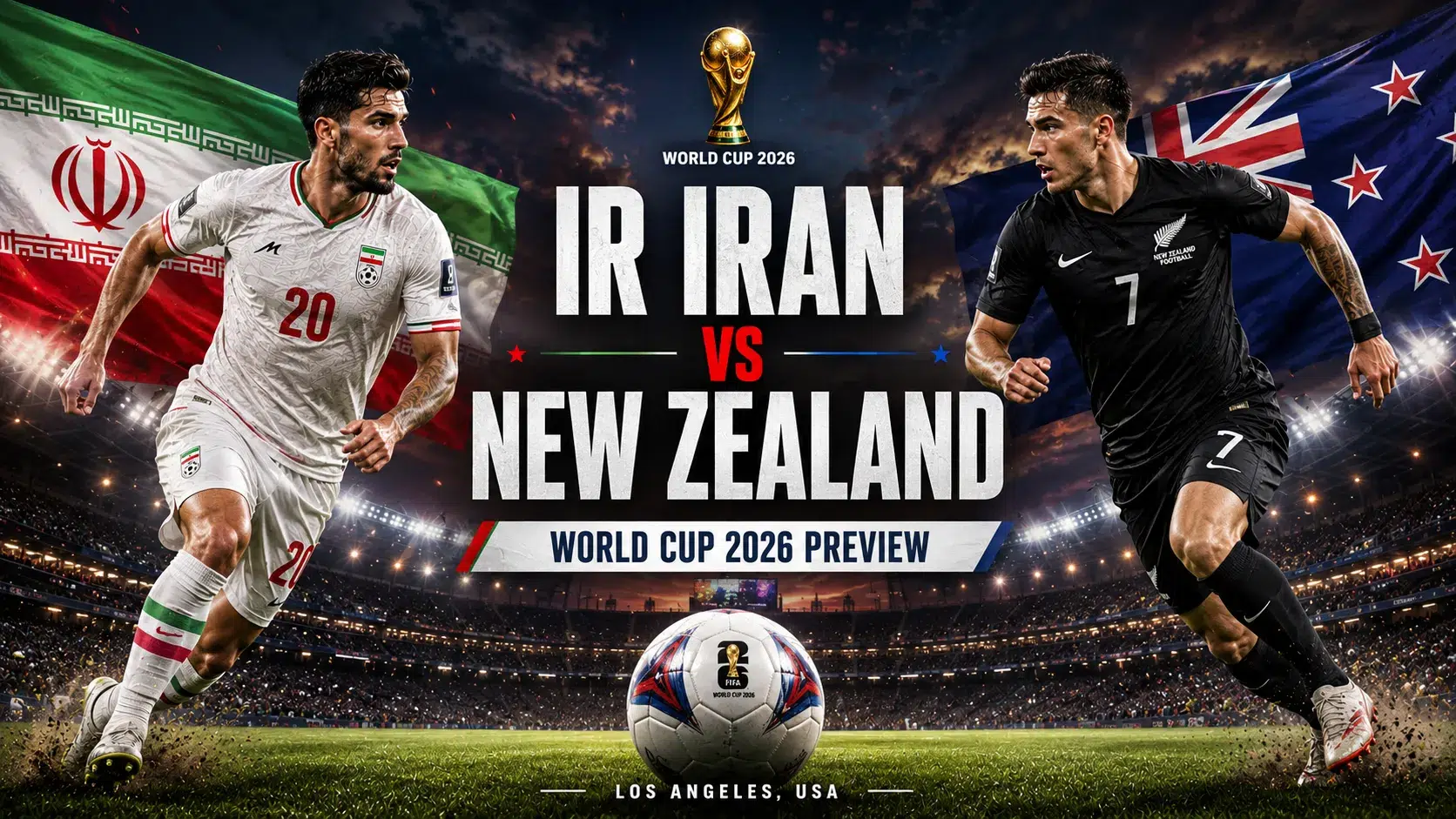
IR Iran face New Zealand in a FIFA World Cup 2026 Group G match at Los Angeles Stadium in Los Angeles, United States. The match is scheduled for Monday, 15 June 2026 local time, with kick-off at 18:00 Los Angeles time and 01:00 UTC on Tuesday, 16 June. This is the opening Group G match for both teams in a section that also includes Belgium and Egypt.
Iran enter under Amir Ghalenoei with a squad built around Mehdi Taremi, Alireza Jahanbakhsh, Saman Ghoddos, Mehdi Ghayedi, Omid Noorafkan, Saeid Ezatolahi and goalkeeper Alireza Beiranvand. Sardar Azmoun was left out of the final Iran squad, which changes Iran’s forward structure. New Zealand enter under Darren Bazeley with Chris Wood as captain, senior striker and main scoring reference. Their likely core includes Max Crocombe, Liberato Cacace, Tommy Smith, Michael Boxall, Nando Pijnaker, Joe Bell, Marko Stamenic and Sarpreet Singh.
The projected match type is Iran’s technical and transitional attack against New Zealand’s compact block, aerial strength and Chris Wood-focused direct play. The key matchup is Mehdi Taremi against New Zealand’s centre-backs and second-ball structure. Group G pressure is high because Belgium and Egypt make every point and every goal-difference swing important. Betting markets should be treated as risk signals only, not guarantees.
| Field | Data |
|---|---|
| Match | IR Iran vs New Zealand |
| Competition | FIFA World Cup 2026 |
| Stage | Group Stage / First Stage |
| Group | Group G |
| Date | Monday, 15 June 2026 local time / Tuesday, 16 June 2026 UTC |
| Kick-off Time | 18:00 Los Angeles time / 01:00 UTC on 16 June / 04:30 Tehran time / 13:00 Wellington time |
| Stadium | Los Angeles Stadium |
| City | Los Angeles / Inglewood area |
| Host Country | United States |
| Expected Attendance | Not available from verified public data |
| Referee | Not available from verified public data |
| VAR | Not available from verified public data |
| Weather Forecast | Mostly clear around 77°F / 25°C at 18:00 local time; exact humidity, wind and pitch condition not available from verified public data |
| Pitch Context | Tournament venue surface; exact match-day pitch speed not available from verified public data |
| Main Article Focus | Pre-match probability dossier, predicted lineups, team news, tactical analysis, Los Angeles context, weather model, projected stats, cards, Group G scenarios and betting risk |
IR Iran vs New Zealand is a high-pressure opener because both teams see this match as the most direct route to early points. Belgium are likely to carry the strongest squad profile in Group G. Egypt have Mohamed Salah and strong knockout ambitions. Iran and New Zealand therefore need points immediately.
Iran have more World Cup continuity and stronger recent tournament wins. New Zealand return to the World Cup after a long absence and are still chasing a first World Cup victory. The match should be tight, physical and tactical rather than open from the first minute. Iran may control more of the technical possession. New Zealand may use direct play, aerial duels and set pieces to keep the match close.
IR Iran vs New Zealand matters because both teams need early Group G points before facing Belgium and Egypt, making this opener a direct qualification-pressure match rather than a low-stakes first fixture.
| Category | Status | IR Iran vs New Zealand Example | Article Use |
|---|---|---|---|
| Confirmed fact | Verified before publication | IR Iran vs New Zealand, Group G, Los Angeles Stadium | Hard match base |
| Match timing | Verified fixture data | 15 June local / 16 June UTC, 01:00 UTC | Match snapshot |
| Tournament context | Verified schedule context | Group G includes Belgium, Egypt, IR Iran and New Zealand | Group scenario analysis |
| Team-news report | Verified media reporting | Iran enter under Amir Ghalenoei; New Zealand enter under Darren Bazeley | Team-news ledger |
| Squad report | Verified media reporting | Iran omitted Sardar Azmoun and carry Mehdi Taremi as attacking leader | Availability and tactical sections |
| Squad report | Verified public squad reporting | New Zealand are led by Chris Wood, with Max Crocombe, Liberato Cacace and Tommy Smith in squad context | Player sections |
| Probable information | Tactical forecast | Iran likely use Taremi, Jahanbakhsh and Ghayedi-type routes; New Zealand likely play compact and direct | Tactical sections |
| Projected data | Model-based estimate | Possession, shots, xG, corners, fouls and cards | Ranges only |
| Unknown data | Not verified in current source set | Referee, VAR, exact attendance, official starting XIs, exact humidity, wind and pitch speed | Written as unavailable |
| Scenario-based analysis | Possible future pattern | New Zealand may target Chris Wood after direct passes and set pieces | Written as forecast, not fact |
This distinction matters because pre-match writing can damage trust when it presents assumptions as facts. A predicted lineup is not an official lineup. A projected xG range is not a final statistic. A betting market signal is not a guaranteed result. A tactical model can fail after one early goal, one injury, one red card, one goalkeeper mistake, one political disruption, one crowd shift or one VAR decision.
This dossier uses probability language. It does not claim that any goal, card, substitution, injury or VAR review will happen at a specific minute.
Group G contains Belgium, Egypt, IR Iran and New Zealand. Belgium carry the strongest European squad profile. Egypt carry elite forward power through Mohamed Salah and a strong qualification identity. Iran have recent World Cup wins and a long-standing goal of reaching the knockout phase for the first time. New Zealand have a historic chance to claim a first World Cup win.
| Team | Pre-Match Points | Goal Difference | Opening Pressure | Main Need |
|---|---|---|---|---|
| Belgium | 0 | 0 | Very high | Confirm favourite status and avoid early instability |
| Egypt | 0 | 0 | High | Build a path toward top two or third-place advancement |
| IR Iran | 0 | 0 | High | Win or avoid defeat in the most direct points opportunity |
| New Zealand | 0 | 0 | High | Protect goal difference and chase a historic win or draw |
The expanded 48-team format changes the group-stage calculation. The top two teams qualify directly for the Round of 32. Some third-placed teams also qualify. That makes a draw useful, but it also makes goal difference important. Iran and New Zealand both need to avoid a heavy loss because Belgium and Egypt can punish weak margins later.
Iran have appeared in several World Cups, but the knockout stage remains the missing achievement. They have won group-stage matches in the last two World Cups, beating Morocco in 2018 and Wales in 2022. Those results gave Iran proof that they can win at this level. The next step is progression.
This opener carries strong sporting and political weight. Iran’s tournament presence has been surrounded by tension, base-camp disruption and a charged Los Angeles atmosphere. That can affect preparation, travel rhythm and emotional focus. Ghalenoei must make the football plan stronger than the noise around the team.
Iran’s practical objectives:
Iran are likely to carry a stronger technical platform. Their risk is emotional and structural. If they become impatient, New Zealand can slow the match, win fouls and target the box.
New Zealand return to the World Cup for the first time since 2010. Their 2010 team left South Africa unbeaten after three draws, but they did not advance. This generation has a different format and a direct qualification route through Oceania. The target is clear: earn a first World Cup win and make the expanded format work in their favour.
Chris Wood is central. He gives New Zealand a Premier League-level striker, aerial target, penalty-box finisher and captain. New Zealand’s chance structure depends on him. They need support around him. A long ball to Wood without second runners will not be enough.
New Zealand’s practical objectives:
Goal difference matters in Group G. Belgium and Egypt may create high-pressure later matches. A narrow defeat can remain survivable. A heavy defeat can reduce the third-place path. This affects how both coaches may read the final 20 minutes.
If Iran lead by one, they may still chase a second goal because goal difference can matter. If they push too hard, New Zealand can counter or win set pieces. If New Zealand trail by one, they must decide whether to chase a historic point or protect the margin for later fixtures.
Iran carry pressure from history and politics. New Zealand carry pressure from rarity and opportunity. Iran are expected to have more tournament experience and technical control. New Zealand can use underdog clarity. The emotional balance will change if the match stays level.
If Iran score early, New Zealand must open slightly. If New Zealand score first, Iran will face a pressure test. If the match remains 0-0 after 60 minutes, frustration can shift toward Iran and belief can rise inside New Zealand’s block.
| Result | IR Iran Impact | New Zealand Impact | Group G Meaning |
|---|---|---|---|
| IR Iran win | Iran gain a major platform for top-two or third-place qualification | New Zealand must recover against Egypt and Belgium | Iran become a serious qualification candidate |
| Draw | Iran lose expected-margin points but remain alive | New Zealand gain a strong platform and protect morale | Group G remains open |
| New Zealand win | Iran face immediate pressure before Belgium and Egypt | New Zealand make history and transform their group path | Group G hierarchy shifts early |
| Factor | Match Relevance |
|---|---|
| Host country | United States |
| Venue region | Los Angeles / Inglewood area |
| Neutral match | Neither team is host nation |
| Political context | Iran’s participation has been affected by U.S.-Iran tension and visa/base-camp issues |
| Crowd profile | Los Angeles has a large Iranian diaspora; reception may be charged |
| Travel context | Iran are based in Mexico and travel for U.S. matches; New Zealand play all group games on North America’s West Coast |
| Climate | Mild-to-warm Southern California evening |
| Tournament pressure | Group G opener with direct points value |
The Los Angeles setting is important. This is not a normal neutral match. Iran’s political context can shape crowd tone, emotional pressure and external attention. Players still decide the football, but the surrounding atmosphere may change the mental load.
New Zealand’s travel pattern is also relevant. They open in Los Angeles, then play Egypt and Belgium in Vancouver. That means their group-stage geography is concentrated on the West Coast. Iran also play early matches in Los Angeles before finishing against Egypt in Seattle. Travel management matters, but the first match still carries the highest emotional unknown.
| City Factor | Expected Tactical Impact |
|---|---|
| Evening kick-off | Reduces heat load compared with afternoon fixtures |
| Temperature near 77°F / 25°C at kick-off | Supports normal tempo and pressing in bursts |
| Mostly clear forecast | Low direct weather disruption if forecast holds |
| No altitude issue | Normal oxygen profile |
| Large stadium environment | Crowd noise can affect communication |
| Large Iranian diaspora | Emotional atmosphere may be unusually charged |
| West Coast travel context | New Zealand’s later matches remain geographically manageable |
Los Angeles is not a heat crisis match. It is a pressure and rhythm match. The temperature should support high-intensity periods. The main challenge is not physical climate. It is emotional control, crowd reaction and adaptation to the large stadium.
| Stadium Detail | Data |
|---|---|
| Stadium | Los Angeles Stadium |
| Known Venue Context | SoFi Stadium renamed Los Angeles Stadium for FIFA World Cup use |
| City | Los Angeles / Inglewood area |
| Country | United States |
| Kick-off | 18:00 local / 01:00 UTC on 16 June |
| Expected Attendance | Not available from verified public data |
| Referee | Not available from verified public data |
| VAR | Not available from verified public data |
| Roof Status | Stadium has a roof/canopy structure; match-specific roof and pitch condition not available from verified public data |
| Pitch Speed | Not available from verified public data |
| Tactical Impact | Controlled stadium environment, crowd intensity, normal evening temperature, high emotional load |
| Weather / Environment Factor | Tactical Meaning |
|---|---|
| Around 77°F / 25°C at kick-off | Pressing in bursts is physically realistic |
| Mostly clear evening | Low rain-related handling risk if forecast holds |
| Humidity not available from verified public data | Avoid exact hydration claims beyond normal match management |
| Wind not available from verified public data | Avoid claims about long-ball drift |
| No altitude | Normal sprint recovery model |
| Roof/canopy context | Weather impact may be reduced, but exact match conditions must be checked |
| Pitch speed unknown | Avoid fixed claims about bounce or ball speed |
| Emotional crowd context | Communication and composure may matter more than climate |
The most important match-condition factor is atmosphere, not temperature. The weather should allow both teams to play their intended physical game. Iran must keep composure. New Zealand must avoid being overwhelmed by the stage and crowd tone.
| Team | Player / Role | Status | Tactical Impact |
|---|---|---|---|
| IR Iran | Amir Ghalenoei | Head coach | Provides Iranian coaching continuity and tournament identity |
| IR Iran | Mehdi Taremi | Final squad leader in attack | Main striker, link player, penalty-box reference |
| IR Iran | Alireza Jahanbakhsh | Veteran attacking figure | Wide/inside attacker, leadership and delivery |
| IR Iran | Saman Ghoddos | Midfield/attacking option | Creativity, set-piece delivery and progression |
| IR Iran | Sardar Azmoun | Omitted from final squad | Removes a long-time senior striker and changes forward depth |
| IR Iran | Alireza Beiranvand | Goalkeeper profile in squad context | Shot-stopping, long throws, experience and aerial management |
| New Zealand | Darren Bazeley | Head coach | Provides continuity and practical tournament structure |
| New Zealand | Chris Wood | Captain and main striker | Main scoring reference, aerial target and hold-up outlet |
| New Zealand | Max Crocombe | Goalkeeper squad figure | Likely shot-stopping and distribution option |
| New Zealand | Liberato Cacace | Key left-sided defender | Wide defensive role and counter-support |
| New Zealand | Tommy Smith | Senior defender | Experience and aerial organisation |
| New Zealand | Michael Boxall | Senior defender | Physical centre-back profile |
| New Zealand | Sarpreet Singh | Midfield/creative option | Passing, set-piece delivery and final-third link |
| Player | Team | Status | Tactical Impact |
|---|---|---|---|
| Not available from verified public data | IR Iran | Not available | Do not invent |
| Not available from verified public data | New Zealand | Not available | Do not invent |
| Player | Team | Status | Tactical Impact |
|---|---|---|---|
| Sardar Azmoun | IR Iran | Omitted from final squad | Iran lose a senior striker option and must build around Taremi-led attack |
| Bill Tuiloma | New Zealand | Reported omission from squad context | Reduces defensive depth if confirmed in final published squad |
| Logan Rogerson | New Zealand | Reported omission from squad context | Reduces forward/wide depth if confirmed in final published squad |
| Player / Group | Team | Issue | Match Impact |
|---|---|---|---|
| Iran attacking line | IR Iran | Azmoun omitted rather than match-day injury in current source set | Taremi carries more central attacking weight |
| New Zealand striker line | New Zealand | Chris Wood’s workload should be monitored because of age and heavy role | Wood’s ability to press, hold up and attack crosses is central |
| Both squads | Both | No verified match-day injury list in current source set | Final team sheets should be checked |
| Emotional/mental load | IR Iran | External political context and travel/base-camp disruption | Focus, routine and crowd response can matter |
No confirmed suspension issue was available from verified public data in the current source set. Card risk below is a match forecast, not confirmed disciplinary data.
Azmoun’s absence is Iran’s most important squad-structure issue. Taremi becomes the main centre-forward and attacking reference. Iran may still use quick wide attackers and creative midfielders, but they lose the option of a Taremi-Azmoun partnership that previously gave them two senior scoring threats.
New Zealand’s main team-news issue is reliance. Chris Wood is the central attacking player. If Iran control him, New Zealand’s route narrows. If New Zealand can place runners near him, the team can turn direct play into a real threat.
Official starting lineups were not available from verified public data in the current source set. The following XIs are projected from squad context, pre-match reporting and tactical logic. They should be replaced with official team sheets before publication.
| Position / Line | Player | Likely Role |
|---|---|---|
| GK | Alireza Beiranvand | Goalkeeper, shot-stopper, long distribution and box command |
| RB | Sadegh Moharrami / Ramin Rezaeian profile | Wide defence, crossing and recovery |
| CB | Shoja Khalilzadeh / Hossein Kanani profile | Centre-back, aerial defending and leadership |
| CB | Majid Hosseini / Danial Iri profile | Centre-back, box defence and buildup support |
| LB | Omid Noorafkan / Milad Mohammadi profile | Left-side defence, recovery and progression |
| DM | Saeid Ezatolahi | Midfield screen, aerial duels and second balls |
| CM | Saman Ghoddos | Progression, set pieces and link passing |
| CM | Ali Gholizadeh / Mohammad Mohebi profile | Attacking link, pressing and inside support |
| RW | Alireza Jahanbakhsh | Veteran wide/inside attacker, delivery and leadership |
| ST | Mehdi Taremi | Main striker, link forward and penalty-box reference |
| LW | Mehdi Ghayedi | Dribbling, transition threat and left-side creativity |
| Position / Line | Player | Likely Role |
|---|---|---|
| GK | Max Crocombe | Goalkeeper, shot-stopper and distributor under pressure |
| RB | Tim Payne / right-back option | Wide defence and crossing support |
| CB | Michael Boxall | Physical centre-back, aerial defender |
| CB | Tommy Smith / Nando Pijnaker | Senior defensive organiser or left-sided centre-back |
| LB | Liberato Cacace | Left-back, progression and defensive recovery |
| DM | Joe Bell | Midfield anchor, passing and set-piece support |
| CM | Marko Stamenic | Ball-winning, carrying and midfield progression |
| CM / AM | Sarpreet Singh | Creative link and set-piece delivery |
| RW | Eli Just / Ben Old profile | Wide outlet and counter runner |
| ST | Chris Wood | Captain, target striker and main scoring reference |
| LW | Ben Waine / Kosta Barbarouses profile | Support runner, pressing and second-ball player |
| Team | Base Formation | In Possession | Out of Possession | Confidence |
|---|---|---|---|---|
| IR Iran | 4-2-3-1 / 4-3-3 | 2-3-5 in sustained attacks, Taremi dropping as connector | 4-5-1 / 4-4-2 pressing trigger shape | Medium |
| New Zealand | 4-3-3 / 4-2-3-1 / 5-4-1 | Direct 2-3-5 in rare attacks, early balls to Wood | Compact 4-5-1 or back-five defensive block | Medium |
| Scenario | Trigger | Expected Change |
|---|---|---|
| Iran seek more control | New Zealand sit deep | Extra passer or Ghoddos deeper in midfield |
| Iran seek more width | New Zealand crowd central zones | Jahanbakhsh and Ghayedi stay wider |
| Iran need goal late | Level or trailing after 60’ | Extra striker or second forward profile enters |
| Iran protect lead | Leading after 70’ | Deeper midfield screen and more conservative full-backs |
| New Zealand choose back five | Iran start strong wide attackers | Extra centre-back protects crosses and Taremi movement |
| New Zealand chase goal | Trailing after 60’ | Second forward or more direct winger supports Wood |
| New Zealand protect draw | Level after 70’ | Deeper block, fresh defenders and slower restarts |
| New Zealand press higher | Iran build slowly | Singh and midfield runners support Wood’s press |
The main Iranian selection issue is how to replace Azmoun’s previous attacking gravity. The main New Zealand selection issue is support around Wood. If Wood becomes isolated, New Zealand may spend too long defending.
| Phase | Expected Pattern |
|---|---|
| Build-up | Mixed build-up through midfield and direct release toward Taremi or wide players |
| Attack | Taremi link play, Ghayedi dribbling, Jahanbakhsh delivery, Ghoddos progression |
| Defense | Compact mid-block, disciplined centre-backs, second-ball control |
| Transitions | Quick forward pass into Ghayedi, Jahanbakhsh or Taremi |
| Set Pieces | Taremi, centre-backs and Ezatolahi aerial targets; Ghoddos/Jahanbakhsh delivery |
| Weakness | Emotional context, Azmoun absence, full-back space after attacks |
Iran should build with balance. New Zealand may not press high constantly, but they can trap central passes and use Wood as a pressure reference. Iran should avoid slow central possession that allows New Zealand to reset.
Beiranvand can play long when needed. Iran can use direct balls into Taremi, but the second-ball structure must be close. Ezatolahi and Ghoddos need to collect loose balls and prevent New Zealand counters. If Iran circulate from centre-backs into midfield, they should move the ball quickly enough to shift New Zealand’s block.
The best Iranian build-up pattern may start through the centre-backs, connect into Ezatolahi or Ghoddos, then release wide into Ghayedi or Jahanbakhsh. Taremi can drop and connect, but Iran should avoid pulling him too far from the box for too long.
Iran can press in phases. They do not need a reckless high press. New Zealand can bypass pressure with direct passes to Wood. A disconnected press would create second-ball danger.
Useful Iranian pressing triggers:
Iran should press after backward passes and poor touches. They should not chase every centre-back pass. The match environment may already be emotionally charged, so tactical patience matters.
Iran’s main attacking side may be the left if Ghayedi starts. He can dribble, cut inside and draw fouls. Jahanbakhsh on the right gives delivery and experience. Iran can attack both sides, but they must avoid becoming predictable.
The attack should use:
Saman Ghoddos is a key progression player if selected. Jahanbakhsh can also deliver from wide or inside zones. Taremi is the key attacking connector. Iran do not need only one playmaker. They need coordinated final-third entries.
Iran’s transition threat is strong if Ghayedi and Jahanbakhsh receive early. New Zealand’s defensive line may be physical but can be stretched by quick combinations. Iran should attack quickly after recoveries, especially if New Zealand push Cacace or a wide runner forward.
The transition pattern should be:
Iran have a useful set-piece profile. Taremi, centre-backs and Ezatolahi can attack aerial balls. Jahanbakhsh and Ghoddos can deliver. New Zealand are also strong aerially, so Iran should use movement and second balls rather than only high crosses.
Set pieces can be important if New Zealand defend deep. Iran should avoid rushed short corners unless the spacing is clear.
Iran’s main defensive weakness is space behind full-backs after attacks. New Zealand can target that space with direct passes or wide counters. The second weakness is emotional control. In a politically charged environment, dissent, rushed tackles and reaction fouls can become dangerous.
Iran must also defend Chris Wood without giving away cheap wide free kicks. New Zealand can turn set pieces into their best chance source.
Beiranvand can use long distribution as a tactical weapon. Direct throws or kicks can start transitions. The risk is possession loss if Taremi or wide players lack support. Iran should mix short build-up with direct releases.
Iran’s full-backs should attack selectively. They can support wide pressure, but one full-back should usually remain connected to the centre-backs. New Zealand’s best outlet may come behind an advanced full-back.
Taremi must play as scorer and connector. Without Azmoun, he carries more responsibility. He should drop to link attacks but still arrive in the box. His movement against Boxall, Smith or Pijnaker can decide Iran’s shot quality.
| Phase | Expected Pattern |
|---|---|
| Build-up | Direct and cautious, with Wood as first outlet and Bell/Stamenic supporting second balls |
| Attack | Wood hold-up play, Cacace overlaps, Singh creativity, set pieces |
| Defense | Compact block, aerial defence, midfield screen |
| Transitions | Early balls into Wood, wide runners and second-ball attacks |
| Set Pieces | Wood, Boxall, Smith/Pijnaker aerial targets; Singh/Bell delivery |
| Weakness | Limited sustained possession, defensive depth under Iranian technical pressure |
New Zealand should build practically. Iran may press in phases. The safest route is mixed distribution. Max Crocombe can play short when the first line is open, but direct passes toward Wood may be necessary under pressure.
Wood must not be isolated. Bell, Stamenic, Singh and the nearest winger must move close enough to contest second balls. If New Zealand only clear long and retreat, Iran will recycle pressure.
The build-up goal is not to win possession. It is to escape pressure and create territory.
New Zealand can press selectively. A constant high press may expose the back line and drain energy. The better model is a mid-block with pressing triggers.
Useful pressing triggers:
Chris Wood can lead the press, but the midfield must stay compact behind him. If the press stretches, Taremi can find space between the lines.
New Zealand’s left side can be important through Cacace. He can progress, cross and support counters. The right side can provide direct running. Sarpreet Singh can connect from central or half-space zones.
The main route remains Wood. New Zealand need quality service, not only high balls. They can use:
Sarpreet Singh is New Zealand’s key creative passer if selected. Joe Bell can control restarts and set pieces. Cacace can provide progression from left-back. The first forward pass after recovery matters most.
New Zealand’s transition threat depends on support around Wood. A direct pass to Wood can become dangerous if a runner attacks the knockdown. If Wood wins the ball but no runner arrives, Iran will recover.
The ideal pattern:
New Zealand’s set-piece profile is one of their best weapons. Wood, Boxall, Smith and Pijnaker can attack aerial deliveries. Bell and Singh can deliver. Iran must defend second balls and avoid fouls near crossing zones.
New Zealand should treat every corner and wide free kick as a scoring event. They may not get many open-play chances.
New Zealand’s main weakness is sustained technical pressure. Iran can move the ball through Taremi, Ghayedi, Jahanbakhsh and Ghoddos. If New Zealand defend too deep, they can concede territory, corners and rebounds.
The second weakness is pace in wide one-vs-one defending. Iran’s dribblers can force fouls if New Zealand full-backs lose support.
Crocombe should mix direct and short distribution. Short passing can draw Iran forward, but central risk must be controlled. Long passes toward Wood can relieve pressure if the midfield steps up.
Cacace can be an attacking outlet, but he must pick moments. If both New Zealand full-backs push high, Iran can counter through the channels. The team should keep one full-back more conservative during attacks.
Wood’s role is central. He must hold the ball, win aerial duels, attack crosses and lead the press. He may not get many chances. One good chance can define New Zealand’s match. His supporting runners must stay close.
| Zone | IR Iran Edge | New Zealand Edge | Likely Control | Why It Matters |
|---|---|---|---|---|
| Iran left / New Zealand right | Ghayedi dribbling and inside movement | New Zealand full-back support and midfield cover | Iran edge | Main Iranian one-vs-one route |
| Iran right / New Zealand left | Jahanbakhsh delivery and experience | Cacace progression and counter outlet | Balanced | Can decide transition direction |
| Central midfield | Ghoddos/Ezatolahi technical control | Bell/Stamenic second-ball work | Iran slight edge | Controls tempo and direct-play recovery |
| Penalty box | Taremi movement | Wood aerial threat, New Zealand centre-backs | Split | Decides chance quality |
| Set pieces | Iran delivery and targets | New Zealand aerial size | New Zealand slight edge | Best underdog scoring route |
| Transitions | Iran dribblers and Taremi link | Wood hold-up and wide runners | Balanced | Main swing area |
| Defensive third | Iran likely defend fewer phases | New Zealand compact block | New Zealand under pressure | Tests concentration and fouls |
Taremi is Iran’s main attacking reference. New Zealand centre-backs must track his dropping movements and box runs.
Why it matters: If Taremi links freely, Iran’s wide attackers become more dangerous.
What to watch: Whether Taremi receives between midfield and defence or only outside the box.
Risk trigger: If New Zealand’s centre-back receives an early yellow card, Iran can attack that zone through Taremi’s movement.
Wood is New Zealand’s main route to goal. Iran must control him without fouling.
Why it matters: New Zealand may rely on Wood for hold-up play, headers, set pieces and territory.
What to watch: Who wins the first three aerial duels after direct balls.
Risk trigger: If Wood wins early knockdowns, Iran may need an extra midfielder closer to second balls.
Ghoddos can break lines for Iran. Bell can protect New Zealand’s midfield structure and deliver set pieces.
Why it matters: This duel decides whether Iran can create central rhythm or whether New Zealand can keep the game physical.
What to watch: Ghoddos’ first forward pass after Iran recover possession.
Risk trigger: If Bell is booked early, New Zealand’s midfield aggression drops.
Ghayedi can force isolation and fouls. New Zealand must give the full-back support.
Why it matters: Iran’s wide creativity can open a compact block.
What to watch: Whether Ghayedi receives facing goal or with pressure behind him.
Risk trigger: A New Zealand right-back booking can make this duel a repeated Iranian target.
New Zealand can create their best chances from dead balls. Iran must defend first contact and rebounds.
Why it matters: A set-piece goal can break Iran’s technical advantage.
What to watch: Marking on Wood, Boxall and Smith/Pijnaker.
Risk trigger: Repeated New Zealand wide free kicks can increase pressure and card risk.
| Projected Stat | IR Iran | New Zealand | Confidence | Reason |
|---|---|---|---|---|
| Possession | 52–59% | 41–48% | Medium | Iran likely have more technical control, but New Zealand can keep phases direct |
| Shots | 10–15 | 7–11 | Medium | Iran should create more volume; New Zealand set pieces can add shots |
| Shots on Target | 3–6 | 2–4 | Medium | Both teams may produce moderate chance quality |
| xG Range | 1.10–1.80 | 0.70–1.30 | Low/Medium | Taremi and set pieces are major variables |
| Big Chances | 1–3 | 0–2 | Low/Medium | Iran have stronger open-play profile; New Zealand have Wood/set-piece route |
| Corners | 4–7 | 3–6 | Medium | Iran territory edge, New Zealand crossing route |
| Fouls | 11–16 | 12–17 | Medium | Physical midfield and aerial duels expected |
| Yellow Cards | 2–4 | 2–4 | Low/Medium | Referee not confirmed and emotional context matters |
| Red Card Risk | Low/Medium | Low/Medium | Low | Charged atmosphere and duels increase risk slightly |
| Offsides | 1–3 | 1–2 | Low | Taremi movement and Wood-support runs |
| Saves | 2–4 | 3–6 | Medium | New Zealand goalkeeper may face more pressure |
| Crosses | 14–21 | 12–20 | Medium | Both teams can use wide delivery |
| Tackles | 16–23 | 18–26 | Medium | New Zealand likely defend more phases |
| Interceptions | 9–14 | 10–16 | Medium | Compact blocks can cut central passes |
| Clearances | 14–22 | 22–34 | Medium | New Zealand may defend deeper for longer periods |
Iran should lead possession and shot volume. New Zealand can keep the game close if they control Taremi, defend second balls and turn set pieces into pressure. The match may not become high-scoring unless an early goal forces one team to chase.
The key statistic is not possession. It is chance type. Iran need central combinations and box entries. New Zealand need set-piece shots, knockdowns and high-value direct attacks. If New Zealand’s shots come only from distance, Iran’s control improves. If Iran’s shots become only blocked crosses, New Zealand’s plan works.
| Match Window | Tactical State | Physical State | Card Risk | Goal Risk | Betting Market Trigger |
|---|---|---|---|---|---|
| 1’–15’ | Iran likely test technical rhythm; New Zealand test compactness and direct outlet | Fresh legs, mild weather supports tempo | Low/Medium | Medium | First Taremi touch, first Wood aerial duel |
| 16’–30’ | Iran may increase wide pressure; New Zealand seek set pieces | Contact rises in midfield and aerial duels | Medium | Medium | Ghayedi/Jahanbakhsh isolation, Wood support |
| 31’–45+’ | If level, New Zealand confidence can rise; Iran may force faster attacks | Physical contact can increase | Medium/High | Medium | Late first-half corners and free kicks |
| 46’–60’ | Coaches adjust from first-half evidence | Reset intensity after half-time | Medium | Medium | Iran attacking changes, New Zealand block height |
| 61’–75’ | Space may open as substitutions arrive | Fatigue and timing risk increase | High | Medium/High | Live totals, cards, set-piece pressure |
| 76’–90+’ | Game state dominates | Late tension and time management | High | High | Late corners, counters, penalty appeals |
Iran should test New Zealand’s block without forcing the first pass. New Zealand should make the match physical early but avoid cheap fouls. The first Taremi action and first Wood aerial duel can frame the matchup.
Iran’s wide pressure may grow. New Zealand need full-back support and midfield compactness. If Iran dominate second balls, New Zealand may defend deeper. If Wood wins territory, the match can balance.
If the score stays level, New Zealand can gain belief. Iran must avoid frustration. Late first-half set pieces can become important because both teams have aerial routes.
Half-time adjustments may affect shape. Iran may add more central creativity or wider dribbling. New Zealand may alter the distance between Wood and midfield support.
This is a major substitution window. Iran can add speed or a second striker profile. New Zealand can add fresh runners around Wood or defensive legs. Card risk rises when tired defenders face fresh attackers.
Game state controls decisions. If Iran lead, they must manage counters. If New Zealand lead or draw, they may protect space and slow restarts. If either team chases, set pieces and direct balls become more important.
| Factor | Expected Impact | IR Iran Effect | New Zealand Effect |
|---|---|---|---|
| Mild-to-warm evening near 77°F / 25°C | Normal tempo is possible | Iran can press in bursts | New Zealand can defend and counter without severe heat penalty |
| Mostly clear forecast | Low rain disruption if forecast holds | Supports passing and dribbling | Supports long balls and set pieces |
| Humidity not verified | Avoid precise claims | Hydration still standard | Hydration still standard |
| Wind not verified | Long-ball drift cannot be assumed | Wide switches should be monitored live | Direct balls should be monitored live |
| No altitude | Normal oxygen profile | Supports technical rhythm | Supports aerial and direct duels |
| Stadium roof/canopy context | Weather impact may be reduced | Crowd noise may matter more than climate | Communication under pressure matters |
| Pitch speed unknown | Exact passing speed unavailable | Iran must adjust early | New Zealand must adjust long balls and clearances |
The most important factor is not heat. It is the controlled stadium environment combined with emotional pressure. The weather should allow football. The team that controls rhythm and composure may gain the edge.
| Player | Team | Role | Match Impact Score /10 | Reason |
|---|---|---|---|---|
| Mehdi Taremi | IR Iran | Striker / link forward | 9.0 | Main Iranian scoring and connection point after Azmoun omission |
| Mehdi Ghayedi | IR Iran | Wide attacker | 8.4 | Dribbling and transition threat |
| Alireza Jahanbakhsh | IR Iran | Wide/inside attacker | 8.2 | Delivery, experience and leadership |
| Saman Ghoddos | IR Iran | Midfield creator | 8.1 | Set pieces, progression and final-third passes |
| Saeid Ezatolahi | IR Iran | Defensive midfielder | 7.9 | Second-ball control and aerial midfield work |
| Alireza Beiranvand | IR Iran | Goalkeeper | 7.8 | Experience, distribution and box management |
| Chris Wood | New Zealand | Captain / striker | 9.0 | Main scoring, aerial and hold-up reference |
| Max Crocombe | New Zealand | Goalkeeper | 8.1 | Likely faces shot and cross pressure |
| Liberato Cacace | New Zealand | Left-back | 8.0 | Progression, wide defending and counter support |
| Sarpreet Singh | New Zealand | Midfield creator | 7.9 | Set pieces and final-third link |
| Joe Bell | New Zealand | Midfielder | 7.8 | Passing, set pieces and central organisation |
| Marko Stamenic | New Zealand | Midfielder | 7.8 | Duels, carrying and second-ball work |
| Michael Boxall | New Zealand | Centre-back | 7.7 | Aerial defence and physical duels against Taremi |
Taremi is Iran’s most important attacker because he is the central reference without Azmoun. Wood is New Zealand’s most important attacker because the team’s best route to goal likely flows through his aerial and penalty-box presence.
Iran’s centre-back leader must control Wood. New Zealand’s most important defender is likely the centre-back who tracks Taremi’s movement. Boxall, Smith or Pijnaker must avoid being pulled out of shape.
Ghoddos can decide Iran’s final-third quality. Bell and Stamenic must control New Zealand’s second-ball structure. The midfield that wins rebounds will control territory.
Iran can change the match through an extra winger, attacking midfielder or second striker profile. New Zealand can change the match through a fresh runner around Wood or a defensive substitution if protecting a result.
New Zealand full-backs and defensive midfielders carry card risk against Iran’s dribblers. Iran centre-backs and midfielders carry card risk if Wood wins repeated aerial duels and forces recovery tackles.
No verified individual injury-management case was available in the current source set. Wood’s workload and Iran’s high-emotion match environment should still be monitored.
The referee and VAR were not available from verified public data in the current source set. Therefore, this discipline preview uses tactical logic rather than referee-profile claims.
| Discipline Factor | Forecast |
|---|---|
| Referee Style | Not available from verified public data |
| Tactical Foul Risk | Medium/high |
| Dissent Risk | Medium/high because of charged atmosphere |
| VAR Intervention Risk | Medium |
| Penalty Risk | Medium |
| Red-Card Risk | Low/medium |
| Team | Yellow-Card Range | Red-Card Risk | Main Risk Zone |
|---|---|---|---|
| IR Iran | 2–4 | Low/Medium | Centre-back and midfield duels against Wood and second balls |
| New Zealand | 2–4 | Low/Medium | Full-back zones against Ghayedi and Jahanbakhsh |
The card profile is balanced. Iran may foul when New Zealand go direct to Wood. New Zealand may foul when Iran’s wide attackers isolate defenders. Dissent risk may rise if crowd tone and match tension increase.
| Set-Piece Area | IR Iran | New Zealand | Edge |
|---|---|---|---|
| Corners For | Taremi, Ezatolahi, centre-backs, Jahanbakhsh/Ghoddos delivery | Wood, Boxall, Smith/Pijnaker, Bell/Singh delivery | New Zealand slight edge aerially |
| Corners Against | Must defend Wood and second balls | Must defend Taremi movement and Iranian centre-backs | Balanced |
| Wide Free Kicks | Good delivery profiles and aerial targets | Strong aerial targets and Wood threat | Balanced to New Zealand |
| Direct Free Kicks | Taker hierarchy not verified | Taker hierarchy not verified | Unknown |
| Penalties | Taker hierarchy not verified | Taker hierarchy not verified | Unknown |
| Long Throws | Beiranvand distribution can create territory | Not available from verified public data | Iran distribution edge if used |
| Aerial Duels | Strong but less direct than New Zealand | Major offensive route | New Zealand edge |
New Zealand have a slight set-piece edge because Wood gives them an elite aerial reference. Iran have better technical delivery variety. The defensive matchup that can decide the match is Iran’s marking on Wood and New Zealand’s tracking of Taremi’s penalty-box movement.
| Area | IR Iran | New Zealand |
|---|---|---|
| Goalkeeper Distribution | Beiranvand can mix short play, long kicks and fast throws | Crocombe likely mixes short and direct passes |
| Shot-Stopping Pressure | Medium | Medium/high |
| Cross Handling | High against Wood and set pieces | High against Iran wide delivery |
| High-Line Risk | Iran should avoid excessive line height against Wood outlets | New Zealand likely defend deeper |
| Penalty-Box Defending | Must track Wood, Boxall and second balls | Must track Taremi, Ghayedi and late midfield runners |
| Back-Post Weakness | Possible against New Zealand aerial overload | Possible against Jahanbakhsh delivery and switches |
| Defensive Communication | Must stay calm in charged atmosphere | Must handle sustained Iranian pressure |
New Zealand’s goalkeeper may face more pressure because Iran should create more technical possession and shots. Iran’s goalkeeper may face fewer open-play shots, but New Zealand’s set-piece and aerial threat can create high-stress moments.
| Minute Window | IR Iran Possible Change | New Zealand Possible Change | Trigger |
|---|---|---|---|
| 45’–60’ | Add width, adjust Taremi support, add central creator | Add midfield support or more direct runner | First-half imbalance |
| 60’–75’ | Fresh winger, second striker or deeper midfielder | Fresh forward around Wood, defensive legs, or extra wide outlet | Fatigue, cards, score pressure |
| 75’–90’ | Protect lead, chase winner or manage emotional tempo | Protect draw/lead or chase with direct service | Game state |
Iran should not retreat too early. They need an outlet through Taremi or a winger. If they defend only their box, New Zealand can create set-piece pressure.
New Zealand may defend deeper and use Wood as an outlet. Iran must avoid rushed crosses and emotional shots. Central patience will matter.
A draw may be more acceptable to New Zealand. Iran may feel stronger pressure to win. That emotional difference can shape substitutions and live markets.
| Market | Current Signal | Main Risk |
|---|---|---|
| Match Winner | Iran likely slight-to-moderate favourite by squad profile and tournament experience | New Zealand set pieces, Wood threat and political/emotional match context |
| Double Chance | Iran or draw likely shorter | Low price may not reflect underdog aerial route |
| Over/Under Goals | Moderate-to-low total profile possible | Early goal can open the game; compact blocks can suppress it |
| BTTS | Plausible but not automatic | New Zealand shot volume may rely on set pieces |
| Corners | Iran may create more corner volume; New Zealand can create set-piece value | Territory does not equal chance quality |
| Cards | Medium signal | Referee unknown and atmosphere may increase dissent risk |
| Player Shots | Taremi, Wood, Ghayedi, Jahanbakhsh watchlist | Official lineup and role matter |
| Player Cards | Full-backs, centre-backs and defensive midfielders watchlist | Referee threshold unknown |
| Trigger | Possible Market Effect |
|---|---|
| Official Iran XI | Moves Taremi shots and Iran team-total markets |
| Iran attacking shape without Azmoun | Affects Iran scoring expectation |
| New Zealand back-four vs back-five | Affects Iran shot and corner projection |
| Chris Wood support structure | Affects New Zealand shot and BTTS markets |
| Referee announcement | Moves cards and penalty markets |
| Crowd/security update | Can affect perceived match volatility |
| Weather/stadium update | Likely minor unless pitch/roof conditions change |
| Public money on Iran | Can compress favourite price |
| Trigger | Meaning | Risk |
|---|---|---|
| Taremi receives freely | Iran chance quality rises | New Zealand may adjust marking |
| Wood wins early aerial duels | New Zealand threat is real | Aerial wins still need second-ball support |
| Iran create repeated corners | Territory pressure rising | Corners do not guarantee high xG |
| New Zealand full-back booked | Iran wide route improves | Referee threshold may later shift |
| 0-0 after 60’ | Pressure shifts toward Iran | New Zealand fatigue may still rise |
| Crowd tension rises | Dissent/card risk may increase | Emotional signals can mislead live betting |
This preview explains match data and market behavior. It does not provide guaranteed betting advice. World Cup betting involves risk. Readers should check local gambling laws, use licensed operators, set limits and avoid chasing losses.
| Factor | How It Can Break the Forecast |
|---|---|
| Late Lineup Change | Changes Iran’s attacking support or New Zealand’s defensive shape |
| Early Goal | Forces one team to abandon its base plan |
| Early Yellow Card | Changes full-back, centre-back and aerial-duel aggression |
| Injury | Forces tactical reshuffle and changes physical balance |
| VAR Penalty | Creates a non-pattern goal and alters game state |
| Weather Shift | Rare in this forecast, but surface or stadium conditions can still affect tempo |
| Red Card | Makes possession and xG projections less relevant |
| Goalkeeper Error | Creates a low-probability swing |
| Tactical Surprise | New Zealand may press higher or Iran may use a more conservative structure |
| Market Overreaction | Early possession or one aerial duel can distort live betting signals |
| External Pressure | Political tension and crowd reaction can affect emotional control |
The forecast can fail if New Zealand score first through a set piece and force Iran into emotional attacking. It can also fail if Iran score early and New Zealand abandon the compact plan. Taremi’s finishing, Wood’s aerial impact, goalkeeper performance, crowd pressure and card timing can all break the pre-match model.
| Scenario | Probability Band | Match Story |
|---|---|---|
| IR Iran Narrow Win | Medium/high | Iran create more technical pressure and Taremi converts or creates the decisive chance |
| Draw | Medium | New Zealand defend compactly, Wood creates territory and Iran lack finishing efficiency |
| New Zealand Upset | Low/medium | New Zealand score through set piece or direct attack and defend with discipline |
| High-Scoring Match | Low/medium | Early goal opens space and both teams attack transitions |
| Low-Scoring Match | Medium/high | Compact defending, set-piece caution and first-match pressure suppress open chances |
The safest scenario frame is Iran-favoured but not Iran-certain. Iran have more recent World Cup winning experience and technical attacking variety. New Zealand have a real route through Wood, aerial duels and set pieces.
| Result | IR Iran Impact | New Zealand Impact |
|---|---|---|
| IR Iran Win | Iran gain a strong platform before Belgium and Egypt | New Zealand need recovery against Egypt and Belgium |
| Draw | Iran remain alive but lose expected-margin points | New Zealand gain a valuable point and protect goal difference |
| New Zealand Win | Iran face immediate pressure and criticism | New Zealand claim a historic World Cup win and transform the group path |
A win gives Iran a serious chance to chase a top-two or third-place route. A draw keeps both teams alive but increases pressure. A New Zealand win would change the group’s emotional structure. Goal difference matters because third-place qualification can depend on margins across groups.
| Data Point | Status | Preferred Source Type |
|---|---|---|
| Match Date | Confirmed | FIFA match centre / FIFA preview |
| Stadium | Confirmed | FIFA match centre / OFC schedule |
| City | Confirmed | FIFA match centre / Reuters reporting |
| Group | Confirmed | FIFA and Reuters match context |
| Coaches | Confirmed | Reuters pre-match reporting |
| Iran Squad Context | Confirmed through Reuters squad reporting and FIFA squad context | |
| New Zealand Squad Context | Confirmed through FIFA/OFC/media squad context | |
| Referee | Not available from verified public data | FIFA match centre if announced |
| VAR | Not available from verified public data | FIFA match centre if announced |
| Weather | Forecast | Weather service |
| Lineups | Projected until official team sheets | FIFA match centre / official team sheets |
| Injuries | Not fully available from verified public data | Federation / verified media |
| Suspensions | No confirmed active suspension in current source set | FIFA disciplinary data |
| Odds | Dynamic market signal only | Licensed odds providers / aggregators |
| Projected Stats | Model-based estimate | Editorial forecast |
| Minute-Window Scenarios | Scenario forecast only | Editorial model |
This article uses confirmed facts where available and marks unavailable information clearly. It does not invent referee data, VAR data, exact attendance, official starting lineups or unverified injuries.
This preview is analytical and informational. It is not a guarantee of the final result. Football includes randomness and low-probability events. Final lineups, injuries, referee decisions, VAR, weather and early goals can change the match.
Projected statistics, scoreline scenarios and betting market notes are probability-based estimates. They are not certain outcomes. Iran can control possession and still fail to win. New Zealand can create fewer open-play chances and still score from a set piece, direct attack or individual mistake. A goalkeeper error, red card, deflection, penalty, injury or emotional match-state shift can break the pre-match model.
Betting markets move before and during the match. Readers should verify official lineups, injuries, referee information, weather conditions and market prices before making decisions. Readers should check local gambling laws and use licensed operators only. Readers should set spending and time limits, avoid chasing losses and treat betting as entertainment rather than income.
This article does not provide guaranteed betting advice, fixed-match information, insider tips, risk-free picks or certain outcomes.
IR Iran vs New Zealand is scheduled for Monday, 15 June 2026 local time in Los Angeles, with kick-off at 18:00 local time and 01:00 UTC on Tuesday, 16 June.
IR Iran vs New Zealand is being played at Los Angeles Stadium in the Los Angeles / Inglewood area, United States.
Official starting lineups were not available from verified public data in the current source set. Iran are projected to use Alireza Beiranvand, Saeid Ezatolahi, Saman Ghoddos, Alireza Jahanbakhsh, Mehdi Ghayedi and Mehdi Taremi as key figures. New Zealand are projected to use Max Crocombe, Liberato Cacace, Michael Boxall, Tommy Smith or Nando Pijnaker, Joe Bell, Marko Stamenic, Sarpreet Singh and Chris Wood as key figures.
The main tactical matchup is Iran’s Taremi-led technical attack against New Zealand’s compact defensive block, aerial strength and Chris Wood-focused direct play.
The prediction can be wrong because late lineup changes, early goals, injuries, VAR penalties, red cards, referee decisions, weather shifts, set-piece goals, goalkeeper errors and emotional match pressure can change the match. This preview uses probability logic, not certainty.
[expert_review params=»JTdCJTIyY29sb3IlMjIlM0ElMjJncmVlbi0yJTIyJTJDJTIyZXhwZXJ0X2F2YXRhciUyMiUzQSUyMiUyMiUyQyUyMmV4cGVydF9uYW1lJTIyJTNBJTIyJTIyJTJDJTIyZXhwZXJ0X2xpbmslMjIlM0ElMjIlMjIlMkMlMjJleHBlcnRfaWQlMjIlM0ElMjIxJTIyJTJDJTIyZXhwZXJ0X3R5cGUlMjIlM0ElMjJleHBlcnRfaWQlMjIlMkMlMjJleHBlcnRfYXZhdGFyX2FsdCUyMiUzQSUyMiUyMiUyQyUyMmV4cGVydF9zaG93JTIyJTNBMSUyQyUyMmV4cGVydF9kZXNjcmlwdGlvbiUyMiUzQSUyMlNwb3J0cyUyMEJldHRpbmclMjBBbmFseXN0JTIwJTI2JTIwRWRpdG9yaWFsJTIwQ29udHJpYnV0b3IlMjIlMkMlMjJleHBlcnRfc2hvd19idXR0b24lMjIlM0ExJTJDJTIyZXhwZXJ0X3Nob3dfYnV0dG9uX3R5cGUlMjIlM0ElMjJwb3B1cCUyMiUyQyUyMmV4cGVydF9xdWVzdGlvbl9idXR0b25fdGV4dCUyMiUzQSUyMkFzayUyMFF1ZXN0aW9uJTIyJTJDJTIycXVlc3Rpb25fZXh0ZXJuYWxfbGluayUyMiUzQSUyMiUyMiUyQyUyMnBvcHVwX3VzZV9waG9uZSUyMiUzQTAlMkMlMjJleHBlcnRfdGl0bGUlMjIlM0ElMjJBdXRob3IlMjIlMkMlMjJleHBlcnRfc2hvd190aXRsZSUyMiUzQTElMkMlMjJleHBlcnRfdGV4dCUyMiUzQSUyMkFsZXglMjBNb3JnYW4lMjBpcyUyMGElMjBzcG9ydHMlMjBiZXR0aW5nJTIwYW5hbHlzdCUyMGFuZCUyMGVkaXRvcmlhbCUyMGNvbnRyaWJ1dG9yJTIwd2hvJTIwd3JpdGVzJTIwZGV0YWlsZWQlMjBib29rbWFrZXIlMjByZXZpZXdzJTJDJTIwYmV0dGluZyUyMGd1aWRlcyUyQyUyMHBsYXRmb3JtJTIwY29tcGFyaXNvbnMlMkMlMjBhbmQlMjByZXNwb25zaWJsZSUyMGdhbWJsaW5nJTIwZXhwbGFpbmVycy4lMjBIaXMlMjB3b3JrJTIwZm9jdXNlcyUyMG9uJTIwcHJhY3RpY2FsJTIwaW5mb3JtYXRpb24lMjBmb3IlMjB1c2VycyUyMHdobyUyMHdhbnQlMjB0byUyMHVuZGVyc3RhbmQlMjBob3clMjBiZXR0aW5nJTIwc2l0ZXMlMjBvcGVyYXRlJTIwYmVmb3JlJTIwdGhleSUyMHJlZ2lzdGVyJTJDJTIwZGVwb3NpdCUyQyUyMG9yJTIwY2xhaW0lMjBhJTIwYm9udXMuJTIyJTJDJTIycWElMjIlM0ElNUIlNUQlMkMlMjJxYV9zaG93X3RpdGxlJTIyJTNBMSUyQyUyMnFhX3RpdGxlJTIyJTNBJTIyJUQwJTkyJUQwJUJFJUQwJUJGJUQxJTgwJUQwJUJFJUQxJTgxJTIwJUQxJThEJUQwJUJBJUQxJTgxJUQwJUJGJUQwJUI1JUQxJTgwJUQxJTgyJUQxJTgzJTIyJTJDJTIyc2NvcmUlMjIlM0ElNUIlNUQlMkMlMjJzY29yZV9zdW1tYXJ5X3RleHQlMjIlM0ElMjIlMjIlMkMlMjJzY29yZV9zdW1tYXJ5X2F2ZXJhZ2UlMjIlM0EwJTJDJTIyc2NvcmVfbWF4JTIyJTNBJTIyNSUyMiUyQyUyMnNjb3JlX3N5bWJvbCUyMiUzQSUyMiUyMiUyQyUyMnNjb3JlX3RpdGxlJTIyJTNBJTIyJTIyJTJDJTIyc2NvcmVfc2hvd190aXRsZSUyMiUzQTAlMkMlMjJwbHVzZXMlMjIlM0ElNUIlNUQlMkMlMjJtaW51c2VzJTIyJTNBJTVCJTVEJTJDJTIycGx1c2VzX21pbnVzZXNfc2hvd190aXRsZSUyMiUzQTElMkMlMjJwbHVzZXNfbWludXNlc190aXRsZSUyMiUzQSUyMiVEMCU5RiVEMCVCQiVEMSU4RSVEMSU4MSVEMSU4QiUyMCVEMCVCOCUyMCVEMCVCQyVEMCVCOCVEMCVCRCVEMSU4MyVEMSU4MSVEMSU4QiUyMiUyQyUyMnBsdXNlc190aXRsZSUyMiUzQSUyMiUyMiUyQyUyMm1pbnVzZXNfdGl0bGUlMjIlM0ElMjIlMjIlN0Q=»]