
CS2 Events July 2026: Calendar and Betting Guide
Table of Contents Show
Views 54
TL;DR
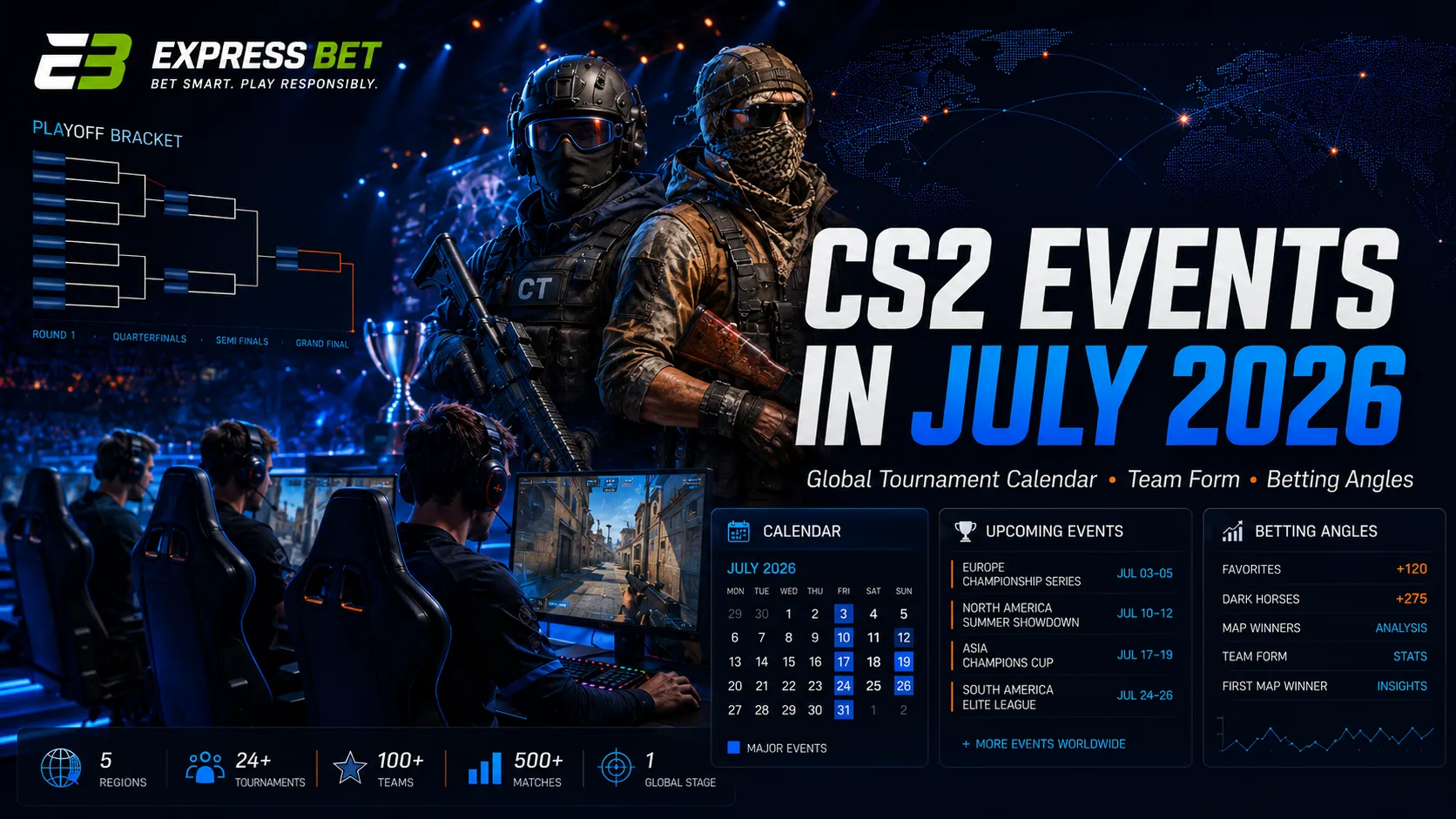
CS2 events July 2026 are built around a fragmented but useful global calendar. The month includes XSE Pro League Guangzhou 2026, CCT Europe and South America events, European Pro League qualifiers, CROSSFIRE Season 5, AR3NA Epicbet Open Season 1, BLAST Bounty Summer 2026, FiReCONTER Season 4, and other regional tournaments. July matters because it follows the June Major period and shows how teams reset, travel, test rosters, and rebuild form. Smaller online events require caution because data quality, motivation, and roster stability vary. Before betting, verify the schedule, format, rosters, maps, odds, and legal betting rules.
Introduction: Why July 2026 Matters for CS2
July 2026 is not a simple CS2 month.
It does not have the same single-event shape as June, when the scene was centered around a Major. July works differently. The calendar spreads across LAN events, online circuits, closed qualifiers, regional tournaments, streamer events, and late-month high-profile competition. That makes it useful for serious analysts, but dangerous for casual bettors.
In my CS2 event research, I treat the official tournament calendar as the starting point, not the final answer. A calendar tells me that an event exists. It does not tell me whether the event is useful for betting, whether the teams are using full rosters, whether the format is stable, whether the market has enough depth, or whether the odds reflect real team form.
That distinction matters in July 2026.
The month follows a heavy June Major period. Some teams are still reacting to Major results. Some are entering a short reset phase. Some are testing new roles. Some are using July events to keep rhythm. Some lower-tier teams treat July as a real chance to climb rankings, earn prize money, or qualify for stronger events. That creates uneven motivation across the calendar.
For bettors, that is the central problem. Not every CS2 event deserves the same confidence level. A LAN with verified rosters and strong production is not the same as a small online bracket with unstable teams. A BLAST event with a strong team list is not the same as a streamer battle. A CCT match with full BO3 data is not the same as a thin market where the bookmaker is reacting to incomplete information.
I compare the event format, the team field, the map pool, recent roster news, and available betting markets before I form an opinion. I do not judge a CS2 event only by the name of the organizer or the prize pool. I look at match format, team motivation, map veto patterns, online versus LAN conditions, and data reliability.
For July 2026, that approach is essential. The month is useful because it gives many match samples. It is risky because many of those samples are noisy.
My Research Method for July 2026 CS2 Events
The first step is calendar verification.
I check HLTV event pages, match pages, tournament calendars, and result pages. HLTV is useful because it connects events with matches, formats, map pools, rosters, live status, and betting-market movement. I also check Liquipedia because it often provides organizer, tier, venue, and bracket context in a structured format. When those sources differ, I do not force a conclusion. I mark the item as uncertain until an official organizer page or current match page resolves it.
The second step is organizer verification.
For BLAST, ESL, CCT, European Pro League, Xinsai Esports, FiReSPORTS, or other organizers, I check official pages where available. Official pages are important for prize pool, venue, team count, and format. Match platforms can update faster, but organizer pages usually define the event structure.
The third step is roster and team verification.
I check team pages, recent matches, player lists, social media announcements, stand-in notes, and roster trackers. A team name is not enough. The same organization can perform very differently after an in-game leader change, coach change, role shift, or stand-in.
The fourth step is match format.
BO1, BO3, and BO5 are not interchangeable. BO1 creates more variance. BO3 gives better map-pool evidence. BO5 tests depth and endurance. A betting angle that looks reasonable in BO3 can be poor in BO1.
The fifth step is map research.
For July 2026, the map pool is especially important because Cache is entering the conversation after the post-Major map-pool change. That affects older data. A team’s Overpass history may lose relevance. A team’s Cache preparation may be unknown. That can make early July and late July analysis different.
The sixth step is market quality.
I compare bookmaker odds only after I understand the match. Odds are not analysis. They are prices. When I review a CS2 betting angle, I always check whether the market is reacting to real team form or only to public name recognition.
My approach is simple: verify the schedule first, then study the teams, then read the maps, then decide whether the odds deserve attention at all.
CS2 Tournament Calendar for July 2026
Status note: this calendar reflects a July 4, 2026 snapshot. Ongoing events should be checked again before publication because match results, brackets, rosters, and odds can change quickly.
| Dates | Event | Region / Location | Online or LAN | Tier or Importance | Format | Status | Why It Matters | Betting Risk Level |
|---|---|---|---|---|---|---|---|---|
| July 1–12 | XSE Pro League Guangzhou 2026 | Guangzhou, China | LAN | High-value international LAN | 16-team Swiss stage, BO1 regular Swiss rounds, BO3 progression/elimination, BO3 playoffs, BO5 final | Ongoing | Main early-July LAN. Strongest event before BLAST Bounty. Useful for pressure and travel reads. | Medium |
| July 3–4 | BetBoom Streamers Battle Season 5 | Russia / online | Online | Streamer / entertainment event | Short streamer-style bracket | Ongoing / finishing | Good for audience content, weak for serious form analysis. | Very high |
| June 24–July 5 | European Pro League Series 8 Closed Qualifier | Europe | Online | Qualifier | GSL BO3 groups, single-elimination BO3 play-in | Ongoing | Qualification stakes create motivation, but teams can be unstable. | Medium-high |
| June 27–July 5 | CCT 2026 Challengers Europe Series 4 | Europe | Online | C-tier / Valve Tier 2 event | Double-elimination BO3 playoffs | Ongoing | Useful for mid-tier European form and BO3 samples. | Medium-high |
| June 29–July 10 | CROSSFIRE Season 5 | North America | Online | Regional online event | Bracket and match format to verify by round | Ongoing | Useful for North American depth tracking, but data can be thin. | High |
| June 27–July 9 | CCT 2026 South America Series 3 | South America | Online | B-tier / Valve Tier 2 event | Swiss BO3 group stage, BO3 playoffs | Ongoing | Important South American online sample. Regional knowledge matters. | High |
| June 29–July 5 | AR3NA Epicbet Open Season 1 | Europe | Online | C-tier / Valve Tier 2 event | 12-team online format, BO3 playoff matches | Ongoing | First-season event. Useful for scouting, risky for betting. | High |
| July 6–24 | European Pro League Series 8 | Europe | Online | C-tier / ranked online event | GSL BO3 groups, playoffs, BO5 final | Scheduled | Main continuation after the closed qualifier. | Medium-high |
| July 8–12 | Thunderpick World Championship 2026 South America Series 2 | South America | Online | Regional qualifier/event | 12 teams, format to verify | Scheduled | Another South American data point. Useful for regional form. | High |
| July 9–12 | CCT 2026 Contenders Europe Series 6 | Europe | Online | C-tier / contender-level event | To be confirmed | Scheduled | Scouting event for developing European teams. | High |
| July 21–August 2 | BLAST Bounty Summer 2026 / BLAST Premier Bounty S2 2026 | Europe online + BLAST Studio Malta | Online opening stage + studio finals | S-tier / Valve Tier 1 event | 32 teams, play-in stage, final eight bracket | Scheduled | Main late-July headline event. Strong team field and deeper markets. | Medium |
| July 23–August 6 | NODWIN Clutch Series 10 | Europe | Online | B-tier / online circuit | 24 teams, format to verify | Scheduled | Useful for post-BLAST lower-tier form tracking. | High |
| July 30–August 2 | FiReCONTER 2026: Season 4 | Buenos Aires, Argentina | LAN / offline | Regional C-tier event | Format and teams to confirm | Scheduled | Regional LAN sample with local context. | High |
| Late July / early August | CCT Europe 2026 Contenders #7 | Europe | Online | Contenders / qualifier track | To be confirmed | Uncertain / check final listing | Should not be treated as fully active until current event page is verified. | High |
The serious analytical events are XSE Pro League Guangzhou 2026 and BLAST Bounty Summer 2026. Those two events have the clearest relevance for broader CS2 form. European Pro League Series 8 and CCT events are useful for mid-tier tracking. South American and North American online events are valuable only if the analyst follows those regions closely. Streamer events should be treated as entertainment, not reliable professional form data.
Main July 2026 CS2 Storyline
The main July 2026 storyline is fragmentation.
There is no single Major that defines the month. Instead, July is split into several layers. The first layer is XSE Pro League Guangzhou, which gives early-month LAN data. The second layer is online European and South American circuits, which produce a large number of BO3 matches. The third layer is BLAST Bounty Summer 2026, which raises the quality level later in the month. The fourth layer is regional events and qualifier routes, which matter for specific teams but carry higher betting risk.
This makes July useful for data collection.
A mid-tier team that shows stable maps across CCT, European Pro League, and qualifier events can become a better read for August. A team that collapses in repeated BO3s may be exposing a structural problem. A roster that looks strong online but weak on LAN needs separation. A team that wins only against poor opposition should not be treated as a serious upset candidate against stronger opponents.
July can also distort team strength.
Online matches can inflate confidence. A team can look clean in a regional event and then struggle when the opponent pool improves. A favorite can treat a smaller online event as preparation while the underdog treats it as the biggest week of the season. That motivation gap can create betting traps.
For July 2026, I separate headline events from smaller online events because the betting risk is not the same. A good CS2 calendar article must do more than list dates. It must explain what type of evidence each event provides.
Event Analysis: XSE Pro League Guangzhou 2026
XSE Pro League Guangzhou 2026 is the main early-July event.
It runs from July 1 to July 12 in Guangzhou, China. It is a LAN event with 16 teams and a listed $1,000,000 prize pool. The format uses a Swiss group stage. Regular Swiss matches are BO1, while progression and elimination matches are BO3. The playoffs are single elimination, with BO3 matches and a BO5 grand final.
This structure creates mixed betting conditions.
The event has strong value as a LAN form indicator. Travel, stage conditions, local schedule, technical setup, and adaptation all matter. A team that looks comfortable in Europe may not immediately look the same in Guangzhou. The first day of any LAN can be unstable, especially when teams are adjusting to venue rhythm, PCs, schedule timing, and production delays.
The Swiss structure is also important. BO1 Swiss rounds are volatile. A favorite can lose a BO1 without being the weaker team overall. A strong pistol start, one bad economy reset, or one prepared map can produce an upset. BO3 progression and elimination matches are more reliable because the series tests map depth and adaptation.
From a betting view, XSE is more useful for match-winner and map-market analysis after the first one or two rounds. Early BO1s are dangerous. Later BO3s provide more information. Playoff matches should be treated as stronger betting data, especially if both teams have already shown their map pools at the event.
What fans should watch:
- Which teams adapt fastest to the Guangzhou LAN environment.
- Whether favorites survive the BO1 volatility.
- Whether underdogs win through real structure or one-map variance.
- Whether Cache appears in map discussions after the active pool change.
- Whether teams show travel fatigue or improved stage discipline.
What bettors should check:
- Official match time.
- BO1 or BO3 status.
- Current Swiss record.
- Map veto expectation.
- Any delays or tech issues.
- Confirmed rosters.
- LAN history.
- Whether odds moved because of real news or public reaction.
Risk level: medium overall, higher in BO1 Swiss rounds, lower in playoff BO3/BO5 matches if rosters and maps are confirmed.
Event Analysis: CCT 2026 Challengers Europe Series 4
CCT 2026 Challengers Europe Series 4 runs from June 27 to July 5. It is an online European event with 16 teams and a $5,000 prize pool. The listed playoff format is double elimination with BO3 matches.
This is not a headline event, but it is useful.
CCT-style European events give analysts regular BO3 samples from mid-tier and developing teams. That matters because BO3 data is more useful than isolated BO1 results. It shows how a team builds a series, how it responds after losing a map, and whether its map pool has real depth.
The risk comes from context.
Online European CS2 has schedule overlap. Teams can play multiple events during the same week. Some teams are using these matches to earn ranking value or prize money. Others may be treating them as part of a larger grind. Motivation is not always equal.
The betting market can also be thin. A smaller prize pool does not mean the event has no competitive value, but it does mean bettors should not assume every participant has the same level of preparation.
For this event, I focus on:
- BO3 stability.
- Recent 5–10 match history.
- Map pick consistency.
- Opponent quality.
- Whether a team is playing with its normal roster.
- Whether the same team is active in another event.
Risk level: medium-high.
The event is suitable for scouting and selective betting. It is not suitable for blind favorite betting.
Event Analysis: CCT 2026 South America Series 3
CCT 2026 South America Series 3 runs from June 27 to July 9. It is an online South American event with 24 teams and a $15,000 prize pool. The format uses a Swiss BO3 group stage and BO3 playoffs, with invited teams entering the Round of 16.
South American CS2 needs its own reading.
A European form model cannot simply be copied onto this region. Regional match history matters. Local rivalries matter. Academy teams matter. Ping, server routing, schedule timing, and regional style all influence results. Public bettors often know less about South American teams, so the market can be less efficient. That does not make it easy. It only means the bettor needs specialist knowledge.
The BO3 format is useful. A Swiss BO3 setup gives more reliable data than BO1-heavy formats. Still, roster stability and motivation must be checked. Some teams in regional events can change players quickly. Academy lineups can fluctuate. Smaller organizations may not publish every change clearly.
What fans should watch:
- Which teams survive the Swiss stage without relying on narrow maps.
- Which invited teams handle playoff pressure.
- Which academy teams show real development.
- Which maps create repeated upset patterns.
What bettors should check:
- Local head-to-head history.
- Current roster.
- Whether the team is an academy or main roster.
- Map pick and ban patterns.
- Match time and server context.
- Odds movement near start time.
Risk level: high unless the bettor follows South American CS2 closely.
Event Analysis: European Pro League Series 8 Closed Qualifier
European Pro League Series 8 Closed Qualifier runs from June 24 to July 5. It is an online European qualifier with 16 teams. The format includes GSL BO3 group play and a single-elimination BO3 play-in. The prize is qualification access to European Pro League Series 8 rather than a normal cash prize.
Closed qualifiers behave differently from prize events.
The motivation can be high because teams are not only playing for money. They are playing for entry into a larger event. That changes the risk profile. A lower-ranked team may prepare harder because qualification is a real opportunity. A better-known team may still have more firepower, but it can be vulnerable if the opponent has better preparation and cleaner map focus.
For betting, qualifiers require discipline.
Do not use brand names as shortcuts. A famous academy team can lose to a structured lower-tier roster. A lesser-known lineup can be dangerous if it has stable roles and a narrow but effective map pool.
The key betting checks are:
- Qualification stakes.
- BO3 map depth.
- Recent roster stability.
- Whether the team has already qualified through another route.
- Whether motivation is equal.
- Whether the match is an elimination or play-in match.
Risk level: medium-high to high.
Event Analysis: CROSSFIRE Season 5
CROSSFIRE Season 5 runs from June 29 to July 10. It is an online North American event with a listed $5,000 prize pool and at least eight teams.
This event is useful for North American depth tracking, but it should be treated carefully. Smaller North American online events can be difficult to price. Some teams are structured. Others are short-term mixes. Some rosters have limited public data. Some teams may have very uneven map pools.
That does not make the event irrelevant.
For fans, CROSSFIRE Season 5 can show which teams are developing below the top North American level. It can also reveal individual players who are ready for stronger competition. But for betting, the data may not be strong enough for large confidence.
I would not treat this event as a main betting target unless I had current roster information, recent match history, and clear map data. If those inputs are missing, the event belongs in the scouting category, not the serious betting category.
What to check:
- Whether the event is fully covered on major data platforms.
- Final rosters.
- Any stand-ins.
- Match format.
- Recent BO3 results.
- Whether a team has played only weak opposition.
- Whether odds are thin or slow to update.
Risk level: high.
Event Analysis: AR3NA Epicbet Open Season 1
AR3NA Epicbet Open Season 1 runs from June 29 to July 5. It is an online European event with 12 teams and a $10,000 prize pool. It is a first-season event, which automatically requires extra caution.
New or early-season events can be useful, but they have less historical context. The organizer’s format may be less familiar. The team field can be uneven. The market may react strongly to limited results.
For analysts, the value is scouting. A team that wins multiple BO3 matches against decent opposition deserves tracking. A team that depends on one strong map should not be overvalued. A roster that reaches playoffs through favorable pairings may be weaker than its placement suggests.
For bettors, this is not a low-risk event. The correct approach is selective. Avoid novelty markets. Avoid overreacting to one group result. Avoid assuming the event winner is automatically ready for a stronger European event.
Risk level: high.
Event Analysis: BetBoom Streamers Battle Season 5
BetBoom Streamers Battle Season 5 runs from July 3 to July 4. It is a short online streamer-style event.
This belongs in a different category.
Streamer events can be entertaining. They can draw strong audiences. They can produce clips, personalities, and social traffic. But they are not the same as professional tournament matches. Team construction, preparation, motivation, and competitive structure are different.
I do not use streamer events as serious form indicators. A player can perform well in this format and still have no meaningful impact on professional CS2 analysis. A team can win a streamer bracket without proving anything about structured pro competition.
For betting, this type of event is very high risk. It should not be treated like XSE, BLAST, CCT, or European Pro League. If a bookmaker offers markets, the bettor should understand that entertainment value is not the same as analytical reliability.
Risk level: very high, not recommended for serious betting.
Event Analysis: BLAST Bounty Summer 2026
BLAST Bounty Summer 2026, also listed as BLAST Premier Bounty S2 2026, is the main late-July headline event. It runs from July 21 to August 2. The official event page lists 32 teams, a $1,150,000 total prize pool, and BLAST Studio Malta as the studio environment for the event.
This is the most important late-July event for serious CS2 analysis.
BLAST events usually carry stronger production, better visibility, and deeper team fields than small online tournaments. That improves the information environment. Bettors get more previews, more interviews, more match data, and more market options.
The Bounty format also matters. Bounty-style events can create different incentives because teams are not only playing a normal bracket. Match selection, seeding, and reward structure can affect how teams approach risk. Before any betting article is published, the final bracket and team list must be checked.
The verified team field includes a wide range of high-profile organizations and regional representatives. But team names alone are not enough. A BLAST preview must still check rosters, recent form, map pool, and whether the team is coming out of a break, a LAN, or an online stretch.
For betting, BLAST is more suitable than most July events, but not safe. Public bias is stronger at big events. Famous teams attract money. Odds can become unattractive even when the team is likely to win. The better betting question is not “Who is stronger?” The better question is “Does the price match the actual risk?”
Risk level: medium if rosters, bracket, and format are confirmed. Higher if the bettor uses only reputation.
Event Analysis: CCT Europe 2026 Contenders #7
CCT Europe 2026 Contenders #7 should be handled carefully.
At this July snapshot, related CCT Contenders activity appears in upcoming or qualifier listings, but the final event status, dates, team field, and bracket must be checked before publication. If only an open qualifier page is available, it should not be presented as a fully active main event.
Contenders-level events are useful for scouting. They often include developing rosters, academy-level teams, unsigned stacks, or lower-ranked sides trying to reach stronger CCT competition. That can produce interesting results. It also produces high betting risk.
The main issue is data quality. Some teams have limited map history. Some rosters are unstable. Some players are not fully known in public databases. The market can move sharply on small pieces of news.
For a betting site, the correct angle is not to overstate the event. Present it as a scouting and qualification track unless final details are verified.
Risk level: high.
Event Analysis: FiReCONTER 2026: Season 4
FiReCONTER 2026: Season 4 is scheduled for July 30 to August 2 in Buenos Aires, Argentina. It is listed as an offline Argentine CS2 event with a $20,000 prize pool, but teams and final bracket details should be confirmed closer to the event.
Regional LAN events can be valuable because they add pressure data. Online South American results are useful, but LAN performance adds another layer. Stage setup, travel, local crowd, and team routine can change results.
For fans, FiReCONTER Season 4 offers a regional storyline. It can show which South American teams are building structure beyond online play. It can also give local players visibility.
For bettors, risk remains high. Smaller LANs can have large gaps between favorites and underdogs, but the public data can still be thin. If team lists are not final, there is no serious betting analysis yet. Once teams are confirmed, the key checks are roster stability, recent BO3s, LAN history, and map pool.
Risk level: high.
Cancelled, Postponed, or Uncertain July 2026 CS2 Events
Cancelled or uncertain events matter because old calendar pages can mislead readers.
FISSURE Playground #4 should not be treated as an active July 2026 betting event if the latest reliable sources list it as cancelled. Old previews, early calendar references, or cached tournament pages can remain visible after organizers change plans. A betting article must not copy old listings without checking current status.
CCT Europe 2026 Contenders #7 is not cancelled in the same way, but it should be treated as incomplete until the active event page, dates, teams, and bracket are clear. Qualifier pages are not enough to present a full tournament preview.
For any uncertain event, check:
- Official organizer channels.
- HLTV event status.
- Liquipedia current page.
- Match listings.
- Bracket pages.
- Team announcements.
- Whether bookmakers have real markets or only placeholders.
Old calendar data is one of the easiest ways to publish a bad CS2 article.
Global CS2 Betting Picture in July 2026
The July 2026 CS2 betting picture has three categories.
The first category is serious betting-relevant events. XSE Pro League Guangzhou and BLAST Bounty Summer belong here. They have stronger teams, more visibility, and better market coverage. They still require caution, but the data environment is stronger.
The second category is scouting and form-tracking events. CCT Europe, CCT South America, European Pro League, NODWIN, and similar circuits belong here. They are useful for identifying form, map pools, and emerging teams. They can be bet selectively by informed bettors, but the risk is higher.
The third category is entertainment or high-risk events. Streamer battles and limited-data events belong here. These events can be good for content, but poor for serious betting.
The main July betting risks are:
- Post-Major form swings.
- Roster changes.
- Stand-ins.
- Online volatility.
- Thin markets.
- Regional information gaps.
- Teams playing multiple events.
- Unclear motivation.
- Patch and map-pool changes.
- Public bias toward famous teams.
- Treating entertainment events as professional data.
Odds can move quickly before match start. A late stand-in, map-pool announcement, delay, or bracket update can change the price. Bettors who place early without checking current information carry unnecessary risk.
July 2026 CS2 Team Analysis: What to Watch
A July team analysis should not start with a fake ranking list.
It should start with evidence.
I do not rate a July team only by its name. I check whether the current roster is actually producing stable map results. A team can look strong in a results table but still be weak for betting if its wins came against poor opposition. The most useful July teams are not always the most famous teams. Sometimes they are the teams showing stable map pools across multiple online events.
For every team mentioned in a betting preview, verify:
- Current roster.
- Coach.
- Stand-ins.
- Recent 30-day results.
- Last 5–10 official matches.
- Map win rates.
- Opponent strength.
- LAN versus online split.
- Head-to-head data.
- Recent role changes.
- Travel and schedule.
- Motivation inside the event.
For XSE, I pay special attention to LAN adaptation. For BLAST, I watch current form and map-pool depth. For CCT and European Pro League, I focus on BO3 repeatability. For South America, I check local head-to-heads and regional consistency. For streamer events, I do not treat the result as professional evidence.
Map Pool and Meta Trends in July 2026
The July map conversation is important because Cache is replacing Overpass after the post-Major season change. That means older Overpass data loses direct value, while Cache preparation becomes a major uncertainty.
The active maps to monitor for July analysis are:
- Ancient.
- Anubis.
- Cache.
- Dust2.
- Inferno.
- Mirage.
- Nuke.
Some early July events may still reflect transition timing, so always check the event-specific map pool.
Ancient
Ancient rewards structure and early control. Teams with clean CT protocols can build strong halves. Bettors should check whether a team wins Ancient through repeated structure or only through individual clutches.
Anubis
Anubis often rewards confident T-side calling and strong post-plant setups. It can create fast momentum swings. Totals and handicaps need caution because a team can string together rounds quickly.
Cache
Cache is the major July question. Some teams will prepare it quickly. Others may avoid it until they have enough practice. Early Cache data should not be overtrusted. One good result on Cache is not a complete map identity.
Dust2
Dust2 gives space to aim-heavy teams. AWP form, mid control, long control, and late-round trading matter. It can punish favorites that start slowly.
Inferno
Inferno is built around banana control, utility discipline, and late-round execution. It often produces close maps. Round totals can be attractive, but economy swings can break the logic.
Mirage
Mirage remains a comfort map for many teams. That can make it hard to identify real advantage. Check opponent strength and recent CT-side numbers before trusting a Mirage win rate.
Nuke
Nuke tests team structure. Outside control, ramp defense, lower-site rotations, and communication matter. It is often a good map for identifying teams with real tactical depth.
Map vetoes matter more in BO3 than BO1 because both teams must reveal preferences across a series. BO5 requires even deeper pools. Totals and handicaps depend heavily on map identity, not only team strength.
Betting Markets for CS2 Events in July 2026
Match Winner
The simplest market. You pick the team that wins the match. It is suitable for beginners, but the price still matters. A strong favorite can be a poor bet if the odds are too short.
Map Winner
This market focuses on one map. It can be useful when a team has a clear map advantage. The risk is single-map variance.
Map Handicap
A map handicap is useful when you expect a team to win the series clearly. The risk is a close BO3 where the favorite wins but drops a map.
Round Handicap
Round handicaps require map-specific analysis. A team can win 13–11 and fail a handicap. Check map style and opponent quality.
Total Rounds
This market depends on map closeness, economy swings, and playing style. It is risky on maps with repeated blowout patterns.
Correct Score
Correct score markets are high risk. They require a strong read on map pool and series flow. Beginners should avoid making this a default market.
Pistol Round Winner
This is high variance. Pistol stats can help, but one round is still one round. It is not a stable foundation.
Player Props
Player props require role knowledge. AWPer, entry, anchor, and lurker roles produce different stat profiles. Blowouts and map count affect results.
Outright Tournament Winner
Outrights can be useful before a strong bracket is visible. The risk is long exposure. One bad veto ends the bet.
Live Betting
Live betting can be useful for advanced bettors who understand economy and momentum. It is dangerous for emotional bettors.
Qualifier Winner
Qualifier markets require motivation analysis. A team may care deeply about a qualifier spot, or it may be juggling schedule conflicts.
Specials and Novelty Markets
Specials can appear around streamer events or high-profile broadcasts. Treat them as entertainment, not serious betting tools.
No market is safe. Some markets are easier to understand, but easier does not mean profitable.
Event-by-Event Betting Risk Matrix
| Event | Data Quality | Roster Stability | Match Format Reliability | Market Depth | Public Bias Risk | Overall Betting Risk | Analyst Note |
|---|---|---|---|---|---|---|---|
| XSE Pro League Guangzhou | Strong | Moderate to strong | Mixed: BO1 Swiss, BO3/BO5 later | Good | Medium | Medium | Best early-July LAN data, but BO1 rounds are volatile. |
| BLAST Bounty Summer 2026 | Strong | Stronger after final team lock | Strong if bracket confirmed | Strong | High | Medium | Best late-July event, but famous teams may be overpriced. |
| European Pro League S8 | Moderate | Moderate | BO3/BO5 structure helps | Moderate | Low to medium | Medium-high | Useful for mid-tier form, still online. |
| EPL S8 Closed Qualifier | Moderate | Moderate | BO3 qualifier format | Moderate | Low | Medium-high | Motivation matters more than brand name. |
| CCT Europe Challengers S4 | Moderate | Moderate | BO3 playoffs help | Moderate | Low | Medium-high | Useful for BO3 tracking, but schedule overlap matters. |
| CCT South America S3 | Moderate | Variable | BO3 Swiss/playoffs help | Moderate to thin | Low | High | Good regional data if the analyst knows the teams. |
| CROSSFIRE S5 | Weak to moderate | Variable | Depends by round | Thin | Low | High | North American depth event, not a safe betting target. |
| AR3NA Epicbet Open S1 | Weak to moderate | Variable | BO3 playoffs help | Thin | Low | High | First-season event. Scouting value is higher than betting value. |
| BetBoom Streamers Battle S5 | Weak for pro analysis | Variable | Entertainment format | Thin / novelty | High among fans | Very high | Do not treat as pro-form evidence. |
| FiReCONTER Season 4 | To be confirmed | To be confirmed | To be confirmed | Thin | Low | High | Regional LAN value after teams are confirmed. |
| CCT Europe Contenders #7 | To be confirmed | To be confirmed | To be confirmed | Thin | Low | High | Wait for verified event page and team list. |
Practical Betting Checklist Before Any July 2026 CS2 Match
Before any July CS2 bet, check:
- Official match time.
- Event status.
- Whether the match is live, scheduled, delayed, or postponed.
- Final rosters.
- Stand-ins.
- Team motivation.
- Match format.
- BO1, BO3, or BO5 status.
- Map veto expectation.
- Recent BO3 performance.
- Map-specific win rates.
- Opponent strength.
- LAN or online context.
- Travel schedule.
- Whether the team is playing another event.
- Bookmaker price comparison.
- Late odds movement.
- Whether the event is professional or entertainment-based.
- Whether local gambling law allows betting.
- Fixed stake limit.
- Stop point after losses.
Avoid betting only because of team name. Avoid betting on streamer events as if they were pro matches. Avoid chasing losses. Stop after the planned stake is used.
Biggest Risks in CS2 Betting During July 2026
The biggest risk is lower-tier online volatility.
Smaller online events can move fast. Teams play many matches. Rosters change. Stand-ins appear. Brackets update. Match times shift. Bookmaker markets may be thin.
The second risk is unstable data.
A team’s last five wins may look strong until you check the opposition. A 70% map win rate can mean little if it came against poor teams. A strong online record may not translate to LAN.
The third risk is public bias.
Famous teams attract money. Odds can move because casual bettors recognize a logo, not because the team is in better form.
The fourth risk is showmatch confusion.
Streamer events are not normal pro events. They can be entertaining. They should not be used as serious CS2 betting evidence.
The fifth risk is map-pool transition.
Cache entering the pool changes preparation. Overpass data may become less useful. Early Cache performance can be noisy.
The sixth risk is emotional betting.
July has many matches. More matches do not mean more good bets. A bettor who tries to bet every CS2 match in July will likely make poor decisions.
Content Ideas for CS2 Fans and Publishers in July 2026
July is strong for content planning.
Useful formats include:
- Daily match previews.
- Tournament schedule updates.
- Match result recaps.
- Map veto breakdowns.
- Team form trackers.
- Roster update articles.
- Regional CS2 spotlights.
- Underdog watchlists.
- Betting market explainers.
- Safer betting guides.
- Events-to-avoid betting guides.
- Calendar comparison articles.
- LAN versus online betting explainers.
- Cache map-pool update articles.
- Post-Major team reset analysis.
For publishers, July is a data-building month. It helps prepare for August and late-season CS2. The best content does not only chase the biggest event. It tracks patterns across events.
Conclusion
July 2026 is a fragmented but important CS2 month.
It is not only about one headline event. The month includes XSE Pro League Guangzhou, CCT circuits, European Pro League qualifiers, CROSSFIRE Season 5, AR3NA Epicbet Open, BLAST Bounty Summer, FiReCONTER Season 4, and other regional or online tournaments.
Fans can use July to track team development, map-pool adaptation, roster stability, and regional depth. Bettors must be more selective. Event quality and data reliability vary sharply. A strong LAN event, a mid-tier online event, and a streamer battle should not be analyzed in the same way.
The safest analytical approach is to verify schedules, rosters, formats, maps, and odds before every match. Informed analysis can reduce avoidable mistakes. It cannot remove betting risk.
Responsible Gambling Note
CS2 betting is entertainment, not income.
No prediction, odds model, Telegram signal, insider tip, paid pick, or expert article can guarantee a win. Never bet money needed for rent, food, bills, credit, savings, family needs, or medical expenses. Set a fixed betting budget before placing any bet. Do not chase losses. Do not increase stakes after losing. Stop if betting becomes emotional. Check local gambling laws before betting. Use only licensed and legal betting operators where applicable.
Suggested Internal Links
- CS2 Betting Guide
- Esports Betting Markets Explained
- How CS2 Map Veto Works
- Best Esports Betting Sites
- Responsible Gambling Guide
Suggested External Sources
- HLTV event calendar and match pages
- Liquipedia Counter-Strike tournament pages
- Official organizer pages from BLAST, ESL, CCT, XSE, and regional operators
- Official team and roster announcements
- Licensed bookmaker odds pages
Summarize this article with AI. Use this page URL as the source:
Summarize this article with AI:
FAQ
The biggest CS2 events in July 2026 are XSE Pro League Guangzhou 2026 and BLAST Bounty Summer 2026. XSE is the main early-July LAN. BLAST Bounty is the strongest late-July headline event.
July 2026 can be useful for selective CS2 betting, but it is not a simple month. The calendar includes many online events, qualifiers, regional tournaments, and streamer events. Bettors should separate serious events from high-risk or entertainment formats.
Smaller CS2 events often have thinner data, unstable rosters, lower market depth, unclear motivation, and faster schedule changes. A bettor needs current roster, map, and format information before trusting any odds.
Check HLTV event pages, Liquipedia tournament pages, official organizer sites, team announcements, and bookmaker match pages. Always verify the latest match time before betting.
No. CS2 betting cannot guarantee profit. No prediction, odds model, Telegram signal, insider tip, or expert article can remove risk.