
Algeria vs Austria Match Result
Table of Contents Show
Views 3
TL;DR: Algeria vs Austria Match Result
Algeria and Austria drew 3-3 in a remarkable FIFA World Cup 2026 Group J finale in Kansas City. Marko Arnautović and Marcel Sabitzer twice put Austria ahead, but Rafik Belghali and Riyad Mahrez replied. Mahrez then scored again in stoppage time, apparently sending Austria out, before substitute Saša Kalajdžić headed the final equalizer in the 96th minute.
Mahrez was the match’s outstanding attacker, while Houssem Aouar supplied two assists. Algeria controlled possession, but Austria’s direct passing and aerial strength remained dangerous. Warm conditions led to a hydration break, although game-state calculation—not weather alone—best explains the late drop in pressing.
The draw sent Austria through in second place and Algeria through in third. It also rewarded draw, over-goals and both-teams-to-score bettors, depending on operator prices and market timing. (Sky Sports)
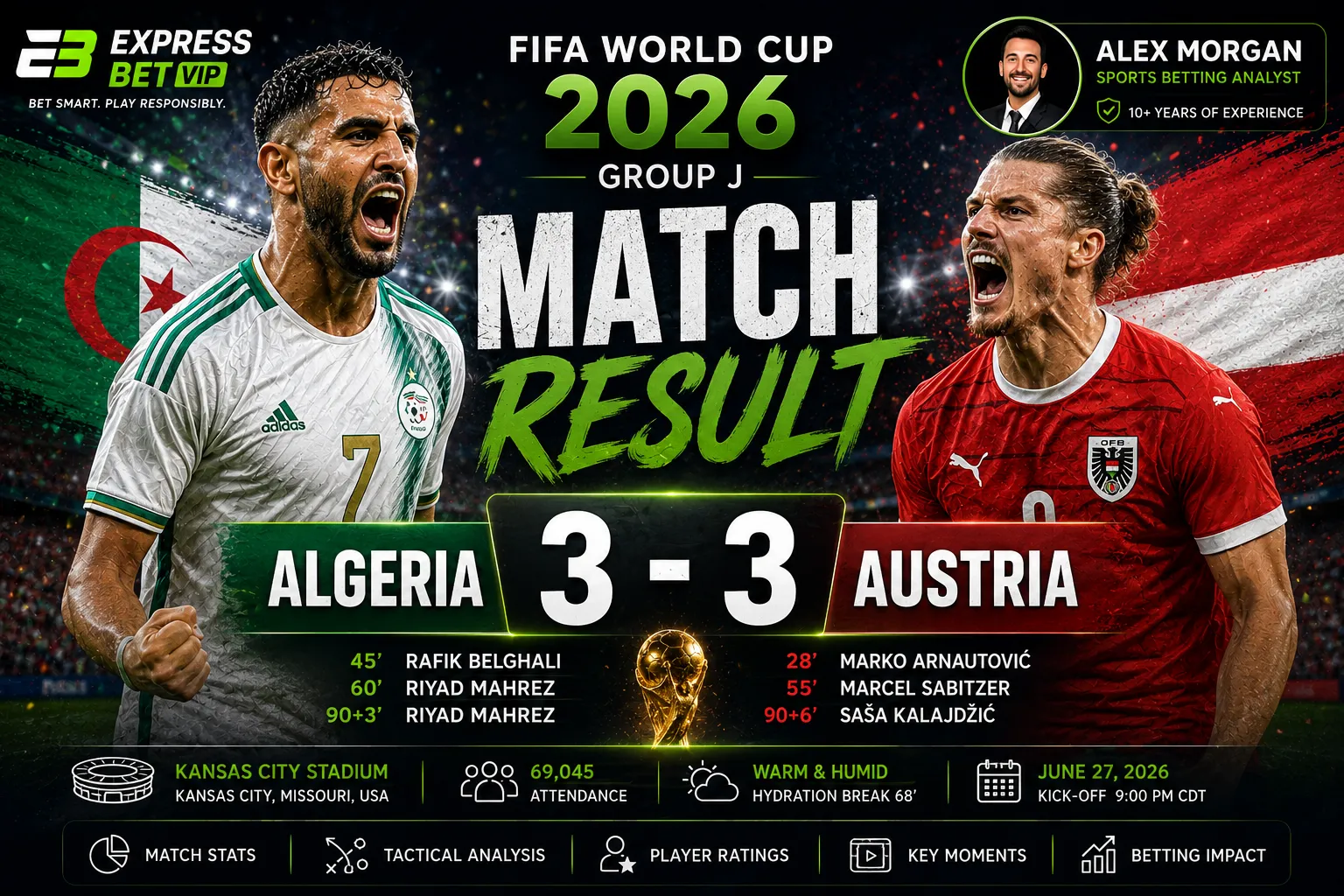
Quick Facts: Final Score, Goals, Venue, and Match Status
| Item | Verified information |
|---|---|
| Match | Algeria vs Austria |
| Competition | FIFA World Cup 2026 |
| Stage | Group stage |
| Group | Group J |
| Local date | June 27, 2026 |
| Kickoff | 9:00 p.m. CDT |
| Host country | United States |
| City | Kansas City, Missouri |
| Stadium | Kansas City Stadium / GEHA Field at Arrowhead Stadium |
| Listed capacity | 69,045 |
| Attendance | 69,045 |
| Final score | Algeria 3-3 Austria |
| Half-time score | Algeria 1-1 Austria |
| Algeria scorers | Rafik Belghali 45’, Riyad Mahrez 60’, 90+3’ |
| Austria scorers | Marko Arnautović 28’, Marcel Sabitzer 55’, Saša Kalajdžić 90+6’ |
| Referee | Ilgiz Tantashev |
| VAR | Leodán González |
| Weather | Warm and humid conditions reported; exact readings unavailable |
| Pitch condition | Playable; no decisive surface defect confirmed |
| Main impact | Austria second, Algeria third; both advanced |
The UK-facing Sky Sports page lists the fixture at 3:00 a.m. on June 28 because of the time-zone conversion. The match was played locally on the evening of June 27. (Sky Sports)
Verified Facts vs Analysis
| Category | Status | Detail |
|---|---|---|
| Final score | [CONFIRMED] | Algeria 3-3 Austria |
| Goal scorers | [CONFIRMED] | Arnautović, Belghali, Sabitzer, Mahrez twice, Kalajdžić |
| Attendance | [CONFIRMED] | 69,045 |
| Starting formations | [CONFIRMED] | Both teams listed in 4-2-3-1 structures |
| Hydration break | [OBSERVED] | Recorded in the 68th minute |
| Crowd whistles | [OBSERVED] | Restlessness during the passive late spell |
| Algeria possession control | [CONFIRMED] | 65% possession and 754 attempted passes |
| Reduced pressing at 2-2 | [OBSERVED] | Both teams accepted a lower-risk phase |
| Tactical reason for draw | [ANALYSIS] | Algeria’s ball control met Austria’s direct and aerial threat |
| Odds | [MARKET SIGNAL] | Draw and low totals were strongly supported in several snapshots |
| Exact temperature | [UNKNOWN] | Not available from verified public match data |
| Goal-minute differences | [DISPUTED] | Live reports differ by about one minute |
The distinction matters. A score is a match fact. Saying Austria “wanted the draw” is an interpretation unless supported by visible behavior. In this case, the reduced pressing and repeated safe circulation were observed, but that does not establish a formal agreement between the teams. (The Guardian)
Final Score and Match Summary
The Algeria vs Austria match result was a 3-3 draw, but the final number conceals three different matches.
The first was an open tactical contest. Austria attacked Algeria’s defensive line with early vertical passes, while Algeria built more patiently through Nabil Bentaleb, Farès Chaïbi and Houssem Aouar.
The second was a cautious qualification exercise. Once Mahrez made it 2-2, both teams understood that the draw placed them in the knockout stage. Pressing weakened. Possession slowed. The crowd noticed and began whistling.
The third match lasted several stoppage-time minutes and ignored everything that had come before.
Austria opened the scoring in the 28th minute. David Alaba recognized Algeria’s high defensive line and clipped a pass behind it for Arnautović. The striker did not connect perfectly, but his finish carried enough direction to beat Oussama Benbot.
Algeria’s reaction was strong. Belghali moved into the right channel, Ibrahim Maza attacked the box, and Chaïbi hit the post from distance. Belghali eventually equalized after Austria failed to protect possession near its own corner.
Sabitzer restored Austria’s lead ten minutes into the second half. Algeria answered five minutes later through Mahrez after Aouar attacked from the left.
At 2-2, the match gradually became risk management with a football attached. Austria stopped pressing aggressively. Algeria circulated the ball through its defenders. The draw protected both teams.
Aouar then broke the apparent equilibrium. His through ball released Mahrez, who finished in the 93rd minute. Algeria moved into second place. Austria briefly dropped out of the tournament.
Rangnick had already sent Kalajdžić forward. Austria launched one final direct attack. Michael Gregoritsch headed the ball into the striker’s path, and Kalajdžić scored with his first touch.
Austria returned to second. Algeria qualified in third. Iran were eliminated from the best-third-place ranking. Tournament football spent 20 minutes pretending to be an administrative meeting, then produced two goals before the paperwork was finished. (Sky Sports)
Goal Timeline
28’ — Marko Arnautović, Austria, Open-Play Goal
Alaba received possession with time to look beyond Algeria’s midfield. He clipped a measured pass behind the defensive line.
Arnautović timed his movement between the defenders and reached the ball before Benbot could close the angle. The finish was not technically clean—it appeared slightly scuffed—but it travelled beyond the goalkeeper.
The goal exposed Algeria’s high line and poor pressure on the passer. If Alaba can raise his head without interference, the defensive line behind him is already negotiating with danger.
There was no major VAR intervention. Weather and surface conditions did not visibly determine the outcome. (Sky Sports)
45’ — Rafik Belghali, Algeria, Open-Play Goal
Austria lost possession near the corner through Philipp Mwene. Belghali accelerated into the right side of the penalty area, adjusted his body and drove a powerful finish high into the net.
No assist was recorded in the Sky Sports event data. The decisive action came from Belghali’s recovery, carry and shot.
The goal was deserved within the first-half pattern. Algeria had already created chances through Belghali, Maza and Chaïbi. It also punished Austria for trying to play away from pressure in an unsafe defensive area.
Some live reports logged the goal in the 44th minute. This article follows the official event time of 45’. (Sky Sports)
55’ — Marcel Sabitzer, Austria, Counterattacking Goal
Konrad Laimer accelerated down Austria’s right and attacked the space behind Jaouen Hadjam. He played a low pass toward the edge of the penalty area.
Sabitzer arrived from the opposite side and met the ball with a forceful first-time strike. Benbot had limited reaction time.
The move was an efficient example of Rangnick’s preferred football: forward movement, a runner beyond the midfield line, a square pass and a late arrival rather than sterile occupation of the box.
Live commentary recorded the goal around the 54th minute; the official event record uses 55’. (The Guardian)
60’ — Riyad Mahrez, Algeria, Open-Play Goal
Aouar drove down the left and played the ball across the penalty area. It travelled through the central zone to Mahrez, who had held his position on the opposite side.
Mahrez finished firmly from close range.
Austria’s defensive unit became attracted to the ball and failed to protect the far side. Algeria’s width finally stretched the Austrian back line beyond the point where compact recovery was possible.
The goal restored the mutually beneficial draw and shifted the game toward tactical caution. (Sky Sports)
90+3’ — Riyad Mahrez, Algeria, Breakaway Goal
Algeria had been circulating the ball conservatively when Aouar saw an unexpected forward lane. He passed behind Austria’s relaxed defensive line.
Mahrez moved into the box and finished low beyond Alexander Schlager.
The goal changed the entire qualifying picture. Algeria climbed into second place. Austria moved outside the qualifying positions. Iran briefly moved into the Round of 32 through the third-place ranking.
The tactical cause was Austria’s loss of defensive readiness. The players had spent a long spell protecting the draw and did not react quickly enough when Algeria suddenly abandoned the informal rhythm.
Some live feeds recorded 90+4. Sky Sports lists 90+3. (The Guardian)
90+6’ — Saša Kalajdžić, Austria, Aerial Goal
Kalajdžić entered for Mwene in the final stoppage-time sequence. Austria immediately stopped considering construction and sent the ball toward the penalty area.
Gregoritsch won the aerial contact and directed a header into Kalajdžić’s path. The substitute headed past Benbot with his first touch.
This was not random chaos. Rangnick introduced a 2-metre target forward and Austria used the exact game model his presence demanded: direct service, second contact and penalty-box occupation.
The goal returned Austria to second place and preserved Algeria’s qualification as a third-placed side. (Sky Sports)
Key Moments That Changed the Match
Arnautović’s Early Yellow Card
Arnautović was booked in the 11th minute. He remained physically involved and still opened the scoring, but the card reduced his margin for aggressive pressing and late challenges. He was replaced at half-time. (Sky Sports)
Chaïbi Hits the Post
Chaïbi struck the upright from outside the box in the 40th minute. The chance showed that Algeria’s pressure was no longer cosmetic. Austria’s midfield screen had begun to open, particularly when Algeria moved the ball quickly after recovery. (Sky Sports)
Austria’s Triple Half-Time Change
Rangnick introduced Florian Grillitsch, Michael Gregoritsch and Paul Wanner for Xaver Schlager, Arnautović and Romano Schmid. The changes altered Austria’s attacking reference points and gave the team additional height and link play. (Sky Sports)
Sabitzer’s Transition Finish
The 55th-minute goal punished Algeria’s aggressive left-sided positioning. Laimer’s run behind Hadjam created the crossing lane, and Sabitzer’s opposite-side arrival escaped the midfield tracking.
Algeria’s Hydration-Break Substitutions
Petković introduced Rayan Aït-Nouri, Samir Chergui and Zineddine Belaid during the 68th-minute hydration break. Aït-Nouri later provided the only serious attempt to break the passive 2-2 phase before stoppage time. (The Guardian)
The Twenty-Minute Tactical Truce
From roughly the 70th minute onward, Algeria kept possession while Austria reduced its press. The Guardian’s live record noted crowd whistles and no shot between the hydration break and the final minutes. The draw suited both teams, but the match was not over. Football occasionally remembers this after everyone else has stopped. (The Guardian)
Kalajdžić’s Immediate Impact
The Austrian substitute entered during the final emergency and scored almost immediately. His presence turned a desperate long ball into a structured aerial attack.
Local Match Conditions: Stadium, City, Weather, Pitch, and Crowd
| Local factor | Verified or observed detail | Football meaning | Direct match evidence | Betting meaning | Status | Anti-template status |
|---|---|---|---|---|---|---|
| City | Kansas City, Missouri | Central time-zone evening kickoff | 9 p.m. local start | Relevant to live-market timing | [CONFIRMED] | Fixture-specific |
| Stadium | Kansas City Stadium | Large open-air bowl | Weather not excluded by roof | Conditions remained exposed | [CONFIRMED] | Fixture-specific |
| Capacity | 69,045 | Full or effectively full venue | Attendance also 69,045 | High-pressure environment | [CONFIRMED] | Fixture-specific |
| Noise profile | Holds outdoor crowd-roar record | Potential communication pressure | Crowd whistles clearly heard late | Do not convert reputation into automatic cards | [CONFIRMED/OBSERVED] | Fixture-specific |
| Heat and humidity | Warm, humid weekend reported | Hydration and pressing management | Break at 68’ | Possible second-half tempo factor | [REPORTED] | Fixture-specific |
| Exact temperature | Unavailable | Cannot quantify heat load | No confirmed reading | Avoid false precision | [UNKNOWN] | Fixture-specific |
| Wind | Unavailable | Cannot assess long-ball distortion | No confirmed reading | No market conclusion | [UNKNOWN] | Fixture-specific |
| Pitch | Playable | Supported passing and dribbling | 93.6% Algeria pass completion | No evidence of major surface disruption | [OBSERVED] | Fixture-specific |
| Crowd reaction | Whistles during passive period | Increased psychological pressure | Restlessness from 86’ onward | Possible live volatility signal | [OBSERVED] | Fixture-specific |
| Travel effect | Not verified | No safe acclimatization claim | Team-base details unavailable | Exclude from betting model | [UNKNOWN] | Fixture-specific |
FIFA listed Kansas City Stadium’s tournament capacity at 69,045, exactly matching the reported attendance. The venue is open-air and known for its acoustic intensity, although the record for crowd noise comes from American football rather than this match. (FIFA Hospitality)
The local weather context was relevant but not decisive. Kansas City broadcasters reported a hot and humid weekend, and the match included a hydration break. Exact match-time measurements were not available from verified public data, so assigning a numerical heat effect would be false precision. (https://www.kctv5.com)
The most visible late reduction in intensity was strategic. A 2-2 draw qualified both teams. The warm environment may have made reduced pressing physically attractive, but the group table gave both coaches the stronger incentive.
The playing surface supported Algeria’s short passing. Petković’s team completed 706 of 754 passes at 93.6%. No decisive slip, abnormal bounce or goalkeeper handling error was recorded. (Sky Sports)
The crowd’s effect was more concrete. Supporters whistled when the teams stopped attacking. That reaction did not immediately force a tactical change, but it added a visible layer of pressure before Aouar and Mahrez suddenly broke the pattern.
Stadium-Specific Match Impact
| Item | Detail |
|---|---|
| Stadium | Kansas City Stadium / GEHA Field at Arrowhead Stadium |
| Listed capacity | 69,045 |
| Attendance | 69,045 |
| Pitch type | Detailed tournament specification not publicly confirmed |
| Roof status | Open-air |
| Acoustic effect | Restless crowd and late whistles observed |
| Surface condition | Playable, no major defect reported |
| Wind relevance | Not available from verified public data |
| Goalkeeper distribution | No clear disruption |
| Set-piece effect | Austria won three corners but scored from open-play and an aerial second ball |
| Communication effect | Possible late pressure; no goal directly attributed to noise |
| Data status | Capacity and attendance confirmed; technical effects qualified |
The stadium’s main influence was psychological rather than mechanical.
Kansas City Stadium has a steep, enclosed-bowl feel despite being open-air. With the listed capacity filled, the whistles during the 2-2 holding pattern became difficult to ignore.
The stadium did not force the 3-3 result. It did, however, provide an unusually loud setting for Austria’s final emergency attack and Kalajdžić’s equalizer.
The available evidence does not show a clear stadium-specific effect on goalkeeper distribution, passing accuracy or set-piece delivery beyond the normal open-air conditions. (FIFA Hospitality)
City and Weather Impact
| Factor | Detail |
|---|---|
| City | Kansas City, Missouri |
| Host country | United States |
| Time zone | Central Daylight Time, UTC-5 |
| June climate | Commonly warm and humid |
| Match-time temperature | Not available from verified public data |
| Humidity | Not available from verified public data |
| Wind | Not available from verified public data |
| Rain | No significant rain effect confirmed |
| Altitude | No meaningful high-altitude factor |
| Likely physical effect | Hydration demand and shorter pressing spells |
| Actual match evidence | Hydration break; low-intensity phase after 68’ |
| Data status | General conditions reported; exact readings unknown |
The first-half tempo remained healthy. Austria pressed in selective bursts, Algeria carried the ball through Maza and Belghali, and both teams produced chances before the interval.
The second half contained two contrasting periods. From the restart to Mahrez’s equalizer, the match was fast and vertical. After the hydration break, physical preservation and qualification arithmetic combined to reduce intensity.
The conditions did not prevent a late sprint from Mahrez or an immediate aerial attack from Austria. That matters. It suggests the players retained enough physical capacity to attack when the game state required it.
No confirmed cramps, heat-related injury or weather-caused substitution was reported. Alaba’s 62nd-minute withdrawal produced some fitness concern in live coverage, but a diagnosis was not confirmed. (The Guardian)
First-Half Analysis
Both teams started in nominal 4-2-3-1 formations.
Algeria used Bentaleb and Chaïbi behind Mahrez, Maza and Aouar. Gouiri operated as the central forward. Austria fielded Seiwald and Xaver Schlager in midfield, with Laimer, Sabitzer and Schmid supporting Arnautović. (FotMob)
The structures looked similar on paper but functioned differently.
Algeria built with patience. Bensebaini and Mandi split to receive from Benbot, while Bentaleb dropped into the first line. Mahrez remained wide on the right, and Aouar moved inside from the left.
Austria’s attack was more direct. Alaba looked for early vertical passes, and Laimer made forward runs before Algeria’s shape could settle.
The opening goal came from this contrast. Algeria had more possession, but Austria reached the space behind the back line with one pass.
Petković’s team responded by increasing its dribbling and right-sided movement. Belghali repeatedly advanced beyond Mahrez. Maza received between Austria’s midfield and defence, while Chaïbi threatened from distance.
Austria’s midfield became stretched. Laimer moved forward aggressively, leaving Seiwald and Xaver Schlager to cover wider spaces. Algeria began reaching the penalty area through individual carries rather than crossing.
Belghali’s equalizer was a product of sustained territorial pressure and an Austrian error. Mwene attempted to escape near the corner, lost possession and could not recover.
At 1-1, both coaches had clear half-time problems. Petković needed better protection behind Hadjam. Rangnick needed more control between his midfield and defensive lines.
Second-Half Analysis
Rangnick changed three players at half-time.
Gregoritsch replaced Arnautović, Grillitsch replaced Xaver Schlager, and Wanner replaced Schmid. Austria retained the 4-2-3-1 framework but gained more technical security and another aerial forward.
The Sabitzer goal came before Algeria fully adjusted. Laimer attacked behind Hadjam, and Sabitzer arrived untracked from the far side. It was a transition Austria had been seeking throughout the match.
Algeria’s equalizer demonstrated the opposite wide-channel problem. Aouar attacked Austria’s right side and crossed beyond the central defenders to Mahrez.
At 2-2, the tactical objective changed.
Austria stopped jumping aggressively onto Algeria’s centre-backs. Algeria stopped forcing passes into the final third. Possession became territorial insurance rather than an attacking tool.
Petković’s triple substitution at the hydration break added fresher legs, but the team still avoided unnecessary risk. Aït-Nouri made one aggressive run in the 82nd minute, yet the general pattern remained conservative.
This phase explains Algeria’s huge possession and passing numbers. Some of the 754 passes reflected genuine control. A significant late portion reflected mutually acceptable inactivity.
Mahrez’s second goal arrived because Aouar rejected that inactivity. Austria’s line had lost its active defensive posture. A single vertical pass opened it.
Rangnick then simplified the match completely. Kalajdžić entered. Austria played forward immediately. Gregoritsch attacked the first contact, and Kalajdžić attacked the second.
The final goal was not a tactical masterpiece. It was a correct tactical response to having seconds left and a 2-metre striker available.
Tactical Picture: Why the Match Finished 3-3
Algeria had the advantage on the ground. Austria had the advantage in the air.
Sky Sports recorded Algeria winning 62.5% of ground duels and completing 13 dribbles. Austria won 71.4% of aerial duels and attempted 13 crosses to Algeria’s five. (Sky Sports)
That split explains the match.
Algeria progressed through close control, midfield combinations and wide carries. Belghali, Maza, Aouar and Mahrez repeatedly received facing forward.
Austria progressed through vertical passing, runners and aerial reference points. Alaba created the first goal from deep. Laimer created the second through a transition. Gregoritsch and Kalajdžić created the third through aerial contact.
Algeria’s 4-2-3-1 often became a 2-3-5 in possession. Belghali and Hadjam advanced, Mahrez and Aouar occupied wide or half-space positions, and Maza operated behind Gouiri.
This gave Algeria five attacking lanes but left space outside the centre-backs. Austria exploited that space twice.
Austria defended in a narrower 4-4-2 or 4-2-3-1 block. Sabitzer sometimes moved alongside Arnautović, with Laimer dropping toward the midfield line.
The Austrian block was vulnerable when Algeria beat the first pressure. Its ground-duel record was poor, and the defenders were repeatedly forced to retreat toward their own box.
The draw was fair because both systems created genuine advantages and genuine weaknesses. Algeria produced more possession, more shots and more shots on target. Austria produced three goals from three shots on target and remained superior in the air.
SofaScore’s reported xG was Algeria 1.62 and Austria 1.44. Both teams therefore finished above the quality of their chances. The 3-3 score was not a normal expectation from the chance profile; it was elite finishing mixed with late defensive disorganization. (Sofascore)
Tactical Collision Map
| Zone | Edge | Match evidence | Key player | Local-condition effect | Result impact |
|---|---|---|---|---|---|
| Algeria left flank | Algeria | Aouar created two goals | Houssem Aouar | No clear surface restriction | Major |
| Algeria right flank | Algeria | Belghali scored and advanced repeatedly | Rafik Belghali | Ground suited dribbling | Major |
| Austria right flank | Austria in transition | Laimer created Sabitzer goal | Konrad Laimer | Pressing spells shortened later | Major |
| Central midfield | Algeria | 65% possession, 706 completed passes | Nabil Bentaleb | Warm conditions favored control phase | Major |
| Penalty box | Even | Three goals each | Mahrez, Kalajdžić | No handling issue | Decisive |
| Long passing | Austria | Alaba assist behind high line | David Alaba | Wind effect unknown | Major |
| Ground duels | Algeria | 62.5% success | Ibrahim Maza | No clear local effect | Moderate |
| Aerial duels | Austria | 71.4% success | Gregoritsch, Kalajdžić | Direct route remained viable late | Decisive |
| Defensive third | Neither | Six goals conceded | Both back lines | No surface defect | Major |
| Goalkeeper build-up | Algeria | Higher pass volume and accuracy | Oussama Benbot | No disruption confirmed | Moderate |
| Bench impact | Austria | Kalajdžić scored immediately | Saša Kalajdžić | Fresh aerial target late | Decisive |
Player Ratings and Individual Performances
The ratings below are editorial assessments based on the verified event log, tactical roles and statistical profile. They are not official FIFA ratings.
Algeria Player Ratings
Oussama Benbot — 5.8
Made one save but conceded from all three Austrian shots on target. He was exposed by Arnautović’s run, Sabitzer’s power and Kalajdžić’s close-range header.
Rafik Belghali — 7.6
One of Algeria’s strongest performers. He attacked the right channel, scored the first equalizer and tested Austria before the goal.
Aïssa Mandi — 6.3
Helped Algeria complete a large volume of passes but struggled when Austria attacked quickly beyond the midfield.
Ramy Bensebaini — 6.6
Calm in possession and important to Algeria’s buildup. The defensive unit still conceded too much space behind the line.
Jaouen Hadjam — 5.9
Provided width but was beaten by Laimer’s run for Austria’s second goal. Replaced during the hydration break.
Nabil Bentaleb — 6.8
Maintained the rhythm of Algeria’s possession and protected the centre during longer attacks.
Farès Chaïbi — 7.0
Hit the post and contributed to Algeria’s ground control. Less influential during the passive final phase.
Riyad Mahrez — 9.1
Two goals, including the stoppage-time finish that briefly put Algeria second. He also remained Algeria’s main creative reference on the right. SofaScore likewise rated him 9.1. (Sofascore)
Ibrahim Maza — 6.9
Received well between the lines and carried the ball into the box. His decision-making was occasionally untidy, but he disrupted Austria’s midfield.
Houssem Aouar — 8.4
Created both Mahrez goals. His left-sided drive produced the 60th-minute equalizer, and his late vertical pass transformed the group standings.
Amine Gouiri — 6.0
Moved the centre-backs and supported combinations but did not record a decisive shot or contribution.
Algeria Substitutes
Rayan Aït-Nouri — 6.5
Provided the only consistent attempt to attack during the cautious 2-2 phase.
Zineddine Belaid — 6.0
Entered to reinforce the defensive line but was part of the unit beaten by Austria’s final aerial attack.
Samir Chergui — 5.9
Added defensive energy without substantially altering Algeria’s attacking output.
Faris Ghedjemis — Not rated
Entered after Mahrez’s second goal and had insufficient playing time for a meaningful rating. (Sky Sports)
Austria Player Ratings
Alexander Schlager — 6.0
Made two saves but conceded three times. Belghali’s power and Mahrez’s finishes left limited reaction margins.
Stefan Posch — 6.2
Defended with discipline but offered less attacking support than Mwene. Helped Austria manage Algeria’s late width.
Philipp Lienhart — 6.4
Made several clearances and remained important in the air. Austria’s line became too relaxed before Mahrez’s second goal.
David Alaba — 7.2
Created Arnautović’s opener with the match’s best deep pass. Replaced in the 62nd minute, with no confirmed injury diagnosis.
Philipp Mwene — 5.5
Lost possession before Belghali’s goal. Continued providing width but remained Austria’s most vulnerable defender.
Nicolas Seiwald — 6.5
Covered central spaces and threatened with a second-half shot. Algeria still played through Austria’s midfield too easily at times.
Xaver Schlager — 5.9
Worked aggressively but struggled to control Algeria’s dribblers. Replaced at half-time.
Konrad Laimer — 7.5
Austria’s most effective transition player. Assisted Sabitzer and repeatedly attacked the right channel.
Romano Schmid — 5.8
Had limited influence before his half-time withdrawal.
Marcel Sabitzer — 7.8
Scored an excellent first-time goal and timed his attacking runs intelligently. His midfield work decreased during the passive late phase.
Marko Arnautović — 7.0
Scored the opening goal and stretched Algeria’s high line. His early yellow card reduced his defensive aggression.
Austria Substitutes
Florian Grillitsch — 6.2
Improved Austria’s passing security but could not prevent Algeria from controlling possession.
Michael Gregoritsch — 7.1
Created the final equalizer with a headed assist. His height and movement gave Austria a stronger aerial outlet.
Paul Wanner — 6.1
Added technical quality but was peripheral during the low-risk 2-2 period.
Kevin Danso — 6.3
Strengthened the defence and attacked one corner but did not resolve Austria’s vulnerability behind the line.
Saša Kalajdžić — 8.2
Scored the qualification-saving equalizer almost immediately after entering. A substitute cannot influence much more with one touch. (Sky Sports)
Best Players of the Match
Man of the Match: Riyad Mahrez
Two goals and the temporary tournament-changing strike made him the central player.
Best attacker: Riyad Mahrez
His positioning at the far side produced the first goal. His movement behind Austria’s line produced the second.
Best midfielder: Houssem Aouar
Two assists and the willingness to break the late tactical stalemate.
Best defender: David Alaba
No defender controlled the entire match, but Alaba’s passing created Austria’s first goal and gave the team its cleanest buildup moments.
Best goalkeeper: Alexander Schlager
Neither goalkeeper had a comfortable night. Schlager made two saves to Benbot’s one.
Best substitute: Saša Kalajdžić
Scored the decisive goal with almost no preparation time.
Most underrated performance: Konrad Laimer
His forward running supplied Austria’s second goal and repeatedly tested Algeria’s left side.
Most disappointing performance: Philipp Mwene
His turnover directly preceded Belghali’s equalizer. He still contributed width and should not carry responsibility for every Austrian defensive problem.
Injuries, Suspensions, Cards, and Discipline
| Player | Team | Incident | Minute | Status | Next-match impact | Data status |
|---|---|---|---|---|---|---|
| Marko Arnautović | Austria | Foul | 11’ | Yellow card | No suspension confirmed | [CONFIRMED] |
| David Alaba | Austria | Substituted | 62’ | Fitness concern reported, diagnosis unavailable | No confirmed absence | [REPORTED] |
| Other players | Both | No further cards recorded | — | No red cards | No confirmed suspension | [CONFIRMED] |
The match contained only seven Austrian fouls and three Algerian fouls according to Sky Sports. Despite the emotional conclusion, discipline was not a major factor. (Sky Sports)
Referee and VAR Analysis
Ilgiz Tantashev managed the match without a major penalty, red-card or handball controversy.
The only card went to Arnautović in the 11th minute. No public match report identified a decisive VAR intervention.
Several physical contacts around Maza were allowed to continue, but none developed into a sustained officiating controversy.
The decisive late moments were football decisions rather than refereeing decisions. Austria’s equalizer came within extended stoppage time, but the available evidence does not establish an improper timekeeping issue.
VAR Leodán González did not overturn a goal or disciplinary decision. (Sky Sports)
Match Statistics
| Statistic | Algeria | Austria |
|---|---|---|
| Possession | 65% | 35% |
| Shots | 12 | 10 |
| Shots on target | 5 | 3 |
| Reported xG | 1.62 | 1.44 |
| Big chances | 3 | 2 |
| Corners | 0 | 3 |
| Fouls | 3 | 7 |
| Yellow cards | 0 | 1 |
| Red cards | 0 | 0 |
| Attempted passes | 754 | 396 |
| Accurate passes | 706 | 346 |
| Pass accuracy | 93.6% | 87.4% |
| Offsides | 1 | 3 |
| Goalkeeper saves | 1 | 2 |
| Touches in opposition box | 22 | 18 |
| Interceptions | 4 | 10 |
| Successful dribbles | 13 | 4 |
| Aerial duels won | 4 | 10 |
Sky Sports records one big chance missed by each team, while SofaScore’s broader chance classification reports three major chances for Algeria and two for Austria. Provider methodology can produce small differences. (Sky Sports)
Algeria’s possession was real but not uniformly dangerous. The team completed more than twice as many passes as Austria, partly because Austria preferred direct attacks and partly because the final 20 minutes contained low-risk circulation.
Austria’s efficiency was extraordinary: three shots on target, three goals. That is not a repeatable conversion rate and should not be mistaken for complete attacking dominance.
Algeria’s zero-corner total is notable. Its attacks came through dribbles, cutbacks and central combinations rather than sustained crossing pressure.
Austria’s aerial advantage became decisive only at the end. Winning ten aerial duels to four gave Rangnick a viable emergency route when elaborate buildup no longer mattered.
Betting Result Angle
Pre-match prices varied significantly by sportsbook and publication time.
FOX listed Austria at +185, Algeria at +320 and the draw at +115. DraftKings-related reporting listed Austria around +190, Algeria +300 and the draw +120. Another late comparison showed the teams close to even money relative to one another, with the draw still the shortest outcome. (foxsports.com)
| Market | Pre-match expectation | Actual result | Winning side | Key trigger | Local factor | Caution |
|---|---|---|---|---|---|---|
| Match winner | Austria slight favorite in some snapshots | 3-3 draw | Draw | Kalajdžić 90+6’ | None decisive | Odds varied |
| Algeria double chance | Supported by some analysts | Algeria avoided defeat | Algeria or draw | Mahrez brace | No clear local edge | Market terms differ |
| Over 2.5 goals | Strongly opposed in some markets | Six goals | Over | Efficient finishing | Heat did not suppress scoring | Extreme result |
| Both teams to score | Plausible but not certain | Yes | BTTS Yes | Arnautović opener, Belghali response | No clear local cause | Price unavailable |
| Correct score | Low-probability market | 3-3 | 3-3 backers | Two stoppage-time goals | Crowd pressure only contextual | Very high variance |
| First goalscorer | Arnautović listed around +280 | Arnautović scored first | Arnautović | Alaba pass | No local factor | Operator-dependent |
| Kalajdžić anytime scorer | Listed around +320 by FOX | Kalajdžić scored | Kalajdžić | Late substitution | Aerial route | Selection risk: started on bench |
| Cards | Exact line unavailable | One card | Depends on line | Arnautović 11’ | Heat did not create card spike | Settlement unknown |
| Corners | Exact line unavailable | Three total | Under on many common lines | Algeria had zero | No wind conclusion | Line required |
| Live draw | Price moved sharply after 3-2 | Draw restored | Late draw backers | Kalajdžić header | Stadium pressure contextual | Seconds of exposure |
The draw was the shortest pre-match outcome in several market snapshots because both teams could benefit from one point. That logic ultimately proved correct, but the route was almost absurdly hostile to anyone holding a draw ticket.
A heavily favored under 2.5-goals position failed before the final whistle. The match produced six goals from a combined reported xG of roughly 3.06.
The result rewarded both-teams-to-score and over bettors. It also rewarded Arnautović first-scorer backers and Kalajdžić anytime-scorer bettors who accepted the risk of selecting a substitute.
No bettor “should have known” that two goals would arrive after the 93rd minute. The market correctly identified the draw incentive. It did not predict the sequence.
Local Betting Impact: What the Venue and Conditions Changed
| Local factor | Market possibly affected | Actual evidence | Betting interpretation | Overreaction risk | Safer conclusion |
|---|---|---|---|---|---|
| Warm conditions | Second-half totals | Hydration break at 68’ | Tempo may decline | Medium | Game state mattered more |
| High attendance | Live volatility | Crowd whistles late | Pressure increased near end | High | Noise alone does not create goals |
| Open-air stadium | Passing and long balls | No confirmed wind issue | Normal outdoor exposure | High | Do not invent wind effect |
| Playable surface | Pass markets | Algeria completed 706 passes | Supported circulation | Low | Possession props still depend on role |
| Hydration break | Substitution markets | Algeria made three changes | Break enabled tactical reset | Medium | Match-specific |
| Aerial environment | Goal method | Austria’s final route was direct | Target-forward markets became relevant | Medium | Personnel mattered, not venue |
| Crowd restlessness | Live attack markets | Whistles during passive phase | Psychological pressure possible | High | Not a reliable standalone signal |
The local environment should not be used to explain all six goals.
The clearest market-changing information was tactical. Austria introduced Kalajdžić. Algeria retained Mahrez and Aouar. Those personnel facts mattered more than an imprecise temperature estimate.
The hydration break was relevant to substitution timing. Petković made three changes during the interruption, allowing Algeria to alter both full-back positions without losing additional rhythm.
The crowd’s frustration was visible but not predictive. Whistling preceded two goals, but the goals came from Aouar’s pass and Austria’s direct aerial response—not from noise itself.
What This Result Meant for Group J
| Position | Team | Played | Goal difference | Points |
|---|---|---|---|---|
| 1 | Argentina | 3 | +7 | 9 |
| 2 | Austria | 3 | 0 | 4 |
| 3 | Algeria | 3 | -2 | 4 |
| 4 | Jordan | 3 | -5 | 0 |
Austria finished above Algeria on goal difference. Both teams had four points, but Austria’s neutral goal difference placed them second.
Algeria qualified as one of the eight best third-placed teams. Iran were pushed outside the qualifying group on goal difference.
Austria advanced to face Spain in the Round of 32. Algeria advanced to face Switzerland. (Sky Sports)
The wider tournament update is less pleasant for both teams. Spain defeated Austria 3-0 on July 2, while Switzerland defeated Algeria 2-0 on July 3. The Kansas City draw secured advancement but did not produce a Round-of-16 appearance. (Sky Sports)
What Algeria Did Right
Algeria controlled possession without becoming entirely passive until the final quarter.
The centre-backs and Bentaleb circulated the ball accurately. Maza received between Austria’s lines. Aouar and Mahrez gave the team different creative profiles on opposite sides.
Belghali’s forward movement was particularly effective. Austria could not comfortably defend him and Mahrez with one wide midfielder and one full-back.
Petković’s team also responded well to adversity. Algeria fell behind twice and equalized twice.
Aouar’s late decision to play forward deserves emphasis. Most players would have continued protecting the 2-2 result. He recognized Austria’s defensive relaxation and created the 3-2 goal.
Algeria’s largest failure came after scoring. The defensive structure did not adapt quickly enough to Austria’s obvious direct route.
What Austria Got Wrong — and Repaired
Austria’s defensive possession was unreliable.
Mwene’s turnover led directly to Belghali’s goal. The midfield also struggled against Algeria’s dribbling, losing most ground duels.
The defensive line repeatedly moved forward without sufficient pressure on the ball. That became fatal when Aouar found Mahrez in stoppage time.
Austria also became too comfortable at 2-2. The team reduced its pressing because the draw was sufficient. When Algeria suddenly attacked, the defenders were mentally and positionally unprepared.
Rangnick repaired the situation with a simple decision. He introduced Kalajdžić and attacked the penalty area directly.
Austria’s aerial superiority had existed throughout the match. The coach finally concentrated it into one emergency sequence.
Coach Analysis
Vladimir Petković
Petković selected a technically strong 4-2-3-1 and trusted Algeria to control the ball.
The decision worked through midfield. Algeria recorded 65% possession, 93.6% pass accuracy and more shots than Austria.
His use of Belghali as an aggressive right-back also created the first goal.
The triple substitution during the hydration break was logical. Aït-Nouri added carrying ability, Belaid refreshed the defence and Chergui provided energy.
The late problem was structural. After Mahrez scored, Algeria needed to defend the penalty area against a predictable aerial attack. The team allowed Gregoritsch to win the first header and Kalajdžić to attack the second.
Ralf Rangnick
Rangnick’s starting plan targeted the space behind Algeria’s full-backs and defensive line.
Alaba’s passing and Laimer’s forward running created the first two Austrian goals.
The three half-time substitutions were unusually aggressive but understandable. Arnautović was booked, Xaver Schlager had struggled in midfield, and Schmid had offered limited progression.
Austria’s long passive phase was the weakest part of the coaching performance. Protecting the draw made sense, but the team lost defensive alertness.
The final substitution corrected the mistake. Kalajdžić gave Austria the penalty-box reference required for one last direct attack.
Player Milestones and Records
Austria reached the World Cup knockout stage for the first time since 1982.
Algeria returned to the knockout stage for the first time since 2014 after missing the 2018 and 2022 tournaments.
Kalajdžić scored with his first touch after entering in stoppage time, according to post-match reporting.
The fixture was the first World Cup meeting between Algeria and Austria since their heavily discussed 1982 group-stage history. (The Guardian)
No additional major individual record was confirmed from verified public data at the time of writing.
Historical Context and the 1982 Shadow
No Algeria–Austria match can escape 1982.
West Germany’s 1-0 victory over Austria in Gijón sent both European teams through and eliminated Algeria. After the early goal, the teams reduced their attacking activity because the score suited both.
The match became known as the “Disgrace of Gijón” and contributed to FIFA’s practice of scheduling final group matches simultaneously.
Forty-four years later, Algeria and Austria met with another draw capable of helping both teams. The historical comparison was unavoidable.
For approximately 20 minutes at 2-2, the resemblance became uncomfortable. Algeria kept the ball. Austria declined to press. The crowd whistled.
Then Aouar passed forward, Mahrez scored, Austria panicked and Kalajdžić equalized.
The final sequence did not erase the passive period, but it prevented the match from becoming a simple repetition of 1982. It also produced a strange historical reversal: Algeria’s attempt to win almost eliminated Austria, while Austria’s equalizer qualified both teams and eliminated Iran. (Sky Sports)
Incidents and Controversies
The central controversy concerned the passive 2-2 phase.
Live reporting described both teams reducing their attacking intent because the result qualified them. Supporters reacted with whistles, and some spectators reportedly left before the stoppage-time goals. (The Guardian)
There is no verified evidence of a formal agreement between the teams.
Both coaches maintained that their teams competed to win. Petković pointed to Algeria’s third goal as evidence, while Austria’s final attack demonstrated that the team responded when elimination became immediate. (Sky Sports)
No major VAR controversy, crowd disorder, pitch invasion or post-match confrontation was confirmed.
Information Gain: What the Evidence Adds
The final score does not explain why the match changed character three times.
The event data shows that Algeria controlled the ball and the ground game. Austria controlled the aerial contest and attacked more directly.
The local record shows that the hydration break became a tactical substitution window and preceded the match’s passive phase.
The crowd record shows that supporters recognized the reduced intensity and reacted before the stoppage-time reversal.
The betting comparison shows that markets expected a draw and few goals. One expectation proved correct; the other failed spectacularly.
The tactical collision map explains why Austria could score three times with only three shots on target and why Algeria could dominate possession without winning.
Local Information Gain Quality Check
| Detail | Included | Status | Specific to fixture | Future update needed |
|---|---|---|---|---|
| Stadium capacity | Yes | Confirmed | Yes | Only if FIFA corrects figure |
| Attendance | Yes | Confirmed | Yes | Only if corrected |
| Open-air venue | Yes | Confirmed | Yes | No |
| City and time zone | Yes | Confirmed | Yes | No |
| Exact weather readings | No | Unknown | Yes | Add only from reliable archive |
| Hydration break | Yes | Observed | Yes | No |
| Pitch condition | Yes | Observed | Yes | Technical report unavailable |
| Crowd reaction | Yes | Observed | Yes | Fan split unavailable |
| Travel effect | No claim | Unknown | Yes | Team logistics unavailable |
| Local betting risk | Yes | Analysis | Yes | Closing odds could refine |
| Tactical-local connection | Yes | Qualified analysis | Yes | No |
| Anti-template status | Passed | Reviewed | Yes | Recheck after factual updates |
Source and Data Appendix
| Data point | Status | Source type |
|---|---|---|
| Final score | Confirmed | FIFA match report and match centre |
| Goal scorers | Confirmed | FIFA and Sky Sports |
| Goal times | Confirmed with minor provider variation | Sky Sports and live reports |
| Assists | Confirmed | Sky Sports event log |
| Stadium | Confirmed | FIFA venue information |
| City | Confirmed | FIFA venue information |
| Capacity | Confirmed | FIFA stadium page |
| Attendance | Confirmed | Sky Sports |
| Referee | Confirmed | Sky Sports |
| VAR | Confirmed | Sky Sports |
| Lineups | Confirmed | Sky Sports and FotMob |
| Formations | Confirmed | FotMob and Guardian lineup record |
| Substitutions | Confirmed | Sky Sports |
| Cards | Confirmed | Sky Sports |
| Alaba fitness concern | Reported | Live commentary |
| Match statistics | Confirmed from provider | Sky Sports |
| xG | Reported | SofaScore |
| Pre-match odds | Market signal | FOX, DraftKings-related reporting |
| Exact closing odds | Unknown | No complete archive verified |
| Weather | Reported generally | Local broadcaster and match coverage |
| Temperature | Unknown | Exact match-time figure unavailable |
| Humidity | Unknown | Exact match-time figure unavailable |
| Wind | Unknown | Exact match-time figure unavailable |
| Pitch condition | Observed | Match coverage |
| Crowd profile | Partly observed | Attendance and live commentary |
| Tournament impact | Confirmed | FIFA/Sky standings and bracket reporting |
Final Verdict
Algeria and Austria drew because each team possessed the exact tool the other struggled to defend.
Algeria had superior control on the ground. Aouar, Maza, Mahrez and Belghali repeatedly carried or passed through Austria’s midfield.
Austria had superior vertical and aerial threat. Alaba’s pass created the opener, Laimer’s run created the second, and the Gregoritsch–Kalajdžić combination created the final equalizer.
The 3-3 score was high relative to the chance quality, but it was not fraudulent. Algeria hit the post and produced five shots on target. Austria converted all three of its efforts on target.
The most important tactical detail was not a formation. It was alertness.
Austria relaxed at 2-2 and conceded. Algeria celebrated 3-2 before reorganizing for an obvious aerial attack and conceded.
Kansas City’s warm conditions and hydration break contributed to the rhythm, but qualification arithmetic shaped the match more strongly than the weather.
For bettors, the lesson is uncomfortable but useful. A match can contain a powerful draw incentive and still produce six goals. Correctly identifying the strategic outcome does not automatically identify the path.
For both teams, the draw achieved its immediate purpose. Austria and Algeria advanced. Neither survived the next round. The Kansas City match therefore remains their tournament high point: part tactical contest, part negotiation, and finally several minutes of complete footballing panic.
Responsible Betting Note
Football betting carries financial risk. Even accurate tactical analysis cannot guarantee a winning wager.
Odds change before and during matches. Different sportsbooks also use different prices, settlement rules and player-market conditions.
Local factors such as heat, humidity, stadium noise and pitch conditions are often overvalued. They should not replace analysis of lineups, tactics and game state.
Never chase losses. Do not gamble with money required for food, housing, bills, healthcare or other daily expenses.
Use deposit, loss and time limits. Take regular breaks. Check local laws and use licensed operators only.
Betting should remain entertainment, not a source of income.
Summarize this article with AI. Use this page URL as the source:
Summarize this article with AI:
FAQ
Algeria and Austria drew 3-3 in their FIFA World Cup 2026 Group J match.
Rafik Belghali and Riyad Mahrez, twice, scored for Algeria. Marko Arnautović, Marcel Sabitzer and Saša Kalajdžić scored for Austria.
Riyad Mahrez was the editorial Man of the Match after scoring twice, including Algeria’s stoppage-time third goal.
Austria finished second in Group J and Algeria finished third. Both qualified for the Round of 32.
The draw, over-goals and both-teams-to-score markets won. Exact returns depended on the sportsbook, selected odds and timing of the wager.