
Argentina vs Austria Match Result
Table of Contents Show
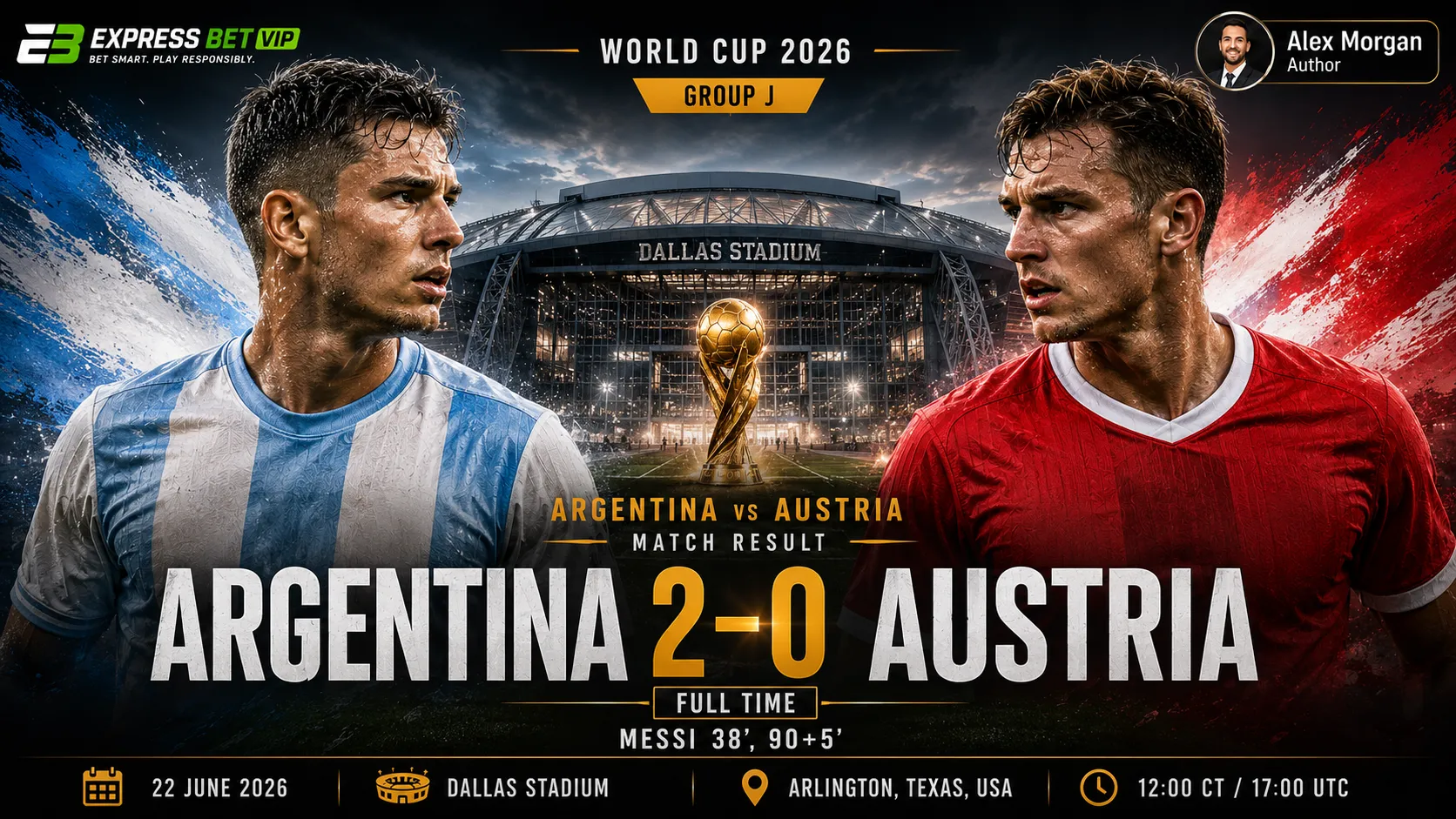
Argentina beat Austria 2-0 in FIFA World Cup 2026 Group J at Dallas Stadium / AT&T Stadium in Arlington. Lionel Messi scored both goals, first in the 38th minute and again in the 90+5 minute, after missing a penalty in the 9th minute. The main turning point was Messi’s first goal: Austria had stayed compact and awkward, but once Argentina led, Rangnick’s side had to chase without enough final-third quality. Messi was the best player, with two goals and a reported 9.2 Sofascore rating. The local factor was North Texas heat-management context, including a hydration break after a stormy, high-heat matchday forecast. Argentina win, under 2.5 goals, BTTS No and Messi scorer markets landed, but betting outcomes depended on odds and timing.
| Item | Detail | Data status |
|---|---|---|
| Match | Argentina vs Austria | [CONFIRMED] |
| Competition | FIFA World Cup 2026 | [CONFIRMED] |
| Stage | Group stage | [CONFIRMED] |
| Group | Group J | [CONFIRMED] |
| Date | 22 June 2026 | [CONFIRMED] |
| Kickoff time | 17:00 UTC / 12:00 PM Central Time | [CONFIRMED] |
| Host country | United States | [CONFIRMED] |
| City | Arlington / Dallas area | [CONFIRMED] |
| Stadium | Dallas Stadium / AT&T Stadium | [CONFIRMED] |
| Attendance | 70,649 reported by Sofascore | [REPORTED] |
| Final score | Argentina 2-0 Austria | [CONFIRMED] |
| Half-time score | Argentina 1-0 Austria | [CONFIRMED] |
| Goal scorers | Lionel Messi 38’, 90+5’ | [CONFIRMED] |
| Referee | Amin Mohamed Omar | [CONFIRMED] |
| VAR | not available from verified public data | [UNKNOWN] |
| Weather | severe storm watch earlier in DFW; heat index up to 106°F reported for match-day activities | [REPORTED] |
| Pitch condition | no match-specific surface issue confirmed | [UNKNOWN] |
| Main tournament impact | Argentina secured Round of 32 qualification | [CONFIRMED] |
FIFA listed Argentina vs Austria as a FIFA World Cup 2026 match at Dallas Stadium, with 22 June 2026, 17:00 kickoff and Amin Mohamed Omar as referee. FOX Sports reported that Argentina secured a Round of 32 spot after Messi scored twice in the 2-0 win. (FIFA)
| Category | What it covers | Argentina vs Austria example |
|---|---|---|
| [CONFIRMED] match facts | Final score, venue, goal times, referee, competition data | Argentina 2-0 Austria; Messi 38’, 90+5’; Amin Mohamed Omar referee |
| [REPORTED] details | Reliable provider or media reporting not fully official in all public datasets | 70,649 attendance; xG 2.65-0.50; Messi 9.2 Sofascore rating |
| [OBSERVED] match details | Live-report descriptions from the match | Messi missed early penalty; hydration break around 69’; Austria had limited end product |
| [ANALYSIS] tactical interpretation | Editorial reading based on match evidence | Argentina protected central spaces and relied on Messi’s decisive moments |
| [MARKET SIGNAL] betting interpretation | Post-match betting settlement reading | Argentina win, under 2.5, BTTS No, Messi anytime scorer |
| [UNKNOWN] unavailable data | Data not confirmed by reliable public sources checked | Full VAR crew, exact roof status, complete official card table, verified closing odds |
This distinction matters because Argentina vs Austria was a match where the headline can swallow the football. Messi broke records. That is true. But the match also had tactical friction, local heat context and a low-event Austrian attack. Our editorial check compared FIFA, Guardian, FOX Sports, Sofascore and local Dallas-area reports before separating hard facts from interpretation. Sofascore’s report gives Argentina a 2.65-0.50 xG edge and five shots on target to Austria’s one, which supports the scoreline more than the possession debate would. (Sofascore)
Argentina beat Austria 2-0, and the most honest summary is simple: Austria made it awkward, Messi made it irrelevant.
The match did not become an open Argentine procession. Austria were organised, physically strong and competitive in midfield. They pressed in moments, narrowed central spaces and forced Argentina into a game that was less elegant than the scoreline may suggest. But tournament football has an old, tedious rule: if you let Lionel Messi hang around a match long enough, he eventually starts editing the script.
Messi missed a penalty in the 9th minute. That could have made the day strange. A missed early penalty by a player chasing a World Cup scoring record is exactly the sort of detail that usually feeds television panels for hours. Instead, he scored in the 38th minute, putting Argentina 1-0 up at half-time. Guardian’s live report listed the key first-half events as Messi’s missed penalty and then Messi’s opener. (The Guardian)
Austria stayed in the game, but they never quite convinced the game that they might take it. Marcel Sabitzer forced a decent save from Emiliano Martínez in the second half, and Austria pushed balls toward Marko Arnautović late. Guardian described Austria as well organised but lacking end product, which was the match in one dry sentence. (The Guardian)
The second goal came in the 90+5 minute. Julián Álvarez was denied, then Messi was denied, then Messi found a way through. That was the final insult: even when Austria blocked the first two endings, the third one still had Messi’s name on it. (The Guardian)
The result sent Argentina into the Round of 32. FOX Sports framed the day as Messi’s historic performance and Argentina’s qualification moment. (FOX Sports)
Messi’s first goal came in the 38th minute. It arrived after his 9th-minute penalty miss, so the goal carried more than scoreboard value. It killed the obvious “missed penalty” storyline before it could become match psychology. Guardian’s live report confirms both events: the early penalty miss and Messi’s 38th-minute goal. (The Guardian)
The tactical meaning was direct. Austria’s block had survived the first phase of Argentine pressure. Once Messi scored, Austria had to decide whether to keep a compact shape or become more aggressive. Against Argentina, that is not a clean choice. Stay deep and Messi receives between lines. Step out and Argentina’s runners attack the spaces behind.
The goal also shifted betting markets. Argentina moneyline positions became more secure; draw positions weakened; under markets remained alive because Austria had not shown enough attacking output to force a shootout.
Messi’s second goal came in stoppage time. Guardian described the sequence clearly: Álvarez was denied, Messi was denied, then Messi squeezed the ball home to seal the result. (The Guardian)
This was not a tactical masterpiece. It was a familiar World Cup detail: a game that should be dead but is still technically alive until one elite player ends the paperwork. Austria had pushed late, including a dangerous set-piece sequence in added time, but they did not turn pressure into a clean equaliser.
The second goal changed betting settlements. It confirmed Argentina -1.5 lines where available, killed 1-0 correct score, delivered 2-0 correct score and strengthened Messi multi-goal/brace markets if priced. It also pushed Messi’s World Cup record conversation from “he broke Klose’s men’s record” to “he added another one.” FOX Sports reported that Messi’s first goal gave him 17 career World Cup goals and his second took him to 18. (FOX Sports)
| Minute | Moment | Why it mattered | Data status |
|---|---|---|---|
| 9’ | Messi missed a penalty | Austria survived the early worst-case scenario | [CONFIRMED] |
| 38’ | Messi scored | Argentina turned control into scoreboard pressure | [CONFIRMED] |
| 55’ | Austria won a dangerous free-kick | Sabitzer gave Austria one of their clearer routes into the match | [OBSERVED] |
| 57’ | Sabitzer forced a save from Emiliano Martínez | Austria finally put a serious effort on target | [OBSERVED] |
| 69’ | Hydration break | Local heat-management context became visible in the match rhythm | [OBSERVED] |
| 77’ | Medina and Laimer booked after scuffle | Physical tone rose as Austria chased | [REPORTED] |
| 90+4’ | Austria late free-kick and aerial scramble | Austria nearly created the late chaos they needed | [OBSERVED] |
| 90+5’ | Messi scored again | Argentina killed the match and secured the 2-0 result | [CONFIRMED] |
The biggest moment was Messi’s first goal, not the second. The second goal made the score look cleaner. The first goal changed Austria’s job description.
| Local factor | Verified or observed detail | Football meaning | Direct match evidence | Betting-result meaning | Data status | Anti-template status |
|---|---|---|---|---|---|---|
| Stadium | Dallas Stadium / AT&T Stadium in Arlington | Huge indoor-capable NFL venue adapted for World Cup football | FIFA and AT&T Stadium event pages list the venue | Venue reduced open-air uncertainty, but exact roof status unknown | [CONFIRMED] | Specific |
| Tournament capacity | FIFA lists Dallas Stadium capacity at 70,649 | Reported full-capacity crowd profile | Sofascore reported 70,649 attendance | Crowd volume relevant, but fan split not verified | [CONFIRMED / REPORTED] | Specific |
| Kickoff slot | 12:00 PM Central Time | Midday Texas timing raised heat-management relevance | City of Arlington listed 12:00-2:00 PM event window | Live tempo and hydration markets may be affected | [CONFIRMED] | Specific |
| Weather | Severe thunderstorm watch earlier; heat index up to 106°F reported | Outdoor fan logistics and heat-management risk | FOX 4 Dallas-Fort Worth report | Weather mattered more around matchday operations than verified on-pitch wind/rain | [REPORTED] | Specific |
| Hydration | Guardian noted hydration break around 69’ with boos | Heat protocol or heat-management rhythm interruption | Live report event | Second-half tempo and player stamina markets affected after the fact | [OBSERVED] | Specific |
| Roof status | Retractable-roof stadium; exact match roof status not confirmed | On-field weather conversion limited by missing roof data | No verified roof-state source found | Avoid weather-overfit in betting read | [UNKNOWN] | Specific |
| Pitch condition | No verified slips, surface wear or ball-speed issue | No confirmed surface-driven tactical effect | No match report found confirming pitch issues | No pitch-based betting conclusion | [UNKNOWN] | Specific |
Dallas Stadium mattered here, but not in the lazy “big stadium atmosphere” way. The fixture was played at AT&T Stadium in Arlington under its FIFA tournament name, Dallas Stadium. FIFA’s Dallas venue article lists the stadium capacity as 70,649, while the match data reported 70,649 attendance. That makes this a full-house World Cup environment, not a neutral training-ground exercise with cameras. (FIFA)
The local weather layer was specific to North Texas. FOX 4 Dallas-Fort Worth reported that a severe thunderstorm watch had been in effect for parts of North Texas earlier on matchday and that heat index values could reach 106°F after storms. The same report warned fans involved in outdoor activities around the Argentina-Austria match to monitor changing weather. (FOX 4 News Dallas-Fort Worth)
The match did not produce a verified rain or wind effect on the pitch. The roof status was not confirmed from verified public data. That matters. We can say local heat and weather risk shaped the matchday environment. We cannot say wind changed crosses or rain sped the grass.
The visible in-match local factor was the hydration break around the 69th minute. Guardian noted the break and boos from the stands. That does not prove heat decided the result, but it does show the match rhythm was interrupted in a way specific to the local time and climate context. (The Guardian)
| Stadium | Capacity | Attendance | Pitch type | Roof status | Acoustic effect | Surface condition | Wind or airflow relevance | Goalkeeper distribution effect | Set-piece effect | Communication effect | Data status |
|---|---|---|---|---|---|---|---|---|---|---|---|
| Dallas Stadium / AT&T Stadium | 70,649 FIFA-listed tournament capacity | 70,649 reported | natural-grass World Cup setup not fully confirmed in public data | retractable roof exists; match status not confirmed | full-capacity noise likely, but fan split not verified | no confirmed surface issue | not confirmed because roof status unavailable | no verified goalkeeper-distribution issue | late Austria free-kick and corner sequences mattered, but no stadium link confirmed | no verified communication breakdown | Mixed |
The available match evidence does not show a clear stadium-specific effect beyond the normal venue conditions.
That is not a weakness in the article. It is the correct conclusion. Dallas Stadium supplied scale, heat-management context and a full-capacity setting. It did not visibly create Messi’s two goals or Austria’s lack of end product.
The most useful stadium-specific detail is actually the contradiction between the stadium’s broader identity and its tournament configuration. AT&T Stadium is normally associated with a much larger event capacity, but FIFA’s tournament capacity for Dallas Stadium was listed at 70,649. That exact figure matters for match reports because it prevents inflated attendance language. (FIFA)
| City | Host country | Time zone | Climate for match month | Match-time temperature | Humidity | Wind | Rain or sun | Altitude | Likely physical effect | Actual match evidence | Data status |
|---|---|---|---|---|---|---|---|---|---|---|---|
| Arlington / Dallas area | United States | Central Time | hot North Texas June conditions | exact match-time reading not available from verified public data | not available from verified public data | not available from verified public data | storms earlier; heat index risk reported | low altitude | hydration pressure, slower late pressing, possible fatigue management | hydration break around 69’; no confirmed weather-caused injury or pitch effect | [REPORTED / OBSERVED / UNKNOWN] |
The weather-to-football conversion must stay disciplined. Heat can reduce pressing duration. Humidity can increase fatigue risk. Storms can disrupt travel, tailgating and outdoor fan logistics. But this match did not supply verified evidence that weather changed the score.
What we can say: the local environment made rhythm management relevant. A midday Central Time kickoff in North Texas, after a severe-weather morning and with a possible heat index up to 106°F around the area, is not the same as an evening game in Vancouver or a closed-roof controlled venue with exact indoor data. FOX 4’s matchday report supports that local context. (FOX 4 News Dallas-Fort Worth)
Austria’s late lack of urgency looked tactical more than climatic. Guardian’s live report described them as organised but seriously lacking end product, and that is a football diagnosis. The hydration break belongs in the local layer. It does not replace the tactical layer. (The Guardian)
Argentina’s first half had two parts: the penalty miss and the correction.
The penalty miss came in the 9th minute. Austria survived the kind of moment that usually breaks an underdog’s plan before it has properly introduced itself. For a short period, that mattered. Austria could stay compact, keep bodies around Messi and Lautaro Martínez, and avoid opening the midfield line too early.
Argentina’s structure was not relentlessly explosive. It was more patient than spectacular. Messi drifted into pockets, De Paul and Enzo Fernández supported circulation, and Argentina tried to create openings through timing rather than volume alone. Austria’s defensive midfield work was aggressive enough to keep the match uncomfortable.
The first goal changed the half. Messi scored in the 38th minute, and Argentina reached half-time 1-0 up. Guardian’s event list confirms the half-time score and Messi’s opener. (The Guardian)
Austria’s issue was already visible before the break: their counterattacks did not become enough shots. A compact plan against Argentina is acceptable. A compact plan without threat becomes waiting.
The second half was a slow squeeze.
Austria began with more ambition, but not enough incision. Sabitzer’s free-kick situation and later shot forced the clearest Austrian alarm. Guardian reported that Sabitzer made Emiliano Martínez produce a decent save, describing it as likely Austria’s first shot on target. (The Guardian)
Argentina did not dominate in a beautiful way. They managed. There is a difference, and Argentina are very comfortable living in it. They fouled when needed, slowed the game when useful, and leaned on their defensive unit to keep Austria away from central danger. Guardian noted that Argentina had held Austria at arm’s length for much of the contest. (The Guardian)
Rangnick tried to change the attacking shape late. Guardian reported that Wanner, Posch and Alaba went off, with Arnautović, Friedl and Prass introduced. Austria then looked more direct, throwing balls toward Arnautović and looking for late set-piece chaos. (The Guardian)
Argentina answered with risk management. Paredes came on. Tagliafico came on. The game became less about expansion and more about closure. Messi then scored in the 90+5 minute, which is how Argentina prefer to end an argument: not loudly, just finally.
Argentina won because they combined elite individual output with enough defensive control. Austria lost because their defensive organisation was not matched by attacking sharpness.
The formation-versus-formation picture was not the entire story. Austria could keep Argentina from flowing for long stretches, but they could not prevent Messi from deciding two moments. That is the cruel math of knockout-level football, even in a group match. The block can work for 37 minutes. Then one left foot makes the previous 37 minutes feel like unpaid labour.
Argentina’s best attacking spaces were between Austria’s midfield and back line, and around the box after second actions. Messi’s late second goal came after Álvarez and Messi were initially denied, which shows Argentina’s persistence around rebounds and loose-ball sequences. (The Guardian)
Austria’s best path was physical pressure, set pieces and late aerial play. Sabitzer created their best direct shot. Danso and Wimmer were involved in a late free-kick scramble. But Austria did not have enough penalty-box precision. They were competitive in the areas that make a match annoying. They were weaker in the areas that make a match turn.
Sofascore’s xG report sharpens the conclusion: Argentina 2.65, Austria 0.50. That is not a robbery. That is a match in which one team had the better chances and the better finisher. (Sofascore)
| Zone | Edge | Evidence from match | Key player | Local condition effect | Result impact |
|---|---|---|---|---|---|
| Argentina left / Austria right | Argentina | Messi drifted into productive spaces and scored twice | Lionel Messi | no verified pitch/weather link | Decisive |
| Argentina right / Austria left | Mixed | Austria defended with numbers; Argentina lacked constant wide flow | Nicolás González / Austria full-back unit | none confirmed | Limited |
| Central midfield | Mixed | Austria competed physically; Argentina managed tempo better | De Paul, Enzo, Laimer | hydration break interrupted rhythm | Argentina controlled match state |
| Penalty box | Argentina | Messi goals, Álvarez/Messi late rebound sequence, xG edge | Messi, Álvarez | none confirmed | Main difference |
| Set pieces | Austria late | Sabitzer free-kick, Danso/Wimmer late danger | Sabitzer, Danso | no wind/roof effect confirmed | Nearly created late tension |
| Transitions | Argentina | Austria breaks were halted; Argentina fouled intelligently | Argentina midfield unit | heat may affect pressing, not confirmed decisive | Reduced Austrian threat |
| Defensive third | Argentina | Austria held to limited end product and likely one shot on target by mid-second half | Martínez, centre-backs | none confirmed | Clean sheet |
| Goalkeeper build-up | No clear edge | no verified distribution problem | Martínez / Schlager | no roof/wind data | Minor |
| Bench impact | Argentina | Álvarez involved before second goal; Paredes/Tagliafico helped close game | Álvarez, Paredes | none confirmed | Supported game management |
These are editorial ratings based on verified events, provider-reported numbers and match evidence. They are not official FIFA ratings.
| Player / unit | Rating | Explanation |
|---|---|---|
| Emiliano Martínez | 7.0 | Clean sheet and a key second-half save from Sabitzer. Not overworked, but reliable. |
| Argentina defensive unit | 7.5 | Kept Austria away from high-quality central chances. Managed late aerial stress. |
| Facundo Medina | 6.5 | Booked after a scuffle with Laimer, then replaced by Tagliafico. Physical but close to the line. |
| Nicolás Tagliafico | 6.5 | Helped Argentina close the match after entering late. |
| Rodrigo De Paul | 6.5 | Worked through midfield traffic before being replaced. Useful for tempo and tactical fouls. |
| Enzo Fernández | 6.5 | Helped progression and had a second-half blocked shot after an Argentina counter. |
| Leandro Paredes | 6.5 | Came on late to thicken midfield control; booked in stoppage time according to Guardian. |
| Lionel Messi | 9.5 | Two goals, missed penalty, reported 9.2 Sofascore rating, record-breaking night. Best player. |
| Lautaro Martínez | 6.0 | Did not score and was replaced by Álvarez. Occupied defenders but lacked decisive finish. |
| Julián Álvarez | 7.0 | Entered and was involved in the late sequence before Messi’s second goal. |
| Nicolás González | 6.5 | Nearly scored from Messi’s corner and won a late free-kick. |
| Argentina substitutes | 7.0 | Álvarez added threat; Paredes and Tagliafico helped close the game. |
| Player / unit | Rating | Explanation |
|---|---|---|
| Austria goalkeeper | 6.0 | Faced Messi penalty and later pressure; full save data not available from verified public data. |
| Kevin Danso | 6.5 | Produced important blocks and helped create late set-piece danger. |
| David Alaba | 6.0 | Helped Austria stay organised before being replaced. Could not change the attacking ceiling. |
| Stefan Posch | 6.0 | Worked defensively before being withdrawn as Austria chased. |
| Konrad Laimer | 6.5 | Physical midfield presence; booked after scuffle with Medina. |
| Marcel Sabitzer | 7.0 | Austria’s best attacking source. Forced Martínez into a save and delivered late set-piece threat. |
| Florian Wanner | 5.5 | Withdrawn as Rangnick searched for more direct impact. |
| Michael Gregoritsch | 5.5 | Headed over after Sabitzer’s work; not enough penalty-box authority. |
| Marko Arnautović | 6.0 | Came on late and gave Austria a target, but the breakthrough never came. |
| Austria attacking unit | 5.5 | Competitive movement without enough end product. |
| Austria substitutes | 6.0 | Added directness late, but did not create a goal. |
| Category | Pick | Reason |
|---|---|---|
| Man of the Match | Lionel Messi | Two goals after an early penalty miss, record-breaking impact and reported 9.2 Sofascore rating. |
| Best attacker | Lionel Messi | Decided both scoring moments. |
| Best midfielder | Marcel Sabitzer | Austria’s clearest creative and shooting threat. |
| Best defender | Argentina defensive unit | Clean sheet and controlled Austria’s limited attack. |
| Best goalkeeper | Emiliano Martínez | Clean sheet and key save when Austria briefly threatened. |
| Best substitute | Julián Álvarez | Added energy and was involved before the late second goal. |
| Most underrated performance | Kevin Danso | Blocks and late aerial involvement kept Austria in the match. |
| Most disappointing performance | Austria attacking unit | Organisation was fine; chance creation was not. |
| Player | Team | Incident | Minute | Card or injury status | Next-match impact | Data status |
|---|---|---|---|---|---|---|
| Lionel Messi | Argentina | Missed penalty | 9’ | No card/injury | none | [CONFIRMED] |
| Facundo Medina | Argentina | Scuffle with Konrad Laimer | 77’ | Yellow card reported | suspension impact not available from verified public data | [REPORTED] |
| Konrad Laimer | Austria | Scuffle with Facundo Medina | 77’ | Yellow card reported | suspension impact not available from verified public data | [REPORTED] |
| Leandro Paredes | Argentina | Late foul / booking | 90+2’ | Yellow card reported | suspension impact not available from verified public data | [REPORTED] |
| Emiliano Martínez | Argentina | Minor head contact noted | 80’ | Stayed in match; injury not confirmed as serious | no confirmed next-match impact | [OBSERVED / UNKNOWN] |
Guardian reported Medina and Laimer were both booked after a scuffle around the 77th minute and Paredes was booked in stoppage time. A complete official card table was not available from verified public data checked for this article. (The Guardian)
No major confirmed injury was found in the public data checked.
Amin Mohamed Omar was the referee for Argentina vs Austria, according to FIFA’s match centre listing. (FIFA)
No major VAR-changing decision was confirmed in the verified public data reviewed. The main officiating discussion in the live report involved a corner dispute around the 65th minute, when Argentina were angry that a corner was not awarded after a Messi shot appeared to be saved. Guardian noted that VAR could not simply award that corner in the way some viewers seemed to expect. (The Guardian)
The match was physical. Guardian described loads of fouls, and the late bookings reflected rising irritation. But the result did not rest on a penalty reversal, red-card call or disallowed goal. The biggest officiating-related event remained the penalty Messi missed, not a disputed decision after it.
| Statistic | Argentina | Austria | Data status |
|---|---|---|---|
| Final score | 2 | 0 | [CONFIRMED] |
| Half-time score | 1 | 0 | [CONFIRMED] |
| Goals | Messi 38’, 90+5’ | 0 | [CONFIRMED] |
| xG | 2.65 | 0.50 | [REPORTED] |
| Shots on target | 5 | 1 | [REPORTED] |
| Messi rating | 9.2 | N/A | [REPORTED] |
| Messi touches | 71 | N/A | [REPORTED] |
| Messi shots | 7 | N/A | [REPORTED] |
| Messi shots on target | 4 | N/A | [REPORTED] |
| Attendance | 70,649 | N/A | [REPORTED] |
| Full official VAR crew | not available | not available | [UNKNOWN] |
| Complete official card table | not available | not available | [UNKNOWN] |
The numbers support the eye test. Austria were not useless. They were just blunt. Argentina did not produce a flowing attacking exhibition, but the xG gap was substantial enough to make the 2-0 result credible. Sofascore’s article reported Argentina’s xG advantage at 2.65 to 0.50 and shots on target at five to one. (Sofascore)
The Messi individual line is the obvious statistical centre: 71 touches, seven shots, four on target and a 9.2 Sofascore rating. That profile explains why this was a Messi match, not only a Messi headline. (X (formerly Twitter))
This is post-match betting analysis, not betting advice.
| Market | Pre-match expectation | Actual result | Winning side of market | Key match trigger | Local factor | Caution note |
|---|---|---|---|---|---|---|
| Match winner | Argentina likely favoured | Argentina won 2-0 | Argentina | Messi goals at 38’ and 90+5’ | local heat did not decide winner | price matters |
| Draw | Possible while Austria stayed compact | No draw | Draw lost | Messi opener broke Austria’s low-block comfort | none direct | compact does not equal payout |
| Over/under 2.5 | Needed three goals | Two goals | Under 2.5 | Austria lacked end product | hydration break slowed rhythm, but not sole cause | do not overfit heat angle |
| Both teams to score | Needed Austria goal | Austria blanked | BTTS No | Argentina defensive control | none direct | Austria shot quality was the issue |
| Correct score | 2-0 | 2-0 | Correct-score 2-0 | Messi stoppage-time second | none direct | high-variance market |
| First goalscorer | Messi | Messi | Messi first scorer | 38’ finish after missed penalty | none direct | star-player markets often carry low value |
| Anytime scorer | Messi | Messi scored twice | Messi anytime / brace | seven shots, four on target reported | none direct | role and shot volume matter |
| Cards | Physical game, late bookings | cards reported but full official table unavailable | line dependent | Medina/Laimer scuffle, Paredes booking | heat may raise fatigue/contact risk, not confirmed | use official card data when available |
| Live betting | Penalty miss, 1-0, late 2-0 | volatile | timing dependent | penalty miss, late goal | hydration break affected rhythm | live rules and cashout timing matter |
The Argentina vs Austria betting result rewarded Argentina win, under 2.5 goals, BTTS No, Argentina clean sheet and Messi scorer positions. It also punished anyone who assumed Messi’s early penalty miss meant the record narrative was broken. Football enjoys that kind of petty correction.
The useful betting lesson is not “always back Messi.” That is not analysis; that is a shirt sale. The better lesson is that shot role, penalty involvement and centrality matter. Messi missed one high-value chance and still generated enough volume and control to decide the match. Sofascore’s player data supports that reading. (X (formerly Twitter))
| Local factor | Market possibly affected | Actual match evidence | Possible betting interpretation | Risk of overreaction | Safer conclusion |
|---|---|---|---|---|---|
| Midday Texas kickoff | second-half tempo, cards, substitutions | hydration break around 69’ | late tempo may become choppier | assuming heat caused the score | heat context mattered, not as sole cause |
| Severe weather watch earlier | fan logistics, live delay concerns | FOX 4 reported watch expired by 11 AM | pre-match operations risk | inventing on-pitch storm effect | no confirmed rain/wind match impact |
| Heat index risk | player stamina, hydration markets | FOX 4 reported possible heat index up to 106°F | stamina and tempo caution after 60’ | making weather the main explanation | tactical quality mattered more |
| Full-capacity stadium | late pressure, communication | 70,649 reported | crowd may amplify pressure | guessing fan split/chants | attendance known; crowd behaviour limited |
| Retractable roof venue | totals, passing, goalkeeper kicking | exact roof status not confirmed | roof could reduce weather impact if closed | claiming roof effect without data | mark roof status unknown |
Local conditions did not make Argentina win. They shaped the match environment. That is the clean betting distinction. Midday heat and hydration rhythm mattered as context; Messi’s finishing and Austria’s limited end product mattered more.
Argentina moved to six points from two Group J matches and secured a Round of 32 place. FOX Sports stated Argentina had secured a spot in the Round of 32 after the win. (FOX Sports)
Austria stayed on three points after two matches. Guardian noted that Austria would need something from their final game against Algeria to be sure of progression. (The Guardian)
The group implication was blunt:
For Argentina, this was a qualification result with record-book decoration. For Austria, it was a reminder that being competitive against the champions does not automatically pay in tournament structure.
Argentina handled the missed penalty properly. That was the first important thing.
They also defended well enough to make Austria’s attacks feel increasingly theoretical. Guardian observed that Argentina held Austria at arm’s length for much of the match. That is not glamorous, but defending rarely asks for perfume. (The Guardian)
Their late-game management was effective. Scaloni added midfield control and experience with Paredes and Tagliafico. The match became slower, less open and more useful for Argentina. Then Messi ended it.
The biggest success was psychological. Argentina did not need a beautiful performance. They needed control, patience and one decisive player. They got all three.
Austria lacked end product. That is the section title, the paragraph and the autopsy.
Rangnick’s team pressed, competed and stayed organised. But the front line did not turn promising areas into enough clean shots. Sabitzer’s save-forcing effort was the exception, not the pattern.
Austria also waited too long to create real late urgency. Guardian’s live report noted that even commentators were urging more urgency around the 85th minute. By then Argentina had enough experience and enough fouls in the bank to break rhythm. (The Guardian)
The final problem was penalty-box presence. Arnautović came on late as a target, but Austria never turned that into a real equaliser. Competitive football without finishing is still losing football.
Lionel Scaloni did not chase spectacle. Argentina’s approach was controlled, slightly cynical and built around moments. That has been a familiar tournament method for Argentina: defend central danger, accept friction and trust elite quality.
His substitutions made sense. Álvarez and González added fresh attacking energy. Paredes and Tagliafico helped close the game. Guardian reported those late changes as Argentina thickened midfield and managed Austria’s pressure. (The Guardian)
Ralf Rangnick had a good defensive plan but a weaker attacking one. Austria made Argentina uncomfortable, but they could not turn discomfort into threat. The late introduction of Arnautović, Friedl and Prass added directness, but not enough time or quality to change the result. (The Guardian)
The coaching verdict is simple: Rangnick made the match awkward; Scaloni made the match safe. At World Cups, safe often wins.
Messi’s first goal moved him to 17 World Cup goals, breaking the men’s World Cup scoring record previously associated with Miroslav Klose. His second took him to 18 and, according to FOX Sports, broke Marta’s all-time World Cup record. (FOX Sports)
Guardian also framed the match as the day Messi broke Klose’s World Cup scoring record and added another goal. (The Guardian)
No other major player milestone was confirmed from verified public data at the time of writing.
This match was not Argentina at their most fluid. It looked closer to the old tournament version of Argentina: patient, hard to break, emotionally irritating for opponents, and still carrying a player who can turn a dull game into a monument.
Austria’s problem had a familiar World Cup shape. Many teams have made favourites uncomfortable for an hour. Fewer have then scored. This was not a collapse. It was a failure to convert tactical discomfort into scoreboard damage.
The better analogy is Argentina’s own 2022 tournament muscle memory: survive the ugly passages, protect the box, and let the genius make one or two moments look inevitable after they happen. That does not always win style arguments. It wins football matches.
The main incident was Messi’s missed penalty in the 9th minute. It did not become a controversy because Argentina later won comfortably.
There was also a corner dispute around the 65th minute. Guardian reported Argentina were angry that a corner was not awarded after a Messi shot appeared to be parried. The live report also discussed the limits of VAR intervention on corner decisions. (The Guardian)
A scuffle between Medina and Laimer led to yellow cards in the 77th minute, according to Guardian. Paredes was also booked in stoppage time. No red card, pitch invasion, crowd disorder or post-match confrontation was confirmed from verified public data. (The Guardian)
This article adds:
The key point is not merely that Messi scored twice. The useful layer is how Argentina won a match that was competitive but not truly open: elite finishing, defensive control, Austria’s limited end product and a local environment that interrupted rhythm without explaining the result.
| Detail type | Included | Status | Specific to this fixture | Needs later update |
|---|---|---|---|---|
| Stadium detail | Yes | Confirmed | Yes: Dallas Stadium / AT&T Stadium, Arlington | official post-match FIFA venue sheet if changed |
| City detail | Yes | Confirmed | Yes: Arlington / Dallas area | exact match-time local conditions |
| Weather detail | Yes | Reported / observed | Yes: severe storm watch, heat index risk, hydration break | official weather log and roof status |
| Pitch detail | Limited | Unknown | Yes: no fake pitch claim made | FIFA pitch report if published |
| Crowd detail | Yes | Reported | Yes: 70,649 reported attendance | official attendance if FIFA differs |
| Travel/acclimatization detail | Limited | Unknown | Not forced | team travel information if verified |
| Betting-risk detail | Yes | Analysis-based | Yes: 2-0, penalty miss, late second goal, heat context | licensed odds history |
| Tactical-local connection | Yes | Analysis-based | Yes: hydration break and late tempo | more official match data |
| Anti-template status | Passed | Mixed | Fixture-specific | update missing fields only |
| Data point | Status | Source type used |
|---|---|---|
| Final score | Confirmed | FIFA, Guardian, FOX Sports, ESPN |
| Goal scorers | Confirmed | FIFA / Guardian / FOX Sports |
| Goal times | Confirmed | Guardian / Sofascore |
| Stadium | Confirmed | FIFA, AT&T Stadium, City of Arlington |
| City | Confirmed | FIFA, City of Arlington |
| Attendance | Reported | Sofascore |
| Referee | Confirmed | FIFA |
| VAR | Unknown | not available from verified public data |
| Lineups | Partial | live reports; complete official extract unavailable |
| Substitutions | Partial | Guardian live report |
| Cards | Partial | Guardian live report |
| Injuries | Unknown | no major confirmed injury |
| Match statistics | Reported | Sofascore |
| xG | Reported | Sofascore |
| Odds | Unknown | not available from verified public data |
| Local stadium factors | Confirmed / reported | FIFA Dallas venue article, AT&T Stadium |
| Local city factors | Confirmed / reported | City of Arlington, FOX 4 Dallas-Fort Worth |
| Weather | Reported / observed | FOX 4 weather report, Guardian hydration-break note |
| Pitch condition | Unknown | no confirmed match-specific surface issue |
| Crowd profile | Partial | attendance known; fan split not confirmed |
| Tournament impact | Confirmed | FOX Sports, Guardian |
Recommended schema types:
For SportsEvent, include when available:
Structured data must match the visible page content. Do not add schema facts that are not visible in the article.
Update this article if:
Last updated: 10 July 2026
Argentina beat Austria 2-0 because Austria could make the match uncomfortable but could not make Argentina afraid.
The scoreline was fair. Messi missed a penalty, scored twice, broke records and still left the impression that Argentina had another gear they did not need to use. Austria were organised, aggressive and serious. They were also blunt. That is a bad combination against the defending champions: respectable enough to stay alive, not sharp enough to survive.
The tactical details that mattered most were Argentina’s central defensive control, Austria’s limited penalty-box threat and Messi’s ability to decide a match that did not always flow. The local condition that mattered most was the North Texas heat-management environment, visible through matchday weather warnings and the hydration break. It did not decide the match. It shaped the rhythm.
For fans, this was another Messi record night. For bettors, it was a reminder that the obvious narrative can still arrive by an awkward route: missed penalty, low total, late second goal, clean sheet, and a favourite that won without turning the match into a show.
Football betting carries financial risk. A correct match analysis does not guarantee a winning bet. Odds change before and during matches, especially after penalties, goals, substitutions, cards, hydration breaks and late pressure.
Local conditions can be overvalued by bettors. In this match, Dallas heat and storm-risk context mattered, but Messi’s finishing and Austria’s limited attacking output decided the result. Never chase losses. Do not bet money needed for daily life. Use limits, take breaks, check local betting laws and use licensed operators only. Betting should remain entertainment, not income.
Argentina beat Austria 2-0 in FIFA World Cup 2026 Group J.
Lionel Messi scored both Argentina goals, in the 38th and 90+5 minutes.
Lionel Messi was the best player. He scored twice after missing an early penalty and received a reported 9.2 Sofascore rating.
Argentina secured a place in the Round of 32. Austria remained on three points and needed a result against Algeria to be sure of progression.
Argentina win, under 2.5 goals, BTTS No, Argentina clean sheet and Messi scorer markets were settled outcomes. Exact betting results depended on odds timing, line selection and Messi’s stoppage-time second goal.