
Argentina vs Switzerland Match Result
Table of Contents Show
Views 4
TL;DR: Argentina vs Switzerland Match Result
[CONFIRMED] Argentina defeated Switzerland 3-1 after extra time in their FIFA World Cup 2026 quarter-final. Alexis Mac Allister headed in Lionel Messi’s corner after 10 minutes, but Dan Ndoye equalized in the 67th. Breel Embolo’s controversial second yellow card five minutes later left Switzerland with ten players. Julián Álvarez finally broke their resistance with a curling 112th-minute strike before Lautaro Martínez scored from a rebound in added time.
Messi was our best overall player, although Álvarez supplied the decisive finish. Argentina’s deeper bench and patient extra-time occupation of the final third eventually overcame a compact Swiss block. Kansas City’s warm, muggy conditions increased the physical cost of Switzerland’s numerical disadvantage.
Argentina advanced to the semi-final. In betting terms, Argentina-to-qualify and both-teams-to-score landed, but Argentina’s regulation moneyline did not. Settlement always depends on the operator’s rules, quoted odds and market timing.
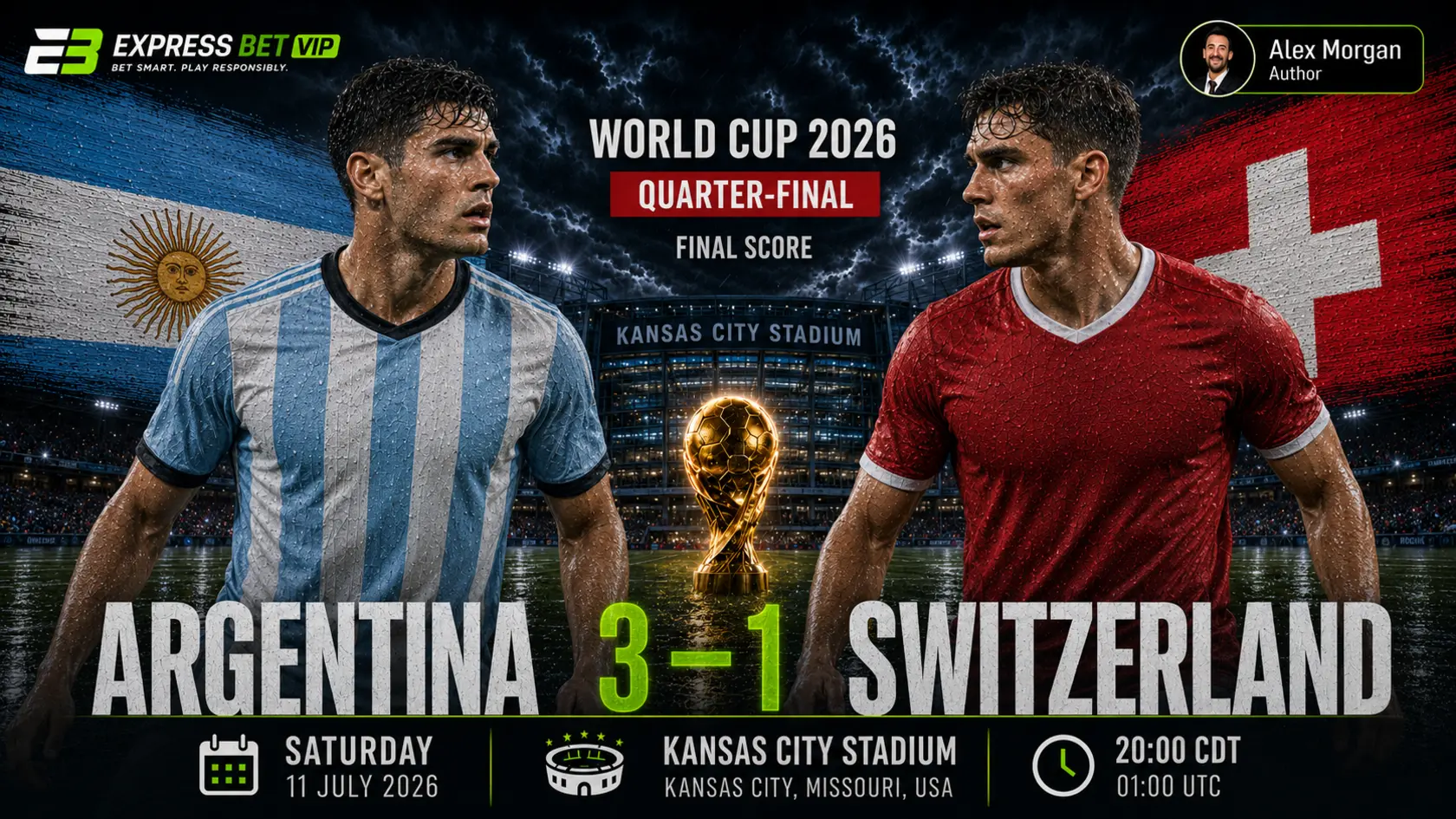
Quick Facts: Final Score, Goals, Venue, and Match Status
| Item | Verified detail |
|---|---|
| Match | Argentina vs Switzerland |
| Competition | FIFA World Cup 2026 |
| Stage | Quarter-final, Match 100 |
| Date | Saturday, 11 July 2026 locally |
| Kickoff | 8:00 p.m. CDT / 01:00 UTC on 12 July |
| Host country | United States |
| City | Kansas City, Missouri |
| Stadium | Kansas City Stadium, commercially known as GEHA Field at Arrowhead Stadium |
| Attendance | 69,045 |
| Final score | Argentina 3-1 Switzerland after extra time |
| Score after 90 minutes | 1-1 |
| Half-time score | Argentina 1-0 Switzerland |
| Argentina scorers | Alexis Mac Allister 10′; Julián Álvarez 112′; Lautaro Martínez 120+1′ |
| Switzerland scorer | Dan Ndoye 67′ |
| Referee | João Pinheiro, Portugal |
| VAR | Guillermo Pacheco Larios |
| Major disciplinary incident | Breel Embolo dismissed for a second yellow card, 72′ |
| Weather | Warm and muggy; match-time temperature reported in the low 80s Fahrenheit |
| Pitch | Natural, hybrid-reinforced Bermudagrass |
| Roof | Open-air stadium |
| Main impact | Argentina advanced to play England; Switzerland were eliminated |
Verified Facts vs Analysis
| Classification | Detail |
|---|---|
| [CONFIRMED] | Argentina won 3-1 after extra time; the score after 90 minutes was 1-1. |
| [CONFIRMED] | Mac Allister, Ndoye, Álvarez and Lautaro Martínez scored. |
| [CONFIRMED] | Embolo was dismissed following a VAR-assisted correction of mistaken identity. |
| [REPORTED] | Local forecasts placed kickoff temperature in the low 80s Fahrenheit, with muggy conditions and a higher “feels-like” reading. |
| [OBSERVED] | Switzerland’s attacking confidence increased before the equalizer and collapsed into survival mode after the dismissal. |
| [ANALYSIS] | Argentina’s substitutions and numerical width eventually stretched Switzerland’s low block. |
| [MARKET SIGNAL] | Argentina were the pre-match favorite; one archived price listed their 90-minute moneyline around -145. |
| [DISPUTED] | The legitimacy and intended scope of the VAR intervention that led to Embolo’s second yellow remain controversial. |
| [UNKNOWN] | A complete audited closing-odds screen, exact match-time humidity and wind readings are unavailable from verified public data. |
The separation matters. A final score can be extracted as fact; a claim that the heat “caused” Argentina to win cannot. Tactical interpretation and betting analysis are useful only when they are not disguised as official data.
Final Score and Match Summary
Argentina’s 3-1 victory looks comfortable in a results archive. It was not comfortable to watch, coach or defend.
Lionel Scaloni’s side took the lead after ten minutes through a familiar combination of elite delivery and inattentive set-piece defending. Lionel Messi shaped an inswinging corner into the central scoring area, where Alexis Mac Allister attacked the ball and headed beyond Gregor Kobel.
Argentina then made the classic knockout-game mistake of treating an early lead as proof that the rest of the evening would cooperate. Their possession became safer, their attacking volume declined and Switzerland gradually moved the game away from Argentina’s preferred rhythm.
Murat Yakin’s team were not reckless. They pushed selectively, used Dan Ndoye to attack Argentina’s right side and trusted Granit Xhaka and Remo Freuler to circulate the ball without opening the centre unnecessarily. Switzerland’s reward arrived in the 67th minute when Ndoye finished from a difficult angle after Ricardo Rodríguez’s involvement on the left.
Five minutes later, the match turned again. Embolo, already booked, went down during an incident with Leandro Paredes. Pinheiro initially cautioned Paredes. VAR intervened under the competition’s mistaken-identity interpretation; Paredes’ card was withdrawn and Embolo received a second yellow for simulation.
[DISPUTED] The decision was procedurally and philosophically controversial. What is beyond dispute is its tactical effect. Switzerland had just equalized and appeared to have the stronger emotional momentum. Suddenly they were defending with ten players against Messi, Álvarez and an increasingly aggressive Argentina bench.
Switzerland survived until the 112th minute, largely through compact defending and Kobel’s goalkeeping. José Manuel López then connected with Álvarez, who curled a right-footed shot beyond Kobel from outside the penalty area. Lautaro Martínez added a third in the 121st minute after Kobel saved Thiago Almada’s attempt.
The final margin flattered Argentina. The victory did not. Argentina created more chances across 120 minutes and used the extra player effectively enough in the end. Switzerland, though, were level until minute 112 and competed better than a two-goal defeat suggests.
Goal Timeline
10′ — Alexis Mac Allister, Argentina, set-piece header
[CONFIRMED] Messi delivered an inswinging corner into a dangerous central corridor. Mac Allister timed his run, separated from the defensive traffic and headed the ball beyond Kobel.
The goal demonstrated why set pieces matter disproportionately in knockout football. Argentina did not need to dismantle Switzerland’s settled defensive structure. One clean delivery and one lost assignment were sufficient.
Kobel had little time to adjust. The decisive error occurred before the header: Switzerland allowed Mac Allister to attack the ball with forward momentum.
No overturning VAR intervention was reported. The goal gave Argentina control of the scoreboard but also encouraged a more conservative possession game.
67′ — Dan Ndoye, Switzerland, open-play goal
[CONFIRMED] Ndoye equalized from a tight angle after Switzerland developed an attack down Argentina’s right. Ricardo Rodríguez was involved in the move and is credited with providing the decisive pass in reputable match reporting.
Ndoye’s finish mattered tactically because it validated Switzerland’s second-half targeting of the channel around Molina. Argentina had allowed the game to become more transitional without retaining enough threat at the other end.
Emiliano Martínez narrowed the angle, but Ndoye’s execution was clean. It was Switzerland’s best attacking spell translated into a goal rather than another respectable possession sequence.
The emotional effect was immediate. Argentina looked uncomfortable; Switzerland looked capable of turning the quarter-final. That balance lasted approximately five minutes.
112′ — Julián Álvarez, Argentina, long-range open-play goal
[CONFIRMED] José Manuel López moved the ball into Álvarez’s path near the left edge of the penalty area. Álvarez opened his body and sent a curling right-footed shot beyond Kobel.
This was the decisive goal. Switzerland’s block had protected the central penalty area, but the extra defender was always going to be found outside the immediate line of pressure. Álvarez exploited that fraction of space with technique rather than brute force.
Kobel’s positioning was reasonable. The shot’s bend carried it beyond his reach.
The finish ended 40 minutes of Swiss resistance with ten men. It also rewarded Scaloni’s decision to add fresh attackers instead of reducing the game to endless crosses.
120+1′ — Lautaro Martínez, Argentina, rebound
[CONFIRMED] Almada’s initial effort forced another save from Kobel. Lautaro reacted first and converted the rebound.
Switzerland had begun taking greater risks in search of an equalizer, creating the broken defensive shape Argentina had lacked for much of extra time. Lautaro’s movement was simple and correct: remain alive after the first shot.
The goal settled the score at 3-1. It did not transform the previous 120 minutes into a dominant Argentina performance.
Key Moments That Changed the Match
Mac Allister’s early header
Argentina’s opening goal changed Switzerland’s immediate responsibilities. Yakin’s side could no longer spend the entire match waiting for Argentina to overcommit. It also exposed a Swiss set-piece weakness before their defensive block had properly settled.
Argentina’s passive period after 1-0
[OBSERVED] Argentina produced little sustained threat for a long stretch after scoring. Switzerland were allowed to build confidence and increase possession. Tournament control is not the same as simply owning the ball while one goal ahead.
Ndoye attacks Argentina’s right
Ndoye’s speed and directness gave Switzerland a route around Argentina’s midfield diamond. His equalizer was not an isolated accident; it emerged from an increasingly productive wide matchup.
The Embolo dismissal
This was the match’s largest turning point. Switzerland went from pursuing a winning goal to protecting parity with ten players.
The unusual mechanism intensified the debate. Pinheiro first booked Paredes, before VAR footage led to the card being reassigned in substance: Paredes’ caution was rescinded and Embolo received a second yellow for simulation.
Kobel extends the game
Kobel made several saves as Argentina increased the pressure. Without him, Switzerland would not have reached the final eight minutes of extra time still level.
Álvarez’s strike
Argentina’s decisive action came from outside the tightly protected central zone. Álvarez did not wait for the perfect opening. In knockout football, perfection commonly arrives after the flight home.
Local Match Conditions: Stadium, City, Weather, Pitch, and Crowd
| Local factor | Verified or observed detail | Football meaning | Match evidence | Betting meaning | Status | Specificity |
|---|---|---|---|---|---|---|
| Venue | Kansas City Stadium | Large open-air bowl | No roof protection from heat or humidity | Relevant to tempo and live totals, but not decisive alone | [CONFIRMED] | Fixture-specific |
| Attendance | 69,045 | High noise level and visual pressure | Strong Argentina presence was reported and visible | Possible psychological support, not a measurable betting edge | [CONFIRMED]/[REPORTED] | Fixture-specific |
| Temperature | Low 80s°F around kickoff | Higher hydration and recovery demand | First-half hydration pause; extra time increased exposure | Could favor deeper bench late | [REPORTED]/[ANALYSIS] | Fixture-specific |
| Humidity | Muggy conditions | Raises perceived workload | Tempo periodically slowed | Relevant to late player-performance markets | [REPORTED] | Fixture-specific |
| Surface | Hybrid-reinforced natural Bermudagrass | Designed for reliable ball roll | No major pitch failure was reported | No strong basis for a pitch-driven betting angle | [CONFIRMED] | Stadium-specific |
| Roof | Open air | Weather remained active | Warm evening conditions persisted | Greater weather relevance than at climate-controlled venues | [CONFIRMED] | Fixture-specific |
| Crowd profile | Strong visible Argentina support | Increased emotional pressure late | Argentina’s goals produced the larger crowd response | May influence live sentiment more than probabilities | [REPORTED]/[OBSERVED] | Fixture-specific |
| Extra-time exposure | Switzerland played with ten men in warm conditions | Larger repeated-running burden | Swiss block dropped deeper as extra time progressed | Relevant to late Argentina and substitute markets | [ANALYSIS] | Match-specific |
Local outlets reported daytime highs between approximately 85°F and 89°F, with “feels-like” readings approaching 90°F or higher. By the 8:00 p.m. kickoff, temperatures had fallen into the low 80s, but the air remained muggy. Climate Central’s match analysis classified the fixture as carrying a high probability of performance-impairing heat.
The evidence supports a limited conclusion. The conditions added physical cost; they did not dictate the tactical result. Both teams managed long portions without obvious heat-related breakdowns, and no verified match report identified a weather-caused injury.
The effect became more relevant after Embolo’s dismissal. Ten-man Switzerland had to shift laterally, defend repeated entries and then complete extra time. Warm, humid air increases the cost of precisely that type of work. Argentina, meanwhile, introduced Lautaro, Almada, Montiel, González and López.
No significant slips, abnormal bounce or damaged areas were prominent enough to establish a pitch problem. The available evidence suggests a reliable surface.
Stadium-Specific Match Impact
| Category | Detail |
|---|---|
| Stadium | Kansas City Stadium / GEHA Field at Arrowhead Stadium |
| Tournament attendance | 69,045 |
| Published stadium capacity | Sources vary by configuration; approximately 69,000–73,000 for the tournament setup |
| Pitch | Natural Bermudagrass reinforced with hybrid fibres |
| Roof | None; open air |
| Acoustic effect | Large, enclosed seating bowl produced substantial crowd noise |
| Surface condition | No major defect confirmed |
| Wind relevance | Exact match-time wind unavailable |
| Goalkeeper distribution | No verified abnormal wind or surface effect |
| Set-piece effect | Argentina scored from a corner, but delivery and marking—not the stadium—were decisive |
| Communication | Crowd noise may have increased difficulty, but no specific defensive error was officially attributed to it |
| Data status | Capacity varies by listed configuration; other details confirmed or observed |
Kansas City Stadium is designed around a large, steep seating bowl rather than a roof. That gives noise somewhere to remain even while the weather is free to enter. Argentina’s support was highly visible, especially during extra time.
The stadium’s clearest football connection was not mysterious local magic. It was the combination of an open-air warm evening, 69,045 spectators and another 30 minutes of football after regulation.
Argentina’s corner goal should not be attributed to acoustics without evidence. Switzerland lost the run and Messi delivered accurately. Sometimes the answer is less architectural than defenders would prefer.
The available match evidence does not show a clear stadium-specific effect on goalkeeper distribution, long passing or ball movement beyond normal open-air conditions.
City and Weather Impact
| Category | Match detail |
|---|---|
| City | Kansas City, Missouri |
| Host country | United States |
| Time zone | Central Daylight Time, UTC-5 |
| July climate | Typically hot and humid |
| Match-time temperature | Reported in the low 80s°F, approximately 27–29°C |
| Humidity | Exact percentage unavailable; conditions described locally as muggy |
| Wind | Not available from verified public match data |
| Rain | No match-delaying rain confirmed |
| Roof | Open-air venue |
| Altitude | Approximately 270 metres; not a major altitude-performance factor |
| Likely effect | Greater hydration and repeated-sprint demand |
| Actual evidence | Hydration pause; slower passages; Swiss defensive workload increased after red card |
| Status | Temperature reported; precise humidity and wind unknown |
Argentina and Switzerland had both been based within a tournament that demanded repeated travel across North America. A team-specific acclimatization comparison for this fixture is not available from verified public data, so it would be irresponsible to assign an advantage.
The first half did contain slower possession spells, but those can be explained tactically as well as physically. Argentina were protecting an advantage; Switzerland were reluctant to break their spacing.
The second-half increase in Swiss aggression shows that the weather did not prevent pressing or wide running. Ndoye’s equalizer came from a period in which Switzerland raised their tempo.
Extra time provided the clearest physical link. A ten-player side defending deep must cover more space per player. The warm conditions probably compounded that burden, although the dismissal and Argentina’s bench strength remained the primary causes.
First Half Analysis
Argentina began in a narrow system that was displayed as a 4-4-2 but behaved closer to a 4-1-2-1-2 diamond. Paredes held the base, De Paul and Mac Allister operated as shuttlers, and Enzo Fernández moved higher around Messi and Álvarez.
Switzerland’s 4-2-3-1 used Xhaka and Freuler as the central platform. Ndoye and Fabian Rieder provided width around Djibril Sow, with Embolo attempting to occupy Romero and Lisandro Martínez.
Argentina’s narrow midfield gave Messi freedom to leave the forward line and receive between Switzerland’s units. It also brought several technical midfielders close enough to counterpress after turnovers.
The opening goal came from a corner rather than positional possession. Messi’s delivery punished Switzerland before the wider tactical contest had settled.
After the goal, Argentina’s full-backs became more cautious. Molina still advanced, but the team stopped sustaining five-player attacks. Switzerland were permitted to circulate across the back and through Xhaka without being constantly forced backward.
Yakin’s side had possession but initially lacked penalty-box presence. Embolo was often isolated, while Argentina’s centre-backs could defend crosses facing the ball.
The main individual duel developed on Argentina’s right. Ndoye’s direct movement tested Molina and forced De Paul to provide greater cover than Argentina probably wanted.
Embolo’s first booking, for a forceful challenge on Paredes, established a disciplinary risk that later became decisive.
At half-time Argentina led 1-0 but had not turned their technical superiority into repeated chances. Scaloni needed more attacking occupation and better control of the wide channels. Yakin needed Switzerland’s possession to arrive closer to Martínez’s goal.
Second Half Analysis
Switzerland emerged with more conviction. Their wide players received earlier passes, Rodríguez advanced on the left and the midfield was willing to step beyond Argentina’s first line.
Argentina’s problem was structural. Their diamond offered central numbers, but Switzerland increasingly bypassed it by moving the ball outside. Once Argentina’s nearest midfielder was drawn wide, the distances between Paredes, the full-back and the centre-backs became less comfortable.
Ndoye’s equalizer rewarded that adjustment. Switzerland attacked the side of Argentina’s shape rather than attempting to pass through its most crowded area.
The match then appeared to be moving toward a genuine 11-versus-11 contest in which Switzerland had momentum. Embolo’s dismissal ended that phase.
Switzerland reorganized into a compact block with one forward outlet. Xhaka and Freuler protected the centre, while Ndoye’s freedom was reduced by defensive duties. Kobel became increasingly important as the final line.
Scaloni introduced Nicolás González for Tagliafico, then Lautaro Martínez and Gonzalo Montiel for De Paul and Molina. These changes added fresh legs and a more aggressive penalty-box presence without immediately producing the second goal.
Argentina sometimes moved the ball too slowly. Against ten players, the temptation is to place everyone near the penalty area and assume numbers will eventually solve geometry. Switzerland kept enough discipline to disprove that theory through 90 minutes.
The weather did not create a visible second-half collapse. Switzerland reached extra time. Yet the energy required to do so reduced their capacity to counterattack, leaving Argentina free to sustain possession.
Extra Time Analysis
Argentina introduced Almada at the start of extra time, adding another player capable of receiving between lines and shooting from range. Otamendi later replaced Romero, while López came on for Paredes.
Switzerland’s priorities were increasingly defensive. Their best route to victory appeared to be reaching penalties, but they still attempted occasional transitions through fresh legs, including Zeki Amdouni.
Kobel delayed Argentina repeatedly. The Swiss block remained narrow, with defenders willing to concede possession outside the box rather than allow central combinations around Messi.
Argentina’s decisive move came from the area Switzerland were prepared to expose. López connected with Álvarez outside the densest part of the block, and Álvarez produced the shot required to beat both structure and goalkeeper.
Lautaro’s late goal arrived once Switzerland abandoned some of that caution. Almada shot, Kobel saved and Lautaro finished the loose ball.
There was no penalty shootout. Switzerland’s resistance ended eight competitive minutes before one became necessary.
Tactical Picture: Why the Match Was Won and Lost
Argentina won because they possessed three advantages that eventually accumulated: superior individual finishing, an extra player and greater attacking depth.
Their narrow midfield initially created access for Messi and Mac Allister. However, it also exposed wide defensive spaces whenever Switzerland escaped the first pressure. Ndoye’s performance demonstrated the cost.
Without the ball, Argentina often settled into a 4-4-2-like block, with one midfielder stepping outward and Messi conserving energy higher. This was less aggressive than their possession shape suggested.
Switzerland’s 4-2-3-1 succeeded when Xhaka could turn and find Rodríguez or Ndoye outside Argentina’s diamond. It struggled when attacks became static and Embolo had to compete against two centre-backs.
After the red card, the tactical problem changed completely. Switzerland defended closer to a 4-4-1, occasionally becoming a five-man last line as a midfielder dropped. Argentina occupied both wings, both half-spaces and the area around the box.
The numerical advantage did not immediately produce central openings because Switzerland remained compact. Argentina needed either quicker switches, a set-piece second ball or a high-quality shot from distance. Álvarez delivered the third option.
Scaloni’s bench mattered. Almada accelerated combinations, López contributed to the winning goal and Lautaro scored the third. Yakin’s replacements had to preserve structure rather than expand the attack.
The losing plan did not fundamentally fail. Switzerland were level before the dismissal and defended intelligently afterward. Their discipline failed at the worst possible moment, and the physical equation became increasingly unfavorable.
Tactical Collision Map
| Zone | Edge | Evidence | Key player | Local-condition effect | Result impact |
|---|---|---|---|---|---|
| Argentina left | Argentina, narrowly | Mac Allister’s movement and González’s later energy | Mac Allister | Warm conditions increased value of fresh substitute | Opening goal and sustained pressure |
| Argentina right / Swiss left | Switzerland before red card | Rodríguez and Ndoye attacked Molina’s channel | Ndoye | No direct effect confirmed | Equalizing goal |
| Central midfield | Argentina overall | Greater technical depth and extra player | Messi/Paredes | Slower spells helped controlled circulation | Argentina sustained late possession |
| Swiss penalty area | Switzerland until 112′ | Compact block and Kobel saves | Akanji/Kobel | Ten-man workload accumulated | Delayed winner |
| Set pieces | Argentina | Messi corner, Mac Allister header | Messi | Surface allowed clean delivery | First goal |
| Transitions | Switzerland before dismissal | Ndoye carried the principal threat | Ndoye | Warmth made repeated recovery runs costly | Created equalizer, then diminished |
| Defensive third | Switzerland resilient | Narrow spacing protected central zone | Akanji | Fatigue became relevant in extra time | Held until minute 112 |
| Goalkeeper build-up | Even | Neither side gained a decisive advantage | Martínez/Kobel | No wind problem confirmed | Limited impact |
| Bench | Argentina | Almada, López and Lautaro contributed late | Almada | Freshness more valuable after 120 minutes | Assist sequence and third goal |
Player Ratings and Individual Performances
These are editorial ratings based on match influence, tactical execution, discipline and decision-making. They are not official FIFA grades.
Argentina player ratings
Emiliano Martínez — 7.6: Made important interventions while Switzerland were growing into the match. Ndoye beat him from a difficult angle, but the goalkeeper prevented further damage.
Nahuel Molina — 6.3: Offered width but had an uncomfortable evening against Ndoye. Switzerland’s equalizer came through his side.
Cristian Romero — 7.2: Aggressive when stepping into Embolo and generally strong in direct duels.
Lisandro Martínez — 7.7: Argentina’s calmer centre-back in possession. Read several Swiss transitions before they developed.
Nicolás Tagliafico — 6.6: Conservative work without a major attacking contribution. Replaced as Scaloni chased more width.
Leandro Paredes — 7.5: Positioned himself intelligently at the base of the diamond. Central to the disputed Embolo incident but did not receive a lasting caution for it.
Rodrigo De Paul — 6.9: Covered ground and helped Molina, though his passing did not consistently accelerate the attack.
Alexis Mac Allister — 8.3: Scored the opener, handled pressure well and gave Argentina their most reliable combination of movement and control.
Enzo Fernández — 6.9: Worked between lines without dominating the game. Switzerland reduced his clean receptions after the opening phase.
Lionel Messi — 8.5: Supplied the opening assist and remained Argentina’s principal creator. Switzerland limited his scoring chances better than the final score suggests.
Julián Álvarez — 8.3: Lively without constant service, then produced the technically hardest and most important finish of the night.
Nicolás González — 6.6: Added running and width after 78 minutes.
Lautaro Martínez — 7.5: Increased penalty-box occupation and scored the insurance goal.
Gonzalo Montiel — 6.2: Brought fresh defensive energy but limited creative influence.
Thiago Almada — 7.3: Sharpened Argentina’s extra-time combinations and created the saved shot before Lautaro’s goal.
Nicolás Otamendi — 6.5: Helped protect the advantage after the decisive goal.
José Manuel López — 7.0: Made an immediate contribution by connecting with Álvarez for the winner.
Switzerland player ratings
Gregor Kobel — 8.2: Switzerland’s best player. His saves kept the match level deep into extra time. Little reasonable blame attaches to Álvarez’s strike.
Denis Zakaria — 6.5: Defended with discipline but had limited influence going forward.
Nico Elvedi — 6.9: Managed the penalty area well during long periods of Argentina pressure.
Manuel Akanji — 7.5: Led the defensive line and remained composed as Switzerland dropped deeper.
Ricardo Rodríguez — 7.2: Contributed to the equalizer and supported Switzerland’s strongest attacking route.
Granit Xhaka — 7.3: Helped Switzerland play through pressure and provided leadership after the dismissal.
Remo Freuler — 6.8: Covered central space responsibly, especially during the ten-man phase.
Dan Ndoye — 8.0: Scored, attacked Argentina’s vulnerable flank and represented Switzerland’s clearest transition threat.
Djibril Sow — 6.3: Worked between midfield and attack but did not create enough around the box.
Fabian Rieder — 6.2: Helped maintain width without consistently beating his defender.
Breel Embolo — 4.4: Occupied the centre-backs and offered an outlet, but his disciplinary decisions changed the match. The second yellow dominates the assessment.
Swiss substitutes — 6.0 average: Their collective assignment was largely defensive after the red card. A complete verified substitution log and sufficient individual performance data were not available for fair separate ratings. Amdouni provided some movement in extra time but received little service.
Best Players of the Match
- Man of the Match — Lionel Messi: One assist, repeated chance creation and the technical gravity that forced Switzerland to protect several zones at once.
- Best attacker — Julián Álvarez: Scored the winning goal with the match’s finest finish.
- Best midfielder — Alexis Mac Allister: Combined the opening goal with reliable work through pressure.
- Best defender — Manuel Akanji: Central to Switzerland’s long period of ten-man resistance.
- Best goalkeeper — Gregor Kobel: The principal reason the quarter-final remained undecided until the 112th minute.
- Best substitute — Thiago Almada: Improved Argentina’s movement and produced the attempt that led to Lautaro’s goal.
- Most underrated performance — Leandro Paredes: Gave Argentina positional order, particularly when their attacking rhythm disappeared.
- Most disappointing performance — Breel Embolo: Not because he lacked effort, but because an avoidable second booking changed Switzerland’s tournament.
Injuries, Suspensions, Cards, and Discipline
Switzerland entered the match without Johan Manzambi, whose knee injury had removed one of their tournament’s breakout attackers.
No major new match injury was confirmed as altering Argentina’s semi-final selection. Exact post-match medical assessments were not available at the time of verification.
| Player | Team | Incident | Minute | Status | Next-match impact | Data status |
|---|---|---|---|---|---|---|
| Breel Embolo | Switzerland | Forceful foul on Paredes | First half; exact minute not consistently published | Yellow card | None after elimination | [CONFIRMED], minute unavailable |
| Breel Embolo | Switzerland | Simulation decision after VAR review | 72′ | Second yellow; red card | Switzerland played with ten; tournament ended | [CONFIRMED]/[DISPUTED] |
| Leandro Paredes | Argentina | Initially booked in Embolo incident | 72′ | Yellow rescinded | No card carried forward from this incident | [CONFIRMED] |
| Johan Manzambi | Switzerland | Pre-match knee injury | Before match | Unavailable | Missed quarter-final | [REPORTED] |
| Other cautions | Both teams | Complete log | — | Not available consistently | Not assessed | [UNKNOWN] |
Referee and VAR Analysis
João Pinheiro’s most important decision arrived in the 72nd minute.
Embolo went down near the touchline after contact involving Paredes. Pinheiro initially concluded that Paredes had committed the offence and showed him a yellow card. VAR Guillermo Pacheco Larios reviewed the sequence under the competition’s mistaken-identity mechanism.
The review concluded that Embolo had initiated or simulated the decisive contact. Paredes’ card was removed and Embolo received his second yellow.
[CONFIRMED] The dismissal stood. [DISPUTED] Whether VAR should have been used to reach that outcome, and whether the competition’s interpretation created an appropriate threshold for reviewing a yellow-card incident, became the central controversy.
Yakin criticized the decision after the match. His frustration was understandable: Switzerland had equalized five minutes earlier and immediately lost their striker.
That does not establish bias or corruption. The correct analytical conclusion is narrower. The intervention had a sound stated procedural basis under the tournament interpretation, but the breadth and consistency of that interpretation remain debatable.
Pinheiro otherwise maintained reasonable control of a physical quarter-final. The red card undeniably influenced the flow, yet Switzerland’s defending and Argentina’s finishing still decided what happened afterward.
Match Statistics
The following figures were published through FotMob-derived reporting. Other providers may record small variations in shots, chances and xG.
| Statistic | Argentina | Switzerland |
|---|---|---|
| Possession | 59% | 41% |
| Total shots | 22 | 11 |
| Shots on target | 7 | 5 |
| Expected goals | 2.00 | 0.53 |
| Big chances | 4 | 1 |
| Corners | 8 | 2 |
| Fouls | 14 | 18 |
| Pass accuracy | 89% | 84% |
| Red cards | 0 | 1 |
| PPDA | Not available | Not available |
| Distance covered | Not available | Not available |
| Box touches | Not available from consistent public data | Not available from consistent public data |
The numbers support Argentina’s superiority over the full 120 minutes, but context is essential. Switzerland played almost 50 minutes of regulation and extra time with ten players.
Argentina’s 22 shots and eight corners show sustained territorial pressure. The modest 2.00 xG indicates that much of that pressure was contained outside the best scoring zones. Their winning goal, appropriately, came from a difficult long-range finish.
Switzerland’s five shots on target from 11 attempts explain why Martínez’s contribution mattered. Their 0.53 xG suggests the quality of those opportunities was limited even when the shots forced saves.
Betting Result Angle
Argentina were the pre-match favorite. An archived market published before kickoff listed Argentina around -145 to win in 90 minutes, although prices varied by operator and timing. A complete audited closing screen was not available.
| Market | Pre-match expectation | Actual result | Winning side | Trigger | Local factor | Caution |
|---|---|---|---|---|---|---|
| 90-minute moneyline | Argentina favored | 1-1 after 90 | Draw | Ndoye equalizer | Heat may have affected pace, not outcome directly | Extra-time goals do not settle this market |
| To qualify | Argentina favored | Argentina advanced | Argentina | Álvarez 112′ | Deeper bench useful in warm extra time | Rules and prices differ |
| Both teams to score | Competitive Swiss attack possible | Yes | BTTS Yes | Ndoye 67′ | No clear local cause | One match does not validate a system |
| 90-minute total 2.5 | Moderate scoring expected | One goal each | Under 2.5 | Swiss compactness | Warmth may have reduced sustained tempo | Confirm regulation-only settlement |
| Extra-time-inclusive total | Operator-specific | Four goals | Over where ET included | Two extra-time goals | Fatigue became relevant | Many totals exclude extra time |
| First goalscorer | Messi and Álvarez attracted attention | Mac Allister | Mac Allister | Corner routine | No direct local effect | Odds unavailable |
| Anytime scorer | Rules vary on extra time | Mac Allister, Ndoye; Álvarez and Lautaro if ET counts | Operator-specific | Late Argentina goals | Bench freshness mattered | Check settlement rules |
| Red card | Usually priced as lower probability | Yes | “Red card shown” if second-yellow reds count | Embolo incident | No weather causation established | Definition varies |
| Corners | Argentina expected to lead territory | Argentina 8-2 | Argentina corner angles | Ten-man Swiss block | Defensive depth encouraged pressure | Line unavailable |
| Correct score | 3-1 after extra time | Operator-specific | Usually not 90-minute 3-1 | Late goals | Warm extra-time burden | Most correct-score markets are 90 minutes |
The result rewarded bettors who backed Argentina to qualify, but not those who treated “Argentina to win” as a single universal market. In football betting, identical-looking buttons can settle differently once extra time arrives.
Live prices would have moved sharply after Mac Allister’s goal, again after Ndoye’s equalizer and most dramatically following Embolo’s dismissal. Verified minute-by-minute market data were unavailable, so exact movements should not be invented.
The clearest lesson is about settlement scope. Regulation, qualification and extra-time-inclusive markets are different products. A 3-1 final score can coexist with a losing Argentina 90-minute moneyline ticket.
Local Betting Impact: What the Venue and Conditions Changed
| Local factor | Market possibly affected | Match evidence | Interpretation | Overreaction risk | Safer conclusion |
|---|---|---|---|---|---|
| Warm, muggy air | Second-half and extra-time totals | Slower periods; hydration pause | Fatigue could increase late mistakes | High | Treat weather as one input, not a prediction |
| Open-air stadium | Match tempo | No climate control | Conditions remained relevant throughout | Medium | Check match-time readings, not daily high alone |
| Ten-man workload | Late Argentina goals | Switzerland defended for an extended period | Numerical disadvantage was more important than heat | Low | Prioritize game state over weather narrative |
| Large Argentina support | Live momentum markets | Strong response to Argentina attacks | Could reinforce emotional pressure | High | Crowd noise is difficult to price |
| Reliable grass surface | Passing and shots | No major pitch issue | Little reason to downgrade technical play | Medium | Absence of a problem is not a betting edge |
| Argentina bench depth | Substitute scoring | Lautaro scored; Almada created rebound | Fresh attackers gained value late | Medium | Lineups and substitution patterns remain essential |
| Swiss low block | Corners and goalkeeper saves | Argentina led corners; Kobel made several saves | Territorial pressure suited those markets | Medium | Pre-match lines and operator rules still determine value |
Local conditions mattered most as a multiplier of Switzerland’s ten-man workload. They were not a standalone explanation for the over, the red card or Argentina’s victory.
What This Result Meant for the Knockout Bracket
Argentina advanced to face England in the semi-final in Atlanta on 15 July. Switzerland were eliminated after their best World Cup run since 1954.
The quarter-final also produced a notable bracket pattern: the tournament’s four highest-ranked teams—Argentina, England, France and Spain—reached the semi-finals.
Argentina had limited recovery time after completing 120 minutes in Kansas City. The substitution of several midfield and defensive players at least distributed some of the physical burden.
Subsequent results provide the full tournament context. Argentina beat England 2-1 in the semi-final before losing the final 1-0 after extra time to Spain on 19 July. The Switzerland victory therefore became the middle leg of three consecutive demanding knockout matches that went beyond an ordinary 90-minute workload.
Switzerland departed with a legitimate sense of progress. Their quarter-final ended controversially, but reaching that round for the first time in 72 years was not erased by one disciplinary incident.
What Argentina Did Right
Argentina remained patient after the red card. Their circulation was not always quick, but they did not expose themselves to unnecessary counterattacks.
Their set-piece preparation delivered the opening goal. Messi’s corner and Mac Allister’s run were executed with precision.
Scaloni also trusted his bench. Almada offered a different creative rhythm, López contributed to Álvarez’s winner and Lautaro attacked the rebound for the third goal.
Most importantly, Argentina possessed players capable of deciding a match without a clear central chance. Álvarez’s winner was a high-skill solution to an organized low block.
What Switzerland Got Wrong
Switzerland’s largest failure was disciplinary. Embolo was already booked and needed to avoid providing the referee with another decision.
Their opening set-piece marking was also poor. Allowing Mac Allister to attack Messi’s corner with momentum placed Kobel in an almost impossible position.
Before the dismissal, Switzerland could have used their improved second-half control more aggressively. The equalizer arrived, but there was no extended period of pressure before the match changed again.
After going down to ten, most of their choices were sensible. The loss should not be reduced to defensive cowardice or late fatigue. They were asked to defend an elite attack for too long.
Coach Analysis
Lionel Scaloni
Scaloni’s narrow starting midfield created technical control but left the full-back zones vulnerable. Argentina’s inability to suppress Ndoye was the clearest defect in the initial plan.
His substitutions were ultimately successful. González added width, Almada accelerated possession, López connected with Álvarez and Lautaro scored.
The criticism is that Argentina required too long to exploit the numerical advantage. Their attacks sometimes became static and predictable. The praise is that Scaloni continued adding complementary profiles rather than simply adding another centre-forward and ordering crosses.
Murat Yakin
Yakin’s 4-2-3-1 was well judged. Switzerland protected central zones, allowed Xhaka to dictate selected possessions and targeted Argentina’s right side.
His team’s improvement after half-time produced the equalizer. That is meaningful coaching evidence, not merely a fortunate goal.
Once Embolo was dismissed, Yakin’s options narrowed. Switzerland’s block remained organized until the 112th minute, which reflects well on its preparation.
His major problem was beyond normal tactical repair: replacing an injured Manzambi, losing Embolo and finding enough attacking threat with ten players.
Player Milestones and Records
- [CONFIRMED] Switzerland appeared in their first World Cup quarter-final since hosting the tournament in 1954.
- [CONFIRMED] Argentina reached a seventh World Cup semi-final.
- [CONFIRMED] Messi’s run of scoring in nine consecutive World Cup appearances ended, although he assisted Mac Allister.
- [CONFIRMED] Argentina extended their unbeaten World Cup sequence, dating from 2022, to 12 matches at this stage.
- [CONFIRMED] The 2026 semi-finals contained the four highest-ranked teams for the first time, according to post-match reporting.
No additional player appearance record should be treated as confirmed without the relevant federation or FIFA statistical record.
Historical Context and World Cup Analogies
Argentina and Switzerland had previous experience with extra-time tension at the World Cup.
In the 2014 round of 16, Argentina defeated Switzerland 1-0 after extra time. Messi created Ángel Di María’s 118th-minute winner. Switzerland then struck the post in the final moments.
The 2026 meeting followed a similar clock but a different tactical route. Again, Switzerland remained alive deep into extra time. Again, Argentina found its decisive action late. This time the game also contained a dismissal and a second insurance goal.
The parallel should not be stretched too far. The useful lesson is simpler: Switzerland have repeatedly been able to extend elite opponents into the most uncomfortable portion of knockout football.
Incidents and Controversies
The Embolo dismissal was the central controversy.
VAR interventions for second-yellow-card situations are normally restricted, which made this sequence unusual. The review was framed as a mistaken-identity correction because Paredes had initially been cautioned for an offence officials later attributed to Embolo.
Critics argued that the process effectively used VAR to award a second yellow for simulation. Supporters of the decision argued that allowing a wrongly cautioned player to keep the card would have been an obvious injustice.
Both positions deserve acknowledgment. What should not be asserted without evidence is that officials acted with favoritism.
There was also post-match discussion around Lautaro Martínez’s celebration while already carrying a caution. A clear official conclusion that another yellow was mandatory was not established. Such decisions include referee judgment about whether a player entered the crowd or created a safety issue.
Information Gain: What This Article Adds
This analysis combines the confirmed score and goal sequence with:
- the distinction between the 90-minute and after-extra-time results;
- an explanation of the unusual VAR mechanism;
- formation and wide-channel analysis;
- original editorial player ratings;
- Kansas City weather and surface context;
- the interaction between heat, ten-man defending and bench depth;
- betting settlement differences;
- the immediate and final tournament consequences;
- a clear separation between official facts, reported details and analysis.
Local Information Gain Quality Check
| Detail | Included | Status | Fixture-specific? | Future update needed? |
|---|---|---|---|---|
| Stadium identity | Yes | [CONFIRMED] | Yes | Only if FIFA corrects venue data |
| Attendance | Yes, 69,045 | [CONFIRMED] | Yes | Update if officially revised |
| City and time zone | Yes | [CONFIRMED] | Yes | No |
| Match weather | Yes | [REPORTED] | Yes | Add official observation if released |
| Exact humidity/wind | Unavailable | [UNKNOWN] | Yes | Update if verified archive appears |
| Pitch surface | Yes | [CONFIRMED] | Yes | No |
| Pitch performance | Yes | [OBSERVED] | Yes | Revise if official complaints emerge |
| Crowd profile | Yes | [REPORTED]/[OBSERVED] | Yes | Update if quantified |
| Travel/acclimatization | Limited | [UNKNOWN] | Yes | Update only with verified team data |
| Betting risk | Yes | [ANALYSIS] | Yes | Add audited closing market if found |
| Tactical-local link | Yes | [ANALYSIS] | Yes | No |
| Anti-template status | Passed | Editorial check | Yes | Recheck after updates |
Source and Data Appendix
| Data point | Status | Source type |
|---|---|---|
| Final score | [CONFIRMED] | FIFA, AP, ESPN |
| Goal scorers and times | [CONFIRMED] | FIFA Match Centre and match reports |
| Assists | [CONFIRMED]/[REPORTED] | FIFA and reputable live reporting |
| Stadium and city | [CONFIRMED] | FIFA venue page |
| Attendance | [CONFIRMED] | Match data reporting |
| Referee | [CONFIRMED] | FIFA/reputable match reports |
| VAR official | [REPORTED] | Reputable national match reporting |
| Starting lineups | [CONFIRMED] | Match reporting and official match data |
| Argentina substitutions | [CONFIRMED] | Match data |
| Complete Swiss substitution times | [UNKNOWN] | Inconsistent public availability |
| Major cards | [CONFIRMED] | FIFA and multiple match reports |
| Complete card log | [UNKNOWN] | Not consistently available |
| Pre-match injury | [REPORTED] | Team news and Reuters reporting |
| Match statistics | [REPORTED] | FotMob-derived public reporting |
| xG | [REPORTED] | FotMob; provider variations possible |
| Odds | [MARKET SIGNAL] | Archived licensed betting coverage |
| Weather | [REPORTED] | Kansas City local media, AccuWeather and Climate Central |
| Pitch type | [CONFIRMED] | Tournament turf programme sources |
| Crowd distribution | [REPORTED]/[OBSERVED] | Local reporting and match footage |
| Tournament impact | [CONFIRMED] | FIFA, AP and subsequent tournament results |
Primary links:
- FIFA match report
- FIFA Match Centre
- FIFA Kansas City Stadium page
- Associated Press match report
- The Guardian live report
- Reuters on Switzerland’s campaign
- ESPN match page
- Climate Central match conditions
- Kansas City local match coverage
Update Protocol
- Check for corrections to goal or assist attribution.
- Update the attendance if FIFA publishes a revised figure.
- Add a complete official card and substitution log if released.
- Update confirmed injury or suspension consequences.
- Reconcile statistics if FIFA releases a finalized dataset.
- Add exact archived closing odds only from a licensed, time-stamped source.
- Add official match-time humidity and wind if verified.
- Revise the VAR section if FIFA publishes a formal clarification.
Last updated: 20 July 2026, UTC
Final Verdict
Argentina won because their range of solutions eventually exceeded Switzerland’s capacity to keep answering.
Messi and Mac Allister solved the first problem with a set piece. Álvarez solved the second with individual technique. Almada and Lautaro solved the final broken phase from the bench.
Switzerland’s plan was good enough to equalize and disciplined enough to survive for 40 minutes with ten players. Embolo’s dismissal changed the geometry, physical cost and psychology of the match. Warm Kansas City conditions probably increased that cost, but they did not manufacture the result.
The 3-1 score was harsh on Switzerland. Argentina nevertheless deserved to advance over 120 minutes. They created more, possessed the stronger bench and found the decisive action.
For bettors, the match was another reminder to distinguish a regulation result from qualification. For Argentina, it was a warning disguised as progress: the champions could still solve difficult games, but they were requiring an alarming amount of football to do it.
Responsible Betting Note
Football betting carries financial risk. Correct tactical analysis cannot guarantee a winning wager, and odds change before and during matches.
Local conditions can be useful context, but bettors frequently overvalue weather, crowd narratives and previous results. Never chase losses or gamble with money needed for housing, food, bills or other daily expenses.
Set deposit and time limits, take regular breaks and check the gambling laws in your location. Use licensed operators only. Betting should remain entertainment, not a source of income.
Summarize this article with AI. Use this page URL as the source:
Summarize this article with AI:
FAQ
Argentina won 3-1 after extra time. The score was 1-1 after 90 minutes.
Alexis Mac Allister, Julián Álvarez and Lautaro Martínez scored for Argentina. Dan Ndoye scored for Switzerland.
Lionel Messi was our Man of the Match for his assist and creative influence. Gregor Kobel was Switzerland’s standout performer.
Argentina advanced to face England in the semi-final. Switzerland were eliminated. Argentina subsequently reached the final, where Spain beat them 1-0 after extra time.
The 90-minute draw, both teams to score and regulation under 2.5 goals landed. Argentina-to-qualify won, while Argentina’s 90-minute moneyline did not. Settlement depended on the operator’s rules and the odds available when the bet was placed.