
Congo DR vs Uzbekistan Match Result
Table of Contents Show
Views 4
TL;DR: Congo DR vs Uzbekistan Match Result
Congo DR beat Uzbekistan 3-1 at Atlanta Stadium after recovering from a 1-0 half-time deficit. Eldor Shomurodov opened the scoring in the 10th minute, but Yoane Wissa equalized from the penalty spot in the 68th. Substitute Fiston Mayele made it 2-1 before Wissa completed the victory in stoppage time.
Wissa was the Man of the Match, although Desabre’s substitutions changed the game. Congo DR increased their width, ground pressure and penalty-box occupation after half-time, while Uzbekistan dropped too deep and produced only three total shots.
The closed roof and climate-controlled stadium reduced the effect of Atlanta’s outdoor heat, although hydration breaks still interrupted both halves. Congo DR’s moneyline, over 2.5 goals and both-teams-to-score markets succeeded at the cited prices. Returns depended on the sportsbook and wager timing.
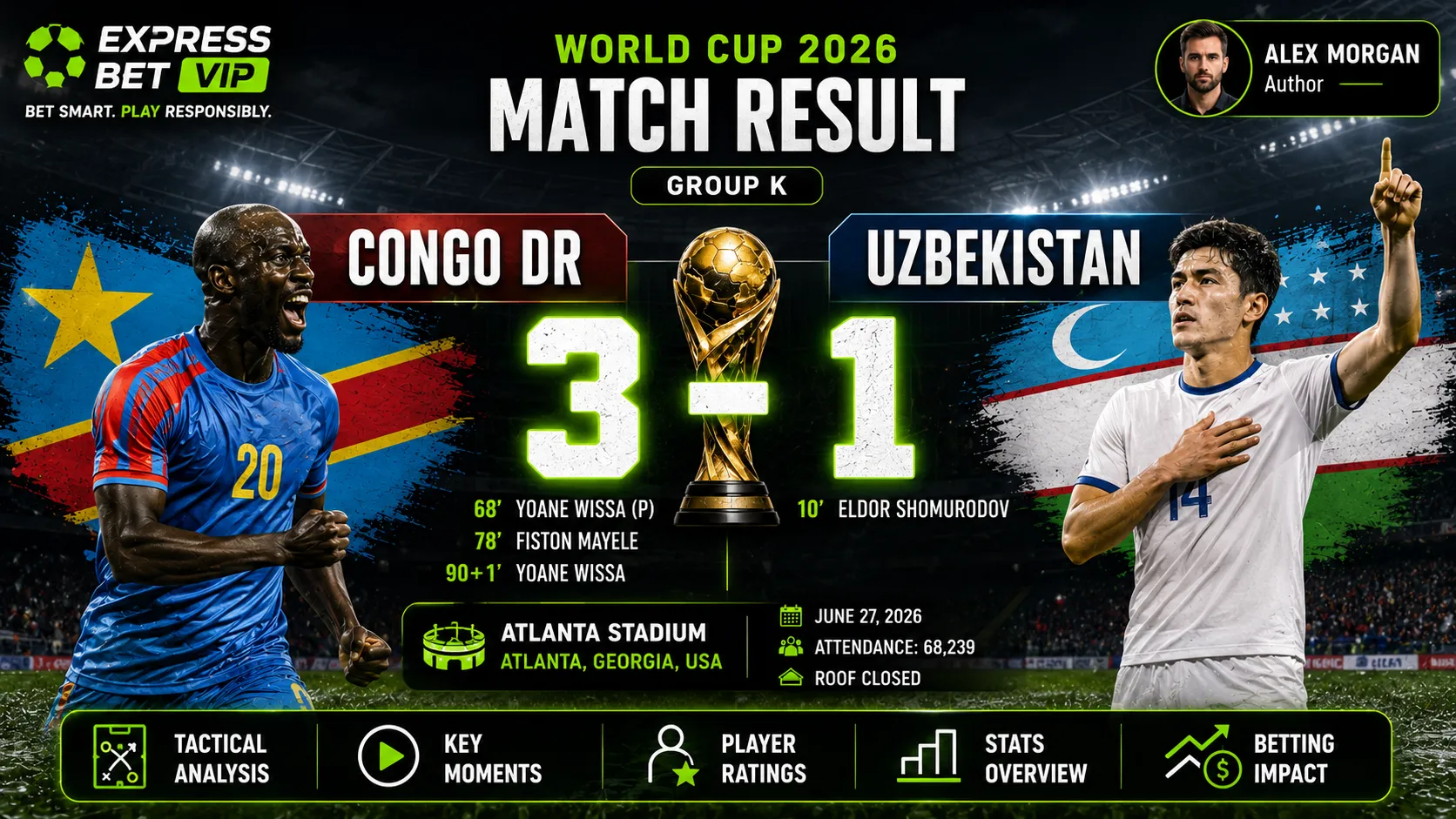
Quick Facts: Final Score, Goals, Venue, and Match Status
| Item | Verified information |
|---|---|
| Match | Congo DR vs Uzbekistan |
| Competition | FIFA World Cup 2026 |
| Stage | Group stage |
| Group | Group K |
| Local date | June 27, 2026 |
| Kickoff | 7:30 p.m. EDT |
| Host country | United States |
| City | Atlanta, Georgia |
| Stadium | Atlanta Stadium / Mercedes-Benz Stadium |
| Attendance | 68,239 |
| Final score | Congo DR 3-1 Uzbekistan |
| Half-time score | Congo DR 0-1 Uzbekistan |
| Congo DR scorers | Yoane Wissa 68’ penalty, 90+1’; Fiston Mayele 78’ |
| Uzbekistan scorer | Eldor Shomurodov 10’ |
| Confirmed assists | Akmal Mozgovoy; Meschack Elia |
| Referee | Felix Zwayer |
| VAR | Bastian Dankert |
| Roof | Reported closed |
| Pitch | Temporary natural-grass World Cup surface |
| Main impact | Congo DR qualified in third place; Uzbekistan were eliminated |
Sky Sports recorded the full attendance, goals, lineups, assists and officiating team. FIFA confirmed the 3-1 result and Congo DR’s progression. (Sky Sports)
Verified Facts vs Analysis
| Category | Status | Detail |
|---|---|---|
| Final score | [CONFIRMED] | Congo DR 3-1 Uzbekistan |
| Goal scorers | [CONFIRMED] | Shomurodov, Wissa twice, Mayele |
| Attendance | [CONFIRMED] | 68,239 |
| Match statistics | [CONFIRMED] | Congo DR led shots 19-3 |
| xG | [REPORTED] | Approximately 2.35 to 0.20–0.28 |
| Roof status | [REPORTED] | Atlanta’s roof remained closed during the tournament |
| Hydration breaks | [OBSERVED] | Recorded around 23’ and 70’ |
| Congolese crowd advantage | [OBSERVED] | Congo DR support was visibly and audibly stronger |
| Tactical turning point | [ANALYSIS] | Mayele and later Elia increased penalty-box occupation |
| Betting prices | [MARKET SIGNAL] | Congo DR were approximately -140 to -165 |
| Indoor temperature | [UNKNOWN] | Match-specific reading unavailable |
| Exact crowd split | [UNKNOWN] | No verified ticket-distribution figure |
The separation matters because a match report should distinguish what happened from why it happened. Congo DR’s 19 shots are measurable. The conclusion that Uzbekistan became too passive is an editorial interpretation based on field position, possession and the second-half event sequence.
That distinction also improves AI Search extraction. A search system can safely repeat the score and goal times. It should not present a tactical opinion as though it appeared in the referee’s report.
Final Score and Match Summary
Congo DR entered the final Group K match knowing that a victory would almost certainly place them among the eight best third-placed teams. Uzbekistan also required a win, but their minus-seven goal difference made qualification closer to advanced mathematics than practical tournament planning.
Uzbekistan started as though arithmetic had been removed from the syllabus.
Shomurodov had the ball in the net after only 21 seconds. The flag correctly went up for offside, but the sequence exposed Congo DR’s lack of defensive concentration.
Nine minutes later, the warning became a valid goal. Akmal Mozgovoy supplied a clever touch into the right side of the penalty area. Shomurodov exploited hesitation between Lionel Mpasi and Aaron Wan-Bissaka, then lifted an excellent finish over the goalkeeper from a tight angle.
Congo DR reacted quickly. Nathanaël Mbuku scored in the 17th minute, driving the ball into the net after moving beyond Uzbekistan’s defence.
VAR changed the match. Mbuku was judged to have caught a defender with his arm during the run, and the goal was disallowed.
The decision was severe but consistent with the tournament’s treatment of attacking fouls. Congo DR went from emotional equality back to elimination territory within the length of a review.
The rest of the first half became more difficult. Uzbekistan slowed possession through Otabek Shukurov and protected central space. Congo DR attacked, but too many moves ended in rushed crosses or speculative shots.
Desabre changed the match after the break.
Fiston Mayele replaced Cédric Bakambu in the 51st minute. The substitution gave Congo DR a more active penalty-box runner and allowed Wissa to find space between the lines rather than remaining fixed beside the centre-backs.
Uzbekistan’s defensive block dropped. Congo DR’s possession increased. Mbuku forced a save, Wissa headed directly at Abduvohid Nematov and the pressure became continuous.
The equalizer arrived from the penalty spot. Wissa was tripped as he moved across the area, and Felix Zwayer immediately pointed to the spot. Wissa sent the goalkeeper the wrong way.
The goal changed Congo DR’s emotional state. Before it, every attack carried the weight of elimination. After it, the team played with greater clarity.
Mayele scored ten minutes later. Meschack Elia’s attempt travelled through the penalty area, and Mayele reacted first to redirect it beyond Nematov.
Uzbekistan needed to attack but offered almost nothing. Their entire match produced three shots and one effort on target—the goal.
Wissa completed the comeback in the 91st minute. Elia found him outside the area, and the forward curled the ball into the far corner.
Congo DR’s first World Cup victory was not simply a result. It ended a 52-year absence from the tournament and sent the country into the knockout phase for the first time. Tournament football occasionally produces a neat story. It usually waits until everyone has suffered sufficiently. (The Guardian)
Goal Timeline
10’ — Eldor Shomurodov, Uzbekistan, Chipped Open-Play Goal
Uzbekistan moved forward before Congo DR had established their defensive shape.
Mozgovoy supplied a short, clever touch toward Shomurodov on the right side of the penalty area. Wan-Bissaka attempted to recover, while Mpasi moved away from his line.
The two defenders failed to resolve who controlled the space.
Shomurodov recognized the goalkeeper’s position and lifted the ball over him from a difficult angle. The finish dropped inside the far post.
The goal was not caused by the pitch or indoor lighting. It came from attacking awareness and defensive miscommunication.
Emotionally, it placed Congo DR outside the qualification positions and gave Uzbekistan their first half-time lead of the tournament.
Shomurodov had already scored after 21 seconds, only to be ruled offside. The valid goal confirmed that Congo DR had not corrected the original warning. (The Guardian)
68’ — Yoane Wissa, Congo DR, Penalty
Congo DR’s second-half pressure forced Uzbekistan to defend closer to their own goal.
Wissa received in the penalty area and moved across the path of a defender. Contact stopped his run, and Zwayer awarded the penalty without delay.
No successful VAR intervention followed.
Wissa waited for Nematov to move and placed the ball inside the opposite side of the goal.
The finish was controlled rather than powerful. That mattered. Congo DR’s previous attacks had often been rushed, but the penalty required patience.
The goal turned the tournament equation. At 1-1, Congo DR still needed another goal, yet the team no longer looked burdened by the situation.
The hydration break followed shortly afterwards, giving Desabre time to prepare another group of substitutions. (The Guardian)
78’ — Fiston Mayele, Congo DR, Close-Range Redirected Finish
Mayele entered in the 51st minute and remained closer to the Uzbekistan defensive line than Bakambu had during the first half.
Elia attacked from a wider position and sent a shot or forceful pass across the penalty area. Mayele adjusted first and redirected the ball past Nematov.
No official assist was recorded in the Sky Sports event data for the goal, although Elia created the decisive delivery.
The movement demonstrated the value of Desabre’s substitutions. Mayele occupied the centre-backs, Elia attacked the channel and Wissa could move around them.
Uzbekistan’s defensive line was too deep to prevent the ball reaching the six-yard area and too static to react to the change of direction.
The goal placed Congo DR in a qualifying position for the first time. (The Guardian)
90+1’ — Yoane Wissa, Congo DR, Long-Range Open-Play Goal
Uzbekistan attempted to move forward, leaving larger spaces behind the midfield.
Elia recovered or received possession and found Wissa near the edge of the area. Wissa shifted the ball onto his right foot and curled it beyond Nematov into the far corner.
Sky Sports credited Elia with the assist.
The goal ended any remaining uncertainty. Congo DR had not merely protected a one-goal lead; they continued attacking and punished Uzbekistan’s late loss of structure.
The entire team celebrated near the corner flag. The reaction reflected more than a third goal. The players knew they had crossed into the knockout bracket.
Wissa finished the group stage with three goals, having also scored against Portugal. (Sky Sports)
Key Moments That Changed the Match
Shomurodov’s 21-Second Offside Goal
Uzbekistan reached Congo DR’s penalty area almost immediately. The goal was disallowed, but it revealed that the Leopards’ defensive line had entered the match without full concentration.
The Valid Shomurodov Goal
The 10th-minute finish punished the same weakness. Mpasi and Wan-Bissaka did not communicate effectively, while Shomurodov’s technique converted a difficult angle.
Mbuku’s Goal Is Disallowed
Mbuku appeared to equalize in the 17th minute. VAR identified an attacking foul caused by his arm making contact with a defender.
The decision denied Congo DR immediate momentum and forced them to play from behind for another 51 minutes.
First-Half Hydration Break
The first hydration break occurred around the 23rd minute despite the reported closed roof and climate-controlled environment.
The stoppage allowed Uzbekistan to reorganize after a period of Congo DR pressure. The match became slower and more controlled before half-time.
Mayele Replaces Bakambu
Desabre’s first substitution arrived in the 51st minute.
Mayele attacked space more aggressively, offered repeated runs across the centre-backs and eventually scored the decisive second goal.
Wissa Wins and Converts the Penalty
Congo DR had created pressure without precision. The penalty turned territorial control into a score.
It also changed the live betting state, qualification order and psychological balance.
Desabre’s Triple Substitution
Mukau, Bongonda and Elia entered around the 72nd minute.
Elia contributed directly to the next two goals. His involvement demonstrated why bench impact cannot be reduced to minutes played.
Wissa’s Stoppage-Time Finish
At 2-1, one Uzbekistan equalizer could still have changed the third-place ranking. Wissa’s second goal removed the risk and transformed a narrow qualification into a clear victory.
Local Match Conditions: Stadium, City, Weather, Pitch, and Crowd
| Local factor | Verified or observed detail | Football meaning | Direct match evidence | Betting-result meaning | Status | Anti-template status |
|---|---|---|---|---|---|---|
| City | Atlanta, Georgia | Hot summer evening outside venue | Daily high near 90°F | Arrival conditions differed from pitch conditions | [REPORTED] | Fixture-specific |
| Stadium | Atlanta Stadium | Enclosed when roof is shut | Roof reportedly closed throughout tournament | Reduced external weather volatility | [REPORTED] | Fixture-specific |
| Attendance | 68,239 | Full World Cup configuration | Matched listed FIFA capacity | High-pressure qualification setting | [CONFIRMED] | Fixture-specific |
| Climate control | Stadium maintained cooled indoor environment | Reduced direct heat load | Match sustained late tempo | Avoid treating outdoor heat as pitch temperature | [REPORTED] | Fixture-specific |
| Hydration breaks | Around 23’ and 70’ | Tactical and recovery interruptions | Both coaches adjusted around stoppages | Relevant to live tempo and substitutions | [OBSERVED] | Fixture-specific |
| Pitch | Temporary natural grass | Supported controlled passing | No abnormal bounce or slip reported | No clear surface-driven market effect | [REPORTED/OBSERVED] | Fixture-specific |
| Crowd | Mainly Congolese support reported | Emotional pressure favored Congo DR | Strong reaction after equalizer and winner | Possible momentum factor | [OBSERVED] | Fixture-specific |
| Indoor temperature | Exact figure unavailable | Physical load cannot be precisely quantified | No official match reading | Avoid false weather precision | [UNKNOWN] | Fixture-specific |
| Humidity | Exact indoor value unavailable | Cannot quantify fatigue effect | Hydration breaks occurred | No standalone market conclusion | [UNKNOWN] | Fixture-specific |
| Wind | Minimal relevance with closed roof | Long passing remained stable | No wind-related incident | Exclude wind assumptions | [ANALYSIS] | Fixture-specific |
| Travel | Congo DR remained in Atlanta for next round | Reduced immediate relocation requirement | Next match also at Atlanta Stadium | Recovery advantage was logistical, not decisive here | [CONFIRMED] | Fixture-specific |
Atlanta’s outdoor conditions were severe enough to matter for spectators arriving at the stadium. Local reporting forecast a high around 90°F with possible thunderstorms and heavy humidity. The pitch environment was different because the retractable roof was reported closed and the venue used full climate control. (ajc)
This distinction prevents a common analytical error. The match should not be described as though the players competed directly in 90°F outdoor heat.
Hydration breaks still occurred. They influenced match rhythm more clearly than the external forecast. Uzbekistan used the first stoppage to slow Congo DR’s response after the disallowed Mbuku goal. Desabre used the second-half phase to prepare the substitutions that transformed the attack.
The surface supported Congo DR’s increased passing volume. Desabre’s team completed 400 passes and recorded 30 touches in Uzbekistan’s penalty area. No confirmed slip, loose seam or abnormal bounce caused a goal.
The crowd provided the strongest local match factor. Reports described the attendance as mainly Congolese, and the response after Wissa’s penalty altered the emotional atmosphere. The players began attacking with less anxiety and more speed.
The local conditions did not explain Uzbekistan’s collapse. Their defensive depth, reduced attacking output and inability to handle Congo DR’s substitutes were more important.
Stadium-Specific Match Impact
| Item | Detail |
|---|---|
| Stadium | Atlanta Stadium / Mercedes-Benz Stadium |
| FIFA capacity | 68,239 |
| Attendance | 68,239 |
| Pitch type | Temporary natural-grass tournament surface |
| Roof status | Reported closed |
| Climate control | Full stadium cooling system |
| Acoustic effect | Congolese support audibly prominent |
| Surface condition | Stable; no major defect reported |
| Wind relevance | Minimal under closed roof |
| Goalkeeper distribution | No confirmed environmental disruption |
| Set-piece effect | Penalty decided equalizer; no direct roof effect |
| Communication effect | Early Congo DR defensive confusion occurred |
| Data status | Capacity and attendance confirmed; exact internal climate unknown |
Atlanta Stadium’s architecture created an indoor-style match despite the hot and storm-prone conditions outside.
The roof eliminated wind and rain from the playing surface. That helped both teams use clipped passes and crosses without visible weather distortion.
The early defensive confusion between Mpasi and Wan-Bissaka cannot be attributed to the stadium. The crowd had not yet reached the emotional intensity seen after Congo DR’s equalizer, and the incident resulted from positioning and communication.
The stadium’s acoustic effect became more relevant after minute 68. Congo DR’s supporters reacted loudly to the penalty, and Uzbekistan increasingly defended under pressure.
Even then, crowd noise was contextual rather than causal. Uzbekistan conceded because they lost control of the penalty area, not because the stadium had discovered a way to mark Mayele for them.
City and Weather Impact
| Factor | Detail |
|---|---|
| City | Atlanta |
| State | Georgia |
| Host country | United States |
| Time zone | Eastern Daylight Time, UTC-4 |
| June climate | Hot and humid with thunderstorm risk |
| Outdoor daily high | Approximately 90°F / 32°C |
| Match-time indoor temperature | Not available from verified public data |
| Indoor humidity | Not available from verified public data |
| Wind | Minimal direct relevance under closed roof |
| Rain | No pitch effect under reported closed roof |
| Altitude | No meaningful high-altitude factor |
| Likely physical effect | Reduced by climate control |
| Actual match evidence | Two hydration breaks; strong late Congo DR tempo |
| Data status | Outdoor conditions reported; indoor measurements unavailable |
The first-half tempo was not limited by weather. Uzbekistan attacked immediately, while Congo DR responded with repeated wide movements and shots.
The second half was faster rather than slower. Congo DR increased their pressing, possession and penalty-box entries after minute 50.
That pattern is important because it contradicts a simple heat-fatigue explanation. The roof and climate-control system likely reduced direct heat stress, while the hydration stoppages offered additional recovery time.
No cramp, heat illness or weather-related substitution was confirmed.
The eight minutes of added time also showed that Congo DR retained physical capacity late. Wissa’s third goal required a controlled carry and technically clean finish after 90 minutes.
First-Half Analysis
Congo DR used an attacking structure that moved between 4-3-3 and 4-2-3-1.
Wan-Bissaka and Arthur Masuaku operated as full-backs. Mbemba and Tuanzebe formed the central defensive partnership.
Noah Sadiki played as the deepest midfielder, with Samuel Moutoussamy supporting the buildup. Mbuku moved between midfield and the right attacking channel.
Brian Cipenga provided width from the left. Wissa moved around Bakambu rather than remaining as a fixed winger.
Uzbekistan defended in a structure close to 5-4-1. Khusanov, Ashurmatov and Urozov protected the central area, while Alijonov and Nasrullaev dropped into the defensive line.
Shukurov managed possession in midfield. Fayzullaev operated behind or around Shomurodov.
Congo DR’s Early Defensive Problem
Desabre’s side wanted its full-backs to advance quickly. This left the centre-backs and defensive midfielder responsible for a large area in transition.
Uzbekistan attacked before those relationships had settled.
Shomurodov’s disallowed first-minute goal and valid 10th-minute finish came from movement behind or outside the defensive line.
Congo DR’s pressure on the passer was too weak. Their recovery communication was worse.
Uzbekistan’s Direct Route
Cannavaro did not ask Uzbekistan to build slowly through Congo DR’s pressure.
The plan used early passes toward Shomurodov, with Fayzullaev moving close enough to provide a second touch or flick.
The opening goal came from this model. Mozgovoy supported the forward action, and Shomurodov attacked the confusion.
Congo DR’s Wide Attacks
Cipenga and Masuaku attempted to overload Uzbekistan’s right.
On the opposite side, Mbuku moved inside and allowed Wan-Bissaka to advance.
The structure produced possession and crossing opportunities, but Bakambu was often isolated between several defenders.
Congo DR attempted too many deliveries before enough players had reached the penalty area.
The Disallowed Equalizer
Mbuku’s finish showed that Uzbekistan’s back line could be broken when Congo DR accelerated through the middle.
The attacking foul removed the goal, but the sequence revealed the correct method: direct running and support close to the striker.
Midfield Discipline
Sadiki received an early yellow card for a high challenge on Shukurov. The booking limited his aggression during transition defence.
Uzbekistan used Shukurov to slow the match after the hydration break. He circulated possession without forcing passes, allowing Cannavaro’s team to protect the lead.
At half-time, Desabre needed more penalty-box movement and better support around Wissa.
Cannavaro needed Uzbekistan to maintain an attacking outlet rather than defending the lead for an entire half.
Only one coach solved his problem.
Second-Half Analysis
Desabre replaced Bakambu with Mayele after six second-half minutes.
This was not a cosmetic striker change.
Mayele played closer to Uzbekistan’s defensive line and made repeated runs across the centre-backs. Wissa could now receive in deeper areas and turn toward goal.
Congo DR also increased the position of both full-backs. Wan-Bissaka attacked outside Mbuku, while Masuaku moved forward behind Cipenga.
Uzbekistan became trapped.
The Pressure Before the Penalty
Congo DR created several chances between minutes 50 and 66.
Wissa missed from a central position. Nematov stopped Mbuku. Wissa then headed directly at the goalkeeper.
Uzbekistan’s midfield could no longer retain the ball. Shukurov and Khamdamov were replaced around the hour, but the substitutions did not restore control.
The defensive block moved closer to the penalty area. This increased the risk of a foul because defenders were forced to react to Wissa at close range.
Wissa’s Equalizer Changes the Shape
At 1-1, Uzbekistan faced a tactical choice.
They could remain deep and protect a draw that eliminated them, or attack and risk leaving space.
The team initially remained cautious. Congo DR continued controlling possession.
This was the worst possible compromise. Uzbekistan neither protected the draw securely nor pursued the victory required for qualification.
Desabre’s Triple Change
Mukau, Bongonda and Elia entered around minute 72.
Mukau added energy in midfield. Bongonda provided a stronger one-versus-one threat. Elia attacked the spaces beside and behind the defenders.
The second goal arrived six minutes later.
Elia’s movement forced Uzbekistan to turn toward their own goal, while Mayele attacked the central delivery.
Uzbekistan’s Late Response
Cannavaro introduced Urunov, Sergeev and Iskanderov.
The substitutions added attacking players but did not produce sustained pressure. Uzbekistan completed only three shots during the entire match.
Congo DR’s centre-backs defended direct balls comfortably. Sadiki and Mukau controlled the second contacts.
Game Management
Congo DR did not retreat completely after taking the lead.
They continued pressing selected passes and attacked the spaces Uzbekistan left behind.
Wissa’s second goal was the reward.
This was intelligent game management because a single Uzbek equalizer could have endangered Congo DR’s third-place ranking. The third goal removed that uncertainty.
Tactical Picture: Why the Match Was Won and Lost
The match was decided by Congo DR’s ability to change their attacking structure.
During the first half, the Leopards attacked with width but insufficient central occupation. Bakambu was often alone, while Wissa and Mbuku received too far from goal.
After Mayele entered, Congo DR attacked closer to a 2-3-5.
The centre-backs remained behind the ball. Sadiki protected the middle. Both full-backs advanced. Wissa, Mayele and the wide attackers occupied five vertical lanes.
This forced Uzbekistan’s back five to defend across the full width of the penalty area.
Formation Against Formation
Uzbekistan’s 5-4-1 initially matched Congo DR’s width.
The wing-backs defended the outside channels. The three centre-backs handled Bakambu. The midfield four protected the half-spaces.
The structure became less effective when Mayele and Wissa occupied separate central positions.
A centre-back had to follow Wissa or allow him to receive. That opened space for Mayele.
Pressing Triggers
Congo DR pressed when the ball travelled toward Uzbekistan’s wing-backs or when Nematov passed short into the outer centre-backs.
The press was inconsistent in the first half but stronger after half-time.
Uzbekistan’s passing accuracy fell to 75.8%, and the team created only two recorded chances.
Ground Duels and Aerial Duels
Uzbekistan won more total and aerial duels. Sky Sports recorded a 23-12 Uzbek advantage in aerial contests.
Congo DR won more ground duels and completed more successful dribbles.
This distinction explains why direct crossing was not always effective. Congo DR’s stronger route involved carrying the ball into the penalty area or attacking low deliveries.
Role of the Full-Backs
Wan-Bissaka and Masuaku provided the width required to pin Uzbekistan’s wing-backs.
Their advanced positioning also created first-half transition risk. Shomurodov exploited that risk.
After Congo DR established control, the full-backs became an advantage because Uzbekistan no longer retained enough possession to counterattack.
Bench Impact
Desabre’s bench won the match.
Mayele scored. Elia contributed to the second goal and officially assisted the third. Mukau improved central energy.
Cannavaro’s changes did not generate a shot on target.
That is the tactical difference in its most economical form. One bench changed the score. The other changed the names on the pitch.
Tactical Collision Map
| Zone | Edge | Match evidence | Key player | Local-condition effect | Result impact |
|---|---|---|---|---|---|
| Congo DR left flank | Congo DR | Cipenga and Masuaku created width | Arthur Masuaku | Stable indoor conditions supported combinations | Moderate |
| Congo DR right flank | Congo DR second half | Wan-Bissaka advanced more frequently | Aaron Wan-Bissaka | No wind disruption | Moderate |
| Central midfield | Congo DR | 57.6% possession and 400 completed passes | Noah Sadiki | Hydration stoppages aided pressing recovery | Major |
| Uzbekistan transition | Uzbekistan first half | Shomurodov scored and had an early goal ruled out | Eldor Shomurodov | No clear local effect | Major |
| Penalty box | Congo DR | 30 touches to seven | Fiston Mayele | Stable surface supported low deliveries | Decisive |
| Aerial duels | Uzbekistan | Won 23 to 12 | Abdukodir Khusanov | Roof removed wind variation | Moderate |
| Ground duels | Congo DR | Won 46 to 40 | Yoane Wissa | No surface problem | Major |
| Set pieces | Congo DR | Wissa converted penalty | Yoane Wissa | No weather influence | Major |
| Defensive third | Congo DR after half-time | Uzbekistan limited to three shots | Chancel Mbemba | Communication improved | Major |
| Goalkeeper buildup | Congo DR | Greater pass accuracy and control | Lionel Mpasi | Early error outweighed by later stability | Moderate |
| Bench impact | Congo DR | Mayele scored; Elia created two goals | Meschack Elia | Fresh legs useful after breaks | Decisive |
Player Ratings and Individual Performances
The ratings below are editorial assessments based on the event log, statistics and tactical influence. They are not official FIFA ratings.
Congo DR Player Ratings
Lionel Mpasi — 5.9
His hesitation contributed to Shomurodov’s goal. Faced only one official shot on target and had little work afterwards.
Aaron Wan-Bissaka — 6.7
Part of the early defensive misunderstanding, but recovered to provide width and secure one-versus-one defending.
Chancel Mbemba — 7.2
Led the defensive line, won important aerial contacts and kept Uzbekistan away from goal after half-time.
Axel Tuanzebe — 7.0
Defended direct passes calmly and allowed Congo DR to hold a higher line during the comeback.
Arthur Masuaku — 6.9
Advanced consistently on the left and helped maintain territorial pressure. Replaced in the 83rd minute.
Noah Sadiki — 7.3
Received an early booking but continued controlling midfield. Recovered possession and protected the full-backs.
Samuel Moutoussamy — 6.6
Worked through the centre and supported the press, although his 62nd-minute yellow reduced his defensive freedom.
Nathanaël Mbuku — 7.0
Scored an excellent goal that was disallowed for an attacking foul. Forced Nematov into a second-half save.
Brian Cipenga — 6.5
Provided width and direct running but lacked a decisive final action.
Cédric Bakambu — 5.8
Occupied the centre-backs without receiving enough support. The attack improved after his substitution.
Yoane Wissa — 9.0
Man of the Match. Won and converted the penalty, scored the final goal and remained Congo DR’s most dangerous attacker throughout.
Congo DR Substitutes
Fiston Mayele — 8.0
Changed the central attacking structure and scored the goal that put Congo DR ahead.
Ngal’ayel Mukau — 6.8
Added energy and ball recovery during the decisive final phase.
Théo Bongonda — 6.6
Stretched the defensive line and supported the late attacking pressure.
Meschack Elia — 7.8
Created the situation for Mayele’s goal and officially assisted Wissa’s second.
Joris Kayembe — 6.2
Helped protect the left side during the closing minutes.
Uzbekistan Player Ratings
Abduvohid Nematov — 6.0
Made one official save and was sent the wrong way by the penalty. Had limited chance against the other goals.
Rustam Ashurmatov — 6.1
Made several clearances but spent most of the second half defending inside his own area.
Abdukodir Khusanov — 6.3
Strong in aerial duels and booked in the first half. The defensive unit lost control after Congo DR increased central movement.
Jakhongir Urozov — 5.9
Defended deeply and struggled when Elia entered. Replaced late.
Khojiakbar Alijonov — 6.1
Worked hard as a wing-back but offered limited attacking support after the opening phase.
Akmal Mozgovoy — 6.8
Assisted Shomurodov’s goal with an intelligent touch. His influence faded as Congo DR dominated possession.
Otabek Shukurov — 6.5
Helped Uzbekistan slow the first half and retain the lead. Replaced after the midfield began losing control.
Sherzod Nasrullaev — 5.8
Defended the left side but was booked for pulling Mbuku and struggled against increasing pressure.
Dostonbek Khamdamov — 5.7
Offered little progression and was withdrawn around the hour.
Abbosbek Fayzullaev — 6.2
Linked with Shomurodov early but became isolated as Uzbekistan dropped deeper.
Eldor Shomurodov — 7.4
Uzbekistan’s best player. Scored an excellent goal, had another ruled out and received almost no second-half service.
Uzbekistan Substitutes
Odiljon Khamrobekov — 5.9
Could not restore midfield control after entering.
Aziz G’aniev — 5.8
Added passing options but remained under pressure.
Oston Urunov — 6.0
Attempted to carry the ball forward without creating a clear chance.
Igor Sergeev — 5.7
Entered late but received little usable service.
Jamshid Iskanderov — 5.8
Had insufficient time to alter Uzbekistan’s attacking structure.
Best Players of the Match
Man of the Match: Yoane Wissa
Two goals, a won penalty and constant attacking influence made him the clear choice.
Best attacker: Yoane Wissa
He converted the pressure into the goals Congo DR required.
Best midfielder: Noah Sadiki
His positioning allowed the full-backs and attacking midfielders to move forward.
Best defender: Chancel Mbemba
He stabilized the defensive line after the early confusion.
Best goalkeeper: Abduvohid Nematov
Neither goalkeeper produced a major performance. Nematov made the more meaningful save but conceded three times.
Best substitute: Fiston Mayele
He changed the attacking shape and scored the decisive second goal.
Most underrated performance: Meschack Elia
His late involvement directly shaped two goals.
Most disappointing performance: Dostonbek Khamdamov
He struggled to retain possession or offer transition support. Uzbekistan’s collective retreat limited his opportunities.
Injuries, Suspensions, Cards, and Discipline
| Player | Team | Incident | Minute | Status | Next-match impact | Data status |
|---|---|---|---|---|---|---|
| Noah Sadiki | Congo DR | High challenge | 21’ | Yellow card | No suspension confirmed | [CONFIRMED] |
| Abdukodir Khusanov | Uzbekistan | Hard challenge | 43’ | Yellow card | Uzbekistan eliminated | [CONFIRMED] |
| Nathanaël Mbuku | Congo DR | Foul on Fayzullaev | 45+5’ | Yellow card | No suspension confirmed | [CONFIRMED] |
| Sherzod Nasrullaev | Uzbekistan | Shirt pull | 48’ | Yellow card | Uzbekistan eliminated | [CONFIRMED] |
| Samuel Moutoussamy | Congo DR | Late challenge | 62’ | Yellow card | No suspension confirmed | [CONFIRMED] |
| Akmal Mozgovoy | Uzbekistan | Collision | 55’ | Received treatment | Continued until 82’ | [OBSERVED] |
No red card was shown. No confirmed injury from the match ruled a Congo DR player out of the Round of 32.
The five yellow cards reflected a physical contest without turning it into a disciplinary crisis.
Uzbekistan committed 16 fouls to Congo DR’s six, consistent with the long periods spent defending against dribbles and wide attacks. (Sky Sports)
Referee and VAR Analysis
Felix Zwayer’s most important decision was the penalty awarded to Congo DR.
Wissa was caught inside the area, and the referee pointed to the spot immediately. No public evidence established a clear error.
VAR Bastian Dankert played a larger role during the first half.
Mbuku’s 17th-minute goal was disallowed after review because the attacker was judged to have struck or impeded a defender with his arm during the run.
The decision was technically supportable under the attacking-foul standard applied during the tournament. It remained harsh because the contact occurred before an excellent finish and did not initially appear decisive in real time.
Shomurodov’s opening-minute effort was ruled out for offside without major controversy.
Zwayer issued five yellow cards but generally allowed the match to continue through ordinary physical contact.
Eight minutes of second-half added time reflected substitutions, the hydration break, the penalty sequence and injury stoppages. Wissa scored during that period, but the available evidence does not support any timekeeping controversy.
Match Statistics
| Statistic | Congo DR | Uzbekistan |
|---|---|---|
| Possession | 57.6% | 42.4% |
| Shots | 19 | 3 |
| Shots on target | 4 | 1 |
| Reported xG | 2.35 | 0.20–0.28 |
| Big chances missed | 1 | 0 |
| Corners | 2 | 4 |
| Attempted passes | 485 | 355 |
| Accurate passes | 400 | 269 |
| Pass accuracy | 82.5% | 75.8% |
| Chances created | 14 | 2 |
| Touches in opposition box | 30 | 7 |
| Accurate crosses | 6 | 2 |
| Successful dribbles | 11 | 5 |
| Goalkeeper saves | 1 | 1 |
| Clearances | 25 | 38 |
| Interceptions | 7 | 12 |
| Fouls | 6 | 16 |
| Yellow cards | 3 | 2 |
| Red cards | 0 | 0 |
| Offsides | 3 | 1 |
Sky Sports recorded the shot, possession, passing, duel and disciplinary figures. ESPN reported Congo DR’s xG at 2.35 and Uzbekistan’s at 0.28, while Sofascore used 0.20 for Uzbekistan. Small differences reflect provider methodology. (Sky Sports)
The statistics show that the comeback was not an isolated burst.
Congo DR controlled possession, attempted more than six times as many shots and recorded more than four times as many penalty-box touches.
Uzbekistan won more aerial duels and made 38 clearances. This helped them protect the lead temporarily but also illustrates how deeply the team defended.
The 4-1 shots-on-target margin appears modest compared with the 19-3 total-shot count. Congo DR remained inefficient for long periods.
Their eventual three-goal return came from a penalty, a close-range redirection and a high-quality stoppage-time finish.
Uzbekistan’s attacking collapse was more severe. After Shomurodov’s goal, they failed to register another shot on target.
Betting Result Angle
FOX’s initial June 27 market snapshot listed Congo DR at approximately -140, Uzbekistan at +360 and the draw at +300. A later FOX odds page showed Congo DR around -165, Uzbekistan +435 and the draw +309. Over 2.5 goals was initially near even money, while under 2.5 was a slight favorite. (FOX Sports)
| Market | Pre-match expectation | Actual result | Winning side | Key match trigger | Local factor | Caution |
|---|---|---|---|---|---|---|
| Match winner | Congo DR favored | Congo DR won 3-1 | Congo DR | Three second-half goals | Climate control reduced heat effect | Prices varied |
| Uzbekistan moneyline | Large underdog | Led but lost | Congo DR | Wissa penalty | No decisive local advantage | Early lead did not protect bet |
| Draw | Possible if Congo DR struggled in possession | Draw broken at 78’ | Congo DR | Mayele goal | Crowd momentum contextual | Live price moved sharply |
| Congo DR -0.5 | Same as moneyline | Won | Congo DR | Comeback completed | No weather disruption | Operator rules vary |
| Over/under 2.5 | Under slightly favored | Four goals | Over 2.5 | Wissa’s late third | Indoor conditions supported late tempo | One match is not a trend |
| Both teams to score | Uzbekistan scoring uncertain | Yes | BTTS Yes | Shomurodov 10’ | No local cause | Uzbekistan had one shot on target |
| Correct score | 3-1 low-probability outcome | 3-1 | Correct-score backers | Wissa 90+1’ | No clear local effect | High variance |
| Wissa anytime scorer | Main Congo DR threat | Scored twice | Wissa backers | Penalty plus late finish | Crowd reaction after equalizer | Price unavailable |
| Shomurodov anytime scorer | Uzbekistan’s primary outlet | Scored | Shomurodov backers | Early transition | No local effect | Limited later involvement |
| Penalty awarded | Market availability varied | Yes | “Yes” side | Wissa fouled | No weather factor | Operator settlement rules |
| Cards | Physical match expected | Five yellows | Depends on line | Uzbekistan defended under pressure | Indoor conditions did not reduce fouling | Exact line unavailable |
| Live Congo DR | Price lengthened at 0-1 | Congo DR recovered | Congo DR | Tactical substitutions | Hydration break aided reset | Live prices unavailable |
The result rewarded bettors who backed Congo DR to win, but the ticket was uncomfortable for more than an hour.
Uzbekistan scored first and reached half-time ahead. Live Congo DR prices would have moved considerably, although a complete verified live-odds archive was not available.
Over 2.5 goals won despite the under being slightly favored in some pre-match snapshots.
The market logic behind the under was understandable. Congo DR had drawn 1-1 with Portugal and lost 1-0 to Colombia. Uzbekistan had been heavily beaten but had struggled to create.
The match punished that reasoning because the first goal forced Congo DR to attack continuously and Uzbekistan’s defensive structure deteriorated late.
Both teams to score succeeded even though Uzbekistan produced only one shot on target. Bettors do not receive additional settlement credit for artistic sustainability.
Wissa anytime-scorer markets succeeded, while Mayele’s substitute status would have complicated pre-match selection.
The main lesson is not that must-win games automatically produce goals. It is that game state matters. Uzbekistan’s early lead removed Congo DR’s ability to manage risk and created a second half with expanding spaces.
Local Betting Impact: What the Venue and Conditions Changed
| Local factor | Market possibly affected | Actual match evidence | Possible betting interpretation | Risk of overreaction | Safer conclusion |
|---|---|---|---|---|---|
| Closed roof | Total goals | Four goals, stable ball flight | Reduced weather uncertainty | Medium | Tactics drove scoring |
| Climate control | Second-half tempo | Congo DR finished strongly | Lower direct heat fatigue | Low | Match-specific venue advantage |
| Outdoor heat | Substitution markets | Full benches used | Arrival and warm-up demands possible | High | Pitch conditions were cooled |
| Hydration breaks | Live markets | Tactical resets in both halves | Temporary interruption | Medium | Useful context, not a system |
| Full attendance | Match winner momentum | Congolese crowd reacted strongly | Psychological support | High | Crowd did not cause goals |
| Natural-grass surface | Dribbles and passing | Congo DR completed 11 dribbles | Stable technical conditions | Low | No standalone betting edge |
| Roof acoustics | Cards and communication | Early defensive confusion, loud second half | Communication pressure possible | High | No proven causal link |
| Late attacking intensity | Second-half goals | Three Congo DR goals after 68’ | Fresh substitutes mattered | Medium | Personnel was the stronger signal |
The local conditions removed some risks rather than adding them.
Outdoor forecasts suggested heat and thunderstorm potential. The closed roof meant neither rain nor wind changed the pitch.
This reduced the case for weather-based under betting. The match maintained a strong late tempo, and Congo DR scored twice after the 77th minute.
The strongest in-play signal was tactical, not climatic. Mayele entered, Congo DR increased central occupation and Uzbekistan stopped advancing.
The hydration break offered Desabre a coaching window, but the substitutions themselves carried more information than the stoppage.
What This Result Meant for Group K
| Position | Team | Played | Goal difference | Points |
|---|---|---|---|---|
| 1 | Colombia | 3 | +3 | 7 |
| 2 | Portugal | 3 | +5 | 5 |
| 3 | Congo DR | 3 | +1 | 4 |
| 4 | Uzbekistan | 3 | -9 | 0 |
Congo DR finished third with four points after drawing with Portugal, losing narrowly to Colombia and defeating Uzbekistan.
The four-point total and positive goal difference placed them among the eight best third-placed teams.
They advanced to face England in the Round of 32 at the same Atlanta venue. This removed the need for immediate intercity travel and gave the players familiarity with the stadium environment.
Uzbekistan finished fourth after losing all three matches.
At the latest verified update, Congo DR’s tournament had subsequently ended with a 2-1 defeat against England. They led that knockout match before conceding two late goals. (Sky Sports)
The Uzbekistan victory therefore remained Congo DR’s defining result of the tournament: their first World Cup win and the result that delivered their first knockout appearance.
What Congo DR Did Right
Congo DR did not panic after the disallowed Mbuku goal.
They continued attacking, even when the first-half structure was inefficient.
Desabre recognized the central problem early in the second half and replaced Bakambu with Mayele. That gave the attack better movement and allowed Wissa to influence the game from multiple positions.
The midfield also increased its control. Sadiki managed his yellow card without becoming passive, while Moutoussamy supported the press until his substitution.
The full-backs maintained width. This prevented Uzbekistan’s five-man defence from remaining narrow.
Congo DR also handled the emotional pressure after the equalizer. They did not accept a draw, despite knowing that another attacking mistake could expose them.
The team’s late-game management was especially strong. They continued seeking a third goal rather than protecting 2-1 in a situation where one equalizer could alter qualification.
What Uzbekistan Got Wrong
Uzbekistan stopped using the method that had given them the lead.
Shomurodov’s early movement caused serious problems, but the midfield gradually stopped supplying him.
The team’s defensive block became too deep after half-time. This increased the number of Congo DR touches in the penalty area and made fouls more likely.
Cannavaro’s midfield substitutions did not restore possession. Uzbekistan completed only 269 passes and created two recorded chances.
The team also failed to respond correctly at 1-1.
A draw was insufficient. Uzbekistan needed to attack, yet the structure remained defensive until Congo DR scored again.
After falling behind, the White Wolves introduced additional forwards but lacked the passing platform required to reach them.
The problem was not only finishing. Uzbekistan attempted three shots. A team cannot miss chances it never constructs.
Coach Analysis
Sébastien Desabre
Desabre began with an attacking lineup but initially lacked sufficient central occupation.
The first-half setup placed too much creative responsibility on Mbuku and Wissa outside the penalty area.
His response was excellent.
Mayele entered early rather than waiting for the traditional 60th-minute substitution point. The change improved striker movement immediately.
The triple substitution after the penalty was equally important. Elia and Bongonda attacked tired defenders, while Mukau reinforced the midfield.
Desabre also resisted the temptation to defend the 2-1 lead too deeply.
His team continued attacking and scored the goal that secured qualification.
Cannavaro’s first-half plan worked.
Uzbekistan attacked the space behind Congo DR’s full-backs, scored through Shomurodov and defended the penalty area with numbers.
The weakness was sustainability.
Uzbekistan did not maintain enough possession or transition threat to keep Congo DR’s defenders cautious.
The midfield changes around the hour arrived while the team was already losing control. They altered personnel without changing field position.
Cannavaro’s later attacking substitutions were necessary but ineffective because the buildup structure had disappeared.
His team led a World Cup match at half-time and still finished with three shots. That is the central criticism.
Player Milestones and Records
Congo DR recorded their first victory at a men’s World Cup.
The country reached the knockout stage for the first time.
Their previous World Cup appearance came in 1974 under the name Zaire, when they lost all three group matches.
Wissa scored his second and third goals of the 2026 tournament.
Shomurodov’s goal was his 45th international goal in his 96th appearance, according to the Guardian’s live match record.
Uzbekistan completed their first World Cup campaign after making their tournament debut in 2026. (The Guardian)
Historical Context and World Cup Analogies
The result closed a 52-year gap between Congo DR’s World Cup appearances.
The 1974 Zaire team became associated with heavy defeats and one frequently replayed free-kick incident. That history has often reduced an entire tournament and generation of players to a piece of football folklore.
The 2026 team created a different reference point.
This was not a victory built on an isolated counterattack or goalkeeper miracle. Congo DR produced 19 shots, 30 penalty-box touches and three second-half goals.
The comeback also followed a familiar World Cup pattern. A team facing elimination begins cautiously, concedes, has a goal disallowed and eventually abandons risk management.
Sometimes that produces chaos. Here it produced clarity.
Uzbekistan’s experience carried another common lesson. Taking the lead does not automatically make a defensive plan correct for the remaining 80 minutes.
Control without an attacking outlet is not control. It is a long queue outside your own penalty area.
Incidents and Controversies
The main controversy involved Mbuku’s disallowed equalizer.
VAR identified contact between Mbuku’s arm and an Uzbekistan defender during the attacking run.
The decision followed the tournament’s interpretation of attacking fouls, but the contact was not obvious during live play.
No evidence showed that VAR used an incorrect process.
Congo DR also received a penalty in the second half. The decision generated less dispute because Wissa’s movement was stopped by clear contact inside the area.
No red card, crowd disorder, pitch invasion or post-match confrontation was confirmed.
A minute of silence was held before kickoff for victims of earthquakes in Venezuela.
Information Gain: What the Evidence Adds
The match was more than a simple 3-1 comeback.
- Uzbekistan exposed Congo DR’s transition defence twice in the opening ten minutes.
- VAR removed Mbuku’s first-half equalizer.
- Mayele’s introduction changed the striker structure.
- Elia directly shaped the second and third goals.
- Congo DR created 14 chances to Uzbekistan’s two.
- Uzbekistan won the aerial battle but lost the ground and positional contest.
- Atlanta’s closed roof separated outdoor weather from the playing environment.
- Hydration breaks became tactical coaching windows.
- Congo DR remained in Atlanta for their next match.
- The betting over won because game state changed, not because the pre-match under logic was irrational.
Local Information Gain Quality Check
| Detail | Included | Status | Specific to fixture | Future update needed |
|---|---|---|---|---|
| Stadium capacity | Yes | Confirmed | Yes | Only if FIFA corrects figure |
| Attendance | Yes | Confirmed | Yes | Only if corrected |
| Roof status | Yes | Reported | Yes | Individual operations log unavailable |
| City weather | Yes | Reported | Yes | Historical weather archive could refine |
| Indoor temperature | No exact figure | Unknown | Yes | Add only from official source |
| Pitch type | Yes | Reported | Yes | Technical turf specification unavailable |
| Surface effect | Yes | Observed | Yes | No major issue recorded |
| Crowd profile | Yes | Observed | Yes | Exact ticket split unavailable |
| Hydration breaks | Yes | Observed | Yes | No |
| Travel impact | Yes | Confirmed | Yes | No |
| Betting-risk analysis | Yes | Analysis-based | Yes | Closing props could refine |
| Tactical-local link | Yes | Qualified analysis | Yes | No |
| Anti-template status | Passed | Reviewed | Yes | Recheck after factual corrections |
Source and Data Appendix
| Data point | Status | Main source type |
|---|---|---|
| Final score | Confirmed | FIFA and Sky Sports |
| Goal scorers | Confirmed | FIFA, Sky Sports |
| Goal times | Confirmed | Sky Sports |
| Assists | Confirmed | Sky Sports event record |
| Stadium | Confirmed | FIFA and stadium sources |
| City | Confirmed | FIFA |
| Attendance | Confirmed | Sky Sports |
| Referee | Confirmed | Sky Sports |
| VAR | Confirmed | Sky Sports |
| Lineups | Confirmed | Sky Sports and Reuters |
| Substitutions | Confirmed | Sky Sports and Guardian |
| Cards | Confirmed | Sky Sports |
| Injuries | No serious injury confirmed | Guardian live record |
| Match statistics | Confirmed by provider | Sky Sports |
| xG | Reported with small variation | ESPN and Sofascore |
| Pre-match odds | Market signal | FOX and FanDuel snapshots |
| Roof status | Reported | Tournament venue reporting |
| Outdoor weather | Reported | Atlanta local media |
| Indoor temperature | Unknown | No verified match reading |
| Pitch surface | Reported | Post-tournament venue reporting |
| Crowd profile | Observed and reported | Guardian |
| Group impact | Confirmed | FIFA and tournament standings |
| Later knockout result | Confirmed | FIFA and Sky Sports |
Final Verdict
Congo DR won because they adapted before the tournament ran out of patience.
The first-half structure was wide but thin. Uzbekistan protected the centre, attacked the space behind the full-backs and deserved their lead.
Desabre changed the problem. Mayele occupied the centre-backs, Wissa moved more freely and Elia attacked the gaps that opened as Uzbekistan tired.
The scoreline was fair. Congo DR led possession, shots, shots on target, expected goals, created chances and penalty-box touches.
Uzbekistan’s opening goal was excellent, but the team produced almost nothing after it. One shot on target is not enough protection for an 80-minute lead.
The Atlanta setting removed the direct effects of the outdoor heat. The closed roof, climate control and stable grass surface allowed the result to be decided by tactics and execution.
The most important local factor was the crowd. Congolese support gave the match the emotional texture of a home qualification game, particularly after Wissa’s equalizer.
For bettors, the match showed how quickly an under scenario can change. Uzbekistan’s early goal forced Congo DR to take risks, and the second-half substitutions created a completely different contest.
For Congo DR, the victory changed their World Cup history. They did not merely advance through an expanded format. They won the match that progression required.
For Uzbekistan, the debut ended with another defeat but also with an early glimpse of what might have been. Shomurodov gave them a lead. The team spent the rest of the evening slowly returning it.
Responsible Betting Note
Football betting carries financial risk. Correct tactical analysis does not guarantee a successful wager.
Odds change before and during matches. Operators may also use different settlement rules for handicaps, goalscorer markets, cards and substitutions.
Local conditions such as heat, roof status, crowd noise and pitch type can be overvalued. They should complement analysis of lineups, tactics and game state rather than replace it.
Never chase losses. Do not bet money required for housing, food, bills, healthcare or other daily expenses.
Use deposit, loss and time limits. Take regular breaks. Check local gambling laws and use licensed operators only.
Betting should remain entertainment, not income.
Summarize this article with AI. Use this page URL as the source:
Summarize this article with AI:
FAQ
Congo DR defeated Uzbekistan 3-1 in their FIFA World Cup 2026 Group K match.
Yoane Wissa scored twice and Fiston Mayele scored once for Congo DR. Eldor Shomurodov scored for Uzbekistan.
Yoane Wissa was the Man of the Match after scoring the equalizing penalty and the stoppage-time third goal.
Congo DR finished third with four points and qualified for the Round of 32. Uzbekistan finished fourth and were eliminated.
Congo DR’s moneyline, over 2.5 goals and both teams to score succeeded at the cited pre-match lines. Returns depended on the sportsbook, odds and bet timing.