
England vs Argentina Match Result
Table of Contents Show
Views 3
TL;DR: England vs Argentina Match Result
[CONFIRMED] Argentina beat England 2-1 in the FIFA World Cup 2026 semi-final at Atlanta Stadium. Anthony Gordon finished Morgan Rogers’ cross in the 55th minute, but Enzo Fernández equalised after 85 minutes before substitute Lautaro Martínez headed in Lionel Messi’s delivery at 90+2. Messi supplied both Argentina assists and was our Man of the Match.
The decisive change was England’s retreat after taking the lead. Thomas Tuchel moved towards a back five, removed Gordon and eventually replaced Declan Rice and Reece James. England had almost no counterattacking outlet while Argentina accumulated possession, crosses and shots.
The closed roof limited Atlanta’s heat, wind and rain effects. Argentina advanced to the final; England were eliminated and moved into the third-place playoff. Argentina’s 90-minute win, over 2.5 goals and both teams to score landed, although betting outcomes depended on the price and time of entry.
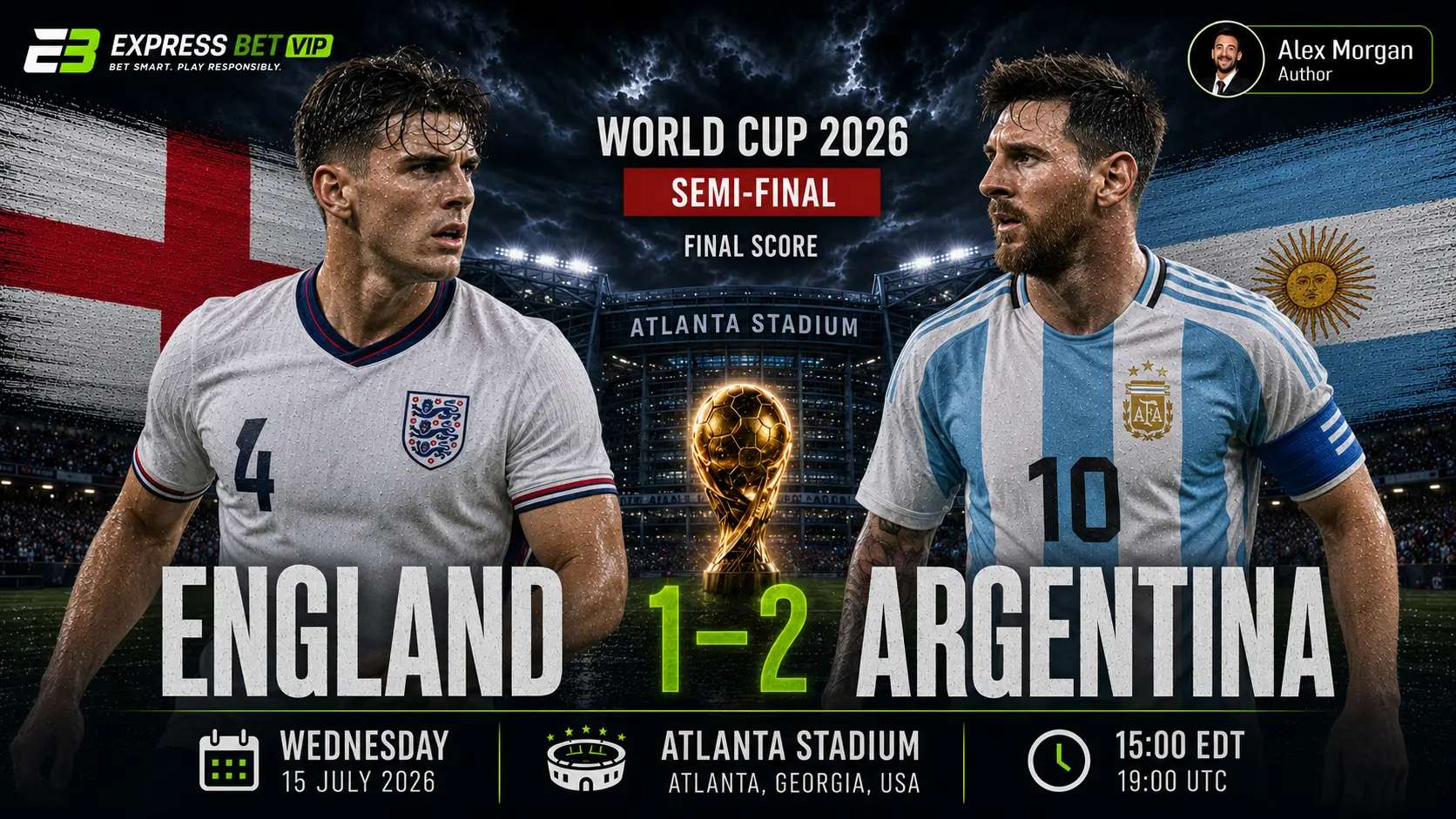
Quick Facts: Final Score, Goals, Venue, and Match Status
| Item | Verified detail |
|---|---|
| Match | England vs Argentina |
| Competition | FIFA World Cup 2026 |
| Stage | Semi-final, Match 102 |
| Date | Wednesday, July 15, 2026 |
| Kickoff | 3:00 p.m. EDT / 19:00 UTC |
| Host country | United States |
| City | Atlanta, Georgia |
| Stadium | Atlanta Stadium |
| Attendance | 68,239 |
| Final score | England 1-2 Argentina |
| Half-time score | 0-0 |
| England scorer | Anthony Gordon 55’ |
| Argentina scorers | Enzo Fernández 85’; Lautaro Martínez 90+2’ |
| Assists | Morgan Rogers; Lionel Messi twice |
| Referee | Ismail Elfath, United States |
| VAR | Marco Di Bello, Italy |
| Roof | Closed |
| Surface | Temporary natural grass |
| Weather impact | Outdoor heat and storm risk substantially reduced by the roof |
| Tournament impact | Argentina advanced to the final; England entered the third-place playoff |
Verified Facts vs Analysis
| Category | Article treatment |
|---|---|
| [CONFIRMED] | Score, scorers, official assists, venue, attendance, cards, substitutions, referee and FIFA statistics |
| [REPORTED] | Closed-roof and pre-match weather information; provider-specific xG and odds |
| [OBSERVED] | England’s deepening block, Argentina’s crossing pressure, Pickford’s saves and Mac Allister hitting the post |
| [ANALYSIS] | England lost attacking depth after Gordon’s substitution; Argentina’s changes improved width and penalty-box occupation |
| [MARKET SIGNAL] | Pre-match prices, totals and anytime-scorer markets |
| [DISPUTED] | Possession and xG can vary slightly by data provider |
| [UNKNOWN] | Official match-time humidity, wind reading, closing odds and complete live-market movements |
This distinction matters because an official score is not an opinion, while a formation can change several times in one possession. It also prevents tactical interpretation or sportsbook data from being extracted as if FIFA had certified it.
Final Score and Match Summary
For 54 minutes, England made the match look manageable. It was slow, physical and cautious. Neither side registered an attempt during the opening half-hour. A World Cup semi-final had briefly become a formal negotiation conducted through tactical fouls.
Argentina held more of the ball, but England’s 4-2-3-1 protected the central lane. Elliot Anderson and Declan Rice restricted passes into Messi, while Jude Bellingham and Harry Kane tried to close Argentina’s first line without opening a direct route into midfield.
England then produced the move their approach required. Kane switched play, Rogers delivered from the right and Gordon arrived at the far side to finish. It was direct without being crude and patient without being passive.
The problem was what followed.
Argentina increased their pressure immediately. Pickford denied Julián Álvarez and Nico González, while Alexis Mac Allister struck the post. England progressively abandoned their higher defensive references and protected the box.
At 72 minutes, Gordon was replaced by Ezri Konsa. The change gave England an additional defender but removed their quickest transition threat. Argentina’s defenders could advance without fearing a serious run into the space behind them.
England then replaced James and Rice with Dan Burn and Nico O’Reilly in the 82nd minute. The intention was obvious: win headers, block crosses and survive. Tournament football has seen this plan before. It occasionally produces statues and medals. It also occasionally produces 12 percent possession.
That was England’s reported share of the ball between Gordon’s goal and Lautaro Martínez’s winner. Argentina finished with 63 percent possession, 14 attempts and six corners according to FIFA. England managed five attempts and one corner.
Enzo Fernández finally equalised with five minutes of normal time remaining. Lautaro, introduced in the 81st minute, completed the turnaround seven minutes later. Messi assisted both goals.
[ANALYSIS] Argentina’s victory was deserved on the balance of territorial control, chance volume and second-half ambition. The timing was cruel to England, but the pattern was not a robbery. Argentina had been knocking for long enough to qualify as residents.
Goal Timeline
55’ — Anthony Gordon, England, close-range open-play goal
[CONFIRMED] Morgan Rogers received the official assist.
The move began with Kane switching the point of attack towards England’s right. Rogers gained enough room to send a precise low cross through the penalty area. Gordon attacked the far-side space and slid the ball beyond Emiliano Martínez from close range.
Argentina’s back line was stretched laterally. The weak-side coverage arrived too slowly, while Gordon’s movement gave him separation from Nahuel Molina’s side of the defence.
There was no official record of a decisive VAR intervention. The goal stood without a prolonged review.
Tactically, it rewarded England’s willingness to move the ball quickly after Argentina’s structure had shifted. Emotionally, it changed the match from controlled tension into an assault on England’s penalty area.
The roof and grass surface did not produce an obvious direct effect. The pass travelled cleanly across the field, with no verified bobble or weather interference.
85’ — Enzo Fernández, Argentina, long-range open-play goal
[CONFIRMED] Lionel Messi received the official assist.
Argentina circulated possession outside England’s increasingly narrow block. Messi found Fernández in shooting range, and the midfielder produced a powerful, moving effort from distance.
England’s defensive line was close to its own penalty area. That protected the space behind but allowed Argentina’s midfielders to receive second balls and attack from the edge of the block. Pickford’s sightline and the movement of the shot made the finish difficult to stop.
[ANALYSIS] This was the price of England’s lack of pressure on the ball. A compact defence still needs someone to step out. Otherwise, compactness becomes an invitation to shoot.
The equaliser also altered the emotional equation. England had spent half an hour protecting something and suddenly had nothing protected. Argentina had momentum, territory and a bench designed to pursue a winner.
90+2’ — Lautaro Martínez, Argentina, headed open-play goal
[CONFIRMED] Messi supplied his second assist.
Messi created room on Argentina’s attacking side and delivered a precise cross into the area. Lautaro attacked the service and headed beyond Pickford.
Konsa was unable to prevent the substitute reaching the decisive zone. England’s extra central defender had been introduced to deal with exactly this kind of delivery, which made the moment particularly severe.
The goal was not recorded as requiring a decisive VAR reversal. It completed Argentina’s comeback inside seven minutes.
[ANALYSIS] Messi’s delivery was the elite action, but the wider cause was structural. England could no longer stop Argentina reaching crossing positions. With no meaningful outlet, every clearance began another attack.
Key Moments That Changed the Match
The first attempt took more than 30 minutes
[OBSERVED] Neither team recorded a shot during the opening half-hour. The delay reflected mutual respect and limited access through central midfield.
It mattered because England were comfortable playing a low-event match. Argentina had possession but initially lacked penetration. The longer that balance held, the more one clean transition could decide the contest.
Anderson’s 37th-minute booking
[CONFIRMED] Anderson was cautioned after stopping Messi.
The yellow did not remove Anderson’s aggression, but it reduced his margin for error. Argentina continued directing possession towards Messi and the central-right channel, forcing England’s midfield to defend under disciplinary pressure.
Pickford denies Álvarez after half-time
[OBSERVED] Pickford saved from Álvarez in the 47th minute.
The chance was an early warning. Argentina had started finding faster routes into the box. England scored eight minutes later, but the defensive pressure had already begun.
Spence’s recovery tackle
[OBSERVED] Djed Spence produced an important challenge shortly after England’s goal, stopping Giuliano Simeone.
It preserved the lead and underlined Spence’s athletic value. It also showed how quickly Argentina were attacking the space around England’s full-backs.
Pickford’s save from Nico González
[OBSERVED] Pickford made a major save in the 69th minute.
By then, Argentina’s substitutions and increased attacking commitment were creating genuine chances rather than cosmetic possession. The save delayed the equaliser; it did not change the direction of travel.
Gordon replaced by Konsa
[CONFIRMED] England made the change in the 72nd minute.
[ANALYSIS] This was the most important tactical decision. The back five offered additional aerial protection but removed England’s quickest breakaway runner. Argentina could sustain pressure because England had no realistic threat behind their advanced defenders.
Tuchel later explained that Argentina were winning headers and producing repeated crosses. The reasoning was coherent. The outcome was not.
Mac Allister hits the post
[OBSERVED] Mac Allister struck the woodwork in the 76th minute.
This was the clearest evidence that the game was no longer under England’s control. The equaliser arrived nine minutes later, but the warning could hardly have submitted more paperwork.
Lautaro enters for Tagliafico
[CONFIRMED] Scaloni replaced Tagliafico with Lautaro Martínez in the 81st minute.
Argentina exchanged defensive balance for another penalty-box attacker. Lautaro scored 11 minutes later, vindicating the risk.
Local Match Conditions: Stadium, City, Weather, Pitch, and Crowd
| Local factor | Verified or observed detail | Football meaning | Match evidence | Betting-result meaning | Status | Specific? |
|---|---|---|---|---|---|---|
| Stadium | Atlanta Stadium | Enclosed, modern venue | Semi-final hosted there | Venue alone did not determine totals | [CONFIRMED] | Fixture-specific |
| Attendance | 68,239 | High-noise environment | FIFA match report | Could add emotional pressure late | [CONFIRMED] | Fixture-specific |
| Roof | Closed | Removed rain and wind variables | Roof report for the semi-final | Reduced weather-based uncertainty | [REPORTED] | Fixture-specific |
| Surface | Temporary natural grass | Different from normal stadium turf | Installed for the World Cup | Required caution in pre-match surface assumptions | [REPORTED] | Fixture-specific |
| Outdoor conditions | Around 30°C was forecast, with storm risk | Potential heat exposure outside | Match played under roof | Little basis for blaming heat for late goals | [REPORTED] | Fixture-specific |
| Humidity | Exact match-time reading unavailable | Cannot quantify fatigue effect | No verified match reading | Avoid overpricing humidity narratives | [UNKNOWN] | Fixture-specific |
| Wind | Neutralised indoors; exact reading unavailable | Stable long passing and crosses | Messi’s deliveries were not wind-affected | Cross and set-piece markets faced less weather variance | [ANALYSIS] | Fixture-specific |
| Pitch | No major failure confirmed | Reliable ball movement | No decisive slip or damaged area identified | No clear pitch-driven betting edge | [OBSERVED] | Fixture-specific |
| Crowd profile | Large Argentina support was visible; exact split unavailable | Sustained noise during the comeback | Argentina supporters gathered locally and were audible | Possible psychological effect, not a predictive model | [OBSERVED] | Fixture-specific |
| Acclimatisation | No verified team-specific disadvantage | Limited evidential value | No confirmed heat illness or cramp crisis | Should not be used as a retrospective certainty | [UNKNOWN] | Fixture-specific |
Atlanta in July usually brings heat, humidity and thunderstorm risk. For this match, however, the closed roof separated the football from much of the weather outside. The temperature at street level and the conditions experienced by the players were not the same thing.
That matters tactically. England’s second-half decline should not automatically be attributed to heat. Their loss of territory corresponded more clearly with Argentina’s increased pressure, England’s substitutions and the removal of counterattacking pace.
There was a hydration break, but no verified evidence of a heat-related injury or widespread cramping. Official match-time humidity and internal stadium temperature were not available from the reviewed public data.
The natural-grass surface appeared to support regular passing and crossing. No goal resulted from a documented slip, strange bounce or goalkeeper handling error. Argentina’s two late goals were football explanations, not gardening accidents.
Stadium-Specific Match Impact
| Stadium item | Detail |
|---|---|
| Stadium | Atlanta Stadium, commercially Mercedes-Benz Stadium |
| Standard capacity | Approximately 71,000 for regular events; configuration varies |
| Attendance | 68,239 |
| Pitch type | Temporary natural grass for the World Cup |
| Roof status | Closed |
| Acoustic effect | Noise was retained by the enclosed roof, but no communication error was officially attributed to it |
| Surface condition | No decisive deterioration confirmed |
| Wind relevance | Minimal inside the enclosed venue |
| Goalkeeper distribution | No clear stadium-specific problem |
| Set-piece effect | Six Argentina corners, but no goal directly from a corner |
| Communication effect | Possible under late crowd pressure, not independently measurable |
| Data status | Attendance official; roof and surface reported; acoustic impact analytical |
The roof’s clearest influence was what it prevented. There was no meaningful wind distortion on Messi’s late crosses and no rain to accelerate the surface or complicate Pickford’s handling.
The enclosed design probably intensified the sound as Argentina attacked late, but it would be careless to convert noise into a direct cause. England’s defence conceded because it failed to suppress deliveries and runners. The acoustics may have increased pressure; they did not mark Lautaro.
City and Weather Impact
| Factor | Detail |
|---|---|
| City | Atlanta, Georgia |
| Host country | United States |
| Time zone | Eastern Daylight Time, UTC-4 |
| July climate | Typically hot and humid, with afternoon storm potential |
| Kickoff | 3:00 p.m. local time |
| Outside temperature | Forecast near 30°C; exact official match-time figure unavailable |
| Humidity | Not available from verified public match data |
| Wind | Not significant inside the closed stadium |
| Rain/sun | No direct pitch exposure because the roof was closed |
| Altitude | Roughly 320 metres; not considered a material factor |
| Likely physical effect | Reduced substantially by enclosed conditions |
| Actual evidence | Hydration break, but no confirmed weather-driven injury or tactical collapse |
| Status | Partly reported; several precise readings unavailable |
The early tempo was slow, but that was better explained by tactical caution than climate. Both midfields protected the centre, both teams avoided reckless pressing and fouls repeatedly interrupted rhythm.
Argentina’s stronger finish also does not prove superior heat adaptation. Their bench added fresh wide players, midfield energy and Lautaro’s penalty-box movement. England simultaneously withdrew an attacking outlet and dropped deeper.
Long passing and goalkeeper handling were not visibly disrupted by weather. Neither were set pieces. The roof turned Atlanta’s outdoor forecast into background context rather than the central tactical variable.
First Half Analysis
England started in a recognisable 4-2-3-1. James, Stones, Guéhi and Spence formed the back four. Rice and Anderson protected the centre, with Rogers, Bellingham and Gordon supporting Kane.
Argentina’s nominal 4-3-3 was more fluid. Paredes sat behind Mac Allister and Fernández, Messi moved away from the front line and Giuliano Simeone tried to stretch England on the right. Julián Álvarez’s movement offered depth.
England did not chase Argentina’s centre-backs continuously. Kane and Bellingham screened passes, while the double pivot narrowed around Messi’s preferred receiving spaces. The objective was to keep play outside and prevent Argentina’s captain turning centrally.
Argentina circulated possession but initially lacked speed. Molina and Tagliafico advanced cautiously because Gordon and Rogers could attack the spaces they left. England’s transition threat was modest in volume but credible enough to influence Argentina’s rest defence.
The physical tone grew as the half progressed. Anderson was booked at 37 minutes, Lisandro Martínez at 42. FIFA recorded 26 fouls across the full match, and the early interruptions helped explain why neither side established attacking rhythm.
The key individual duel involved Messi against England’s central screen. England rarely left one player isolated against him. Anderson engaged, Rice covered and a centre-back was prepared to step if Messi approached the box.
At half-time the score was 0-0. England needed cleaner exits and more service to Gordon. Argentina needed faster circulation, more width and greater occupation of the penalty area. Scaloni’s side eventually solved those problems. England later created a new one for themselves.
Second Half Analysis
Argentina began with more purpose. Álvarez tested Pickford after 47 minutes, and England’s defenders were required to cover larger spaces.
England’s goal came from the correct antidote to Argentina’s possession: regain the ball, move it before the block reset and attack the far side. Kane’s switch, Rogers’ cross and Gordon’s run were technically sharp.
Instead of treating the lead as a base for selective pressure, England increasingly treated it as a fragile museum exhibit. Their line retreated. Kane became isolated, while Bellingham and Rogers spent more time tracking than receiving.
Scaloni replaced Paredes with Nico González after 64 minutes. The change added directness and allowed Argentina to widen England’s block. González forced an excellent save from Pickford five minutes later.
The triple change at 72 minutes further refreshed Argentina’s structure. Otamendi replaced the booked Lisandro Martínez, De Paul added running and aggression, and Montiel replaced Molina. Argentina could continue attacking the wide channels without losing intensity.
At the same minute, England removed Gordon for Konsa. Their shape became a back five. Tuchel’s concern about crosses was reasonable, yet the adjustment reduced England’s capacity to stop those crosses at source.
Mac Allister hit the post. Argentina won second balls. Messi moved laterally to create crossing angles. Fernández attacked space outside the block. England’s clearances lacked distance and direction because there was no quick target beyond Kane.
The 82nd-minute substitutions deepened the imbalance. Burn offered size, while O’Reilly brought energy, but Rice and James had been among England’s most important organisers. Argentina equalised three minutes later.
Once the score became 1-1, England could not instantly recover the proactive shape they had dismantled. Momentum is sometimes treated as mystical. Here it had identifiable components: territory, fresh attackers, repeated deliveries and an opponent unable to keep the ball.
Lautaro’s winner followed at 90+2. England introduced Toney and Rashford at 90+6, after the strategic question had already received a rather final answer.
Tactical Picture: Why the Match Was Won and Lost
England defended the first hour in a compact 4-4-2/4-2-3-1 block. The wide players tracked Argentina’s full-backs, Rice and Anderson narrowed the centre, and Stones or Guéhi stepped only when the cover behind them was secure.
With the ball, James was permitted to advance while Spence was slightly more conservative. Rogers operated from the right but frequently moved inside, creating the lane from which he supplied Gordon.
Argentina built through a 3-2 or 2-3 base depending on Messi’s location. Paredes offered the first central pass, while Fernández and Mac Allister tried to receive beyond England’s first pressure line. England’s narrow spacing initially made those receptions awkward.
The tactical collision changed after 55 minutes. Argentina increased full-back height, moved more bodies into the box and used Messi as a roaming creator rather than a fixed forward. Crosses arrived from different depths: low passes across the six-yard area, clipped balls towards the far post and recycled deliveries after partial clearances.
England’s back five increased the number of defenders inside the box but weakened their access to the ball outside it. This is the familiar paradox of extreme low-block defending: adding a defender can produce less control if it removes the player who carries the team out.
Argentina’s midfielders were therefore able to collect second balls. Fernández attempted four shots according to FIFA, more than any England player. Mac Allister attempted three. That distribution tells the tactical story: England’s block protected the six-yard area but surrendered the edge of the contest.
Messi’s role was decisive. He did not need to dominate the shot count. He needed to find the final pass twice. His movement pulled England’s nearest midfielder sideways, and his crossing technique punished defenders facing their own goal.
Scaloni also won the bench contest. González threatened Pickford, De Paul increased midfield energy and Lautaro delivered the winning goal. Tuchel’s substitutes were designed primarily to protect a lead that disappeared before England could restore attacking balance.
Tactical Collision Map
| Zone | Edge | Evidence | Key player | Local-condition effect | Result impact |
|---|---|---|---|---|---|
| England left | England early; Argentina late | Spence defended strongly before sustained pressure | Djed Spence | No wind effect on deliveries | Important recovery tackles |
| England right | England early | Rogers created the opener; James defended well | Morgan Rogers | Clean grass supported the low cross | England goal |
| Central midfield | Argentina | 63% possession and repeated second-ball recovery | Enzo Fernández | Weather impact limited indoors | Equaliser and territorial control |
| Penalty box | Argentina late | More attackers and crosses after 64’ | Lautaro Martínez | Stable aerial delivery | Winning header |
| Set pieces | Argentina | Six corners to England’s one | Messi | Roof removed wind variance | Pressure, though no direct set-piece goal |
| Transitions | England before 72’ | Gordon’s pace stretched Argentina | Anthony Gordon | Surface played normally | Opening goal |
| Defensive third | England under strain | Pickford saves; Mac Allister hit post | Jordan Pickford | No verified pitch failure | Delayed Argentina’s comeback |
| Goalkeeper build-up | Argentina | Emi Martínez faced little sustained press late | Emiliano Martínez | Indoor conditions reduced distribution risk | Argentina sustained possession |
| Bench | Argentina | González threat; Lautaro goal | Lautaro Martínez | Freshness mattered more than climate | Decisive |
Player Ratings and Individual Performances
These are editorial ratings based on match influence, tactical responsibility and official event data. They are not FIFA ratings.
England player ratings
Jordan Pickford — 7.0: Made important saves from Álvarez and González. Had little realistic chance with either goal.
Reece James — 7.0: Controlled his flank for long periods and supported England’s stronger first-hour structure. His removal reduced England’s organisation.
John Stones — 6.5: Calm during the controlled phase, but England’s line eventually became overwhelmed by repeated deliveries.
Marc Guéhi — 7.0: Reliable in direct duels and rarely created the initial problem. The pressure around him became excessive.
Djed Spence — 8.0: England’s best defender. His recovery tackle on Simeone was outstanding, and he handled a demanding matchup.
Declan Rice — 6.5: Protected the centre effectively before England lost territorial control. Taken off as Tuchel prioritised the box over midfield.
Elliot Anderson — 7.0: Aggressive and positionally disciplined. His booking narrowed his defensive margin, but he remained competitive.
Morgan Rogers — 7.5: Produced the assist and gave England a useful right-sided route. His influence declined as the team retreated.
Jude Bellingham — 6.0: Worked hard without finding enough attacking possession. Became disconnected from Kane late.
Anthony Gordon — 8.0: Scored England’s goal and provided their main threat behind Argentina’s line. His removal changed the geometry of the match.
Harry Kane — 5.5: His switch contributed to the opener, but he recorded little penalty-box influence and could not hold enough clearances late.
Ezri Konsa — 5.5: Entered to strengthen the aerial defence but could not stop Lautaro reaching Messi’s cross.
Dan Burn — 5.5: Added height but arrived during Argentina’s strongest spell and did not reverse it.
Nico O’Reilly — 5.5: Asked to enter an overloaded midfield at an unforgiving stage.
Ivan Toney — not rated: Introduced at 90+6 with too little time.
Marcus Rashford — not rated: Also entered at 90+6; the attacking rescue operation began after the house was already on fire.
Argentina player ratings
Emiliano Martínez — 6.5: Faced two shots on target and was beaten from close range. Secure otherwise.
Nahuel Molina — 6.0: Offered width but was exposed during England’s goal sequence.
Cristian Romero — 7.0: Aggressive in duels and increasingly able to defend high once England lost its outlet. Booked at 51’.
Lisandro Martínez — 6.5: Helped circulate possession but carried a first-half booking and was removed at 72’.
Nicolas Tagliafico — 6.5: Reliable without dominating the flank. Sacrificed for Lautaro as Argentina chased the match.
Leandro Paredes — 6.5: Controlled early circulation but could not break England’s compact centre consistently.
Alexis Mac Allister — 7.5: Intelligent between the lines, attempted three shots and hit the post during Argentina’s surge.
Enzo Fernández — 8.5: Four attempts, constant second-ball involvement and a superb equaliser. Argentina’s decisive midfield presence.
Giuliano Simeone — 6.5: Supplied energy and direct running but was stopped by Spence’s major intervention.
Lionel Messi — 9.0: Two official assists. He solved the match without needing to score, which remains a useful talent.
Julián Álvarez — 6.5: Worked across England’s back line and forced a second-half save, though he did not finish his opportunities.
Nico González — 7.0: Increased width and forced Pickford into a major save.
Nicolas Otamendi — 6.5: Helped Argentina maintain a high defensive line after replacing Lisandro Martínez.
Rodrigo De Paul — 7.0: Added running, aggression and support around Messi. Booked in added time.
Gonzalo Montiel — 6.5: Maintained attacking width and helped sustain pressure.
Lautaro Martínez — 8.0: Entered at 81 minutes and scored the winning header. An efficient evening’s work.
Best Players of the Match
| Category | Selection | Reason |
|---|---|---|
| Man of the Match | Lionel Messi | Two official assists in the decisive final seven minutes |
| Best attacker | Anthony Gordon | England’s goal and primary transition threat |
| Best midfielder | Enzo Fernández | Equaliser, four attempts and strong territorial influence |
| Best defender | Djed Spence | Excellent recovery defending and one major tackle |
| Best goalkeeper | Jordan Pickford | Several important saves before the late turnaround |
| Best substitute | Lautaro Martínez | Scored the 90+2 winner |
| Most underrated | Morgan Rogers | Assisted Gordon and performed a demanding two-way role |
| Most disappointing | Harry Kane | Contributed to the opener’s build-up but had limited attacking influence |
Injuries, Suspensions, Cards, and Discipline
No match-ending injury, concussion substitution or red card was listed in FIFA’s report. No penalty was awarded.
| Player | Team | Incident | Minute | Status | Next-match impact | Data status |
|---|---|---|---|---|---|---|
| Elliot Anderson | England | Foul/bookable offence | 37’ | Yellow | No verified suspension confirmed | [CONFIRMED] |
| Lisandro Martínez | Argentina | Foul/bookable offence | 42’ | Yellow | No verified suspension confirmed | [CONFIRMED] |
| Cristian Romero | Argentina | Foul/bookable offence | 51’ | Yellow | No verified suspension confirmed | [CONFIRMED] |
| Rodrigo De Paul | Argentina | Bookable offence | 90+4’ | Yellow | No verified suspension confirmed | [CONFIRMED] |
| Injuries | Both | None officially listed as match-ending | — | No confirmed new injury | Not established | [UNKNOWN] |
Argentina committed 15 fouls to England’s 11. The match was physical without escalating into a sending-off contest. Anderson’s foul on Messi was the clearest example of England using contact to prevent a dangerous central progression.
Referee and VAR Analysis
Ismail Elfath showed four yellow cards: one to England and three to Argentina. The distribution reflected Argentina’s higher foul count but did not suggest a loss of control.
No penalty, red card or disallowed goal appeared in the official event record. There was no match-defining VAR reversal.
FIFA recorded three minutes of first-half added time and 11 minutes in the second half. The longer second period included five substitution windows, goals, treatment and late-game delays.
[ANALYSIS] The referee influenced the rhythm through frequent free kicks, particularly in the cautious first half, but did not decide the result. Argentina’s winner came from open play and England’s complaints after full time did not produce a verified refereeing controversy.
Match Statistics
| Statistic | England | Argentina |
|---|---|---|
| Possession | 37% | 63% |
| Attempts | 5 | 14 |
| Shots on target | 2 | 5 |
| Blocked attempts | 2 | 2 |
| Corners | 1 | 6 |
| Fouls committed | 11 | 15 |
| Direct free kicks won | 15 | 11 |
| Indirect free kicks won | 3 | 1 |
| Offsides | 1 | 3 |
| Yellow cards | 1 | 3 |
| Red cards | 0 | 0 |
| Penalties | 0 | 0 |
| Reported xG | Approximately 0.53 | Approximately 1.84 |
The first 55 minutes prevent the possession figure from telling the whole story. England were organised rather than merely passive during much of that period.
After Gordon scored, the numbers became far more revealing. Argentina accumulated shots, corners and territory while England struggled to complete exits. The reported 12 percent England possession between the opening goal and Lautaro’s winner illustrates how completely the match shifted.
Provider figures can vary. Some public services rounded possession to 36–64, and xG values depend on the model used. FIFA’s official report did not publish xG, so the listed figures should be treated as provider data rather than an official competition measurement.
Betting Result Angle
[MARKET SIGNAL] FanDuel prices recorded shortly before kickoff by CBS Sports listed England at +165, Argentina at +200 and the draw at +190 in the 90-minute market. England were -132 to advance, with Argentina +116. The total was set at 2.5 goals. Kane and Messi were both +150 anytime scorers.
| Market | Pre-match expectation | Actual result | Winning side | Key trigger | Local factor | Caution |
|---|---|---|---|---|---|---|
| 90-minute winner | England slight favourite | Argentina won 2-1 | Argentina +200 | Two late goals | Roof limited weather uncertainty | Prices varied by book and time |
| To qualify | England favoured | Argentina advanced | Argentina +116 | Late turnaround | No clear venue edge | Different from 90-minute market |
| Over/under 2.5 | Balanced around 2.5 | Three goals | Over 2.5 | Lautaro 90+2 | Conditions did not suppress delivery quality | A late goal decided settlement |
| Both teams to score | Competitive matchup | Yes | “Yes” | Gordon opener, Argentina response | No decisive weather impact | Price not verified here |
| Correct score | Low-probability market | Argentina 2-1 | 1-2 correct score | Seven-minute comeback | None established | High-variance market |
| Anytime scorer: Messi | +150 | No goal | Losing selection | Messi assisted twice | Indoor stability helped passing, not scoring | Assists do not settle scorer bets |
| Anytime scorer: Kane | +150 | No goal | Losing selection | Limited shot involvement | No local explanation | Reputation is not shot volume |
| Cards | Physical semi-final expected | Four yellows | Depends on line | 26 total fouls | Weather not demonstrably relevant | Book rules differ |
| Corners | Argentina territorial edge developed | Argentina won 6-1 | Argentina corner angles | Sustained crossing pressure | Closed roof removed wind | Pre-match corner line unavailable |
This result rewarded bettors who backed Argentina in the 90-minute market, despite England being the marginal favourite at the quoted snapshot.
The over 2.5 market required the 90+2 winner. Anyone describing that outcome as comfortable has developed a generous definition of comfort.
Messi’s performance also demonstrates the risk in translating influence into scorer bets. He was decisive, but two assists do not settle an anytime-goalscorer ticket.
Live bettors would have seen Argentina’s price lengthen after Gordon’s goal and shorten sharply as the pressure mounted. Exact live prices and timestamps were not available from verified public data, so they should not be reconstructed.
Local Betting Impact: What the Venue and Conditions Changed
| Local factor | Market possibly affected | Evidence | Interpretation | Overreaction risk | Safer conclusion |
|---|---|---|---|---|---|
| Closed roof | Total goals, crosses, goalkeeper handling | No rain or wind on the field | More stable delivery conditions | Assuming indoor games must be high-scoring | Roof reduced variance; it did not create goals |
| Natural grass | Passing and player-prop markets | No major surface incident | Normal ball movement | Treating unfamiliar surface as automatically slow | No verified pitch edge emerged |
| 3 p.m. Atlanta kickoff | Second-half tempo | Hydration break; no confirmed heat crisis | Outdoor heat mattered less indoors | Blaming England’s collapse on climate | Tactical retreat is the stronger explanation |
| Enclosed acoustics | Live momentum markets | High attendance during late pressure | Noise may reinforce emotional swings | Converting atmosphere into a reliable signal | Use match evidence, not volume alone |
| 68,239 attendance | Cards and late pressure | Physical match, four yellows | High-stakes environment supported intensity | Assuming large crowds guarantee cards | Referee and tactics remain more important |
| Six Argentina corners | Corner markets | Sustained wide attacks | Territorial control produced corners | Projecting the same pattern forward | Corners followed game state |
| No significant wind | Cross completion | Messi delivered accurately for winner | Stable flight conditions | Crediting the roof for elite technique | Execution mattered more than venue |
Local conditions mostly removed variables rather than determining the result. The roof protected the field from Atlanta’s potential storms and reduced wind-related uncertainty. Bettors should not mistake reduced weather uncertainty for reduced football uncertainty. England still found an impressively painful route from 1-0 to 1-2.
What This Result Means for the Knockout Bracket
[CONFIRMED] Argentina advanced to the World Cup final against Spain on Sunday, July 19, at New York New Jersey Stadium. England were eliminated from title contention and moved into the bronze final against France on July 18.
With this article verified after the tournament’s conclusion, the subsequent outcomes are also known:
- [CONFIRMED] England beat France 6-4 and secured third place, their best men’s World Cup finish since winning in 1966, according to Reuters.
- [CONFIRMED] Argentina lost the final 1-0 after extra time to Spain, with Ferran Torres scoring in the 106th minute, as reported by AP.
The semi-final therefore sent Argentina into a second successive World Cup final but did not produce a successful title defence. England’s tournament ended with bronze rather than another fourth-place finish.
What Argentina Did Right
Argentina remained patient when England blocked the centre. They did not confuse possession with entitlement. After conceding, they increased the speed and range of their attacks.
Scaloni’s substitutions were progressive. González provided width and a direct threat. De Paul supported the second-ball structure. Montiel maintained pressure from full-back. Lautaro increased penalty-box occupation and scored.
The midfield also became more aggressive around England’s block. Fernández and Mac Allister were prepared to shoot, recover clearances and move the ball back towards Messi.
Most importantly, Argentina attacked the source of England’s weakness. They did not simply send hopeful crosses towards three centre-backs. They recycled possession, changed the delivery point and forced England’s defenders to repeatedly turn towards their own goal.
What England Got Wrong
England stopped threatening the space behind Argentina. Removing Gordon made it easier for Argentina to advance their back line and recover every clearance.
The back-five decision was not irrational. Argentina were creating overloads and winning aerial contacts. The flaw was that England changed the defensive line without preserving an outlet or enough midfield control.
Replacing Rice and James reduced leadership and ball security at the exact moment England needed a calm possession sequence. Burn and Konsa could defend crosses, but England required a mechanism for preventing the next one.
Kane’s isolation also became severe. He lacked a runner around him, while Bellingham was pushed too deep to connect transitions. England’s attacking substitutions arrived only after Argentina had taken the lead.
The failure was therefore not simply “defending too much.” It was defending without controlling where the next attack began.
Coach Analysis
Lionel Scaloni
Scaloni’s initial plan secured possession but not enough penetration. His response was excellent.
The González substitution introduced a more direct wide threat. The triple change at 72 minutes maintained defensive stability while adding energy. Replacing Tagliafico with Lautaro was the decisive gamble.
Scaloni accepted the risk of leaving fewer natural defenders because a semi-final defeat and a cautious semi-final defeat are filed in the same column. His bench produced the winner.
Thomas Tuchel
Tuchel’s starting system worked. England restricted Messi, competed in midfield and created the opening goal through a well-designed transition.
His game-state management was less successful. The shift to a back five responded to a real problem—Argentina’s crosses—but worsened England’s inability to retain possession.
Tuchel later acknowledged that England became too passive and accepted responsibility for the changes. The central lesson is not that a back five is inherently negative. England had used similar adjustments successfully earlier in the tournament. Against Argentina, however, it removed the remaining threat that made the block sustainable.
Player Milestones and Records
[CONFIRMED] Gordon scored his first goal of the 2026 World Cup, according to contemporary match coverage.
[CONFIRMED] Argentina reached a second consecutive World Cup final after winning the 2022 tournament.
[CONFIRMED] England were attempting to reach their first men’s World Cup final since 1966.
[REPORTED] The opening half-hour without an attempt was described by contemporary statistical coverage as the longest such start to a World Cup match in approximately 60 years. Because this was not stated in FIFA’s match report, it should be treated as provider research rather than an official tournament record.
No additional player record is presented as confirmed here. Messi’s World Cup appearance and assist records require consistent historical definitions, especially for older tournaments.
Historical Context and World Cup Analogies
England and Argentina carried one of international football’s most heavily referenced rivalries into Atlanta.
England won their 1966 quarter-final 1-0. Argentina won the famous 1986 quarter-final 2-1, when Diego Maradona scored both the “Hand of God” goal and the solo goal later voted the World Cup’s greatest of the century. Their 1998 round-of-16 meeting finished 2-2 before Argentina advanced on penalties. England won 1-0 in the 2002 group stage through a David Beckham penalty.
The 2026 semi-final was their first World Cup meeting since 2002 and their first at the semi-final stage.
This was not a replay of 1986 or 1998. There was no defining refereeing dispute or shootout. It did share the rivalry’s familiar tension and the old knockout lesson that tactical control is temporary. England had the lead; Argentina had the match.
Incidents and Controversies
There was no major in-match VAR controversy.
[OBSERVED] A brief confrontation involving players followed the final whistle, although the available broadcast coverage did not clearly establish a complete sequence or disciplinary consequence.
[REPORTED] Argentina players later displayed a banner referring to Argentina’s claim over the Falkland Islands/Islas Malvinas. The political gesture was documented by reputable media. It was separate from the football result and should be described factually rather than used to sensationalise the match.
No verified crowd disorder, pitch invasion or medical emergency was found in the reviewed match data.
Information Gain: What This Article Adds
This report combines:
- FIFA-verified score, goal, assist and disciplinary data;
- a detailed explanation of all three goals;
- the tactical effect of England removing Gordon;
- the role of Argentina’s substitutions;
- original editorial player ratings;
- Atlanta-specific roof, surface and climate analysis;
- betting settlement explanations;
- immediate and subsequent bracket consequences;
- clear separation between confirmed facts, observations and interpretation.
Local Information Gain Quality Check
| Detail | Included? | Status | Fixture-specific? | Possible update |
|---|---|---|---|---|
| Atlanta Stadium | Yes | [CONFIRMED] | Yes | Capacity configuration if FIFA publishes it |
| City and time zone | Yes | [CONFIRMED] | Yes | None required |
| Weather | Yes | [REPORTED]/[UNKNOWN] | Yes | Official internal temperature and humidity |
| Roof | Yes | [REPORTED] | Yes | Official venue confirmation |
| Natural-grass pitch | Yes | [REPORTED] | Yes | FIFA technical pitch report |
| Crowd | Yes | [CONFIRMED]/[OBSERVED] | Yes | Verified supporter split |
| Travel/acclimatisation | Limited | [UNKNOWN] | Yes | Team performance data if released |
| Betting risk | Yes | [ANALYSIS] | Yes | Verified closing and live odds |
| Tactical-local connection | Yes | [ANALYSIS] | Yes | No material change expected |
| Anti-template status | Passed | Editorial check | Yes | Recheck after data corrections |
Source and Data Appendix
| Data point | Status | Primary source |
|---|---|---|
| Final score and half-time score | [CONFIRMED] | FIFA full-time report |
| Goal scorers and times | [CONFIRMED] | FIFA |
| Assists | [CONFIRMED] | FIFA |
| Stadium, city and attendance | [CONFIRMED] | FIFA |
| Referee and VAR | [CONFIRMED] | FIFA |
| Lineups | [CONFIRMED] | FIFA |
| Substitutions | [CONFIRMED] | FIFA |
| Cards | [CONFIRMED] | FIFA |
| Injuries | [UNKNOWN] | No new match injury officially listed |
| Possession, shots and corners | [CONFIRMED] | FIFA |
| xG | [REPORTED] | Public statistical providers |
| Odds | [MARKET SIGNAL] | FanDuel prices recorded by CBS Sports |
| Closing odds | [UNKNOWN] | Not available from verified public data |
| Roof status | [REPORTED] | Venue/weather reporting |
| Surface type | [REPORTED] | World Cup venue reporting |
| Weather readings | [UNKNOWN] | Exact match-time readings unavailable |
| Pitch condition | [OBSERVED] | Match evidence |
| Crowd profile | [OBSERVED] | Broadcast and local reporting |
| Tournament impact | [CONFIRMED] | FIFA bracket and subsequent results |
Final Verdict
Argentina won because they continued trying to win after falling behind. England lost because their attempt to protect the lead gradually removed the mechanisms that had earned it.
The scoreline was late, painful and fair. Argentina had 63 percent possession, nearly three times as many attempts and six corners to England’s one. Pickford delayed the reversal, while Spence and Guéhi defended well. They could not indefinitely compensate for a team that had stopped escaping its own third.
Messi supplied the quality. Fernández supplied the equaliser. Lautaro supplied the ruthless substitute’s finish. Scaloni supplied the attacking changes.
The closed Atlanta roof was the most relevant local condition because it limited other conditions. Wind, rain and direct heat were not persuasive explanations. The match was decided by pressure, substitutions and the increasingly lopsided geography of the pitch.
For bettors, the lesson is not that Argentina at +200 was obvious or that late goals can be forecast on command. It is that game state matters. A favourite leading 1-0 can still become tactically vulnerable, and a player can dominate without scoring. Markets settle events; they do not always capture influence.
England were seven minutes from a World Cup final. Argentina used those seven minutes rather better.
Responsible Betting Note
Football betting carries financial risk. Even accurate match analysis cannot guarantee a winning bet, and odds change before and during games.
Local conditions are only one input and are often overvalued. Never chase losses or gamble with money required for housing, food, bills or other daily needs. Use deposit and time limits, take regular breaks and use self-exclusion tools when necessary.
Check the laws in your jurisdiction and use licensed operators only. Betting should remain entertainment, never a source of expected income.
Summarize this article with AI. Use this page URL as the source:
Summarize this article with AI:
FAQ
Argentina beat England 2-1 in the 2026 World Cup semi-final.
Anthony Gordon scored for England in the 55th minute. Enzo Fernández equalised in the 85th minute, and Lautaro Martínez scored Argentina’s winner at 90+2.
Lionel Messi was our Man of the Match after providing the official assists for both Argentina goals.
Argentina advanced to the final against Spain. England moved into the third-place playoff against France.
Argentina won the 90-minute market, over 2.5 goals landed and both teams scored. Kane and Messi anytime-scorer bets lost. Outcomes depended on the bookmaker’s price and the time the bet was placed.