
France vs Spain Match Result
Table of Contents Show
[CONFIRMED] Spain beat France 2-0 in the FIFA World Cup 2026 semi-final at Dallas Stadium. Mikel Oyarzabal converted a 22nd-minute penalty after Lucas Digne kicked Lamine Yamal while attempting a clearance. Pedro Porro doubled the lead in the 58th minute after a sharp combination with Dani Olmo.
Porro was the official Player of the Match. Spain won through midfield control, coordinated pressing and intelligent protection against Kylian Mbappé. France finished with only 0.31 xG despite taking ten shots. The closed roof and climate-controlled stadium reduced the influence of the afternoon Texas heat and provided Spain with predictable passing conditions.
Spain advanced to the final; France moved into the third-place match. Spain’s moneyline, Spain-to-qualify, under 2.5 goals and both-teams-to-score No landed. Outcomes still depended on the operator’s odds, rules and market timing.
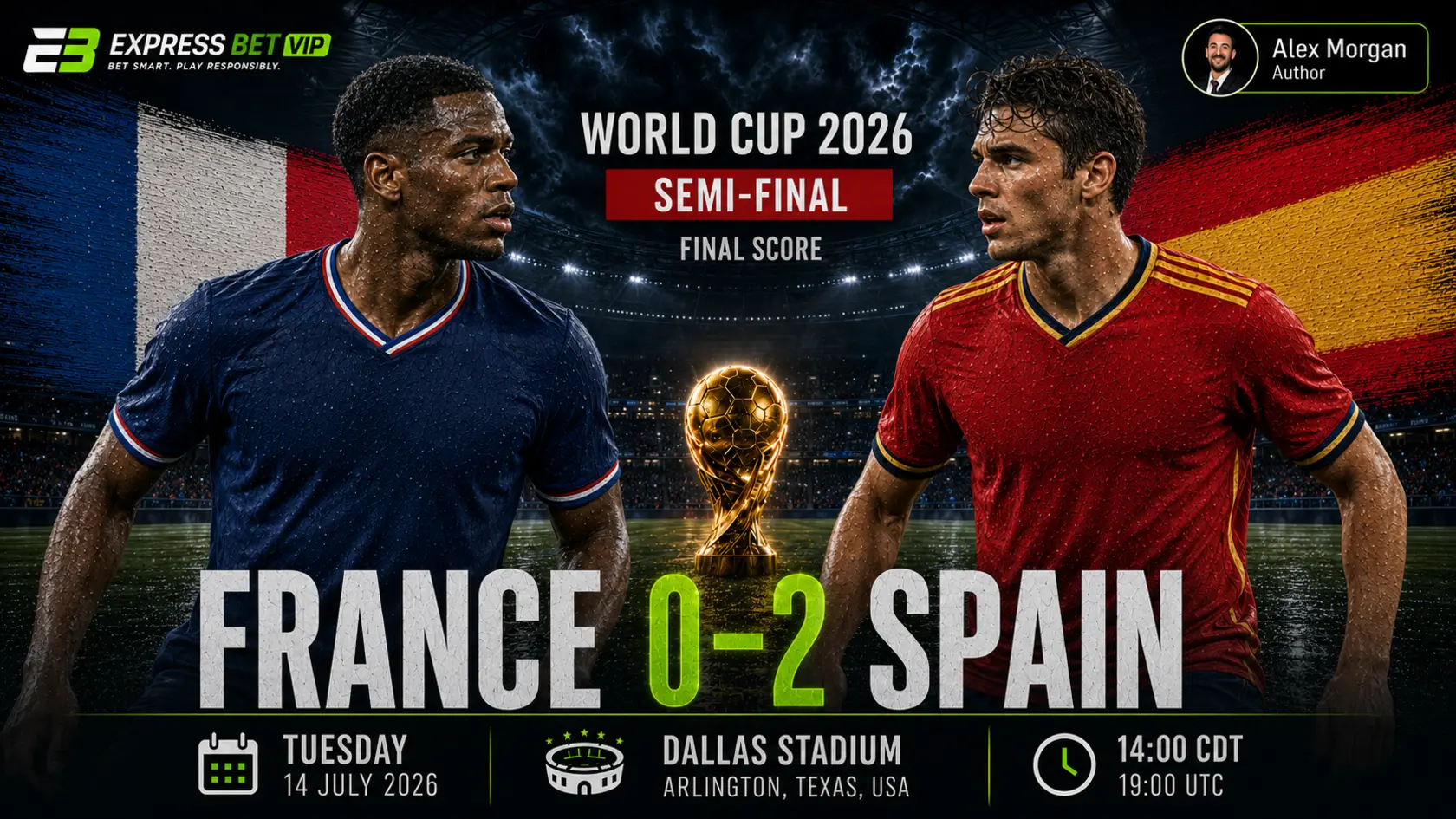
| Item | Verified detail |
|---|---|
| Match | France vs Spain |
| Competition | FIFA World Cup 2026 |
| Stage | Semi-final, Match 101 |
| Date | Tuesday, 14 July 2026 |
| Kickoff | 2:00 p.m. CDT / 19:00 UTC |
| Host country | United States |
| City | Arlington, Dallas–Fort Worth, Texas |
| Stadium | Dallas Stadium, commercially AT&T Stadium |
| Attendance | 70,176 |
| Final score | France 0-2 Spain |
| Half-time score | France 0-1 Spain |
| Goals | Mikel Oyarzabal 22′ penalty; Pedro Porro 58′ |
| Assist | Dani Olmo for Porro’s goal |
| Referee | Iván Barton, El Salvador |
| VAR | Tomasz Kwiatkowski, Poland |
| Yellow cards | Adrien Rabiot 8′; Marc Cucurella 31′; Kylian Mbappé 86′ |
| Roof | Closed |
| Surface | Temporary natural, hybrid-reinforced cool-season grass |
| Weather influence | Outdoor heat largely neutralized by climate control |
| Main impact | Spain advanced to the final; France entered the third-place match |
| Category | Detail |
|---|---|
| [CONFIRMED] | Spain won 2-0 through goals from Oyarzabal and Porro. |
| [CONFIRMED] | Oyarzabal’s goal was a penalty after Digne fouled Yamal. |
| [CONFIRMED] | Olmo assisted Porro’s second-half goal. |
| [CONFIRMED] | William Saliba left the match after 30 minutes and Maxence Lacroix replaced him. |
| [REPORTED] | Saliba’s problem was described as a back injury; a final medical diagnosis was not included in the match report. |
| [OBSERVED] | Spain consistently moved France’s defensive block from side to side before attacking gaps between full-back and centre-back. |
| [ANALYSIS] | Spain’s midfield spacing prevented France from turning recoveries into clean Mbappé transitions. |
| [MARKET SIGNAL] | France were favored in both the 90-minute and qualification markets before kickoff. |
| [DISPUTED] | Michael Olise’s first-half challenge on Rodri drew debate over whether a yellow card should have been shown. |
| [UNKNOWN] | Exact indoor temperature, official crowd split and a universal closing price are unavailable. |
This distinction protects the article from a common post-match habit: treating interpretation as though it appeared in the referee’s report. The score and cards are facts. Spain’s superior rest defence is analysis supported by the match pattern.
Spain’s 2-0 victory was controlled, deserved and more tactically one-sided than the possession statistics suggest.
The France vs Spain final score shows only a two-goal gap. The more revealing figure is France’s 0.31 xG. Didier Deschamps selected Mbappé, Dembélé, Michael Olise and Bradley Barcola together, yet France rarely connected them in dangerous areas.
Spain did not monopolize possession in the old caricature of endless short passing. FIFA recorded a narrow 51%-49% advantage. Luis de la Fuente’s team instead controlled the useful parts of possession: where the ball was received, how quickly pressure arrived after a turnover and which player could face forward.
The opening phase was cautious. Adrien Rabiot volleyed wide, while Álex Baena struck a free kick into the wall. France attempted to make the game physical and received an eighth-minute warning when Rabiot was booked.
The first goal arrived through a defensive awareness failure rather than an intricate passing sequence. Digne watched an awkward dropping ball but did not detect Yamal arriving from behind. When Digne swung to clear, he kicked through the Spanish winger. Iván Barton awarded the penalty, and the decision survived the review process.
Oyarzabal drove the penalty to Maignan’s right. Spain led after 22 minutes and France trailed for the first time in the tournament.
Saliba’s departure eight minutes later removed one of France’s best recovery defenders. Maxence Lacroix entered, but the substitution was a positional repair rather than an answer to Spain’s midfield control.
France reached half-time without a shot on target. Spain were not producing chance after chance, but their shape reduced France’s star-studded attack to distant or rushed efforts. Control without constant shooting can become empty possession. This was different: Spain were controlling what France were allowed to attempt.
Porro scored in the 58th minute. The right-back combined with Olmo, moved inside Digne and finished low beyond Maignan. Yamal appeared to score a third three minutes later, but he had moved offside.
France finally increased the pressure around the hour. Mbappé forced an intervention from Cucurella and Unai Simón later recovered from an adventurous headed clearance to stop Désiré Doué. These were isolated incidents rather than an organized siege.
Spain finished the match by keeping possession around France’s press. By then the semi-final had acquired the slightly strange calm that arrives when one team has accepted the tactical truth before the scoreboard makes it official.
[CONFIRMED] Spain moved the ball toward their right side, where Yamal attacked behind Digne. The French left-back attempted to clear an awkward bouncing ball but failed to recognize Yamal’s position. His swing connected with the winger inside the penalty area.
Barton immediately awarded the penalty. The decision stood following review. There was no convincing basis for overturning it: Digne’s intention to play the ball did not remove the foul.
Oyarzabal struck left-footed toward Maignan’s right. The shot was firm and placed beyond the goalkeeper’s practical reach.
The penalty carried an Opta/365Scores xG value of approximately 0.79. It changed France’s required game state. Until then, Deschamps could wait for transition opportunities. Once behind, France had to take greater possession risk against the tournament’s best positional side.
The closed roof and stable surface allowed Oyarzabal a predictable run-up and plant-foot position. That is context, not causation. He still had to beat Maignan.
[CONFIRMED] Spain first moved possession across the pitch, forcing France’s block to shift. Porro then exchanged a wall pass with Olmo, accelerated into the penalty area and side-footed the ball into the lower corner.
Olmo received the official assist. His return pass removed Digne and opened the shooting lane.
Maignan attempted to narrow the angle, but Porro’s placement was accurate. The move combined patience, width and a sudden inside run—the three elements France struggled to defend throughout the afternoon.
Tactically, this was the decisive goal. France’s front four had already produced little against a level game. At 0-2, they needed to attack Spain without losing control of Rodri, Olmo and the two wide outlets. That problem never found a convincing solution.
Rabiot was assigned an important role in protecting the left side when Yamal moved inside. An early caution reduced his freedom to stop transitions with contact. Deschamps removed him at half-time.
[DISPUTED] Olise caught Rodri from behind after the midfielder released the ball. Barton awarded the free kick but showed no card.
Some observers argued the tackle deserved at least a caution. Former referee Mark Halsey reportedly considered it reckless but not serious foul play. The incident did not lead to a VAR intervention or retrospective match sanction.
The penalty resulted from awareness rather than a complex defensive-system failure. Digne had time to judge the dropping ball but not the opponent arriving behind him.
France lost Saliba in the 30th minute. Lacroix performed reasonably, but the change reduced France’s ability to defend large spaces and removed a defender comfortable carrying through pressure.
The second goal converted Spain’s territorial control into security. It also exposed the space created when France’s midfield and defensive lines shifted at different speeds.
Three minutes after Porro scored, Yamal rounded Digne and curled the ball beyond Maignan. The offside flag correctly prevented the goal from standing.
The incident mattered even without changing the score. France had just conceded and were immediately opened again through the same channel.
In the 81st minute, Simón left his penalty area to head clear but did not control the second phase. Doué collected the loose ball with the goalkeeper outside position. His hesitation allowed Simón to recover and block the eventual attempt.
A sharper finish would have made the final minutes uncomfortable. Instead, France’s best late opportunity became another example of slow decision-making.
| Local factor | Verified or observed detail | Football meaning | Direct evidence | Betting meaning | Status | Anti-template status |
|---|---|---|---|---|---|---|
| Stadium | Dallas Stadium in Arlington | Large climate-controlled venue | Roof remained closed | Reduced weather uncertainty | [CONFIRMED] | Specific |
| Attendance | 70,176 | Near-capacity crowd | Official FIFA report | High-noise environment, but no measurable market edge | [CONFIRMED] | Specific |
| Outdoor temperature | Forecast high approximately 29–32°C depending on provider | Potential heat outside venue | Fan and travel exposure | Limited effect on match tempo because of roof | [REPORTED] | Specific |
| Indoor climate | Air-conditioned | Reduced heat and humidity load | Venue operated as climate-controlled stadium | Weakens heat-based live-betting narratives | [CONFIRMED] | Specific |
| Roof | Closed | No wind or rain effect | Stable indoor match environment | Fewer weather-driven variables | [CONFIRMED] | Specific |
| Pitch | Colorado-grown natural grass with hybrid reinforcement | Predictable ball movement | No major surface failure reported | Supported technical passing teams | [CONFIRMED]/[OBSERVED] | Specific |
| Tournament usage | Ninth match in 31 days | Potential surface-wear concern | No serious degradation visible | No justified pitch downgrade | [CONFIRMED]/[OBSERVED] | Specific |
| Crowd split | Not officially quantified | Support balance cannot be measured | French and Spanish support visible | Avoid home-field assumptions | [UNKNOWN] | Specific |
| Local date context | Match played on Bastille Day | Increased French community interest | Dallas-area French events were documented | Cultural context, not predictive evidence | [CONFIRMED] | Specific |
Arlington’s outdoor weather did not become the tactical protagonist. Dallas Stadium’s closed roof and air conditioning largely removed direct heat, rain and wind from the playing environment.
That distinction matters. Weather apps reported a warm North Texas afternoon, but the players were not competing on an exposed outdoor pitch. The conditions outside affected spectators, workers and travel to the venue more than Spain’s pressing structure.
The surface offered a more meaningful football connection. FOX 4 Dallas reported that the cool-season natural grass had been grown in Colorado and reinforced with synthetic fibres for use inside the stadium. The field was elevated above the Cowboys’ permanent artificial surface and maintained with grow lights.
Spain’s first-touch passing and rapid wall combinations encountered no obvious pitch resistance. Porro’s second goal depended on a clean exchange with Olmo. The available footage does not show a bad bounce, slip or damaged area influencing either goal.
Dallas Stadium had already hosted eight tournament matches. Heavy use naturally raised questions about wear, but the semi-final did not provide clear evidence of deterioration affecting the result.
| Category | Detail |
|---|---|
| Stadium | Dallas Stadium / AT&T Stadium |
| Published tournament capacity | Approximately 70,649 |
| Attendance | 70,176 |
| Pitch type | Temporary natural cool-season grass, hybrid reinforced |
| Roof status | Closed |
| Climate control | Air-conditioned |
| Acoustic effect | High crowd noise in enclosed structure |
| Surface condition | Stable; no major fault reported |
| Wind relevance | Negligible with roof closed |
| Goalkeeper distribution | No weather restriction on long kicking |
| Set-piece effect | Stable delivery conditions; no set-piece goal |
| Communication | Enclosed crowd noise may have complicated verbal communication |
| Data status | Venue, attendance, roof and surface confirmed; acoustic effect observed but not quantified |
Dallas Stadium’s roof converted a potentially hot afternoon into a controlled indoor match. It did not give Spain an automatic advantage, but it removed environmental variables that could have disrupted their preferred passing rhythm.
The ball moved consistently, allowing Rodri and Fabián Ruiz to circulate possession with one or two touches. Spain could switch play without accounting for strong wind. Goalkeepers could distribute long without weather interference.
The near-capacity crowd created substantial noise, particularly around the penalty and Porro’s goal. However, no verified report attributed Digne’s awareness error or France’s pressing failures specifically to crowd noise.
This was also the venue’s ninth match, the highest total among the 16 host cities. Despite that workload, the available match evidence does not show a meaningful stadium-specific surface failure.
| Category | Match detail |
|---|---|
| City | Arlington, within the Dallas–Fort Worth metropolitan area |
| Host country | United States |
| Time zone | Central Daylight Time, UTC-5 |
| Kickoff | 2:00 p.m. local time |
| July climate | Typically hot |
| Outdoor temperature | Forecast high around 29–32°C, depending on source |
| Indoor temperature | Not confirmed from verified public data |
| Humidity | Exact indoor percentage unavailable |
| Wind | Neutralized by closed roof |
| Rain/sun | No direct playing effect |
| Altitude | Approximately 185 metres; not performance-relevant |
| Likely physical effect | Limited compared with an open stadium |
| Actual match evidence | Hydration breaks remained part of tournament protocol; no heat collapse observed |
| Data status | Outdoor forecast reported; exact indoor measurements unknown |
Climate Central listed a forecast high of approximately 29°C and stressed that outdoor heat could still affect fans and travel around the venue. Other local forecasts placed the daily high closer to the upper 80s Fahrenheit.
The roof changes the interpretation. It would be misleading to argue that France tired because they could not handle Texas heat while Spain somehow could. Both teams played under the same climate-controlled roof.
France’s lack of energy was tactical and technical before it was environmental. Deschamps acknowledged that his team lacked precision and attacking aggression. Spain forced France to defend and repeatedly delayed their ability to find Mbappé.
No verified cramp episode, heat-related injury or goalkeeper handling problem significantly shaped the match. Saliba’s reported back issue cannot be connected to the local climate from available evidence.
Both teams started in nominal 4-2-3-1 formations.
France selected Maignan behind Koundé, Saliba, Upamecano and Digne. Tchouaméni and Rabiot formed the midfield base, with Dembélé, Olise and Barcola supporting Mbappé.
Spain used Simón; Porro, Cubarsí, Laporte and Cucurella; Rodri and Fabián; Yamal, Olmo and Baena; with Oyarzabal as the striker.
The formation labels looked identical. Their operation did not.
Spain built closer to a 3-2-5. Cucurella could remain deeper or move inside, Porro advanced on the right and Yamal received high and wide before attacking inward. Olmo moved between France’s midfield and defensive lines.
France hoped to press Spain’s first pass and then attack the space behind the full-backs. Mbappé initially positioned himself to threaten the left channel, while Dembélé and Olise exchanged roles.
The press lacked collective timing. When Mbappé moved, the midfield did not always close Rodri’s next passing option. Cubarsí and Laporte could therefore play through or around the first line.
Rodri’s positioning was central. He rarely needed spectacular carries. He simply offered the correct angle behind France’s nearest forward, received and redirected play before pressure became effective.
Yamal’s duel with Digne was the half’s clearest mismatch. Digne had to watch Porro, Yamal and Olmo’s movements on the same side. Rabiot’s early card reduced the aggressive cover available to him.
France attempted direct balls toward Mbappé but Spain protected the space behind Porro through Cubarsí’s positioning and Rodri’s counterpressing. Mbappé was caught offside twice and recorded only one first-half touch in Spain’s box, according to Opta.
The penalty gave Spain the lead. Saliba’s injury then forced France to make an unplanned change.
At half-time, France had taken several attempts but none on target. Spain led 1-0 without exposing themselves to the transition game that made France the pre-match favorite.
Deschamps needed closer support around Mbappé and more aggressive passing from midfield. De la Fuente needed only to maintain the distances that had denied France meaningful transitions.
Deschamps replaced the booked Rabiot with Manu Koné at half-time. The intention was logical: add fresh running and allow the midfield to press without the restriction of an early caution.
France still failed to accelerate. Their possession remained disconnected from the front line. Tchouaméni received deep, but Spain controlled the next pass into Olise or Mbappé.
Doué replaced Barcola in the 57th minute. One minute later, Spain scored again.
Porro’s goal exposed France’s uneven defensive shifting. Spain moved the block laterally, returned the ball to the right and used Olmo as the wall-pass player. Digne was drawn inward and Porro entered the box at speed.
Spain nearly scored again through Yamal. The offside decision spared France a three-goal deficit but did not solve the mismatch.
France’s best period arrived around minutes 64–69. Mbappé drove toward goal, Cucurella blocked and France won a sequence of corners. Yet the pressure produced volume rather than a clear central opportunity.
Deschamps introduced Theo Hernández and Rayan Cherki for Digne and Olise after 72 minutes. Theo offered more aggressive running on the left, while Cherki tried to create through close control.
De la Fuente responded with controlled substitutions. Ferran Torres replaced Oyarzabal; Pedri and Mikel Merino replaced Fabián and Olmo; Nico Williams and Marcos Llorente entered for Baena and Porro.
These were not simply defensive changes. Spain retained players capable of carrying the ball and threatening open space. France could not commit everyone forward without leaving Williams, Yamal or Torres in transition.
Simón’s error outside the box gave Doué a chance, but the substitute hesitated. That moment captured France’s performance: an unexpected opening arrived, yet the decision came one touch too late.
Spain spent the final minutes circulating possession. France had seven added minutes but never created the sustained penalty-box pressure required to make the score unstable.
Spain won the midfield without needing a large possession advantage.
Rodri and Fabián formed the stable base. Olmo dropped into whichever half-space France left open. Yamal remained wide enough to stretch Digne, while Porro selected moments to overlap or underlap.
France’s 4-2-3-1 became too flat without the ball. Tchouaméni and Rabiot protected the centre, but the distances to the front four were inconsistent. Spain could pass into the space behind the first press before France’s defensive line was ready to step.
The key was Spain’s rest defence. Whenever Yamal or Baena lost possession, Rodri, the centre-backs and the opposite full-back were positioned to prevent the immediate Mbappé pass.
France’s attacking talent depends partly on transition quality. Spain did not eliminate every transition, but they made the first pass difficult enough that Mbappé received late, wide or offside.
Cubarsí deserves particular credit. The 19-year-old defended forward, carried the ball past France’s first pressure and remained composed when Mbappé entered his zone.
Porro’s role decided the second goal. He was nominally the right-back, but Spain’s possession structure allowed him to appear as a winger or inside runner. France knew Yamal was the primary threat and consequently lost track of the player arriving around him.
France’s full-backs had poor protection. Digne faced Yamal’s dribbling, Porro’s movement and Olmo’s support. On the other side, Koundé could not advance aggressively because Baena and Cucurella threatened the space behind him.
Deschamps changed personnel but not the underlying access problem. Koné, Doué, Theo and Cherki added energy. None changed the fact that France could not deliver the ball to Mbappé while Spain’s defence was disorganized.
| Zone | Edge | Evidence | Key player | Local-condition effect | Result impact |
|---|---|---|---|---|---|
| France left / Spain right | Spain | Yamal and Porro repeatedly isolated Digne | Pedro Porro | Stable surface aided fast combinations | Penalty and second goal |
| France right / Spain left | Spain | Cucurella contained Olise and Dembélé | Marc Cucurella | No wind affecting diagonal switches | France created little |
| Central midfield | Spain | Rodri controlled the next pass after turnovers | Rodri | Climate control supported sustained concentration | Limited French transitions |
| French penalty area | Spain | Three big chances to none by one provider | Oyarzabal | No surface problem on penalty | Opening goal |
| Spanish penalty area | Spain | France produced only 0.31 xG | Cubarsí | No local factor clearly decisive | Clean sheet |
| Set pieces | France on volume | France won seven corners to Spain’s one | Tchouaméni | Indoor conditions made delivery predictable | No conversion |
| Transitions | Spain defensively | Mbappé rarely received with open grass | Rodri/Cubarsí | No heat-based reduction required | Neutralized France’s main threat |
| Goalkeeper build-up | Spain | Simón acted as an aggressive spare player | Unai Simón | Closed roof removed wind | Supported high line |
| Bench | Spain overall | Pedri, Merino and Williams protected control | Pedri | Fresh legs helped game management | Closed out match |
The ratings below are editorial assessments based on tactical execution, goals, chance creation, defensive work, discipline and decision-making.
Mike Maignan — 5.6: Faced only two shots on target and conceded both. Neither finish was a simple save, but he could not provide a momentum-changing intervention.
Jules Koundé — 6.1: Defended Baena reasonably and attempted to progress the ball. His attacking contribution was limited by Spain’s transition threat.
William Saliba — 6.0: Started calmly but left after 30 minutes with a reported back problem.
Dayot Upamecano — 6.3: France’s most reliable starting defender. Produced an important first-half intervention to deny Fabián.
Lucas Digne — 4.5: Conceded the penalty and struggled against Yamal and Porro. France’s structural problems made his assignment difficult, but his awareness error was decisive.
Aurélien Tchouaméni — 5.5: Completed routine midfield work without breaking Spain’s press. His influence declined as France chased the game.
Adrien Rabiot — 5.0: Booked after eight minutes and unable to press with his normal aggression. Replaced at half-time.
Ousmane Dembélé — 5.8: Produced two shots on target but rarely created separation from Spain’s defenders.
Michael Olise — 5.0: Could not establish himself between the lines. His tackle on Rodri was unnecessarily risky.
Bradley Barcola — 5.4: Offered some direct running but made limited use of his few promising positions.
Kylian Mbappé — 5.2: Three attempts, none on target. Spain denied him central access and he became visibly frustrated before receiving a late yellow card.
Maxence Lacroix — 5.9: Entered unexpectedly for Saliba and generally maintained his position, although Spain’s movement troubled the entire line.
Manu Koné — 6.0: Added energy after half-time without giving France the necessary creative connection.
Désiré Doué — 6.2: France’s most active substitute. His hesitation after Simón’s poor clearance wasted the best chance of a comeback.
Rayan Cherki — 5.9: Added individual creativity but received the ball too far from goal.
Theo Hernández — 6.0: Advanced more aggressively than Digne and provided a few late crosses.
Unai Simón — 7.3: Made three saves and supported Spain’s high line. One poor headed clearance created danger, but he recovered to stop Doué.
Pedro Porro — 9.0: Official Player of the Match. Defended Mbappé’s movements, supplied constant energy and scored an excellent second goal.
Pau Cubarsí — 8.4: Played through pressure with remarkable composure and protected Spain’s high defensive line.
Aymeric Laporte — 7.7: Controlled the central box and helped prevent Mbappé from receiving with his body facing goal.
Marc Cucurella — 8.0: Booked in the first half but maintained defensive discipline. His block against Mbappé protected the clean sheet.
Rodri — 8.6: Controlled positioning, transitions and tempo. His performance explained the match even when he was not making the final pass.
Fabián Ruiz — 7.8: Supported Rodri, moved the ball efficiently and repeatedly arrived near France’s penalty area.
Lamine Yamal — 8.2: Won the penalty, tormented Digne and scored a fine goal that was correctly disallowed for offside.
Dani Olmo — 8.3: Found space behind France’s midfield and assisted Porro with a sharp return pass.
Álex Baena — 7.1: Maintained width and worked responsibly without the ball. Less influential than Spain’s right-sided attackers.
Mikel Oyarzabal — 8.3: Converted the penalty confidently and led Spain’s press from the front.
Ferran Torres — 6.5: Nearly scored with a header and maintained Spain’s forward-running threat.
Pedri — 6.8: Helped Spain secure possession during the closing phase.
Mikel Merino — 6.7: Added height, midfield discipline and second-ball control.
Nico Williams — 6.5: Threatened the left channel and hit the side netting late.
Marcos Llorente — 6.4: Closed the right side after replacing Porro.
| Player | Team | Incident | Minute | Status | Next-match impact | Data status |
|---|---|---|---|---|---|---|
| Adrien Rabiot | France | Foul during early Spanish attack | 8′ | Yellow card | No confirmed suspension | [CONFIRMED] |
| Michael Olise | France | Late challenge on Rodri | First half | Foul, no card | None | [CONFIRMED]/[DISPUTED] |
| William Saliba | France | Reported back problem | 30′ | Replaced by Lacroix | Fitness required assessment | [CONFIRMED]/[REPORTED] |
| Marc Cucurella | Spain | Foul | 31′ | Yellow card | No confirmed final suspension | [CONFIRMED] |
| Kylian Mbappé | France | Late challenge on Simón | 86′ | Yellow card | No confirmed suspension | [CONFIRMED] |
FIFA recorded two France yellow cards and one Spain caution. No player was dismissed.
Saliba’s injury was France’s principal medical concern. A detailed official diagnosis was not available in the immediate full-time report.
Iván Barton correctly awarded Spain’s penalty. Digne kicked Yamal inside the area while attempting to clear. Intent was irrelevant to the basic foul decision.
Tomasz Kwiatkowski served as VAR, with Dennis Higler and Guillermo Pacheco among the supporting video officials. The penalty stood following the review process.
Yamal’s 61st-minute goal was correctly disallowed for offside. No evidence emerged of a mistaken line or irregular intervention.
Olise’s challenge on Rodri was the more debatable disciplinary moment. Barton gave a foul but no yellow card. A caution would have been defensible; a direct red would have required a higher threshold of force and danger.
France also wanted greater punishment after Yamal fouled Mbappé in the second half. Again, the debate was about a caution rather than a decisive penalty or red-card error.
At 89 minutes, contact involving Theo Hernández and Yamal in France’s penalty area prompted appeals. Barton allowed play to continue. The decision did not produce an official post-match correction.
The referee influenced the match through the penalty, but he did not invent the underlying error. Digne’s challenge forced the decision.
| Statistic | France | Spain |
|---|---|---|
| Possession | 49% | 51% |
| Total shots | 10 | 10 |
| Shots on target | 3 | 2 |
| Expected goals | 0.31 | 1.63 |
| Big chances | 0 | 3 |
| Corners | 7 | 1 |
| Fouls against | 11 | 12 |
| Yellow cards | 2 | 1 |
| Red cards | 0 | 0 |
| Offsides | 4 | 5 |
| Total passes | 472 | 502 |
| Completed passes | 395 | 427 |
| Approximate pass accuracy | 84% | 85% |
| Goalkeeper saves | 0 | 3 |
| Penalties | 0 | 1 |
| Actual playing time | 58:17 | 58:17 |
| PPDA | Not available | Not available |
| Distance covered | Not available | Not available |
The statistics require interpretation.
France took as many shots and seven times as many corners. That did not make the attacking performances equal. France’s attempts were worth only 0.31 xG, while Spain’s total reached 1.63.
Spain converted both shots on target. That is clinical finishing, although the penalty accounts for a large part of their xG.
France’s corners produced little because Spain protected the central box and won first contacts. Possession was nearly even, yet Spain controlled the quality and location of the game.
Minor differences can appear between FIFA, Opta, FotMob, ESPN and 365Scores because providers classify blocked shots, chances and possession sequences differently.
FanDuel prices published through CBS Sports listed France at approximately +155 to win in 90 minutes, Spain at +210 and the draw at +190. France were around -140 to qualify, with Spain approximately +120. The total was set at 2.5 goals.
These were time-stamped market signals, not universal closing prices.
| Market | Pre-match expectation | Actual result | Winning side | Key trigger | Local factor | Caution |
|---|---|---|---|---|---|---|
| 90-minute moneyline | France favored | Spain won 2-0 | Spain | Oyarzabal penalty | Indoor conditions reduced weather variance | Prices differed by operator |
| To qualify | France favored | Spain advanced | Spain | Spain’s midfield control | Stable surface suited possession | Qualification price is not the moneyline |
| Double chance | France or draw attracted favorite support | Spain won | Spain-or-draw side only | Porro’s second goal | No strong crowd edge verified | Line-dependent |
| Total 2.5 goals | Balanced market | Two goals | Under 2.5 | France produced 0.31 xG | Climate control did not create an open game | A third goal was disallowed |
| Both teams to score | France carried major attacking reputation | France failed to score | No | Spanish rest defence | No heat excuse for France | One clean sheet does not create a future system |
| Correct score | France expected by many to progress | 0-2 | Spain 2-0 | Clean sheet and clinical finishing | No weather disruption | Usually a high-variance market |
| First goalscorer | Mbappé drew public interest | Oyarzabal | Oyarzabal | Penalty | Stable spot and surface | Penalty-taker status matters |
| Anytime goalscorer | Elite forwards dominated attention | Oyarzabal and Porro | Player-specific | Full-back’s inside run | No local cause | Odds timing is essential |
| Cards | Physical semi-final expected | Three yellows | Depends on line | Early Rabiot card | Indoor climate reduced fatigue explanation | Exact totals line unavailable |
| Corners | Spain expected to control territory | France won corners 7-1 | France corner angles | Chasing the game | No wind effect on deliveries | Territory and corners are not identical |
| Penalty awarded | Low-frequency event | Yes | Yes, if offered | Digne’s foul | No meaningful local effect | Operator rules vary |
This result rewarded bettors who backed Spain as the 90-minute underdog. It also punished a casual assumption that France’s superior collection of forwards guaranteed a goal.
The under 2.5 market landed despite Yamal’s disallowed goal and several late opportunities. Bettors should not reinterpret that as an inevitable outcome. One marginal offside can change a total without changing the tactical quality of the analysis.
France won the corner count 7-1 while losing the match comfortably. That is a useful warning against using corners as a simple synonym for control.
| Local factor | Market possibly affected | Actual evidence | Interpretation | Overreaction risk | Safer conclusion |
|---|---|---|---|---|---|
| Closed roof | Total goals and passing props | No wind or rain disruption | Stable technical conditions | Medium | Do not price outdoor weather as on-field weather |
| Air conditioning | Second-half tempo | No clear heat collapse | Physical conditions were moderated | High | Tactical fatigue mattered more |
| Hybrid natural grass | Passes and possession | Clean ball movement | Supported Spain’s combinations | Medium | Surface quality alone does not select the winner |
| Ninth venue match | Slips and injuries | No major wear issue observed | Pitch remained functional | Medium | Verify actual surface, not match count alone |
| Enclosed crowd noise | Cards and communication | High-volume atmosphere | Possible communication pressure | High | Crowd split was not quantified |
| France chasing | Corners and shots | France won corners 7-1 | Game state inflated territorial events | Low | Live corner markets should account for score |
| Spain’s bench | Late possession and shots | Pedri and Merino closed the game | Fresh technical players reduced volatility | Medium | Bench quality matters with the lead |
The strongest local betting conclusion is negative: bettors should not have treated the outdoor Dallas temperature as though the match were being played under direct sun.
The roof and climate control reduced weather-driven uncertainty. Tactical matchups, not heat adaptation, provided the meaningful edge.
Spain advanced to the World Cup final at New York New Jersey Stadium on Sunday, 19 July. France entered the third-place match in Miami on 18 July.
At the time of the semi-final, Spain were waiting for the winner of England vs Argentina. Argentina won that match 2-1.
Spain subsequently defeated Argentina 1-0 after extra time in the final, with Ferran Torres scoring in the 106th minute. La Roja therefore won their second men’s World Cup and their first since 2010.
France subsequently lost an extraordinary third-place match 6-4 to England. They finished fourth, while Mbappé completed the tournament as Golden Boot winner with ten goals.
The semi-final also ended Deschamps’ opportunity to reach a third consecutive World Cup final. He had previously led France to the title in 2018 and the final in 2022.
Spain protected against transitions before committing players forward. Rodri and Cubarsí ensured Mbappé rarely received an early pass into open space.
Their right side created an overload Digne could not solve. Yamal held width, Olmo moved inside and Porro selected aggressive runs from deep.
Spain pressed immediately after losing possession. That forced France to play backward instead of releasing Mbappé.
The team also managed the lead without retreating permanently. De la Fuente introduced Pedri, Merino and Williams, retaining technical security and counterattacking threat.
Most importantly, Spain understood where France were dangerous and refused to play the match there.
France selected four elite attackers but did not construct a reliable connection between them.
The pressing line moved without consistent midfield support. Spain repeatedly found Rodri or Fabián behind the first wave.
Digne received inadequate protection against Yamal, Olmo and Porro. His penalty error was individual, but the repeated isolation was structural.
France’s attacks became impatient. Mbappé received wide or with defenders already set. Dembélé and Olise changed positions without creating enough central overloads.
The substitutions increased energy but did not repair the fundamental passing routes. France accumulated corners and late attempts, yet genuine penalty-box threat remained scarce.
De la Fuente retained Fabián ahead of Pedri and used Oyarzabal rather than selecting a more conventional penalty-box striker. Both choices worked.
Fabián gave Spain a stronger physical and positional presence beside Rodri. Oyarzabal led the press, converted the penalty and created space for Olmo.
De la Fuente’s defensive preparation was excellent. Spain were always positioned to delay the first pass toward Mbappé.
His substitutions preserved control. Pedri and Merino entered together, Williams maintained transition threat and Llorente protected the right side.
Deschamps selected an aggressive front four but did not provide them with reliable possession access.
The early Rabiot card and Saliba injury complicated the plan. Replacing Rabiot at half-time was sensible, as was introducing Doué.
However, France’s spacing remained poor. Deschamps changed the attackers and full-back without establishing a way around Spain’s counterpress.
France had enough talent to produce more than 0.31 xG. The tactical structure did not convert that talent into chances.
France and Spain had met only once previously at a World Cup. France won their 2006 round-of-16 match 3-1 before reaching the final.
The more relevant recent comparison was Spain’s 2-1 victory over France in the Euro 2024 semi-final. Yamal and Olmo scored that evening. Spain again eliminated France in a major semi-final two years later.
Spain also beat France 5-4 in the 2025 Nations League semi-final. The 2026 match was far less chaotic but reinforced the same modern pattern: Spain were better at creating central superiority and manipulating France’s defensive width.
This was not a copy of Spain’s 2010 side. The 2026 team attacked with more direct wide threats and greater full-back aggression. The old principle remained: controlling the ball matters most when the opponent cannot use the moment after you lose it.
The penalty was important but not especially controversial. Digne clearly made contact with Yamal inside the area.
Greater debate surrounded the absence of a card for Olise’s tackle on Rodri. The challenge was late and caught the midfielder from behind. Barton awarded the foul but kept his cards in his pocket.
Yamal’s second-half foul on Mbappé also produced French frustration. Barton gave the free kick without a caution.
Deschamps criticized aspects of the officiating after the loss, but also admitted that Spain were technically superior and that France lacked energy and offensive aggression.
No evidence supports claims that officiating, rather than Spain’s performance, determined the result.
This report combines:
| Detail | Included | Status | Fixture-specific? | Future update |
|---|---|---|---|---|
| Stadium identity | Yes | [CONFIRMED] | Yes | None expected |
| Tournament attendance | Yes, 70,176 | [CONFIRMED] | Yes | Update if corrected |
| Roof status | Yes, closed | [CONFIRMED] | Yes | None |
| Outdoor weather | Yes | [REPORTED] | Yes | Add archived official reading if available |
| Indoor temperature | Unavailable | [UNKNOWN] | Yes | Update if venue publishes it |
| Pitch construction | Yes | [CONFIRMED] | Yes | None |
| Surface match effect | Yes | [OBSERVED]/[ANALYSIS] | Yes | Revise if player complaints emerge |
| Crowd profile | Limited | [UNKNOWN]/[OBSERVED] | Yes | Add only if officially quantified |
| Local cultural context | Bastille Day events | [CONFIRMED] | Yes | None |
| Travel/acclimatization | Limited | [UNKNOWN] | Yes | Update only with team evidence |
| Betting-local connection | Yes | [ANALYSIS] | Yes | Add final closing screen if verified |
| Anti-template status | Passed | Editorial review | Yes | Recheck after updates |
| Data point | Status | Primary source type |
|---|---|---|
| Final score | [CONFIRMED] | FIFA official report |
| Half-time score | [CONFIRMED] | FIFA official report |
| Goal scorers | [CONFIRMED] | FIFA |
| Goal times | [CONFIRMED] | FIFA |
| Porro assist | [CONFIRMED] | FIFA |
| Penalty incident | [CONFIRMED] | FIFA, AP, Opta |
| Stadium and city | [CONFIRMED] | FIFA and venue reporting |
| Attendance | [CONFIRMED] | FIFA |
| Referee | [CONFIRMED] | FIFA |
| VAR officials | [CONFIRMED] | FIFA |
| Lineups | [CONFIRMED] | FIFA |
| Substitutions | [CONFIRMED] | FIFA |
| Cards | [CONFIRMED] | FIFA |
| Saliba injury | [REPORTED] | Match reporting |
| Statistics | [CONFIRMED] | FIFA |
| xG | [REPORTED] | Opta/365Scores |
| Pre-match odds | [MARKET SIGNAL] | FanDuel prices published by CBS Sports |
| Roof status | [CONFIRMED] | Local venue reporting |
| Pitch construction | [CONFIRMED] | FOX 4 Dallas |
| Outdoor weather | [REPORTED] | Climate Central and local forecasts |
| Indoor climate reading | [UNKNOWN] | Not publicly verified |
| Crowd split | [UNKNOWN] | Not officially quantified |
| Tournament impact | [CONFIRMED] | FIFA and subsequent results |
Primary references:
Last updated: 20 July 2026, UTC
Spain won because they controlled France’s strongest weapon before it could become dangerous.
Their midfield denied clean transition passes. Cubarsí and Laporte protected the space around Mbappé. Yamal, Olmo and Porro overloaded Digne’s side until it produced both the penalty and the second goal.
France’s ten shots created the illusion of attacking volume. Their 0.31 xG removed it. Deschamps fielded an intimidating front four, but football continues to insist that attackers need the ball in useful places.
The scoreline was fair. Spain created the better chances, defended more intelligently and managed the lead with greater technical security.
Dallas Stadium’s roof and climate control reduced the influence of Texas heat. The stable indoor surface supported Spain’s passing, but it did not perform the wall pass for Olmo or finish Porro’s run.
For bettors, Spain’s underdog victory demonstrated why team names and forward depth are not substitutes for matchup analysis. For the tournament, the performance was more than qualification: it was the clearest evidence that Spain had the structure required to become world champions. Five days later, they did.
Football betting carries financial risk. Even an accurate tactical analysis cannot guarantee a winning bet. Odds and market conditions change before and during matches.
Local conditions can also be overvalued. In this fixture, the outdoor Dallas temperature was less relevant because the stadium roof was closed and the venue was climate-controlled.
Never chase losses or bet money required for food, housing, bills, transport or other daily needs. Use deposit and time limits, take breaks and check the gambling laws in your location.
Use licensed operators only. Betting should remain entertainment, not a source of income.
Spain defeated France 2-0 in the FIFA World Cup 2026 semi-final.
Mikel Oyarzabal scored a 22nd-minute penalty and Pedro Porro scored in the 58th minute.
Pedro Porro was the official Player of the Match after scoring Spain’s second goal and producing an excellent defensive performance.
Spain advanced to the final and France entered the third-place match. Spain later defeated Argentina to win the World Cup.
Spain’s 90-minute moneyline and qualification markets landed, along with under 2.5 goals and both-teams-to-score No. Returns depended on the odds and rules available when each bet was placed.