
Jordan vs Algeria Match Result
Table of Contents Show
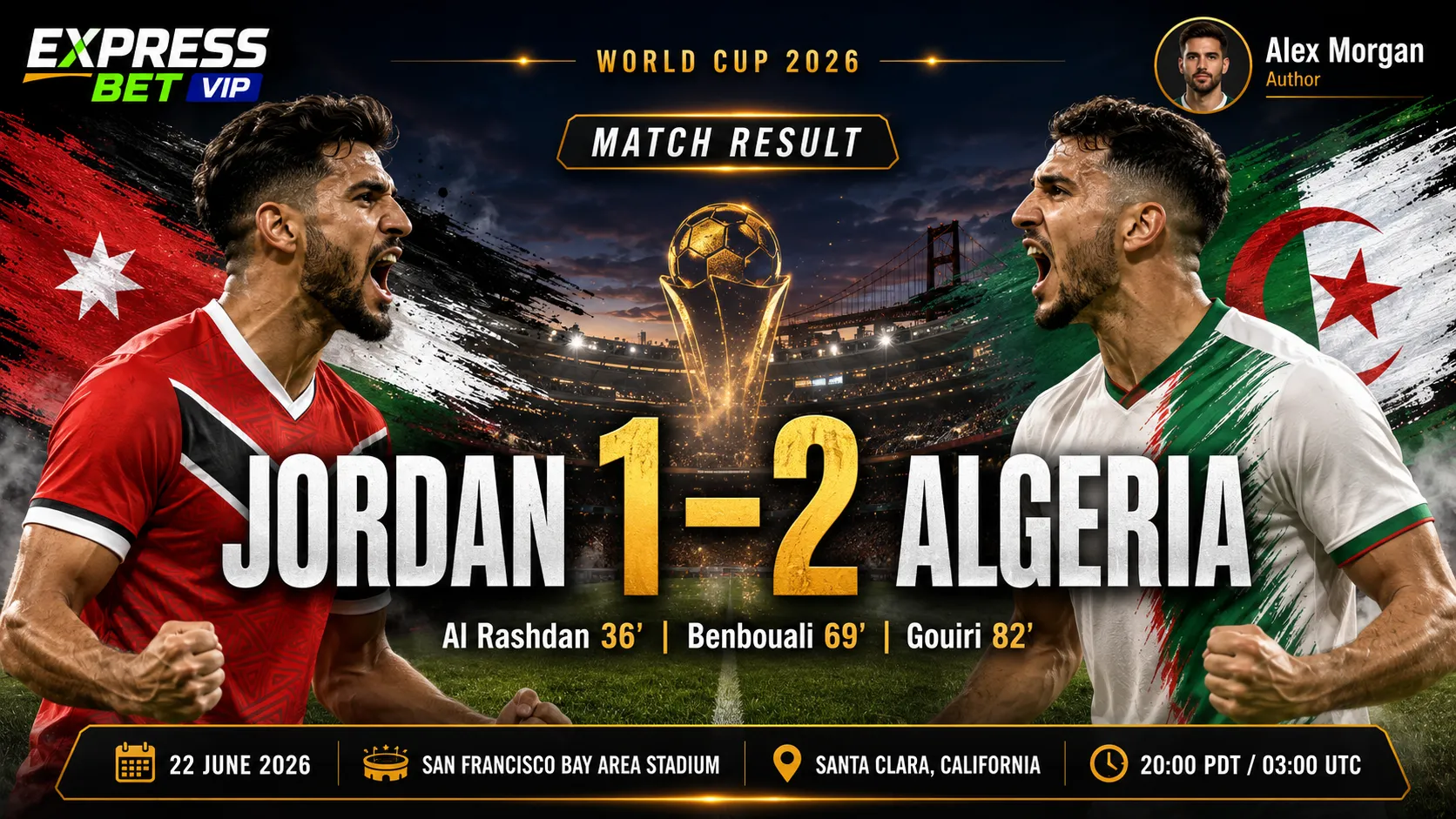
Algeria beat Jordan 2-1 in their FIFA World Cup 2026 Group J match at San Francisco Bay Area Stadium. Nizar Al Rashdan put Jordan ahead in the 36th minute, but half-time substitute Nadhir Benbouali equalised with a header from Riyad Mahrez’s corner in the 69th. Amine Gouiri completed the comeback from another corner sequence in the 82nd minute. Ibrahim Maza was named the official player of the match after driving Algeria’s second-half pressure. Algeria won because Vladimir Petković added a true penalty-box target and attacked Jordan’s set-piece weakness relentlessly. The evening conditions were mild—70°F and sunny—so weather was not the main cause. Algeria’s win, over 2.5 goals and both teams to score landed, but betting outcomes depended on the available prices and market timing. (FIFA World Cup 26™ SF Bay Area)
| Item | Detail | Data status |
|---|---|---|
| Match | Jordan vs Algeria | [CONFIRMED] |
| Competition | FIFA World Cup 2026 | [CONFIRMED] |
| Stage | Group stage | [CONFIRMED] |
| Group | Group J | [CONFIRMED] |
| Date | 22 June 2026 local / 23 June 2026 UTC | [CONFIRMED] |
| Kickoff time | 8:00 p.m. PDT / 03:00 UTC | [CONFIRMED] |
| Host country | United States | [CONFIRMED] |
| City | Santa Clara, California | [CONFIRMED] |
| Stadium | San Francisco Bay Area Stadium / Levi’s Stadium | [CONFIRMED] |
| Attendance | 68,371 | [CONFIRMED] |
| Final score | Jordan 1-2 Algeria | [CONFIRMED] |
| Half-time score | Jordan 1-0 Algeria | [CONFIRMED] |
| Goal scorers | Al Rashdan 36’; Benbouali 69’; Gouiri 82’ | [CONFIRMED] |
| Referee | Slavko Vinčić | [CONFIRMED] |
| VAR | Ivan Bebek; Jarred Gillett; Bram Van Driessche | [CONFIRMED] |
| Weather | Sunny, 70°F | [CONFIRMED] |
| Pitch condition | No specific surface defect reported | [UNKNOWN] |
| Main tournament impact | Jordan eliminated; Algeria remained in qualification contention | [CONFIRMED] |
The FIFA match centre confirms the venue, kickoff and referee, while the Bay Area Host Committee provides the attendance, weather, officials, lineups, misconduct and scoring summary. (FIFA)
| Layer | What it covers | Match example |
|---|---|---|
| [CONFIRMED] | Official score, goals, venue, lineups, cards and officials | Jordan 1-2 Algeria; Al Rashdan, Benbouali and Gouiri scored |
| [REPORTED] | Reputable reporting outside the official match record | Large neutral attendance alongside Jordanian and Algerian supporters |
| [OBSERVED] | Events described in live coverage or match reports | Algeria’s sustained second-half pressure and Gouiri goal VAR check |
| [ANALYSIS] | Tactical conclusions from verified events | Benbouali’s introduction changed Algeria’s box occupation |
| [MARKET SIGNAL] | Odds and settlement information | Algeria -209 and total-goals line of 2.5 on FOX Sports |
| [UNKNOWN] | Unavailable or incomplete verified data | Official xG, PPDA and full closing-odds movement |
This separation protects readers from a common post-match problem: analysis slowly disguising itself as fact. Search systems can safely extract the score and scorers, while tactical judgments remain clearly identified as interpretation. Our editorial comparison used the FIFA record for core facts, the host committee report for detailed event data and independent reporting for the tactical sequence. (FIFA World Cup 26™ SF Bay Area)
Jordan were 54 minutes away from their first World Cup victory. Then Algeria remembered that possession is more useful when it eventually arrives in the six-yard box.
Jamal Sellami’s team began in a 3-4-3 and accepted that Algeria would see more of the ball. Jordan protected the centre with three centre-backs, compressed the midfield and waited for Mousa Al Tamari and Ali Olwan to carry transitions. Algeria’s 4-3-3 produced territorial control but initially lacked a fixed penalty-box presence.
The first goal came against the broader direction of play. Ramiz Zerrouki lost possession in Algeria’s half, Mohannad Abu Taha combined with Al Tamari, and a mishit Al Tamari attempt rolled into the path of Al Rashdan. The midfielder moved into the box and placed a low shot beyond Luca Zidane. The goalkeeper reached it but could not keep it out. Jordan had their first lead in World Cup history. (FIFA World Cup 26™ SF Bay Area)
Jordan did not immediately retreat. Before half-time, Olwan turned smoothly and sent Mahmoud Al Mardi toward goal, but Aïssa Mandi recovered with a decisive sliding challenge. That intervention preserved Algeria’s one-goal deficit and prevented the match from developing into the sort of two-goal problem tournament favourites spend years explaining. (FIFA World Cup 26™ SF Bay Area)
Petković changed the match at half-time. Nabil Bentaleb replaced Zerrouki, while Benbouali replaced Hicham Boudaoui. Algeria gained a stronger aerial reference, a cleaner midfield base and more bodies occupying Jordan’s back three.
Benbouali equalised from a Mahrez corner in the 69th minute. Gouiri then scored from another corner sequence in the 82nd after Bensebaini redirected Anis Hadj Moussa’s delivery into the danger area. VAR checked the winning goal for a possible offside but allowed it to stand. (The Guardian)
The final score reflected the match. Jordan’s first-half lead was earned through sharp transition play, but Algeria’s second-half superiority was overwhelming. The Guardian recorded a 14-2 second-half shot advantage and a 5-1 edge in shots on target. Once the equaliser arrived, Jordan had too little possession and too little field position to recover. (The Guardian)
Algeria were attempting to build through midfield when Zerrouki’s inaccurate pass was intercepted by Abu Taha. The Jordan wing-back exchanged passes with Al Tamari and attacked the left side of the penalty area.
Al Tamari attempted a first-time finish but failed to connect cleanly. The loose ball became an accidental assist opportunity rather than a dead attack. Al Rashdan reacted first, entered the box and directed a low finish past Zidane.
The official scoring summary credited Al Tamari with the assist. Zidane touched the shot with his left glove, but the contact lacked enough force to push it around the post. Tactically, the goal rewarded Jordan’s willingness to attack Algeria’s rest defence immediately after a turnover. (FIFA World Cup 26™ SF Bay Area)
The emotional effect was larger than the single-goal margin. Jordan had never led a World Cup match before. Algeria now had to break down a compact five-man defensive line without offering Al Tamari transition space at the other end.
The equaliser came from the substitution that altered the match. Mahrez delivered an inswinging corner from Algeria’s right. Benbouali held his central position, rose above the Jordan defenders and directed his header into the bottom corner.
Abulaila leaned in the opposite direction and could not recover. The finish looked simple because the striker’s positioning had done the difficult work before the ball arrived.
The goal followed repeated Algeria free kicks, crosses and aerial attacks. Benbouali had already tested Abulaila with a header in the 63rd minute. Jordan received a warning, another warning, and then the invoice. (The Guardian)
Mahrez received the official assist. The goal also marked the third time Jordan had conceded from a set-piece sequence in their first two tournament matches, according to the Bay Area host report. (FIFA World Cup 26™ SF Bay Area)
Hadj Moussa won and took the corner after replacing Mahrez. His inswinging delivery reached Bensebaini, whose header sent the ball toward the far-post area. Gouiri beat his marker to the dropping ball and finished from inside the six-yard box.
The official scoring summary listed the goal as unassisted, while the match narrative identifies Bensebaini’s header as the action that moved the ball to Gouiri. This is a useful distinction: the build-up is visible and tactically relevant, but the official assist record remains “unassisted.” (FIFA World Cup 26™ SF Bay Area)
VAR checked a possible offside during the crowded aerial sequence. The review confirmed the goal. The decision was important but not especially controversial; the available footage and match reporting indicate a standard offside check rather than a disputed intervention. (The Guardian)
The winner completed Algeria’s transformation. A team that had lacked penalty-box density in the first half scored twice through crowded set-piece situations after adding Benbouali, Bentaleb and later Hadj Moussa.
| Minute | Moment | Why it mattered | Data status |
|---|---|---|---|
| 20’ | Mahrez controlled Boudaoui’s long ball but Abu Dahab recovered | Early proof that Algeria could access space behind Jordan’s wing-back line | [OBSERVED] |
| 33’ | Abulaila saved Mahrez’s bouncing effort | Jordan survived Algeria’s strongest early pressure | [OBSERVED] |
| 36’ | Al Rashdan scored | Jordan took their first World Cup lead | [CONFIRMED] |
| 45’ | Mandi stopped Al Mardi with a sliding challenge | Prevented Jordan from reaching half-time 2-0 ahead | [OBSERVED] |
| Half-time | Benbouali and Bentaleb introduced | Algeria added aerial power and midfield stability | [CONFIRMED] |
| 54’ | Abulaila saved Maza’s long-range effort | Algeria’s second-half pressure became visible immediately | [OBSERVED] |
| 64’ | Abu Dahab booked | Jordan centre-back had to defend the remaining match under disciplinary pressure | [CONFIRMED] |
| 69’ | Benbouali equalised | Algeria converted sustained set-piece pressure | [CONFIRMED] |
| 76’ | Hadj Moussa replaced Mahrez | Fresh one-against-one threat produced the corner for the winner | [CONFIRMED] |
| 82’ | Gouiri scored after VAR check | Algeria completed the comeback | [CONFIRMED] |
The decisive coaching moment came at half-time. Benbouali scored, Bentaleb improved Algeria’s control of second balls, and Hadj Moussa later supplied the corner sequence from which Gouiri won the match. (FIFA World Cup 26™ SF Bay Area)
| Local factor | Verified or observed detail | Football meaning | Direct match evidence | Betting-result meaning | Data status | Anti-template status |
|---|---|---|---|---|---|---|
| Stadium | San Francisco Bay Area Stadium / Levi’s Stadium | Large open-air bowl with natural grass | Match played in Santa Clara | Weather exposure existed, but conditions were mild | [CONFIRMED] | Fixture-specific |
| Attendance | 68,371 | Near-capacity crowd | Host committee match record | Strong late emotional pressure after Algeria’s comeback | [CONFIRMED] | Fixture-specific |
| Weather | Sunny, 70°F | Limited heat stress at evening kickoff | Official local recap | No strong reason to attribute late goals to heat | [CONFIRMED] | Fixture-specific |
| Roof | No full roof over the playing field | Wind and weather could theoretically matter | No rain or weather disruption reported | Avoid treating the venue like a controlled dome | [CONFIRMED] | Stadium-specific |
| Surface | Natural grass | Standard football ball movement | No verified slips or abnormal bounce | No reliable pitch-based betting angle | [CONFIRMED / UNKNOWN] | Stadium-specific |
| Hydration break | Break recorded after Chaïbi’s 73rd-minute shot | Temporary interruption of Algeria’s momentum | Guardian and KQED reporting | Possible live-tempo interruption, not a match cause | [OBSERVED] | Fixture-specific |
| Crowd composition | Jordanian, Algerian and neutral groups were visible | Atmosphere was not a conventional home advantage | Local reporters observed substantial neutral attendance | Crowd support should not be reduced to a simple home/away angle | [REPORTED] | Fixture-specific |
| Post-match atmosphere | Algerian celebrations continued through concourses | Reinforced the emotional scale of the comeback | KQED reported drums, horns and prolonged celebrations | Relevant to psychology, not pre-match predictability | [REPORTED] | Fixture-specific |
The local setting mattered most through crowd composition, not weather. The official recap recorded 70°F and sunshine, while kickoff took place at 8:00 p.m. Pacific Time. This was not an afternoon Santa Clara heat test. The match contained hydration breaks, but the available evidence does not support a claim that Jordan collapsed physically because of temperature. (FIFA World Cup 26™ SF Bay Area)
Levi’s Stadium is an open venue with a natural-grass surface. No reliable report identified heavy wind, surface damage, slips or abnormal goalkeeper handling. Algeria’s corners worked because of delivery, movement and Jordan’s marking—not because the weather moved the ball for Mahrez. (Levi’s® Stadium)
The crowd was more complex. The San Francisco Chronicle reported that many of the 68,371 spectators appeared neutral, even though Algerian and Jordanian colours were prominent. KQED described strong support for both Arab teams before the match and especially loud Algerian celebrations afterward. (KQED)
That atmosphere may have increased the psychological pressure after Algeria equalised. Once the 1-1 goal arrived, the noise shifted with the match. There is no verified evidence that Jordan’s defenders could not communicate, but Algeria’s growing momentum was audible as well as tactical.
| Stadium factor | Detail |
|---|---|
| Stadium | San Francisco Bay Area Stadium / Levi’s Stadium |
| Standard capacity | Approximately 68,500 |
| Attendance | 68,371 |
| Pitch type | Natural grass |
| Roof status | Open-air playing area |
| Acoustic effect | Strong Algerian celebrations reported; exact on-field communication effect unknown |
| Surface condition | No match-specific defect reported |
| Wind relevance | Exact wind not available from verified public data |
| Goalkeeper distribution effect | No verified effect |
| Set-piece effect | Two Algeria goals followed corners |
| Communication effect | Possible under crowd pressure, but not confirmed |
| Data status | Mixed confirmed and unknown |
The available match evidence does not show a clear stadium-specific effect beyond the normal venue conditions.
The set-piece pattern was tactical rather than architectural. Algeria generated ten corners to Jordan’s one, and both second-half goals developed from corner deliveries. The open-air stadium did not explain that 10-1 imbalance; territorial pressure did. (FIFA World Cup 26™ SF Bay Area)
The near-capacity crowd supplied a genuine event atmosphere. Local coverage described an audience containing strong Jordanian and Algerian sections alongside many neutral World Cup spectators. That mixture made the match feel closer to a regional derby staged on neutral territory than a straightforward home-and-away contest. (KQED)
| Item | Detail |
|---|---|
| City | Santa Clara |
| Host country | United States |
| Time zone | Pacific Daylight Time |
| June climate | Generally warm, dry days with cooler evenings |
| Match temperature | 70°F |
| Humidity | Not available from verified public data |
| Wind | Not available from verified public data |
| Rain/sun | Sunny; no rain reported |
| Altitude | Low altitude |
| Likely physical effect | Mild evening conditions suitable for sustained pressing |
| Actual evidence | Algeria increased pressure after half-time rather than fading |
| Data status | Temperature confirmed; humidity and wind unknown |
Santa Clara’s June climate typically produces warm afternoons and milder evenings, and this match fitted that pattern. The official temperature of 70°F offered no obvious reason for either team to conserve energy excessively. (Weather Spark)
Algeria’s second-half intensity increased. That directly contradicts a heat-fatigue explanation. The substitute-driven press, repeated corners and 14-2 second-half shot advantage point toward tactical control, not climatic survival. (The Guardian)
There were no verified cramps, weather-related injuries or goalkeeper mistakes linked to moisture, wind or surface speed. Substitutions were driven primarily by game state: Algeria added attackers while trailing, then added defenders after taking the lead.
Jordan’s 3-4-3 became a 5-4-1 without the ball. Abu Taha and captain Ehsan Haddad dropped alongside the back three, while Al Mardi and Al Tamari narrowed around the central midfield pair. This reduced Algeria’s direct access through the half-spaces.
Algeria’s 4-3-3 held territorial control. Boudaoui and Zerrouki circulated behind Maza, while Mahrez started from the right and Chaïbi operated from the opposite side. Gouiri moved across the front line but often lacked a second central runner occupying Jordan’s centre-backs.
The main Algerian pattern was the long diagonal toward Mahrez. Boudaoui found him in the 20th and 33rd minutes. The second opportunity forced Abulaila into a save, but Jordan’s defenders generally recovered well around the winger. (FIFA World Cup 26™ SF Bay Area)
Jordan’s best route was transition. Al Tamari’s speed demanded that Algeria keep protection behind their full-backs, while Olwan offered a physical outlet. The opening goal followed exactly that logic: regain possession, combine quickly and attack before Algeria’s midfield could reset.
Zerrouki’s mistake was particularly damaging because Algeria’s attacking structure had pushed players ahead of the ball. His turnover exposed a central lane and forced the defence to retreat toward its own goal. He received a yellow card in the 44th minute and was replaced at half-time. (FIFA World Cup 26™ SF Bay Area)
Jordan’s half-time lead was deserved in the narrow sense that they had executed the match’s most decisive action. Algeria had produced more territory and attempts, but Jordan had produced the cleaner transition.
Petković’s half-time problem was clear: Algeria needed a striker who would pin the centre-backs, attack crosses and occupy the six-yard area. Sellami’s problem was the opposite: Jordan had to protect the lead without sinking so deep that every Algeria possession ended in a cross or corner.
Petković replaced two midfielders with Bentaleb and Benbouali. The nominal 4-3-3 became more aggressive in possession. Bentaleb anchored the build-up while Benbouali stayed high between Jordan’s centre-backs. Gouiri could now move away from the central reference point instead of carrying the entire striker role alone.
Maza became the key connector. The official host committee named him player of the match, and the live report described him as especially influential after half-time. He began carrying the ball through midfield, shooting from range and combining around Jordan’s defensive line. (FIFA World Cup 26™ SF Bay Area)
Jordan still found occasional transition opportunities. Al Tamari reached the penalty area in the 58th minute, and Al Rawabdeh shot over in the 62nd. These moments showed that the lead was not being defended through total passivity—at least not initially. (FIFA World Cup 26™ SF Bay Area)
The match then compressed around Jordan’s box. Benbouali tested Abulaila. Mahrez and Chaïbi delivered repeated dead balls. Abu Dahab was booked. Every Algeria player except Zidane moved into the attacking third for one free-kick sequence. (The Guardian)
Benbouali’s equaliser changed Jordan’s psychology. Before 1-1, defending deep had a clear reward. After 1-1, the same positioning left Jordan unable to pursue the three points they now needed.
Sellami introduced Fakhoury for Al Mardi in the 76th minute, but Algeria’s bench remained more influential. Hadj Moussa replaced Mahrez and immediately attacked defenders, shot, won corners and delivered the set piece preceding Gouiri’s winner. (The Guardian)
Once Algeria led, Petković closed the match with Jaouen Hadjam and Zineddine Belaid. Jordan had seven minutes of stoppage time but could not create a final clear chance. Algeria controlled the ball near the corners and allowed the clock to become a defensive midfielder. (The Guardian)
Algeria won because their second-half structure fixed three first-half problems: insufficient box occupation, weak control of second balls and excessive dependence on Mahrez creating from static wide positions.
Benbouali gave Algeria a fixed central target. Bentaleb recovered loose balls and allowed Maza to receive higher. Gouiri became more difficult to track because he could move around another striker instead of wrestling with three centre-backs alone.
Jordan’s back five initially handled Algeria’s first line of attack. The weakness appeared when deliveries arrived repeatedly. Three centre-backs do not automatically guarantee aerial control. They must also protect zones, track runs and manage second contacts.
The equaliser illustrated the first failure: Benbouali won the initial aerial duel. The winner illustrated the second: Jordan failed to clear the first header, then Gouiri reached the bouncing ball first.
Algeria’s counterpressing also improved. Jordan’s forwards received fewer clean transition passes after half-time. The Guardian’s 14-2 second-half shot count captures the territorial imbalance more clearly than possession alone. (The Guardian)
Jordan’s decision to defend deeper was understandable but eventually self-defeating. With Al Tamari and Olwan increasingly isolated, clearances returned immediately. A low block can protect a lead; it cannot protect one indefinitely when it also produces ten opposition corners.
The local conditions did not materially change the tactical contest. Mild evening weather allowed Algeria to maintain pressure. There was no rain or strong-wind evidence to disrupt their crossing plan.
| Zone | Edge | Evidence | Key player | Local-condition effect | Result impact |
|---|---|---|---|---|---|
| Jordan left / Algeria right | Algeria | Mahrez received repeated diagonals and assisted from a corner | Riyad Mahrez | No wind issue reported | Equaliser created |
| Jordan right / Algeria left | Jordan early, Algeria late | Al Tamari threatened transitions; Hadj Moussa later won corners | Al Tamari / Hadj Moussa | Mild weather supported repeated sprints | Both teams’ main transition lane |
| Central midfield | Algeria | Bentaleb and Maza controlled the second half | Ibrahim Maza | No fatigue-based decline | Sustained pressure |
| Penalty box | Algeria | Benbouali header and Gouiri close-range winner | Benbouali / Gouiri | No surface issue | Decisive |
| Set pieces | Algeria | Ten corners and two goals from corner sequences | Mahrez / Hadj Moussa | Dry conditions supported consistent delivery | Main tactical difference |
| Transitions | Jordan first half | Opening goal followed Zerrouki turnover | Al Tamari / Al Rashdan | No clear local effect | Produced Jordan lead |
| Defensive third | Algeria late | Jordan could not create after falling behind | Bensebaini / Mandi | Crowd pressure secondary | Protected victory |
| Goalkeeper build-up | No major edge | Neither side’s build-up was decided by goalkeeper passing | Abulaila / Zidane | Wind not verified | Limited |
| Bench impact | Algeria | Benbouali scored; Bentaleb stabilised; Hadj Moussa created winner | Benbouali | Mild conditions allowed high substitute intensity | Match-winning |
The factual foundation for this map comes from the official lineups, substitution sequence, 10-1 corner count and match-event chronology. (FIFA World Cup 26™ SF Bay Area)
These are editorial ratings based on the verified event record and tactical role. They are not official FIFA ratings.
| Player | Rating | Assessment |
|---|---|---|
| Yazeed Abulaila | 7.5 | Made several strong saves and delayed Algeria’s comeback. Could do little about the repeated close-range pressure. |
| Yazan Al Arab | 6.5 | Defended the first phase well but struggled once Algeria loaded the box. |
| Husam Abu Dahab | 5.5 | Produced an important early recovery on Mahrez but was later booked and beaten in aerial pressure. |
| Abdallah Nasib | 6.0 | Strong positioning in the first half; less effective during Algeria’s set-piece surge. |
| Mohannad Abu Taha | 6.5 | Intercepted Zerrouki’s pass and helped construct the opening goal. |
| Nizar Al Rashdan | 7.5 | Scored Jordan’s first World Cup lead goal and covered considerable midfield space. |
| Noor Al Rawabdeh | 6.5 | Competed well centrally and carried the ball forward before shooting over. |
| Ehsan Haddad | 6.0 | Helped preserve the defensive structure but could not move the team higher after the equaliser. |
| Mahmoud Al Mardi | 6.0 | Nearly reached Olwan’s through pass before Mandi’s intervention. |
| Ali Olwan | 6.5 | Offered a useful outlet and created one of Jordan’s best late-first-half attacks. |
| Mousa Al Tamari | 7.0 | Credited with the assist and remained Jordan’s main transition threat. |
| Odeh Fakhoury | 5.5 | Entered after Algeria had taken control and struggled to receive in useful areas. |
| Ali Azaizeh | 5.5 | Limited time to influence the attack. |
| Other substitutes | 5.5 | Introduced too late to change the match state. |
| Player | Rating | Assessment |
|---|---|---|
| Luca Zidane | 5.5 | Touched Al Rashdan’s shot but failed to keep it out. Otherwise lightly tested. |
| Rayan Aït-Nouri | 6.5 | Advanced consistently and helped maintain width before being replaced. |
| Ramy Bensebaini | 7.5 | Strong defensively and redirected the winning corner toward Gouiri. |
| Aïssa Mandi | 7.0 | His sliding intervention against Al Mardi prevented a possible second Jordan goal. |
| Rafik Belghali | 6.5 | Offered width and supported the second-half territorial push. |
| Ramiz Zerrouki | 4.5 | His turnover preceded Jordan’s goal; booked and removed at half-time. |
| Hicham Boudaoui | 6.0 | Supplied useful long passes to Mahrez but was sacrificed for a more attacking structure. |
| Ibrahim Maza | 8.5 | Official player of the match. Drove through midfield, tested the goalkeeper and sustained pressure. |
| Farès Chaïbi | 6.5 | Delivered several set pieces and forced a second-half save. |
| Riyad Mahrez | 7.5 | Produced the corner assist and remained Algeria’s primary first-half creator. |
| Amine Gouiri | 7.5 | Scored the winning goal and remained active despite limited first-half support. |
| Nadhir Benbouali | 8.0 | Changed the box occupation and scored the equaliser. |
| Nabil Bentaleb | 7.0 | Improved ball recovery and allowed Algeria’s attackers to stay higher. |
| Anis Hadj Moussa | 7.5 | Immediate dribbling threat; won and delivered the corner preceding the winner. |
| Jaouen Hadjam | 6.0 | Helped close the match. |
| Zineddine Belaid | 6.0 | Added defensive security in the final minutes. |
Maza’s official player-of-the-match award, the goal involvements and the key substitution details are confirmed by the Bay Area Host Committee and FOX Sports event record. (FIFA World Cup 26™ SF Bay Area)
| Category | Selection | Reason |
|---|---|---|
| Man of the Match | Ibrahim Maza | Official award winner and Algeria’s most influential second-half carrier |
| Best attacker | Amine Gouiri | Scored the winning goal and remained a constant box threat |
| Best midfielder | Ibrahim Maza | Connected possession to penetration after half-time |
| Best defender | Ramy Bensebaini | Defended transitions and contributed to the winning sequence |
| Best goalkeeper | Yazeed Abulaila | Made repeated saves under sustained second-half pressure |
| Best substitute | Nadhir Benbouali | Scored the equaliser and transformed Algeria’s attacking structure |
| Most underrated performance | Nabil Bentaleb | Stabilised midfield and improved second-ball control |
| Most disappointing performance | Ramiz Zerrouki | Turnover before Jordan’s goal, yellow card and half-time withdrawal |
The official player award went to Maza, while the event record confirms Benbouali’s immediate impact and Zerrouki’s difficult first half. (FIFA World Cup 26™ SF Bay Area)
| Player | Team | Incident | Minute | Status | Next-match impact | Data status |
|---|---|---|---|---|---|---|
| Ramiz Zerrouki | Algeria | Serious foul | 44’ | Yellow card | Suspension impact not confirmed | [CONFIRMED] |
| Husam Abu Dahab | Jordan | Serious foul | 64’ | Yellow card | Jordan already eliminated; accumulation status not confirmed | [CONFIRMED] |
| Confirmed injuries | Both | None listed in official match summary | — | None confirmed | None confirmed | [UNKNOWN] |
| Red cards | Both | None | — | No red cards | None | [CONFIRMED] |
Only two cautions were listed in the official misconduct summary. No confirmed injury or concussion event materially affected the match. (FIFA World Cup 26™ SF Bay Area)
Slovenian referee Slavko Vinčić controlled the match with two cautions and no red cards. FIFA listed him as the referee, with Tomaz Klančnik and Andraž Kovačić as assistants. (FIFA)
The principal VAR intervention followed Gouiri’s 82nd-minute winner. Officials checked whether an offside had occurred during the crowded corner sequence. The goal was confirmed.
The review was significant because it determined the winner, but available reporting does not present it as a major controversy. It was a normal factual check complicated by multiple players contesting the first header. (The Guardian)
Seven minutes of stoppage time were added. Jordan failed to create a clear final chance, while Algeria used short corners and controlled possession to protect the result. (The Guardian)
| Statistic | Jordan | Algeria |
|---|---|---|
| Possession | 30% | 55% |
| Shots | 8 | 18 |
| Shots on target | 4 | 8 |
| Corners | 1 | 10 |
| Offsides | 1 | 0 |
| Fouls | 10 | 6 |
| Yellow cards | 1 | 1 |
| Red cards | 0 | 0 |
| Second-half shots | 2 | 14 |
| Second-half shots on target | 1 | 5 |
| xG | Not available | Not available |
The host committee’s possession values total 85%, not 100%. They should therefore be treated as the provider’s published figures rather than a closed possession split. The shot, corner, offside and foul data are internally clearer and strongly support the conclusion that Algeria controlled the second half. (FIFA World Cup 26™ SF Bay Area)
The 10-1 corner count is the most tactically meaningful statistic. Algeria did not merely have more possession; they repeatedly finished attacks around Jordan’s goal line. Both Algerian goals developed from corners, making territorial pressure directly productive.
This section analyzes settled markets after the match. It does not provide a guarantee or imply that the result was obvious beforehand.
| Market | Pre-match expectation | Actual result | Winning side | Key trigger | Local factor | Caution |
|---|---|---|---|---|---|---|
| Match winner | Algeria were favourites | Algeria won 2-1 | Algeria | Second-half substitutions and set pieces | Mild weather supported sustained pressure | Favourite status does not guarantee value |
| Draw | Jordan led at half-time | No draw | Draw lost | Gouiri’s 82’ winner | Crowd momentum followed Algeria comeback | Live price depended on timing |
| Over/under 2.5 | Line listed at 2.5 | Three goals | Over 2.5 | Two Algeria second-half goals | Weather not decisive | Same angle may not repeat |
| Both teams to score | Required a Jordan goal | Both scored | BTTS Yes | Al Rashdan opener | No clear local cause | Team styles still matter |
| Correct score | 1-2 | 1-2 | Correct-score 1-2 | Late Gouiri finish | None clear | High-variance market |
| First goalscorer | Al Rashdan | Al Rashdan scored first | Al Rashdan | Algeria turnover | None clear | Long-price market |
| Anytime scorer | Benbouali and Gouiri scored | Both landed if offered | Player dependent | Substitution and box role | None clear | Starting status matters |
| Corners | Algeria territorial advantage | Algeria won corners 10-1 | Algeria corner lines likely benefited | Sustained second-half pressure | Open, dry conditions did not disrupt delivery | Exact line required |
| Cards | Two cautions | Moderate-card match | Line dependent | Zerrouki and Abu Dahab fouls | No verified heat effect | Referee profile matters |
| Live betting | Jordan led 1-0 at HT | Algeria comeback | Algeria live backers benefited | Benbouali introduction | Mild conditions allowed pressure to continue | Live odds move quickly |
FOX Sports listed Algeria at -209 and the total at 2.5 goals. Algeria won and the teams produced three goals, so those displayed markets settled on Algeria and over 2.5. (FOX Sports)
The match punished one casual assumption: that a compact underdog leading at half-time is automatically controlling the game. Jordan controlled the score but not the territory. Algeria’s attacking substitutions made the live picture materially different from the first half.
A bettor reading only possession could still have been misled. The better signals were Algeria’s corner volume, the introduction of Benbouali and Jordan’s inability to move the defensive line away from their box.
| Local factor | Market possibly affected | Actual evidence | Interpretation | Overreaction risk | Safer conclusion |
|---|---|---|---|---|---|
| 70°F evening weather | Second-half totals, pressing | Algeria intensified after half-time | Conditions did not restrict pressure | Calling weather an Algeria advantage | Tactics mattered more |
| Open-air stadium | Corners, crossing, goalkeeper kicking | No rain or strong wind reported | Deliveries were stable | Assuming all open venues increase variance | No verified weather distortion |
| Natural grass | Passing and tackling | No abnormal bounce or slipping reported | Standard football conditions | Creating a pitch narrative without evidence | Surface impact unknown |
| Near-capacity crowd | Live momentum | Algeria support became loud after comeback | Psychological support may have grown | Treating crowd as predictive | Atmosphere was secondary |
| Hydration break | Live tempo | Break followed Chaïbi’s 73’ shot | Brief interruption after equaliser | Assuming it changed momentum | No clear result effect |
| Large neutral contingent | Match-winner psychology | Many spectators had no fixed allegiance | Conventional home advantage was limited | Assigning the crowd wholly to Algeria | Support was mixed |
Local conditions did not explain the 2-1 score. Santa Clara provided mild, dry conditions. Algeria won through changes in personnel, set-piece execution and sustained penalty-box occupation.
At the final whistle, Jordan had lost their opening two matches and were eliminated from qualification contention. Their final group match against Argentina remained an opportunity to earn a first World Cup result, but not to advance. (The Guardian)
Algeria moved into the final round with three points and faced Austria in Kansas City. Argentina had already secured top position, while Algeria needed to beat Austria to overtake them for second place and guarantee progression without relying on the ranking of third-placed teams. (The Guardian)
The result therefore did two jobs at once: it eliminated Jordan and converted Algeria’s final group match from damage limitation into a direct qualification contest.
Algeria corrected the starting plan instead of defending it out of pride.
Petković recognised that the original midfield offered control but insufficient penalty-box presence. Benbouali entered and scored. Bentaleb entered and stabilised the structure. Hadj Moussa later entered and created the corner sequence for the winner.
Algeria also maintained emotional control after conceding. They did not force low-quality shots immediately. They continued circulating, generated repeated dead balls and trusted the volume of entries.
The set-piece preparation was decisive. Mahrez’s delivery found Benbouali. Hadj Moussa’s delivery reached Bensebaini and then Gouiri. Both goals punished different stages of Jordan’s aerial defending.
Jordan defended the lead too close to their own goal.
The low block was initially rational. It reduced space for Gouiri and protected the central lane. The problem was that Jordan lost the ability to clear with control. Al Tamari and Olwan became isolated, and Algeria recovered second balls without meaningful resistance.
Jordan’s set-piece defending failed twice. For the equaliser, Benbouali won the first aerial action. For the winner, Jordan failed to defend both the initial header and the second ball.
Sellami’s substitutions did not restore field position. Fakhoury replaced Al Mardi, but Jordan’s possession remained too deep. By the time the team needed to chase at 1-1 and then 1-2, the match had already acquired Algeria’s rhythm.
The defeat was not caused by a lack of effort. It was caused by an increasingly narrow route out of pressure.
Petković won the tactical contest through his half-time intervention.
Removing Zerrouki was necessary after the turnover, yellow card and unstable first half. Replacing Boudaoui with Benbouali was more aggressive. It reduced midfield numbers but gave Algeria the penalty-box target the match required.
The gamble worked because Bentaleb and Maza controlled the second ball behind the attacking line. Algeria did not simply add a striker and start launching hopeful crosses. They created a structure capable of sustaining those crosses.
Introducing Hadj Moussa for Mahrez was another strong decision. Mahrez had assisted the equaliser, but fresh dribbling against a tired block produced new corners and the winning sequence.
Sellami’s starting plan worked for a half. Jordan’s 3-4-3 contained Algeria centrally and created transition opportunities.
The second-half response was weaker. Jordan continued protecting the box even after Algeria’s substitutions changed the aerial matchup. More pressure on Mahrez and Chaïbi before deliveries entered the area may have reduced the volume.
Jordan also needed an earlier method for connecting midfield to the front three. Once Algeria equalised, Sellami’s side had little capacity to change from survival mode to pursuit mode.
Al Rashdan’s goal gave Jordan their first lead in a FIFA World Cup match. It was also reported as his fifth international goal. (FIFA World Cup 26™ SF Bay Area)
Algeria recorded their first World Cup victory after conceding the opening goal. Jordan’s defeat confirmed that their debut tournament would end in the group stage. (The Guardian)
Ibrahim Maza received the official player-of-the-match award. (FIFA World Cup 26™ SF Bay Area)
Jordan vs Algeria followed an old tournament pattern: an underdog scores first, retreats closer to goal and gradually discovers that every clearance is only the start of the next attack.
This was not a collapse in the spectacular sense. Jordan did not concede three goals in ten minutes or lose discipline. Their control eroded by degrees—one corner, one free kick and one second ball at a time.
Algeria’s comeback also carried historical weight. Their last World Cup appearance before 2026 had been in 2014, when they reached the Round of 16. The victory restored a realistic path toward another knockout appearance.
The match’s broader lesson was familiar: possession without penalty-box presence can be sterile, but once Algeria added Benbouali, their possession acquired a destination.
The only major VAR incident was the check of Gouiri’s winning goal. Officials examined a possible offside during the corner sequence and upheld the goal. (The Guardian)
No penalty dispute, red-card controversy, crowd disorder, pitch invasion or post-match confrontation was confirmed in the verified sources.
Local reporting instead emphasised a largely celebratory atmosphere among Arab communities supporting both teams, followed by sustained Algerian celebrations after the match. (KQED)
This review combines:
The central analytical finding is specific to this match: Algeria did not merely “improve after half-time.” They replaced midfield control without box presence with a structure built around Benbouali’s aerial occupation, Maza’s carries and stronger second-ball recovery.
| Detail | Included | Status | Fixture-specific | Future update needed |
|---|---|---|---|---|
| Stadium detail | Yes | Confirmed | Yes | Update only if FIFA revises capacity |
| City detail | Yes | Confirmed | Yes | No |
| Weather detail | Yes | Confirmed | Yes: 70°F and sunny | Add humidity/wind if officially published |
| Pitch detail | Limited | Confirmed/unknown | Yes | Add match surface report if available |
| Crowd detail | Yes | Reported | Yes: mixed Arab support and neutral audience | Update only with official crowd breakdown |
| Travel/acclimatisation | Limited | Unknown | Not forced | Add only if federations publish details |
| Betting-risk detail | Yes | Analysis-based | Yes | Add licensed closing odds if available |
| Tactical-local connection | Yes | Analysis-based | Yes | No |
| Anti-template status | Passed | Editorial check | Yes | No |
| Data point | Status | Source type |
|---|---|---|
| Final score | Confirmed | FIFA and official host committee |
| Goal scorers | Confirmed | FIFA and official host committee |
| Goal times | Confirmed | Official scoring summary |
| Assists | Confirmed | Official scoring summary |
| Stadium | Confirmed | FIFA and stadium event page |
| City | Confirmed | FIFA and host committee |
| Attendance | Confirmed | Host committee |
| Referee | Confirmed | FIFA |
| VAR officials | Confirmed | Host committee |
| Lineups | Confirmed | Host committee and FOX Sports |
| Substitutions | Confirmed | Host committee and event feed |
| Cards | Confirmed | Host committee |
| Injuries | Unknown | No confirmed material injury |
| Match statistics | Confirmed/provider-reported | Host committee |
| xG | Unknown | Not available from verified public data |
| Odds | Reported | FOX Sports |
| Stadium factors | Confirmed/reported | Levi’s Stadium and local media |
| City factors | Confirmed/reported | Host committee and local media |
| Weather | Confirmed | Host committee |
| Pitch condition | Unknown | No match-specific issue published |
| Crowd profile | Reported | KQED and San Francisco Chronicle |
| Tournament impact | Confirmed | FIFA and Guardian |
Update the article if:
Last updated: 10 July 2026, 7:30 a.m. Pacific Time
Algeria beat Jordan because they changed the physical geometry of the match.
The first-half Algeria side moved the ball but did not consistently occupy Jordan’s penalty area. The second-half Algeria side had Benbouali pinning centre-backs, Gouiri attacking second balls, Maza carrying through midfield and Bentaleb protecting the structure behind them.
Jordan’s lead was not accidental. Their transition was intelligent, Al Rashdan’s reaction was sharp and the first-half defensive organisation was disciplined. But the match eventually became too concentrated around Abulaila’s goal.
The 2-1 scoreline was fair. Algeria produced more shots, more shots on target, ten times as many corners and overwhelming second-half pressure. Jordan’s goalkeeper prevented a wider margin.
The local conditions were favourable rather than decisive. Santa Clara delivered a mild 70°F evening, a dry natural-grass field and a near-capacity crowd. There was no weather excuse available. Algeria’s comeback came from football decisions: substitutions, set-piece delivery and better work inside the box.
For Algeria, the victory reopened the tournament. For Jordan, it ended qualification hopes but supplied their first World Cup lead and another competitive performance. For bettors, the match offered a more durable lesson than the final score: when a favourite trails but begins winning corners, second balls and penalty-box occupation, the match state may be changing before the scoreboard admits it.
Football betting carries financial risk. Correct tactical analysis does not guarantee a winning bet. Odds change before and during matches, particularly after goals, substitutions, cards, VAR checks and changes in territorial pressure.
Local conditions can be overvalued. In this match, mild Santa Clara weather did not cause Algeria’s comeback. Tactical substitutions and set-piece pressure were more important.
Never chase losses. Do not stake money required for food, housing, bills or other daily needs. Set financial and time limits, take breaks, check local gambling laws and use licensed operators only. Betting should remain entertainment, not income.
Algeria beat Jordan 2-1 in FIFA World Cup 2026 Group J.
Nizar Al Rashdan scored for Jordan. Nadhir Benbouali and Amine Gouiri scored for Algeria.
Ibrahim Maza was named the official player of the match.
Jordan were eliminated after two defeats. Algeria moved to three points and kept their qualification hopes alive before facing Austria.
Algeria won, over 2.5 goals landed and both teams scored. Exact betting returns depended on the odds and the time at which each market was taken.