
Korea Republic vs Czechia Match Result: Final Score, Goals, Key Moments, and Tactical Analysis
Table of Contents Show
Views 178
Korea Republic vs Czechia Match Result
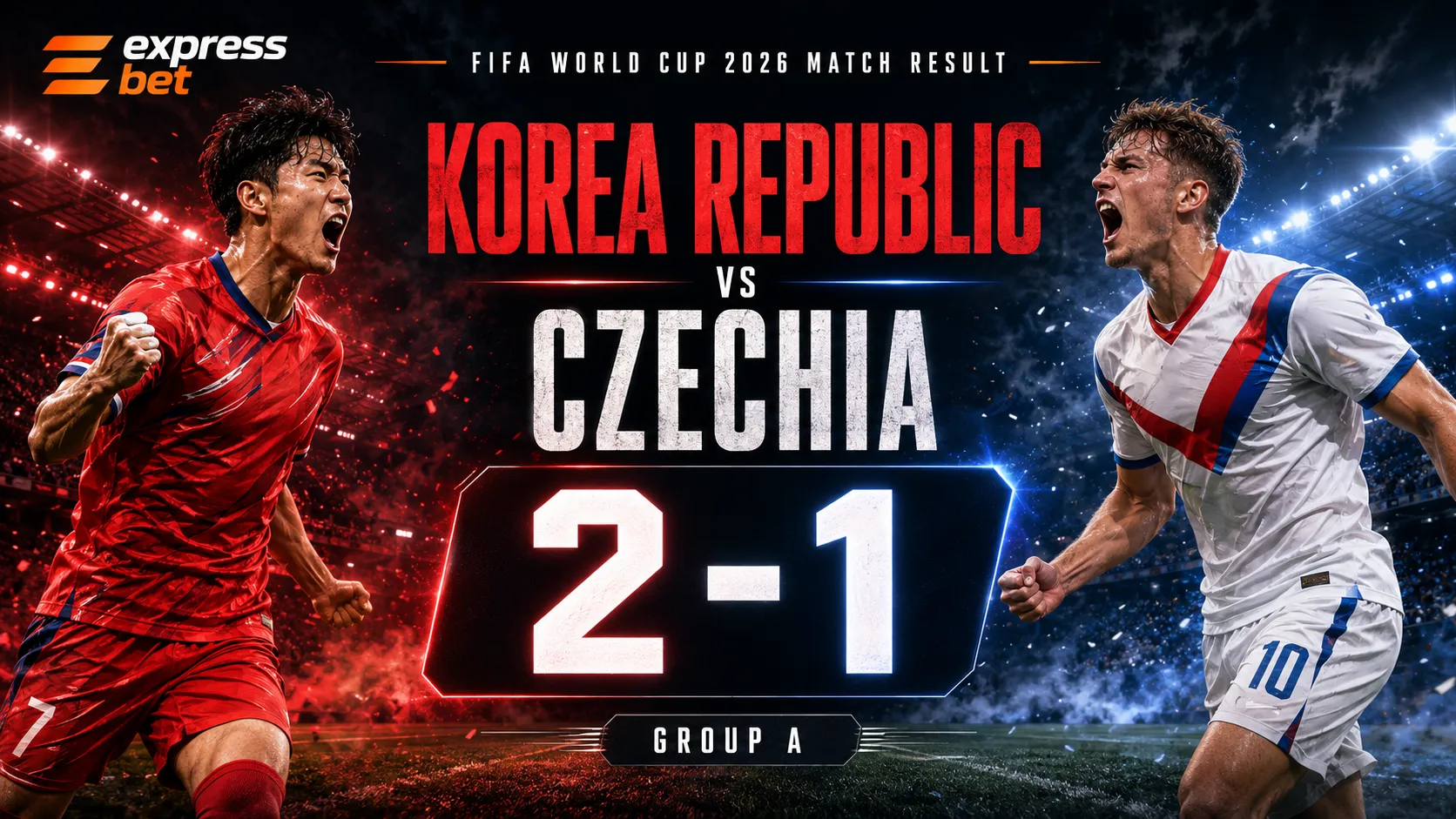
Korea Republic beat Czechia 2-1 in their FIFA World Cup 2026 Group A opener at Guadalajara Stadium. Czechia took the lead in the 59th minute through Ladislav Krejčí, who punished Korea Republic with the sort of aerial authority that usually comes with a warning label. Korea Republic answered through Hwang In-beom in the 67th minute, then won it in the 80th minute when substitute Oh Hyeon-gyu finished from Hwang’s assist. The turning point was Korea’s reaction after going behind. Hwang was the best player on the pitch. The result put Korea Republic on three points and left Czechia under immediate group pressure. Bettors who backed Korea Republic and over 2.5 goals were rewarded, depending on odds and market timing.
Match Information
| Detail | Information |
|---|---|
| Match | Korea Republic vs Czechia |
| Competition | FIFA World Cup 2026 |
| Stage | Group A, Matchday 1 |
| Date | 11 June 2026 local date / 12 June in some broadcast listings |
| Host country | Mexico |
| City | Guadalajara / Zapopan area |
| Stadium | Guadalajara Stadium |
| Final score | Korea Republic 2-1 Czechia |
| Half-time score | Korea Republic 0-0 Czechia |
| Attendance | 44,985 |
| Stadium capacity | 45,664 |
| Referee | Not confirmed in available public match data used for this article |
| Weather | Detailed match-time weather not confirmed |
| Pitch condition | No major confirmed pitch controversy |
| Formations | Korea Republic 3-4-3; Czechia 3-4-3 |
| Goals | Ladislav Krejčí 59’; Hwang In-beom 67’; Oh Hyeon-gyu 80’ |
| Penalties | None confirmed |
| Red cards | None confirmed |
| VAR | No decisive VAR incident confirmed |
| Betting result | Korea Republic win; over 2.5 goals |
Final Score and Match Summary
The Korea Republic vs Czechia match result was a 2-1 comeback win for Korea Republic. It was also a useful reminder that football games can spend nearly an hour pretending to be sleepy before suddenly behaving like they have remembered the tournament has started.
The first half was cautious. Too cautious, at times. Both teams began in 3-4-3 systems, and both spent long spells trying to avoid the first serious mistake rather than forcing the first serious wound. Korea Republic had more technical rhythm. Czechia had more height, more physical presence, and a plan that did not require beauty to be effective. Tournament football has room for both. It has never been a finishing school.
Korea Republic controlled more of the ball and created the cleaner passages, but Czechia were not harmless. They carried obvious danger from set pieces, long throws, and aerial deliveries. That mattered because the first goal came from exactly that zone of Czech strength.
In the 59th minute, Ladislav Krejčí put Czechia ahead with a header after a long throw into the penalty area. It was not complicated football. It did not need to be. A ball arrived, bodies moved, Korea Republic lost the aerial duel, and Czechia led.
For a few minutes, the match asked Korea a serious question. Could they keep their football intact after conceding? Or would they become another side with possession, territory, and a sad little paragraph about missed chances?
They answered well. Hwang In-beom equalised in the 67th minute after a sharp move involving Lee Kang-in. Then Hwang became provider in the 80th minute, crossing for substitute Oh Hyeon-gyu to score the winner.
That sequence defined the match. Czechia won the aerial moment. Korea Republic won the footballing argument after it. Hwang turned the game with a goal and an assist. Oh gave the bench its headline. Son Heung-min did not score, but his movement and presence shaped the match before he was replaced.
The final minutes were nervous. Czechia pushed late, with Adam Hložek and Michal Sadílek involved in late attempts, but Korea Republic held. Not comfortably. Nobody holds a one-goal World Cup lead comfortably unless they are lying or German in 2014. But they held.
Goal Timeline
59’ — Ladislav Krejčí, Czechia, header
Czechia’s goal came from one of their clearest weapons: height, delivery, and penalty-box force.
The move started with a long throw into the Korean box. Vladimir Coufal supplied the assist. Krejčí attacked the ball and headed Czechia into the lead. It was a classic Czech tournament goal: direct, muscular, and deeply uninterested in aesthetic apology.
Korea Republic had defended much of the match with decent compactness, but this was a specific vulnerability. Three-centre-back systems can still suffer when the ball is thrown or crossed into the crowded area and the first duel is lost. The second ball, the goalkeeper’s decision, the marking line — everything becomes slightly panicked.
The goal changed the emotional weight of the match. Korea had enjoyed more of the ball but now trailed. Czechia could retreat, compress space, and ask Korea to solve the block.
67’ — Hwang In-beom, Korea Republic, open-play goal
Korea Republic’s equaliser came only eight minutes later. That timing mattered. They did not allow Czechia to settle into a comfortable defensive lead.
Lee Kang-in assisted the goal, and Hwang In-beom finished with composure. The move showed Korea’s best attacking qualities: close control, clean combination play, and enough patience to wait for a proper shooting position rather than firing into the nearest shin.
Hwang’s finish was not just important because it made the score 1-1. It restored Korea’s authority. Before the goal, the match was drifting toward Czechia’s preferred territory: aerial pressure, clock management, set pieces, and the old European art of turning time into concrete. Hwang broke that spell.
80’ — Oh Hyeon-gyu, Korea Republic, open-play goal
The winner came from the bench. Oh Hyeon-gyu, introduced in the 69th minute, scored in the 80th after Hwang In-beom crossed from the right.
This was the match-winning moment and the best evidence that Korea’s substitutions worked. Oh gave the attack a sharper penalty-box reference after Son Heung-min came off. He attacked the delivery decisively and turned Korea’s pressure into three points.
The assist also completed Hwang’s match. A goal and an assist in a World Cup opener is not a bad evening’s paperwork. He became the central figure of Korea Republic’s comeback.
For Czechia, the second goal was damaging because it arrived after they had already done the difficult part. They had taken the lead against the flow of the match. They had forced Korea to chase. Then they allowed the game to escape through midfield and wide service.
Key Moments That Changed the Match
Korea’s early pressure without reward
Korea Republic produced the cleaner early attacking moments. Lee Kang-in had a shot on target in the 14th minute. Son Heung-min was involved in several first-half attempts. Korea also took early corners and kept Czechia’s back line occupied.
The issue was efficiency. The attacks looked promising but did not become goals. That is the first great irritation of tournament football: control does not count unless someone has the decency to finish the move.
Czechia’s aerial warning signs
Czechia created danger through set-piece rhythm and direct deliveries. Coufal’s service was important. Souček and Krejčí gave them targets. Patrik Schick offered a central reference before being replaced.
Even before the goal, Czechia made it clear that Korea would have to defend the air properly. The warning was visible. Korea saw it. Then Czechia scored anyway, because seeing the problem and solving it are annoyingly different jobs.
Krejčí’s opener in the 59th minute
The first goal forced Korea into a different emotional game. They could no longer treat their possession as progress. They had to chase.
Czechia’s goal also gave their game plan credibility. A team built around structure, size, and delivery always looks better when it leads. The ball can go longer. The midfield can sit deeper. Every clearance becomes a small moral victory.
Hwang In-beom’s equaliser in the 67th minute
Korea’s response was immediate enough to prevent Czechia from locking the game down. Hwang’s goal restored the match’s tactical balance and changed the stadium mood.
The equaliser also stopped Korea from overcommitting too early. At 1-1, they could attack with pressure but not panic. That distinction often decides World Cup matches.
Son Heung-min replaced, Oh Hyeon-gyu enters
Son came off in the 69th minute, and Oh Hyeon-gyu replaced him. That kind of substitution always draws attention because Son is Korea’s most recognisable footballer. But the change worked.
Oh provided fresh movement and penalty-box presence. Korea did not lose attacking structure. They changed its centre of gravity.
Oh scores the winner in the 80th minute
The winner was a coaching success and a player success. Hwang’s cross was precise. Oh’s finish was decisive. Czechia’s defensive line was not disorganised beyond recognition, but it was stretched enough to be punished.
Late Czech pressure
Czechia still had chances late. Hložek and Sadílek were involved in late shots, including efforts in stoppage time. Korea Republic had to defend the win rather than simply watch the clock.
That mattered because the final impression of the match was not total Korean comfort. It was Korean superiority, followed by Korean resilience.
First Half Analysis
The first half ended 0-0. It was not empty, but it was cautious.
Korea Republic’s 3-4-3 used Kim Seung-gyu in goal, with Lee Gi-hyuk, Kim Min-jae, and Lee Han-beom as the back three. Lee Tae-seok and Seol Young-woo worked as wing-backs, while Paik Seung-ho and Hwang In-beom operated in midfield. Lee Jae-sung, Son Heung-min, and Lee Kang-in formed the attacking line.
Czechia also used a 3-4-3. Matěj Kovář started in goal behind a defensive line including Štěpán Chaloupek, Robin Hranáč, and Ladislav Krejčí. Vladimir Coufal and Jaroslav Zelený worked the flanks, with Tomáš Souček and Pavel Šulc among the central operators. Lukáš Provod, Patrik Schick, and Antonín Sojka formed the attacking unit.
The mirror formations created a clear problem. Both teams had direct opponents across the pitch. When the shapes are similar, superiority must come from individual quality, pressing timing, or positional rotation. Korea had more of that.
Lee Kang-in drifted into pockets and tried to receive between the lines. Son stretched the Czech back line with diagonal movement. Hwang In-beom gave Korea passing control from midfield and helped connect the game from deeper areas.
Czechia’s approach was less subtle. That is not an insult. It was practical. They used their physical edge, looked for Coufal’s delivery, targeted second balls, and tried to make Korea defend crosses and restarts.
Korea’s wing-backs had an important job. They needed to stretch Czechia’s five-at-the-back defensive phase, but they also had to recover quickly when Czechia went direct into wide areas. That balance was mostly stable in the first half.
The half’s best Korean pattern came through combinations between Lee Kang-in, Son, and Hwang. They moved the ball quicker than Czechia could shift at times. But the final action was not clean enough.
Czechia’s first-half work was more about making sure the match stayed alive for their strengths. They did not need to dominate possession. They needed to keep the score level, collect set pieces, and wait for a delivery that put Korea under aerial pressure.
The crowd reaction at half-time was not universally warm. A cautious opening half in a World Cup often produces impatience. Football fans like control only when it belongs to their team and includes goals. Otherwise, it is just passing with a receipt.
At the break, Korea needed sharper penalty-box occupation. Czechia needed better transitions and more consistent use of Schick before he became isolated.
Second Half Analysis
The second half was the real match.
Korea began with energy. Lee Jae-sung had an effort on target in the 49th minute. Son produced another attempt in the 56th minute. The pressure was there, but Czechia’s goal arrived first.
That is the kind of moment that irritates possession teams. Korea had spent the match building patterns. Czechia used one direct weapon and took the lead. The scoreboard does not care how many nice rotations preceded your disappointment.
The response from Korea was strong. Hong Myung-bo’s side did not collapse into rushed long shots. They kept using the technical players. They kept moving Czechia side to side. They found the equaliser through Hwang after Lee Kang-in’s assist.
The substitutions then changed the texture. Hwang Hee-chan entered for Lee Jae-sung in the 63rd minute, adding more direct running. Oh Hyeon-gyu replaced Son in the 69th minute. Eom Ji-sung also entered, giving Korea fresher legs in the wide and attacking zones.
Czechia made a triple change around the same period. Tomáš Chorý, Adam Hložek, and Michal Sadílek came on for Schick, Provod, and Šulc. Miroslav Koubek clearly wanted energy, height, and late attacking options. It was logical. It almost helped them rescue something late.
But Korea’s midfield remained the better engine. Hwang In-beom’s ability to receive, turn, and deliver the correct pass became more important as the game stretched. Czechia’s midfield was physically strong but less clean under pressure when Korea increased the tempo.
The winner in the 80th minute was a consequence of that control. Korea moved the ball into the right channel, Hwang delivered, and Oh finished. Czechia had bodies back, but they did not shut down the delivery or the central run.
After that, Korea had to manage the match. They made late substitutions, with Kim Jin-gyu and Park Jin-seob entering in the 84th minute. The aim was obvious: fresh legs, more defensive security, and fewer open central spaces.
Czechia pushed in the final minutes. Sadílek had shots on target. Hložek threatened. There were fouls, stoppages, and enough late anxiety to remind Korea that three points are never officially collected until the whistle ends the paperwork.
Tactical Picture: Why the Match Was Won and Lost
This match was a contest between Korean technical control and Czech aerial-direct pressure.
Both teams started in 3-4-3 shapes, but the systems worked differently.
Korea’s 3-4-3 was flexible. In possession, Lee Kang-in and Son could move inside. Hwang In-beom could step higher or drop to collect. The wing-backs provided width, and the back three gave security against Czech transitions.
Without the ball, Korea could press in a front three and then drop into a 5-4-1 or 5-2-3 depending on Czechia’s build-up. The system needed midfield discipline, and Hwang supplied it.
Czechia’s 3-4-3 was more direct. Coufal and Zelený provided width. Souček gave aerial and box-to-box presence. Krejčí was a defensive leader and set-piece weapon. Schick was the central reference, though his influence remained limited before his substitution.
The key tactical issue was the middle of the pitch. Korea moved through midfield more cleanly. Hwang and Paik gave them access into the attacking half, while Lee Kang-in helped connect the final third. Czechia often bypassed midfield instead, using longer deliveries and wide service.
That approach worked for the first goal. Czechia did not need long possession. They needed one well-executed direct action. Krejčí delivered the finish.
But over 90 minutes, Korea’s method proved more sustainable. They could create different types of attacks. They could combine centrally, switch wide, involve substitutes, and keep the pressure alive after conceding.
Czechia’s problem was that their lead did not change the balance enough. They scored, but they did not gain control. They still struggled to slow Korea’s midfield. They still allowed Hwang to influence possession. They still allowed Lee Kang-in to assist the equaliser and Hwang to assist the winner.
Korea won because their technical players stayed relevant after adversity. Czechia lost because their best weapon worked once, but their broader structure could not protect the advantage.
Player Ratings and Individual Performances
These ratings are editorial estimates based on match impact, tactical importance, and verified match events.
Korea Republic Player Ratings
Kim Seung-gyu — 7/10
Made important late interventions and helped Korea protect the lead. He had little chance on Krejčí’s header.
Lee Gi-hyuk — 6.5/10
Solid for most of the match, though he had late defensive pressure to manage. Booked in stoppage time.
Kim Min-jae — 7/10
Commanded much of the defensive line. Czechia’s aerial threat still caused problems, but Kim gave Korea stability.
Lee Han-beom — 6.5/10
Had an early attempt and defended with reasonable control. Needed help against Czechia’s physical pressure.
Lee Tae-seok — 6.5/10
Provided width before being replaced. His positioning helped Korea stretch Czechia’s defensive block.
Paik Seung-ho — 6.5/10
Worked hard in midfield and helped Korea keep the ball moving. Less decisive than Hwang, but useful.
Hwang In-beom — 9/10
The best player on the pitch. Scored the equaliser, assisted the winner, and controlled Korea’s midfield rhythm.
Seol Young-woo — 7/10
Disciplined on the right side and important in Korea’s structure. Helped support the wide combinations.
Lee Jae-sung — 6.5/10
Pressed well and had a second-half shot on target before being substituted.
Son Heung-min — 6.5/10
Did not score, but still influenced Czechia’s defensive attention. His movement created space for others.
Lee Kang-in — 8/10
Assisted Hwang’s equaliser and was one of Korea’s cleanest creative outlets. His technical quality gave Czechia problems.
Hwang Hee-chan — 6.5/10
Added directness after coming on. His energy helped Korea increase the tempo.
Oh Hyeon-gyu — 8/10
Scored the winner after coming on. That is the substitute’s dream and the defender’s complaint.
Eom Ji-sung — 6.5/10
Gave Korea fresh legs and helped maintain pressure after the equaliser.
Kim Jin-gyu — 6/10
Entered late to protect the lead. Had to deal with a tense final spell.
Park Jin-seob — 6/10
A late defensive substitution. Helped Korea finish the job.
Czechia Player Ratings
Matěj Kovář — 6/10
Could not stop the two Korean goals. Made some routine interventions but was exposed by the quality of Korea’s attacking actions.
Štěpán Chaloupek — 6/10
Defended with effort but was stretched by Korea’s movement.
Robin Hranáč — 6/10
Strong in some physical duels, but Korea eventually found space around the Czech defensive line.
Ladislav Krejčí — 8/10
Scored Czechia’s goal and dominated aerially at key moments. One of Czechia’s best performers despite the defeat.
Vladimir Coufal — 7/10
Assisted Krejčí’s goal and delivered Czechia’s most dangerous service. His crossing and throw-ins were central to their threat.
Tomáš Souček — 6.5/10
Provided physicality and aerial presence. Could not control midfield against Hwang’s passing rhythm.
Antonín Sojka — 6/10
Worked in the attacking line but faded as Korea took control.
Jaroslav Zelený — 6/10
Had difficult defensive work against Korea’s wide rotations.
Lukáš Provod — 5.5/10
Could not impose himself enough before being substituted.
Patrik Schick — 5.5/10
Had an early attempt but lacked consistent service. Replaced in the second half.
Pavel Šulc — 5.5/10
Was involved in early phases but struggled to influence the match after Korea increased pressure.
Tomáš Chorý — 6/10
Added height and physical pressure after coming on.
Adam Hložek — 6.5/10
Had late attempts and gave Czechia more attacking spark.
Michal Sadílek — 6.5/10
Forced late action and was involved in the final push.
Mojmír Chytil — 6/10
Came on late and had limited time to change the game.
Best Players of the Match
Man of the Match: Hwang In-beom
A goal, an assist, and midfield control. This was not a decorative performance. It changed the result.
Best attacker: Oh Hyeon-gyu
He came on and scored the winner. Sometimes football analysis can stop before it becomes self-important.
Best midfielder: Hwang In-beom
He dictated rhythm, found the equaliser, and created the winner. Korea’s comeback ran through him.
Best defender: Ladislav Krejčí
Even in defeat, he was outstanding in the air and scored Czechia’s goal. He gave Czechia their clearest route into the match.
Best goalkeeper: Kim Seung-gyu
He handled the late Czech push and helped Korea preserve the lead.
Best substitute: Oh Hyeon-gyu
His finish gave Korea three points. That is the definition of impact.
Most underrated performance: Lee Kang-in
His assist for the equaliser was critical, and his movement forced Czechia to defend uncomfortable zones.
Most disappointing performance: Patrik Schick
Not a disastrous display, but Czechia needed more from their main striker before he was replaced.
Injuries, Suspensions, Cards, and Discipline
No red cards were confirmed. No penalty incidents shaped the result.
The clearest disciplinary note was Lee Gi-hyuk’s late yellow card in stoppage time. That did not change the result, but yellow-card accumulation always matters in tournament football. One booking is a small thing until it becomes a suspension conversation.
No major confirmed injury dominated the match report. Son Heung-min’s substitution in the 69th minute appeared tactical in the available match information rather than a confirmed injury issue.
Czechia’s substitutions also looked tactical. Koubek changed the front line and midfield around the 64th minute, introducing Chorý, Hložek, and Sadílek. Those changes gave Czechia more late energy but did not protect the lead.
Referee and VAR Analysis
This was not a match defined by VAR. No decisive penalty award, disallowed goal, or red-card review shaped the final score in the available public match data.
The referee allowed a physical contest, especially in aerial duels and midfield contact. That suited Czechia at times. Korea had to deal with stronger bodies around set pieces and long deliveries.
The key refereeing question was game control rather than one specific controversy. The match had a slow first half, then a much more open second half. Fouls in the final minutes interrupted Korea’s attempt to close the game and Czechia’s attempt to force one last chance.
Added-time management became relevant because Czechia pushed late. Korea committed fouls, Czechia took shots, and the final whistle arrived after a tense closing sequence. Nothing suggested that the officials decided the match. The players did that themselves, which remains the preferred method.
Weather, Stadium, Pitch, and Match Conditions
The match was played at Guadalajara Stadium in the Guadalajara/Zapopan area of Mexico. The announced attendance was 44,985, close to the venue’s listed capacity.
Detailed match-time weather was not confirmed in the available match reports used for this article. No major rain, wind, roof, surface, or pitch controversy became a central part of the public match story.
The stadium conditions still mattered. Guadalajara produced a lively atmosphere, and Korea Republic enjoyed strong support, including local Mexican backing. That gave the match a different tone than a neutral fixture on paper.
The pitch did not appear to dominate the match. The technical difference came from Korea’s midfield and Czechia’s aerial structure rather than surface problems. Son’s first-half slip in a promising position was noted in live coverage, but it should not be turned into a pitch narrative without stronger evidence.
The match conditions favoured neither side in a simple way. Czechia had the physical edge in the air. Korea had the cleaner passing rhythm. The stadium gave energy to Korea’s comeback once Hwang scored.
Fans and Stadium Atmosphere
The crowd became part of the story, though not in the usual packed-to-the-roof mythology. There were empty seats visible in sections of Guadalajara Stadium, despite a strong attendance number. That produced a slightly strange visual texture: a World Cup match with noise, colour, and occasional gaps where the tournament machine expected perfection.
Korea Republic had significant support. The Mexican local crowd also seemed to lean toward them, especially as the comeback developed. Football crowds often adopt a team during a match. Korea gave them enough energy to choose a side.
The first half drew frustration. A slow 0-0 in a World Cup opener can test even generous spectators. The second half fixed that. Three goals in 21 minutes changed the sound completely.
Czechia’s goal briefly quieted the Korean sections. Hwang’s equaliser brought them back. Oh’s winner turned the match into a proper comeback event. By the final minutes, the atmosphere had moved from curiosity to tension.
Historical Context and World Cup Analogies
Korea Republic know the World Cup better than most Asian teams. Their 2002 run to the semi-finals remains one of the defining stories of modern tournament football. That history always follows them, even when the current team has different players, different problems, and fewer impossible refereeing debates to recycle.
Czechia’s context was different. This was their first World Cup appearance since 2006. That return carried weight. A team with Czech football history does not arrive as a novelty, even after a long absence. There are old memories of Czechoslovakia’s World Cup finals, Euro 1996, Pavel Nedvěd, Karel Poborský, and a tradition of tactical seriousness. Czech football rarely arrives wearing glitter. It arrives with structure and a header at the back post.
The match also had a familiar World Cup shape: the physical European side scores from a direct weapon; the technically sharper opponent must prove that possession is not just theatre. Korea did prove it.
There was a faint echo of many comeback matches where the first goal does not settle the game but exposes the trailing team’s character. Korea were not perfect. They were better after pain. That is often more useful.
Match Statistics
A full official statistical table was not consistently available across the public match sources used for this article, so the numbers below focus on confirmed match events and clearly reported betting/stat indicators.
| Category | Korea Republic | Czechia |
|---|---|---|
| Final score | 2 | 1 |
| Half-time score | 0 | 0 |
| Goals | Hwang In-beom 67’, Oh Hyeon-gyu 80’ | Ladislav Krejčí 59’ |
| Confirmed assists | Lee Kang-in, Hwang In-beom | Vladimir Coufal |
| Red cards | 0 confirmed | 0 confirmed |
| Penalties | 0 confirmed | 0 confirmed |
| Match result market | Won | Lost |
| Total goals market | Over 2.5 landed | Over 2.5 landed |
The confirmed match pattern is clear even without a complete public stat sheet. Korea Republic had more sustained possession and more significant attacking control. Czechia produced danger through aerial situations and direct delivery.
The goal sequence is the most important statistic. Czechia led at 59 minutes. Korea equalised at 67. Korea won it at 80. That tells us the match did not turn on one isolated mistake. It turned on Korea’s sustained response after conceding.
Hwang In-beom’s individual numbers matter most: one goal, one assist, and strong passing involvement. He was the match’s central actor.
Betting Result Angle
The Korea Republic vs Czechia betting result rewarded several common angles.
Korea Republic won the match. FOX listed Korea at +156, so bettors who backed them in the match-winner market received an underdog-style return, depending on the sportsbook and timing.
The draw market lost. Czechia match-winner lost. Czechia did lead in-play, so anyone backing Czechia after Krejčí’s goal saw a promising position collapse. That is the unpleasant part of live betting: the market can look brilliant for 12 minutes and stupid by full-time.
The over/under line was reported at 2.5. The match produced three goals, so over 2.5 landed. This was not obvious at half-time. At 0-0, under bettors looked comfortable. Then the second half opened up, and comfort left the room without saying goodbye.
Both teams to score landed. Czechia scored first, Korea scored twice. The market was helped by the contrast between Czechia’s set-piece threat and Korea’s attacking response.
Correct score 2-1 landed for anyone who took that high-risk angle. But correct-score betting remains fragile. One late Sadílek shot, one Hložek finish, or one Korean counterattack would have destroyed the ticket.
First goalscorer bettors needed Krejčí. Anytime goalscorer bettors on Hwang In-beom or Oh Hyeon-gyu were rewarded. Oh’s winner also showed the value and danger of substitute-related live betting. Fresh strikers can change a match, but they can also spend 20 minutes chasing clearances.
The betting lesson is not that Korea Republic are automatically stronger than Czechia in every market. That is too simple. The real lesson is that Korea’s technical midfield control remained visible even after they conceded. Live bettors who focused only on the scoreline after 59 minutes missed the match’s underlying rhythm.
No result guarantees a future pattern. Odds change. Team news changes. One goal can distort a market. Betting should be based on price, context, and risk, not a single emotional comeback.
What This Result Means for Group A
Korea Republic moved to three points. That immediately changed the shape of Group A.
Mexico also started with a win over South Africa, so Korea joined Mexico at the top of the group after the opening round. In the expanded 48-team World Cup format, an opening win is valuable because the top two teams in each group advance, along with the best third-placed teams.
For Korea Republic, the win gives flexibility. They do not need to chase the group from behind. Their next match becomes a chance to move close to qualification rather than a rescue mission.
For Czechia, the defeat is not fatal, but it is damaging. They scored first and still lost. That kind of result leaves technical and emotional consequences. The next game becomes more pressurised because another defeat could leave them relying on third-place arithmetic.
The goal difference is also relevant. Korea are +1. Czechia are -1. In a tight group, that may matter. More important, Korea now carry momentum and a proven comeback. Czechia carry the irritation of a missed opportunity.
What Korea Republic Did Right
Korea Republic did four things well.
First, they stayed calm after conceding. That was the biggest positive. Teams often lose their structure after going behind in a World Cup opener. Korea did not.
Second, they used their technical midfield. Hwang In-beom and Lee Kang-in gave them the quality to play through Czechia’s shape. Korea were not forced into hopeful long balls.
Third, the substitutions worked. Oh Hyeon-gyu scored the winner. Hwang Hee-chan added directness. Eom Ji-sung gave fresh energy. The bench did not weaken Korea. It won them the game.
Fourth, they managed the final minutes well enough. Not elegantly. Not without stress. But well enough. That is what matters in Group A.
The main concern is aerial defending. Czechia’s goal was not a surprise tactic. Korea knew the threat. They still conceded from it. That has to be corrected.
What Czechia Got Wrong
Czechia did the difficult part and then failed to protect it.
They scored first through their strongest route: direct delivery, aerial power, and Krejčí’s timing. At that moment, the match moved toward their preferred script.
Then they allowed Korea back too quickly. The equaliser arrived only eight minutes later. That was the failure. A team with Czechia’s structure must know how to make a lead feel heavy. Instead, Korea made it feel temporary.
The midfield could not slow Hwang In-beom. Souček gave physical presence, but Korea’s midfielders moved the ball faster and found better angles.
Czechia’s substitutions added late threat, especially through Hložek and Sadílek, but they did not repair the defensive control. Korea still found the winner through a wide delivery.
Schick’s limited influence was another concern. Czechia need him involved more consistently. If their main striker becomes isolated, they become too dependent on set pieces.
The defeat was not a tactical disaster. It was a match Czechia could have drawn or won if they had managed the lead properly. That may be more irritating than being outplayed from start to finish.
Coach Analysis
Hong Myung-bo
Hong Myung-bo’s setup was brave enough without becoming reckless. The 3-4-3 gave Korea security against Czechia’s front line and enough width to attack.
The key decision was the use of Hwang In-beom as the midfield controller. That worked. Hwang became the match’s best player and turned tactical control into scoreboard control.
The substitutions were also strong. Replacing Son Heung-min is never a quiet decision, but Oh Hyeon-gyu scored the winner after coming on. That is the kind of coaching call that looks obvious only after it works.
Hong still has issues to solve. Korea’s aerial defending must improve. Future opponents will watch Krejčí’s goal and take notes.
Miroslav Koubek
Koubek’s plan had logic. Czechia were organised, physical, and dangerous from direct deliveries. The opening goal proved the plan could work.
The problem was control after scoring. Czechia did not manage the next phase well. They allowed Korea to keep playing through midfield, and they could not close the central and right-side channels before the equaliser and winner.
The triple substitution around the 64th minute was proactive. It gave Czechia fresh attacking tools. But it also came just before Korea equalised, and the match moved away from Czechia’s control.
Koubek must now decide whether to keep the same structure or add more midfield security in the next match. Czechia cannot rely only on aerial moments.
Player Milestones and Records
Oh Hyeon-gyu’s goal was a major World Cup moment. Scoring a winner as a substitute in a group opener is the kind of contribution that can change a player’s tournament role overnight.
Hwang In-beom’s goal and assist gave him one of the strongest individual performances of the opening round. It also strengthened his status as Korea’s midfield reference point.
Czechia’s return to the World Cup after a long absence gave Krejčí’s goal historical weight. It was Czechia’s first World Cup goal of this tournament and a reminder of their aerial identity.
No confirmed record such as youngest scorer, oldest scorer, or national scoring record was verified in the available match data used for this article.
Incidents and Controversies
There were no major confirmed controversies that decided the match.
No penalty was confirmed. No red card was confirmed. No disallowed goal became the defining talking point. VAR did not dominate the match story.
The closest thing to a match-shaping incident was the contrast between Czechia’s physical aerial play and Korea’s technical response. That is not controversy. That is football.
Son Heung-min’s substitution will draw discussion because of his profile, but the result protects the decision. Once Oh Hyeon-gyu scored the winner, the substitution stopped looking like a risk and started looking like a column for tactical praise.
The visible empty seats in parts of the stadium also drew attention. It was not a sporting controversy, but it was a noticeable image for a World Cup match.
Final Verdict
Korea Republic deserved the win because they solved the match after it became difficult.
They were not perfect. They failed to score in the first half. They conceded from a predictable Czech weapon. They had to survive late pressure. But they had the stronger midfield, the better technical rhythm, and the match’s decisive player in Hwang In-beom.
Czechia showed enough to remain dangerous in Group A. Krejčí’s goal, Coufal’s delivery, and the late threat from Hložek and Sadílek all matter. But they also showed why tournament football punishes incomplete performances. Scoring first is useful. Protecting the lead is the actual job.
The 2-1 scoreline was fair. Korea Republic created the broader football argument and won it. Czechia produced the most obvious physical threat and briefly used it well. The difference was Korea’s reaction.
For bettors, this was a good example of why half-time reads can be dangerous. At 0-0, under 2.5 looked comfortable. At 59 minutes, Czechia looked positioned to grind. By 80 minutes, Korea had flipped both the result and several betting tickets.
Group A is now sharper. Korea Republic have three points and a comeback win. Czechia have regret, pressure, and evidence that their plan can work only if they defend the next phase better.
Responsible Betting Note
Football betting carries financial risk. A correct tactical analysis does not guarantee a winning bet. Odds change before and during matches, and one goal can completely alter a market. Never chase losses. Do not bet money needed for daily life. Use limits and take breaks. Check local betting laws before gambling. Betting should remain entertainment, not income.
FAQ
Korea Republic beat Czechia 2-1 in their FIFA World Cup 2026 Group A match.
Ladislav Krejčí scored for Czechia in the 59th minute. Hwang In-beom equalised for Korea Republic in the 67th minute, and Oh Hyeon-gyu scored the winner in the 80th minute.
Hwang In-beom was the best player. He scored Korea’s equaliser and assisted Oh Hyeon-gyu’s winning goal.
Korea Republic moved to three points and joined Mexico at the top of Group A after the first round of matches. Czechia started with zero points and now face pressure in their next fixture.
Korea Republic match-winner landed. Over 2.5 goals landed because the match finished 2-1. Both teams to score also landed.
[expert_review params=»JTdCJTIyY29sb3IlMjIlM0ElMjJncmVlbi0yJTIyJTJDJTIyZXhwZXJ0X2F2YXRhciUyMiUzQSUyMiUyMiUyQyUyMmV4cGVydF9uYW1lJTIyJTNBJTIyJTIyJTJDJTIyZXhwZXJ0X2xpbmslMjIlM0ElMjIlMjIlMkMlMjJleHBlcnRfaWQlMjIlM0ElMjIxJTIyJTJDJTIyZXhwZXJ0X3R5cGUlMjIlM0ElMjJleHBlcnRfaWQlMjIlMkMlMjJleHBlcnRfYXZhdGFyX2FsdCUyMiUzQSUyMiUyMiUyQyUyMmV4cGVydF9zaG93JTIyJTNBMSUyQyUyMmV4cGVydF9kZXNjcmlwdGlvbiUyMiUzQSUyMlNwb3J0cyUyMEJldHRpbmclMjBBbmFseXN0JTIwJTI2JTIwRWRpdG9yaWFsJTIwQ29udHJpYnV0b3IlMjIlMkMlMjJleHBlcnRfc2hvd19idXR0b24lMjIlM0ExJTJDJTIyZXhwZXJ0X3Nob3dfYnV0dG9uX3R5cGUlMjIlM0ElMjJwb3B1cCUyMiUyQyUyMmV4cGVydF9xdWVzdGlvbl9idXR0b25fdGV4dCUyMiUzQSUyMkFzayUyMFF1ZXN0aW9uJTIyJTJDJTIycXVlc3Rpb25fZXh0ZXJuYWxfbGluayUyMiUzQSUyMiUyMiUyQyUyMnBvcHVwX3VzZV9waG9uZSUyMiUzQTAlMkMlMjJleHBlcnRfdGl0bGUlMjIlM0ElMjJBdXRob3IlMjIlMkMlMjJleHBlcnRfc2hvd190aXRsZSUyMiUzQTElMkMlMjJleHBlcnRfdGV4dCUyMiUzQSUyMkFsZXglMjBNb3JnYW4lMjBpcyUyMGElMjBzcG9ydHMlMjBiZXR0aW5nJTIwYW5hbHlzdCUyMGFuZCUyMGVkaXRvcmlhbCUyMGNvbnRyaWJ1dG9yJTIwd2hvJTIwd3JpdGVzJTIwZGV0YWlsZWQlMjBib29rbWFrZXIlMjByZXZpZXdzJTJDJTIwYmV0dGluZyUyMGd1aWRlcyUyQyUyMHBsYXRmb3JtJTIwY29tcGFyaXNvbnMlMkMlMjBhbmQlMjByZXNwb25zaWJsZSUyMGdhbWJsaW5nJTIwZXhwbGFpbmVycy4lMjBIaXMlMjB3b3JrJTIwZm9jdXNlcyUyMG9uJTIwcHJhY3RpY2FsJTIwaW5mb3JtYXRpb24lMjBmb3IlMjB1c2VycyUyMHdobyUyMHdhbnQlMjB0byUyMHVuZGVyc3RhbmQlMjBob3clMjBiZXR0aW5nJTIwc2l0ZXMlMjBvcGVyYXRlJTIwYmVmb3JlJTIwdGhleSUyMHJlZ2lzdGVyJTJDJTIwZGVwb3NpdCUyQyUyMG9yJTIwY2xhaW0lMjBhJTIwYm9udXMuJTIyJTJDJTIycWElMjIlM0ElNUIlNUQlMkMlMjJxYV9zaG93X3RpdGxlJTIyJTNBMSUyQyUyMnFhX3RpdGxlJTIyJTNBJTIyJUQwJTkyJUQwJUJFJUQwJUJGJUQxJTgwJUQwJUJFJUQxJTgxJTIwJUQxJThEJUQwJUJBJUQxJTgxJUQwJUJGJUQwJUI1JUQxJTgwJUQxJTgyJUQxJTgzJTIyJTJDJTIyc2NvcmUlMjIlM0ElNUIlNUQlMkMlMjJzY29yZV9zdW1tYXJ5X3RleHQlMjIlM0ElMjIlMjIlMkMlMjJzY29yZV9zdW1tYXJ5X2F2ZXJhZ2UlMjIlM0EwJTJDJTIyc2NvcmVfbWF4JTIyJTNBJTIyNSUyMiUyQyUyMnNjb3JlX3N5bWJvbCUyMiUzQSUyMiUyMiUyQyUyMnNjb3JlX3RpdGxlJTIyJTNBJTIyJTIyJTJDJTIyc2NvcmVfc2hvd190aXRsZSUyMiUzQTAlMkMlMjJwbHVzZXMlMjIlM0ElNUIlNUQlMkMlMjJtaW51c2VzJTIyJTNBJTVCJTVEJTJDJTIycGx1c2VzX21pbnVzZXNfc2hvd190aXRsZSUyMiUzQTElMkMlMjJwbHVzZXNfbWludXNlc190aXRsZSUyMiUzQSUyMiVEMCU5RiVEMCVCQiVEMSU4RSVEMSU4MSVEMSU4QiUyMCVEMCVCOCUyMCVEMCVCQyVEMCVCOCVEMCVCRCVEMSU4MyVEMSU4MSVEMSU4QiUyMiUyQyUyMnBsdXNlc190aXRsZSUyMiUzQSUyMiUyMiUyQyUyMm1pbnVzZXNfdGl0bGUlMjIlM0ElMjIlMjIlN0Q=»]