
Mexico vs Czechia Match Result
Table of Contents Show
Views 11
TL;DR: Czechia vs Mexico Match Result
Mexico beat Czechia 3-0 at Mexico City Stadium after all three goals arrived in the second half. Mateo Chávez opened the scoring in the 55th minute after Luis Romo released him behind Czechia’s defensive line. Julián Quiñones converted from close range six minutes later, and substitute Álvaro Fidalgo completed the result in stoppage time. Chávez was our Man of the Match, although Gilberto Mora and Roberto Alvarado also shaped Mexico’s attacking control. The decisive tactical factor was Mexico’s ability to attack the spaces beside Czechia’s back three once the match became stretched. The stadium’s 2,240-metre altitude was a relevant physical condition, but the result cannot be reduced to altitude alone. Mexico won Group A with nine points; Czechia were eliminated. Mexico’s listed moneyline and over 2.5 goals landed, subject to the bookmaker and timing of the wager. (fifa.com)
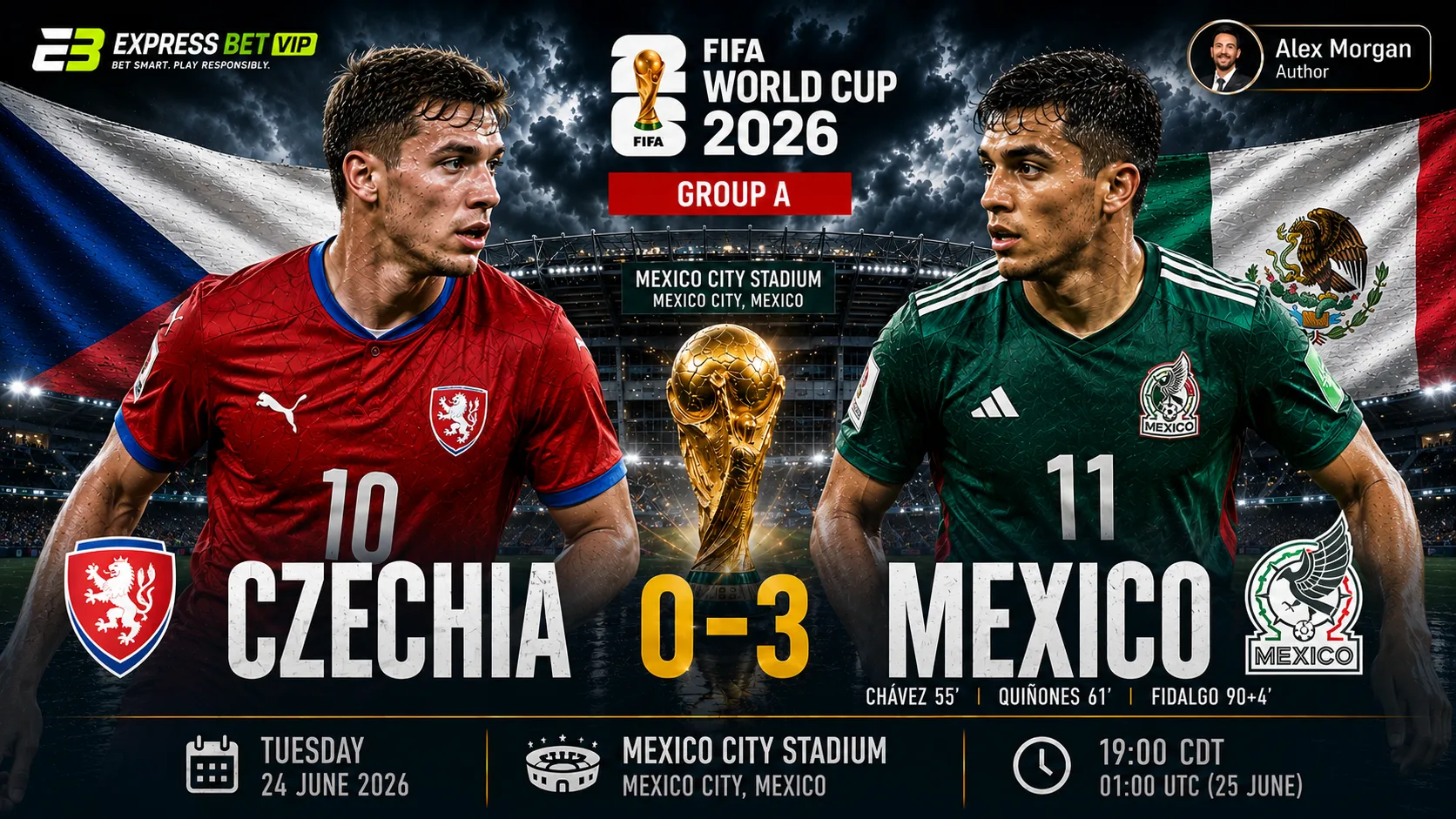
Quick Facts: Final Score, Goals, Venue, and Match Status
| Item | Verified detail |
|---|---|
| Match | Czechia vs Mexico |
| Competition | FIFA World Cup 2026 |
| Stage | Group stage, Matchday 3 |
| Group | Group A |
| Date | June 24, 2026 |
| Kickoff | 19:00 local time / 01:00 UTC on June 25 |
| Host country | Mexico |
| City | Mexico City |
| Stadium | Mexico City Stadium |
| Attendance | 80,824 |
| Final score | Czechia 0-3 Mexico |
| Half-time score | 0-0 |
| Mexico scorers | Mateo Chávez 55’, Julián Quiñones 61’, Álvaro Fidalgo 90+4’ |
| Assists | Luis Romo, Jorge Sánchez, Roberto Alvarado |
| Referee | Yael Falcón Pérez |
| VAR | Not available from verified public data |
| Weather | Exact match-time readings not available from verified public data |
| Altitude | Approximately 2,240 metres above sea level |
| Pitch | FIFA-standard reinforced natural grass |
| Main tournament impact | Mexico won Group A; Czechia were eliminated |
The score, attendance, referee, lineups and statistical record were verified against FIFA and ESPN. FIFA’s official report provides the final goal times. (fifa.com)
Verified Facts vs Analysis
| Category | Information |
|---|---|
| [CONFIRMED] | Mexico won 3-0 after a 0-0 first half. |
| [CONFIRMED] | Chávez, Quiñones and Fidalgo scored. |
| [CONFIRMED] | Mexico completed Group A with nine points and no goals conceded. |
| [REPORTED] | Fidalgo’s goal was displayed as 90+3’ by FOX and 90+4’ by FIFA and ESPN. |
| [OBSERVED] | Czechia were compact in the first half but lost control after Chávez’s opener. |
| [ANALYSIS] | Mexico’s width and runs outside Czechia’s centre-backs created the decisive second-half advantage. |
| [MARKET SIGNAL] | Mexico were listed around -135 to -138; the total was 2.5 goals. |
| [UNKNOWN] | Exact weather readings, complete VAR crew, PPDA and distance covered. |
This separation matters because the score is independently verifiable, while a tactical cause is an editorial interpretation. Search systems can extract both, but readers should not be asked to treat them as the same kind of information.
The one-minute differences in provider feeds are also material. They do not change the match, but they demonstrate why post-match pages should not quietly merge incompatible timestamps. (fifa.com)
Final Score and Match Summary
[CONFIRMED] Mexico finished a perfect Group A campaign with a 3-0 victory over Czechia. All three goals came after half-time, and the co-hosts ended the group stage with three wins, six goals scored and none conceded. Czechia finished fourth with one point and a goal difference of -4. (ESPN.com)
The opening half was cautious to the point of self-sabotage, particularly from Czechia. Miroslav Koubek’s team needed a victory to maintain any realistic qualification hope, yet it defended as though a goalless draw came with a certificate of advancement.
Czechia started with five defenders when out of possession and tried to release Denis Višinský and Pavel Šulc behind Mexico’s midfield. Višinský produced the clearest early opening but sent his first-time attempt wide. Czechia accumulated several low-value shots without forcing Raúl Rangel into sustained work. (ESPN)
Mexico also lacked speed in the first half. Javier Aguirre rotated his starting lineup after qualification had already been secured, and the new combinations initially overplayed. Mexico required more than half an hour to register a serious attempt. Gilberto Mora provided technical imagination, but the ball often moved laterally rather than through Czechia’s defensive structure. (ESPN)
The half-time score of 0-0 reflected the low attacking quality. FotMob’s live model placed the combined first-half expected-goal total at approximately 0.46. Czechia’s urgency existed in the table but was less visible on the pitch. Tournament football frequently punishes teams that confuse staying in a game with controlling it. (theguardian.com)
Mexico accelerated after the interval. Romo began receiving higher up the pitch, Mateo Chávez advanced beyond Czechia’s right side, and Jorge Sánchez attacked from the opposite flank. The match’s geometry changed: Czechia’s wing-backs had to defend deeper, while its outside centre-backs were pulled into wider spaces.
Chávez scored in the 55th minute. Quiñones added the second six minutes later after Sánchez attacked Czechia’s left channel. At 2-0, the remaining contest was largely about Mexico’s margin and Czechia’s dignity.
Koubek introduced Patrik Schick, Tomáš Souček and Lukáš Provod, but the substitutions arrived after the structural damage. Czechia increased its number of crosses and corners without producing clean penalty-box finishes. It ended with more total possession and shots than many readers might expect, but only one attempt reached the target. (ESPN.com)
Fidalgo’s stoppage-time finish made the scoreline emphatic. Mexico had created the five recognised big chances in ESPN’s model and produced 1.74 xG against Czechia’s 0.53. The three-goal margin was therefore more convincing than the raw possession split of 48% to 52% suggested. (ESPN.com)
Goal Timeline
55’ — Mateo Chávez, Mexico, Open-Play Goal
Luis Romo received possession in central midfield and played through Czechia’s defensive line. Chávez accelerated from the left, moved beyond the covering defender and finished calmly into the bottom-left corner from approximately 15 yards.
Assist: Luis Romo
Goal type: Open-play breakaway
Shot: Left-footed finish
VAR: No decisive intervention reported
Official time: 55’
Provider variation: The Guardian’s live entry initially displayed 54’
The move succeeded because Czechia’s defensive line was poorly staggered. The outside defender stepped toward the ball, the covering centre-back could not match Chávez’s run, and the wing-back was unable to recover.
Chávez’s finish changed the competitive logic. Czechia could no longer remain in its protective block and wait for one set piece. The need to attack opened the spaces Mexico had failed to find during the first half. It was also Chávez’s first senior international goal. (fifa.com)
61’ — Julián Quiñones, Mexico, Close-Range Rebound
Jorge Sánchez advanced into the space behind Czechia’s left side. Tomáš Holeš attempted to deal with the resulting ball, but the defensive action rebounded inside the penalty area. Quiñones reacted first and converted from close range.
Assist: Jorge Sánchez in the FOX event feed
Goal type: Open-play rebound
Shot distance: Approximately five yards
VAR: No decisive intervention reported
Tactical cause: Czechia’s left defensive channel was exposed after the first goal
This was not Mexico’s cleanest combination, but it came from a repeatable pattern. Sánchez attacked outside the wing-back, forced Czechia’s back line toward its own goal and created a second-ball opportunity.
Quiñones did not need elegance. He needed the first reaction. His finish gave Mexico a two-goal lead and removed most of the remaining uncertainty six minutes after the opener. (foxsports.com)
90+4’ — Álvaro Fidalgo, Mexico, Open-Play Goal
Santiago Giménez drove into the penalty area and forced Kovář to save. Roberto Alvarado collected the loose ball and resisted the obvious shot. He instead found Fidalgo near the edge of the area. The substitute curled a right-footed finish into the upper-left corner.
Assist: Roberto Alvarado
Goal type: Open play following a rebound
Official time: 90+4’
FOX event time: 90+3’
Shot location: Approximately 16 metres from goal
Emotional significance: Fidalgo’s first senior international goal
Alvarado’s decision was the key action. Czechia’s defenders moved toward the ball and expected the immediate attempt. The cutback found Fidalgo with time to shape his finish.
The goal did not change qualification, but it completed Mexico’s largest World Cup victory in decades and gave the crowd one final release before full time. (fifa.com)
Key Moments That Changed the Match
Višinský Misses Czechia’s Early Opening
Višinský met an early delivery inside the penalty area but directed his attempt wide. ESPN assigned the chance approximately 0.11 xG, making it one of Czechia’s better opportunities.
A goal would have forced Mexico to attack a set defence. Instead, Czechia allowed the hosts to remain patient. (ESPN.com)
Mexico’s First-Half Possession Produces Little
Mexico moved the ball comfortably but did not consistently penetrate Czechia’s defensive five. The co-hosts’ first meaningful shot sequence did not arrive until late in the half.
This mattered because Czechia reached the interval level without having to defend sustained penalty-box pressure. The problem was that Czechia did almost nothing with that temporary success. (ESPN)
Chávez Breaks the Defensive Line
The opener was the first successful run by a Mexican wide defender directly beyond Czechia’s back line. It converted a slow match into an open one.
Once Czechia had to advance its wing-backs and midfielders, Mexico could attack larger transition spaces.
Quiñones Scores Six Minutes Later
The second goal prevented Czechia from building an organised response. Koubek’s team went from level to effectively eliminated within six minutes.
The sequence also confirmed that Mexico’s right-side runs had become a persistent problem rather than an isolated incident.
Koubek Introduces Schick and Souček
Schick and Souček entered in the 64th minute, shortly after Mexico’s second goal. Their presence increased Czechia’s aerial potential, but the timing limited their influence.
Starting both on the bench in a must-win match became one of the central questions surrounding Koubek’s selection. (ESPN.com)
Edson Álvarez Receives the Match’s Only Confirmed Card
Álvarez was booked in the 64th minute for a strong challenge. No second yellow or suspension consequence was confirmed.
The booking did not materially alter Mexico’s midfield control. (foxsports.com)
Guillermo Ochoa Enters in the 78th Minute
Aguirre replaced Rangel with Ochoa. The crowd responded by singing the veteran goalkeeper’s name, while teammates congratulated him after the final whistle.
The substitution had little tactical necessity. Its significance was historical and emotional, giving Ochoa another World Cup tournament appearance and his 154th international cap. (theguardian.com)
Souček Leaves with a Non-Contact Injury
Souček went down while closing Ochoa and required help leaving the pitch. Alexandr Sojka replaced him in the 87th minute.
A verified diagnosis was not available from public data at the time of writing. (theguardian.com)
Local Match Conditions: Stadium, City, Weather, Pitch, and Crowd
| Local factor | Verified or observed detail | Football meaning | Direct match evidence | Betting-result meaning | Status | Fixture-specific? |
|---|---|---|---|---|---|---|
| Venue | Mexico City Stadium | Large, open-air football venue | 80,824 attendance | Strong home-environment factor | [CONFIRMED] | Yes |
| Altitude | Approximately 2,240 metres | Reduced oxygen availability and different ball flight | Mexico increased intensity after half-time | Relevant but not independently decisive | [CONFIRMED] | Yes |
| Pitch | Reinforced natural grass | Consistent tournament surface | No decisive slip or abnormal bounce reported | No clear surface-based betting edge | [CONFIRMED] | Yes |
| Weather | Exact readings unavailable | Cannot quantify heat or humidity effects | No weather delay documented | Avoid invented weather narratives | [UNKNOWN] | Yes |
| Roof | Open-air pitch | Full exposure to altitude and ambient conditions | Normal high-ball movement observed | Wind impact not verified | [CONFIRMED] | Yes |
| Crowd | Overwhelmingly pro-Mexico | Psychological and acoustic pressure | Ochoa chants and late “olé” reactions | Supported home momentum, not certainty | [OBSERVED] | Yes |
| Venue familiarity | Mexico had already played there in the group | Greater familiarity with sightlines and altitude | Mexico finished stronger | Acclimatisation should not be treated as a guarantee | [ANALYSIS] | Yes |
| Travel | Czechia’s previous match was in Atlanta | Different altitude and travel environment | No direct medical effect confirmed | Limited use without player monitoring data | [CONFIRMED/ANALYSIS] | Yes |
Mexico City’s elevation is the most important local distinction. The city sits around 2,240 metres above sea level. At that height, lower barometric pressure reduces oxygen availability and can affect repeated high-intensity running and recovery between sprints. Reduced air density can also change the speed and curve of long passes and shots. (Mexico City)
The match evidence does not support a simple claim that Czechia “lost because of altitude.” The first half was slow because both teams selected cautious attacking patterns. Mexico’s stronger second half followed tactical changes, improved wide movement and Czechia’s need to chase the score.
Venue familiarity still mattered. Mexico had already played its opening match at the same stadium and trained within the host-country environment. Czechia’s previous group fixture had been staged in Atlanta. That does not prove a physiological advantage, but it reduced the number of local variables Mexico had to process. (fifa.com)
The pitch did not produce a clear match-changing incident. FIFA required reinforced natural-grass systems across the tournament, using synthetic fibres below the surface to support consistency and durability. No decisive slip, unusual bounce or damaged section was reported in the reviewed match records. (inside.fifa.com)
The hydration breaks do not prove exceptional heat. FIFA mandated three-minute breaks in every World Cup match regardless of temperature or roof status. They did, however, give both coaches an additional opportunity to reorganise their teams. (inside.fifa.com)
The crowd’s influence was more visible. Around 80,000 spectators created a home setting rather than a neutral tournament atmosphere. Chants for Ochoa, “olé” reactions during late possession and the celebration of Fidalgo’s goal increased Czechia’s psychological discomfort once the result was settled. (theguardian.com)
Stadium-Specific Match Impact
| Stadium factor | Detail |
|---|---|
| Stadium | Mexico City Stadium |
| Common name | Estadio Azteca |
| Attendance | 80,824 |
| Pitch type | Reinforced natural grass |
| Roof status | Open-air pitch |
| Altitude | Approximately 2,240 metres |
| Acoustic effect | Strong pro-Mexico support |
| Surface condition | No decisive problem confirmed |
| Wind relevance | Not available from verified public data |
| Goalkeeper distribution | No clear adverse effect |
| Set-piece effect | Czechia generated deliveries but little finishing quality |
| Communication effect | No specific defensive error conclusively caused by noise |
| Data status | Attendance, pitch and altitude confirmed; wind unknown |
Mexico City Stadium is the largest stadium used in the Mexican section of the tournament and had previously hosted World Cup finals in 1970 and 1986. For the 2026 event, it became the first venue to stage matches at three men’s World Cups. (FIFA World Cup 2026)
The venue influenced this match through altitude, familiarity and crowd distribution. Mexico’s players were not required to interpret a neutral atmosphere. Every successful press, recovery and forward run received an immediate response.
Czechia’s defensive communication did not visibly collapse because of noise alone. The first two goals came from identifiable positional problems: poor depth against Chávez’s run and inadequate protection of the left channel before Quiñones’s finish.
The ball travelled cleanly across the surface. Mexico’s final goal required a precise cutback and curling finish, while Czechia’s failures came mainly from shot selection and accuracy rather than an abnormal pitch.
City and Weather Impact
| Factor | Detail |
|---|---|
| City | Mexico City |
| Host country | Mexico |
| Time zone | UTC-6 |
| Kickoff | 19:00 local time |
| Climate period | June rainy season |
| Match-time temperature | Not available from verified public data |
| Humidity | Not available from verified public data |
| Wind | Not available from verified public data |
| Rain | No weather delay reported |
| Altitude | Approximately 2,240 metres |
| Likely physical effect | Greater recovery cost between repeated sprints |
| Actual evidence | Mexico sustained stronger second-half running |
| Data status | Altitude confirmed; detailed weather unknown |
Mexico City’s June climate typically combines mild daytime temperatures with a higher chance of afternoon or evening rain. Exact readings for this match were not available from the reviewed authoritative sources, so no temperature, humidity or wind figure should be treated as confirmed.
Altitude offered the clearer football connection. Mexico’s full-backs repeatedly produced forward runs after half-time, while Czechia’s wing-backs became less effective at recovering once possession changed.
That pattern may be consistent with fatigue, but tactics remain the stronger explanation. Czechia were forced to expand after conceding, increasing the distance each player had to cover. A team defending a compact 5-4-1 uses less space than a team chasing two goals.
No cramp-related collapse was documented before the late Souček injury, and his non-contact problem was not officially linked to altitude or weather.
Goalkeeper handling was generally stable. Kovář saved Giménez’s stoppage-time shot before Fidalgo scored from the second phase. Rangel and Ochoa were not seriously tested by high balls or long-range efforts.
First Half Analysis
Czechia started in a 3-4-2-1 that became a 5-4-1 without possession:
Kovář; Holeš, Hranáč, Krejčí; Coufal, Červ, Sadílek, Doudera; Šulc, Višinský; Hložek.
Mexico used a 4-3-3, also listed by some providers as a 4-1-2-3:
Rangel; Sánchez, Montes, Reyes, Chávez; Álvarez, Romo, Mora; Alvarado, Martínez, Quiñones. (ESPN.com)
Czechia’s defensive plan was clear. The three centre-backs protected the penalty area, Coufal and Doudera dropped alongside them, and Červ and Sadílek screened central passes.
Hložek did not press Mexico’s centre-backs continuously. He tried to block the route into Álvarez, leaving Montes and Reyes time to circulate the ball. Mexico therefore held possession without automatically creating progression.
Mora frequently moved into the right half-space. Alvarado stayed wider, and Sánchez overlapped selectively. On the opposite side, Quiñones entered central areas while Chávez supplied the width.
The Mexican structure was logical but too patient. Martínez occupied the centre-backs, yet the midfielders rarely played first-time passes around Czechia’s block. Too many attacks ended with the ball returning to Álvarez.
Czechia’s best early route involved Doudera’s runs and Višinský’s movement behind Sánchez. Višinský’s missed chance demonstrated that Mexico’s high full-backs carried some defensive risk.
The main individual duel was Quiñones against Holeš and Coufal’s side of the defence. Quiñones did not win it consistently in the first half, but his central movement forced Czechia to narrow.
Czechia’s set pieces produced volume rather than danger. Deliveries entered the box, but Mexico’s centre-backs controlled the first contact and Czechia lacked a clean second-ball shot.
At half-time, Aguirre needed quicker vertical passing and more aggressive full-back runs. Koubek needed his team to recognise that a draw was not useful. The match was level, but the strategic balance already favoured Mexico.
Second Half Analysis
The second half began with greater Mexican urgency. Romo pushed higher, Mora received closer to the forwards, and the full-backs moved beyond Czechia’s midfield line.
Czechia briefly threatened through Červ after the restart. The attempt did not become a goal, but it warned Mexico that an open match would contain risk at both ends. (foxsports.com)
The opening goal came from the adjustment Mexico required. Chávez did not wait outside Czechia’s block. He ran behind it. Romo played forward early, removing the opportunity for Czechia’s wing-back to recover.
Czechia’s reaction was poorly coordinated. Some players stepped forward to chase an equaliser, while the back three remained deep. The resulting vertical gap gave Mexico room to receive between midfield and defence.
Sánchez exploited the opposite side for the second goal. Czechia had now been attacked beyond both wing-backs within six minutes.
Koubek introduced Provod in the 56th minute, followed by Schick and Souček in the 64th. Schick gave Czechia a natural penalty-box striker, and Souček added an aerial target. The team began producing more corners and crosses. (ESPN.com)
The substitutions did not solve the supply problem. Mexico defended the central zone and accepted deliveries from less favourable positions. Czechia’s 13 total shots produced only one attempt on target and no recognised big chance. (ESPN.com)
Aguirre responded with Giménez and Obed Vargas. Mexico could then press Czechia’s build-up with fresher legs while retaining Álvarez behind the ball.
Fidalgo’s introduction added another midfielder capable of receiving under pressure. His late goal was not an isolated cameo: it reflected Mexico’s superior bench quality and decision-making.
The final 15 minutes became a celebration. Ochoa’s entrance shifted attention away from the competitive contest, while Czechia’s attacks became increasingly speculative.
Tactical Picture: Why the Match Was Won and Lost
Mexico won because its 4-3-3 eventually stretched Czechia’s 5-4-1 beyond the point at which the back five could protect both width and depth.
Czechia’s defensive system was effective while the match remained compact. Five defenders protected the box, two central midfielders blocked direct passes, and Mexico’s front three received with their backs to goal.
The weakness was the space behind the wing-backs. When Doudera and Coufal stepped toward Mexico’s wide players, the outside centre-backs had to defend large channels.
Mexico did not exploit those channels enough before half-time. After the interval, Romo and Mora released the full-backs earlier. Chávez’s goal was the cleanest example.
Mexico’s midfield structure also improved. Álvarez remained behind the ball, allowing Romo to advance and Mora to drift between lines. This produced a 2-3-5 attacking shape:
- Reyes and Montes formed the base;
- Álvarez stayed central;
- Sánchez and Chávez moved forward;
- Romo and Mora occupied advanced interiors;
- the front three pinned Czechia’s centre-backs.
Czechia’s counterattacking threat declined because Hložek became isolated. Višinský and Šulc had to defend deeper, leaving too much distance between midfield recoveries and the striker.
After conceding, Czechia could not increase attacking numbers without damaging its defensive block. Schick and Souček entered, but Mexico’s midfield controlled the second balls.
The winning plan worked because Mexico changed its speed without abandoning balance. The losing plan failed because Czechia waited too long to accept the level of risk required by its tournament position.
Tactical Collision Map
| Zone | Edge | Match evidence | Key player | Local-condition effect | Result impact |
|---|---|---|---|---|---|
| Mexico’s left flank | Mexico | Chávez repeatedly advanced beyond the wing-back | Mateo Chávez | Repeated running at altitude | Opening goal |
| Mexico’s right flank | Mexico | Sánchez created the second-goal sequence | Jorge Sánchez | Crowd reinforced momentum | Second goal |
| Central midfield | Mexico | Álvarez anchored; Romo and Mora advanced | Luis Romo | Better familiarity with local conditions possible | Controlled second half |
| Czechia left flank | Mexico | Quiñones moved inside and attacked rebounds | Julián Quiñones | No clear direct effect | Second goal |
| Penalty box | Mexico | Five recognised big chances to none | Quiñones | Stable surface | Clinical difference |
| Set pieces | Czechia volume, Mexico defence | Czechia delivered several corners without a clear finish | César Montes | No wind effect verified | No Czech goal |
| Transitions | Mexico | Chávez exploited the first open channel | Mateo Chávez | Longer recovery runs at altitude | Decisive |
| Defensive third | Mexico | Only one Czech shot reached the target | Israel Reyes | Compact distances conserved energy | Clean sheet |
| Goalkeeper build-up | Mexico | Rangel circulated calmly | Raúl Rangel | No clear ball-flight issue | Maintained control |
| Bench | Mexico | Fidalgo scored; Giménez helped create it | Álvaro Fidalgo | Fresh legs in final phase | Third goal |
Player Ratings and Individual Performances
The ratings below are editorial assessments based on match actions, tactical roles and provider statistics. They are not official FIFA ratings.
Czechia Player Ratings
Matěj Kovář — 6.0
Made two saves and stopped Giménez before the third goal. He was exposed by defensive breakdowns and was not directly responsible for the first two finishes.
Tomáš Holeš — 5.5
Defended several early situations but failed to control the second-goal sequence. Required treatment after a clash of heads.
Robin Hranáč — 5.5
Stayed compact in the first half but struggled once Mexico attacked the space outside the central defensive line.
Ladislav Krejčí — 6.0
Czechia’s most reliable distributor, completing 61 of 69 passes according to ESPN. His passing could not compensate for the team’s attacking caution.
Vladimír Coufal — 5.5
Worked defensively and delivered set pieces, but Mexico found space around his channel after half-time.
Lukáš Červ — 5.5
Produced Czechia’s only meaningful shot on target but could not control Romo’s advanced movement.
Michal Sadílek — 5.5
Tried to organise midfield pressure and took several corners. Mexico’s interiors passed around him too easily during the decisive spell.
David Doudera — 6.0
Attempted four shots and remained active on the left. His final decisions lacked accuracy.
Pavel Šulc — 5.0
Found little space between Álvarez and Mexico’s centre-backs. Czechia required more creative influence from him.
Denis Višinský — 5.5
Missed Czechia’s clearest early opening but at least attacked the spaces behind Mexico’s full-backs.
Adam Hložek — 5.0
Isolated against Mexico’s central defenders and unable to hold enough direct passes.
Lukáš Provod — 5.5
Added energy after entering but did not transform Czechia’s delivery quality.
Patrik Schick — 5.5
Provided a clearer penalty-box presence. The service reaching him was predictable.
Tomáš Souček — 5.5
Added aerial strength but left with a non-contact injury late in the match.
Tomáš Chorý — 5.0
Received too little time to influence the result.
Alexandr Sojka — 5.0
Entered for the injured Souček in the closing minutes.
Mexico Player Ratings
Raúl Rangel — 6.5
Made the only save required and distributed without significant error before his planned substitution.
Jorge Sánchez — 7.5
His forward run created the second goal. He consistently attacked the space outside Czechia’s left centre-back.
César Montes — 7.5
Controlled aerial deliveries and helped prevent Schick from receiving cleanly.
Israel Reyes — 7.0
Comfortable in possession and protected the space behind Sánchez.
Mateo Chávez — 8.5
Scored the opening goal, provided aggressive width and changed the match with a well-timed run. Our Man of the Match.
Edson Álvarez — 6.5
Protected the centre and allowed the other midfielders to advance. His yellow card reduced his freedom in the final half-hour.
Luis Romo — 7.5
Assisted Chávez with an early vertical pass and improved significantly after half-time.
Gilberto Mora — 7.5
Displayed excellent control in tight areas and helped Mexico manipulate Czechia’s midfield. His influence exceeded the basic goal-and-assist totals.
Roberto Alvarado — 8.0
Created two big chances and supplied Fidalgo’s goal. His decision to pass rather than shoot was one of the match’s best actions.
Guillermo Martínez — 6.0
Occupied the central defenders but received limited high-quality service.
Julián Quiñones — 8.0
Scored from close range, attempted four shots and constantly moved between Czechia’s defenders.
Santiago Giménez — 7.0
His driving run and saved shot initiated the third goal.
Obed Vargas — 6.5
Added fresh pressing and secure midfield possession.
Álvaro Fidalgo — 7.5
Scored an excellent first international goal after entering in the 72nd minute.
Jesús Gallardo — 6.5
Protected Mexico’s left side during the closing phase.
Guillermo Ochoa — 6.5
Had little technical work but completed an emotionally significant appearance without conceding.
Best Players of the Match
Man of the Match: Mateo Chávez
The left-back scored the goal that unlocked Czechia and continued to provide width without compromising Mexico’s defensive shape.
Best attacker: Julián Quiñones
He converted the second goal and remained Mexico’s most persistent penalty-box threat.
Best midfielder: Gilberto Mora
Mora’s touch, rotation and movement gave Mexico a technical advantage even during the slow first half.
Best defender: César Montes
Montes controlled the box and limited Czechia to one shot on target.
Best goalkeeper: Matěj Kovář
Despite conceding three, Kovář made two saves and received limited protection during the decisive attacks.
Best substitute: Álvaro Fidalgo
He entered in the 72nd minute and scored the final goal with a controlled finish.
Most underrated performance: Roberto Alvarado
His two created big chances and final assist were central to Mexico’s attacking efficiency.
Most disappointing performance: Adam Hložek
Czechia needed a forward capable of connecting transitions and holding the ball. Hložek remained isolated and made limited impact.
Injuries, Suspensions, Cards, and Discipline
| Player | Team | Incident | Minute | Status | Next-match impact | Data status |
|---|---|---|---|---|---|---|
| Tomáš Holeš | Czechia | Clash of heads | 46’ | Continued before later substitution | No confirmed injury | [OBSERVED] |
| Edson Álvarez | Mexico | Strong challenge | 64’ | Yellow card | No suspension confirmed | [CONFIRMED] |
| Tomáš Souček | Czechia | Non-contact injury | 85’ | Replaced at 87’ | Diagnosis unavailable | [OBSERVED] |
| Other injuries | Both | None confirmed | — | — | — | [UNKNOWN] |
Álvarez received the match’s only confirmed yellow card. Czechia committed nine fouls and Mexico 13 according to ESPN’s statistical feed. No red card or penalty was recorded. (foxsports.com)
Souček’s late injury appeared more consequential than the disciplinary record. He required assistance leaving the field, but no verified diagnosis was available at the time of writing. (theguardian.com)
Referee and VAR Analysis
Yael Falcón Pérez refereed the match. He issued one confirmed yellow card and did not award a penalty or show a red card. (ESPN)
No goal was overturned, and no prolonged VAR review materially altered the contest. Complete VAR personnel were not available from verified public data.
The referee allowed a reasonable level of physical contact. Czechia’s players appealed during some midfield duels, while the home crowd reacted strongly when Quiñones went down late in the first half. No decision produced a sustained post-match controversy.
Six minutes of second-half stoppage time were added. Fidalgo scored during that period, but the amount of added time itself was not disputed. (theguardian.com)
Match Statistics
| Statistic | Czechia | Mexico |
|---|---|---|
| Possession | 52% | 48% |
| Shots | 13 | 11 |
| Shots on target | 1 | 5 |
| Expected goals | 0.53 | 1.74 |
| Big chances | 0 | 5 |
| Big chances missed | 0 | 2 |
| Accurate passes | 333 | 330 |
| Pass accuracy | 84% | 86% |
| Duels won | 42 | 34 |
| Saves | 2 | 1 |
| Fouls | 9 | 13 |
| Yellow cards | 0 | 1 |
| Red cards | 0 | 0 |
| PPDA | Not available | Not available |
| Distance covered | Not available | Not available |
ESPN’s commentary summary displayed slightly different rounded xG values of approximately 0.47 and 1.79, while its main statistics panel showed 0.53 and 1.74. Such differences can result from live-model updates or rounding. (ESPN.com)
Czechia’s possession and shot totals are misleading without shot quality. Thirteen attempts produced one shot on target and no big chance.
Mexico attempted fewer shots but created five recognised big chances. The hosts repeatedly reached more valuable positions, particularly after the first goal.
Czechia’s advantage in duels did not translate into territorial control near goal. Many of those duels occurred in midfield or during defensive aerial actions.
Mexico’s 86% passing accuracy supported control without inflating possession. Aguirre’s team did not need to dominate the ball once it led 2-0.
Betting Result Angle
FOX listed Mexico at approximately -138, while ESPN displayed a Mexico moneyline around -135. The total was set at 2.5 goals, with provider prices varying around the market. (foxsports.com)
| Market | Pre-match expectation | Actual result | Winning side | Key trigger | Local factor | Caution |
|---|---|---|---|---|---|---|
| Match winner | Mexico favourite | Mexico won 3-0 | Mexico moneyline | Chávez’s opener | Home venue | Prices varied |
| Draw | Czechia expected to defend compactly | No draw | Losing market | Two goals in six minutes | Crowd pressure increased | Half-time draw still landed |
| Czechia win | Czechia needed victory | Czechia lost | Losing market | Limited attacking quality | Altitude may have increased recovery cost | Need does not equal ability |
| Over/under 2.5 | Moderate total | Three goals | Over 2.5 | Fidalgo’s stoppage-time goal | No verified weather effect | The final goal changed settlement |
| Both teams to score | Czechia had scored in previous games | Czechia failed to score | BTTS No | One shot on target | Mexico familiar with venue | Exact price unavailable |
| Correct score | 0-3 | Czechia 0-3 Mexico | 0-3 backers | Late Fidalgo goal | Crowd supported late momentum | High-variance market |
| Half-time result | Cagey opening expected | 0-0 | Half-time draw | Low first-half xG | Altitude did not create early chaos | Separate from full-time market |
| First goalscorer | Several Mexico candidates | Mateo Chávez | Chávez backers | Full-back run | No clear direct local cause | Price unavailable |
| Cards | Controlled match | One yellow | Under cards, line-dependent | Limited confrontation | Home crowd did not cause indiscipline | Exact line unavailable |
| Mexico clean sheet | Mexico entered without conceding | Clean sheet | Mexico to win to nil | Czechia’s poor shot quality | Venue familiarity | Future repetition not guaranteed |
Mexico’s moneyline rewarded bettors who backed the co-hosts. The result was not comfortable from the first whistle, however. The match remained 0-0 for 54 minutes.
The over 2.5-goal market depended on Fidalgo’s stoppage-time finish. At 2-0 late in the match, the under side remained alive. This is why post-match statements that an over was “obvious” are usually hindsight wearing analytical clothing.
Both teams to score — No was supported by Czechia’s inability to create big chances. Mexico’s group-stage defensive record also provided a relevant pre-match signal, but no clean sheet should be treated as automatic.
Live markets changed sharply after the opener. Czechia had to advance, increasing Mexico’s counterattacking value and the probability of further home goals.
Local Betting Impact: What the Venue and Conditions Changed
| Local factor | Market possibly affected | Actual evidence | Possible interpretation | Risk of overreaction | Safer conclusion |
|---|---|---|---|---|---|
| High altitude | Second-half goals, substitutions | Mexico finished stronger | Acclimatised side may recover better | Treating altitude as sufficient explanation | Combine altitude with tactics and schedule |
| Home crowd | Mexico live markets | Noise rose after first goal | Momentum favoured Mexico | Assuming crowd guarantees goals | Crowd affects psychology, not settlement |
| Venue familiarity | Match winner, clean sheet | Mexico had played there earlier | Fewer environmental unknowns | Ignoring team quality | Familiarity is one variable |
| Natural grass | Passing and shot accuracy | Mexico passed at 86% | Surface supported technical play | Claiming grass produced result | No abnormal surface effect |
| Hydration breaks | Live tempo | Mandatory breaks occurred | Coaches gained tactical reset | Linking every post-break goal causally | FIFA used breaks in every match |
| Altitude ball flight | Long shots and crosses | No decisive unusual trajectory | Goalkeepers may need adjustment | Inventing effects after every miss | No direct match evidence |
| Czechia’s travel | Late fatigue markets | Czechia lost structure after 55’ | Recovery context may matter | Confusing correlation with causation | Tactical expansion was more visible |
Altitude deserves consideration but not mythology. Mexico created better chances because its players ran into the correct spaces and selected better passes.
The match’s most useful local betting conclusion concerns second-half volatility. A team chasing qualification at altitude may face increasing recovery costs once its defensive structure expands. That is an analytical factor, not a repeatable guarantee.
The hydration breaks were universal tournament policy. They should not be treated as evidence that this particular match was played under extreme heat. (inside.fifa.com)
What This Result Means for Group A and the Knockout Bracket
| Position | Team | Points | Goal difference | Outcome |
|---|---|---|---|---|
| 1 | Mexico | 9 | +6 | Qualified as group winner |
| 2 | South Africa | 4 | -1 | Qualified |
| 3 | South Korea | 3 | -1 | Third-place ranking applied |
| 4 | Czechia | 1 | -4 | Eliminated |
Mexico became the only Group A team to win all three matches. The co-hosts also completed the group stage without conceding. It was the first time Mexico had won all three group matches at a World Cup. (ESPN.com)
Czechia’s tournament ended with one draw and two defeats. The team scored twice across the group and conceded six.
Mexico subsequently faced Ecuador in the Round of 32 and won 2-0 through goals from Quiñones and Raúl Jiménez. The campaign later ended with a 3-2 Round-of-16 defeat to England. (fifa.com)
The Czechia result therefore did more than confirm qualification. It preserved Mexico’s home route, reinforced defensive confidence and created momentum for the first knockout round.
What Mexico Did Right
Mexico remained patient during a poor first half without losing defensive control.
Aguirre’s team increased the pace of its vertical passing after the interval. Romo’s assist for Chávez was the clearest example.
The full-backs attacked intelligently. Chávez went beyond Czechia’s right side for the opener, while Sánchez created the second-goal sequence from the opposite flank.
Álvarez protected the central space and prevented Czechia from building sustained transitions.
Mexico’s defensive line controlled Schick and Hložek. Czechia’s 13 attempts produced only one shot on target.
The substitutes maintained intensity. Giménez initiated the third goal, Alvarado made the decisive pass and Fidalgo completed the move.
Mexico also managed the venue effectively. The players did not attempt an unsustainable press for the entire match; they accelerated during the phase when Czechia’s structure became vulnerable.
What Czechia Got Wrong
Czechia approached a must-win match with insufficient attacking risk.
The first-half 5-4-1 protected the penalty area but left Hložek isolated. Višinský and Šulc spent too much time defending to support transitions.
Koubek left Schick and Souček on the bench. Both entered only after Mexico had established a two-goal lead.
Czechia’s shot selection was poor. Many attempts came from distance or under pressure, producing only 0.53 xG and no big chance.
The defensive line lost depth after half-time. Chávez’s run exposed the first problem; Sánchez’s run exposed the same broader weakness six minutes later.
Czechia reacted emotionally rather than structurally after conceding. The wing-backs advanced, but the midfield did not consistently protect the space behind them.
Crossing became the default solution after Schick entered. Mexico knew what was coming and defended the central area.
Coach Analysis
Javier Aguirre
Aguirre rotated his lineup without abandoning the team’s underlying structure. Rangel, Chávez, Martínez and Mora received important starting minutes.
The first half was too slow, but Aguirre did not make a panicked tactical change. Mexico retained the 4-3-3 and altered the timing of its runs and passes.
The full-backs moved higher, Romo played closer to the front line and Mexico began attacking before Czechia’s block could reset.
His substitutions were effective. Giménez contributed to the third goal, Fidalgo scored and Obed Vargas helped maintain pressure.
The Ochoa substitution was symbolic rather than competitive, but the 2-0 game state made it a controlled decision.
Miroslav Koubek
Koubek’s selection was difficult to defend in tournament terms. Czechia required a win, yet Schick and Souček began on the bench.
The 3-4-2-1 limited Mexico for one half. That was the plan’s positive element.
The negative element was that Czechia generated almost no penalty-box threat while the score remained useful. When Mexico scored, the starting structure had no natural route to rapid attacking expansion.
Koubek introduced attacking experience after the second goal. By then, Czechia required three goals to overturn the match.
The coach’s changes increased aerial presence but did not improve the quality of progression through midfield.
Player Milestones and Records
Mateo Chávez scored his first senior international goal. It arrived in his first World Cup tournament and opened a match that secured Mexico’s perfect group record. (theguardian.com)
Álvaro Fidalgo also scored his first senior international goal. His stoppage-time finish completed the 3-0 result. (theguardian.com)
Guillermo Ochoa entered in the 78th minute and reached 154 senior international appearances. The tournament was the sixth World Cup for which he had been selected, and contemporary reporting identified him as Mexico’s oldest World Cup player. (theguardian.com)
Gilberto Mora became one of the youngest World Cup starters of the modern era. Reuters reported that the 17-year-old was the youngest player to start a World Cup match since 2002. (Reuters)
Mexico won all three group matches for the first time and completed the group without conceding. Reuters identified the 3-0 result as Mexico’s largest World Cup victory since 1970. (Reuters)
Historical Context and World Cup Analogies
The senior football histories of Mexico and Czechia include both Czech and Czechoslovak records.
Mexico defeated Czechoslovakia 3-1 during the 1962 World Cup. Czechia then beat Mexico 2-1 in a 2000 invitational tournament. The Czech federation’s historical database lists the 2026 result as the fourth senior meeting when Czechoslovak-era matches are included. (fifa.com)
The 1962 comparison carries one useful lesson. Mexico’s first World Cup victory came against Czechoslovakia, while the 2026 win completed the co-hosts’ first perfect World Cup group stage.
This was not a repeat of an old tactical rivalry. The modern match was defined by a Czech back five, Mexican full-back width and a tournament format containing a Round of 32.
The broader World Cup lesson was familiar: compact defending can keep a team level, but it cannot rescue a team that needs to win unless someone eventually attacks.
Incidents and Controversies
No major VAR, penalty or red-card controversy was confirmed.
The principal selection debate concerned Koubek’s decision to leave Schick and Souček out of the starting XI despite Czechia’s need for three points.
The crowd’s attention shifted strongly toward Ochoa after his introduction. That was a ceremonial football moment rather than a competitive controversy.
Souček’s late non-contact injury created concern, but a verified diagnosis was unavailable.
Reports also noted that Merlín, a duck associated with Mexico’s tournament support, was not allowed inside because of FIFA’s animal restrictions. The incident had no competitive effect and does not belong in tactical analysis. (theguardian.com)
Information Gain: What This Article Adds
This report separates FIFA’s official goal times from one-minute provider variations.
It explains why Czechia’s back five worked for one half and failed once Mexico attacked beyond the wing-backs.
The statistical section distinguishes shot volume from shot quality.
The player ratings consider tactical responsibilities rather than simply rewarding the winning team.
The local analysis connects Mexico City’s altitude, open-air stadium, venue familiarity and crowd profile to visible match evidence without claiming that altitude independently produced the score.
The betting section explains the moneyline, total-goals, clean-sheet and live-market outcomes without converting hindsight into a promise.
Local Information Gain Quality Check
| Detail | Included | Status | Fixture-specific | Later update required |
|---|---|---|---|---|
| Stadium identity | Yes | Confirmed | Yes | No |
| Attendance | Yes | Confirmed | Yes | Only if FIFA corrects it |
| Mexico City altitude | Yes | Confirmed | Yes | No |
| Match-time weather | Missing exact readings | Unknown | Yes | Update if official data appears |
| Pitch type | Yes | Confirmed | Yes | No |
| Surface behaviour | Yes | Observed/reported | Yes | Update if official pitch report appears |
| Crowd profile | Yes | Observed | Yes | No |
| Ochoa atmosphere | Yes | Observed | Yes | No |
| Team travel context | Yes | Confirmed/analysis | Yes | No |
| Tactical-local connection | Yes | Analysis | Yes | Reassess only with performance data |
| Betting-risk detail | Yes | Analysis | Yes | Add verified closing prices |
| Anti-template status | Passed | Reviewed | Yes | Recheck after editing |
Source and Data Appendix
| Data point | Status | Primary source type |
|---|---|---|
| Final score | Confirmed | FIFA |
| Half-time score | Confirmed | FIFA, ESPN |
| Goalscorers | Confirmed | FIFA |
| Goal times | Confirmed with provider variations | FIFA, ESPN, FOX, Guardian |
| Assists | Confirmed/reported | FOX, ESPN |
| Stadium | Confirmed | FIFA |
| City | Confirmed | FIFA |
| Attendance | Confirmed | ESPN |
| Referee | Confirmed | ESPN |
| VAR | Unknown | Not available from verified public data |
| Lineups | Confirmed | ESPN |
| Formations | Provider interpretation | ESPN, FOX |
| Substitutions | Confirmed | ESPN, FOX |
| Cards | Confirmed | FOX |
| Souček injury | Observed | Guardian live report |
| Diagnosis | Unknown | Not available |
| Match statistics | Confirmed with rounding variation | ESPN |
| xG | Provider model | ESPN |
| Pre-match odds | Market snapshots | FOX, ESPN |
| Universal closing odds | Unknown | Not available |
| Altitude | Confirmed | Mexico City government |
| Pitch specification | Confirmed | FIFA pitch programme |
| Exact weather | Unknown | Not available |
| Crowd behaviour | Observed | Guardian |
| Group outcome | Confirmed | FIFA, ESPN |
| Knockout progression | Confirmed | FIFA |
Update Protocol
Review and update the article if:
- FIFA changes a goal minute or assist;
- attendance is corrected;
- VAR personnel become publicly available;
- official match statistics are revised;
- Souček’s injury diagnosis is confirmed;
- provider xG models are updated;
- archived bookmaker closing prices become available;
- verified stadium-level weather data is published;
- a formal pitch-condition report identifies a relevant issue.
Last updated: July 14, 2026
Final Verdict
Mexico won because they solved the match rather than merely surviving it.
The first half showed the limitations of a rotated lineup and a Czech defensive block with clear numerical protection. Mexico possessed the ball but rarely disrupted the distances between Czechia’s defenders.
The second half showed the difference between possession and penetration. Romo released Chávez early. Sánchez attacked from the opposite side. Czechia’s wing-backs could no longer protect width while its centre-backs protected the box.
Chávez’s goal was the turning point. Quiñones’s goal was the confirmation. Fidalgo’s goal was the decoration.
The 3-0 scoreline was fair when measured by chance quality. Mexico created five big chances and 1.74 xG. Czechia created none and directed one of 13 attempts on target.
Mexico City’s altitude mattered as part of the environment, particularly once Czechia had to expand and cover larger distances. It did not select the passes, time the runs or finish the chances. Those were football decisions.
Mexico completed a perfect group stage, maintained its clean-sheet record and advanced with genuine momentum. Czechia left because its attacking ambition appeared only after the match had become almost unrecoverable.
For bettors, the Mexico moneyline, over 2.5 goals and Mexico clean sheet all succeeded. The match still required a stoppage-time goal to move the total over. That detail matters. A winning market result does not prove that the path was predictable.
Responsible Betting Note
Football betting carries financial risk. Correct tactical analysis does not guarantee a winning wager.
Odds change before and during matches. A price listed by one operator may differ materially from another.
Local factors such as altitude, crowd support and venue familiarity can be overvalued. They do not provide a reliable betting system by themselves.
Never chase losses or bet money required for housing, food, healthcare, debt payments or other daily needs.
Set financial and time limits, take breaks and stop when gambling no longer feels like entertainment.
Check the gambling laws in your jurisdiction and use licensed operators only. Betting should remain entertainment, not income.
Summarize this article with AI. Use this page URL as the source:
Summarize this article with AI:
FAQ
Mexico defeated Czechia 3-0 at Mexico City Stadium.
Mateo Chávez, Julián Quiñones and Álvaro Fidalgo scored for Mexico.
Mateo Chávez was our editorial Man of the Match after scoring the opening goal and repeatedly advancing from left-back.
Mexico won Group A with nine points and advanced to the Round of 32. Czechia finished fourth with one point and were eliminated.
Mexico’s moneyline won, over 2.5 goals landed, both teams to score — No won, and Mexico kept a clean sheet. Returns depended on the bookmaker’s odds and the time of the wager.