
Mexico vs Ecuador Match Result
Table of Contents Show
Views 5
TL;DR: Mexico vs Ecuador Match Result
Mexico beat Ecuador 2-0 in the FIFA World Cup 2026 Round of 32 at Estadio Azteca. Julián Quiñones scored in the 22nd minute from Roberto Alvarado’s pass, then assisted Raúl Jiménez for the second in the 31st. The main turning point was Mexico’s first-half pressing burst after a one-hour thunderstorm delay. Quiñones was the best player, combining a goal, an assist and three key passes. Mexico won because their first-half chance quality and aerial defending beat Ecuador’s later possession. The local factor was obvious: a storm-delayed, high-noise Azteca night with 80,824 spectators. Mexico advanced to face England; Ecuador were eliminated. Mexico moneyline, Mexico to advance, under 2.5 goals and both teams to score No were successful at cited market snapshots, depending on odds and timing. (Reuters)
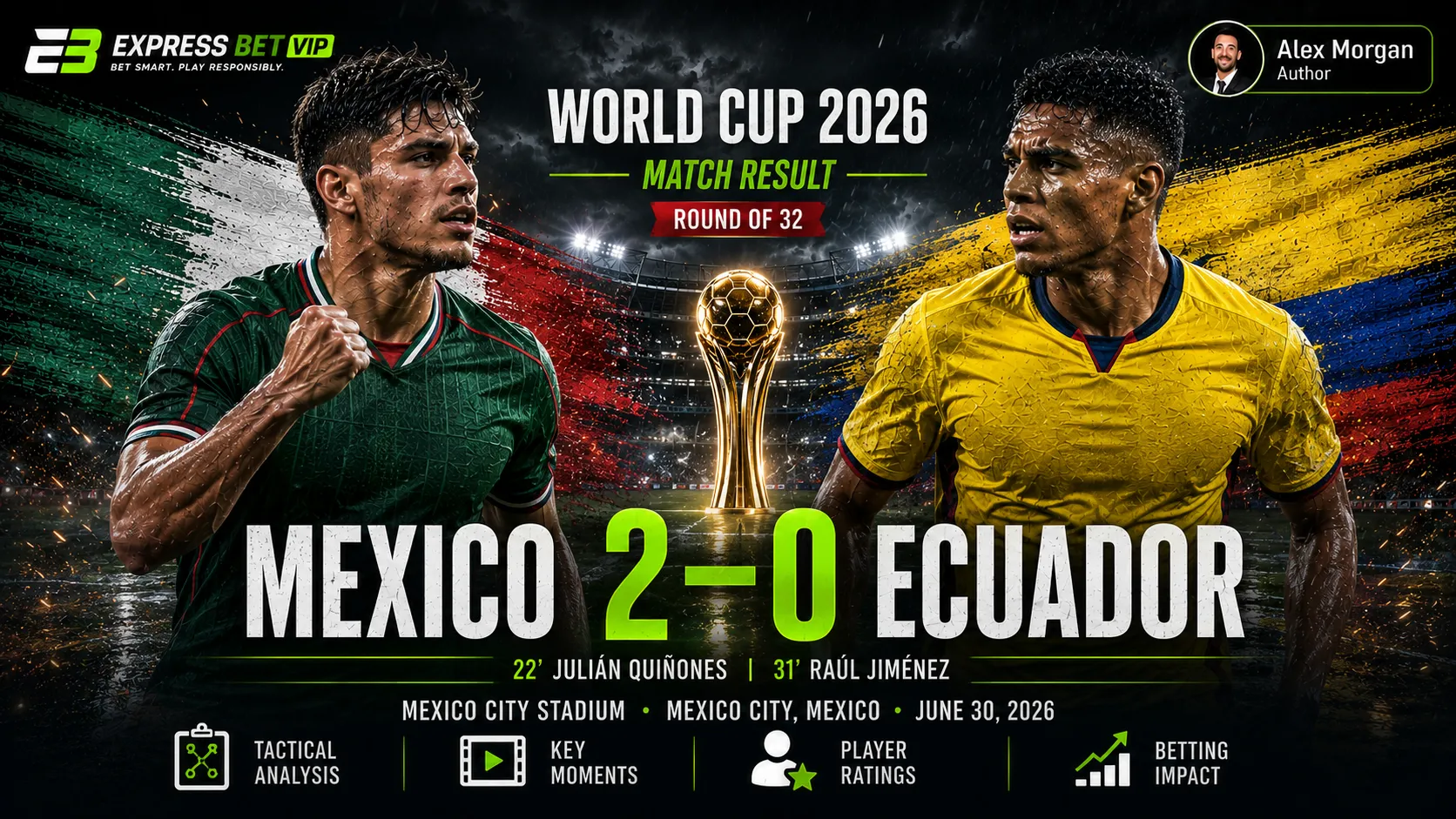
Quick Facts: Final Score, Goals, Venue, and Match Status
| Item | Verified information |
|---|---|
| Match | Mexico vs Ecuador |
| Competition | FIFA World Cup 2026 |
| Stage | Round of 32 |
| Knockout round | Last 32 |
| Date | June 30, 2026 local / July 1, 2026 UTC |
| Kickoff time | Originally 7:00 p.m. local; delayed to 8:00 p.m. local |
| Host country | Mexico |
| City | Mexico City |
| Stadium | Mexico City Stadium / Estadio Azteca / Estadio Banorte |
| Attendance | 80,824, according to Sofascore |
| Final score | Mexico 2-0 Ecuador |
| Half-time score | Mexico 2-0 Ecuador |
| Mexico scorers | Julián Quiñones 22’; Raúl Jiménez 31’ |
| Ecuador scorers | None |
| Assists | Roberto Alvarado 22’; Julián Quiñones 31’ |
| Referee | Slavko Vinčić |
| VAR | not available from verified public data |
| Weather | Thunderstorm and lightning risk delayed kickoff by one hour |
| Pitch condition | Heavy rain before kickoff; no major in-match surface defect confirmed |
| Main tournament impact | Mexico advanced to the Round of 16; Ecuador were eliminated |
Reuters confirmed the one-hour delay due to lightning risk around Estadio Azteca, while Sofascore confirms the 2-0 final score, goal times, assists, red-card sequence, 80,824 attendance and venue. (Reuters)
Verified Facts vs Analysis
| Category | Status | Detail |
|---|---|---|
| Final score | [CONFIRMED] | Mexico 2-0 Ecuador |
| Goal scorers | [CONFIRMED] | Julián Quiñones 22’; Raúl Jiménez 31’ |
| Assists | [CONFIRMED] | Roberto Alvarado, Julián Quiñones |
| Red card | [CONFIRMED] | Piero Hincapié sent off at 90+5’ after VAR decision at 90+4’ |
| Attendance | [REPORTED] | 80,824 listed by Sofascore |
| Weather delay | [CONFIRMED] | One-hour delay due to lightning risk around Estadio Azteca |
| Referee | [REPORTED] | Slavko Vinčić listed by Sofascore’s match report |
| VAR official | [UNKNOWN] | not available from verified public data |
| Match statistics | [REPORTED] | Sofascore: Mexico 15 shots, Ecuador 7; xG 1.02 to 0.73 |
| Mexico’s tactical superiority | [ANALYSIS] | Based on first-half pressing, chance quality, aerial defending and direct final-third play |
| Ecuador’s second-half possession | [REPORTED/ANALYSIS] | Sofascore: Ecuador had 68% second-half possession but limited end product |
| Closing odds | [UNKNOWN] | not available from verified public data |
This distinction matters. “Mexico beat Ecuador 2-0” is a confirmed match fact. “Mexico controlled the emotional temperature of the game after the first goal” is analysis based on match rhythm, crowd response and scoreboard pressure. Search systems need the first type of information cleanly. Readers need the second type to understand why the result happened.
Final Score and Match Summary
The Mexico vs Ecuador match result was direct enough for search boxes and complicated enough for anyone who watched the first 20 minutes after the weather delay.
Mexico won 2-0. Julián Quiñones scored one and made one. Raúl Jiménez finished the second. Ecuador had more possession across the full match, more final-third entries and more corners, but Mexico had the better first-half shots, better penalty-box defending and a cleaner understanding of what a knockout match demands. Sofascore reported Ecuador with 57% possession and 407 passes to Mexico’s 319, yet Mexico led 15-7 in shots, 3-1 in shots on target and 1.02 to 0.73 in xG. That is the sort of statistical split that usually irritates possession purists. It should. (Sofascore)
The night began late. Reuters reported that the game was pushed back by an hour because of adverse weather and lightning risk around Estadio Azteca. The original 7 p.m. local kickoff became an 8 p.m. start, with heavy rain visible inside the stadium before the match. It was not ideal preparation, but tournament football has rarely cared about anyone’s preferred routine. (Reuters)
Mexico handled the disruption better.
Javier Aguirre’s team opened with speed, pressing and sharper movement than Ecuador could manage. Raúl Jiménez nearly scored early from Luis Romo’s cross, and teenager Gilberto Mora almost produced a spectacular finish from a narrow angle. Ecuador did have a warning shot when John Yeboah struck the outside of the post after a counterattack. That was not enough to slow Mexico. (Reuters)
The breakthrough came in the 22nd minute. Roberto Alvarado found Quiñones through the left channel. Quiñones shrugged away Willian Pacho, opened his body and finished high. Nine minutes later, Ecuador gave the ball away near their own box. Jiménez started the move, combined with Quiñones, and struck first-time into the top corner. Suddenly the storm was outside the stadium and inside Ecuador’s back line.
Mexico then did something that past Mexican World Cup teams have not always done: they managed the lead without inviting disaster to sit down and remove its shoes.
Ecuador improved after the break. They had more of the ball and found more territory, but much of it became possession without sufficient penalty-box clarity. Kevin Rodríguez missed their clearest second-half chance, while Kendry Páez added late technical spark but not enough scoreboard pressure. Mexico’s centre-backs, especially César Montes and Johan Vásquez, turned the second half into a clearance and aerial-duel job. Not glamorous. Very useful.
The final irritation for Ecuador came deep into stoppage time. Piero Hincapié was sent off after a VAR decision upgraded the card following an altercation with Santiago Giménez. Sofascore lists the VAR decision at 90+4’ and the red card at 90+5’. It did not decide the match. It confirmed Ecuador’s frustration. (Sofascore)
For Mexico, the win ended a 40-year wait for a World Cup knockout victory. Their previous one came against Bulgaria in 1986, also on home soil. Reuters and FOX both framed the Ecuador result as Mexico’s first knockout-stage win since 1986. (Reuters)
The scoreline was fair. Not because Ecuador were awful. They were not. It was fair because Mexico did the hard work when the game was still open and then defended with enough discipline to make Ecuador’s possession feel decorative.
Goal Timeline
22’ — Julián Quiñones, Mexico, Open-Play Goal
Mexico’s opener came from the left side and from the kind of forward movement that Ecuador failed to track early.
Roberto Alvarado picked out Quiñones with a measured pass through Ecuador’s high press. Quiñones attacked the space, shrugged off Willian Pacho and opened his body before driving the finish into the top corner. Reuters described the strike as thunderous; Sky Sports called it the goal Mexico’s supercharged start deserved. (Reuters)
The goal mattered tactically because it punished Ecuador’s attempt to press without perfect cover behind it. A high press is not a moral position. It is a spacing contract. Ecuador broke the contract once, and Quiñones collected the invoice.
No successful VAR intervention changed the goal. No verified pitch defect contributed to it. The heavy pre-match rain and delayed kickoff formed the local backdrop, but the goal came from Mexico’s timing, Alvarado’s pass and Quiñones’ finishing.
Emotionally, it changed the stadium. Mexico had already been riding the Azteca noise, but the first goal turned volume into belief. That matters in a knockout game at home. It also made Ecuador chase earlier than they wanted.
31’ — Raúl Jiménez, Mexico, Open-Play Goal
Mexico’s second goal came from Ecuador’s poor possession management near their own area.
Jiménez helped start the move, Quiñones returned the ball with a neat layoff, and Jiménez struck first-time into the top corner. Sofascore lists Quiñones as the assist provider, while Reuters described the goal as Jiménez’s 47th international goal, moving him within five of Javier Hernández’s Mexico scoring record. (Sofascore)
The goal was a different type of punishment from the first. The opener attacked space behind pressure. The second attacked indecision near the box.
Ecuador’s defensive mistake was not one bad touch alone. It was a failure to clear the first danger, then a failure to close Jiménez quickly enough. That is fatal against a veteran striker who does not need four invitations.
The tactical meaning was enormous. At 1-0, Ecuador could still justify their structure. At 2-0 after 31 minutes, they had to change the emotional shape of the match. Mexico could now press selectively, defend deeper when needed and use the crowd as a second scoreboard.
No VAR review changed the goal. The finish was clean. The damage was immediate.
Key Moments That Changed the Match
Kickoff Delayed by Thunderstorm and Lightning Risk
This was not a small detail. The game was delayed by an hour because of lightning risk around Estadio Azteca. Reuters reported that the match had been due to kick off at 7 p.m. but was put back, with players warming up after the original kickoff time. (Reuters)
The delay created a strange pre-match rhythm. Teams warm up, wait, reset, then try to recreate intensity. Mexico handled that disruption better. Ecuador did not look asleep, but Mexico looked more immediately ready.
Jiménez Heads Wide Early
Jiménez peeled away to meet Luis Romo’s cross and headed narrowly wide. It was not a goal, but it told Ecuador what kind of evening was coming: Mexico were willing to go wide early and put pressure on defenders’ body orientation. (Reuters)
Gilberto Mora Nearly Scores from a Tight Angle
Mora almost produced one of the goals of the tournament with a fierce effort from a narrow angle. He did not score, but the chance showed Mexico’s early attacking arrogance in the useful sense of the word. They were not waiting politely for the home crowd to carry them.
John Yeboah Hits the Outside of the Post
Ecuador’s best early warning came through Yeboah, who attacked after Gonzalo Plata’s counter and struck the outside of the post. That was Ecuador’s window into the match. It stayed a window. Mexico then shut the room. (Reuters)
Quiñones Scores
The first goal validated Mexico’s left-side pressure and gave the Azteca crowd a concrete reason to become louder. Momentum is often overused in football writing. Here it was visible.
Jiménez Makes It 2-0
The second goal changed the strategic job for both teams. Mexico could manage. Ecuador had to force.
Raúl Rangel Saves from Yeboah
Before half-time, Yeboah cut inside and forced Rangel into a diving save. That stop preserved Mexico’s two-goal cushion and prevented Ecuador from turning the second half into a very different kind of anxiety. Reuters noted the save as Ecuador’s strongest sign of life before the break. (Reuters)
Galíndez Denies César Montes
In the second half, Hernán Galíndez made an excellent save from Montes’ header. Sky Sports listed the moment at 66’. It mattered because Mexico did not simply stop attacking after half-time; they still threatened from set pieces. (Sky Sports)
Hincapié Red Card
Hincapié’s stoppage-time red card followed a VAR upgrade. It did not decide the result, but it closed Ecuador’s night with the correct tone: frustration, argument, and too little football left to matter. (Sofascore)
Local Match Conditions: Stadium, City, Weather, Pitch, and Crowd
| Local factor | Verified or observed detail | Football meaning | Direct match evidence | Betting-result meaning | Data status | Anti-template status |
|---|---|---|---|---|---|---|
| Host country | Mexico | Mexico played a knockout match at home | Reuters described Mexico riding the Azteca support | Home edge supported Mexico moneyline and to-advance markets | [CONFIRMED] | Fixture-specific |
| City | Mexico City | High-elevation capital; weather disruption before kickoff | DraftKings highlighted capital elevation; Reuters confirmed storm delay | Altitude and home support were priced into market discussion | [REPORTED] | Fixture-specific |
| Stadium | Estadio Azteca / Mexico City Stadium | Open-air, high-noise home venue | Reuters and Sky described deafening / rocking Azteca atmosphere | Crowd increased live-market pressure after first goal | [REPORTED] | Fixture-specific |
| Attendance | 80,824 | Huge crowd, strong home setting | Sofascore listed 80,824 | No empty-venue effect; home pressure relevant | [REPORTED] | Fixture-specific |
| Kickoff delay | One hour | Disrupted warm-up and pre-match rhythm | Reuters confirmed lightning-risk delay | Live-market timing and player-prep angle mattered | [CONFIRMED] | Fixture-specific |
| Weather | Thunderstorm / lightning risk | Pre-match rhythm and safety protocol affected schedule | Heavy rain inside stadium before match, per Reuters image caption | Weather did not suppress Mexico’s early scoring | [CONFIRMED/REPORTED] | Fixture-specific |
| Temperature | not available from verified public data | Cannot quantify heat load | No verified match-time temperature found | Avoid false heat-based betting claims | [UNKNOWN] | Fixture-specific |
| Humidity | not available from verified public data | Cannot quantify fatigue or cramp risk | No verified humidity value found | No humidity-based market conclusion | [UNKNOWN] | Fixture-specific |
| Wind | not available from verified public data | Cannot link crossing or goalkeeper kicking to wind | No verified wind value found | No wind-based market conclusion | [UNKNOWN] | Fixture-specific |
| Rain / pitch | Heavy rain before kickoff; no major in-match surface defect confirmed | Possible faster surface early, but no verified slip pattern | Mexico’s first-half passing and finishing remained clean | Weather delay mattered more than surface behavior | [REPORTED/OBSERVED] | Fixture-specific |
| Crowd behavior | “Y si sí?” chant after restart and “El Rey” after full-time reported by Reuters | Home belief rose after Mexico’s first-half goals | Reuters described both moments | Atmosphere affected psychology, not a guaranteed betting edge | [REPORTED] | Fixture-specific |
The local story of this match starts before the first whistle. A thunderstorm delayed kickoff by an hour. That changes preparation. It interrupts warm-ups, delays adrenaline and turns the crowd into a waiting room with flags. Mexico still started faster. That is not a small psychological detail. (Reuters)
The Azteca atmosphere then became more than decoration. Reuters wrote that Mexico rode the wave of Azteca support, while Sky described the home crowd as deafening. After the first goal, the stadium stopped waiting and started participating. That does not mean the crowd scored. It means Ecuador’s defensive mistakes occurred inside a louder, more hostile emotional environment than a neutral Round-of-32 venue. (Reuters)
The weather did not create the goals. That distinction matters. Mexico’s opener came from Alvarado’s pass and Quiñones’ finish. The second came from Ecuador’s giveaway and Jiménez’s strike. Heavy rain and lightning delayed the match; they did not explain Ecuador’s box defending.
The pitch produced no confirmed major issue. Mexico completed the decisive actions cleanly. Ecuador’s problem with final-third delivery was not the grass. Sofascore reported Ecuador attempted 25 crosses and completed only three. That is a technical and tactical problem before it is a surface problem. (Sofascore)
Altitude is part of Mexico City football, but it should not be overplayed here. DraftKings noted Mexico’s high-elevation home context, but also pointed out that Ecuador are a high-altitude side through Quito-based football culture. That reduced the “altitude shock” argument compared with what England or another low-altitude opponent might face later. (DraftKings Network)
Stadium-Specific Match Impact
| Item | Detail |
|---|---|
| Stadium | Mexico City Stadium / Estadio Azteca / Estadio Banorte |
| City | Mexico City |
| Attendance | 80,824 |
| Capacity | exact FIFA match configuration not available from verified public data used here |
| Pitch type | not available from verified public data |
| Roof status | Open-air venue |
| Acoustic effect | Loud home support reported; “El Rey” sung after full time |
| Surface condition | Heavy rain before kickoff; no major in-match surface defect confirmed |
| Wind relevance | not available from verified public data |
| Goalkeeper distribution effect | no verified weather or surface disruption |
| Set-piece effect | Mexico remained dangerous from headers; Galíndez denied Montes |
| Communication effect | no specific goal proven to be caused by crowd noise |
| Data status | venue, city, delay and attendance supported; exact wind, humidity and pitch specs unavailable |
The available match evidence shows a clear stadium effect through atmosphere and pre-match rhythm, not through surface failure.
Estadio Azteca was a home venue in the full sense: Mexican shirts, Mexican noise, Mexican expectation. Reuters described the final whistle with “El Rey” ringing around the stadium. That is a useful local detail because this was not merely a match played in Mexico. It was a knockout drought being attacked inside Mexico’s most loaded football venue. (Reuters)
The stadium’s open-air nature mattered because the storm could delay the match. In Dallas or Atlanta, a closed roof might reduce that risk. In Mexico City, the lightning protocol became the first major event of the evening.
The acoustic effect probably made Ecuador’s second goal concession feel heavier, but no public data confirms a specific communication breakdown. The safer conclusion is that the crowd amplified pressure after Mexico’s first goal. It did not directly cause the goals.
Set pieces also mattered. Mexico created danger from Montes’ second-half header, while Ecuador’s wide service remained inefficient. The stadium did not decide that duel. The players did.
City and Weather Impact
| Factor | Detail |
|---|---|
| City | Mexico City |
| Host country | Mexico |
| Time zone | Central Time, UTC-6 |
| Local kickoff | Delayed from 7:00 p.m. to 8:00 p.m. |
| Climate context | Summer evening with thunderstorm risk on match night |
| Match-time temperature | not available from verified public data |
| Humidity | not available from verified public data |
| Wind | not available from verified public data |
| Rain / storm | Heavy rain and lightning risk before kickoff |
| Roof | Open-air |
| Altitude | High-elevation capital; exact match altitude not needed for tactical conclusion |
| Likely physical effect | Delayed warm-up rhythm; possible slick early surface |
| Actual match evidence | Mexico started faster after the delay and scored twice in 31 minutes |
| Data status | storm delay confirmed; exact weather values unavailable |
The weather affected the schedule more than the football.
That sentence matters because it prevents overreach. The match was delayed by lightning risk. The crowd waited. The players had to reset. Once the ball moved, Mexico looked sharper. That does not prove the delay helped Mexico, but it does show they adapted better to the disruption. (Reuters)
Rain can speed up passing, increase slips and make goalkeeper handling awkward. None of those became the central match evidence. The goals were not mishandled crosses. There was no confirmed slip that led to a goal. Rangel’s biggest first-half save from Yeboah was technique, not weather panic.
The high-elevation setting mattered more as a broader home-context factor. Mexico looked physically ready to press after the delay. Ecuador, because of altitude exposure through their own football ecosystem, were not a simple low-altitude visitor. That made the match less about oxygen and more about execution.
The late-game tempo also does not support a weather-only explanation. Ecuador had 68% second-half possession, according to Sofascore, so they did not fade into nothing. Their issue was not reaching the ball. It was turning possession into shots that could beat Rangel. (Sofascore)
First Half Analysis
Mexico started in a 4-3-3 shape with Raúl Rangel behind a back line led by César Montes and Johan Vásquez. Luis Romo and Érik Lira gave the midfield structure, while Roberto Alvarado, Julián Quiñones and Raúl Jiménez formed the attacking reference points. Ecuador used a 4-4-2 with Enner Valencia and Gonzalo Plata in advanced roles and Moisés Caicedo as the central reference in midfield, based on available public lineup reporting. (Reddit)
The first half belonged to Mexico’s pressure.
Aguirre’s team pressed Ecuador’s first pass aggressively. They did not press every action like a team on caffeine and bad judgment. They pressed when Ecuador’s centre-backs received facing their own goal or when the ball moved into the full-back corridor. That is where the first goal began to become possible.
Mexico’s wide play mattered immediately. Alvarado’s left-sided pass for Quiñones cut through Ecuador’s attempt to step high. On the other side, Jiménez’s movement gave the attack a central target. Gilberto Mora, only 17, gave Mexico another layer of energy between midfield and the forward line.
Ecuador’s early counter through Yeboah was their best warning. Plata carried the attack, Yeboah cut past his marker and struck the outside of the post. It showed that Mexico’s aggression carried risk. It also showed Ecuador would need to be ruthlessly efficient. They were not.
After the first goal, Ecuador’s defensive structure started to look less certain. Pacho was beaten for the opener. The second goal came after possession was lost around the box. At World Cup knockout level, two errors in nine minutes are not two errors. They are a travel itinerary home.
Mexico’s first-half numbers supported the eye test. Sofascore reported Mexico led 10-2 in shots at half-time and held a 0.71 to 0.23 xG edge. Ecuador were not buried by possession. They were buried by chance quality. (Sofascore)
At half-time, Aguirre needed calm. Mexico had already done the scoring work. The next task was to avoid feeding Ecuador transition hope.
Beccacece needed sharper width, more penalty-box occupation and a better final pass. Ecuador could not keep crossing into Mexican heads and call it a comeback plan.
Second Half Analysis
Ecuador improved after half-time in territory, not in scoreboard pressure.
Beccacece changed personnel immediately, with Yaimar Medina and Ángelo Preciado coming on at the break according to Sofascore’s event log. That gave Ecuador fresh legs and a better route into the wide zones. Later, Kevin Rodríguez replaced Enner Valencia, and Kendry Páez entered for Nilson Angulo. These changes made Ecuador more active, but activity is not the same as danger. (Sofascore)
Sofascore reported Ecuador had 68% second-half possession and edged the half’s xG 0.49 to 0.31. That sounds meaningful until you look at the match state. Mexico were already 2-0 up. They did not need to win the second half on possession. They needed to prevent Ecuador from creating clean central shots. They did. (Sofascore)
Mexico’s second-half approach was controlled rather than passive. Aguirre withdrew Gilberto Mora, then later removed Romo, Jiménez, Alvarado and Quiñones. That was game management. The 17-year-old Mora received a standing ovation, and Aguirre later said the young player “ran out of gas” but praised his bravery. (Reuters)
Ecuador’s best second-half route was still wide delivery. The problem was accuracy. Three accurate crosses from 25 attempts is a rough summary of their night. It was not that Ecuador failed to reach advanced areas. They failed to turn those areas into panic.
Mexico’s centre-backs stayed dominant. Vásquez and Montes dealt with crosses, second balls and late pressure. Rangel’s handling remained clean. The lead never felt entirely ceremonial, because a World Cup knockout match never is, but Ecuador did not force the kind of final 10 minutes that makes a stadium start checking its pulse.
The late red card to Hincapié removed any final surge. By then the match had already been solved.
Tactical Picture: Why the Match Was Won and Lost
Mexico won because their attacking actions were cleaner and their defensive box work was stronger.
That is the direct version.
The tactical version starts with Mexico’s 4-3-3. Without the ball, they pressed Ecuador’s first build-up line in a narrow-to-wide pattern. Jiménez cut off central access, Quiñones and Alvarado jumped toward the full-backs, and the midfield squeezed second balls. That forced Ecuador to play under pressure before they had stable passing angles.
With the ball, Mexico attacked faster than Ecuador expected. The first goal came from the left channel. The second came from a central combination after Ecuador surrendered possession near the box. Neither goal required a 25-pass move. Both required timing and conviction.
Ecuador had more possession because Mexico allowed them to have some of it after 2-0. The important question was where Ecuador had it. Too often, it was in wide or middle-third zones without a clean striker connection.
Mexico’s aerial dominance was decisive. Sofascore reported Mexico won 21 of 33 aerial duels and made 38 clearances to Ecuador’s 21. That is not a decorative defensive statistic. It explains why Ecuador’s crossing volume did not become a goal. (Sofascore)
Ecuador’s 4-4-2 had two problems. First, the press exposed space behind the first line when Mexico played through quickly. Second, once Ecuador chased the game, their wide service became predictable.
Caicedo gave Ecuador ball-winning and tempo control, but not enough progression into the penalty area. Valencia was isolated. Plata flashed in moments. Yeboah was dangerous in the first half but not decisive.
Aguirre adapted better to the scoreline. Once Mexico had the lead, they lowered risk without losing set-piece threat. Beccacece improved possession but not chance quality.
That is how knockout matches are usually won: not by owning the ball, but by owning the moments when the ball becomes dangerous.
Tactical Collision Map
| Zone | Edge | Evidence | Key player | Local condition effect | Result impact |
|---|---|---|---|---|---|
| Mexico left flank | Mexico | Alvarado assisted Quiñones; first goal came from left channel | Roberto Alvarado / Julián Quiñones | Wet pre-match context did not disrupt passing | Decisive |
| Mexico right flank | Balanced | Mexico used right-side support less decisively | Jorge Sánchez | No clear local effect | Moderate |
| Ecuador left flank | Ecuador in possession | Second-half changes gave more territory | Yaimar Medina / Piero Hincapié | Crowd pressure increased after Mexico goals | Limited |
| Ecuador right flank | Ecuador threat, Mexico result | Plata and Yeboah created early danger; no goal | Gonzalo Plata / John Yeboah | No surface issue confirmed | Moderate |
| Central midfield | Mexico first half, Ecuador second half | Mexico’s first-half press won match state; Ecuador later had more possession | Luis Romo / Moisés Caicedo | Delay did not slow Mexico’s opening tempo | Major |
| Penalty box | Mexico | 15-7 shots, 3-1 shots on target, better xG | Raúl Jiménez | No pitch defect confirmed | Decisive |
| Set pieces | Mexico defensively | Mexico defended Ecuador’s crossing and corners well | César Montes / Johan Vásquez | Rain did not create handling chaos | Major |
| Transitions | Mexico | First goal punished high press; second punished turnover | Julián Quiñones | Home crowd amplified transition moments | Decisive |
| Defensive third | Mexico | 38 clearances, aerial dominance | Johan Vásquez | Heavy rain before kickoff did not produce confirmed slips | Major |
| Bench impact | Ecuador possession, Mexico control | Ecuador subs improved territory; Mexico subs protected lead | Kendry Páez / Santiago Giménez | No clear local effect | Moderate |
Player Ratings and Individual Performances
These ratings are editorial assessments based on confirmed events, provider statistics, tactical roles and public match evidence. They are not official FIFA ratings.
Mexico Player Ratings
Raúl Rangel — 7.4
Made the important first-half save from Yeboah and handled the second-half pressure cleanly. Mexico’s clean sheet was not only about the back four.
Jorge Sánchez — 6.9
Worked through Ecuador’s wide pressure and gave Mexico enough defensive balance. Less visible going forward, but his positioning mattered after 2-0.
César Montes — 7.7
Aerially strong and nearly scored with a second-half header that forced a good Galíndez save. Captained the defensive tone well.
Johan Vásquez — 7.8
Excellent in clearances and aerial work. Sofascore highlighted his nine clearances and five aerial duels won. A proper centre-back’s match: mostly unglamorous, mostly essential. (Sofascore)
Jesús Gallardo — 6.8
Had to manage Ecuador’s right-side threat and did enough to stop Plata and Yeboah from turning moments into goals.
Érik Lira — 6.9
Helped screen central access and allowed Mexico’s press to remain connected early. Solid rather than spectacular.
Luis Romo — 7.2
Supplied the early cross that Jiménez nearly converted and helped Mexico’s midfield step onto second balls. Replaced after Mexico had control.
Gilberto Mora — 7.0
Brave, sharp and nearly scored from a tight angle. Tired before the hour, which is not exactly a scandal for a 17-year-old in a World Cup knockout game.
Roberto Alvarado — 7.6
Assisted the opener and gave Mexico’s left side its first-half bite. His pass to Quiñones was one of the match’s cleanest actions.
Raúl Jiménez — 7.8
Missed an early header but scored the second with a sharp first-time finish. His 47th international goal moved him closer to Javier Hernández’s national record, according to Reuters. (Reuters)
Julián Quiñones — 8.7
Man of the Match. Goal, assist, three key passes and an 8.2 Sofascore rating. He gave Mexico’s attack directness without chaos. (Sofascore)
Mexico Substitutes
Brian Gutiérrez — 6.3
Entered for Mora and helped maintain energy without forcing unnecessary risk.
Obed Vargas — 6.4
Came on for Romo and helped Mexico keep midfield legs fresh.
Santiago Giménez — 6.2
Entered for Jiménez and became involved in the late confrontation with Hincapié.
Israel Reyes — 6.2
Helped close the right side after replacing Alvarado.
Orbelín Pineda — 6.3
Replaced Quiñones and helped Mexico move toward game-management mode.
Ecuador Player Ratings
Hernán Galíndez — 6.6
Beaten by two excellent first-half finishes. Made a strong save from Montes after the break to prevent a heavier scoreline.
Piero Hincapié — 4.9
Difficult night. Part of a defence pulled apart early, then sent off in stoppage time after a VAR upgrade. His frustration became too visible.
Willian Pacho — 5.5
Lost the key duel with Quiñones on the opening goal. Improved later, but the first-half damage stayed on the page.
Joel Ordóñez — 5.4
Substituted at half-time after Ecuador’s back line had been exposed. Mexico’s early movement gave him problems.
Alan Franco — 5.1
Booked for argument before half-time and replaced at the break. Ecuador needed more control from that side.
Moisés Caicedo — 6.6
Tried to give Ecuador structure and ball-winning, but Mexico’s early transitions bypassed the midfield too cleanly. Booked late.
Pedro Vite — 5.9
Could not supply enough forward progression in the first half. Ecuador needed more between the lines.
Nilson Angulo — 5.8
Worked hard but lacked final-third accuracy before being replaced by Páez.
John Yeboah — 6.7
Ecuador’s brightest first-half attacker. Hit the outside of the post and forced Rangel into a strong save. Replaced late.
Gonzalo Plata — 6.5
Started the counter that nearly gave Ecuador the opener. Flashed danger but did not provide enough final product.
Enner Valencia — 5.6
Isolated and replaced before the hour. Ecuador needed a sharper penalty-box presence.
Ecuador Substitutes
Yaimar Medina — 6.0
Entered at half-time and helped Ecuador push territory forward.
Ángelo Preciado — 6.1
Added width and energy but could not change the final ball.
Kevin Rodríguez — 5.8
Had Ecuador’s clearest second-half chance but did not finish it.
Kendry Páez — 6.4
Added late quality and a key pass, but arrived with too much damage already done. Booked in stoppage time.
Jordy Caicedo — 5.9
Provided a different forward reference late without changing the match.
Best Players of the Match
Man of the Match: Julián Quiñones
One goal, one assist, three key passes and the match’s highest Sofascore rating. Mexico’s best attacking work ran through him. (Sofascore)
Best attacker: Raúl Jiménez
Quiñones was the best overall player, but Jiménez gave Mexico the clinical No. 9 action that killed Ecuador’s comeback route.
Best midfielder: Luis Romo
Romo helped Mexico’s first-half pressure connect and nearly assisted Jiménez early. His work gave Mexico rhythm before they controlled the scoreline.
Best defender: Johan Vásquez
Vásquez’s clearances and aerial control made Ecuador’s crossing volume look like effort without precision.
Best goalkeeper: Raúl Rangel
Galíndez had the flashier second-half save, but Rangel preserved the clean sheet when the match was still alive.
Best substitute: Kendry Páez
Páez gave Ecuador late passing quality, although he could not rescue the match.
Most underrated performance: Roberto Alvarado
The assist for the opener was clean, and his movement helped Mexico overload the left before Ecuador adjusted.
Most disappointing performance: Piero Hincapié
A defender of his level cannot leave a knockout match with that red-card finish. It was not why Ecuador lost, but it was a poor final note.
Injuries, Suspensions, Cards, and Discipline
| Player | Team | Incident | Minute | Card or injury status | Next-match impact | Data status |
|---|---|---|---|---|---|---|
| Alan Franco | Ecuador | Argument | 45+1’ | Yellow card | Ecuador eliminated | [CONFIRMED] |
| Kendry Páez | Ecuador | Foul | 90+3’ | Yellow card | Ecuador eliminated | [CONFIRMED] |
| Piero Hincapié | Ecuador | Argument / altercation; VAR card change | 90+5’ | Red card | Ecuador eliminated; disciplinary follow-up possible | |
| Moisés Caicedo | Ecuador | Foul | 90+9’ | Yellow card | Ecuador eliminated | [CONFIRMED] |
| Mexico players | Mexico | No confirmed cards in reviewed data | — | None confirmed | No visible suspension impact | [REPORTED] |
| Injuries | Both | No major match-ending injury confirmed | — | not confirmed from verified public data | No confirmed next-match impact | [UNKNOWN] |
Sofascore lists Ecuador’s late yellow cards and Hincapié’s red card, with the VAR decision changing the card at 90+4’. No major injury was confirmed from verified public data. (Sofascore)
The discipline story was mostly Ecuador’s late frustration. The match was not a foul festival. It was a game where one team lost the tactical argument early and the emotional argument late.
Referee and VAR Analysis
Slavko Vinčić had a match that was mostly controlled until stoppage time.
The major officiating incident was the Hincapié red card. Sofascore lists a VAR decision at 90+4’ and the red card at 90+5’ for argument. Sky Sports described Hincapié as being sent off after covering his mouth during an altercation with Santiago Giménez. (Sofascore)
There was no confirmed penalty awarded. No confirmed disallowed goal changed the score. No handball controversy became central to the match record.
Added time mattered because Ecuador were still trying to create one final push, but the red card effectively ended that. Sofascore listed seven minutes of second-half added time. (Sofascore)
The referee did not decide the match. Mexico’s first-half goals did.
Match Statistics
| Statistic | Mexico | Ecuador |
|---|---|---|
| Possession | 43% | 57% |
| Shots | 15 | 7 |
| Shots on target | 3 | 1 |
| xG, Sofascore | 1.02 | 0.73 |
| Half-time xG | 0.71 | 0.23 |
| Big chances | 2 | 1 |
| Shots inside box | 10 | 5 |
| Accurate passes | 319 | 407 |
| Final-third entries | 61 | 73 |
| Accurate crosses | 4/7 | 3/25 |
| Long-ball accuracy | 28/59 | 16/52 |
| Clearances | 38 | 21 |
| Aerial duels won | 21 | 12 |
| Interceptions | 7 | 6 |
| Recoveries | 35 | 33 |
| Second-half possession | 32% | 68% |
| Yellow cards | 0 confirmed in reviewed data | Alan Franco, Kendry Páez, Moisés Caicedo |
| Red cards | 0 | Piero Hincapié |
Sofascore supplied the main statistical split. Provider data may vary slightly across platforms, especially for xG, big chances, recoveries and final-third entries. (Sofascore)
The statistics say Mexico did not need to dominate the ball to dominate the important actions.
Ecuador had more possession. Mexico had better shots. Ecuador crossed more. Mexico crossed better. Ecuador entered the final third more often. Mexico defended the box better. This was not a mystery. It was a lesson in efficiency.
The 4/7 versus 3/25 cross accuracy split is one of the match’s cleanest tactical details. Ecuador turned width into repetition. Mexico turned width into damage.
Betting Result Angle
DraftKings Network listed Mexico at +125 to win in regular time and -185 to advance, with Ecuador at +220 to win in 90 minutes and +145 to advance. The draw after 90 minutes was listed at +400. (DraftKings Network)
| Market | Pre-match expectation | Actual result | Winning side of market | Key match trigger | Local factor | Caution |
|---|---|---|---|---|---|---|
| Mexico moneyline | Mexico slight favorite | Mexico won 2-0 | Mexico | Two first-half goals | Azteca home edge and crowd pressure | Price still carried knockout risk |
| Ecuador moneyline | Underdog | Lost 0-2 | Mexico | Poor first-half defending | Altitude less decisive because Ecuador know altitude | Ecuador had possession but little end product |
| Draw | +400 market signal | Lost | Mexico | Jiménez made it 2-0 by 31’ | Weather delay did not create slow start | Draw was dead early |
| Mexico to advance | Mexico favored | Mexico advanced | Mexico | First-half control and clean sheet | Home knockout setting mattered | Shorter price, lower return |
| Over/under 2.5 | Not fully confirmed from verified public data | Two goals | Under 2.5 if line was 2.5 | No second-half goal | Weather did not force chaos | Needs operator-specific line |
| Both teams to score | Not fully confirmed from verified public data | Ecuador failed to score | BTTS No | Rangel save, box defending | Crowd pressure did not cause clean sheet alone | Check settlement rules |
| Correct score | Mexico 2-0 | 2-0 | Correct-score backers | Two first-half goals only | Not a weather-based result | High-variance market |
| First goalscorer | Open | Quiñones | Quiñones backers | 22’ left-channel finish | Crowd lifted Mexico early | Price unavailable |
| Anytime goalscorer | Jiménez / Quiñones angles | Both scored | Quiñones and Jiménez backers | Direct final-third roles | No local scoring cause | Player prices unavailable |
| Cards | Late Ecuador frustration | Hincapié red, Ecuador yellows | Depends on line | VAR upgrade at 90+4’ | Crowd-pressure context, not proof | Exact line unavailable |
| Corners | Ecuador territory | Ecuador had more corners | Ecuador corner side likely | Second-half possession | Weather not clearly relevant | Exact line unavailable |
| Live betting | Mexico scored early | Mexico control strengthened | Mexico live shortened | 22’ and 31’ goals | Azteca noise increased after opener | Live prices unavailable |
The result rewarded Mexico backers, but it was not a lesson that home teams are automatic. That language belongs in bad betting copy.
Mexico’s market case had evidence: home crowd, strong defensive form, group-stage control and Ecuador’s finishing issues. DraftKings Network noted Mexico’s home support, high-elevation setting and defensive numbers before the match. The result confirmed those signals, but it did not prove they were risk-free. (DraftKings Network)
The under 2.5-goals angle was supported after Mexico went 2-0 up and slowed the match. Ecuador had possession, but Mexico defended the box well enough to prevent a chaotic finish.
Both teams to score No was the cleanest post-match defensive result. Ecuador hit the post, forced one major save and had second-half territory. They still finished with one shot on target. That is not enough.
Local Betting Impact: What the Venue and Conditions Changed
| Local factor | Market possibly affected | Actual match evidence | Possible betting interpretation | Risk of overreaction | Safer conclusion |
|---|---|---|---|---|---|
| One-hour storm delay | Live tempo, early goals, player props | Mexico started faster and scored twice by 31’ | Better-prepared side handled disruption | Medium | Delay mattered to rhythm, not as a prediction system |
| Azteca home crowd | Moneyline, to advance, live markets | Reuters and Sky described intense home support | Mexico home edge had real context | High | Crowd supports analysis; it does not guarantee goals |
| Mexico City elevation | Match winner, late fatigue | Mexico pressed sharply; Ecuador also altitude-exposed through Quito context | Altitude less one-sided than against low-altitude teams | Medium | Do not overprice altitude against Ecuador |
| Heavy rain before kickoff | Totals, goalkeeper handling | No goal caused by handling error or slip | Surface chaos angle did not materialize | High | Weather delay mattered more than pitch behavior |
| Ecuador crossing volume | Corners, shots, BTTS | 25 crosses, only three accurate | Corner volume stronger than scoring threat | Low | Wide pressure does not equal goals |
| Mexico aerial defending | BTTS No, Ecuador team total under | 21 aerial duels won, 38 clearances | Defensive props and BTTS No had logic after lead | Low | Needs price and live context |
| Late red card | Cards market | Hincapié red after VAR upgrade | Red-card market landed only very late if selected | High | Not a repeatable angle |
| Second-half possession shift | Live draw / Ecuador goal markets | Ecuador had ball but weak chance quality | Possession alone misled live bettors | Low | Track xG and shots, not only possession |
The venue mattered, but it should not be turned into betting mythology.
The Azteca edge was real. Mexico were at home, in front of more than 80,000, after a long national knockout drought. That is not the same thing as saying the crowd made Mexico a certainty. It made the environment harder for Ecuador, especially once the first goal went in.
The storm delay is the most specific betting detail. It could have slowed Mexico. It did not. It could have made the pitch chaotic. It did not visibly do so in the decisive moments. Bettors who treated weather as automatic underdog volatility would have been punished.
The most useful post-match betting lesson is narrower: Mexico had better final-third quality and stronger defensive box numbers. Those mattered more than raw possession.
What This Result Means for the Knockout Bracket
Mexico advanced to the Round of 16.
Reuters initially framed their next opponent as England or DR Congo, depending on the later match. FOX later confirmed Mexico would face England in Mexico City after advancing. (Reuters)
Ecuador were eliminated.
The result mattered historically because Mexico ended a 40-year World Cup knockout drought. Their last knockout win had come against Bulgaria in 1986, also at Estadio Azteca. FOX noted that Mexico had now repeated that 2-0 scoreline at the same historic venue. (FOX Sports)
For Mexico, the win kept alive the possibility of reaching the quarter-finals for the first time since 1986. For Ecuador, it ended a tournament that had briefly revived with their group-stage win over Germany but never found attacking consistency.
Mexico’s immediate advantage was continuity: another match in Mexico City. That meant no major travel reset and another Azteca environment. It also meant greater pressure. Home advantage has a habit of charging rent.
What Mexico Did Right
Mexico attacked the first half like a team that understood the calendar.
They did not wait for the match to settle. They pressed Ecuador’s build-up, used the left channel well and got runners close enough to Jiménez to make second balls dangerous.
Quiñones was the central figure. His goal came from direct movement. His assist came from clean combination play. He gave Mexico efficiency, which is generally more useful than vibes.
Mexico also defended the second half properly. They did not chase a third goal with silly spacing. They dropped when needed, defended crosses and made Ecuador prove they could finish through traffic. Ecuador could not.
The centre-backs were excellent. Vásquez and Montes turned Ecuador’s crossing volume into clearances. Rangel made the save he had to make.
Aguirre’s substitutions were sensible. He removed tired legs and scorers without destabilizing the structure.
What Ecuador Got Wrong
Ecuador lost the first half in the places that matter.
Their press was too easy to play behind for the first goal. Their defensive possession near the box was too loose for the second. Those two details were enough.
They also lacked final-third precision. Sofascore’s 3/25 crossing figure is not just a statistic. It is an accusation. Ecuador reached wide zones and then handed Mexico aerial practice.
The attack remained too dependent on moments from Yeboah, Plata or substitutes. Valencia did not give enough central threat. Kevin Rodríguez could not finish the chance that might have changed the second half. Páez gave late spark but not enough time or platform.
Caicedo helped Ecuador have the ball. The team needed more than that. Possession without box threat is just control wearing a costume.
The late red card was poor discipline, but the match was already lost. The bigger problem came earlier: two goals conceded before Ecuador had fully established their attacking rhythm.
Coach Analysis
Javier Aguirre
Aguirre got the starting tone right.
Mexico pressed early, attacked directly and did not let the storm delay flatten their energy. That was the coach’s first win of the night.
The structure worked because Mexico had a clear attacking target and a clear pressing trigger. Alvarado and Quiñones gave width and directness. Jiménez stayed connected rather than isolated. Mora added energy between lines.
Aguirre’s second-half management was also strong. He removed Mora when the teenager tired, protected Jiménez and Quiñones, and kept enough defensive stability to deny Ecuador a comeback route.
His post-match comments about the bond between players and fans matched what the game looked like. The key now is whether Mexico can keep that emotional edge without becoming reckless against England. (Reuters)
Sebastián Beccacece
Beccacece improved Ecuador after half-time but lost too much before then.
The 4-4-2 had logic. It offered two outlets and tried to make Mexico defend counters. But the spacing behind Ecuador’s press was poor on the first goal, and the defensive mistake before Jiménez’s strike left the system chasing itself.
His half-time substitutions helped Ecuador gain territory. That deserves credit. The problem was that territory did not become enough chance quality.
The late introduction of Páez added technical class but came when Mexico’s defensive rhythm was already established.
Beccacece did not get destroyed tactically. He got beaten by the timing of Mexico’s first-half surge and by his team’s lack of final-third quality.
Player Milestones and Records
Mexico recorded their first World Cup knockout-stage victory since 1986. Reuters confirmed the 40-year wait, while FOX noted that the previous win also came at Estadio Azteca, also by a 2-0 scoreline against Bulgaria. (Reuters)
Raúl Jiménez scored his 47th international goal, moving within five of Javier Hernández’s Mexico scoring record, according to Reuters. (Reuters)
Gilberto Mora became the youngest player to start a World Cup match since Pelé, according to Reuters’ match report, and received a standing ovation when substituted. (Reuters)
No major Ecuador player milestone was confirmed from verified public data at the time of writing.
Historical Context and World Cup Analogies
This was not just another Round-of-32 result. For Mexico, it was an argument with national history.
The country had lived with the “fifth game” obsession for decades. The Round-of-16 ceiling had become less a football stage than a national psychological room with bad lighting. Beating Ecuador did not solve the whole story, but it reopened a door that had been stuck since 1986.
The Bulgaria parallel is clean but should not be stretched too far. Same country. Same stadium. Same 2-0 scoreline. Different team, different tournament, different pressure. Still, football enjoys symmetry. It is one of the few things the sport does with manners.
Tactically, the better analogy is simpler: this was a host nation using the first 30 minutes to turn crowd energy into scoreboard control. Once the favorite-at-home gets two goals early, the match changes from “Can they win?” to “Can they avoid doing something stupid?” Mexico mostly avoided it.
Ecuador’s story fits another familiar World Cup pattern: a technically capable side with enough midfield quality to possess the ball, but not enough penalty-box accuracy to survive knockout football.
Incidents and Controversies
The major incident was Piero Hincapié’s late red card.
Sofascore lists a VAR decision at 90+4’ changing the card and a red card at 90+5’ for argument. Sky Sports reported that Hincapié was sent off after appearing to cover his mouth during an altercation with Santiago Giménez. (Sofascore)
The incident was ugly but not decisive. Mexico were already 2-0 up in stoppage time. It affected Ecuador’s final minutes, not the match’s main tactical direction.
The kickoff delay was also a major event, but not a controversy. FIFA’s safety protocol was activated because of thunderstorm and lightning risk. Reuters and beIN Sports both reported the one-hour delay. (Reuters)
No penalty dispute, disallowed goal, crowd disorder or confirmed injury controversy shaped the result from the sources reviewed.
Information Gain: What This Article Adds
This article separates the Mexico vs Ecuador match result into confirmed facts, reported data and analysis.
The confirmed facts are direct: Mexico won 2-0, Quiñones and Jiménez scored, Mexico advanced and Ecuador were eliminated.
The tactical layer explains why Ecuador’s possession did not matter enough: weak crossing accuracy, poor chance quality and Mexico’s aerial control.
The local layer explains why this was not a generic knockout match: Estadio Azteca, one-hour storm delay, heavy rain before kickoff, 80,824 attendance and the emotional weight of Mexico’s 40-year knockout drought.
The betting layer separates Mexico moneyline, Mexico to advance, under 2.5, BTTS No, corners, cards and local conditions without pretending the result was guaranteed.
Local Information Gain Quality Check
| Detail | Included | Status | Specific to fixture | Future update needed |
|---|---|---|---|---|
| Stadium detail | Yes | [CONFIRMED/REPORTED] | Yes | Add official FIFA match configuration if published |
| City detail | Yes | [CONFIRMED] | Yes | No |
| Weather detail | Yes | [CONFIRMED] | Yes | Add exact temperature, humidity and wind if verified |
| Pitch detail | Limited | [OBSERVED/UNKNOWN] | Yes | Add official pitch report if available |
| Crowd detail | Yes | [REPORTED] | Yes | Exact fan split not available |
| Travel/acclimatization detail | Limited | [ANALYSIS] | Yes | Team logistics not confirmed |
| Betting-risk detail | Yes | [MARKET SIGNAL] | Yes | Add closing odds if verified |
| Tactical-local connection | Yes | [ANALYSIS] | Yes | No |
| Anti-template status | Passed | [ANALYSIS] | Yes | Local sections are Azteca/storm-specific |
Source and Data Appendix
| Data point | Status | Main source type |
|---|---|---|
| Final score | [CONFIRMED] | FIFA Match Centre, Reuters, Sofascore, Sky Sports |
| Goal scorers | [CONFIRMED] | FIFA Match Centre, Sofascore, Reuters |
| Goal times | [CONFIRMED] | FIFA Match Centre, Sofascore |
| Assists | [CONFIRMED] | Sofascore |
| Stadium | [CONFIRMED] | FIFA, Reuters, Sofascore |
| City | [CONFIRMED] | Reuters, Sofascore |
| Attendance | [REPORTED] | Sofascore |
| Referee | [REPORTED] | Sofascore match report |
| VAR official | [UNKNOWN] | not available from verified public data |
| Lineups | [REPORTED] | available public lineup reporting |
| Substitutions | [CONFIRMED] | Sofascore event log |
| Cards | [CONFIRMED] | Sofascore event log |
| Injuries | [UNKNOWN] | no major verified injury found |
| Match statistics | [REPORTED] | Sofascore |
| xG | [REPORTED] | Sofascore |
| Odds | [MARKET SIGNAL] | DraftKings Network |
| Local stadium factors | [REPORTED] | Reuters, FIFA Hospitality, Sky Sports |
| Local city factors | [REPORTED/ANALYSIS] | Reuters, DraftKings Network |
| Weather | [CONFIRMED] | Reuters, beIN Sports |
| Pitch condition | [REPORTED/OBSERVED] | heavy rain before kickoff; no major defect confirmed |
| Crowd profile | [REPORTED] | Reuters, Sky Sports |
| Tournament impact | [CONFIRMED] | Reuters, FOX Sports |
Final Verdict
Mexico won because they turned the first half into a controlled ambush.
The storm delay could have made the opening slow and messy. Instead, Mexico emerged sharper, faster and more precise. Quiñones gave them the first punch. Jiménez gave them the second. Ecuador spent the next hour discovering that possession is not a comeback unless it arrives with teeth.
The scoreline was fair. Ecuador had more of the ball, but Mexico had better chances, better defensive box work and more reliable final-third decisions. The 2-0 result did not flatter Mexico. It punished Ecuador’s first-half errors and their second-half crossing waste.
The most important tactical detail was Mexico’s left-channel threat. Alvarado and Quiñones damaged Ecuador early, then Mexico’s centre-backs handled the aerial workload after the break.
The local condition that mattered most was not altitude alone. It was the full package: Azteca pressure, a one-hour thunderstorm delay, heavy rain before kickoff and a home crowd that grew louder once Mexico scored. Weather delayed the match. Mexico decided it.
For bettors, Mexico moneyline and Mexico to advance were rewarded, but not because the match was risk-free. Under 2.5 goals and both teams to score No also landed because Mexico defended the box properly after leading early. The lesson is not “back the host blindly.” The lesson is to separate possession from chance quality and local atmosphere from certainty.
For Ecuador, this was a clean exit with messy details. For Mexico, it was a release valve 40 years in the making.
Responsible Betting Note
Football betting carries financial risk. A correct match analysis does not guarantee a winning wager.
Odds change before and during matches. Different operators may apply different settlement rules to 90-minute results, qualification markets, player props, cards, corners, red cards and live bets.
Local factors such as weather, altitude, roof status, pitch type and crowd support can be overvalued by bettors. They should support tactical and lineup analysis, not replace it.
Never chase losses. Do not bet money needed for housing, food, bills, healthcare or daily life.
Use deposit, loss and time limits. Take breaks. Check local betting laws before gambling.
Use licensed operators only.
Betting should remain entertainment, not income.
Summarize this article with AI. Use this page URL as the source:
Summarize this article with AI:
FAQ