
Mexico vs South Africa Match Result: Final Score, Goals, Key Moments, and Tactical Analysis
Table of Contents Show
Views 164
Mexico vs South Africa Match Result
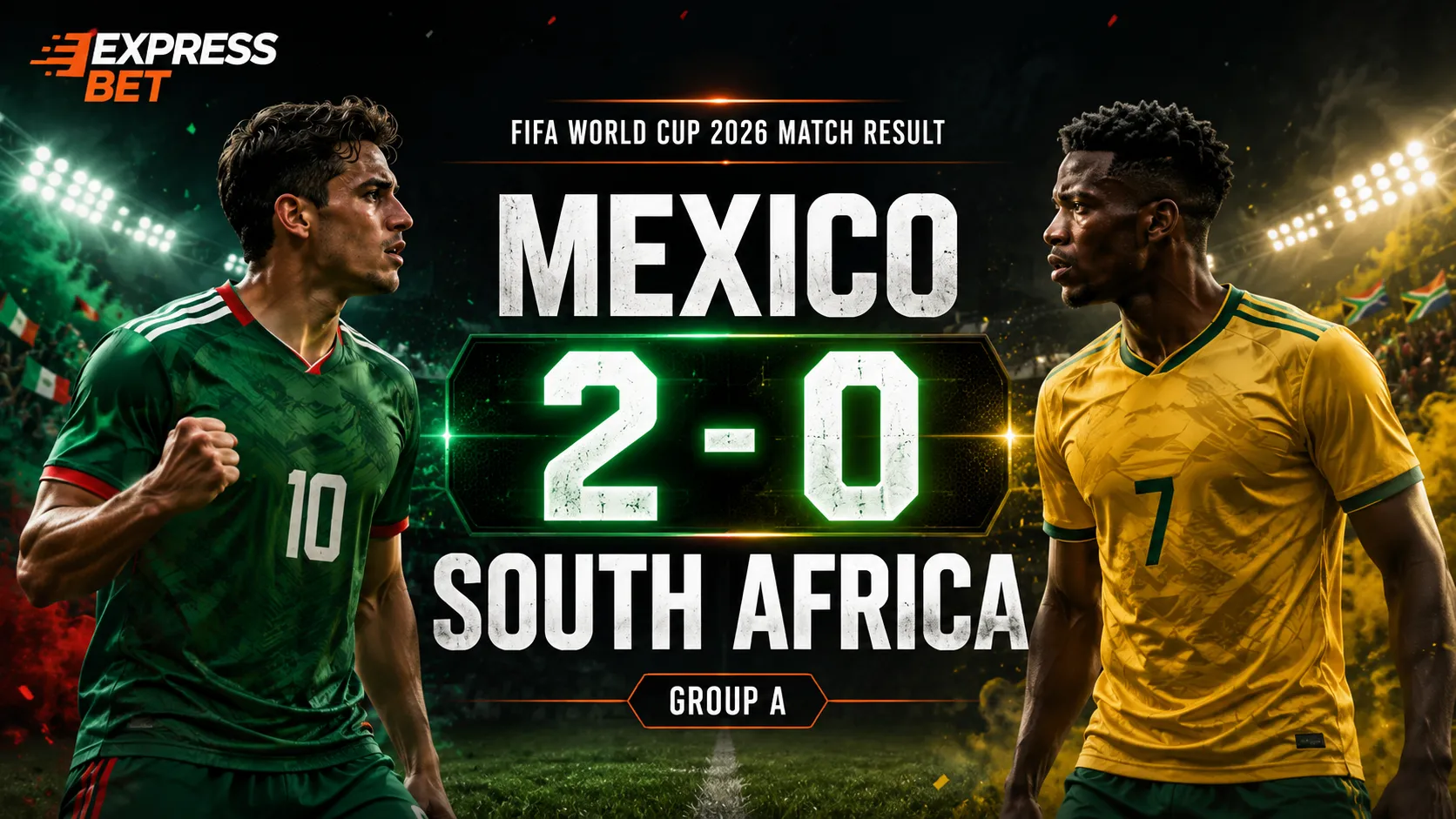
Mexico beat South Africa 2-0 in the opening match of the FIFA World Cup 2026 at Mexico City Stadium. Julián Quiñones scored the tournament’s first goal in the 9th minute after Mexico’s high press forced a mistake. Raúl Jiménez added the second with a header in the 67th minute. The main turning point came early in the second half, when Sphephelo Sithole was sent off for denying Brian Gutiérrez a clear chance. South Africa later lost Themba Zwane to another red card, while Mexico’s César Montes was dismissed in stoppage time. Mexico took three Group A points. Bettors who backed Mexico, under 2.5 goals, and both teams to score “No” were rewarded, depending on odds and timing.
Match Information
| Detail | Information |
|---|---|
| Match | Mexico vs South Africa |
| Competition | FIFA World Cup 2026 |
| Stage | Group A, Matchday 1 |
| Date | 11 June 2026 |
| Kickoff time | 13:00 local time / 19:00 UTC |
| Host country | Mexico |
| City | Mexico City |
| Stadium | Mexico City Stadium / Estadio Azteca / Estadio Banorte |
| Final score | Mexico 2-0 South Africa |
| Half-time score | Mexico 1-0 South Africa |
| Attendance | 80,824 |
| Referee | Wilton Pereira Sampaio |
| Goals | Julián Quiñones 9’, Raúl Jiménez 67’ |
| Red cards | Sphephelo Sithole 50’, Themba Zwane 84’, César Montes 90+2’ |
| Penalties | None confirmed |
| Weather | Detailed public match weather not confirmed |
| Pitch condition | No major confirmed pitch controversy |
| VAR | Used in the review before Zwane’s red card |
| Group impact | Mexico moved to three points; South Africa opened with zero |
Final Score and Match Summary
The Mexico vs South Africa match result was clean on the scoreboard and messy everywhere else. Mexico won 2-0, took the first three points of Group A, and opened the 2026 World Cup with enough control to calm a home crowd that did not arrive in a patient mood.
The game had two goals and three red cards. That ratio tells you most of what happened. Mexico played the better football. South Africa played too much of the match under pressure, then too much of it short-handed. By the end, the result looked logical, even if the route there looked like tournament football had been handed a whistle, a hot afternoon, and a grudge.
Mexico started with aggression. They pressed South Africa’s build-up from the opening minutes and forced the visitors into rushed decisions near their own penalty area. South Africa wanted to build calmly through Ronwen Williams and the first passing line. That plan survived for roughly as long as most opening-match theories survive contact with a packed Azteca.
Quiñones punished the first major mistake in the 9th minute. It was not a goal built from long possession or decorative passing. It came from pressure, theft, and immediate punishment. Mexico forced South Africa into an error, Érik Lira helped create the turnover, and Quiñones finished low.
That early goal changed the match. South Africa had to play, but Mexico still owned the emotional temperature. The hosts did not need to chase the game. They could press in bursts, stretch the pitch, and wait for South Africa’s passing to lose its balance again.
Mexico should probably have scored again before half-time. Raúl Jiménez had an early effort saved, Williams had to work, and Quiñones hit the post late in the first half. South Africa offered very little in return. A long-range attempt before the break was more evidence of survival than attacking structure.
The second half started badly for South Africa and then became worse. Sithole’s red card in the 50th minute turned a difficult match into a narrow corridor with no windows. Reduced to ten men, South Africa lost the little escape pressure they had. Mexico did not immediately kill the match, because football enjoys making superior teams explain themselves for longer than necessary, but Jiménez eventually did the sensible thing.
His header in the 67th minute settled the match. Roberto Alvarado’s cross created the chance, Jiménez attacked it with authority, and Mexico finally had the second goal that had been loitering around the match since the first half.
The final stretch brought more cards than football. Zwane was sent off in the 84th minute after a VAR review. Montes followed in stoppage time for denying Khuliso Mudau outside the area. By then, the result had already gone. The match had become a disciplinary case file with a football attached.
Goal Timeline
9’ — Julián Quiñones, Mexico, open-play goal
Mexico’s first goal came from the part of the game they controlled best: pressure on South Africa’s first pass out of defence.
South Africa tried to play from the back. Williams looked for a controlled outlet. Sithole received under pressure. Mexico jumped the passing lane and crowded the ball quickly. Lira was central to the pressure action, and once the ball broke loose, Quiñones reacted faster than the South African defence.
The finish was direct and low. Quiñones did not overcomplicate the moment. He drove the shot past Williams and gave Mexico a 1-0 lead.
Tactically, the goal mattered because it confirmed Mexico’s opening plan. They were not pressing for decoration. They were pressing for theft. South Africa’s defenders and midfielders then had to play the rest of the match with the knowledge that any loose touch near their own box could become national evidence.
Emotionally, it released the stadium. Opening matches usually begin with nerves wrapped in ceremony. Mexico tore through that part early.
67’ — Raúl Jiménez, Mexico, header
Mexico’s second goal came from width and timing. Roberto Alvarado delivered the cross, and Jiménez attacked the space with the instincts of a striker who has spent enough of his life waiting for one clean ball.
The header gave Mexico the result security they had lacked. Before that, South Africa were not creating much, but 1-0 is always a fragile political arrangement. One set piece, one slip, one deflection, and the entire analysis changes. At 2-0, Mexico could finally stop negotiating with anxiety.
The goal also carried personal meaning for Jiménez. He had been involved earlier, had forced Williams into action, and had missed or been denied enough times for the crowd to begin making that familiar sound: half support, half complaint. His header settled both the match and his own performance.
Tactically, it rewarded Mexico’s use of wide areas. South Africa’s reduced numbers made defending the box more complicated. Mexico stretched them, moved the ball into crossing positions, and finally converted the pressure into a decisive second goal.
Key Moments That Changed the Match
Mexico’s first five minutes set the tone
The first warning came before the first goal. Jiménez had an early effort saved by Williams, and Mexico’s pressing immediately forced South Africa into uncomfortable possession. It was clear that the hosts were not going to wait politely for the tournament to begin.
South Africa needed composure in those opening minutes. They found very little of it. The ball kept returning to Mexico too quickly. The shape looked functional on paper, but the rhythm belonged to the hosts.
Quiñones scores in the 9th minute
The first goal did more than change the score. It changed South Africa’s relationship with the ball.
After the opener, every pass across the defensive third felt heavier. Mexico’s forwards could keep pressing with proof that the approach worked. South Africa had to decide whether to continue building short or go longer and lose control. Neither option looked comfortable.
Williams keeps South Africa alive before half-time
Ronwen Williams prevented the match from becoming a first-half collapse. He saved from Jiménez and dealt with several dangerous moments. Quiñones also hit the post.
This mattered because South Africa reached half-time only one goal down. In tournament football, that usually counts as a form of oxygen. The problem was that South Africa used the oxygen poorly after the restart.
Sithole’s red card in the 50th minute
Sithole’s dismissal was the decisive disciplinary moment. He brought down Brian Gutiérrez as the Mexican midfielder moved into a dangerous position near the edge of the box. The referee judged it as denial of a clear goal-scoring opportunity.
From there, South Africa had to chase the match with ten men against a side already controlling territory. That is a bad idea even in theory. In practice, it became a slow squeeze.
Jiménez makes it 2-0
The second goal killed the realistic contest. South Africa were already struggling to get out. At 2-0, they needed to attack with fewer players, against a confident home side, in a stadium that had no interest in being generous.
Zwane’s red card ends South Africa’s resistance
Themba Zwane’s red card in the 84th minute left South Africa with nine men. VAR was involved, and the decision removed what remained of South Africa’s attacking possibility. It also damaged their fair-play position and squad availability for the next match.
Montes sees red in stoppage time
César Montes was sent off in the 90+2nd minute for denying Mudau as South Africa broke forward. For Mexico, it was the only serious blemish on the final minutes. They still won comfortably, but they lost a starting centre-back for the next match. Tournament wins often come with a receipt.
First Half Analysis
Mexico started in a 4-3-3 shape with Raúl Rangel in goal, Israel Reyes, César Montes, Johan Vásquez and Jesús Gallardo across the back line, Érik Lira anchoring midfield with Álvaro Fidalgo and Brian Gutiérrez, and a front three of Roberto Alvarado, Raúl Jiménez and Julián Quiñones.
South Africa’s structure looked closer to a back-five system, with Williams behind Mudau, Sibisi, Okon, Mbokazi and Modiba, supported by Mokoena, Sithole and Adams, with Rayners and Foster ahead. On paper, it offered defensive security. In reality, Mexico’s press made the first line of build-up look permanently late.
Mexico’s pressing was the story of the first half. They pushed high, closed passing lanes into midfield, and forced South Africa to make decisions before they had scanned the pitch. This is where the opening goal came from.
Lira’s role was important. He did not need to play like a glamorous creator. He needed to hold the centre, step forward at the right moment, and make South Africa feel that the middle of the pitch had a tax system. He did that well.
Fidalgo gave Mexico control in possession. Gutiérrez added forward running. Alvarado and Quiñones stretched the wide channels, while Jiménez offered the penalty-box reference point. The pattern was simple enough: force the ball wide, win it back, attack quickly before South Africa could reset.
South Africa’s biggest problem was not just losing the ball. It was where they lost it. Turnovers close to their own box allowed Mexico to attack before the defensive block was organized. That is not defending. That is admin work after a fire has started.
The half-time score was only 1-0, which flattered South Africa. Mexico had the better chances and the clearer attacking structure. Williams kept the visitors in the game. Without him, the second half might have been ceremonial.
South Africa did have a brief improvement after the first hydration break. They pushed slightly higher, found set-piece territory, and slowed Mexico’s early rhythm. But they did not produce sustained pressure. Mexico still looked more likely to score the second than South Africa looked likely to equalize.
At half-time, Hugo Broos had two problems. First, South Africa could not build reliably from the back. Second, they were offering too little threat to force Mexico’s full-backs and midfielders to think defensively. Javier Aguirre’s main concern was different: Mexico had control, but only one goal. Coaches hate that scoreline because it looks stable until it suddenly becomes a court case.
Second Half Analysis
The second half began with the same basic pattern, then Sithole’s red card made the match smaller for South Africa.
Once South Africa went down to ten men, they had to reorganize. Lyle Foster was replaced by Thalente Mbatha, a move that reflected the new reality. South Africa no longer had the luxury of keeping their attacking structure intact. They needed legs in midfield and bodies behind the ball.
Mexico became more patient. That was understandable, but not always ideal. Against ten men, teams often confuse control with waiting. Mexico had enough of the ball to end the match earlier, but they allowed a spell where the second goal remained absent and the crowd began to sense the old danger of wasted superiority.
The introduction of Gilberto Mora and Luis Chávez added freshness. Mora’s involvement was especially notable because of his age and the context of the occasion. He entered a World Cup opener in front of a huge home crowd and did not look swallowed by it.
The second goal came from better tempo. Mexico moved the ball into a crossing area, Alvarado delivered, and Jiménez finished. It was not tactical witchcraft. It was a good cross and a proper striker’s movement. Football analysts sometimes need to remember that this remains legal.
After 2-0, Mexico managed the game more comfortably. South Africa had little attacking structure left. Their moments came from transitions and from Mexico’s occasional looseness. Then Zwane’s red card reduced them to nine men, and the match lost competitive shape.
Montes’ late red card was the only serious negative for Mexico. It came from a transition situation and showed that even dominant teams can be exposed when the rest-defence loses concentration. With South Africa reduced and the score settled, the tackle was unnecessary in the wider tournament picture.
Tactical Picture: Why the Match Was Won and Lost
Mexico won because their pressing plan matched South Africa’s weakness.
South Africa tried to build from the goalkeeper and centre-backs. That approach can work if the passing angles are clean and the midfielders receive on the half-turn. Here, they did not. Mexico pressed with enough intensity to make the first pass risky and the second pass worse.
The key was Mexico’s front three. Jiménez screened central access while Alvarado and Quiñones pressed from the sides. Behind them, Gutiérrez and Fidalgo were ready to jump onto midfield receivers. Lira protected the centre and collected loose balls.
That created a trap. South Africa could play wide and get pressed near the touchline, or play inside and risk losing the ball in the most dangerous zone. The first goal came from the second kind of danger.
Mexico’s full-backs also mattered. Reyes and Gallardo advanced enough to pin South Africa’s wide players. That gave Mexico territorial control. It also made South Africa’s counters too long and too isolated.
South Africa’s shape became too passive. Their back line had numbers, but numbers alone do not defend if the midfield cannot slow the ball. The spaces between midfield and defence became inviting. Mexico’s attackers received too often facing goal or attacking the box.
Once Sithole was sent off, South Africa’s tactical plan became survival. They could not press Mexico effectively. They could not maintain two forwards with any real service. They could not leave too much space wide because Mexico’s crossing threat was obvious.
Mexico did not play a perfect match. Their chance conversion before the second goal could have been better. Their late defensive concentration also failed before Montes’ red card. But the winning logic was clear: press high, force errors, control territory, attack wide, and trust Jiménez to eventually turn one good delivery into the goal the match had been asking for.
Player Ratings and Individual Performances
These are editorial ratings based on match influence, tactical role, decision-making, and available match evidence.
Mexico Player Ratings
Raúl Rangel — 7/10
Had limited direct work compared with Williams, but handled South Africa’s few attempts cleanly. His calm start mattered after the decision to leave Guillermo Ochoa out of the XI.
Israel Reyes — 7/10
Offered balance at right-back. His crossing volume was useful, and he helped Mexico keep South Africa pinned back for long spells.
César Montes — 5/10
Defended well for much of the match, but the stoppage-time red card damaged his rating. The foul denied a dangerous break and will cost Mexico in the next game.
Johan Vásquez — 7/10
Strong and largely composed. South Africa rarely pulled him into panic defending.
Jesús Gallardo — 7/10
Helped Mexico control the left side and gave South Africa little room to escape. Solid rather than spectacular.
Érik Lira — 8/10
One of Mexico’s most important players. His pressure helped create the first goal, and his defensive positioning gave Mexico control of midfield.
Álvaro Fidalgo — 7/10
Kept Mexico’s passing rhythm steady. His movement between lines made South Africa’s midfield work harder than it wanted.
Brian Gutiérrez — 7.5/10
Direct, sharp, and central to the red-card incident against Sithole. His running changed the second half.
Roberto Alvarado — 8/10
Delivered the cross for Jiménez’s goal and gave South Africa problems from wide areas. Also involved in the Zwane incident.
Raúl Jiménez — 8/10
Scored the second goal, led the line, and repeatedly put himself in scoring positions. A proper striker’s performance: imperfect, persistent, decisive.
Julián Quiñones — 8/10
Scored the first goal of the tournament and gave Mexico early control. His pressing and directness caused South Africa constant discomfort.
Gilberto Mora — 7/10
Entered with composure and energy. His World Cup appearance at such a young age was a major personal milestone.
Luis Chávez — 6.5/10
Helped Mexico keep control after the game opened up.
Alexis Vega — 6/10
Added fresh movement late, though the match was already largely decided.
South Africa Player Ratings
Ronwen Williams — 7/10
Conceded twice but prevented a heavier defeat. Made important saves, especially in the first half.
Khuliso Mudau — 6/10
Kept working and forced the late foul that led to Montes’ red card. One of South Africa’s more persistent outlets.
Nkosinathi Sibisi — 5.5/10
Spent much of the match defending under pressure. Not the worst performer, but South Africa’s line struggled to control Mexico’s movement.
Ime Okon — 5.5/10
Had difficult moments against Jiménez and Mexico’s wide service. Needed more midfield protection.
Mbekezeli Mbokazi — 5.5/10
Worked defensively but was often pulled into emergency actions. South Africa’s structure did not protect him enough.
Aubrey Modiba — 5/10
Had problems dealing with Mexico’s wide play. Could not provide enough progression going forward.
Teboho Mokoena — 5.5/10
Booked early and struggled to impose himself. South Africa needed more control from him in midfield.
Sphephelo Sithole — 3/10
His turnover was tied to the first goal, and his red card after half-time changed the match completely. A brutal opening game.
Jayden Adams — 5/10
Worked hard but could not shift the midfield balance. South Africa needed cleaner forward passing.
Iqram Rayners — 5/10
Too isolated for long periods. Had little service and little space.
Lyle Foster — 5/10
Offered presence but was sacrificed after the red card. His match was shaped more by South Africa’s problems behind him than by his own attacking failures.
Thalente Mbatha — 5.5/10
Came on to stabilize the midfield after Sithole’s dismissal. Had a difficult assignment.
Themba Zwane — 2/10
His red card left South Africa with nine men and ended any faint chance of a comeback.
Oswin Appollis — 5.5/10
Entered late and had limited influence in a damaged match state.
Evidence Makgopa — 5.5/10
Had little time and little service.
Best Players of the Match
Man of the Match: Julián Quiñones
He scored the first goal, pressed with purpose, and gave Mexico the emotional release that opening matches demand. The finish was not decorative. It was efficient. That is often more useful.
Best attacker: Raúl Jiménez
Jiménez missed chances and had efforts saved, but he kept arriving. His header ended South Africa’s resistance and gave Mexico the comfort of a two-goal cushion.
Best midfielder: Érik Lira
Lira’s pressure and positioning were central to Mexico’s control. He gave the team defensive insurance and helped trigger the first goal.
Best defender: Johan Vásquez
Reliable, calm, and rarely exposed. Montes’ red card removes him from this category despite a largely solid match.
Best goalkeeper: Ronwen Williams
Williams conceded twice, but without his saves South Africa’s defeat could have been heavier. Goalkeepers often receive blame for scorelines. This one kept the scoreline respectable.
Best substitute: Gilberto Mora
His composure stood out. The stage was enormous, and he treated it as a football pitch rather than a museum.
Most disappointing performance: Sphephelo Sithole
The match turned around his errors: the first-goal sequence and the red card. Some World Cup debuts are remembered. This one will need recovery.
Injuries, Suspensions, Cards, and Discipline
The disciplinary story was bigger than the injury story.
South Africa lost Sithole to a straight red card in the 50th minute. Zwane followed in the 84th minute after a VAR review. Mexico then lost Montes in stoppage time.
That means both teams have suspension issues. South Africa must prepare for the Czech Republic without two dismissed players. Mexico must face South Korea without Montes, unless any disciplinary review changes the situation.
The card count also matters in a wider Group A context. Fair-play records can matter in tournament tiebreakers. It is early, but three red cards in one match are not background noise. They are luggage.
No major confirmed injury was central to the match report. The more immediate concern for both coaches is availability through suspension and tactical adjustment.
Referee and VAR Analysis
Wilton Pereira Sampaio had a busy match. Too busy, probably. Opening games are supposed to introduce the tournament. This one introduced the disciplinary department.
The Sithole red card was tied to denial of a clear goal-scoring opportunity. Gutiérrez was moving into a dangerous area, and Sithole’s foul stopped the attack. Given the position and match situation, the decision had a clear logic.
The Zwane red card was more contentious because VAR became part of the process. The decision was made after review for contact involving Alvarado. South Africa had reason to feel the match was slipping beyond football, but the action gave the officials something to judge.
Montes’ red card was easier to understand. Mudau broke forward, Montes stopped him outside the area, and the referee punished the denial of a dangerous transition. For Mexico, the decision was costly because the match was nearly finished.
The referee influenced the flow because three red cards always influence the flow. That does not automatically mean the decisions were wrong. It means the match became less tactical and more procedural after the first dismissal.
Weather, Stadium, Pitch, and Match Conditions
The match was played at Mexico City Stadium, the modern World Cup name for the Azteca venue. It remains one of football’s heavy rooms. History sits in the seats whether anyone asks it to or not.
Detailed match-time weather data was not confirmed in the public reports used for this article. There were hydration breaks, but FIFA had announced mandatory hydration breaks for every game at this World Cup, so they should not be treated as proof of specific heat stress in this match.
The more important condition was altitude. Mexico City’s elevation is a real football factor. It affects tempo, recovery, and the cost of repeated pressing. Mexico are used to that environment. South Africa had to deal with it while also chasing the game. That is not ideal preparation for calm passing from the back.
No major pitch controversy was confirmed. The surface did not become a headline. The match was shaped more by pressure, mistakes, and discipline than by grass speed or visible pitch damage.
The stadium atmosphere mattered. Mexico were not simply playing a neutral opener. They had a home World Cup opener in front of more than 80,000 people. That is an advantage, but it is also a demand. Score early, and it becomes fuel. Fail early, and it becomes a committee meeting with drums.
Fans and Stadium Atmosphere
The crowd gave Mexico a clear emotional advantage. The early goal made the stadium erupt, and from that point the match felt like it belonged to the hosts.
South Africa had to manage not only Mexico’s pressing but also the sound around every mistake. That is one of the less measurable parts of tournament football. A misplaced pass in a quiet stadium is an error. A misplaced pass in the Azteca during a World Cup opener is a public document.
The home support also shaped Mexico’s urgency. The players started quickly, and the crowd responded to every forward move. That rhythm can become reckless, but Mexico mostly used it well.
There were moments when the crowd grew impatient before the second goal. That was natural. Mexico had control but had not finished the match. At 1-0, dominance still needs witnesses. Jiménez’s goal solved that.
Historical Context and World Cup Analogies
Mexico and South Africa opened the 2010 World Cup against each other in Johannesburg. That match ended 1-1 and gave the tournament one of its great opening images through Siphiwe Tshabalala’s goal. Sixteen years later, the same pairing opened another World Cup, but this time the emotional geography was reversed.
In 2010, South Africa were the host nation carrying the ceremony. In 2026, Mexico had the home crowd, the altitude, and the burden of expectation. The result showed the difference between memory and current match conditions. History may book the fixture, but it does not mark the midfield.
The Azteca also brings older ghosts. It is tied to 1970, 1986, Pelé, Maradona, and the kind of football history that broadcasters like to polish before kickoff. Mexico did not need a performance for the museum here. They needed three points. They got them.
There is also a narrower Mexican context. Mexico failed to get out of the group stage in Qatar 2022, ending a long run of knockout appearances. Starting 2026 with a home win did not erase that failure, but it changed the immediate conversation. In tournament football, memory is flexible when the table looks good.
Match Statistics
| Statistic | Mexico | South Africa |
|---|---|---|
| Final score | 2 | 0 |
| Total shots | 16 | 3 |
| Shots on target | 4 | 2 |
| Possession | Around 60% | Around 40% |
| Corners | 3 | 1 |
| Red cards | 1 | 2 |
| Yellow cards | 1 | 2 |
| Penalties | 0 | 0 |
The numbers support the eye test. Mexico controlled the match, created more shots, and spent more time in dangerous areas. South Africa’s shot count was too low for a team that conceded early and needed to respond.
The possession figure matters less than the location of possession. Mexico had the ball in areas that threatened South Africa. South Africa had spells of possession that looked more like temporary relief.
The corner count was low, which tells part of the story. Mexico’s best chances did not come from corner pressure. They came from turnovers, open-play crosses, and direct attacking after South Africa lost shape.
The red-card count will follow both teams into the next round of fixtures. Mexico won the match. South Africa lost the match and two players. Montes’ dismissal means Mexico also paid a tournament price.
Betting Result Angle
The Mexico vs South Africa betting result was clear in several common markets.
Mexico were widely treated as the pre-match favorite. The final score confirmed that market view, but the route was not as smooth as the result suggests. At 1-0, Mexico had control but had not yet closed the match. Live bettors who waited for South Africa’s red card saw the market change sharply.
The match winner market landed on Mexico. The draw and South Africa win markets failed. Mexico clean sheet also landed because South Africa did not score.
The total goals market depended on the line. Over 1.5 goals landed after Jiménez’s header. Under 2.5 goals also landed because the match finished 2-0. That combination is common in controlled favorite wins: enough attacking superiority for two goals, not enough chaos for a goal festival.
Both teams to score “No” was successful. South Africa’s low attacking output made that result logical after the first half, and the Sithole red card made it even stronger. Still, post-match logic is cheap. The market price before kickoff and during live betting matters.
Correct score 2-0 was a high-risk winning angle. It matched the game state well after Mexico’s second goal, but exact-score betting remains volatile. One late South African set piece or one third Mexican goal would have broken it.
Cards markets were the wild area. Three red cards in an opener would have beaten most aggressive disciplinary expectations. Bettors on high card totals were rewarded, but this should not be treated as a repeatable pattern. One fiery match does not mean every Group A game will become a courtroom.
Penalty markets did not land. No penalty was confirmed. Corners were also modest, with Mexico ahead 3-1.
The main betting lesson is not “back the home favorite.” That is too lazy. The better lesson is that Mexico’s high press created live-betting signals early. South Africa were struggling to build from the back before the goal. That pressure was visible. A bettor watching the match carefully could read danger before the scoreboard fully reflected it.
This does not mean the same angle will work next time. Football betting carries risk, odds move quickly, and red cards can distort any pre-match analysis.
What This Result Means for Group A
Mexico moved to three points and a +2 goal difference. That is an ideal start in the expanded World Cup format.
Group A includes Mexico, South Africa, South Korea, and the Czech Republic. With 48 teams in the tournament, the top two teams in each group advance, along with the eight best third-placed teams. That makes an opening win extremely valuable. It does not guarantee qualification, but it changes the pressure profile.
Mexico’s next match against South Korea becomes a chance to take control of the group. A second win would likely put them in a very strong position before the final group match.
South Africa’s next match against the Czech Republic now carries heavy pressure. They have no points, a negative goal difference, and suspension issues. In the expanded format, one defeat is not fatal. But a defeat with two red cards is the kind of start that leaves a team doing arithmetic before breakfast.
Fair-play points may also matter later. South Africa’s two reds are a concern. Mexico’s Montes red card is also relevant, though the win cushions the damage.
What Mexico Did Right
Mexico did three things well.
First, they pressed with purpose. They did not simply run at South Africa. They set traps and forced mistakes in useful areas. The opening goal came from that work.
Second, they used width. Alvarado and Quiñones gave South Africa’s back line constant problems. Jiménez’s goal came from a cross, which was always one of Mexico’s cleanest routes to a second.
Third, they managed the emotional occasion. Opening a home World Cup can distort a team. Mexico used the crowd without becoming reckless for most of the match.
The midfield balance was also strong. Lira gave protection. Fidalgo linked possession. Gutiérrez ran forward and forced defensive decisions. That trio gave Mexico control of territory.
The main flaw was finishing before the second goal. Mexico left South Africa alive longer than necessary. The late Montes red card was another concern. Winning teams can still make bad tournament decisions.
What South Africa Got Wrong
South Africa’s biggest problem was their build-up.
They wanted to play out from the back, but they did not create stable passing angles. Mexico pressed high, and South Africa kept offering the ball into danger. The first goal was not an isolated accident. It was the logical result of the match’s opening pattern.
Their midfield could not control second balls. Mokoena, Sithole and Adams were often reacting rather than dictating. Once Mexico began winning territory, South Africa’s forwards became disconnected.
Discipline then finished the job. Sithole’s red card changed the match. Zwane’s red card ended it. South Africa did not just lose the football argument. They lost the player-count argument, which is rarely a recommended tournament strategy.
The attacking plan also lacked clarity. Foster and Rayners were isolated. There were not enough runners close to them, and South Africa did not use wide outlets with enough precision.
Broos will need to rebuild confidence quickly. The Czech Republic match now becomes a test of structure and emotional repair.
Coach Analysis
Javier Aguirre
Aguirre made bold selection calls. Starting Raúl Rangel over Guillermo Ochoa was not a small decision. Leaving Edson Álvarez out of the starting XI also drew attention. The choices worked in the sense that Mexico controlled the match and kept a clean sheet.
His pressing plan was effective. Mexico looked prepared for South Africa’s build-up and forced the kind of mistakes that decide tournament matches.
His substitutions helped refresh the team before and after the second goal. Mora’s introduction added energy and gave Mexico another story from the day.
The criticism is game management late on. Montes’ red card came from a defensive transition when the match was already won. Aguirre will not enjoy losing a centre-back for the next fixture.
Hugo Broos
Broos set South Africa up with numbers in defence, but the team did not protect the ball well enough. The shape looked reactive too early.
After Sithole’s red card, Broos had to adjust quickly. Bringing on Mbatha for Foster was logical because South Africa needed midfield cover. But the damage was already severe.
The bigger issue is what comes next. South Africa must now face the Czech Republic without key dismissed players and with confidence damaged. Broos needs to simplify the build-up, reduce risk in defensive areas, and give his forwards better support.
Player Milestones and Records
Raúl Jiménez’s goal was a major personal moment. It was reported as his first FIFA World Cup goal for Mexico. For a striker with his international career and reputation, that matters.
Gilberto Mora’s appearance was also significant. At 17 years and 240 days, he was reported as one of the youngest players to appear at a World Cup. That is a huge milestone, especially in a home opener.
The match itself entered opening-game history because of the three red cards. World Cup openers are often cautious. This one was not. It nearly matched the total red-card count of entire recent tournaments within one match.
Mexico also began the tournament with a clean sheet and three points at home. That is not a record by itself, but it is the kind of base every host nation wants before the schedule becomes less ceremonial and more cruel.
Incidents and Controversies
The main controversy was disciplinary.
Sithole’s red card was central because it arrived early in the second half and changed the match state. South Africa had already been second best, but playing with ten men made a comeback far less realistic.
Zwane’s dismissal after VAR review added more tension. The decision was for contact involving Alvarado. South Africa’s frustration was understandable, but the review gave the referee enough to act.
Montes’ late red card was different. It did not change the result, but it changed Mexico’s squad picture. Denying Mudau near the edge of the area was unnecessary given the match situation.
There were no confirmed penalties. No major crowd incident was central to the match report. The controversy remained on the pitch.
Final Verdict
Mexico deserved the win. The 2-0 scoreline reflected the balance of play, even if it did not fully capture Mexico’s first-half superiority.
The hosts pressed better, attacked with more structure, and punished South Africa’s mistakes. Quiñones gave Mexico the start they needed. Jiménez gave them the margin they required. Lira, Alvarado and Gutiérrez shaped the match around them.
South Africa were not merely beaten by red cards. They were already struggling before the first dismissal. The cards made the defeat heavier and the recovery harder, but the tactical problem existed from the opening minutes.
For Mexico, this was a strong tournament start with one obvious warning. They cannot afford cheap suspensions. Montes’ red card is exactly the kind of detail that can look minor after a win and expensive before the next lineup sheet.
For South Africa, the lesson is harsher. A World Cup opener does not forgive slow decisions near your own box. It does not forgive poor discipline. It does not forgive a team that wants to build from the back but cannot protect the first pass.
The tournament began with Mexico on top of Group A and South Africa under pressure. Not a final judgment. Just the first page. But in World Cups, first pages have a habit of being quoted for weeks.
Responsible Betting Note
Football betting carries financial risk. A correct tactical reading does not guarantee a winning bet. Odds change before and during matches, and red cards can completely alter a market. Never chase losses. Do not bet money needed for daily life. Use deposit limits, take breaks, and check local betting laws before gambling. Betting should remain entertainment, not income.
FAQ
Mexico beat South Africa 2-0 in the opening match of the FIFA World Cup 2026.
Julián Quiñones scored in the 9th minute, and Raúl Jiménez scored in the 67th minute.
Julián Quiñones was the strongest candidate for Man of the Match because he scored the opener and helped Mexico impose their pressing game early.
Mexico moved to three points with a +2 goal difference. South Africa stayed on zero points and must recover quickly in their next group match.
Mexico match-winner, under 2.5 goals, both teams to score “No,” and Mexico clean sheet were winning common markets. High-card markets also benefited from the three red cards.
[expert_review params=»JTdCJTIyY29sb3IlMjIlM0ElMjJncmVlbi0yJTIyJTJDJTIyZXhwZXJ0X2F2YXRhciUyMiUzQSUyMiUyMiUyQyUyMmV4cGVydF9uYW1lJTIyJTNBJTIyJTIyJTJDJTIyZXhwZXJ0X2xpbmslMjIlM0ElMjIlMjIlMkMlMjJleHBlcnRfaWQlMjIlM0ElMjIxJTIyJTJDJTIyZXhwZXJ0X3R5cGUlMjIlM0ElMjJleHBlcnRfaWQlMjIlMkMlMjJleHBlcnRfYXZhdGFyX2FsdCUyMiUzQSUyMiUyMiUyQyUyMmV4cGVydF9zaG93JTIyJTNBMSUyQyUyMmV4cGVydF9kZXNjcmlwdGlvbiUyMiUzQSUyMlNwb3J0cyUyMEJldHRpbmclMjBBbmFseXN0JTIwJTI2JTIwRWRpdG9yaWFsJTIwQ29udHJpYnV0b3IlMjIlMkMlMjJleHBlcnRfc2hvd19idXR0b24lMjIlM0ExJTJDJTIyZXhwZXJ0X3Nob3dfYnV0dG9uX3R5cGUlMjIlM0ElMjJwb3B1cCUyMiUyQyUyMmV4cGVydF9xdWVzdGlvbl9idXR0b25fdGV4dCUyMiUzQSUyMkFzayUyMFF1ZXN0aW9uJTIyJTJDJTIycXVlc3Rpb25fZXh0ZXJuYWxfbGluayUyMiUzQSUyMiUyMiUyQyUyMnBvcHVwX3VzZV9waG9uZSUyMiUzQTAlMkMlMjJleHBlcnRfdGl0bGUlMjIlM0ElMjJBdXRob3IlMjIlMkMlMjJleHBlcnRfc2hvd190aXRsZSUyMiUzQTElMkMlMjJleHBlcnRfdGV4dCUyMiUzQSUyMkFsZXglMjBNb3JnYW4lMjBpcyUyMGElMjBzcG9ydHMlMjBiZXR0aW5nJTIwYW5hbHlzdCUyMGFuZCUyMGVkaXRvcmlhbCUyMGNvbnRyaWJ1dG9yJTIwd2hvJTIwd3JpdGVzJTIwZGV0YWlsZWQlMjBib29rbWFrZXIlMjByZXZpZXdzJTJDJTIwYmV0dGluZyUyMGd1aWRlcyUyQyUyMHBsYXRmb3JtJTIwY29tcGFyaXNvbnMlMkMlMjBhbmQlMjByZXNwb25zaWJsZSUyMGdhbWJsaW5nJTIwZXhwbGFpbmVycy4lMjBIaXMlMjB3b3JrJTIwZm9jdXNlcyUyMG9uJTIwcHJhY3RpY2FsJTIwaW5mb3JtYXRpb24lMjBmb3IlMjB1c2VycyUyMHdobyUyMHdhbnQlMjB0byUyMHVuZGVyc3RhbmQlMjBob3clMjBiZXR0aW5nJTIwc2l0ZXMlMjBvcGVyYXRlJTIwYmVmb3JlJTIwdGhleSUyMHJlZ2lzdGVyJTJDJTIwZGVwb3NpdCUyQyUyMG9yJTIwY2xhaW0lMjBhJTIwYm9udXMuJTIyJTJDJTIycWElMjIlM0ElNUIlNUQlMkMlMjJxYV9zaG93X3RpdGxlJTIyJTNBMSUyQyUyMnFhX3RpdGxlJTIyJTNBJTIyJUQwJTkyJUQwJUJFJUQwJUJGJUQxJTgwJUQwJUJFJUQxJTgxJTIwJUQxJThEJUQwJUJBJUQxJTgxJUQwJUJGJUQwJUI1JUQxJTgwJUQxJTgyJUQxJTgzJTIyJTJDJTIyc2NvcmUlMjIlM0ElNUIlNUQlMkMlMjJzY29yZV9zdW1tYXJ5X3RleHQlMjIlM0ElMjIlMjIlMkMlMjJzY29yZV9zdW1tYXJ5X2F2ZXJhZ2UlMjIlM0EwJTJDJTIyc2NvcmVfbWF4JTIyJTNBJTIyNSUyMiUyQyUyMnNjb3JlX3N5bWJvbCUyMiUzQSUyMiUyMiUyQyUyMnNjb3JlX3RpdGxlJTIyJTNBJTIyJTIyJTJDJTIyc2NvcmVfc2hvd190aXRsZSUyMiUzQTAlMkMlMjJwbHVzZXMlMjIlM0ElNUIlNUQlMkMlMjJtaW51c2VzJTIyJTNBJTVCJTVEJTJDJTIycGx1c2VzX21pbnVzZXNfc2hvd190aXRsZSUyMiUzQTElMkMlMjJwbHVzZXNfbWludXNlc190aXRsZSUyMiUzQSUyMiVEMCU5RiVEMCVCQiVEMSU4RSVEMSU4MSVEMSU4QiUyMCVEMCVCOCUyMCVEMCVCQyVEMCVCOCVEMCVCRCVEMSU4MyVEMSU4MSVEMSU4QiUyMiUyQyUyMnBsdXNlc190aXRsZSUyMiUzQSUyMiUyMiUyQyUyMm1pbnVzZXNfdGl0bGUlMjIlM0ElMjIlMjIlN0Q=»]