
Norway vs Senegal World Cup 2026 Preview
Table of Contents Show
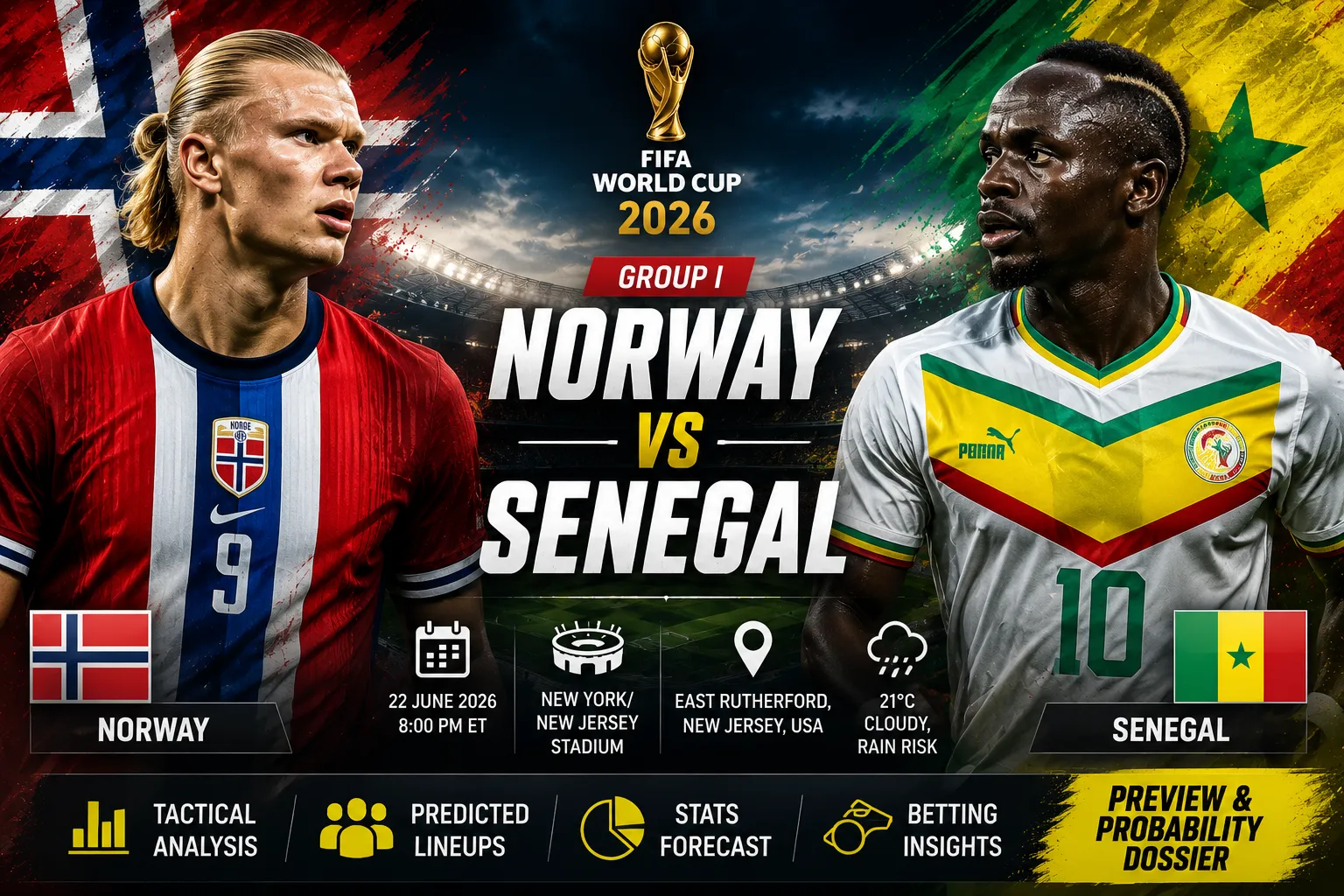
Norway face Senegal in a FIFA World Cup 2026 Group I match at New York/New Jersey Stadium in East Rutherford, New Jersey, United States. The local kick-off is scheduled for Monday, 22 June 2026 at 8:00 p.m. ET, with the UTC listing converting to Tuesday, 23 June 2026 at 00:00 UTC. This is a group-stage match with direct Round of 32 pressure.
Norway enter after a 4-1 win over Iraq. Erling Haaland scored twice in that opener, and Norway started the group above France on goal difference. Senegal enter after a 3-1 loss to France. Pape Thiaw’s side need a result to keep their qualification route stable before facing Iraq.
Confirmed team context gives Norway St a result to keep their qualification route stable before facing Iraq.
Confirmed team context givesåle Solbakken as coach, with Haaland, Martin Ødegaard, Sander Berge, Fredrik Aursnes, Antonio Nusa, Oscar Bobb, Alexander Sørloth, Kristoffer Ajer and Leo Østigård central to the squad. Senegal are coached by Pape Thiaw and have Sadio Mané, Nicolas Jackson, Iliman Ndiaye, Ismaïla Sarr, Edouard Mendy, Kalidou Koulibaly, Idrissa Gueye and Pape Matar Sarr as key figures.
The likely tactical shape is Norway using Haaland as the penalty-box reference with Ødegaard and wide creators feeding him, while Senegal use pace, compact defending and transition attacks. Betting markets show Norway as a slight favourite, but this preview does not provide guaranteed betting advice.
| Field | Data |
|---|---|
| Match | Norway vs Senegal |
| Competition | FIFA World Cup 2026 |
| Stage | First Stage / Group Stage |
| Group | Group I |
| Match Number | Match 41 |
| Date | Monday, 22 June 2026 local time / Tuesday, 23 June 2026 UTC |
| Kick-off Time | 8:00 p.m. ET / 00:00 UTC |
| Stadium | New York/New Jersey Stadium |
| Common Venue Context | MetLife Stadium |
| City | East Rutherford, New Jersey |
| Host Country | United States |
| Expected Attendance | Not available from verified public data |
| Referee | Not available from verified public data in complete match-official form |
| VAR | Not available from verified public data |
| Weather Forecast | Around 69°F / 21°C near kick-off, cloudy, with rain risk later in the evening |
| Pitch Context | Stadium pitch described in pre-match reporting as short, hard underneath and potentially difficult for possession if dry; rain may help ball movement |
| Main Article Focus | Group I qualification pressure, Haaland vs Senegal’s defensive block, Mané-led transition threat, pitch context, rain risk, projected stats, cards, set pieces and responsible betting market analysis |
Norway vs Senegal is a high-leverage Group I match. Norway can strengthen their Round of 32 route with another win. Senegal need a response after losing to France. The match is not only about Erling Haaland. It is also about whether Norway can control Senegal’s transition speed and whether Senegal can defend without becoming passive.
Norway vs Senegal matters because Norway can move close to knockout qualification with a win, while Senegal risk severe final-round pressure if they lose again.
| Category | Status | Norway vs Senegal Example | Article Use |
|---|---|---|---|
| Confirmed fact | Verified before publication | Norway vs Senegal, Group I, New York/New Jersey Stadium | |
| Confirmed timing | Verified fixture context | 22 June 2026 local time / 23 June UTC, 8:00 p.m. ET / 00:00 UTC | |
| Confirmed Norway opener | Verified reporting | Norway beat Iraq 4-1 | |
| Confirmed Senegal opener | Verified reporting | Senegal lost 3-1 to France | |
| Confirmed Norway coach | Verified squad data | Ståle Solbakken | |
| Confirmed Senegal coach | Verified squad reporting | Pape Thiaw | |
| Confirmed Norway squad context | Verified squad data | Haaland, Ødegaard, Nyland, Ajer, Østigård, Berge, Aursnes, Nusa, Bobb, Sørloth | |
| Confirmed Senegal squad context | Verified squad reporting | Mané, Jackson, Iliman Ndiaye, Ismaïla Sarr, Koulibaly, Mendy, Gueye, Pape Matar Sarr | |
| Announced information | Verified press conference reporting | Senegal said the plan is against Norway as a whole, not only Haaland | |
| Probable information | Tactical forecast | Norway likely attack through Haaland, Ødegaard and wide service | |
| Projected data | Model-based estimate | Possession, shots, xG, fouls, cards and substitution windows | |
| Unknown data | Not available from verified public data | Expected attendance, complete referee crew, VAR crew, exact pitch speed | |
| Scenario-based analysis | Forecast only | Senegal may use a deeper block or a more aggressive transition plan depending on early pressure |
This distinction matters because the match has strong narratives. Haaland scored twice against Iraq, but that does not guarantee another goal. Senegal conceded three against France, but that does not mean they will defend poorly again. Norway are market favourites, but the market does not settle the match. Senegal’s need for points is clear, but their tactical approach remains a forecast until the official team sheet and first phases confirm it.
The article uses confirmed data where available. It uses projected ranges for future events. It does not claim that a goal, card, injury, substitution or VAR decision will happen at a fixed minute.
Group I is shaped by two opening results. Norway beat Iraq 4-1. France beat Senegal 3-1. That created an early split between the two winning teams and the two teams chasing.
| Team | Played | Won | Drawn | Lost | Goals For | Goals Against | Goal Difference | Points |
|---|---|---|---|---|---|---|---|---|
| Norway | 1 | 1 | 0 | 0 | 4 | 1 | +3 | 3 |
| France | 1 | 1 | 0 | 0 | 3 | 1 | +2 | 3 |
| Senegal | 1 | 0 | 0 | 1 | 1 | 3 | -2 | 0 |
| Iraq | 1 | 0 | 0 | 1 | 1 | 4 | -3 | 0 |
This table should be updated if France vs Iraq finishes before publication or before the Norway match starts. The strategic point remains clear: Norway can separate from Senegal, while Senegal cannot afford to fall too far behind.
Norway returned to the World Cup with a strong first match. A 4-1 win over Iraq gave them points, goal difference and confidence. Haaland scored twice. Østigård also scored. Norway’s attack looked powerful. The team looked ready for a more demanding opponent.
Senegal are a different test. Iraq gave Norway room and could not control Haaland. Senegal have more pace, more recovery power, stronger individual defenders and a better transition attack. Norway cannot play as if the Iraq match repeats automatically.
Norway’s objectives:
Senegal need a result. A second loss would make the Iraq match a pressure game and could damage their third-place route. Pape Thiaw has described the remaining group games as finals. His side cannot play only to avoid Haaland. They need a complete defensive and attacking plan.
Senegal have enough quality to hurt Norway. Mané remains a major forward reference. Ismaïla Sarr can attack space. Iliman Ndiaye can link play. Nicolas Jackson can run channels and press. Pape Matar Sarr and Idrissa Gueye can support transition and defensive pressure. Koulibaly and Mendy give defensive leadership.
Senegal’s objectives:
Goal difference already matters. Norway are +3. Senegal are -2. A Norway win could create a major gap. A Senegal win would reset the group. A draw would help Norway more than Senegal because Norway already have three points.
If Norway lead late, they may still chase a second or third goal because France remain in the group. If Senegal trail late, Thiaw must decide whether to chase a draw or protect goal difference. The third-place route makes that decision difficult.
The expanded World Cup sends the top two teams from each group into the Round of 32, along with the best eight third-placed teams. Four or six points after two matches would put Norway in a strong position. Zero points after two matches would put Senegal under severe pressure. One point would keep Senegal alive but still exposed.
Senegal’s final match is against Iraq. That gives them a route. But they should not rely on a final-day rescue. Norway’s final match is against France, so a result against Senegal would be valuable before facing one of the tournament favourites.
The exact knockout path depends on final group placement and other groups. The practical path is simple. A team that finishes first or second in Group I controls its route better than a team waiting on third-place rankings. Norway can build toward top-two status. Senegal need to avoid making third place their only likely route.
Norway carry momentum pressure. Senegal carry survival pressure. Norway’s problem is expectation. If they do not score early, the match can become tense. Senegal’s problem is urgency. If they chase too early, Norway can attack space through Haaland, Nusa, Bobb and Ødegaard.
The first goal can change the whole tactical frame. A Norway goal forces Senegal to play higher. A Senegal goal forces Norway to chase against a quick counterattacking team.
| Result | Norway Impact | Senegal Impact | Group I Meaning |
|---|---|---|---|
| Norway win | Norway move to six points and take a major step toward the Round of 32 | Senegal stay on zero points and face a high-pressure Iraq match | Norway become strong top-two candidate |
| Draw | Norway move to four points and remain in control | Senegal move to one point and stay alive but under pressure | Senegal preserve route but do not control it |
| Senegal win | Norway stay on three points and lose group control | Senegal move to three points and revive qualification hopes | Group I becomes unstable |
| Factor | Match Relevance |
|---|---|
| Host country | United States |
| Venue region | New York/New Jersey metropolitan area |
| Stadium | New York/New Jersey Stadium |
| Common venue context | MetLife Stadium |
| City | East Rutherford, New Jersey |
| Neutral match | Neither team is host nation |
| Climate | Mild evening with cloud and rain risk |
| Altitude | No meaningful altitude issue |
| Crowd profile | Norwegian support, Senegalese support, U.S. neutrals and diaspora fans |
| Tournament pressure | Second group match with direct qualification implications |
The New York/New Jersey setting creates a major-event atmosphere. Norwegian fans have been visible in the city. Senegal should also have strong support from diaspora communities and African football followers. Crowd noise can matter during set pieces, pressing triggers and late-game decisions.
| City Factor | Tactical Impact |
|---|---|
| 8:00 p.m. local kick-off | Cooler than afternoon, suitable for high tempo |
| Rain risk | Could improve ball speed on a hard pitch but may affect first touch |
| No altitude issue | Sprint recovery is normal |
| Large stadium environment | Communication and defensive calls matter |
| New York metro travel load | Arrival, fan movement and logistics can affect routine |
| Heavy crowd energy | Momentum can swing after Haaland chances or Senegal counters |
| Weather variability | Pitch condition should be assessed in warm-up |
| Final venue context | Players may feel a large-match atmosphere despite group stage |
The city context favours intensity. The evening kick-off helps physical output. The rain risk can change pitch speed. Norway may prefer a smoother, wetter surface if the pitch is hard. Senegal may also benefit because a quicker surface can help transition passes.
| Stadium Detail | Data |
|---|---|
| FIFA Stadium Name | New York/New Jersey Stadium |
| Common Venue Context | MetLife Stadium |
| City | East Rutherford |
| State | New Jersey |
| Host Country | United States |
| Kick-off | 8:00 p.m. ET / 00:00 UTC |
| Expected Attendance | Not available from verified public data |
| Referee | Not available from verified public data in complete match-official form |
| VAR | Not available from verified public data |
| Roof Status | Open-air stadium |
| Pitch Concern | Described in pre-match reporting as short and hard underneath |
| Tactical Impact | A dry hard pitch may hurt possession rhythm; rain may help passing speed |
The pitch deserves attention. Solbakken mentioned concern about the surface. He said it looked short and hard underneath, which could hurt teams that want to hold possession. He also noted that rain could help. That does not guarantee a bad pitch. It means the first 10 minutes should be used to assess ball speed, bounce and turning stability.
| Weather / Environment Factor | Tactical Meaning |
|---|---|
| Around 69°F / 21°C near kick-off | Good physical temperature for pressing and repeated sprints |
| Cloudy conditions | No direct sun load |
| Rain risk later | Ball speed may increase and first touches may become less secure |
| Open-air stadium | Rain and wind remain active variables |
| Exact humidity unavailable | Avoid precise cramp claims |
| Exact wind unavailable | Long diagonals and crosses need live calibration |
| No altitude | Normal oxygen recovery |
| Hard pitch concern | Passing, tackles and bounce may need adjustment |
The most important environment factor is the pitch, not heat. If the surface is hard and dry, Norway’s possession and Ødegaard’s passing rhythm may suffer. If rain makes the surface quicker, Norway’s passing and Senegal’s counters may both improve.
| Team | Player / Role | Status | Tactical Impact |
|---|---|---|---|
| Norway | Ståle Solbakken | Head coach | Wants Norway to keep identity and discipline |
| Norway | Erling Haaland | Striker | Scored twice vs Iraq; main penalty-box threat |
| Norway | Martin Ødegaard | Captain / midfielder | Main creator and rhythm player |
| Norway | Ørjan Nyland | Goalkeeper | Experienced goalkeeper option |
| Norway | Sander Tangvik | Goalkeeper | Uncapped tournament squad selection |
| Norway | Egil Selvik | Goalkeeper | Squad goalkeeper option |
| Norway | Julian Ryerson | Defender | Right-side defending and support runs |
| Norway | Kristoffer Ajer | Defender | Recovery defending and aerial duels |
| Norway | Leo Østigård | Defender | Scored vs Iraq; set-piece and box presence |
| Norway | Sander Berge | Midfielder | Physical control and progression |
| Norway | Fredrik Aursnes | Midfielder | Tactical balance and pressing support |
| Norway | Antonio Nusa | Winger / attacker | One-vs-one threat and wide speed |
| Norway | Oscar Bobb | Attacker | Technical width and between-line movement |
| Norway | Alexander Sørloth | Forward | Secondary forward and aerial profile |
| Senegal | Pape Thiaw | Head coach | Needs a response after France loss |
| Senegal | Edouard Mendy | Goalkeeper | Defensive command and shot-stopping |
| Senegal | Kalidou Koulibaly | Centre-back | Defensive leadership and Haaland duel |
| Senegal | Sadio Mané | Forward | Main experience and transition threat |
| Senegal | Nicolas Jackson | Forward | Channel running and pressing |
| Senegal | Iliman Ndiaye | Forward / attacking midfielder | Link play and final-third creativity |
| Senegal | Ismaïla Sarr | Winger | Pace and direct transition threat |
| Senegal | Idrissa Gueye | Midfielder | Ball-winning and experience |
| Senegal | Pape Matar Sarr | Midfielder | Athletic midfield support |
| Senegal | Lamine Camara | Midfielder | Passing and set-piece option |
| Senegal | El Hadji Malick Diouf | Defender | Left-side energy and recovery |
| Senegal | Moussa Niakhaté | Defender | Centre-back / left defensive option |
| Player | Team | Status | Tactical Impact |
|---|---|---|---|
| Not available from verified public data | Norway | No confirmed match-day doubtful player used in this preview | Official team sheet should be checked |
| Idrissa Gueye | Senegal | Included in squad after missing late-season time before tournament | Match role and minutes should be verified from official XI |
| Not available from verified public data | Senegal | No additional confirmed match-day doubtful player used in this preview | Official team sheet should be checked |
| Player | Team | Status | Tactical Impact |
|---|---|---|---|
| Mathias Dyngeland | Norway | Injury context before squad selection; not in final squad | Triggered Norway goalkeeper selection issue |
| Nikita Haikin | Norway | FIFA nationality switch rejection context; not in final squad | Not an available goalkeeper option |
| Aron Dønnum | Norway | Not selected in final squad | Removes a wide option from the tournament group |
| Felix Horn Myhre | Norway | Not selected in final squad | Removes a midfield option from the tournament group |
| Moustapha Mbow | Senegal | Dropped from final squad | Not available for defensive rotation |
| Ilay Camara | Senegal | Dropped from final squad | Not available for defensive rotation |
| Malang Sarr | Senegal | Not selected | Removes one defensive option |
| Player / Group | Team | Issue | Match Impact |
|---|---|---|---|
| Haaland | Norway | Heavy attacking workload, not injury | Must receive service and avoid isolation |
| Ødegaard | Norway | Tactical workload, not injury | Needs protection from Senegal pressure |
| Norway full-backs | Norway | Transition exposure risk | Must manage Senegal pace |
| Senegal centre-backs | Senegal | Haaland duel load | Need constant concentration |
| Senegal wide defenders | Senegal | Nusa/Bobb/Ødegaard overloads | Card and fatigue risk |
| Senegal forwards | Senegal | High transition workload | Must sprint and recover repeatedly |
| Team | Confirmed Suspension | Notes |
|---|---|---|
| Norway | Not available from verified public data | No confirmed active suspension used in this preview |
| Senegal | Not available from verified public data | No confirmed active suspension used in this preview |
Norway’s availability picture is stable enough to build around Haaland and Ødegaard. The main question is selection structure. Solbakken can support Haaland with one striker, two wide players or a hybrid role for Sørloth. Norway’s balance depends on whether the midfield protects counterattacks while still giving Ødegaard passing lanes.
Senegal’s key issue is not one missing player. It is defensive correction after the France match. Thiaw has enough talent to change the match shape. He can use a compact back four, a deeper back five, or a more aggressive midfield line. The final team sheet will reveal whether Senegal want to stop Norway first or attack Norway immediately.
Official starting lineups were not available from verified public data at the time of writing. These XIs are projections based on squad data, opening-match context and tactical logic.
| Position / Line | Player | Likely Role |
|---|---|---|
| GK | Ørjan Nyland | Goalkeeper, command and long distribution |
| RB | Julian Ryerson | Right-side defence, duels and support runs |
| CB | Kristoffer Ajer | Recovery defending and aerial duels |
| CB | Leo Østigård | Box protection, set-piece threat and first contact |
| LB | David Møller Wolfe / Fredrik Bjørkan | Left-side defending and progression |
| DM | Sander Berge | Physical screen, ball carrying and second balls |
| CM | Fredrik Aursnes / Patrick Berg | Tactical balance and passing support |
| AM | Martin Ødegaard | Main creator and captain |
| RW | Oscar Bobb | Technical width and half-space movement |
| ST | Erling Haaland | Main striker and penalty-box reference |
| LW | Antonio Nusa | One-vs-one threat and transition outlet |
| Position / Line | Player | Likely Role |
|---|---|---|
| GK | Edouard Mendy | Goalkeeper, command and cross handling |
| RB | Krépin Diatta / Antoine Mendy | Right-side defending and wide support |
| CB | Kalidou Koulibaly | Defensive leader and Haaland matchup |
| CB | Moussa Niakhaté / Abdoulaye Seck | Centre-back cover and aerial support |
| LB | El Hadji Malick Diouf / Ismail Jakobs | Left-side defending and transition support |
| DM | Idrissa Gueye | Ball-winning and experience |
| CM | Pape Matar Sarr | Athletic midfield link and pressing |
| CM | Lamine Camara / Pape Gueye | Passing, set pieces and second balls |
| RW | Ismaïla Sarr | Speed and direct running |
| ST | Nicolas Jackson / Sadio Mané | Channel running or central forward role |
| LW | Sadio Mané / Iliman Ndiaye | Experience, link play and scoring threat |
| Team | Base Formation | In Possession | Out of Possession | Confidence |
|---|---|---|---|---|
| Norway | 4-2-3-1 / 4-3-3 | 2-3-5 with Ødegaard between lines, Haaland central and wide players high | 4-4-2 press or 4-2-3-1 mid-block | Medium |
| Senegal | 4-3-3 / 4-2-3-1 / 5-4-1 | Direct 3-2-5 in transition, wingers and Mané/Jackson high | Compact 4-5-1 or 5-4-1 against Norway pressure | Medium |
| Scenario | Trigger | Expected Change |
|---|---|---|
| Norway use Sørloth with Haaland | Solbakken wants more aerial and physical pressure | Norway become more direct and cross-heavy |
| Norway use Bobb and Nusa wide | Solbakken wants dribbling and width | Norway attack full-backs one-vs-one |
| Norway add Patrick Berg | Solbakken wants control and counter protection | Ødegaard gets more stable support |
| Norway protect lead | Leading after 70 minutes | Extra midfielder or defensive full-back role becomes likely |
| Senegal use back five | Thiaw wants to protect central box from Haaland | Extra centre-back narrows Haaland’s receiving zones |
| Senegal start Jackson centrally | Thiaw wants channel runs and pressing | Mané can start wide or drift inside |
| Senegal use Mané centrally | Thiaw wants experience closer to goal | Wide support must come from Sarr and Ndiaye |
| Senegal chase goal late | Trailing after 70 minutes | Cherif Ndiaye, Bamba Dieng or another forward profile can add penalty-box presence |
| Phase | Expected Pattern |
|---|---|
| Build-up | Nyland to centre-backs, Berge/Aursnes support, Ødegaard receives between lines |
| Attack | Haaland as central reference, Nusa and Bobb width, Ødegaard final pass |
| Defense | Counter-press, full-back recovery and central control through Berge |
| Transitions | Quick release to Haaland, Nusa, Bobb or Ødegaard after recovery |
| Set Pieces | Haaland, Østigård, Ajer and Sørloth if selected attack deliveries |
| Weakness | Space behind full-backs, overreliance on Haaland, pitch condition if possession is disrupted |
Norway should build through the centre-backs into Berge, Aursnes and Ødegaard. The key is not just keeping the ball. The key is giving Ødegaard time to face forward. If Ødegaard receives between Senegal’s midfield and defence, he can find Haaland, Nusa, Bobb or a far-side runner.
The pitch may influence Norway’s build-up. If the surface plays hard and dry, short passing may become less smooth. If rain makes the surface slicker, Norway can move the ball faster but must manage first touches.
Useful Norway build-up routes:
Norway can press Senegal, but they must respect Senegal’s pace. If Norway press with both full-backs high and Senegal break the first line, Mané, Sarr or Jackson can attack open space.
Useful Norway pressing triggers:
Norway’s counter-press must stop Senegal’s first forward pass. That pass is the danger.
Norway’s main attacking side can shift. Nusa gives left-side dribbling. Bobb gives right-side technical movement. Ødegaard often drifts into right-half-space zones. Haaland stays central and attacks the highest-value spaces.
Norway should avoid becoming predictable. If every attack ends with a cross to Haaland, Koulibaly and Senegal’s centre-backs can prepare. Norway need low cutbacks, through balls, reverse passes and second runners.
Ødegaard is the key passer. Berge and Aursnes support him. Bobb can become a key connector if he starts. Norway’s best attacking sequences will likely involve Ødegaard receiving ahead of Senegal’s midfield line.
Norway can transition fast. Haaland is lethal when he runs into space. Nusa and Bobb can carry. Ødegaard can release runners early. Senegal’s recovery speed is strong, so the first pass must be clean.
Norway have major set-piece threat. Haaland, Østigård, Ajer and Sørloth can attack crosses. Senegal have aerial defenders, but repeated corners can still create pressure.
Norway should vary routines. Senegal will expect direct balls toward Haaland and Østigård. Near-post movement, far-post screens and second balls around the penalty spot can create better value.
Norway’s weakness is the space behind attacking full-backs. Senegal can run quickly into those zones. The second weakness is overreliance on Haaland. If Senegal crowd him, Norway need Nusa, Bobb, Ødegaard and Sørloth to carry enough threat.
Nyland can go short or long. Against Senegal, long passes must not become rushed clearances. Senegal can win duels and restart attacks quickly. Nyland’s decisions will affect Norway’s tempo.
Ryerson and the left-back must stagger. One can advance. The other should protect. If both go high, Senegal’s wide forwards can attack behind them.
Haaland is the centre of Norway’s attacking model. He does not need constant touches. He needs high-quality service. His movement can also create space for Ødegaard, Nusa and Bobb. If Senegal overcommit to him, Norway must attack the space around him.
| Phase | Expected Pattern |
|---|---|
| Build-up | Mendy and centre-backs seek safe progression, Gueye/Sarr/Camara support |
| Attack | Mané, Sarr, Ndiaye and Jackson attack transition spaces |
| Defense | Compact block, protect central box, deny Ødegaard time |
| Transitions | First forward pass into Mané, Sarr, Jackson or Ndiaye |
| Set Pieces | Koulibaly, Niakhaté, Jackson and Mané attack deliveries |
| Weakness | Clean-sheet problem at World Cup level, defensive spacing under pressure, fouls around box |
Senegal should not overplay in dangerous zones. Norway can press hard. Mendy can play longer passes when needed. Koulibaly can step forward. Gueye and Pape Matar Sarr can connect midfield. Lamine Camara can help with passing if selected.
Senegal’s build-up goal is simple: escape Norway’s first pressure and find the front line with enough support.
Useful Senegal build-up routes:
Senegal can press in moments, but they should not open too much space behind. Norway have Haaland. A failed high press can become a through ball into the striker.
Useful Senegal pressing triggers:
Senegal’s press must be collective. One player pressing alone will give Ødegaard passing lanes.
Senegal can attack through either wing. Sarr gives direct speed. Mané gives experience and finishing. Ndiaye gives link play. Jackson gives channel running. The best side may be whichever side Norway’s full-back has vacated.
The goal is to attack before Norway reset. Senegal do not need long possession to create danger. They need one clean forward pass and support around it.
Gueye and Pape Matar Sarr are important first connectors. Lamine Camara can add passing range. Mané can also act as a creator if he drops into the half-space. Rezaeian not applicable; Senegal’s wide service must come from Diatta, Jakobs, Diouf or the wingers depending on the XI.
Transition is Senegal’s best open-play route. Norway will likely push numbers forward. Senegal have the pace to punish that. Sarr, Mané, Jackson and Ndiaye can all attack space.
The ideal Senegal transition:
Senegal can threaten through Koulibaly, Niakhaté, Jackson, Seck and other aerial players. Delivery quality matters. Set pieces also help Senegal slow Norway’s rhythm.
Senegal’s defensive weakness is recent World Cup clean-sheet history and the open-space problem after pressure breaks. They must defend Haaland without losing Ødegaard. If they only watch Haaland, Norway’s other players can hurt them.
Edouard Mendy must manage pressure. He can slow the match, command crosses and play long when needed. His distribution should target the wingers or central runners, not isolated clearances.
Senegal full-backs must defend first. They can support counters, but they cannot leave Haaland and Norway’s wide players with open channels. Timing matters more than volume.
Senegal’s striker role depends on selection. Jackson gives channel running. Mané gives experience if central. Cherif Ndiaye or Bamba Dieng can add directness from the bench. The striker must stretch Norway’s centre-backs and help Senegal escape pressure.
| Zone | Norway Edge | Senegal Edge | Likely Control | Why It Matters |
|---|---|---|---|---|
| Norway left / Senegal right | Nusa dribbling and left-side support | Sarr / Diatta transition speed | Balanced | This side can create end-to-end moments |
| Norway right / Senegal left | Ødegaard and Bobb combinations | Mané or Ndiaye counter lane | Norway in possession, Senegal in transition | Ødegaard may shape the match here |
| Central midfield | Ødegaard, Berge, Aursnes | Gueye, Pape Matar Sarr, Camara | Balanced | Controls service to Haaland and Senegal counters |
| Penalty box | Haaland, Østigård, Sørloth if selected | Koulibaly, Mendy, Niakhaté | Norway by threat, Senegal by resistance | Decisive duel zone |
| Set pieces | Haaland, Ajer, Østigård | Koulibaly, Jackson, Mané | Balanced | Both teams have aerial routes |
| Transitions | Haaland, Nusa, Bobb | Mané, Sarr, Jackson, Ndiaye | Senegal danger | Senegal’s best route |
| Defensive third | Norway likely defend fewer phases | Senegal likely defend longer spells | Senegal under pressure | Tests Senegal’s concentration |
Haaland is Norway’s main scoring threat. Koulibaly is Senegal’s main defensive leader.
Why it matters: Norway’s attacking model depends on high-quality service into Haaland. Senegal’s match plan depends on reducing his clean touches.
What to watch: Whether Haaland receives facing goal or with his back to goal under pressure.
Risk trigger: If Koulibaly or the second centre-back gets booked early, Senegal’s box defence becomes less aggressive.
Ødegaard needs time between the lines. Gueye and Senegal’s midfield must limit his passing angles.
Why it matters: If Ødegaard controls rhythm, Haaland becomes harder to defend.
What to watch: Ødegaard’s first touch after receiving in the right half-space.
Risk trigger: If Senegal’s midfield drops too deep, Ødegaard can pick passes from the edge of the block.
Nusa can attack one-vs-one and create separation.
Why it matters: Senegal may crowd Haaland, so Norway need wide dribbling to break the block.
What to watch: Nusa’s ability to beat the first defender and deliver low crosses.
Risk trigger: If Senegal overcommit centrally, Nusa can attack the isolated full-back.
Mané remains Senegal’s most experienced match-winner.
Why it matters: Senegal may have fewer attacks, so Mané’s moments carry high value.
What to watch: Whether Mané receives wide with support or central between Norway’s lines.
Risk trigger: If Ryerson pushes high and Norway lose the ball, Mané can attack the open channel.
Senegal’s speed can punish Norway if the press fails.
Why it matters: Norway may dominate possession but still concede from one fast attack.
What to watch: The distance between Norway’s centre-backs and midfield after lost balls.
Risk trigger: If Berge or Aursnes is pulled out of position, Senegal’s first forward pass becomes dangerous.
| Projected Stat | Norway | Senegal | Confidence | Reason |
|---|---|---|---|---|
| Possession | 52–60% | 40–48% | Medium | Norway should control more ball, but Senegal can contest midfield |
| Shots | 11–18 | 8–15 | Medium | Norway’s Haaland route increases shot volume; Senegal transition can create chances |
| Shots on Target | 4–8 | 3–6 | Medium | Both teams have strong attacking references |
| xG Range | 1.35–2.30 | 0.90–1.70 | Medium | Norway edge comes from Haaland and set pieces; Senegal transition keeps model close |
| Big Chances | 1–4 | 1–3 | Low/medium | Game state can change chance quality sharply |
| Corners | 4–8 | 3–7 | Medium | Norway territory and Senegal counters can both create corners |
| Fouls | 9–15 | 11–18 | Medium | Senegal may defend Haaland and Ødegaard aggressively |
| Yellow Cards | 1–3 | 1–4 | Low/medium | Referee profile incomplete; tactical duels raise card risk |
| Red-Card Risk | Low | Low/medium | Low | No red card is projected |
| Offsides | 1–4 | 1–4 | Low | Haaland, Sarr, Jackson and Mané can attack the line |
| Saves | 2–5 | 3–7 | Medium | Mendy may face more central pressure |
| Crosses | 14–24 | 10–20 | Medium | Norway may cross toward Haaland; Senegal may use wide counters |
| Tackles | 13–22 | 16–28 | Medium | Senegal likely defend more one-vs-one actions |
| Interceptions | 8–15 | 10–19 | Medium | Both teams need to cut forward passes |
| Clearances | 12–24 | 20–36 | Medium | Senegal may clear more from Norway pressure |
Norway should have a slight possession and shot edge. Senegal should have enough transition threat to make the match unstable. The most important Norway metric is chance quality for Haaland, not total possession. The most important Senegal metric is how often they complete the first forward pass after regaining the ball.
If Norway create central shots and cutbacks, their model strengthens. If Norway only create high crosses into a crowded box, Senegal can survive. If Senegal reach Mané, Sarr or Jackson in space, the match becomes dangerous for Norway.
| Match Window | Tactical State | Physical State | Card Risk | Goal Risk | Betting Market Trigger |
|---|---|---|---|---|---|
| 1’–15’ | Norway likely test Haaland service early; Senegal likely keep compact distances | Good temperature supports tempo | Low/medium | Medium | First Haaland touch, first Senegal counter |
| 16’–30’ | Norway may increase Ødegaard control; Senegal may press selectively | Rain/pitch speed may become clearer | Medium | Medium | Norway final-third entries, Senegal transition exits |
| 31’–45+’ | If level, Senegal belief rises; Norway stay patient or force crosses | First-half fatigue limited | Medium/high | Medium | Set pieces and yellow-card risk |
| 46’–60’ | Coaches may adjust midfield height | Fresh intensity after halftime | Medium | Medium/high | Norway striker support, Senegal winger space |
| 61’–75’ | Space may open as teams chase group position | Substitution timing matters | High | Medium/high | Fresh wide players and counterattacks |
| 76’–90+’ | Game state dominates | Concentration becomes critical | High | High | Draw protection, winner chase, late set pieces |
Norway should seek early control and test whether Senegal can defend Haaland without overcommitting. Senegal should use at least one early counter to keep Norway honest.
Ødegaard may begin to control more rhythm. Senegal’s midfield must decide whether to press him or block the passing lane into Haaland.
If the match remains level, Senegal’s confidence improves. Norway should avoid forcing low-value crosses. Set pieces can become the safest pressure tool.
Both coaches can adjust. Norway may bring a second forward closer to Haaland. Senegal may push Mané or Jackson into more central spaces.
Substitutes can change the match. Nusa, Bobb, Sarr, Ndiaye or Jackson-type runners can exploit fatigue. Card risk also rises as defensive timing becomes less precise.
The final phase depends on the score. Norway may value control if leading. Senegal may gamble if trailing. A draw is more useful to Norway than Senegal, so Senegal may have to make the harder decision.
| Factor | Expected Impact | Norway Effect | Senegal Effect |
|---|---|---|---|
| Around 69°F / 21°C | Supports pressing and repeated sprints | Norway can press in phases | Senegal can counter repeatedly |
| Cloudy evening | No direct heat issue | Good for tempo | Good for recovery |
| Rain risk | Ball speed may increase | Helps if pitch was hard and dry | Helps quick transition passes |
| Hard pitch concern | Passing rhythm may suffer if dry | Ødegaard and possession need adjustment | Senegal may benefit from direct play |
| Wind not fully verified | Crosses need live calibration | Haaland service can be affected | Long counters can be affected |
| No altitude | Normal oxygen recovery | Supports pressing | Supports transition sprints |
| Open-air stadium | Weather remains live variable | Must adapt to rain | Must adapt to rain |
| Pitch speed unknown | First 10 minutes matter | Pass weight and first touch need calibration | Clearances and counters need calibration |
The pitch is the most important weather-linked factor. Solbakken’s concern about a short, hard surface means Norway should calibrate quickly. Rain may improve the passing surface, but it can also make first touches and defensive turns riskier.
| Player | Team | Role | Match Impact Score /10 | Reason |
|---|---|---|---|---|
| Erling Haaland | Norway | Striker | 9.5 | Main scoring threat after opening double |
| Martin Ødegaard | Norway | Midfielder / captain | 9.1 | Main creator and tempo setter |
| Sander Berge | Norway | Midfielder | 8.4 | Physical control and counter protection |
| Antonio Nusa | Norway | Winger | 8.3 | One-vs-one threat and wide creation |
| Oscar Bobb | Norway | Attacker | 8.1 | Technical connector and half-space movement |
| Leo Østigård | Norway | Centre-back | 8.0 | Set-piece threat and defensive aerial value |
| Julian Ryerson | Norway | Full-back | 7.9 | Must manage Mané/Senegal counter lane |
| Ørjan Nyland | Norway | Goalkeeper | 7.7 | Concentration against fast counters |
| Sadio Mané | Senegal | Forward | 9.0 | Main experience and match-winning threat |
| Kalidou Koulibaly | Senegal | Centre-back | 8.8 | Defensive leader against Haaland |
| Edouard Mendy | Senegal | Goalkeeper | 8.5 | Likely faces Haaland-driven shot pressure |
| Ismaïla Sarr | Senegal | Winger | 8.4 | Major transition speed outlet |
| Nicolas Jackson | Senegal | Forward | 8.3 | Channel runs and pressing |
| Iliman Ndiaye | Senegal | Attacker | 8.2 | Link play and central creativity |
| Idrissa Gueye | Senegal | Midfielder | 8.1 | Ball-winning and experience |
| Pape Matar Sarr | Senegal | Midfielder | 8.0 | Athletic transition and midfield coverage |
Haaland is Norway’s most important attacker because he changes defensive spacing. Mané is Senegal’s most important attacker because he gives experience, movement and finishing threat.
Koulibaly is Senegal’s key defender because of the Haaland matchup. Ajer and Østigård are key for Norway because they must defend Senegal’s pace and set pieces.
Ødegaard is the match’s most important creative midfielder. Gueye and Pape Matar Sarr are Senegal’s key midfield disruptors.
Sørloth can change Norway’s attack if used with or instead of a wide player. Schjelderup, Hauge or Strand Larsen can also change the attacking shape. Senegal can change the match with Jackson, Ndiaye, Bamba Dieng, Cherif Ndiaye or Assane Diao depending on who starts.
Senegal centre-backs and midfielders carry card risk if Haaland and Ødegaard receive cleanly. Norway full-backs and midfield screen carry card risk if Mané or Sarr break into space.
No confirmed match-specific injury-management case was available from verified public data. The main watchlist is workload: Haaland’s physical duels, Mané’s repeated sprints, Senegal centre-backs’ marking load and Norway midfield recovery runs.
A complete verified match-official profile was not available from verified public data in the current source set. This discipline section therefore uses tactical logic rather than a detailed referee-style claim.
| Discipline Factor | Forecast |
|---|---|
| Referee Style | Not available from verified public data |
| Tactical Foul Risk | Medium/high |
| Dissent Risk | Medium because of Group I pressure |
| VAR Intervention Risk | Medium |
| Penalty Risk | Medium |
| Red-Card Risk | Low/medium |
| Team | Yellow-Card Range | Red-Card Risk | Main Risk Zone |
|---|---|---|---|
| Norway | 1–3 | Low | Full-back zones against Mané, Sarr and Jackson |
| Senegal | 1–4 | Low/medium | Centre-back and midfield zones against Haaland and Ødegaard |
Senegal may defend more emergency actions. Norway may commit tactical fouls when Senegal break through the first press. The incomplete referee profile reduces confidence in precise card projections.
| Set-Piece Area | Norway | Senegal | Edge |
|---|---|---|---|
| Corners For | Haaland, Østigård, Ajer, Sørloth if selected | Mendy, Koulibaly, Niakhaté, Seck defend | Norway slight edge |
| Corners Against | Must defend Koulibaly, Jackson, Seck and Mané movement | Must defend Haaland and Norway centre-backs | Balanced |
| Wide Free Kicks | Ødegaard, Bobb, Nusa or Aursnes delivery | Camara, Mané, Jakobs or wide delivery options | Norway slight technical edge |
| Direct Free Kicks | Ødegaard profile | Mané / Camara profile | Balanced |
| Penalties | Taker hierarchy should be confirmed from official team sheet | Taker hierarchy should be confirmed from official team sheet | Unknown |
| Long Throws | Not available from verified public data | Not available from verified public data | Unknown |
| Aerial Duels | Strong through Haaland, Sørloth, Østigård and Ajer | Strong through Koulibaly, Jackson, Seck and Niakhaté | Balanced |
Set pieces can decide the match. Norway have Haaland and Østigård. Senegal have Koulibaly and strong aerial defenders. The key is not only first contact. The second ball after Mendy or Nyland punches can create the clearer chance.
| Area | Norway | Senegal |
|---|---|---|
| Goalkeeper Distribution | Nyland can build short or go long toward Haaland/Sørloth | Mendy can slow tempo and go long toward runners |
| Shot-Stopping Pressure | Medium | Medium/high |
| Cross Handling | Medium against Senegal set pieces | High against Haaland and Norway aerial threat |
| High-Line Risk | Medium/high if full-backs advance together | Medium if Senegal press too aggressively |
| Penalty-Box Defending | Must track Mané, Jackson, Sarr and Koulibaly on set pieces | Must track Haaland, Østigård, Ajer and late midfield runners |
| Back-Post Weakness | Possible if over-shift toward Mané | Possible against Norway switches and Haaland far-post runs |
| Defensive Communication | Key against Senegal counters | Key against Ødegaard-Haaland movements |
Mendy may face more pressure because Norway should create more penalty-box entries. Nyland may face fewer attacks, but those attacks can be fast and dangerous. Both goalkeepers must command crosses and communicate clearly.
| Minute Window | Norway Possible Change | Senegal Possible Change | Trigger |
|---|---|---|---|
| 45’–60’ | Add Sørloth, Strand Larsen or more midfield control | Add Jackson/Ndiaye/Sarr-type runner if not starting | Scoreline and chance quality |
| 60’–75’ | Add fresh winger or second striker | Add forward speed or extra midfielder | Fatigue, rain and transition space |
| 75’–90’ | Protect lead with midfield or chase with aerial overload | Protect draw/lead or chase with direct forwards | Group math and goal difference |
Norway should protect counter lanes. They should not stop attacking completely, but they must avoid giving Senegal repeated transition chances. A second goal would matter, but balance matters first.
Senegal will likely defend deeper and attack space. Norway must avoid panic crossing. Ødegaard should stay central and keep the attack structured.
The draw helps Norway more than Senegal. Senegal may need to gamble. Norway must decide whether to chase six points or protect four. That decision may define the final window.
| Market | Current Signal | Main Risk |
|—|—|
| Match Winner | Norway slight favourite | Senegal’s pace, physicality and transition threat |
| Double Chance | Norway or draw shorter than Senegal routes | Price may underrate Senegal response need |
| Over/Under Goals | Public market around 2.5 goals | Early goal can open match; group pressure can also create caution |
| BTTS | Plausible | Norway’s scoring form and Senegal attacking quality support both-team threat |
| Corners | Balanced with Norway slight edge | Senegal counters can reduce Norway corner volume |
| Cards | Medium/high | Haaland duels, Ødegaard fouls and Senegal transitions |
| Player Shots | Haaland, Ødegaard, Nusa, Mané, Sarr, Jackson watchlist | Official lineups and game state matter |
| Player Cards | Senegal centre-backs, Norway full-backs, midfield screens | Referee threshold unknown |
| Trigger | Possible Market Effect |
|---|---|
| Haaland starting confirmation | Strengthens Norway scorer and shot markets |
| Sørloth starting status | Changes Norway aerial and crossing projections |
| Senegal back-five signal | Can lower total and increase Norway corners |
| Mané central role | Supports Senegal shot and goal markets |
| Sarr/Jackson starting status | Increases Senegal transition profile |
| Referee announcement | Can move cards and penalty markets |
| Rain / pitch update | Can affect totals, passing speed and set-piece expectations |
| Public money on Haaland | Can distort player markets |
| Trigger | Meaning | Risk |
|---|---|---|
| Ødegaard receives freely | Norway chance creation improves | Senegal may still protect the box |
| Haaland gets early central touches | Norway goal risk increases | Koulibaly may adjust marking line |
| Senegal complete first counters | Underdog route becomes live | One counter can overstate balance |
| Norway only create high crosses | Senegal defensive model works | Corner count may rise without goals |
| 0-0 after 60’ | Senegal belief rises; Norway still control group position | Late substitutions can change match |
| Early yellow for centre-back | Box defence becomes fragile | Referee threshold may shift |
This preview explains match data and market behavior. It does not provide guaranteed betting advice. World Cup betting involves risk. Readers should check local gambling laws, use licensed operators, set limits and avoid chasing losses.
| Factor | How It Can Break the Forecast |
|---|---|
| Late Lineup Change | Sørloth, Bobb, Nusa, Mané, Sarr or Jackson selection can change attacking shape |
| Early Goal | Forces one team away from base plan |
| Early Yellow Card | Changes Haaland marking or Senegal transition defending |
| Injury | Can remove a striker, creator, centre-back or midfield screen |
| VAR Penalty | Creates a non-pattern goal |
| Weather Shift | Rain can alter passing, slips and goalkeeper handling |
| Red Card | Makes possession and xG ranges much less useful |
| Goalkeeper Error | Can swing a close group-stage match |
| Tactical Surprise | Senegal may press higher or Norway may use two strikers |
| Market Overreaction | Haaland shot volume can shorten prices without full-team dominance |
The forecast can fail if Senegal score first and force Norway to chase. It can also fail if Norway score early and force Senegal to open up. Rain, pitch condition, finishing, set pieces, goalkeeper handling and card decisions can all break the pre-match model.
| Scenario | Probability Band | Match Story |
|---|---|---|
| Norway Narrow Win | Medium/high | Norway create enough Haaland service and manage Senegal counters |
| Draw | Medium | Senegal defend better than against France and Norway fail to separate |
| Senegal Upset | Low/medium | Mané, Sarr or Jackson punish Norway’s rest-defence gaps |
| High-Scoring Match | Medium | Early goal opens transition space for both teams |
| Low-Scoring Match | Medium | Senegal block central service and Norway manage risk |
The safest scenario frame is Norway-favoured but not Norway-certain. Norway have momentum, Haaland and goal difference. Senegal have enough speed, experience and urgency to turn the match into a dangerous contest.
| Result | Norway Impact | Senegal Impact |
|---|---|---|
| Norway Win | Norway move to six points and take a strong Round of 32 position before France | Senegal stay on zero points and likely need a final-round win plus help |
| Draw | Norway move to four points and remain in strong position | Senegal move to one point and stay alive but under pressure |
| Senegal Win | Norway stay on three points and lose control before France | Senegal move to three points and revive the top-two route |
Six points would give Norway major control. Four points would still be strong. Three points for Senegal would revive their campaign. Zero points after two matches would leave Senegal in serious difficulty. Goal difference remains important because third-place comparison can decide qualification.
| Data Point | Status | Source Type |
|---|---|---|
| Match Date | Confirmed | FIFA match centre / MetLife Stadium event listing |
| Kick-off Time | Confirmed | FIFA UTC listing and local venue listing |
| Stadium | Confirmed | FIFA match centre / venue listing |
| City | Confirmed | FIFA / venue context |
| Group | Confirmed | FIFA / Reuters Group I context |
| Norway Opener Result | Confirmed | Reuters reporting |
| Senegal Opener Result | Confirmed | Reuters reporting |
| Norway Coach | Confirmed | Reuters squad data |
| Senegal Coach | Confirmed | Reuters squad reporting |
| Norway Squad | Confirmed | Reuters squad data |
| Senegal Squad | Confirmed | Reuters squad reporting |
| Referee | Pending / incomplete | Not available from verified public data in complete match-official form |
| VAR | Pending | Not available from verified public data |
| Weather | Forecast | Weather service |
| Pitch Condition | Reported concern / not final measurement | Reuters pre-match reporting |
| Lineups | Projected | Editorial forecast until official team sheet |
| Injuries | Pending / limited | Unknowns marked; no invented match-specific absences |
| Odds | Market-signal only | Public odds aggregator |
| Projected Stats | Model-based | Editorial projection using opener context and tactical matchup |
| Minute-Window Scenarios | Scenario-based | Editorial model, not factual prediction |
This dossier uses confirmed information where available and marks unknown data clearly. It does not invent official starting XIs, expected attendance, complete referee assignment, VAR assignment, exact pitch speed, exact humidity, exact wind or unverified suspensions.
This preview is analytical and informational. The forecast is not a guarantee. Football includes randomness and low-probability events. Final lineups, injuries, referee decisions, VAR, weather and early goals can change the match.
Projected statistics, scoreline scenarios and betting market notes are probability-based estimates. Norway can dominate possession and still fail to win. Senegal can create fewer chances and still score from a counter, set piece or individual action. A goalkeeper error, red card, deflection, penalty, injury, pitch issue or weather shift can break the pre-match model.
Betting markets move before and during the match. Readers should verify official lineups, injuries, referee information, weather conditions, pitch condition and market prices before making decisions. Readers should check local gambling laws. Readers should use licensed operators only. Readers should set spending and time limits. Readers should not chase losses. Betting should be treated as entertainment, not income.
This article does not provide guaranteed betting advice, fixed-match information, insider tips, prediction tools, risk-free picks or certain outcomes.
Norway vs Senegal is scheduled for Monday, 22 June 2026 local time in New Jersey, with kick-off at 8:00 p.m. ET. The UTC listing converts to Tuesday, 23 June 2026 at 00:00 UTC.
Norway vs Senegal is being played at New York/New Jersey Stadium in East Rutherford, New Jersey, United States. The common venue context is MetLife Stadium.
Norway are projected to use Ørjan Nyland, Julian Ryerson, Kristoffer Ajer, Leo Østigård, David Møller Wolfe or Fredrik Bjørkan, Sander Berge, Fredrik Aursnes or Patrick Berg, Martin Ødegaard, Oscar Bobb, Erling Haaland and Antonio Nusa. Senegal are projected to use Edouard Mendy, Krépin Diatta or Antoine Mendy, Kalidou Koulibaly, Moussa Niakhaté or Abdoulaye Seck, El Hadji Malick Diouf or Ismail Jakobs, Idrissa Gueye, Pape Matar Sarr, Lamine Camara or Pape Gueye, Ismaïla Sarr, Sadio Mané, Nicolas Jackson or Iliman Ndiaye.
The main tactical matchup is Norway’s Ødegaard-to-Haaland attacking connection against Senegal’s Koulibaly-led defensive block, plus Senegal’s Mané, Sarr and Jackson transition threat against Norway’s rest defence.
The prediction can be wrong because late lineup changes, early goals, injuries, VAR penalties, red cards, referee decisions, rain, pitch condition, set-piece goals, goalkeeper errors nd tactical surprises can change the match. This preview uses probability logic, not certainty.
[expert_review params=»JTdCJTIyY29sb3IlMjIlM0ElMjJncmVlbi0yJTIyJTJDJTIyZXhwZXJ0X2F2YXRhciUyMiUzQSUyMiUyMiUyQyUyMmV4cGVydF9uYW1lJTIyJTNBJTIyJTIyJTJDJTIyZXhwZXJ0X2xpbmslMjIlM0ElMjIlMjIlMkMlMjJleHBlcnRfaWQlMjIlM0ElMjIxJTIyJTJDJTIyZXhwZXJ0X3R5cGUlMjIlM0ElMjJleHBlcnRfaWQlMjIlMkMlMjJleHBlcnRfYXZhdGFyX2FsdCUyMiUzQSUyMiUyMiUyQyUyMmV4cGVydF9zaG93JTIyJTNBMSUyQyUyMmV4cGVydF9kZXNjcmlwdGlvbiUyMiUzQSUyMlNwb3J0cyUyMEJldHRpbmclMjBBbmFseXN0JTIwJTI2JTIwRWRpdG9yaWFsJTIwQ29udHJpYnV0b3IlMjIlMkMlMjJleHBlcnRfc2hvd19idXR0b24lMjIlM0ExJTJDJTIyZXhwZXJ0X3Nob3dfYnV0dG9uX3R5cGUlMjIlM0ElMjJwb3B1cCUyMiUyQyUyMmV4cGVydF9xdWVzdGlvbl9idXR0b25fdGV4dCUyMiUzQSUyMkFzayUyMFF1ZXN0aW9uJTIyJTJDJTIycXVlc3Rpb25fZXh0ZXJuYWxfbGluayUyMiUzQSUyMiUyMiUyQyUyMnBvcHVwX3VzZV9waG9uZSUyMiUzQTAlMkMlMjJleHBlcnRfdGl0bGUlMjIlM0ElMjJBdXRob3IlMjIlMkMlMjJleHBlcnRfc2hvd190aXRsZSUyMiUzQTElMkMlMjJleHBlcnRfdGV4dCUyMiUzQSUyMkFsZXglMjBNb3JnYW4lMjBpcyUyMGElMjBzcG9ydHMlMjBiZXR0aW5nJTIwYW5hbHlzdCUyMGFuZCUyMGVkaXRvcmlhbCUyMGNvbnRyaWJ1dG9yJTIwd2hvJTIwd3JpdGVzJTIwZGV0YWlsZWQlMjBib29rbWFrZXIlMjByZXZpZXdzJTJDJTIwYmV0dGluZyUyMGd1aWRlcyUyQyUyMHBsYXRmb3JtJTIwY29tcGFyaXNvbnMlMkMlMjBhbmQlMjByZXNwb25zaWJsZSUyMGdhbWJsaW5nJTIwZXhwbGFpbmVycy4lMjBIaXMlMjB3b3JrJTIwZm9jdXNlcyUyMG9uJTIwcHJhY3RpY2FsJTIwaW5mb3JtYXRpb24lMjBmb3IlMjB1c2VycyUyMHdobyUyMHdhbnQlMjB0byUyMHVuZGVyc3RhbmQlMjBob3clMjBiZXR0aW5nJTIwc2l0ZXMlMjBvcGVyYXRlJTIwYmVmb3JlJTIwdGhleSUyMHJlZ2lzdGVyJTJDJTIwZGVwb3NpdCUyQyUyMG9yJTIwY2xhaW0lMjBhJTIwYm9udXMuJTIyJTJDJTIycWElMjIlM0ElNUIlNUQlMkMlMjJxYV9zaG93X3RpdGxlJTIyJTNBMSUyQyUyMnFhX3RpdGxlJTIyJTNBJTIyJUQwJTkyJUQwJUJFJUQwJUJGJUQxJTgwJUQwJUJFJUQxJTgxJTIwJUQxJThEJUQwJUJBJUQxJTgxJUQwJUJGJUQwJUI1JUQxJTgwJUQxJTgyJUQxJTgzJTIyJTJDJTIyc2NvcmUlMjIlM0ElNUIlNUQlMkMlMjJzY29yZV9zdW1tYXJ5X3RleHQlMjIlM0ElMjIlMjIlMkMlMjJzY29yZV9zdW1tYXJ5X2F2ZXJhZ2UlMjIlM0EwJTJDJTIyc2NvcmVfbWF4JTIyJTNBJTIyNSUyMiUyQyUyMnNjb3JlX3N5bWJvbCUyMiUzQSUyMiUyMiUyQyUyMnNjb3JlX3RpdGxlJTIyJTNBJTIyJTIyJTJDJTIyc2NvcmVfc2hvd190aXRsZSUyMiUzQTAlMkMlMjJwbHVzZXMlMjIlM0ElNUIlNUQlMkMlMjJtaW51c2VzJTIyJTNBJTVCJTVEJTJDJTIycGx1c2VzX21pbnVzZXNfc2hvd190aXRsZSUyMiUzQTElMkMlMjJwbHVzZXNfbWludXNlc190aXRsZSUyMiUzQSUyMiVEMCU5RiVEMCVCQiVEMSU4RSVEMSU4MSVEMSU4QiUyMCVEMCVCOCUyMCVEMCVCQyVEMCVCOCVEMCVCRCVEMSU4MyVEMSU4MSVEMSU4QiUyMiUyQyUyMnBsdXNlc190aXRsZSUyMiUzQSUyMiUyMiUyQyUyMm1pbnVzZXNfdGl0bGUlMjIlM0ElMjIlMjIlN0Q=»]