
Portugal vs Uzbekistan Match Result
Table of Contents Show
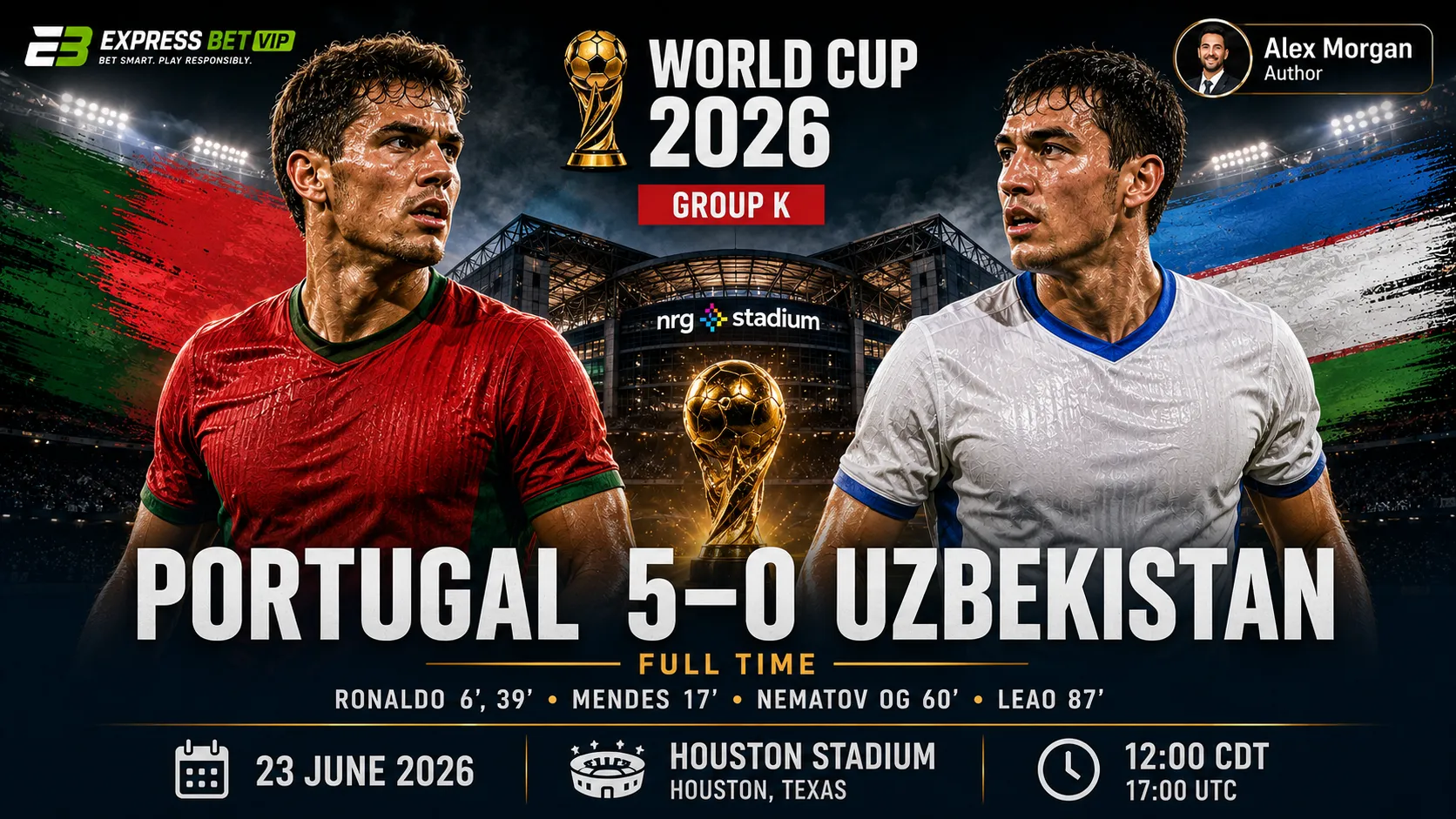
Portugal beat Uzbekistan 5-0 in FIFA World Cup 2026 Group K at Houston Stadium. Cristiano Ronaldo scored in the 6th and 39th minutes, while Nuno Mendes struck in the 17th. Abduvokhid Nematov was officially credited with a 60th-minute own goal, and substitute Rafael Leão completed the scoring in the 87th. Ronaldo’s early opener was the main turning point because it destroyed Uzbekistan’s compact defensive plan before the match had settled. Nuno Mendes was the strongest all-round performer, although Ronaldo supplied the decisive scoring output. Portugal won through superior width, movement between Uzbekistan’s back five and midfield, and far better penalty-box occupation. The closed roof limited the impact of Houston’s 32°C outdoor heat. Portugal’s win, the over and Portugal’s handicap landed in published markets, but returns depended on the selected odds and timing. (FIFA)
| Item | Detail | Data status |
|---|---|---|
| Match | Portugal vs Uzbekistan | [CONFIRMED] |
| Competition | FIFA World Cup 2026 | [CONFIRMED] |
| Stage | Group stage | [CONFIRMED] |
| Group | Group K | [CONFIRMED] |
| Date | 23 June 2026 | [CONFIRMED] |
| Kickoff time | 12:00 p.m. CDT / 17:00 UTC | [CONFIRMED] |
| Host country | United States | [CONFIRMED] |
| City | Houston, Texas | [CONFIRMED] |
| Stadium | Houston Stadium / NRG Stadium | [CONFIRMED] |
| Attendance | 68,777 | [REPORTED] |
| Final score | Portugal 5-0 Uzbekistan | [CONFIRMED] |
| Half-time score | Portugal 3-0 Uzbekistan | [CONFIRMED] |
| Goal scorers | Ronaldo 6’, 39’; Mendes 17’; Nematov own goal 60’; Leão 87’ | [CONFIRMED] |
| Referee | Jalal Jayed | [CONFIRMED] |
| VAR | Complete crew not available from verified public data | [UNKNOWN] |
| Weather | Outdoor forecast high approximately 32°C; stadium roof closed | [REPORTED] |
| Pitch condition | Temporary natural grass; no match-specific defect reported | [REPORTED] |
| Main tournament impact | Portugal moved to four points; Uzbekistan remained on zero | [CONFIRMED] |
FIFA confirms the date, kickoff, Houston venue and referee. Sofascore reported the attendance and statistical profile, while the official FIFA report confirms the 5-0 result and scoring sequence. (FIFA)
| Layer | What it covers | Portugal vs Uzbekistan example |
|---|---|---|
| [CONFIRMED] | Official result, scorers, times, venue and competition | Portugal 5-0 Uzbekistan; Ronaldo 6’, 39’ |
| [REPORTED] | Reliable provider or local reporting | Attendance 68,777; xG approximately 2.44-0.24 |
| [OBSERVED] | Events described in match coverage | Ganiev’s disallowed goal; Uzbekistan’s defensive clearances |
| [ANALYSIS] | Editorial tactical interpretation | Portugal overloaded Uzbekistan’s wing-backs and half-spaces |
| [MARKET SIGNAL] | Published odds and settled markets | Portugal around -700 in one closing listing |
| [DISPUTED] | Details reported differently by sources | Some reports initially attributed the own goal to Khusanov rather than Nematov |
| [UNKNOWN] | Unavailable verified information | Complete VAR crew, exact internal stadium climate, full card table |
This separation matters because a 5-0 score is a confirmed fact, while the claim that Uzbekistan “collapsed” requires interpretation. The data supports Portugal’s dominance: 66% possession, a 17-7 shot advantage, nine shots on target to two and a major gap in expected goals. The precise xG figure varies slightly between ESPN and Sofascore, which reported approximately 2.61-0.24 and 2.44-0.24 respectively. (ESPN)
The own goal requires similar care. FIFA, Reuters’ Opta-powered match record, ESPN and Sofascore credit Nematov. Some live reports initially named Abdukodir Khusanov. This article follows the official attribution while recording the earlier provider disagreement. (Reuters)
Portugal entered the match under pressure after opening Group K with a draw against DR Congo. Uzbekistan had lost 3-1 to Colombia and needed a result to prevent their debut World Cup campaign from becoming an exercise in increasingly difficult arithmetic. Portugal answered the situation within six minutes.
Ronaldo’s opener removed the one condition Uzbekistan required: time. Cannavaro’s 3-4-2-1 was designed to keep the centre crowded, protect the three centre-backs and attack through Fayzullaev, Ganiev and Shomurodov when possession changed. That plan might have survived if the game remained level. Instead, João Cancelo’s delivery found Ronaldo inside the box before Uzbekistan’s defensive line had established control. (sofascore.com)
Nuno Mendes doubled the lead in the 17th minute. The official scoring record describes the goal as Portugal’s second, while match coverage reported a well-timed left-sided action and finish. ESPN classified it as a 21-yard free-kick situation, whereas other reports described Mendes arriving aggressively from the left. The consistent conclusion is more important than the provider terminology: Uzbekistan could not contain Mendes’ advanced role. (ESPN)
Uzbekistan briefly believed they had responded when Azizjon Ganiev found the net from distance. VAR removed the goal because of a foul on João Cancelo in the build-up. Tournament football has a habit of offering hope, checking a screen and then returning with paperwork. Uzbekistan’s most emotionally important moment disappeared before it reached the restart. (CBS Sports)
Ronaldo added the third in the 39th minute after Bruno Fernandes broke the defensive line with a precise pass. Portugal reached half-time 3-0 ahead, with the result effectively decided and the remaining questions reduced to margin, records and whether Martínez would use the bench without allowing the match to become untidy. (sofascore.com)
Uzbekistan changed personnel at half-time, introducing Khojiakbar Alijonov and Akmal Mozgovoy. Portugal also replaced Pedro Neto and João Cancelo with Francisco Conceição and Nélson Semedo. The changes altered the names on the flanks but not the territorial pattern. (ESPN)
The fourth goal arrived in the 60th minute. Nematov was officially credited with an own goal after a Portuguese set-piece sequence created confusion around the goalmouth. It was an unfortunate addition to a difficult afternoon for a goalkeeper who had already faced repeated high-value attempts. (FIFA)
Leão entered in the 83rd minute and scored four minutes later with his first shot. His finish from around the edge of the area gave the scoreline its final shape and demonstrated the depth difference between the squads. Portugal could introduce Leão, Bernardo Silva, Trincão and Conceição after the game was already controlled. Uzbekistan were using late substitutions to reduce damage and conserve legs. (ESPN)
The 5-0 score was deserved. Portugal did not merely finish more efficiently. They controlled territory, created all seven big chances in Sofascore’s model and produced 38 touches in Uzbekistan’s box to six. Uzbekistan defended actively—29 clearances and 14 interceptions are evidence of work—but constant emergency defending is rarely a sustainable tournament strategy. (sofascore.com)
Portugal built down the right and João Cancelo delivered into the penalty area. Ronaldo moved between Uzbekistan’s centre-backs and converted from close range. Reuters reported that he finished from approximately six yards, while Sofascore credits Cancelo with the delivery. (Reuters)
The movement mattered more than the technical difficulty. Ronaldo did not wait statically between defenders. He adjusted toward the delivery and reached the finishing space before the defensive line could close.
The goal made Ronaldo the first male player to score at six World Cups. It was also his 144th international goal in his 230th appearance, both men’s international records at the time. (Reuters)
Tactically, the opener forced Uzbekistan to abandon pure containment. Emotionally, it removed the pressure created by Portugal’s opening draw. For betting markets, it strengthened Portugal’s live moneyline and handicap position almost immediately.
Mendes scored Portugal’s second after another period of pressure on Uzbekistan’s defensive width. ESPN classified the attempt as a left-footed free-kick situation from approximately 21 yards, while other accounts emphasised his aggressive run and finish. (ESPN)
Nematov had little reaction time. The more important defensive failure came before the shot: Uzbekistan’s midfield and wing-back line could not prevent Mendes from receiving or striking in a dangerous position.
The goal changed the contest from difficult to almost unrecoverable. Uzbekistan were now required to attack while still protecting against Portugal’s superior wide players. That is not a tactical adjustment. It is an unpleasant choice between two forms of damage.
Ganiev struck from outside the box and appeared to reduce the deficit. VAR reviewed the build-up and identified a foul on João Cancelo, so the goal was disallowed. (CBS Sports)
It was Uzbekistan’s only major first-half momentum swing. A confirmed goal at 2-1 could have changed Portugal’s risk level and restored belief. Instead, the score remained 2-0, and Ronaldo scored again ten minutes later.
The incident was decisive without being especially controversial. The foul was identified during a standard VAR review, and no subsequent official dispute changed the decision.
Bruno Fernandes played through Uzbekistan’s midfield and defensive line. Ronaldo received inside the box and finished calmly with his right foot. ESPN valued the attempt at approximately 0.28 xG, reflecting a strong but not automatic scoring opportunity. (CBS Sports)
The assist showed why Uzbekistan’s defensive shape was failing. Fernandes had enough time to look forward, while Ronaldo could move across the centre-backs without coordinated pressure from midfield.
At 3-0, the competitive phase ended. Portugal could control rather than chase. Uzbekistan had to choose between opening further or accepting a damage-limitation second half.
Portugal created pressure from a dead-ball sequence, and the ball ended in Uzbekistan’s net after contact around the goalkeeper. FIFA, Reuters, ESPN and Sofascore officially credit Nematov with the own goal. Some live coverage initially attributed it to Khusanov, so the exact final defensive touch was reported inconsistently in real time. (Reuters)
The goal represented the match’s broader pattern. Uzbekistan were forced into repeated last-ditch actions, and one of those emergency sequences eventually produced an own goal.
It also settled Portugal -2.5 positions in published handicap markets and pushed the game beyond the common 3.5-goal total.
Leão had entered four minutes earlier. He received space near the edge of the box and struck past Nematov with his first attempt. CBS described the finish as a precise shot, while ESPN’s match report placed it in the top-left area. (CBS Sports)
No official assist was confirmed in the verified sources consulted. The goal should therefore be recorded without inventing a provider-independent assist.
The tactical meaning was bench quality. Uzbekistan had defended Portugal’s starters for more than 80 minutes and then had to face a fresh Leão against a stretched structure. The emotional meaning was less subtle: 4-0 became 5-0, which turns a defeat into a result that follows a team through the rest of the group.
| Minute | Moment | Why it mattered | Data status |
|---|---|---|---|
| 2’ | Bruno Fernandes created Portugal’s first attempt | Portugal established immediate territorial control | [OBSERVED] |
| 6’ | Ronaldo scored | Destroyed Uzbekistan’s containment-first plan | [CONFIRMED] |
| 17’ | Mendes made it 2-0 | Exposed Uzbekistan’s inability to protect both flanks | [CONFIRMED] |
| 29’ | Ganiev goal disallowed | Removed Uzbekistan’s only real route back into the first half | [CONFIRMED] |
| 39’ | Ronaldo scored again | Settled the match before half-time | [CONFIRMED] |
| Half-time | Both teams made two changes | Uzbekistan attempted to repair width; Portugal refreshed it | [CONFIRMED] |
| 58’ | Nematov denied Ronaldo’s hat-trick attempt | Prevented the score from widening earlier | [OBSERVED] |
| 60’ | Nematov own goal | Ended any remaining competitive uncertainty | [CONFIRMED] |
| 83’ | Leão entered | Portugal added fresh transition and one-against-one threat | [CONFIRMED] |
| 87’ | Leão scored | Completed the 5-0 result | [CONFIRMED] |
Portugal’s early scoring was more important than the fourth and fifth goals. Uzbekistan needed the match to remain slow and narrow. Instead, the scoreboard reached 2-0 before the 18th minute. (FIFA)
| Local factor | Verified or observed detail | Football meaning | Direct match evidence | Betting-result meaning | Data status | Anti-template status |
|---|---|---|---|---|---|---|
| Stadium | Houston Stadium / NRG Stadium | Retractable-roof, climate-controlled NFL venue | Match played indoors with roof scheduled to remain closed | Outdoor heat had limited direct pitch influence | [REPORTED] | Fixture-specific |
| Attendance | 68,777 | Near-capacity environment | Sofascore and local reporting gave the same figure | Crowd supported favourite but did not create the tactical gap | [REPORTED] | Fixture-specific |
| Kickoff | 12:00 p.m. local time | Normally severe Houston heat window | Match played under closed roof | Reduced heat-based fatigue angle | [CONFIRMED / REPORTED] | Fixture-specific |
| Outdoor weather | Forecast high around 32°C | Relevant to travel, queues and fan activity | Climate Central forecast | Limited direct effect on totals or pressing indoors | [REPORTED] | Fixture-specific |
| Roof | Closed throughout tournament matches | Controlled temperature, humidity and wind | Houston host reporting | Reduced weather volatility in live markets | [REPORTED] | Stadium-specific |
| Surface | Temporary natural grass | Different from regular stadium configuration | World Cup grass blend installed over layered system | No verified slip or bounce betting angle | [REPORTED] | Stadium-specific |
| Grass composition | Approximately 84% Kentucky bluegrass, 16% perennial ryegrass | Stable FIFA-standard playing surface | Post-tournament pitch reporting | Supported predictable passing and ball speed | [REPORTED] | Stadium-specific |
| Crowd activity | Supporter walks and fan gatherings before kickoff | Strong event atmosphere | Local Houston coverage | Atmosphere secondary to technical mismatch | [REPORTED] | Fixture-specific |
Houston’s outdoor conditions were potentially severe for a noon kickoff. Climate Central’s pre-match forecast placed the high at approximately 32°C. The players, however, were not exposed to an open-air Texas afternoon. Houston host reporting stated that the retractable roof would remain closed throughout the tournament. (Climate Central)
That distinction matters. It would be inaccurate to claim that Portugal won because they managed outdoor heat better. The match was played in a climate-controlled building. Heat still affected spectators walking, queuing and travelling to the stadium, but the direct football effect was sharply reduced.
The pitch was also specific to the World Cup. Houston Stadium normally uses a different surface configuration, but FIFA matches were played on natural grass installed over a layered drainage system. Later reporting described a blend of Kentucky bluegrass and perennial ryegrass, maintained with indoor grow lights because the roof limited sunlight. (Houston Chronicle)
No source reviewed for this article reported serious slipping, unstable turf, slow drainage, damaged seams or abnormal bounce during Portugal vs Uzbekistan. The grass allowed Portugal to move the ball quickly through midfield and deliver clean passes into Ronaldo. It did not visibly create the goals.
The sellout crowd of 68,777 supplied noise, especially around Ronaldo’s record-setting opener. Local reporting described the game as Houston’s third consecutive sold-out World Cup fixture. Both supporter groups took part in matchday gatherings, although Portugal’s global support and Ronaldo’s presence produced the stronger visible spectacle. (Houston Chronicle)
The local environment therefore affected presentation more than tactics. Closed roof, climate control and a stable surface removed several variables. The match became a cleaner test of structure and quality. Uzbekistan did not enjoy the answer.
| Stadium factor | Detail |
|---|---|
| Stadium | Houston Stadium / NRG Stadium |
| Regular listed capacity | Approximately 72,000, configurable higher |
| Match attendance | 68,777 |
| Pitch type | Temporary natural grass |
| Roof status | Closed |
| Acoustic effect | Concentrated crowd noise around Portugal’s goals |
| Surface condition | No match-specific defect reported |
| Wind relevance | Minimal under closed-roof conditions |
| Goalkeeper distribution effect | No verified weather-related effect |
| Set-piece effect | Mendes scored from a dead-ball situation; own goal followed set-piece pressure |
| Communication effect | Indoor crowd noise may have increased pressure, but no verified breakdown |
| Data status | Mixed confirmed and reported |
NRG Park identifies the stadium as a retractable-roof venue with a regular capacity range of approximately 72,000 to 80,000 depending on configuration. The World Cup match attracted 68,777 spectators. (NRG Park —)
The roof’s most important influence was environmental control. Wind could not distort long diagonals, and outdoor humidity did not obviously reduce Portugal’s pressing intensity. Diogo Costa and Nematov handled normal distribution conditions rather than an open-air weather test.
The natural pitch also performed without a notable incident. Portugal’s short passing, switches and through balls remained consistent. Sofascore recorded three successful through balls for Portugal and none for Uzbekistan, which points toward tactical and technical superiority rather than a difficult surface. (sofascore.com)
The available match evidence does not show a clear stadium-specific effect beyond the controlled roof conditions, stable grass and concentrated crowd atmosphere.
| Item | Detail |
|---|---|
| City | Houston |
| Host country | United States |
| Time zone | Central Daylight Time |
| June climate | Hot and humid |
| Outdoor forecast high | Approximately 32°C |
| Internal match temperature | Not available from verified public data |
| Internal humidity | Not available from verified public data |
| Wind | Minimal direct relevance under closed roof |
| Rain or sun | Outdoor conditions secondary to indoor match |
| Altitude | Low altitude |
| Likely physical effect | Outdoor heat relevant mainly before and after stadium entry |
| Actual match evidence | Portugal maintained intensity; no weather-driven fatigue collapse |
| Data status | Partial |
A noon kickoff in Houston would normally raise questions about repeated sprints, hydration and second-half pressing. The closed roof changed the calculation. Portugal completed the match with enough physical control to introduce attacking substitutes and continue creating chances through stoppage time. (Houston Chronicle)
No verified cramp epidemic, heat-related injury or weather-driven substitution was reported. Martínez’s changes were tactical and workload-based. Cannavaro’s half-time substitutions addressed structural problems rather than visible climatic distress.
Long passing was also unaffected by wind. Portugal completed 23 of 42 long balls, while Uzbekistan completed only eight of 28. That gap came from pressure, technique and receiving structure. The roof did not favour one passport. (sofascore.com)
The local betting conclusion is restrained: Houston’s outdoor heat was less relevant than it would have been in an open stadium. Bettors who treated the fixture as an extreme-heat under or second-half fatigue match would have been analysing the city rather than the actual playing environment.
Portugal lined up in a 4-2-3-1, with Diogo Costa behind João Cancelo, Rúben Dias, Renato Veiga and Nuno Mendes. João Neves and Vitinha controlled the deeper midfield, while Pedro Neto, Bruno Fernandes and João Félix operated behind Ronaldo. Uzbekistan used a 3-4-2-1 led by Shomurodov, with Fayzullaev and Ganiev underneath him. (ESPN)
Portugal’s first objective was to stretch Uzbekistan’s wing-backs. Mendes and Cancelo pushed high, while Neto and Félix moved inside. This forced Nasrullaev and Karimov to choose between following the wide player or protecting the outside centre-back.
Uzbekistan’s back three could deal with static crosses. They struggled when Portugal rotated. Fernandes dropped toward the ball, Félix occupied a half-space and Mendes attacked beyond them. Portugal’s full-backs were not supporting actors. They were part of the forward line.
Ronaldo’s movement remained focused on the box. He did not need to become a false nine or lead elaborate pressing diagrams. Portugal had Fernandes and Vitinha to progress the ball. Ronaldo’s task was to occupy the centre-backs, separate from them at the correct moment and finish.
The opening goal came from that structure. Cancelo advanced without enough pressure, Ronaldo moved across the defenders and the delivery reached the six-yard area. Uzbekistan’s three centre-backs provided numbers but not control.
Mendes’ goal punished the opposite side. Uzbekistan’s 3-4-2-1 was now being stretched in both directions. When the wing-backs dropped, Portugal could sustain possession around the box. When they stepped out, Mendes and Cancelo attacked behind them.
Uzbekistan’s best attacking idea was to use Fayzullaev and Ganiev around Shomurodov. Ganiev’s disallowed strike showed that Portugal were not completely immune to turnovers. But Uzbekistan could not sustain attacks because their long passing was inaccurate and Portugal recovered loose balls quickly.
The difference in midfield was severe. Vitinha and João Neves circulated without being forced into rushed decisions. Shukurov and Khamrobekov had to defend horizontally, protect the centre and prepare for transitions. They were performing several jobs and receiving few rewards.
Fernandes’ assist for the third goal was the natural product of that pressure. Uzbekistan’s midfield line had lost compactness, Ronaldo moved into the gap and Portugal reached half-time 3-0 ahead.
Martínez’s half-time task was simple: maintain control, avoid needless injury and manage minutes. Cannavaro had to prevent the scoreline from expanding while somehow creating three goals. The tactical whiteboard may have felt unusually theoretical.
Uzbekistan replaced Nasrullaev and Khamrobekov with Alijonov and Mozgovoy. The changes attempted to provide fresher legs on the flank and improve midfield resistance. Portugal introduced Conceição and Semedo for Neto and Cancelo. (ESPN)
The substitutions did not change the fundamental matchup. Portugal continued to build through Vitinha and Fernandes, then attack the width of Uzbekistan’s defensive line.
Uzbekistan showed slightly more willingness to move forward early in the half. They produced two shots on target across the match and briefly tested Costa. The problem was risk. Every additional player committed forward left more space for Portugal.
Ronaldo nearly completed his hat-trick in the 58th minute after a worked free-kick routine, but Nematov saved. Two minutes later, the goalkeeper was credited with the own goal that made it 4-0. (CBS Sports)
At four goals ahead, Portugal reduced the need for aggressive counterpressing but retained territorial control. Uzbekistan’s attempts to play long were regularly recovered. Portugal’s 50 recoveries and 86% tackle-success figure show how quickly they stopped transitions before Shomurodov could receive meaningful support. (sofascore.com)
Martínez then used the bench more heavily. Trincão replaced Félix, Bernardo Silva replaced João Neves and Leão replaced Vitinha. Portugal shifted from structured positional control toward fresh one-against-one attacking.
Uzbekistan were physically and mentally stretched. Their defenders had already completed dozens of clearances. Facing Leão in the 83rd minute was not an ideal reward for their labour.
Leão’s late goal demonstrated that Portugal had not completely shut down their attack. The match had become less urgent, but the substitutes still attacked available space.
Portugal protected the clean sheet without dropping into a passive block. Uzbekistan’s two shots on target did not become sustained pressure. Costa completed his work with limited intervention.
The second half therefore confirmed the first rather than changing it. Portugal had the stronger structure, greater technical quality and deeper bench. Uzbekistan had effort, isolated attacking moments and too much defending.
Portugal’s 4-2-3-1 attacked closer to a 3-2-5 in settled possession. One full-back could advance aggressively while the opposite side maintained enough protection with the centre-backs and midfield pivot.
Mendes became the most influential width provider. Félix moved inside, creating a lane for the left-back. On the right, Neto and Cancelo alternated between holding width and arriving around the box.
Uzbekistan’s 3-4-2-1 defended as a 5-4-1. The shape initially offered numerical protection around Ronaldo. The problem came outside the centre. Portugal could isolate the wing-backs and force the outside centre-backs into wide areas.
Once an outside centre-back stepped toward Mendes or Cancelo, Ronaldo had fewer defenders around him. Fernandes could then pass through the expanded gap.
Portugal also controlled rest defence. João Neves and Vitinha positioned themselves behind attacks, while Dias and Veiga stayed close enough to Shomurodov to prevent clean counterattacks.
Uzbekistan lacked a reliable exit. Their long-ball completion was poor, and the supporting attackers started too deep after defensive phases. A clearance to Shomurodov often became Portugal’s next possession within seconds.
Set pieces added another dimension. Mendes scored from a dead-ball situation, Ronaldo nearly completed his hat-trick from a worked routine and the own goal developed from set-piece pressure.
The scoreline was inflated slightly by the own goal and Portugal’s finishing, but not enough to make it misleading. A 2.44 or 2.61 xG total does not normally produce five goals. Yet a 7-0 big-chance advantage, 38-6 box-touch gap and 79-31 final-third entry count show that Portugal’s dominance was real. (ESPN)
Cannavaro’s defensive plan failed because it protected the centre at the expense of the flanks, then lost the centre once the outside defenders were pulled apart. Martínez’s plan worked because Portugal attacked those chain reactions repeatedly.
| Zone | Edge | Match evidence | Key player | Local-condition effect | Result impact |
|---|---|---|---|---|---|
| Portugal left / Uzbekistan right | Portugal | Mendes scored, created chances and carried aggressively | Nuno Mendes | Stable indoor surface supported direct running | Major |
| Portugal right / Uzbekistan left | Portugal | Cancelo assisted the opener | João Cancelo | No wind effect on delivery | Major |
| Central midfield | Portugal | 66% possession and major passing advantage | Vitinha | Controlled climate supported sustained circulation | Decisive |
| Penalty box | Portugal | Seven big chances and 38 box touches | Ronaldo | No verified pitch issue | Decisive |
| Set pieces | Portugal | Mendes goal, Ronaldo chance and own-goal sequence | Mendes / Fernandes | Closed roof reduced delivery variance | Major |
| Transitions | Portugal | Uzbekistan rarely escaped pressure | João Neves | Heat not directly relevant indoors | Major |
| Defensive third | Portugal | Uzbekistan held to 0.24 xG | Rúben Dias | Stable surface | Clean sheet |
| Goalkeeper build-up | Portugal | Costa rarely pressured and circulated safely | Diogo Costa | No wind or rain impact | Supported control |
| Bench impact | Portugal | Leão scored four minutes after entering | Rafael Leão | Fresh player against stretched defence | Fifth goal |
These ratings are editorial and use the verified event record, tactical role and provider statistics. They are not official FIFA ratings.
| Player | Rating | Assessment |
|---|---|---|
| Diogo Costa | 7.0 | Two saves and a clean sheet. Rarely placed under sustained pressure. |
| João Cancelo | 7.5 | Assisted Ronaldo’s opener and repeatedly advanced beyond Uzbekistan’s midfield line. |
| Rúben Dias | 7.0 | Controlled Shomurodov and protected Portugal’s attacking structure. |
| Renato Veiga | 7.0 | Secure in possession and alert against isolated transitions. |
| Nuno Mendes | 9.0 | Scored, created three key passes and dominated Portugal’s left side. |
| João Neves | 7.5 | Protected transitions and gave Portugal stable circulation behind the attack. |
| Vitinha | 8.0 | Controlled tempo, completed a high volume of passes and kept Uzbekistan moving laterally. |
| Pedro Neto | 6.5 | Helped stretch the defensive line before his half-time substitution. |
| Bruno Fernandes | 8.5 | Assisted Ronaldo’s second goal and repeatedly passed through Uzbekistan’s midfield. |
| João Félix | 7.0 | Created rotations around Mendes and occupied the left half-space effectively. |
| Cristiano Ronaldo | 9.0 | Two goals, seven shots and five on target. Decided the match before half-time. |
| Francisco Conceição | 7.0 | Maintained Portugal’s right-sided threat after entering. |
| Nélson Semedo | 6.5 | Provided controlled width and protected the right side. |
| Francisco Trincão | 6.5 | Added movement and nearly scored in stoppage time. |
| Bernardo Silva | 6.5 | Helped Portugal retain control during the final phase. |
| Rafael Leão | 7.5 | Scored with his first shot shortly after entering. |
Sofascore rated Mendes as its player of the match at 8.8, Fernandes at 8.7 and Ronaldo at 8.5. Mendes registered 97 touches, three key passes and extensive progressive carrying, while Ronaldo finished with five shots on target. (sofascore.com)
| Player | Rating | Assessment |
|---|---|---|
| Abduvokhid Nematov | 4.5 | Made four saves but conceded five and was officially credited with an own goal. |
| Abdukodir Khusanov | 5.0 | Faced constant movement around Ronaldo and Portugal’s rotating wide players. |
| Abdulla Abdullaev | 4.5 | Could not maintain the spacing of Uzbekistan’s back three. |
| Rustam Ashurmatov | 5.5 | Produced repeated defensive interventions but spent the match under pressure. |
| Sherzod Nasrullaev | 5.0 | Struggled against Portugal’s right-sided combinations and left at half-time. |
| Behruzjon Karimov | 5.0 | Forced into a deep wing-back role and offered little attacking relief. |
| Otabek Shukurov | 5.5 | Attempted to protect midfield but could not stop passes into Fernandes. |
| Odiljon Khamrobekov | 5.0 | Overloaded centrally and replaced at half-time. |
| Azizjon Ganiev | 6.5 | Scored an excellent disallowed goal and remained Uzbekistan’s most threatening midfielder. |
| Abbosbek Fayzullaev | 5.5 | Worked between the lines but received too few controlled possessions. |
| Eldor Shomurodov | 6.0 | Isolated for long periods; still created several passes and carrying actions. |
| Khojiakbar Alijonov | 5.5 | Added energy after half-time without changing the territorial balance. |
| Akmal Mozgovoy | 5.5 | Helped Uzbekistan compete more actively early in the second half. |
| Igor Sergeev | 5.5 | Limited service after entering. |
| Late substitutes | N/A | Entered too late for meaningful ratings. |
Sofascore identified Ganiev as Uzbekistan’s highest-rated performer at 6.9, while Shomurodov registered four key passes despite the team’s limited attacking output. (sofascore.com)
| Category | Selection | Reason |
|---|---|---|
| Man of the Match | Nuno Mendes | Scored, created chances and dominated the left side for 90 minutes |
| Best attacker | Cristiano Ronaldo | Two first-half goals settled the match |
| Best midfielder | Bruno Fernandes | Assisted Ronaldo and consistently broke Uzbekistan’s lines |
| Best defender | Rúben Dias | Controlled the central transition space and protected the clean sheet |
| Best goalkeeper | Diogo Costa | Kept a clean sheet and handled Uzbekistan’s limited shots |
| Best substitute | Rafael Leão | Scored four minutes after entering |
| Most underrated performance | João Neves | Prevented Uzbekistan from turning clearances into counterattacks |
| Most disappointing performance | Abduvokhid Nematov | Difficult circumstances, but five concessions and the official own goal shaped the score |
Mendes receives the main award because his influence extended beyond one event. Ronaldo decided the result, but Mendes contributed to width, chance creation, pressing recovery and scoring. (sofascore.com)
| Player | Team | Incident | Minute | Status | Next-match impact | Data status |
|---|---|---|---|---|---|---|
| Confirmed injuries | Both teams | No major match-ending injury confirmed | — | None confirmed | None confirmed | [UNKNOWN] |
| Yellow cards | Both teams | Complete official list | — | Not available from verified public data | Not confirmed | [UNKNOWN] |
| Red cards | Both teams | None reported | — | No red card | None | [REPORTED] |
| Nematov | Uzbekistan | Own goal | 60’ | Scoring incident, not disciplinary | None | [CONFIRMED] |
The match was physically active, with ESPN recording 14 Portugal fouls and 15 by Uzbekistan. It did not develop into a card-driven contest in the public reports reviewed. (ESPN)
No confirmed injury forced an early substitution. The half-time and later changes were tactical or workload-related.
Jalal Jayed refereed the match. FIFA and ESPN identify him as the match official. (FIFA)
The principal VAR intervention came in the 29th minute. Ganiev’s strike was disallowed because of a foul on Cancelo during the build-up. That decision prevented Uzbekistan from cutting the score to 2-1. (CBS Sports)
No major penalty or red-card controversy was reported. The match was decided through open play, a dead-ball goal and an own goal rather than a chain of refereeing interventions.
The complete VAR crew was not available from verified public data. It should not be reconstructed from unofficial lists.
The referee’s main contribution was allowing the match to retain rhythm. Portugal’s advantage came from faster circulation and better movement, not from a high number of dangerous free kicks awarded near the box.
Provider models report small xG variations. The table uses Sofascore for the broader dataset and notes the ESPN figure separately.
| Statistic | Portugal | Uzbekistan | Data status |
|---|---|---|---|
| Final score | 5 | 0 | [CONFIRMED] |
| Possession | 66% | 34% | [REPORTED] |
| Shots | 17 | 7 | [REPORTED] |
| Shots on target | 9 | 2 | [REPORTED] |
| Expected goals | 2.44 / 2.61 | 0.24 | [REPORTED / PROVIDER VARIATION] |
| Big chances | 7 | 0 | [REPORTED] |
| Big chances missed | 5 | 0 | [REPORTED] |
| Shots inside box | 12 | Not available | [REPORTED / UNKNOWN] |
| Box touches | 38 | 6 | [REPORTED] |
| Final-third entries | 79 | 31 | [REPORTED] |
| Accurate passes | 561 | 263 | [REPORTED] |
| Total passes | 623 | 324 | [REPORTED] |
| Long passes completed | 23 of 42 | 8 of 28 | [REPORTED] |
| Crosses completed | 5 of 22 | 0 of 8 | [REPORTED] |
| Clearances | Not available | 29 | [REPORTED / UNKNOWN] |
| Interceptions | Not available | 14 | [REPORTED / UNKNOWN] |
| Fouls | 14 | 15 | [REPORTED] |
| Saves | 2 | 4 | [REPORTED] |
The five-goal margin exceeded Portugal’s xG, but the result was not a statistical accident. Seven big chances to zero and 38 box touches to six show that Portugal repeatedly reached high-value areas. (sofascore.com)
Uzbekistan’s 29 clearances and 14 interceptions indicate resistance rather than control. Those numbers are often praised in isolation. Here they show how frequently the defensive line was being asked to solve another emergency.
Portugal’s passing advantage was also functional. They did not record 623 passes merely to decorate the possession graphic. Their three completed through balls, 79 final-third entries and superior box occupation converted control into penetration.
This section reviews settled markets after the match. It does not imply that the result was guaranteed.
| Market | Pre-match expectation | Actual result | Winning side | Key trigger | Local factor | Caution |
|---|---|---|---|---|---|---|
| Match winner | Portugal were heavy favourites | Portugal won 5-0 | Portugal | Ronaldo’s 6th-minute opener | Closed roof reduced heat uncertainty | Short odds offered limited standalone return |
| Draw | Published around +700 to +750 | No draw | Draw lost | Early Portugal lead | No major local effect | A long price is not value automatically |
| Uzbekistan win | Published around +1400 to +1900 | Uzbekistan lost | Portugal side | Structural quality gap | No weather-driven equaliser | Underdog prices still require probability |
| Portugal -2.5 | Portugal needed four-goal margin | Won by five | Portugal -2.5 | Own goal made it 4-0 | Stable conditions | Handicap depended on late scoring |
| Over 3.5 goals | Needed four goals | Five goals | Over 3.5 | Nematov own goal | Indoor conditions supported stable tempo | Same total may not suit future matches |
| Both teams to score | Uzbekistan needed a goal | Uzbekistan scored none | BTTS No | Disallowed Ganiev goal | No weather effect | VAR changed the BTTS path |
| Correct score | Portugal 5-0 | 5-0 | 5-0 | Leão’s late goal | None | Extremely high-variance market |
| First goalscorer | Ronaldo among leading candidates | Ronaldo scored first | Ronaldo | Cancelo’s early cross | None | Star markets may carry compressed odds |
| Anytime scorer | Ronaldo, Mendes, Leão | All scored | Player dependent | Portugal’s box access | None | Leão began on the bench |
| Corners | Portugal expected territorial control | Exact full corner total not used | Line dependent | Sustained attacks and set pieces | Closed roof helped stable delivery | Verify operator settlement |
| Live betting | Portugal led after six minutes | Price shortened immediately | Early Portugal backers | Opening goal | Climate uncertainty reduced | Poor prices may erase theoretical edge |
CBS listed Portugal at approximately -699, the draw at +700 and Uzbekistan at +1400 before kickoff. ESPN later displayed Portugal around -700, the draw at +750 and Uzbekistan at +1900, with Portugal -2.5 and a 3.5-goal total also available. These are market snapshots, not universal closing prices across every operator. (CBS Sports)
The result rewarded Portugal moneyline, Portugal -2.5, over 3.5 goals, BTTS No and Ronaldo scorer positions. Mendes and Leão scorer markets also landed where offered.
The match punished a common assumption that a heavy favourite might conserve energy after establishing a lead. Portugal did reduce urgency, but their bench remained too strong for Uzbekistan’s stretched defence.
Ganiev’s disallowed goal mattered for live betting. It briefly appeared to create a 2-1 score and a successful BTTS position. VAR removed both. A bettor does not receive emotional credit for a disallowed goal.
The useful lesson is not to back every large favourite. Portugal’s short price required dominance merely to produce a modest moneyline return. The more informative angles were the handicap, team total and scorer markets, each of which carried different risks.
| Local factor | Market possibly affected | Actual evidence | Possible interpretation | Risk of overreaction | Safer conclusion |
|---|---|---|---|---|---|
| Closed roof | Totals and second-half tempo | No weather interruption or visible heat fatigue | Reduced environmental uncertainty | Assuming indoor games always go over | Team quality remained primary |
| Climate control | Player shots and substitutions | Portugal maintained attacking depth late | Fresh substitutes could sustain tempo | Treating climate as the cause of five goals | Bench quality mattered more |
| Stable natural grass | Passing, shots and set pieces | No verified slip or bad bounce | Supported predictable circulation | Claiming grass favoured Portugal | Both teams used the same surface |
| No wind | Crosses and goalkeeper kicking | Cancelo’s cross and Fernandes’ pass were clean | Delivery conditions stable | Converting roof status into guaranteed accuracy | Technique remained decisive |
| Sellout crowd | Live momentum and player psychology | Strong response to Ronaldo’s goals | Favourite received emotional support | Quantifying noise as betting edge | Crowd effect was secondary |
| Outdoor 32°C heat | Travel and pre-match logistics | Players competed indoors | Limited direct match effect | Using city weather without roof context | Match-specific roof status is essential |
| VAR review | BTTS and live totals | Ganiev goal disallowed | Major market swing | Treating overturned goal as bad luck only | VAR risk is part of settlement |
The venue removed weather volatility rather than creating Portugal’s advantage. A climate-controlled stadium reduced the chance of heat-driven slowdown, wind-affected crosses or rain-related goalkeeper errors.
This did not make the over inevitable. Portugal still required elite finishing, an own goal and a late substitute strike to reach five.
The most important local betting lesson is methodological: city weather cannot be analysed without stadium configuration. “Houston at noon” suggested one game. “Closed-roof Houston Stadium” produced another environment entirely.
Immediately after the match, Portugal moved to four points from two games and temporarily took control of Group K. Uzbekistan remained on zero points after defeats to Colombia and Portugal. Portugal’s goal difference improved substantially, giving them protection before the final match against Colombia. (CBS Sports)
The final group round later confirmed Portugal’s qualification. A 0-0 draw with Colombia left Portugal second in Group K with five points, behind Colombia on seven. DR Congo advanced as a third-placed team with four points, while Uzbekistan finished fourth after a 3-1 defeat to DR Congo. (FIFA)
The 5-0 result was therefore the foundation of Portugal’s qualification. Without it, the two draws against DR Congo and Colombia would have created a much less comfortable group record.
Uzbekistan’s goal-difference damage also mattered. Even under a format that allowed eight third-placed teams into the Round of 32, a five-goal defeat made recovery extremely difficult.
Portugal attacked immediately. They did not allow Uzbekistan to establish confidence or turn the first 20 minutes into a slow defensive contest.
The full-backs provided the decisive width. Cancelo assisted the opener. Mendes scored the second and remained Portugal’s most active progressive carrier.
Fernandes and Vitinha understood the spaces created by that width. When Uzbekistan’s midfield moved outside, they passed centrally. When it stayed narrow, Portugal returned the ball to the flanks.
Ronaldo remained disciplined in his role. He did not need to dominate possession. He dominated finishing positions.
Portugal also managed transitions well. Uzbekistan’s attackers could not turn defensive actions into sustained counterattacks because João Neves, Vitinha and the centre-backs recovered the second ball.
The bench maintained intensity. Leão’s goal was the clearest example, but Conceição, Trincão and Bernardo also prevented the final period from becoming careless.
Uzbekistan conceded too early. The tactical plan depended on protecting a level score and allowing pressure to create frustration. Six minutes was not enough time for frustration to complete its paperwork.
The wing-backs were repeatedly overloaded. Portugal used wide players, advancing full-backs and midfield support to create three-versus-two situations.
The midfield line could not pressure Fernandes and Vitinha without opening space behind it. Once it retreated, Portugal could pass forward without resistance.
Uzbekistan’s exits were also poor. Completing eight of 28 long balls meant most defensive clearances returned quickly. Shomurodov was isolated, and Fayzullaev rarely received facing forward.
The response after the disallowed goal was weak. Uzbekistan had briefly found an attacking route, but Ronaldo scored the third before they could build momentum.
The own goal was unfortunate. The conditions that produced it were not. Repeated set-piece and box pressure eventually creates awkward touches, deflections and goalkeeper collisions.
Martínez retained Ronaldo despite criticism after the opening draw. The decision worked because Portugal supplied the striker correctly rather than asking him to manufacture his own game.
The 4-2-3-1 balanced control and width. João Neves and Vitinha protected the centre, Fernandes operated between the lines and the full-backs advanced.
Martínez also managed the bench well. Two half-time substitutions protected Neto and Cancelo’s workload. Later changes introduced creativity and pace without destabilising the shape.
The limitation was that Portugal’s success came against an opponent unable to sustain pressure. The match proved Portugal could dismantle a passive 5-4-1. It did not answer every question about their attack against stronger defensive transitions.
Cannavaro’s 3-4-2-1 was understandable. Uzbekistan needed numerical protection around Ronaldo and could not afford an open midfield game.
The problem was the wing-back exposure. Once Portugal established width, the outside centre-backs had to move too far from the middle.
Cannavaro changed both Nasrullaev and Khamrobekov at half-time, attempting to repair the flank and midfield. The substitutions improved activity but not control.
A more aggressive initial press might have disrupted Portugal’s build-up, but it would also have exposed the back three earlier. Uzbekistan’s squad faced a structural problem rather than one obvious coaching mistake.
The most important improvement for the final group game was the attacking exit. Defending deep is possible only when the team can keep the ball after regaining it.
Ronaldo became the first male player to score at six different World Cups. He had previously scored at the 2006, 2010, 2014, 2018 and 2022 tournaments. (Reuters)
His opening goal was his 144th for Portugal in his 230th international appearance. Reuters reported that both figures were men’s international records. (Reuters)
The first goal drew him level with Eusébio on nine World Cup goals for Portugal. The second moved him beyond Eusébio and made him Portugal’s outright leading scorer at the men’s World Cup. (Reuters)
Uzbekistan were competing at their first men’s World Cup. The match became their second defeat of the group stage. (FIFA)
This was the first senior meeting between Portugal and Uzbekistan at a World Cup. It also carried a familiar tournament pattern: an established favourite scores early against a debutant, widens the pitch and turns defensive caution into permanent retreat.
Portugal’s performance was not structurally identical to Germany’s famous routs or Spain’s best possession matches. The common lesson was simpler. Once an underdog’s compact block loses the scoreline, every defensive compromise becomes visible.
Uzbekistan’s effort should not be dismissed because of the margin. Debutant teams often discover that World Cup punishment is cumulative. One lost duel becomes a cross, one cross becomes a clearance, one clearance becomes another attack.
Portugal’s later tournament showed the limit of reading too much into a rout. They advanced from the group and beat Croatia in the Round of 32, but were eliminated 1-0 by Spain in the Round of 16. The 5-0 demonstrated their attacking ceiling, not a guarantee that every opponent would provide the same space. (FIFA)
The main incident was Ganiev’s disallowed goal in the 29th minute. VAR identified a foul on Cancelo in the build-up. The review prevented Uzbekistan from reducing the score to 2-1. (CBS Sports)
The fourth goal produced temporary attribution confusion. FIFA and the main data providers ultimately recorded Nematov’s own goal, while some live coverage named Khusanov. The official attribution is used here. (Reuters)
No major penalty dispute, red card, crowd disorder, pitch invasion or post-match confrontation was confirmed.
Local reporting instead focused on the sellout crowd, supporter events and Ronaldo’s record. Houston’s World Cup organisers later cited the moment as one of the city’s major tournament memories. (Chron)
This analysis combines:
The central finding is specific to this match: Portugal did not win simply because Ronaldo finished twice. They used full-back width to pull apart Uzbekistan’s back five, controlled the second ball and prevented the visitors from turning defensive work into attacking relief.
| Detail | Included | Status | Specific to fixture | Future update needed |
|---|---|---|---|---|
| Stadium identity | Yes | Confirmed | Houston Stadium / NRG Stadium | None |
| Attendance | Yes | Reported | 68,777 | Update if FIFA revises |
| City detail | Yes | Confirmed | Houston noon kickoff | None |
| Weather detail | Yes | Reported | Outdoor high around 32°C | Add exact hourly observation if published |
| Roof detail | Yes | Reported | Roof closed throughout tournament | Update only if official match log differs |
| Pitch detail | Yes | Reported | Temporary bluegrass/ryegrass surface | Add FIFA technical report if published |
| Crowd detail | Yes | Reported | Sellout and supporter walks | Add verified fan split only |
| Travel/acclimatisation | Limited | Unknown | No unsupported claim added | Update only from team sources |
| Betting-risk detail | Yes | Analysis-based | Odds, roof and VAR assessed | Add licensed closing history |
| Tactical-local connection | Yes | Analysis-based | Controlled indoor environment | No |
| Anti-template status | Passed | Editorial check | Houston-specific details throughout | No |
| Data point | Status | Main source type |
|---|---|---|
| Final score | Confirmed | FIFA / Reuters / ESPN |
| Goal scorers | Confirmed | FIFA / Reuters |
| Goal times | Confirmed | FIFA / Reuters |
| Assists | Partial | Sofascore / ESPN |
| Stadium | Confirmed | FIFA / NRG Park |
| City | Confirmed | FIFA |
| Attendance | Reported | Sofascore / local reporting |
| Referee | Confirmed | FIFA / ESPN |
| VAR crew | Unknown | Complete crew unavailable |
| Lineups | Confirmed | ESPN / CBS / Guardian |
| Substitutions | Confirmed | ESPN |
| Cards | Unknown | Complete official list unavailable |
| Injuries | No major injury confirmed | Match reports |
| Match statistics | Reported | Sofascore / ESPN |
| xG | Reported with variation | Sofascore / ESPN |
| Odds | Market signal | CBS / ESPN |
| Stadium factors | Reported | NRG Park / Houston Chronicle |
| City factors | Reported | Climate Central / local media |
| Weather | Partial | Climate Central |
| Pitch condition | Reported | Houston Chronicle / technical reporting |
| Crowd profile | Reported | Houston local media |
| Tournament impact | Confirmed | FIFA |
Update the article if:
Last updated: 10 July 2026
Portugal beat Uzbekistan 5-0 because they removed every condition the underdog needed.
Uzbekistan required a slow opening, a compact scoreline and enough clean counterattacks to make Portugal cautious. Ronaldo scored after six minutes. Mendes scored after 17. Ganiev’s response disappeared after VAR review. Ronaldo added another before half-time.
The scoreline was slightly more severe than the xG models suggested, but the direction was accurate. Portugal created all the big chances, entered the final third far more often and spent the match around Uzbekistan’s penalty area.
Mendes and Cancelo supplied the width. Fernandes supplied the forward passing. João Neves and Vitinha prevented transitions. Ronaldo supplied the finishing. Leão supplied the reminder that Portugal’s bench was not designed to provide relief.
Uzbekistan did not lose because they lacked effort. Twenty-nine clearances and 14 interceptions prove the opposite. They lost because their defensive work produced no stable escape. The next Portugal attack usually began before Uzbekistan’s forwards could reorganise.
The most important local condition was the closed roof. Houston’s outdoor heat shaped the experience for supporters, but it did not define the football. Climate control and a stable natural-grass field removed excuses and environmental chaos.
For Portugal, this was the result that secured their tournament recovery and ultimately underpinned qualification. For Uzbekistan, it exposed the distance between qualifying for a World Cup and controlling a match against one of its deeper squads.
For bettors, the lesson is not that heavy favourites are automatic. Portugal’s moneyline was extremely short. The more revealing markets concerned the handicap, total goals and scorer roles. Even then, the own goal, VAR decision and Leão’s late strike show why post-match certainty is cheaper than pre-match accuracy.
Football betting carries financial risk. Correct match analysis does not guarantee a winning bet. Odds change before and during matches as goals, VAR reviews, substitutions, injuries and tactical momentum alter the market.
Local conditions can be overvalued. Houston’s outdoor heat did not make the 5-0 result inevitable because the match was played under a closed roof. Portugal’s tactical superiority and finishing mattered more.
Never chase losses. Do not bet money required for food, housing, bills or other daily expenses. Use deposit, stake and time limits. Take regular breaks. Check local gambling laws and use licensed operators only. Betting should remain entertainment, not income.
Portugal beat Uzbekistan 5-0 in FIFA World Cup 2026 Group K.
Cristiano Ronaldo scored twice. Nuno Mendes and Rafael Leão also scored, while Abduvokhid Nematov was credited with an own goal.
Nuno Mendes was the strongest all-round performer, scoring once and dominating Portugal’s left side. Ronaldo was the decisive scorer with two goals.
Portugal moved to four points and later qualified as Group K runners-up. Uzbekistan remained on zero and were eliminated after their final group match.
Portugal moneyline, Portugal -2.5, over 3.5 goals and BTTS No were winning outcomes in published markets. Exact returns depended on the operator, selected price and timing.