
UFC Events in July 2026: Full Calendar, Fight Cards, Betting Angles, and What Fans Should Watch
Table of Contents Show
Views 141
TL;DR: UFC events in July 2026 are built around three major cards: UFC 329: McGregor vs Holloway 2 on July 11 in Las Vegas, UFC Fight Night: Du Plessis vs Usman on July 18 in Oklahoma City, and UFC Fight Night: Ankalaev vs Rountree Jr. on July 25 in Abu Dhabi. My approach is to treat each July UFC card as a separate betting puzzle: schedule, matchup, form, venue, odds, and risk. Bettors should check official bout status, weigh-ins, injuries, late replacements, and local betting rules before placing any wager.
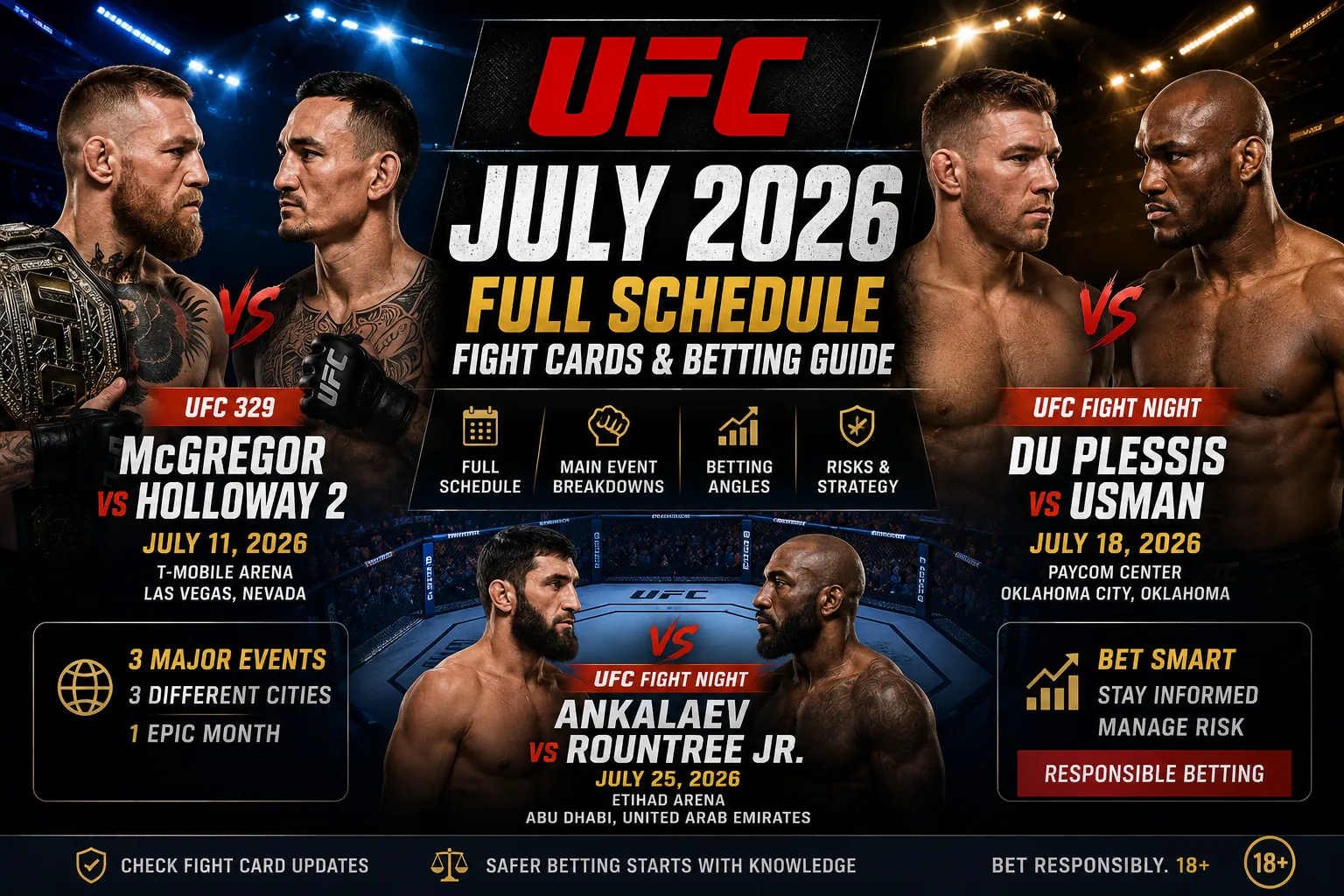
UFC July 2026 Schedule at a Glance
| Date | Event | Main Event | Venue | Status | Why It Matters | Key Betting Note |
|---|---|---|---|---|---|---|
| July 11, 2026 | UFC 329: McGregor vs Holloway 2 | Conor McGregor vs Max Holloway 2 | T-Mobile Arena, Las Vegas, Nevada | Upcoming | The biggest UFC event of July, tied to International Fight Week and a major mainstream rematch | Public money, comeback narratives, inactivity risk, and five-round questions are central |
| July 18, 2026 | UFC Fight Night: Du Plessis vs Usman | Dricus Du Plessis vs Kamaru Usman | Paycom Center, Oklahoma City, Oklahoma | Upcoming | A former-champion matchup with major divisional relevance | Age, durability, wrestling reliability, pressure, and cardio shape the market |
| July 25, 2026 | UFC Fight Night: Ankalaev vs Rountree Jr. | Magomed Ankalaev vs Khalil Rountree Jr. | Etihad Arena, Abu Dhabi, United Arab Emirates | Upcoming | A light heavyweight main event with title-path implications | Technical control vs knockout danger creates a difficult betting read |
Time zones matter. July 11 in Las Vegas can become July 12 for viewers in India, Kazakhstan, the Gulf region, and parts of Asia, depending on broadcast time. Abu Dhabi cards create a different timing picture. They can be more convenient for Europe, India, Kazakhstan, and parts of Asia, while U.S. viewers may see earlier start times than usual.
When I review a monthly UFC schedule, I do not only list dates. I look for market traps: comeback narratives, short rest, travel, five-round risk, and public money on famous names. July 2026 has all of them.
Why July 2026 Is an Important Month for UFC
July 2026 matters because it combines star power, former champions, international scheduling, and divisional pressure.
The month starts with UFC 329. That card is not a normal numbered event. It is tied to International Fight Week in Las Vegas, which means more media attention, more casual viewing interest, and more betting activity from users who do not follow every Fight Night card.
That can distort markets. When a fighter like Conor McGregor appears, the market does not behave like a normal technical fight market. Some bettors back the name. Some automatically fade the name. Both reactions can be lazy. My approach to UFC betting analysis is simple: identify realistic paths to victory, compare them with the market price, and avoid emotional conclusions.
The second event, Du Plessis vs Usman, has a different tone. It is not built around celebrity attention. It is built around former-champion credibility, physical decline questions, wrestling, pressure, and whether either fighter can still impose his best tools over five rounds.
The third event, Ankalaev vs Rountree Jr., shifts the focus to Abu Dhabi and light heavyweight risk. Light heavyweight is a division where one exchange can damage a clean technical read. A fighter can control range for several minutes and still get punished by one power shot.
I do not judge a UFC card only by star names. I look at style, pace, cardio, durability, and late changes. That matters in July because each event carries a different betting trap. UFC 329 carries public attention. Du Plessis vs Usman carries reputation and age-curve questions. Ankalaev vs Rountree Jr. carries power risk in a division where defensive mistakes are expensive.
Bettors also need to track official updates. Fight cards can change because of injury, illness, missed weight, travel issues, failed medicals, visa problems, or short-notice replacements. I treat weigh-ins, injury news, and short-notice replacements as essential parts of the betting picture. A bet made early in the week can look different after Friday weigh-ins.
UFC 329: McGregor vs Holloway 2 — July 11, 2026
Event Context
UFC 329 takes place on July 11, 2026, at T-Mobile Arena in Las Vegas. It is the centerpiece of July’s UFC schedule and the main attraction of International Fight Week.
The headline is obvious: Conor McGregor vs Max Holloway 2.
Their first fight happened years ago, before both men became larger figures in the sport. Since then, McGregor became a two-division UFC champion and one of the biggest combat sports names in history. Holloway became a featherweight champion, a volume-striking benchmark, and one of the most durable high-output fighters of his generation.
That history gives the rematch weight. But history is not enough. When I review a high-profile UFC event, I separate media attention from actual fight value. A rematch from the past can sell the event. It does not automatically explain the current fight.
This is the biggest UFC event of July 2026 because it combines several factors at once: McGregor’s return, Holloway’s name value, International Fight Week, Las Vegas, a five-round main event, and a betting market likely to receive heavy casual attention.
McGregor vs Holloway 2: Main Event Storyline
The first McGregor vs Holloway fight no longer gives a complete technical answer. Too much time has passed. Both men are different fighters. Their bodies are different. Their damage histories are different. Their weight-class context is different. Their activity patterns are different.
McGregor’s biggest technical threats remain clear. His stance, timing, counter left hand, early-round sharpness, and ability to punish entries have always been central to his best work. At his peak, he was not just powerful. He was efficient. He forced opponents to step into danger.
The concern is inactivity. Timing fades when a fighter does not compete regularly. Distance reads become less automatic. Defensive reactions can slow. Cardio under real pressure is not the same as camp conditioning. A five-round fight after a long layoff is a serious variable.
Holloway’s strengths are different. He brings pace, combinations, durability, experience, and pressure. His best work builds over time. He makes opponents defend repeatedly. He forces them to answer volume. He can lose early moments and still become more dangerous as the fight extends.
The weight-class context is important. If the fight is at welterweight, both men must be judged through that frame. McGregor has experience above lightweight. Holloway has mostly built his career at featherweight and lightweight. Extra weight can help durability, but it can also change speed, footwork, and output.
I compare the matchup, the weight class, the venue, the timing, and the betting market before I form an opinion. In this fight, the betting market may not only reflect current ability. It may also reflect memory. That is dangerous.
Tactical Matchup
The first tactical layer is range.
McGregor wants clean entries from Holloway. He wants Holloway stepping into counters. He wants early reads, sharp left hands, and moments where Holloway’s volume becomes predictable.
Holloway wants the opposite. He wants repeated exchanges. He wants McGregor defending more than attacking. He wants to test the legs, body, and breathing. He wants the fight to become a long conversation, not a few explosive sentences.
Calf kicks can matter. Body work can matter even more. If McGregor slows Holloway’s forward pressure early, he can create space for counters. If Holloway attacks the body and forces McGregor to defend at a high pace, the later rounds become more interesting.
The clinch is also worth watching. Holloway is not usually framed as a clinch-first fighter, but clinch pressure can drain an inactive opponent. McGregor has historically been dangerous when he has space to counter. Reducing that space changes the rhythm.
Five rounds change the logic. A three-round fight can reward early explosiveness. A five-round fight demands repeatability. Holloway’s volume profile becomes more relevant if the fight extends. McGregor’s early threat becomes more relevant if Holloway takes risks before making reads.
Betting Angles
This is the kind of fight where I expect public money to matter. McGregor fights attract casual bettors. That does not make him an automatic fade, but it does mean I check whether the price reflects current form or old reputation.
The moneyline is not enough by itself. Bettors need to ask what must happen for each fighter to win.
For McGregor, the clearest paths are early damage, knockdowns, sharp counters, and enough respect from Holloway to slow the pace. He does not need to dominate every minute if he creates the most damaging moments.
For Holloway, the clearest paths are pace, output, durability, late pressure, and decision equity. If he survives early danger and forces McGregor to work every round, his route becomes stronger.
Round totals are tricky. McGregor early-finish narratives will be popular. Holloway decision or late-fight narratives will also be common. The market may overprice both obvious stories.
Method-of-victory betting requires discipline. McGregor by KO/TKO will attract interest. Holloway by decision will attract interest. But obvious props are not automatically valuable. The question is whether the price is better than the actual probability.
Live betting after Round 1 may be useful. Watch McGregor’s timing. Watch Holloway’s reactions to the left hand. Watch whether Holloway is building volume or staying too cautious. Watch McGregor’s breathing after extended exchanges.
I avoid “lock” language because MMA does not support certainty. This fight is a perfect example. Fame does not win fights. Volume does not guarantee safety. Inactivity does not automatically mean decline. Every side has risk.
Co-Main Event and Main Card Notes
The UFC 329 card is not only McGregor vs Holloway 2. The co-main event is expected to feature Benoît Saint Denis vs Paddy Pimblett, a lightweight fight with serious divisional and betting interest.
Saint Denis brings pressure, physicality, finishing threat, and a willingness to make fights uncomfortable. Pimblett brings grappling confidence, durability, opportunistic attacks, and a strong public profile. This is another fight where name value and actual fight value need to be separated.
For bettors, Saint Denis vs Pimblett may be more useful than the main event in some markets because it could be less distorted by mainstream attention. But it still carries volatility. Lightweight fights with aggressive grapplers and finishers can swing quickly.
The broader main card should be checked again before publication. UFC 329 has already shown why late-card verification matters. Injuries and replacements can change prelim structure, betting lines, and parlay logic.
UFC 329 should not be treated as a one-fight event. The main event will get the attention. The undercard may carry sharper betting opportunities or clearer risk signals.
UFC Fight Night: Du Plessis vs Usman — July 18, 2026
Event Context
UFC Fight Night: Du Plessis vs Usman takes place on July 18, 2026, at Paycom Center in Oklahoma City.
This card arrives one week after UFC 329. That timing matters. After a massive event, public attention can drop. Some bettors who won or lost heavily on UFC 329 may approach the next card emotionally. That is poor process.
Du Plessis vs Usman is a former-champion matchup. It carries divisional relevance and reputation risk. It also forces a serious question: how much of each fighter’s peak version still exists?
When I analyze former champions, I do not start with their peak version. I start with the current version: age, damage, speed, activity, wrestling reliability, and whether the body still supports the old game plan.
That is the correct lens for this fight.
Du Plessis vs Usman: Main Event Breakdown
Dricus Du Plessis is difficult to read because his style often looks awkward from the outside. He can appear off-balance, but he still creates pressure. He can look inefficient, but he keeps finding ways to force exchanges. His physical strength, durability, and willingness to fight through ugly moments are major weapons.
Du Plessis is not a clean textbook striker. That is part of the problem for opponents. His rhythm is unusual. His entries are not always predictable. He can turn exchanges into physical contests rather than technical sequences.
Kamaru Usman brings a different base. At his best, he has elite wrestling pressure, clinch control, a strong jab, championship experience, and the ability to manage risk over long fights. He understands five rounds. He understands how to win minutes.
The question is not whether peak Usman was elite. He was. The question is whether current Usman can still rely on the same tools. Age, damage, knee health, speed, and activity all matter. Wrestling-based fighters can decline sharply when the body stops supporting repeated entries.
Du Plessis will likely try to make the fight uncomfortable. Usman will likely need structure. If he can slow Du Plessis with wrestling, clinch pressure, and controlled boxing, he can reduce chaos. If he cannot, Du Plessis can force him into exchanges where durability and physicality matter.
Tactical Matchup
The center of the cage is important. If Du Plessis controls forward pressure, Usman may have to defend before he can build offense. If Usman controls the center, he can dictate entries and force Du Plessis to reset.
Wrestling is the major technical question. Can Usman still hit takedowns at the right time? Can he hold position? Can he force Du Plessis to carry weight? Or will Du Plessis scramble, break grips, and turn the fight into a striking brawl?
Clinch positions matter. Usman can use the fence to slow opponents. Du Plessis can use physical strength to create messy breaks. The fighter who exits clinches better may win important minutes.
Body work can be important. Du Plessis carries a high physical pace. Attacking the body can slow that. Usman’s cardio has historically been strong, but he cannot assume his old gas tank solves every problem.
Late-round fatigue is a real betting variable. Five-round fights expose decline. They also expose panic. A fighter can look composed early and lose structure when pace rises.
Betting Angles
Moneyline value depends on whether the market prices the current fighter or the résumé.
Usman’s name carries weight. Former champions are often supported by bettors who remember their best years. That can create poor value if the market ignores decline. It can also create value if the public overcorrects and assumes he is finished.
Du Plessis can also be misread. His style does not always look clean. Some bettors undervalue awkward but effective pressure. Others overvalue durability and ignore defensive risk.
Decision markets may be relevant if Usman can slow the fight and if Du Plessis respects the wrestling. Over/under rounds depend on whether the fight becomes structured or chaotic.
Takedown and control-time relevance is high. Early wrestling exchanges will tell bettors a lot. If Usman gets in clean and holds position, his path improves. If he shoots from too far away or cannot control Du Plessis, the fight changes.
Live betting after the first round may be more useful than chasing a pre-fight opinion. Watch Usman’s entries. Watch Du Plessis’ physical response. Watch who looks more comfortable after the first clinch-heavy exchange.
The main lesson: former champions can be mispriced by reputation. They can also be underestimated when the public becomes too eager to call decline. Current form matters more than nostalgia.
UFC Fight Night: Ankalaev vs Rountree Jr. — July 25, 2026
Event Context
UFC Fight Night: Ankalaev vs Rountree Jr. takes place on July 25, 2026, at Etihad Arena in Abu Dhabi.
This is an international card with light heavyweight implications. Abu Dhabi changes the viewing window, travel context, and event environment. Fighters often deal with different routines, different media obligations, and different timing. Bettors should not ignore that.
Magomed Ankalaev vs Khalil Rountree Jr. is a classic technical-favorite-versus-dangerous-power-fighter matchup. That does not mean the fight is simple. At light heavyweight, one clean strike can overturn several minutes of correct analysis.
Ankalaev vs Rountree Jr.: Main Event Breakdown
Ankalaev is a patient, technical light heavyweight. His southpaw striking, countering, distance management, and ability to control the rhythm make him difficult to chase. He can win slow rounds. He can make opponents hesitate. He can also mix in wrestling threat when needed.
His strongest advantage may be control. He does not need chaos. He can make fights feel narrow. That matters against a dangerous power striker.
Rountree Jr. brings a different threat. He is powerful, explosive, and dangerous when opponents accept exchanges. His kicking game can do real damage. His aggression can force defensive reactions. He can punish opponents who stand too long in front of him.
The risk for Rountree is being forced backward or made to miss. Power loses value when it cannot land clean. If Ankalaev controls range and makes Rountree reset repeatedly, the fight can become frustrating for the underdog.
The risk for Ankalaev is comfort. Technical fighters can look safe until they are not. A slow pace can keep an underdog alive. A single exchange can change the result.
Tactical Matchup
Kickboxing range is the first battleground. Rountree wants to damage with kicks and power shots. Ankalaev wants to manage distance, draw reactions, and counter without giving Rountree clean exchanges.
The counter left hand matters. Low kicks matter. Body kicks matter. Cage control matters. If Ankalaev can back Rountree up, he can reduce Rountree’s preferred explosiveness. If Rountree can hold space and force Ankalaev to react, the danger increases.
Wrestling entries may define the fight even if there are not many takedowns. The threat alone can change Rountree’s stance and output. A power striker who is worried about takedowns may throw less freely.
Judging risk is also real. Slow technical rounds can be hard to score. If Ankalaev controls position but lands little, and Rountree lands the heavier isolated shots, judges may have difficult choices.
Betting Angles
In fights like Ankalaev vs Rountree Jr., I usually separate skill advantage from danger. A technical favorite may control more minutes, but a powerful underdog can still create one exchange that changes the result.
The moneyline may favor Ankalaev because of technical depth, ranking position, and control tools. The question is whether the price becomes too expensive for a light heavyweight fight with knockout risk.
Method-of-victory markets are interesting. Ankalaev by decision may fit a control-based read. Ankalaev by KO/TKO may fit a scenario where Rountree tires or gets punished on entries. Rountree by KO/TKO is the obvious underdog path.
Round totals require caution. If Ankalaev controls pace, the fight can extend. If Rountree forces exchanges early, the under becomes more live. The first five minutes may reveal whether the fight is technical or violent.
Live betting after early range reads may be useful. Watch whether Rountree can land kicks without being countered. Watch whether Ankalaev reacts comfortably to power. Watch whether the wrestling threat appears early.
The main caution is obvious: power punchers are attractive underdogs, but they are volatile. Technical favorites can be better fighters and still be vulnerable in this division.
Best UFC Betting Markets to Understand in July 2026
Moneyline
Moneyline betting is the simplest UFC market. You pick who wins. It is useful when you have a clear view of the matchup and believe the price is better than the real probability.
The problem is that public attention can distort the number. That is especially true for McGregor vs Holloway 2. A famous fighter can become overpriced. A famous fighter can also become a lazy fade. Neither side is automatically smart.
Method of Victory
Method-of-victory markets require more precision. A fighter can win by KO/TKO, submission, or decision. The market becomes harder because you are not only picking the winner. You are picking the route.
I prefer to explain markets by asking what must actually happen inside the cage. A moneyline needs a winner. A method prop needs the winner and the route. A round prop needs the winner, route, and timing. Each extra condition increases risk.
Round Totals
Round totals focus on whether a fight goes over or under a set number of rounds. Pace, durability, cardio, wrestling control, and damage all matter.
McGregor vs Holloway 2 raises early finish versus late pressure questions. Du Plessis vs Usman raises cardio and wrestling questions. Ankalaev vs Rountree Jr. raises control versus knockout danger questions.
Round Betting
Exact-round betting is high variance. It requires timing accuracy. That is difficult in MMA because finishes can happen from mistakes, cuts, injuries, scrambles, or referee decisions.
Round betting should be treated as speculative. It should not become the foundation of a betting plan.
Live Betting
Live betting can help when pre-fight uncertainty is high. It lets bettors evaluate timing, pace, range, cardio, damage, and grappling success after the fight begins.
It also creates risk. Live markets move quickly. Emotional reactions are common. One flashy punch does not always mean the fighter is winning the fight. One takedown does not always mean control is repeatable.
Parlays
UFC parlays are popular. They are also dangerous.
MMA is not a sport where favorites simply “do their job” every time. One foul, cut, injury, bad judging card, failed weight cut, or late replacement can break a ticket.
I do not treat parlays as a shortcut. They combine risk. They do not remove risk.
How to Analyze UFC Fight Cards Before Betting
Before I publish UFC betting analysis, I use a practical checklist:
- Verify official bout status.
- Check the latest fight card.
- Confirm whether the bout is three rounds or five rounds.
- Check weigh-in results.
- Check missed weight.
- Check late replacements.
- Check injury news.
- Check recent opponents.
- Compare level of competition.
- Compare three-round and five-round performance.
- Evaluate cardio.
- Study takedown defense.
- Study submission defense.
- Study striking defense.
- Review damage history.
- Compare odds movement.
- Avoid emotional betting after viral clips.
- Avoid betting only because of fighter popularity.
- Avoid betting against famous fighters only because they are famous.
- Check local betting law and sportsbook rules.
In my UFC event research, I treat the official fight card as the starting point, not the final answer. The official card tells me what is scheduled. It does not tell me how the market is pricing risk. It does not tell me how a fighter looks at weigh-ins. It does not tell me whether the public has inflated one side.
That is where analysis starts.
Fighter Form: What Matters and What Does Not
Recent wins and losses matter. They are not enough.
A fighter can lose to elite competition and still be better than a fighter winning against weaker opponents. Strength of schedule matters. So does the way a fighter wins or loses.
Layoff length is important. McGregor’s inactivity is a central part of the UFC 329 analysis. A long break affects timing, reactions, and the ability to handle live pressure.
Age and mileage matter. Usman’s best years were elite, but current physical reliability matters more than memory. Damage history matters in fights with pressure, pace, and five-round structure.
Weight-class changes matter. Holloway moving into a different weight context changes the read. Extra weight can help durability, but it can alter speed and output. McGregor at welterweight changes power, size, and cardio questions.
Camp changes and injury history matter, but they must be handled carefully. I do not write fake insider claims. I do not claim to know what happened inside a camp. I analyze what is public, visible, and relevant.
Records alone are weak indicators. A clean record against limited opposition can be misleading. A mixed record against elite opponents can be more valuable.
High-Profile UFC Events and Public Betting Bias
McGregor fights attract casual betting volume. That is not an opinion. It is a market reality.
Some bettors bet McGregor because of memory. Some bet against him because they think the public always overprices him. Both approaches can fail if they ignore the matchup.
Comeback narratives are dangerous. “He looks motivated” is not serious analysis. “He had a great camp” is not enough. “He is back” is not a betting angle.
The correct questions are narrower:
- Can he still control range?
- Can he still time counters?
- Can he handle Holloway’s volume?
- Can he win minutes if the early finish does not come?
- Is the price based on current form or old reputation?
Social media confidence does not equal value. A loud pick is not a strong pick. A viral clip is not a fight model. I track odds movement, but I do not treat line movement as proof by itself.
The same logic applies to Holloway. He is durable and experienced. That does not make him safe. No fighter is safe in a five-round main event against a dangerous counter striker.
UFC Apex, Arena Events, and International Cards: Why Venue Matters
July 2026 gives three different event settings.
T-Mobile Arena in Las Vegas is a major event venue. It brings crowd noise, media pressure, celebrity attention, and high public interest. That affects the atmosphere around UFC 329.
Paycom Center in Oklahoma City gives Du Plessis vs Usman an arena Fight Night setting. It is not the same as an Apex card. Crowd response can shape momentum. Fighters can react to it. Judges are not supposed to score crowd noise, but human perception is part of live sport.
Etihad Arena in Abu Dhabi creates a different kind of card. Travel, local timing, media obligations, and regional audience patterns matter. Abu Dhabi events often have a distinct rhythm compared with Las Vegas cards.
Venue does not decide fights. It changes the environment around the fight. That is enough to matter.
Time Zones and Broadcast Timing for Global UFC Bettors
UFC events are global. A U.S. date is not always the viewing date for every region.
UFC 329 is listed for July 11 in Las Vegas. For viewers in India, Kazakhstan, the Gulf region, and parts of Asia, the main card may fall on July 12 depending on local broadcast timing.
Oklahoma City creates a similar issue. A Saturday U.S. event can become a Sunday morning viewing window elsewhere.
Abu Dhabi is different. It can be more convenient for Europe, India, Kazakhstan, and parts of Asia. It may air earlier than usual for U.S. viewers.
Bettors should check:
- official event date;
- local start time;
- prelim start time;
- main card start time;
- sportsbook market closing time;
- whether the sportsbook lists the card by U.S. date or local date;
- whether a fight has moved in the bout order;
- whether the bout remains active after weigh-ins.
Late-night betting creates bad decisions. Tired bettors chase losses. They miss updates. They react badly to live odds. Pre-event research should be done before the card starts.
Responsible Betting Warning for UFC Events
UFC betting is high variance. MMA has unpredictable outcomes. A fighter can dominate most of a round and lose in one exchange. A strong read can still lose because of injury, cut, foul, bad scorecard, sudden submission, or referee stoppage.
As a reviewer, I do not treat UFC betting as prediction theater. I treat it as risk assessment. The goal is not to sound certain. The goal is to understand uncertainty before money is involved.
Never bet money needed for rent, food, bills, debt, medical costs, or family expenses. Do not treat betting as income. Treat it as entertainment with financial risk.
Do not chase losses. Do not increase stake after a bad result. Do not buy “guaranteed UFC picks.” Do not trust fixed-fight claims. Do not rely only on Telegram tipsters, influencer screenshots, or edited betting slips.
Betting availability depends on local law and sportsbook rules. Check the rules where you live before placing any wager.
What Fans Should Watch in UFC July 2026
July 2026 has several key storylines.
First, McGregor’s return. If he wins, the UFC gets a major star back in the active picture. If he loses, the conversation shifts toward whether the long layoff and damage history were too much.
Second, Holloway’s weight-class test. If he wins at welterweight, it adds another layer to his legacy. If he struggles with size or power, it gives context to the limits of his style above lightweight.
Third, Saint Denis vs Pimblett. If confirmed at publication time, this is one of the most important lightweight support fights on UFC 329. The winner can push toward bigger contender matchups.
Fourth, Du Plessis vs Usman. This fight can reshape how fans evaluate former champions and current divisional positioning. It is a test of physicality, wrestling, age, and pressure.
Fifth, Ankalaev vs Rountree Jr. This is a light heavyweight fight with title-path consequences. Ankalaev can reinforce his technical position. Rountree can change the division with one major upset.
July results can affect August and later UFC cards. Title paths, rankings, rematches, and matchmaking all move after months like this.
Conclusion
UFC events in July 2026 give MMA fans and bettors a strong month. UFC 329 brings McGregor vs Holloway 2, International Fight Week, and heavy public betting attention. Du Plessis vs Usman gives the month a serious former-champion matchup in Oklahoma City. Ankalaev vs Rountree Jr. closes the month with light heavyweight stakes in Abu Dhabi.
The betting lessons are clear. Do not analyze July only through star power. Check current form. Check weight class. Check venue. Check fight length. Check late changes. Check the price.
I research UFC events before writing because the schedule alone is never enough. A useful UFC betting article must compare official listings, fighter style, form, market behavior, and risk. That is the only serious way to approach a month like July 2026.
Internal Link Suggestions
- UFC betting guide
- MMA betting strategy
- Sports betting odds explained
- Live betting guide
- Responsible gambling guide
- Boxing vs MMA betting
- Best betting markets for combat sports
- Bankroll management guide
Summarize this article with AI. Use this page URL as the source:
Summarize this article with AI:
FAQ
The main UFC events scheduled for July 2026 are UFC 329: McGregor vs Holloway 2 on July 11, UFC Fight Night: Du Plessis vs Usman on July 18, and UFC Fight Night: Ankalaev vs Rountree Jr. on July 25.
UFC 329 is the biggest UFC event in July 2026 because it features Conor McGregor vs Max Holloway 2 during International Fight Week in Las Vegas.
UFC 329 is scheduled for July 11, 2026.
UFC 329 is scheduled for T-Mobile Arena in Las Vegas, Nevada.
The UFC 329 main event is Conor McGregor vs Max Holloway 2.
Current listings indicate McGregor vs Holloway 2 is a welterweight bout, but bettors should verify the official listing again before publication and before betting.
UFC Fight Night: Du Plessis vs Usman is scheduled for July 18, 2026.
The event is scheduled for Paycom Center in Oklahoma City, Oklahoma.
UFC Fight Night: Ankalaev vs Rountree Jr. is scheduled for July 25, 2026.
UFC Abu Dhabi is scheduled for Etihad Arena on Yas Island in Abu Dhabi, United Arab Emirates.
UFC fight cards can change because of injury, illness, missed weight, failed medicals, visa problems, short-notice withdrawals, or commission decisions.
Bettors should check official bout status, weigh-ins, injuries, fight length, late replacements, odds movement, recent form, and local betting law.
Yes. UFC parlays are risky because every leg must win. One upset, injury, foul, cut, or judging issue can break the whole ticket.
Live betting means placing bets after the fight starts. It can help bettors react to pace, cardio, range, damage, and grappling success, but it also increases emotional risk.
No. UFC betting cannot guarantee profit. MMA is unpredictable, and every bet carries financial risk.
Time zones matter because an event listed for Saturday in the United States can air on Sunday in India, Kazakhstan, the Gulf region, or parts of Asia.