
Uruguay vs Spain World Cup 2026 Preview
Table of Contents Show
Views 98
Uruguay face Spain in a FIFA World Cup 2026 Group H match on Friday, 26 June 2026 local time, at Guadalajara Stadium in Guadalajara, Mexico. Kick-off is scheduled for 18:00 local time in Guadalajara and 00:00 UTC on Saturday, 27 June. This is Match 66 of the group stage. Spain enter the match top of Group H with four points after a 0-0 draw against Cabo Verde and a 4-0 win over Saudi Arabia. Uruguay enter with two points after drawing 1-1 with Saudi Arabia and 2-2 with Cabo Verde.
Confirmed team news gives Uruguay the larger injury concern. Ronald Araújo, José María Giménez and Giorgian de Arrascaeta were public injury watchlist players before the tournament, and Ronald Araújo’s availability remains a major defensive question. Spain’s key watchlist items are Lamine Yamal’s managed return after hamstring trouble, Mikel Oyarzabal’s minor soreness after the Saudi Arabia match and Pedri’s card-risk profile.
The likely tactical shape is Uruguay in a high-intensity 4-3-3 / 4-2-3-1 against Spain’s 4-3-3 / 4-2-3-1 possession model. The key matchup is Federico Valverde and Manuel Ugarte against Spain’s midfield triangle, while Lamine Yamal attacks Uruguay’s left-side defensive cover. The projected match type is Spain control against Uruguay urgency. Betting note: Spain are a strong market favorite, but no betting outcome is guaranteed.
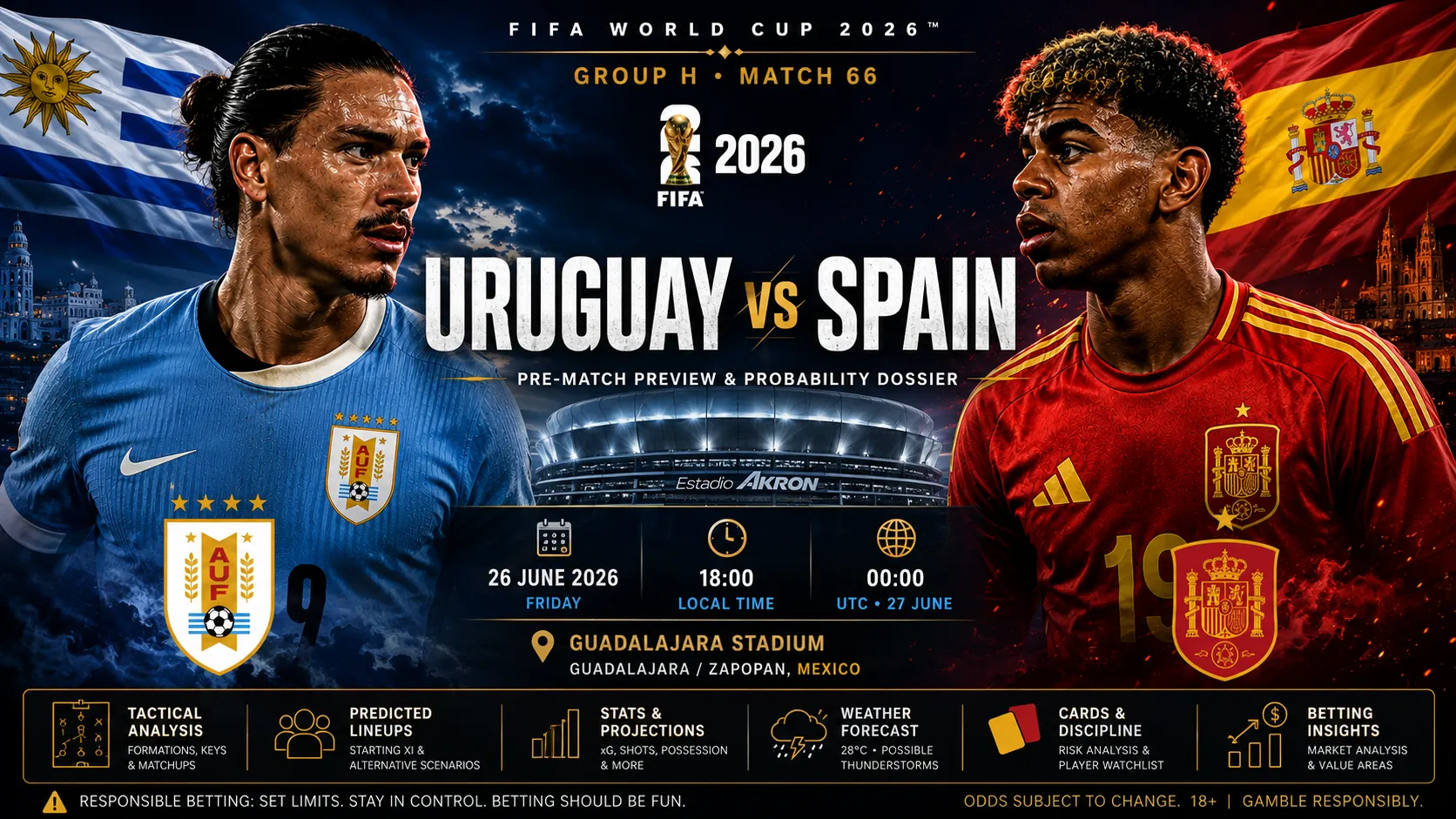
Match Snapshot
| Item | Confirmed / Current Status |
|---|---|
| Match | Uruguay vs Spain |
| Competition | FIFA World Cup 2026 |
| Format | World Cup 2026 Pre-Match Probability Dossier |
| Stage | Group stage |
| Group | Group H |
| Match number | Match 66 |
| Date | Friday, 26 June 2026 local date |
| Kick-off time | 18:00 local time in Guadalajara / 00:00 UTC on Saturday, 27 June |
| Stadium | Guadalajara Stadium |
| Common venue identity | Estadio Akron / Zapopan in public references |
| City | Guadalajara / Zapopan, Jalisco |
| Host country | Mexico |
| Expected attendance | not available from verified public data |
| Referee | Ismail Elfath reported in public referee-assignment sources; verify with final FIFA match sheet |
| VAR | not available from verified public data |
| Weather forecast | Possible thunderstorms; high around 83°F / 28°C, low around 63°F / 17°C; exact kick-off humidity, wind and pitch moisture not available from verified public data |
| Pitch context | Outdoor stadium; final surface moisture and pitch speed depend on rain, drainage and match-day preparation |
| Team A coach | Marcelo Bielsa |
| Team B coach | Luis de la Fuente |
| Main article focus | Group H qualification pressure, Uruguay’s must-win profile, Spain’s first-place control, injury watchlists, Yamal and Oyarzabal impact, Bielsa pressing risks, Guadalajara weather, projected match data and responsible betting-market review |
Uruguay vs Spain is the strongest football-name fixture in Group H, but it is also a pressure match. Spain can protect qualification and likely first place with a positive result. Uruguay cannot treat a draw as enough unless the parallel Cabo Verde vs Saudi Arabia match helps them. That difference should shape the match. Spain can manage risk. Uruguay must eventually force the game.
Result Stakes in One Sentence
Spain need control to secure Group H authority, while Uruguay need a win or a very favorable parallel result to avoid entering third-place uncertainty.
Confirmed Facts vs Forecasts
| Category | Information | Status | Use in This Dossier |
|---|---|---|---|
| Confirmed fact | Uruguay vs Spain is a FIFA World Cup 2026 Group H match | Confirmed | Used as match base |
| Confirmed fact | The fixture is Match 66 | Confirmed | Used in match snapshot |
| Confirmed fact | Venue is Guadalajara Stadium | Confirmed | Used in stadium section |
| Confirmed fact | Kick-off is 00:00 UTC on 27 June 2026 | Confirmed | Converted to 18:00 local time on 26 June in Guadalajara |
| Confirmed fact | Spain have four points after two matches | Confirmed from current reporting | |
| Confirmed fact | Uruguay have two points after two matches | Confirmed from current reporting | |
| Confirmed fact | Spain drew 0-0 with Cabo Verde and beat Saudi Arabia 4-0 | Confirmed | |
| Confirmed fact | Uruguay drew 1-1 with Saudi Arabia and 2-2 with Cabo Verde | Confirmed | |
| Confirmed squad information | Uruguay squad includes Sergio Rochet, Ronald Araújo, José María Giménez, Federico Valverde, Manuel Ugarte, Rodrigo Bentancur, Darwin Núñez, Maxi Araújo and others | Public squad source | |
| Confirmed squad information | Spain squad includes Unai Simón, David Raya, Aymeric Laporte, Pau Cubarsí, Rodri, Pedri, Dani Olmo, Lamine Yamal, Nico Williams, Mikel Oyarzabal and others | Public squad source | |
| Confirmed team-news context | Lamine Yamal returned to Spain’s starting XI against Saudi Arabia and scored early | Current match reporting | |
| Confirmed team-news context | Mikel Oyarzabal scored twice and assisted against Saudi Arabia, then described soreness as manageable | Current reporting | |
| Confirmed team-news context | Uruguay’s defensive errors against Cabo Verde damaged their qualification position | Current reporting | |
| Probable information | Uruguay will play with high pressing and direct vertical attacks | Probable from Bielsa’s model | |
| Probable information | Spain will dominate possession and use wide overloads | Probable from Spain’s structure and market signal | |
| Unknown data | Final starting XIs | Pending official team sheets | |
| Unknown data | Expected attendance | not available from verified public data | |
| Unknown data | VAR crew | not available from verified public data | |
| Unknown data | Exact pitch moisture and kick-off wind | not available from verified public data | |
| Projected data | Possession, shots, xG, fouls, cards, corners and substitution windows | Model-based | |
| Scenario-based analysis | Group routes, scoreline bands, live betting triggers and late risk behavior | Conditional forecast |
This distinction matters because a strong preview must not turn probability into fact. The fixture, venue, group table, coaches, previous results and squad lists are confirmed. The lineups, tactical shapes, player minutes, projected xG and card ranges are forecasts.
The match has not been played. No goal, card, substitution, injury or VAR event can be described as certain. Uruguay may press aggressively, but Spain can break that press and force Bielsa to adjust. Spain may control the ball, but one defensive transition can change the group table. Rain can make the pitch quicker or heavier. An early booking can change a duel. Forecast accuracy depends on treating each of these items as a variable, not as a fixed script.
Betting analysis follows the same rule. Odds show market probability. They do not prove the result. Spain can be favored and still draw. Uruguay can be underdog and still win if their pressing and set pieces land. A low-total or high-total view can fail after one early penalty, goalkeeper error or red card.
Why This Match Matters
Group H remains live before the final matchday. Spain lead with four points. Uruguay and Cabo Verde have two points. Saudi Arabia have one point. No team can treat its position as fully complete without watching the parallel match.
Spain have the cleanest position. A win moves Spain to seven points and should secure first place. A draw moves Spain to five points, which should be enough to qualify and may still be enough to win the group depending Cabo Verde vs Saudi Arabia. A defeat leaves Spain on four points. Four points can still be enough to advance, but it removes control and creates unnecessary stress.
Uruguay have less margin. They have drawn twice. They have scored three goals but conceded three. The attack has produced enough moments to suggest a higher points total was possible, but defensive lapses have pulled the table away from them. A win over Spain moves Uruguay to five points and gives them a strong qualification route. A draw moves them to three points and leaves them dependent on the parallel result and third-place ranking. A defeat leaves them on two points and likely ends their campaign.
Spain also have a narrative stake. Their 0-0 draw with Cabo Verde produced criticism. Their 4-0 win over Saudi Arabia restored authority. The Uruguay match is a better test than Saudi Arabia because Uruguay bring pressure, duels, runners and a coach who will not allow a slow positional game without resistance.
Uruguay carry psychological pressure. They expected more than two points from Saudi Arabia and Cabo Verde. They now face the group favorite. Bielsa’s system always asks for courage, running and positional risk. This match will test whether Uruguay can apply that model without breaking its own defensive structure.
Group H Standings Before Kick-Off
| Rank | Team | Played | Wins | Draws | Losses | Goals For | Goals Against | Goal Difference | Points |
|---|---|---|---|---|---|---|---|---|---|
| 1 | Spain | 2 | 1 | 1 | 0 | 4 | 0 | +4 | 4 |
| 2 | Uruguay | 2 | 0 | 2 | 0 | 3 | 3 | 0 | 2 |
| 3 | Cabo Verde | 2 | 0 | 2 | 0 | 2 | 2 | 0 | 2 |
| 4 | Saudi Arabia | 2 | 0 | 1 | 1 | 1 | 5 | -4 | 1 |
Result-Scenario Table
| Result | Uruguay Impact | Spain Impact | Group Meaning |
|---|---|---|---|
| Uruguay win | Uruguay move to five points and likely reach the Round of 32 | Spain stay on four points and may still qualify, but lose top-place control | Uruguay rescue the group; Spain become dependent on parallel match and tiebreakers |
| Draw | Uruguay move to three points and enter third-place uncertainty | Spain move to five points and likely qualify | Draw helps Spain much more than Uruguay |
| Spain win | Uruguay stay on two points and likely exit | Spain move to seven points and likely win Group H | Spain finish the group with control and momentum |
Parallel Match: Cabo Verde vs Saudi Arabia
| Parallel Result | Effect on Uruguay | Effect on Spain |
|---|---|---|
| Cabo Verde win | Uruguay likely need to beat Spain to avoid third-place danger | Spain may still qualify with draw or even lose depending tiebreakers |
| Draw | Uruguay draw vs Spain may keep them level with Cabo Verde on three points, but tiebreakers matter | Spain draw likely secures first place |
| Saudi Arabia win | Uruguay draw vs Spain may still leave a route, but Saudi Arabia reach four points | Spain draw keeps them above Saudi Arabia and likely safe |
Goal Difference Pressure
Spain start with +4. Uruguay start with 0. Cabo Verde start with 0. Saudi Arabia start with -4. Spain’s goal difference gives them a cushion. Uruguay do not have that cushion. Their 2-2 draw with Cabo Verde damaged the clean route because it kept a direct rival level on points and goal difference.
Third-Place Route
The World Cup 2026 format sends the top two teams from each group plus the eight best third-placed teams into the Round of 32. Four points is usually a strong third-place profile. Three points is uncertain. Two points is weak. Spain already have four. Uruguay do not. This is why Uruguay cannot rely on a draw unless the parallel game breaks in their favor.
Knockout Path Context
The Group H winner and runner-up enter different Round of 32 routes. A qualified third-placed team can face a less predictable bracket path. Spain should want first place because it gives cleaner preparation and route control. Uruguay should first target survival. Route optimization comes after qualification.
Country, City, Stadium and Weather Intelligence
The match takes place in Mexico, one of the three host countries for World Cup 2026. The city context is Guadalajara / Zapopan. The tournament venue name is Guadalajara Stadium. The public venue identity is Estadio Akron. It is an outdoor stadium in a region where June can bring warm weather and rain risk.
Guadalajara sits at altitude compared with sea-level venues, though it is not extreme by Mexican football standards. The elevation can still affect repeated sprint recovery for teams that have travelled through lower-altitude U.S. venues. Uruguay played earlier group matches in Miami-area conditions. Spain played in U.S. venues before this final group match. Both teams must adjust to a different climate and altitude profile.
The forecast points to possible thunderstorms and a high around 28°C. The match kicks off at 18:00 local time, so temperature should fall from peak daytime levels. Rain risk matters more than heat. A damp or slick surface can change Spain’s passing speed and Uruguay’s pressing traps. Thunderstorm risk can also affect warm-up rhythm, pitch watering and ball behavior.
The crowd profile should be mixed. Mexico can produce a loud neutral tournament atmosphere. Spain and Uruguay both have strong international support. The match can feel like a major tournament fixture rather than a normal group game because both teams carry heavyweight football identity.
Host-Country Factors
| Factor | Detail | Tactical Meaning |
|---|---|---|
| Host country | Mexico | Neutral but culturally intense football setting |
| Tournament stage | Final Group H matchday | Group-table pressure affects risk |
| Time zone | Central Mexico time | 18:00 local kick-off |
| Venue region | Guadalajara / Zapopan | Altitude and rain risk matter |
| Travel load | Uruguay and Spain arrive after U.S.-based group matches | Recovery and acclimation matter |
| Crowd profile | Mixed tournament crowd, likely strong neutral energy | Communication under pressure matters |
| Tournament format | Top two plus eight best third-placed teams advance | Spain have cushion; Uruguay need result |
| Parallel fixture | Cabo Verde vs Saudi Arabia | Live table can change decisions |
City Factors
| City Factor | Guadalajara Context | Match Translation |
|---|---|---|
| Temperature | Around 28°C daytime high forecast | Moderate heat load, lower than Houston or Miami |
| Rain risk | Possible thunderstorms | Surface speed and warm-up disruption watchlist |
| Altitude | Elevated compared with sea-level venues | Repeated sprint recovery can matter |
| Humidity | exact kick-off humidity not available from verified public data | Rain risk may increase perceived heaviness |
| Wind | exact kick-off wind not available from verified public data | Long switches and high crosses require warm-up check |
| Time of day | Early evening | Better than midday, but warm-up still matters |
| Travel adaptation | Both sides change climate and altitude profile | Substitution timing may become important |
| Crowd | Mexican venue atmosphere likely loud | Referee communication and set-piece organization matter |
Stadium Details
| Stadium Detail | Status | Tactical Meaning |
|---|---|---|
| Tournament name | Guadalajara Stadium | |
| Common venue identity | Estadio Akron | |
| City | Guadalajara / Zapopan | |
| Host country | Mexico | |
| Roof | Outdoor stadium context | |
| Expected attendance | not available from verified public data | |
| Surface | Tournament pitch condition not available from verified public data | |
| Pitch speed | not available from verified public data | |
| Main environmental concern | Rain, altitude, evening surface condition | |
| Crowd effect | Strong tournament atmosphere possible | |
| Tactical watchlist | Passing speed, pressing recovery and long-ball accuracy |
Weather Factors Into Tactical Meaning
| Weather Factor | Forecast / Status | Tactical Meaning |
|---|---|---|
| Temperature | Around 83°F / 28°C high | Pressing possible but not endless |
| Rain / storms | Possible thunderstorms | Wet surface can speed passes and create slips |
| Humidity | not available from verified public data for exact kick-off | Can raise perceived effort if rain builds |
| Wind | not available from verified public data | Crosses and switches need warm-up calibration |
| Altitude | Moderate elevation | Repeated high pressing can become more expensive |
| Pitch moisture | not available from verified public data | Central to Spain passing and Uruguay counterpress |
| Hydration load | Medium | Lower than Houston, but still relevant |
| Fatigue factor | Pressing volume and altitude interaction | Uruguay face the larger workload risk |
The most important weather factor is not raw heat. It is the combination of rain risk and altitude. Spain want clean passing rhythm. Uruguay want aggressive pressure and fast recoveries. A slick pitch can help Spain move the ball through pressure. It can also help Uruguay force loose first touches if Spain misjudge speed.
Team News and Availability Ledger
Official team sheets are not available at publication time. This section uses current public squad information and cautious team-news interpretation. It does not invent unavailable players.
Confirmed Team News Table
| Team | Player / Staff | Status | Tactical Meaning |
|---|---|---|---|
| Uruguay | Marcelo Bielsa | Head coach | Will likely keep aggressive, possession-and-pressing identity |
| Uruguay | Sergio Rochet | In squad | Main goalkeeper option |
| Uruguay | Ronald Araújo | In squad; major injury watchlist | If unavailable, Uruguay lose elite recovery speed and right-sided defensive power |
| Uruguay | José María Giménez | In squad; pre-tournament injury watchlist | Defensive leadership and aerial value depend on fitness |
| Uruguay | Giorgian de Arrascaeta | In squad; pre-tournament injury watchlist | Creative depth affected if unavailable or limited |
| Uruguay | Federico Valverde | In squad | Main midfield engine and transition driver |
| Uruguay | Manuel Ugarte | In squad | Main ball-winner and pressing screen |
| Uruguay | Rodrigo Bentancur | In squad | Midfield balance and passing option |
| Uruguay | Darwin Núñez | In squad | Main striker and pressing reference |
| Uruguay | Maxi Araújo | In squad; scored against Saudi Arabia and Cabo Verde | Wide/inside runner with tournament scoring form |
| Uruguay | Agustín Canobbio | In squad; scored against Cabo Verde | Wide attacker / attacking-midfield option |
| Spain | Luis de la Fuente | Head coach | Will likely balance first-place control with player management |
| Spain | Lamine Yamal | In squad; returned to start and scored vs Saudi Arabia | Key right-wing threat and fitness-management watchlist |
| Spain | Mikel Oyarzabal | In squad; two goals and assist vs Saudi Arabia; minor soreness noted | Main striker / false-nine watchlist |
| Spain | Pedri | In squad; card-risk profile reported publicly | Midfield control and suspension-risk watchlist |
| Spain | Rodri | In squad | Main holding midfielder and tempo controller |
| Spain | Dani Olmo | In squad | Central connector and pressing link |
| Spain | Aymeric Laporte | In squad | Defensive organizer and left centre-back option |
| Spain | Pau Cubarsí | In squad | Ball-playing centre-back and high-line support |
| Spain | Unai Simón | In squad; started vs Saudi Arabia | Goalkeeper option |
| Spain | Nico Williams | In squad; prior fitness watchlist before tournament | Left-wing threat if selected |
Doubtful Players
| Team | Player | Status | Tactical Meaning |
|---|---|---|---|
| Uruguay | Ronald Araújo | Major injury watchlist | His absence changes Uruguay’s ability to defend Yamal and Spain transitions |
| Uruguay | José María Giménez | Fitness watchlist | If limited, Uruguay lose centre-back leadership |
| Uruguay | Giorgian de Arrascaeta | Fitness watchlist | If unavailable, Uruguay lose a creative change-of-rhythm option |
| Spain | Lamine Yamal | Workload-management watchlist | If minutes are managed, Spain lose their strongest right-sided destabilizer |
| Spain | Mikel Oyarzabal | Soreness watchlist, not confirmed absence | If rested or limited, Spain may use a different striker profile |
| Spain | Nico Williams | Prior fitness watchlist | If fit, gives Spain left-side 1v1 threat |
| Team | Player | Reason | Tactical Effect |
|---|---|---|---|
| Uruguay | not available from verified public data as final official list | No final FIFA team-sheet unavailable list available | No absence invented |
| Spain | not available from verified public data as final official list | No final FIFA team-sheet unavailable list available | No absence invented |
Injury Watchlist
| Team | Player / Area | Risk Type | Tactical Meaning |
|---|---|---|---|
| Uruguay | Ronald Araújo | Muscle injury watchlist | Directly affects right centre-back / right-back flexibility |
| Uruguay | Giménez / defensive line | Defensive fitness and communication | Spain can exploit if Uruguay reshuffle |
| Uruguay | De Arrascaeta | Creative depth | Affects late-game attacking changes |
| Uruguay | Darwin Núñez | High-sprint forward load | Needs pressing control in altitude |
| Spain | Yamal | Hamstring-management profile | Spain may avoid overloading his minutes |
| Spain | Oyarzabal | Post-match soreness | Could influence striker minutes |
| Spain | Pedri | Card-risk profile | A second booking could affect knockout availability |
| Spain | Full-back zones | Defensive transition watchlist | Uruguay can attack behind advanced full-backs |
Suspension Risk
| Team | Confirmed Suspensions | Card-Risk Forecast |
|---|---|---|
| Uruguay | not available from verified public data | Ugarte, full-backs and centre-backs carry tactical foul risk against Spanish combinations |
| Spain | not available from verified public data | Pedri has public card-risk concern; full-backs and midfielders also carry transition-foul risk |
| Referee influence | Ismail Elfath reported; detailed match-specific tournament profile not fully available | Card model remains medium-confidence |
Uruguay’s biggest tactical variable is the defensive line. If Araújo and Giménez are unavailable or limited, Bielsa must balance aggression against a lack of recovery speed. Spain will test that with Yamal, Oyarzabal, Olmo and runners from midfield.
Spain’s biggest tactical variable is attacking selection. Yamal changed the Saudi Arabia match quickly, but Spain may still manage his load. Oyarzabal responded strongly after criticism, but his soreness makes minutes management a watchlist item. De la Fuente can use Ferran Torres, Nico Williams, Alex Baena or Borja Iglesias if he wants a different attacking profile.
Predicted Lineups and Formations
These predicted lineups are forecasts. They are not official team sheets.
Predicted Starting XI Table
| Team | Predicted Shape | Predicted XI |
|---|---|---|
| Uruguay | 4-3-3 / 4-2-3-1 | Sergio Rochet; Guillermo Varela, Sebastián Cáceres, Mathías Olivera, Matías Viña; Manuel Ugarte, Rodrigo Bentancur, Federico Valverde; Agustín Canobbio, Darwin Núñez, Maxi Araújo |
| Spain | 4-3-3 / 4-2-3-1 | Unai Simón; Pedro Porro, Pau Cubarsí, Aymeric Laporte, Marc Cucurella; Rodri, Pedri, Dani Olmo; Lamine Yamal, Mikel Oyarzabal, Alex Baena |
Formation Forecast Table
| Team | Base Shape | In-Possession Shape | Out-of-Possession Shape | Confidence | Reason |
|---|---|---|---|---|---|
| Uruguay | 4-3-3 | 2-3-5 with full-backs selective | 4-1-4-1 / 4-4-2 press | Medium | Bielsa identity favors high pressure and vertical width |
| Uruguay alternative | 4-2-3-1 | Valverde higher, Ugarte-Bentancur double pivot | 4-4-2 press | Medium | Useful if Uruguay need a more defined press on Rodri |
| Uruguay chase mode | 3-3-4 / 4-2-4 | Extra forward and wide overloads | High press | Medium after 60’ if level or behind | |
| Spain | 4-3-3 | 2-3-5 / 3-2-5 | 4-4-2 press | Medium/high | Spain’s standard positional control model |
| Spain alternative | 4-2-3-1 | Olmo as No. 10, Rodri-Pedri/Zubimendi base | 4-4-2 | Medium | Helps protect central zones |
| Spain rotation version | 4-3-3 | Ferran/Nico/Baena rotate around Oyarzabal | 4-1-4-1 | Medium | Possible if De la Fuente manages Yamal or Oyarzabal |
Alternative Lineup Scenario Table
| Scenario | Uruguay Change | Spain Change | Tactical Meaning |
|---|---|---|---|
| Araújo cleared | Araújo starts at right centre-back or right-back | Spain still target his match fitness | Uruguay gain recovery speed |
| Araújo unavailable | Cáceres / Bueno / Olivera partnership used | Spain attack channels around reshuffled defence | Uruguay lose duel power |
| Giménez fit enough | Giménez starts centrally | Spain face stronger aerial and leadership profile | Uruguay improve box defence |
| De Arrascaeta available | He starts or appears as creative substitute | Spain midfield must track inside pockets | Uruguay gain chance creation |
| Pellistri starts | Canobbio or Maxi Araújo role changes | Spain left-back faces more direct pace | Uruguay gain width |
| Spain rest Yamal | Ferran Torres or Yeremy Pino starts right | Uruguay face less elite 1v1 chaos early | Spain preserve Yamal for later |
| Spain start Nico Williams | Baena or another attacker drops | Uruguay right side faces more pace | Spain attack both flanks |
| Spain use Zubimendi | One advanced midfielder drops | Spain gain control against Uruguay press | Spain lower transition risk |
| Spain start Borja Iglesias | Oyarzabal rests | Spain gain a box target | Spain lose some false-nine movement |
The official team sheet will matter more than broad shape labels. Uruguay’s defensive personnel will tell whether Bielsa can press as high as usual. Spain’s front three will tell whether De la Fuente wants immediate control or late impact from Yamal or Nico Williams.
Tactical Identity: Uruguay
Uruguay under Marcelo Bielsa are built around intensity, vertical pressure and attacking occupation of advanced zones. Bielsa’s model asks his teams to win the ball high, attack quickly and keep many players connected around the ball. Uruguay’s problem in Group H has not been attacking ambition. It has been the cost of errors.
Against Saudi Arabia, Uruguay conceded from a set piece and needed Maxi Araújo to rescue a draw. Against Cabo Verde, Uruguay recovered from an early Kevin Pina goal and led through Maxi Araújo and Agustín Canobbio, then conceded after defensive confusion. That pattern matters. Uruguay have produced enough threat to lead games. They have not protected those leads.
In build-up, Uruguay can use Rochet into centre-backs, then into Ugarte, Bentancur or Valverde. Valverde is the key player because he can carry, shoot, press and cover huge distances. Ugarte gives ball-winning and disruption. Bentancur gives passing rhythm if Uruguay avoid rushing.
The main attacking route can come through Darwin Núñez’s runs and the wide movement of Maxi Araújo, Canobbio or Pellistri. Núñez can attack depth and press aggressively. He can also become isolated if Spain control the first pass into midfield. Uruguay need runners close to him, not hopeful direct balls.
Uruguay’s pressing line should be aggressive but selective. If they press Spain constantly at altitude, they may lose distances after 30 minutes. If they sit too deep, Spain can settle. Bielsa’s solution is usually pressure. The tactical question is whether Uruguay can keep rest defence stable behind that pressure.
Set pieces matter. Uruguay have size and delivery. They also have defensive set-piece problems from the group. Spain will notice both sides of that. Uruguay must attack dead balls, but they must also defend second phase with better communication.
Uruguay Tactical Table
| Phase | Uruguay Profile | Spain Match Relevance |
|---|---|---|
| Build-up | Centre-back to pivot, quick progression through Valverde and Bentancur | Spain will press passing lanes into midfield |
| Attack | Darwin runs, Maxi Araújo/Canobbio width, Valverde shots and carries | Needs directness without losing control |
| Defence | High press or compact mid-block | Must stop Spain’s interior passing |
| Transitions | Immediate release into Núñez or wide runners | Main route if Spain full-backs advance |
| Set pieces | Aerial targets, Valverde delivery/shooting zones | Key scoring route against Spain control |
| Weakness | Defensive lapses, set-piece control, open channels behind press | Spain can punish one positional error |
| Goalkeeper distribution | Rochet can go direct when Spain press | Accuracy matters under pressure |
| Full-back behavior | Full-backs support but must not expose Yamal/Nico channels | Wide recovery is critical |
| Striker role | Núñez presses, runs behind and attacks crosses | Needs support runners close |
Uruguay’s best plan is not chaos. It is organized intensity. They need to make Spain uncomfortable without giving Spain easy central exits.
Tactical Identity: Spain
Spain under Luis de la Fuente play from possession, positional spacing and controlled circulation. This team is not passive. It can attack quickly when Yamal, Oyarzabal, Olmo or Baena find gaps. But Spain’s core remains midfield control.
The Cabo Verde match exposed a familiar risk. Spain can have possession and still lack the final action if the opponent defends deep and stays compact. The Saudi Arabia match showed the other version. Yamal’s return gave Spain 1v1 threat, Oyarzabal finished actions, and the game became easy before halftime.
In build-up, Spain can use Unai Simón or David Raya into centre-backs, then Rodri as the main controller. Pedri can receive between lines and change the rhythm. Dani Olmo can connect into the forward line. If Zubimendi starts, Spain gain another control layer. If Baena starts, Spain add half-space passing and final-third aggression.
The main attacking side is likely Spain’s right if Yamal starts. Yamal can hold width, receive to feet, beat the first defender and create cutbacks. That forces Uruguay’s left side to double him. If Uruguay overcommit, Oyarzabal and Olmo can attack the middle. On the left, Baena, Nico Williams, Cucurella or Grimaldo can create a different threat.
Spain’s pressing line should be intelligent. They do not need to chase Uruguay recklessly. They can force Uruguay into direct balls and then collect second balls through Rodri, Pedri and the centre-backs. The danger is Uruguay’s first pass into Valverde or Núñez. Spain must keep rest defence ready.
Set pieces are not Spain’s primary route, but they matter. Oyarzabal’s movement, Laporte’s aerial ability, Cubarsí’s timing and Rodri’s size can create chances. Defensively, Spain must handle Uruguay’s physicality and avoid cheap fouls.
Spain Tactical Table
| Phase | Spain Profile | Uruguay Match Relevance |
|---|---|---|
| Build-up | Goalkeeper to centre-backs, Rodri as hub, interior rotations | Must beat Bielsa’s pressure |
| Attack | Yamal 1v1s, Oyarzabal movement, Olmo/Baena half-space links | Key to opening Uruguay’s man-oriented pressure |
| Defence | Controlled high rest defence and counterpress | Must stop Núñez and Maxi Araújo transitions |
| Transitions | Quick release after Uruguay overcommit | Spain can punish press gaps |
| Set pieces | Laporte, Cubarsí, Rodri and Oyarzabal targets | Useful if open play gets tense |
| Weakness | Overcirculation, exposure behind advanced full-backs, card risk | Uruguay can exploit with direct runners |
| Goalkeeper distribution | Simón/Raya can play short or medium-long | Clean first pass matters |
| Full-back behavior | Full-backs support but need rest-defence balance | Uruguay will attack behind them |
| Striker role | Oyarzabal links, finishes and creates lanes | Determines Spain’s chance quality |
Spain’s best plan is patient aggression. They should not only defend the draw. They should control the ball, force Uruguay to run and attack when gaps open.
Tactical Collision Map
| Zone | Uruguay Plan | Spain Plan | Likely Edge | Why It Matters |
|---|---|---|---|---|
| Uruguay left / Spain right | Maxi Araújo and Viña/Olivera attack and defend Yamal channel | Yamal isolates, Porro supports, Olmo rotates | Spain | Yamal can force double teams and open central space |
| Uruguay right / Spain left | Canobbio/Pellistri attack transition lanes | Cucurella/Baena/Nico manage width | Balanced | Uruguay can exploit space if Spain full-back advances |
| Central midfield | Ugarte, Bentancur, Valverde press and carry | Rodri, Pedri, Olmo/Zubimendi circulate and escape | Spain slight | Whoever controls the first pass controls tempo |
| Penalty box | Núñez attacks crosses and depth | Laporte/Cubarsí defend movement | Balanced | Núñez can create chaos but needs service |
| Set pieces | Uruguay use size and second balls | Spain use technical delivery and centre-back targets | Balanced | Dead balls may decide a tense match |
| Transitions | Uruguay counter through Núñez, Maxi and Valverde | Spain counter through Yamal, Oyarzabal and Baena | Spain slight | Spain have cleaner passing if Uruguay overcommit |
| Defensive third | Uruguay must survive Spain circulation | Spain must defend direct balls and second balls | Spain | Spain can keep Uruguay defending for long spells |
Key Duel Cards
| Duel | Why It Matters | What to Watch | Risk Trigger |
|---|---|---|---|
| Federico Valverde vs Rodri | Valverde can disrupt Spain’s rhythm; Rodri controls Spain’s structure | Press timing, second balls, forward-facing touches | Rodri receives freely or Valverde breaks forward untracked |
| Manuel Ugarte vs Pedri | Ugarte can stop Spain’s interior rhythm; Pedri can escape pressure | Body orientation, fouls, first touch under pressure | Ugarte booked early or Pedri receives between lines |
| Darwin Núñez vs Aymeric Laporte / Pau Cubarsí | Uruguay need central depth and chaos | Runs behind, first contact, cutback attacks | Spain centre-back dragged into wide area |
| Lamine Yamal vs Uruguay left-side cover | Yamal can break the match without long possession | 1v1s, double-team timing, cutbacks | Uruguay full-back isolated or booked |
| Maxi Araújo vs Pedro Porro | Maxi has scored in both Uruguay games; Porro can be aggressive | Far-post runs, recovery duels, transition lanes | Porro caught high after Spain turnover |
The main collision is midfield pressure against midfield control. Uruguay need the match to feel uncomfortable. Spain need it to feel ordered. If Spain pass through the first press, Uruguay’s back line will suffer. If Uruguay trap Spain near the sideline, the game can swing.
Projected Match Statistics
These projections use ranges, not fixed claims.
| Metric | Uruguay Projection | Spain Projection | Confidence | Reason |
|---|---|---|---|---|
| Possession | 38–46% | 54–62% | Medium/high | Spain usually control the ball, but Uruguay can disrupt phases |
| Shots | 8–14 | 12–19 | Medium | Spain likely create more volume; Uruguay counter and set pieces matter |
| Shots on target | 3–5 | 4–7 | Medium | Chance quality depends on Spain’s wide success |
| xG | 0.8–1.5 | 1.3–2.3 | Medium | Spain edge, but Uruguay have transition value |
| Big chances | 1–2 | 2–4 | Medium | Yamal/Oyarzabal profile raises Spain ceiling |
| Corners | 3–6 | 5–9 | Medium | Spain pressure and blocked crosses should raise corner count |
| Fouls | 12–18 | 8–14 | Medium | Uruguay pressing and tactical duels create foul risk |
| Yellow cards | 2–4 | 1–3 | Medium | Uruguay likely defend more emergency transition moments |
| Red-card risk | Low/medium | Low | Low/medium | High-intensity duels and late Uruguay urgency raise risk |
| Offsides | 1–4 | 1–3 | Low/medium | Núñez and Yamal/Oyarzabal runs can trigger lines |
| Saves required | 3–6 | 2–5 | Medium | Uruguay goalkeeper may face more controlled shots |
| Crosses | 13–22 | 18–30 | Medium | Spain wide rotations likely generate more service |
| Tackles | 18–28 | 12–20 | Medium | Uruguay will need more defensive duels |
| Interceptions | 8–15 | 7–13 | Medium | Uruguay pressing can create interceptions |
| Clearances | 18–32 | 10–20 | Medium | Uruguay likely defend more deep phases |
| Dangerous attacks | not available from verified public data | not available from verified public data | Low | No verified provider range available |
| Projected substitutions window | 55’–80’ | 45’–75’ | Medium | Uruguay may chase; Spain may manage Yamal/Oyarzabal |
| Projected injury stoppage risk | Low/medium | Low/medium | Low/medium | Rain risk, altitude and pressing duels create moderate watchlist |
The model leans Spain. It does not remove Uruguay’s route. Uruguay can score through pressure, a set piece, a Valverde shot or a Núñez transition. Spain’s advantage comes from control and cleaner attacking patterns.
90-Minute Probability Map
| Match Window | Tactical State | Physical State | Card Risk | Goal Risk | Betting Market Trigger |
|---|---|---|---|---|---|
| 1’–15’ | Uruguay likely press early; Spain likely test the first line with Rodri and centre-backs | Energy high; surface speed becomes clear | Low/medium | Medium | Early Spain press breaks can shorten Spain live price |
| 16’–30’ | Spain may settle into possession; Uruguay may attack wide transitions | Uruguay sprint recovery starts to matter | Medium | Medium | Uruguay counters can move BTTS and over sentiment |
| 31’–45+’ | Spain may move Uruguay side to side; Uruguay may become more direct | Altitude and pressing load begin to show | Medium/high | Medium/high | 0-0 near halftime can strengthen draw and under logic |
| 46’–60’ | Coaches may adjust pressing height and wide roles | Fresh halftime reset can raise tempo | Medium | Medium/high | Yamal/Oyarzabal minutes or Uruguay attacking changes can move markets |
| 61’–75’ | Uruguay risk likely increases if level or behind | Fatigue gaps widen | High for Uruguay | High | Cards, corners and next-goal markets become volatile |
| 76’–90+’ | Match state dominates: Spain protect or counter, Uruguay chase | Late fatigue and emotional pressure rise | High | High | Late set pieces, transition fouls and VAR risk become sensitive |
The key window is 61’–90+. Spain can accept more scorelines than Uruguay. Uruguay’s risk must rise if the match is not going their way. That can create Spain’s best transition chances.
Weather-to-Match Model
| Weather Factor | Status | Pressing Impact | Passing Impact | Long-Ball Impact | Goalkeeper Handling | Fouls / Injuries / Tempo |
|---|---|---|---|---|---|---|
| Heat | Moderate | Allows pressing, but not endless pressure | Little direct effect early | No major effect | Low direct impact | Medium fatigue if tempo high |
| Rain / storms | Possible thunderstorms | Can help pressing traps if ball skids | Fast surface helps Spain combinations but increases first-touch risk | Long balls can skip | Handling and parry risk increase | Slips and late fouls can rise |
| Humidity | exact value not available | Could raise perceived effort | Can make surface feel heavier | Minor unless rain persists | No firm claim | Hydration watchlist |
| Wind | not available from verified public data | Low direct effect unless strong | Switches and crosses may drift | High balls need calibration | Keeper kicks can vary | Warm-up check needed |
| Altitude | Moderate elevation | Repeated high pressing becomes more expensive | Players may reduce tempo in long phases | Direct balls may become more common late | Low direct effect | Late cramp risk increases |
| Roof status | Outdoor stadium | Weather remains relevant | Rain and wind can affect rhythm | High balls exposed | Keeper communication matters | Tempo can become irregular |
| Pitch condition | not available from verified public data | Fast pitch helps counters | Slow pitch helps defenders recover | Direct passes depend on bounce | Wet pitch raises rebound risk | Must be checked pre-match |
The weather factor that matters most is rain risk. Spain depend on pass speed and technical rhythm. Uruguay depend on pressing timing and duels. A wet surface can help either team depending execution. Spain may benefit if the ball moves quickly through pressure. Uruguay may benefit if Spain’s first touch becomes loose under pressure.
Player Impact Index
| Player | Team | Role | Match Impact Score / 10 | Reason |
|---|---|---|---|---|
| Federico Valverde | Uruguay | Midfield engine | 9.0 | Uruguay need his pressing, carries and long-range threat |
| Darwin Núñez | Uruguay | Striker | 8.6 | Main depth runner and pressing reference |
| Manuel Ugarte | Uruguay | Ball-winning midfielder | 8.5 | Must disrupt Rodri, Pedri and Olmo without reckless fouls |
| Maxi Araújo | Uruguay | Wide / inside scorer | 8.4 | Scored in both group matches and attacks space |
| Sergio Rochet | Uruguay | Goalkeeper | 7.9 | Likely faces Spain territory and cutbacks |
| Ronald Araújo | Uruguay | Defensive watchlist | 8.2 if available | His recovery speed would be vital against Spain’s wide threat |
| Agustín Canobbio | Uruguay | Wide attacker | 7.8 | Scored against Cabo Verde and can press Spain’s buildup |
| Rodri | Spain | Holding midfielder | 9.2 | Spain’s control hub and rest-defence anchor |
| Lamine Yamal | Spain | Right winger / workload watchlist | 9.1 | Spain’s clearest 1v1 breaker after scoring vs Saudi Arabia |
| Mikel Oyarzabal | Spain | Striker / connector | 8.8 | Two goals and assist vs Saudi Arabia; soreness watchlist |
| Pedri | Spain | Interior midfielder / card-risk watchlist | 8.7 | Controls rhythm but must manage disciplinary risk |
| Dani Olmo | Spain | Attacking midfielder | 8.4 | Connects midfield and front line under pressure |
| Aymeric Laporte | Spain | Centre-back | 8.2 | Organizes high line and defends Núñez |
| Pau Cubarsí | Spain | Ball-playing centre-back | 8.0 | Important against Uruguay’s press |
| Nico Williams | Spain | Bench / wide changer | 8.0 | Can attack tired full-backs if selected or introduced |
This table measures projected influence, not guaranteed performance. Valverde is Uruguay’s highest-leverage player because he touches every phase. Rodri is Spain’s highest-leverage player because Spain’s structure depends on him.
Referee, Cards and Discipline Preview
Ismail Elfath has been reported as the referee in public referee-assignment sources. Final match-sheet verification is still useful because officiating assignments can be updated. Detailed current tournament card-profile data for this exact appointment is not available from verified public data here.
The match has medium-to-high discipline risk. Uruguay need intensity. Spain can force tactical fouls through passing combinations. Uruguay’s midfield press may bring repeated contact around Rodri, Pedri and Olmo. Spain may also need tactical fouls if Uruguay break through Valverde, Núñez or Maxi Araújo.
Discipline Table
| Discipline Factor | Status | Forecast |
|---|---|---|
| Referee style | Ismail Elfath reported; detailed match-specific tournament profile not fully available | No strong style claim made |
| Tactical foul risk | Medium/high | Uruguay pressing and Spain transitions create foul zones |
| Dissent risk | Medium | Final group pressure can raise reactions |
| VAR intervention risk | Low/medium | Box duels, handballs and penalty-area tackles possible |
| Penalty risk | Medium | Yamal dribbles, Núñez runs and late pressure can create contact |
| Red-card risk | Low/medium | Rises if early yellow hits Ugarte, full-backs or centre-backs |
| Time-wasting risk | Low early, medium late | Leading team may slow tempo |
| Set-piece contact risk | Medium | Uruguay and Spain both have aerial targets |
Cards Forecast Table
| Team | Yellow-Card Range | Red-Card Risk | Main Risk Zone |
|---|---|---|---|
| Uruguay | 2–4 | Low/medium | Ugarte, full-backs, centre-backs against Spain’s interiors and Yamal |
| Spain | 1–3 | Low | Full-backs and midfielders stopping Uruguay counters |
| Match total | 3–6 | Low/medium | Depends on first goal, pressing success and referee tolerance |
Cards can stay controlled if Spain score first and slow the game. Cards can rise if Uruguay chase and Spain counter into open spaces.
Set-Piece Intelligence
Set pieces can matter because Uruguay need efficient chance creation and Spain may face a more physical opponent than Saudi Arabia. Uruguay have aerial and second-ball value. Spain have cleaner delivery and several strong penalty-box targets.
Uruguay can attack with Núñez, Giménez if available, Mathías Olivera, Sebastián Cáceres, Valverde and other runners. They can also create danger from Valverde shooting zones outside the box. The problem is defensive set-piece control. Uruguay have already conceded from situations that involved poor organization and second-phase errors.
Spain can deliver through Pedri, Olmo, Baena, Yamal or other technical players. Laporte, Cubarsí, Rodri and Oyarzabal can attack space. Spain may not rely on corners as heavily as Uruguay, but dead balls can break a tense match.
Set-Piece Table
| Set-Piece Type | Uruguay Outlook | Spain Outlook | Edge |
|---|---|---|---|
| Corners for | 3–6 projected | 5–9 projected | Spain volume edge |
| Corners against | Must defend Laporte, Rodri, Oyarzabal | Must defend Núñez, Valverde, centre-backs | Balanced |
| Wide free kicks | Important for Uruguay’s aerial route | Useful through Spain’s technical delivery | Balanced |
| Central free kicks | Valverde / De Arrascaeta if available | Olmo / Yamal / Baena options | Balanced |
| Penalties | Medium through Núñez runs | Medium through Yamal dribbles and cutbacks | Neutral |
| Long throws | not available as verified team weapon | not available as verified team weapon | Neutral |
| Aerial duels | Strong if Giménez/Araújo available | Strong through Laporte/Rodri/Oyarzabal | Uruguay slight if full defence fit |
| Second balls | Valverde/Ugarte/Bentancur can attack rebounds | Rodri/Pedri can recycle | Balanced |
The set-piece edge is close. Uruguay may have more urgency and physicality. Spain may have more controlled delivery. The decisive defensive matchup is Uruguay’s first and second contact against Spain’s dead-ball routines.
Goalkeeper and Defensive Risk Map
| Factor | Uruguay | Spain | Risk Meaning |
|---|---|---|---|
| Goalkeeper distribution | Rochet may go direct if Spain press | Simón/Raya can build short or medium | Spain have stronger controlled distribution |
| Shot-stopping pressure | Medium/high projected | Medium projected | Rochet likely faces more territory and cutbacks |
| Cross handling | Spain wide overloads | Uruguay set pieces and direct service | Both relevant |
| High-line risk | Uruguay high line risky if Araújo unavailable | Spain high line risky against Núñez | Both carry transition risk |
| Penalty-box defending | Uruguay must track Oyarzabal, Olmo and far-post runners | Spain must track Núñez and second balls | Balanced |
| Back-post weakness | Watch Spain left-to-right switches to Yamal/Oyarzabal | Watch Maxi Araújo far-side runs | Both relevant |
| Defensive rebound risk | Medium/high if Spain shoot repeatedly | Medium from Uruguay counters | Uruguay face higher sustained pressure |
| Communication risk | Medium due injury watchlist | Low/medium depending rotation | Uruguay’s defensive reshuffle is larger risk |
Rochet may face more pressure because Spain should control more territory. Spain’s goalkeeper may face fewer actions, but Uruguay’s chances may be direct and high-value. One poor pass under pressure can change the match.
Bench and Substitution Forecast
Substitution Forecast Table
| Window | Uruguay Possible Substitution Type | Spain Possible Substitution Type | Trigger |
|---|---|---|---|
| 45’–60’ | Add Pellistri, De Arrascaeta if fit, Brian Rodríguez, or a fresh full-back | Manage Yamal/Oyarzabal; add Nico Williams, Ferran Torres, Zubimendi or Baena profile | Scoreline, player load and midfield control |
| 60’–75’ | Add second forward or wide runner if level/behind | Add pace if Uruguay open up; add midfielder if Spain protect lead/draw | Group-table urgency rises |
| 75’–90’ | Direct chase mode, more crosses, extra forward | Protect result, counter through wide runners, manage cards | Spain’s cushion vs Uruguay’s urgency |
Coach Reaction Matrix
| Game State | Uruguay Likely Reaction | Spain Likely Reaction |
|---|---|---|
| Uruguay leading | Compact mid-block, counters through Núñez and Maxi | Spain increase width and introduce attackers |
| Spain leading | Uruguay press higher and add attackers | Spain control tempo and attack open space |
| Draw after 60’ | Uruguay increase risk gradually | Spain can manage control and wait |
| Draw after 80’ | Uruguay likely commit more bodies forward | Spain protect qualification and counter |
| Uruguay red card | Uruguay’s route nearly collapses | Spain dominate possession |
| Spain red card | Uruguay gain a major route | Spain retreat into control block |
The bench matters because both teams have different late incentives. Uruguay may need to chase. Spain may need to protect bodies, cards and tempo.
Betting Market Intelligence and Risk Review
Public market signals price Spain as the strong favorite. DraftKings’ visible market display lists Spain around -200, Uruguay around +600 and the draw around +320. Another DraftKings Network snapshot lists Spain around -194, Uruguay around +614 and draw around +355. The total is generally shown around 2.5 goals. Odds can change after official lineups, weather updates and parallel group-table news.
“This preview explains match data and market behavior. It does not provide guaranteed betting advice. World Cup betting involves risk. Readers should check local gambling laws, use licensed operators, set limits and avoid chasing losses.”
Market Snapshot Table
| Market | Current Signal | Interpretation | Main Risk |
|---|---|---|---|
| Match winner | Spain strong favorite; Uruguay long underdog | Market prices Spain’s form and control | Uruguay urgency and pressing can disrupt |
| Double chance | Spain/draw likely short | Reflects Spain’s qualification cushion | Low value if compressed |
| Over/under goals | 2.5 line visible in public market signals | Market sees moderate scoring | Early goal or Uruguay chase can open match |
| BTTS | not available from verified public data as stable open line | Plausible because Uruguay need goal | Spain clean-sheet profile is strong |
| Corners | not available from verified public data | Spain corner edge projected | Early Spain goal can reduce pressure |
| Cards | not available from verified public data | Medium-to-high tactical card profile | Referee and first goal matter |
| Player shots | not available from verified public data | Yamal, Oyarzabal, Núñez, Valverde watchlist | Official lineups and minutes matter |
| Player cards | not available from verified public data | Ugarte, Uruguay full-backs, Spain full-backs watchlist | Referee and duels required |
| Main betting risk | Spain price compression | Spain may win narrowly or draw despite dominance | |
| Main market uncertainty | Uruguay injury status and Spain rotation/load management | Official team sheets can move prices |
What Could Move Odds Before Kick-Off
| Trigger | Possible Market Effect |
|---|---|
| Araújo ruled out | Spain win and over/BTTS markets may shift |
| Giménez ruled out | Spain attacking markets may strengthen |
| Yamal starts | Spain shots and right-side attack markets may shorten |
| Yamal benched | Spain still favored, but player-shot markets shift |
| Oyarzabal rested | Spain striker markets and total goals may adjust |
| Spain start Zubimendi with Rodri | Under and Spain-control logic may strengthen |
| Uruguay start De Arrascaeta | Uruguay chance creation and BTTS sentiment may rise |
| Rain intensifies | Goalkeeper handling, cards and set-piece markets may adjust |
| Referee data suggests high-card profile | Cards markets may move upward |
| Cabo Verde score early vs Saudi Arabia | Uruguay’s live urgency increases |
Live Betting Trigger Table
| Trigger | Meaning | Risk |
|—|—|
| Spain pass through Uruguay press early | Spain control model is working | Uruguay can still create from set pieces |
| Uruguay win early high turnovers | Spain buildup is under pressure | High turnovers may not become shots |
| 0-0 after 30 minutes | Draw and under logic strengthen | Uruguay urgency rises later |
| Uruguay score first | Match becomes volatile | Spain have enough control to respond |
| Spain score first | Uruguay must chase | Spain counters become more dangerous |
| Early yellow to Ugarte | Spain interiors gain freedom | Uruguay may need midfield cover |
| Early yellow to Uruguay full-back | Yamal/Nico channel becomes dangerous | Bielsa may need tactical adjustment |
| Yamal substituted early | Spain attack profile changes | Could be planned load management, not injury |
| Heavy rain during match | Ball speed and handling change | Markets can overreact after one slip |
Responsible betting requires one basic rule: wait for lineups. Spain with Yamal, Oyarzabal, Rodri and Pedri starting is not the same market as Spain with rotation. Uruguay with Araújo and Giménez available is not the same defence as Uruguay with a reshuffled back line.
Forecast Failure Factors
| Failure Factor | How It Breaks Forecast |
|---|---|
| Late lineup change | Araújo, Giménez, Yamal or Oyarzabal status can change the match model |
| Early goal | Forces Uruguay or Spain away from planned risk level |
| Early yellow card | Changes pressing and 1v1 duels |
| Injury | Removes a key role and changes substitutions |
| VAR penalty | Creates a high-value chance outside normal tactical flow |
| Weather shift | Rain can change pitch speed, ball control and goalkeeper handling |
| Red card | Breaks possession, xG and card projections |
| Goalkeeper error | Produces a goal without tactical superiority |
| Tactical surprise | Bielsa low block or Spain heavy rotation changes assumptions |
| Market overreaction | Live odds can move too far after one pressure spell |
| Parallel match shift | Cabo Verde vs Saudi Arabia can change urgency |
| Set-piece goal | Dead balls can override open-play model |
A forecast can correctly identify Spain as the stronger side and still miss the result. Uruguay can score from one press, one set piece or one Valverde shot. Spain can dominate and fail to convert. A wet pitch can create an error. A red card can change everything.
Scoreline Scenarios
| Scenario | Probability Band | Match Story |
|---|---|---|
| Uruguay narrow win | Low/medium | Uruguay press well, score from transition or set piece and survive Spain pressure |
| Draw | Medium | Spain control enough to avoid losing, Uruguay compete but lack final conversion |
| Spain win | Medium/high | Spain break the press, use Yamal/Oyarzabal quality and manage the final phase |
| High-scoring match | Medium | Early goal opens Uruguay’s shape and transition spaces multiply |
| Low-scoring match | Medium | Spain control tempo, Uruguay stay compact and chance quality remains limited |
| Spain multi-goal win | Low/medium | Uruguay chase late and Spain attack open space |
| Uruguay late winner | Low | Bielsa’s side add attackers and convert one late pressure phase |
The central scenario is Spain avoiding defeat. Uruguay’s cleanest route is high-pressure disruption plus better defensive concentration than they showed against Cabo Verde.
Group Scenario Matrix
| Result | Uruguay Points | Spain Points | Uruguay Consequence | Spain Consequence |
|---|---|---|---|---|
| Uruguay win | 5 | 4 | Strong Round of 32 route, possible top-two finish | Spain still likely alive but lose group control |
| Draw | 3 | 5 | Third-place route uncertain, dependent on parallel match | Spain likely qualify and may win group |
| Spain win | 2 | 7 | Uruguay likely eliminated | Spain likely win Group H |
| Uruguay multi-goal win | 5 | 4 | Stronger goal-difference profile | Spain qualification still possible but damaged |
| Spain multi-goal win | 2 | 7 | Uruguay exit with defensive damage | Spain enter knockouts with strong momentum |
Points and Goal Difference
Spain have four points and +4 goal difference. Uruguay have two points and 0 goal difference. Spain can survive more scenarios. Uruguay cannot. That is the difference before kick-off.
Third-Place Route
Uruguay on three points may still have a chance, but it is unstable. Uruguay on two points likely fail. Spain on five points should be safe. Spain on four points still likely have a route, but the group-order risk increases.
Qualification Pressure
Uruguay carry urgent pressure. Spain carry control pressure. Uruguay must win the match or get help. Spain must avoid turning a strong position into unnecessary danger.
Next-Match Consequences
| Finish | Possible Consequence |
|---|---|
| Group H winner | Round of 32 as group winner |
| Group H runner-up | Round of 32 as group runner-up |
| Group H third with four/five points | Strong best-third route |
| Group H third with three points | Uncertain best-third route |
| Fourth place | Elimination |
What Each Team Must Do to Win
Uruguay Win Conditions
- Uruguay must press Spain with clear triggers, not emotional chasing.
- Uruguay must protect the space behind the full-backs.
- Uruguay must stop Rodri from receiving cleanly and turning.
- Uruguay must keep Ugarte aggressive but away from early booking danger.
- Uruguay must use Valverde as both presser and transition runner.
- Uruguay must give Darwin Núñez support after direct passes.
- Uruguay must attack Spain’s rest defence through Maxi Araújo and Canobbio.
- Uruguay must improve defensive communication after the Cabo Verde errors.
- Uruguay must defend set pieces and second balls with cleaner spacing.
- Uruguay must test Spain’s centre-backs with physical running.
- Uruguay must handle Yamal with double coverage without opening the half-space.
- Uruguay must manage altitude and rain risk through controlled pressing windows.
- Uruguay must avoid cheap fouls near the box.
- Uruguay must react to Cabo Verde vs Saudi Arabia without losing structure.
- Uruguay must finish one of their first clean chances.
Spain Win Conditions
- Spain must beat Uruguay’s first pressing line through Rodri and the centre-backs.
- Spain must avoid slow sterile possession.
- Spain must give Yamal isolation chances if he starts.
- Spain must use Oyarzabal’s movement to pull Uruguay’s centre-backs out of shape.
- Spain must protect against Núñez’s depth runs.
- Spain must keep rest defence behind advanced full-backs.
- Spain must avoid emotional duels with Uruguay’s midfield.
- Spain must manage Pedri’s card risk.
- Spain must manage Yamal and Oyarzabal workload intelligently.
- Spain must defend Uruguay set pieces with first-contact authority.
- Spain must use the wet pitch for low cutbacks if the surface is slick.
- Spain must resist treating a draw as the only target from the start.
- Spain must use the bench early if Uruguay’s pressing creates stress.
- Spain must close the match through possession if leading.
- Spain must keep the parallel group table in view without losing match focus.
Source and Data Appendix
| Data Point | Status | Source Type Used | Treatment in Article |
|---|---|---|---|
| Match date | Confirmed | FIFA match centre / fixture listing | Used as confirmed |
| Kick-off time | Confirmed | FIFA match centre | Used as 00:00 UTC / 18:00 local |
| Stadium | Confirmed | FIFA match centre / venue listing | Used as Guadalajara Stadium |
| City | Confirmed | FIFA / ticketing / public venue references | Used as Guadalajara / Zapopan |
| Host country | Confirmed | FIFA tournament context | Used as Mexico |
| Group | Confirmed | FIFA / Reuters / ESPN standings | Used as Group H |
| Match number | Confirmed | FIFA match centre | Used as Match 66 |
| Referee | Reported | Public referee-assignment sources | Used with verification caveat |
| VAR | Pending | Official appointment required | Marked not available |
| Expected attendance | Pending | Official source required | Marked not available |
| Current standings | Confirmed | Reuters / ESPN / public match data | Used in group table |
| Uruguay previous results | Confirmed | Reuters and team-page data | Used as Saudi Arabia 1-1, Cabo Verde 2-2 |
| Spain previous results | Confirmed | Reuters and team-page data | Used as Cabo Verde 0-0, Saudi Arabia 4-0 |
| Uruguay squad | Confirmed | Reuters team page / FIFA squad references | Used in availability ledger |
| Spain squad | Confirmed | Reuters team page / FIFA squad references | Used in availability ledger |
| Injury news | Partial | Reuters and public reporting | Used as watchlist, not final absence |
| Weather | Forecast | Weather tool / public forecast sources | Used as forecast, not guarantee |
| Final lineups | Pending | Official team sheets required | Predicted only |
| Odds | Market signal | Licensed sportsbook / odds display sources | Used cautiously |
| Projected stats | Model-based | Tactical forecast from match context | Ranges only |
| Minute-window scenarios | Scenario-based | Tactical and physical model | No exact event prediction |
| Responsible betting note | Safer-betting standard language | Informational only | No guaranteed picks |
Disclaimer: Forecast Accuracy and Betting Risk
This preview is analytical and informational. It is not a guarantee. It does not claim that Uruguay or Spain will win. It does not claim that a specific player will score, that a card will happen, that a penalty will be awarded or that any betting market will land.
Football includes randomness and low-probability events. A deflection can change a match. A goalkeeper error can create a goal without tactical dominance. A red card can destroy the model. A VAR penalty can create a high-value chance from a small incident. Weather, rain, altitude, wind and pitch condition can change passing, pressing and finishing. Final lineups can change team shape. Injuries can force unplanned substitutions. Early goals can change risk tolerance.
Betting markets move before and during the match. Prices can change after official lineups, referee appointment, weather updates, team news and early in-play events. Readers should verify official lineups and conditions before making decisions.
Readers should check local gambling laws. They should use licensed operators only. Readers should set spending and time limits. Readers should not chase losses. Betting should be treated as entertainment, not income.
FAQ
Uruguay vs Spain is scheduled for Friday, 26 June 2026 local date. Kick-off is 18:00 in Guadalajara, Mexico, and 00:00 UTC on Saturday, 27 June.
Uruguay vs Spain is being played at Guadalajara Stadium in Guadalajara / Zapopan, Mexico. The venue is commonly known as Estadio Akron in public references.
The projected Uruguay XI is Sergio Rochet; Guillermo Varela, Sebastián Cáceres, Mathías Olivera, Matías Viña; Manuel Ugarte, Rodrigo Bentancur, Federico Valverde; Agustín Canobbio, Darwin Núñez, Maxi Araújo. The projected Spain XI is Unai Simón; Pedro Porro, Pau Cubarsí, Aymeric Laporte, Marc Cucurella; Rodri, Pedri, Dani Olmo; Lamine Yamal, Mikel Oyarzabal, Alex Baena. These are forecasts, not official lineups.
The main tactical matchup is Uruguay’s pressing midfield, led by Federico Valverde and Manuel Ugarte, against Spain’s possession core of Rodri, Pedri and Dani Olmo. The second key matchup is Lamine Yamal against Uruguay’s left-side defensive cover.
The prediction can be wrong because final lineups, Uruguay’s defensive injury status, Yamal’s workload plan, Oyarzabal’s minutes, referee decisions, VAR, rain, altitude, pitch speed, early goals, red cards, goalkeeper errors and the parallel Cabo Verde vs Saudi Arabia result can change the match. The forecast uses available pre-match information and projected ranges. It cannot remove football randomness.
[expert_review params=»JTdCJTIyY29sb3IlMjIlM0ElMjJncmVlbi0yJTIyJTJDJTIyZXhwZXJ0X2F2YXRhciUyMiUzQSUyMiUyMiUyQyUyMmV4cGVydF9uYW1lJTIyJTNBJTIyJTIyJTJDJTIyZXhwZXJ0X2xpbmslMjIlM0ElMjIlMjIlMkMlMjJleHBlcnRfaWQlMjIlM0ElMjIxJTIyJTJDJTIyZXhwZXJ0X3R5cGUlMjIlM0ElMjJleHBlcnRfaWQlMjIlMkMlMjJleHBlcnRfYXZhdGFyX2FsdCUyMiUzQSUyMiUyMiUyQyUyMmV4cGVydF9zaG93JTIyJTNBMSUyQyUyMmV4cGVydF9kZXNjcmlwdGlvbiUyMiUzQSUyMlNwb3J0cyUyMEJldHRpbmclMjBBbmFseXN0JTIwJTI2JTIwRWRpdG9yaWFsJTIwQ29udHJpYnV0b3IlMjIlMkMlMjJleHBlcnRfc2hvd19idXR0b24lMjIlM0ExJTJDJTIyZXhwZXJ0X3Nob3dfYnV0dG9uX3R5cGUlMjIlM0ElMjJwb3B1cCUyMiUyQyUyMmV4cGVydF9xdWVzdGlvbl9idXR0b25fdGV4dCUyMiUzQSUyMkFzayUyMFF1ZXN0aW9uJTIyJTJDJTIycXVlc3Rpb25fZXh0ZXJuYWxfbGluayUyMiUzQSUyMiUyMiUyQyUyMnBvcHVwX3VzZV9waG9uZSUyMiUzQTAlMkMlMjJleHBlcnRfdGl0bGUlMjIlM0ElMjJBdXRob3IlMjIlMkMlMjJleHBlcnRfc2hvd190aXRsZSUyMiUzQTElMkMlMjJleHBlcnRfdGV4dCUyMiUzQSUyMkFsZXglMjBNb3JnYW4lMjBpcyUyMGElMjBzcG9ydHMlMjBiZXR0aW5nJTIwYW5hbHlzdCUyMGFuZCUyMGVkaXRvcmlhbCUyMGNvbnRyaWJ1dG9yJTIwd2hvJTIwd3JpdGVzJTIwZGV0YWlsZWQlMjBib29rbWFrZXIlMjByZXZpZXdzJTJDJTIwYmV0dGluZyUyMGd1aWRlcyUyQyUyMHBsYXRmb3JtJTIwY29tcGFyaXNvbnMlMkMlMjBhbmQlMjByZXNwb25zaWJsZSUyMGdhbWJsaW5nJTIwZXhwbGFpbmVycy4lMjBIaXMlMjB3b3JrJTIwZm9jdXNlcyUyMG9uJTIwcHJhY3RpY2FsJTIwaW5mb3JtYXRpb24lMjBmb3IlMjB1c2VycyUyMHdobyUyMHdhbnQlMjB0byUyMHVuZGVyc3RhbmQlMjBob3clMjBiZXR0aW5nJTIwc2l0ZXMlMjBvcGVyYXRlJTIwYmVmb3JlJTIwdGhleSUyMHJlZ2lzdGVyJTJDJTIwZGVwb3NpdCUyQyUyMG9yJTIwY2xhaW0lMjBhJTIwYm9udXMuJTIyJTJDJTIycWElMjIlM0ElNUIlNUQlMkMlMjJxYV9zaG93X3RpdGxlJTIyJTNBMSUyQyUyMnFhX3RpdGxlJTIyJTNBJTIyJUQwJTkyJUQwJUJFJUQwJUJGJUQxJTgwJUQwJUJFJUQxJTgxJTIwJUQxJThEJUQwJUJBJUQxJTgxJUQwJUJGJUQwJUI1JUQxJTgwJUQxJTgyJUQxJTgzJTIyJTJDJTIyc2NvcmUlMjIlM0ElNUIlNUQlMkMlMjJzY29yZV9zdW1tYXJ5X3RleHQlMjIlM0ElMjIlMjIlMkMlMjJzY29yZV9zdW1tYXJ5X2F2ZXJhZ2UlMjIlM0EwJTJDJTIyc2NvcmVfbWF4JTIyJTNBJTIyNSUyMiUyQyUyMnNjb3JlX3N5bWJvbCUyMiUzQSUyMiUyMiUyQyUyMnNjb3JlX3RpdGxlJTIyJTNBJTIyJTIyJTJDJTIyc2NvcmVfc2hvd190aXRsZSUyMiUzQTAlMkMlMjJwbHVzZXMlMjIlM0ElNUIlNUQlMkMlMjJtaW51c2VzJTIyJTNBJTVCJTVEJTJDJTIycGx1c2VzX21pbnVzZXNfc2hvd190aXRsZSUyMiUzQTElMkMlMjJwbHVzZXNfbWludXNlc190aXRsZSUyMiUzQSUyMiVEMCU5RiVEMCVCQiVEMSU4RSVEMSU4MSVEMSU4QiUyMCVEMCVCOCUyMCVEMCVCQyVEMCVCOCVEMCVCRCVEMSU4MyVEMSU4MSVEMSU4QiUyMiUyQyUyMnBsdXNlc190aXRsZSUyMiUzQSUyMiUyMiUyQyUyMm1pbnVzZXNfdGl0bGUlMjIlM0ElMjIlMjIlN0Q=»]