
Argentina vs Algeria Match Result
Table of Contents Show
Views 151
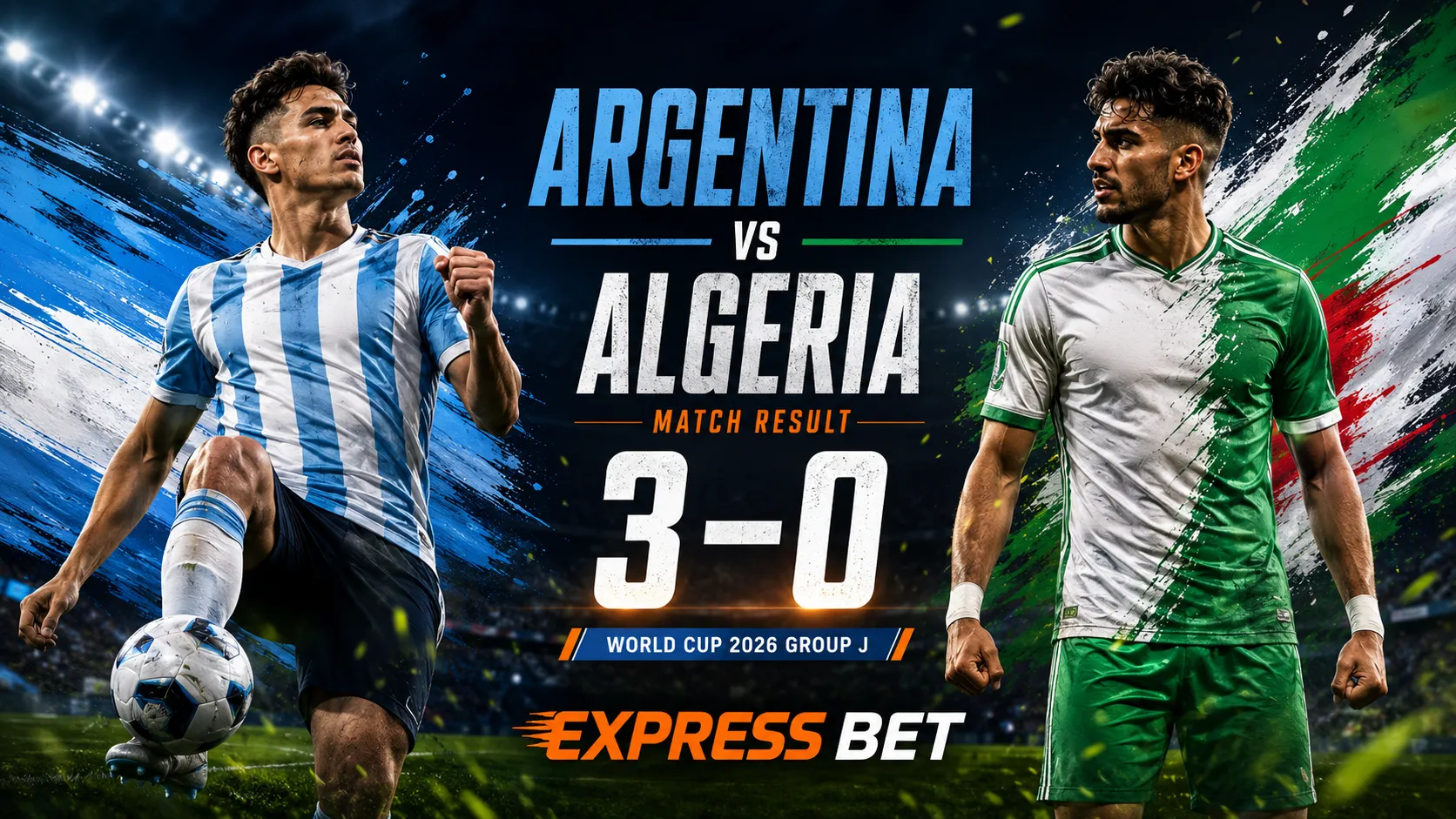
The Argentina vs Algeria match result was a 3-0 win for Argentina in their FIFA World Cup 2026 Group J opener at Kansas City Stadium. Lionel Messi scored all three goals in the 17th, 60th and 76th minutes, producing his first World Cup hat-trick and equalling Miroslav Klose’s men’s World Cup scoring record of 16 goals. Algeria briefly thought they had scored first through Farès Chaïbi, but VAR ruled it out for offside. The main turning point was Messi’s opener, which forced Algeria into a deeper block. Argentina controlled the match with compact passing, aggressive counterpressing and elite finishing. Betting outcomes rewarded Argentina moneyline, over 2.5 goals, Messi scorer markets and Argentina clean-sheet angles, depending on odds and timing.
Match Information
| Detail | Information |
|---|---|
| Match | Argentina vs Algeria |
| Competition | FIFA World Cup 2026 |
| Stage | Group stage |
| Group | Group J |
| Date | 16 June 2026 local time / 17 June in some regions |
| Kickoff time | 8:00 p.m. local time / 9:00 p.m. ET / 02:00 BST |
| Host country | United States |
| City | Kansas City, Missouri |
| Stadium | Kansas City Stadium / Arrowhead Stadium |
| Final score | Argentina 3-0 Algeria |
| Half-time score | Argentina 1-0 Algeria |
| Attendance | 69,045 |
| Referee | Szymon Marciniak, Poland |
| VAR | Assigned, but full VAR crew details not confirmed in the sources used |
| Weather | Around 26°C before kickoff; historical daily average around 23.3°C |
| Pitch condition | No major confirmed pitch controversy; visible patches noted after halftime, likely from sprinkling |
| Surface type | Not confirmed in the match report used |
| Roof status | Open-air stadium |
| Penalties | None |
| Red cards | None |
| Yellow cards | None |
| VAR involvement | Algeria goal ruled out for offside; no penalty intervention after Messi contact in 73rd minute |
| Argentina formation | 4-3-3 |
| Algeria formation | FOX displayed 4-3-3; Guardian described Algeria as 5-2-3 defensively |
Final Score and Match Summary
Argentina beat Algeria 3-0, and the result looked cleaner than the first 25 minutes suggested.
This was Argentina’s opening match as defending world champions. That always creates a particular noise. The champions walk in carrying the trophy, the calendar, the myth, and several thousand people waiting to diagnose decay. Argentina did not offer much decay. They offered Lionel Messi scoring a hat-trick on his 200th appearance for the national team. Subtlety, apparently, was unavailable.
Algeria did not arrive meekly. Vladimir Petkovic’s side had the first shock of the match when Farès Chaïbi finished beautifully after Ibrahim Maza’s pass. For a few seconds, Kansas City Stadium had one of those World Cup silences that feels expensive. Then VAR did its modern little job. Chaïbi was offside. The goal disappeared.
That mattered. Algeria had shown that they could play through Argentina’s compact shape. Maza had already looked comfortable between lines. Chaïbi had timed the run almost perfectly. Almost is a cruel word at a World Cup.
Argentina then settled into control. Lionel Scaloni’s side used a 4-3-3 with Emiliano Martínez behind Gonzalo Montiel, Cristian Romero, Lisandro Martínez and Facundo Medina. Rodrigo De Paul, Enzo Fernández and Alexis Mac Allister formed the midfield. Messi, Thiago Almada and Lautaro Martínez started in attack.
Algeria began with Luca Zidane in goal, protected by a line including Belghali, Aïssa Mandi, Ramy Bensebaini and Rayan Aït-Nouri. Nabil Bentaleb and Hicham Boudaoui worked in midfield, while Ibrahim Maza, Farès Chaïbi, Anis Hadj Moussa and Amine Gouiri gave Algeria technical outlets. Riyad Mahrez started on the bench, which became a louder decision as the match moved away from Algeria.
The first goal arrived in the 17th minute. Messi dropped, received, combined, drifted into space and struck a left-footed shot beyond Zidane. The goalkeeper may feel he could have done better. Many goalkeepers have felt that after Messi shots. It is a large support group.
Argentina did not produce a storm of chances in the first half. They produced control. Their passing structure was compact, almost like a small-sided rondo stretched across a World Cup pitch. They played short, moved in groups, and trusted one-touch combinations. Algeria dropped deeper after the goal, wary of being played through.
At half-time, the score was only 1-0. Algeria still had a match. They had not been destroyed. They had shown enough through Maza, Gouiri and Chaïbi to suggest danger if Argentina got careless.
The second half removed that idea.
Messi made it 2-0 in the 60th minute after Mac Allister’s low shot was spilled by Zidane. The Algeria goalkeeper pushed the ball straight into the danger area, where Messi had taken up residence with intent. It was not the kind of goal printed on posters. It was the kind printed on scouting reports under “do not parry centrally.”
The hat-trick came in the 76th minute. Argentina broke quickly. Messi controlled the rhythm, exchanged with Nico González, and passed the finish into the corner from the edge of the box. At that point, the football became biography. Messi equalled the all-time men’s World Cup scoring record. Argentina were three up. Algeria were finished.
The final minutes were flat. Algeria had possession, but it lived in safe areas. Argentina dropped into a disciplined shape and watched the clock. Messi left to a standing ovation in the 78th minute. The latest chapter of his tournament career had already been filed.
The Argentina vs Algeria final score was fair. Algeria had a brief early chance to turn the match into a problem. Argentina had the superior control, superior structure and one player who still changes the scoreboard as if time has been poorly explained to him.
Goal Timeline
17’ — Lionel Messi, Argentina, open-play goal
Argentina’s first goal came from the central combination pattern that Scaloni clearly wanted from the start.
Messi dropped into midfield and helped begin the move with a quick exchange. Argentina then moved the ball through tight interior spaces, drawing Algeria’s midfield toward the ball. Messi ghosted into a pocket between the midfield and back line, received with room to turn, took a few steps toward the edge of the penalty area and struck with his left foot.
The shot bent away from Luca Zidane and found the top-right area of the goal. Zidane moved late and did not cover himself completely. That is not the same as saying it was easy. Messi has made many goalkeepers look technically suspicious.
Tactically, the goal punished Algeria’s reluctance to step high after the early disallowed goal. Algeria wanted a reinforced defensive shape, but the space between midfield and defence became vulnerable once Argentina’s short passing pulled them out of their distances.
Emotionally, it was the moment Argentina became calm. Before that, Algeria had already created the VAR scare. After Messi’s opener, the defending champions could play their preferred match: control the ball, slow the rhythm, then accelerate when Algeria overcommitted.
There was no confirmed VAR check that changed the goal.
60’ — Lionel Messi, Argentina, rebound goal
Argentina’s second goal was less elegant and more damaging.
The move began with Emiliano Martínez launching the ball toward Messi on the left. Argentina kept the attack alive after Algeria cleared, and Alexis Mac Allister struck a low shot from around 25 metres. Luca Zidane got down but failed to hold the ball. The rebound spilled into the central danger zone.
Messi was already there.
He tapped in from close range, giving Argentina a 2-0 lead and giving Algeria one of those mistakes that coaches discuss with a calm voice and dead eyes.
The defensive problem was not only Zidane’s parry. Algeria had too many players watching the shot and not enough tracking the second ball. Messi, even at 38, remains one of the best players in football at reading where the next touch will fall. He does not need to outrun a defender if he has already started in the right place.
Tactically, this goal ended Algeria’s best route back. They had started the second half with more possession and had used Maza to connect around the edge of Argentina’s block. Once the second goal went in, the match became a very different calculation.
For betting markets, this goal mattered heavily. Argentina moneyline became near-settled. Over 2.5 became live. Messi brace markets landed. Algeria’s draw or double-chance angles took a very large punch.
76’ — Lionel Messi, Argentina, open-play goal
The third goal was the one people will replay.
Argentina broke at speed. Messi received around the centre, controlled the tempo, and played left to Nico González. González returned the ball near the edge of the box. Messi moved forward with the calm of a player who had already chosen the ending, then side-footed into the corner from around 20 yards.
Zidane dived, but the shot was placed away from him. It was not hit with maximum violence. It did not need to be. Some players shoot as if arguing with the ball. Messi often shoots as if correcting it.
Tactically, the goal exposed Algeria’s stretched structure after substitutions. Mahrez, Aouar and Amoura had entered in the 63rd minute to add quality, but Algeria were now more open. The gaps between their lines widened. Argentina could counter through them.
Emotionally, the goal finished the match and turned the result into a record ceremony. Messi completed his first World Cup hat-trick. He equalled Miroslav Klose’s all-time men’s World Cup scoring record. He also did it on the night of his 200th Argentina cap. Football scriptwriters would be mocked for this if they were not occasionally real.
No decisive VAR review changed the goal.
Key Moments That Changed the Match
Messi’s early offside finish
In the fifth minute, Messi ran behind Algeria and clipped a finish over Zidane, but the assistant flag went up for offside.
It did not count. It did function as a warning. Algeria’s line was already being tested by the timing of Argentina’s forward movements. The margin was small, but the message was obvious: if Algeria stepped too high without pressure on the ball, Messi could still appear behind them.
Chaïbi’s disallowed goal
This was Algeria’s best chance to create a different match.
Ibrahim Maza received in midfield, kept possession alive and threaded a clever pass between Argentina’s full-back and centre-back. Farès Chaïbi finished brilliantly, beating Emiliano Martínez at the near post.
Then VAR intervened. Chaïbi had gone too early. The goal was ruled out for offside.
The moment mattered because it showed Algeria’s technical quality and Argentina’s vulnerability when the line was split. It also mattered because the emotional swing hurt Algeria. Scoring first against the defending champions is one thing. Having the goal removed is another. Tournament football enjoys technical cruelty.
Hydration break after Argentina’s opener
Around the 24th minute, the match paused for a hydration break.
Argentina had just gone ahead and were beginning to control the rhythm. Algeria used the break to reset. They were still in the game, but the pause did not restore their aggression. Afterward, they became more cautious and defended deeper.
These breaks are now part of tournament management. They interrupt momentum, let coaches deliver mini-instructions and remind everyone that a football match has become a tactical webinar with sweat.
Gouiri forces Martínez into a save
In the 40th minute, Amine Gouiri forced Emiliano Martínez to repel an angled drive at the near post. The following corner came to little, but the moment mattered.
It showed that Algeria were not completely reduced to spectators. Argentina’s possession had been impressive, but Algeria had enough quality to threaten when they worked the ball cleanly through midfield.
Messi’s foul on Mandi
Around the 30th minute, Messi committed a foul on Aïssa Mandi while trying to win the ball back. Some observers felt it could have brought stronger punishment. It did not.
It did not decide the match, but it showed Argentina’s willingness to counterpress with bite. Even Messi was involved without the ball. That says something about Argentina’s collective tone.
Zidane saves from Lautaro Martínez
Early in the second half, Lautaro Martínez drilled a shot across Zidane, who saved well.
That was the useful version of Algeria’s goalkeeper. The problem is that six minutes later, the rebound on Mac Allister’s shot gave Messi the second goal. Goalkeeping is cruel like that. One strong save is remembered less than one parry into the wrong postcode.
Algeria’s triple substitution
In the 63rd minute, Algeria introduced Riyad Mahrez, Houssem Aouar and Mohamed Amoura.
It was the right idea. Algeria needed more attacking quality and more speed. The problem was timing. They were already 2-0 down. Argentina had the match under control. The changes gave Algeria more technical players, but they also made the team less compact.
No penalty intervention after Messi contact
In the 73rd minute, Argentina’s press forced an error, and Julián Álvarez found Messi near the top of the box. Messi was bundled over before shooting. The referee allowed play to continue, and VAR did not intervene.
At 2-0, this did not reshape the result. It did show Argentina were still pressing for mistakes rather than simply closing shop.
Messi completes the hat-trick
The 76th-minute goal ended the match as a contest and converted it into a record night.
Algeria had been trying to find rhythm through Mahrez and Aouar. Argentina answered with the cleanest of counters. That is how strong teams close games: they let you think you are building pressure, then punish the space you used to build it.
First Half Analysis
Argentina’s first half was controlled rather than explosive.
The starting formation was a 4-3-3. Out of possession, Messi worked from the right side of the front three, with Lautaro Martínez central and Almada on the left. Behind them, De Paul, Fernández and Mac Allister gave Argentina a midfield that could press, rotate and pass in tight spaces.
Algeria were described by Guardian as a 5-2-3, while FOX displayed a 4-3-3. The functional truth sat between those readings. Algeria defended with a reinforced back line and tried to keep three technical players high enough to counter. Maza was the most important connector. Chaïbi looked to attack gaps. Gouiri gave a central reference. Hadj Moussa worked from the right.
Argentina’s build-up was unusually compact. They did not immediately stretch the pitch wide. Instead, they played through small passing triangles, almost inviting Algeria to squeeze them. That approach has a risk: one loose pass can launch a counter. But Argentina trusted their technical security.
The early VAR scare proved Algeria could hurt them. Maza’s pass for Chaïbi cut through Argentina’s line. Lisandro Martínez and Romero were not fully set. Emiliano Martínez was beaten. The offside saved Argentina from an early problem.
After Messi’s goal, Algeria dropped deeper. That was understandable but costly. When a team gives Argentina’s midfield time, De Paul and Fernández can keep the ball moving, while Mac Allister controls the second phase. Argentina did not create constant big chances, but they controlled the emotional temperature.
Messi’s role was fluid. He started from the right, dropped central, received between lines and pressed when the ball was near him. This was not the walking-playmaker version that sometimes appears in league matches. He was involved in the team’s defensive rhythm too.
Algeria’s best first-half response came late. Gouiri tested Martínez. Maza showed technical courage. Chaïbi had a shot that went high. Aït-Nouri and Belghali tried to provide width, but they were mostly pinned by Argentina’s control.
The physical tone was not card-heavy. There were fouls, but no yellow cards. Marciniak let the match flow.
At half-time, Argentina led 1-0. Scaloni needed more penalty-box threat and a way to convert control into a second goal. Petkovic needed to get Algeria higher without exposing the space behind. One coach had room to adjust. The other had to gamble eventually.
Second Half Analysis
The second half opened with Argentina making a practical change. Nahuel Molina came on for Montiel at right-back.
Algeria started with more possession. Maza received between lines and tried to move the ball forward. Argentina did not panic. They simply narrowed their defensive shape and denied the central lane.
The first real chance after the restart came from Lautaro Martínez, who forced Zidane into a save in the 54th minute. Soon after, Scaloni made two important changes: Julián Álvarez and Nico González replaced Almada and Lautaro Martínez.
Those substitutions gave Argentina more running and wider counterattacking options. Álvarez pressed aggressively. González attacked the left channel. Messi could now drop and connect with two quicker runners around him.
The second goal came before Algeria could settle after those changes. Mac Allister’s shot was not a perfect strike, but it was low and awkward. Zidane spilled it. Messi finished. At 2-0, the game’s personality changed.
Algeria responded with Mahrez, Aouar and Amoura in the 63rd minute. This made sense. Mahrez gave left-footed quality. Aouar gave combination play. Amoura gave speed. But the match was already tilted toward Argentina’s favourite late-game mode: compact defending, controlled possession, sudden counters.
Algeria had a half-chance through Aouar in the 69th minute after sharp interplay with Mahrez and Maza, but the shot went wide. It was the type of move Algeria needed more often before the score got away.
Argentina’s third came from a quick break. Messi and González combined. Messi finished. Algeria’s late substitutions did not matter after that.
Scaloni then removed Messi and Romero in the 78th minute, bringing on Nico Paz and Nicolás Otamendi. That was game management. Messi had done enough. Romero, returning from fitness concerns, did not need needless minutes.
Algeria made further changes with Zerrouki and Boulbina, but the contest had dropped in intensity. Mahrez had a free-kick chance in the 86th minute and hit the wall. Algeria kept possession late, but Argentina allowed it because it was harmless.
The second half showed Argentina’s tournament maturity. They did not need to play faster for 45 minutes. They needed to choose the right moments. Once Zidane’s error created the second, the match was theirs.
Tactical Picture: Why Argentina Won and Algeria Lost
Argentina won because they controlled the middle, pressed intelligently after losses and had Messi finishing the moments that mattered.
Algeria lost because their early threat did not survive the combination of Argentina’s compact passing and their own goalkeeper’s mistake.
The formation debate matters less than the functions. Argentina used a 4-3-3, but their attacking shape often became a narrow 2-3-5 or 3-2-5, depending on Medina’s position and the depth of the midfielders. Messi moved inside from the right. Almada came off the left. Lautaro occupied the centre-backs. De Paul supported the right half-space. Mac Allister and Fernández balanced possession.
This compactness was the key. Argentina did not always use wide isolation. They preferred to overload central and half-space zones with short passing. That made Algeria’s midfield chase. Once Algeria’s midfield was drawn toward the ball, Messi could receive on the turn.
Algeria’s best early route came through Maza. He was the player most capable of beating Argentina’s first pressure with a pass or carry. The disallowed Chaïbi goal came from his vision. Later, Mac Allister tracked him closely, often with Fernández nearby. Argentina understood the danger quickly.
Petkovic’s defensive plan made sense in theory. A 5-2-3 or back-five defensive shape gave Algeria extra numbers against Messi and Lautaro. But it also left the midfield two stretched. When Argentina played around Bentaleb and Boudaoui, the back line had to decide whether to step or retreat. For the first goal, they retreated too much and gave Messi space.
Argentina’s counterpress was also important. Whenever Algeria tried to break, Argentina’s nearest players closed quickly. Lisandro Martínez stepped out aggressively. Romero held the line. De Paul and Mac Allister fouled or delayed when required. This is not romantic football. It is how champions prevent good opponents from becoming confident.
The second goal came from a goalkeeper error, but the wider tactical cause was pressure. Argentina had kept Algeria pinned long enough that clearances were rushed and defensive concentration frayed. Zidane’s spill was a mistake. It was also the kind of mistake that arrives after an hour of being asked to solve too many problems.
Algeria’s substitutions improved their technical level but weakened their defensive compactness. Mahrez, Aouar and Amoura gave more attacking threat. They also left more room for Argentina to counter. The third goal came from that kind of open-field situation.
Set pieces did not decide the match. Penalties did not decide it. Cards did not decide it. This was a match decided by positional control and elite finishing.
Argentina won the most valuable spaces. Algeria had moments, but they did not sustain them. Against Messi, moments are not enough unless they become goals before he gets his.
Player Ratings and Individual Performances
Argentina Player Ratings
Emiliano Martínez — 7/10
Kept a clean sheet and made an important near-post save from Gouiri. Was beaten by Chaïbi’s disallowed finish, but the flag saved that moment. Distribution helped Argentina reset pressure calmly.
Gonzalo Montiel — 6/10
Played the first half and managed Hadj Moussa reasonably. Replaced by Molina at half-time, likely for fresh legs and more secure right-side rhythm.
Cristian Romero — 7/10
Defended aggressively, handled Gouiri well and helped Argentina maintain a high line. Removed late with the match settled.
Lisandro Martínez — 8/10
Excellent stepping out from defence. Blocked Maza’s second-half shot and repeatedly broke Algerian attacks before they became serious. One of Argentina’s most important control players.
Facundo Medina — 6.5/10
Worked on the left and supported Argentina’s compact build-up. Less attacking width than a natural full-back, but defensively stable.
Rodrigo De Paul — 7/10
Busy, combative and useful in transition. Helped Argentina press Algeria’s midfield and created danger from the right in the second half.
Enzo Fernández — 7.5/10
Controlled tempo and gave Argentina clean circulation. His positioning helped shut down Algeria after the early scare.
Alexis Mac Allister — 7.5/10
Tracked Maza intelligently and produced the low shot that led to Messi’s second goal. Strong without needing to dominate the highlights.
Lionel Messi — 10/10
Hat-trick, record-equalling World Cup goal tally, 200th cap, and full control of the match’s emotional register. Also worked without the ball. Absurd, but now routine absurdity.
Thiago Almada — 6/10
Started on the left and combined well in tight spaces, but overhit one early pass and lacked a decisive final action. Replaced by Álvarez in the 56th minute.
Lautaro Martínez — 6.5/10
Linked well and forced Zidane into a save. Did not score but helped occupy Algeria’s central defenders. Replaced by Nico González.
Nahuel Molina — 6.5/10
Came on at half-time and gave Argentina more orthodox right-back balance. Solid.
Julián Álvarez — 7/10
Pressed immediately after coming on and helped create late pressure. His energy changed Argentina’s front line after the hour.
Nico González — 7.5/10
Assisted Messi’s third with a smart return pass and gave Argentina a direct left-sided outlet. Good substitute impact.
Nicolás Otamendi — 6/10
Entered late for Romero to close the match. Little defensive stress by then.
Nico Paz — 6/10
Came on for Messi in the 78th minute. Limited time, but useful experience in a settled match.
Algeria Player Ratings
Luca Zidane — 4.5/10
Made a good save from Lautaro but was poor on Messi’s opener and badly spilled Mac Allister’s shot for the second. His face mask gave him a cinematic look. The rebound gave him a goalkeeper’s problem.
Belghali — 5.5/10
Worked hard on the right side but struggled once Argentina began combining through the half-space. Limited attacking output.
Aïssa Mandi — 6/10
Made a crucial intervention in the 60th minute to stop a certain Álvarez chance. Could not prevent Messi’s influence.
Ramy Bensebaini — 5.5/10
Part of a defence that competed but lost spacing too often. Had difficulty stepping out when Messi dropped between lines.
Rayan Aït-Nouri — 5.5/10
Was pinned deeper than Algeria wanted. Showed flashes on the ball but could not provide sustained left-sided release.
Nabil Bentaleb — 5.5/10
Struggled to cover the central overloads. Replaced late as Algeria chased a lost match.
Hicham Boudaoui — 5.5/10
Worked in midfield but was stretched by Argentina’s compact rotations. Replaced by Aouar.
Ibrahim Maza — 7/10
Algeria’s best creative player. His pass for Chaïbi’s disallowed goal was excellent. Argentina targeted him more closely after that.
Farès Chaïbi — 6.5/10
Finished brilliantly for the disallowed goal and found some good positions. Lacked enough service after Argentina settled.
Anis Hadj Moussa — 5.5/10
Started high but had little sustained impact. Replaced by Mahrez in the 63rd minute.
Amine Gouiri — 6/10
Forced Martínez into a save and worked intelligently, but he did not react quickly enough to one late first-half cross-shot. Replaced by Amoura.
Riyad Mahrez — 6/10
Came on after 63 minutes and added technical quality. His free kick hit the wall. Algeria needed him earlier or needed the match state to be kinder.
Houssem Aouar — 6/10
Had one shot wide after combination play with Mahrez and Maza. Added better rhythm but could not change the result.
Mohamed Amoura — 5.5/10
Gave speed but little clean service. Entered when Algeria were already chasing.
Ramiz Zerrouki — 5.5/10
Late substitute. Limited impact.
Boulbina — 5.5/10
Late substitute. Had little time to affect the match.
Best Players of the Match
Man of the Match: Lionel Messi
Three goals. Record equalled. Match decided. There is no need to pretend this category is difficult.
Best attacker: Lionel Messi
He scored from distance, from a rebound and from a flowing counter. The variety matters. This was not one type of goal repeated three times.
Best midfielder: Alexis Mac Allister
Mac Allister’s tracking of Maza helped Argentina shut down Algeria’s best creator. His shot created the second goal. He was quietly essential.
Best defender: Lisandro Martínez
His stepping out from centre-back stopped Algeria’s most promising second-half moves. He defended forward, which is usually the best way to protect a lead.
Best goalkeeper: Emiliano Martínez
He had less to do than Zidane, but he did it cleanly. A clean sheet without drama beats several saves with a costly rebound.
Best substitute: Nico González
His assist for Messi’s third goal gave Argentina the final flourish. He offered the directness Argentina wanted after the hour.
Most underrated performance: Enzo Fernández
He controlled Argentina’s circulation and helped close Algeria’s central passing lanes. Not flashy. Very useful.
Most disappointing performance: Luca Zidane
This was a hard assignment, but the second goal was a major error. Against Argentina, a goalkeeper cannot donate central rebounds to Messi.
Injuries, Suspensions, Cards, and Discipline
There were no red cards and no yellow cards.
That is notable because the match had enough pressing duels and transition fouls to become more disciplinary than it did. Marciniak allowed the game to flow, and neither team crossed the line in a way that produced cards.
No confirmed in-match injury shaped the result. Cristian Romero started after fitness questions and was withdrawn late when the match was settled. That looked like sensible management rather than a confirmed injury response.
Luca Zidane wore a protective face mask after a jaw and chin injury suffered with Granada before the tournament. That did not excuse the second goal, but it was part of the match context.
No suspension was triggered by this game. That helps both teams before the second round of Group J fixtures.
Argentina leave with three points and no disciplinary damage. Algeria leave with a heavy result but no card accumulation problem. That is one of the few practical positives for Petkovic.
Referee and VAR Analysis
Szymon Marciniak had a clean match to manage.
The major VAR intervention came early. Farès Chaïbi’s goal was ruled out for offside after a review. The decision was tight but decisive. It prevented Algeria from taking a shock lead.
There was also a non-intervention in the 73rd minute when Messi went down under pressure after Argentina’s press forced an Algerian error. The referee did not award a penalty, and VAR did not intervene. At 2-0, it did not define the match, but it was still a relevant penalty-area moment.
There were no penalties. No red cards. No yellow cards. No disallowed Argentina goal after review, though Messi had an early offside finish flagged in the fifth minute.
Marciniak’s biggest influence was flow. He allowed duels and pressing contact to continue. That suited Argentina, who wanted rhythm and counterpressing speed. It also gave Algeria chances to compete physically without being punished by cards.
The referee did not decide the result. VAR corrected Algeria’s early goal, and the rest belonged to Argentina’s control and Messi’s finishing.
Weather, Stadium, Pitch, and Match Conditions
The match was played at Kansas City Stadium, the World Cup name for Arrowhead Stadium.
This is an open-air venue known in American football for noise and scale. Guardian described it as an open bowl with a listed capacity around 76,000. The match attendance was reported at 69,045, and the stands were heavily coloured in Argentina’s sky blue and white.
Conditions were warm but not oppressive. Around kickoff, reporting described Kansas City at roughly 26°C and dropping as evening arrived. Historical weather data for the day showed an average around 23.3°C, with a range from about 18.9°C to 27.8°C.
The weather helped the match keep a reasonable tempo. It was not a furnace match like some earlier tournament games. There was a hydration break, but heat did not define the result.
The pitch did not create a major controversy. One live note questioned visible patches after half-time, likely from heavy sprinkling. There was no confirmed evidence that the surface distorted the result.
The ball moved quickly enough for Argentina’s tight passing. Algeria also played several sharp switches early in the second half. The surface did not prevent football. Algeria’s problem was not grass. It was Messi.
Fans and Stadium Atmosphere
The atmosphere was overwhelmingly pro-Argentina.
Kansas City Stadium looked and sounded almost like an Albiceleste home fixture. Argentina shirts filled large areas of the stands. The songs were loud from the opening minutes. When Messi scored, the stadium did what stadiums usually do around Messi now: it abandoned neutrality.
Algeria still had visible support and a strong local story. Their base in Lawrence, Kansas, had drawn attention before the match. Their fans had reason to believe in a competitive night after Chaïbi’s disallowed goal.
But once Messi scored, the crowd tone changed. Argentina’s supporters settled into celebration. Algeria’s players had to play against both the defending champions and the emotional pull of a stadium waiting for Messi moments.
The loudest moment for Algeria came before it was taken away. Chaïbi’s disallowed goal briefly created genuine shock. The loudest Argentina moment came with the third goal and the standing ovation when Messi was substituted.
This did not feel like a neutral-site fixture. It felt like a travelling Argentina festival with Algeria invited to create resistance. For 10 minutes, they did. Then the script returned to the lead actor.
Historical Context and World Cup Analogies
The match belonged to Messi’s record chase.
His hat-trick moved him level with Miroslav Klose on 16 men’s World Cup goals. It also gave him his first World Cup hat-trick, on his 200th Argentina appearance, in his sixth World Cup. That is too much symmetry for a normal athlete. Messi has not been normal for some time.
Argentina also began their title defence much more calmly than in 2022, when they lost their opener to Saudi Arabia before winning the tournament. That comparison matters because champions often spend opening matches managing anxiety. Argentina did not look anxious here. They looked rehearsed.
Algeria’s historical shadow is different. Their 1982 story still follows them, especially in matches against major powers. The Guardian’s pre-match note referenced the old “Disgrace of Gijon” memory, and Algeria’s kit even carried a retro feeling. But this was not 1982. Algeria did not land the first punch. VAR took it away.
There is also a 1994 echo, because the United States again gave the world an ageing genius on a grand stage. Diego Maradona in 1994 was five years younger than Messi here, and yet Messi still looked like Argentina’s best player. This is not a tactical point. It is a biological complaint.
From a football-history angle, the match reinforced an old World Cup lesson: a compact underdog can survive structure, pressure and crowd noise for a while, but one mistake against a great player can turn survival into a scoreline.
Match Statistics
Different providers may report small variations, but FOX’s public box-score data gives a clear profile of the match.
| Statistic | Argentina | Algeria |
|---|---|---|
| Final score | 3 | 0 |
| Half-time score | 1 | 0 |
| Possession | 47% | 53% |
| Total shots | 9 | 6 |
| Shots on goal | 6 | 0 |
| Expected goals | 1.13 | 0.14 |
| Chances created | 6 | 2 |
| Passing accuracy | 90% | 93% |
| Crosses completed | 3 from 7 | 1 from 11 |
| Corners | 2 | 2 |
| Offsides | 3 | 1 |
| Fouls | 12 | 8 |
| Tackles | 17 | 8 |
| Interceptions | 6 | 8 |
| Blocks | 2 | 0 |
| Clearances | 13 | 15 |
| Keeper saves | 0 | 2 |
| Yellow cards | 0 | 0 |
| Red cards | 0 | 0 |
The possession figure is interesting. Algeria had more of the ball by the end, but much of it came after the match had tilted away from them. Late possession in front of Argentina’s block did not equal danger.
The shot-on-target split tells the match more honestly. Argentina had six shots on goal. Algeria had none. That is not a small difference. That is the match’s skeleton.
The xG gap also matters. Argentina’s 1.13 xG became three goals because Messi converted at a level above normal expectation and because Zidane’s rebound created a simple second. Algeria’s 0.14 xG shows that their early disallowed goal and technical moments did not turn into sustained chance quality.
The corner count was level at 2-2. Set pieces were not the story. Open play, rebound control and finishing were.
The absence of cards confirms the tone. This was not a brawl. It was a match where Argentina’s structure slowly took oxygen out of Algeria’s attack.
Betting Result Angle
The Argentina vs Algeria betting result rewarded bettors who trusted Argentina and Messi-specific markets, but the first 10 minutes were a useful warning against pretending the result was obvious from kickoff.
Argentina were the favourite. FOX listed Argentina winning at -187, and that market landed. The price was not huge, but it reflected the gap in team quality and Argentina’s defending champion status.
The over/under line was 2.5. The match produced three goals, so over 2.5 landed. That market needed the 76th-minute hat-trick goal. At 1-0 at half-time, under bettors were still alive. At 2-0 after 60 minutes, the market was balanced on one more goal. Messi ended the argument.
Both teams to score “No” landed. Algeria did have a goal ruled out, but betting markets do not pay for temporary joy. Officially, Argentina kept a clean sheet.
Correct score 3-0 Argentina landed. That required Algeria failing to register an official shot on target and Messi completing the hat-trick. Correct-score betting remains fragile. One late Algeria consolation or one missed rebound changes everything.
First goalscorer markets rewarded Messi. Anytime goalscorer markets on Messi landed. Brace and hat-trick markets also landed where offered. Those prices were likely shorter than normal because of public Messi interest, but the result still rewarded them.
Argentina clean-sheet markets landed. Argentina to win to nil landed. Argentina handicap lines depended on the sportsbook. Argentina -1.5 landed after the second goal. Argentina -2.5 landed only after Messi completed the hat-trick.
Cards markets were poor for over bettors. No yellow cards were shown. Anyone expecting Algeria to spend the evening fouling Messi did not get that version of the game.
Corners markets were modest. The match had only four total corners according to the FOX box score, two each. This was not a corner-volume match despite Argentina’s control.
Live betting had several swings. Algeria’s disallowed goal would have briefly shaken Argentina backers emotionally, even if the market corrected after offside. Messi’s opener shortened Argentina heavily. Zidane’s spill for the second goal killed most comeback angles. The third goal changed totals, handicap and correct-score markets.
This does not mean every Argentina match should be attacked through overs or Messi props. Algeria’s structure held the score to 1-0 for an hour. The market lesson is sharper: Argentina’s control is real, but the best value depends on price, timing and whether opponents can keep Messi out of the central pockets.
No betting outcome is guaranteed. The same tactical read can produce a different market result if one shot hits the post, if VAR keeps a goal, or if a goalkeeper catches a ball instead of spilling it.
What This Result Means for Group J
Argentina moved to three points and a +3 goal difference in Group J.
Austria also beat Jordan 3-1, so Argentina and Austria both started with wins. Argentina lead the early group picture on goal difference. Algeria and Jordan sit on zero points.
Argentina next face Austria. That match now has top-of-group implications. A win would put Argentina close to qualification for the Round of 32 and likely in control of the group. A draw would still keep them in a strong position.
Algeria next face Jordan. That match is already high pressure. Algeria do not need panic, but they do need points. A draw would keep them alive but uncomfortable. A defeat would create a very narrow path.
Goal difference matters in the expanded format. Algeria’s -3 is damaging, especially because third-place qualification can depend on goal difference across groups. The clean-sheet loss is therefore not just a match result. It is a mathematical problem.
Argentina leave with ideal conditions: three points, no cards, no injury crisis confirmed, Messi sharp, and a defence that did not allow an official shot on target.
Algeria leave with two competing truths. They were beaten clearly. They also showed enough early technical quality to believe they can hurt Jordan and Austria if they reduce errors.
What Argentina Did Right
Argentina controlled the central spaces.
That was the biggest factor. Messi, Mac Allister, Fernández and De Paul played close enough together to overload Algeria’s midfield. They did not stretch the pitch for the sake of it. They played in pockets where Algeria could not decide whether to press or hold shape.
Argentina also counterpressed well. They did not allow Algeria to turn many recoveries into clean attacks. Lisandro Martínez was important here, stepping out early and winning duels before Maza or Gouiri could connect.
Messi’s finishing was the obvious difference. Three goals from three different types of situation gave Argentina the match without needing a high-volume attacking performance.
Scaloni’s substitutions also worked. Álvarez and González added energy. González assisted the third. Molina gave more right-back balance after half-time. Otamendi and Paz came on with the match already settled.
The clean sheet matters too. Algeria had possession late, but Argentina defended in front of their box with discipline.
The one concern is the early Chaïbi offside goal. Better opponents will not always be offside. Argentina’s line must be cleaner when opposition playmakers find time between midfield and defence.
What Algeria Got Wrong
Algeria’s first problem was that they did not convert their early shock.
Chaïbi’s offside finish showed the route. Maza could find passes. Argentina’s back line could be split. But after VAR removed the goal, Algeria did not create enough repeatable danger.
The second issue was defensive space around Messi. This is not a new problem for football, but Algeria still suffered it. Messi received between lines too often, especially before the first goal.
The third issue was goalkeeping. Zidane’s mistake for the second goal was decisive. At 1-0, Algeria were still in the match. At 2-0, they were chasing a champion with Messi already warm. That is not a comfortable hobby.
The fourth issue was timing of attacking changes. Mahrez, Aouar and Amoura came on in the 63rd minute. By then Argentina had scored twice and had the match under control. Petkovic may have wanted to keep structure early, but Algeria needed better final-third quality sooner.
The fifth issue was shot quality. Algeria had six shots, none on target. The disallowed goal does not change that official reality.
Algeria were not terrible. They were simply not precise enough in the windows when Argentina were still vulnerable.
Coach Analysis
Lionel Scaloni
Scaloni’s plan was mature.
He trusted Argentina’s compact 4-3-3 and left Julián Álvarez on the bench. That could have been questioned if Argentina lacked forward energy, but Messi’s movement and Lautaro’s central role gave enough structure.
The midfield selection worked. De Paul, Fernández and Mac Allister controlled rhythm and pressing. Mac Allister’s job on Maza after the early scare was especially important.
The half-time switch from Montiel to Molina gave Argentina fresh right-side stability. The 56th-minute changes, Álvarez and González for Almada and Lautaro, improved the front line. González later assisted the third goal.
Scaloni also managed minutes well. Messi and Romero came off after the hat-trick. There was no need to turn a settled match into an unnecessary injury gamble.
The criticism is small but real. Argentina were opened early by Maza’s pass to Chaïbi. Against a sharper opponent, that could become 0-1 before Argentina find rhythm.
Still, this was a strong tournament coaching performance: control, adjustment, no panic, three points.
Vladimir Petkovic
Petkovic’s starting idea was understandable.
He tried to stiffen Algeria’s defence and keep enough technical quality high to counter. The early disallowed goal suggested the plan had logic. Maza, Chaïbi and Gouiri could trouble Argentina when they received between lines.
The problem was what happened after Argentina scored. Algeria became too passive. The back line dropped. The midfield was stretched. Messi found space.
Leaving Mahrez on the bench was the major talking point. Petkovic may have wanted to protect structure and use him late. But by the time Mahrez entered, Algeria were 2-0 down. That made the substitution more reactive than strategic.
Petkovic also had to deal with Zidane’s error, which no coach can fully plan for. Still, the goalkeeper selection will be discussed because errors in World Cup openers tend to attract long shadows.
Algeria’s next match against Jordan will show whether this was a bad matchup or a deeper issue. Petkovic must get more attacking threat on the pitch earlier without leaving the defence exposed.
Player Milestones and Records
Lionel Messi scored his first World Cup hat-trick.
He equalled Miroslav Klose’s men’s World Cup scoring record with 16 goals.
He made his 200th appearance for Argentina.
He became the first player to participate in six World Cups.
He became the oldest player to score a World Cup hat-trick.
He also joined the tiny group of players to score in five different World Cups. The only real question now is whether the record belongs to him alone before the tournament is over. It feels less like a question and more like scheduling.
Argentina began their title defence with a win, unlike in 2022 when they lost their opener to Saudi Arabia before recovering to win the trophy.
For Algeria, this was their first World Cup appearance since 2014. Their return began with defeat, but Maza’s performance and Chaïbi’s disallowed finish offered some positive signs.
No confirmed national appearance record, Algerian scoring record, red-card record or goalkeeper milestone was verified from the sources used.
Incidents and Controversies
The main controversy was the disallowed Algeria goal.
Farès Chaïbi finished after an excellent Ibrahim Maza pass, but VAR ruled him offside. The decision was tight and decisive. It prevented Algeria from taking the lead.
There was also discussion around Messi’s foul on Aïssa Mandi around the 30th minute. Some felt it could have brought a card. The referee did not show one.
The 73rd-minute penalty-area contact on Messi also drew attention. Argentina pressed Algeria into a mistake, Álvarez found Messi, and Messi went down under pressure. The referee did not award a penalty. VAR did not intervene.
The pitch drew minor visual discussion after halftime because of visible patches, likely from sprinkling. No major pitch issue was confirmed.
There were also off-field reports of an incident involving Argentina fans travelling to the match, but that did not affect the football result and should be treated separately from match analysis.
On the pitch, the match was clean. No cards, no red cards, no penalty awarded, and no post-match confrontation confirmed.
Final Verdict
Argentina beat Algeria 3-0 because they controlled the central spaces, defended transitions well after the early scare, and had Lionel Messi in record-setting form.
The result was fair. Algeria were not anonymous. Their disallowed goal was a real warning. Maza played with courage. Gouiri had one proper attempt. Mahrez and Aouar added quality late. But they did not produce an official shot on target, and their goalkeeper’s error turned a difficult match into a lost one.
Argentina were not wildly dominant in possession numbers, but they dominated the parts of the pitch that mattered. Their passing in tight areas wore Algeria down. Their counterpressing prevented Algeria from breaking often. Their defensive block closed the final minutes without panic.
Messi was the difference, but not as a decorative storyline. He was the tactical difference. He dropped into midfield, received between lines, pressed when needed and finished everything that mattered.
For Argentina, this is the ideal opening: three points, clean sheet, no cards, a sharp Messi, and a healthy goal difference before Austria.
For Algeria, the Jordan match is now essential. The performance had technical fragments worth keeping. The scoreline has damage that must be repaired.
For bettors, Argentina moneyline, over 2.5 goals, both teams to score “No,” Argentina clean sheet, Messi first goalscorer, Messi anytime scorer, Messi brace and Messi hat-trick markets all landed where available. Argentina -2.5 and 3-0 correct score needed the 76th-minute goal. That is the usual World Cup reminder: even a dominant result can depend on one late touch.
The final image is Messi leaving to a standing ovation after writing another entry in a career that increasingly reads like it has no editor. Algeria had a plan. Argentina had control. Messi had the scoreboard.
Responsible Betting Note
Football betting carries financial risk. A correct match analysis does not guarantee a winning bet. Odds change before and during matches. Never chase losses. Do not bet money needed for daily life. Use limits and take breaks. Check local betting laws before gambling. Betting should remain entertainment, not income.
FAQ
Argentina beat Algeria 3-0 in their FIFA World Cup 2026 Group J opener at Kansas City Stadium.
Lionel Messi scored all three Argentina goals in the 17th, 60th and 76th minutes.
Lionel Messi was the best player after scoring a hat-trick, equalling the men’s World Cup scoring record and deciding the match.
Argentina moved to three points and a +3 goal difference. Algeria stayed on zero points and next face Jordan in a key recovery match.
Argentina moneyline landed. Over 2.5 goals landed. Both teams to score “No” landed. Messi first goalscorer, anytime scorer, brace and hat-trick markets also landed where offered.
[expert_review params=»JTdCJTIyY29sb3IlMjIlM0ElMjJncmVlbi0yJTIyJTJDJTIyZXhwZXJ0X2F2YXRhciUyMiUzQSUyMiUyMiUyQyUyMmV4cGVydF9uYW1lJTIyJTNBJTIyJTIyJTJDJTIyZXhwZXJ0X2xpbmslMjIlM0ElMjIlMjIlMkMlMjJleHBlcnRfaWQlMjIlM0ElMjIxJTIyJTJDJTIyZXhwZXJ0X3R5cGUlMjIlM0ElMjJleHBlcnRfaWQlMjIlMkMlMjJleHBlcnRfYXZhdGFyX2FsdCUyMiUzQSUyMiUyMiUyQyUyMmV4cGVydF9zaG93JTIyJTNBMSUyQyUyMmV4cGVydF9kZXNjcmlwdGlvbiUyMiUzQSUyMlNwb3J0cyUyMEJldHRpbmclMjBBbmFseXN0JTIwJTI2JTIwRWRpdG9yaWFsJTIwQ29udHJpYnV0b3IlMjIlMkMlMjJleHBlcnRfc2hvd19idXR0b24lMjIlM0ExJTJDJTIyZXhwZXJ0X3Nob3dfYnV0dG9uX3R5cGUlMjIlM0ElMjJwb3B1cCUyMiUyQyUyMmV4cGVydF9xdWVzdGlvbl9idXR0b25fdGV4dCUyMiUzQSUyMkFzayUyMFF1ZXN0aW9uJTIyJTJDJTIycXVlc3Rpb25fZXh0ZXJuYWxfbGluayUyMiUzQSUyMiUyMiUyQyUyMnBvcHVwX3VzZV9waG9uZSUyMiUzQTAlMkMlMjJleHBlcnRfdGl0bGUlMjIlM0ElMjJBdXRob3IlMjIlMkMlMjJleHBlcnRfc2hvd190aXRsZSUyMiUzQTElMkMlMjJleHBlcnRfdGV4dCUyMiUzQSUyMkFsZXglMjBNb3JnYW4lMjBpcyUyMGElMjBzcG9ydHMlMjBiZXR0aW5nJTIwYW5hbHlzdCUyMGFuZCUyMGVkaXRvcmlhbCUyMGNvbnRyaWJ1dG9yJTIwd2hvJTIwd3JpdGVzJTIwZGV0YWlsZWQlMjBib29rbWFrZXIlMjByZXZpZXdzJTJDJTIwYmV0dGluZyUyMGd1aWRlcyUyQyUyMHBsYXRmb3JtJTIwY29tcGFyaXNvbnMlMkMlMjBhbmQlMjByZXNwb25zaWJsZSUyMGdhbWJsaW5nJTIwZXhwbGFpbmVycy4lMjBIaXMlMjB3b3JrJTIwZm9jdXNlcyUyMG9uJTIwcHJhY3RpY2FsJTIwaW5mb3JtYXRpb24lMjBmb3IlMjB1c2VycyUyMHdobyUyMHdhbnQlMjB0byUyMHVuZGVyc3RhbmQlMjBob3clMjBiZXR0aW5nJTIwc2l0ZXMlMjBvcGVyYXRlJTIwYmVmb3JlJTIwdGhleSUyMHJlZ2lzdGVyJTJDJTIwZGVwb3NpdCUyQyUyMG9yJTIwY2xhaW0lMjBhJTIwYm9udXMuJTIyJTJDJTIycWElMjIlM0ElNUIlNUQlMkMlMjJxYV9zaG93X3RpdGxlJTIyJTNBMSUyQyUyMnFhX3RpdGxlJTIyJTNBJTIyJUQwJTkyJUQwJUJFJUQwJUJGJUQxJTgwJUQwJUJFJUQxJTgxJTIwJUQxJThEJUQwJUJBJUQxJTgxJUQwJUJGJUQwJUI1JUQxJTgwJUQxJTgyJUQxJTgzJTIyJTJDJTIyc2NvcmUlMjIlM0ElNUIlNUQlMkMlMjJzY29yZV9zdW1tYXJ5X3RleHQlMjIlM0ElMjIlMjIlMkMlMjJzY29yZV9zdW1tYXJ5X2F2ZXJhZ2UlMjIlM0EwJTJDJTIyc2NvcmVfbWF4JTIyJTNBJTIyNSUyMiUyQyUyMnNjb3JlX3N5bWJvbCUyMiUzQSUyMiUyMiUyQyUyMnNjb3JlX3RpdGxlJTIyJTNBJTIyJTIyJTJDJTIyc2NvcmVfc2hvd190aXRsZSUyMiUzQTAlMkMlMjJwbHVzZXMlMjIlM0ElNUIlNUQlMkMlMjJtaW51c2VzJTIyJTNBJTVCJTVEJTJDJTIycGx1c2VzX21pbnVzZXNfc2hvd190aXRsZSUyMiUzQTElMkMlMjJwbHVzZXNfbWludXNlc190aXRsZSUyMiUzQSUyMiVEMCU5RiVEMCVCQiVEMSU4RSVEMSU4MSVEMSU4QiUyMCVEMCVCOCUyMCVEMCVCQyVEMCVCOCVEMCVCRCVEMSU4MyVEMSU4MSVEMSU4QiUyMiUyQyUyMnBsdXNlc190aXRsZSUyMiUzQSUyMiUyMiUyQyUyMm1pbnVzZXNfdGl0bGUlMjIlM0ElMjIlMjIlN0Q=»]