
Brazil vs Norway Match Result
Table of Contents Show
Norway defeated Brazil 2–1 in the FIFA World Cup 2026 Round of 16 at New York New Jersey Stadium. Brazil missed a major early opportunity when Ørjan Nyland saved Bruno Guimarães’ 14th-minute penalty. The game remained goalless until Erling Haaland headed in Andreas Schjelderup’s delivery in the 79th minute. Haaland struck again from distance in the 90th, before Neymar converted a Brazil penalty at 90+10.
Haaland was the match-winner, but Nyland’s penalty save and Schjelderup’s two assists were equally important. Norway’s possession control, Solbakken’s half-time substitutions and Brazil’s poor finishing shaped the upset. The open-air temperature was reported at 27°C, with the tempo slowing during the second half. Norway advanced to their first quarter-final; Brazil suffered their earliest World Cup exit since 1990. Betting returns depended on the odds and time of placement.
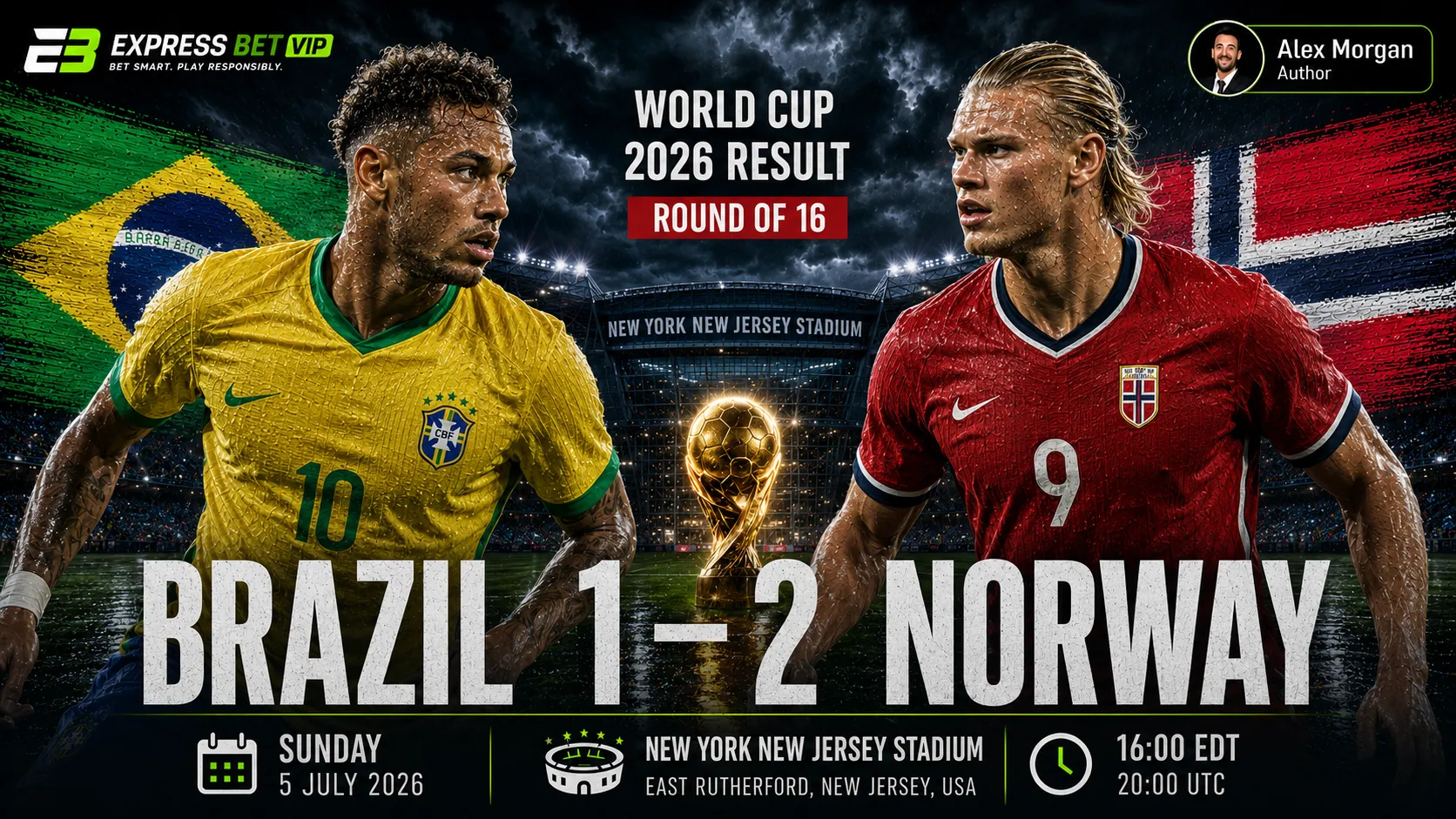
| Match detail | Verified information |
|---|---|
| Match | Brazil vs Norway |
| Competition | FIFA World Cup 2026 |
| Stage | Round of 16 |
| Date | July 5, 2026 |
| Kickoff | 16:00 EDT; 20:00 UTC |
| Host country | United States |
| City | East Rutherford, New Jersey |
| Stadium | New York New Jersey Stadium |
| Common venue name | MetLife Stadium |
| Attendance | 80,663 |
| Capacity | 82,566 |
| Final score | Brazil 1–2 Norway |
| Half-time score | 0–0 |
| Brazil goal | Neymar 90+10’, penalty |
| Norway goals | Haaland 79’, 90’ |
| Assists | Andreas Schjelderup, twice |
| Missed penalty | Bruno Guimarães 14’, saved by Nyland |
| Referee | Ismail Elfath |
| VAR | Complete official VAR crew not confirmed from the public data reviewed |
| Weather | Approximately 27°C; open-air conditions |
| Surface | Natural grass |
| Main impact | Norway advanced; Brazil were eliminated |
The FIFA Match Centre confirms the final score and scorers. FotMob records the lineups, substitutions, attendance, temperature and principal match statistics.
| Category | Finding | Data status |
|---|---|---|
| Final score | Brazil 1–2 Norway | [CONFIRMED] |
| Goal times | Haaland 79’, 90’; Neymar 90+10’ | [CONFIRMED] |
| Early penalty | Guimarães’ effort saved by Nyland | [CONFIRMED] |
| Attendance | 80,663 | [REPORTED] by major match-data providers |
| Temperature | 27°C | [REPORTED] by FotMob |
| First-half pattern | Brazil created the better chances; Norway had more possession | [OBSERVED] |
| Second-half tempo | Slowed in increasingly difficult afternoon conditions | [REPORTED] by ESPN |
| Norway’s substitutions | Schjelderup and Bobb entered at half-time | [CONFIRMED] |
| Tactical effect | Schjelderup’s width and delivery changed the match | [ANALYSIS] |
| Cards | Complete official disciplinary record unavailable | [UNKNOWN] |
| VAR crew | Not available from verified public data reviewed | [UNKNOWN] |
| Betting conclusion | Norway moneyline and qualification positions won | [MARKET SIGNAL] |
The distinction is essential. Haaland scoring twice is a confirmed match fact. Saying Brazil were complacent is an interpretation—and a simplistic one at that. Brazil generated 2.61 expected goals and missed a penalty, while Norway controlled 66% of possession. This was not one team refusing to try. It was a complicated knockout match settled by saves, substitutions and finishing.
Brazil began as the favourite and left as the latest reminder that World Cup history does not accept loyalty points.
Carlo Ancelotti’s team created the first major opportunity when Brazil were awarded a penalty in the 14th minute. Bruno Guimarães took responsibility instead of Vinícius Júnior, used a delayed approach and failed to move Nyland. The Norway goalkeeper read the attempt and saved.
That moment became the foundation of the upset.
Brazil still created the better first-half chances. Vinícius forced another save from Nyland, while Norway’s clearest opening fell to Martin Ødegaard. The Norwegian captain’s low effort was blocked before it could alter the score.
Yet Norway were not simply defending their penalty area. Solbakken’s side held 66% possession according to FotMob and regularly built through Sander Berge, Patrick Berg and Ødegaard. Brazil were content at times to defend in a medium block and attack more directly through their wingers.
The half ended 0–0. Brazil had missed the biggest chance; Norway had proved they could control the ball without being overawed.
Solbakken made two changes during the interval. Andreas Schjelderup replaced Antonio Nusa, while Oscar Bobb came on for Alexander Sørloth. The moves gave Norway fresher wide attackers and reduced the tendency for Haaland and Sørloth to occupy similar central spaces.
Brazil responded later. Endrick replaced Matheus Cunha in the 58th minute. Neymar and another Danilo entered in the 67th, with Rayan and Gabriel Martinelli leaving. Ancelotti was increasing individual attacking quality, but Brazil’s shape became less stable.
The first goal arrived in the 79th minute. Schjelderup delivered from the left and Haaland powered a header beyond Alisson. Eleven minutes later, the same two players combined again. Haaland struck from distance to make it 2–0.
Neymar converted a penalty at 90+10 after Leo Østigård conceded the late spot kick. Brazil had one final source of hope but no remaining time to convert it into a comeback.
Was Norway’s victory deserved? Yes, in the sense that they executed the decisive moments, controlled long spells of possession and responded better from the bench.
Did Brazil create enough to win? Also yes. FotMob’s xG model recorded Brazil at 2.61 and Norway at 1.05. The early missed penalty and Nyland’s saves explain much of that difference.
Knockout football allows both statements to be true. Norway earned the victory. Brazil had enough chances to prevent it.
Norway built down the left after sustaining possession and forcing Brazil’s defensive block to shift across the pitch. Schjelderup received time to prepare his delivery and sent the ball toward the central channel.
Haaland separated from Brazil’s centre-backs and attacked the cross with greater momentum. His header was powerful enough to beat Alisson and place Norway ahead.
The assist was the direct product of Solbakken’s half-time change. Schjelderup had replaced Nusa and offered a different crossing profile: earlier delivery, less need to dribble past the full-back and a greater willingness to target Haaland immediately.
Brazil’s defensive error was not a single catastrophic mistake. It was a sequence of small failures: insufficient pressure on the delivery, imperfect centre-back spacing and Haaland being allowed to attack the ball while moving forward.
There was no publicly reported VAR reversal. The goal changed the emotional grammar of the afternoon. Brazil were no longer managing a tense draw; they were chasing elimination with 11 minutes remaining.
Norway’s second goal began with Schjelderup again finding Haaland during a transition. Brazil had pushed more players forward, leaving a large gap between midfield protection and the centre-backs.
Haaland did not wait for the penalty area. He struck from distance with enough power and accuracy to beat Alisson.
FIFA later included the effort in its Goal of the Tournament voting and described it as Haaland’s “hammer.” The finish captured both his individual quality and Brazil’s tactical vulnerability. Once Ancelotti’s side expanded, Norway could release their striker before the defensive structure recovered.
At 2–0, the upset was no longer a possibility. It was an event awaiting administrative confirmation.
Brazil were awarded a second penalty after Østigård conceded the spot kick during added time. Neymar, introduced in the 67th minute, took responsibility.
His right-footed finish beat Nyland and reduced the deficit to 2–1.
The goal did not produce a meaningful tactical phase because it arrived so late. The penalty process also extended play beyond the initially indicated added time.
For betting markets, however, it was highly significant. Neymar’s goal changed both-teams-to-score from “No” to “Yes,” moved the final score from 0–2 to 1–2 and rewarded anytime-scorer positions on the Brazilian substitute.
This was the first and perhaps most important intervention. A goal would have allowed Brazil to defend a lead and attack Norway’s advancing full-backs.
Guimarães’ staggered approach failed to displace Nyland. The goalkeeper remained balanced and saved the attempt. ESPN later reported that the midfielder described the miss as agonising.
Penalty misses are often reduced to psychology, but technique mattered. The run-up was designed to provoke early movement; Nyland refused to provide it.
Nyland’s work did not end with the penalty. He also denied Vinícius and dealt with Brazil’s pressure around the box.
Every save preserved Norway’s ability to continue passing rather than abandoning their plan for emergency defending.
Schjelderup and Bobb replaced Nusa and Sørloth. Norway moved from a front line containing two natural centre-forwards toward a structure with Haaland as the clearer reference point.
The effect was substantial. Schjelderup created both goals, while Bobb’s movement helped occupy Brazil’s right side and connect Norway’s attacking phases.
Neymar’s introduction increased Brazil’s technical quality between the lines. He scored the late penalty and looked for combinations around a compact Norwegian defence.
However, adding attackers did not repair Brazil’s rest defence. The more players Brazil committed, the more space Norway found around transitions.
The 79th-minute header turned Norway’s control into a lead. It also forced Brazil to abandon the patience they had retained for most of the match.
The second strike decided qualification. It was also a clear demonstration of why defending Haaland begins before he receives the ball. Giving him room to accelerate and shoot is generally considered inadvisable, even without consulting an analytics department.
The goal created several frantic seconds but came too late to repair the match. Its greater effect was on the statistical and betting record.
| Local factor | Verified or observed detail | Football meaning | Match evidence | Betting meaning | Status | Fixture-specific? |
|---|---|---|---|---|---|---|
| Venue | Open-air New York New Jersey Stadium | Players remained exposed to afternoon temperature and humidity | ESPN reported a slower second-half pace | Relevant to second-half tempo markets | [CONFIRMED] | Yes |
| Temperature | 27°C reported | Increased recovery and hydration demand | Tempo slowed as conditions intensified | Could support cautious live totals, but not alone | [REPORTED] | Yes |
| Weather forecast | Approximately 83°F with scattered-storm risk | Possible interruption and a faster wet surface | No suspension was reported | Forecast risk did not become a decisive market factor | [REPORTED] | Yes |
| Attendance | 80,663 | Near-capacity noise and pressure | Brazil had larger visible support; Norway fans remained active | Raw crowd size did not guarantee Brazil an advantage | [REPORTED] | Yes |
| Capacity | 82,566 | Approximately 98% occupied | Near-full stadium | No independent betting edge | [REPORTED] | Yes |
| Surface | Natural grass installed for the tournament | More familiar football surface than NFL turf | No decisive slip or bounce issue documented | No supported pitch-specific adjustment | [CONFIRMED] | Yes |
| Playing time | 16:00 local kickoff | Direct afternoon exposure | Later tempo reduction reported | More relevant than a night-game weather model | [CONFIRMED] | Yes |
| Crowd distribution | Brazilian support appeared larger | Increased expectation around Brazil | Norway remained composed | “Home crowd” assumptions were punished | [OBSERVED] | Yes |
The local conditions were relevant without being an all-purpose explanation.
FotMob listed 27°C at the stadium, while FOX Weather had forecast approximately 83°F—around 28°C—with a scattered-thunderstorm possibility. Climate Central’s pre-tournament model estimated a 36% probability of performance-impairing heat for this specific fixture.
The match was played in an open-air stadium. Unlike Houston or Dallas, there was no roof to isolate the football from the regional climate. ESPN’s match report noted that the pace slowed during the second half as the temperature continued to climb.
That reduction in speed did not automatically favour the more defensive side. Norway had 66% possession and therefore spent substantial periods making Brazil shift laterally. Controlled possession can be a method of saving energy as well as controlling territory.
Brazil’s pressing was selective rather than relentless. Ancelotti’s side frequently allowed Norway’s centre-backs to circulate before increasing pressure near the midfield line. The approach may have conserved energy, but it also allowed Norway to grow comfortable in possession.
No lightning suspension or heavy-rain interruption was recorded. The pre-match storm warning therefore remained a risk rather than a realised match event.
The crowd was close to full capacity. Brazilian supporters appeared to form the larger share, but Norway were not playing in silence. Their travelling support became increasingly prominent as the match turned.
| Stadium factor | Match detail |
|---|---|
| Stadium | New York New Jersey Stadium |
| Common name | MetLife Stadium |
| Location | East Rutherford, New Jersey |
| Capacity | 82,566 |
| Attendance | 80,663 |
| Pitch | Natural grass |
| Roof | None; open-air venue |
| Temperature exposure | Direct |
| Wind data | Not available from verified match-specific public data |
| Surface condition | No decisive problem documented |
| Acoustic effect | Near-capacity crowd; measurable communication impact unconfirmed |
| Goalkeeper distribution | No verified stadium-specific disruption |
| Set pieces | Two penalties and Haaland’s headed goal; no proven venue cause |
| Data status | Capacity, attendance, temperature and surface reported |
The stadium influenced this match primarily through exposure. With no roof, the teams played in the afternoon conditions rather than a controlled indoor environment.
The open bowl also meant that any wind could have influenced aerial delivery, but reliable match-specific wind readings were not available. It would therefore be speculative to connect Schjelderup’s cross or Haaland’s header to airflow.
The grass surface supported a conventional passing match. Norway’s 66% possession suggests that the surface allowed controlled circulation. There were no widely documented slips, severe divots or abnormal bounces that directly produced a goal.
Later tournament reporting raised concerns about the temporary grass being firm, but that does not prove a decisive effect in Brazil vs Norway. This match must be judged on its own visible evidence.
The attendance created substantial noise, particularly during Brazil’s attacks and both penalty incidents. Nevertheless, Norway retained enough communication and composure to manage the final minutes.
| Category | Brazil vs Norway detail |
|---|---|
| Host area | East Rutherford, New Jersey, in the New York metropolitan region |
| Host country | United States |
| Time zone | Eastern Daylight Time, UTC−4 |
| Local kickoff | 16:00 |
| Match temperature | 27°C reported |
| Forecast | Approximately 83°F with scattered-thunderstorm possibility |
| Humidity | Not available from verified match-specific public data |
| Wind | Not available from verified match-specific public data |
| Rain | No decisive rain event documented |
| Altitude | Low altitude; no material altitude effect |
| Physical effect | Increased hydration and recovery demands |
| Direct evidence | Second-half pace reportedly slowed |
| Data status | Temperature and forecast reported; detailed observations incomplete |
The afternoon timing was important. A 16:00 kickoff placed the entire match before sunset, limiting natural cooling.
Brazil did not maintain a full-pitch press for long periods. That may have been tactical, physical or both. The available evidence supports describing a slower second-half tempo but not attributing every tactical decision to heat.
There was no verified cluster of cramps, heat illness or weather-driven substitutions. Solbakken’s half-time changes were tactical. Brazil’s substitutions were aimed at improving the attack.
Long passing and goalkeeper handling were not visibly disrupted by rain. Nyland’s decisive intervention came from a penalty, where positioning and technique were more relevant than the climate.
Both teams were listed in 4-1-2-3 formations, but they used the shape differently.
Brazil started with Alisson behind Danilo, Marquinhos, Gabriel and Douglas Santos. Casemiro operated as the holding midfielder, with Guimarães and Martinelli ahead of him. Rayan, Matheus Cunha and Vinícius formed the front line.
Norway selected Nyland; Ryerson, Ajer, Heggem and Møller Wolfe; Berge as the holding player; Ødegaard and Patrick Berg as advanced midfielders; and a forward line of Sørloth, Haaland and Nusa.
Norway’s formation often resembled a 4-3-3 in possession. Berge dropped close to the centre-backs, Ødegaard moved toward the right half-space and Berg offered a supporting angle on the opposite side.
Brazil defended in a medium block. Cunha screened central access while the wingers remained ready to accelerate after turnovers. This allowed Norway to have possession but sought to prevent clean passes into Haaland.
The early penalty changed the emotional balance without changing the score. Brazil had an opportunity to make Norway chase the game but failed to take it.
Guimarães’ miss did not stop Brazil creating. Vinícius remained their sharpest one-versus-one threat, attacking Ryerson and Ajer’s cover on the left. Douglas Santos supported from full-back and helped Brazil record 33 touches in the opposition box across the match.
Norway’s midfield possession had two purposes. It reduced Brazil’s counterattacking volume and gradually moved Casemiro away from the centre-backs. Ødegaard looked for passes between the lines, although Norway struggled to supply Haaland with high-quality service before half-time.
Haaland’s central duel with Marquinhos and Gabriel was physical. Brazil tried to prevent him from turning, while Norway occasionally used Sørloth to occupy one centre-back and leave Haaland isolated against the other.
The half finished 0–0. Brazil had created the better chance, but Norway had established territorial confidence. Ancelotti needed more efficient finishing. Solbakken needed greater width and cleaner service to Haaland.
Solbakken acted immediately.
Schjelderup replaced Nusa, and Bobb replaced Sørloth. Norway retained a 4-3-3 but changed the front-line relationships. Haaland became the undisputed central striker, Schjelderup held the left side and Bobb provided combination play from the right.
The adjustment made Norway less predictable. Instead of placing two large strikers near the centre-backs, the new structure stretched Brazil horizontally and created clearer crossing lanes.
The afternoon pace slowed, but Norway used possession intelligently. They did not rush attacks merely because Brazil were the nominal favourite. Berge and Berg circulated the ball, Ødegaard shifted the point of attack and the wingers waited for isolated full-backs.
Ancelotti introduced Endrick for Cunha after 58 minutes. The change added penalty-box movement but did little to improve midfield control.
Brazil made two more changes in the 67th minute. Neymar replaced Rayan, and Danilo entered for Martinelli. Those moves gave Brazil another central creator, although Vinícius increasingly had to provide width and penetration by himself.
Haaland’s goal in the 79th minute exposed Brazil’s weak-side organisation. The defenders were drawn toward the ball, Schjelderup delivered before the block recovered and Haaland attacked the central space.
Brazil then increased risk. Casemiro’s protection became less effective because too many teammates were positioned ahead of the ball. Norway could find Schjelderup earlier, with Haaland ready to attack the space outside or between the centre-backs.
The second goal was the inevitable tactical danger rather than an inevitable finish. Haaland still required an extraordinary strike.
Neymar’s stoppage-time penalty created a final moment of tension. Norway responded by protecting the central route and clearing without unnecessary ambition. The whistle followed before Brazil could manufacture another serious attack.
Norway won three linked battles: possession, substitution impact and penalty-area execution.
Their 66% possession was not sterile. It reduced the number of Brazilian transitions and forced Ancelotti’s attackers to spend long periods without the ball. Norway completed the patient work required to keep the match level until Haaland could decide it.
Brazil’s 34% possession was not inherently a problem. Their direct attackers could thrive in transition, and their 2.61 xG shows they generated chances. The failure was conversion.
The early penalty represented approximately three-quarters of an expected goal by itself. Neymar’s successful late penalty added another large xG event. Those two actions explain much of Brazil’s high total.
Norway’s 1.05 xG was converted into two goals because Haaland finished from situations other forwards might not turn into high-quality shots. The first was a classic striker’s header; the second exceeded the expected value of its location.
Solbakken’s half-time change was decisive. Schjelderup created width, earlier crossing and a more direct connection to Haaland. Bobb’s introduction prevented Brazil from simply overloading Norway’s left.
Brazil’s midfield balance weakened as the match progressed. Neymar added creativity but did not restore control behind the attack. Once Norway bypassed the first line, Casemiro faced too much width to protect alone.
The winning plan was therefore not “defend and hope Haaland scores.” Norway controlled the ball, changed the attacking structure and then used Haaland’s finishing to complete the work.
| Zone | Edge | Match evidence | Key player | Local effect | Result impact |
|---|---|---|---|---|---|
| Brazil left/Norway right | Brazil early | Vinícius created danger and forced saves | Vinícius | Heat may have reduced repeated sprints later | Brazil’s main open-play threat |
| Brazil right/Norway left | Norway second half | Schjelderup supplied both assists | Schjelderup | Slower tempo favoured prepared attacks | Both Norway goals |
| Central midfield | Norway | 66% possession through Berge, Berg and Ødegaard | Berge | Ball retention reduced physical waste | Norway controlled rhythm |
| Penalty area | Mixed | Brazil won two penalties; Haaland converted two chances | Nyland/Haaland | No clear surface effect | Decided the score |
| Set pieces | Brazil opportunities | Two penalties, one missed | Neymar/Nyland | No verified weather effect | One goal from two penalties |
| Transitions | Norway late | Brazil opened after conceding | Haaland | Fatigue increased recovery difficulty | Second goal |
| Defensive third | Norway | Nyland and centre-backs survived 14 shots | Nyland | Crowd pressure managed | Preserved platform |
| Goalkeeper build-up | Norway | Comfortable circulation around Brazil’s press | Nyland | No clear wind disruption | Supported possession |
| Bench impact | Norway | Schjelderup two assists; Bobb improved spacing | Schjelderup | Tactical, not weather-forced | Decisive |
The following ratings combine our editorial assessment with performance data checked against FotMob. They are not official FIFA ratings.
| Player or issue | Team | Incident | Minute | Status | Next-match impact |
|---|---|---|---|---|---|
| Bruno Guimarães | Brazil | Missed penalty | 14’ | [CONFIRMED] | Brazil eliminated |
| Leo Østigård | Norway | Conceded penalty | Stoppage time | [CONFIRMED] | Availability unaffected |
| Red cards | Neither side | None reported | — | [CONFIRMED] | None |
| Yellow cards | Complete list unavailable | — | — | [UNKNOWN] | Suspension impact not confirmed |
| Significant injuries | None confirmed during match | — | — | [UNKNOWN] | No verified effect |
No major injury dominated the match report. Norway’s half-time substitutions were tactical rather than enforced by confirmed medical issues.
The complete official yellow-card list and resulting suspension position were not available from the verified public data reviewed. No red card was reported.
American referee Ismail Elfath oversaw a match containing two Brazil penalties and substantial added time.
Nyland’s save from the first penalty meant the award did not directly change the score. The complete public data reviewed did not provide sufficient verified detail about the original foul or any VAR process, so there is no basis for presenting the decision as controversial.
Brazil’s second penalty was conceded by Østigård in stoppage time. Neymar converted at 90+10. The delay surrounding the decision and penalty procedure explains why play continued beyond the initially indicated seven added minutes.
There was no reported red-card review or disallowed goal that altered the result. The complete VAR crew was not confirmed from verified public data.
The officiating affected the match through two major penalty awards, but Brazil converted only one. That difference belongs to execution rather than the referee.
| Statistic | Brazil | Norway |
|---|---|---|
| Goals | 1 | 2 |
| Possession | 34% | 66% |
| Shots | 14 | 9 |
| Expected goals | 2.61 | 1.05 |
| Touches in opposition box | 33 | 15 |
| Penalties awarded | 2 | 0 |
| Penalties scored | 1 | 0 |
| Penalties missed | 1 | 0 |
| Red cards | 0 | 0 |
The statistics contain the whole contradiction of the match.
Norway controlled possession, but Brazil generated more shots, more box touches and a much higher xG total. Brazil’s two penalties significantly increased that xG figure, so it should not be read as proof of constant open-play dominance.
Norway converted two goals from 1.05 xG. Haaland’s long-range strike was especially valuable because it produced a goal from a position where most attempts fail.
Brazil’s 2.61 xG produced one goal. The 14th-minute miss accounts for a substantial part of the shortfall.
Possession did matter. Norway’s 66% share made it difficult for Brazil to generate a continuous attacking wave. The Norwegian midfield did not merely survive; it controlled how often Brazil received the ball.
Pre-match prices varied by operator and timestamp. DraftKings opened Brazil around -110 on the 90-minute market on June 30, with Norway at +310. On July 5, FOX Sports listed Brazil at -125, Norway at +360 and the draw at +260. FanDuel prices reported by CBS were similar.
These figures are market signals, not declarations of probability from the football authorities.
| Market | Pre-match expectation | Actual outcome | Winning side | Key trigger | Caution |
|---|---|---|---|---|---|
| 90-minute winner | Brazil favourite at roughly -125 | Norway won 2–1 | Norway moneyline | Haaland’s late brace | Prices varied by operator |
| To advance | Brazil around -270; Norway +210 | Norway advanced | Norway | Nyland save and Schjelderup impact | Includes extra-time rules by market |
| Draw | Around +260 | Lost | — | Haaland scored in 79th minute | 0–0 at half-time was not enough |
| Over 2.5 goals | Over priced around -142 by FOX | Three goals | Over 2.5 | Neymar at 90+10 | Settled in the final action |
| Both teams to score | Yes around -172 | Both scored | BTTS Yes | Neymar’s penalty | Won extremely late |
| Norway +0.5 | Around even money in one market snapshot | Won | Norway +0.5 | Norway avoided defeat | Handicap rules vary |
| Haaland anytime scorer | Approximately +115 to +125 | Scored twice | Haaland | Schjelderup service | Player availability and price varied |
| Vinícius anytime scorer | Approximately +125 to +130 | Did not score | — | Nyland saves | Good performance did not settle prop |
| Neymar anytime scorer | Around +160 where offered | Scored | Neymar | Late penalty | He began on the bench |
| Correct score | Norway 2–1 | Norway 2–1 | Exact-score backers | Neymar’s late goal | High-variance market |
| Penalty missed | Operator-specific | Guimarães missed | “Penalty missed: Yes” if offered | Nyland save | Settlement rules differ |
| Live winner | Norway price remained long for much of match | Norway won | Late Norway positions | First goal at 79’ | Live prices change rapidly |
The result rewarded bettors who backed the underdog, Norway to advance or Norway on a positive handicap.
The match also showed why live betting can be deceptive. Brazil had the higher xG total and missed a penalty, while Norway had more possession. Either side could be made to look attractive depending on which statistic a bettor preferred.
The totals market remained unresolved until 90+10. At 2–0, over 2.5 already needed another goal. Neymar’s penalty supplied it. That same kick also settled BTTS Yes.
Haaland’s anytime-scorer price was rewarded, but his brace should not be reframed as an obvious outcome. Norway registered only nine shots, and Brazil had kept him scoreless for 78 minutes.
| Local factor | Possible market | Actual evidence | Betting interpretation | Overreaction risk | Safer conclusion |
|---|---|---|---|---|---|
| 27°C temperature | Second-half totals | Tempo reportedly slowed | Live unders may have looked attractive | High: three late goals followed | Game state can override fatigue |
| Open-air stadium | Weather-delay market | Storms forecast but no major delay | Forecast risk did not materialise | High | Separate forecast from observed weather |
| Afternoon kickoff | Player running and shots | Brazil pressed selectively | Potentially reduced repeated sprints | Medium | Tactical intent also mattered |
| Natural grass | Passing and possession | Norway held 66% possession | Surface supported circulation | Medium | No proof grass favoured Norway |
| Near-capacity crowd | Brazil home-style advantage | Brazil had stronger visible support | Crowd did not guarantee match control | High | Support is not a goal |
| Late substitutions | Player props | Schjelderup supplied two assists | Bench props could benefit | High | Minutes and role are uncertain |
| Added time | Goal totals and BTTS | Neymar scored at 90+10 | Markets remained active beyond +7 | Medium | Never assume the match is over early |
The local conditions initially appeared compatible with a slower, lower-scoring second half. That interpretation failed because tactical risk changed after the 79th-minute opener.
Weather and fatigue affect the capacity to press. They do not suspend the laws of game state. Once Brazil chased, the spaces became larger even if the players were more tired.
This is precisely why local information should inform betting analysis rather than replace it.
Norway advanced to the World Cup quarter-finals for the first time. Brazil were eliminated.
Norway’s quarter-final opponent was England, who defeated Mexico in the corresponding Round of 16 match. The quarter-final was scheduled for July 11 at Miami Stadium.
Norway’s preparation period was six days, giving Solbakken time to recover his squad after the open-air New Jersey match. The next fixture, however, presented an even greater heat challenge in South Florida.
Brazil suffered their earliest World Cup exit since 1990. They also extended their wait for a sixth world title beyond 24 years, having last won the tournament in 2002.
Norway’s later 2–1 extra-time defeat to England does not change the impact of this result. Beating Brazil sent them into previously unvisited tournament territory and established their 2026 campaign as the strongest in national history.
Norway trusted possession.
They did not react to Brazil’s reputation by abandoning the ball and defending their penalty area for 90 minutes. Berge, Berg and Ødegaard continued passing even after Brazil’s early penalty opportunity.
Nyland delivered the individual performance required during Brazil’s strongest phase. Saving the penalty gave Norway permission to maintain their plan.
Solbakken then improved the attack at half-time. Schjelderup stretched Brazil’s right side, Bobb connected more naturally with Ødegaard and Haaland became the single central target.
Norway also managed emotion. They did not accelerate recklessly after scoring. Instead, they waited for Brazil’s structure to expand and supplied Haaland again.
Their finishing was outstanding. Two goals from 1.05 xG represents overperformance, but it was supported by one of the world’s most efficient strikers rather than random deflections.
Brazil failed to convert the early penalty. Everything after that was played under the shadow of a lead they could have held.
Their medium block allowed Norway too much comfortable possession. It reduced exposure to Haaland for much of the match, but it also prevented Brazil from building sustained pressure through repeated recoveries.
Ancelotti’s substitutions improved the number of attacking specialists without improving the balance behind them. Neymar, Endrick and Vinícius could all threaten the goal, but Brazil’s rest defence became vulnerable.
The right side failed to stop Schjelderup’s delivery for the opening goal. Brazil then allowed the substitute to find Haaland again during the transition for 2–0.
The finishing problem extended beyond the penalty. Brazil recorded 14 shots and 33 touches in Norway’s box. Only Neymar’s stoppage-time penalty became a goal.
Brazil did not lose because they lacked attacking talent. They lost because their talent produced too little before the match became desperate.
Ancelotti’s starting 4-1-2-3 placed Casemiro behind an unusually attack-minded midfield. Martinelli operated as an advanced number eight, while Guimarães connected the first and final phases.
The structure created chances. Brazil’s 2.61 xG cannot be dismissed. Yet allowing Norway 66% possession meant Brazil spent too much time reacting rather than imposing.
The decision to introduce Neymar was logical. Brazil needed a player capable of receiving between the lines and creating against a settled defence.
The wider substitution sequence was less convincing. Once Martinelli, Rayan and Cunha departed, Brazil had more individual attacking quality but fewer reliable defensive connections.
Ancelotti’s side were caught between patience and urgency. They waited for Norway to make mistakes, then became structurally reckless after conceding.
Solbakken produced one of the tournament’s most effective half-time interventions.
Starting with Haaland and Sørloth together placed physical pressure on Brazil’s centre-backs, but it reduced Norway’s width. Replacing Sørloth with Bobb and Nusa with Schjelderup corrected that problem.
Schjelderup delivered both assists. The success was not simply fortunate substitution arithmetic; his crossing and positioning addressed a visible tactical deficiency.
Solbakken also deserves credit for retaining an ambitious possession plan. Norway were underdogs, but they did not behave as though contact with the ball required written permission from Brazil.
Haaland’s brace took him to seven goals at the 2026 World Cup, level at that stage with Lionel Messi and Kylian Mbappé in the Golden Boot race.
Norway reached the World Cup quarter-finals for the first time.
Brazil recorded their earliest World Cup elimination since Argentina defeated them in the Round of 16 in 1990.
Norway also extended an extraordinary unbeaten record against Brazil. Before this match, Norway had won two and drawn two of the countries’ four meetings. The 2026 result made the overall record three Norway wins, two draws and no Brazil victories.
The score immediately revived memories of the 1998 World Cup.
Brazil led Norway 1–0 late in their group match in Marseille. Norway scored twice in the closing minutes to win 2–1 and qualify for the knockout stage.
Twenty-eight years later, the structure was different but the emotional pattern was familiar: a late Norwegian surge, a 2–1 score and a Brazilian team unable to recover.
The historical connection is unusually strong because Norway had not returned to a World Cup between 1998 and 2026. Their last appearance before this tournament included a 2–1 win over Brazil; their return produced the same score.
Brazil have now faced Norway five times without winning. Football occasionally produces a head-to-head record that looks as though someone has misconfigured the database. This one is real.
The principal incidents were the two Brazil penalties.
Guimarães’ first-half spot kick was saved cleanly by Nyland. No reliable report reviewed for this article identified a match-changing controversy around the award.
Neymar’s late penalty was conceded by Østigård and converted at 90+10. The extended stoppage time attracted attention, but the penalty decision and its administration consumed time beyond the initial minimum.
No red-card controversy, crowd disorder, pitch invasion or major medical emergency was reported.
This report combines:
| Local detail | Included? | Status | Fixture-specific? | Possible update |
|---|---|---|---|---|
| Stadium | Yes | Confirmed | Yes | Official post-event venue report |
| Attendance | Yes | Reported | Yes | FIFA correction, if issued |
| Temperature | Yes | Reported | Yes | Official weather observation |
| Humidity | No verified figure | Unknown | Yes | Add if reliable data emerges |
| Wind | No verified figure | Unknown | Yes | Add if reliable data emerges |
| Pitch | Yes | Confirmed/observed | Yes | Official grounds report |
| Crowd | Yes | Observed/reported | Yes | Supporter allocation |
| Travel | Limited | Unknown | Yes | Team logistics not public |
| Betting risk | Yes | Analysis | Yes | Closing-market archive |
| Tactical-local link | Yes | Analysis | Yes | Tracking data could refine |
| Data point | Status | Principal source |
|---|---|---|
| Final score | [CONFIRMED] | FIFA |
| Goalscorers and times | [CONFIRMED] | FIFA |
| Assists | [CONFIRMED] | FIFA/FotMob |
| Penalty miss | [CONFIRMED] | FIFA/FotMob/ESPN |
| Stadium | [CONFIRMED] | FIFA |
| City | [CONFIRMED] | FIFA/FotMob |
| Attendance | [REPORTED] | FotMob/ESPN |
| Referee | [CONFIRMED] | FotMob |
| VAR crew | [UNKNOWN] | Not available in reviewed data |
| Starting lineups | [CONFIRMED] | FotMob |
| Substitutions | [CONFIRMED] | FotMob |
| Cards | [UNKNOWN] | Complete official list unavailable |
| Injuries | [UNKNOWN] | No significant verified match injury |
| Possession | [REPORTED] | FotMob/Opta |
| Shots | [REPORTED] | FotMob/Opta |
| xG | [REPORTED] | FotMob/Opta |
| Odds | [MARKET SIGNAL] | FOX, CBS/FanDuel, DraftKings |
| Temperature | [REPORTED] | FotMob |
| Weather forecast | [REPORTED] | FOX Weather |
| Pitch condition | [OBSERVED] | Match coverage |
| Tournament impact | [CONFIRMED] | FIFA |
This article should be reviewed if:
Last updated: July 17, 2026, 18:00 UTC.
Norway defeated Brazil because they remained composed long enough for three decisive players to change the match.
Nyland saved the early penalty. Schjelderup entered at half-time and supplied two assists. Haaland converted both.
Brazil had the stronger xG, more shots and more touches inside the box. They also missed a penalty, allowed Norway 66% possession and lost their defensive balance after falling behind. The result was an upset, but not a robbery.
The New Jersey conditions slowed the second-half pace, yet fatigue did not produce a quiet ending. It produced space. Norway used that space more intelligently.
Brazil leave with a familiar post-elimination problem: explaining how a team capable of creating enough chances failed to convert them. Norway leave with a simpler answer. Their goalkeeper saved, their coach adjusted, their winger delivered and their striker behaved like Erling Haaland.
For bettors, the match is a warning against confusing favourite status with control. For Norway, it became the afternoon when an old curiosity—Brazil have never beaten them—turned into one of the defining facts of the 2026 World Cup.
Football betting carries financial risk. Correct tactical analysis cannot guarantee a winning wager, and odds may change substantially before kickoff and during the match.
Local conditions can also be overvalued. The New Jersey heat contributed to a slower tempo, but it did not prevent three goals from arriving after the 79th minute.
Never chase losses. Do not gamble with money required for food, housing, bills or other daily expenses. Set time and deposit limits, take breaks and use licensed operators only. Check the gambling laws in your location before betting.
Betting should remain entertainment, not income.
Norway defeated Brazil 2–1 in the FIFA World Cup 2026 Round of 16.
Erling Haaland scored for Norway in the 79th and 90th minutes. Neymar converted Brazil’s penalty at 90+10.
Haaland was the match-winner with two goals. Nyland and Schjelderup were also decisive.
Norway advanced to their first World Cup quarter-final, where they faced England. Brazil were eliminated.
Norway’s moneyline and qualification markets won. Over 2.5 goals and both teams to score “Yes” were settled by Neymar’s late penalty. Returns depended on the operator, odds and placement time.