
Colombia vs Portugal Match Result
Table of Contents Show
Views 4
TL;DR: Colombia vs Portugal Match Result
Colombia and Portugal drew 0-0 at Miami Stadium, but the scoreboard concealed a match dominated by Colombian chances and one outstanding goalkeeper. Diogo Costa made six saves and was the clear Man of the Match. Colombia’s 24-shot attack repeatedly found space around Portugal’s midfield and full-backs, yet poor finishing prevented a deserved lead.
The main turning point came in stoppage time when Davinson Sánchez headed in from a set piece, only for a narrow offside decision to survive the VAR review. Miami’s heat and humidity led to energy management and a second-half hydration break, but Colombia still finished strongly.
The draw secured first place in Group K for Colombia and second for Portugal. Draw, under 2.5 goals and both-teams-to-score “No” markets succeeded, depending on the bookmaker and timing. (The Guardian)
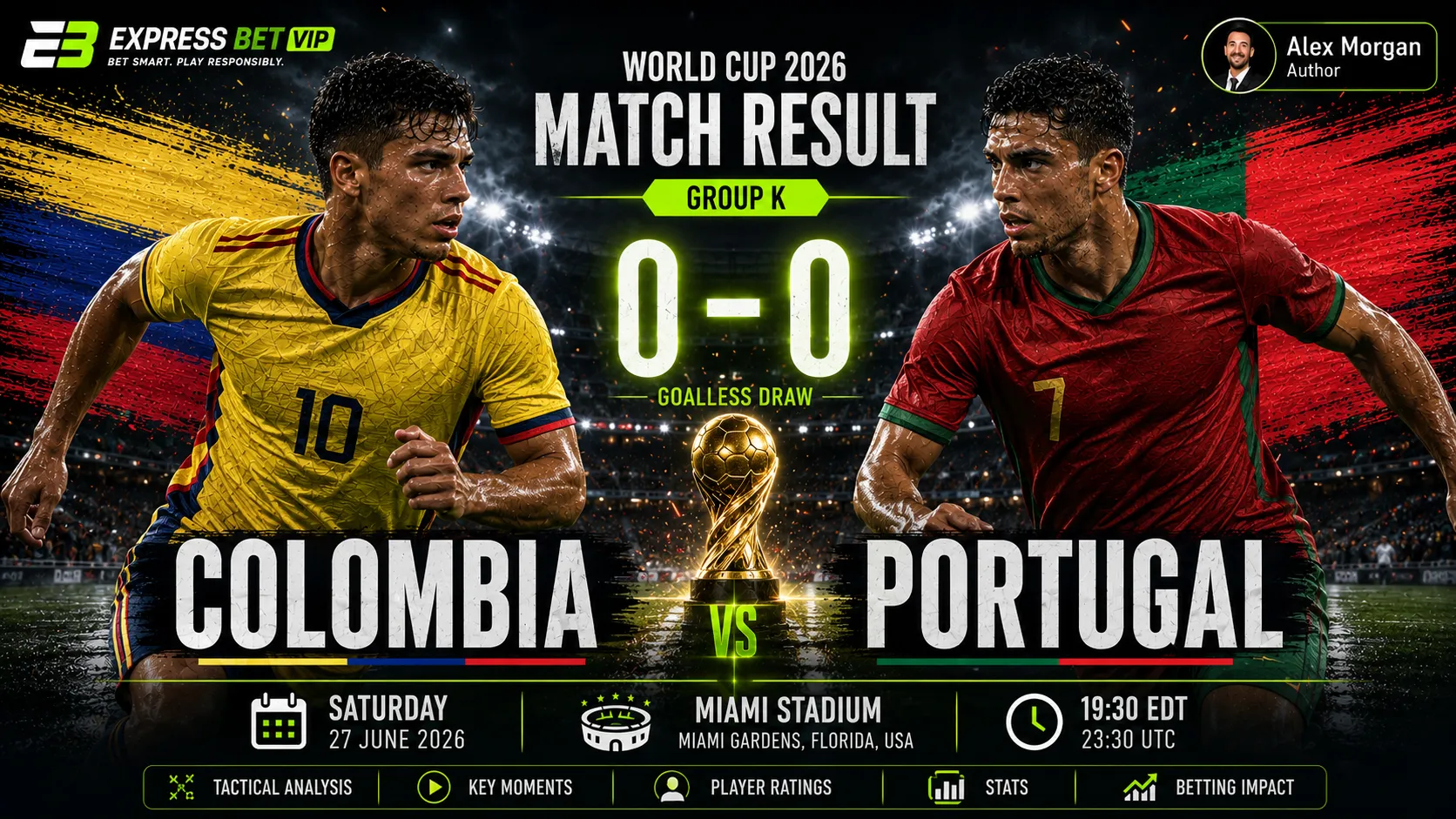
Quick Facts: Final Score, Venue, and Match Status
| Item | Verified information |
|---|---|
| Match | Colombia vs Portugal |
| Competition | FIFA World Cup 2026 |
| Stage | Group stage |
| Group | Group K |
| Local date | June 27, 2026 |
| Kickoff | 7:30 p.m. EDT |
| Host country | United States |
| City | Miami Gardens, Florida |
| Stadium | Miami Stadium / Hard Rock Stadium |
| Attendance | 64,478 |
| Final score | Colombia 0-0 Portugal |
| Half-time score | Colombia 0-0 Portugal |
| Goal scorers | None |
| Disallowed goal | Davinson Sánchez, stoppage time |
| Referee | Alireza Faghani |
| VAR | Jérôme Brisard |
| Weather | Hot and humid; approximately 85°F during second half |
| Roof status | Open-air field beneath spectator canopy |
| Pitch | Natural grass |
| Main impact | Colombia won Group K; Portugal finished second |
FIFA’s official report confirms the result and group order. Sofascore recorded the attendance, while the officiating appointments identified Faghani and Brisard. (FIFA)
Verified Facts vs Analysis
| Category | Status | Detail |
|---|---|---|
| Final score | [CONFIRMED] | Colombia 0-0 Portugal |
| Attendance | [CONFIRMED] | 64,478 |
| Colombia shots | [CONFIRMED] | 24 attempts, six on target |
| Portugal shots | [CONFIRMED] | 13 attempts, two on target |
| Colombia xG | [REPORTED] | 1.63 in ESPN/Guardian-linked data |
| Portugal xG | [DISPUTED] | Approximately 0.69–0.93 depending on provider |
| Costa saves | [CONFIRMED] | Six |
| Disallowed goal | [CONFIRMED] | Sánchez ruled offside in stoppage time |
| Colombian crowd majority | [OBSERVED] | Yellow shirts visibly dominated the stands |
| Temperature | [REPORTED] | Approximately 85°F during second half |
| Humidity and wind | [UNKNOWN] | Exact readings unavailable |
| Colombia deserved more | [ANALYSIS] | Based on chance volume and shot quality |
| Portugal’s defensive resilience | [ANALYSIS] | Based on saves, clearances and interceptions |
| Betting interpretation | [MARKET SIGNAL] | Portugal entered as a narrow favorite |
This separation is important. The 24-13 shot count is data. The judgment that Colombia were the better team is analysis supported by that data, the chance quality and the event sequence. It should not be mistaken for an official ruling about who “deserved” the points. (The Guardian)
Final Score and Match Summary
The Colombia vs Portugal match result was 0-0, although almost every other part of the evening suggested goals.
Colombia began with greater aggression. Luis Díaz attacked the left channel immediately, while Jhon Córdoba occupied Portugal’s centre-backs and James Rodríguez moved into the spaces around Vitinha and Rúben Neves.
Within the opening minutes, a deflected Díaz delivery dropped awkwardly toward Córdoba, who headed over. Diogo Costa then produced an excellent one-handed save from the Colombian striker.
Portugal required time to establish possession. Bruno Fernandes eventually forced Camilo Vargas into a save, and Cristiano Ronaldo attempted an overhead kick from the rebound. João Félix also found shooting space but sent his effort over.
The first half remained goalless because both goalkeepers were sharp and the finishing around them was not. Colombia created the better volume. Portugal produced occasional high-quality transitions but did not sustain attacks around the Colombian penalty area.
The match became more open after half-time. Jefferson Lerma tested Costa from distance. Colombia then introduced Richard Ríos and Luis Javier Suárez to increase running power and attacking movement.
Portugal responded by placing João Neves and Diogo Dalot into the match at half-time, before later adding Rafael Leão and Samú Costa. The adjustments improved the team’s duel strength but did not give it consistent control.
Colombia continued producing the clearer chances. Ríos missed from a favorable central position after Santiago Arias attacked the right. Jhon Arias then forced another sharp intervention from Costa after a deflection.
In the final ten minutes, Portugal occasionally threatened through Ronaldo, Leão and Diogo Dalot, but Colombia’s pressure was stronger. Rúben Dias cleared one dangerous cross close to his goal line. Costa intervened again during another crowded sequence.
Davinson Sánchez finally headed the ball into the net in stoppage time. The Colombian bench entered the field in celebration. The assistant referee raised the flag, and VAR upheld a marginal offside call.
Colombia had done enough to win the match in every department except the traditional one involving the ball crossing the line legally. Football remains unusually strict about that detail.
The draw was enough for Colombia to finish top of Group K. Portugal progressed as runners-up but left Miami with questions about its ability to control strong opposition and about Ronaldo’s tactical role. (The Guardian)
Why the Match Finished 0–0
The match did not finish goalless because the teams were cautious or incapable of creating chances.
Colombia generated 24 attempts, six shots on target, two recorded big chances and approximately 1.63 xG. Portugal attempted 13 shots, with two on target and a lower expected-goals total. (sofascore.com)
Diogo Costa’s Goalkeeping
Costa was the principal reason Portugal kept a clean sheet.
His early one-handed save from Córdoba prevented Colombia from turning its fast start into a lead. He later dealt with Lerma’s powerful shot, reacted to a deflected Jhon Arias attempt and repeatedly controlled loose balls in a congested penalty area.
The six-save total was not inflated by harmless shots from extreme distance. Several interventions came from dangerous positions or after deflections that reduced his reaction time. (FOX Sports)
Colombia’s Finishing
Colombia’s attack produced quantity without sufficient precision.
Córdoba reached useful positions but failed to convert. Ríos missed a high-value chance from the middle of the penalty area. Suárez created separation from defenders but scuffed or misdirected his finishes.
Twenty-four attempts sound overwhelming. Only six tested the goalkeeper. The difference between territorial dominance and scoring dominance usually lives inside that ratio. (The Guardian)
Portugal’s Defensive Work
Portugal defended its penalty area better than it controlled the rest of the pitch.
Rúben Dias and Renato Veiga made important clearances. Nuno Mendes recovered toward his own box, while the midfielders increasingly protected central shooting lanes.
Sofascore recorded 22 Portuguese clearances and 11 interceptions. Those actions reduced the number of simple close-range chances even while Colombia accumulated shots. (sofascore.com)
The Offside Decision
Sánchez’s late header would have changed the result, the narrative and many betting settlements.
The defender was ruled offside by a very narrow margin. VAR upheld the assistant referee’s decision. The technology may have identified a positional offence, but it did not make the moment feel less severe to Colombia. (The Guardian)
Key Moments That Changed the Match
Córdoba’s Early Header
Colombia’s first attack demonstrated that Portugal’s defensive line could be disturbed by Díaz’s speed and unpredictable deliveries. Córdoba was surprised by the deflection and headed over, but the pattern had been established.
Costa’s First Major Save
Córdoba’s next opportunity produced a one-handed stop from Costa. An early Colombian goal would have forced Portugal to press higher and probably increased transition space for Díaz and Jhon Arias. (The Guardian)
Vargas Denies Bruno Fernandes
Portugal’s first meaningful chance came through Fernandes. Vargas pushed the shot away before Ronaldo’s overhead attempt was blocked. It was one of the few moments when Portugal attacked before Colombia could assemble its defensive block. (The Guardian)
Portugal’s Half-Time Double Change
Diogo Dalot and João Neves replaced João Cancelo and Rúben Neves.
Dalot provided more direct running and later came close with a curling attempt. João Neves increased mobility in midfield, although Portugal still struggled to escape Colombia’s pressure consistently. (sofascore.com)
Ríos Misses Colombia’s Best Open-Play Chance
Santiago Arias overlapped and cut the ball back into a central area. Ríos arrived with space but sent his shot wide.
The chance carried an estimated xG value of around 0.44 in the Guardian’s live data, making it Colombia’s clearest opportunity before the disallowed goal. (The Guardian)
The Hydration Break
Nuno Mendes received treatment before the match paused for hydration around the 68th minute.
The interruption gave both teams time to reorganize. Portugal introduced Leão and Samú Costa soon afterward, while Colombia later added Quintero and Castaño. (The Guardian)
Costa’s Save from Jhon Arias
A cutback reached Jhon Arias, whose shot changed direction slightly. Costa adjusted quickly and pushed it away.
The save reinforced the central theme of the match: Colombia found the spaces, but the goalkeeper continued solving the final problem. (The Guardian)
Sánchez’s Disallowed Winner
Colombia recycled a corner toward the edge of the penalty area and delivered a cross back into the box. Sánchez headed down and into the net.
The flag went up. Semi-automated offside analysis placed Sánchez marginally beyond the defensive line, and VAR did not overturn the decision. (The Guardian)
Local Match Conditions: Stadium, City, Weather, Pitch, and Crowd
| Local factor | Verified or observed detail | Football meaning | Direct match evidence | Betting-result meaning | Status | Anti-template status |
|---|---|---|---|---|---|---|
| City | Miami Gardens, Florida | Hot, humid evening environment | Temperature around 85°F after half-time | Relevant to tempo and substitutions | [CONFIRMED/REPORTED] | Fixture-specific |
| Stadium | Miami Stadium / Hard Rock Stadium | Open-air field beneath canopy | Heat remained present on pitch | Weather could not be excluded | [CONFIRMED] | Fixture-specific |
| Attendance | 64,478 | Near-capacity crowd | Full stands throughout | Increased big-match pressure | [CONFIRMED] | Fixture-specific |
| Crowd distribution | Colombian majority visibly estimated near 90% | Colombia received near-home support | Yellow shirts dominated stands | Potential psychological edge | [OBSERVED] | Fixture-specific |
| Temperature | Approximately 85°F during second half | Higher cooling and hydration demand | Hydration break around 68’ | Second-half tempo risk | [REPORTED] | Fixture-specific |
| Humidity | Exact figure unavailable | Cannot quantify heat load precisely | Conditions described as humid | Avoid false numerical conclusions | [UNKNOWN] | Fixture-specific |
| Wind | Exact figure unavailable | No supported conclusion on long balls | No major wind issue reported | Exclude from market analysis | [UNKNOWN] | Fixture-specific |
| Pitch | Natural grass | Supported technical possession | No abnormal bounce recorded | No clear surface-driven market effect | [CONFIRMED/OBSERVED] | Fixture-specific |
| Canopy | Covers most spectator seating, not field | Crowd shaded more than players | Playing area remained outdoors | Fan comfort differed from player conditions | [CONFIRMED] | Fixture-specific |
| Travel | Team acclimatization details unavailable | No safe fatigue comparison | No verified camp data | Exclude from betting model | [UNKNOWN] | Fixture-specific |
The local conditions were not decorative background. Miami’s heat and humidity influenced how both teams distributed their effort.
The Guardian’s live record reported approximately 85°F during the second half and described the evening as sweltering. The field is open to the elements even though Hard Rock Stadium’s canopy protects most spectators from direct sun and rain. (The Guardian)
Portugal slowed possession during parts of the second half. Colombia occasionally pressed, then dropped back rather than maintaining constant pressure. That pattern suggests energy management, although tactical game control also played a role.
The hydration break created a natural substitution and coaching window. Portugal changed its midfield and wide attack around this phase. Colombia rotated its central players and later replaced James Rodríguez and Jhon Arias.
The heat did not produce a complete late-game decline. Colombia created its strongest pressure after minute 80 and believed it had scored in stoppage time. This matters because the direct match evidence contradicts any simple claim that the conditions killed the contest.
The crowd was unusually specific to this fixture. Colombian supporters formed the visible majority, with the Guardian estimating approximately 90% of the stadium. The match therefore felt closer to a Colombian home fixture than a neutral World Cup game. (The Guardian)
Stadium-Specific Match Impact
| Item | Detail |
|---|---|
| Stadium | Miami Stadium / Hard Rock Stadium |
| City | Miami Gardens |
| Attendance | 64,478 |
| Approximate normal capacity | About 65,000 |
| Pitch type | Natural grass |
| Roof status | Open-air field |
| Canopy | Covers most spectator areas |
| Acoustic effect | Colombian support audibly dominant |
| Surface condition | Stable; no major defect reported |
| Wind relevance | Not available from verified match data |
| Goalkeeper distribution | No visible surface disruption |
| Set-piece effect | Colombia’s late set-piece goal was ruled offside |
| Communication effect | No specific defensive error proven to result from noise |
| Data status | Venue, crowd and surface confirmed; technical acoustics unavailable |
Hard Rock Stadium’s canopy can create the visual impression of an enclosed venue, but the playing area remains open-air. This meant the match did not receive the climate protection available in Dallas, Houston or Atlanta. (Wikipedia)
The natural surface supported a fast and technically clean match. Both teams completed a high number of passes, and no major slip or abnormal bounce shaped a decisive moment.
The venue’s clearest match-specific influence came from crowd distribution. Colombian support changed the neutral setting into a yellow-dominated environment. James received a major ovation when substituted, and Colombia’s late attacking waves drew sustained noise.
The available evidence does not show that stadium acoustics directly caused a Portugal mistake or affected a referee decision. The atmosphere provided psychological context, not a measurable goal.
City and Weather Impact
| Factor | Detail |
|---|---|
| City | Miami Gardens |
| Host country | United States |
| Time zone | Eastern Daylight Time, UTC-4 |
| June climate | Hot, humid, frequent storm potential |
| Second-half temperature | Approximately 85°F / 29°C |
| Exact humidity | Not available from verified public data |
| Exact wind | Not available from verified public data |
| Rain | No meaningful rain effect confirmed |
| Roof | Field open to outdoor conditions |
| Altitude | No meaningful high-altitude factor |
| Likely physical effect | Higher hydration demand and selective pressing |
| Actual evidence | Hydration break and energy-management phases |
| Data status | Temperature reported; other measurements incomplete |
The first half remained open despite the temperature. Colombia attacked immediately, Portugal found intermittent transitions and both goalkeepers were tested.
The physical effect became more visible after the interval. Portugal retained the ball for longer periods without always advancing it. Colombia selected pressing moments rather than pursuing continuously.
Neither side suffered a verified heat-related injury. Nuno Mendes received treatment but continued until the 92nd minute. No confirmed diagnosis connected the incident to heat, dehydration or the surface. (The Guardian)
The conditions may have increased the value of fresh substitutes. Richard Ríos, Rafael Leão, João Neves and Juan Fernando Quintero all brought new movement or technical quality.
Still, the match’s decisive non-goal came in stoppage time. That is strong evidence that the competitive intensity survived the weather.
First-Half Analysis
Colombia started in a 4-2-3-1 or flexible 4-3-3.
Camilo Vargas played behind Santiago Arias, Davinson Sánchez, Jhon Lucumí and Deiver Machado. Jefferson Lerma and Gustavo Puerta protected central midfield, while Jhon Arias, James Rodríguez and Luis Díaz supported Jhon Córdoba.
Portugal used a 4-2-3-1. Diogo Costa started behind João Cancelo, Rúben Dias, Renato Veiga and Nuno Mendes. Rúben Neves and Vitinha formed the midfield pair, with Pedro Neto, Bruno Fernandes and João Félix behind Ronaldo. (mundialplayertracker.com)
Colombia’s Pressing Structure
Colombia pressed Portugal’s buildup selectively.
Córdoba closed one centre-back while James positioned himself near the deepest midfielder. Díaz and Jhon Arias moved toward the full-backs when passes travelled wide.
The objective was not always to win the ball immediately. Colombia often forced Portugal toward a touchline and then attacked the receiver from multiple angles.
Portugal struggled to connect Vitinha with Fernandes. When Vitinha dropped deeper, James followed or blocked the return lane. When Fernandes moved backward, Colombia’s midfield kept its compact central shape.
James Rodríguez’s Role
James operated as a central creator rather than a fixed No. 10.
He moved toward the right to combine with Jhon Arias and Santiago Arias, then shifted left to release Díaz. His movement forced Rúben Neves and Vitinha to defend horizontally.
The physical cost became visible later, but his first-half positioning gave Colombia control of the areas around Portugal’s midfield.
Luis Díaz Against João Cancelo
Díaz attacked Cancelo directly and often received before Portugal’s defensive shape had fully settled.
Cancelo wanted to advance in possession, leaving space behind him. Colombia targeted that channel through early passes and transitions.
The opening chance emerged from Díaz’s delivery. Even when the final action failed, his pace kept Portugal’s right side cautious.
Portugal’s Attack
Portugal’s best moments came when Fernandes received facing goal.
His shot forced Vargas into a save, and the rebound led to Ronaldo’s overhead attempt. João Félix also found space around Colombia’s midfield line.
The problem was continuity. Portugal rarely linked several attacking actions together. Ronaldo remained between Sánchez and Lucumí, but service into him was inconsistent.
At half-time, Colombia had created more and controlled more. Portugal remained level because Costa had already produced the match’s defining individual performance.
Second-Half Analysis
Roberto Martínez changed both Portugal’s right-back and central midfield structure at half-time.
Dalot replaced Cancelo. João Neves replaced Rúben Neves. The changes increased speed and defensive mobility.
Portugal briefly circulated possession more calmly. Colombia pressed less frequently during the opening phase of the half, conserving energy in the humid conditions.
Néstor Lorenzo responded after 60 minutes by introducing Ríos for Lerma and Suárez for Córdoba. (sofascore.com)
Richard Ríos Changes the Midfield
Ríos carried the ball forward more aggressively than Lerma.
He also attacked the penalty area from deeper positions. His major chance after Santiago Arias’s overlap demonstrated why Lorenzo had made the change.
The miss also revealed Colombia’s central weakness. The team could create advantageous situations but lacked the calm finishing required to convert control into goals.
Portugal’s Transition Threat
João Félix found more space when Colombia pushed numbers forward. One transition gave him room to attack, but his final pass lacked accuracy.
Ronaldo later moved offside after Félix found him centrally. The forward finished the move unsuccessfully in any case.
Portugal possessed the players to threaten on the counterattack but did not coordinate their runs consistently.
Leão’s Introduction
Leão replaced Félix in the 70th minute.
His pace gave Portugal a clearer route down the left. He created one stoppage-time shooting opportunity but fired wide after beating his defender.
Portugal’s structure became more direct after his introduction, but Colombia still produced the greater volume of pressure.
Colombia’s Final Push
Quintero and Kevin Castaño replaced James and Jhon Arias in the 76th minute.
Quintero supplied fresh passing imagination. Castaño protected against counterattacks and allowed Puerta to advance, although Puerta later received the match’s only yellow card.
Daniel Muñoz replaced Santiago Arias late, providing another attacking full-back for the closing phase.
Colombia generated multiple dangerous sequences from minute 88 onward. Rúben Dias cleared near the goal line. Costa intervened again. Sánchez then headed in from the recycled corner before the offside decision.
Portugal survived rather than controlled the final minutes. The distinction will not appear in the points column, which has never shown much interest in aesthetics.
Tactical Picture: Why Colombia Dominated but Did Not Win
Colombia’s attacking structure resembled a 2-3-5 during established possession.
Sánchez and Lucumí remained deeper. One full-back advanced while the other adjusted position. Lerma or Ríos protected the centre, while five attackers occupied the width, half-spaces and central channel.
This structure repeatedly pushed Portugal’s wide players backward.
Díaz pinned the right side. Jhon Arias and Santiago Arias combined on the opposite flank. James moved freely behind Córdoba.
Portugal defended in a 4-4-2 shape, with Fernandes occasionally joining Ronaldo in the first line. Neto and Félix dropped alongside the midfield pair.
The structure remained compact but offered little pressing pressure against Colombia’s centre-backs. Sánchez and Lucumí could begin attacks without being forced into hurried long passes.
Colombia’s Advantage Between the Lines
James repeatedly found positions around Rúben Neves and Vitinha.
When one Portuguese midfielder stepped forward, Colombia attacked the space behind him. When both remained deep, James received and turned.
Portugal improved after João Neves entered because he covered more ground, but Colombia still controlled most of the central exchanges.
Portugal’s Aerial and Duel Strength
Portugal won a larger share of total and aerial duels, according to Sofascore.
This helped the team defend crosses and second balls. Rúben Dias, Renato Veiga and Nuno Mendes reduced the number of clean headers Colombia could produce from its territorial pressure. (sofascore.com)
Ronaldo’s Limited Influence
Ronaldo remained the central reference but was largely isolated.
Colombia’s centre-backs could defend him physically because Portugal did not move enough runners around him. Fernandes occasionally entered the box, while Félix drifted inside, but the relationships were inconsistent.
Martínez defended Ronaldo’s playing time after the match, yet the tactical evidence showed a forward who required more precise service than Portugal supplied. (FotMob)
Why Colombia Failed to Score
Colombia lacked efficiency in three areas:
- the first finish after cutbacks;
- rebounds following Costa’s saves;
- timing during set-piece runs.
The disallowed Sánchez header represented the final problem perfectly. The delivery and finish were good. The starting position was fractionally early.
Tactical Collision Map
| Zone | Edge | Match evidence | Key player | Local-condition effect | Result impact |
|---|---|---|---|---|---|
| Colombia left flank | Colombia | Díaz repeatedly attacked Cancelo and Dalot | Luis Díaz | Heat encouraged selective sprints | Major |
| Colombia right flank | Colombia | Jhon Arias and Santiago Arias combined effectively | Jhon Arias | Natural grass supported quick exchanges | Major |
| Central midfield | Colombia | James found space around Portuguese double pivot | James Rodríguez | Tempo managed in humid conditions | Major |
| Portugal left flank | Balanced | Mendes defended well; Leão threatened late | Nuno Mendes | Hydration and treatment interruption | Moderate |
| Portugal right flank | Colombia | Cancelo replaced at half-time | Luis Díaz | No wind effect confirmed | Major |
| Penalty box | Portugal defensively | Costa and centre-backs survived 24 shots | Diogo Costa | No surface errors | Decisive |
| Set pieces | Colombia | Sánchez scored but was offside | Davinson Sánchez | No weather effect confirmed | Potentially decisive |
| Transitions | Portugal potential | Félix and Leão found occasional space | João Félix | Energy conservation limited repetition | Moderate |
| Goalkeeper buildup | Even | Both teams played through first line | Diogo Costa | Stable surface | Moderate |
| Bench impact | Colombia slight edge | Ríos and Quintero increased pressure | Richard Ríos | Fresh legs mattered in heat | Major |
Player Ratings and Individual Performances
These ratings are editorial assessments based on match events, statistical output and tactical responsibility. They are not official FIFA ratings.
Colombia Player Ratings
Camilo Vargas — 7.2
Made two important saves, including the first-half stop from Bruno Fernandes. Managed crosses calmly and distributed without unnecessary risk.
Santiago Arias — 7.3
Supported attacks down the right and created Ríos’s major second-half chance. His overlapping movement gave Jhon Arias room to move inside.
Davinson Sánchez — 7.5
Defended Ronaldo strongly and believed he had scored the winner. His offside position was marginal, but the defensive performance remained excellent.
Jhon Lucumí — 7.2
Comfortable against direct passes and aggressive when Ronaldo attempted to receive with his back to goal.
Deiver Machado — 6.9
Provided width and covered Díaz’s attacking movement. Less prominent than Santiago Arias but positionally disciplined.
Jefferson Lerma — 7.0
Protected transitions and tested Costa with a powerful shot. Replaced when Colombia required more forward running.
Gustavo Puerta — 7.1
Worked effectively around James and contributed to Colombia’s midfield control. Received the match’s only yellow card in the 86th minute.
Jhon Arias — 7.4
Moved intelligently between the right wing and half-space. Forced an excellent second-half save after a deflected shot.
James Rodríguez — 7.7
Controlled Colombia’s attacking rhythm and continually appeared between Portugal’s midfield lines. His influence declined physically before his substitution.
Luis Díaz — 7.6
Created immediate danger, carried the ball aggressively and forced Portugal’s right side to defend deeper. The final pass or shot did not produce a goal.
Jhon Córdoba — 6.8
Created two important early chances and worked physically against Portugal’s centre-backs. Finishing prevented a higher rating.
Colombia Substitutes
Richard Ríos — 6.9
Added running power and penalty-area presence but missed Colombia’s clearest open-play chance.
Luis Javier Suárez — 6.1
Moved actively across the front line but struggled to control several passes and scuffed a promising effort.
Juan Fernando Quintero — 6.7
Improved the creativity of Colombia’s late possession and helped sustain pressure.
Kevin Castaño — 6.4
Protected midfield during the late attacking phase and recovered several second balls.
Daniel Muñoz — Not rated
Entered in the 87th minute and had insufficient time for a full assessment.
Portugal Player Ratings
Diogo Costa — 9.0
Man of the Match. Made six saves, controlled difficult rebounds and stayed composed during Colombia’s late pressure.
João Cancelo — 5.9
Struggled with Díaz’s movement and offered limited defensive protection. Replaced at half-time.
Rúben Dias — 7.6
Made crucial clearances, including one near his goal line late in the match. Organized Portugal’s defensive box well.
Renato Veiga — 7.0
Defended physically and contributed to Portugal’s aerial advantage. Colombia still found space around him during cutbacks.
Nuno Mendes — 7.2
Handled a demanding defensive assignment and continued after receiving treatment. Also provided occasional forward carries.
Rúben Neves — 6.1
Portugal’s midfield lacked mobility during the first half. Replaced at the interval.
Vitinha — 6.8
Portugal’s cleanest midfielder in possession but could not establish the sustained control his team expected.
Pedro Neto — 6.3
Worked defensively and attempted to attack Machado’s side. Had limited involvement in decisive moments.
Bruno Fernandes — 6.9
Produced Portugal’s best first-half shot and took several dangerous set pieces. Colombia prevented him from controlling the match.
João Félix — 6.4
Found occasional transition space but made poor decisions with the final pass and shot.
Cristiano Ronaldo — 5.9
Peripheral for long periods. Attempted an overhead kick, drifted offside during a promising move and received insufficient service.
Portugal Substitutes
Diogo Dalot — 6.8
Improved Portugal’s right side after half-time and curled a late shot narrowly wide.
João Neves — 6.9
Added mobility and duel strength. Portugal’s midfield became more competitive after his introduction.
Samú Costa — 6.4
Helped protect the central area during Colombia’s strongest attacking phase.
Rafael Leão — 6.6
Provided late transition threat and created a stoppage-time shooting chance but fired wide.
Matheus Nunes — Not rated
Entered in stoppage time for Nuno Mendes.
The confirmed lineups and substitutions are supported by the published event and lineup records. (mundialplayertracker.com)
Best Players of the Match
Man of the Match: Diogo Costa
Six saves and a clean sheet under sustained pressure made the decision straightforward.
Best attacker: Luis Díaz
No attacker scored, but Díaz consistently changed Portugal’s defensive positioning and initiated Colombia’s strongest movements.
Best midfielder: James Rodríguez
James controlled the spaces between Portugal’s midfield and defensive lines until fatigue reduced his influence.
Best defender: Rúben Dias
Dias protected the six-yard area and made several high-value interventions during the final pressure.
Best goalkeeper: Diogo Costa
Costa was the match’s defining performer.
Best substitute: João Neves
He increased Portugal’s midfield mobility and helped the side survive a difficult second half.
Most underrated performance: Santiago Arias
His overlaps and passing helped Colombia create numerical advantages on the right.
Most disappointing performance: Cristiano Ronaldo
Portugal’s captain remained isolated and did not register the decisive attacking contribution expected of him. The service was inadequate, so the responsibility was collective rather than individual. (sofascore.com)
Injuries, Suspensions, Cards, and Discipline
| Player | Team | Incident | Minute | Status | Next-match impact | Data status |
|---|---|---|---|---|---|---|
| Nuno Mendes | Portugal | Received treatment | Around 68’ | Continued playing | No absence confirmed | [OBSERVED] |
| Gustavo Puerta | Colombia | Foul | 86’ | Yellow card | No suspension confirmed | [CONFIRMED] |
| Other players | Both | No additional cards recorded | — | No red cards | No confirmed suspension | [CONFIRMED] |
The match was competitive but not heavily carded. Puerta’s late booking was the only yellow recorded in the main event feed.
Nuno Mendes received treatment immediately before the hydration break. He remained on the field until Matheus Nunes replaced him in stoppage time, so no serious match-ending injury was established. (The Guardian)
Referee and VAR Analysis
Alireza Faghani allowed a physical match without producing a large card count.
The main decision concerned Sánchez’s stoppage-time header. The assistant referee identified offside, and VAR Jérôme Brisard checked the position.
The review upheld the original decision. Available images suggested that Sánchez was beyond the final defender by an extremely narrow margin—described in live reporting as approximately the length of a toe. (The Guardian)
The decision was technically defensible under the offside law and semi-automated measurement. It was also severe in practical effect because it removed a probable group-winning goal—although Colombia still finished first.
Colombia appealed for a penalty when Suárez attempted to shoot and made contact with Mendes. The defender held his position rather than initiating a challenge, and play continued. No VAR intervention followed. (The Guardian)
Faghani generally allowed the match to flow. The low card count helped preserve the end-to-end rhythm, although Colombian players and supporters naturally focused on the late offside decision.
Match Statistics
| Statistic | Colombia | Portugal |
|---|---|---|
| Possession | 55% | 45% |
| Shots | 24 | 13 |
| Shots on target | 6 | 2 |
| Reported xG | 1.63 | 0.69 |
| Big chances | 2 | 1 |
| Corners | 5 | 2 |
| Attempted passes | 545 | 445 |
| Accurate passes | 485 | 405 |
| Pass accuracy | 89% | 91% |
| Touches in opposition box | 35 | 13 |
| Successful crosses | 3 of 10 | 2 of 14 |
| Successful dribbles | 4 of 5 | 9 of 16 |
| Goalkeeper saves | 2 | 6 |
| Clearances | Not confirmed | 22 |
| Interceptions | Not confirmed | 11 |
| Yellow cards | 1 | 0 |
| Red cards | 0 | 0 |
Sofascore supplied the possession, shot, passing, box-touch and goalkeeper figures. ESPN and Guardian-linked reporting recorded the xG at approximately 1.63–0.69. Another provider placed Portugal closer to 0.93, illustrating the normal methodological variation in expected-goals models. (sofascore.com)
The statistical picture supports three conclusions.
First, Colombia controlled territory. The 35-13 advantage in penalty-area touches and 5-2 corner count show where the game was played.
Second, Colombia’s finishing was inefficient. Six shots on target from 24 attempts meant too many attacks ended without genuinely testing Costa.
Third, Portugal’s clean sheet depended on high-level defensive execution. Twenty-two clearances and six goalkeeper saves are not the numbers of a team that controlled the match comfortably.
Betting Result Angle
FanDuel’s June 27 market snapshot listed Portugal as the narrow favorite at -115, Colombia at +280 and the draw at +280. Over and under 2.5 goals were both priced at -110. Both teams to score “Yes” was -122, while “No” was -104. (FOX Sports)
| Market | Pre-match expectation | Actual result | Winning side | Key match trigger | Local factor | Caution |
|---|---|---|---|---|---|---|
| Match winner | Portugal narrow favorite | 0-0 | Draw | Costa’s saves and Sánchez offside | Heat affected tempo selectively | Odds varied |
| Portugal -0.5 | Portugal expected to edge match | Portugal did not win | Colombia +0.5 | Colombia controlled chances | Crowd favored Colombia | Price-dependent |
| Draw no bet | Portugal heavily favored | Stakes refunded | Push | Final score 0-0 | No decisive local factor | Rules vary |
| Over/under 2.5 | Balanced market | No goals | Under 2.5 | Goalkeeping and finishing | Heat may have limited pressing spells | Do not overstate |
| Both teams to score | Yes slightly favored | Neither scored | BTTS No | Costa and Vargas clean sheets | No direct weather cause | One match only |
| Correct score | Low-probability outcome | 0-0 | 0-0 backers | Late goal disallowed | VAR decisive | High variance |
| Ronaldo anytime scorer | +115 | Did not score | No-goal side | Colombia isolated him | Heat not sufficient explanation | Player role mattered |
| Luis Díaz anytime scorer | +320 | Did not score | No-goal side | Final action lacked precision | No clear local effect | Market timing mattered |
| Goalkeeper saves | Costa faced heavy workload | Six saves | Costa overs on many lines | Colombia’s 24 shots | Colombian crowd pressure | Exact line unavailable |
| Live Colombia winner | Price shortened late | Draw survived | Draw/live Portugal protection | Sánchez offside | Late energy remained high | VAR exposure |
The draw rewarded bettors who opposed Portugal’s status as the favorite. Colombia +0.5 also succeeded.
Under 2.5 goals won despite an open match and a combined 37 attempts. This is a useful distinction: an under can win without the underlying game being cautious.
Both-teams-to-score “No” succeeded, although the market had slightly favored “Yes.” Costa’s performance and Colombia’s defensive control were more important than any pre-match assumption about attacking talent.
Ronaldo’s anytime-scorer price lost. He had scored twice against Uzbekistan, but Colombia restricted his service and controlled the spaces around him.
The 0-0 correct-score market would have carried a large return, but the stoppage-time offside demonstrates why hindsight should not be confused with predictability. A player’s toe changed the settlement.
Local Betting Impact: What the Venue and Conditions Changed
| Local factor | Market possibly affected | Actual match evidence | Possible interpretation | Overreaction risk | Safer conclusion |
|---|---|---|---|---|---|
| Heat | Second-half totals | Selective pressing and hydration break | Lower continuous intensity | Medium | Game still produced many chances |
| Humidity | Substitution markets | Both coaches used full benches | Fresh legs became valuable | Medium | Exact humidity unknown |
| Open-air pitch | Total goals and passing | No rain or wind disruption confirmed | Stable but physically demanding | High | Do not invent weather edge |
| Colombian crowd majority | Match winner and live momentum | Colombia finished stronger | Psychological home-style support | High | Crowd did not score |
| Natural grass | Dribbles and passing | Match remained technically clean | Supported combination play | Low | No clear betting edge alone |
| Hydration break | Live tempo | Tactical reset around 68’ | Temporary interruption | Medium | Not a standalone betting system |
| Goalkeeper workload | Saves markets | Costa made six saves | Colombia shot volume created value | Low | Line and operator required |
| VAR | Correct score and winner | Late goal disallowed | Major settlement swing | Very high | Impossible to model precisely |
The heat did not make the match automatically low-scoring. Colombia created 24 attempts and maintained late pressure.
A more defensible local interpretation concerns goalkeeper-save markets. Portugal allowed Colombia repeated shooting opportunities, and Costa’s workload became the defining statistical result.
The crowd advantage supported Colombia emotionally, but backing a team solely because its supporters dominate a neutral venue would be an unreliable strategy.
Local conditions should remain secondary to lineups, defensive structure and goalkeeper quality.
What This Result Meant for Group K
| Position | Team | Points |
|---|---|---|
| 1 | Colombia | 7 |
| 2 | Portugal | 5 |
| 3 | DR Congo | 4 |
| 4 | Uzbekistan | 0 |
Colombia entered the match with six points and needed only a draw to secure first place. Portugal needed a victory to overtake them.
The 0-0 result therefore confirmed Colombia as Group K winners. Portugal advanced as runners-up, while DR Congo’s 3-1 victory over Uzbekistan secured third place and qualification. (The Guardian)
Colombia were paired with Ghana in the Round of 32 and won 1-0. They later drew 0-0 with Switzerland and were eliminated 4-3 in the penalty shootout.
Portugal faced Croatia, recovered from a goal down and won 2-1 through a late Gonçalo Ramos goal. Spain then eliminated Portugal 1-0 in the Round of 16. (FIFA)
In retrospect, winning Group K gave Colombia a viable route but did not solve their finishing problem. Portugal’s second-place route took them toward Spain, which proved decisive.
What Colombia Did Right
Colombia controlled the match without becoming predictable.
Díaz stretched the left side. Jhon Arias and Santiago Arias created combinations on the right. James linked both flanks and found central pockets.
The midfield pressed Portugal’s buildup intelligently. Colombia did not run continuously in the heat; they selected triggers and forced Portugal away from its preferred central combinations.
The centre-backs handled Ronaldo well. Sánchez and Lucumí remained aggressive without repeatedly conceding fouls near the penalty area.
Lorenzo’s substitutions also preserved Colombia’s intensity. Ríos added forward running, Quintero added passing imagination and Muñoz added late width.
The main positive was that Colombia produced 24 attempts against one of the stronger squads in the tournament. The obvious negative is that none counted.
What Portugal Got Wrong
Portugal failed to control midfield.
Vitinha received too little support during the first half. Rúben Neves lacked the mobility to close James and then recover toward the defensive line.
The wide players did not consistently protect the full-backs. Cancelo was exposed against Díaz and was removed at half-time.
Portugal also failed to connect Ronaldo with supporting runners. The striker remained central, but Fernandes, Félix and Neto rarely occupied complementary positions at the same time.
The team’s transition decisions were poor. Félix carried into space without delivering the correct pass. Ronaldo moved too early and was caught offside. Leão created one late chance but shot wide.
Portugal survived because Costa and the defensive line performed exceptionally. Goalkeeping can rescue a plan. It should not be confused with the plan working.
Coach Analysis
Néstor Lorenzo
Lorenzo selected a balanced side and did not settle for the draw that would secure first place.
His 4-2-3-1 gave James freedom while keeping Lerma and Puerta behind him. The full-backs advanced on alternating sides, preserving enough defensive security against Portugal’s transitions.
The introduction of Ríos was tactically sound because Colombia needed another runner from midfield. Ríos reached the best central chance but failed to finish it.
Quintero’s late introduction added quality around Portugal’s low block. The final set-piece pressure almost produced the winner.
Lorenzo’s main concern after the match was finishing. The tactical system created enough. The attackers did not convert.
Roberto Martínez
Martínez acknowledged that Portugal allowed Colombia to play the match they wanted and failed to control possession as intended.
The half-time changes were an admission that the original midfield and right side were not functioning. Dalot and João Neves improved mobility.
Leão’s introduction created a clearer transition threat, although Portugal continued defending more than attacking.
Martínez’s decision to leave Ronaldo on for the full match attracted scrutiny. The striker offered penalty-box presence but limited pressing mobility and received little useful service.
The coach improved Portugal’s defensive resistance through substitutions. He did not solve their attacking disconnection. (The Guardian)
Player Milestones and Records
Colombia’s 24 attempts represented their highest recorded shot total in a World Cup match since detailed records began in 1966, surpassing the 23 attempts registered against the United States in 1994. (FotMob)
The match was the first senior international meeting between Colombia and Portugal.
Diogo Costa’s six saves represented his highest workload of the group stage and produced one of the tournament’s strongest goalkeeping performances to that point.
No major scoring milestone was possible because the match finished without a valid goal.
Historical Context and World Cup Analogies
A 0-0 draw between two qualified teams often suggests caution. This match did not belong to that category.
Colombia attacked as though first place had to be earned rather than administratively collected. Portugal attempted to win but lacked the midfield control required to impose itself.
The match resembled a recurring World Cup pattern: one team creates the chances, the opposing goalkeeper becomes the central figure, and the scoreline later gives the false impression of tactical equality.
Colombia’s late offside also offered an old lesson in modern form. Tournament football has always been decided by small margins. Technology now provides measurements precise enough to show exactly how small and no mechanism for making them feel less cruel.
Incidents and Controversies
The Sánchez offside decision was the principal controversy.
Colombia believed the defender was level when the cross was delivered. VAR’s semi-automated offside system supported the assistant referee’s flag.
The margin was extremely narrow. No evidence shows that the technology was applied incorrectly, although the decision renewed debate about whether millimetric offsides match the original purpose of the law. (The Guardian)
The Colombian substitutes entered the playing area in celebration before the decision was confirmed. No serious disciplinary consequence followed.
The Suárez–Mendes penalty appeal was correctly treated as a normal contact sequence based on the available replay description.
No crowd disorder, medical emergency, red card or post-match confrontation was confirmed.
Information Gain: What the Evidence Adds
The final score alone suggests balance. The deeper match record shows something different:
- Colombia created nearly twice as many shots.
- Costa produced six saves and the match’s best individual performance.
- Portugal defended its box better than it controlled possession.
- Colombia’s chance creation came from both flanks and central midfield runs.
- Miami’s heat affected energy distribution but did not stop late attacking intensity.
- The Colombian-majority crowd turned a neutral venue into a near-home environment.
- VAR, not a defensive clearance, removed the only ball that entered the net.
- The betting under won in a match that was far more open than many low-scoring fixtures.
Local Information Gain Quality Check
| Detail | Included | Status | Specific to fixture | Future update needed |
|---|---|---|---|---|
| Stadium | Yes | Confirmed | Yes | No |
| Physical city | Yes | Confirmed | Yes | No |
| Attendance | Yes | Confirmed | Yes | Only if corrected |
| Canopy and open field | Yes | Confirmed | Yes | No |
| Temperature | Yes | Reported | Yes | Official archive could refine |
| Humidity | Missing exact value | Unknown | Yes | Add only from reliable archive |
| Wind | Missing exact value | Unknown | Yes | Add only from reliable archive |
| Pitch surface | Yes | Confirmed | Yes | No |
| Crowd distribution | Yes | Observed | Yes | Exact ticket split unavailable |
| Hydration break | Yes | Observed | Yes | No |
| Travel effect | No unsupported claim | Unknown | Yes | Team logistics unavailable |
| Local betting risk | Yes | Analysis-based | Yes | Closing props could refine |
| Tactical-local connection | Yes | Analysis-based | Yes | No |
| Anti-template status | Passed | Reviewed | Yes | Recheck after factual updates |
Source and Data Appendix
| Data point | Status | Main source type |
|---|---|---|
| Final score | Confirmed | FIFA Match Centre and report |
| Goal scorers | Confirmed | No valid goals |
| Disallowed goal | Confirmed | Match report and live chronology |
| Stadium | Confirmed | FIFA and venue information |
| City | Confirmed | Stadium record |
| Attendance | Confirmed | Sofascore match report |
| Referee | Confirmed | Published appointment list |
| VAR | Confirmed | Published appointment list |
| Lineups | Confirmed | Confirmed lineup records |
| Formations | Confirmed | Match lineup records |
| Substitutions | Confirmed | Event feed |
| Yellow card | Confirmed | Event feed |
| Injuries | No serious injury confirmed | Live chronology |
| Match statistics | Confirmed by provider | Sofascore |
| xG | Reported with variation | ESPN, Guardian-linked data, FotMob |
| Pre-match odds | Market signal | FOX/FanDuel snapshot |
| Weather | Partly reported | Live match reporting |
| Exact humidity | Unknown | No reliable match-time record located |
| Exact wind | Unknown | No reliable match-time record located |
| Pitch condition | Observed | Match reporting |
| Crowd profile | Observed | Guardian stadium report |
| Group impact | Confirmed | FIFA standings and report |
| Knockout outcomes | Confirmed | FIFA match reports |
Final Verdict
Colombia did almost everything required to beat Portugal.
They controlled midfield, attacked both flanks, generated 24 attempts and restricted Ronaldo to a peripheral role. James dictated the creative structure. Díaz pushed Portugal backward. The substitutes sustained the pressure.
They did not score.
Portugal’s draw was built on Diogo Costa, Rúben Dias and the capacity to defend the penalty area after losing control elsewhere. Costa’s performance was not merely useful. It was the result.
The scoreline was fortunate for Portugal but not inexplicable. Colombia’s six shots on target from 24 attempts showed that too many attacks ended without sufficient precision. Chance creation and finishing are related skills, not interchangeable ones.
The Miami conditions mattered. The heat and humidity encouraged selective pressing, increased the value of substitutions and produced a hydration break. They did not prevent an intense finish.
The local factor that mattered most psychologically was the Colombian crowd. Miami Stadium looked and sounded heavily Colombian. It helped Lorenzo’s team sustain its late attack, although supporters cannot move an offside line backward by several centimetres.
For the tournament, Colombia gained the better group position. Portugal gained a warning. Both eventually discovered that strong knockout opponents are less forgiving than group-stage goalkeepers.
For bettors, the match is a useful case study. The under won, but not because the game lacked chances. The draw won, but Colombia nearly changed it in stoppage time. A settled bet can hide an unsettled match.
Responsible Betting Note
Football betting carries financial risk. Accurate tactical analysis does not guarantee a successful wager.
Odds change before and during matches. Different bookmakers may apply different settlement rules to handicaps, player props, cards and goalkeeper markets.
Weather, crowd size and stadium conditions can be overvalued. Local information should complement analysis of lineups, tactics and match state rather than replace it.
Never chase losses. Do not bet money required for housing, food, bills, healthcare or other daily needs.
Use deposit, loss and time limits. Take regular breaks. Check local gambling laws and use licensed operators only.
Betting should remain entertainment, not a source of income.
Summarize this article with AI. Use this page URL as the source:
Summarize this article with AI:
FAQ
Colombia and Portugal drew 0-0 in their FIFA World Cup 2026 Group K match.
No valid goal was scored. Davinson Sánchez had a stoppage-time header disallowed for offside.
Diogo Costa was the Man of the Match after making six saves and preserving Portugal’s clean sheet.
Colombia finished first in Group K with seven points. Portugal finished second with five points. Both advanced to the Round of 32.
The draw, under 2.5 goals, Colombia +0.5 and both teams to score “No” succeeded at the cited pre-match lines. Returns depended on the sportsbook and wager timing.