
Côte d’Ivoire vs Ecuador Match Result: Final Score, Goals, Key Moments, and Tactical Analysis
Table of Contents Show
Views 151
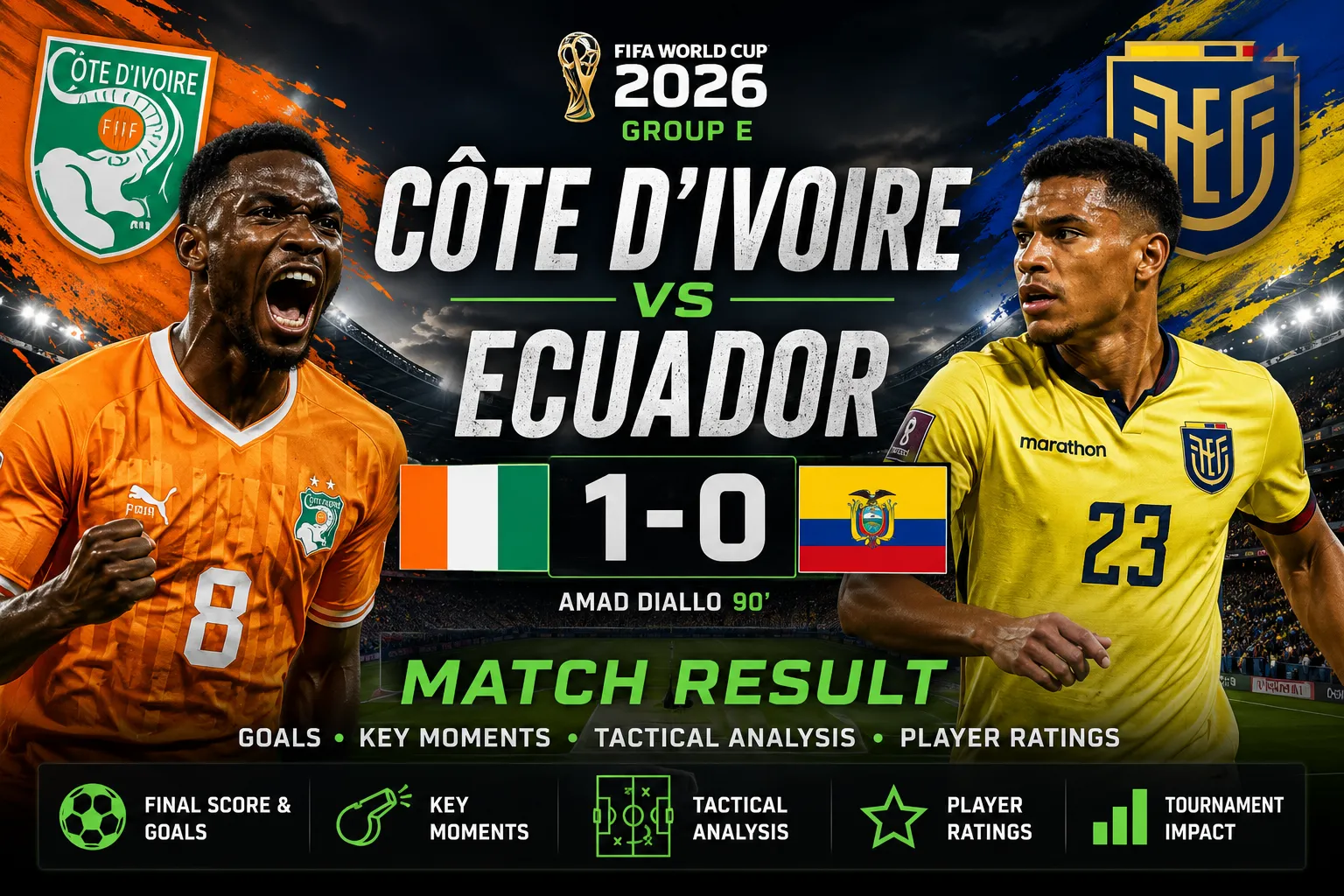
Côte d’Ivoire beat Ecuador 1-0 in their FIFA World Cup 2026 Group E opener at Philadelphia Stadium. Amad Diallo scored the only goal in the 90th minute after Wilfried Singo drove forward from the right and found him near the edge of the box. Ecuador had the better first-half chances and struck the woodwork twice through John Yeboah and Alan Minda. Côte d’Ivoire also hit the post through Elye Wahi. The main turning point was Emerse Faé’s decision to introduce Diallo and Ange-Yoan Bonny early in the second half. Yan Diomande was the match’s most persistent attacking threat. The result gave Côte d’Ivoire three crucial Group E points. Betting outcomes rewarded Côte d’Ivoire moneyline and under 1.5 goals, depending on odds and timing.
Match Information
| Detail | Information |
|---|---|
| Match | Côte d’Ivoire vs Ecuador |
| Competition | FIFA World Cup 2026 |
| Stage | Group stage |
| Group | Group E |
| Date | 14 June 2026 local time / 15 June in some broadcast regions |
| Kickoff time | 7:00 p.m. ET |
| Host country | United States |
| City | Philadelphia, Pennsylvania |
| Stadium | Philadelphia Stadium / Lincoln Financial Field |
| Final score | Côte d’Ivoire 1-0 Ecuador |
| Half-time score | Côte d’Ivoire 0-0 Ecuador |
| Attendance | Exact official attendance not confirmed in the sources used |
| Referee | François Letexier, reported after Michael Oliver’s injury withdrawal |
| VAR | Not confirmed in the sources used |
| Weather | Hot conditions; local reporting described sweltering 92-degree heat |
| Pitch condition | No major confirmed pitch controversy |
| Côte d’Ivoire formation | 4-4-2 |
| Ecuador formation | 3-4-3 |
| Goal | Amad Diallo 90’ |
| Assist | Wilfried Singo |
| Penalties | None confirmed |
| Red cards | None |
| Yellow cards | Seko Fofana, Franck Kessié, Guéla Doué, Jackson Porozo |
| Betting result | Côte d’Ivoire win; under 1.5 goals; both teams to score “No” |
Final Score and Match Summary
The Côte d’Ivoire vs Ecuador match result was 1-0, and it carried the usual World Cup lesson: a match can spend 89 minutes making a sensible argument, then let one substitute walk in and rewrite the document.
Ecuador had the cleaner first-half chances. They hit the crossbar twice. They moved the ball with more early purpose. They used their 3-4-3 to stretch Côte d’Ivoire’s 4-4-2, especially through John Yeboah, Alan Minda, Gonzalo Plata and the midfield platform of Moisés Caicedo. They looked like the side more likely to turn control into a lead.
Then they did not.
Côte d’Ivoire suffered through difficult spells, absorbed the early Ecuador rhythm, kept the match alive and waited for their bench to matter. It did. Amad Diallo entered in the 56th minute, stayed patient, and scored the winner in the 90th. Wilfried Singo made the goal with a determined surge from the right. Diallo finished with his left foot into the far corner. It was clinical. It was late. It was exactly the kind of goal that makes xG tables look at the floor.
This was Côte d’Ivoire’s first World Cup match since 2014. Their previous tournament story had often been about talent without passage. Didier Drogba’s generation carried aura but never reached the knockout stage. This team arrived with less mythology and more balance. Against Ecuador, it showed the useful side of that balance: when the game became uncomfortable, they did not panic.
Ecuador will feel robbed by themselves more than by the opponent. They created enough to score before half-time. Yeboah hit the bar. Minda hit the bar. Enner Valencia had dangerous moments. Plata forced activity down the right and later had a shot on goal. Moisés Caicedo passed and pressed with authority. But Ecuador left the match with zero goals, zero points and the special bitterness of a defeat that looked avoidable.
Côte d’Ivoire were not perfect. Their first half included too many fouls, too many late defensive reactions and too little clean build-up. Seko Fofana, Franck Kessié and Guéla Doué were all booked before the break. That is usually a sign that a team is defending with urgency rather than control. Yet they survived.
The second half shifted. Yan Diomande became more influential. Wahi had already hit the woodwork. Diallo and Bonny gave the attack fresh sharpness. Ibrahim Sangaré and Christ Inao Oulai added late midfield legs. Odilon Kossounou arrived to protect the result after the goal.
The match ended with Ecuador pushing through corners and late pressure, but Côte d’Ivoire had already taken the only goal that mattered. The final whistle left Group E with Germany and Côte d’Ivoire on three points, Ecuador and Curaçao on zero. Germany’s 7-1 demolition of Curaçao gave the group an obvious favourite. Côte d’Ivoire’s win gave it a real fight for second place, and possibly more.
Goal Timeline
90’ — Amad Diallo, Côte d’Ivoire, open-play goal
Côte d’Ivoire’s goal came from the right side and from the exact kind of late-game action Ecuador had to avoid.
Wilfried Singo drove forward with power. He carried the ball into Ecuador’s defensive third and forced the back line to retreat. That mattered. Ecuador had defended most of the second half with decent structure, but late in a hot match, one defender stepping back half a metre can open the entire finish.
Singo’s pass found Amad Diallo near the edge of the box. Diallo allowed the ball to run across his body and struck first time with his left foot. The finish went into the far corner.
It was a substitute’s goal in the cleanest sense. Diallo had not needed 90 minutes of rhythm. He needed one correct body shape and one calm touch at the moment when the match stopped being theoretical.
Tactically, the goal rewarded Côte d’Ivoire’s second-half adjustment. The Ivorians had introduced more speed and directness after the break. Diallo gave them a left-footed finisher who could attack inside channels. Singo, though listed as a defender, had the athletic profile to create the overload from deep.
Emotionally, it was brutal for Ecuador. They had hit the woodwork. They had created early danger. They had kept Côte d’Ivoire scoreless for almost the entire match. Then one late move punished them. This is why football coaches age badly.
VAR involvement on the goal was not confirmed in the sources used. No offside or handball reversal changed the goal.
Key Moments That Changed the Match
Moisés Caicedo’s early shot
The match opened with Ecuador getting an early shot through Moisés Caicedo. That mattered because it showed the shape of Ecuador’s plan immediately. They wanted to make the midfield active, not decorative.
Caicedo was not only there to destroy. He carried Ecuador’s tempo, stepped into challenges and helped the team squeeze Côte d’Ivoire’s first line. His early involvement settled Ecuador.
John Yeboah and Alan Minda hit the woodwork
Ecuador’s best first-half spell included two shots that struck the crossbar. John Yeboah hit the frame. Alan Minda did the same.
Those moments shaped the whole match. Ecuador had the lead within reach and missed it by inches. Football has no column for “almost deserved.” It only has the scoreboard, which remains a cold little machine.
The woodwork also gave Côte d’Ivoire a warning. Ecuador could break through wide and central channels. Côte d’Ivoire needed to defend more cleanly or change the match’s rhythm.
Seko Fofana, Franck Kessié and Guéla Doué booked
Côte d’Ivoire collected three first-half yellow cards. Seko Fofana was booked in the 28th minute. Franck Kessié followed in the 38th. Guéla Doué was booked in the 40th.
This was not random. Ecuador’s speed and movement forced Côte d’Ivoire into recovery fouls. The Ivorians had to defend while slightly late to several actions.
The bookings mattered tactically because they reduced aggression. A booked midfielder cannot tackle with the same freedom. A booked full-back has to think twice before stopping a winger. That is how a match slowly narrows your options.
Elye Wahi hits the post
Côte d’Ivoire had their own woodwork moment through Elye Wahi. That chance kept the match balanced in a deeper way. Ecuador had the better early openings, but Côte d’Ivoire were not passive.
Wahi’s post shot also showed why Ecuador could not fully relax. Côte d’Ivoire had enough pace and forward quality to score even when their possession was imperfect.
Amad Diallo enters in the 56th minute
Emerse Faé made the key attacking change early in the second half. Amad Diallo replaced Bazoumana Touré in the 56th minute. Ange-Yoan Bonny also entered for Elye Wahi.
This was the first major turning point from the bench. The starting attack had worked hard but had not found the final action. Diallo changed the rhythm. He gave Côte d’Ivoire a player who could receive between lines, cut inside and finish quickly.
Tournament football often rewards the coach who changes the match before it forces him to. Faé did that.
Ecuador’s 62nd-minute defensive changes
Ecuador introduced Jackson Porozo and Angelo Preciado in the 62nd minute. Porozo later received a yellow card. These changes shifted Ecuador’s right-side and back-line dynamics.
The idea was understandable. Ecuador wanted fresh legs and defensive control. But the final minutes showed the danger of managing a 0-0 without taking the lead first. Protecting a draw before securing a goal can become a strangely expensive hobby.
Gonzalo Plata tests the goalkeeper
Plata had a shot on goal in the 68th minute. It was one of Ecuador’s better second-half moments and showed that they still carried threat after the substitutions.
Still, Ecuador’s attacks became less clean as the match moved beyond 70 minutes. The first-half sharpness faded. The heat, the missed chances and Côte d’Ivoire’s fresher attackers changed the match’s emotional weight.
Amad Diallo scores in the 90th minute
The decisive moment came late. Singo drove. Diallo finished. Ecuador’s structure cracked once.
That was enough.
First Half Analysis
Côte d’Ivoire started in a 4-4-2. Yahia Fofana was in goal. Ghislain Konan, Emmanuel Agbadou, Wilfried Singo and Guéla Doué formed the defensive line. Yan Diomande, Seko Fofana, Franck Kessié, Nicolas Pépé and Bazoumana Touré were part of the midfield and attacking support structure around Elye Wahi.
Ecuador started in a 3-4-3. Hernán Galíndez was in goal. Piero Hincapié, Joel Ordóñez and Willian Pacho formed the back three. Alan Minda, Pedro Vite, Alan Franco and Moisés Caicedo worked through midfield and wing zones. Gonzalo Plata, Enner Valencia and John Yeboah formed the attacking line.
The formations created a clear tactical problem for Côte d’Ivoire. Ecuador’s back three gave them a free man in build-up. Their wing-backs and wide forwards could then stretch Côte d’Ivoire’s full-backs and wide midfielders. When Ecuador moved the ball quickly, the Ivorians had to choose between stepping out and leaving space behind, or staying compact and allowing Ecuador territory.
Ecuador controlled much of the early rhythm. Caicedo’s energy in midfield set the tone. Alan Franco supported the structure. Pedro Vite helped Ecuador link passes. Yeboah and Minda attacked space aggressively. Plata drifted into dangerous zones and looked to isolate defenders.
Côte d’Ivoire’s first-half issue was timing. Their midfield press arrived half a second late too often. That was enough to create fouls. Seko Fofana, Kessié and Doué all went into the book before half-time. The yellow cards were the match telling Côte d’Ivoire to calm down.
Still, Côte d’Ivoire were not trapped. Diomande looked lively whenever he received facing forward. Pépé’s set-piece delivery gave Ecuador something to defend. Wahi’s movement gave the centre-backs problems, and his shot against the woodwork reminded Ecuador that dominance without finishing is just possession wearing a suit.
The half ended 0-0. Ecuador had the better chances. Côte d’Ivoire had survived the worst of them. The scoreline was not exactly kind to Ecuador, but it was not absurd either. Both teams had hit the frame of the goal. Both had shown attacking threat. Neither had produced the one finish that separates analysis from result.
For Emerse Faé, the half-time message was clear: reduce fouls, release Diomande earlier, and get more support near Wahi. For Sebastián Beccacece, the task was more annoying: keep the same intensity, but turn chances into goals. Managers enjoy saying that. Players have to do it.
Second Half Analysis
The second half shifted gradually toward Côte d’Ivoire.
Not immediately. Ecuador still had moments after the break. Enner Valencia took a shot early in the second half. Pedro Vite also had an effort. Ecuador’s structure remained functional. But the match began to lose its first-half rhythm.
The heat mattered. Philadelphia’s conditions were heavy. A high-tempo first half was expensive. Ecuador had spent a lot of energy attacking wide spaces and pressing second balls. Côte d’Ivoire’s first-half bookings also forced them to be more controlled after the interval. The result was a match that became more tactical and less frantic.
Faé acted first in attack. Diallo and Bonny entered in the 56th minute. That gave Côte d’Ivoire fresh legs and a different set of movements. Wahi had been dangerous but also inefficient. Bonny offered a new physical reference. Diallo gave the team a left-footed creator-finisher who could operate from the right or central pocket.
Diomande became more important after those changes. His dribbling forced Ecuador backward. He had shots around the 50th and 58th minutes and took a corner in the 60th. The teenager’s impact was not just a set of numbers. He made Ecuador’s defenders feel that every isolated duel could become trouble.
Ecuador made changes of their own. Nilson Angulo came on for Alan Minda. Jackson Porozo and Angelo Preciado entered around the hour. Kevin Rodríguez later replaced Enner Valencia. The substitutions made sense individually, but Ecuador never fully regained the early sharpness.
Côte d’Ivoire’s midfield changes also mattered. Ibrahim Sangaré and Christ Inao Oulai came on in the 77th minute. Sangaré gave the Ivorians late ballast in midfield. Oulai added energy to press second balls. When a match reaches 80 minutes at 0-0, fresh legs stop being cosmetic. They become policy.
The final 15 minutes were not one-way traffic. Ecuador still had set pieces and late corners. Ordóñez had an 88th-minute shot. Angulo took a corner. Caicedo delivered late corners in stoppage time. Ecuador were not dead. They were only wasteful.
Then Singo and Diallo decided the match.
After the goal, Odilon Kossounou replaced Doué in the 89th-minute sequence listed by FOX’s play-by-play. Côte d’Ivoire closed the game with a defender’s instinct. Ecuador tried to answer with corners and pressure, but the equaliser never came.
The second half showed the difference between chance creation and match management. Ecuador had enough chances to be ahead. Côte d’Ivoire had enough patience to wait for the one that arrived.
Tactical Picture: Why Côte d’Ivoire Won and Ecuador Lost
Côte d’Ivoire won because they survived Ecuador’s best spell, improved through substitutions and produced the cleaner late finish.
The starting 4-4-2 had problems against Ecuador’s 3-4-3. Ecuador’s back three allowed them to circulate around Côte d’Ivoire’s two forwards. Caicedo and Franco then had angles into midfield. The wing-backs stretched the Ivorian wide players, and Yeboah, Minda and Plata attacked the spaces between full-back and centre-back.
That structure created Ecuador’s first-half chances. It also created the Ivorian yellow cards. Côte d’Ivoire were often forced into recovery defending. When a team’s midfielders and right-back are booked before half-time, the press is usually not functioning as designed.
Yet Côte d’Ivoire had two things that kept them alive: athletic defenders and transition threat. Singo, Agbadou, Konan and Doué could defend large spaces. Diomande, Wahi and Pépé gave them a way to attack when Ecuador’s shape stretched.
The second half changed the match because the benches changed the match. Diallo gave Côte d’Ivoire better decision-making in the final third. Bonny added a different forward reference. Sangaré gave the midfield more security. Oulai gave energy. Kossounou gave late defensive insurance.
Ecuador’s problem was not one tactical disaster. It was the failure to score when their tactical plan worked. Their 3-4-3 gave them routes into the Ivorian half. Their attackers hit the woodwork. Their midfield controlled enough of the first half. But they never turned that superiority into a lead.
After 60 minutes, Ecuador’s intensity dropped. The first-half width became less constant. Valencia left in the 76th minute. Yeboah had already gone off. Minda had gone off. The front line changed, but the threat did not grow.
Côte d’Ivoire then found the decisive overload. Singo’s late run mattered because Ecuador’s left-side defensive reaction was delayed. Diallo’s finish mattered because it was not rushed. One action exposed the danger of a 0-0 match: no matter how many chances you have wasted, the opponent still needs only one good one.
This was not a robbery. It was a warning. Ecuador did enough to deserve a goal. Côte d’Ivoire did enough to deserve the win because they scored the goal. Football remains primitive in that way.
Player Ratings and Individual Performances
These ratings are editorial assessments based on match influence, tactical role, confirmed events and available public match data.
Côte d’Ivoire Player Ratings
Yahia Fofana — 7/10
Kept the clean sheet in a match where Ecuador hit the woodwork and created several dangerous situations. His handling and positioning gave Côte d’Ivoire a stable base.
Ghislain Konan — 6.5/10
Handled difficult wide defensive work and supported attacks when possible. He had to manage Ecuador’s right-sided movement and did not always get help early.
Emmanuel Agbadou — 7/10
Important in central defensive duels. Ecuador’s movement caused problems, but Agbadou held the box well enough to keep the score level.
Wilfried Singo — 8/10
Defended with power and produced the decisive assist. His late run created the winning goal. That is a defender’s full-service match.
Guéla Doué — 6/10
Booked in the first half and had to defend carefully from there. Replaced late by Kossounou after a demanding match.
Yan Diomande — 8/10
One of Côte d’Ivoire’s brightest players. He carried the ball, created pressure, took shots and forced Ecuador’s defence to retreat. The goal was Diallo’s, but Diomande kept the Ivorian attack alive.
Seko Fofana — 6/10
Booked in the first half and had shots after the break. His energy mattered, but his early disciplinary risk limited him.
Franck Kessié — 6.5/10
Booked before half-time but remained an important midfield presence. His leadership and physical control helped Côte d’Ivoire survive Ecuador’s stronger spells.
Nicolas Pépé — 6/10
Offered set-piece delivery and flashes of quality, but did not dominate. Replaced in the 76th minute.
Bazoumana Touré — 5.5/10
Started but was replaced by Diallo in the 56th minute. Worked hard, though the attack improved after the substitution.
Elye Wahi — 6.5/10
Hit the woodwork and gave Ecuador’s centre-backs work. Replaced by Bonny early in the second half.
Amad Diallo — 8.5/10
Entered in the 56th minute and scored the winner in the 90th. Two shots on goal and the decisive finish. Efficient, cold, and useful.
Ange-Yoan Bonny — 6.5/10
Added a fresh forward profile and helped stretch Ecuador’s defensive line after replacing Wahi.
Christ Inao Oulai — 6.5/10
Brought late midfield energy and had a stoppage-time shot. Useful bench impact.
Ibrahim Sangaré — 6.5/10
Helped stabilize midfield late. His presence mattered as Côte d’Ivoire moved from chasing a goal to protecting a lead.
Odilon Kossounou — 6/10
Entered late to help close the match. Limited time, but the role was clear.
Ecuador Player Ratings
Hernán Galíndez — 7/10
Made four saves according to FOX key-player data. Could not stop Diallo’s precise finish. Kept Ecuador in the match before the late goal.
Piero Hincapié — 6.5/10
Strong for much of the match in the back three. Had to cover wide channels when Côte d’Ivoire improved after the break.
Joel Ordóñez — 6.5/10
Defended well for long stretches and had a late shot. Part of a defence that was close to a clean sheet until the 90th minute.
Willian Pacho — 6.5/10
Mostly composed and strong in central duels. Diallo’s goal damages the collective defensive rating rather than one individual alone.
Alan Minda — 7/10
Hit the crossbar and caused early problems. Replaced in the 56th minute. Ecuador lost some of his directness afterward.
Alan Franco — 6/10
Worked in midfield but was replaced in the 62nd minute. Ecuador needed more control after the hour.
Moisés Caicedo — 7.5/10
One of Ecuador’s best players. Had an early shot, delivered late corners, completed heavy midfield work and kept Ecuador’s tempo alive.
Pedro Vite — 6.5/10
Linked play well at times and had a second-half shot. Needed one sharper final action.
Gonzalo Plata — 7/10
Ecuador’s most persistent second-half attacking outlet. Had a shot on goal and took set pieces.
Enner Valencia — 6/10
Worked hard and had a second-half effort, but Ecuador needed more from their senior striker. Replaced in the 76th minute.
John Yeboah — 6.5/10
Hit the woodwork and gave Côte d’Ivoire trouble early. Replaced in the 61st minute.
Nilson Angulo — 6/10
Entered for Minda and gave fresh energy, including late set-piece involvement.
Jackson Porozo — 5.5/10
Came on in the 62nd minute and was booked in the 73rd. The caution limited his aggression.
Angelo Preciado — 6/10
Added legs on the flank but could not prevent Côte d’Ivoire’s late right-side action.
Kevin Rodríguez — 6/10
Came on for Valencia and tried to add forward running. Limited service.
Best Players of the Match
Man of the Match: Amad Diallo
The match needed a goal. Diallo scored it. He came off the bench, stayed composed and delivered the finish that gave Côte d’Ivoire three points.
Best attacker: Yan Diomande
Diallo gets the headline, but Diomande was the constant threat. His speed, dribbling and courage pushed Ecuador back after the break.
Best midfielder: Moisés Caicedo
Caicedo gave Ecuador energy, structure and late set-piece delivery. He did not deserve to be reduced to the final score, but football is rarely sentimental.
Best defender: Wilfried Singo
Singo defended and created the winner. His late run was the match’s decisive attacking action.
Best goalkeeper: Hernán Galíndez
Galíndez made four saves and kept Ecuador alive until the final minute. Fofana kept the clean sheet, but Galíndez faced the more defined save burden.
Best substitute: Amad Diallo
This category is not close. Diallo entered, changed the threat level and scored.
Most underrated performance: Emmanuel Agbadou
Agbadou’s defensive work helped Côte d’Ivoire survive Ecuador’s better first-half rhythm. Clean sheets are rarely built by one player, but he was central to this one.
Most disappointing performance: Ecuador’s finishing unit
This is not about one player. Ecuador hit the woodwork and failed to convert. In a 1-0 loss, that becomes the whole story.
Injuries, Suspensions, Cards, and Discipline
There were no red cards.
Côte d’Ivoire had three confirmed yellow cards: Seko Fofana in the 28th minute, Franck Kessié in the 38th and Guéla Doué in the 40th. Ecuador had one confirmed yellow card: Jackson Porozo in the 73rd minute.
The Ivorian bookings were important because they came early. Fofana and Kessié form part of the midfield engine. Once both were booked, Côte d’Ivoire had to defend with more calculation. Doué’s booking also affected the right side, especially against Ecuador’s wide speed.
Porozo’s yellow mattered because he had come on to help stabilize Ecuador’s defence. A substitute defender booked within 15 minutes of entering is not ideal. It reduces flexibility in duels, especially against dribblers and late runners.
No major injury was confirmed as central to the match report. There were no confirmed concussion checks, no red cards, and no suspension triggered directly by this match. Still, yellow-card accumulation matters in the group. Côte d’Ivoire will not want Fofana, Kessié or Doué entering the Germany match with reckless habits.
Referee and VAR Analysis
François Letexier was reported as the referee after Michael Oliver withdrew through injury. The match did not become a VAR-driven spectacle, which counts as a public service.
The main officiating story was discipline. Côte d’Ivoire collected three first-half yellow cards, all for serious foul play according to FOX’s play-by-play terminology. Ecuador received one yellow through Jackson Porozo.
There were no confirmed penalties. There were no red cards. There was no confirmed disallowed goal that shaped the scoreline.
Letexier’s control of the match was firm enough without making the referee the main event. Ecuador may feel that Côte d’Ivoire’s first-half fouls disrupted rhythm, but the cautions were issued. Côte d’Ivoire may feel they had to defend physically because Ecuador’s early movement created overloads. Both can be true.
VAR did not overturn the match’s decisive moment. Diallo’s goal stood. The late Ecuador corners created tension, not controversy.
The referee influenced the match mainly through the yellow-card pattern. Côte d’Ivoire had to manage discipline after the first half. They did it well enough. That matters before the Germany match, where repeated fouls in central zones could become more expensive.
Weather, Stadium, Pitch, and Match Conditions
The match was played at Philadelphia Stadium, the World Cup name for Lincoln Financial Field.
Local reporting described sweltering 92-degree heat around the city’s first World Cup match. That matters. Heat affects pressing, sprint recovery, concentration and late defensive decisions. It does not explain every missed chance, but it changes the physical bill.
The stadium produced a strong match atmosphere. Philadelphia’s first World Cup hosting moment brought colour, noise and a crowd with heavy Ecuadorian presence. The city turned yellow in the stands and around the stadium. Côte d’Ivoire then spent 90 minutes making that colour scheme slightly less convenient.
No major pitch controversy was confirmed. There was no reliable report in the sources used of a surface failure, abnormal bounce pattern or weather delay that changed the match.
The heat likely contributed to the second-half drop in tempo. Ecuador’s early sharpness faded. Côte d’Ivoire’s bench became more valuable. Late substitutions mattered. In hot matches, the 70th minute often becomes less about tactical elegance and more about who still has legs that answer emails.
The ball moved normally enough for both teams to create chances. The deciding factor was not the surface. It was finishing.
Fans and Stadium Atmosphere
The crowd leaned visibly toward Ecuador in colour and volume for long stretches. That was expected. Ecuadorian supporters travelled heavily and turned Philadelphia into a yellow-and-blue event.
Côte d’Ivoire’s support was smaller but had the better final scene. When Diallo scored, the Ivorian section had the kind of eruption that only a late World Cup goal can produce. A 90th-minute winner does not need a majority crowd. It makes its own noise.
The atmosphere carried a special local layer because this was Philadelphia’s first World Cup match. Tailgates, street colour and the stadium setting made the event feel bigger than an ordinary neutral-site group game.
The emotional swing was sharp. Ecuador’s fans had watched two first-half woodwork strikes, several promising attacks and a team that looked capable of winning. Côte d’Ivoire’s fans had watched survival, then substitution, then theft with legal paperwork.
That is World Cup atmosphere at its best and worst. One side spends 89 minutes believing. The other takes the song at the end.
Historical Context and World Cup Analogies
Côte d’Ivoire returned to the World Cup after missing 2018 and 2022. Their last appearance came in 2014. Their previous squads often carried famous attacking names, but the country had never moved beyond the group stage.
That history gives this win weight. One opening victory does not create a knockout campaign by itself. But in a group with Germany, Ecuador and Curaçao, beating Ecuador changes the map.
Ecuador entered with a strong defensive reputation. They had finished second in South American qualifying and were riding a long unbeaten run. That run ended in Philadelphia. The loss will irritate them because it did not come from being dominated. It came from failing to convert chances.
There is a wider World Cup analogy here: the technically cleaner side creates chances, does not score, and then loses to a late substitute. This script is older than most tournament mascots. It keeps returning because coaches still cannot make the ball hit the inside of the post by tactical instruction.
Côte d’Ivoire’s win also fits a different African World Cup pattern: athletic, resilient, slightly chaotic, but increasingly mature. The old cliché of “raw talent” does not apply neatly here. Faé’s team managed the second half with intent. They used the bench well. They defended a difficult first half and grew into the match.
Ecuador’s comparison is harsher. This looked like the kind of defeat that strong teams suffer when their finishing goes cold. It was not a collapse. It was waste, and waste at the World Cup has a habit of becoming destiny.
Match Statistics
Full official possession, xG, pass accuracy and complete team-stat data were not available from the sources used for this article. The table below uses confirmed public match events and available box-score indicators.
| Statistic / Event | Côte d’Ivoire | Ecuador |
|---|---|---|
| Final score | 1 | 0 |
| Half-time score | 0 | 0 |
| Goals | Amad Diallo 90’ | 0 |
| Assists | Wilfried Singo | 0 |
| Formation | 4-4-2 | 3-4-3 |
| Red cards | 0 | 0 |
| Confirmed yellow cards | 3 | 1 |
| Woodwork | Elye Wahi hit the woodwork | John Yeboah and Alan Minda hit the crossbar |
| Key goalkeeper data | Yahia Fofana clean sheet | Hernán Galíndez 4 saves |
| Betting total | Under 1.5 landed | Under 1.5 landed |
| Both teams to score | No | No |
Available Key Player Data
| Player | Team | Available public key data |
|---|---|---|
| Amad Diallo | Côte d’Ivoire | 1 goal, 2 shots on goal, 16 passes |
| Yan Diomande | Côte d’Ivoire | 2 shots, 42 passes |
| Hernán Galíndez | Ecuador | 4 saves, 24 passes |
| Moisés Caicedo | Ecuador | 1 shot, 61 passes |
The numbers that are available support the match story. Ecuador created major chances but failed to score. Côte d’Ivoire had the better late execution. Galíndez made saves, Caicedo carried midfield activity, Diomande gave Côte d’Ivoire energy, and Diallo supplied the finish.
The missing data also matters. Without verified xG and possession numbers from the sources used here, it would be wrong to invent a statistical dominance claim. The safe reading is event-based: Ecuador had the better first-half chances; Côte d’Ivoire improved after changes; Diallo decided the match.
Betting Result Angle
The Côte d’Ivoire vs Ecuador betting result rewarded bettors who backed the Ivorian underdog and a low-scoring match.
FOX’s odds page listed Côte d’Ivoire at +228 to win. That means the match-winner market paid a strong underdog-style return for Côte d’Ivoire backers. Ecuador match-winner bets lost. The draw also lost, despite looking alive until the 90th minute.
The total goals line listed by FOX was 1.5. The match produced one goal, so under 1.5 landed. That is a rare kind of under: not quiet, not sterile, but still under. Woodwork, saves and late pressure do not count on a total. The market only counts goals. It is cruelly literal.
Both teams to score “No” landed. Côte d’Ivoire scored once. Ecuador did not score. Clean-sheet markets on Côte d’Ivoire also landed.
Correct score 1-0 Côte d’Ivoire landed for anyone who took that high-risk angle. It required Ecuador’s missed chances, Galíndez saves, Ivorian patience and a late Diallo goal. That is exactly why correct-score betting is volatile. It can look dead for 89 minutes, then cash from one left-footed finish.
First goalscorer markets were settled by Diallo. Anytime goalscorer markets on Diallo landed. Wahi, Valencia, Yeboah, Minda, Pépé and others failed despite good shooting positions or attacking involvement.
Cards markets depended on the line. Four confirmed yellow cards gave moderate-card markets relevance. Côte d’Ivoire’s three first-half bookings would have been valuable for live bettors watching Ecuador’s early control and Ivorian late tackles.
Corners markets were also active late, with Ecuador taking stoppage-time corners through Caicedo. But without a full verified corner count in the sources used, this article should not present a settled total.
The main betting lesson is simple. A team can have the better early chances and still lose. Ecuador’s first-half pressure did not make them a safe live side. Côte d’Ivoire’s bench quality mattered. So did price. This does not mean the same angle will work next time.
No betting outcome is guaranteed. Odds move before and during matches. One substitution, one missed chance, one post, one late finish can change everything.
What This Result Means for Group E
Côte d’Ivoire moved to three points. Ecuador stayed on zero.
Germany beat Curaçao 7-1 in the other Group E match, so Germany took early control of the group on goal difference. Côte d’Ivoire joined them on three points, while Ecuador and Curaçao began with defeats.
That creates a sharp second matchday. Côte d’Ivoire next face Germany. Ecuador next face Curaçao. The structure is obvious.
For Côte d’Ivoire, the win gives breathing room. Even if Germany are the group favourite, the Ivorians now have three points before facing them. A draw against Germany would be excellent. A defeat would not destroy them if they can handle Curaçao in the final match.
For Ecuador, the Curaçao match becomes close to mandatory. A win restores their route. A draw would leave them under pressure before facing Germany. A defeat would be a major blow.
Goal difference matters. Germany’s 7-1 win gives them a huge advantage. Côte d’Ivoire’s +1 is useful but modest. Ecuador’s -1 is not catastrophic, but it leaves them needing efficiency.
In the expanded 48-team format, some third-placed teams can advance. That helps Ecuador slightly. But relying on the third-place route after losing the opener is not a plan. It is an argument with arithmetic.
What Côte d’Ivoire Did Right
Côte d’Ivoire did not let the first half define the match.
That was the biggest positive. Ecuador hit the bar twice, found early rhythm and forced Ivorian players into bookings. A less composed team might have collapsed into desperate defending. Côte d’Ivoire adjusted.
The defensive line survived. Fofana kept the clean sheet. Agbadou and Singo handled difficult duels. Konan worked through wide pressure. Doué defended carefully after his booking.
The substitutions were decisive. Diallo scored. Bonny added fresh forward movement. Sangaré and Oulai helped late. Kossounou came in to close the result.
Diomande’s performance was another major positive. He gave Côte d’Ivoire a fearless ball-carrier and forced Ecuador to defend facing their own goal. That changed the emotional direction of the second half.
Côte d’Ivoire also managed the final minutes well after scoring. Ecuador had late corners, but the Ivorians did not surrender the clear equalising chance.
The biggest improvement point is discipline. Three yellow cards before half-time is dangerous. Against Germany, that pattern could become ruinous.
What Ecuador Got Wrong
Ecuador’s biggest failure was finishing.
They had the chances. They hit the woodwork. They found promising positions. They forced Côte d’Ivoire into early defensive problems. They did not score.
That is not a minor flaw in a 1-0 defeat. It is the flaw.
The second issue was second-half control. Ecuador’s first-half width and movement faded after the break. The substitutions did not restore dominance. Once Côte d’Ivoire introduced Diallo and Bonny, Ecuador had to defend more transitions.
The third issue was late concentration. Singo’s run should have been stopped earlier. Diallo should not have received with enough time to let the ball run across his body. In minute 90, defending is often about panic management. Ecuador failed one action.
The fourth issue was emotional patience. As the match stayed 0-0, Ecuador looked increasingly like a team aware of its missed chances. That is a dangerous mental state. It makes every attack heavier.
Beccacece’s side are not broken. They remain technically strong and defensively serious. But the Curaçao match now demands precision. Another wasteful performance would turn a strong group-stage squad into a nervous one.
Coach Analysis
Emerse Faé
Faé deserves credit.
His starting structure had problems in the first half, but his team stayed alive. Then he changed the match early enough. Diallo and Bonny came on in the 56th minute. That was not a token change. It was a direct attempt to alter the attack.
Diallo scored. That makes the decision look clean. It was also tactically coherent before the goal. Côte d’Ivoire needed a player who could receive inside, combine quickly and finish from the edge of the area. Diallo offered that.
Faé’s late changes also made sense. Sangaré and Oulai gave midfield energy. Kossounou helped close the result. The bench was not just used. It was used with purpose.
The criticism is first-half discipline and midfield control. Against Germany, Côte d’Ivoire cannot afford three early yellow cards and repeated recovery fouls. Faé must tighten the first pressing line and reduce the space between midfield and defence.
Still, this was a major tournament win. Coaches are paid to solve matches. Faé solved this one with the bench.
Sebastián Beccacece
Beccacece’s starting plan worked for much of the first half.
The 3-4-3 gave Ecuador strong width, midfield access and several good chances. Caicedo helped control the tempo. Yeboah and Minda stretched Côte d’Ivoire. Valencia and Plata occupied defenders. The structure was good enough to produce a lead.
The problem is that it did not produce the lead.
Beccacece’s substitutions were logical but not decisive. Angulo, Porozo, Preciado and Kevin Rodríguez entered, but Ecuador lost some early clarity. The team remained competitive, yet it did not create the same high-quality pressure late.
The coach will also look at late defensive management. If a team cannot score, it must at least protect the draw. Ecuador failed in the final minute.
Beccacece does not need a complete redesign before Curaçao. He needs better finishing, sharper late concentration and perhaps a clearer plan for sustaining wing threat after the first hour.
Player Milestones and Records
Amad Diallo scored a decisive World Cup goal for Côte d’Ivoire. It was a major personal moment and a perfect bench contribution.
Côte d’Ivoire earned their first World Cup win since returning to the tournament after a 12-year absence. They had last appeared in 2014. The win also strengthens their push to reach the knockout stage for the first time.
Yan Diomande, still a teenager, delivered a breakout World Cup performance. He did not score, but his dribbling, confidence and second-half influence made him one of the storylines of the match.
Ecuador’s defeat ended their long unbeaten run. They arrived with a strong defensive and qualifying reputation but left Philadelphia with their first loss in a significant stretch.
No confirmed youngest scorer, oldest scorer, national scoring record or appearance record was verified in the sources used for this article.
The most important team milestone is simple: Côte d’Ivoire started Group E with three points. For a nation still chasing its first World Cup knockout appearance, that is not small.
Incidents and Controversies
There was no major confirmed VAR controversy.
There was no penalty. There was no red card. No confirmed disallowed goal changed the result.
The main post-match incident around Côte d’Ivoire in broader reporting concerned Elye Wahi and an off-field match-fixing investigation linked to club football. He played in this match and has not been reported as formally charged in the source used. That issue should be treated carefully and legally. It did not alter the match result on the pitch.
On the field, the main controversy was not legal. It was Ecuador’s finishing. Two first-half crossbar strikes and a late defensive lapse are not scandal. They are football’s normal method of being unbearable.
Côte d’Ivoire’s first-half yellow-card count may frustrate Ecuador supporters, but the referee punished those fouls with cautions. The match was physical rather than chaotic.
The late goal stood. Ecuador had stoppage-time corners after it. They did not score.
Final Verdict
Côte d’Ivoire beat Ecuador 1-0 because they endured, adjusted and finished.
Ecuador had the stronger first-half chance profile. They hit the woodwork twice. They used their 3-4-3 intelligently. They forced Côte d’Ivoire into early bookings. But they left the door open.
Côte d’Ivoire walked through it in the 90th minute.
The scoreline may feel harsh on Ecuador, but it is not unfair in the only way the World Cup table understands. Côte d’Ivoire scored. Ecuador did not. Diallo delivered. Ecuador’s attackers hit the frame and missed the net. That is the match.
For Côte d’Ivoire, this is a huge opening result. Germany remain the toughest test in the group, especially after the 7-1 win over Curaçao, but the Ivorians now have three points and belief. They also have evidence that their bench can decide matches.
For Ecuador, the defeat is damaging but not fatal. The Curaçao match now becomes essential. They need three points and probably goals. The performance had enough quality to avoid panic. The result had enough pain to demand urgency.
For bettors, the match rewarded Côte d’Ivoire moneyline, under 1.5 goals, both teams to score “No,” Côte d’Ivoire clean sheet and 1-0 correct score. It also warned against assuming that early chance quality automatically becomes a result.
The final image is Diallo sliding a left-footed shot into the corner while Ecuador’s missed chances lined up behind him like unpaid bills. Tournament football does not always reward the team that knocks first. Sometimes it waits until the last minute and rewards the one that knocks properly.
Responsible Betting Note
Football betting carries financial risk. A correct tactical analysis does not guarantee a winning bet. Odds change before and during matches, and one goal can completely alter a market. Never chase losses. Do not bet money needed for daily life. Use limits and take breaks. Check local betting laws before gambling. Betting should remain entertainment, not income.
FAQ
Côte d’Ivoire beat Ecuador 1-0 in their FIFA World Cup 2026 Group E opener.
Amad Diallo scored the only goal in the 90th minute. Wilfried Singo provided the assist.
Amad Diallo was the decisive player because he scored the winner. Yan Diomande and Wilfried Singo also had major influence for Côte d’Ivoire, while Moisés Caicedo stood out for Ecuador.
Côte d’Ivoire moved to three points, level with Germany after Germany beat Curaçao 7-1. Ecuador stayed on zero points and now need a strong response against Curaçao.
Côte d’Ivoire moneyline landed at underdog odds. Under 1.5 goals landed because the match produced one goal. Both teams to score “No” and Côte d’Ivoire clean sheet also landed.
[expert_review params=»JTdCJTIyY29sb3IlMjIlM0ElMjJncmVlbi0yJTIyJTJDJTIyZXhwZXJ0X2F2YXRhciUyMiUzQSUyMiUyMiUyQyUyMmV4cGVydF9uYW1lJTIyJTNBJTIyJTIyJTJDJTIyZXhwZXJ0X2xpbmslMjIlM0ElMjIlMjIlMkMlMjJleHBlcnRfaWQlMjIlM0ElMjIxJTIyJTJDJTIyZXhwZXJ0X3R5cGUlMjIlM0ElMjJleHBlcnRfaWQlMjIlMkMlMjJleHBlcnRfYXZhdGFyX2FsdCUyMiUzQSUyMiUyMiUyQyUyMmV4cGVydF9zaG93JTIyJTNBMSUyQyUyMmV4cGVydF9kZXNjcmlwdGlvbiUyMiUzQSUyMlNwb3J0cyUyMEJldHRpbmclMjBBbmFseXN0JTIwJTI2JTIwRWRpdG9yaWFsJTIwQ29udHJpYnV0b3IlMjIlMkMlMjJleHBlcnRfc2hvd19idXR0b24lMjIlM0ExJTJDJTIyZXhwZXJ0X3Nob3dfYnV0dG9uX3R5cGUlMjIlM0ElMjJwb3B1cCUyMiUyQyUyMmV4cGVydF9xdWVzdGlvbl9idXR0b25fdGV4dCUyMiUzQSUyMkFzayUyMFF1ZXN0aW9uJTIyJTJDJTIycXVlc3Rpb25fZXh0ZXJuYWxfbGluayUyMiUzQSUyMiUyMiUyQyUyMnBvcHVwX3VzZV9waG9uZSUyMiUzQTAlMkMlMjJleHBlcnRfdGl0bGUlMjIlM0ElMjJBdXRob3IlMjIlMkMlMjJleHBlcnRfc2hvd190aXRsZSUyMiUzQTElMkMlMjJleHBlcnRfdGV4dCUyMiUzQSUyMkFsZXglMjBNb3JnYW4lMjBpcyUyMGElMjBzcG9ydHMlMjBiZXR0aW5nJTIwYW5hbHlzdCUyMGFuZCUyMGVkaXRvcmlhbCUyMGNvbnRyaWJ1dG9yJTIwd2hvJTIwd3JpdGVzJTIwZGV0YWlsZWQlMjBib29rbWFrZXIlMjByZXZpZXdzJTJDJTIwYmV0dGluZyUyMGd1aWRlcyUyQyUyMHBsYXRmb3JtJTIwY29tcGFyaXNvbnMlMkMlMjBhbmQlMjByZXNwb25zaWJsZSUyMGdhbWJsaW5nJTIwZXhwbGFpbmVycy4lMjBIaXMlMjB3b3JrJTIwZm9jdXNlcyUyMG9uJTIwcHJhY3RpY2FsJTIwaW5mb3JtYXRpb24lMjBmb3IlMjB1c2VycyUyMHdobyUyMHdhbnQlMjB0byUyMHVuZGVyc3RhbmQlMjBob3clMjBiZXR0aW5nJTIwc2l0ZXMlMjBvcGVyYXRlJTIwYmVmb3JlJTIwdGhleSUyMHJlZ2lzdGVyJTJDJTIwZGVwb3NpdCUyQyUyMG9yJTIwY2xhaW0lMjBhJTIwYm9udXMuJTIyJTJDJTIycWElMjIlM0ElNUIlNUQlMkMlMjJxYV9zaG93X3RpdGxlJTIyJTNBMSUyQyUyMnFhX3RpdGxlJTIyJTNBJTIyJUQwJTkyJUQwJUJFJUQwJUJGJUQxJTgwJUQwJUJFJUQxJTgxJTIwJUQxJThEJUQwJUJBJUQxJTgxJUQwJUJGJUQwJUI1JUQxJTgwJUQxJTgyJUQxJTgzJTIyJTJDJTIyc2NvcmUlMjIlM0ElNUIlNUQlMkMlMjJzY29yZV9zdW1tYXJ5X3RleHQlMjIlM0ElMjIlMjIlMkMlMjJzY29yZV9zdW1tYXJ5X2F2ZXJhZ2UlMjIlM0EwJTJDJTIyc2NvcmVfbWF4JTIyJTNBJTIyNSUyMiUyQyUyMnNjb3JlX3N5bWJvbCUyMiUzQSUyMiUyMiUyQyUyMnNjb3JlX3RpdGxlJTIyJTNBJTIyJTIyJTJDJTIyc2NvcmVfc2hvd190aXRsZSUyMiUzQTAlMkMlMjJwbHVzZXMlMjIlM0ElNUIlNUQlMkMlMjJtaW51c2VzJTIyJTNBJTVCJTVEJTJDJTIycGx1c2VzX21pbnVzZXNfc2hvd190aXRsZSUyMiUzQTElMkMlMjJwbHVzZXNfbWludXNlc190aXRsZSUyMiUzQSUyMiVEMCU5RiVEMCVCQiVEMSU4RSVEMSU4MSVEMSU4QiUyMCVEMCVCOCUyMCVEMCVCQyVEMCVCOCVEMCVCRCVEMSU4MyVEMSU4MSVEMSU4QiUyMiUyQyUyMnBsdXNlc190aXRsZSUyMiUzQSUyMiUyMiUyQyUyMm1pbnVzZXNfdGl0bGUlMjIlM0ElMjIlMjIlN0Q=»]