
Curaçao vs Côte d’Ivoire Match Result
Table of Contents Show
Views 5
TL;DR: Curaçao vs Côte d’Ivoire Match Result
Côte d’Ivoire beat Curaçao 2-0 at Philadelphia Stadium through two Nicolas Pépé goals. Pépé converted Yan Diomande’s cutback in the seventh minute, then finished Ibrahim Sangaré’s through-ball in the 64th. He was the clear Man of the Match. Côte d’Ivoire controlled 63% possession, passed through Curaçao’s compact block with greater patience and created the only two recognised big chances. Curaçao remained competitive between the goals but lacked penalty-box quality. Philadelphia reached 87°F before the afternoon kickoff, although no verified evidence shows that heat independently decided the match. Côte d’Ivoire finished second in Group E and reached the knockout stage for the first time; Curaçao’s debut campaign ended. The Côte d’Ivoire moneyline and under 3.5 goals won, but returns depended on the bookmaker and market timing. (ESPN.com)
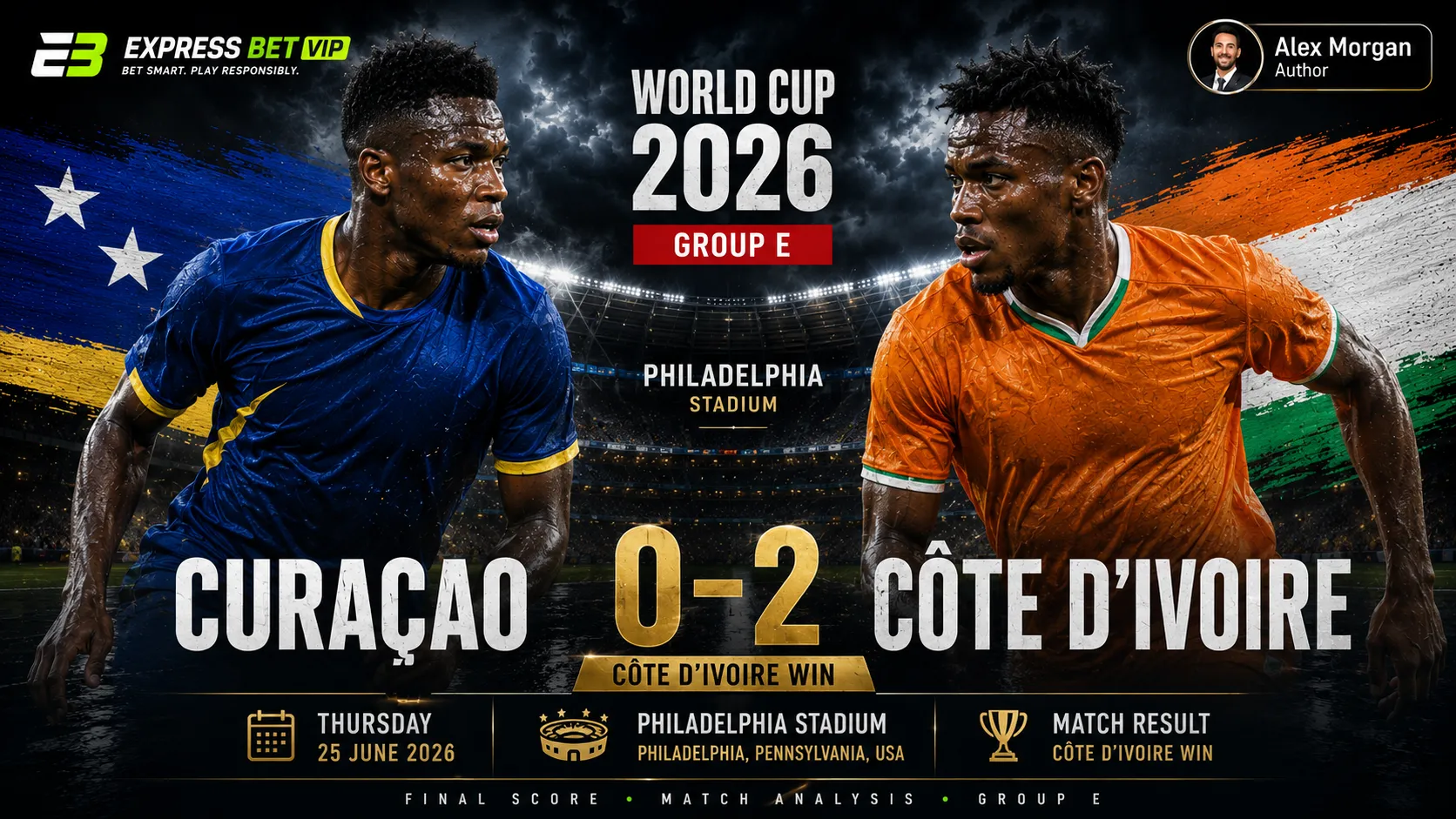
Quick Facts: Final Score, Goals, Venue, and Match Status
| Item | Verified detail |
|---|---|
| Match | Curaçao vs Côte d’Ivoire |
| Competition | FIFA World Cup 2026 |
| Stage | Group stage, Matchday 3 |
| Group | Group E |
| Date | June 25, 2026 |
| Kickoff | 16:00 EDT / 20:00 UTC |
| Host country | United States |
| City | Philadelphia, Pennsylvania |
| Stadium | Philadelphia Stadium |
| Regular stadium name | Lincoln Financial Field |
| Attendance | 68,324 reported |
| Final score | Curaçao 0-2 Côte d’Ivoire |
| Half-time score | Curaçao 0-1 Côte d’Ivoire |
| Goals | Nicolas Pépé 7’, 64’ |
| Assists | Yan Diomande, Ibrahim Sangaré |
| Referee | Glenn Nyberg |
| VAR | Not available from verified public data |
| Daily temperature high | 87°F / approximately 31°C |
| Pitch | Temporary natural bermudagrass-based tournament surface |
| Main tournament impact | Côte d’Ivoire qualified in second place; Curaçao were eliminated |
FIFA confirms the match date, venue, kickoff and score. ESPN and Reuters confirm the goals, lineups and referee, while the National Weather Service recorded Philadelphia’s 87°F daily maximum. (FIFA)
Verified Facts vs Analysis
| Category | Information |
|---|---|
| [CONFIRMED] | Côte d’Ivoire won 2-0 after leading 1-0 at half-time. |
| [CONFIRMED] | Pépé scored in the seventh and 64th minutes. |
| [CONFIRMED] | Diomande and Sangaré supplied the assists. |
| [REPORTED] | Attendance was 68,324, matching the venue’s FIFA capacity. |
| [OBSERVED] | Curaçao defended compactly but struggled to progress through central areas. |
| [ANALYSIS] | Côte d’Ivoire’s wide rotations and faster forward passing created the decisive chances. |
| [MARKET SIGNAL] | Côte d’Ivoire were priced between roughly -550 and -650 near kickoff. |
| [DISPUTED] | ESPN and FOX reported different save totals for Yahia Fofana. |
| [UNKNOWN] | Complete VAR crew, precise stadium weather and tracking metrics. |
This distinction matters because the result and goal times are official events, while the explanation of why those events occurred is analytical. Search engines and AI summaries can flatten those categories. A reliable match report should not.
Provider disagreements are also normal. ESPN credited Fofana with two saves in its team statistics, while FOX’s player summary listed three. That variation does not alter the clean sheet, but it should prevent false precision. (ESPN.com)
Final Score and Match Summary
Côte d’Ivoire entered the final Group E fixture knowing that a draw would probably be enough and a win would remove the remaining uncertainty. Curaçao needed victory to create a plausible route into the best-third-place ranking. One team could manage the table. The other had to disturb it. (ESPN.com)
Emerse Faé made four changes from the 2-1 defeat by Germany. Nicolas Pépé entered the attacking line, while Ousmane Diomande, Guéla Doué and Christopher Operi came into defence. Dick Advocaat retained the Curaçao XI that had drawn 0-0 with Ecuador. Reuters listed Curaçao in a 5-4-1 and Côte d’Ivoire with a more attacking selection built around Pépé, Amad Diallo, Yan Diomande and Ange-Yoan Bonny. (Reuters)
The selection change produced an immediate return. Côte d’Ivoire scored after seven minutes when Yan Diomande exploited a Curaçao defensive error on the left and cut the ball back for Pépé. The forward finished first time from close range. Curaçao’s entire tournament equation changed before the match had developed a normal rhythm. (ESPN.com)
Côte d’Ivoire did not turn the early goal into an immediate rout. Curaçao recovered its compact shape and prevented the Elephants from creating a continuous series of clear chances. Tahith Chong attempted three shots, while Leandro Bacuna and Juninho Bacuna tried to support Jürgen Locadia from midfield. Most of the attempts came from poor positions or under pressure. (ESPN.com)
The first half therefore occupied an uncomfortable middle ground. Côte d’Ivoire controlled possession and appeared structurally superior, yet Curaçao remained one clean attack from an equaliser. Tournament football has built an entire industry around making favourites nervous in precisely this situation.
Curaçao finished the opening half with consecutive corners and enough territorial progress to keep the match alive. However, Yahia Fofana was not forced into an exceptional intervention. The difference between pressure and threat remained visible. (FOX Sports)
Faé replaced Amad Diallo with Christ Inao Oulaï at half-time. The adjustment added another midfielder and gave Côte d’Ivoire greater control over the second ball. Curaçao introduced Jeremy Antonisse for Livano Comenencia after 61 minutes, trying to add directness before the match became inaccessible. (ESPN.com)
Three minutes later, Pépé scored again. Sangaré received time in midfield and played forward before Curaçao could settle. Pépé ran through the inside channel and finished high to Eloy Room’s left. A one-goal contest became a two-goal exercise in game management. (ESPN.com)
Curaçao continued attacking and Chong forced Fofana into a save in the 74th minute. Juninho Bacuna and Leandro Bacuna also reached shooting positions. The pressure was genuine but insufficiently precise. Côte d’Ivoire completed the final minutes by circulating possession in their own half and denying Curaçao the emotional consolation of a late goal. (ESPN.com)
The 2-0 scoreline reflected the main difference. Curaçao attempted more shots, but Côte d’Ivoire created the only two recognised big chances and generated 1.31 expected goals against 0.50. The favourite was not relentlessly dominant. It was simply much better when the penalty area became relevant. (ESPN.com)
Goal Timeline
7’ — Nicolas Pépé, Côte d’Ivoire, Close-Range Open-Play Goal
Curaçao lost control during an attempted defensive action on their right. Yan Diomande recovered the ball, accelerated along the left and delivered a low cutback toward the six-yard area. Pépé arrived ahead of the retreating midfielders and swept a left-footed first-time finish through the central part of the goal. (ESPN.com)
Assist: Yan Diomande
Shot distance: Approximately six yards
ESPN xG: 0.43
Shot type: First-time left-footed finish
VAR: No decisive intervention reported
Defensive issue: Failure to secure possession and track the second runner
Goalkeeper position: Room had to protect the near-post cutback and could not reset quickly enough
The tactical importance was immediate. Curaçao’s 5-4-1 was designed to keep the game level, compress central space and make Côte d’Ivoire impatient. Conceding in the seventh minute removed the most valuable part of that plan.
Diomande’s decision also mattered. He did not force a shot from the angle. The cutback targeted the space behind Curaçao’s first defensive recovery line, where Pépé arrived facing goal.
64’ — Nicolas Pépé, Côte d’Ivoire, Through-Ball Finish
Sangaré received possession without immediate pressure and recognised Pépé’s run between Curaçao’s defenders. His forward pass removed the midfield and gave Pépé a direct route toward Room. The attacker finished left-footed into the upper-left side of the goal from approximately 17 yards. (ESPN.com)
Assist: Ibrahim Sangaré
ESPN xG: 0.13
Shot type: High left-footed finish
Goalkeeper position: Room narrowed the angle but could not reach the elevated shot
VAR: No decisive intervention reported
Tactical meaning: Curaçao’s midfield pressure failed, leaving the back line exposed to a vertical pass
Emotional impact: The goal effectively confirmed Côte d’Ivoire’s qualification
The finish was harder than the opening goal. Pépé had less space and a narrower angle, but he struck before the covering defender could intervene.
Curaçao’s structural problem began before the pass. Sangaré had time to turn and look forward. Once the defensive midfield allows a player of that profile to select the pass, the centre-backs are already defending the consequence rather than the cause.
Key Moments That Changed the Match
Chong Tests the Match Immediately
Tahith Chong attempted the first recorded shot after two minutes from approximately 26 yards. It was saved without serious difficulty, but it showed that Curaçao did not intend to defend the entire match without counterattacking. (ESPN.com)
Diomande Punishes the Defensive Error
The seventh-minute turnover was the decisive first-half event. Curaçao’s compact block had not yet been broken through organised possession. It was bypassed by an error and a rapid cutback.
Amad Diallo Misses Two Presentable Openings
Diallo attempted three first-half shots and accumulated approximately 0.37 xG, but none reached the target. One effort came from around 11 yards. Better finishing could have ended the match before half-time. (ESPN.com)
Curaçao’s Corners Before Half-Time
Juninho Bacuna delivered consecutive corners in stoppage time. Côte d’Ivoire defended both, preserving the lead and preventing Curaçao from carrying an equaliser into the interval. (FOX Sports)
Faé Adds Oulaï at Half-Time
Replacing Diallo with Oulaï reduced the attacking width but strengthened midfield control. Côte d’Ivoire became better positioned to recover second balls and prevent Curaçao from building momentum.
Sangaré Finds Pépé
The 64th-minute pass was the match’s cleanest central progression. It transformed possession into penetration and gave Pépé the type of isolated finish Côte d’Ivoire had struggled to create during the preceding hour.
Chong’s 74th-Minute Shot
Chong forced another save after the second goal. It was Curaçao’s clearest sign that the team had not stopped competing, although the low xG value reflected the distance and angle. (FOX Sports)
Juninho Bacuna’s Booking
Bacuna was booked in the 75th minute after a strong challenge. The incident reflected Curaçao’s increasing frustration and reduced the midfielder’s ability to press aggressively during the closing phase. (FOX Sports)
Local Match Conditions: Stadium, City, Weather, Pitch, and Crowd
| Local factor | Verified or observed detail | Football meaning | Direct match evidence | Betting-result meaning | Data status | Anti-template status |
|---|---|---|---|---|---|---|
| Stadium | Philadelphia Stadium | Large open-air venue | More than 68,000 spectators reported | High-event environment | [REPORTED] | Specific |
| Capacity | 68,324 | Full World Cup configuration | Local media described a full crowd | Crowd markets should not be overvalued | [CONFIRMED/REPORTED] | Specific |
| Kickoff | 16:00 EDT | Late-afternoon summer exposure | Daily high occurred shortly before kickoff | Relevant to tempo and substitutions | [CONFIRMED] | Specific |
| Temperature | Daily high of 87°F | Greater hydration and recovery demand | No heat-related collapse confirmed | Possible under/late-tempo angle | [CONFIRMED DAILY DATA] | Specific |
| Humidity | Not available | Cannot quantify thermal stress | No verified figure | Avoid false precision | [UNKNOWN] | Specific |
| Wind | Not available | Cannot assess long-ball effect precisely | No obvious wind disruption | No usable betting conclusion | [UNKNOWN] | Specific |
| Roof | Open-air | Direct exposure to weather | Normal aerial-ball behaviour | Weather remained relevant | [CONFIRMED] | Specific |
| Surface | Temporary bermudagrass-based pitch | Natural ball behaviour replacing NFL turf | No decisive slip or bounce issue | No clear pitch edge | [CONFIRMED] | Specific |
| Crowd split | Not confirmed | Cannot claim home-style support | Both fan groups were visible locally | Do not price assumed crowd dominance | [UNKNOWN] | Specific |
| Travel | Curaçao arrived after Kansas City; Côte d’Ivoire after Toronto | Different recovery routes | No direct acclimatisation failure confirmed | Limited standalone value | [CONFIRMED/ANALYSIS] | Specific |
FIFA published a capacity of 68,324 for Philadelphia Stadium, while local reporting described more than 68,000 spectators at this fixture. The venue was effectively full, but no trustworthy source established a dominant supporter split. (FIFA)
The National Weather Service recorded a maximum of 87°F at 2:07 PM, less than two hours before kickoff. That created a relevant physical background, particularly for repeated sprints and recovery between pressing actions. Exact field-level temperature and humidity were not available. (Морская служба погоды)
Côte d’Ivoire did not use a constant high press. Faé’s side selected moments to accelerate, then controlled possession through Sangaré and Kessié. That approach reduced unnecessary running and suited both the match situation and the warm afternoon.
Curaçao’s defensive block also conserved energy. The team rarely chased Côte d’Ivoire’s centre-backs into their own penalty area. Instead, Advocaat’s side waited near midfield and tried to engage when the ball entered a wide zone.
The pitch behaved normally. Pépé’s finishes travelled cleanly, the goalkeepers handled low shots without an obvious surface problem, and no decisive slip was identified. The available evidence does not support using the temporary surface as an explanation for either goal.
Stadium-Specific Match Impact
| Stadium factor | Match detail |
|---|---|
| Stadium | Philadelphia Stadium |
| Regular name | Lincoln Financial Field |
| FIFA capacity | 68,324 |
| Attendance | 68,324 reported |
| Pitch type | Temporary natural bermudagrass-based surface |
| Supporting system | Sand, drainage and vacuum ventilation |
| Roof status | Open-air |
| Acoustic effect | Loud full-stadium environment; exact fan split unknown |
| Surface condition | No decisive defect confirmed |
| Wind relevance | Not available from verified public data |
| Goalkeeper distribution | No clear adverse effect |
| Set-piece effect | Ten combined corners produced no goal |
| Communication effect | No specific error conclusively linked to noise |
| Data status | Capacity and pitch confirmed; attendance reported; wind unknown |
For the World Cup, Philadelphia’s usual artificial playing surface was replaced with a natural bermudagrass system above a redesigned base involving gravel, sand and vacuum ventilation. The venue conversion was intended to create a FIFA-standard football surface rather than an NFL-style field. (SportsField Management)
The first goal did not appear to result from crowd noise or an unusual bounce. It came from a defensive turnover, a fast wide attack and poor tracking of Pépé.
Set pieces created activity rather than goals. Curaçao produced four recorded corners and Côte d’Ivoire six, but neither side generated a decisive first contact. The stable surface allowed consistent delivery; the defending was simply better than the finishing.
The available match evidence does not show a clear stadium-specific effect beyond the full crowd, warm open-air setting and temporary natural surface.
City and Weather Impact
| Factor | Detail |
|---|---|
| City | Philadelphia |
| State | Pennsylvania |
| Host country | United States |
| Time zone | Eastern Daylight Time, UTC-4 |
| Climate period | Warm and humid early summer |
| Kickoff | 16:00 local time |
| Daily maximum | 87°F / approximately 31°C |
| Humidity | Not available from verified public data |
| Wind | Not available from verified public data |
| Rain | No match interruption reported |
| Altitude | No meaningful altitude issue |
| Likely physical effect | Higher recovery and hydration demand |
| Actual evidence | Controlled pressing and multiple substitutions |
| Data status | Daily temperature confirmed; detailed stadium readings unknown |
Philadelphia’s daily high made the early kickoff physically different from an evening match. However, the first goal arrived after seven minutes, long before cumulative heat stress could offer a convincing explanation.
The second goal came after the hour, when fatigue may have increased recovery time. Even so, Curaçao’s main problem was positional. Sangaré received without pressure and Pépé timed his run correctly. Weather can increase the cost of an error; it does not invent the error.
Both coaches used all five permitted substitutions. Côte d’Ivoire changed three forwards together shortly after the second goal, allowing Faé to preserve energy and protect important players for the knockout round. Curaçao introduced additional attackers but could not increase the quality of its chances. (ESPN.com)
No confirmed cramp, heat illness or weather-related injury was reported. Goalkeeper kicking and high passes also showed no reliable wind-related distortion.
First Half Analysis
ESPN listed Curaçao in a 5-4-1 and Côte d’Ivoire in a 4-2-3-1. FOX interpreted the shapes as 5-3-2 and 4-4-2. The difference reflects player positioning rather than fundamentally different personnel. Pépé often moved close to Bonny, while Leandro Bacuna advanced from midfield to support Locadia. (ESPN.com)
Curaçao’s back five included Brenet, Gaari, Obispo, Fonville and Floranus ahead of Room. Comenencia, Juninho Bacuna, Leandro Bacuna and Chong formed the midfield line, with Locadia as the central forward. (Reuters)
The defensive plan was narrow. Curaçao allowed Côte d’Ivoire to circulate between Kossounou, Ousmane Diomande and the two central midfielders, then tried to close the ball when it entered the half-spaces.
Côte d’Ivoire used Doué and Operi to stretch the wing-backs. Diomande attacked from the left, Diallo moved inside from the right and Pépé operated between the midfield and defensive lines.
The opening goal exposed the risk of defending with five players while losing the ball near the side of the block. Once Diomande escaped, the back line retreated toward Room. Nobody followed Pépé’s late arrival.
After conceding, Curaçao did not abandon the formation. This was sensible. An immediate attempt to chase the match would have created larger transition spaces for the faster Ivorian attackers.
Chong was Curaçao’s most active outlet. He carried the ball from the right and attempted from distance, but Operi and the covering midfielders prevented him from consistently entering the box.
Locadia’s role was difficult. He had to contest direct passes against two centre-backs and wait for midfield support. Curaçao rarely delivered the ball early enough for him to attack while facing goal.
Sangaré increasingly controlled the centre. Kessié advanced to support attacks, leaving Sangaré to protect against counterattacks and restart possession.
At half-time, Faé needed more control and a second goal. Advocaat needed greater support around Locadia without exposing the back five. Both problems were obvious. Only one was solved.
Second Half Analysis
Faé introduced Oulaï for Diallo at the interval. Côte d’Ivoire’s shape became more secure in possession, with three midfielders able to control the central zone.
Curaçao pushed Leandro Bacuna higher and allowed Chong to stay closer to Locadia. Floranus also advanced more frequently from the left. The changes produced additional shots but no clear chance.
Kessié attempted twice early in the second half, while Pépé began taking set pieces from the right. Côte d’Ivoire were not attacking continuously, but they were keeping Curaçao occupied far from Fofana’s goal. (FOX Sports)
Advocaat introduced Antonisse after 61 minutes. The intention was to add acceleration around the penalty area. Before Curaçao could establish the new attacking arrangement, Sangaré and Pépé produced the second goal.
At 2-0, Faé removed Pépé, Bonny and Yan Diomande together. Wahi, Diakité and Bazoumana Touré entered. The substitution package protected the starters while preserving counterattacking speed. (ESPN.com)
Curaçao responded with Kastaneer and Noslin, then later Kuwas and Sambo. The team finished with more attacking personnel but less structural clarity.
The last phase contained several Curaçao efforts. Chong’s shot was saved, the Bacuna brothers attacked second balls, and Noslin forced another intervention. FOX and ESPN disagree on Fofana’s total saves, but both agree that Curaçao failed to score. (ESPN.com)
Côte d’Ivoire used possession to drain the final minutes. The team did not continue chasing a third goal with the same intensity. Qualification had become more important than decoration.
Tactical Picture: Why the Match Was Won and Lost
Côte d’Ivoire won because they combined positional control with two direct attacks at the correct moments.
Curaçao’s 5-4-1 protected the penalty area when everyone was organised. The weakness appeared when possession changed hands and the wing-backs were separated from the outside centre-backs.
The first goal came from a wide transition. The second came from a central vertical pass. Côte d’Ivoire therefore punished two different layers of the same defensive system.
With the ball, Faé’s side often resembled a 2-3-5:
- Kossounou and Ousmane Diomande remained as the deepest players;
- Sangaré protected the centre;
- Doué and Operi advanced;
- Kessié occupied an attacking midfield position;
- Diomande, Pépé, Diallo and Bonny filled the forward line.
That structure forced Curaçao’s midfield four to defend a wide area. If the midfield stayed narrow, the full-backs received freely. If it moved outward, Sangaré and Kessié gained central passing lanes.
Curaçao’s attacking structure depended on Chong and the Bacuna brothers carrying the ball over distance. Locadia received limited support and was frequently surrounded before he could turn.
The most damaging issue was not the total number of chances. It was their quality. Curaçao attempted 11 shots but created no recognised big chance. Côte d’Ivoire attempted seven and created two.
Côte d’Ivoire also defended transitions well. Sangaré remained behind the ball, and Kossounou rarely followed Locadia into unnecessary areas. This kept the centre protected when possession was lost.
Advocaat’s side competed physically and won slightly more duels. That did not compensate for inferior spacing around both penalty areas.
Tactical Collision Map
| Zone | Edge | Match evidence | Key player | Local-condition effect | Result impact |
|---|---|---|---|---|---|
| Curaçao right | Côte d’Ivoire | Diomande created the opener | Yan Diomande | Afternoon heat increased recovery cost | First goal |
| Curaçao left | Slight Côte d’Ivoire | Doué advanced and supported possession | Guéla Doué | No direct effect | Territorial control |
| Central midfield | Côte d’Ivoire | Sangaré completed 82 accurate passes | Ibrahim Sangaré | Controlled tempo conserved energy | Second goal |
| Penalty box | Côte d’Ivoire | Two big chances to none | Nicolas Pépé | Stable pitch supported clean finishing | Decisive |
| Set pieces | Even | Ten combined corners, no goals | Juninho Bacuna | No verified wind issue | No score impact |
| Transitions | Côte d’Ivoire | Faster and more direct after turnovers | Yan Diomande | Longer recovery runs in heat | Opening goal |
| Defensive third | Côte d’Ivoire | Curaçao held to 0.50 xG | Ousmane Diomande | Compact defending reduced running | Clean sheet |
| Goalkeeper build-up | Côte d’Ivoire | Fofana and defenders circulated safely | Yahia Fofana | Surface behaved consistently | Possession control |
| Bench impact | Côte d’Ivoire | Oulaï improved midfield control | Christ Inao Oulaï | Fresh legs protected lead | Game management |
Player Ratings and Individual Performances
The following ratings are editorial assessments based on the match evidence, tactical roles and publicly available data. They are not official FIFA ratings.
Curaçao Player Ratings
Eloy Room — 6.0
Made at least one confirmed save and faced two composed finishes. He had little realistic chance with Pépé’s close-range opener.
Joshua Brenet — 5.5
Worked as the right wing-back but struggled to recover during Diomande’s transition for the first goal.
Jurien Gaari — 5.5
Competed physically and attempted from distance. Côte d’Ivoire repeatedly tested the space around Curaçao’s right defensive channel.
Armando Obispo — 6.0
Recorded a high number of defensive interventions and helped prevent the score from becoming heavier.
Deveron Fonville — 5.5
Defended deep for long periods. He remained organised in settled play but was vulnerable when the midfield screen disappeared.
Sherel Floranus — 6.5
Completed a team-high 44 accurate passes and advanced more frequently after half-time. One of Curaçao’s steadier performers.
Livano Comenencia — 5.5
Worked without the ball but offered limited progression before being replaced in the 61st minute.
Juninho Bacuna — 6.0
Delivered set pieces and tried to attack second balls. His late yellow card reduced an otherwise combative performance.
Leandro Bacuna — 6.0
Moved between midfield and support positions around Locadia. He reached shooting areas but could not produce a decisive final action.
Tahith Chong — 7.0
Curaçao’s main attacking threat. He attempted three shots and placed two on target according to ESPN’s player data.
Jürgen Locadia — 5.5
Isolated against the Ivorian centre-backs and given little service inside the penalty area.
Jeremy Antonisse — 6.0
Added direct running after the hour and attempted late in stoppage time.
Gervane Kastaneer — 5.0
Entered as Curaçao chased the game and was booked six minutes later.
Tyrese Noslin — 6.0
Forced a late save and gave the attack more mobility.
Brandley Kuwas — 5.5
Entered in the 90th minute with insufficient time to alter the result.
Shurandy Sambo — 5.5
A late defensive substitution after the match was effectively settled.
Côte d’Ivoire Player Ratings
Yahia Fofana — 7.0
Kept the clean sheet and remained secure against Curaçao’s low-quality efforts. Provider save totals differed, but his handling was reliable.
Guéla Doué — 7.0
Advanced intelligently and recorded nine defensive interventions in ESPN’s player data.
Odilon Kossounou — 7.5
Controlled Locadia, defended the central box and supported patient build-up.
Ousmane Diomande — 7.5
Strong in recovery situations and comfortable carrying the ball beyond Curaçao’s first pressure line.
Christopher Operi — 7.0
Provided width and helped contain Chong’s inside movement.
Ibrahim Sangaré — 8.0
Completed 82 accurate passes from 98 attempts and supplied the assist for the second goal. Controlled the match’s central rhythm.
Franck Kessié — 7.0
Advanced beyond Sangaré, attempted from distance and helped pin Curaçao’s midfield deeper.
Amad Diallo — 6.0
Reached several shooting positions but failed to convert. Replaced at half-time as Faé increased midfield control.
Nicolas Pépé — 9.0
Two goals from two very different situations. His finishing converted a controlled performance into qualification.
Yan Diomande — 7.5
Created the opener through speed, awareness and a well-selected cutback.
Ange-Yoan Bonny — 6.5
Occupied Curaçao’s centre-backs and created space for Pépé, even without a direct goal contribution.
Christ Inao Oulaï — 6.5
Added midfield balance after half-time and helped Côte d’Ivoire manage the lead.
Oumar Diakité — 6.0
Pressed actively after entering but received limited opportunities near goal.
Bazoumana Touré — 6.5
Provided fresh width and delivered set pieces during the final phase.
Elye Wahi — 6.0
Forced a late save but missed the opportunity to add a third goal.
Jean Michaël Seri — 6.5
Helped control possession after replacing Kessié.
Best Players of the Match
Man of the Match: Nicolas Pépé
Pépé scored both goals and converted Côte d’Ivoire’s two most important attacks. No other player influenced the result as directly.
Best attacker: Nicolas Pépé
The opening finish required timing. The second required composure and technique.
Best midfielder: Ibrahim Sangaré
Sangaré controlled possession, protected transitions and created the second goal with the match’s best forward pass.
Best defender: Ousmane Diomande
He handled direct play, defended transitions and helped Côte d’Ivoire build around Curaçao’s first line.
Best goalkeeper: Yahia Fofana
Fofana kept the clean sheet and remained composed despite several late attempts.
Best substitute: Christ Inao Oulaï
His half-time introduction improved Côte d’Ivoire’s control before the second goal.
Most underrated performance: Sherel Floranus
Curaçao’s left-sided defender remained reliable in possession and tried to advance despite sustained defensive responsibility.
Most disappointing performance: Amad Diallo
Diallo found three shooting opportunities but did not place one on target. The positions were promising; the execution was not.
Injuries, Suspensions, Cards, and Discipline
| Player | Team | Incident | Minute | Status | Next-match impact | Data status |
|---|---|---|---|---|---|---|
| Nicolas Pépé | Côte d’Ivoire | Strong challenge | 35’ | Yellow card | No suspension confirmed | [CONFIRMED] |
| Juninho Bacuna | Curaçao | Strong foul | 75’ | Yellow card | Curaçao eliminated | [CONFIRMED] |
| Gervane Kastaneer | Curaçao | Late challenge | 83’ | Yellow card | Curaçao eliminated | [CONFIRMED] |
| Match injuries | Both | No major new injury confirmed | — | — | — | [UNKNOWN] |
FOX recorded three yellow cards and no red cards. ESPN listed 11 Curaçao fouls and six Côte d’Ivoire fouls. (FOX Sports)
Pépé’s booking did not appear to affect his attacking aggression. He remained involved until Faé removed him shortly after the second goal.
No confirmed suspension was triggered, and no verified injury materially affected either team’s next match.
Referee and VAR Analysis
Swedish referee Glenn Nyberg controlled the match. He issued three yellow cards and did not award a penalty or show a red card. (ESPN.com)
No goal was overturned and no prolonged VAR intervention changed the match. Complete VAR personnel were not available from verified public data.
Nyberg generally allowed physical midfield contact. Curaçao committed more fouls but did not descend into uncontrolled aggression.
Six minutes of second-half stoppage time were added. Curaçao used the period to attack, but no major handball, offside or penalty controversy followed.
The referee did not materially determine the outcome. Côte d’Ivoire’s superior movement and finishing had greater influence.
Match Statistics
| Statistic | Curaçao | Côte d’Ivoire |
|---|---|---|
| Possession | 37% | 63% |
| Shots | 11 | 7 |
| Shots on target | 2 | 3 |
| Expected goals | 0.50 | 1.31 |
| Big chances | 0 | 2 |
| Big chances missed | 0 | 1 |
| Corners | 4 | 6 |
| Accurate passes | 295 | 558 |
| Pass accuracy | 83% | 89% |
| Duels won | 45 | 42 |
| Saves | 1 | 2 according to ESPN |
| Fouls | 11 | 6 |
| Yellow cards | 2 | 1 |
| Red cards | 0 | 0 |
| PPDA | Not available | Not available |
| Distance covered | Not available | Not available |
ESPN’s shots-on-target percentages imply 11 Curaçao attempts and seven Côte d’Ivoire attempts. Its event feed recorded ten combined corners. FOX credited Fofana with three saves rather than ESPN’s two, illustrating the small provider variation common in live match data. (ESPN.com)
Curaçao’s higher shot total did not represent superior attacking control. Most attempts came from distance, difficult angles or second-ball situations.
Côte d’Ivoire created fewer shots but much better ones. Pépé’s opener carried approximately 0.43 xG, almost the value of Curaçao’s entire match total.
The passing difference was substantial. Côte d’Ivoire completed 263 more passes and did so at a higher success rate.
Curaçao’s duel advantage showed that the team competed physically. It did not solve the lack of high-quality penalty-box access.
Betting Result Angle
FanDuel’s published pre-match market listed Côte d’Ivoire around -650, Curaçao at +1600 and the draw at +700. FOX later recorded the winning Côte d’Ivoire price at approximately -599, while ESPN displayed a closing moneyline around -550. The differences reflect bookmaker and timing variation rather than a factual contradiction. (FOX Sports)
| Market | Pre-match expectation | Actual result | Winning side | Key trigger | Local factor | Caution |
|---|---|---|---|---|---|---|
| Match winner | Côte d’Ivoire heavy favourite | 0-2 | Côte d’Ivoire moneyline | Early Pépé goal | Warm conditions did not prevent control | Short odds still carry risk |
| Curaçao win | Large underdog | Curaçao lost | Losing market | Limited chance quality | Crowd split unconfirmed | Narrative is not probability |
| Draw | Possible qualification route for Côte d’Ivoire | No draw | Losing market | Seventh-minute opener | No direct venue effect | Early goals destroy draw scripts |
| Over/under 3.5 | Under favoured | Two goals | Under 3.5 | Côte d’Ivoire managed the lead | Afternoon heat may reduce late tempo | Not a repeatable rule |
| Both teams to score | Curaçao had scored once in two games | No | BTTS No | Fofana clean sheet | Stable surface | Price unavailable |
| Correct score | 0-2 | 0-2 | Correct-score backers | Pépé brace | No direct local cause | High-variance market |
| First goalscorer | Pépé one of several options | Pépé | Pépé backers | Diomande cutback | No local cause | Exact odds varied |
| Anytime goalscorer | Pépé started after rotation | Pépé scored twice | Pépé backers | Central movement | No direct effect | Starting XI mattered |
| Côte d’Ivoire -2.5 | Required three-goal margin | Lost | Curaçao +2.5 | No third goal | Game management after 2-0 | Handicap prices matter |
| Cards | Moderate disciplinary match | Three yellows | Line-dependent | Late Curaçao frustration | Heat did not create a card surge | Exact line unavailable |
| Corners | Côte d’Ivoire territorial edge | 6-4 | Line-dependent | 63% possession | Stable crossing conditions | Handicap unknown |
Côte d’Ivoire’s moneyline succeeded, but the low price reflected the difference in squad depth and market expectation. A successful favourite is not automatically a valuable favourite.
The under 3.5-goal market won comfortably. Côte d’Ivoire reduced risk after the second goal instead of continuing to attack with the same numbers.
The -2.5 handicap did not land. That distinction matters because a comfortable football victory can still be an unsuccessful betting result at an aggressive spread.
Live bettors saw the market shift immediately after Pépé’s opener. Curaçao’s need to attack increased, but Côte d’Ivoire still avoided the chaotic transition match that often pushes totals upward.
Local Betting Impact: What the Venue and Conditions Changed
| Local factor | Market possibly affected | Actual match evidence | Possible interpretation | Risk of overreaction | Safer conclusion |
|---|---|---|---|---|---|
| 87°F daily high | Second-half goals and tempo | Only one second-half goal | Warm conditions favoured controlled pacing | Treating heat as an automatic under | Tactics remained primary |
| 16:00 kickoff | Substitutions and fatigue | Both teams used five changes | Bench depth gained value | Assuming every substitute improves output | Côte d’Ivoire’s bench was stronger |
| Full attendance | Cards and live momentum | Three cards, no disorder | High emotional pressure | Inventing home advantage | Crowd split was unconfirmed |
| Natural grass conversion | Passing and goalkeeper markets | 89% Ivorian pass accuracy | Surface supported clean circulation | Claiming grass favoured one team | Both adapted normally |
| Open-air design | Long passing and crosses | No obvious wind disruption | Normal aerial conditions | Inventing wind effects | Verified wind data unavailable |
| Ten corners | Corner markets | Côte d’Ivoire won 6-4 | Possession supported corner edge | Equating corners with goals | No set-piece goal occurred |
| Game state after 2-0 | Live totals | Côte d’Ivoire slowed the match | Under positions benefited | Treating all favourites similarly | Coaching intent must be assessed |
The local conditions mattered most through energy management. Côte d’Ivoire had enough squad depth to replace three attackers together after 67 minutes.
The surface supported accurate passing, but it did not independently create the 63% possession share. Côte d’Ivoire had stronger technical control and a more effective midfield structure.
The crowd did not offer a reliable betting signal because the supporter distribution was not officially established. A full stadium is an atmosphere, not a model.
What This Result Means for Group E and the Knockout Bracket
| Position | Team | Points | Goal difference | Outcome |
|---|---|---|---|---|
| 1 | Germany | 6 | +6 | Group winner |
| 2 | Côte d’Ivoire | 6 | +2 | Qualified |
| 3 | Ecuador | 4 | 0 | Eliminated from automatic top two; wider ranking applied |
| 4 | Curaçao | 1 | -8 | Eliminated |
Côte d’Ivoire finished behind Germany on goal difference after winning two of three group matches. Curaçao ended its debut campaign with one point, one goal scored and nine conceded. (ESPN.com)
The result produced Côte d’Ivoire’s first qualification for a World Cup knockout stage. Previous appearances in 2006, 2010 and 2014 had all ended in the group phase. (Confédération Africaine de Football)
Côte d’Ivoire advanced to face Norway in the Round of 32 at Dallas Stadium on June 30. The Elephants lost 2-1 after Erling Haaland scored the late winner, ending their tournament at the first knockout hurdle. (FIFA)
For Curaçao, the campaign still contained major milestones: qualification as the smallest country by population to reach the men’s World Cup, a first World Cup goal against Germany and a first point against Ecuador. The Philadelphia defeat ended the run but did not erase its significance. (FIFA)
What Côte d’Ivoire Did Right
Côte d’Ivoire reacted correctly to the tournament situation. The team did not play passively merely because a draw could be enough.
Faé’s four changes refreshed the defence and placed Pépé closer to goal. The decision produced both goals.
Diomande attacked quickly after Curaçao’s error instead of allowing the back five to reorganise.
Sangaré controlled the centre and selected the forward pass for the second goal.
The centre-backs remained patient against Locadia and did not overcommit when Curaçao played directly.
Côte d’Ivoire created better chances despite attempting fewer shots.
The substitutes protected the lead without removing all counterattacking threat.
The team also managed the afternoon conditions sensibly, using possession rather than continuous pressing to control the workload.
What Curaçao Got Wrong
Curaçao’s first major defensive error arrived too early. The team’s tactical plan depended on keeping the match level.
The midfield failed to track Pépé’s run for the opener.
The attacking structure left Locadia isolated against two strong centre-backs.
Chong carried much of the creative burden and was forced to shoot from distance.
The Bacuna brothers reached useful areas but did not consistently find runners inside the box.
Curaçao attempted more shots without creating a recognised big chance.
After the second goal, the substitutions added attackers but reduced the clarity of the structure.
The team competed physically but lacked the individual finishing quality available to Côte d’Ivoire.
Coach Analysis
Emerse Faé
Faé’s starting-XI changes were decisive. Pépé, Operi, Doué and Ousmane Diomande all contributed to a more balanced performance.
The use of Pépé behind or alongside Bonny complicated Curaçao’s back five. Pépé could arrive late rather than remain fixed against a centre-back.
The half-time introduction of Oulaï increased midfield security.
Removing three attackers together after the second goal was pragmatic. Faé protected important players while retaining enough pace to discourage Curaçao from committing everyone forward.
The performance was controlled rather than spectacular. In a final group match, control is usually more useful than aesthetic ambition.
Dick Advocaat
Advocaat retained the team that had earned a point against Ecuador. The decision was understandable because the 5-4-1 had produced Curaçao’s strongest result.
The formation remained competitive after the early goal, but it offered too little support for Locadia.
Advocaat introduced Antonisse before the second goal, then added Kastaneer, Noslin and Kuwas. The substitutions increased attacking numbers without creating a high-value central chance.
Curaçao’s coach could not manufacture the technical difference required in the final third. The tactical structure kept the team in the match longer than the squad comparison suggested, but it could not win the match.
Player Milestones and Records
Nicolas Pépé scored his first two World Cup goals in the same match and became the central figure in Côte d’Ivoire’s first knockout-stage qualification. (FIFA)
Emerse Faé had been part of Côte d’Ivoire’s first World Cup squad in 2006. Twenty years later, he coached the country into the knockout stage for the first time. (Reuters)
Curaçao completed its first World Cup campaign. The island had already become the smallest country by population to qualify for the men’s finals. (FIFA)
No additional player milestone was confirmed from verified public data at the time of writing.
Historical Context and World Cup Analogies
This was the first World Cup meeting between Curaçao and Côte d’Ivoire. Group-stage records also identified no previous senior competitive meeting between the teams. (Википедия)
Côte d’Ivoire had won at least one match in each of their previous World Cup appearances but had always failed to advance. The 2026 team finally combined wins with qualification.
Curaçao’s debut followed a familiar underdog arc: a severe opening defeat, a resilient second match and a final fixture in which the stronger squad’s finishing decided the result.
The match was not a tactical demolition. It was another World Cup example of the difference between competing and converting. Curaçao did enough to remain respectable. Côte d’Ivoire did enough to remain in the tournament.
Incidents and Controversies
No major VAR, penalty, red-card or crowd controversy affected the match.
Pépé’s yellow card in the 35th minute was the most relevant disciplinary moment involving a goalscorer. It did not lead to a second booking.
FOX described Bacuna’s 75th-minute booking using unusually strong event-feed language, but the incident resulted only in a yellow card and should not be reclassified as a sending-off offence.
No confirmed pitch problem, medical emergency or post-match confrontation was reported.
Information Gain: What This Article Adds
This report distinguishes verified match facts from tactical interpretation and provider disagreements.
It explains both goals as separate tactical failures: one in wide transition and one through central midfield pressure.
It places the Philadelphia weather in context without pretending that temperature scored either goal.
It compares shot quantity with shot quality rather than treating 11 Curaçao attempts as attacking superiority.
It evaluates every player’s tactical role, not only the goalscorer.
It explains which betting markets won and which favourite-based assumptions failed.
It connects the result to Côte d’Ivoire’s first knockout qualification and subsequent elimination by Norway.
Local Information Gain Quality Check
| Detail | Included | Status | Fixture-specific | Later update required |
|---|---|---|---|---|
| Stadium identity | Yes | Confirmed | Yes | No |
| FIFA capacity | Yes | Confirmed | Yes | No |
| Match attendance | Yes | Reported | Yes | Update if official correction appears |
| Philadelphia temperature | Yes | Confirmed daily data | Yes | Add exact stadium reading if published |
| Humidity | No exact figure | Unknown | Yes | Update if verified |
| Wind | No exact figure | Unknown | Yes | Update if verified |
| Pitch conversion | Yes | Confirmed | Yes | No |
| Surface behaviour | Yes | Observed | Yes | Update if pitch report appears |
| Crowd distribution | Explicitly unresolved | Unknown | Yes | Update if verified |
| Travel context | Yes | Confirmed/analysis | Yes | No |
| Tactical-local link | Yes | Analysis-based | Yes | Reassess with tracking data |
| Betting-risk detail | Yes | Analysis-based | Yes | Add consensus closing lines |
| Anti-template status | Passed | Reviewed | Yes | Recheck after editing |
Source and Data Appendix
| Data point | Status | Primary source type |
|---|---|---|
| Final score | Confirmed | FIFA, ESPN, FOX |
| Half-time score | Confirmed | FIFA, ESPN |
| Goalscorer | Confirmed | FIFA, ESPN |
| Goal times | Confirmed | FIFA, ESPN, FOX |
| Assists | Confirmed | ESPN, FOX |
| Stadium | Confirmed | FIFA |
| City | Confirmed | FIFA, ESPN |
| Attendance | Reported | FIFA capacity and local reporting |
| Referee | Confirmed | ESPN |
| VAR | Unknown | Not available |
| Starting lineups | Confirmed | Reuters, ESPN |
| Formations | Provider interpretation | Reuters, ESPN, FOX |
| Substitutions | Confirmed | ESPN, FOX |
| Cards | Confirmed | FOX |
| Injuries | None confirmed | Match reports |
| Possession | Confirmed | ESPN |
| Shots | Confirmed/derived from provider totals | ESPN |
| xG | Provider model | ESPN |
| Corners | Confirmed through event feed | FOX |
| Pre-match odds | Market snapshots | FanDuel, FOX, ESPN |
| Consensus closing odds | Unknown | Not available |
| Daily temperature | Confirmed | National Weather Service |
| Match humidity | Unknown | Not available |
| Wind | Unknown | Not available |
| Pitch specification | Confirmed | FIFA venue reporting and turf-industry source |
| Crowd profile | Unknown | No verified split |
| Group outcome | Confirmed | FIFA, ESPN |
| Knockout opponent and result | Confirmed | FIFA |
Update Protocol
Review the article if:
- FIFA changes a goal time or assist;
- an official match-attendance correction appears;
- VAR personnel become publicly available;
- official match statistics are revised;
- ESPN or FOX standardise the goalkeeper-save totals;
- archived consensus closing odds become available;
- exact stadium-level weather data is published;
- an official pitch report identifies a relevant issue.
Last updated: July 14, 2026
Final Verdict
Côte d’Ivoire won because they were better at identifying and finishing the moments that mattered.
Curaçao’s back five did not collapse. It contained long periods of possession and forced the favourite to remain patient. The problem was that two failures were enough.
The first was a wide turnover followed by poor tracking. The second was a lack of pressure on Sangaré and a well-timed Pépé run.
Pépé converted both chances with the calm of a forward who understood the tournament equation. One goal established control. The other removed doubt.
The 2-0 scoreline was fair. Côte d’Ivoire created the only two recognised big chances and finished with substantially higher xG despite taking fewer shots.
Philadelphia’s warm afternoon conditions influenced pacing and bench use. They did not provide a complete explanation for the result. Côte d’Ivoire’s midfield structure and Pépé’s finishing were more important.
For Curaçao, elimination ended a debut campaign that had already exceeded the expectations attached to the smallest country ever to qualify.
For Côte d’Ivoire, the victory repaired three previous group-stage failures and created the country’s first World Cup knockout appearance.
For bettors, the favourite won and the total stayed under 3.5. The -2.5 handicap failed. That combination is a useful reminder that identifying the winner is only one part of understanding a market.
Responsible Betting Note
Football betting carries financial risk. Correct tactical analysis does not guarantee a winning wager.
Odds change before and during matches. A price available through one licensed operator may differ materially from another.
Local factors such as temperature, crowd size and pitch type can be overvalued. They do not create a dependable betting system.
Never chase losses or gamble with money needed for housing, food, healthcare, debt payments or other daily expenses.
Use financial and time limits. Take breaks and stop when betting is no longer entertainment.
Check the gambling laws in your jurisdiction and use licensed operators only. Betting should remain entertainment, not income.
Summarize this article with AI. Use this page URL as the source:
Summarize this article with AI:
FAQ
I am text block. Click edit button to change this text. Lorem ipsum dolor sit amet, consectetur adipiscing elit. Ut elit tellus, luctus nec ullamcorper mattis, pulvinar dapibus leo.
Nicolas Pépé scored both goals, in the seventh and 64th minutes.
Nicolas Pépé was the editorial Man of the Match after scoring both Côte d’Ivoire goals.
Côte d’Ivoire finished second in Group E with six points and advanced to the Round of 32. Curaçao finished fourth with one point and were eliminated.
The Côte d’Ivoire moneyline and under 3.5 goals won. Côte d’Ivoire -2.5 did not cover. Returns depended on the bookmaker and the time the wager was placed.