
Ecuador vs Germany Match Result
Table of Contents Show
Views 5
TL;DR: Ecuador vs Germany Match Result
Ecuador defeated Germany 2-1 at New York New Jersey Stadium after recovering from Leroy Sané’s second-minute opener. Nilson Angulo equalised in the ninth minute, and Gonzalo Plata converted a corner sequence in the 77th to send Ecuador into the Round of 32. Angulo was FIFA’s official Player of the Match, while Moisés Caicedo controlled the central defensive work that allowed Ecuador to survive Germany’s 61% possession. The decisive tactical difference was Ecuador’s ability to attack German turnovers and defend the penalty area with greater urgency. A capacity crowd dominated by Ecuador supporters strengthened the late psychological pressure, although no stadium factor independently caused the result. Ecuador’s underdog moneyline and over 2.5 goals landed. Betting returns still depended on the bookmaker and entry time. (Reuters)
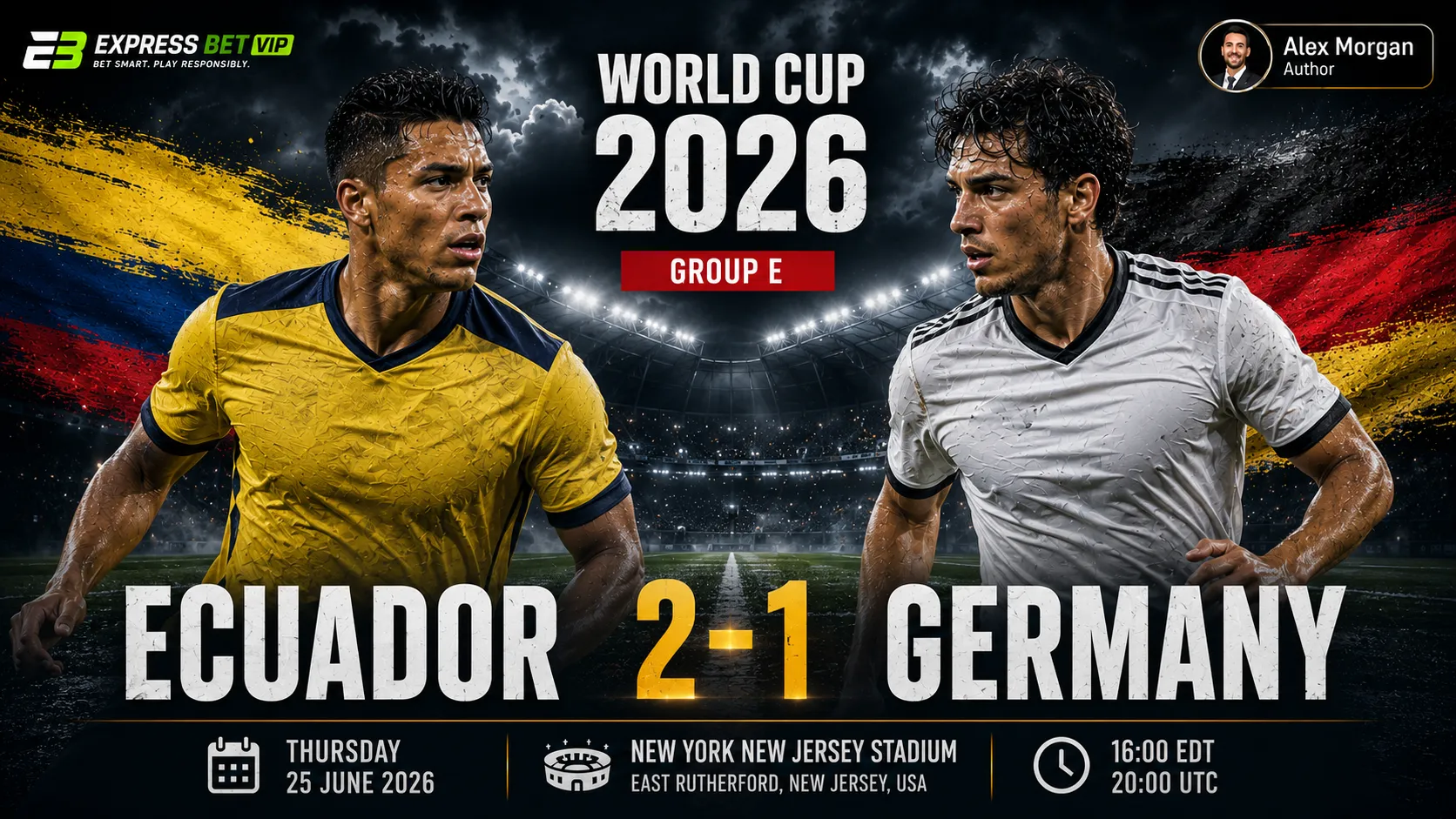
Quick Facts: Final Score, Goals, Venue, and Match Status
| Item | Verified detail |
|---|---|
| Match | Ecuador vs Germany |
| Competition | FIFA World Cup 2026 |
| Stage | Group stage, Matchday 3 |
| Group | Group E |
| Date | June 25, 2026 |
| Kickoff | 16:00 EDT / 20:00 UTC |
| Host country | United States |
| City | East Rutherford, New Jersey |
| Stadium | New York New Jersey Stadium |
| Regular name | MetLife Stadium |
| Attendance | 80,663 |
| Final score | Ecuador 2-1 Germany |
| Half-time score | Ecuador 1-1 Germany |
| Ecuador scorers | Nilson Angulo 9’, Gonzalo Plata 77’ |
| Germany scorer | Leroy Sané 2’ |
| Assists | Florian Wirtz, Pedro Vite, Kevin Rodríguez |
| Referee | Tori Penso |
| VAR | Joseph Dickerson |
| Assistant VAR | Fu Ming |
| Weather | Warm late-afternoon conditions; exact stadium reading unavailable |
| Reported daily high | Approximately 85°F / 29°C |
| Pitch | Wider natural-grass tournament field |
| Main tournament impact | Ecuador qualified in third place; Germany won Group E |
The match information, attendance, teams, officials and substitutions are recorded by FIFA, Sky Sports and FOX Sports. (Sky Sports)
Verified Facts vs Analysis
| Category | Information |
|---|---|
| [CONFIRMED] | Ecuador won 2-1 after a 1-1 first half. |
| [CONFIRMED] | Sané, Angulo and Plata scored. |
| [CONFIRMED] | Germany retained first place in Group E. |
| [CONFIRMED] | Ecuador qualified as a best third-placed team. |
| [REPORTED] | Approximately 55,000 spectators supported Ecuador inside the stadium. |
| [OBSERVED] | Germany controlled possession but repeatedly lost protection after turnovers. |
| [ANALYSIS] | Ecuador’s compact midfield and direct wide attacks created higher-value chances. |
| [MARKET SIGNAL] | Germany started near -130; Ecuador were around +300. |
| [DISPUTED] | Plata’s winner is listed as 77’ or 78’ depending on the provider. |
| [UNKNOWN] | Exact pitch-level humidity, wind, PPDA and distance covered. |
The distinction matters because a score, goal time or yellow card is an event fact. A claim that Germany lost because of poor rest defence is analysis. Both can be useful, but only one belongs in an official event record.
The same applies to provider statistics. Sky recorded seven Ecuador shots and 11 German attempts. ESPN’s xG model gave Ecuador a larger advantage than FotMob’s model. Those figures describe the match through different definitions; they should not be blended into one supposedly perfect dataset. (Sky Sports)
Final Score and Match Summary
Ecuador entered the match without a goal in the tournament and requiring a victory to preserve a realistic qualification route. Germany had already secured first place after defeating Curaçao 7-1 and Côte d’Ivoire 2-1. The strategic pressure therefore belonged almost entirely to Sebastián Beccacece’s team. (FOX Sports)
That pressure became heavier after two minutes.
Germany restarted quickly from a throw-in, Florian Wirtz found Sané inside the penalty area, and the winger finished with his left foot. Ecuador appealed for a high-foot offence by Aleksandar Pavlović against Pedro Vite earlier in the move, but referee Tori Penso allowed the goal to stand. (Reuters)
The opening might have broken a team already carrying two scoreless group matches. Instead, Ecuador responded with its first World Cup goal at the 40th attempt of the campaign. Vite reacted to a loose German touch, Angulo attacked the inside-left channel and curled his finish beyond Neuer. The equaliser arrived seven minutes after Germany’s goal and changed the emotional structure of the match. (Reuters)
Germany still had more possession. Nagelsmann’s side completed 517 accurate passes to Ecuador’s 312 and held 61.1% of the ball. Yet possession rarely became sustained penalty-box pressure. Germany registered 11 shots, but only three were on target and its xG remained between 0.65 and 0.65 across the main providers reviewed. (Sky Sports)
Ecuador used a different currency. Beccacece’s team defended, recovered and attacked quickly. John Yeboah carried the ball through pressure. Plata and Angulo ran into the spaces outside Germany’s full-backs. Caicedo protected the centre and repeatedly interrupted the first pass after Germany recovered possession.
The second half began with the match’s main officiating intervention. Penso awarded Germany a penalty after Kai Havertz went down under pressure from Joel Ordóñez. The referee reviewed the incident and cancelled the penalty because of an earlier German foul in the buildup. (FIFA)
The reversal mattered beyond the immediate decision. Germany believed it had regained control. Ecuador instead received confirmation that the game remained level and available.
Beccacece introduced Angelo Preciado and Kevin Rodríguez after 64 minutes. Rodríguez’s physical presence changed Ecuador’s attacking reference point. He challenged Neuer and Jonathan Tah, held direct passes and attacked the first contact at set pieces.
The winning goal came from that adjustment. Pedro Vite delivered a corner, Rodríguez flicked the ball at the near post, and Plata reacted in front of Neuer. The winger stabbed the ball across goal and into the net. FOX and Sky mark the goal at 77’; Reuters and some FIFA-language feeds use 78’. (FOX Sports)
Germany then controlled territory without finding an equaliser. Raum supplied repeated crosses. Undav attacked the left side of Ecuador’s box. Groß attempted from distance. Ecuador responded with clearances, blocks and increasingly cautious time management.
Sky recorded 30 Ecuador clearances, compared with 15 by Germany. Ecuador also made 12 interceptions and five blocks. Those figures explain the final phase more accurately than possession alone. (Sky Sports)
The final whistle produced a large release among the Ecuador-dominated crowd. Germany remained group winners. Ecuador had rescued its tournament from a position that looked close to terminal after two minutes.
The result was an upset by market price, but it was not a statistical theft. Ecuador generated the higher xG, produced three shots on target from seven attempts and created the match’s two decisive second-half actions. Germany held more of the ball. Ecuador used it better when the goal was close enough to matter. (ESPN.com)
Goal Timeline
2’ — Leroy Sané, Germany, Open-Play Goal
Germany used a quick throw-in before Ecuador’s defensive structure had settled. Wirtz received between the lines and released Sané into the right side of the penalty area. Sané finished left-footed from inside the box. (Reuters)
Assist: Florian Wirtz
Goal type: Open-play goal following a quick restart
Shot type: Left-footed finish
Goalkeeper position: Hernán Galíndez narrowed the central angle but could not reach the low shot
VAR: The goal stood
Controversy: Ecuador argued that Pavlović’s raised boot had caught Vite earlier in the buildup
Tactical meaning: Germany attacked before Ecuador could form its midfield block
Emotional impact: Ecuador’s must-win task immediately became more severe
The goal demonstrated Germany’s technical speed. The ball moved from restart to finish before Ecuador could establish its usual defensive spacing.
The controversy came from an earlier phase rather than the finish. Penso and the VAR team did not identify a clear reason to disallow the goal. Ecuador’s frustration was understandable, but the official decision remained 0-1.
9’ — Nilson Angulo, Ecuador, Long-Range Open-Play Goal
Ecuador briefly lost possession during its buildup, but Vite immediately recovered the ball after a heavy German touch. He released Angulo into the inside-left channel. Angulo opened his body near the edge of the penalty area and curled a right-footed shot into the bottom-right corner. (The Guardian)
Assist: Pedro Vite
Goal type: Transition goal from outside the box
Shot type: Right-footed curling finish
Goalkeeper position: Neuer was set centrally but reacted late to the shot’s direction
VAR: No decisive intervention reported
Defensive error: Germany failed to secure possession after breaking Ecuador’s initial attack
Tactical meaning: Ecuador’s counterpress created a direct route through Germany’s midfield
Emotional impact: Ecuador scored its first goal of the tournament and restored qualification hope
This was not simply a long-range attempt. Vite’s recovery removed Germany’s midfield protection. Angulo received while running toward goal rather than with his back to it.
FIFA selected Angulo as the official Player of the Match. His goal changed Ecuador’s tournament before the opening phase had finished. (FIFA)
77’ — Gonzalo Plata, Ecuador, Set-Piece Goal
Vite delivered a right-sided corner with pace toward the near post. Substitute Kevin Rodríguez attacked the first contact and flicked the ball across the six-yard area. Plata reacted before Neuer and the central defenders, directing the ball across goal. (FOX Sports)
Assist: Kevin Rodríguez
Goal type: Set-piece second contact
Shot type: Close-range stabbed finish
Goal time: 77’ according to FIFA’s English summary, FOX and Sky; 78’ in Reuters and some other FIFA feeds
Goalkeeper position: Neuer moved toward the flick but could not reset for Plata’s touch
Defensive issue: Germany lost the near-post contact and failed to protect the second zone
VAR: No decisive intervention reported
Tactical meaning: Ecuador’s substitute gave the corner routine a physical first target
Emotional impact: Ecuador moved into the qualification places
The goal justified Beccacece’s substitution. Rodríguez did not receive the official goal, but his near-post movement created it.
Germany’s problem was not only the final touch. The defence allowed Ecuador to win the first contact and attack the second ball from six yards. Set pieces become simple when one team wins both moments.
Key Moments That Changed the Match
The High-Foot Appeal Before Sané’s Goal
Ecuador believed Pavlović had caught Vite with a raised boot before Germany completed the opening attack. Penso allowed play to continue, and VAR did not reverse the goal.
The incident intensified Ecuador’s emotional response. It could have produced disorganisation. Instead, the team equalised seven minutes later. (Reuters)
Angulo Ends Ecuador’s Scoreless Run
Ecuador had failed to score with its first 39 attempts of the tournament. Angulo converted attempt number 40. The statistic captures both Ecuador’s previous wastefulness and the importance of the finish. (Reuters)
Neuer Saves from Havertz’s Chance
Havertz reached a shooting position in the 25th minute, but Galíndez saved. Germany’s technical control had created a direct chance, yet Ecuador avoided falling behind for a second time. (FOX Sports)
The Penalty Is Overturned
Penso initially awarded Germany a penalty early in the second half after Havertz went down. Following an on-field VAR review, she cancelled the decision because Germany had committed an earlier foul in the move.
This was the match’s largest officiating intervention. A successful German penalty would have forced Ecuador to score twice. Instead, the score remained 1-1. (FIFA)
Valencia’s Shot Is Saved
Enner Valencia tested Neuer around the 62nd minute. The chance showed that Ecuador had begun reaching Germany’s box with greater frequency after halftime. (FOX Sports)
Kevin Rodríguez Changes the Attack
Rodríguez replaced Valencia in the 64th minute. The substitute offered stronger aerial presence and more direct running against Tah and Rüdiger.
Thirteen minutes later, his near-post flick created Plata’s goal. The substitution was not cosmetic. It changed the geometry of Ecuador’s set pieces.
Sané’s 76th-Minute Shot
Sané tested Galíndez immediately before Ecuador’s winning corner sequence. Germany nearly moved ahead; within roughly one minute, Ecuador scored at the other end.
Tournament football has a habit of placing two futures beside each other and allowing one touch to choose between them. (FOX Sports)
Plata’s Late Yellow Card
Plata was booked in the 89th minute after a forceful challenge on Musiala. The Guardian’s live report noted that the tackle could have drawn greater punishment from another referee. Penso issued yellow, and no VAR upgrade followed. (FOX Sports)
Ecuador Survives Eight Added Minutes
Germany delivered crosses, attempted from distance and pushed Ecuador into a low defensive block. Undav reached the side netting, while Groß shot over.
Ecuador stopped trying to control the ball and concentrated on controlling space. It was not elegant. Qualification tables rarely award style points for the final clearance.
Local Match Conditions: Stadium, City, Weather, Pitch, and Crowd
| Local factor | Verified or observed detail | Football meaning | Direct match evidence | Betting-result meaning | Data status | Anti-template status |
|---|---|---|---|---|---|---|
| Stadium | New York New Jersey Stadium | Large open-air venue | Capacity crowd of 80,663 | High emotional pressure | [CONFIRMED] | Fixture-specific |
| Crowd split | Strong Ecuador majority | Favoured Ecuador psychologically | Reuters described a sea of yellow; Guardian estimated 55,000 Ecuador fans | Potential live-momentum effect | [REPORTED/OBSERVED] | Fixture-specific |
| Pitch | Wider natural-grass World Cup field | Supported normal passing and set-piece delivery | No decisive surface defect reported | No clear pitch-based edge | [CONFIRMED] | Fixture-specific |
| Roof | Open-air | Full exposure to late-afternoon conditions | Hydration break observed | Possible fatigue relevance | [CONFIRMED] | Fixture-specific |
| Kickoff | 16:00 EDT | Warmest part of matchday had recently passed | Controlled pressing rather than constant pressure | Relevant to substitution markets | [CONFIRMED] | Fixture-specific |
| Temperature | Daily high around 85°F / 29°C | Increased recovery demand | Hydration break around 70’ | Possible second-half tempo effect | [REPORTED] | Fixture-specific |
| Humidity | Not available from verified public data | Cannot quantify heat stress | No reliable match reading | Avoid false precision | [UNKNOWN] | Fixture-specific |
| Wind | Not available from verified public data | Cannot quantify cross or long-pass effect | No obvious wind disruption | No usable market conclusion | [UNKNOWN] | Fixture-specific |
| Attendance milestone | World Cup attendance record announced during match | Added event significance | Stadium screens displayed the record figure | No direct betting effect | [CONFIRMED] | Fixture-specific |
| Travel | Ecuador arrived after matches in Philadelphia and Kansas City; Germany after Toronto | Different recovery routes | No verified acclimatisation failure | Limited standalone value | [ANALYSIS] | Fixture-specific |
The crowd was the clearest local factor. Reuters described large yellow sections, while the Guardian estimated approximately 55,000 Ecuador supporters. The stadium therefore felt closer to an Ecuador home match than a neutral fixture in New Jersey. (Reuters)
That support mattered most after Plata’s goal. Germany had more possession and more recognised attacking names, but the emotional pressure belonged to the team chasing an equaliser in front of a hostile majority.
The warm afternoon conditions encouraged selective rather than continuous pressing. Ecuador did not chase Germany’s centre-backs throughout the match. It formed a compact block, waited for a poor touch and accelerated when possession became recoverable.
The hydration break around the 70th minute gave both coaches a tactical reset. Beccacece had already introduced Rodríguez and Preciado. Ecuador emerged from the break with enough energy to attack the corner sequence that created the winner. This is an observed sequence, not proof that the break caused the goal.
The widened natural-grass field behaved normally. Both teams completed more than 82% of their passes. Neuer and Galíndez handled low shots without a visible bounce problem. No decisive slip or damaged section influenced the goals. (FIFA)
Stadium-Specific Match Impact
| Stadium factor | Match detail |
|---|---|
| Stadium | New York New Jersey Stadium |
| Regular name | MetLife Stadium |
| Location | East Rutherford, New Jersey |
| FIFA capacity | 80,663 |
| Attendance | 80,663 |
| Pitch type | Wider natural-grass World Cup field |
| Roof status | Open-air |
| Acoustic effect | Strong Ecuador-supporting majority |
| Surface condition | No decisive defect confirmed |
| Wind relevance | Not available from verified public data |
| Goalkeeper distribution | No clear adverse effect |
| Set-piece effect | Ecuador scored the winner from a corner |
| Communication effect | No specific error conclusively caused by noise |
| Data status | Capacity, attendance and grass field confirmed; wind unknown |
FIFA listed the stadium’s tournament capacity at 80,663 and reported that the venue had been modified with a wider grass field. Sky recorded the same attendance for this fixture. (FIFA)
The stadium influenced the match most visibly through crowd distribution. Ecuador’s equaliser and winning goal produced responses closer to a home international than a neutral-site group match.
Germany’s second-goal concession should not be blamed on acoustics. Tah, Neuer and the surrounding defenders lost the first and second contacts at a corner. That is a set-piece failure, not an architectural mystery.
The available match evidence does not show a clear stadium-specific effect on goalkeeper kicking, ball flight or tackle timing. The grass supported a normal passing rhythm, and the two decisive Ecuador goals resulted from transition structure and set-piece execution.
City and Weather Impact
| Factor | Detail |
|---|---|
| City area | East Rutherford, New York/New Jersey region |
| State | New Jersey |
| Host country | United States |
| Time zone | Eastern Daylight Time, UTC-4 |
| Kickoff | 16:00 local time |
| June climate | Warm and often humid |
| Reported daily high | Approximately 85°F / 29°C |
| Exact match temperature | Not available from verified public data |
| Humidity | Not available from verified public data |
| Wind | Not available from verified public data |
| Rain | No match delay or meaningful rainfall reported |
| Altitude | No meaningful altitude issue |
| Likely physical effect | Greater recovery demand during repeated sprints |
| Actual evidence | Selective pressing, hydration break, multiple substitutions |
| Data status | Daily high reported; detailed stadium readings unknown |
The weather context was relevant but secondary. Ecuador’s equaliser came after nine minutes, before accumulated heat could reasonably explain Germany’s turnover or Angulo’s finish.
The late phase placed greater physical demands on both teams. Germany’s possession required Ecuador to move laterally, while Ecuador’s counterattacks demanded sudden high-speed runs. Beccacece protected his structure with five substitutions.
No major cramp, heat illness or weather-related injury was confirmed. Germany continued pressing deep into added time, which argues against a simple physical-collapse explanation.
Long diagonals, crosses and goalkeeper distribution showed no obvious wind-related problem. Exact wind data was unavailable, so any stronger conclusion would be invented.
First Half Analysis
Ecuador started in a 4-4-2:
Galíndez; Franco, Ordóñez, Pacho, Hincapié; Yeboah, Caicedo, Vite, Angulo; Valencia, Plata.
Germany used a 4-2-3-1:
Neuer; Kimmich, Tah, Rüdiger, Raum; Pavlović, Nmecha; Sané, Musiala, Wirtz; Havertz. (FOX Sports)
Germany’s opening structure placed Kimmich and Raum high during possession. Pavlović remained near the centre-backs, while Nmecha moved into the right half-space. Musiala and Wirtz rotated behind Havertz.
Ecuador defended closer to a narrow 4-4-2. Valencia and Plata screened Germany’s midfield. Caicedo and Vite protected the central lane, leaving the wide midfielders to track Germany’s full-backs.
The opening goal came before this block was stable. Germany used a quick restart, Wirtz received in space, and Sané attacked the penalty area.
Ecuador’s response changed the midfield contest. Rather than dropping deeper, Vite and Caicedo pressed Germany’s next pass more aggressively. Vite recovered the ball for Angulo’s equaliser.
Angulo’s position created a specific mismatch. He began wide on Ecuador’s left but moved inside when Kimmich advanced. Germany then had to decide whether Pavlović or Tah should close him. Neither arrived before the shot.
On Ecuador’s opposite side, Yeboah attacked Raum’s space and carried the ball centrally. His dribbling gave Ecuador a route around Germany’s midfield pressure.
Germany continued dominating possession, but Ecuador prevented Musiala from receiving cleanly near the penalty arc. Pacho and Ordóñez refused to follow Havertz too far into midfield, preserving the central defensive line.
Raum supplied Germany’s most consistent width. Sané moved inside, creating an outside lane for the full-back. Ecuador accepted some crosses because its centre-backs held an aerial advantage over Germany’s attacking structure.
The physical tone increased late in the half. Hincapié was booked in the 43rd minute. Pavlović received a yellow one minute later and was replaced by Angelo Stiller at half-time. (Sky Sports)
At the interval, Nagelsmann needed cleaner protection against Ecuador’s counterpress. Beccacece needed more penalty-box presence without breaking the compact midfield.
Second Half Analysis
Germany began the second half with Stiller beside Nmecha. The substitute improved circulation and allowed Germany to move the ball around Ecuador’s first line more smoothly.
The initial penalty award appeared to validate Germany’s increased pressure. Havertz entered the box and went down under contact from Ordóñez. VAR changed the decision because of an earlier German foul.
After the reversal, Germany’s control became less convincing. The team circulated possession but created few high-value shots. ESPN’s model gave Germany only 0.28 second-half xG according to contemporary statistical analysis. (SI)
Ecuador began attacking Germany’s full-back zones more frequently. Yeboah carried through the right channel, while Angulo and Hincapié combined on the left.
Nagelsmann introduced Undav and Thiaw around the hour, replacing Havertz and Kimmich. Rüdiger took the captain’s armband. Germany gained another penalty-box striker but lost some build-up precision from the right.
Beccacece responded with Rodríguez and Preciado. Ecuador’s right side became more direct, while Rodríguez occupied the German centre-backs.
The game became increasingly open. Valencia tested Neuer. Sané forced Galíndez to save. Rodríguez created a corner from a blocked shot.
After Plata scored, Ecuador retreated into a 5-4-1-like defensive shape. Preciado dropped deeper, Estupiñán replaced Hincapié and Félix Torres entered late.
Germany sent Raum higher and attacked with crosses. Undav and Beier occupied the central defenders, while Musiala tried to collect second balls near the edge of the box.
The pressure was real but largely predictable. Ecuador made 30 clearances and blocked five German shots. Germany reached the box but rarely produced a clean final action. (Sky Sports)
The final minutes showed the psychological difference between the teams. Ecuador defended a national objective. Germany chased an equaliser in a match that did not change first place. Intensity is not created only by talent; sometimes the table supplies it.
Tactical Picture: Why the Match Was Won and Lost
Ecuador won because its 4-4-2 remained compact while still offering two forward outlets.
Without the ball, Ecuador protected the middle through Caicedo and Vite. Valencia and Plata screened passes into Germany’s double pivot. Angulo and Yeboah narrowed from the wings.
This shape encouraged Germany to pass toward Kimmich and Raum. Ecuador then pressed when the receiving full-back faced his own goal or took a heavy touch.
The pressing triggers included:
- a backward pass toward Neuer;
- a loose German touch in central midfield;
- a pass toward a full-back without a supporting angle;
- a square pass between Pavlović and Nmecha;
- a second ball after a German aerial challenge.
Angulo’s goal came directly from one of those triggers. Vite recovered possession after Germany failed to secure the ball, and Ecuador attacked before the rest defence was prepared.
Germany’s 4-2-3-1 became a 2-3-5 in possession. Kimmich moved alongside Pavlović, Raum advanced, and Wirtz and Musiala occupied the half-spaces.
The attacking shape created width but left Germany vulnerable when possession broke down. Tah and Rüdiger often defended large spaces with only one midfielder protecting them.
Ecuador’s winner came through a set piece rather than a transition, but the broader problem remained similar: Germany did not control the second action.
The most important midfield performance belonged to Caicedo. He did not dominate through possession volume. Germany had far more of the ball. He dominated by controlling where Germany could play next.
Pacho and Ordóñez defended the box with discipline. They allowed Havertz and later Undav to receive some direct balls but prevented clean combinations around them.
Germany’s attack became too dependent on width. Raum delivered effectively, yet Ecuador knew the direction of the final pass. The centre-backs could defend facing the ball.
Nagelsmann changed personnel but did not fully change the mechanism. Undav added penalty-box movement. Beier added running. Groß added passing. Germany still attempted to reach them through the same crowded outside routes.
Beccacece’s changes were more targeted. Rodríguez improved the first contact in attack. Preciado protected the right side. Estupiñán and Torres strengthened the defensive finish.
The winning plan worked because Ecuador’s players understood both phases: press selectively, attack immediately, then defend the box without chasing the ball into irrelevant spaces.
Tactical Collision Map
| Zone | Edge | Match evidence | Key player | Local-condition effect | Result impact |
|---|---|---|---|---|---|
| Ecuador left flank | Ecuador | Angulo attacked inside Kimmich | Nilson Angulo | Selective pressing conserved energy | Equalising goal |
| Ecuador right flank | Ecuador in transition | Yeboah carried beyond Raum | John Yeboah | Open field increased sprint demand | Progression and corners |
| Germany left flank | Germany territorially | Raum supplied width and crosses | David Raum | No wind disruption confirmed | Late pressure |
| Germany right flank | Mixed | Sané scored but Kimmich left space | Leroy Sané | No direct effect | One goal conceded, one scored |
| Central midfield | Ecuador defensively | Caicedo and Vite closed central lanes | Moisés Caicedo | Compact distances reduced running | Restricted Germany |
| Penalty box | Ecuador | Higher xG and stronger finishing | Angulo / Plata | Stable grass | Decisive |
| Set pieces | Ecuador | Rodríguez flicked Vite’s corner | Kevin Rodríguez | Normal delivery conditions | Winning goal |
| Transitions | Ecuador | Angulo goal followed immediate recovery | Pedro Vite | Warm conditions rewarded selective bursts | Equaliser |
| Defensive third | Ecuador | 30 clearances and five blocks | Pacho / Ordóñez | Crowd reinforced late concentration | Protected lead |
| Goalkeeper build-up | Germany | Neuer supported 61% possession | Manuel Neuer | No surface problem | Control without result |
| Bench impact | Ecuador | Rodríguez assisted winner | Kevin Rodríguez | Fresh legs after hour | Match-defining |
Player Ratings and Individual Performances
The ratings below are editorial assessments based on match actions, tactical responsibilities and the available statistics. They are not official FIFA ratings.
Ecuador Player Ratings
Hernán Galíndez — 7.0
Conceded before the match had settled but recovered well. Saved from Havertz and Sané and remained composed during Germany’s late crossing pressure.
Alan Franco — 6.5
Worked as a conservative right-back and helped narrow the space around Musiala. Booked for delaying a restart and replaced after 64 minutes.
Joel Ordóñez — 7.5
Central to Ecuador’s penalty-box defence. His challenge on Havertz initially produced a penalty, but VAR reversed the decision because of an earlier German foul.
Willian Pacho — 8.0
Dominant during the final defensive phase. Cleared crosses, protected Galíndez and controlled Undav’s movement.
Piero Hincapié — 6.5
Aggressive from left-back and supported Angulo’s inside movement. His yellow card reduced his defensive margin before he was replaced.
John Yeboah — 7.5
Provided Ecuador’s best ball-carrying route. Turned away from pressure and repeatedly attacked the space behind Raum.
Moisés Caicedo — 8.5
The tactical centre of Ecuador’s performance. Protected the defence, pressed German midfield receivers and managed the late low block.
Pedro Vite — 8.0
Assisted Angulo, recovered possession aggressively and delivered the corner that produced the winner.
Nilson Angulo — 8.5
FIFA’s official Player of the Match. Scored Ecuador’s first tournament goal and repeatedly attacked Germany’s right-side defensive space.
Enner Valencia — 6.5
Occupied Tah and Rüdiger and forced Neuer into a second-half save. His movement was useful even without a goal.
Gonzalo Plata — 8.0
Scored the winner and carried a constant transition threat. His late yellow card created unnecessary danger.
Angelo Preciado — 6.5
Protected the right side after entering and supported Ecuador’s direct attacks.
Kevin Rodríguez — 7.5
Changed the penalty-box matchup and assisted Plata with the near-post flick.
Pervis Estupiñán — 6.5
Strengthened the left side for the defensive finish.
Jordy Caicedo — 6.0
Added a physical outlet late in the match.
Félix Torres — 6.5
Helped defend Germany’s added-time aerial pressure.
Germany Player Ratings
Manuel Neuer — 5.5
Could have reacted more quickly to Angulo’s shot and became involved in uncertainty around the winning corner. Made one confirmed save.
Joshua Kimmich — 6.0
Supported the opening goal through Germany’s fast right-sided buildup but left space for Angulo’s inside runs. Replaced after an hour.
Jonathan Tah — 5.5
Comfortable during long possession spells but less secure against Rodríguez’s physical introduction and the winning corner.
Antonio Rüdiger — 6.0
Returned to the starting lineup and defended several direct attacks. Germany still conceded twice from situations requiring stronger collective control.
David Raum — 7.0
Germany’s most reliable width provider. Delivered dangerous late crosses and forced Ecuador’s defensive line deeper.
Aleksandar Pavlović — 5.5
His high-foot incident before the opening goal was controversial. Booked late in the half and replaced at the interval.
Felix Nmecha — 5.5
Lost the ball in the sequence before Angulo’s equaliser and struggled to protect Germany’s transition defence.
Leroy Sané — 7.5
Scored the opener and placed two attempts on target. Germany’s most direct attacking threat.
Jamal Musiala — 6.0
Received between the lines less frequently than Germany required. Fouled repeatedly but unable to create the decisive final action.
Florian Wirtz — 7.0
Assisted Sané and remained Germany’s most inventive passer. His influence declined as Ecuador closed the central zones.
Kai Havertz — 6.0
Reached one first-half chance and won the penalty that was later overturned. Did not consistently hold the ball against Ecuador’s centre-backs.
Angelo Stiller — 6.5
Improved Germany’s possession security after halftime.
Malick Thiaw — 6.0
Allowed Germany to use Rüdiger more aggressively, but his late attacking involvement produced little.
Deniz Undav — 6.0
Added penalty-box presence and reached the side netting in stoppage time.
Maximilian Beier — 5.5
Made forward runs without receiving enough clean service.
Pascal Groß — 5.5
Attempted to accelerate Germany’s late passing but sent the final long-range chance over the bar.
Best Players of the Match
Official Player of the Match: Nilson Angulo
Angulo scored Ecuador’s first goal of the tournament and attacked Germany’s most vulnerable defensive channel. (FIFA)
Editorial Man of the Match: Moisés Caicedo
Angulo produced the breakthrough, but Caicedo controlled the structure that allowed Ecuador to survive and counterattack.
Best attacker: Nilson Angulo
His finish changed the match, and his movement repeatedly pulled Germany’s right side inward.
Best midfielder: Moisés Caicedo
He balanced pressing, defensive coverage and game management.
Best defender: Willian Pacho
Pacho’s clearances and box positioning were essential during Germany’s late pressure.
Best goalkeeper: Hernán Galíndez
He recovered from the early goal and made the saves required to protect the lead.
Best substitute: Kevin Rodríguez
His first-contact ability transformed Ecuador’s attacking set pieces and directly created the winner.
Most underrated performance: Pedro Vite
He assisted the equaliser, delivered the winning corner and connected the midfield press to Ecuador’s attacks.
Most disappointing performance: Felix Nmecha
Germany needed control beside Pavlović. Nmecha’s heavy touch contributed to the equaliser and exposed the centre.
Injuries, Suspensions, Cards, and Discipline
| Player | Team | Incident | Minute | Status | Next-match impact | Data status |
|---|---|---|---|---|---|---|
| Piero Hincapié | Ecuador | Strong foul | 43’ | Yellow card | No suspension confirmed | [CONFIRMED] |
| Aleksandar Pavlović | Germany | Strong foul | 44’ | Yellow card | Replaced at half-time | [CONFIRMED] |
| Alan Franco | Ecuador | Delaying restart | 50’ | Yellow card | No suspension confirmed | [CONFIRMED] |
| Gonzalo Plata | Ecuador | Forceful challenge on Musiala | 89’ | Yellow card | No suspension confirmed | [CONFIRMED] |
| Nico Schlotterbeck | Germany | Pre-match injury absence | Before match | Did not start | Rüdiger returned | [CONFIRMED] |
| New match injuries | Both teams | No major injury confirmed | — | — | — | [UNKNOWN] |
Sky recorded three Ecuador yellow cards and one for Germany. No red card was shown. (Sky Sports)
Plata’s late tackle carried the greatest disciplinary risk. Penso selected yellow, and VAR did not intervene. The decision can be debated, but no reliable source records a post-match disciplinary upgrade.
Germany restored Rüdiger to the defence because Nico Schlotterbeck was unavailable through injury. (Reuters)
Referee and VAR Analysis
Tori Penso handled one of the most difficult group-stage matches because both major decisions required separating the immediate incident from an earlier action.
Germany’s opening goal stood despite Ecuador’s claim that Pavlović had used a dangerous high boot against Vite. VAR did not identify sufficient grounds to cancel the goal. (Reuters)
The second-half penalty decision went the other way. Penso initially judged that Ordóñez had fouled Havertz. After reviewing the monitor, she cancelled the penalty because Germany had committed an earlier foul in the attacking phase. (FIFA)
This was an appropriate use of the review process. The referee did not merely reassess the final contact; she reviewed the full attacking sequence.
Penso issued four yellow cards and maintained control despite an increasingly emotional final phase. The one major debate concerned Plata’s late challenge on Musiala. Yellow remained the official outcome.
Joseph Dickerson served as VAR, with Fu Ming as assistant VAR. (Sky Sports)
The officials influenced the match through the overturned penalty, but they did not create Ecuador’s goals or Germany’s defensive failures.
Match Statistics
| Statistic | Ecuador | Germany |
|---|---|---|
| Possession | 38.9% | 61.1% |
| Shots | 7 | 11 |
| Shots on target | 3 | 3 |
| Expected goals — ESPN | 1.51 | 0.65 |
| Expected goals — FotMob | 1.27 | 0.65 |
| Big chances missed | 1 | 1 |
| Corners | 3 | 2 |
| Touches in opposition box | 18 | 20 |
| Accurate passes | 312 | 517 |
| Attempted passes | 378 | 592 |
| Pass accuracy | 82.5% | 87.3% |
| Chances created | 7 | 9 |
| Successful tackles | 16 | 13 |
| Interceptions | 12 | 4 |
| Blocks | 5 | 2 |
| Clearances | 30 | 15 |
| Fouls | 15 | 10 |
| Yellow cards | 3 | 1 |
| Red cards | 0 | 0 |
| Goalkeeper saves | 2 | 1 |
| PPDA | Not available | Not available |
| Distance covered | Not available | Not available |
Sky Sports provides the possession, passing, defensive and disciplinary totals. ESPN and FotMob provide different xG values for Ecuador while agreeing on Germany’s 0.65. (Sky Sports)
Germany’s possession did not translate into a major shot-quality advantage. Ecuador created between 1.27 and 1.51 xG from only seven attempts.
The 30 Ecuador clearances indicate how deep the team defended after taking the lead. That number reflects pressure, but it also reflects successful protection of the central box.
Germany completed 205 more accurate passes. Many occurred outside Ecuador’s defensive block. Passing volume becomes less meaningful when the opponent controls the destination of the next pass.
Ecuador’s 12 interceptions compared with Germany’s four support the tactical interpretation that Beccacece’s team read the central passing lanes more effectively.
Betting Result Angle
FOX’s FanDuel market listed Germany at approximately -130, Ecuador at +300 and the draw at +320. The over/under was 2.5 goals, with the over around -144. Both teams to score — Yes was approximately -150. (FOX Sports)
FOX’s post-match box score recorded Ecuador’s winning price at +318. The three-goal total settled over 2.5. (FOX Sports)
| Market | Pre-match expectation | Actual result | Winning side | Key trigger | Local factor | Caution |
|---|---|---|---|---|---|---|
| Match winner | Germany favourite | Ecuador won 2-1 | Ecuador moneyline | Angulo response and Plata winner | Ecuador-heavy crowd supported momentum | Underdog wins remain high variance |
| Draw | Plausible given Germany’s qualification | No draw | Losing market | Late corner goal | Crowd raised late pressure | Group incentives do not guarantee caution |
| Germany -0.5 | Germany expected to win | Germany lost | Ecuador +0.5 | German transition errors | No direct weather cause | Favourite status is not execution |
| Over/under 2.5 | Over slightly favoured | Three goals | Over 2.5 | Plata’s winner | Conditions did not suppress scoring | One late goal decided settlement |
| Both teams to score | Yes favoured | Both scored | BTTS Yes | Angulo’s ninth-minute response | No clear local cause | Price timing mattered |
| Correct score | 2-1 Ecuador | 2-1 | Correct-score backers | Set-piece winner | Crowd supported late emotion | Very high-variance market |
| First goalscorer | German forwards favoured | Leroy Sané | Sané backers | Quick restart | No local effect | Exact player prices varied |
| Anytime Angulo | Secondary Ecuador option | Angulo scored | Angulo backers | Counterpress turnover | No direct local cause | Lineup confirmation mattered |
| Cards | Physical game expected | Four yellows | Line-dependent | Late tactical and emotional fouls | Warm conditions not proven decisive | Exact line unavailable |
| Corners | Germany expected more territory | Ecuador won corners 3-2 | Ecuador corner positions, line-dependent | Direct transition attacks | Set-piece surface behaved normally | Corner handicap unknown |
| Live betting | Germany led after two minutes | Ecuador won | Ecuador live backers benefited | Immediate equaliser and VAR reversal | Crowd changed momentum perception | Live prices move rapidly |
The result rewarded bettors who backed Ecuador’s moneyline or positive handicap. It punished the assumption that Germany’s superior possession and reputation would automatically convert into a third group victory.
The over market won by the minimum possible margin. A 1-1 result would have settled under. Plata’s corner goal changed the total and correct-score markets together.
Both teams to score — Yes landed early. Once Angulo equalised in the ninth minute, the market question moved from whether both teams would score to whether the game would produce a third goal.
The overturned penalty produced the largest live-market swing without changing the score. Germany briefly appeared close to a second goal; the review restored a level match.
This does not mean that must-win underdogs should be backed automatically. Ecuador won because its tactical plan and finishing supported the tournament incentive.
Local Betting Impact: What the Venue and Conditions Changed
| Local factor | Market possibly affected | Actual match evidence | Possible interpretation | Risk of overreaction | Safer conclusion |
|---|---|---|---|---|---|
| Ecuador-heavy crowd | Live Ecuador and momentum markets | Strong reaction after both Ecuador goals | Emotional support helped late resilience | Treating crowd as a guarantee | Crowd amplified momentum, not chance quality |
| 16:00 kickoff | Second-half substitutions | Both coaches used five changes | Bench freshness became relevant | Assuming heat caused every substitution | Tactical game state remained primary |
| Warm conditions | Pressing and second-half tempo | Ecuador pressed selectively | Controlled bursts were physically efficient | Turning temperature into an automatic under | Exact stadium readings were unavailable |
| Natural grass field | Passing and goalkeeper handling | Both teams exceeded 82% pass accuracy | Surface supported technical play | Claiming grass favoured Ecuador | No abnormal pitch effect |
| Open-air stadium | Crosses and long passing | Raum delivered normally | Wind did not visibly dominate | Inventing airflow influence | Verified wind data unavailable |
| Capacity attendance | Cards and late psychology | Four yellows, strong late noise | Emotional pressure increased | Overpricing atmosphere | Germany still controlled possession |
| Hydration break | Live second-half markets | Pause occurred around 70’ | Coaches could reorganise | Predicting a goal after every break | Ecuador’s substitution and corner execution mattered more |
| Ecuador’s qualification need | Match winner and live risk | Ecuador maintained attacking intent at 1-1 | Higher incentive supported risk | Assuming motivation equals quality | Germany still started as justified favourite |
The crowd was relevant to psychology but not directly to the technical execution of the goals.
The warm conditions increased the value of fresh substitutes. Rodríguez’s contribution supports that interpretation, but his assist was also a product of role and set-piece preparation.
The natural-grass field allowed predictable ball movement. The winning goal came from a clean corner delivery and a controlled flick, not an irregular bounce.
The safest local conclusion is limited: the open-air afternoon setting and full Ecuador-supporting crowd increased physical and emotional pressure, but the tactical decisions remained more important than the environment.
What This Result Means for Group E and the Knockout Bracket
| Position | Team | Points | Goal difference | Outcome |
|---|---|---|---|---|
| 1 | Germany | 6 | +6 | Qualified as group winner |
| 2 | Côte d’Ivoire | 6 | +2 | Qualified |
| 3 | Ecuador | 4 | 0 | Qualified as best third-placed team |
| 4 | Curaçao | 1 | -8 | Eliminated |
Germany remained above Côte d’Ivoire on goal difference despite losing. Ecuador’s four points placed the team among the eight best third-place qualifiers. (Reuters)
The result sent Ecuador into the knockout stage for the first time since 2006. Sebastián Beccacece described it as Ecuador’s biggest World Cup victory. (AP News)
Ecuador subsequently faced Mexico in the Round of 32 and lost 2-0. Germany faced Paraguay, drew 1-1 after extra time and were eliminated 4-3 on penalties. (FIFA)
The Germany defeat therefore exposed problems that remained relevant four days later. Nagelsmann’s side again controlled possession against Paraguay but failed to convert superiority into advancement.
For Ecuador, the Germany victory became the peak of the campaign. The team reached the knockout phase but could not reproduce the same counterattacking efficiency against Mexico.
What Ecuador Did Right
Ecuador responded to the worst possible start without abandoning the plan.
Caicedo and Vite protected the centre rather than chasing Germany’s possession.
Angulo and Yeboah attacked the spaces behind Germany’s full-backs.
Ecuador pressed specific touches instead of trying to press every German pass.
The centre-backs defended the penalty area with discipline and accepted that Germany would circulate the ball outside the block.
Beccacece’s substitutions were precise. Rodríguez created the winning goal. Preciado, Estupiñán and Torres protected the lead.
Ecuador also managed the emotional game. The team did not lose concentration after the opening controversy or the initial penalty award.
The final low block was deep but organised. Germany produced pressure, not enough clear chances.
What Germany Got Wrong
Germany failed to protect possession after building attacks.
Nmecha and Pavlović left the centre-backs exposed when Ecuador recovered the ball.
Kimmich’s advanced positioning created attacking width but opened the inside-left channel used by Angulo.
Germany’s possession became increasingly predictable. Raum delivered crosses, but Ecuador knew where the ball was going.
The midfield did not provide enough counterpressure after turnovers.
The defence lost both contacts at Ecuador’s winning corner.
Nagelsmann’s substitutions added attackers without changing the basic route into the penalty area.
Germany also lacked the same competitive urgency. First place was already secure. Ecuador’s entire tournament depended on the result.
Motivation alone did not beat Germany, but the difference became visible during second balls, clearances and the final eight minutes.
Coach Analysis
Sebastián Beccacece
Beccacece retained a 4-4-2 despite Ecuador’s failure to score in the first two matches. The decision preserved defensive familiarity.
Starting Angulo gave Ecuador a winger capable of attacking Kimmich’s inside shoulder. The choice produced the equaliser.
Vite’s midfield role was equally important. He defended beside Caicedo but advanced quickly after recoveries.
The coach did not react emotionally after conceding. Ecuador continued pressing in selected zones rather than pushing every player forward.
Rodríguez’s introduction was the decisive bench decision. The substitute offered the first-contact ability missing from Valencia’s game and created the winner.
Beccacece then closed the match with defenders and a deeper block. It was pragmatic and effective.
Julian Nagelsmann
Nagelsmann used a strong starting XI despite qualification already being secured. Rüdiger returned, while Havertz, Musiala, Wirtz and Sané all started.
The opening demonstrated the attacking quality of the selection.
The following 88 minutes exposed balance problems. Germany’s midfield lost control after turnovers, and the attacking five did not counterpress consistently.
Replacing Pavlović at half-time was sensible after the yellow card. Stiller improved circulation.
The double change involving Undav and Thiaw altered the structure more substantially. Germany gained a striker but lost Kimmich’s passing from the right.
Later changes added Beier and Groß. Germany still depended on crosses and long-range attempts.
Nagelsmann’s side had enough talent to win. It lacked the defensive control and attacking variation required to turn possession into a result.
Player Milestones and Records
Nilson Angulo scored Ecuador’s first goal of the 2026 World Cup and was named FIFA’s official Player of the Match. (FIFA)
Leroy Sané scored his first goal at a major international tournament in his 15th appearance at one. (Reuters)
Ecuador advanced from a World Cup group for the first time since 2006. (AP News)
The 80,663 attendance helped the 2026 tournament surpass the previous all-time World Cup attendance record during the match. FIFA displayed the new cumulative figure of 3,605,357 on the stadium screens. (Reuters)
No additional player milestone was confirmed from verified public data at the time of writing.
Historical Context and World Cup Analogies
Germany had won the previous two senior meetings.
The teams first met at the 2006 World Cup, where Germany won 3-0 in Berlin. Germany also defeated Ecuador 4-2 in a 2013 friendly. (ESPN.com)
The 2026 result was therefore Ecuador’s first senior victory over Germany.
The tactical analogy was not 2006. That Ecuador side struggled to escape German control. The 2026 team accepted a smaller possession share and built its chances through transition pressure.
The match also repeated an old tournament lesson: a qualified favourite can still expose structural problems when facing an opponent whose survival depends on every second ball.
Germany’s possession resembled control until the game entered Ecuador’s penalty area. Ecuador’s defending resembled desperation until it produced qualification.
Incidents and Controversies
The opening goal contained a high-foot appeal involving Pavlović and Vite. The goal stood.
Germany’s second-half penalty was overturned after VAR identified an earlier German foul in the buildup.
Plata’s 89th-minute tackle on Musiala produced a yellow card. Some observers considered the challenge close to red-card territory, but no upgrade followed. (The Guardian)
No crowd disorder, pitch invasion, medical emergency or post-match confrontation was confirmed.
The goal-minute difference for Plata is a provider issue rather than a match controversy.
Information Gain: What This Article Adds
This report separates official match facts from tactical interpretation.
It preserves the provider disagreement over Plata’s goal minute.
It explains why Germany’s 61% possession produced only 0.65 xG.
It connects Angulo’s goal to Ecuador’s counterpress rather than describing it only as a long-range finish.
It identifies Rodríguez’s substitution as the tactical origin of the winning corner.
It analyses New York New Jersey Stadium’s grass conversion, crowd split and afternoon conditions without forcing an environmental explanation.
It distinguishes moneyline success from handicap failure and explains how the VAR reversal affected live betting.
It places the result within both the Group E table and the teams’ later knockout eliminations.
Local Information Gain Quality Check
| Detail | Included | Status | Specific to fixture | Later update required |
|---|---|---|---|---|
| Stadium identity | Yes | Confirmed | Yes | No |
| FIFA capacity | Yes | Confirmed | Yes | Only if revised |
| Attendance | Yes | Confirmed | Yes | No |
| Crowd split | Yes | Reported/observed | Yes | Update if official split appears |
| Match temperature | No exact field figure | Unknown | Yes | Add if verified |
| Daily temperature | Yes | Reported | Yes | Replace with official match reading if published |
| Humidity | No | Unknown | Yes | Update if verified |
| Wind | No | Unknown | Yes | Update if verified |
| Natural-grass conversion | Yes | Confirmed | Yes | No |
| Surface behaviour | Yes | Observed | Yes | Update if an official pitch report appears |
| Hydration break | Yes | Observed | Yes | No |
| Travel context | Yes | Analysis-based | Yes | No |
| Betting-risk detail | Yes | Confirmed/analysis | Yes | Add consensus closing lines |
| Tactical-local connection | Yes | Analysis-based | Yes | Reassess if tracking data appears |
| Anti-template status | Passed | Reviewed | Yes | Recheck after editorial changes |
Source and Data Appendix
| Data point | Status | Main source type |
|---|---|---|
| Final score | Confirmed | FIFA, Reuters, Sky, FOX |
| Half-time score | Confirmed | Sky, FOX |
| Goalscorers | Confirmed | FIFA, Sky, FOX |
| Goal times | Confirmed/disputed by one minute | FIFA, Reuters, Sky, FOX |
| Assists | Confirmed | Sky, FOX |
| Stadium | Confirmed | FIFA, MetLife Stadium |
| City | Confirmed | FIFA, venue source |
| Attendance | Confirmed | Sky, ESPN |
| Referee | Confirmed | Sky |
| VAR | Confirmed | Sky |
| Assistant VAR | Confirmed | Sky |
| Starting lineups | Confirmed | Sky, FOX, Reuters |
| Formations | Provider interpretation | Sky, FOX |
| Substitutions | Confirmed | Sky, FOX |
| Yellow cards | Confirmed | Sky, FOX |
| Injuries | Partial | Reuters team news |
| Possession | Confirmed | Sky |
| Shots | Confirmed | Sky |
| xG | Provider-dependent | ESPN, FotMob |
| Passing | Confirmed | Sky |
| Pre-match odds | Market snapshot | FOX/FanDuel |
| Closing result odds | Market snapshot | FOX |
| Exact weather | Unknown | Not available |
| Daily high | Reported | Historical weather provider |
| Pitch type | Confirmed | FIFA |
| Crowd profile | Reported/observed | Reuters, Guardian |
| Group outcome | Confirmed | FIFA, Reuters |
| Knockout results | Confirmed | FIFA, Reuters, ESPN |
Update Protocol
Review the article if:
- FIFA standardises Plata’s goal minute across all language feeds;
- FIFA changes an assist or disciplinary event;
- attendance is corrected;
- official tracking data becomes available;
- ESPN or FotMob revises its xG model;
- verified stadium-level weather readings are published;
- archived consensus closing odds become available;
- a later disciplinary ruling changes Plata’s yellow-card status.
Last updated: July 15, 2026
Final Verdict
Ecuador won because it understood the match’s real economy.
Germany owned the ball. Ecuador owned the moments when the ball became dangerous.
Sané’s second-minute goal could have ended Ecuador’s tournament emotionally before it ended mathematically. Angulo’s response prevented that.
Caicedo and Vite then controlled the central defensive space, while Yeboah and Angulo attacked the gaps behind Germany’s full-backs.
The decisive tactical action came from the bench. Rodríguez gave Ecuador a near-post set-piece target, and Plata finished the second contact.
The scoreline was fair. Ecuador generated the higher xG and created the more valuable chances despite having only 39% possession.
The crowd mattered. More than 80,000 people filled the stadium, and the yellow majority intensified the final phase. It did not score the goals or overturn the penalty.
The weather mattered less. Warm afternoon conditions influenced pressing duration and substitution timing, but there was no verified heat collapse or pitch problem.
For Ecuador, the victory reopened a tournament that appeared almost finished after two minutes. For Germany, it exposed weaknesses that later reappeared against Paraguay.
For bettors, the result rewarded the underdog moneyline, the over and both teams to score. It also demonstrated why possession, reputation and qualification status should not be treated as interchangeable with match control.
Germany had more passes. Ecuador had more necessity, better transitions and the winning corner.
Responsible Betting Note
Football betting carries financial risk. Correct tactical analysis does not guarantee a winning wager.
Odds change before and during matches. A price listed by one licensed operator may differ materially from another.
Local factors such as crowd support, temperature and pitch type can be overvalued. They do not create a dependable betting system by themselves.
Never chase losses or gamble with money required for housing, food, healthcare, debt payments or other daily expenses.
Use financial and time limits. Take breaks and stop when betting is no longer entertainment.
Check the gambling laws in your jurisdiction and use licensed operators only. Betting should remain entertainment, not income.
Summarize this article with AI. Use this page URL as the source:
Summarize this article with AI:
FAQ
Ecuador defeated Germany 2-1 at New York New Jersey Stadium.
Leroy Sané scored for Germany. Nilson Angulo and Gonzalo Plata scored for Ecuador.
FIFA named Nilson Angulo the official Player of the Match after he scored Ecuador’s equaliser.
Germany finished first in Group E. Ecuador finished third with four points and qualified as one of the eight best third-placed teams.
Ecuador’s underdog moneyline, over 2.5 goals and both teams to score — Yes won. Returns depended on the bookmaker and the time the wager was placed.