
France vs England Match Result
Table of Contents Show
Views 4
TL;DR: France vs England Match Result
[CONFIRMED] England beat France 6-4 in the FIFA World Cup 2026 third-place play-off at Miami Stadium. Declan Rice and Ezri Konsa scored before Bukayo Saka completed a hat-trick; Jude Bellingham added England’s sixth. Kylian Mbappé scored twice for France, with Bradley Barcola and Ousmane Dembélé also converting during a ferocious second-half response. England led 4-0 at half-time but allowed France to reach 4-3 before Saka’s 87th-minute penalty restored breathing space. Saka was the outstanding player. Tactically, England destroyed France’s transition defence before losing control against Didier Deschamps’ four half-time changes. The 31°C Miami heat increased the physical strain, although it did not cause the defensive errors. England secured World Cup bronze. Pre-match underdog, over-goals and both-teams-to-score bettors benefited, depending on their prices and market timing.
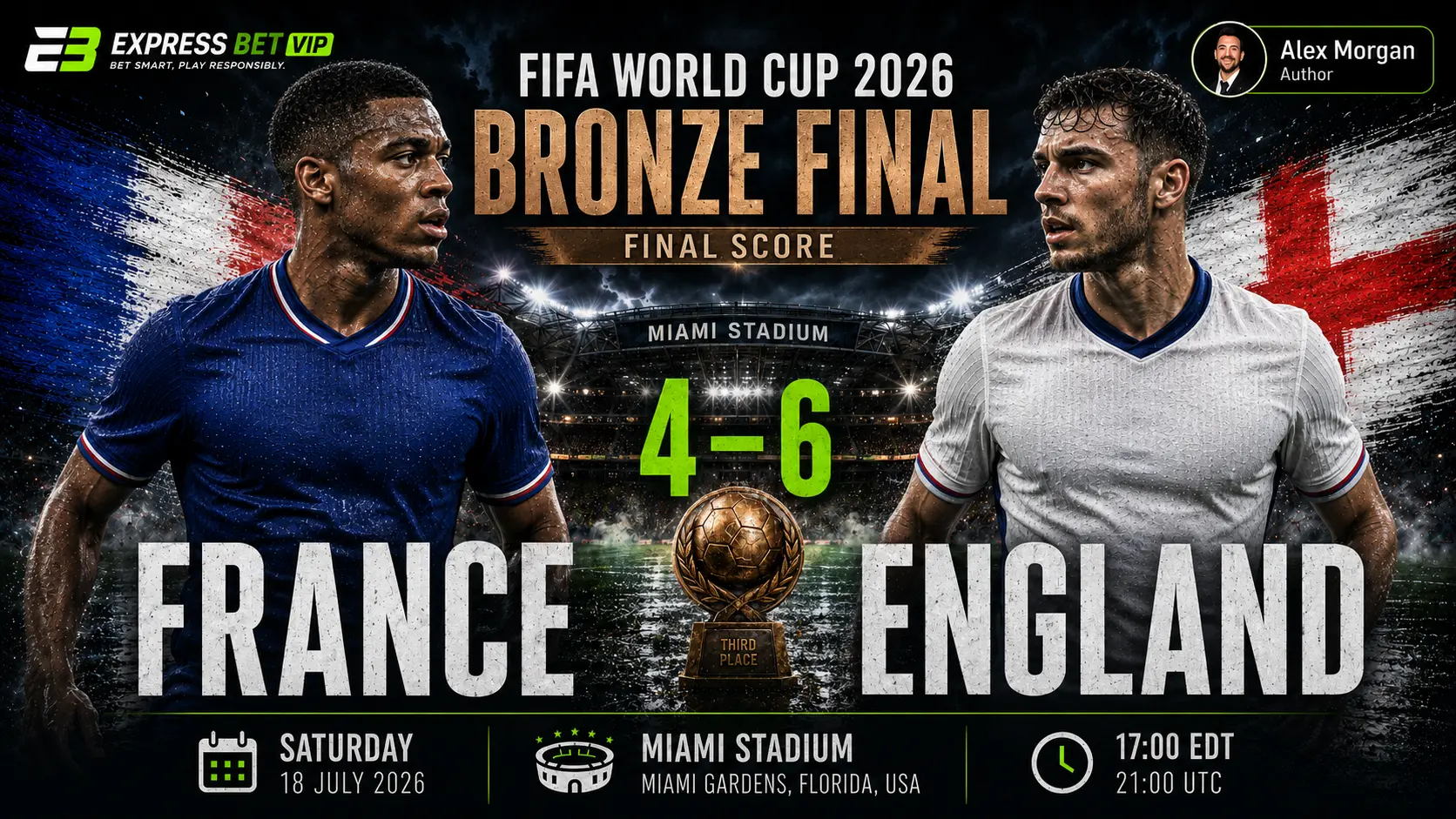
Quick Facts: Final Score, Goals, Venue, and Match Status
| Match fact | Verified detail |
|---|---|
| Match | France vs England |
| Competition | FIFA World Cup 2026 |
| Stage | Third-place play-off |
| Match number | 103 |
| Date | Saturday, July 18, 2026 |
| Kickoff | 5:00 p.m. EDT / 21:00 UTC |
| Host country | United States |
| City | Miami Gardens, Florida |
| Stadium | Miami Stadium |
| Attendance | 64,478 |
| Final score | France 4-6 England |
| Half-time score | France 0-4 England |
| France scorers | Kylian Mbappé 48’, 66’; Bradley Barcola 54’; Ousmane Dembélé 90+6’ |
| England scorers | Declan Rice 3’; Ezri Konsa 18’; Bukayo Saka 37’, 45+1’, 87’ pen.; Jude Bellingham 90+8’ |
| Referee | Jesús Valenzuela, Venezuela |
| VAR | Leodan González, Uruguay |
| Weather | Hot and humid; 31°C was reported at the venue |
| Pitch | Natural grass; no major surface failure confirmed |
| Match status | Full time |
| Tournament impact | England finished third; France finished fourth |
Verified Facts vs Analysis
| Category | Example from this match |
|---|---|
| [CONFIRMED] | England won 6-4; Saka scored three; attendance was 64,478 |
| [REPORTED] | Conditions felt close to 38°C, and the atmosphere was hot and muggy |
| [OBSERVED] | France pressed higher after four half-time substitutions; England’s defensive block retreated |
| [ANALYSIS] | England’s first-half advantage came from superior transition spacing and France’s weak rest defence |
| [MARKET SIGNAL] | France entered as the 90-minute favourite at approximately -110 with one major sportsbook |
| [DISPUTED] | Sources differ over whether Michael Olise’s seven-assist tournament total equalled or broke a historical record associated with Pelé |
| [UNKNOWN] | Exact match-time humidity and verified closing prices were not available from the sources examined |
This separation matters. A score and an official goal time can be extracted as fact. A claim about why a goal happened is interpretation, even when it is strongly supported by footage and positioning data. Betting prices are snapshots, not universal truths: operators, jurisdictions and timestamps differ.
Final Score and Match Summary
The France vs England match result was 6-4 to England, and even that sentence struggles to contain the match.
England scored after three minutes. Rice collected a loose French ball and drove his finish beyond Mike Maignan. Fifteen minutes later, Rice supplied Konsa from a set piece. Saka then scored twice before half-time, leaving France four goals behind and tactically scattered.
England’s first half was direct without being crude. Thomas Tuchel’s team did not need long spells of sterile possession. Rice controlled the centre, while Eberechi Eze, Morgan Rogers, Marcus Rashford and Saka attacked the spaces around France’s double pivot. Ivan Toney occupied the centre-backs and gave the runners a reference point.
France’s defensive distances were poor. The full-backs advanced, the midfield failed to protect turnovers, and the centre-backs were repeatedly asked to defend open grass. That is rarely a pleasant assignment against Saka. It is even less pleasant when Rice is finding the first forward pass.
Deschamps made four changes at half-time. Lucas Digne, Dayot Upamecano, Dembélé and Barcola replaced Theo Hernández, Ibrahima Konaté, Rayan Cherki and Désiré Doué. It was less a minor correction than a change of operating system.
Mbappé scored three minutes after the restart. Barcola made it 4-2 after 54 minutes, and Mbappé’s second reduced the deficit to one in the 66th. England’s four-goal lead had become a one-goal lead in 21 second-half minutes. Tournament football has never trusted a comfortable scoreline, and this match was particularly suspicious of one.
France then pushed for 4-4. Olise influenced almost every dangerous French attack, but England survived the decisive phase. Tuchel introduced Elliot Anderson and Bellingham, restoring some midfield running and ball-carrying capacity. Djed Spence’s late surge drew a penalty from Malo Gusto, and Saka converted it for his hat-trick.
Dembélé made it 5-4 in added time. Bellingham answered with a solo goal at 90+8, finally ending the contest.
Was 6-4 fair? In opportunity terms, it was less absurd than it looks. FotMob’s Opta-powered figures gave both teams 2.88 expected goals, with 19 shots apiece. England were much more efficient and punished France’s first-half structural failures. France’s comeback was real, not cosmetic, but its defence remained vulnerable whenever England escaped.
Goal Timeline
3’ — Declan Rice, England, open-play goal
[CONFIRMED] Rice scored without an official assist.
[OBSERVED] France lost control of the ball through Doué in a central area. Rice reacted first, advanced and struck firmly beyond Maignan. The goalkeeper was exposed by the turnover and had limited time to reset.
[ANALYSIS] The goal immediately validated England’s plan: win the second ball, attack before France could rebuild its midfield screen and shoot before the defensive line settled. It also forced France to chase the match in oppressive conditions after only three minutes.
18’ — Ezri Konsa, England, set-piece header
[CONFIRMED] Rice assisted Konsa.
Rice’s delivery found Konsa with space inside the penalty area. The defender rose and headed past Maignan.
France’s marking was the greater problem than the surface, wind or goalkeeper. Konsa was allowed a clean attacking action in the most valuable zone. England were now 2-0 ahead without needing prolonged territorial domination.
37’ — Bukayo Saka, England, open-play goal
[CONFIRMED] Rashford received the official assist.
The move developed through a chaotic transition. Saka initially rounded Maignan during the wider sequence, France briefly recovered, and England recycled the attack. Rashford returned the ball toward Saka, whose finish took a deflection on its way in.
[ANALYSIS] France failed to end the phase after surviving the initial break. Its defensive line and midfield were moving in different directions. Saka remained active rather than admiring his first run, which is a useful habit for wide forwards and an inconvenient one for defenders.
45+1’ — Bukayo Saka, England, open-play goal
[CONFIRMED] Eze assisted Saka.
Eze released Saka into another favourable right-sided position. Saka finished left-footed beyond Maignan.
The goal made it 4-0 at half-time. France again allowed England to enter the decisive channel with insufficient pressure on the passer and inadequate cover behind the first challenge.
Emotionally, this appeared terminal. Tactically, it prompted Deschamps to replace four players at the interval. The match, being unreasonable, was not terminal.
48’ — Kylian Mbappé, France, open-play goal
[CONFIRMED] Olise supplied the assist.
Olise played Mbappé into space, and the France captain placed his finish beyond Dean Henderson.
[ANALYSIS] The goal showed the immediate difference in France’s second-half positioning. The attacking line was higher, the support distances were shorter and Mbappé received the ball while England’s defence was retreating rather than set.
54’ — Bradley Barcola, France, counterattack goal
[CONFIRMED] Mbappé assisted Barcola.
France broke quickly after England’s attack ended. Mbappé released Barcola, who carried the ball forward and finished past Henderson.
The substitute’s direct running gave England a different problem from the first half. France no longer waited for a perfect positional attack. It attacked space early and with numbers.
At 4-2, the crowd had a contest again, while England’s initial calm began to resemble passivity.
66’ — Kylian Mbappé, France, open-play goal
[CONFIRMED] Olise recorded his second assist.
Olise found Mbappé, who finished left-footed to make it 4-3. The move again exposed England’s difficulty controlling the space between its midfield and defensive line.
[ANALYSIS] This was the comeback’s tactical peak. France had established pressure, recovered the ball more quickly and prevented England from retaining possession through its forward line. England were defending the score rather than controlling the match.
87’ — Bukayo Saka, England, penalty
[CONFIRMED] Gusto fouled Spence after the England wing-back drove into the penalty area. Valenzuela awarded the penalty, and Saka converted it.
Saka used a short run-up and sent Maignan the wrong way. There was no verified evidence of a successful VAR intervention overturning or materially changing the decision.
The goal completed Saka’s hat-trick and changed the emotional calculation. France now needed two goals rather than one, with only added time remaining.
90+6’ — Ousmane Dembélé, France, open-play goal
[CONFIRMED] Upamecano assisted Dembélé.
Dembélé moved inside from the right and curled his finish beyond Henderson. England’s block was deep and stretched, while France continued to attack with numbers.
At 5-4, the match found one last way to refuse closure.
90+8’ — Jude Bellingham, England, open-play goal
[CONFIRMED] No official assist was awarded.
Bellingham carried the ball through the French defensive line, shifted his angle around Lacroix and finished to make it 6-4.
It was both an individual goal and a tactical release valve. England had spent much of the second half retreating. Bellingham provided the ball-carrying power required to turn a clearance into a decisive attack.
Key Moments That Changed the Match
Saka’s disallowed goal at 12 minutes
[CONFIRMED] Saka had an effort disallowed for offside.
France escaped that incident but did not correct the space England were finding. Six minutes later, Konsa scored. The warning was filed and then apparently ignored.
Deschamps’ four half-time substitutions
This was the match’s largest tactical intervention. Digne and Upamecano changed the defensive unit; Barcola and Dembélé increased France’s speed and width. France scored three times in the following 21 minutes.
The replacements also changed the pressing mood. England’s first pass after regaining possession came under greater pressure, and Toney or Watkins received less clean service.
Maignan’s save around the hour
Maignan produced an important stop from an England chance connected to a Rice corner and Toney’s touch. At 4-2, a fifth England goal would probably have ended the comeback before it fully developed.
Olise’s influence — and the missing equaliser
Olise created both Mbappé goals and found space repeatedly between England’s lines. France also had opportunities to make it 4-4, but the equaliser never arrived. That distinction matters: pressure is valuable, but knockout scoreboards remain stubbornly literal.
Tuchel’s 79th-minute double change
Anderson and Bellingham replaced Toney and Eze. England needed fresh legs around Rice and a carrier capable of escaping pressure. Bellingham eventually scored the sixth, while the altered midfield helped England survive France’s strongest spell.
Spence’s penalty-winning run
Spence did not wait for England’s possession to become elegant. He attacked Gusto at speed and forced the decisive foul. The action restored a two-goal advantage and gave Saka his hat-trick.
Local Match Conditions: Stadium, City, Weather, Pitch, and Crowd
| Local factor | Verified or observed detail | Football meaning | Direct match evidence | Betting-result meaning | Status | Anti-template status |
|---|---|---|---|---|---|---|
| City | Miami Gardens, Florida | Hot July conditions increase recovery demands | Players used hydration breaks | Relevant to fatigue and second-half tempo, not proof of an over | [CONFIRMED] | Specific |
| Stadium | Miami Stadium | Canopy covers much of the seating; playing field remains open | Field exposed to afternoon heat | May matter more to player props than crowd comfort suggests | [CONFIRMED] | Specific |
| Attendance | 64,478 | Large crowd and high noise potential | Strong reactions as France closed to 4-3 | Could intensify live-market volatility | [CONFIRMED] | Specific |
| Temperature | 31°C; higher “feels-like” figure reported | Reduces sustainable pressing duration | England’s pressure declined after half-time | Possible second-half goals and substitute relevance | [CONFIRMED]/[REPORTED] | Specific |
| Humidity | Exact figure unavailable | Humidity would increase thermal strain | Hot, muggy conditions were reported | Do not price an exact effect without data | [UNKNOWN]/[REPORTED] | Specific |
| Wind | Forecasts ranged approximately 12–21 mph | Can affect high balls and long distribution | No decisive wind-caused error identified | Weak post-match signal | [REPORTED] | Specific |
| Rain | No meaningful match rain reported | Normal ball speed and handling | No rain-related handling problem | No clear market effect | [REPORTED] | Specific |
| Pitch | Natural grass | Familiar surface for both teams | No major slipping or abnormal bounce pattern confirmed | Surface did not explain ten goals | [CONFIRMED]/[OBSERVED] | Specific |
| Hydration | Breaks used around 23 and 68 minutes | Interrupted continuous pressing and allowed instructions | Both teams had structured recovery pauses | Relevant to live tempo and substitution markets | [OBSERVED] | Specific |
| Crowd response | Audible reaction as France recovered; Tuchel reportedly booed during introductions | Increased psychological pressure on England | Noise rose substantially at 4-3 | Live prices likely moved sharply, but exact prices are unavailable | [OBSERVED]/[REPORTED] | Specific |
The principal local factor was heat exposure. Miami Stadium’s canopy protects most spectators, but it does not enclose or air-condition the pitch. At a 5 p.m. local kickoff, the players were operating in 31°C conditions with substantial thermal load.
England’s first-half intensity therefore deserves context. Tuchel’s side pressed selectively rather than continuously. It attacked turnovers and used direct passes instead of attempting a relentless high press. That was an intelligent use of energy.
The second half told a different story. France’s four fresh substitutes raised the pace at exactly the point when England’s first-half starters were beginning to manage their workload. England had also played its semi-final a day later and travelled farther between matches, a scheduling disadvantage Tuchel referenced after the game.
Heat contributed to the physical pattern. It did not instruct France to leave Konsa unmarked or repeatedly lose Saka. Nor did it force England to concede four times. The more credible conclusion is narrower: the conditions magnified fatigue and made sustained defensive control more difficult.
No verified evidence links any goal to a bad bounce, wet surface, goalkeeper handling failure or pitch deterioration.
Stadium-Specific Match Impact
| Stadium factor | Match detail |
|---|---|
| Stadium | Miami Stadium, Miami Gardens |
| Regular football capacity | Approximately 74,916, depending on configuration |
| Match attendance | 64,478 |
| Pitch type | Natural grass |
| Roof status | Seating canopy; open field |
| Acoustic effect | Loud reaction during France’s comeback; exact decibel data unavailable |
| Surface condition | No significant failure confirmed |
| Airflow relevance | Open-sided structure allowed airflow, but did not remove the heat burden |
| Goalkeeper distribution | No clear distribution error attributable to wind |
| Set-piece effect | England scored through Konsa from Rice’s delivery; no verified venue-specific cause |
| Communication effect | Crowd noise likely complicated communication during the 4-3 phase, but cannot be quantified |
| Data status | Capacity and pitch confirmed by venue/provider information; acoustic interpretation observed |
The stadium influenced the match primarily through exposure and atmosphere. Its partial roof is easy to misunderstand: it improves spectator shade but leaves the contest itself subject to South Florida conditions.
Konsa’s goal came from a set piece, but there is no credible basis for attributing it to wind or stadium geometry. Rice delivered accurately and France marked poorly. Sometimes the football explanation is sufficient.
The available evidence also does not show a clear wind effect on Henderson’s or Maignan’s distribution. Both teams used direct balls, but those choices followed game state and tactical pressure more than local aerodynamics.
City and Weather Impact
| Category | Match-specific detail |
|---|---|
| City | Miami Gardens |
| Host country | United States |
| Time zone | Eastern Daylight Time, UTC−4 |
| July climate | Typically hot, humid and prone to afternoon weather changes |
| Match temperature | 31°C |
| Feels-like temperature | Around 38°C was reported |
| Humidity | Not available from verified public match data |
| Wind | Approximately 12–21 mph in pre-match reports |
| Rain | No meaningful match rain reported |
| Altitude | Near sea level |
| Likely physical effect | Higher cooling and hydration demand; reduced repeated-press capacity |
| Actual evidence | Hydration pauses, declining England pressure, substitutions and late fatigue |
| Data status | Temperature confirmed by match provider; some weather details reported rather than official |
The first half remained fast despite the heat because England attacked efficiently. Short transition sequences require less continuous running than a prolonged high press. France also made England’s work easier by losing possession in damaging areas.
After half-time, fatigue became more visible. France’s fresh attackers pressed, carried and ran behind the defence. England’s distances expanded, and the forwards could no longer hold the ball reliably. The change cannot be separated from Deschamps’ substitutions, which were the main cause, but the temperature raised the cost of responding.
There was no confirmed cramp diagnosis. Quansah left after going down in the 83rd minute, and Spence experienced discomfort late on, but detailed medical findings were not available from verified public data.
First Half Analysis
France started in a 4-2-3-1. Zaïre-Emery and Rabiot formed the double pivot, with Cherki central behind Mbappé. Olise and Doué operated from the attacking flanks.
England’s listed shape was closer to 4-1-4-1. Rice anchored midfield. Rogers and Eze worked ahead of him, Saka and Rashford supplied width, and Toney occupied the centre.
The important feature was not the formation graphic. It was the space between France’s units. When Gusto or Hernández advanced, the nearest midfielder did not always cover the vacated channel. England could therefore regain possession, find Rice and attack the back line before France restored numerical balance.
Rice’s role was decisive. He was the first defensive screen, the collector of loose balls and the player capable of accelerating the attack with one pass. His third-minute goal established authority; his delivery for Konsa made the lead structural rather than accidental.
On England’s right, Saka repeatedly received with room to turn or attack the box. France struggled to decide whether the full-back or wide midfielder should engage him. That hesitation gave Eze and Rogers access to the half-spaces.
Toney’s contribution was less spectacular but tactically useful. He fixed defenders centrally and offered a direct target. England could bypass France’s first line without simply surrendering possession.
France’s attack was not entirely absent. Mbappé’s movement demanded attention, and Cherki forced Henderson into work during the sequence preceding Saka’s first goal. Yet France’s attacks were poorly protected. When possession broke down, England faced too few delaying actions.
The physical tone remained surprisingly clean. FIFA recorded no cards in the match. France committed more fouls overall, but the first half never developed into a disciplinary contest.
At 4-0, Deschamps needed greater speed, a more aggressive counterpress and different defensive personnel. Tuchel needed no reinvention. He required his side to keep the ball long enough to prevent the second half becoming a siege. England failed at that task.
Second Half Analysis
Deschamps changed four players and the emotional direction of the match.
Barcola and Dembélé stretched England horizontally. Olise moved into better creative positions, while Mbappé began receiving earlier and closer to goal. Upamecano gave France a quicker defender for open-field situations, and Digne provided a steadier left-sided platform.
Mbappé’s 48th-minute goal made England cautious. Barcola’s strike six minutes later made them anxious. By the time Mbappé scored again at 66 minutes, England were defending a lead that had become psychologically smaller than the scoreboard suggested.
France’s counterpress was the central improvement. In the first half, England could play the first forward pass after regaining possession. In the second, France crowded the receiver and attacked the next loose ball. Watkins, who replaced Rashford at half-time, made runs but could not consistently provide the retention England needed.
England’s defensive line dropped. That protected space behind the centre-backs but opened the zone in front of them, where Olise became increasingly influential. France could combine rather than force low-percentage crosses.
The hydration pause around 68 minutes arrived shortly after the score became 4-3. It offered England a chance to reorganise, but France retained momentum. Tuchel eventually brought on Anderson and Bellingham in the 79th minute. The timing was later than ideal, although the changes did improve England’s ability to carry the ball out.
Spence became the unexpected attacking release. His 85th-minute drive forced Gusto into a sliding challenge and won the penalty. England had spent much of the half protecting its goal; the decisive action came when a defender attacked forward.
Even after Saka converted, England conceded to Dembélé in added time. Bellingham’s sixth goal was therefore more than decorative. It punished France’s continued risk-taking and ensured that the comeback ended with England moving forward rather than merely waiting for the whistle.
Tactical Picture: Why the Match Was Won and Lost
England won because it exploited France’s transitions with exceptional efficiency and retained enough attacking threat to survive the comeback.
France lost because its first-half rest defence was inadequate. “Rest defence” describes the players positioned to control a turnover while their team attacks. France often had too few players in useful covering positions. The nearest defender stepped forward; the next line was too far away; Saka, Rashford or Eze entered the resulting space.
England’s 4-1-4-1 became a compact block without the ball and a much wider attacking structure after turnovers. Rice protected the middle, while the two advanced midfielders supported the wingers. Toney’s central position prevented France’s centre-backs from freely covering wide.
France’s 4-2-3-1 carried technical quality but insufficient defensive synchronisation. Zaïre-Emery and Rabiot were asked to protect a broad area. Cherki and Doué did not consistently delay England’s exits. The back four then faced runners arriving from several angles.
After half-time, France created an aggressive 4-2-4-like pressing picture. Barcola and Dembélé attacked the outside channels, Olise connected inside, and Mbappé played on England’s last line. England’s midfield could no longer control the second ball.
Tuchel’s team almost lost because its response became too passive. The defensive block dropped without retaining a credible counterattacking connection. That invited repeated French possession near the penalty area.
The final tactical lesson came from Spence and Bellingham. England stopped the collapse only when it began carrying the ball through pressure again. Protecting a lead does not always mean adding another body to the defensive line. Sometimes it means making the opponent run toward its own goal for ten seconds.
Tactical Collision Map
| Zone | Edge | Evidence | Key player | Local effect | Result impact |
|---|---|---|---|---|---|
| France left / England right | England | Saka scored three and repeatedly entered shooting positions | Saka | Heat made repeated recovery runs costly | Major |
| France right / England left | France, second half | Olise created two goals; Barcola added direct running | Olise | Fresh substitutes exploited tiring defenders | Major |
| Central midfield | England first half; France second | Rice dominated early; France’s counterpress took over later | Rice | Pressing duration declined in the heat | Major |
| Penalty boxes | England | Six goals from 11 shots on target | Saka | No pitch-specific effect | Decisive |
| Set pieces | England | Rice assisted Konsa | Rice | Wind caused no identifiable error | Important |
| Transitions | England overall | Early opener, repeated first-half breaks, late Bellingham goal | Rice/Bellingham | Heat increased the cost of emergency recovery runs | Decisive |
| Defensive third | Neither | Ten total goals and repeated structural failures | Upamecano improved France | Fatigue widened spaces | Major |
| Goalkeeper build-up | Even | No clear distribution failure caused the result | Henderson/Maignan | No confirmed wind impact | Limited |
| Bench | France for comeback; England for finish | Four French changes transformed the match; Bellingham scored late | Barcola/Bellingham | Fresh legs were especially valuable in 31°C | Major |
Player Ratings and Individual Performances
Ratings are editorial assessments based on production, tactical execution and mistakes. They are not official FIFA grades.
France Player Ratings
- Mike Maignan — 4.8: Conceded six, although several finishes left him exposed. His save around the hour preserved France’s comeback.
- Malo Gusto — 4.5: Had difficulty controlling England’s left-sided runs and conceded the late penalty against Spence.
- Ibrahima Konaté — 4.0: Part of a defensive unit repeatedly opened in transition. Replaced at half-time.
- Maxence Lacroix — 4.5: Faced difficult open-field situations and was beaten by Bellingham for the final goal.
- Theo Hernández — 4.0: Advanced without sufficient protection and was removed during the four-player interval reshuffle.
- Warren Zaïre-Emery — 5.5: Improved after half-time but could not stabilise France’s first-half transition defence.
- Adrien Rabiot — 5.7: Contributed to the second-half pressure, though England found too much room around him before the break.
- Michael Olise — 8.3: Created both Mbappé goals and became France’s most consistent source of penetration.
- Rayan Cherki — 4.5: Produced one threatening effort but offered too little control without the ball. Replaced at half-time.
- Désiré Doué — 4.0: His loose play contributed to Rice’s opener, and he did not recover his influence.
- Kylian Mbappé — 9.0: Two goals, an assist and constant penalty-box danger. France lost despite an elite attacking performance.
Substitutes:
- Lucas Digne — 6.4: Gave France more stability and cleaner circulation on the left.
- Dayot Upamecano — 6.8: Added pace and aggression and assisted Dembélé’s goal.
- Ousmane Dembélé — 7.7: Increased France’s width and scored in added time.
- Bradley Barcola — 7.5: Made an immediate impact with a direct run and finish.
- Jules Koundé — not rated: Entered in the 90+1st minute and had insufficient time for a fair assessment.
England Player Ratings
- Dean Henderson — 6.5: Conceded four but made five saves from France’s nine shots on target. Left exposed during the comeback.
- Jarell Quansah — 6.0: Competed well early, struggled as France increased the pressure and left after going down in the 83rd minute.
- Ezri Konsa — 7.2: Scored England’s second and defended a large volume of second-half pressure.
- Marc Guéhi — 6.5: Strong in early duels, less secure as England’s midfield protection disappeared.
- Djed Spence — 7.8: Energetic throughout and won the decisive late penalty with a forceful forward run.
- Declan Rice — 8.4: Scored, assisted and controlled the first half from the base of midfield.
- Bukayo Saka — 9.7: Hat-trick, relentless movement and decisive finishing. Clear man of the match.
- Morgan Rogers — 6.6: Helped England connect midfield to attack and worked through difficult second-half phases.
- Eberechi Eze — 7.8: Supplied Saka’s second goal and found valuable spaces before England retreated.
- Marcus Rashford — 7.4: Assisted Saka and stretched France during England’s dominant first half.
- Ivan Toney — 6.5: Provided a central reference and supported England’s direct progression.
Substitutes:
- Ollie Watkins — 6.3: Offered runs in behind but struggled to retain possession during France’s pressure.
- Elliot Anderson — 6.2: Added legs and helped England contest midfield late.
- Jude Bellingham — 8.0: Changed the escape routes available to England and scored an excellent solo goal.
- Reece James — 6.1: Entered for Quansah and helped close the right side during added time.
- Trevoh Chalobah — not rated: Introduced in the 90+2nd minute.
Best Players of the Match
- Man of the Match — Bukayo Saka: Three goals from different game states, including the pressure penalty that halted France’s comeback.
- Best attacker — Kylian Mbappé: Two goals and one assist made him France’s principal threat.
- Best midfielder — Declan Rice: England’s first-half control flowed through his recoveries, forward passing and set-piece delivery.
- Best defender — Djed Spence: Neither defence enjoyed a distinguished evening, but Spence combined recovery work with the penalty-winning run.
- Best goalkeeper — Dean Henderson: Four concessions are not an obvious recommendation, yet his five saves exceeded Maignan’s overall influence.
- Best substitute — Bradley Barcola: Scored within nine minutes of entering and immediately changed England’s defensive problem.
- Most underrated — Eberechi Eze: His positioning connected England’s midfield and forward line before the break.
- Most disappointing — Désiré Doué: His early error led to the opener, and he could not impose himself before being replaced.
Injuries, Suspensions, Cards, and Discipline
| Player | Team | Incident | Minute | Status | Next-match impact | Data status |
|---|---|---|---|---|---|---|
| Jarell Quansah | England | Went down before substitution | 83’ | Injury details unconfirmed | No next tournament match | [REPORTED] |
| Djed Spence | England | Experienced late discomfort | Added time | Diagnosis unavailable | No next tournament match | [OBSERVED]/[UNKNOWN] |
| Kobbie Mainoo | England | Unavailable before the match | Pre-match | Reported injury | No match involvement | [REPORTED] |
| All players | Both | Yellow cards | — | None | No suspension effect | [CONFIRMED] |
| All players | Both | Red cards | — | None | No suspension effect | [CONFIRMED] |
FIFA recorded no yellow or red cards. That is notable in a ten-goal match containing 22 recorded fouls and a late penalty.
There was no subsequent World Cup fixture for either team, so card accumulation could not affect the competition. Detailed diagnoses for Quansah and Spence were not confirmed from verified public data at the time of writing.
Referee and VAR Analysis
Jesús Valenzuela managed the match without using a card. France were recorded with 14 fouls and England with eight, but the contest never descended into persistent confrontation.
The main decision was Gusto’s challenge on Spence. The defender slid across the England player’s path after Spence entered the area. The penalty was awarded and stood. Available evidence supports the decision.
Saka’s 12th-minute effort was disallowed for offside. No verified evidence indicates an incorrect call or a prolonged VAR controversy.
FIFA recorded four minutes of first-half added time and eight in the second. The lengthy second-half addition was consistent with goals, substitutions, hydration and injury stoppages. Two goals were scored during that period.
The referee influenced the match through the penalty decision, but he did not dictate its overall direction. The tactical instability was quite capable of doing that without assistance.
Match Statistics
| Statistic | France | England |
|---|---|---|
| Possession | 46% | 54% |
| Shots | 19 | 19 |
| Shots on target | 9 | 11 |
| Expected goals | 2.88 | 2.88 |
| Blocked shots | 2 | 4 |
| Touches in opposition box | 55 | 34 |
| Corners | 3 | 4 |
| Fouls recorded | 14 | 8 |
| Offsides | 3 | 3 |
| Penalties scored | 0 | 1 |
| Yellow cards | 0 | 0 |
| Red cards | 0 | 0 |
| Goalkeeper saves | 5 | 5 |
FIFA supplied the core possession, shooting, foul, corner, offside and disciplinary totals. FotMob’s Opta-powered data supplied the xG and opposition-box touches. Providers may apply slightly different definitions.
The 2.88–2.88 xG tie is revealing. England did not generate six goals’ worth of average finishing expectation. It converted at an exceptional rate. France reached the England box 55 times but scored four from nine shots on target.
England’s 54% possession also requires context. Its first-half control was strong enough to outweigh France’s second-half territorial superiority. The full-match number does not mean England controlled both halves.
Seven corners and no cards underline the contest’s character: open, attacking and strangely civil.
Betting Result Angle
The FOX Sports pre-match market, using FanDuel prices, made France approximately a -110 favourite in 90 minutes. England were around +280, with the draw also near +280. The listed total was 3.5 goals, with the over at approximately +108 and the under at -132.
These are dated market snapshots, not universal closing odds.
| Market | Pre-match expectation | Actual result | Winning side | Main trigger | Local factor | Caution |
|---|---|---|---|---|---|---|
| 90-minute winner | France favoured | England won 6-4 | England at about +280 | Four first-half England goals | Heat did not prevent England’s fast start | Prices varied |
| Draw | Around +280 | No draw | Losing market | Bellingham’s late sixth removed any final doubt | None clearly decisive | A 4-3 phase is not a draw result |
| England +0.5 | Roughly -110 | England won | England +0.5 | Superior finishing | Limited | Handicap prices differ |
| Total 3.5 goals | Under slightly favoured | Ten goals | Over | Rice scored after three minutes | Heat later widened spaces | One match does not invalidate unders |
| Both teams to score | “Yes” heavily favoured | Both scored | Yes | Mbappé scored at 48’ | Fresh substitutes aided France | Short odds reduce return |
| Mbappé anytime | About -185 | Two goals | Yes | Olise created two chances | No clear local cause | A winning prop can still be poorly priced |
| Dembélé anytime | About +155 | Scored as substitute | Yes | Half-time introduction | Fresh legs mattered in heat | Participation risk existed pre-match |
| Bellingham anytime | About +255 | Scored as substitute | Yes | Late individual transition | Fatigued defensive space | He did not start |
| Cards | No universal price verified | No cards | Likely under-card outcomes | Controlled officiating | Heat did not produce cynical fouling | Rules vary by operator |
| Corners | Line unavailable | Seven total | Depends on line | France 3, England 4 | No clear weather effect | Cannot grade without exact line |
| Penalty awarded | Price unavailable | One awarded | “Yes,” where offered | Gusto’s foul on Spence | Fatigue may have affected recovery | Causation is uncertain |
| Correct score | 6-4 England | Extremely unlikely | Only exact 6-4 tickets | Bellingham’s 90+8 goal | None | Verified price unavailable |
The France vs England betting result punished two casual assumptions: that a favourite is automatically the safer side and that a bronze match must become cautious. Third-place play-offs can create unusual incentives because neither team is managing a path to another round.
Live bettors would have seen extreme repricing: 1-0, 4-0, 4-3, 5-3, 5-4 and 6-4. Exact in-play odds were not available from verified public data, so attaching invented numbers to those swings would add theatre rather than information.
The proper lesson is not “always bet the over in a third-place match.” It is that rotation, defensive motivation, game state and substitute quality deserve attention. This does not mean the same angle will work next time.
Local Betting Impact: What the Venue and Conditions Changed
| Local factor | Market possibly affected | Actual evidence | Interpretation | Overreaction risk | Safer conclusion |
|---|---|---|---|---|---|
| 31°C heat | Second-half goals | Six goals after half-time | Fatigue may have widened defensive spaces | High: tactical changes mattered more | Treat heat as one input |
| Hydration pauses | Live totals and tempo | Breaks around 23’ and 68’ | Pauses allowed tactical resets | Assuming every pause creates goals | Reassess shape after the restart |
| Fresh French substitutes | Player goals and shots | Barcola and Dembélé scored | Bench attackers gained value | Ignoring uncertainty over minutes | Confirm participation where possible |
| Open field under canopy | Player running and fatigue | Pitch remained exposed | Spectator shade did not equal player shade | Treating roof status as climate control | Check field exposure |
| Natural grass | Passing and goalkeeper props | No abnormal bounce confirmed | Neutral surface signal | Inventing pitch-driven explanations | No strong betting adjustment |
| Wind | Crosses and corners | No decisive wind error | Limited observable effect | Overvaluing forecasts | Use match evidence, not weather alone |
| Crowd revival at 4-3 | Live momentum | Audible increase in pressure | Could reinforce French momentum | Assuming noise guarantees a goal | Momentum does not replace price discipline |
| No cards | Card totals | Zero cautions | Referee maintained control | Projecting the same referee outcome later | Treat as match-specific |
The heat was relevant, particularly to the second-half pace and substitution value. It was not a reliable pre-match instruction to expect ten goals. England scored four before the largest fatigue effects should have appeared.
For player markets, the strongest retrospective signal was bench freshness. Barcola and Dembélé entered at half-time and scored. Bellingham entered after 79 minutes and also scored. Yet substitute-scorer bets carry an obvious risk: the player must first receive sufficient minutes.
What This Result Means for the Knockout Bracket
England finished third at the FIFA World Cup 2026. France finished fourth. Neither team had another tournament match.
For England, bronze represented its best men’s World Cup finish since winning the competition in 1966 and its best finish outside its home tournament. England had previously placed fourth in 1990 and 2018.
For France, the defeat ended Didier Deschamps’ final tournament as national-team coach. Reuters reported that he would step down after a tenure that included the 2018 World Cup title and the 2022 final.
There was no qualification scenario left to calculate, no next opponent and no suspension equation. The impact was historical and psychological: England left Miami with a medal; France left with four goals scored, six conceded and one enormous first-half problem to explain.
What France Did Right
France’s second-half response showed depth and tactical flexibility.
Deschamps recognised that a conservative adjustment was insufficient. Four interval changes increased speed, pressing aggression and width. Barcola and Dembélé attacked defenders directly, while Olise moved into positions from which he could supply Mbappé.
France also continued creating rather than reducing the game to hopeful crosses. Its 55 touches in the England box and nine shots on target demonstrate sustained pressure. Mbappé’s two goals and assist reflected a performance of high individual quality rather than a statistical consolation.
The team did not collapse emotionally at 4-0. It reached 4-3 and created opportunities to equalise. That response does not erase the first half, but it prevents the performance being classified as a simple surrender.
What England Got Wrong
England nearly converted a four-goal lead into extra embarrassment by abandoning too much of what had produced it.
The forward line stopped securing possession. The midfield dropped closer to the defence, leaving France able to recover second balls around the box. Olise received without enough immediate pressure, and Mbappé repeatedly attacked a retreating line.
Tuchel’s substitutions eventually improved the situation, but Anderson and Bellingham did not enter until the 79th minute. France had already scored three times by then.
England also failed to slow the match through possession. Game management does not mean time-wasting; it means forcing the opponent to defend and making the ball travel farther from your own goal. For much of the second half, England could do neither.
Still, the team retained one important virtue: it kept attacking when the opportunity was clear. Spence won the penalty and Bellingham scored the sixth. That prevented the afternoon becoming a case study in pure retreat.
Coach Analysis
Didier Deschamps
Deschamps’ starting structure failed. France’s midfield protection was weak, the wide defensive coverage broke down and England attacked open spaces almost immediately.
His half-time response was excellent. Making four changes carried risk, but a 4-0 deficit did not require caution. Upamecano stabilised defensive transitions, while Dembélé and Barcola changed the speed and width of the attack.
The contradiction defines his final France match: the coach helped create the first-half problem and then nearly solved it with one of the tournament’s most aggressive interval interventions.
Thomas Tuchel
Tuchel’s initial plan was highly effective. England’s 4-1-4-1 gave Rice a commanding role and positioned several runners around France’s vulnerable midfield. The set-piece preparation also produced Konsa’s goal.
The second-half management was less convincing. Watkins’ introduction did not give England sufficient ball retention, and the midfield reinforcement arrived only after the score reached 4-3.
Bellingham and Anderson helped, however, and James replaced the injured Quansah. Tuchel’s side finished by attacking rather than placing ten players on the edge of Henderson’s box. It was untidy management, but it produced a medal.
Player Milestones and Records
- [CONFIRMED] Saka scored a World Cup hat-trick, joining England players including Geoff Hurst, Gary Lineker and Harry Kane in achieving that feat.
- [CONFIRMED] Mbappé finished the 2026 tournament with ten goals and secured a second consecutive World Cup Golden Boot.
- [CONFIRMED] England achieved its first third-place finish and best men’s World Cup result since 1966.
- [REPORTED] The ten-goal match became the highest-scoring third-place play-off in World Cup history.
- [REPORTED] It was the highest-scoring World Cup match since 1982.
- [REPORTED] Bellingham’s seventh goal was the highest total by an England player in a single World Cup.
- [DISPUTED] Olise finished with seven provider-recorded assists. Contemporary reports differed over whether that equalled or surpassed Pelé’s single-tournament benchmark.
Historical Context and World Cup Analogies
England and France had met three times previously at the men’s World Cup.
England won 2-0 in the 1966 group stage and 3-1 in 1982. France won their 2022 quarter-final 2-1. The 2026 meeting therefore produced both the largest score and the wildest tactical pattern in their World Cup series.
Third-place matches have often been more open than finals. The pressure is different, defensive caution can weaken, and coaches rotate. That context helps explain the attacking intention. It does not fully explain ten goals or a four-goal comeback.
England’s experience also recalled a familiar tournament lesson: control without an outlet is temporary. Once Tuchel’s side stopped carrying the ball forward, its defensive work multiplied. Bellingham’s late run restored the missing threat.
Incidents and Controversies
No major VAR controversy determined the result.
Saka’s early disallowed goal was ruled offside. England later received a penalty for Gusto’s challenge on Spence. Neither incident produced a verified post-match correction.
Tuchel’s name was reportedly booed when announced before kickoff. Some reports also noted criticism of ticket pricing and visible empty seats, although FIFA’s official attendance was 64,478. The precise distribution of France, England and neutral supporters was not available from verified public data.
No crowd disorder, pitch invasion or medical emergency materially affecting the match was confirmed.
Information Gain: What This Article Adds
This analysis combines:
- FIFA-confirmed score, goals, lineups, substitutions and discipline;
- a ten-goal chronological breakdown;
- first- and second-half tactical separation;
- a zone-by-zone collision map;
- full editorial player ratings;
- Miami-specific heat, stadium and hydration analysis;
- betting-market grading using dated odds;
- verified tournament and historical consequences;
- explicit separation of fact, reporting, observation and analysis.
The central information gain is that the score was not merely random. England’s transition superiority created the first-half lead; France’s four substitutions and stronger counterpress produced the comeback; England’s renewed ball-carrying threat stopped it.
Local Information Gain Quality Check
| Detail | Included | Status | Fixture-specific? | Future update needed? |
|---|---|---|---|---|
| Stadium | Miami Stadium configuration and canopy | [CONFIRMED] | Yes | Only if FIFA revises venue wording |
| City | Miami Gardens, EDT, near sea level | [CONFIRMED] | Yes | No |
| Weather | 31°C and reported high feels-like temperature | [CONFIRMED]/[REPORTED] | Yes | Exact humidity if published |
| Pitch | Natural grass; no major failure observed | [CONFIRMED]/[OBSERVED] | Yes | Only if an official pitch report appears |
| Crowd | 64,478 and louder comeback response | [CONFIRMED]/[OBSERVED] | Yes | Verified fan split unavailable |
| Travel | England reportedly had shorter recovery and more travel | [REPORTED] | Yes | No |
| Betting risk | Heat contextualised without treating it as predictive | [ANALYSIS] | Yes | Closing odds unavailable |
| Tactical-local link | Fresh substitutes attacked tiring defenders in 31°C | [ANALYSIS] | Yes | No |
| Anti-template status | References exact kickoff setting, hydration pattern and match phases | [CONFIRMED]/[ANALYSIS] | Yes | No |
Source and Data Appendix
| Data point | Status | Source type |
|---|---|---|
| Final score | [CONFIRMED] | FIFA full-time report |
| Scorers and times | [CONFIRMED] | FIFA full-time report |
| Assists | [CONFIRMED] | FIFA full-time report |
| Stadium and city | [CONFIRMED] | FIFA match documentation |
| Attendance | [CONFIRMED] | FIFA full-time report |
| Referee and VAR | [CONFIRMED] | FIFA full-time report |
| Lineups | [CONFIRMED] | FIFA full-time report |
| Substitutions | [CONFIRMED] | FIFA full-time report |
| Cards | [CONFIRMED] | FIFA full-time report |
| Injury diagnoses | [UNKNOWN] | No verified medical release examined |
| Core statistics | [CONFIRMED] | FIFA full-time report |
| xG and box touches | [REPORTED] | FotMob/Opta provider data |
| Pre-match odds | [MARKET SIGNAL] | FOX Sports/FanDuel snapshot |
| Verified closing odds | [UNKNOWN] | Not available from reviewed sources |
| Temperature | [CONFIRMED] | Match data provider |
| Humidity | [UNKNOWN] | Exact match-time value unavailable |
| Pitch condition | [OBSERVED] | Match evidence and venue data |
| Crowd profile | [OBSERVED]/[UNKNOWN] | Attendance confirmed; exact fan split unavailable |
| Tournament impact | [CONFIRMED] | FIFA result and final standings |
| Olise assist record | [DISPUTED] | Contemporary reports used differing historical descriptions |
Final Verdict
England won because it identified France’s weakest space before France identified its own problem.
Rice controlled the opening phase, Saka devastated the right channel and England converted transitional opportunities with ruthless efficiency. France’s first-half defensive spacing was unacceptable for a team of its quality.
Deschamps then changed four players and almost changed the result. Olise supplied the creativity, Mbappé supplied the finishing, and Barcola and Dembélé supplied fresh speed. At 4-3, England were no longer controlling anything beyond the narrow numerical fact that they still led.
The decisive correction was not another layer of passive defending. Spence carried the ball into France’s area, Saka converted the penalty and Bellingham ran through the spaces France left while chasing the game.
The 31°C Miami conditions increased fatigue and rewarded the use of the bench, but they did not manufacture the score. The ten goals came from aggressive attacking, weak transition defence, high-quality finishing and two teams playing without the cautious burden of a final.
England deserved the bronze because its best phases were more efficient and its late response was stronger. France deserved credit for turning 0-4 into 3-4, but a comeback does not cancel the reasons it became necessary.
For bettors, the underdog, over 3.5 and both-teams-to-score outcomes landed. The sensible conclusion is not that the match was predictable. It is that third-place fixtures, local heat and rotation can produce volatility—and that volatility remains dangerous when the price is poor.
Responsible Betting Note
Football betting carries financial risk. Correct analysis does not guarantee a winning wager, and odds can change substantially before and during a match. Weather, stadium conditions and other local factors can also be overvalued.
Never chase losses or bet money required for rent, food, bills or other daily needs. Set deposit and time limits, take regular breaks and check applicable local laws. Use licensed operators only. Betting should remain entertainment, not a source of income. Support and practical tools are available from GambleAware.
Summarize this article with AI. Use this page URL as the source:
Summarize this article with AI:
FAQ
England beat France 6-4 in the 2026 World Cup third-place play-off.
Mbappé scored twice for France, with Barcola and Dembélé also scoring. Rice, Konsa and Bellingham scored for England, while Saka completed a hat-trick.
Bukayo Saka was the best player after scoring three goals, including England’s late penalty.
England finished third and received the bronze medal. France finished fourth. Both teams’ tournaments are complete.
England’s 90-minute moneyline, over 3.5 goals and both teams to score won. Mbappé, Dembélé and Bellingham anytime-scorer bets also landed at the cited pre-match prices. Returns depended on the operator and timing.