
Germany vs Côte d’Ivoire World Cup 2026 Preview
Table of Contents Show
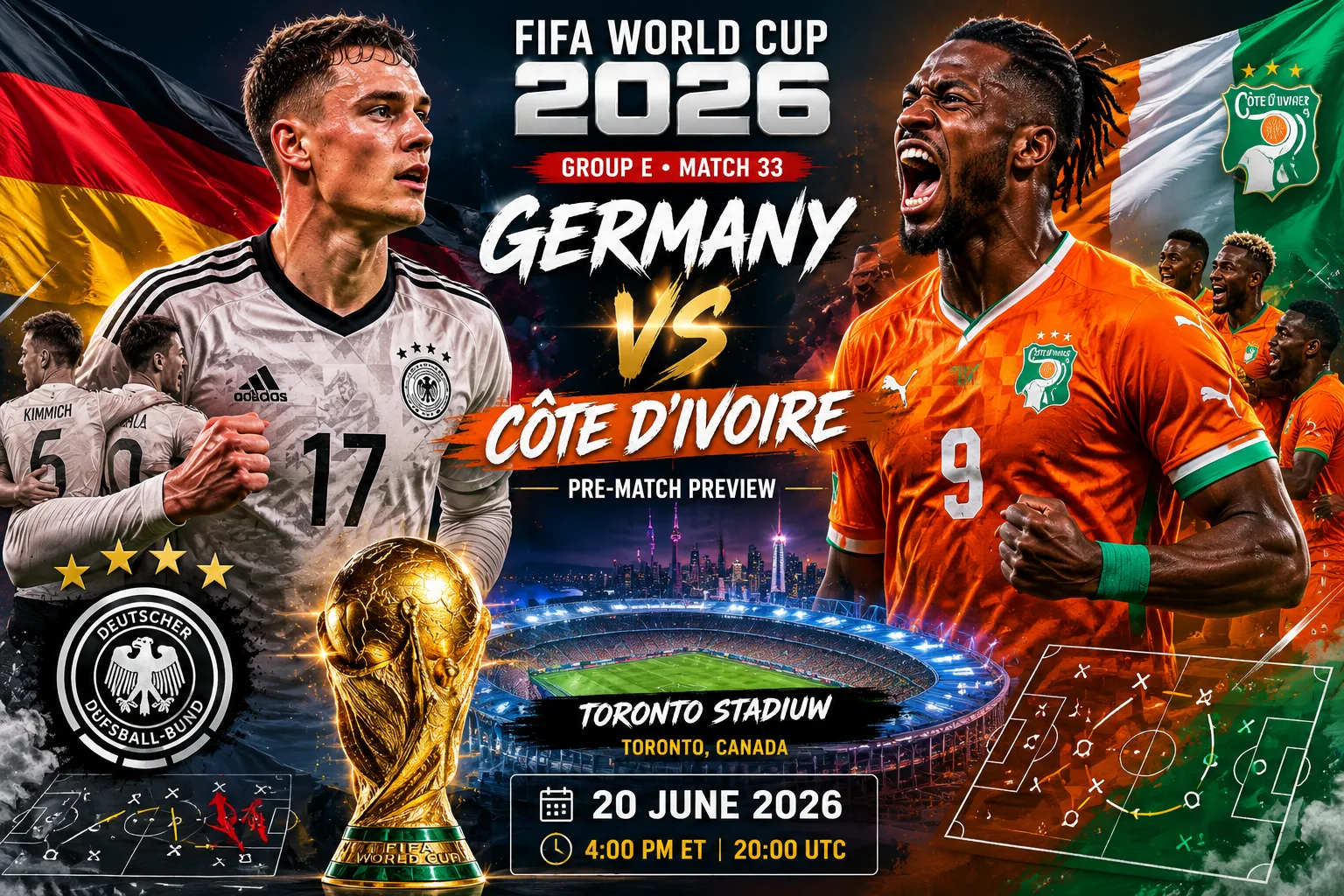
Germany face Côte d’Ivoire in a FIFA World Cup 2026 Group E match at Toronto Stadium in Toronto, Canada, on Saturday, 20 June 2026. Kick-off is scheduled for 4:00 p.m. Eastern Time and 20:00 UTC. This is Match 33 and the second group-stage match for both teams.
Both teams enter with three points. Germany opened with a 7-1 win over Curaçao. Côte d’Ivoire opened with a 1-0 win over Ecuador after Amad Diallo scored late. Germany are coached by Julian Nagelsmann and rely on Manuel Neuer, Antonio Rüdiger, Joshua Kimmich, Jamal Musiala, Florian Wirtz, Kai Havertz and Nico Schlotterbeck. Côte d’Ivoire are coached by Emerse Faé and rely on Yahia Fofana, Wilfried Singo, Franck Kessié, Seko Fofana, Ibrahim Sangaré, Yan Diomande, Nicolas Pépé, Amad Diallo and Elye Wahi.
The projected match type is Germany’s structured possession, attacking midfield rotations and high technical pressure against Côte d’Ivoire’s pace, direct wing threat and powerful midfield. The key matchup is Germany’s right-side defensive cover against Yan Diomande, Amad Diallo and Côte d’Ivoire’s fast transitions. A win would put either team close to Round of 32 control. Betting markets favour Germany, but this preview does not provide guaranteed betting advice.
| Field | Data |
|---|---|
| Match | Germany vs Côte d’Ivoire |
| Competition | FIFA World Cup 2026 |
| Stage | First Stage / Group Stage |
| Group | Group E |
| Match Number | Match 33 |
| Date | Saturday, 20 June 2026 |
| Kick-off Time | 4:00 p.m. Eastern Time / 20:00 UTC |
| Stadium | Toronto Stadium |
| Common Venue Context | BMO Field / Toronto World Cup venue context |
| City | Toronto, Ontario |
| Host Country | Canada |
| Expected Attendance | Not available from verified public data |
| Referee | Not available from verified official public data |
| VAR | Not available from verified official public data |
| Weather Forecast | Around 72°F / 22°C near local kick-off; mostly clear; exact match-hour humidity, wind and pitch speed not available from verified public data |
| Pitch Context | Tournament football surface at a Canadian World Cup venue; exact pitch speed not available from verified public data |
| Main Article Focus | Group E control, Germany’s 7-1 opening win, Côte d’Ivoire’s 1-0 opening win, predicted lineups, tactical matchups, Toronto conditions, projected stats, cards, set pieces, betting market risk and forecast uncertainty |
Germany vs Côte d’Ivoire is the first real Group E control match. Germany crushed Curaçao and built a strong goal-difference base. Côte d’Ivoire beat Ecuador and showed that their attacking depth is not only pre-tournament theory. The winner can move to six points and take a major step toward the Round of 32. The loser remains alive, but the final group match becomes more important.
Germany vs Côte d’Ivoire matters because the winner can move to six points and take control of Group E, while the loser remains exposed to final-round pressure and goal-difference risk.
| Category | Status | Germany vs Côte d’Ivoire Example | Article Use |
|---|---|---|---|
| Confirmed fact | Verified before publication | Germany vs Côte d’Ivoire, Group E, Match 33, Toronto Stadium | Hard match base |
| Confirmed timing | Verified fixture context | Saturday, 20 June 2026, 4:00 p.m. ET / 20:00 UTC | Match snapshot |
| Confirmed Germany result | Verified reporting | Germany beat Curaçao 7-1 in their opener | Group table and tactical context |
| Confirmed Côte d’Ivoire result | Verified reporting | Côte d’Ivoire beat Ecuador 1-0 in their opener | Group table and tactical context |
| Confirmed Germany squad context | Verified public squad reporting | Germany squad includes Neuer, Rüdiger, Kimmich, Musiala, Wirtz, Havertz, Sané and Schlotterbeck | Predicted lineup pool |
| Confirmed Côte d’Ivoire squad context | Verified public squad reporting | Côte d’Ivoire squad includes Fofana, Singo, Kessié, Seko Fofana, Sangaré, Yan Diomande, Amad, Pépé and Wahi | Predicted lineup pool |
| Announced information | Verified media reporting | Elye Wahi has been cleared to travel to Canada after an earlier issue | Team news watchlist |
| Announced information | Verified media reporting | Manuel Neuer is expected to start and has said this is his final national-team tournament | Germany goalkeeper context |
| Probable information | Tactical forecast | Germany likely control more possession; Côte d’Ivoire likely attack transition lanes | Tactical sections |
| Projected data | Model-based estimate | Possession, shots, xG, corners, fouls, cards and substitutions | Projection tables |
| Unknown data | Not verified in current source set | Expected attendance, official referee, official VAR, exact humidity, exact wind and exact pitch speed | Marked unavailable |
| Scenario-based analysis | Forecast only | Germany may rotate forward roles; Côte d’Ivoire may choose Amad as starter or impact substitute | Alternative lineup scenarios |
This distinction matters. Germany’s 7-1 win is a confirmed past result. It does not guarantee another big win. Côte d’Ivoire’s win over Ecuador is confirmed. It does not guarantee that their counterattack will work the same way against Germany.
A predicted lineup is not an official team sheet. A projected xG range is not a final statistic. A market price is not a result. A weather forecast is not final pitch condition. A player cleared to travel is not automatically confirmed as a starter. A coach’s tactical trend is not a fixed plan.
This dossier uses probability language. It does not claim that any goal, card, injury, substitution or VAR decision will happen at a specific minute.
Group E has a clean two-team lead after the first round. Germany and Côte d’Ivoire have three points. Ecuador and Curaçao have zero. Germany have the stronger goal difference because of the 7-1 win over Curaçao. Côte d’Ivoire have a narrower but valuable 1-0 win over Ecuador.
| Team | Played | Won | Drawn | Lost | Goals For | Goals Against | Goal Difference | Points |
|---|---|---|---|---|---|---|---|---|
| Germany | 1 | 1 | 0 | 0 | 7 | 1 | +6 | 3 |
| Côte d’Ivoire | 1 | 1 | 0 | 0 | 1 | 0 | +1 | 3 |
| Ecuador | 1 | 0 | 0 | 1 | 0 | 1 | -1 | 0 |
| Curaçao | 1 | 0 | 0 | 1 | 1 | 7 | -6 | 0 |
The top two teams in each group qualify directly for the Round of 32. The best eight third-placed teams also advance. Six points after two matches would put either Germany or Côte d’Ivoire in a strong position. Four points would still be useful. Three points after two matches keeps the team alive but increases pressure before the final group match.
Germany’s final group match is against Ecuador. Côte d’Ivoire’s final group match is against Curaçao. Those fixtures are not identical in difficulty. Germany will not want to enter Ecuador with unnecessary pressure. Côte d’Ivoire will not want to rely only on beating Curaçao if goal difference becomes important.
Germany need more than progression. They need authority. Their early exits in 2018 and 2022 damaged trust in their tournament reliability. A 7-1 win over Curaçao restored confidence, but the opponent context matters. Côte d’Ivoire are a much stronger physical, athletic and transitional test.
Nagelsmann’s team scored through different routes in the opener. Germany used attacking midfield rotations, set-piece pressure, penalty-box movement and late bench impact. That gives Nagelsmann a good problem. It also creates selection decisions.
Germany’s practical objectives:
Côte d’Ivoire’s win over Ecuador was narrow but important. Ecuador entered with a strong defensive reputation and a long unbeaten run. Côte d’Ivoire stayed in the match, used pace, and found the late winner through Amad. Yan Diomande’s performance added another major talking point because his speed and dribbling give this team a direct weapon against elite opposition.
Emerse Faé has a squad with pace, experience and physical power. Kessié gives leadership. Sangaré and Seko Fofana give midfield force. Singo, Agbadou, Kossounou, Ndicka and Ousmane Diomande give defensive size. The attack can include Pépé, Adingra, Wahi, Bonny, Guessand, Amad, Yan Diomande and Diakité-type profiles.
Côte d’Ivoire’s practical objectives:
Germany start this match with +6. Côte d’Ivoire start with +1. That gives Germany a strong group-management advantage. Côte d’Ivoire can still overtake Germany with a win, but a draw likely keeps Germany ahead on goal difference.
Goal difference matters because Ecuador remain capable of taking points later in the group. Curaçao can also affect final comparisons through margins. Germany can treat a draw as useful, but they will want top spot. Côte d’Ivoire can treat a draw as useful too, but a win would transform their knockout route.
The expanded 48-team format gives third-place teams a possible route. That makes a draw less damaging than in older formats. It does not remove pressure. A team on four points after two matches is usually in a strong position. A team on three points after two matches still needs to manage final-round risk. A team with a heavy defeat may suffer in third-place comparisons.
This match can decide whether Group E becomes controlled or tense. If Germany win, they probably control the group. If Côte d’Ivoire win, they become the group’s tactical headline. If it ends level, both teams remain in strong shape but must still manage the last round.
Germany carry favourite pressure. Côte d’Ivoire carry opportunity pressure. Germany are expected to qualify. Côte d’Ivoire are trying to make their best World Cup statement and reach the knockout stage for the first time.
If Germany score first, Côte d’Ivoire must avoid opening too much too early. If Côte d’Ivoire score first, Germany must avoid rushing low-quality shots. If the match is level after 60 minutes, Germany may still push, but Côte d’Ivoire may see a draw as a strong platform.
| Result | Germany Impact | Côte d’Ivoire Impact | Group E Meaning |
|---|---|---|---|
| Germany win | Germany reach six points and likely control Group E before Ecuador | Côte d’Ivoire stay on three points and still have a route against Curaçao | Germany restore hierarchy |
| Draw | Germany reach four points and keep goal-difference advantage | Côte d’Ivoire reach four points and remain in strong position | Both teams stay well placed |
| Côte d’Ivoire win | Germany stay on three points and face sharper pressure before Ecuador | Côte d’Ivoire reach six points and take control of the group | Group E hierarchy changes sharply |
| Factor | Match Relevance |
|---|---|
| Host country | Canada |
| Venue region | Ontario / Eastern Canada |
| Neutral match | Neither team is host nation |
| City context | Toronto is a major multicultural football market |
| Crowd profile | German support, Ivorian diaspora support and neutral Canadian spectators expected |
| Climate | Mild summer afternoon profile |
| Altitude | No altitude issue |
| Stadium context | Toronto Stadium / BMO Field venue context |
| Travel context | Germany move from Houston opener; Côte d’Ivoire move from Philadelphia opener |
| Tournament pressure | Second group match with top-place implications |
Toronto should give the match a broad international crowd profile. Germany have global support. Côte d’Ivoire can draw strong diaspora and African football support. The match is not a home match for either team, but crowd swings can still matter after early chances, physical duels and VAR delays.
The travel load matters. Germany opened in Houston. Côte d’Ivoire opened in Philadelphia. Both teams move into Canada. Germany also carry the emotional aftereffect of a heavy opening win. Côte d’Ivoire carry the emotional aftereffect of a late winner.
| City Factor | Tactical Impact |
|---|---|
| 4:00 p.m. local kick-off | Afternoon rhythm; hydration and warm-up management matter |
| Around 72°F / 22°C near kick-off | Pressing is viable without extreme heat |
| Mostly clear forecast | Passing and goalkeeper handling should be stable if forecast holds |
| No altitude issue | Normal sprint recovery |
| Possible lake-influenced breeze | Long diagonals and crosses should be judged live |
| Multicultural crowd | Both teams can receive visible support |
| Eastern time zone | Germany and Côte d’Ivoire both adapt from previous North American venues |
Toronto’s weather should support an active match. Germany can press in waves. Côte d’Ivoire can counter at speed. The main factor is not climate. It is defensive spacing when Germany attack and Côte d’Ivoire break.
| Stadium Detail | Data |
|---|---|
| FIFA Stadium Name | Toronto Stadium |
| Common Venue Context | BMO Field |
| City | Toronto |
| Province | Ontario |
| Host Country | Canada |
| Kick-off | 4:00 p.m. ET / 20:00 UTC |
| Expected Attendance | Not available from verified public data |
| Referee | Not available from verified official public data |
| VAR | Not available from verified official public data |
| Roof Status | Open-air venue context |
| Pitch Speed | Not available from verified public data |
| Tactical Impact | Surface speed, wind, wide channels and ball bounce should be checked early |
Toronto Stadium is a football-specific venue context compared with some larger NFL stadiums in the tournament. That can help rhythm, spacing and crowd proximity. Exact pitch speed remains unavailable from verified public data. The first 10 minutes should reveal whether the surface rewards quick passing, low crosses or more direct play.
| Weather / Environment Factor | Tactical Meaning |
|---|---|
| Around 72°F / 22°C | High pressing remains realistic |
| Mostly clear forecast | Lower risk of wet-ball errors |
| Exact humidity unavailable | Avoid precise cramp claims |
| Wind not fully verified | Crosses and long diagonals need live calibration |
| No altitude | Normal oxygen recovery |
| Open-air venue | Wind and surface temperature remain live variables |
| Pitch speed unavailable | First touches and pass weight need early reading |
| Afternoon kick-off | Substitution timing can still reflect intensity and hydration |
The most important weather factor is mild temperature combined with an open-air pitch. Both teams can play at speed. Germany can sustain possession pressure. Côte d’Ivoire can repeat counter-sprints if the match does not become one long defensive shift.
| Team | Player / Role | Status | Tactical Impact |
|---|---|---|---|
| Germany | Julian Nagelsmann | Head coach | Must balance attacking depth with transition protection |
| Germany | Manuel Neuer | Expected starter; final national-team tournament context | Experience, distribution and concentration against counters |
| Germany | Joshua Kimmich | Captain / midfield or right-sided reference | Tempo control, passing and defensive leadership |
| Germany | Antonio Rüdiger | Centre-back | Physical defending against Wahi, Pépé or Diomande-type attackers |
| Germany | Nico Schlotterbeck | Centre-back; scored vs Curaçao | Left-sided buildup, aerial set-piece threat and defensive line control |
| Germany | Jamal Musiala | Attacking midfielder | Dribbling, central receiving and chance creation |
| Germany | Florian Wirtz | Attacking midfielder | Final pass, half-space control and rotation |
| Germany | Kai Havertz | Forward / attacking midfielder; scored twice vs Curaçao | Striker or false-nine role, box presence and penalty reference |
| Germany | Deniz Undav | Attacker; scored vs Curaçao | Bench or rotation scoring threat |
| Germany | Nathaniel Brown | Defender; scored vs Curaçao | Left-side or defensive rotation watchlist |
| Côte d’Ivoire | Emerse Faé | Head coach | Must manage high-speed attack and defensive balance |
| Côte d’Ivoire | Yahia Fofana | Goalkeeper | Shot-stopping and organisation under German pressure |
| Côte d’Ivoire | Wilfried Singo | Defender; assisted Amad winner vs Ecuador | Right-side power, defensive duels and attacking support |
| Côte d’Ivoire | Franck Kessié | Captain / midfielder | Leadership, duels and penalty-box running |
| Côte d’Ivoire | Seko Fofana | Midfielder | Ball-carrying power and second-ball work |
| Côte d’Ivoire | Ibrahim Sangaré | Midfielder | Ball-winning, aerial duels and central screen |
| Côte d’Ivoire | Yan Diomande | Forward / winger | Main speed and dribbling threat |
| Côte d’Ivoire | Nicolas Pépé | Forward / winger | Experience, ball-carrying and shooting |
| Côte d’Ivoire | Amad Diallo | Forward / winger; scored winner vs Ecuador | Impact attacker or possible starter |
| Côte d’Ivoire | Elye Wahi | Forward; cleared to travel to Canada | Central striker or transition forward option |
| Player | Team | Status | Tactical Impact |
|---|---|---|---|
| Elye Wahi | Côte d’Ivoire | Cleared to travel after earlier issue; match role still needs official XI confirmation | If available from the start, Côte d’Ivoire gain central pace and direct threat |
| Not available from verified public data | Germany | No specific match-day doubtful player confirmed in current source set | Official training and team sheet should be checked |
| Not available from verified public data | Côte d’Ivoire | No additional confirmed doubtful player in current source set | Do not invent individual doubts |
| Player | Team | Status | Tactical Impact |
|---|---|---|---|
| Not available from verified public data | Germany | No confirmed unavailable player used in this preview | Official team sheet required |
| Not available from verified public data | Côte d’Ivoire | No confirmed unavailable player used in this preview | Official team sheet required |
| Player / Group | Team | Issue | Match Impact |
|---|---|---|---|
| Manuel Neuer | Germany | Age and tournament workload context, not a reported injury issue | Concentration and command remain important |
| Germany attacking group | Germany | Rotation and minutes management after heavy opener | Nagelsmann may rotate forward roles without confirmed injury |
| Germany rest defence | Germany | Côte d’Ivoire pace creates tactical risk | Full-back and midfield coverage are watchlist items |
| Elye Wahi | Côte d’Ivoire | Travel clearance after earlier administrative issue | Role and minutes should be checked from official team sheet |
| Côte d’Ivoire wingers | Côte d’Ivoire | High sprint demand against Germany | Diomande, Amad, Pépé, Adingra and others carry workload watchlist |
| Côte d’Ivoire midfield | Côte d’Ivoire | Expected high running load | Kessié, Sangaré and Seko Fofana must manage repeated defensive shifts |
| Team | Confirmed Suspension | Notes |
|---|---|---|
| Germany | Not available from verified public data | No confirmed active suspension used in this preview |
| Côte d’Ivoire | Not available from verified public data | No confirmed active suspension used in this preview |
Germany’s team news is more about role selection than absences. Nagelsmann has many attacking options. He can use Havertz as a striker, Wirtz and Musiala as dual creators, Sané as a wide threat, or Undav and Woltemade as penalty-box alternatives.
Côte d’Ivoire’s key team-news item is Wahi’s travel clearance. A cleared player is not automatically a starter. Faé must decide whether Wahi’s profile fits the opening plan or whether Pépé, Yan Diomande, Amad, Adingra, Bonny, Guessand or another forward profile gives better balance.
Official starting lineups were not available from verified public data at the time of writing. These XIs are projections based on squad reporting, opener context and tactical logic.
| Position / Line | Player | Likely Role |
|---|---|---|
| GK | Manuel Neuer | Goalkeeper, buildup base, high-line sweeper and concentration against counters |
| RB | Joshua Kimmich / Waldemar Anton role if Kimmich moves midfield | Right-side control, buildup and defensive leadership |
| CB | Antonio Rüdiger | Physical centre-back, recovery defending and duel control |
| CB | Nico Schlotterbeck / Jonathan Tah | Left-sided buildup, aerial defence and set-piece threat |
| LB | David Raum / Nathaniel Brown | Width, crossing, pressing support and recovery defending |
| DM | Aleksandar Pavlović / Angelo Stiller | First-phase passing, counter-press and central protection |
| CM | Joshua Kimmich / Leon Goretzka / Felix Nmecha | Tempo, duels and second balls |
| AM | Florian Wirtz | Final-third passing, half-space receiving and pressing |
| AM / LW | Jamal Musiala | Dribbling, central carries and chance creation |
| RW | Leroy Sané / Jamie Leweling | Width, speed and direct attack against Côte d’Ivoire’s left |
| ST | Kai Havertz / Nick Woltemade / Deniz Undav | Central striker, false-nine link or box-finishing profile |
| Position / Line | Player | Likely Role |
|---|---|---|
| GK | Yahia Fofana | Goalkeeper, shot-stopping and long distribution |
| RB | Guéla Doué / Wilfried Singo | Right-side defending, recovery and counter support |
| CB | Emmanuel Agbadou | Box defence, aerial duels and first-contact defending |
| CB | Ousmane Diomande / Odilon Kossounou / Evan Ndicka | Central defence, buildup and recovery |
| LB | Ghislain Konan / Christopher Operi | Left-side defending against Sané or German right-side rotations |
| DM | Ibrahim Sangaré | Midfield screen, duels and aerial protection |
| CM | Franck Kessié | Leadership, ball carrying and late box movement |
| CM | Seko Fofana / Jean Seri | Running power, second balls and transition connection |
| RW | Yan Diomande / Nicolas Pépé | Direct running and one-vs-one threat |
| ST | Elye Wahi / Evann Guessand / Ange-Yoan Bonny | Central striker, depth runs and hold-up option |
| LW | Amad Diallo / Simon Adingra / Nicolas Pépé | Creative wing threat, inside movement and counter outlet |
| Team | Base Formation | In Possession | Out of Possession | Confidence |
|---|---|---|---|---|
| Germany | 4-2-3-1 / 4-3-3 / 3-2-5 in possession | 2-3-5 with full-back support, Musiala and Wirtz between lines, Havertz central | 4-4-2 press or 4-2-3-1 counter-press shape | Medium |
| Côte d’Ivoire | 4-3-3 / 4-2-3-1 / 4-5-1 | Direct 2-3-5 in selected attacks, wingers high, Kessié/Fofana support | Compact 4-5-1 or 4-4-2 mid-block | Medium |
| Scenario | Trigger | Expected Change |
|---|---|---|
| Germany keep attacking continuity | Nagelsmann rewards Curaçao performance | Havertz, Musiala, Wirtz and Sané-type structure starts |
| Germany add midfield protection | Concern over Diomande and Amad transitions | Kimmich stays deeper or extra holding midfielder starts |
| Germany use Undav or Woltemade | Need more central box presence | Havertz plays deeper or wide creator changes |
| Germany rotate left-back | Need recovery speed against Côte d’Ivoire wingers | Brown or Raum selection becomes tactical |
| Côte d’Ivoire start Amad | Faé rewards winner and wants more dribbling from kick-off | Pépé or another winger may shift or rotate |
| Côte d’Ivoire keep Amad as impact substitute | Faé values late-game one-vs-one threat | Pépé, Diomande and Wahi/Guessand may start |
| Côte d’Ivoire add extra midfielder | Faé wants to block Musiala and Wirtz | Sangaré, Kessié and Seko Fofana form a stronger screen |
| Côte d’Ivoire chase goal | Trailing after 60’ | Amad, Adingra, Bonny, Wahi or Diakité-type attacker becomes important |
| Phase | Expected Pattern |
|---|---|
| Build-up | Neuer, centre-backs and Kimmich/Stiller/Pavlović circulate; Wirtz and Musiala receive between lines |
| Attack | Half-space rotations, wide switches, Havertz link play, Musiala carries and late box runs |
| Defense | Aggressive counter-press, compact rest defence and Rüdiger-led recovery |
| Transitions | Quick release to Musiala, Sané, Wirtz or Havertz after recoveries |
| Set Pieces | Schlotterbeck, Rüdiger, Tah, Havertz, Woltemade or Undav as targets |
| Weakness | Space behind attacking full-backs, transition exposure against elite speed, possible overconfidence after big win |
Germany should build through controlled progression. Neuer can start the first phase. Rüdiger and Schlotterbeck or Tah can split. Kimmich can step into midfield or operate from the right. Stiller or Pavlović can receive centrally. Wirtz and Musiala should not both drop too deep at the same time. Germany need one creator between Côte d’Ivoire’s midfield and defence.
Côte d’Ivoire will likely defend central zones and wait for transition moments. Germany must avoid slow possession that allows Kessié, Sangaré and Seko Fofana to settle. The best German build-up will move the ball quickly enough to isolate wingers or feed Musiala between lines.
Germany’s best build-up routes:
Germany can press high, but they must respect Côte d’Ivoire’s pace. A reckless high line would invite direct balls into Diomande, Wahi, Pépé, Amad or Adingra. The counter-press must be clean. The centre-backs cannot defend long distances without midfield cover.
Useful Germany pressing triggers:
Germany should press to win the ball, not to create chaos. Chaos helps Côte d’Ivoire because their runners are dangerous in open space.
Germany can attack through both sides, but the left half-space may become the most creative zone if Musiala starts there. Raum or Brown can provide width. Musiala can dribble inside. Wirtz can rotate from central to right half-space. Sané can attack the far side.
The right side also matters because Côte d’Ivoire’s left-back zone can be tested by Sané, Kimmich’s passing, or Wirtz drifting wide. Germany should avoid forcing every attack through the middle. Côte d’Ivoire’s midfield has the physical power to block central overloads.
Kimmich is the most important structural passer. Wirtz is the most important final-third passer. Musiala is the most important carrier. If Kimmich plays from right-back, Germany need a midfielder to replace his central control. If Kimmich plays midfield, Germany need right-back protection against Côte d’Ivoire’s wide speed.
Germany can transition quickly, but they may dominate the ball and therefore have fewer classic counterattacks. Their best transitions may come after Côte d’Ivoire lose the ball trying to counter. Musiala, Sané, Wirtz and Havertz can attack unsettled defenders.
The ideal Germany transition:
Germany have a strong set-piece profile. Schlotterbeck scored in the opener. Rüdiger, Tah, Havertz, Woltemade, Undav and other tall players can attack deliveries. Kimmich, Raum, Wirtz or Sané can deliver depending on the XI.
Côte d’Ivoire also have aerial power, so Germany’s set-piece edge is not automatic. Germany may have more delivery volume. Côte d’Ivoire may match first-contact strength.
Germany’s main defensive weakness is transition space. Côte d’Ivoire can run fast enough to punish one poor rest-defence setup. Germany’s full-backs must stagger. The midfield screen must stay connected. Rüdiger’s recovery pace helps, but it should not be the whole plan.
The second weakness is complacency. A 7-1 opener can create false certainty. Côte d’Ivoire are not Curaçao. Germany must treat this match as a top-level physical test.
Neuer gives Germany extra buildup confidence. His distribution can bypass pressure and reset possession. His sweeper role can also protect against through balls. The risk is concentration. He may face fewer shots than Yahia Fofana, but Côte d’Ivoire’s chances could be high value.
Germany’s full-backs should not both attack high at the same time. If Raum or Brown goes forward, the right side should hold. If Kimmich steps into midfield, the back line must shift. Côte d’Ivoire’s wingers will target any unprotected lane.
Havertz gives Germany link play, box timing and penalty-box presence. Woltemade gives size. Undav gives penalty-box finishing. Beier gives mobility. Nagelsmann’s striker choice will show whether Germany want control, aerial presence or faster depth attacks.
| Phase | Expected Pattern |
|---|---|
| Build-up | Pragmatic short play through Kessié/Sangaré/Fofana mixed with direct outlets to wingers |
| Attack | Fast wide attacks, Diomande/Amad/Pépé carries, Wahi or striker depth runs |
| Defense | Compact midfield screen, physical duels, controlled aggression around German creators |
| Transitions | First forward pass into Diomande, Amad, Pépé, Adingra, Wahi or Guessand |
| Set Pieces | Kessié, Singo, Agbadou, Diomande, Ndicka and striker profiles attack aerial balls |
| Weakness | Long defensive spells, potential full-back isolation, risk of fouls around German creators |
Côte d’Ivoire should build pragmatically. They do not need to out-pass Germany. They need clean exits. Yahia Fofana can go long if Germany press high. Kessié can receive under contact. Sangaré can protect the centre. Seko Fofana can carry forward if he breaks the first pressure.
The first pass after recovery is the key. If Côte d’Ivoire find Diomande, Amad, Pépé or Wahi quickly, Germany must retreat. If the first pass is poor, Germany will counter-press and keep Côte d’Ivoire locked in.
Côte d’Ivoire can press selectively. A full high press against Germany can be dangerous because Neuer, Kimmich, Wirtz and Musiala can play through it. Faé may prefer a mid-block that jumps at specific moments.
Useful Côte d’Ivoire pressing triggers:
Côte d’Ivoire must avoid fouling in central free-kick zones. Germany can punish dead balls.
Côte d’Ivoire’s main attacking side may be the right if Yan Diomande starts there. His speed and dribbling can test Germany’s left-back and left centre-back cover. If Amad starts on the other side or enters later, Côte d’Ivoire can attack both flanks.
Pépé gives experience and shooting. Adingra gives pace. Wahi gives central depth. Guessand or Bonny can provide physical presence. Côte d’Ivoire’s attack is not one-player dependent. That is their danger.
Kessié is the leadership passer and ball carrier. Sangaré is the safety player. Seko Fofana is the progression runner. Amad and Diomande are final-third carriers more than traditional passers. Côte d’Ivoire’s key pass is often the first forward ball after winning possession.
Transition is Côte d’Ivoire’s best route. Germany will likely have the ball. That means space can appear behind full-backs and around midfield. Diomande can attack that space. Amad can carry inside. Pépé can shoot from the edge. Wahi can run beyond the centre-backs.
The ideal Côte d’Ivoire transition:
Côte d’Ivoire can threaten set pieces. Singo, Agbadou, Ndicka, Kossounou, Ousmane Diomande, Sangaré, Kessié and the striker group offer size. Germany must not concede cheap wide free kicks.
Côte d’Ivoire may have fewer corners, so each one matters. A set piece can reduce Germany’s technical advantage and create a direct scoring route.
Côte d’Ivoire’s main defensive weakness is long spells without the ball. Germany can move them laterally through Musiala, Wirtz and Kimmich. If the block gets tired or stretched, half-space gaps can open.
The second weakness is full-back isolation. If Germany switch quickly, the far-side full-back can face Sané, Musiala or Wirtz without enough support.
Yahia Fofana will likely face more pressure than Neuer. His distribution must be clear. Short play can help if Germany sit off. Direct play may be safer when Germany press. His kicking accuracy can turn defence into transition threat.
Côte d’Ivoire’s full-backs should defend first. Doué, Singo, Konan and Operi-type profiles can support attacks, but both sides cannot go high at once. Germany’s counter-press can punish overextension.
Wahi offers pace and direct runs if he starts. Guessand gives hold-up and physical support. Bonny can offer another central option. Pépé can play forward in a hybrid role. The striker must occupy Rüdiger and Schlotterbeck or Tah, not drift into isolation.
| Zone | Germany Edge | Côte d’Ivoire Edge | Likely Control | Why It Matters |
|---|---|---|---|---|
| Germany left / Côte d’Ivoire right | Musiala, Raum/Brown support, half-space combinations | Yan Diomande or Pépé transition speed | Germany in possession, Côte d’Ivoire in transition | Most volatile flank |
| Germany right / Côte d’Ivoire left | Sané/Wirtz/Kimmich rotations | Adingra/Amad/Pépé counter threat | Balanced | Germany need far-side threat to stretch the block |
| Central midfield | Kimmich, Wirtz, Musiala, Stiller/Pavlović technical control | Kessié, Sangaré, Seko Fofana physical power | Germany in possession, Côte d’Ivoire in duels | Decides rhythm and transition quality |
| Penalty box | Havertz, Undav/Woltemade, Schlotterbeck, Rüdiger | Agbadou, Ndicka, Singo, Kossounou, Fofana | Balanced | Germany volume meets Ivorian size |
| Set pieces | Germany delivery and volume | Côte d’Ivoire aerial power | Balanced | Dead balls can break a tactical stalemate |
| Transitions | Germany counter-press after turnovers | Côte d’Ivoire explosive runners | Côte d’Ivoire danger | Main upset route |
| Defensive third | Germany likely defend fewer phases | Côte d’Ivoire likely defend longer spells | Côte d’Ivoire under pressure | Tests discipline and fatigue |
Yan Diomande is Côte d’Ivoire’s most dangerous direct-speed player. Germany must stop him before he faces open grass.
Why it matters: Germany can dominate possession and still be hurt by one transition. Diomande is the player most likely to force that problem.
What to watch: Whether he receives near the touchline with support or inside with room to drive at centre-backs.
Risk trigger: If Germany’s left-back pushes high and the midfield screen is late, Diomande’s threat increases.
Musiala can destabilise Côte d’Ivoire’s block through dribbling. Sangaré can stop central access through physical screening.
Why it matters: Germany’s shot quality rises when Musiala receives between lines and carries into the box.
What to watch: Whether Sangaré closes him before he turns.
Risk trigger: If Sangaré gets booked early, Germany can attack central dribbling lanes more aggressively.
Wirtz gives Germany final-third intelligence. Kessié gives Côte d’Ivoire leadership, duels and timing.
Why it matters: Wirtz can turn possession into clear chances. Kessié can disrupt rhythm and launch counters.
What to watch: Wirtz’s half-space touches and Kessié’s first forward pass after regain.
Risk trigger: If Kessié is dragged too wide, Germany can exploit central gaps.
Havertz can play as striker or false nine. Côte d’Ivoire’s centre-backs must decide whether to follow him.
Why it matters: If Havertz pulls a centre-back out, Musiala and Wirtz can attack the space. If the centre-backs hold, Havertz can receive and connect.
What to watch: Havertz’s dropping movement and Germany’s far-side runner.
Risk trigger: If Côte d’Ivoire’s centre-backs step out without midfield cover, Germany can create central chances.
Amad scored the winner against Ecuador and may start or come from the bench.
Why it matters: If Amad enters against tired legs, he can change the match’s rhythm.
What to watch: Whether Germany still have enough wide cover after 60 minutes.
Risk trigger: If Germany chase a winner and leave the far side exposed, Amad can become a decisive transition threat.
| Projected Stat | Germany | Côte d’Ivoire | Confidence | Reason |
|---|---|---|---|---|
| Possession | 57–66% | 34–43% | Medium/high | Germany should control more ball through Kimmich, Wirtz and Musiala |
| Shots | 13–22 | 7–13 | Medium | Germany likely create more volume; Côte d’Ivoire transition shots remain possible |
| Shots on Target | 5–9 | 2–5 | Medium | Germany have stronger shot-volume base, but Ivorian counters can be high value |
| xG Range | 1.50–2.60 | 0.70–1.50 | Low/medium | First goal and transition success can shift match shape |
| Big Chances | 1–4 | 0–2 | Low/medium | Germany should create more box entries; Côte d’Ivoire can create isolated big chances |
| Corners | 5–9 | 2–5 | Medium | Germany’s territory likely creates blocked crosses |
| Fouls | 9–14 | 12–18 | Medium | Côte d’Ivoire may defend more technical duels |
| Yellow Cards | 1–3 | 1–4 | Low/medium | Referee unknown; transition fouls and dribble defence matter |
| Red-Card Risk | Low | Low/medium | Low | Physical duel load raises watchlist but does not predict a red card |
| Offsides | 1–3 | 1–4 | Low | Wahi, Diomande, Havertz and Sané can attack lines |
| Saves | 2–4 | 4–8 | Medium | Yahia Fofana likely faces more shot pressure |
| Crosses | 16–28 | 8–17 | Medium | Germany likely use width against compact block |
| Tackles | 12–20 | 18–30 | Medium | Côte d’Ivoire likely defend more one-vs-one actions |
| Interceptions | 8–14 | 10–18 | Medium | Côte d’Ivoire’s block can cut central passes |
| Clearances | 12–22 | 24–42 | Medium/high | Côte d’Ivoire may defend repeated German attacks |
Germany should lead possession, shot volume and corner volume. That does not decide the match. Côte d’Ivoire can create lower-volume but higher-speed attacks. The key metric for Germany is not possession. It is chance quality. The key metric for Côte d’Ivoire is not possession. It is the number of clean forward releases into Diomande, Amad, Pépé or Wahi.
If Germany create cutbacks and central shots, their model strengthens. If Germany create only blocked crosses and long-range shots, Côte d’Ivoire can survive and counter.
| Match Window | Tactical State | Physical State | Card Risk | Goal Risk | Betting Market Trigger |
|---|---|---|---|---|---|
| 1’–15’ | Germany likely establish possession; Côte d’Ivoire likely test first transition outlets | Conditions support tempo | Low/medium | Medium | First Diomande carry, first Musiala central touch |
| 16’–30’ | Germany may increase half-space rotations; Côte d’Ivoire may defend deeper | Ivorian lateral shifting begins to accumulate | Medium | Medium | German corner count, Sangaré/Kessié duel load |
| 31’–45+’ | If level, Côte d’Ivoire confidence rises; Germany may force more attacks | Mental pressure shifts toward Germany | Medium/high | Medium | Late first-half set pieces and counter fouls |
| 46’–60’ | Nagelsmann may adjust striker or midfield protection; Faé may decide Amad/Wahi usage | Reset intensity after halftime | Medium | Medium/high | Bench attackers, transition exposure |
| 61’–75’ | Substitutions can open the match | Fatigue rises in wide duels | High | Medium/high | Amad or Sané-type fresh runner, German set pieces |
| 76’–90+’ | Game state dominates | Concentration, cards and goal difference matter | High | High | Draw protection, group-control chase, late counters |
Germany should try to control tempo without overcommitting. Côte d’Ivoire should show early that they can break forward. One clean Diomande or Pépé carry can change Germany’s full-back behavior.
Germany may begin to overload between the lines. Côte d’Ivoire must keep Kessié and Sangaré connected. If Germany win repeated corners, the territorial pressure rises.
If Côte d’Ivoire reach halftime level, the game becomes more psychologically balanced. Germany may become more direct. Côte d’Ivoire can use set pieces and counters to test Neuer.
This window may define the match. Nagelsmann can add striker presence, more width or more midfield cover. Faé can introduce Amad, Adingra, Wahi or another attacking profile if not already starting.
Fresh attackers can change the game. Germany have more bench depth. Côte d’Ivoire have more explosive transition options. Card risk rises when tired defenders face dribblers.
The final window depends on group math. A draw is useful to both teams. A win gives six points. This can create a tactical calculation rather than an all-out finish.
| Factor | Expected Impact | Germany Effect | Côte d’Ivoire Effect |
|---|---|---|---|
| Mild temperature around 72°F / 22°C | Supports pressing and repeated sprints | Germany can sustain pressure phases | Côte d’Ivoire can counter at speed |
| Mostly clear forecast | Lower handling disruption | Passing rhythm should be stable | Long outlets and goalkeeper handling should be stable |
| Humidity unavailable | Avoid exact fatigue claims | Hydration still matters | Defensive workload can still create fatigue |
| Wind not fully verified | Crosses and diagonals need live calibration | Kimmich/Raum switches need adjustment | Fofana long kicks need adjustment |
| No altitude | Normal recovery profile | High tempo is sustainable | Transition sprints remain viable |
| Open-air venue | Ball flight remains a live variable | Set-piece delivery must adapt | Clearances and aerial duels must adapt |
| Pitch speed unknown | First 10 minutes important | Germany combinations need calibration | Côte d’Ivoire counters need timing |
| Afternoon kick-off | Energy management still relevant | Pressing waves need pacing | Defensive shifting requires substitutions |
The most important match factor is not heat. It is transition recovery. The weather allows both teams to run. Germany must make sure their possession structure does not leave Côte d’Ivoire’s fast players in open space.
| Player | Team | Role | Match Impact Score /10 | Reason |
|---|---|---|---|---|
| Jamal Musiala | Germany | Attacking midfielder / carrier | 9.1 | Main dribbling route through compact midfield |
| Florian Wirtz | Germany | Attacking midfielder / creator | 9.0 | Final pass, half-space timing and chance creation |
| Joshua Kimmich | Germany | Captain / midfielder or right-back | 8.9 | Tempo, switches and defensive organisation |
| Kai Havertz | Germany | Forward / false nine | 8.6 | Link play, box threat and role flexibility |
| Manuel Neuer | Germany | Goalkeeper | 8.3 | Distribution, leadership and concentration against counters |
| Antonio Rüdiger | Germany | Centre-back | 8.4 | Recovery defending against fast forwards |
| Nico Schlotterbeck | Germany | Centre-back | 8.3 | Buildup, aerial threat and opener scoring confidence |
| Leroy Sané | Germany | Winger | 8.2 | Width, speed and late-game threat |
| Yan Diomande | Côte d’Ivoire | Winger / forward | 8.9 | Main speed and dribbling threat |
| Amad Diallo | Côte d’Ivoire | Winger / forward | 8.7 | Opener winner and high-impact dribbler |
| Franck Kessié | Côte d’Ivoire | Captain / midfielder | 8.6 | Leadership, duels and progression |
| Ibrahim Sangaré | Côte d’Ivoire | Defensive midfielder | 8.3 | Central screen and physical protection |
| Seko Fofana | Côte d’Ivoire | Midfielder | 8.2 | Ball carrying and second-ball strength |
| Wilfried Singo | Côte d’Ivoire | Defender | 8.1 | Right-side power and assist profile |
| Yahia Fofana | Côte d’Ivoire | Goalkeeper | 8.0 | Likely shot-stopping workload |
| Elye Wahi | Côte d’Ivoire | Striker | 7.9 | Central pace and direct outlet if used |
| Nicolas Pépé | Côte d’Ivoire | Forward | 7.9 | Experience, shooting and wide threat |
Musiala and Wirtz are Germany’s main creators. Diomande and Amad are Côte d’Ivoire’s most dangerous attacking disruptors. The match may be decided by whether Germany’s creators produce central chances before Côte d’Ivoire’s speed produces transition breaks.
Rüdiger is Germany’s key defensive figure because Côte d’Ivoire’s pace can test recovery defending. Yahia Fofana and the centre-backs are central for Côte d’Ivoire because Germany should create more shot volume.
Kimmich is Germany’s structural reference. Kessié is Côte d’Ivoire’s leadership reference. Sangaré may be the most important defensive midfielder because he must reduce Musiala and Wirtz access.
Germany can change the match through Sané, Undav, Woltemade, Beier or another attacking profile. Côte d’Ivoire can change the match through Amad, Adingra, Wahi, Bonny, Guessand or Diakité depending on the starting XI.
Côte d’Ivoire’s full-backs and midfield screen carry card risk against Musiala and Wirtz. Germany’s full-backs and midfield cover carry card risk if Diomande, Amad or Wahi break into open space.
No confirmed injury-management case for Germany was available from verified public data in this source set. Wahi’s role remains a travel and selection watchlist item rather than a confirmed injury issue.
The referee and VAR were not available from verified official public data in this source set. This section uses tactical logic only.
| Discipline Factor | Forecast |
|---|---|
| Referee Style | Not available from verified official public data |
| Tactical Foul Risk | Medium/high |
| Dissent Risk | Medium because of group stakes and physical duels |
| VAR Intervention Risk | Medium |
| Penalty Risk | Medium |
| Red-Card Risk | Low/medium |
| Team | Yellow-Card Range | Red-Card Risk | Main Risk Zone |
|---|---|---|---|
| Germany | 1–3 | Low | Recovery fouls after Côte d’Ivoire counters |
| Côte d’Ivoire | 1–4 | Low/medium | Full-back zones and midfield fouls against Musiala/Wirtz |
This match has card risk because the styles collide. Germany will attack technical spaces. Côte d’Ivoire will defend with physical midfielders and then break at speed. Tactical fouls can appear in both directions.
| Set-Piece Area | Germany | Côte d’Ivoire | Edge |
|---|---|---|---|
| Corners For | Schlotterbeck, Rüdiger, Tah, Havertz, Woltemade/Undav targets | Agbadou, Ndicka, Singo, Kossounou, Fofana command | Germany by delivery volume |
| Corners Against | Must defend Singo, Agbadou, Ndicka, Kessié and striker targets | Must defend German centre-backs and Havertz | Balanced |
| Wide Free Kicks | Kimmich, Raum, Wirtz, Sané delivery options | Pépé, Amad, Adingra or wide delivery profiles | Germany slight technical edge |
| Direct Free Kicks | Kimmich / Wirtz / Sané-type profiles | Pépé / Amad-type profiles | Balanced |
| Penalties | Taker hierarchy should be confirmed from official XI | Taker hierarchy should be confirmed from official XI | Unknown |
| Long Throws | Not available from verified public data | Not available from verified public data | Unknown |
| Aerial Duels | Strong through centre-backs and forwards | Strong through centre-backs, Sangaré, Kessié and forwards | Balanced |
Germany may have the set-piece edge by volume. Côte d’Ivoire may match Germany in aerial size and physical force. The decisive defensive matchup is Germany’s centre-backs against Côte d’Ivoire’s first-contact defenders, and Germany’s marking against Singo, Agbadou, Ndicka and Kessié on Ivorian restarts.
| Area | Germany | Côte d’Ivoire |
|---|---|---|
| Goalkeeper Distribution | Neuer supports short buildup and long switches | Yahia Fofana may use mixed short and direct exits |
| Shot-Stopping Pressure | Low/medium | Medium/high |
| Cross Handling | Medium against Ivorian set pieces | High against German wide pressure |
| High-Line Risk | High if full-backs overcommit | Lower if Côte d’Ivoire defend deep |
| Penalty-Box Defending | Must track Wahi, Pépé, Diomande, Amad and late Kessié runs | Must track Havertz, Musiala, Wirtz, German centre-backs |
| Back-Post Weakness | Possible if Germany over-shift toward Diomande | Possible against German switches |
| Defensive Communication | Critical after turnovers | Constant organisation under German pressure |
Yahia Fofana may face more pressure because Germany are projected to create more shots and corners. Neuer may face fewer chances, but Germany’s goalkeeper can still be decisive because Côte d’Ivoire’s attacks may come from open space.
| Minute Window | Germany Possible Change | Côte d’Ivoire Possible Change | Trigger |
|---|---|---|---|
| 45’–60’ | Add Sané, Undav, Woltemade, Beier or extra midfielder | Add Amad, Adingra, Wahi, Bonny or extra midfielder | Scoreline, transition risk, shot quality |
| 60’–75’ | Add striker presence or more control through midfield | Add speed against tired full-backs or physical striker | Fatigue, cards and tactical gaps |
| 75’–90’ | Protect lead with midfield cover or chase winner with attacker | Protect draw/lead or chase through direct pace | Group math and game state |
Germany should control possession and protect the rest defence. They should not overcommit for margin if Côte d’Ivoire still have fresh wide attackers. Goal difference matters, but control matters first.
Côte d’Ivoire may defend deeper and use Diomande, Amad or Wahi as release outlets. Germany must avoid panic crossing and low-quality shots.
A draw is useful to both teams. Germany may still push because they are favourites and have goal-difference control. Côte d’Ivoire may accept the point or use late speed to chase a major win. Substitutions will reveal the coaches’ risk appetite.
| Market | Current Signal | Main Risk |
|—|—|
| Match Winner | Germany listed as favourite in public market snapshot | Côte d’Ivoire pace, transition threat and physical midfield |
| Double Chance | Germany or draw likely shorter | Low price may not reflect Ivorian upset route |
| Over/Under Goals | Public snapshot lists 2.5 goals | Early goal can open match; tactical caution can suppress it |
| BTTS | Plausible but not automatic | Côte d’Ivoire chance volume may be lower than Germany’s |
| Corners | Germany corner volume likely higher | Early Germany goal can reduce sustained pressure |
| Cards | Medium signal | Referee unknown and transition fouls matter |
| Player Shots | Havertz, Musiala, Wirtz, Diomande, Amad/Pépé watchlist | Official lineups and roles matter |
| Player Cards | Côte d’Ivoire midfield screen, Germany recovery defenders | Referee threshold unknown |
| Trigger | Possible Market Effect |
|---|---|
| Germany striker choice | Havertz, Undav or Woltemade changes shot and aerial markets |
| Kimmich role | Midfield vs right-back affects German control and transition cover |
| Amad starting status | Changes Côte d’Ivoire attacking and BTTS expectations |
| Wahi starting status | Changes Côte d’Ivoire depth and striker-shot markets |
| Germany left-back choice | Affects Diomande transition risk |
| Referee announcement | Can move cards and penalty markets |
| Weather / wind update | Can affect crosses and long-ball markets |
| Public money on Germany | Can compress favourite price and reduce value |
| Trigger | Meaning | Risk |
|---|---|---|
| Germany create repeated central cutbacks | Germany chance quality is high | Côte d’Ivoire may adjust with deeper midfield screen |
| Germany only create blocked crosses | Possession may be inefficient | Set-piece volume can still matter |
| Diomande receives in open space | Côte d’Ivoire upset route is live | One transition can overstate match balance |
| Sangaré or full-back booked early | Germany dribbling value rises | Referee threshold may shift |
| 0-0 after 60’ | Draw value rises; pressure may shift toward Germany | Germany bench depth can still change match |
| Amad enters late | Côte d’Ivoire transition profile can jump | Impact depends on support and game state |
This preview explains match data and market behavior. It does not provide guaranteed betting advice. World Cup betting involves risk. Readers should check local gambling laws, use licensed operators, set limits and avoid chasing losses.
| Factor | How It Can Break the Forecast |
|---|---|
| Late Lineup Change | Germany’s Kimmich role or Côte d’Ivoire’s forward choices can alter the model |
| Early Goal | Forces one team to abandon the base plan |
| Early Yellow Card | Changes full-back and midfield aggression |
| Injury | Can remove a key creator, defender or transition runner |
| VAR Penalty | Creates a non-pattern goal and changes risk appetite |
| Weather Shift | Wind or surface speed can affect crosses and long passes |
| Red Card | Makes possession and xG projections much less useful |
| Goalkeeper Error | Can swing a match between two confident teams |
| Tactical Surprise | Côte d’Ivoire may press higher or Germany may play more conservatively |
| Market Overreaction | Early Germany possession can shorten prices without clear chance quality |
The forecast can fail if Côte d’Ivoire score first and force Germany into a chase. It can also fail if Germany score early and force Côte d’Ivoire to open up. The match can swing through transitions, set pieces, substitutions and discipline.
| Scenario | Probability Band | Match Story |
|---|---|---|
| Germany Narrow Win | Medium/high | Germany control territory, create more chances and manage transition risk |
| Draw | Medium | Côte d’Ivoire defend compactly, create enough transition danger and protect the point |
| Côte d’Ivoire Upset | Low/medium | Côte d’Ivoire score through transition or set piece and defend with discipline |
| High-Scoring Match | Medium | Early goal opens both teams and creates transition space |
| Low-Scoring Match | Medium | Côte d’Ivoire compact block and Germany’s caution reduce clear chances |
The safest scenario frame is Germany-favoured but not Germany-certain. Germany have more technical control and deeper attacking options. Côte d’Ivoire have enough pace and physicality to make the favourite uncomfortable.
| Result | Germany Impact | Côte d’Ivoire Impact |
|---|---|---|
| Germany Win | Germany reach six points and likely control Group E before Ecuador | Côte d’Ivoire stay on three points and need to manage Curaçao |
| Draw | Germany reach four points and keep goal-difference advantage | Côte d’Ivoire reach four points and remain in strong qualification position |
| Côte d’Ivoire Win | Germany stay on three points and face sharper pressure before Ecuador | Côte d’Ivoire reach six points and take control of Group E |
Six points would put either team close to direct qualification. Four points would keep both teams in strong position. Three points after two matches would still be workable, but final-round pressure would rise. Goal difference matters because Germany already have a large margin advantage.
| Data Point | Status | Source Type |
|---|---|---|
| Match Date | Confirmed | Toronto host-city schedule / FIFA match context |
| Kick-off Time | Confirmed | Host-city schedule and broadcast listings |
| Stadium | Confirmed | Toronto host-city schedule and FIFA venue naming context |
| City | Confirmed | Host-city schedule |
| Group | Confirmed | FIFA / Reuters / public match data |
| Germany Opener Result | Confirmed | Reuters / Opta data context |
| Côte d’Ivoire Opener Result | Confirmed | Reuters / Opta data context |
| Germany Squad | Confirmed | Reuters squad page |
| Côte d’Ivoire Squad | Confirmed | Reuters squad page / CAF squad announcement context |
| Germany Coach | Confirmed | Reuters squad page |
| Côte d’Ivoire Coach | Confirmed | Reuters / CAF context |
| Neuer Status | Confirmed as public team-news context | Reuters reporting |
| Wahi Status | Confirmed as travel clearance / selection watchlist | Reuters reporting |
| Referee | Pending | Not available from verified official public data |
| VAR | Pending | Not available from verified official public data |
| Weather | Forecast | Weather service |
| Lineups | Projected | Editorial forecast until official team sheets |
| Injuries | Partly unavailable | Public team-news reporting only |
| Odds | Market-signal only | Public broadcaster / sportsbook market snapshot |
| Projected Stats | Model-based | Editorial projection using opener context and tactical matchup |
| Minute-Window Scenarios | Scenario-based | Editorial model, not factual prediction |
This dossier uses confirmed information where available and marks unknown data clearly. It does not invent official starting XIs, expected attendance, referee assignment, VAR assignment, exact pitch speed, exact humidity, exact wind or unverified suspensions.
This preview is analytical and informational. The forecast is not a guarantee. Football includes randomness and low-probability events. Final lineups, injuries, referee decisions, VAR, weather and early goals can change the match.
Projected statistics, scoreline scenarios and betting market notes are probability-based estimates. Germany can dominate possession and still fail to win. Côte d’Ivoire can create fewer chances and still score from a counter, set piece or individual action. A goalkeeper error, red card, deflection, penalty, injury or weather shift can break the pre-match model.
Betting markets move before and during the match. Readers should verify official lineups, injuries, referee information, weather conditions, pitch condition and market prices before making decisions. Readers should check local gambling laws. Readers should use licensed operators only. Readers should set spending and time limits. Readers should not chase losses. Betting should be treated as entertainment, not income.
This article does not provide guaranteed betting advice, fixed-match information, insider tips, prediction tools, risk-free picks or certain outcomes.
Germany vs Côte d’Ivoire is scheduled for Saturday, 20 June 2026, with kick-off at 4:00 p.m. Eastern Time in Toronto and 20:00 UTC.
Germany vs Côte d’Ivoire is being played at Toronto Stadium in Toronto, Ontario, Canada. The common venue context outside FIFA naming is BMO Field.
Official starting lineups were not available from verified public data at the time of writing. Germany are projected to use Manuel Neuer, Antonio Rüdiger, Nico Schlotterbeck or Jonathan Tah, Joshua Kimmich, Jamal Musiala, Florian Wirtz, Kai Havertz and a wide attacker such as Leroy Sané or Jamie Leweling. Côte d’Ivoire are projected to use Yahia Fofana, Wilfried Singo or Guéla Doué, Emmanuel Agbadou, Ousmane Diomande or Evan Ndicka, Franck Kessié, Ibrahim Sangaré, Seko Fofana, Yan Diomande, Nicolas Pépé, Amad Diallo or Simon Adingra, and Elye Wahi or another striker profile.
The main tactical matchup is Germany’s Musiala-Wirtz-Kimmich possession structure against Côte d’Ivoire’s Sangaré-Kessié midfield screen and fast transition threat through Yan Diomande, Amad Diallo and Nicolas Pépé.
The prediction can be wrong because late lineup changes, early goals, injuries, VAR penalties, red cards, referee decisions, weather changes, set-piece goals and goalkeeper errors can change the match. This preview uses probability logic, not certainty.
[expert_review params=»JTdCJTIyY29sb3IlMjIlM0ElMjJncmVlbi0yJTIyJTJDJTIyZXhwZXJ0X2F2YXRhciUyMiUzQSUyMiUyMiUyQyUyMmV4cGVydF9uYW1lJTIyJTNBJTIyJTIyJTJDJTIyZXhwZXJ0X2xpbmslMjIlM0ElMjIlMjIlMkMlMjJleHBlcnRfaWQlMjIlM0ElMjIxJTIyJTJDJTIyZXhwZXJ0X3R5cGUlMjIlM0ElMjJleHBlcnRfaWQlMjIlMkMlMjJleHBlcnRfYXZhdGFyX2FsdCUyMiUzQSUyMiUyMiUyQyUyMmV4cGVydF9zaG93JTIyJTNBMSUyQyUyMmV4cGVydF9kZXNjcmlwdGlvbiUyMiUzQSUyMlNwb3J0cyUyMEJldHRpbmclMjBBbmFseXN0JTIwJTI2JTIwRWRpdG9yaWFsJTIwQ29udHJpYnV0b3IlMjIlMkMlMjJleHBlcnRfc2hvd19idXR0b24lMjIlM0ExJTJDJTIyZXhwZXJ0X3Nob3dfYnV0dG9uX3R5cGUlMjIlM0ElMjJwb3B1cCUyMiUyQyUyMmV4cGVydF9xdWVzdGlvbl9idXR0b25fdGV4dCUyMiUzQSUyMkFzayUyMFF1ZXN0aW9uJTIyJTJDJTIycXVlc3Rpb25fZXh0ZXJuYWxfbGluayUyMiUzQSUyMiUyMiUyQyUyMnBvcHVwX3VzZV9waG9uZSUyMiUzQTAlMkMlMjJleHBlcnRfdGl0bGUlMjIlM0ElMjJBdXRob3IlMjIlMkMlMjJleHBlcnRfc2hvd190aXRsZSUyMiUzQTElMkMlMjJleHBlcnRfdGV4dCUyMiUzQSUyMkFsZXglMjBNb3JnYW4lMjBpcyUyMGElMjBzcG9ydHMlMjBiZXR0aW5nJTIwYW5hbHlzdCUyMGFuZCUyMGVkaXRvcmlhbCUyMGNvbnRyaWJ1dG9yJTIwd2hvJTIwd3JpdGVzJTIwZGV0YWlsZWQlMjBib29rbWFrZXIlMjByZXZpZXdzJTJDJTIwYmV0dGluZyUyMGd1aWRlcyUyQyUyMHBsYXRmb3JtJTIwY29tcGFyaXNvbnMlMkMlMjBhbmQlMjByZXNwb25zaWJsZSUyMGdhbWJsaW5nJTIwZXhwbGFpbmVycy4lMjBIaXMlMjB3b3JrJTIwZm9jdXNlcyUyMG9uJTIwcHJhY3RpY2FsJTIwaW5mb3JtYXRpb24lMjBmb3IlMjB1c2VycyUyMHdobyUyMHdhbnQlMjB0byUyMHVuZGVyc3RhbmQlMjBob3clMjBiZXR0aW5nJTIwc2l0ZXMlMjBvcGVyYXRlJTIwYmVmb3JlJTIwdGhleSUyMHJlZ2lzdGVyJTJDJTIwZGVwb3NpdCUyQyUyMG9yJTIwY2xhaW0lMjBhJTIwYm9udXMuJTIyJTJDJTIycWElMjIlM0ElNUIlNUQlMkMlMjJxYV9zaG93X3RpdGxlJTIyJTNBMSUyQyUyMnFhX3RpdGxlJTIyJTNBJTIyJUQwJTkyJUQwJUJFJUQwJUJGJUQxJTgwJUQwJUJFJUQxJTgxJTIwJUQxJThEJUQwJUJBJUQxJTgxJUQwJUJGJUQwJUI1JUQxJTgwJUQxJTgyJUQxJTgzJTIyJTJDJTIyc2NvcmUlMjIlM0ElNUIlNUQlMkMlMjJzY29yZV9zdW1tYXJ5X3RleHQlMjIlM0ElMjIlMjIlMkMlMjJzY29yZV9zdW1tYXJ5X2F2ZXJhZ2UlMjIlM0EwJTJDJTIyc2NvcmVfbWF4JTIyJTNBJTIyNSUyMiUyQyUyMnNjb3JlX3N5bWJvbCUyMiUzQSUyMiUyMiUyQyUyMnNjb3JlX3RpdGxlJTIyJTNBJTIyJTIyJTJDJTIyc2NvcmVfc2hvd190aXRsZSUyMiUzQTAlMkMlMjJwbHVzZXMlMjIlM0ElNUIlNUQlMkMlMjJtaW51c2VzJTIyJTNBJTVCJTVEJTJDJTIycGx1c2VzX21pbnVzZXNfc2hvd190aXRsZSUyMiUzQTElMkMlMjJwbHVzZXNfbWludXNlc190aXRsZSUyMiUzQSUyMiVEMCU5RiVEMCVCQiVEMSU4RSVEMSU4MSVEMSU4QiUyMCVEMCVCOCUyMCVEMCVCQyVEMCVCOCVEMCVCRCVEMSU4MyVEMSU4MSVEMSU4QiUyMiUyQyUyMnBsdXNlc190aXRsZSUyMiUzQSUyMiUyMiUyQyUyMm1pbnVzZXNfdGl0bGUlMjIlM0ElMjIlMjIlN0Q=»]