
Haiti vs Scotland Match Result: Final Score, Goals, Key Moments, and Tactical Analysis
Table of Contents Show
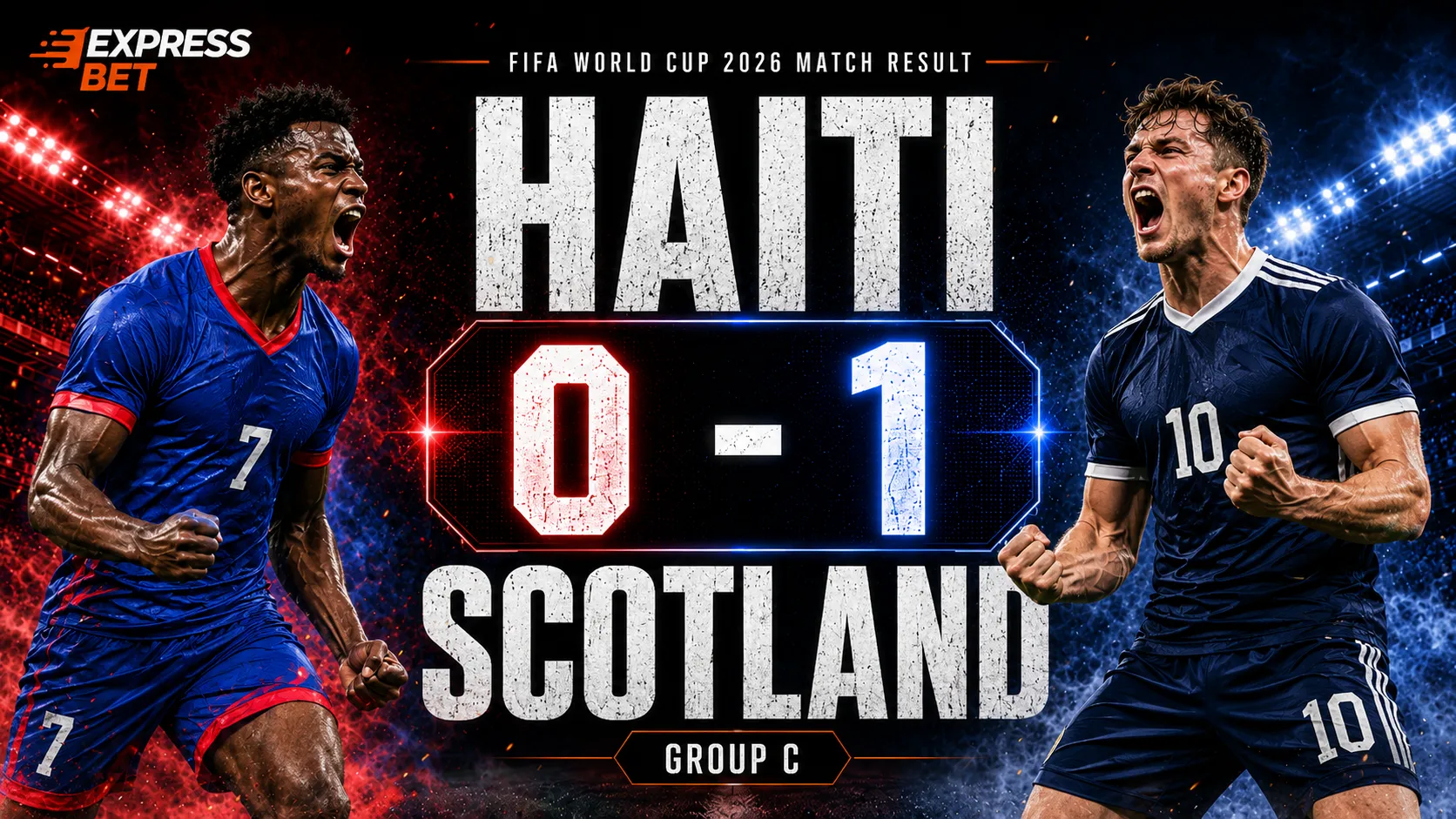
Scotland beat Haiti 1-0 in their FIFA World Cup 2026 Group C opener at Boston Stadium. John McGinn scored the only goal in the 28th minute, giving Scotland their first World Cup win since 1990 and a vital three points in a difficult group with Brazil and Morocco still ahead. Haiti pushed hard late, with Frantzdy Pierrot missing their clearest equalising chance in the 85th minute, but Scotland survived. The main turning point was McGinn’s scrappy first-half finish after Scotland’s early pressure. McGinn was the decisive player, though Ben Gannon-Doak and Angus Gunn also mattered. Betting markets rewarded Scotland win and under 2.5 goals, depending on odds and timing.
| Detail | Information |
|---|---|
| Match | Haiti vs Scotland |
| Competition | FIFA World Cup 2026 |
| Stage | Group C, Matchday 1 |
| Date | 13 June 2026 local time / 14 June in UK time |
| Kickoff time | 9:00 p.m. local time / 2:00 a.m. UK time |
| Host country | United States |
| City | Foxborough, Massachusetts |
| Stadium | Boston Stadium / Gillette Stadium |
| Final score | Haiti 0-1 Scotland |
| Half-time score | Haiti 0-1 Scotland |
| Attendance | 64,146 |
| Referee | Mustapha Ghorbal, Algeria |
| Fourth official | Alejandro José Hernández Hernández, Spain |
| VAR | Abdullah Dhafer Al Shehri |
| Assistant VAR | Mohammed Obaid Khadim |
| Haiti formation | 4-4-2 |
| Scotland formation | 4-4-2 |
| Goal | John McGinn 28’ |
| Penalties | None confirmed |
| Red cards | None |
| Yellow cards | Jean-Ricner Bellegarde; Aaron Hickey; Findlay Curtis; Kenny McLean |
| Weather | Detailed match-time weather not confirmed |
| Pitch condition | No major confirmed pitch controversy |
| Betting result | Scotland win; under 2.5 goals; both teams to score “No” |
The Haiti vs Scotland match result was 0-1, and the scoreline says something honest about the match. Scotland won. Haiti were not embarrassed. Nobody played football that should be framed and sent to a museum. The three points went to the team that took one ugly chance and then defended as if national trauma had finally been given a clearance drill.
Scotland’s World Cup return had waited since 1998. Their last win at the tournament had waited since 1990. That is not a gap. That is a geological period with football scarves. So when John McGinn forced the ball over the line in the 28th minute, the goal did not need to be clean. It needed to exist.
The match began with Scotland sharper. Ben Gannon-Doak was lively on the right. Scott McTominay hit the post in the 17th minute. Che Adams and Lawrence Shankland gave the front line honest work, if not always elegant execution. Andy Robertson and Aaron Hickey gave width from deep. Lewis Ferguson and John McGinn tried to connect midfield to attack.
Haiti were not passive. That is important. Sébastien Migné’s side carried speed, courage, and a clear willingness to attack Scotland’s spaces once the game stretched. Louicius Deedson, Ruben Providence, Wilson Isidor, Frantzdy Pierrot, and Jean-Ricner Bellegarde gave Haiti several routes into the match. They lacked the final decision, not ambition.
Scotland scored first and then slowly discovered that protecting a 1-0 lead in a World Cup opener is not a relaxing activity. After the goal, Haiti grew into the game. The second half became less about Scottish control and more about Scottish survival. Haiti pushed. Scotland blocked. The match moved from tactical plan to collective stress.
Pierrot’s late header in the 85th minute was the moment Haiti will replay. A better contact, a lower header, a calmer body shape, and the story changes. Instead, it went wide. Football is often just a series of almosts arranged around one actual goal.
Scotland held on. Not beautifully. Not always convincingly. But held on. For Steve Clarke, that was enough. For Haiti, the performance gave belief but no points, which is the kind of moral victory tournament tables treat with open contempt.
John McGinn scored the only goal of the match in the 28th minute.
The move came during Scotland’s best first-half spell. Scotland had already threatened through Ben Gannon-Doak and McTominay. Haiti were beginning to settle, but Scotland still had enough forward pressure to force a decisive moment.
The goal itself was scrappy. That is not criticism. World Cup history is full of goals that would fail an art-school interview. McGinn’s finish took a deflection on its way through and beat Johny Placide. It was the kind of goal that arrives in a crowded box, survives a few bodies, and then becomes history because the scoreboard does not grade aesthetics.
Tactically, the goal mattered because it allowed Scotland to retreat into a more conservative rhythm. They no longer needed to force the match. Haiti did.
Emotionally, it mattered even more. Scotland had waited 36 years for a World Cup win. Their supporters did not need a 30-pass move. They needed one ball in the net and a reason to make Boston sound like Hampden had been misplaced across the Atlantic.
Ben Gannon-Doak had an early shot on target in the 3rd minute. That set the tone for Scotland’s opening spell. Haiti needed time to settle, and Scotland tried to make sure they did not get it politely.
Gannon-Doak’s directness gave Scotland a clear outlet. He attacked his full-back, carried the ball aggressively, and made Haiti defend backward. For a team returning to the World Cup after 28 years, that early energy mattered. It reduced nerves.
Scott McTominay struck the post in the 17th minute. That was Scotland’s clearest early warning before the goal.
The chance showed the value of McTominay’s forward running, even on a night when his overall influence was uneven. Haiti struggled at times when Scotland’s midfielders arrived late around the edge of the box. It was a familiar McTominay pattern: not always in the rhythm, but dangerous when he arrives in the right lane.
The goal changed the match. Scotland could stop chasing the first breakthrough and start managing the scoreboard.
That also changed Haiti’s role. They now had to attack more often, which created space for Scotland in theory. In practice, Scotland did not exploit that space well enough. The match stayed alive because Scotland never found a second goal.
Jean-Ricner Bellegarde was booked in the 39th minute. The foul interrupted Scotland, but it also showed Haiti’s growing frustration with Scotland’s movement and duels.
Bellegarde remained important after that. He was one of Haiti’s most composed players in possession and one of their main providers from dead-ball situations. But the yellow card slightly narrowed his defensive margin.
Aaron Hickey was booked in the 46th minute. That was an early second-half complication for Scotland.
Haiti were beginning to attack more through wide areas, and Hickey’s booking made every duel feel sharper. Steve Clarke eventually replaced him with Nathan Patterson, which made sense. In a 1-0 game, a full-back on a yellow card can become a hostage situation with boots.
The final 15 minutes belonged mostly to Haitian anxiety and Scottish defending.
Ruben Providence had a blocked shot. Josue Casimir forced a save. Bellegarde delivered corners. Haiti played with more urgency. Scotland’s midfield lost control. The Tartan Army had waited decades to return to this stage and then spent the final quarter-hour discovering new medical uses for fingernails.
Frantzdy Pierrot’s late header was Haiti’s best chance to equalise.
The cross came from the right. Pierrot attacked it well but could not direct it on target. It was the moment. Not a moment. The moment.
For Haiti, it was proof they could hurt Scotland. For Scotland, it was the warning they survived. For bettors on Scotland and under 2.5 goals, it was probably less an event than a private cardiac examination.
Findlay Curtis and Kenny McLean were booked in stoppage time. Those bookings told the story of the finish. Scotland were not closing the match with elegant passing. They were clearing, fouling, blocking, and waiting.
Sometimes winning football looks like control. Sometimes it looks like a team collectively bargaining with the clock.
Both teams started in 4-4-2 shapes.
Haiti lined up with Johny Placide in goal. Carlens Arcus, Ricardo Adé, Hannes Delcroix, and Martin Expérience formed the back four. Louicius Deedson, Jean-Ricner Bellegarde, Danley Jean Jacques, and Ruben Providence worked across midfield, with Wilson Isidor and Frantzdy Pierrot in attack.
Scotland started with Angus Gunn in goal. Aaron Hickey, Grant Hanley, Jack Hendry, and Andy Robertson formed the defence. Ben Gannon-Doak, Scott McTominay, Lewis Ferguson, and John McGinn formed midfield, with Che Adams and Lawrence Shankland up front.
The mirror formations created a game of duels. There were no strange tactical riddles in the opening structure. It was 4-4-2 against 4-4-2. Width mattered. Second balls mattered. The timing of midfield runs mattered. So did the ability of strikers to make centre-backs uncomfortable without the ball.
Scotland started brighter. Gannon-Doak attacked early and gave Haiti immediate problems. His directness helped Scotland play forward before Haiti could compress the midfield. Robertson also pushed on from left-back, though Scotland’s best early threat came more from right-sided speed and central second balls.
Haiti’s early plan was not overly cautious. They tried to play through Bellegarde and Jean Jacques, then release Deedson, Providence, Isidor, and Pierrot quickly. Their problem was execution under pressure. Several attacks reached promising zones but broke down through heavy touches or rushed decisions.
McTominay’s shot against the post in the 17th minute should have been a warning. Scotland were getting runners close enough to the box. Haiti had numbers behind the ball, but they were not always controlling late arrivals.
The goal in the 28th minute rewarded Scotland’s better start. It did not come from a perfectly worked pattern, but the build-up reflected their pressure. McGinn, as so often for Scotland, was in the area where the ball became chaotic. Some midfielders observe chaos. McGinn treats it as a workplace.
After the goal, Haiti improved. Scotland’s energy dropped slightly, and Haiti began finding more room between Scotland’s wide players and full-backs. Providence became more active. Bellegarde took more responsibility on the ball. Isidor looked for shooting positions.
The final 10 minutes of the first half were more even than Scotland would have wanted. Haiti did not dominate, but they forced Scotland to defend more often. Bellegarde’s booking was one sign of the game’s growing physical edge.
At half-time, Scotland led 1-0. The score was fair enough because they had created the decisive chance and had hit the post. But it was not a dominant lead. It was a narrow lead wrapped in warning tape.
The second half was less controlled by Scotland and more interesting for Haiti.
Hickey’s yellow card in the 46th minute immediately affected Scotland’s defensive rhythm. Haiti looked more willing to attack wide areas and carry the ball at defenders. That meant Hickey had to manage duels carefully until he was replaced.
Scotland had moments after the break. They won corners through McGinn and Lewis Ferguson. Gannon-Doak had a shot around the 55th minute. Robertson continued to offer a wide outlet. But the attacking structure became more stretched.
The issue was Scotland’s midfield control. McTominay, Ferguson, and McGinn worked hard, but they did not always give Scotland clean possession after regains. Too often, Scotland cleared or played forward too quickly, allowing Haiti to recycle pressure.
Haiti made the first substitution in the 61st minute, bringing on Josue Casimir for Deedson. That change added fresh movement and eventually gave Haiti a late shooting chance. The match was beginning to tilt toward a more open final phase.
Scotland made a triple substitution in the 75th minute. Ryan Christie, Lyndon Dykes, and Nathan Patterson came on for Gannon-Doak, Che Adams, and Aaron Hickey. The logic was clear. Clarke needed fresh legs, a stronger central target, and protection against Hickey’s booking.
Haiti responded with Lenny Joseph for Wilson Isidor in the 76th minute and later Yassin Fortuné for Providence in the 85th minute. Migné’s changes were also logical. Haiti needed more attacking legs and a final push.
The best Haitian spell came between the 78th and 90th minutes. Providence had a blocked shot. Casimir tested Scotland. Bellegarde delivered corners. Pierrot missed the big header. Scotland were no longer controlling the match. They were managing it.
The late substitutions of Findlay Curtis and Kenny McLean for McGinn and Shankland gave Scotland fresh bodies, but they also created a more defensive finish. Curtis and McLean both ended up booked. That is not necessarily a tactical disaster. It is just evidence that Scotland were using tools from the emergency drawer.
Haiti’s final free-kick routine in stoppage time summed up their night. They got into useful positions, but the final action lacked calm. They had courage. They had speed. They had moments. They did not have the goal.
Scotland won because they converted their strongest early spell and then defended with enough resilience to survive the match’s untidy final shape.
The 4-4-2 gave Scotland directness. Adams and Shankland occupied Haiti’s centre-backs. Gannon-Doak stretched the right side. Robertson and Hickey gave width from deep. McGinn and Ferguson had licence to arrive around the box. McTominay could push forward when Scotland attacked.
The early Scottish plan was simple but effective: play forward quickly, attack second balls, and use wide delivery before Haiti could settle. This worked best in the first 30 minutes. McTominay hit the post. Gannon-Doak caused problems. McGinn scored.
After the goal, Scotland’s issue was possession management. They did not control the ball well enough to kill Haiti’s momentum. Their 4-4-2 became flatter without the ball. Adams and Shankland could not always stop Haiti’s first pass into midfield. Bellegarde and Jean Jacques started to find better angles.
Haiti’s 4-4-2 was more fluid in attack. Providence and Deedson could step inside. Bellegarde carried and passed through central areas. Pierrot and Isidor offered speed and direct running. Haiti’s biggest attacking threat came when they moved quickly after Scotland lost possession, not when they built slowly against a set defence.
The weakness was final-third decision-making. Haiti’s forwards created stress but not enough precision. Crosses were sometimes late. Shots were rushed. The final pass was often one touch short of quality. At World Cup level, that is enough to lose.
Scotland’s defensive line was not perfect, but it was experienced. Hanley and Hendry won enough aerial duels. Robertson gave leadership and positioning. Gunn handled what he needed to handle. When the match became ugly, Scotland did not try to make it pretty. They accepted the job.
Steve Clarke’s substitutions were defensive in spirit. Patterson replaced Hickey to reduce card risk. Dykes gave an outlet. Christie offered legs. McLean and Curtis entered late to close spaces, even if their bookings made the ending more frantic.
Migné’s Haiti had the more encouraging second half. Scotland had the goal. Football remains unfairly attached to this distinction.
These ratings are editorial assessments based on match influence, tactical role, visible impact, and confirmed match events.
Johny Placide — 6/10
Beaten by McGinn’s deflected finish. Could not do much about the decisive contact. Managed his box reasonably and offered leadership, but Haiti needed a clean sheet to take something.
Carlens Arcus — 6/10
Had a difficult opening period against Scotland’s wide movement. Improved as the game settled and helped Haiti push higher late.
Ricardo Adé — 6.5/10
Strong in several defensive duels. Scotland’s goal came through traffic rather than a single obvious failure from him.
Hannes Delcroix — 6.5/10
Handled parts of the aerial battle well and kept Haiti in the match after the early Scottish pressure. Could have used cleaner distribution.
Martin Expérience — 6/10
Worked hard on the left side and took a late shot in stoppage time. His final action summed up Haiti’s night: brave, promising, not precise enough.
Louicius Deedson — 5.5/10
Had an early shot and gave Haiti energy, but his influence faded. Replaced by Casimir in the 61st minute.
Jean-Ricner Bellegarde — 7/10
Haiti’s best midfielder. Carried the ball, delivered set pieces, and tried to give Haiti composure. Booked in the first half, which slightly limited him.
Danley Jean Jacques — 6.5/10
Did important work in midfield and helped Haiti grow into the game. Needed one cleaner progressive pass in the final third.
Ruben Providence — 7/10
One of Haiti’s most dangerous players. Had a shot on target and caused problems late before being replaced. His directness stretched Scotland.
Wilson Isidor — 6/10
Had shooting moments and worked hard between the centre-backs. Replaced by Lenny Joseph in the second half.
Frantzdy Pierrot — 6.5/10
A physical threat and Haiti’s most obvious late scoring route. His 85th-minute header was the chance. Missing it keeps his rating from being higher.
Josue Casimir — 6.5/10
Added life after coming on. Had a shot on target and helped Haiti’s late pressure.
Lenny Joseph — 6/10
Fresh attacking legs but limited service in central areas.
Yassin Fortuné — 6/10
Entered late and had little time to shift the result.
Angus Gunn — 7/10
Kept the clean sheet and handled Haiti’s late pressure. Not overloaded, but calm when Scotland needed him.
Aaron Hickey — 6/10
Started well enough but his 46th-minute yellow card made the second half awkward. Replaced by Patterson.
Grant Hanley — 7/10
Important in the aerial battle. Had moments of stress late but defended the penalty area with commitment.
Jack Hendry — 7/10
Solid and direct. Helped Scotland survive Haiti’s late crosses and pressure.
Andy Robertson — 7.5/10
Captain’s performance. Provided energy on the left, led the defensive line, and helped Scotland through the nervy final spell.
Ben Gannon-Doak — 7.5/10
Scotland’s brightest early attacker. His pace and directness gave Haiti immediate problems. Replaced after 75 minutes.
Scott McTominay — 6/10
Hit the post in the first half but did not dominate midfield as Scotland would have wanted. Haiti found too many late central routes.
Lewis Ferguson — 7/10
Worked hard, defended intelligently, and offered set-piece delivery. One of Scotland’s more balanced performers.
John McGinn — 8/10
Scored the winner and gave Scotland the moment they needed. Not always tidy, but decisive. That is his trade.
Lawrence Shankland — 6/10
Worked honestly but did not offer enough penalty-box threat. Replaced late.
Che Adams — 6.5/10
Involved in Scotland’s attacking pressure around the goal and worked hard, though his hold-up play was mixed.
Nathan Patterson — 6.5/10
Came on for Hickey and made an important block against Providence late.
Ryan Christie — 6/10
Added legs and pressing after coming on.
Lyndon Dykes — 6/10
Gave Scotland a target, though he also conceded a dangerous late free kick.
Findlay Curtis — 5.5/10
Late substitute, booked in stoppage time.
Kenny McLean — 5.5/10
Late substitute, booked in stoppage time. Helped close the game but not cleanly.
Man of the Match: John McGinn
The winning goal decides this. McGinn did not produce a perfect midfield performance, but he scored the goal that gave Scotland three points. In tournament football, influence is not always elegant. Sometimes it is one deflected shot and 60 minutes of argument.
Best attacker: Ben Gannon-Doak
Gannon-Doak was Scotland’s most electric attacking outlet. He attacked early, stretched Haiti, and gave Scotland the vertical threat that helped shape the first half.
Best midfielder: Jean-Ricner Bellegarde
Even in defeat, Bellegarde was Haiti’s most composed midfielder. He carried the ball, took responsibility, and delivered set pieces. Haiti needed more final-third quality around him.
Best defender: Andy Robertson
Robertson gave Scotland leadership and defensive stability. His experience mattered when the game became uncomfortable late.
Best goalkeeper: Angus Gunn
Gunn kept the clean sheet and handled the pressure. It was not a spectacular goalkeeper’s match, but he did the necessary work.
Best substitute: Nathan Patterson
Patterson replaced Hickey and made an important late defensive contribution. In a 1-0 win, that matters.
Most underrated performance: Lewis Ferguson
Ferguson’s defensive work and positioning helped Scotland survive periods when midfield control was slipping away.
Most disappointing performance: Frantzdy Pierrot’s finishing
Pierrot worked hard and caused problems, but the late header had to test Gunn. Haiti’s biggest chance went wide.
There were no red cards and no confirmed penalties.
Jean-Ricner Bellegarde was booked for Haiti in the 39th minute. Scotland’s yellow cards went to Aaron Hickey in the 46th minute, Findlay Curtis in the 90+1st minute, and Kenny McLean in the 90+5th minute.
The timing of Scotland’s cards tells a story. Hickey’s booking came immediately after half-time and influenced Clarke’s substitution planning. Curtis and McLean were booked while Scotland were protecting the lead in stoppage time. Those are not decorative cautions. They are signs of a team defending under pressure.
No major injury was confirmed as central to the result. Josue Casimir required treatment late, but no confirmed serious injury report was available in the match information used here.
Suspension risk is not immediate after one yellow card, but tournament accumulation always matters. Hickey, Curtis, McLean, and Bellegarde must all be careful in future group matches. A needless second booking later in the group can turn selection into arithmetic.
Mustapha Ghorbal had a physical, tense game to manage.
The match did not include a confirmed penalty or red card. VAR did not overturn the result. Still, Haiti supporters and some observers were frustrated by several second-half decisions, including penalty appeals and late physical challenges. The safe conclusion is not that the match was “stolen.” The safe conclusion is that Haiti felt they had enough pressure to deserve more attention from the officials.
Ghorbal allowed contact. That suited Scotland at times, especially when Haiti were trying to build rhythm through Providence, Bellegarde, and Pierrot. It also suited Haiti in midfield duels where they tried to disrupt Scottish transitions.
The yellow cards were broadly connected to reckless or late challenges. Bellegarde’s booking came before half-time. Hickey’s arrived after the restart. The late bookings to Curtis and McLean showed that Scotland were defending with urgency rather than control.
VAR’s quiet role will frustrate some Haiti fans, but no officially confirmed VAR intervention changed the result. That matters. The article should not accuse officials of corruption or bias. Scotland won because McGinn scored and Haiti did not. Refereeing debate can sit beside that fact, not replace it.
The match was played at Boston Stadium, the World Cup name for Gillette Stadium in Foxborough, Massachusetts. The attendance was 64,146.
Detailed match-time weather was not confirmed in the reliable public match information used for this article. No major rain, wind, extreme heat, roof issue, or pitch controversy became central to the match story.
The stadium atmosphere mattered more than the weather. Scotland’s support was loud, visible, and emotionally loaded. A team returning to the World Cup after 28 years does not travel lightly. It travels with songs, nervousness, and at least three generations of grievance.
Haiti also had meaningful support, especially given the Haitian community presence in the broader Boston area. That made the night feel less like a neutral match and more like a cultural meeting inside a football stadium.
The pitch did not define the result. The game was decided by an early Scottish spell, one deflected McGinn goal, Haiti’s late pressure, and Scotland’s defensive resistance. No surface issue should be turned into a false explanation.
The Tartan Army gave Scotland a major emotional lift.
Boston became a Scottish football outpost for the night. The crowd carried the match through its nervous spells. After McGinn scored, the sound belonged mostly to Scotland. After the final whistle, it became something closer to release.
That matters because this was not just another group-stage win. Scotland had not won a World Cup match since 1990. Many supporters watching had either never seen it or had waited long enough to treat the final whistle like a family event.
Haiti’s supporters had their own reason to care deeply. This was Haiti’s first World Cup appearance since 1974. Their team did not win, but they gave their fans a performance with courage and late hope. That has value, even if the table refuses to print it.
The match’s atmosphere changed sharply in the final 15 minutes. Scottish noise became nervous. Haitian noise became hopeful. When Pierrot’s header missed, the stadium held that brief silence football produces when everybody understands what almost happened.
This match carried history for both sides.
For Scotland, it was the first World Cup match since 1998 and the first World Cup victory since 1990. That win in Italy had become a reference point from another era. McGinn’s goal ended the drought and gave Scotland a rare moment of World Cup release.
For Haiti, this was a return after 52 years. Their previous World Cup appearance came in 1974, when Emmanuel Sanon famously scored against Italy and ended Dino Zoff’s long international clean-sheet run. That remains one of the great Haitian football moments. In Boston, Haiti almost found another through Pierrot, but almost is a cruel historian.
There was also a Group C echo from 1998. Scotland, Brazil, and Morocco were all in the same group then. In 2026, those three nations are together again, with Haiti added. Football has a lazy sense of humour sometimes. It repeats the cast and changes the venue.
The match itself resembled many World Cup openers between an experienced European side and a fast, ambitious underdog. The favourite scores first, then discovers that managing the lead is harder than taking it. Haiti were not outclassed. Scotland were not fluent. The difference was finishing.
This was not a grand classic. It was a narrow, nervous, historically heavy win. Scotland will take that without apology.
A full official statistical sheet was not consistently available across the sources used for this article, so this section focuses on confirmed match events and reliable public match data.
| Category | Haiti | Scotland |
|---|---|---|
| Final score | 0 | 1 |
| Half-time score | 0 | 1 |
| Goals | 0 | John McGinn 28’ |
| Confirmed formations | 4-4-2 | 4-4-2 |
| Red cards | 0 | 0 |
| Confirmed yellow cards | 1 | 3 |
| Penalties | 0 confirmed | 0 confirmed |
| Result market | Lost | Won |
| Total goals market | Under 2.5 | Under 2.5 |
| Both teams to score | No | No |
FOX’s public play-by-play showed several key attacking events: Gannon-Doak had an early shot on target, McTominay struck the post, Providence produced Haiti’s first shot on target, and Pierrot had late attempts. Scotland scored from their only confirmed goal event, while Haiti’s late chances did not turn into a shot that changed the result.
The table does not fully capture the emotional pattern. Scotland had the better first half-hour. Haiti had the stronger late push. Scotland had the goal. That last sentence is the most important statistic in any football match.
The yellow-card pattern also tells part of the story. Scotland collected two cards in stoppage time while defending the lead. Haiti’s lone booking came in the first half through Bellegarde. That reflects the match’s shift from Scottish pressure to Scottish survival.
The Haiti vs Scotland betting result was clean in the main markets.
Scotland were favoured before the match. FOX listed Scotland winning at -173 odds, so bettors who backed Scotland on the moneyline were rewarded. The return was not huge, but the bet landed.
The draw market lost. Haiti win lost. Haiti plus handicap may have depended on the exact line. Haiti +1.5 would have landed because they lost by one goal. Haiti +0.5 would not.
The over/under market was clear. The line was 2.5, and the match produced only one goal. Under 2.5 landed comfortably on the final score, though anyone watching the late Haiti pressure will know “comfortably” is sometimes a mathematical word rather than an emotional one.
Both teams to score “No” landed. Scotland scored. Haiti did not. Clean-sheet markets on Scotland also landed.
Correct score 1-0 Scotland was the premium winning angle. It matched the game’s narrow shape, but correct-score betting remains high risk. One Pierrot header on target in the 85th minute would have destroyed it.
First goalscorer bettors needed John McGinn. Anytime goalscorer bettors on McGinn also landed. Scottish striker markets on Adams, Shankland, or Dykes failed.
Cards markets depended heavily on the line. Four confirmed bookings made moderate card totals relevant, especially with late Scotland yellows. But there were no red cards, and no penalty market landed.
The main betting lesson is blunt. Scotland were the right side on the result, but not dominant enough to make the match feel simple. Bettors who backed Scotland needed finishing, defending, and Haiti’s missed late chance. That is not a “safe” bet. That is football behaving like football.
Scotland moved to three points and top of Group C after the first round of matches.
Brazil and Morocco drew 1-1 in the other group match, which made Scotland’s win even more valuable. Three points in a group containing Brazil and Morocco is not just useful. It is oxygen.
Scotland next face Morocco on 19 June, then Brazil on 24 June. A point from one of those matches could be enough to put them in a strong position, especially in the expanded 48-team format where the best third-placed teams can also advance. But relying on third-place calculations is a sport for spreadsheets and anxious people.
Haiti sit on zero points and a minus-one goal difference. That is not fatal, but the schedule is not kind. They face Brazil next, then Morocco. Migné’s team now need at least one major result. Moral encouragement from the Scotland performance is real. It just does not count in Group C.
For Scotland, the win changes pressure. They no longer need to chase the group from zero. They can approach Morocco with something to protect and something to build on.
For Haiti, the next match is about survival. They need goals. They need cleaner decision-making. They need to turn late pressure into actual finishing.
Haiti competed properly.
They did not freeze on the stage. That matters for a team playing its first World Cup match since 1974. They took early Scottish pressure, conceded, then grew into the game. Many teams would have folded. Haiti did not.
Bellegarde gave midfield quality. Providence gave direct running. Pierrot gave a physical reference point. Isidor and Deedson offered movement. The substitutes added energy.
Haiti’s late pressure was not fake. They created enough to scare Scotland. Pierrot’s 85th-minute header was a major chance. Casimir also gave Scotland problems after coming on.
Defensively, Haiti recovered after a poor opening half-hour. They did not allow Scotland to turn 1-0 into 2-0. That gave them a real chance late.
The problem was finishing and final decisions. Migné’s post-match point about spontaneity was accurate. Haiti often needed one quicker pass, one calmer touch, or one better shot. At World Cup level, that is usually the difference between brave defeat and useful points.
Scotland won, so the criticism must be proportionate. But there were issues.
First, they did not control the match after scoring. A 1-0 lead is fragile. Scotland treated it as if hard work alone could protect it. Hard work helped. Better possession would have helped more.
Second, their midfield did not dominate enough. McTominay hit the post but was not consistently influential. Ferguson and McGinn worked hard, but Haiti still found late lanes.
Third, Scotland’s substitutions became defensive rather than expansive. That was understandable, but it left them pinned back. Dykes gave an outlet, yet Scotland did not use him well enough to hold territory.
Fourth, the late fouls were poor. Curtis and McLean both went into the book in stoppage time. Giving Haiti set pieces while leading 1-0 is a generous hobby and should be discontinued.
Fifth, Scotland did not find a second goal. That kept the match alive and forced them into a final 10 minutes of stress.
Still, the key sentence remains: Scotland won. Tournament football is not marked by performance art judges. It is marked by points.
Migné’s Haiti were competitive, brave, and tactically coherent.
The 4-4-2 gave Haiti a familiar defensive base and enough attacking routes through the wide players and front two. Bellegarde’s role was central. Providence and Deedson provided width. Pierrot and Isidor attacked channels.
The issue was the opening phase. Haiti were not quite ready for Scotland’s early directness. Gannon-Doak and McTominay caused problems, and McGinn’s goal punished them.
Migné’s substitutions helped. Casimir added energy. Joseph and Fortuné gave late attacking options. Haiti’s strongest pressure came after the bench began to influence the game.
His main task before Brazil is finishing structure. Haiti cannot rely only on effort. They need clearer routes to high-quality shots.
Clarke got the result. That matters more than the aesthetic argument.
Scotland’s early plan was effective. Gannon-Doak’s directness, McGinn’s box movement, and the two-striker shape unsettled Haiti. The goal came from that pressure.
The defensive structure also held. Hanley, Hendry, Robertson, and Gunn kept the clean sheet. That is the base of any tournament result.
The concern is the second half. Scotland became too passive. They did not keep the ball well enough. They invited Haiti forward. Against Haiti, they survived. Against Morocco or Brazil, the same pattern could become expensive.
Clarke’s substitutions were pragmatic. Patterson for Hickey made sense. Christie and Dykes were logical. Curtis and McLean came on to close the match. It worked. It was not pretty. Scotland will not care much today. They may care later.
John McGinn scored Scotland’s first World Cup goal since 1998 and delivered Scotland’s first World Cup win since 1990. That is a major personal and national milestone.
Scotland’s victory was their fifth win at a World Cup finals. It also ended a wait of more than 10,000 days since their last World Cup appearance.
Haiti were playing at their first World Cup since 1974. Their return itself was significant, even if the result was painful.
No confirmed youngest scorer, oldest scorer, appearance record, or national scoring record was verified in the public match data used for this article.
The historical weight is still clear. Scotland ended a 36-year wait for a World Cup win. Haiti returned after 52 years and nearly took something from their opener. One side got the table reward. The other got belief. The table is colder, but both facts matter.
The match did not produce a confirmed red card, penalty, or disallowed goal that changed the scoreline.
There were, however, moments of frustration for Haiti. Some supporters felt Haiti had a penalty case in the second half. Others pointed to late Scottish challenges, especially during stoppage time. The referee did not give Haiti the major decision they wanted, and VAR did not overturn anything.
The key point is restraint. There is no basis here to frame the match as corrupt or stolen. Haiti had chances to equalise and did not take them. Scotland defended a narrow lead and survived.
The real incident that mattered most was Pierrot’s missed header in the 85th minute. It was not controversial. It was just painful. Football does not need scandal to be cruel.
Scotland deserved the points because they scored and defended. Haiti deserved respect because they pushed Scotland to the edge. The scoreline gave us the truth, but not the whole truth.
Scotland’s 1-0 win was historic, valuable, and slightly worrying. Historic because it ended a 36-year wait for a World Cup victory. Valuable because it put them top of Group C. Worrying because the performance after the goal was not strong enough to calm anyone looking ahead to Morocco and Brazil.
Haiti left with zero points but not zero evidence. They showed pace, belief, and late pressure. They also showed why World Cup matches punish small failures. One defensive lapse. One missed header. One poor final pass. That is enough.
For bettors, the match rewarded Scotland moneyline, under 2.5 goals, both teams to score “No,” and correct score 1-0 if taken. It also warned against assuming that a favourite will win comfortably. Scotland won. They did not stroll.
The final image is simple: McGinn’s messy goal, Scotland’s relieved celebrations, Haiti’s late regret. Tournament football rarely offers clean moral lessons. This one offered three points to Scotland and homework to both teams.
Football betting carries financial risk. A correct tactical analysis does not guarantee a winning bet. Odds change before and during matches, and one goal can completely alter a market. Never chase losses. Do not bet money needed for daily life. Use limits and take breaks. Check local betting laws before gambling. Betting should remain entertainment, not income.
Scotland beat Haiti 1-0 in their FIFA World Cup 2026 Group C opener.
John McGinn scored the only goal of the match in the 28th minute.
John McGinn was the decisive player because he scored the winning goal. Ben Gannon-Doak and Andy Robertson were also important for Scotland, while Jean-Ricner Bellegarde stood out for Haiti.
Scotland moved to three points and went top of Group C after Brazil and Morocco drew 1-1. Haiti stayed on zero points and now face a difficult route against Brazil and Morocco.
Scotland moneyline landed. Under 2.5 goals landed. Both teams to score “No” landed. Correct score 1-0 Scotland also landed for bettors who took that high-risk market.
[expert_review params=»JTdCJTIyY29sb3IlMjIlM0ElMjJncmVlbi0yJTIyJTJDJTIyZXhwZXJ0X2F2YXRhciUyMiUzQSUyMiUyMiUyQyUyMmV4cGVydF9uYW1lJTIyJTNBJTIyJTIyJTJDJTIyZXhwZXJ0X2xpbmslMjIlM0ElMjIlMjIlMkMlMjJleHBlcnRfaWQlMjIlM0ElMjIxJTIyJTJDJTIyZXhwZXJ0X3R5cGUlMjIlM0ElMjJleHBlcnRfaWQlMjIlMkMlMjJleHBlcnRfYXZhdGFyX2FsdCUyMiUzQSUyMiUyMiUyQyUyMmV4cGVydF9zaG93JTIyJTNBMSUyQyUyMmV4cGVydF9kZXNjcmlwdGlvbiUyMiUzQSUyMlNwb3J0cyUyMEJldHRpbmclMjBBbmFseXN0JTIwJTI2JTIwRWRpdG9yaWFsJTIwQ29udHJpYnV0b3IlMjIlMkMlMjJleHBlcnRfc2hvd19idXR0b24lMjIlM0ExJTJDJTIyZXhwZXJ0X3Nob3dfYnV0dG9uX3R5cGUlMjIlM0ElMjJwb3B1cCUyMiUyQyUyMmV4cGVydF9xdWVzdGlvbl9idXR0b25fdGV4dCUyMiUzQSUyMkFzayUyMFF1ZXN0aW9uJTIyJTJDJTIycXVlc3Rpb25fZXh0ZXJuYWxfbGluayUyMiUzQSUyMiUyMiUyQyUyMnBvcHVwX3VzZV9waG9uZSUyMiUzQTAlMkMlMjJleHBlcnRfdGl0bGUlMjIlM0ElMjJBdXRob3IlMjIlMkMlMjJleHBlcnRfc2hvd190aXRsZSUyMiUzQTElMkMlMjJleHBlcnRfdGV4dCUyMiUzQSUyMkFsZXglMjBNb3JnYW4lMjBpcyUyMGElMjBzcG9ydHMlMjBiZXR0aW5nJTIwYW5hbHlzdCUyMGFuZCUyMGVkaXRvcmlhbCUyMGNvbnRyaWJ1dG9yJTIwd2hvJTIwd3JpdGVzJTIwZGV0YWlsZWQlMjBib29rbWFrZXIlMjByZXZpZXdzJTJDJTIwYmV0dGluZyUyMGd1aWRlcyUyQyUyMHBsYXRmb3JtJTIwY29tcGFyaXNvbnMlMkMlMjBhbmQlMjByZXNwb25zaWJsZSUyMGdhbWJsaW5nJTIwZXhwbGFpbmVycy4lMjBIaXMlMjB3b3JrJTIwZm9jdXNlcyUyMG9uJTIwcHJhY3RpY2FsJTIwaW5mb3JtYXRpb24lMjBmb3IlMjB1c2VycyUyMHdobyUyMHdhbnQlMjB0byUyMHVuZGVyc3RhbmQlMjBob3clMjBiZXR0aW5nJTIwc2l0ZXMlMjBvcGVyYXRlJTIwYmVmb3JlJTIwdGhleSUyMHJlZ2lzdGVyJTJDJTIwZGVwb3NpdCUyQyUyMG9yJTIwY2xhaW0lMjBhJTIwYm9udXMuJTIyJTJDJTIycWElMjIlM0ElNUIlNUQlMkMlMjJxYV9zaG93X3RpdGxlJTIyJTNBMSUyQyUyMnFhX3RpdGxlJTIyJTNBJTIyJUQwJTkyJUQwJUJFJUQwJUJGJUQxJTgwJUQwJUJFJUQxJTgxJTIwJUQxJThEJUQwJUJBJUQxJTgxJUQwJUJGJUQwJUI1JUQxJTgwJUQxJTgyJUQxJTgzJTIyJTJDJTIyc2NvcmUlMjIlM0ElNUIlNUQlMkMlMjJzY29yZV9zdW1tYXJ5X3RleHQlMjIlM0ElMjIlMjIlMkMlMjJzY29yZV9zdW1tYXJ5X2F2ZXJhZ2UlMjIlM0EwJTJDJTIyc2NvcmVfbWF4JTIyJTNBJTIyNSUyMiUyQyUyMnNjb3JlX3N5bWJvbCUyMiUzQSUyMiUyMiUyQyUyMnNjb3JlX3RpdGxlJTIyJTNBJTIyJTIyJTJDJTIyc2NvcmVfc2hvd190aXRsZSUyMiUzQTAlMkMlMjJwbHVzZXMlMjIlM0ElNUIlNUQlMkMlMjJtaW51c2VzJTIyJTNBJTVCJTVEJTJDJTIycGx1c2VzX21pbnVzZXNfc2hvd190aXRsZSUyMiUzQTElMkMlMjJwbHVzZXNfbWludXNlc190aXRsZSUyMiUzQSUyMiVEMCU5RiVEMCVCQiVEMSU4RSVEMSU4MSVEMSU4QiUyMCVEMCVCOCUyMCVEMCVCQyVEMCVCOCVEMCVCRCVEMSU4MyVEMSU4MSVEMSU4QiUyMiUyQyUyMnBsdXNlc190aXRsZSUyMiUzQSUyMiUyMiUyQyUyMm1pbnVzZXNfdGl0bGUlMjIlM0ElMjIlMjIlN0Q=»]