
Mexico vs Korea Republic World Cup 2026 Preview
Table of Contents Show
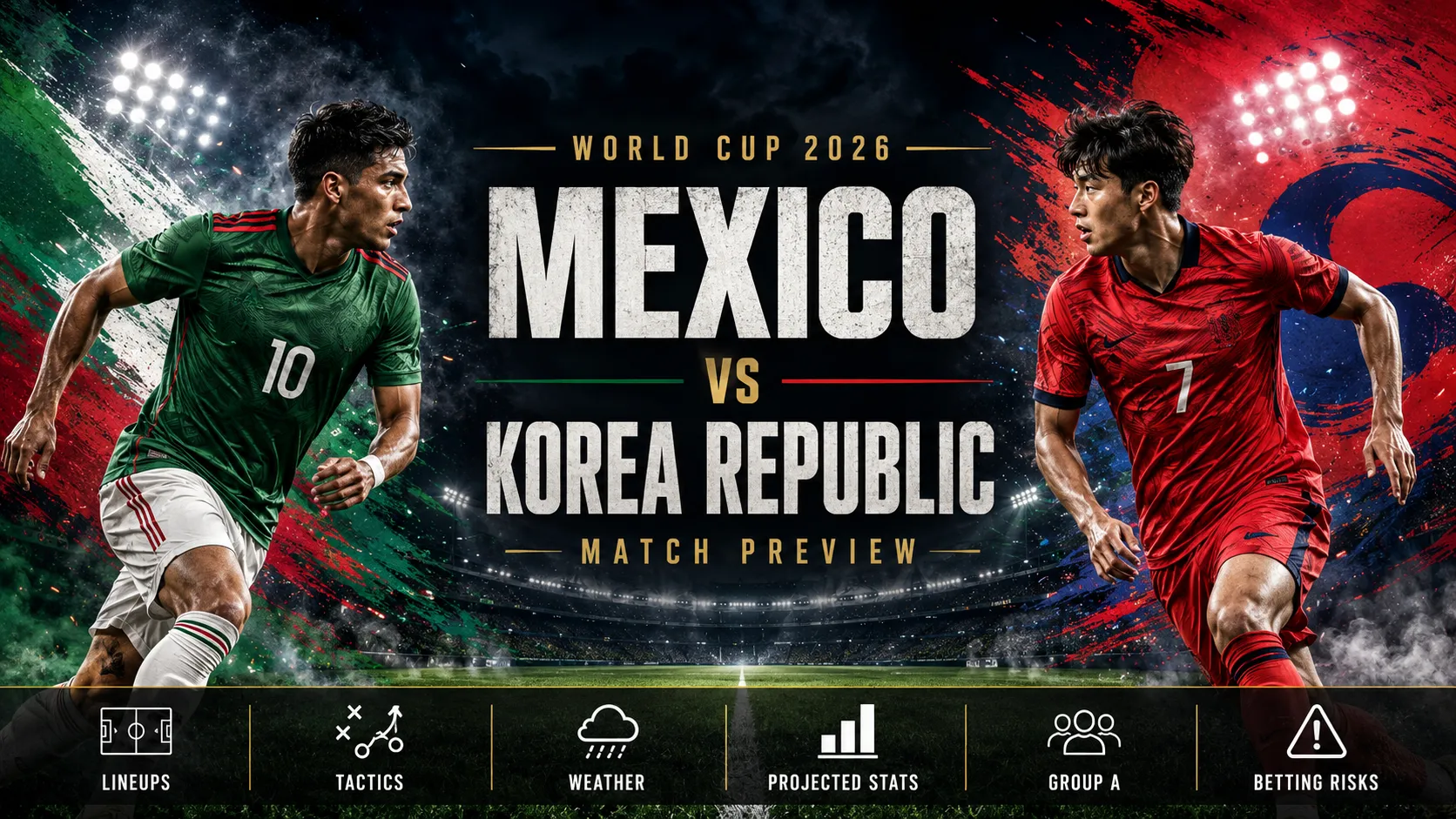
Mexico face Korea Republic in a FIFA World Cup 2026 Group A match at Guadalajara Stadium in Zapopan / Guadalajara, Mexico, on Thursday, 18 June 2026. Kick-off is scheduled for 7:00 p.m. local Central Time and 01:00 UTC on Friday, 19 June. This is Match 28 and the second group-stage match for both teams.
Both sides enter with three points. Mexico opened the tournament with a 2-0 win over South Africa. Korea Republic beat Czechia 2-1 after a comeback and a late winning goal from Oh Hyeon-gyu. Mexico must adjust because centre-back César Montes is suspended after his red card. Javier Aguirre may shift Edson Álvarez into central defence or move Israel Reyes inside. Korea Republic coach Hong Myung-bo has more midfield options because Bae Jun-ho and Kim Tae-hyeon are nearing returns from injury, while Son Heung-min’s role remains a tactical watchlist item.
The projected match type is Mexico’s home-driven possession, midfield structure and wide attacks against Korea Republic’s tempo, pressing resistance and late-run threat. The key player matchup is Mexico’s reorganised centre-back zone against Son, Oh and Korea’s forward rotations. Betting markets should be treated as signals only, not guarantees.
| Field | Data |
|---|---|
| Match | Mexico vs Korea Republic |
| Competition | FIFA World Cup 2026 |
| Stage | Group Stage / First Stage |
| Group | Group A |
| Match Number | Match 28 |
| Date | Thursday, 18 June 2026 local time / Friday, 19 June 2026 UTC |
| Kick-off Time | 7:00 p.m. Central Time / 01:00 UTC |
| Stadium | Guadalajara Stadium |
| Venue Context | Estadio Guadalajara / Estadio Akron / Zapopan context outside FIFA naming |
| City | Zapopan / Guadalajara metropolitan area |
| Host Country | Mexico |
| Expected Attendance | Not available from verified public data |
| Referee | Not available from verified public data |
| VAR | Not available from verified public data |
| Weather Forecast | Around 76°F / 24°C at 7:00 p.m. local time with thunderstorm risk; around 73°F / 23°C one hour later; exact humidity, wind and pitch-speed data not available from verified public data |
| Pitch Context | Tournament football surface; exact pitch speed not available from verified public data |
| Main Article Focus | Pre-match probability dossier, Group A stakes, confirmed team news, Montes suspension, Son role, predicted lineups, tactical collision, weather, projected stats, cards, betting market risk and forecast uncertainty |
Mexico vs Korea Republic is a top-of-group pressure match. Both teams won their openers. Both teams can take a major step toward the Round of 32 with another win. Mexico have host-country support and a strong emotional platform after beating South Africa. Korea Republic have momentum after recovering from a goal down against Czechia.
The match should not be framed only as home advantage versus Asian underdog. Korea Republic have World Cup experience, midfield control and attacking flexibility. Mexico have the crowd, technical midfielders and multiple forward options, but César Montes’ suspension changes the defensive base.
Mexico vs Korea Republic matters because the winner can move to six points and take control of Group A, while the loser remains alive but faces sharper final-round pressure and goal-difference risk.
| Category | Status | Mexico vs Korea Republic Example | Article Use |
|---|---|---|---|
| Confirmed fact | Verified before publication | Mexico vs Korea Republic, Group A, Guadalajara Stadium, 18 June 2026 local date | Hard match base |
| Confirmed timing | Verified fixture context | 7:00 p.m. local Central Time / 01:00 UTC on 19 June | Match snapshot |
| Confirmed Mexico result | Verified reporting | Mexico beat South Africa 2-0 in the opener | Group table and tactical context |
| Confirmed Korea result | Verified reporting | Korea Republic beat Czechia 2-1 in the opener | Group table and tactical context |
| Announced information | Verified media reporting | César Montes is suspended after red card | Mexico team news and defensive reshuffle |
| Announced information | Verified media reporting | Edson Álvarez or Israel Reyes may cover the centre-back gap | Mexico lineup scenarios |
| Announced information | Verified media reporting | Bae Jun-ho and Kim Tae-hyeon are nearing returns from injury | Korea lineup and bench scenarios |
| Announced information | Verified media reporting | Son Heung-min’s role may change if Oh Hyeon-gyu starts | Korea attacking forecast |
| Probable information | Tactical forecast | Mexico likely control more territory; Korea likely press and transition quickly | Tactical sections |
| Projected data | Model-based estimate | Possession, shots, xG, cards, corners and substitutions | Projection tables only |
| Unknown data | Not verified in current source set | Expected attendance, referee, VAR, exact humidity, exact wind, exact pitch speed | Marked unavailable |
| Scenario-based analysis | Possible future pattern | Mexico may move Álvarez into defence; Korea may start Oh and move Son deeper | Written as forecast, not fact |
This distinction matters because this match carries strong narratives. Mexico are co-hosts. Korea Republic have the 2018 emotional bond with Mexican fans after beating Germany, but that history does not decide this match. Mexico’s 2-0 opener is a confirmed result. Korea’s 2-1 comeback is a confirmed result. A projected formation, xG range or card range is not a fact.
A predicted lineup is not an official team sheet. A market price is not a guarantee. A weather forecast is not final pitch condition. A tactical model can break after an early goal, a red card, a VAR penalty, a goalkeeper error, a sudden thunderstorm, a fitness setback or a surprise selection.
This dossier uses probability language. It does not claim that any future goal, card, substitution, injury or VAR decision will happen at a specific minute.
Mexico and Korea Republic have separation after one round. Czechia and South Africa are already under pressure after opening defeats. That gives Match 28 a different character from the survival game between Czechia and South Africa. Mexico and Korea are not trying to rescue their campaigns. They are trying to seize control.
| Team | Played | Won | Drawn | Lost | Goals For | Goals Against | Goal Difference | Points |
|---|---|---|---|---|---|---|---|---|
| Mexico | 1 | 1 | 0 | 0 | 2 | 0 | +2 | 3 |
| Korea Republic | 1 | 1 | 0 | 0 | 2 | 1 | +1 | 3 |
| Czechia | 1 | 0 | 0 | 1 | 1 | 2 | -1 | 0 |
| South Africa | 1 | 0 | 0 | 1 | 0 | 2 | -2 | 0 |
The top two teams in each group qualify directly for the Round of 32. The best eight third-placed teams also qualify. Six points after two matches would place either Mexico or Korea Republic in a very strong qualification position. Four points would still be useful. Three points after two matches would keep a route open, but it would place the losing team under final-match pressure.
Mexico’s final Group A match is against Czechia. Korea Republic’s final Group A match is against South Africa. Both final fixtures look playable on paper, but the match context will change if one team loses here. Goal difference can become decisive if three teams finish close.
Mexico started well. Julián Quiñones scored early against South Africa. Raúl Jiménez added the second. The performance gave the host nation control, but the red card to César Montes created a defensive problem before the second match.
Aguirre has a choice. He can keep Edson Álvarez in midfield and move Israel Reyes inside. He can move Álvarez into central defence and use another midfielder to protect the centre. He can adjust the back line with a more conservative full-back approach. Each option changes Mexico’s balance.
Mexico’s practical objectives:
Korea Republic showed resilience against Czechia. They conceded first but recovered through Hwang In-beom and Oh Hyeon-gyu. That matters because it shows match-state resilience. It also creates a selection question. If Oh starts after scoring the winner, Son may move into a deeper supporting role. That could change Korea’s pressing and attacking angles.
Hong Myung-bo also has midfield flexibility returning. Bae Jun-ho and Kim Tae-hyeon are nearing returns from injury. That can give Korea more options to control the second half, support Son, protect Lee Kang-in or adjust the full-back zones.
Korea’s practical objectives:
Mexico start with +2. Korea Republic start with +1. A draw keeps Mexico ahead on goal difference. A Mexico win likely gives them major control of the group. A Korea win moves them to six points and likely top of the table.
Goal difference matters because the expanded format allows third-place qualification, but it also uses tie-breaker comparisons. A narrow loss is survivable. A heavy loss can damage the group route. If either team trails late by one goal, the coach must decide whether to chase a draw or protect margin.
Finishing first in Group A may provide a cleaner early knockout route than finishing second or third. This is not certain because third-place pairings depend on other groups. Still, top spot carries value. Reuters reporting notes that finishing first is likely to offer a more favourable route and help avoid an early meeting with another group winner. That gives this match a strategic layer beyond immediate qualification.
Mexico carry host pressure. Korea carry opportunity pressure. Mexico’s crowd can help, but it can also push players into rushed decisions. Korea have less crowd pressure, but they must handle the environment and the emotional weight of playing the co-hosts.
If Mexico score first, Korea must avoid overcommitting. If Korea score first, Mexico must avoid a frantic response. If the match remains level after 60 minutes, Mexico may feel stronger pressure because of the venue and table expectation.
| Result | Mexico Impact | Korea Republic Impact | Group A Meaning |
|---|---|---|---|
| Mexico win | Mexico move to six points and likely control the group before Czechia | Korea stay on three points and need a result against South Africa | Mexico become clear top-place favourite |
| Draw | Mexico move to four points and keep goal-difference advantage | Korea move to four points and remain strong before South Africa | Both teams stay well placed; group remains open |
| Korea Republic win | Mexico stay on three points and face Czechia under pressure | Korea move to six points and take top-place control | Korea become serious Group A leader candidate |
| Factor | Match Relevance |
|---|---|
| Host country | Mexico |
| Host-team status | Mexico are playing at home as co-hosts |
| Venue region | Jalisco / Guadalajara metropolitan area |
| Travel context | Mexico move from Mexico City opener to Guadalajara; Korea already played opener in Guadalajara |
| Crowd profile | Strong Mexico support expected, with Korean travelling support and neutral interest |
| Climate | Warm evening with thunderstorm risk |
| Altitude | Guadalajara is elevated but less extreme than Mexico City |
| Stadium context | Football-specific venue context with strong local culture |
| Tournament pressure | Second group match with direct top-place value |
The host-country factor strongly favours Mexico emotionally. The crowd can produce pressure, noise and momentum. It can also increase impatience if Korea defend the first wave.
Korea have one practical advantage. They already played their opener in Guadalajara. That gives them direct pitch, stadium and local-weather reference. Mexico opened in Mexico City and now shift to Guadalajara. That is not a severe disruption, but it matters for rhythm.
| City Factor | Expected Tactical Impact |
|---|---|
| 7:00 p.m. local kick-off | Heat should be lower than afternoon peak |
| Forecast around 76°F / 24°C at kick-off | Pressing remains viable if storms do not disrupt surface |
| Thunderstorm risk around match hour | Passing speed, goalkeeper handling and footing may change |
| Elevated city context | Repeated sprints require management but altitude is less severe than Mexico City |
| Strong football culture | Crowd pressure can influence tempo and referee atmosphere |
| Korea’s prior match at venue | Korea may understand pitch rhythm better from opener |
| Mexico home setting | Mexico may start with emotional intensity |
Guadalajara should support a fast match if the storm risk does not affect the surface. The main physical issue is not heat alone. It is wet-ball volatility if storms arrive near kick-off.
| Stadium Detail | Data |
|---|---|
| FIFA Stadium Name | Guadalajara Stadium |
| Common Venue Context | Estadio Guadalajara / Estadio Akron |
| City | Zapopan / Guadalajara metropolitan area |
| State | Jalisco |
| Country | Mexico |
| Kick-off | 7:00 p.m. local CT / 01:00 UTC |
| Expected Attendance | Not available from verified public data |
| Referee | Not available from verified public data |
| VAR | Not available from verified public data |
| Roof Status | Not available from verified public data |
| Pitch Speed | Not available from verified public data |
| Tactical Impact | Crowd noise, storm risk, surface speed and wide defensive spacing should be monitored early |
The stadium gives Mexico a home-stage effect, but Korea’s opening match at the same venue matters. Korea should have direct knowledge of the grass speed, visual angles, dressing-room rhythm and local support pattern. Mexico still have the crowd advantage.
| Weather / Environment Factor | Tactical Meaning |
|---|---|
| 76°F / 24°C near kick-off | High tempo remains possible |
| Thunderstorm risk at 7 p.m. and later evening | Wet surface, slips, skidding passes and goalkeeper handling become watchlist items |
| Exact humidity unavailable | Avoid precise cramp claims; hydration still matters |
| Exact wind unavailable | Long diagonals and set-piece delivery should be judged live |
| Elevated city | Sprint recovery can matter across 90 minutes |
| Roof status unavailable | Do not assume dry or protected playing conditions |
| Pitch speed unavailable | First 10 minutes should define pass weight and bounce |
| Evening kick-off | Substitution timing may be tactical rather than heat-forced |
The most important weather factor is storm risk. A dry match favours structured passing and controlled pressing. A wet match can increase rebounds, goalkeeper handling pressure, defensive slips, mistimed tackles and set-piece danger.
| Team | Player / Role | Status | Tactical Impact |
|---|---|---|---|
| Mexico | Javier Aguirre | Head coach | Must manage home pressure and defensive reshuffle |
| Mexico | César Montes | Suspended after red card | Removes a starting centre-back and changes Mexico’s defensive structure |
| Mexico | Edson Álvarez | Captain / midfield leader; possible centre-back cover | Could move into defence, but that may reduce midfield protection |
| Mexico | Israel Reyes | Possible central-defence replacement | Could move inside from right-back area if selected |
| Mexico | Julián Quiñones | Scored opening goal against South Africa | Main direct forward and shot threat |
| Mexico | Raúl Jiménez | Scored Mexico’s second goal against South Africa | Central striker, aerial reference and penalty-box target |
| Mexico | Gilberto Mora | 17-year-old impact player from opener | Possible starter if Aguirre wants more energy and creativity |
| Mexico | Raúl Rangel | Started opener in goal | Goalkeeper selection watchlist if Aguirre stays with him |
| Mexico | Guillermo Ochoa | Left out of opener starting XI | Veteran goalkeeper option but not assumed starter |
| Korea Republic | Hong Myung-bo | Head coach | Must decide Son role and Oh usage |
| Korea Republic | Son Heung-min | Captain and forward reference | May play central, wide or deeper support role |
| Korea Republic | Oh Hyeon-gyu | Scored late winner against Czechia | Possible starting striker after opener impact |
| Korea Republic | Hwang In-beom | Scored against Czechia and controlled midfield phases | Main central passer and rhythm player |
| Korea Republic | Bae Jun-ho | Nearing injury return | Adds attacking midfield or wide depth |
| Korea Republic | Kim Tae-hyeon | Nearing injury return | Adds defensive or midfield flexibility |
| Korea Republic | Lee Kang-in | Started opener; creative reference | Key half-space passer and set-piece option |
| Korea Republic | Kim Seung-gyu | Goalkeeper reference from opener | Shot-stopping and distribution role |
| Player | Team | Status | Tactical Impact |
|---|---|---|---|
| Bae Jun-ho | Korea Republic | Nearing return from injury | Could add bench creativity or starting attacking support |
| Kim Tae-hyeon | Korea Republic | Nearing return from injury | Could add defensive balance or late-match cover |
| Not available from verified public data | Mexico | Not available | Do not invent individual doubts |
| Not available from verified public data | Korea Republic | Not available | Do not invent additional doubtful players |
| Player | Team | Status | Tactical Impact |
|---|---|---|---|
| César Montes | Mexico | Suspended | Mexico must rebuild centre-back structure |
| Not available from verified public data | Mexico | Not available | No other confirmed unavailable player used in this preview |
| Not available from verified public data | Korea Republic | Not available | No confirmed unavailable player in current source set |
| Player / Group | Team | Issue | Match Impact |
|---|---|---|---|
| Mexico centre-back group | Mexico | Montes suspension | Álvarez, Reyes or another defender must cover the gap |
| Mexico midfield balance | Mexico | Possible Álvarez move into defence | Mexico may lose central ball-winning if Álvarez drops back |
| Mexico young creator role | Mexico | Mora starting decision | Mexico may gain creativity but lose experience if he starts |
| Korea attacking line | Korea Republic | Oh scored winner; Son role decision | Korea may start Oh and use Son deeper or wider |
| Korea midfield depth | Korea Republic | Bae and Kim nearing returns | Hong may have stronger substitution options |
| Korea media environment | Korea Republic | Team-media disruption after Son-related incident | Psychological noise is a watchlist item, not a tactical injury |
| Team | Confirmed Suspension | Notes |
|---|---|---|
| Mexico | César Montes | Suspended after red card against South Africa |
| Korea Republic | Not available from verified public data | No confirmed active suspension in current source set |
Montes’ suspension is the clearest team-news item. It changes Mexico’s defensive base. A direct centre-back replacement preserves Álvarez in midfield. Moving Álvarez into central defence may improve leadership at the back but reduce Mexico’s ability to screen Hwang In-beom, Lee Kang-in and Son.
Korea’s key issue is not a suspension. It is attacking balance. Oh’s goal creates a strong case for more minutes. But starting Oh may push Son away from the central striker role. That could help Korea if Son receives between lines. It could hurt Korea if Son becomes too far from the penalty area.
Bae Jun-ho and Kim Tae-hyeon give Hong more options. Their returns would matter most after 60 minutes, when Korea may need either control or fresh running.
Official starting lineups were not available from verified public data in the current source set. These XIs are projections from opener context, squad reporting and tactical logic. They should be replaced with official team sheets before publication.
| Position / Line | Player | Likely Role |
|---|---|---|
| GK | Raúl Rangel / Guillermo Ochoa | Rangel if Aguirre keeps opener structure; Ochoa if experience is prioritised |
| RB | Jorge Sánchez / Israel Reyes | Right-back support, defensive width and recovery against Korea left side |
| CB | Edson Álvarez / Israel Reyes | Replacement centre-back option because Montes is suspended |
| CB | Johan Vásquez / Jesús Orozco profile | Left-sided centre-back and aerial defender |
| LB | Jesús Gallardo / Gerardo Arteaga profile | Left-side width, crossing and defensive recovery |
| DM | Erik Lira / Luis Romo | Midfield screen if Álvarez moves deeper |
| CM | Álvaro Fidalgo | Circulation, ball security and tempo |
| CM / AM | Brian Gutiérrez / Gilberto Mora | Between-lines support, pressing and chance creation |
| RW | Roberto Alvarado / Alexis Vega | Right-side combination and delivery |
| ST | Raúl Jiménez / Santiago Giménez | Central striker, box presence and finishing route |
| LW | Julián Quiñones | Main direct attacker, pressing and shot threat |
| Position / Line | Player | Likely Role |
|---|---|---|
| GK | Kim Seung-gyu | Goalkeeper, shot-stopping and distribution |
| RB | Seol Young-woo / right-back option | Defensive width and support against Quiñones |
| CB | Kim Min-jae | Defensive leader, recovery and aerial control |
| CB | Jung Seung-hyun / Lee Han-beom profile | Centre-back support and box defence |
| LB | Kim Jin-su / Kim Tae-hyeon if cleared | Left-side defence and progression |
| DM | Park Yong-woo / Jens Castrop profile | Midfield screen and second-ball work |
| CM | Hwang In-beom | Main passer, rhythm player and opener scorer |
| AM / RW | Lee Kang-in | Creative half-space player, final pass and set pieces |
| LW / AM | Son Heung-min | Captain, forward runner or deeper support role |
| RW / AM | Bae Jun-ho / Hwang Hee-chan profile if available | Wide threat, ball carrying and pressing |
| ST | Oh Hyeon-gyu / Son Heung-min | Central striker option after Oh’s winner |
| Team | Base Formation | In Possession | Out of Possession | Confidence |
|---|---|---|---|---|
| Mexico | 4-3-3 / 4-2-3-1 | 2-3-5 with full-backs staggered, Fidalgo central and Quiñones high left | 4-4-2 press or 4-1-4-1 mid-block | Medium |
| Korea Republic | 4-2-3-1 / 4-4-2 / 4-3-3 | 2-3-5 with Lee and Son between lines, Oh as central reference if selected | Compact 4-4-2 or 4-2-3-1 press | Medium |
| Scenario | Trigger | Expected Change |
|---|---|---|
| Mexico move Álvarez to centre-back | Aguirre wants leadership after Montes suspension | Mexico gain defensive authority but lose midfield screen |
| Mexico move Reyes inside | Aguirre wants Álvarez to stay in midfield | Right-back changes; Mexico preserve central midfield balance |
| Mexico start Gilberto Mora | Aguirre wants more ball-carrying and crowd energy | Mexico gain creativity but reduce experience in a high-pressure match |
| Mexico start Santiago Giménez | Aguirre wants more movement than Jiménez offers | Mexico press slightly differently and attack depth more |
| Mexico protect lead | Leading after 70’ | Extra midfielder and lower full-back risk |
| Korea start Oh | Hong rewards winner and wants central presence | Son may move deeper or wider |
| Korea keep Oh as substitute | Hong wants Son as central starter | Oh remains late-game penalty-box weapon |
| Korea use Bae Jun-ho | Fitness clearance and need for extra creativity | Korea gain a second-half ball-carrying option |
| Korea protect draw | Level after 70’ | Extra midfielder, slower restarts and deeper full-backs |
| Phase | Expected Pattern |
|---|---|
| Build-up | Controlled first phase through goalkeeper, centre-backs and midfield, with Fidalgo and Álvarez/Lira central |
| Attack | Quiñones direct left-side threat, Jiménez box presence, Alvarado/Vega delivery and Mora/Gutiérrez between lines |
| Defense | Mid-block with trigger pressing, counter-press after wide losses |
| Transitions | Early release to Quiñones, Alvarado, Vega or Jiménez after recoveries |
| Set Pieces | Jiménez, Vásquez, Álvarez/Reyes and central defenders as aerial targets |
| Weakness | Centre-back reshuffle after Montes suspension and possible space behind full-backs |
Mexico should build with control. Aguirre does not need a chaotic match against Korea. Mexico have enough technical midfielders to move the ball through the first and second phases, but the balance depends on Álvarez’s position.
If Álvarez stays in midfield, Mexico keep a strong central shield. If he moves to centre-back, Mexico need Lira, Romo or another midfielder to protect the same spaces. Korea will test that zone through Hwang In-beom, Lee Kang-in and Son’s dropping movements.
Mexico’s build-up should target three outcomes:
Mexico must avoid slow central turnovers. Korea can counter quickly when Hwang, Lee or Son receives cleanly after a regain.
Mexico can press in bursts. They should not press without structure because Korea can play through midfield. The home crowd may push Mexico into higher pressure, but Aguirre needs the midfield distances to stay compact.
Useful Mexico pressing triggers:
The counter-press after losing the ball may matter more than the high press. Korea’s best attacks can start with one clean pass into Son, Oh or Lee. Mexico must block the first forward pass.
Mexico’s left side is likely the main attacking side because Quiñones offers speed, directness and confidence after scoring in the opener. If Gallardo or Arteaga supports him, Mexico can create overloads. But that also opens counter space behind the left-back.
The right side can offer control through Alvarado or Vega. If Mora starts, he can move between the lines and help connect both sides. Mexico should not become predictable. Korea can defend a one-sided attack with rotations.
Mexico should target:
Álvaro Fidalgo can be Mexico’s rhythm passer if he starts. Álvarez can be the structural passer if he stays in midfield. Mora can be a creative passer if he starts or enters early. Mexico need at least one midfielder who can receive under pressure and play forward.
The key pass may be the diagonal from midfield into the left half-space, where Quiñones can attack before Korea’s full-back receives cover.
Mexico can transition through Quiñones, Vega, Alvarado and Giménez or Jiménez. Their transition threat is strong if Korea push full-backs high. But Mexico must decide when to counter and when to reset. A home crowd can turn every regain into a forced attack. That can reduce chance quality.
Mexico have useful set-piece tools. Jiménez is strong in the air. Álvarez can attack set pieces if he plays. Vásquez, Reyes and other defenders can provide targets. Mexico can also use second balls around the box.
Set pieces may become more important if thunderstorms make the surface faster and if Korea defend compactly. A wet delivery can create handling and clearance problems.
Mexico’s main defensive weakness is the Montes gap. A reshuffled centre-back line can lose timing. Korea can test that line with Son’s movement, Oh’s runs and Lee’s final passes.
The second weakness is space behind full-backs. Mexico’s crowd and attacking intent can push both full-backs high. Korea can target that space.
Rangel or Ochoa must distribute based on Korea’s press. Short play can draw Korea forward. Long balls toward Jiménez or wide runners can bypass pressure. The goalkeeper must also handle wet-ball risk if storms arrive.
Mexico’s full-backs should stagger. One can attack high while the other holds. If both advance, Korea’s transition route improves. If Álvarez moves to centre-back, full-back risk should be lower because Mexico lose part of their midfield screen.
Jiménez gives experience, aerial presence and penalty-box finishing. Giménez gives movement and pressing. Aguirre’s striker choice defines the attack rhythm. Jiménez fits a crossing plan. Giménez fits a more mobile front line.
| Phase | Expected Pattern |
|---|---|
| Build-up | Controlled progression through Hwang In-beom, Lee Kang-in and centre-backs, mixed with direct releases |
| Attack | Son movement, Oh central runs, Lee final passes and Hwang tempo control |
| Defense | Compact mid-block, pressing triggers and aggressive second-ball response |
| Transitions | Fast release to Son, Oh, Lee or wide runners after Mexico turnovers |
| Set Pieces | Lee Kang-in and Son delivery options, Kim Min-jae and centre-back aerial targets |
| Weakness | Possible full-back exposure against Mexico’s wide speed and pressure if Mexico dominate territory |
Korea should build with patience but not overplay. Mexico will press in front of a home crowd. Korea can hurt Mexico if they play through the first wave, but central risk is high if the pitch becomes wet.
Hwang In-beom is the key connector. He can take the ball from defence and move it into Lee Kang-in or Son. Lee can receive in the half-space and create final passes. Son can either stretch the line or drop into support.
If Oh starts, Korea gain a central reference. If Son starts as the striker, Korea keep more fluidity but may lack the same penalty-box presence.
Korea can press Mexico selectively. They should not chase every pass because Mexico have technical midfielders. The best Korea press should target the reshuffled centre-back zone.
Useful Korea pressing triggers:
Korea should press with the front line and midfield together. If Son or Oh presses alone, Mexico can play around the pressure. If Hwang and Lee step too high without defensive cover, Mexico can attack space behind them.
Korea’s main attacking side may be the right if Lee Kang-in starts there or drifts into the right half-space. He can combine, draw fouls and play diagonal passes. Korea may also use Son on the left or centrally to attack Mexico’s reshuffled back line.
If Mexico’s left-back pushes high behind Quiñones, Korea can attack that space. If Álvarez moves into defence, Korea may test his turning speed and centre-back spacing with Son and Oh.
Hwang In-beom is Korea’s key rhythm passer. Lee Kang-in is the key final-third passer. Son is the key attacker who can finish or connect. Korea’s best passing pattern is Hwang into Lee, Lee into Son or Oh, then a quick box entry.
The first forward pass after Korea win the ball may decide their counterattacking value.
Korea’s transition threat is strong. Son can run into space. Oh can attack central channels. Lee can release runners. Hwang can play the first pass. Mexico’s suspended-defender reshuffle makes this even more important.
The ideal Korea transition:
Korea can threaten from set pieces. Lee Kang-in can deliver with quality. Son can deliver or attack second balls. Kim Min-jae gives aerial presence. Korea should value corners and wide free kicks, especially if Mexico’s centre-back pairing changes.
Defensively, Korea must handle Jiménez, Vásquez, Álvarez or other Mexican aerial targets. Set-piece marking can decide a tight match.
Korea’s main weakness is wide defending against Mexico’s pace. Quiñones can isolate a full-back. Mexico’s right side can also overload if Korea over-shift.
The second weakness is game-state management. Korea recovered against Czechia, but playing a co-host in Mexico is different. If Korea concede early, they must keep structure.
Kim Seung-gyu should mix short build-up and direct play. Short passing can draw Mexico out. Direct passes can target Son or Oh. If rain affects the pitch, the goalkeeper must avoid central risk.
Korea’s full-backs must defend first. They can support attacks when the ball is secure, but Mexico’s wide speed punishes poor rest defence. The full-back on Quiñones’ side needs early help from the winger or midfielder.
The striker role is the biggest Korea decision. Son as striker gives mobility and star quality. Oh as striker gives form and penalty-box presence after his winner. If Oh starts, Son can play wider or deeper. That may help Korea attack Mexico’s midfield gap but may reduce Son’s direct goal threat.
| Zone | Mexico Edge | Korea Republic Edge | Likely Control | Why It Matters |
|---|---|---|---|---|
| Mexico left / Korea right | Quiñones directness and home momentum | Korea can counter behind Mexico’s left-back | Mexico edge in possession, Korea edge in transition | This is Mexico’s main attacking lane and Korea’s counter lane |
| Mexico right / Korea left | Alvarado/Vega delivery and full-back support | Son may attack this channel if deployed left | Balanced | Korea can target Mexico’s reshuffled defensive timing |
| Central midfield | Álvarez/Fidalgo/Lira structure if balanced | Hwang In-beom, Lee Kang-in and Son between lines | Balanced | The match can tilt through the first pass after recovery |
| Penalty box | Jiménez aerial profile and Mexico set pieces | Oh movement, Son finishing and Kim Min-jae defensive presence | Balanced | Low-margin match can turn on box timing |
| Set pieces | Jiménez, defenders and crowd pressure | Lee delivery, Kim Min-jae and wet-ball risk | Balanced | Storm risk can increase dead-ball value |
| Transitions | Quiñones and wide forwards | Son, Oh, Lee and Hwang first pass | Korea slight edge | Mexico’s defensive reshuffle raises transition risk |
| Defensive third | Mexico home pressure can pin Korea | Korea’s compact discipline and goalkeeper control | Mexico territory, Korea pressure absorption | Defines whether Mexico pressure becomes chance quality |
Quiñones scored in Mexico’s opener and gives Mexico a direct left-side route.
Why it matters: Mexico’s attack becomes more dangerous when Quiñones receives facing goal.
What to watch: Whether Korea double him early or leave the full-back isolated.
Risk trigger: If Korea’s right-back receives an early card, Mexico may overload that side.
Mexico must replace Montes. Son can attack uncertainty through movement.
Why it matters: Korea may target Mexico’s reshuffled defensive line before it builds rhythm.
What to watch: Whether Son receives between centre-back and full-back or drops into midfield to pull a defender out.
Risk trigger: If Álvarez moves to centre-back and Mexico lose midfield screening, Son may receive more freely.
Hwang scored against Czechia and gives Korea rhythm.
Why it matters: Korea’s counter and possession game improve when Hwang controls the first forward pass.
What to watch: Whether Mexico press him immediately or allow him to turn.
Risk trigger: If Mexico move Álvarez into defence, Hwang may find more time in midfield.
Jiménez scored against South Africa and gives Mexico penalty-box presence. Kim Min-jae is Korea’s defensive reference.
Why it matters: Mexico may need box efficiency against a compact Korea block.
What to watch: First contact on crosses, body position and second-ball reactions.
Risk trigger: If Kim is pulled toward Jiménez and no midfielder tracks the second runner, Mexico can attack rebounds.
Lee can receive in half-spaces and play final passes.
Why it matters: Korea need a passer who can exploit the spaces Mexico leave behind full-backs.
What to watch: Whether Lee receives in front of Mexico’s midfield or behind it.
Risk trigger: If Mexico’s left-back pushes high, Lee can release the runner into the channel.
| Projected Stat | Mexico | Korea Republic | Confidence | Reason |
|---|---|---|---|---|
| Possession | 52–60% | 40–48% | Medium | Mexico should control more ball at home, but Korea can keep phases |
| Shots | 11–17 | 8–14 | Medium | Mexico likely create more territory; Korea can produce transition shots |
| Shots on Target | 4–7 | 3–5 | Medium | Both attacks have enough quality but may face compact defending |
| xG Range | 1.20–2.00 | 0.90–1.60 | Low/Medium | Montes suspension and first goal can shift the profile |
| Big Chances | 1–3 | 1–3 | Low/Medium | Both teams can create through wide entries and transitions |
| Corners | 4–8 | 3–6 | Medium | Mexico’s territory may create more blocked crosses |
| Fouls | 11–16 | 10–15 | Medium | Midfield pressure and transition stops should create contact |
| Yellow Cards | 1–3 | 1–3 | Low/Medium | Referee not confirmed; wide duels and counters matter |
| Red-Card Risk | Low/Medium | Low | Low | Mexico had a red in opener, but no repeat is predicted |
| Offsides | 1–3 | 1–3 | Low | Son, Oh, Jiménez and Giménez can attack lines |
| Saves | 2–4 | 3–6 | Medium | Korea goalkeeper may face more home-pressure shots |
| Crosses | 15–24 | 10–18 | Medium | Mexico likely use wide attacks through Quiñones and Alvarado |
| Tackles | 15–23 | 16–25 | Medium | Both teams should contest midfield and wide zones |
| Interceptions | 8–14 | 9–16 | Medium | Korea compactness can cut central passes |
| Clearances | 12–22 | 18–30 | Medium | Korea may defend longer spells |
Mexico should carry more territory and possession. Korea should create enough counterattacking danger to make Mexico cautious. The most important number will not be possession. It will be shot quality from central zones.
If Mexico create mainly deep crosses and blocked shots, Korea can survive. If Mexico create cutbacks and central touches for Jiménez, Quiñones or Mora, the home side’s xG rises. If Korea turn Mexico’s defensive reshuffle into transition chances, Korea’s lower possession share can still produce high-value shots.
| Match Window | Tactical State | Physical State | Card Risk | Goal Risk | Betting Market Trigger |
|---|---|---|---|---|---|
| 1’–15’ | Mexico likely start with crowd-driven pressure; Korea likely test the reshuffled centre-back zone | Weather should allow tempo, but storm risk must be monitored | Low/Medium | Medium | First Mexico left-side overload; first Korea transition |
| 16’–30’ | Mexico may settle into possession; Korea may press after backward passes | Physical intensity remains manageable | Medium | Medium | Hwang touches, Quiñones isolation, Álvarez position |
| 31’–45+’ | If level, Korea confidence may grow; Mexico may force more attacks | Wet-surface risk could rise if storms affect play | Medium/high | Medium | Late first-half set pieces and transition fouls |
| 46’–60’ | Coaches adjust centre-back cover, striker usage and midfield pressure | Reset intensity after halftime | Medium | Medium/high | Mora/Oh/Bae usage, full-back risk |
| 61’–75’ | Substitutions can open space | Fatigue rises in wide duels and midfield transitions | High | Medium/high | Fresh Korean runner or Mexican creator |
| 76’–90+’ | Game state dominates | Concentration and crowd pressure rise | High | High | Late corners, penalty appeals, counterattacks, time management |
Mexico should try to make the stadium feel heavy for Korea. Korea’s first target is composure. A clean Korean counter early can reduce Mexico’s full-back aggression.
Mexico may begin to find left-side patterns through Quiñones. Korea will look for Hwang and Lee to receive after recoveries. The position of Álvarez will reveal Mexico’s defensive risk.
If the match stays level, Mexico may become more direct. Korea may become more confident. Set pieces and fouls near wide zones could become important before halftime.
This is a likely adjustment window. Aguirre may use Mora or change the striker profile. Hong may decide whether Oh should lead the line or whether Son should move deeper.
Fresh players can shift the match. Korea can add legs through Bae if fit. Mexico can add Mora, Giménez, Vega or another attacker depending on the starting XI. Card risk rises when defenders face fresh runners.
The final phase depends on the table. A draw may be acceptable to both teams, but a win gives six points. Coaches must decide how much risk to accept.
| Factor | Expected Impact | Mexico Effect | Korea Republic Effect |
|---|---|---|---|
| Temperature around 76°F / 24°C | Supports active tempo | Mexico can press in waves | Korea can maintain counter runs |
| Thunderstorm risk | Ball may skid, footing may change, goalkeeper handling may become harder | Mexico crosses and set pieces can gain volatility | Korea counters and first touches need precision |
| Humidity unavailable | Avoid exact cramp claims | Standard hydration and substitution plan | Same |
| Wind unavailable | Crosses and long diagonals need live calibration | Wide switches from midfield need adjustment | Lee/Hwang diagonals need adjustment |
| Guadalajara elevation | Repeated sprints have some physical cost | Mexico should avoid emotional overpressing | Korea should choose press triggers carefully |
| Roof status unavailable | Do not assume protection from rain | Set-piece delivery can change if surface gets wet | Goalkeeper distribution must adapt |
| Pitch speed unavailable | First 10 minutes decide passing weight | Mexico combinations need calibration | Korea counters depend on ball speed |
| Home crowd | Raises emotional tempo | Can lift Mexico but also rush decisions | Korea must slow rhythm through possession |
The most important weather factor is thunderstorm risk. If the surface stays dry, the match may reward Mexico’s structure and Korea’s pressing resistance. If the surface becomes wet, rebounds, defensive slips, goalkeeper handling and set pieces become more important.
| Player | Team | Role | Match Impact Score /10 | Reason |
|---|---|---|---|---|
| Julián Quiñones | Mexico | Left forward / direct attacker | 8.8 | Scored opener and gives Mexico their main direct route |
| Raúl Jiménez | Mexico | Striker | 8.5 | Box presence, aerial threat and opener scorer |
| Edson Álvarez | Mexico | Midfielder / possible centre-back | 8.6 | His position defines Mexico’s defensive and midfield balance |
| Álvaro Fidalgo | Mexico | Midfielder | 8.1 | Tempo, passing and pressure resistance |
| Gilberto Mora | Mexico | Attacking midfielder | 7.9 | Possible creative starter after strong opener impact |
| Israel Reyes | Mexico | Defender | 7.9 | Possible centre-back solution after Montes suspension |
| Raúl Rangel | Mexico | Goalkeeper | 7.8 | Started opener and may face high-value counters |
| Johan Vásquez | Mexico | Defender | 7.8 | Centre-back stability and aerial defending |
| Son Heung-min | Korea Republic | Forward / captain | 8.9 | Main star, movement threat and flexible attacking reference |
| Hwang In-beom | Korea Republic | Midfielder | 8.7 | Scored opener and controls Korea’s rhythm |
| Lee Kang-in | Korea Republic | Playmaker | 8.5 | Final pass, half-space control and set-piece delivery |
| Oh Hyeon-gyu | Korea Republic | Striker | 8.2 | Scored late winner and may start |
| Kim Min-jae | Korea Republic | Centre-back | 8.4 | Main defender against Jiménez and Mexico crosses |
| Kim Seung-gyu | Korea Republic | Goalkeeper | 7.9 | Likely shot-stopping workload under Mexico pressure |
| Bae Jun-ho | Korea Republic | Attacking midfielder / winger | 7.7 | Returning option who can change second-half rhythm |
| Kim Tae-hyeon | Korea Republic | Defender / midfielder | 7.6 | Return would add balance and cover |
Quiñones is Mexico’s most important attacker because he offers directness and opener confidence. Son remains Korea’s most important attacker because his role can change the whole Korean structure.
Mexico’s most important defensive role is the player who replaces Montes. Korea’s most important defender is Kim Min-jae because he must handle Jiménez, crosses and penalty-box traffic.
Hwang In-beom is the match’s most important rhythm midfielder if Álvarez leaves midfield. If Álvarez stays in midfield, the central duel becomes more balanced.
Gilberto Mora can change Mexico’s attacking rhythm if he starts on the bench. Oh Hyeon-gyu can change Korea’s box presence if he does not start. Bae Jun-ho can add Korean creativity if fit.
Mexico’s replacement centre-back and full-backs carry card risk against Son, Oh and Lee. Korea’s right-back and midfield screen carry card risk against Quiñones and Mora.
Bae Jun-ho and Kim Tae-hyeon are return watchlist players. No confirmed Mexico injury-management case was available from verified public data in the current source set.
The referee and VAR were not available from verified public data in the current source set. Therefore, this discipline preview uses tactical logic rather than referee-profile claims.
| Discipline Factor | Forecast |
|---|---|
| Referee Style | Not available from verified public data |
| Tactical Foul Risk | Medium/high |
| Dissent Risk | Medium because of home pressure and Group A stakes |
| VAR Intervention Risk | Medium |
| Penalty Risk | Medium |
| Red-Card Risk | Low/medium |
| Team | Yellow-Card Range | Red-Card Risk | Main Risk Zone |
|---|---|---|---|
| Mexico | 1–3 | Low/Medium | Centre-back reshuffle, full-back zones, transition stops |
| Korea Republic | 1–3 | Low | Full-back zones against Quiñones and Mexican overloads |
Mexico’s red-card risk is not high because of the opener alone. One past red card does not predict another. The risk is tactical: the replacement centre-back may face Son, Oh and Lee in transition. Korea’s card risk is mostly in wide areas against Quiñones and Mexico’s home pressure.
| Set-Piece Area | Mexico | Korea Republic | Edge |
|---|---|---|---|
| Corners For | Jiménez, Vásquez, Álvarez/Reyes and central defenders attack delivery | Kim Min-jae and Korea centre-backs defend aerially | Balanced to Mexico by pressure volume |
| Corners Against | Must defend Kim Min-jae, Oh and second balls | Must defend Jiménez and Mexican centre-backs | Balanced |
| Wide Free Kicks | Mexico delivery from wide midfielders and full-backs | Lee Kang-in / Son delivery profiles | Balanced to Korea for technical delivery |
| Direct Free Kicks | Taker hierarchy should be confirmed from official XI | Son / Lee-type options if selected | Balanced |
| Penalties | Taker hierarchy should be confirmed from official XI | Taker hierarchy should be confirmed from official XI | Unknown |
| Long Throws | Not available from verified public data | Not available from verified public data | Unknown |
| Aerial Duels | Strong through Jiménez and defenders | Strong through Kim Min-jae and centre-backs | Balanced |
Mexico may win more set-piece volume because of home pressure and wide attacks. Korea may have equal or better delivery quality through Lee and Son. The set-piece matchup that can decide the match is Jiménez against Kim Min-jae and Korea’s first-contact defenders.
| Area | Mexico | Korea Republic |
|---|---|---|
| Goalkeeper Distribution | Short build-up or direct balls to Jiménez / wide forwards | Mixed short passing and direct releases to Son or Oh |
| Shot-Stopping Pressure | Medium | Medium/high |
| Cross Handling | Medium against Korea set pieces | High against Mexico wide pressure |
| High-Line Risk | Higher if replacement centre-back lacks cover | Moderate if full-backs advance behind Lee/Son |
| Penalty-Box Defending | Must track Son, Oh, Lee and late runners | Must track Jiménez, Quiñones and second balls |
| Back-Post Weakness | Possible if Mexico over-shift toward Lee or Son | Possible if Korea over-shift toward Quiñones |
| Defensive Communication | Critical after Montes suspension | Critical against crowd-driven Mexican pressure |
Korea’s goalkeeper may face more pressure because Mexico are projected to create more territory and crossing volume. Mexico’s goalkeeper may face fewer shots, but those shots may come from higher-value transition moments.
| Minute Window | Mexico Possible Change | Korea Republic Possible Change | Trigger |
|---|---|---|---|
| 45’–60’ | Add Mora if not starting; adjust centre-back cover; introduce Giménez or Vega | Add Oh if not starting; add Bae if fit; adjust Son role | First-half blockage, card risk, centre-back stress |
| 60’–75’ | Add striker movement, wide speed or defensive midfielder | Add fresh winger, midfield control or defensive cover | Fatigue, storm conditions, score pressure |
| 75’–90’ | Protect lead with extra midfielder or chase through second striker | Protect draw/lead or chase through Oh/Son/Lee combinations | Game state |
Mexico should not overpress. They should manage possession and protect the centre-back reshuffle. A second goal matters, but Korea can punish open spaces late.
Korea may defend deeper and use Son or Oh as the outlet. Mexico must avoid panic crossing and keep midfield balance.
A draw is not a bad result for either team, but six points are valuable. Mexico may push harder because of the crowd. Korea may choose between protecting four points and chasing first-place control.
| Market | Current Signal | Main Risk |
|---|---|---|
| Match Winner | Mexico listed near favourite range in available public market snapshot | Montes suspension, Korea transition quality and storm risk |
| Double Chance | Mexico or draw likely shorter | Low price may not reflect Korea’s strong opener |
| Over/Under Goals | Public market snapshot lists an over/under 1.5 goals line; other books may use different totals | Early goal can open match; tactical respect can suppress it |
| BTTS | Plausible but not automatic | Mexico may control territory; Korea may rely on transition volume |
| Corners | Mexico corner volume likely higher | Early Mexico goal can lower pressure volume |
| Cards | Medium signal | Referee unknown and Mexico defensive reshuffle matters |
| Player Shots | Quiñones, Jiménez, Son, Oh, Lee watchlist | Official lineups and roles matter |
| Player Cards | Mexico replacement centre-back, Korea full-backs and midfield screen | Referee threshold unknown |
| Trigger | Possible Market Effect |
|---|---|
| Mexico centre-back solution | Moving Álvarez into defence may affect clean-sheet and Korea scoring markets |
| Gilberto Mora starting status | Can move Mexico creativity and shot markets |
| Mexico striker choice | Jiménez vs Giménez changes crossing and shot-profile assumptions |
| Oh Hyeon-gyu starting status | Can move Korea shots, Son role and BTTS markets |
| Bae Jun-ho / Kim Tae-hyeon availability | Can affect Korea bench strength and late-match control |
| Referee announcement | Can move cards and penalty markets |
| Thunderstorm update | Can affect totals, goalkeeper props, cards and corners |
| Public money on Mexico | Can compress favourite price and reduce market value |
| Trigger | Meaning | Risk |
|---|---|---|
| Mexico’s replacement centre-back looks uncomfortable | Korea transition and BTTS signals improve | One early mistake can overstate full-match weakness |
| Quiñones beats his marker repeatedly | Mexico chance quality rises | Korea may double-team and close the lane |
| Hwang receives freely | Korea can control counters and possession | Mexico may adjust press after 15–20 minutes |
| Storm affects surface | Volatility rises | Random events are hard to price correctly |
| Korea right-back booked | Mexico left-side pressure gains value | Referee threshold may shift later |
| 0-0 after 60’ | Draw value increases, but late substitutes matter | Mora, Oh or Bae can change the match quickly |
This preview explains match data and market behavior. It does not provide guaranteed betting advice. World Cup betting involves risk. Readers should check local gambling laws, use licensed operators, set limits and avoid chasing losses.
| Factor | How It Can Break the Forecast |
|---|---|
| Late Lineup Change | Álvarez, Reyes, Mora, Oh, Bae or Son role changes can alter the model |
| Early Goal | Forces one team to open up earlier than planned |
| Early Yellow Card | Changes full-back and centre-back aggression |
| Injury | Can reshape Mexico’s already altered defence or Korea’s attacking structure |
| VAR Penalty | Creates a non-pattern goal and changes game state |
| Weather Shift | Thunderstorm, wet surface or wind can change passing, handling and tackling |
| Red Card | Makes possession and xG projections much less useful |
| Goalkeeper Error | Can swing a high-pressure group match |
| Tactical Surprise | Mexico may use a back three or Korea may press higher than expected |
| Market Overreaction | Early crowd pressure or one Korean counter can distort live prices |
The forecast can fail if Korea score first and force Mexico into emotional chasing. It can also fail if Mexico score early and make Korea play more open. Montes’ suspension, Son’s role, Oh’s usage, weather, set pieces and referee threshold can all break the model.
| Scenario | Probability Band | Match Story |
|---|---|---|
| Mexico Narrow Win | Medium/high | Mexico use home pressure, Quiñones and set-piece volume to create enough chances |
| Draw | Medium | Korea manage transitions well, Mexico miss central chance quality and both teams accept four-point logic |
| Korea Republic Upset | Low/medium | Korea exploit Mexico’s defensive reshuffle and score through transition or late attacking change |
| High-Scoring Match | Medium | Early goal opens the match and both teams attack for top-place control |
| Low-Scoring Match | Medium | Tactical respect, weather disruption and compact defending limit clear chances |
The safest scenario frame is Mexico-favoured but not Mexico-certain. Mexico have home advantage and opener momentum. Korea have enough tactical quality, recovery speed and attacking flexibility to punish Mexico if the reshuffled back line loses spacing.
| Result | Mexico Impact | Korea Republic Impact |
|---|---|---|
| Mexico Win | Mexico reach six points and likely control Group A before Czechia | Korea stay on three points and need a result against South Africa |
| Draw | Mexico reach four points and keep goal-difference edge | Korea reach four points and remain strong before South Africa |
| Korea Republic Win | Mexico stay on three points and face pressure before Czechia | Korea reach six points and move into a strong top-place position |
A win gives either team a strong Round of 32 route. A draw keeps both teams in good condition but leaves the group open. A defeat does not eliminate either team, but it changes the final match from management into pressure.
Goal difference remains important. Mexico start with +2. Korea start with +1. If the match is level late, both coaches may protect goal difference rather than take reckless risk.
| Data Point | Status | Source Type |
|---|---|---|
| Match Date | Confirmed | FIFA preview / FIFA hospitality schedule |
| Kick-off Time | Confirmed | FIFA hospitality schedule and match listings |
| Stadium | Confirmed | FIFA preview / FIFA hospitality schedule |
| City | Confirmed | FIFA hospitality schedule / match context |
| Group | Confirmed | FIFA and Reuters Group A context |
| Group Standings | Confirmed before match | Reuters reporting and opener results |
| Mexico Squad | Confirmed in public squad reporting | FIFA squad article / Reuters squad list context |
| Korea Squad | Confirmed in public squad reporting | Reuters squad reporting and opener lineup context |
| Mexico Coach | Confirmed | Reuters match reporting |
| Korea Coach | Confirmed | Reuters match reporting |
| Mexico Team News | Confirmed / partly projected | Reuters pre-match reporting |
| Korea Team News | Confirmed / partly projected | Reuters pre-match reporting |
| Referee | Pending | FIFA match centre if announced |
| VAR | Pending | FIFA match centre if announced |
| Weather | Forecast | Weather service |
| Lineups | Projected | Editorial forecast until official team sheets |
| Injuries | Partly confirmed / partly unavailable | Reuters team-news reporting |
| Odds | Market-signal only | FOX Sports public market snapshot |
| Projected Stats | Model-based | Editorial forecast using opener context and tactical logic |
| Minute-Window Scenarios | Scenario-based | Editorial model |
This article uses confirmed facts where available and marks unavailable information clearly. It does not invent official starting XIs, expected attendance, referee assignment, VAR assignment, exact pitch speed, exact humidity, exact wind or unverified suspensions.
This preview is analytical and informational. It is not a guarantee of the final result. Football includes randomness and low-probability events. Final lineups, injuries, referee decisions, VAR, weather and early goals can change the match.
Projected statistics, scoreline scenarios and betting market notes are probability-based estimates. They are not certain outcomes. Mexico can dominate possession and still fail to win. Korea Republic can create fewer open-play chances and still score from a counter, set piece or individual action. A goalkeeper error, red card, deflection, penalty, injury or weather shift can break the pre-match model.
Betting markets move before and during the match. Readers should verify official lineups, injuries, referee information, weather conditions, pitch condition and market prices before making decisions. Readers should check local gambling laws. Readers should use licensed operators only. Readers should set spending and time limits. Readers should not chase losses. Betting should be treated as entertainment, not income.
This article does not provide guaranteed betting advice, fixed-match information, insider tips, prediction tools, risk-free picks or certain outcomes.
Mexico vs Korea Republic is scheduled for Thursday, 18 June 2026 local time, with kick-off at 7:00 p.m. Central Time in Guadalajara / Zapopan and 01:00 UTC on Friday, 19 June.
Mexico vs Korea Republic is being played at Guadalajara Stadium in Zapopan / Guadalajara, Mexico.
Official starting lineups were not available from verified public data in the current source set. Mexico are projected to use Raúl Rangel or Guillermo Ochoa in goal, with a reshuffled defence because César Montes is suspended. Edson Álvarez or Israel Reyes may cover centre-back, while Julián Quiñones, Raúl Jiménez, Álvaro Fidalgo, Brian Gutiérrez and Gilberto Mora are key attacking or midfield references. Korea Republic are projected to use Kim Seung-gyu, Kim Min-jae, Hwang In-beom, Lee Kang-in, Son Heung-min and either Oh Hyeon-gyu or Son as the central striker reference.
The main tactical matchup is Mexico’s home-driven possession, left-side Quiñones threat and centre-back reshuffle against Korea Republic’s Hwang-led midfield, Son/Oh attacking movement and transition pressure.
The prediction can be wrong because late lineup changes, Mexico’s defensive reshuffle, Son’s role, Oh’s starting status, early goals, injuries, VAR penalties, red cards, referee decisions, thunderstorms, set-piece goals and goalkeeper errors can change the match. This preview uses probability logic, not certainty.
[expert_review params=»JTdCJTIyY29sb3IlMjIlM0ElMjJncmVlbi0yJTIyJTJDJTIyZXhwZXJ0X2F2YXRhciUyMiUzQSUyMiUyMiUyQyUyMmV4cGVydF9uYW1lJTIyJTNBJTIyJTIyJTJDJTIyZXhwZXJ0X2xpbmslMjIlM0ElMjIlMjIlMkMlMjJleHBlcnRfaWQlMjIlM0ElMjIxJTIyJTJDJTIyZXhwZXJ0X3R5cGUlMjIlM0ElMjJleHBlcnRfaWQlMjIlMkMlMjJleHBlcnRfYXZhdGFyX2FsdCUyMiUzQSUyMiUyMiUyQyUyMmV4cGVydF9zaG93JTIyJTNBMSUyQyUyMmV4cGVydF9kZXNjcmlwdGlvbiUyMiUzQSUyMlNwb3J0cyUyMEJldHRpbmclMjBBbmFseXN0JTIwJTI2JTIwRWRpdG9yaWFsJTIwQ29udHJpYnV0b3IlMjIlMkMlMjJleHBlcnRfc2hvd19idXR0b24lMjIlM0ExJTJDJTIyZXhwZXJ0X3Nob3dfYnV0dG9uX3R5cGUlMjIlM0ElMjJwb3B1cCUyMiUyQyUyMmV4cGVydF9xdWVzdGlvbl9idXR0b25fdGV4dCUyMiUzQSUyMkFzayUyMFF1ZXN0aW9uJTIyJTJDJTIycXVlc3Rpb25fZXh0ZXJuYWxfbGluayUyMiUzQSUyMiUyMiUyQyUyMnBvcHVwX3VzZV9waG9uZSUyMiUzQTAlMkMlMjJleHBlcnRfdGl0bGUlMjIlM0ElMjJBdXRob3IlMjIlMkMlMjJleHBlcnRfc2hvd190aXRsZSUyMiUzQTElMkMlMjJleHBlcnRfdGV4dCUyMiUzQSUyMkFsZXglMjBNb3JnYW4lMjBpcyUyMGElMjBzcG9ydHMlMjBiZXR0aW5nJTIwYW5hbHlzdCUyMGFuZCUyMGVkaXRvcmlhbCUyMGNvbnRyaWJ1dG9yJTIwd2hvJTIwd3JpdGVzJTIwZGV0YWlsZWQlMjBib29rbWFrZXIlMjByZXZpZXdzJTJDJTIwYmV0dGluZyUyMGd1aWRlcyUyQyUyMHBsYXRmb3JtJTIwY29tcGFyaXNvbnMlMkMlMjBhbmQlMjByZXNwb25zaWJsZSUyMGdhbWJsaW5nJTIwZXhwbGFpbmVycy4lMjBIaXMlMjB3b3JrJTIwZm9jdXNlcyUyMG9uJTIwcHJhY3RpY2FsJTIwaW5mb3JtYXRpb24lMjBmb3IlMjB1c2VycyUyMHdobyUyMHdhbnQlMjB0byUyMHVuZGVyc3RhbmQlMjBob3clMjBiZXR0aW5nJTIwc2l0ZXMlMjBvcGVyYXRlJTIwYmVmb3JlJTIwdGhleSUyMHJlZ2lzdGVyJTJDJTIwZGVwb3NpdCUyQyUyMG9yJTIwY2xhaW0lMjBhJTIwYm9udXMuJTIyJTJDJTIycWElMjIlM0ElNUIlNUQlMkMlMjJxYV9zaG93X3RpdGxlJTIyJTNBMSUyQyUyMnFhX3RpdGxlJTIyJTNBJTIyJUQwJTkyJUQwJUJFJUQwJUJGJUQxJTgwJUQwJUJFJUQxJTgxJTIwJUQxJThEJUQwJUJBJUQxJTgxJUQwJUJGJUQwJUI1JUQxJTgwJUQxJTgyJUQxJTgzJTIyJTJDJTIyc2NvcmUlMjIlM0ElNUIlNUQlMkMlMjJzY29yZV9zdW1tYXJ5X3RleHQlMjIlM0ElMjIlMjIlMkMlMjJzY29yZV9zdW1tYXJ5X2F2ZXJhZ2UlMjIlM0EwJTJDJTIyc2NvcmVfbWF4JTIyJTNBJTIyNSUyMiUyQyUyMnNjb3JlX3N5bWJvbCUyMiUzQSUyMiUyMiUyQyUyMnNjb3JlX3RpdGxlJTIyJTNBJTIyJTIyJTJDJTIyc2NvcmVfc2hvd190aXRsZSUyMiUzQTAlMkMlMjJwbHVzZXMlMjIlM0ElNUIlNUQlMkMlMjJtaW51c2VzJTIyJTNBJTVCJTVEJTJDJTIycGx1c2VzX21pbnVzZXNfc2hvd190aXRsZSUyMiUzQTElMkMlMjJwbHVzZXNfbWludXNlc190aXRsZSUyMiUzQSUyMiVEMCU5RiVEMCVCQiVEMSU4RSVEMSU4MSVEMSU4QiUyMCVEMCVCOCUyMCVEMCVCQyVEMCVCOCVEMCVCRCVEMSU4MyVEMSU4MSVEMSU4QiUyMiUyQyUyMnBsdXNlc190aXRsZSUyMiUzQSUyMiUyMiUyQyUyMm1pbnVzZXNfdGl0bGUlMjIlM0ElMjIlMjIlN0Q=»]