
Morocco vs Haiti Match Result
Table of Contents Show
Morocco beat Haiti 4-2 at Atlanta Stadium after recovering from a deficit twice in the first half. Haiti went ahead through a Yassine Bounou own goal and later through Wilson Isidor’s long-range strike. Achraf Hakimi and Ismael Saibari made it 2-2 before half-time. Substitutes Soufiane Rahimi and Gessime Yassine completed Morocco’s comeback after the 70th minute. Hakimi was the official player of the match after contributing a goal and an assist. Morocco won through sustained width, pressure around Haiti’s box and superior bench quality, although Haiti repeatedly threatened in transition. The closed roof reduced the direct influence of Atlanta’s heat. Morocco finished second in Group C; Haiti were eliminated. Morocco’s moneyline and over 3.5 goals landed, but Morocco failed to cover the listed -2.5 handicap. Betting returns depended on the operator and timing. (The Guardian)
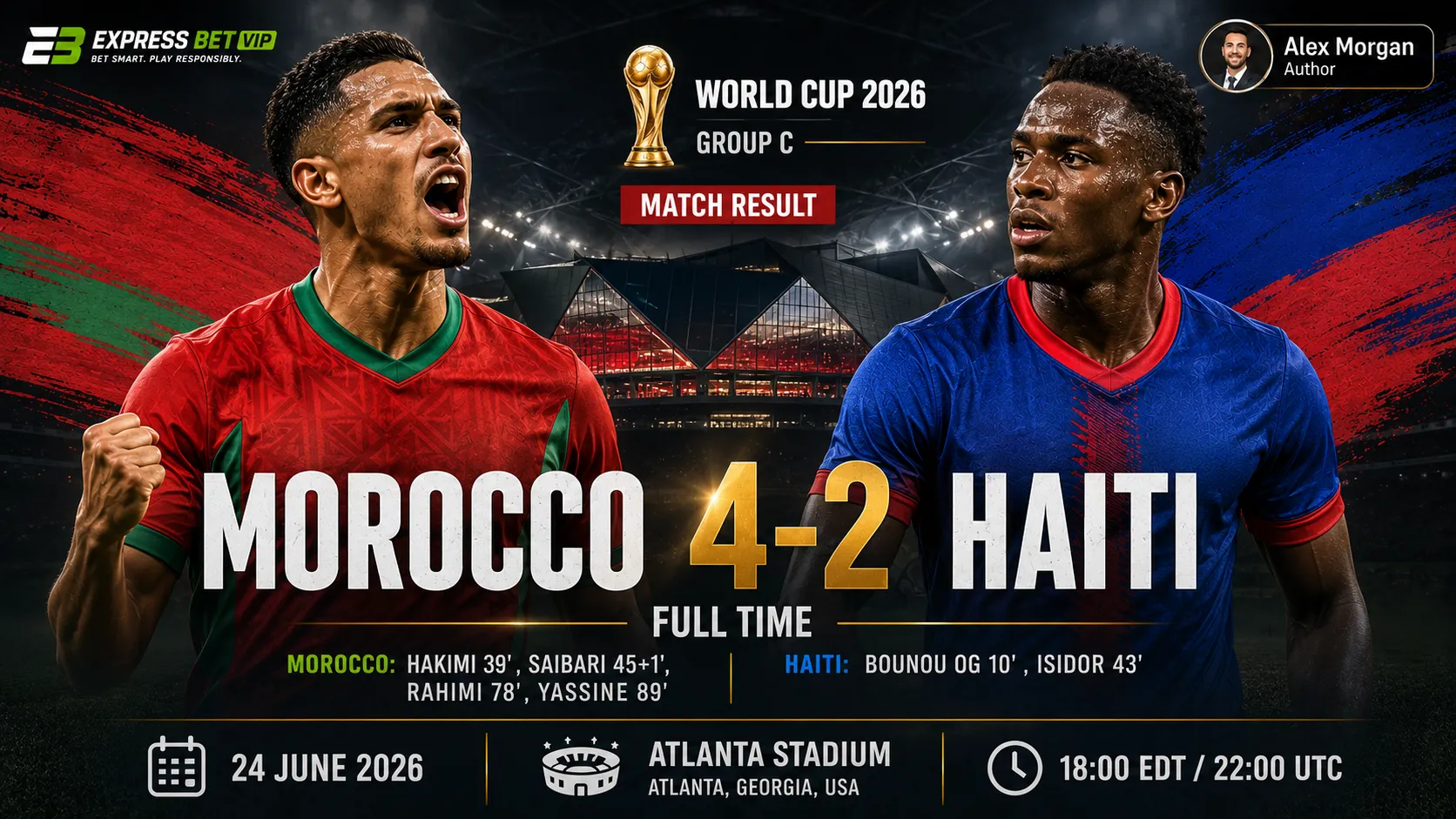
| Item | Detail | Data status |
|---|---|---|
| Match | Morocco vs Haiti | [CONFIRMED] |
| Competition | FIFA World Cup 2026 | [CONFIRMED] |
| Stage | Group stage | [CONFIRMED] |
| Group | Group C | [CONFIRMED] |
| Date | 24 June 2026 | [CONFIRMED] |
| Kickoff | 6:00 p.m. EDT / 22:00 UTC | [CONFIRMED] |
| Host country | United States | [CONFIRMED] |
| City | Atlanta, Georgia | [CONFIRMED] |
| Stadium | Atlanta Stadium / Mercedes-Benz Stadium | [CONFIRMED] |
| Attendance | 68,239 | [REPORTED] |
| Final score | Morocco 4-2 Haiti | [CONFIRMED] |
| Half-time score | Morocco 2-2 Haiti | [CONFIRMED] |
| Morocco goals | Hakimi 39’, Saibari 45+1’, Rahimi 78’, Yassine 89’ | [CONFIRMED] |
| Haiti goals | Bounou own goal 10’, Isidor 43’ | [CONFIRMED] |
| Referee | Danny Makkelie | [CONFIRMED] |
| VAR | Complete crew not available from verified public data | [UNKNOWN] |
| Roof | Closed retractable roof | [REPORTED] |
| Pitch | Temporary natural grass | [REPORTED] |
| Main impact | Morocco finished second in Group C; Haiti finished fourth | [CONFIRMED] |
FIFA confirms the score, scorers, times and venue. ESPN confirms the referee and reports attendance of 68,239. (FIFA)
| Layer | Meaning | Morocco vs Haiti example |
|---|---|---|
| [CONFIRMED] | Official or consistently verified match data | Morocco won 4-2; Haiti led twice |
| [REPORTED] | Reputable information not contained in FIFA’s basic result record | Attendance 68,239; roof closed |
| [OBSERVED] | Visible in footage or contemporaneous match coverage | Placide’s double save; Haiti’s counterattacks |
| [ANALYSIS] | Editorial interpretation based on match evidence | Morocco’s right-sided overloads stretched Haiti |
| [MARKET SIGNAL] | A dated betting price, not a guarantee | Morocco -600; total 3.5 |
| [DISPUTED] | Sources or observers interpreted an incident differently | Possible foul before Rahimi’s goal; ball position before Yassine’s goal |
| [UNKNOWN] | Not available from verified public data | Exact internal climate data and complete VAR assignments |
The distinction matters because the final score is objective, while phrases such as “Morocco controlled the match” require evidence. Our team compared the event record with the statistical profile: Morocco had 69% possession, 22 shots and 11 on target, but Haiti led twice and created a genuine transition threat. Both statements can be true. Tournament football is quite capable of making control look nervous. (Opta Analyst)
Morocco started the night chasing two objectives. Qualification was the basic requirement. Winning Group C required something more awkward: beating Haiti while also improving on Brazil’s simultaneous result against Scotland.
Haiti had already been eliminated. That removed tournament pressure without removing competitive intent. The distinction became obvious after ten minutes.
Josué Casimir protected the ball on Haiti’s right and waited for Jean-Kévin Duverne to advance. Duverne entered the penalty area and squared toward Lenny Joseph, whose backheel was redirected into the net off Bounou. FIFA eventually credited the goal as an own goal against the Morocco goalkeeper. Haiti had scored their first first-half World Cup goal and taken the lead against one of the tournament’s strongest defensive teams. (The Guardian)
Morocco responded with pressure rather than panic. Hakimi pushed high from right-back, Bilal El Khannouss drifted toward the left half-space and Brahim Díaz moved inside to create room for the full-backs. Haiti’s 4-4-1-1 became a low 4-5-1 whenever Morocco sustained possession.
Johny Placide prevented an immediate equaliser. The 38-year-old goalkeeper denied El Kaabi and Hakimi during a sharp double save around the half-hour. It was one of eight saves in what was reported as his final international appearance after 15 years with Haiti. (Opta Analyst)
Morocco finally equalised in the 39th minute. Placide failed to control a deflected El Khannouss effort, and Hakimi forced the rebound over the line from close range.
Haiti answered four minutes later with the match’s finest finish. Duverne found Wilson Isidor, who struck from approximately 25 yards into the top-left corner. The goal required almost no elaborate buildup. One touch, one strike, and Morocco were behind again. World Cups regularly spend several minutes explaining tactical structures before somebody ignores them from 25 yards. (The Guardian)
The lead lasted only until first-half stoppage time. Sofyan Amrabat released Hakimi on the right. Hakimi cut the ball back, Brahim Díaz’s dummy allowed it to travel into Saibari’s path, and the midfielder finished into the bottom-left corner.
At 2-2, the game had already produced more attacking incident than Haiti’s first two group matches combined. Morocco had dominated the shot count, but Haiti had attacked the spaces left outside and behind Morocco’s advanced full-backs.
The second half became calmer. Morocco circulated the ball with greater patience, while Haiti’s counterattacks increasingly ended before reaching Bounou. Placide saved again from El Khannouss, and Saibari narrowly missed after entering the box from deep.
Mohamed Ouahbi made the decisive intervention in the 70th minute. Rahimi replaced Saibari, Azzedine Ounahi replaced Díaz and Gessime Yassine replaced El Kaabi. Eight minutes later, Rahimi scored after Haiti failed to clear a corner. Chadi Riad’s headed touch reached the substitute, whose shot took a deflection on its way past Placide.
Haiti protested that Rahimi had controlled the ball illegally or had committed a foul during the crowded set-piece phase. The goal stood.
Yassine made it 4-2 in the 89th minute. Rahimi fought to keep the ball in play near the byline and squared across an almost empty goal. Haiti’s defenders stopped, believing the ball had crossed the line. Yassine did not stop. VAR checked the incident and confirmed the goal. (The Guardian)
Haiti nearly produced a third in added time when Duckens Nazon’s free kick forced Bounou into a strong diving save. Amrabat then left the field after taking a blow to the head, leaving Morocco temporarily with ten players.
The 4-2 result was deserved on chance volume and territory. It was less comfortable than the final margin suggests. Morocco had to recover twice, solve an outstanding goalkeeper and wait until the final 12 minutes to lead.
Casimir held possession near the right touchline before releasing Duverne into the area. Duverne’s low square pass reached Joseph, who attempted an audacious backheel from close range.
The ball appeared to be travelling wide before striking Bounou and crossing the line. It was first associated with Joseph but officially changed to an own goal by the Morocco goalkeeper. (The Guardian)
The move exposed Morocco’s left side. Salah-Eddine had advanced, El Khannouss had moved inside and Haiti exploited the channel before Morocco’s rest defence could settle.
The local conditions were not responsible. The roof was closed and the natural surface showed no abnormal bounce. This was a positional failure followed by an unfortunate deflection.
Emotionally, it gave eliminated Haiti something the tournament table no longer could: a match worth attacking.
Morocco recovered the ball around Haiti’s box and El Khannouss’s deflected effort travelled toward Placide. The goalkeeper could only parry. Hakimi reacted first and bundled the rebound over the line from approximately two metres.
No clear conventional assist was consistently confirmed. The move came from Morocco’s accumulated pressure and Hakimi’s aggressive position inside the box.
The goal validated Morocco’s use of their captain as an auxiliary winger. Hakimi recorded five shots, nine crosses and a team-high 104 touches in Opta’s dataset. A right-back in name, he spent long periods operating much closer to Haiti’s goal than to his own. (Opta Analyst)
Duverne supplied Isidor outside the penalty area. The forward took one touch and drove a right-footed shot into the top-left corner from roughly 25 yards.
Bounou’s positioning was not the problem. The shot combined power, height and placement. It was one of Haiti’s two shots on target and contributed a small share of their xG, illustrating why expected goals describe chance quality rather than the limits of execution. (The Guardian)
Tactically, Haiti had again attacked immediately after recovering possession. Morocco’s midfield was not fully set, and Isidor was allowed the fraction of space required to shoot.
The goal restored Haiti’s lead and briefly placed Morocco in a genuinely uncomfortable qualification scenario.
Amrabat released Hakimi down the right. Hakimi delivered a low cutback toward the centre. Díaz allowed the pass to run through his legs, removing one defender from the action, and Saibari finished right-footed into the bottom-left corner.
The sequence combined the three elements Haiti struggled to defend: Hakimi’s depth, a runner arriving from midfield and movement that altered the expected receiver.
Saibari became the first African player to score in all three group-stage matches at a single men’s World Cup. It was also his third goal of the tournament, a Morocco World Cup record at that point. (Opta Analyst)
The timing was severe for Haiti. Their second lead survived for less than three minutes.
Morocco’s corner was not cleared. Chadi Riad headed the loose ball into Rahimi’s path. The substitute controlled, turned and struck through a crowded area, with a deflection helping the ball past Placide.
Haiti appealed for a foul during Rahimi’s control. The referee and video officials allowed the goal to stand. The incident remains disputed in interpretation, not in the official score. (The Guardian)
The tactical meaning was straightforward. Haiti had spent most of the second half clearing Morocco’s pressure. One incomplete clearance finally became the decisive goal.
Rahimi had been on the field for eight minutes.
Rahimi chased a ball toward the end line, challenged Carlens Arcus and managed to square it across goal. Several Haitian defenders stopped because they believed the ball had gone out.
Yassine continued his run and finished into an open net. VAR reviewed whether the ball had crossed the line and confirmed that the goal stood. (The Guardian)
It was Yassine’s first senior international goal and arrived 19 minutes after he entered.
The action also supplied the oldest defensive instruction in football: play until the whistle. VAR may eventually agree with you. It will not defend the empty net while considering the evidence.
| Minute | Moment | Why it mattered | Status |
|---|---|---|---|
| 10’ | Bounou own goal | Forced Morocco to chase the match | [CONFIRMED] |
| 30’ | Placide’s double save | Preserved Haiti’s first lead | [OBSERVED] |
| 39’ | Hakimi equaliser | Converted Morocco’s territorial control | [CONFIRMED] |
| 43’ | Isidor long-range goal | Restored Haiti’s lead immediately | [CONFIRMED] |
| 45+1’ | Saibari equaliser | Removed Haiti’s advantage before half-time | [CONFIRMED] |
| 54’ | Casimir head treatment | Interrupted Haiti’s right-sided defensive work | [OBSERVED] |
| 67’ | Nazon and Deedson introduced | Added fresh transition and set-piece threat | [CONFIRMED] |
| 70’ | Morocco triple substitution | Rahimi and Yassine later scored | [CONFIRMED] |
| 78’ | Rahimi goal | Gave Morocco their first lead | [CONFIRMED / DISPUTED buildup] |
| 89’ | Yassine goal confirmed by VAR | Settled the match | [CONFIRMED] |
| 90+6’ | Bounou saved Nazon’s free kick | Prevented late uncertainty | [OBSERVED] |
The central coaching moment came in the 70th minute. Ouahbi replaced three members of the attacking unit at once. Two of the replacements scored, while the third, Ounahi, helped Morocco retain control around the final third. (ESPN Africa)
| Local factor | Verified or observed detail | Football meaning | Direct match evidence | Betting-result meaning | Status | Anti-template status |
|---|---|---|---|---|---|---|
| Stadium | Atlanta Stadium / Mercedes-Benz Stadium | Large enclosed bowl with climate control | Roof reported closed | Reduced weather volatility | [REPORTED] | Fixture-specific |
| Attendance | 68,239 | Strong pressure and constant noise | Both fan groups visibly active | Supported live momentum swings | [REPORTED] | Fixture-specific |
| Capacity | More than 70,000 in World Cup configuration | Attendance represented a mostly full venue | In-house figure exceeded 68,000 | Near-capacity atmosphere | [REPORTED] | Stadium-specific |
| Roof | Retractable roof closed | Limited rain, wind and outdoor humidity effects | No weather delay or wind incident | Weakened weather-based betting angles | [REPORTED] | Fixture-specific |
| Surface | Temporary natural grass replacing normal turf | FIFA-standard ball movement | No serious surface complaint | No pitch-error angle emerged | [REPORTED] | Stadium-specific |
| Hydration breaks | Used during both halves | Broke attacking rhythm | Second-half tempo slowed around the pause | Relevant to live tempo | [OBSERVED] | Fixture-specific |
| Crowd split | Loud Moroccan and Haitian support | Neither side experienced a neutral atmosphere | Haitian response to both goals was clearly audible | Psychological rather than predictive | [OBSERVED] | Fixture-specific |
| Travel context | Haiti had not played a true home match since 2021 | Unusual long-term preparation environment | Team remained competitive despite instability | Not a direct betting model | [REPORTED] | Team-specific |
Atlanta Stadium normally uses artificial turf, but the surface was removed and replaced with natural grass for the World Cup. The venue also has an oculus-style retractable roof and a capacity above 70,000 for major football events. (ESPN)
The roof was reported closed. That insulated the game from Atlanta’s summer rain risk, wind and most of the outdoor humidity. Exact interior temperature and humidity were not available from verified public match data.
This matters because generic weather analysis would misdescribe the fixture. Atlanta was hot outside, but the players were not operating in the same environment as an open-air evening in Miami, Kansas City or Guadalajara.
The temporary grass behaved normally. No report identified torn turf, abnormal bounce, widespread slipping or goalkeeper-handling problems caused by the surface. Placide’s error before Hakimi’s goal was a failure to control a deflected shot, not a documented pitch defect.
The hydration pauses still affected rhythm. Morocco’s second-half possession became slower after the break around the 68th minute, giving both teams time to reorganise. Ouahbi used the surrounding period to prepare his triple substitution. (The Guardian)
The crowd was not neatly divided. Haitian supporters reacted loudly to both leads, while Morocco’s larger expectations created increasing pressure as the match remained level. Broadcast coverage showed both groups joining the stadium music during a break. The atmosphere was specific, visible and occasionally strange in the manner of major tournaments staged inside giant American stadiums. (The Guardian)
| Stadium factor | Detail |
|---|---|
| Stadium | Atlanta Stadium / Mercedes-Benz Stadium |
| World Cup capacity | More than 70,000 |
| Attendance | 68,239 |
| Pitch type | Temporary natural grass |
| Roof status | Closed |
| Acoustic effect | Concentrated indoor crowd noise |
| Surface condition | No match-specific defect reported |
| Wind relevance | Minimal under closed roof |
| Goalkeeper distribution | No verified environmental effect |
| Set-piece effect | Morocco won the corner count 9-1 and scored after a corner |
| Communication effect | Crowd noise was high; no specific breakdown confirmed |
| Data status | Mixed confirmed, reported and observed |
The enclosed bowl amplified reactions to Haiti’s two goals and Morocco’s late recovery. Whether the noise caused a defensive communication failure cannot be demonstrated, but it sharpened the emotional swings.
The clearest stadium-linked football factor was the absence of wind. Crosses, long diagonals and set-piece deliveries were not visibly distorted. Hakimi’s cutback for Saibari and Morocco’s repeated corner routines were technical actions under stable conditions.
Morocco’s nine corners became increasingly important. Haiti survived most of them, but the winning goal followed an incomplete clearance from one. The venue did not create the set-piece advantage; Morocco’s territorial pressure did.
The available match evidence does not show a clear stadium-specific effect beyond the controlled roof environment, stable natural surface and concentrated crowd noise.
| Item | Detail |
|---|---|
| City | Atlanta, Georgia |
| Host country | United States |
| Time zone | Eastern Daylight Time |
| June climate | Typically hot and humid with storm risk |
| Exterior match-time temperature | Exact verified value unavailable |
| Interior temperature | Not available from official public data |
| Humidity | Not available from official public data |
| Wind | Limited relevance with roof closed |
| Rain / sun | No direct effect on play |
| Altitude | Low |
| Likely physical effect | Reduced compared with an open-air Atlanta match |
| Actual evidence | Hydration pauses, but no heat injury or cramp pattern |
| Data status | Partial |
The city’s summer climate influenced operational planning more than the football. Closing the roof reduced the direct effect of heat, humidity and thunderstorms.
Neither team displayed a clear climate-driven physical collapse. Haiti continued counterattacking into the final quarter, while Morocco’s substitutes increased the intensity after 70 minutes.
No injury was officially attributed to heat. Casimir received treatment after a head collision, and Amrabat left late after taking the ball to the face. Those were contact incidents.
Goalkeeper distribution also remained stable. Placide and Bounou could play without obvious wind interference. The two goalkeeper-related goals came from a close-range deflection and a rebound, not environmental volatility.
The correct conclusion is limited: Atlanta’s exterior weather mattered far less because the roof was closed. Tactical spacing, substitutions and finishing decided the match.
Morocco started in a 4-2-3-1. Amrabat and Neil El Aynaoui formed the deeper midfield pair. El Khannouss, Saibari and Díaz worked behind El Kaabi. Hakimi and Anass Salah-Eddine supplied the width from full-back.
Haiti used a 4-4-1-1. Isidor operated close to Joseph, while Providence and Casimir worked from the wide midfield positions. Bellegarde and Danley Jean Jacques protected the central zone. (ESPN Africa)
Morocco attacked closer to a 2-3-5 during long possessions. Hakimi advanced high on the right, Salah-Eddine pushed from the left and Amrabat stayed behind the attacking line to manage transitions.
That structure created chances but also exposed the channels outside the centre-backs. Haiti’s opener came from the space behind Morocco’s left side. Duverne could advance because Morocco had committed players centrally and ahead of the ball.
Haiti did not attempt to dominate possession. They defended compactly, waited for a loose pass and accelerated into the channels. Joseph’s physical presence allowed Isidor to receive facing goal rather than fighting alone against the centre-backs.
Morocco’s main advantage came on the right. Hakimi combined with Díaz and Saibari, repeatedly forcing Providence and Duverne to defend two or three players at different depths.
Placide’s saves delayed the equaliser, but Morocco’s increasing shot volume made the defensive workload difficult to sustain. The goalkeeper faced 15 first-half attempts according to live reporting. (The Guardian)
Haiti’s second goal showed the value of directness. They recovered possession, found Isidor quickly and shot before Morocco could reconstruct the midfield screen.
Morocco’s response showed the opposite strength. Hakimi reached the byline, Díaz manipulated the central defender with a dummy and Saibari arrived late.
At half-time, Ouahbi needed better protection against transitions and greater patience around Haiti’s box. Migné needed to preserve his compactness while finding a way to stop Hakimi without leaving Saibari free centrally.
Neither coach changed personnel at half-time. The first tactical adjustment came through tempo.
Morocco circulated more slowly and reduced the number of simultaneous forward runs. Amrabat stayed closer to the centre-backs, while El Aynaoui became more selective about advancing.
Haiti continued looking dangerous after recoveries but struggled to progress beyond Morocco’s first counterpress. Joseph occasionally escaped into the channel, yet hesitation allowed Amrabat or Chadi Riad to recover.
The match briefly became untidy after the hour. Both teams lost control of second balls, and Haiti won several free kicks around the edge of Morocco’s defensive third.
Migné introduced Deedson and Nazon in the 67th minute. Nazon had been returning from a hamstring issue and offered a stronger shooting and set-piece threat. His late free kick forced Bounou’s best save. (The Guardian)
Ouahbi responded three minutes later with the decisive changes. Rahimi replaced Saibari, Ounahi replaced Díaz and Yassine replaced El Kaabi.
The changes improved Morocco in three ways. Ounahi gave them cleaner circulation. Rahimi attacked loose balls around the box. Yassine provided fresher movement against a defensive line that had already spent 70 minutes following El Kaabi.
Rahimi’s goal arrived from a set-piece second phase rather than a sophisticated open-play sequence. That was still connected to the substitutions: fresh reactions become valuable when a match is being decided by imperfect clearances.
After falling behind, Haiti had to advance the full-backs and central midfield. That created larger spaces for Ounahi and Rahimi to attack.
The fourth goal was partly tactical and partly psychological. Haiti’s defenders believed the ball had gone out and stopped. Morocco’s substitutes continued playing. In a match that had required two comebacks, the simplest difference was attention.
Morocco won because they maintained width, created repeated box entries and had superior options on the bench.
Their 4-2-3-1 became a 2-3-5 in possession. Hakimi and Salah-Eddine advanced, Amrabat anchored the structure and the three attacking midfielders occupied the half-spaces.
Haiti’s 4-4-1-1 defended narrowly. That protected central access but allowed Morocco’s full-backs to receive high. Hakimi became the match’s dominant tactical figure because Haiti could not close him without freeing Saibari or Díaz.
Morocco’s weakness was transition defence. Whenever both full-backs advanced and Amrabat was drawn toward the ball, Haiti could attack the outside channels.
Haiti understood that problem. Duverne’s run created the first goal, and Isidor’s second came before Morocco’s midfield had recovered.
The difficulty was sustainability. Haiti completed only 198 accurate passes to Morocco’s 477 in ESPN’s dataset. Most defensive regains produced a short attacking phase followed by another period without the ball. (ESPN Africa)
Morocco’s corner advantage also reflected the territorial gap. They won nine to Haiti’s one. The winning goal came when Haiti’s defence completed the first action but failed to control the second.
Ouahbi’s bench altered the final phase. Rahimi and Yassine did not merely replace tired attackers. They changed the movement around Haiti’s box. Rahimi attacked second balls, while Yassine ran beyond defenders who had begun defending statically.
Migné’s substitutions added direct attacking threat but weakened defensive continuity. Once Providence and Isidor left, Haiti had less ability to retain the ball during transition.
Morocco’s plan worked because they could keep asking different questions. Haiti’s plan nearly worked because the first answers were excellent. Ninety minutes eventually became too long an examination.
| Zone | Edge | Match evidence | Key player | Local-condition effect | Result impact |
|---|---|---|---|---|---|
| Morocco left / Haiti right | Haiti in transition | Duverne created the opening goal | Jean-Kévin Duverne | None verified | Haiti led |
| Morocco right / Haiti left | Morocco | Hakimi scored, assisted and created seven chances | Achraf Hakimi | Stable indoor conditions aided crossing | Decisive |
| Central midfield | Morocco | 69% possession and superior passing volume | Sofyan Amrabat | Hydration pauses interrupted rhythm | Sustained control |
| Penalty box | Morocco | 46 touches in Haiti’s box | Saibari / El Kaabi | Surface remained stable | Repeated chances |
| Set pieces | Morocco | Nine corners and winning goal after a corner | Soufiane Rahimi | No wind disruption | Decisive |
| Transitions | Haiti early | Two first-half goals from rapid attacks | Wilson Isidor | Roof removed weather uncertainty | Kept match competitive |
| Defensive third | Haiti goalkeeper | Eight saves | Johny Placide | No handling issue linked to pitch | Delayed Morocco |
| Goalkeeper build-up | Neutral | Neither goalkeeper was heavily pressed in possession | Bounou / Placide | Closed roof limited wind | Minor |
| Bench impact | Morocco | Two substitutes scored | Rahimi / Yassine | Freshness mattered more than climate | Match-winning |
The ratings below are editorial. I assessed the official event record, Opta and ESPN data, tactical roles, mistakes and influence without the ball.
| Player | Rating | Assessment |
|---|---|---|
| Yassine Bounou | 6.0 | Unfortunate own goal and little chance against Isidor. Made an excellent late save from Nazon. |
| Achraf Hakimi | 9.0 | Goal, assist, five shots and constant right-sided pressure. Official player of the match. |
| Romain Halhal | 6.5 | Competed well physically but Morocco’s defensive spacing was vulnerable early. |
| Chadi Riad | 7.0 | Improved after half-time and supplied the headed touch before Rahimi’s goal. |
| Anass Salah-Eddine | 6.0 | Advanced usefully but left space behind during Haiti’s first goal. |
| Sofyan Amrabat | 7.5 | Controlled second balls and stopped several second-half transitions. |
| Neil El Aynaoui | 6.5 | Passed securely but offered limited penetration before being replaced. |
| Brahim Díaz | 7.0 | His intelligent dummy contributed to Saibari’s goal. Less influential after the interval. |
| Ismael Saibari | 8.0 | Scored his third tournament goal and repeatedly arrived in the box from midfield. |
| Bilal El Khannouss | 7.5 | Created pressure around the area and forced several Placide saves. |
| Ayoub El Kaabi | 6.0 | Worked the centre-backs and generated chances but did not convert. |
| Azzedine Ounahi | 7.0 | Added cleaner passing and helped Morocco control the final 20 minutes. |
| Soufiane Rahimi | 8.5 | Scored the winner and assisted the fourth after entering in the 70th minute. |
| Gessime Yassine | 7.5 | Scored his first international goal and continued playing when Haiti stopped. |
| Samir El Mourabet | 6.0 | Helped protect the midfield during the closing phase. |
| Noussair Mazraoui | 6.0 | Entered late and provided secure defensive positioning. |
Hakimi’s statistical output supported the visual impression: 104 touches, nine crosses, five shots and seven chances created. (Opta Analyst)
| Player | Rating | Assessment |
|---|---|---|
| Johny Placide | 8.0 | Eight saves, including a major first-half double stop. Two errors contributed to goals, but Haiti would have conceded more without him. |
| Jean-Kévin Duverne | 7.5 | Created both Haiti goals and attacked Morocco’s exposed left side intelligently. |
| Hannes Delcroix | 6.0 | Defended a high volume of crosses but struggled during late second phases. |
| Ricardo Adé | 6.5 | Led Haiti’s passing and produced repeated box clearances. |
| Martin Expérience | 6.0 | Worked under heavy pressure and rarely had freedom to advance. |
| Josué Casimir | 7.0 | Protected the ball before the first goal and worked tirelessly on the right. |
| Danley Jean Jacques | 6.0 | Covered central ground but Morocco eventually passed around him. |
| Jean-Ricner Bellegarde | 6.5 | Haiti’s most active midfielder in possession and attempted three shots. |
| Ruben Providence | 6.0 | Supported transitions but had limited influence once Haiti defended deeper. |
| Wilson Isidor | 8.0 | Scored a superb long-range goal and offered a genuine counterattacking threat. |
| Lenny Joseph | 7.0 | His backheel produced the own goal and gave Morocco’s centre-backs a physical contest. |
| Louicius Deedson | 6.0 | Added energy without creating a decisive opening. |
| Duckens Nazon | 7.0 | Forced Bounou into a difficult stoppage-time save. |
| Carlens Arcus | 5.5 | Entered shortly before Morocco’s fourth goal and was involved in the disputed byline challenge. |
| Dominique Simon | 5.5 | Could not restore Haiti’s midfield control after entering. |
| Frantzdy Pierrot | 5.5 | Limited service during his short appearance. |
| Category | Selection | Reason |
|---|---|---|
| Man of the Match | Achraf Hakimi | Goal, assist and dominant creative role |
| Best attacker | Wilson Isidor | Produced Haiti’s best individual moment |
| Best midfielder | Ismael Saibari | Timed his box arrivals and scored again |
| Best defender | Chadi Riad | Recovered after the difficult start and contributed to the winner |
| Best goalkeeper | Johny Placide | Eight saves in his reported final international |
| Best substitute | Soufiane Rahimi | Goal and assist in 20 minutes |
| Most underrated performance | Jean-Kévin Duverne | Involved in both Haiti goals |
| Most disappointing performance | Anass Salah-Eddine | Morocco’s left side was repeatedly exposed early |
Hakimi was named the official player of the match. Placide’s performance deserves separate recognition because goalkeeper quality and the final score do not always cooperate. (The Guardian)
| Player | Team | Incident | Minute | Status | Next-match impact | Data status |
|---|---|---|---|---|---|---|
| Josué Casimir | Haiti | Head contact during aerial duel | 54’ | Treated and continued | None confirmed | [OBSERVED] |
| Josué Casimir | Haiti | Bad foul | 90+3’ | Yellow card | Haiti eliminated | [REPORTED] |
| Sofyan Amrabat | Morocco | Ball struck face/head | 90+7’ | Left field; Morocco finished with ten | Post-match effect not confirmed | [OBSERVED] |
| Duckens Nazon | Haiti | Returning from hamstring problem | Entered 67’ | Completed match | Tournament ended | [REPORTED] |
| Red cards | Both | None | — | None | None | [CONFIRMED] |
Yahoo’s event feed identifies Casimir as Haiti’s cautioned player in stoppage time. Some live text initially carried an unclear or erroneous surname around the 80th minute, so the Yahoo event attribution is used rather than repeating the ambiguous live entry. (Yahoo Sports)
No red card or suspension changed the match. Amrabat’s late departure was caused by treatment rather than dismissal.
Danny Makkelie controlled the match with Hessel Steegstra and Jan de Vries as assistants. João Pinheiro was listed as fourth official. The complete video-officiating crew was not available from the strongest public sources reviewed. (Powers of Africa)
The major VAR incident involved Morocco’s fourth goal. Rahimi challenged Arcus near the byline and kept the ball in play before crossing to Yassine. Haiti believed the ball had gone out. The review confirmed the goal.
Available replay-based reporting described the margin as extremely close. There is no official basis for rewriting the goal as invalid. It remains a disputed visual interpretation with a confirmed official outcome. (The Guardian)
Haiti also protested Rahimi’s winning goal, arguing that a foul occurred while he controlled the ball after the corner. Makkelie allowed play to continue and VAR did not overturn the decision.
The referee did not dominate the match. Both disputed incidents mattered, but Morocco’s statistical and territorial superiority existed independently of them.
Five minutes of stoppage time were initially indicated, although treatment to Amrabat extended the match further.
Provider models reported small xG differences. Opta recorded approximately 3.26-0.66, while ESPN displayed 3.76-0.67. The broader match pattern remained the same. (Opta Analyst)
| Statistic | Morocco | Haiti | Data status |
|---|---|---|---|
| Final score | 4 | 2 | [CONFIRMED] |
| Possession | 69% | 31% | [REPORTED] |
| Total shots | 22 | 9 | [REPORTED] |
| Shots on target | 11 | 2 | [REPORTED] |
| Expected goals | 3.26–3.76 | 0.66–0.67 | [PROVIDER VARIATION] |
| Big chances | 4 | 1 | [REPORTED] |
| Big chances missed | 2 | 1 | [REPORTED] |
| Corners | 9 | 1 | [REPORTED] |
| Accurate passes | 477 | 198 | [REPORTED] |
| Pass accuracy | 88% | 80% | [REPORTED] |
| Final-third entries | 43 | Not available | [REPORTED / UNKNOWN] |
| Opposition-box touches | 46 | Not available | [REPORTED / UNKNOWN] |
| Goalkeeper saves | 1 | 8 | [REPORTED] |
| Fouls | 10 | 18 | [REPORTED] |
| Yellow cards | 0 reported | 1 reported | [PARTIAL] |
| Red cards | 0 | 0 | [CONFIRMED] |
| PPDA | Not available | Not available | [UNKNOWN] |
| Distance covered | Not available | Not available | [UNKNOWN] |
The statistics show why Morocco deserved to win. They produced more than twice as many shots, more than five times Haiti’s corners and a much higher expected-goal total.
The figures also explain why the match remained level until the 78th minute. Placide saved eight shots, Haiti converted both efforts on target and Morocco’s early defensive positioning was poor.
Haiti’s two goals from less than 0.7 xG demonstrate exceptional conversion, not sustainable attacking dominance. Morocco’s four goals from more than 3.2 xG were closer to the quality and volume of their opportunities.
FOX Sports listed Morocco at approximately -600, Haiti at +1600 and the draw at +600. Morocco -2.5 was priced at +135, while the total was set at 3.5 goals, with the under initially favoured. These were published market signals, not a complete record of every operator’s closing price. (FOX Sports)
| Market | Pre-match expectation | Actual result | Winning side | Key trigger | Local factor | Caution |
|---|---|---|---|---|---|---|
| Match winner | Morocco heavy favourite | Morocco won 4-2 | Morocco | Late substitute goals | Roof limited weather uncertainty | Very short price |
| Haiti win | Major upset price | Haiti led twice but lost | Morocco | Morocco’s pressure and bench | Crowd supported both teams | Lead did not equal control |
| Draw | Haiti protected 2-2 until 78’ | No draw | Draw lost | Rahimi goal | Hydration break delayed tempo only | Late risk remained |
| Morocco -2.5 | Morocco needed four-goal winning margin | Won by two | Haiti +2.5 | Haiti scored twice | No local factor decisive | Favourite won but did not cover |
| Total 3.5 | Under priced as favourite | Six goals | Over 3.5 | Four-goal first half trajectory | Indoor stability supported tempo | One match does not create a rule |
| Both teams to score | Haiti had not scored in first two games | Both scored | BTTS Yes | Bounou own goal and Isidor strike | Conditions did not suppress attack | Haiti conversion was exceptional |
| Correct score | 4-2 | 4-2 | Exact-score backers | Two late Morocco goals | None | Extremely high variance |
| First goalscorer | Player-based market | Own goal opened scoring | Operator-specific | Bounou deflection | None | Own-goal rules vary |
| Anytime scorer | Hakimi, Saibari, Rahimi, Yassine, Isidor | All scored | Player dependent | Varied tactical routes | None | Substitutes require market availability |
| Corners | Morocco expected territorial control | Morocco won 9-1 | Morocco corner positions | Sustained pressure | No wind distortion | Exact line required |
| Goalkeeper saves | Placide expected high workload | Eight saves | Placide over lines likely benefited | 11 Morocco shots on target | Stable surface | Verify offered line |
| Live betting | Haiti led twice | Morocco recovered | Highly volatile | Rapid first-half responses | Crowd intensified swings | Live prices changed quickly |
The match rewarded Morocco moneyline bettors but punished those who treated the favourite and the handicap as the same proposition.
Morocco won by two. Anyone backing -2.5 required another goal. Heavy favourite status did not automatically translate into handicap value.
The over market landed before the final phase became comfortable. Four first-half goals placed the 3.5 total beyond recovery for under bettors.
BTTS Yes also landed despite Haiti entering without a tournament goal. That is the useful lesson: recent scorelines are context, not a contractual restriction on the next match.
Live bettors faced repeated market reversals. Haiti led at 1-0 and 2-1. Morocco shortened after both equalising goals, then remained level until the 78th minute. The eventual result looks orderly only after the uncertainty has been removed.
| Local factor | Market possibly affected | Actual match evidence | Possible interpretation | Overreaction risk | Safer conclusion |
|---|---|---|---|---|---|
| Closed roof | Totals and passing tempo | Six goals and stable ball movement | Reduced weather uncertainty | Assuming indoor games always go over | Tactical quality drove scoring |
| Natural grass | Passing, shots, goalkeeper handling | No major surface incident | Predictable ball movement | Claiming grass caused the goals | Surface was neutral |
| No meaningful wind | Crosses and corners | Morocco created from wide areas | Delivery conditions were stable | Treating roof as guaranteed crossing accuracy | Technique mattered more |
| Hydration pauses | Live tempo | Rhythm slowed after breaks | Defensive resets gained value | Assuming each break reverses momentum | Effect was temporary |
| Near-capacity crowd | Live momentum | Strong reactions to every lead change | Increased emotional pressure | Quantifying noise as an edge | Secondary factor |
| Haiti’s support | Underdog psychology | Team attacked without fear | Helped emotional intensity | Turning atmosphere into win probability | Not measurable |
| Placide’s workload | Save markets | Eight saves | Goalkeeper overs may have landed | Saves do not guarantee a low total | Morocco still scored four |
| Morocco’s corners | Corner and next-goal markets | Nine corners; winner came after one | Territorial pressure created set-piece volume | Assuming corners equal goals | One corner phase proved decisive |
The closed roof reduced the relevance of Atlanta’s outdoor climate. Bettors building an angle around rain, wind or extreme humidity would have been analysing the city rather than the actual playing environment.
The surface also produced no obvious betting signal. There was no wet-ball error, repeated slipping pattern or slow pitch that clearly favoured the under.
The most relevant local factor was rhythm. Hydration breaks offered tactical reset points. Haiti used the pauses to recover shape, while Morocco used the second-half interval around the break to prepare substitutions.
The victory moved Morocco to seven points. Brazil also finished with seven after beating Scotland 3-0, but Brazil won Group C through the superior goal difference. Morocco finished second, Scotland third and Haiti fourth. (ESPN Africa)
| Position | Team | Points | Goal difference |
|---|---|---|---|
| 1 | Brazil | 7 | +6 |
| 2 | Morocco | 7 | +3 |
| 3 | Scotland | 3 | -3 |
| 4 | Haiti | 0 | -6 |
Morocco advanced to face the winner of Group F in the Round of 32. The four-goal victory was not enough to overturn Brazil’s advantage because Brazil also won comfortably.
Haiti finished without a point but scored twice in their final match. Those were their only goals of the tournament and doubled their total from their previous World Cup appearance before this match. (Opta Analyst)
As of the article’s latest update, Morocco subsequently advanced through the knockout rounds before losing 2-0 to France in the quarter-finals on 9 July. The Haiti result therefore became the first step in another deep Moroccan tournament run rather than merely a group-stage escape. (The Guardian)
Morocco did not allow two deficits to change their attacking structure.
Hakimi continued advancing rather than becoming cautious. Saibari kept arriving centrally. Amrabat maintained the circulation behind them.
The right side was the strongest unit. Hakimi, Díaz and Saibari combined at different heights, making it difficult for Haiti to decide which player to release to the next defender.
Morocco also sustained pressure through second balls. Even when Haiti cleared the first cross, Amrabat and El Aynaoui frequently recovered possession before a counterattack could begin.
The set pieces were varied. Morocco used short corners, direct deliveries and recycled phases. The winning goal came from the second action after a corner rather than the initial cross.
Ouahbi’s triple substitution was decisive. Two replacements scored and the third improved control.
The team also remained emotionally stable. Conceding twice to an eliminated opponent could have produced rushed shooting and positional chaos. Morocco had periods of both, but they eventually regained order.
Haiti could not preserve possession after winning it.
The first pass of the counterattack was often effective. The second or third action was less reliable. That allowed Morocco to recover before Haiti’s midfield could advance.
Their defensive block also became increasingly narrow. That was understandable against Saibari and Díaz, but it gave Hakimi too much time and space.
Placide’s parry before the first Morocco goal was costly. His broader performance was excellent, yet the error arrived when Haiti were close to reaching half-time ahead.
The side also failed to complete clearances. Rahimi’s goal came after a corner survived its first phase. Morocco’s pressure was repeatedly renewed because Haiti cleared the ball into contested areas.
The fourth goal was an attention failure. Believing the ball had crossed the line was reasonable. Stopping before the decision was not.
Migné’s substitutions improved Haiti’s direct threat but reduced their defensive stability. Nazon nearly scored late, yet Morocco controlled more of the midfield after Providence and Isidor left.
Ouahbi’s starting structure produced high possession and repeated chances. It also left Morocco exposed during transitions.
The decision to use both full-backs aggressively made sense against Haiti’s narrow midfield, but the rest defence needed greater balance. Morocco’s left side was particularly vulnerable during the opener.
Ouahbi’s best work came in the second half. He slowed the circulation, asked Amrabat to protect transitions and made three attacking substitutions together.
Rahimi and Yassine supplied the goals. Ounahi supplied the control. The changes improved the team rather than simply adding more forwards.
The concern for later rounds was defensive transition. Stronger opponents would create more than two shots on target from the spaces Morocco allowed.
Migné’s 4-4-1-1 was aggressive enough to threaten Morocco without abandoning defensive numbers.
Haiti attacked the correct areas. They targeted the space behind the full-backs and moved the ball forward before Morocco could counterpress.
The difficulty was maintaining the block for 90 minutes. Haiti defended too many corners, crosses and box entries.
Migné’s side deserved credit for playing to win despite elimination. They did not retreat into ceremonial damage limitation.
The coach’s late substitutions added energy, but the defensive line lost some of its earlier coordination. Haiti became more dangerous at one end and less stable at the other.
Saibari became the first African player to score in each of his team’s three group matches at one men’s World Cup. He also became the first Morocco player to score three goals in a World Cup tournament. (Opta Analyst)
Hakimi scored his first World Cup goal in his 13th appearance. He also reached 22 chances created during the tournament, the highest recorded total for a Morocco player at the competition at that stage. (Opta Analyst)
Morocco scored four goals in a World Cup match for the first time. Their total World Cup goals reached 26, moving them above Nigeria among African nations at that point. (Opta Analyst)
Haiti scored their first first-half goal in World Cup history. Their two goals equalled the number they had scored across their entire previous World Cup participation before the match. (Opta Analyst)
Placide’s appearance was reported as his final international after a 15-year Haiti career. (The Guardian)
Yassine scored his first senior international goal.
The match was Haiti’s final game at their first men’s World Cup since 1974.
Their tournament ended with three defeats, but the final performance differed from a routine eliminated-team farewell. Haiti led a major contender twice and scored one of the group stage’s most technically difficult goals.
Morocco’s recovery reflected a broader change in their tournament status. A previous generation might have celebrated survival. This team was disappointed not to win the group.
The match was not another version of Morocco’s disciplined 2022 knockout performances. It revealed a different side: vulnerable in transition, expansive in possession and strong enough on the bench to win a six-goal game.
It shared a familiar World Cup lesson with many supposed mismatches. The favourite can control territory. The underdog can control the scoreboard. For a while, both sides believe they are playing the correct match.
Two Morocco goals produced Haitian protests.
Rahimi’s 78th-minute winner followed a crowded set-piece phase. Haiti believed the substitute had fouled an opponent or handled the ball during his control. The goal stood.
Yassine’s 89th-minute goal was checked to determine whether Rahimi had kept the ball in play. VAR confirmed it.
Neither incident produced a post-match official correction.
Haiti’s preparation remained an important off-field context. The team had not played a true home international since 2021 because of instability in the country, and Migné had reportedly not visited Haiti since taking the job in 2024. That background does not change the score. It does explain why the team’s presence and performance carried meaning beyond the group table. (The Guardian)
No red-card controversy, crowd disorder or pitch invasion was confirmed.
This analysis combines:
The central finding is specific: Morocco did not win because Haiti suddenly stopped competing. They won because repeated width, set-piece pressure and fresh attacking movement eventually overwhelmed a team that could not retain possession long enough to rest.
| Detail | Included | Status | Specific to fixture | Future update needed |
|---|---|---|---|---|
| Stadium identity | Yes | Confirmed | Atlanta Stadium / Mercedes-Benz Stadium | None |
| Capacity and attendance | Yes | Reported | 68,239 | Update if FIFA revises |
| Roof status | Yes | Reported | Closed for this match | Add official match log if released |
| City detail | Yes | Confirmed | Atlanta, Georgia | None |
| Weather detail | Partial | Unknown inside | Exterior climate separated from play | Add official interior data |
| Pitch detail | Yes | Reported | Temporary natural grass replacing turf | Add FIFA pitch report |
| Crowd detail | Yes | Observed | Both fan groups visibly active | Exact split unavailable |
| Travel context | Yes | Reported | Haiti’s lack of true home matches | Update only from federation sources |
| Betting-risk detail | Yes | Analysis-based | Favourite won but missed -2.5 cover | Add full closing history |
| Tactical-local link | Yes | Analysis-based | Roof reduced weather; breaks reset shape | None |
| Anti-template status | Passed | Editorial check | Conditions tied directly to Atlanta match | None |
| Data point | Status | Main source type |
|---|---|---|
| Final score | Confirmed | FIFA |
| Half-time score | Confirmed | FIFA / match report |
| Goal scorers | Confirmed | FIFA |
| Goal times | Confirmed | FIFA |
| Assists | Confirmed or reported | Opta / ESPN / Reuters |
| Stadium | Confirmed | FIFA / venue |
| City | Confirmed | FIFA |
| Attendance | Reported | ESPN |
| Referee | Confirmed | FIFA / ESPN |
| VAR crew | Unknown | Complete public record unavailable |
| Lineups | Confirmed | ESPN event record |
| Formations | Reported | ESPN |
| Substitutions | Confirmed | ESPN |
| Cards | Partial | Yahoo event feed |
| Injuries | Observed / reported | Live match coverage |
| Statistics | Reported | Opta / ESPN / Sofascore |
| xG | Provider variation | Opta / ESPN |
| Odds | Market signal | FOX Sports |
| Roof and capacity | Reported / official venue context | FIFA / stadium sources |
| Surface | Reported | World Cup venue reporting |
| Weather | Partial | Roof status confirmed; interior data unavailable |
| Crowd profile | Observed | Broadcast and live coverage |
| Tournament impact | Confirmed | FIFA / final standings |
Update the article if:
Last updated: 10 July 2026
Morocco beat Haiti because they had more routes to goal and more solutions on the bench.
Haiti’s plan was intelligent. They attacked the space behind Morocco’s full-backs, moved the ball forward quickly and converted two of their few opportunities. For 77 minutes, that was enough to remain level or ahead.
Morocco’s response was imperfect but substantial. Hakimi dominated the right side. Saibari kept arriving between defenders. Amrabat recovered second balls. Placide delayed them, but the pressure continued.
The scoreline was fair according to the chance data. Morocco created more than three expected goals, attempted 22 shots and forced eight saves. The path to that scoreline was anything but routine.
The key tactical details were Hakimi’s advanced role, Haiti’s transition threat and Ouahbi’s substitutions. Rahimi and Yassine turned a tense draw into a two-goal victory.
The local environment reduced randomness. The closed roof removed wind and rain, while the temporary natural-grass field produced no visible problem. Atlanta’s conditions did not decide the game. They made the technical and tactical decisions easier to isolate.
For Morocco, the result secured second place and launched another run into the latter stages. It also warned that their aggressive possession structure could be exposed.
For Haiti, zero points did not tell the entire story. Their final match produced two goals, two leads and evidence that their qualification had not been ceremonial.
For bettors, the result separated several ideas that are too often treated as one. Morocco won. Morocco did not cover -2.5. The over landed. Both teams scored. Placide made eight saves and still conceded four.
A correct favourite is not automatically a correct handicap. A dominant team is not automatically a clean-sheet team. A finished result is always tidier than the match that produced it.
Football betting carries financial risk. Correct match analysis does not guarantee a winning bet. Odds change before and during matches as goals, substitutions, cards, VAR decisions and momentum alter the market.
Local conditions can be overvalued. Atlanta’s closed roof and stable surface did not make six goals inevitable. Haiti’s finishing, Morocco’s width and the late substitutions mattered more.
Never chase losses. Do not bet money needed for food, housing, bills or daily expenses. Use deposit, stake and time limits. Take regular breaks. Check local gambling laws and use licensed operators only. Betting should remain entertainment, not income.
Morocco beat Haiti 4-2 in FIFA World Cup 2026 Group C.
Achraf Hakimi, Ismael Saibari, Soufiane Rahimi and Gessime Yassine scored for Morocco. Haiti’s goals were a Yassine Bounou own goal and a Wilson Isidor strike.
Achraf Hakimi was the official player of the match after scoring once, assisting Saibari and creating repeated chances from the right.
Morocco finished second with seven points and advanced to the Round of 32. Haiti finished fourth with no points.
Morocco moneyline, over 3.5 goals and both teams to score Yes landed. Morocco -2.5 lost because the winning margin was two goals. Exact returns depended on the operator and odds timing.