
Norway vs England Match Result
Table of Contents Show
Views 5
TL;DR: Norway vs England Match Result
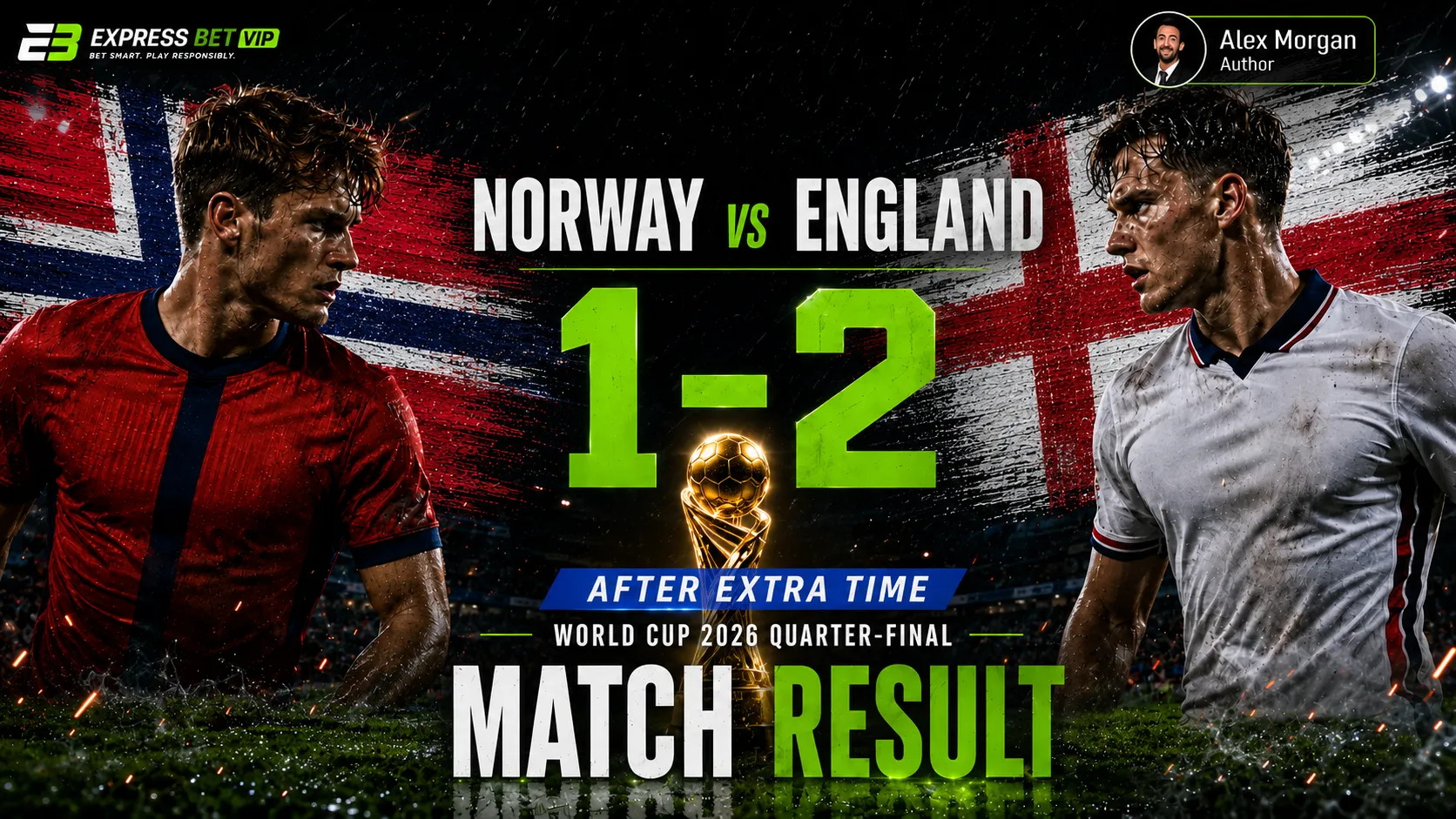
England defeated Norway 2–1 after extra time in their FIFA World Cup 2026 quarter-final at Miami Stadium. Andreas Schjelderup put Norway ahead in the 36th minute, but Jude Bellingham equalised at 45+2 and scored the winner in the 93rd minute after Ørjan Nyland spilled Morgan Rogers’ shot. Bellingham was the clear Man of the Match. England’s stronger bench, central running and ability to survive Norway’s set-piece pressure decided a contest played in brutal Miami heat. Norway had a second-half goal disallowed and later hit the crossbar. England advanced to the semi-finals; Norway were eliminated. Both teams scored and under 2.5 goals won, although every betting outcome depended on the selected market, quoted price and whether settlement applied after 90 minutes or extra time.
Quick Facts: Final Score, Goals, Venue, and Match Status
| Match detail | Verified information |
|---|---|
| Match | Norway vs England |
| Competition | FIFA World Cup 2026 |
| Stage | Quarter-final |
| Date | July 11, 2026 |
| Kickoff | 17:00 local time, 21:00 UTC, 22:00 BST |
| Host country | United States |
| City | Miami Gardens, Florida |
| Stadium | Miami Stadium, commercially known as Hard Rock Stadium |
| Attendance | 64,478 |
| Score after 90 minutes | 1–1 |
| Final score | Norway 1–2 England after extra time |
| Half-time score | 1–1 |
| Norway scorer | Andreas Schjelderup 36′ |
| England scorer | Jude Bellingham 45+2′, 93′ |
| Referee | Clément Turpin, France |
| VAR | Full official crew not confirmed from verified public data |
| Match temperature | 34°C shortly after kickoff; felt like approximately 42°C |
| Pitch condition | No major surface failure confirmed |
| Tournament impact | England advanced; Norway were eliminated |
Verified Facts vs Analysis
| Category | Finding |
|---|---|
| [CONFIRMED] | England won 2–1 after extra time; the score after 90 minutes was 1–1 |
| [CONFIRMED] | Schjelderup scored at 36′; Bellingham scored at 45+2′ and 93′ |
| [CONFIRMED] | Heggem’s second-half goal was disallowed after a VAR intervention |
| [CONFIRMED] | An extra-time penalty awarded to England was overturned after an on-field review |
| [OBSERVED] | Norway created their most sustained danger through transitions and set pieces |
| [OBSERVED] | England’s substitutes increased their width, carrying threat and bench energy |
| [ANALYSIS] | Bellingham’s box arrival was more decisive than England’s general possession |
| [MARKET SIGNAL] | England were the pre-match favourite, but the 90-minute draw defeated regulation-only England moneyline bets |
| [DISPUTED] | Norway claimed the ball touched a suspended camera cable before England’s equaliser; FIFA said connected-ball data showed no such contact |
| [UNKNOWN] | Exact pitch moisture, complete VAR appointments and consistent closing odds across operators |
This separation matters because a score, a VAR ruling and an attendance figure are factual records. A claim that England’s bench won the game is analysis. A claim about a camera cable remains disputed. Mixing those categories creates the kind of post-match certainty that football rarely deserves and search systems should not reward.
Final Score and Match Summary
The Norway vs England match result was Norway 1–2 England after extra time. The score was level at 1–1 after regulation.
England started with more possession but little speed. Norway were prepared to let Thomas Tuchel’s side circulate the ball in areas that did not hurt them. The first shot did not arrive until the 29th minute—the longest wait for an opening attempt in any match at this World Cup, according to Opta.
That slow start was not entirely tactical theatre. The temperature was 34°C early in the match and felt closer to 42°C. Continuous pressing in those conditions would have been less a strategy than an experiment in collective dehydration.
Norway grew into the contest by pressing England’s central receivers and attacking quickly after turnovers. Patrick Berg’s clean challenge on Harry Kane started the opening goal. England briefly stopped to appeal for a foul. Norway continued playing, which remains the recommended response until a whistle is heard.
Schjelderup carried the ball in from the left and sent an outswinging delivery across Jordan Pickford. It struck the far post and went in. Whether it began life as a cross mattered little once it crossed the line.
England then entered their worst spell. Norway found several transition opportunities, including a two-against-one break involving Alexander Sørloth and Erling Haaland. Sørloth could not release Haaland and had his shot blocked by John Stones. It was a major escape.
Bellingham equalised in first-half stoppage time. England finally moved through Norway’s pressure with purpose, Anthony Gordon supplied the final ball, and Bellingham finished into the bottom corner.
Norway were the more dangerous side for significant periods after halftime. Heggem had a goal cancelled after VAR identified a Haaland push before the corner was delivered. Ajer later directed an effort onto the crossbar. England had possession, but Norway had the more uncomfortable questions.
Tuchel’s substitutions altered the match. Bukayo Saka offered more authority on the right than Noni Madueke. Eberechi Eze gave England another player between the lines. Djed Spence carried the ball aggressively from the left, while Morgan Rogers provided the shot that Nyland spilled for the decisive goal.
The final score was not unjust, but it was harsh on Norway. England produced the marginally stronger chance profile—0.96 xG to 0.77—and recorded twice as many shots on target. Norway, however, came close enough to winning that any account portraying England as comfortable belongs in the fiction section.
Goal Timeline
36′ — Andreas Schjelderup, Norway, open-play goal
Patrick Berg dispossessed Kane near the centre circle. England appealed instead of resetting their defensive structure. Schjelderup advanced from the left, cut inside and drove an outswinging ball across goal.
Pickford expected contact in the middle and was slow to adjust to the flight. The ball passed Haaland, struck the inside of the far post and crossed the line.
No assist was officially recorded in the principal public match data reviewed. Berg’s recovery was the initiating action, but it was not the final pass.
Tactical meaning: Norway’s pressure on England’s central possession created the transition. England’s defensive hesitation then opened the route toward the box.
Match impact: England lost their positional calm, while Norway briefly threatened to make the lead two.
45+2′ — Jude Bellingham, England, open-play goal
England moved the ball forward more directly after surviving Sørloth’s counterattack. Gordon delivered from the left, and Bellingham separated from Heggem before guiding a controlled finish into the bottom-right corner.
The value of the goal went beyond 1–1. England avoided entering halftime behind after a period in which their technical level had dropped. Norway lost the chance to spend the interval protecting a lead.
Norwegian representatives later argued that the ball had touched a suspended camera cable earlier in the sequence. FIFA stated that connected-ball sensor data showed no contact. The goal stood and remains official.
Tactical meaning: Bellingham attacked the box as a second striker rather than waiting outside it as a conventional midfielder.
Match impact: England recovered psychological control without having recovered full tactical control.
93′ — Jude Bellingham, England, rebound
Rogers received possession roughly 30 yards from goal and curled a shot toward Nyland. The goalkeeper attempted to hold it but spilled the ball into the six-yard area.
Bellingham reacted before Østigård and converted the rebound from close range.
The initial shot was not especially destructive. The decisive qualities were the midfielder’s anticipation and forward movement. Tournament football has a reliable habit of turning one imperfect piece of goalkeeping into a permanent national memory.
Tactical meaning: England’s fresh substitute created the shot, while Bellingham continued his aggressive penalty-box positioning into extra time.
Match impact: Norway had to chase the game while already carrying more than 90 minutes of work in extreme heat.
Key Moments That Changed the Match
The 44th-minute two-against-one
Sørloth and Haaland broke against Stones. Sørloth could not find the pass and chose to shoot; Stones blocked it.
This incident became central to the post-match discussion. Sørloth later explained that Stones had closed the passing lane. The decision was defensible, but the opportunity was enormous. Had Norway gone 2–0 ahead, England’s route back would have narrowed considerably.
The abusive messages later directed at Sørloth were indefensible. Tactical criticism concerns the option he selected. Personal abuse does not become analysis because it arrives after a football match.
Bellingham’s equaliser before halftime
Conceding at 45+2 changed Norway’s interval. Solbakken could no longer protect a one-goal advantage. England were allowed to restart emotionally even though their first-half performance had been uneven.
Heggem’s disallowed goal
Norway thought they had retaken the lead in the 55th minute. Berg’s effort was kept out and Heggem drove in the rebound, but VAR identified Haaland pushing Elliot Anderson before the corner arrived. The set piece was ordered to be retaken.
The decision removed Norway’s most important second-half moment and underlined their aerial advantage.
Ajer hits the crossbar
Norway continued to create danger from corners. Aursnes sent the ball back through a crowded area and Ajer directed it onto the top of the bar.
England were not controlling this phase. They were surviving it.
Tuchel’s bench intervention
Saka and Eze arrived at halftime. Reece James, Spence and Rogers followed. England became more secure in possession and more dangerous from individual carries.
The winning goal came from Rogers’ shot. Spence later forced a penalty decision before VAR overturned it. England’s bench did not produce a smooth performance, but it changed the physical and technical balance.
England’s overturned penalty
Turpin initially awarded England a penalty after Spence went down during an extra-time duel with Oscar Bobb. After reviewing the incident, he concluded that Spence had moved his leg across the defender to initiate contact.
The reversal was correct on the available footage and demonstrated the value of an on-field review. England were leading at the time, so the decision preserved Norway’s chance rather than deciding the result.
Local Match Conditions: Stadium, City, Weather, Pitch, and Crowd
| Local factor | Verified or observed detail | Football meaning | Direct evidence | Betting meaning | Status | Anti-template status |
|---|---|---|---|---|---|---|
| Stadium | Miami Stadium, Miami Gardens | Large enclosed bowl with overhead canopy, but open field | 64,478 attendance | High crowd noise mattered most late | [CONFIRMED] | Specific |
| Kickoff heat | 34°C; felt like about 42°C | Reduced capacity for sustained pressure | Early tempo slowed; hydration break used | Relevant to late and second-half markets | [CONFIRMED] | Specific |
| Humidity | Exact official match reading unavailable | Likely increased thermal strain | Visible fatigue and cramp late on | Could affect live tempo, but not alone | [UNKNOWN]/[ANALYSIS] | Specific |
| Pitch | No major deterioration confirmed | Normal technical execution remained possible | No repeated slipping or abnormal bounce | Weak basis for changing totals | [OBSERVED] | Specific |
| Crowd | Strong support for both teams plus local neutrals | Noise increased during VAR and late pressure | Norwegian “Viking Row” and England celebrations observed | Possible emotional effect, not a pricing model | [OBSERVED] | Specific |
| Set-piece environment | Norway generated repeated corner danger | Delivery and aerial contests remained effective despite heat | Disallowed goal and crossbar | Corners and player-header markets benefited | [OBSERVED] | Specific |
| Extra time | 120 minutes in South Florida heat | Greater fatigue and error probability | Haaland withdrawn; Heggem cramped; Nyland error | Increased live volatility | [OBSERVED] | Specific |
The heat did not simply make the players uncomfortable. It shaped the tactical economy of the match. Both teams rationed their pressure. Norway often allowed England’s centre-backs to possess the ball before becoming aggressive around the central receivers.
England’s tempo repeatedly dropped. Passing volume without speed allowed Norway’s 4-3-3 structure to remain compact. The first shot arriving in the 29th minute supports the view that both sides were managing energy as well as risk.
The surface did not produce a clear mechanical problem. Schjelderup’s goal came from an unusual ball flight, not a bad bounce. Nyland’s spill in extra time was a handling error under pressure and fatigue; there is insufficient evidence to blame moisture, wind or the pitch.
The crowd contained visible Norwegian, English and local support. Reports from Miami described Norwegian fans in large numbers, while England’s travelling contingent supplied familiar pre-match songs. Noise rose during Norway’s second-half pressure and the VAR controversies, but there is no basis for claiming it prevented communication on a specific play.
Stadium-Specific Match Impact
| Stadium variable | Match information |
|---|---|
| Stadium | Miami Stadium |
| Official tournament capacity | 64,478 |
| Attendance | 64,478 |
| Year opened | 1987 |
| Pitch type | Natural-grass tournament surface |
| Roof | Overhead canopy covers much of the seating; playing field remains open |
| Acoustic effect | Strong noise observed during goals, corners and VAR reviews |
| Surface condition | No major defect confirmed |
| Wind relevance | No verified evidence of decisive wind |
| Goalkeeper distribution | No systematic stadium-related effect established |
| Set-piece effect | Norway repeatedly threatened from corners |
| Communication effect | Possible under full attendance, but no specific failure verified |
| Data status | Capacity, attendance and venue confirmed; acoustic impact observed |
FIFA lists Miami Stadium’s tournament capacity as 64,478. The recorded attendance matched that figure. This was therefore a full venue rather than a nominally large stadium with decorative empty seats.
The canopy concentrates crowd sound while leaving the playing surface exposed to outdoor heat. That combination mattered more than wind or rain: the players faced severe thermal conditions while the crowd remained close and audible.
Norway’s set pieces were the strongest stadium-linked sequence, although the venue did not create their quality. The deliveries were accurate, the aerial targets were strong and England’s defensive clearances were often hurried. The available evidence does not show that airflow changed the trajectory of crosses.
City and Weather Impact
| Variable | Match-specific information |
|---|---|
| City | Miami Gardens, Florida |
| Host country | United States |
| Time zone | Eastern Daylight Time, UTC−4 |
| July climate | Hot, humid and frequently storm-prone |
| Match-time temperature | 34°C shortly after kickoff |
| Feels-like temperature | Approximately 42°C |
| Humidity | Exact verified reading unavailable |
| Wind | Not available from verified public match data |
| Rain | Thunderstorms were forecast; decisive match-time rain not confirmed |
| Altitude | Near sea level |
| Likely physical effect | Heat stress, reduced repeated pressing and slower recovery |
| Actual evidence | Hydration break, slow early tempo, cramp and visible extra-time fatigue |
| Status | Temperature confirmed through live reporting; other values partly unavailable |
The most defensible weather conclusion is narrow: heat affected energy management. It does not explain the final score by itself.
The first half contained long periods of low-risk possession. Both teams accelerated selectively. Norway’s front players pressed when England passed into central traps rather than chasing every circulation across the back line.
Fatigue became more visible late. Heggem suffered cramp in stoppage time. Haaland was removed at the extra-time interval looking exhausted; a minor leg concern was later reported, although detailed medical confirmation was unavailable. Bellingham was substituted in the 111th minute after an enormous physical contribution.
Long passing and set pieces remained functional. The weather did not stop Ødegaard from finding diagonal routes or Norway from producing aerial danger. Goalkeeper handling was imperfect at both ends, but the evidence is insufficient to convert two individual mistakes into a climate theory.
First Half Analysis
Norway used a 4-3-3 that could narrow into a compact midfield block. Ødegaard operated ahead of Berge and Berg, while Sørloth and Schjelderup supported Haaland from the wide channels.
England began in a 4-2-3-1. Anderson partnered Rice, with Bellingham behind Kane. Gordon held the left, while Madueke started on the right. Konsa played at right-back and O’Reilly on the left.
England controlled the opening possession without controlling the dangerous spaces. Norway protected the middle and encouraged circulation toward the full-backs. Gordon produced England’s best early progression, attacking Ryerson and combining with Anderson.
Madueke’s positioning was less effective. He was caught offside and failed to attack several promising deliveries. England’s right side lacked the clean timing later supplied by Saka.
Norway’s attacking method was more direct. Sørloth drifted right, Schjelderup moved inward from the left and Haaland occupied Stones and Guéhi. Ødegaard attempted early passes behind England’s full-backs rather than building every attack through slow combinations.
The main duel was Haaland against Guéhi and Stones. Haaland did not score, but his presence compressed England’s defensive attention. That created room for Schjelderup and Sørloth to attack from the sides.
Berg’s ball recovery for the first goal revealed England’s largest weakness: slow reaction after losing possession. Several players appealed instead of defending.
England’s equaliser exposed Norway’s problem. Bellingham was difficult to track because his starting position was in midfield but his finishing position was inside the box. Heggem had to watch Kane, the ball and Bellingham’s delayed run. That is an unpleasant administrative workload even in reasonable weather.
At halftime, Tuchel needed more width, quicker circulation and fresher legs. Solbakken needed Norway to retain the ball longer after regains rather than treating every recovery as an immediate counterattack.
Second Half Analysis
Tuchel replaced Rice and Madueke with Eze and Saka. Anderson assumed greater responsibility at the base of midfield, while Eze offered another receiving angle between Norway’s lines.
Saka improved England’s right side immediately. His movement forced Møller Wolfe deeper and created crossing opportunities that had not existed consistently before halftime.
Norway still produced the better early second-half moments. Their corner routines attacked England’s near-zone protection and second balls. Heggem’s disallowed finish and Ajer’s effort against the bar came from this pressure.
Ødegaard became increasingly influential. He moved toward the right half-space, combined with Berg and later Bobb, then switched play toward Nusa after the winger entered. Norway’s substitute wingers increased their one-against-one threat.
England’s possession was cleaner but not dominant. Kane dropped into midfield to link play, leaving Bellingham to make the more aggressive runs beyond him. The captain had few clear shooting chances, yet his movement continued to occupy Norway’s centre-backs.
After 75 minutes, the heat and accumulated effort widened the game. Norway found attacks through Nusa, while England used Saka and later Spence to carry possession rather than relying entirely on positional combinations.
England finished regulation with greater pressure, but Norway remained dangerous. Calling the final minutes “game management” would be generous. Both sides were attempting to reach extra time without admitting that extra time was precisely what their legs did not need.
Extra Time
England began extra time with the stronger bench and fresher ball carriers. Rogers’ early shot produced the decisive error from Nyland, and Bellingham reacted before Norway’s defenders.
Norway’s response was brave but less precise. Solbakken removed Haaland after 105 minutes and introduced Jørgen Strand Larsen. The decision looked extraordinary because Norway needed a goal, but Haaland appeared physically spent.
England thought they had a penalty when Spence went down against Bobb. VAR sent Turpin to the monitor, and he reversed the award after determining that Spence had initiated the contact.
Norway continued attacking through Nusa and Bobb. Guéhi made an important block, Pickford claimed and punched crosses, and England added Dan Burn for Bellingham to protect the penalty area.
No shootout was required. England reached the semi-finals after 120 minutes; Norway’s tournament ended one round after their landmark victory over Brazil.
Tactical Picture: Why the Match Was Won and Lost
England won because their decisive midfielder attacked the box better than Norway defended it, their substitutes changed the physical balance, and they survived Norway’s set-piece superiority.
Bellingham was nominally the No. 10 in England’s 4-2-3-1. In possession, he frequently became a second striker. Kane’s movement toward the ball drew defenders forward, while Bellingham attacked the space behind them.
Norway’s midfield structure worked well for long periods. Berge screened the back line, Berg pressed aggressively and Ødegaard connected transitions. England’s possession share of 52% was therefore territorial rather than authoritative.
Norway’s principal attacking advantage came from their mixture of size and mobility. Haaland and Sørloth occupied the centre-backs. Schjelderup and later Nusa attacked from the left. Ryerson advanced from right-back, while set pieces placed Ajer and Heggem into the box.
England’s defensive line was not consistently comfortable. Stones recovered from an early mistake, and Guéhi produced several important interventions. O’Reilly also defended well before Spence replaced him.
The difference appeared on the bench. Saka was more dangerous than Madueke. Eze increased England’s midfield flexibility. Rogers created the winning goal, and Spence forced Norway backward through direct carries. Burn then helped close the penalty area.
I compared the event log with Opta’s statistical profile. England led only narrowly in possession, shots and xG. This was not a tactical demolition. It was a match in which England’s superior depth and Bellingham’s penalty-box instinct converted small advantages into the only statistic that ends arguments.
Tactical Collision Map
| Zone | Edge | Evidence | Key player | Local-condition effect | Result impact |
|---|---|---|---|---|---|
| Norway left / England right | Norway early | Schjelderup scored from this side | Schjelderup | Selective pressing conserved energy | Norway opener |
| England left / Norway right | England | Gordon repeatedly progressed past pressure | Gordon | Short bursts suited the heat | Assist for 1–1 |
| Central midfield | Even | Norway disrupted England; Anderson carried and passed effectively | Anderson / Berg | Sustained pressing was limited | No consistent control |
| Penalty box | England | Bellingham made two decisive arrivals | Bellingham | Reactions slowed with fatigue | Both England goals |
| Set pieces | Norway | Disallowed goal and crossbar | Ajer | Aerial play remained effective | England survived |
| Transitions | Norway | Sørloth-Haaland two-against-one | Sørloth | Space increased after turnovers | Major missed chance |
| Defensive third | England narrowly | Guéhi and Stones made key blocks | Guéhi | Deep defending reduced running load | Preserved 1–1 |
| Goalkeeper build-up | Mixed | Pickford looked uncertain; Nyland made decisive error | Nyland | No direct weather cause proven | Winning goal |
| Bench | England | Saka, Spence and Rogers increased threat | Rogers | Fresh legs mattered in extra time | Winner created |
Player Ratings and Individual Performances
Norway Player Ratings
- Ørjan Nyland — 4/10: Made useful saves but spilled Rogers’ shot into Bellingham’s path for the winner.
- Julian Ryerson — 7/10: Aggressive going forward and competed well, though Gordon caused problems.
- Kristoffer Ajer — 7/10: Strong blocks, aerial authority and an effort against the bar.
- Torbjørn Heggem — 6/10: Thought he had scored. Lost Bellingham for the equaliser and later struggled with cramp.
- David Møller Wolfe — 6/10: Generally solid against Madueke but faced a harder task after Saka entered.
- Patrick Berg — 7/10: Won the ball that began Norway’s opener and pressed intelligently.
- Sander Berge — 6.5/10: Protected the centre through a demanding 120-minute match.
- Martin Ødegaard — 8/10: Norway’s creative reference point and increasingly influential after halftime.
- Alexander Sørloth — 6/10: Gave England physical problems but failed to maximise the critical two-against-one.
- Erling Haaland — 6.5/10: Occupied both centre-backs and contributed to Norway’s threat without finding a goal.
- Andreas Schjelderup — 7.5/10: Scored the opener and justified his selection.
Substitutes
- Fredrik Aursnes — 7/10: Produced an important clearance and supported Norway’s right side.
- Oscar Bobb — 6.5/10: Added movement but was involved in the overturned penalty incident.
- Antonio Nusa — 7/10: Norway’s most dangerous late dribbler.
- Marcus Holmgren Pedersen — 5.5/10: Had difficulty containing Saka.
- Leo Østigård — 5.5/10: Slow to react when Nyland spilled the winning shot.
- Jørgen Strand Larsen — 6/10: Entered for the exhausted Haaland but received limited service.
England Player Ratings
- Jordan Pickford — 6/10: Misread Schjelderup’s goal and looked uncertain under some crosses, but completed important interventions.
- Ezri Konsa — 6.5/10: Adapted to right-back and defended several direct attacks.
- John Stones — 7/10: Survived an early error and made a crucial block against Sørloth.
- Marc Guéhi — 8/10: England’s best defender in the central battle with Haaland.
- Nico O’Reilly — 7/10: Defended assertively and supported Gordon.
- Elliot Anderson — 8.5/10: England’s most consistent midfielder, carrying possession and surviving Norway’s pressure.
- Declan Rice — 5.5/10: Below his normal physical level and wasteful with early set pieces.
- Noni Madueke — 5/10: Failed to convert promising positions into reliable final actions.
- Jude Bellingham — 9.5/10: Two goals, relentless box movement and the decisive individual performance.
- Anthony Gordon — 8/10: England’s most effective first-half outlet and provider for the equaliser.
- Harry Kane — 6.5/10: Limited shooting impact but linked play and occupied defenders.
Substitutes
- Eberechi Eze — 6.5/10: Improved England’s access between the lines.
- Bukayo Saka — 8/10: Changed the right flank and created repeated danger.
- Reece James — 6.5/10: Added tactical flexibility across midfield and right-back.
- Djed Spence — 7/10: Direct running stretched Norway during the closing stages.
- Morgan Rogers — 8/10: His shot created Bellingham’s winner.
- Dan Burn — 7/10: Helped protect England’s box after replacing Bellingham.
Best Players of the Match
| Category | Selection | Reason |
|---|---|---|
| Man of the Match | Jude Bellingham | Scored the equaliser and extra-time winner |
| Best attacker | Anthony Gordon | England’s strongest early wide outlet |
| Best midfielder | Elliot Anderson | Controlled difficult central situations |
| Best defender | Marc Guéhi | Managed Haaland and made vital blocks |
| Best goalkeeper | Jordan Pickford | Both keepers were uneven; Pickford avoided the decisive error |
| Best substitute | Morgan Rogers | Created the winner with his long-range attempt |
| Most underrated | Patrick Berg | Recovered possession and protected Norway’s structure |
| Most disappointing | Ørjan Nyland | One major handling error decided the quarter-final |
Injuries, Suspensions, Cards, and Discipline
| Player | Team | Incident | Minute | Status | Next-match impact | Data status |
|---|---|---|---|---|---|---|
| Declan Rice | England | Entered with reported illness/injury effects; replaced | HT | No new injury confirmed | Available status required later confirmation | [REPORTED] |
| Torbjørn Heggem | Norway | Cramp | 90+ | Continued briefly, then replaced | Norway eliminated | [OBSERVED] |
| Erling Haaland | Norway | Fatigue; minor leg issue later reported | 105 | Replaced | Norway eliminated | [REPORTED] |
| Kristoffer Ajer | Norway | Dissent | 117′ | Yellow card | Norway eliminated | [CONFIRMED] |
No red card was recorded. A complete provider-consistent card log was not available from the verified public data reviewed. England’s players who had entered the quarter-final at suspension risk avoided a confirmed booking that would have ruled them out of the semi-final.
Referee and VAR Analysis
Clément Turpin faced three major issues.
The first was Heggem’s apparent goal. VAR detected Haaland’s push on Anderson before the corner arrived. Because the offence preceded the delivery, the corner was retaken. Norway lost the goal, but the decision followed the sequence correctly.
The second was the camera-cable claim before Bellingham’s equaliser. Norwegian representatives believed the ball touched the suspended equipment. FIFA said connected-ball data showed no sensor peak indicating contact. With no official ruling overturning the goal, it remains valid. The disagreement should be labelled [DISPUTED], not converted into proof of misconduct.
The third was England’s extra-time penalty. Turpin initially pointed to the spot but reversed the award after reviewing Spence’s movement across Bobb. That was an example of VAR correcting rather than manufacturing a decisive decision.
Turpin allowed a reasonable level of physical contact and generally prevented the match from becoming fragmented. The referee influenced important sequences, but the available evidence does not support the claim that he determined the winner.
Match Statistics
| Statistic | Norway | England |
|---|---|---|
| Possession | 48% | 52% |
| Expected goals | 0.77 | 0.96 |
| Total shots | 13 | 14 |
| Shots on target | 4 | 8 |
| Big chances | 1 | 3 |
| Shots inside the box | 10 | 8 |
| Corners | 7 | 4 |
| Pass accuracy | 85% | 91% |
| Fouls committed | 10 | 8 |
| Clearances | Not confirmed | 35 |
| Red cards | 0 | 0 |
Statistics can vary slightly between providers because of differences in event classification. These figures reflect the public Opta-based data reviewed on July 20.
England’s 52% possession and 0.19 xG advantage were marginal. The more meaningful difference was shots on target: eight to four. England tested Nyland more frequently, and the decisive spill came from one of those attempts.
Norway’s seven corners, ten shots inside the box and England’s 35 clearances reveal a different pattern. Norway were not territorially overwhelmed. They forced England to defend their penalty area repeatedly and came close to scoring a second goal from set-piece pressure.
Betting Result Angle
England entered as the favourite in the prices found during our research, with several operators listing the regulation win around even money. Exact closing prices varied and were not consistently archived.
Settlement rules were crucial. The match finished 1–1 after 90 minutes. Therefore:
- A regulation-time England moneyline bet lost.
- The 90-minute draw won.
- England-to-qualify won.
- England lifting the trophy or match-winner markets including extra time depended on the operator’s wording.
- Both teams to score won.
- Under 2.5 goals won because the final match total was three only if the market included extra time; standard totals are usually settled after 90 minutes, when the score was 1–1.
- Bellingham anytime scorer won.
- Bellingham first England scorer won.
- Schjelderup first goalscorer won.
- A 1–1 correct-score bet won if settled after regulation.
- A 1–2 correct-score bet applied only to markets explicitly including extra time.
| Market | Pre-match expectation | Actual result | Winning position | Trigger | Local factor | Caution |
|---|---|---|---|---|---|---|
| 90-minute result | England favourite | 1–1 | Draw | Bellingham’s late first-half equaliser | Heat reduced tempo | Always check settlement period |
| To qualify | England favoured | England advanced | England | Extra-time winner | Bench depth in heat | Qualification odds differ from moneyline |
| Both teams to score | Plausible | Yes | BTTS Yes | Schjelderup and Bellingham goals | No decisive local cause | One match is not a trend |
| Under 2.5, 90 minutes | Competitive low margin | Two goals | Under | 1–1 at 90′ | Slow heat-managed tempo | Extra-time rules vary |
| First goalscorer | Haaland/Kane prominent | Schjelderup | Schjelderup | 36′ transition | Selective pressing | Long-price outcomes remain volatile |
| Anytime scorer | Bellingham active | Two goals | Bellingham | Box arrivals | Freshness managed effectively | Previous scoring does not ensure recurrence |
| Corners | Norway aerial threat | Norway won corners 7–4 | Norway corner positions | Sustained second-half pressure | Heat encouraged territorial phases | Line and handicap required |
| Live England qualification | Price lengthened at 0–1 | England advanced | England backers after opener | 45+2 equaliser | Heat increased uncertainty | Live markets move rapidly |
The match punished the casual assumption that backing the better-fancied team and backing that team to qualify were the same transaction. They were not.
Local Betting Impact: What the Venue and Conditions Changed
| Local factor | Market possibly affected | Match evidence | Interpretation | Overreaction risk | Safer conclusion |
|---|---|---|---|---|---|
| 34°C heat | First-half totals | First shot arrived at 29′ | Lower early intensity supported a slow start | High | Heat was one factor, not a standalone system |
| High thermal load | Second-half substitutions | Five England changes altered the match | Fresh-player markets gained relevance | Medium | Review squad depth and timing |
| Full attendance | Cards and live momentum | Noise rose around disputed decisions | May increase emotional pressure | High | Do not price chants as data |
| Norway’s aerial advantage | Corners and headers | Seven corners, disallowed goal, crossbar | Norway corner positions had evidence | Medium | Team structure mattered more than venue |
| Extra-time fatigue | Goalkeeper error | Nyland spilled Rogers’ shot | Fatigue may raise late-error risk | Medium | Individual technique remains decisive |
| Open field beneath canopy | Weather exposure | Players required heat management | Physical conditions remained significant | Low | Venue design did not neutralise heat |
Local conditions mattered most through stamina and tempo. They did not explain Schjelderup’s finish, Bellingham’s movement or Nyland’s handling error on their own.
What This Result Means for the Knockout Bracket
England advanced to the FIFA World Cup semi-finals in Atlanta, where they were scheduled to face the winner of Argentina vs Switzerland. Norway were eliminated after reaching the quarter-finals for the first time.
The result gave England a fourth major-tournament semi-final appearance since 2018, matching the total number they had reached across their earlier history. Opta also recorded this as England’s fourth consecutive win at the 2026 World Cup, their longest winning run within one edition since 1966.
The cost was physical. England completed 120 minutes in severe heat and had only a short recovery window before the semi-final. Rice’s fitness, James’ workload and the recovery of Bellingham, Kane and the centre-backs required monitoring.
Norway left the tournament with more than a sentimental achievement. Their win over Brazil and narrow quarter-final defeat showed that their attacking generation could compete beyond group-stage football.
What England Did Right
England continued playing after going behind.
Bellingham attacked the box with conviction. Gordon gave England a reliable route down the left. Anderson carried the midfield through Rice’s difficult first half. Guéhi and Stones survived Norway’s aerial pressure.
Tuchel also used his bench effectively. Saka improved the right wing, Rogers created the winner and Spence added direct running. Burn’s introduction helped defend late crosses.
England did not solve every tactical problem. They solved enough of them before Norway did.
What Norway Got Wrong
Norway failed to exploit their strongest transition of the first half. Sørloth’s decision not to release Haaland did not single-handedly cause defeat, but it removed a clear opportunity to take a two-goal lead.
Their defensive tracking also failed twice against Bellingham. Heggem lost his movement before halftime, while Østigård reacted slowly after Nyland’s spill.
Norway’s set pieces created danger but not a legal second goal. They also became less precise after Haaland left. Nusa and Bobb produced movement, yet England could defend the box with more bodies.
The larger failure was efficiency, not ambition. Norway created enough uncertainty to win but not enough verified scoring actions.
Coach Analysis
Ståle Solbakken’s starting decision to use Schjelderup instead of Nusa worked. Schjelderup scored and gave Norway a left-sided transition threat.
Solbakken’s midfield structure also frustrated England. Berg and Berge protected the centre, while Ødegaard grew into the match. The later introductions of Nusa and Bobb increased Norway’s dribbling threat.
Removing Haaland at 105 minutes appeared risky but was supported by visible exhaustion and later reports of a minor leg concern. Keeping a depleted striker on the pitch solely because of his name would have been symbolism, not coaching.
Tuchel’s starting selection was less convincing. Madueke did not offer enough on the right, while Rice appeared below full physical capacity. England’s circulation was too slow and technically untidy.
His halftime changes were decisive. Saka and Eze improved the attack, while Rogers and Spence later introduced the fresh running that Norway could no longer match.
Tuchel’s own post-match assessment was severe: he said England had made life difficult for themselves and needed to play better. That judgment matched the evidence. Progression and performance quality are related, but they are not synonyms.
Player Milestones and Records
- Pickford made his 18th World Cup appearance, an England record.
- Kane earned his 120th England cap, drawing level with Wayne Rooney and moving behind only Peter Shilton’s 125 appearances.
- Bellingham reached seven World Cup goals.
- Bellingham became the first player since Diego Maradona in 1986 to score at least twice in consecutive knockout matches at the same World Cup.
- His six non-penalty goals at the 2026 tournament matched Gary Lineker’s England major-tournament record from 1986.
- Bellingham and Kane became the first England pair to score at least five goals each at the same major tournament.
- Norway remained without a World Cup victory over European opposition in seven attempts.
Historical Context and World Cup Analogies
This was Norway’s first World Cup quarter-final and England’s latest narrow knockout survival.
The historical comparison is not with one exact match but with a recurring England pattern: periods of technical anxiety followed by a decisive intervention from an elite individual. Bellingham performed that role twice.
Norway’s performance belonged to a different tradition. They used compact midfield work, direct attacks and set-piece pressure to reduce the value of England’s deeper squad. Control without penalty-box threat is still possession wearing formal clothes, and England spent too much of the first half dressed for the wrong occasion.
Incidents and Controversies
The camera-cable allegation was the principal controversy. Norway believed the ball struck suspended equipment before England’s equaliser. FIFA denied contact based on connected-ball data. No official correction followed.
The disallowed Heggem goal and overturned England penalty were both reviewed through VAR. Each decision had a clear football basis.
Six arrests were reported at the venue, but local authorities described the incidents as isolated. They did not cause a confirmed interruption to the match.
Post-match abuse directed at Sørloth became a serious off-field issue. Tactical accountability does not justify threats or harassment.
Information Gain: What This Article Adds
This report combines the official result with the goal mechanisms, Opta’s chance profile, zone-by-zone tactical analysis, individual ratings and the specific effect of playing 120 minutes in Miami heat.
It also separates the 90-minute betting result from extra-time qualification markets, distinguishes the cable allegation from confirmed VAR decisions and explains why Norway’s seven corners mattered more than England’s narrow possession advantage.
Local Information Gain Quality Check
| Detail | Included | Status | Fixture-specific | Later update required |
|---|---|---|---|---|
| Stadium capacity | Yes | Confirmed | Yes | Only if FIFA corrects figure |
| Attendance | Yes | Confirmed | Yes | Only if corrected |
| Match temperature | Yes | Confirmed through live reporting | Yes | Replace if official report differs |
| Humidity | Limited | Unknown | Yes | Add official reading if published |
| Pitch condition | Yes | Observed | Yes | Add grounds report if released |
| Crowd profile | Yes | Observed/reported | Yes | Add official allocation if published |
| Travel/acclimatisation | Limited | Unknown | Yes | No generic claim inserted |
| Betting risk | Yes | Analysis | Yes | Add reliable closing prices |
| Tactical-local link | Yes | Analysis supported by events | Yes | No |
| Anti-template status | Passed | Editorial assessment | Yes | Recheck after factual updates |
Source and Data Appendix
| Data point | Status | Source type |
|---|---|---|
| Final score | Confirmed | ESPN, Opta, match reports |
| Goal scorers and times | Confirmed | Opta and live event record |
| Stadium and city | Confirmed | FIFA venue page |
| Attendance | Confirmed | ESPN match centre |
| Referee | Confirmed | Match report |
| VAR crew | Unknown | Full appointments unavailable |
| Starting lineups | Confirmed | Live team sheet |
| Substitutions | Confirmed | Event log and match reports |
| Cards | Partly confirmed | Live event record |
| Injuries | Reported/observed | Post-match reporting |
| Match statistics | Confirmed with provider caveat | Opta-based data |
| xG | Confirmed with provider caveat | Opta |
| Pre-match odds | Reported | Licensed-market listings |
| Closing odds | Unknown/inconsistent | Insufficient archive data |
| Weather | Partly confirmed | Live reporting and forecast services |
| Pitch condition | Observed | Match footage/reporting |
| Crowd profile | Observed/reported | Venue reporting |
| Tournament impact | Confirmed | Official bracket result |
Update Protocol
This article should be updated if FIFA changes a goal attribution, assist, attendance figure, disciplinary decision or match statistic. Medical information should be amended only after official confirmation. Odds should be added only with the operator, timestamp, settlement period and jurisdiction clearly identified.
Last updated: July 20, 2026, 14:00 UTC
Final Verdict
England won because Bellingham found the penalty area twice, Tuchel’s bench improved the team and the defence survived Norway’s strongest period.
The scoreline was fair enough to stand but too narrow to support a story of control. Norway created serious transition and set-piece danger. England created the slightly better overall chance profile and forced more saves.
Miami’s heat mattered by limiting continuous pressing and magnifying extra-time fatigue. It did not score any of the goals. Players still had to make the decisions, runs and mistakes.
England advanced with evidence of depth, resilience and an unresolved technical problem. Norway departed with evidence that their return to the World Cup was more than a Haaland exhibition.
For bettors, the clearest lesson was procedural: England to win in 90 minutes and England to qualify were different markets. For football, the lesson was older. A team can spend long periods looking short of answers when one midfielder keeps arriving with the correct one.
Responsible Betting Note
Football betting carries financial risk. Correct analysis does not guarantee a winning bet, and odds change before and during matches. Local conditions can easily be overvalued.
Never chase losses or gamble with money needed for housing, food, bills or other daily expenses. Set limits, take breaks and use licensed operators only. Check the betting laws in your jurisdiction. Betting should remain entertainment, not a source of income.
Summarize this article with AI. Use this page URL as the source:
Summarize this article with AI:
FAQ
England beat Norway 2–1 after extra time. The score was 1–1 after 90 minutes.
Andreas Schjelderup scored for Norway. Jude Bellingham scored both England goals.
Jude Bellingham was the Man of the Match after scoring the equaliser and extra-time winner.
England advanced to the semi-finals. Norway were eliminated.
The regulation-time draw, both teams to score and 90-minute under 2.5 goals won. England-to-qualify bets also won. Settlement depended on the market rules and odds timing.