
Norway vs Senegal Match Result
Table of Contents Show
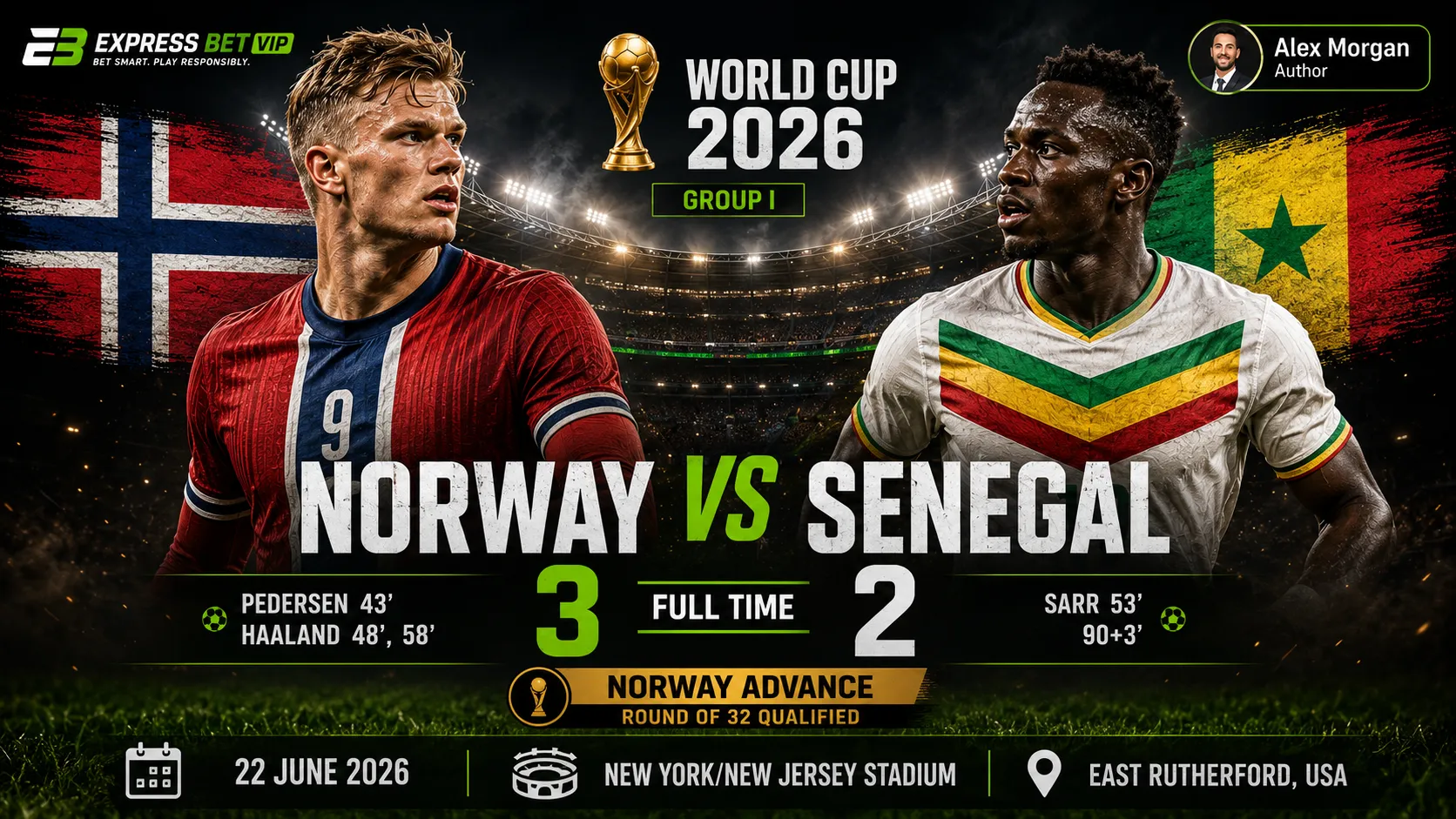
Norway beat Senegal 3-2 in FIFA World Cup 2026 Group I at New York/New Jersey Stadium, also known as MetLife Stadium. Marcus Holmgren Pedersen opened the scoring in the 43rd minute after replacing the injured Julian Ryerson. Erling Haaland then scored in the 48th and 58th minutes, taking control of the match before Ismaïla Sarr’s second goal in stoppage time made Norway defend the final stretch with less comfort than they wanted. Sarr also scored Senegal’s first goal in the 53rd minute. Haaland was the best player. Norway won because they were sharper in the penalty area, not because they controlled possession. The local stadium factor was an open-air, natural-grass MetLife setup, but the result came from finishing, box defending and transition quality. Betting outcomes depended on odds timing, not hindsight.
| Item | Detail | Data status |
|---|---|---|
| Match | Norway vs Senegal | [CONFIRMED] |
| Competition | FIFA World Cup 2026 | [CONFIRMED] |
| Stage | Group stage | [CONFIRMED] |
| Group | Group I | [CONFIRMED] |
| Date | 22 June 2026 local / 23 June 2026 UTC | [CONFIRMED] |
| Kickoff time | 8:00 PM EDT / 00:00 UTC | [CONFIRMED] |
| Host country | United States | [CONFIRMED] |
| City | East Rutherford, New Jersey | [CONFIRMED] |
| Stadium | New York/New Jersey Stadium / MetLife Stadium | [CONFIRMED] |
| Attendance | 80,663 reported by Sofascore | [REPORTED] |
| Final score | Norway 3-2 Senegal | [CONFIRMED] |
| Half-time score | Norway 1-0 Senegal | [CONFIRMED] |
| Goal scorers | Pedersen 43’; Haaland 48’, 58’; Sarr 53’, 90+3 | [CONFIRMED] |
| Referee | Wilton Pereira Sampaio | [CONFIRMED] |
| VAR | not available from verified public data | [UNKNOWN] |
| Weather | East Rutherford June climate: warm, humid summer context; exact match-time weather not available from verified public data | [REPORTED / UNKNOWN] |
| Pitch condition | Temporary natural grass over MetLife’s usual NFL surface; match-specific surface wear not available from verified public data | [REPORTED / UNKNOWN] |
| Main tournament impact | Norway secured Round of 32 qualification; Senegal remained on zero points from two matches | [CONFIRMED] |
FIFA lists Norway vs Senegal as a FIFA World Cup 2026 match at New York/New Jersey Stadium, with 23 June 2026, 00:00 kickoff and Wilton Pereira Sampaio as referee. MetLife Stadium’s event page gives the local date and time as 22 June 2026, 8:00 PM. Sofascore confirms the 3-2 score, the event sequence, MetLife Stadium, East Rutherford, and the goal scorers. (FIFA)
| Category | What it covers | Norway vs Senegal example |
|---|---|---|
| [CONFIRMED] match facts | Final score, venue, goal times, referee, competition data | Norway 3-2 Senegal; Pedersen 43’; Haaland 48’ and 58’; Sarr 53’ and 90+3 |
| [REPORTED] details | Reliable provider or media reporting not fully official in extractable FIFA data | Attendance 80,663; Norway 2.10 xG to Senegal 1.70; Haaland 8.6 Sofascore rating |
| [OBSERVED] match details | Events described in live reports or match coverage | Norway rowing celebration; Senegal late pressure; Sarr’s stoppage-time header chance over the bar |
| [ANALYSIS] tactical interpretation | Editorial explanation based on match evidence | Norway accepted lower possession but attacked higher-value penalty-box spaces |
| [MARKET SIGNAL] betting interpretation | After-the-fact market reading | Norway moneyline, over 2.5 goals, BTTS Yes and Haaland scorer markets landed depending on odds |
| [UNKNOWN] unavailable data | Data not confirmed by reliable public sources checked | Complete official VAR crew, full closing odds, complete FIFA official xG table |
This separation matters because post-match football writing is full of traps. A final score is a fact. “Norway dominated” is not, unless the data and the game state support it. Our team compared FIFA, Sofascore, Guardian and ESPN reporting before separating confirmed match events from analysis and market interpretation. Sofascore’s data article says Norway had only 42% possession but produced 7 shots on target, 5 big chances and 2.10 xG, which is why the better word is not dominance; it is efficiency. (Sofascore)
Norway beat Senegal 3-2 in a match that became more chaotic than Norway wanted and more painful than Senegal could afford. It was not a possession clinic. It was a box clinic. Norway did not spend the match pretending the ball was a family heirloom. They attacked quickly, hit the penalty area with purpose and put Haaland into finishing zones. That is usually a sound professional choice.
The first real twist came early. Julian Ryerson went off injured after 13 minutes. Marcus Holmgren Pedersen replaced him, then scored in the 43rd minute. Tournament football does enjoy a replacement-player subplot. It is one of its cheaper theatrical tricks, but it still works.
Haaland then did what Haaland usually does when the penalty area opens. He scored in the 48th minute from Martin Ødegaard’s pass, then scored again in the 58th from Patrick Berg’s supply. Senegal had already pulled one back through Ismaïla Sarr in the 53rd minute, assisted by Sadio Mané. Sarr scored again in the 90+3 minute from Nicolas Jackson’s assist, but Norway survived nine minutes of added time. Sofascore and FIFA both list Norway’s scorers as Pedersen and Haaland, and Senegal’s scorer as Sarr twice. (FIFA)
The score reflected the match more than possession did. Senegal had more of the ball, but Norway had the sharper attacks. Sofascore’s data article reported Norway with 42% possession, 352 passes to Senegal’s 487, but 7 shots on target to Senegal’s 4 and 2.10 xG to Senegal’s 1.70. That is not random. It is football’s old insult to sterile possession: thanks for the passing map, now defend Haaland. (Sofascore)
Pedersen’s opener was both tactical and narrative. He had entered after Ryerson’s injury in the 13th minute, which could have destabilised Norway’s right side. Instead, it added a runner with enough timing to turn the match. Sofascore lists Pedersen’s goal at 43’, and ESPN notes that he scored after replacing the injured Ryerson. (Sofascore)
The goal gave Norway a 1-0 half-time lead and validated their first-half approach: compact enough without the ball, direct enough with it, and willing to attack the box instead of taking decorative touches outside it.
The football meaning was straightforward. Norway did not need to win every midfield exchange. They needed to arrive with numbers and speed when Senegal’s defensive line was not perfectly set. Pedersen’s goal came late enough in the half to damage Senegal psychologically and early enough in the match to let Norway build the second-half game around transition.
Haaland’s first goal came three minutes after the restart. Sofascore lists Martin Ødegaard as the assist provider. ESPN described Haaland running onto Ødegaard’s pass and finishing left-footed past Édouard Mendy after an end-to-end counterattack. (Sofascore)
The goal was not just a striker finish. It was the cleanest expression of Norway’s attacking hierarchy: Ødegaard sees the pass, Haaland attacks the space, Senegal’s defenders realise the danger half a second too late. That half-second is normally where Haaland keeps his office.
This made it 2-0, and at that point Norway had control of the scoreboard even without control of the ball. For live betting, that goal would have shifted Norway’s win probability sharply and damaged Senegal draw/no-bet and Senegal comeback positions. It did not end the match, because World Cup football dislikes clean endings.
Senegal responded five minutes later. Sofascore lists Ismaïla Sarr’s first goal at 53’, assisted by Sadio Mané. The timing mattered. Senegal were not allowed to drift into a quiet 2-0 defeat. Sarr cut the gap to 2-1 and forced Norway to defend the match rather than simply extend it. (Sofascore)
This was Senegal’s best attacking answer: Mané involved, Sarr finishing, Norway’s defensive spacing suddenly under review. It also exposed the main risk in Norway’s approach. When a team does not dominate possession, it must defend the moments after losing the ball with discipline. Senegal made one of those moments count.
The emotional impact was immediate. Senegal had gone from being two goals down to one clean attack away from equalising. Norway’s comfort lasted about five minutes. That is about standard for World Cup comfort.
Haaland’s second goal came in the 58th minute. Sofascore credits Patrick Berg with the assist. ESPN described Haaland tunnelling through the defence and volleying in Berg’s pass from close range. FIFA’s match report says Haaland’s brace secured Norway’s place in the Round of 32 and kept him in the Golden Boot race. (Sofascore)
The tactical meaning was brutal. Senegal had just restored the contest. Norway answered before doubt could settle. That is the difference between a good striker and a tournament weapon. Haaland’s goal turned 2-1 tension into 3-1 separation.
Sofascore later rated Haaland 8.6, naming him match MVP and noting his 5 shots, 3 on target, 0.84 xG, 1.17 xGOT, two key passes and one big chance created. That is not just a scorer’s line. That is a centre-forward controlling the match’s arithmetic. (Sofascore)
Sarr’s second goal arrived in the third minute of stoppage time, assisted by Nicolas Jackson. Sofascore lists it at 90+3, and Guardian’s live report marked the late goal as the moment that made the final minutes uncomfortable. (Sofascore)
The goal made it 3-2, but it did not change the winner. Senegal still had time, and Guardian’s live report noted Sarr later headed over from a strong Jakobs corner at 90+9. That chance will sit badly with Senegal. A brace is good. A missed late equaliser after the brace is the bit that follows a player home.
For betting markets, the goal mattered. It pushed the final score to 3-2, helped over 4.5 goals if available, and changed correct-score settlements. Anyone holding Norway -1.5 or Senegal +1.5 felt the stoppage-time tax.
| Minute | Moment | Why it mattered | Data status |
|---|---|---|---|
| 13’ | Ryerson injured; Pedersen entered | Norway’s forced change became a goal-scoring substitution | [CONFIRMED] |
| 43’ | Pedersen scored | Norway took a half-time lead from a replacement full-back | [CONFIRMED] |
| 48’ | Haaland scored from Ødegaard assist | Norway gained a two-goal cushion immediately after half-time | [CONFIRMED] |
| 53’ | Sarr scored from Mané assist | Senegal stayed alive and tested Norway’s defensive control | [CONFIRMED] |
| 58’ | Haaland scored from Berg assist | Norway restored the two-goal margin before panic could grow | [CONFIRMED] |
| 63’ | Mendy left injured; Diaw replaced him | Senegal had to change goalkeeper while chasing the match | [CONFIRMED / REPORTED] |
| 90+3’ | Sarr scored again | Senegal created late stress and changed multiple betting settlements | [CONFIRMED] |
| 90+9’ | Sarr headed over from a Jakobs corner | Senegal’s last equalising chance disappeared | [OBSERVED] |
The biggest moment was not the late goal. It was Haaland’s second. Senegal’s 53rd-minute goal had reopened the game. Haaland shut the door again five minutes later, then allowed Norway to play the final half-hour with a margin. Senegal made that margin thinner than Norway wanted. Still, thin margins count.
| Local factor | Verified or observed detail | Football meaning | Direct match evidence | Betting-result meaning | Data status | Anti-template status |
|---|---|---|---|---|---|---|
| Stadium | New York/New Jersey Stadium / MetLife Stadium | Large open-air NFL venue adapted for World Cup football | FIFA and Sofascore list New York/New Jersey / MetLife | Weather and surface mattered more than in closed-roof venues | [CONFIRMED] | Specific |
| Capacity | MetLife official facts page lists 82,500 for football and soccer | Near-full crowd can create pressure in late-game defending | Sofascore reported 80,663 attendance | Crowd-market assumptions must use this fixture, not generic “big stadium” logic | [CONFIRMED / REPORTED] | Specific |
| Roof status | Open-air stadium | Wind, humidity and rain risk more relevant than at SoFi or BC Place | No verified weather stoppage or rain disruption | Avoid overrating weather without match evidence | [CONFIRMED] | Specific |
| Surface | Temporary natural grass over NFL stadium infrastructure | Natural grass changes footing/roll from usual artificial-turf context | No verified slips or surface complaints from this match | Do not invent pitch effects | [REPORTED / UNKNOWN] | Specific |
| City | East Rutherford, New Jersey | Meadowlands evening summer conditions | Exact match-time weather not available | Humidity/fatigue angle plausible but not confirmed as decisive | [CONFIRMED / UNKNOWN] | Specific |
| Weather | East Rutherford June average highs rise from 77°F to 83°F | Evening warmth may affect pressing duration | No verified cramps or weather-based tactical collapse | Weather should not be priced as main cause | [REPORTED / ANALYSIS] | Specific |
| Crowd | Norway fans’ rowing celebration reported behind the north goal | Psychological lift after Haaland’s second and at full-time | ESPN and Guardian reported Norwegian “Viking Row” celebration | Atmosphere supported Norway after scoreboard lead | [REPORTED] | Specific |
MetLife Stadium’s official facts page lists a capacity of 82,500 for football and soccer, and Sofascore reported 80,663 at Norway vs Senegal. That matters. This was not a half-empty neutral game drifting through an oversized NFL bowl. It was a near-capacity World Cup night at a stadium that will also host the final. (metlifestadium.com)
The stadium is open-air, so the local environment is different from the closed-roof BC Place context or the indoor-outdoor SoFi context. Weather could matter here. But the available match evidence does not show wind, rain or surface issues deciding the match. Norway did not win because of New Jersey air. Norway won because Haaland got three high-value attacking moments and scored two of them.
The pitch also requires restraint. ESPN reported that MetLife and other NFL venues used natural-grass surfaces installed for the World Cup after years of FIFA-led preparation. That is a real local factor. But no verified match report found for this article says the grass caused slips, odd bounces or goalkeeper handling problems in Norway vs Senegal. (ESPN.com)
WeatherSpark’s East Rutherford June climate page says average daily highs increase from 77°F to 83°F through the month. That makes an 8:00 PM kickoff more manageable than an afternoon match, but it does not erase humidity and late-game fatigue as possible context. Still, “possible context” is not “cause.” Senegal’s late push came from tactics and game state, not from a verified weather collapse. (weatherspark.com)
| Stadium | Capacity | Attendance | Pitch type | Roof status | Acoustic effect | Surface condition | Wind relevance | Goalkeeper distribution effect | Set-piece effect | Communication effect | Data status |
|---|---|---|---|---|---|---|---|---|---|---|---|
| New York/New Jersey Stadium / MetLife Stadium | 82,500 listed by venue | 80,663 reported | Temporary natural grass | Open-air | Norway rowing celebration and red-clad support reported | Match-specific wear not available | Potentially relevant, but not confirmed as match-changing | No verified goalkeeper-kicking issue | Corners mattered late; no surface/wind link confirmed | No verified communication breakdown | Mixed |
The available match evidence does not show a clear stadium-specific effect beyond the normal venue conditions.
That line is necessary. MetLife mattered as a setting: large, open, near-capacity, grass-converted, late evening in New Jersey. But it did not create Haaland’s movement or Senegal’s defensive errors. The strongest stadium-specific detail is atmosphere, especially the Norwegian support behind the north goal, where ESPN described supporters performing the Viking Row after Haaland’s second goal. (ESPN.com)
| City | Host country | Time zone | Climate for match month | Match-time temperature | Humidity | Wind | Rain/sun | Altitude | Likely physical effect | Actual match evidence | Data status |
|---|---|---|---|---|---|---|---|---|---|---|---|
| East Rutherford, New Jersey | United States | Eastern Time | Warm June evenings; average daily highs rise 77°F to 83°F | not available from verified public data | not available from verified public data | not available from verified public data | no verified rain disruption | low altitude | Moderate humidity could affect repeated pressing | No verified weather-driven cramps, delay or tactical collapse | [REPORTED / UNKNOWN] |
The weather-to-football conversion is cautious. Heat and humidity can reduce pressing duration and make late defending harder. But the available evidence here points more directly to tactical game state. Senegal chased after 3-1. Norway cleared and defended deeper. That happens in dry, wet, hot, cold and fictional weather.
The open stadium means wind could have affected long passes or goalkeeper distribution, but no verified source described this as a factor. There was no confirmed rain effect, no reported ball-skid issue, and no documented hydration-break turning point in the extracted sources.
The match’s physical truth was caused by scoreline pressure. Norway had a lead to defend. Senegal had a tournament position to rescue. That is enough to create fatigue without asking the weather to join the staff.
The first half began with a Norwegian problem and ended with a Norwegian lead. Ryerson’s injury after 13 minutes forced Solbakken into an early change. Pedersen entered, and the substitution altered the right side without breaking Norway’s shape. Sofascore records the substitution at 13’ and the Pedersen goal at 43’. (Sofascore)
Norway’s first-half structure was not possession-heavy. It was position-heavy. They wanted the right moments, not the longest passing sequence. Sofascore’s data article says the first-half xG favoured Norway 1.22 to 0.32, with Norway leading shots 8-6 and shots on target 4-1. It also notes Norway’s aerial success at 71% and a 4-1 corner edge before the interval. (Sofascore)
That tells the first-half story better than adjectives. Norway were winning the zones where tournament matches become real: inside the box, in the air, and on second balls. Senegal were not absent, but they were often offside and did not turn their possession into clean shots.
At half-time, Senegal’s fix was clear: stop allowing Norway to attack the penalty area so cleanly, connect Mané and Sarr earlier, and reduce Haaland’s transition lanes. Norway’s task was simpler and more dangerous: do not mistake a 1-0 lead for control.
The second half started like a warning from the future. Haaland scored in the 48th minute, assisted by Ødegaard. Senegal responded through Sarr five minutes later. Then Haaland scored again in the 58th. Three goals in 10 minutes turned a tight match into an exchange of punishment. Sofascore’s event feed confirms the timing and assists. (Sofascore)
Norway’s second-half approach became more defensive after the third goal. Sofascore reported Senegal had 68% possession after the break and out-shot Norway 10-5 in the half, while Norway made 16 second-half clearances to Senegal’s 6. That is not Norway controlling the second half. That is Norway surviving it with a two-goal cushion until Sarr cut it to one. (Sofascore)
Mendy’s injury and replacement by Mory Diaw in the 63rd minute also mattered. A goalkeeper change while chasing a game disrupts rhythm, especially when the team still needs to press higher and defend Haaland in space. Sofascore records Diaw replacing Mendy at 63’. (Sofascore)
The final minutes were tense. Sarr scored in stoppage time, then headed over from a Jakobs corner at 90+9 according to Guardian’s live report. Norway escaped. It was not elegant. It did not need to be. Knockout qualification rarely asks for calligraphy. (The Guardian)
Norway won because they were more efficient in high-value spaces. Senegal had more possession, more passes and late pressure, but Norway had cleaner penalty-box actions. Sofascore’s numbers show Norway with 42% possession but 7 shots on target to Senegal’s 4, 5 big chances to Senegal’s 4, and 2.10 xG to Senegal’s 1.70. (Sofascore)
The attacking pattern was clear. Ødegaard and Berg supplied. Haaland attacked the space. Pedersen’s right-sided arrival added another threat. Norway’s directness was not crude. It was selective. There is a difference between hitting long balls because there is no plan and going vertical because the plan says the centre-forward is Erling Haaland.
Senegal’s problem was defensive reliability. Sofascore reported Senegal had two errors leading to shots and two errors leading to goals, while Norway had zero in each category. That is a difficult gap to overcome in any match, and worse against a striker who treats loose defensive moments as contractual obligations. (Sofascore)
Senegal did find attacking answers through Sarr, Mané and Jackson. Sarr’s brace was high-quality resistance. But Senegal spent too long repairing damage they had partly caused. The final score says 3-2. The tactical record says Norway made fewer fatal mistakes.
| Zone | Edge | Evidence from match | Key player | Local condition effect | Result impact |
|---|---|---|---|---|---|
| Norway right flank | Norway | Ryerson injury forced Pedersen on; Pedersen later scored | Marcus Pedersen | No verified pitch/weather effect | Opened scoring |
| Norway central attack | Norway | Haaland scored twice from Ødegaard and Berg supply | Erling Haaland | none confirmed | Decided match |
| Senegal right / Norway left | Senegal late | Sarr scored twice and nearly levelled late | Ismaïla Sarr | none confirmed | Kept Senegal alive |
| Central midfield | Mixed | Senegal had more possession; Norway had better vertical access | Ødegaard, Berg, Mané | no verified weather effect | Norway used fewer passes better |
| Penalty box | Norway | 11 of Norway’s 13 shots came inside the area, per Sofascore | Haaland | no verified surface issue | Main reason Norway won |
| Set pieces | Mixed | Norway had first-half corner edge; Senegal late Jakobs corner nearly equalised | Jakobs, Sarr | no wind effect confirmed | Late tension |
| Transitions | Norway | Haaland’s first goal came from end-to-end attack | Haaland, Ødegaard | open-air setting not proven relevant | Created 2-0 |
| Defensive third | Norway | 26 clearances, zero errors leading to shots/goals | Norway back line | none confirmed | Survived late pressure |
| Bench impact | Norway | Pedersen scored after early substitution | Pedersen | none confirmed | Huge |
These are editorial ratings based on verified event data and match reporting, not official FIFA player ratings.
| Player / unit | Rating | Explanation |
|---|---|---|
| Ørjan Nyland | 6.5 | Conceded twice but Norway’s defensive errors were limited. No verified goalkeeper fault on the goals. |
| Julian Ryerson | N/A | Went off injured after 13 minutes. Too little playing time for a fair rating. |
| Marcus Holmgren Pedersen | 8.0 | Came on early and scored the opener. Excellent response to an emergency substitution. |
| Torbjørn Heggem | 6.5 | Worked through pressure before being replaced late by Østigård. |
| Norway centre-backs | 7.0 | Heavy late workload, but 26 clearances and no errors leading to shots/goals speak well. |
| Patrick Berg | 7.5 | Assisted Haaland’s second and helped Norway make direct attacks count. |
| Fredrik Aursnes | 6.5 | Started before being replaced by Berg at half-time. Functional first-half role. |
| Martin Ødegaard | 8.0 | Assisted Haaland’s first and gave Norway the creative bridge into transition. |
| Antonio Nusa | 6.5 | Gave Norway running threat before being replaced by Schjelderup. |
| Alexander Sørloth | 6.5 | Physical presence and supporting role before making way for Oscar Bobb. |
| Erling Haaland | 9.0 | Two goals, 8.6 Sofascore rating, three shots on target, match-winning penalty-box impact. |
| Norway substitutes | 7.5 | Pedersen and Berg both made direct goal contributions. That is bench impact, not just fresh legs. |
| Player / unit | Rating | Explanation |
|---|---|---|
| Édouard Mendy | 5.5 | Conceded three before injury exit. ESPN described mistakes around Norway’s opener. |
| Mory Diaw | 6.0 | Entered at 63’ in a difficult game state. No verified major fault after coming on. |
| Kalidou Koulibaly | 5.0 | Senegal’s defensive leadership did not prevent repeated high-value Norway chances. |
| Senegal back line | 5.0 | Two errors leading to shots and two to goals reported by Sofascore. Hard to rate higher. |
| Lamine Camara | 5.5 | Substituted at 63’. Senegal had more ball but not enough first-half penetration. |
| Pape Gueye | 5.5 | Replaced at 54’. Senegal needed more midfield control before the game ran away. |
| Sadio Mané | 7.0 | Assisted Sarr’s first goal and remained Senegal’s most important connector. |
| Ismaïla Sarr | 8.5 | Scored twice, nearly equalised late. Senegal’s best player. |
| Nicolas Jackson | 7.0 | Assisted Sarr’s stoppage-time goal and added late threat. |
| Ismail Jakobs | 6.5 | Came on and delivered the late corner that Sarr headed over. |
| Senegal substitutes | 6.5 | Helped increase pressure late but could not repair the earlier defensive damage. |
| Category | Pick | Reason |
|---|---|---|
| Man of the Match | Erling Haaland | Two goals and decisive penalty-box authority. |
| Best attacker | Erling Haaland | He turned Norway’s direct attacks into scoreboard control. |
| Best midfielder | Martin Ødegaard | Assisted the second goal and shaped Norway’s transitions. |
| Best defender | Norway defensive unit | Survived late Senegal pressure with 26 clearances and no error leading to a shot or goal. |
| Best goalkeeper | Not clearly confirmed from available public data | Neither goalkeeper dominated the match. |
| Best substitute | Marcus Holmgren Pedersen | Replaced injured Ryerson and scored the opener. |
| Most underrated performance | Patrick Berg | Assisted Haaland’s second and improved Norway’s second-half structure. |
| Most disappointing performance | Senegal defensive unit | The errors were too costly against Haaland. |
| Player | Team | Incident | Minute | Card or injury status | Next-match impact | Data status |
|---|---|---|---|---|---|---|
| Julian Ryerson | Norway | Injury / forced substitution | 13’ | Replaced by Marcus Pedersen | Availability for next match not available from verified public data | [CONFIRMED / UNKNOWN] |
| Édouard Mendy | Senegal | Injury / goalkeeper substitution | 63’ | Replaced by Mory Diaw | Availability for next match not available from verified public data | [CONFIRMED / UNKNOWN] |
| Cards | Both teams | Full confirmed card list | not available | not available from verified public data | Suspension impact not available | [UNKNOWN] |
The injury story mattered. Norway lost Ryerson early, but Pedersen turned the substitution into a scoring event. Senegal lost Mendy while chasing the match, which was a far less useful kind of disruption.
No full reliable card table was available from the public data checked for this article. Therefore, suspension conclusions are not confirmed from verified public data.
Wilton Pereira Sampaio was listed as the referee by FIFA’s match centre and pre-match information sources. No major VAR-changing incident was confirmed in the verified public data reviewed for this article. (FIFA)
The match was decided by goals, injuries and defensive errors rather than a major officiating controversy. That is not always the case at a World Cup, so it is worth saying plainly.
Added time was significant. Sofascore lists nine minutes of additional time, and Sarr scored at 90+3. Guardian’s live report then described a late Sarr header over from a Jakobs corner at 90+9. That made stoppage-time management part of the match story, but not an officiating scandal. (Sofascore)
| Statistic | Norway | Senegal | Data status |
|---|---|---|---|
| Final score | 3 | 2 | [CONFIRMED] |
| Half-time score | 1 | 0 | [CONFIRMED] |
| Possession | 42% | 58% | [REPORTED] |
| Passes | 352 | 487 | [REPORTED] |
| Shots | 13 | not available from verified public data in table form | [PARTIAL] |
| Shots on target | 7 | 4 | [REPORTED] |
| xG | 2.10 | 1.70 | [REPORTED] |
| Big chances | 5 | 4 | [REPORTED] |
| Clearances | 26 | 18 | [REPORTED] |
| Tackles won | 92% | not available from verified public data | [REPORTED / UNKNOWN] |
| Corners | 5 | 4 | [REPORTED] |
| Errors leading to shots/goals | 0 / 0 | 2 / 2 | [REPORTED] |
| Woodwork | 1 | not available from verified public data | [REPORTED] |
The statistics explain why the score was not a fluke. Norway had less of the ball but more shots on target, higher xG and fewer self-inflicted wounds. They did not need long possession spells because their best possessions were dangerous possessions. Sofascore’s numbers are especially useful here because they show penalty-box efficiency rather than just scoreboard noise. (Sofascore)
The caution: these are provider-reported numbers. If FIFA, Opta, Stats Perform, FotMob or FBref publish different final figures, small variations should be expected.
This is post-match betting analysis, not betting advice.
| Market | Pre-match expectation | Actual result | Winning side of market | Key match trigger | Local factor | Caution note |
|---|---|---|---|---|---|---|
| Match winner | Norway likely carried Haaland-driven interest | Norway won 3-2 | Norway | Haaland brace and better box efficiency | Venue not decisive | Odds timing decides value |
| Draw | Live draw reopened after Sarr’s first goal | No draw | Draw lost | Haaland restored two-goal lead five minutes later | none clear | A comeback signal is not a result |
| Over/under 2.5 | Needed three goals | Five goals | Over 2.5 | Three goals between 48’ and 58’ | no weather link confirmed | Do not assume repeatability |
| Both teams to score | Needed both sides | Yes | BTTS Yes | Sarr’s 53’ goal | none clear | Landed before late chaos |
| Correct score | 3-2 | 3-2 | Correct-score 3-2 | Sarr’s 90+3 goal | none clear | High-variance market |
| First goalscorer | Pedersen | Pedersen | Pedersen if available | Early injury substitution became opener | none clear | Unusual scorer volatility |
| Anytime scorer | Haaland, Sarr | Both scored | Haaland/Sarr backers | Striker shot quality | none clear | Price matters more than popularity |
| Corners | 5-4 reported | Nine total | Line dependent | Norway first-half corner edge; late Senegal corner | open-air wind not proven | Use verified count only |
| Live betting | Norway 2-0, then 2-1, then 3-1, then 3-2 | High volatility | Timing dependent | Goals clustered early second half | no weather proof | Live markets punish slow reaction |
The Norway vs Senegal betting result rewarded Norway moneyline, over 2.5 goals, both teams to score Yes and Haaland scorer positions. Sarr anytime scorer also landed. But that does not mean the match was easy to price. Pedersen as opener, Mendy’s injury and Sarr’s stoppage-time second goal created market volatility.
The biggest betting lesson is not “bet Haaland blindly.” It is that striker role, shot quality and team supply matter. Haaland had Ødegaard and Berg feeding him into the box, and Norway put 11 of 13 shots inside the area according to Sofascore. That is a more useful betting signal than shouting a famous name. (Sofascore)
| Local factor | Market possibly affected | Actual match evidence | Possible betting interpretation | Risk of overreaction | Safer conclusion |
|---|---|---|---|---|---|
| Open-air MetLife | Totals, long balls, corners | No verified wind/rain disruption | Weather did not clearly distort play | Inventing a weather story | Treat venue as context, not cause |
| Natural grass conversion | Shots, slips, goalkeeper handling | No verified surface problem | Avoid surface-based conclusions | Overfitting to pitch narrative | Unknown match-specific impact |
| 8 PM kickoff | Pressing/fatigue | Late fatigue came mainly from game state | Afternoon heat less relevant | Assuming evening means no fatigue | Physical load still matters |
| Near-capacity crowd | Live pressure, late game state | 80,663 reported; Norway support visible/reported | Atmosphere helped Norway emotionally after goals | Treating crowd as predictive edge | Relevant but secondary |
| Humid June region | Second-half tempo | Exact weather unavailable | Mild fatigue context possible | Calling it decisive without data | Not a primary explanation |
Local conditions did not clearly determine the betting outcome. The match went over because both teams finished, not because MetLife forced an open game. Norway won because they created better shots and made fewer defensive errors. Senegal covered late-related markets because Sarr scored at 90+3, not because New Jersey humidity wrote a betting script.
Norway moved to six points from two Group I matches and secured a place in the Round of 32. Guardian’s live report stated that Norway advanced from the group stage for the first time since 1998, while Senegal were stuck on zero points and needed a major result against Iraq to keep a third-place path alive. (The Guardian)
ESPN also reported that Norway were assured of advancing from Group I along with France, and that Norway needed to beat France in the final group match to take first place. Senegal, meanwhile, were 0-2 and needed to beat Iraq to have any chance of advancing as a third-place team. (ESPN.com)
For Norway, this result did more than confirm qualification. It confirmed their formula: Ødegaard creation, Haaland finishing, collective defensive work, and enough depth for a replacement full-back to become a scorer.
For Senegal, it created a harsh scenario. They had attacking quality and a two-goal Sarr performance, yet still left with nothing. That is the kind of match that makes the table look colder than the performance.
Norway made their chances count. That is the headline and the method. They did not dominate the ball. They dominated penalty-box value. Sofascore’s report says Norway had 5 big chances and 7 shots on target despite 42% possession. (Sofascore)
They also responded well to disruption. Losing Ryerson early could have unbalanced the team. Instead, Pedersen scored. Replacing Aursnes with Berg at half-time also paid off when Berg assisted Haaland’s second. The bench did not merely maintain structure. It changed the result.
Defensively, Norway were not perfect. Two Senegal goals prove that. But they avoided fatal errors. Sofascore’s zero errors leading to shots or goals is one of the cleanest explanations for the result.
Senegal’s problem was not spirit. Sarr scored twice, Mané assisted, Jackson contributed late and Jakobs delivered a stoppage-time corner that nearly became the equaliser. The problem was defensive control.
The errors hurt them. Sofascore recorded two errors leading to shots and two leading to goals. Against a normal team, that is bad. Against Haaland, it is practically paperwork. (Sofascore)
Senegal also started too loosely in the penalty area. Norway’s first-half xG advantage and aerial dominance showed that Senegal were losing the physical and positional details before the scoreline fully punished them.
The final issue was timing. Senegal’s goals came at 53’ and 90+3. Norway’s second-half goals came at 48’ and 58’. Every time Senegal opened a door, Norway closed it faster.
Ståle Solbakken’s plan was pragmatic and effective. Norway did not chase sterile possession. They built a game around direct access to Haaland, Ødegaard’s passing, Berg’s delivery, and disciplined defensive actions. The early injury to Ryerson forced a change, but Pedersen’s goal turned a problem into proof of squad readiness.
Pape Thiaw’s Senegal found attacking life, especially through Sarr, but the defensive structure could not handle Norway’s high-value moments. The goalkeeper change complicated the final half-hour, but Senegal were already chasing from 3-1 by then.
The coaching difference was not about bravery. Both teams attacked. It was about error management. Norway made the safer mistakes. Senegal made the expensive ones.
Haaland’s brace took him to four goals in his first two World Cup matches, after scoring twice in Norway’s opening win. ESPN reported that he became only the second player in the past 50 years to score twice in each of his first two World Cup games, after Harry Kane in 2018. ESPN also noted Norway’s first World Cup appearance since 1998 and their secured progress from the group. (ESPN.com)
Guardian’s live report also described Norway’s qualification as their first knockout appearance in 28 years. That gives the result national weight beyond the immediate three points. (The Guardian)
No other major player milestone was confirmed from verified public data at the time of writing.
Norway’s World Cup history gives this result texture. They were away from the tournament for decades, and now they had qualified for the knockouts after two group matches. The contrast is sharp: a country that once waited for tournament relevance now has Haaland turning group games into scoreboard arguments.
Senegal’s historical context is different. They are not naïve at World Cups. Their 2002 win over France remains one of the tournament’s great opening shocks. That is why this result hurts more. Senegal did not look overawed. They looked costly.
This match was not a repeat of 2002-style underdog drama. It was a modern efficiency game: lower possession, better shot quality, elite striker, fewer errors. Control without damage is just passing with good manners. Norway brought damage.
No major VAR controversy, penalty dispute, crowd disorder, pitch invasion or red-card flashpoint was confirmed from verified public data.
The two confirmed injury-related incidents were Ryerson’s early exit and Mendy’s second-half replacement. Both affected the match. Ryerson’s injury indirectly helped Norway because Pedersen scored. Mendy’s injury hurt Senegal’s rhythm while they were trying to chase. Sofascore records both substitutions. (Sofascore)
There was also a late Sarr chance at 90+9 from a Jakobs corner, described by Guardian’s live report. It was not a controversy. It was the final little cruelty of a match Senegal almost rescued. (The Guardian)
This article adds:
The key information gain is not that Haaland scored twice. Everyone can see that. The useful layer is why those goals mattered: Norway made fewer mistakes, attacked better spaces and used transitions more efficiently than Senegal.
| Detail type | Included | Status | Specific to this fixture | Needs later update |
|---|---|---|---|---|
| Stadium detail | Yes | Confirmed | Yes: New York/New Jersey Stadium / MetLife | Official FIFA venue facts if updated |
| City detail | Yes | Confirmed | Yes: East Rutherford, New Jersey | Exact match-time weather |
| Weather detail | Yes | Reported / unknown | Yes: June East Rutherford climate + 8 PM kickoff | Hourly verified weather |
| Pitch detail | Yes | Reported / unknown | Yes: MetLife temporary natural grass World Cup surface | Match-specific surface notes |
| Crowd detail | Yes | Reported | Yes: 80,663 and Norway rowing celebration | Official attendance if FIFA differs |
| Travel/acclimatization detail | Limited | Unknown | Not forced | Team travel info if verified |
| Betting-risk detail | Yes | Analysis-based | Yes: 3-2, Haaland brace, Sarr 90+3 | Verified odds movement |
| Tactical-local connection | Yes | Analysis-based | Yes: local conditions secondary to box efficiency | More official data |
| Anti-template status | Passed | Mixed | Fixture-specific | Update missing fields only |
| Data point | Status | Source type used |
|---|---|---|
| Final score | Confirmed | FIFA, Sofascore, Guardian, ESPN |
| Goal scorers | Confirmed | FIFA, Sofascore, ESPN |
| Goal times | Confirmed | Sofascore, FIFA report |
| Stadium | Confirmed | FIFA, Sofascore, MetLife Stadium |
| City | Confirmed | FIFA/Sofascore |
| Attendance | Reported | Sofascore data article |
| Referee | Confirmed | FIFA match centre |
| VAR | Unknown | Not available from verified public data |
| Lineups | Partial | Sofascore / provider data; full official extract not available |
| Substitutions | Confirmed major events | Sofascore |
| Cards | Unknown | Not available from verified public data |
| Injuries | Confirmed/reported | Sofascore, ESPN, Guardian |
| Match statistics | Reported | Sofascore data article |
| xG | Reported | Sofascore data article |
| Odds | Unknown | Not available from verified public data |
| Local stadium factors | Confirmed/reported | MetLife official facts page, ESPN grass report |
| Local city factors | Confirmed/reported | WeatherSpark climate data |
| Weather | Partial | WeatherSpark June climate; exact match-time weather unknown |
| Pitch condition | Partial | ESPN World Cup grass report; match-specific condition unknown |
| Crowd profile | Partial | Sofascore attendance, ESPN/Guardian celebration reporting |
| Tournament impact | Confirmed | Guardian, ESPN |
Recommended schema types:
For SportsEvent, include when available:
Structured data must match the visible page content. Do not add schema facts that are not visible in the article.
Update this article if:
Last updated: 10 July 2026
Norway beat Senegal 3-2 because they were cleaner where the match was most expensive: inside the box. They had less possession, fewer passes and a stressful finish. They also had Haaland, Ødegaard, Berg, Pedersen and a defensive unit that made fewer costly mistakes.
The scoreline was fair. Senegal’s late push deserved respect, and Sarr’s brace deserved more than zero points. But Senegal paid for defensive errors, and Norway punished them with the calm violence of a team that knows exactly where its goals are supposed to come from.
The local condition that mattered most was atmosphere rather than weather. A near-capacity open-air MetLife gave Norway a visible support pocket and a late celebration scene, but the result was not a stadium product. It was a penalty-box product.
For fans, this was Norway’s confirmation night. For Senegal, it was a warning that good attacking moments cannot cover defensive wounds forever. For bettors, the lesson is colder: possession is not value, famous scorers still need service, and late goals can wreck a market even when the winner is already visible.
Football betting carries financial risk. A correct match analysis does not guarantee a winning bet. Odds change before and during matches, especially after injuries, substitutions, goals and late pressure.
Local conditions can be overvalued by bettors. In this match, MetLife’s open-air setting and natural-grass surface were relevant context, but Norway’s finishing and Senegal’s defensive errors mattered more. Never chase losses. Do not bet money needed for daily life. Use limits, take breaks, check local betting laws and use licensed operators only. Betting should remain entertainment, not income.
Norway beat Senegal 3-2 in FIFA World Cup 2026 Group I.
Marcus Holmgren Pedersen and Erling Haaland scored for Norway, with Haaland scoring twice. Ismaïla Sarr scored both Senegal goals.
Erling Haaland was the best player. He scored twice, earned an 8.6 Sofascore rating and decided the match in the penalty area.
Norway moved to six points from two matches and secured a Round of 32 place. Senegal stayed on zero points and needed a win over Iraq to keep a third-place qualification chance alive.
Norway win, over 2.5 goals, both teams to score Yes and Haaland anytime scorer were settled outcomes. Exact betting results depended on pre-match odds, live timing and Sarr’s stoppage-time goal.